
Bulgarian Kitenik: Identification, Value & Collector Guide
Bulgarian Folk Textiles · Wool Rugs · Identification · Value · Care
Last Updated: October 2026
Quick Answer
A Bulgarian kitenik is a traditional pile textile, commonly described in English as a tufted or shaggy wool rug. To identify an old kitenik properly, examine the wool pile, field, border, ornamentation, composition, reverse, edges, dimensions, wear, repairs and provenance. Pattern or colour alone is not enough to establish age, region or value. Collector interest depends on the relationship between construction, craftsmanship, rarity, condition, originality, provenance and current demand.
The Bulgarian kitenik occupies an interesting position between traditional household textile, wool rug, decorative furnishing and collectible folk object. Its long or prominent pile creates a tactile, three-dimensional surface that is very different from a flat-woven kilim or ordinary woven rug.
Today, old Bulgarian kiteniks are collected not only for their decorative qualities but also for their connection with regional textile traditions, family history and historic domestic interiors. They can also work remarkably well in modern rustic, bohemian, eclectic and minimalist spaces.
For collectors, however, appearance is only the beginning. The same principles used when examining historic rugs and traditional textiles apply here: construction, fibres, technique, design, condition and provenance must be considered together.
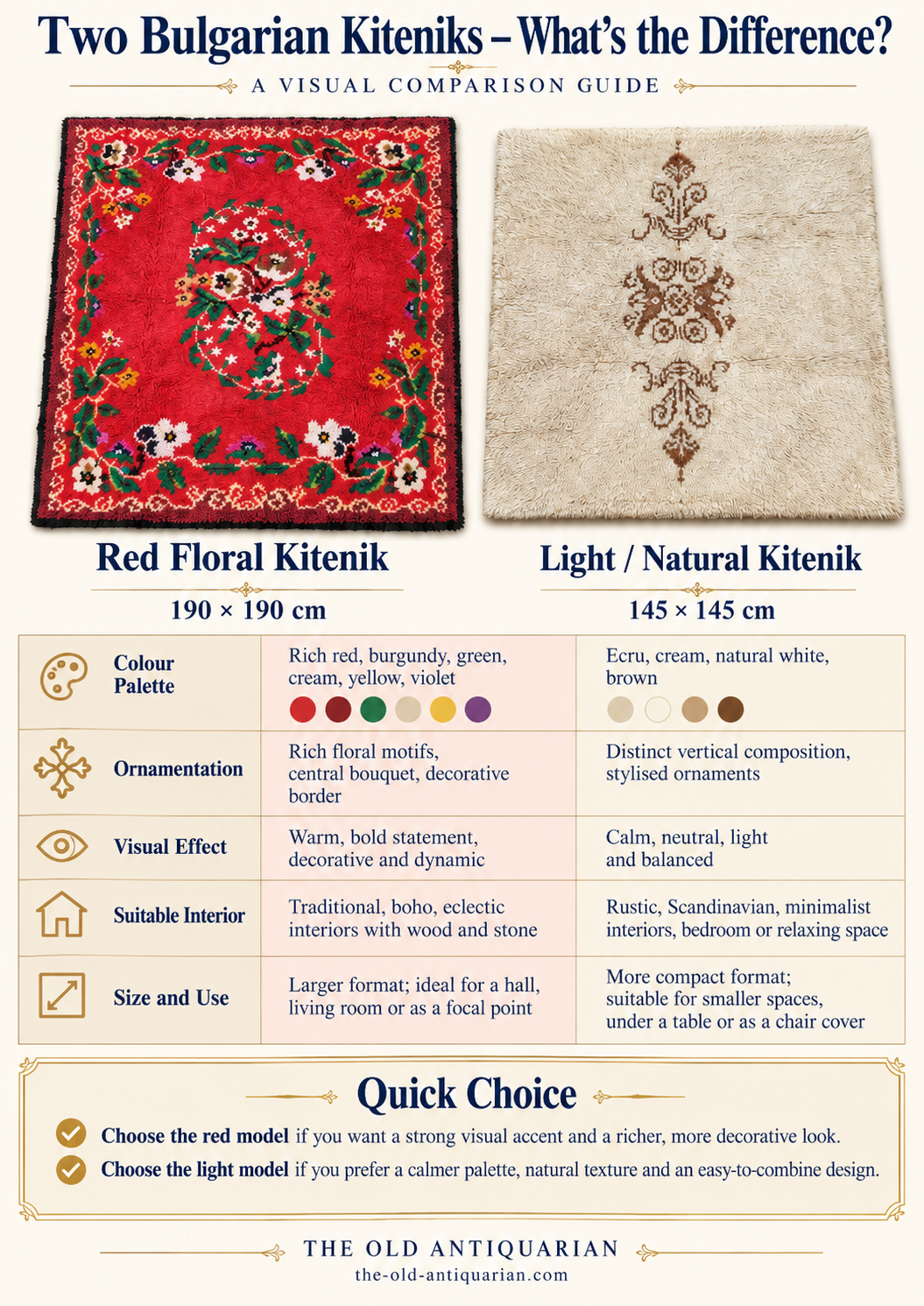
| At a Glance | Red Floral Kitenik | Light / Natural Kitenik |
|---|---|---|
| Dimensions | 190 × 190 cm | 145 × 145 cm |
| Main Palette | Red, burgundy, green, cream, yellow, violet | Ecru, cream, natural white, brown |
| Composition | Central floral arrangement with decorative border | Vertical central ornamentation |
| Visual Character | Bold, warm, decorative and highly expressive | Calm, neutral, textural and restrained |
| Important Identification Clues | Pile, reverse, edges, field, border, ornamentation, dimensions, condition, repairs and provenance | |
Collector Rule: Never assign an exact age, region or workshop to a Bulgarian kitenik from one flower, colour or decorative motif alone. Secure attribution requires several independent characteristics to agree. Contents
- What is a Bulgarian kitenik?
- Two real kitenik examples
- Anatomy of a kitenik
- How to identify an old kitenik
- Why the reverse matters
- Condition and damage
- What determines value?
- Collector checklist
- How to photograph a kitenik
- Cleaning and storage
- Kiteniks in modern interiors
- Frequently asked questions
What Is a Bulgarian Kitenik?
The Bulgarian word kitenik is commonly used for a thick, pile-covered textile traditionally associated with household furnishing. Depending on construction and use, English descriptions may include tufted wool rug, shaggy wool rug, pile rug or wool cover. No single English term captures every historic Bulgarian example perfectly.
Kiteniks are associated with Bulgaria’s wider tradition of domestic wool textiles. Museum collections preserve examples with floral and other ornamentation, including pieces made using knotted or pile-forming techniques.
Related Bulgarian textile terms such as guber and halishte sometimes overlap in everyday descriptions, but collectors should avoid assuming that these names always describe exactly the same construction.
Terminology matters: When cataloguing an old textile, record the traditional family name for the object if one is known, but also describe what can actually be observed: material, pile, weave, dimensions, ornamentation and construction.
Two Bulgarian Kiteniks: How Different Can They Be?
The two real examples used throughout this guide demonstrate why Bulgarian kitenik should not be treated as one fixed decorative style.
Red Floral Kitenik — 190 × 190 cm
This larger square example has a vivid red field, darker burgundy framing, green foliage and multicoloured floral ornamentation. A prominent central floral arrangement is surrounded by additional decorative elements and a defined border.
Its strong palette and large format create an immediate visual focal point. The combination of floral decoration and dense wool pile gives the textile a particularly rich surface.
Light Natural Kitenik — 145 × 145 cm
The second example uses an almost opposite visual language. A light cream or ecru field is decorated with brown motifs organised along a central vertical axis.
Here, the visual effect depends less on contrasting colour and more on the density and texture of the wool pile. Its restrained palette makes the structure of the textile particularly easy to observe.
Do not date from appearance alone. A photograph of the front may suggest a broad stylistic context, but it does not by itself prove a decade, village, region or maker. Family documentation, the reverse, construction details and reliable provenance may be far more important.
Anatomy of an Old Bulgarian Kitenik
A useful way to examine any old rug or textile is to divide it into individual structural and decorative elements.
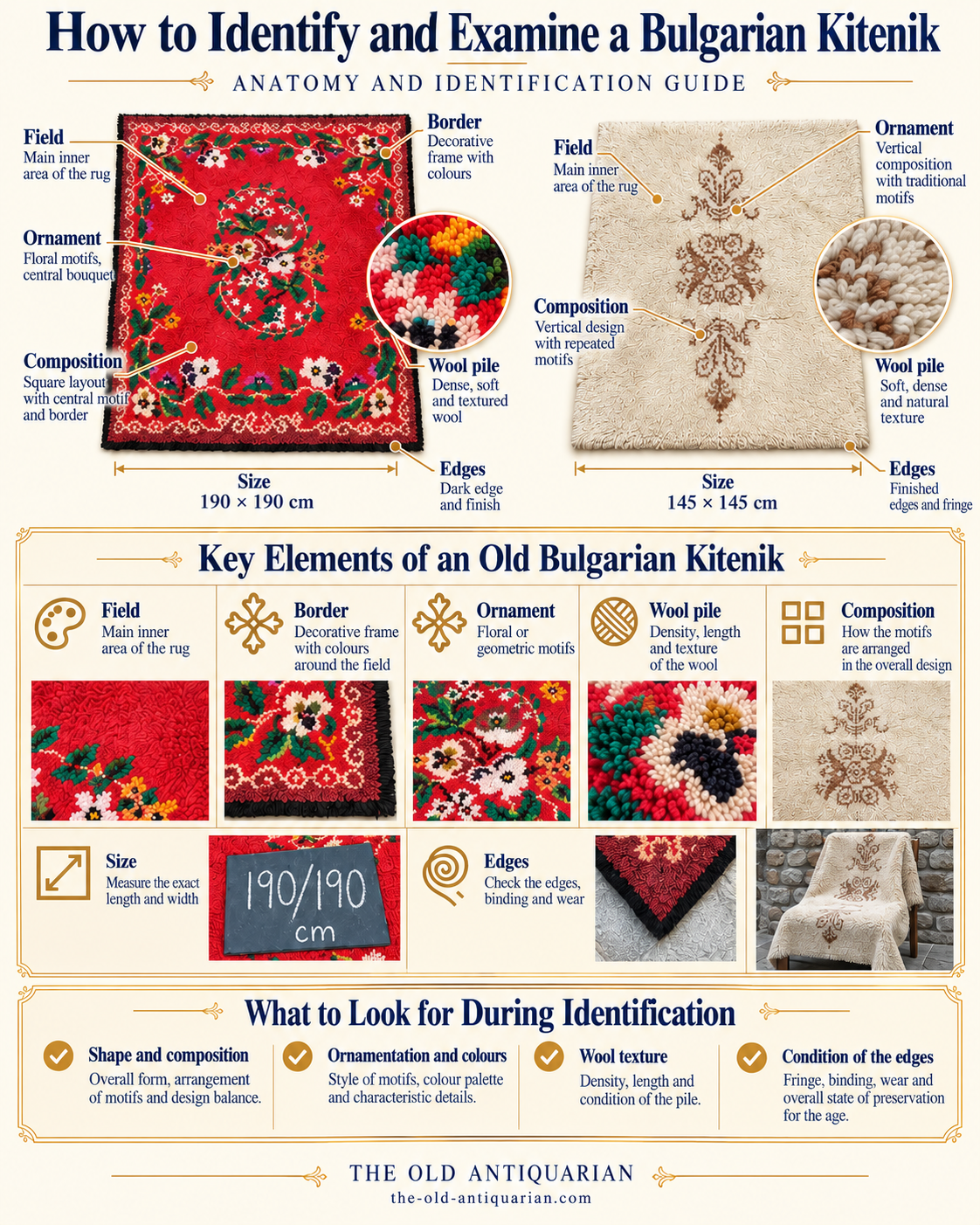
| Element | What It Is | Why It Matters |
|---|---|---|
| Field | The main internal area of the textile | Shows palette, layout, fading and distribution of decoration |
| Border | The decorative frame surrounding the field | Can reveal design structure, wear and finishing |
| Ornament | Floral, geometric or stylised motifs | Provides stylistic clues but should not be used alone for attribution |
| Wool Pile | The raised, tactile surface | Density, length and wear may reveal construction and condition |
| Composition | The arrangement of motifs across the textile | May be central, vertical, repeated, symmetrical or border-based |
| Edges | The outer finishing, binding or fringe areas | Often reveal wear, later repairs and construction details |
| Dimensions | Exact length and width | Useful for classification, comparison and practical function |
| Reverse | The back of the textile | Can expose weaving structure, repairs and details hidden from the front |
How to Identify an Old Bulgarian Kitenik
There is no single authenticity test for a kitenik. Identification works best as a sequence of observations.
Study the overall format.
Record whether the piece is square or rectangular and whether its design uses a central motif, vertical arrangement, border or repeating pattern.
Examine the pile closely.
Look at its density, length, texture and consistency. Compare heavily used areas with better-protected sections.
Study the ornamentation.
Record floral, geometric and stylised motifs without immediately assigning them to a particular region.
Compare the colours.
Look for uneven fading, repairs using different yarns and colour changes between exposed and protected areas.
Inspect the edges.
Edges often reveal fraying, later binding, replaced yarn, stitching or structural losses.
Turn the textile over.
The reverse may reveal construction, later patches and features that are difficult to understand from the pile side.
Measure it accurately.
Record length and width in centimetres and inches if cataloguing for an international audience.
Record provenance.
Family history, old photographs, handwritten notes and information about where the textile was acquired can provide valuable context.
Why Is the Reverse of a Kitenik So Important?
Collectors often focus on the colourful surface, but the reverse can be equally informative.
It can help reveal how the textile is structured, whether sections have been repaired, whether edges were altered and whether patches or later backing conceal damage.
For that reason, The Old Antiquarian recommends photographs of both front and reverse when reviewing old rugs, historic textiles and traditional objects .
Identification Principle: The front tells you how the textile was meant to be seen. The reverse often helps explain how it was made.
Condition: What Damage Should You Look For?
Historic textiles naturally acquire wear, but not every sign of age has the same importance. Condition should be described rather than simply labelled “good” or “bad”.
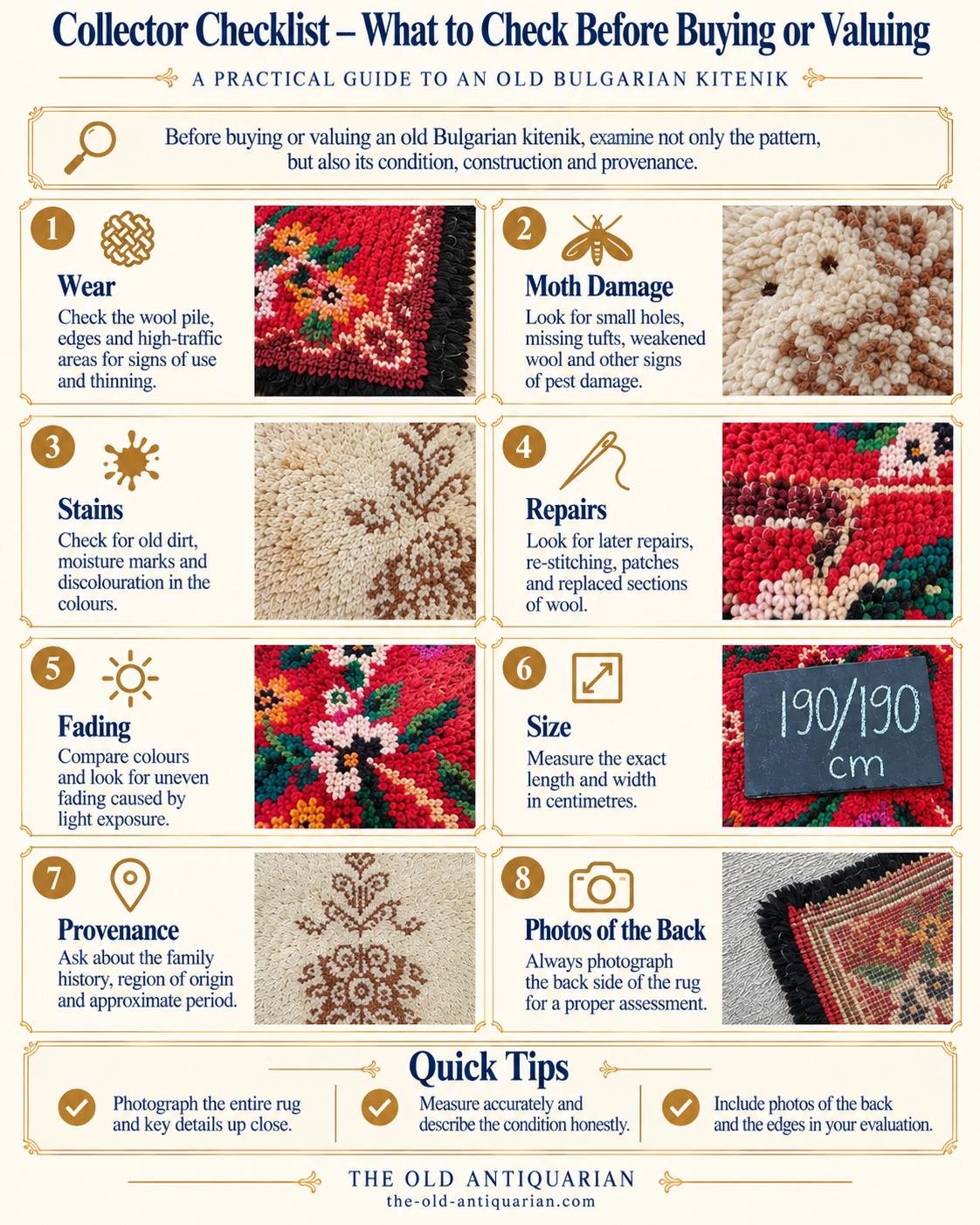
| Condition Issue | What to Look For | Why It Matters |
|---|---|---|
| Pile Wear | Thin, flattened or missing pile | Shows use and may affect decorative completeness |
| Moth or Insect Damage | Small holes, missing tufts, grazing or weakened wool | Can represent significant structural loss and may indicate active pests |
| Stains | Old dirt, moisture marks, discolouration or tide marks | May be difficult or unsafe to remove |
| Fading | Colour differences between exposed and protected sections | Changes the original visual balance of the textile |
| Repairs | Re-stitching, patches, replacement yarn or reconstructed sections | May affect originality and collector interest |
| Edge Damage | Fraying, losses, later binding or unravelled areas | Can become structurally serious if left unsupported |
| Moisture / Mould | Odour, staining, weakened fibres or visible growth | Requires careful assessment before treatment or storage |
Wool textiles are particularly vulnerable to certain insect pests. If damage is suspected, isolate the textile from unaffected wool objects until the problem is understood. Further guidance is available in our guide to protecting antiques from mould and pests .
What Determines the Value of a Bulgarian Kitenik?
There is no reliable universal price list for old Bulgarian kiteniks. Age alone does not determine value, and two textiles of similar dimensions can have very different collector appeal.
| Value Factor | Why It Matters |
|---|---|
| Origin | A reliably documented regional or family origin can strengthen the object’s historical context. |
| Period | Age can be relevant, but it should be supported by construction, provenance and comparable documented examples. |
| Material & Technique | Fibre quality, pile construction and workmanship contribute to both historical and aesthetic interest. |
| Design | Unusual floral, geometric or compositional schemes may be more desirable than common patterns. |
| Rarity | A less common design, format or documented regional type may attract greater collector attention. |
| Condition | Serious moth damage, major losses, staining or poor repairs usually reduce market appeal. |
| Originality | Original edges, structure and historic material may be preferred to heavily altered examples. |
| Provenance | Family history, old photographs or documentary evidence may add meaningful context. |
| Collector Demand | Market value also depends on what collectors and interior buyers are seeking at a particular time. |
Asking Price ≠ Market Value. A high online listing price does not prove that a similar kitenik sells for that amount. Compare genuinely similar examples and consider condition, construction, rarity, provenance and confirmed sales where available.
Collector Checklist: Before Buying or Valuing a Kitenik
Before Buying
Ask for photographs of the entire textile, both sides, the edges, close-ups of the pile and clear images of all damage. If a seller claims a specific region, village or period, ask what evidence supports the attribution.
Before Valuation or Sale
Do not hide stains, holes or repairs. Accurate condition photographs make an initial assessment more useful. Include exact dimensions and any known family or collection history.
Avoid washing, cutting damaged edges or attempting amateur repairs simply to make the textile appear more presentable. Our guide to what not to do before an antique valuation or sale explains why documenting an object before altering it is usually the safer first step.
How to Photograph a Bulgarian Kitenik for Identification or Valuation
One photograph of the front is rarely enough for a useful textile review. A complete set should document both appearance and construction.
| Photograph | What It Should Show |
|---|---|
| Complete Front | Overall proportions, colour scheme, border and composition |
| Complete Reverse | Construction, repairs, backing and structural details |
| Pile Close-Up | Texture, density, fibre condition and wear |
| Characteristic Ornament | Colour relationships and decorative structure |
| Edges and Corners | Binding, fringe, losses, repairs and wear |
| Damage | Moth holes, stains, fading, tears, patches or replaced areas |
| Measurements | Exact length and width |
| Associated Documentation | Labels, family photographs, notes or provenance information |
How Should an Old Wool Kitenik Be Cleaned and Stored?
Historic textiles should not automatically be treated like modern household rugs. Wool fibres, old dyes and previous repairs may respond unpredictably to water, detergents and mechanical cleaning.
Do not automatically machine-wash, bleach, soak or aggressively scrub an old kitenik. Before wet cleaning, the fibre, dyes, construction and condition should be better understood.
For long-term preservation, protect old wool textiles from strong light, excess moisture, insects, dirt and unnecessary physical stress. Direct light can fade dyes and weaken textile fibres over time.
When the piece is not in use, storage should avoid sharp creasing and unnecessary compression. Large stable textiles may sometimes be suitable for supported rolled storage, while more fragile examples may require a different approach.
See our detailed guide to storing antique rugs, textiles and historic clothing for broader preventive-care guidance.
Preservation before improvement: A collector should first understand a textile’s material, construction and condition before deciding whether cleaning or restoration is necessary.
Using an Old Bulgarian Kitenik in a Modern Interior
A kitenik can remain culturally interesting while also functioning as an effective decorative textile. The best approach is to respect both its physical condition and its visual character.
Red Floral Kitenik
A large red floral example can become the dominant visual element in a living room, study or dining area. Rich reds, burgundy and green work particularly well with wood, stone, leather and otherwise restrained interiors.
Because the design is already highly decorative, surrounding furniture does not need to compete with it.
Light Natural Kitenik
A cream or ecru kitenik offers a different effect. The eye notices the wool texture before the colour contrast, making this type particularly suitable for rustic, Scandinavian-inspired or minimalist interiors.
Light textiles should, however, be protected carefully from staining, frequent foot traffic and direct sunlight if preservation is a priority.
Colour psychology vs. factual claims: A red textile may make a room feel visually warmer or more energetic, while a cream textile may feel calmer or lighter. These are subjective design effects, not evidence that a rug can medically treat stress, insomnia or other health conditions.
Do You Own an Old Bulgarian Kitenik or Historic Textile?
Send clear photographs of the complete textile, front and reverse, close-ups of the pile and ornamentation, edges, visible damage and exact dimensions. Include anything you know about its family history or origin. Request a Professional Valuation Textiles & Rugs We Buy
Frequently Asked Questions About Bulgarian Kiteniks
What is a Bulgarian kitenik?
A kitenik is a traditional Bulgarian pile textile commonly described in English as a tufted or shaggy wool rug. Historic examples may differ in materials, construction, colours, size and intended household use.
How can I tell if a Bulgarian kitenik is old?
Examine the pile, weave or underlying construction, reverse, edges, colours, wear, repairs and provenance. Natural wear can support an assessment, but wear alone does not prove age.
Can I identify the region from the pattern?
Sometimes ornamentation can provide a useful research clue, but a secure regional attribution should not rely on pattern alone. Materials, construction, technique and provenance should support the conclusion.
Are Bulgarian kiteniks handwoven?
Historic examples may involve hand weaving and pile-forming or knotting techniques, but every individual textile should be examined rather than automatically classified from appearance alone.
Are old Bulgarian kiteniks valuable?
Some can have collector or decorative value, but age alone does not determine price. Origin, technique, design, rarity, condition, originality, provenance and market demand all matter.
Does moth damage make a kitenik worthless?
Not necessarily. Damage generally reduces condition and may affect value, but a rare or historically interesting textile can retain collector interest even when imperfect.
Should I wash an old kitenik before selling it?
Avoid automatic machine washing, bleaching or aggressive cleaning before the fibres, dyes and condition have been assessed. Inappropriate cleaning can permanently alter old textile material.
Why should I photograph the back of a kitenik?
The reverse may reveal construction details, repairs, patches, edge alterations and other information that is difficult to see from the pile side.
What photographs are needed for a valuation?
Photograph the complete front and reverse, pile texture, characteristic ornamentation, every edge, visible damage and repairs. Include exact measurements and provenance information where available.
Is a guber the same as a kitenik?
The terms can overlap in casual usage because both relate to traditional Balkan wool textiles, but collectors should not automatically treat every guber, halishte and kitenik as structurally identical. The physical textile should determine the catalogue description.
Can a twentieth-century kitenik still be collectible?
Yes. A textile does not need to be extremely old to be interesting. Craftsmanship, design, regional context, rarity, condition and provenance can all contribute to collector appeal.
Final Collector Checklist
| Before You Buy, Sell or Value | Check |
|---|---|
| Photograph the entire textile | ✓ |
| Photograph the reverse | ✓ |
| Measure length and width accurately | ✓ |
| Inspect pile wear | ✓ |
| Look for moth or insect damage | ✓ |
| Document stains and fading | ✓ |
| Look for later repairs | ✓ |
| Inspect edges and corners | ✓ |
| Preserve family history and provenance | ✓ |
| Avoid unassessed washing or restoration | ✓ |
Conclusion
An old Bulgarian kitenik should be studied as a complete textile object, not simply as a colourful pattern. Its field, border, ornamentation, wool pile, reverse, edges, dimensions, condition and provenance together create its technical and historical profile.
For collectors, the most reliable approach is evidence-based: observe what is present, document what has changed, preserve provenance and avoid assigning a precise age or origin without supporting information.
That method not only improves identification. It also helps preserve the history carried by the textile itself.
Continue Exploring
- Textiles, Rugs & Traditional Objects We Buy
- How to Store Antique Rugs, Textiles and Historic Clothing
- What Not to Do Before an Antique Valuation or Sale
- How to Protect Antiques from Mould, Rust & Pests
- Professional Antique Valuation
Sources & Further Research
Museum of National Artistic Crafts, Troyan — museum collections and catalogues documenting Bulgarian traditional textiles, including kiteniks and other wool rugs.
Museum of National Artistic Crafts, Troyan
Canadian Conservation Institute — Caring for Textiles and Costumes — preventive-conservation guidance on textile fibres, light, moisture, physical damage and insect pests.
Canadian Conservation Institute: Caring for Textiles and Costumes
Canadian Conservation Institute — Textiles and the Environment — guidance on light exposure, humidity, pests and textile preservation.
CCI Notes 13/1: Textiles and the Environment
The Old Antiquarian — practical guides to identification, condition, storage, valuation and collecting of historic rugs and textiles.
Object Note: The dimensions and visual characteristics of the two kiteniks illustrated in this guide are based on the actual photographed objects. No precise regional attribution or date should be considered confirmed without additional documentary or physical evidence.
About The Old Antiquarian
The Old Antiquarian brings more than 35 years of practical experience with antiques, vintage objects, historic textiles and collectibles. Our approach combines close observation, comparison with documented examples, condition assessment, provenance research and respect for the history carried by every object.
