
Egyptian Hookahs: History, Traditional Craftsmanship and Collector’s Guide to Yehia El Khawanky
Historical & Collector’s Guide | The Old Antiquarian | Last Updated: October 28, 2026
Quick Answer: What Is a Traditional Egyptian Hookah?
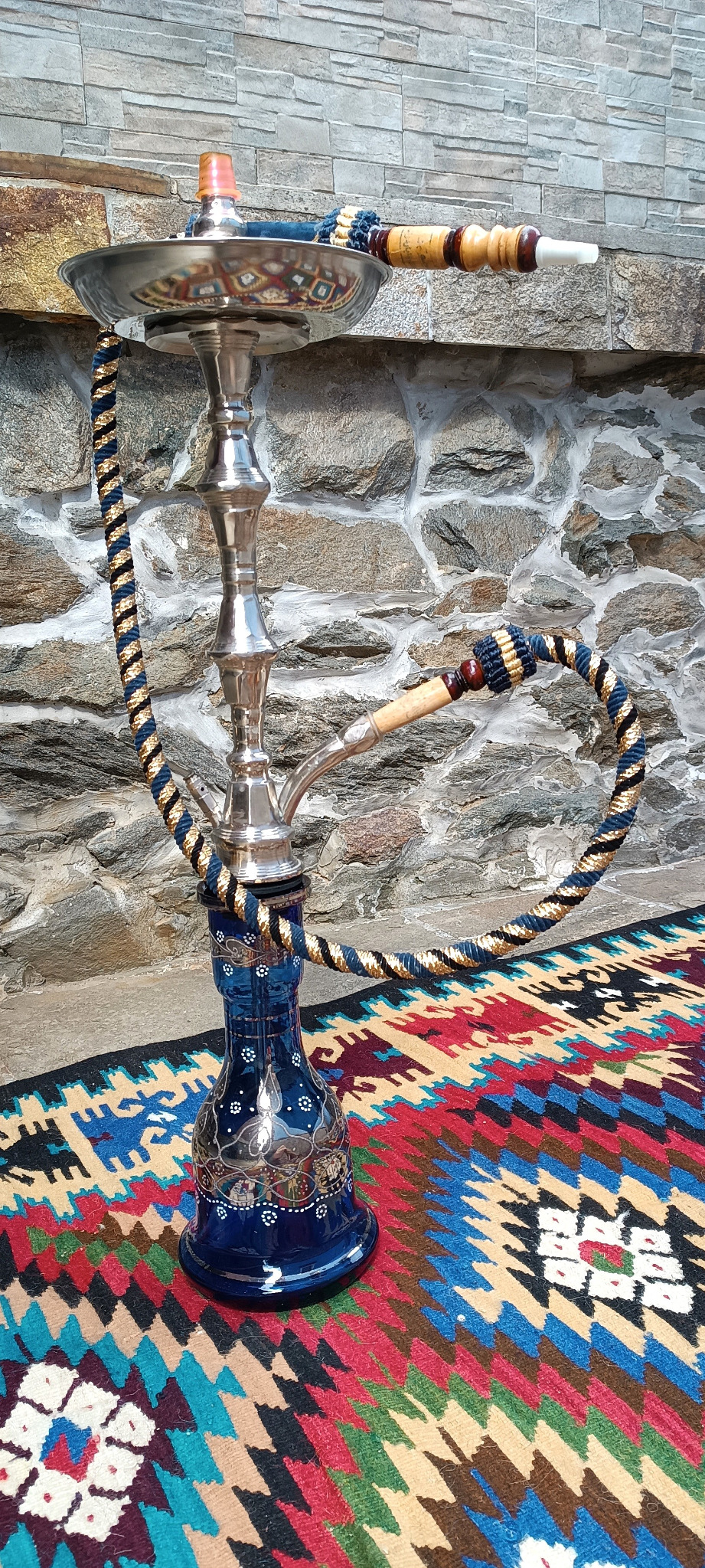
A traditional Egyptian hookah, also known as a shisha, nargile or waterpipe, is a multi-component object traditionally consisting of a glass or other reservoir, a metal stem, an upper bowl and tray, a flexible hose and a mouthpiece. Egyptian examples are especially associated with tall decorative metal stems, shaped fittings, colourful glass bases and elaborately braided hoses. For collectors, the most important factors include maker identification, Arabic inscriptions, original components, condition and documented ownership history. One historic Egyptian name associated with this tradition is Yehia El Khawanky.
Egyptian Hookahs at a Glance
| Feature | Historical and Collectible Information |
|---|---|
| Common Names | Hookah, shisha, nargile, narghile, waterpipe |
| Historical Origins | Connected with South Asia, Persia and the wider Middle East; the precise origin remains debated. |
| Egyptian Context | Traditional metalworking, decorative glassware, urban coffeehouse culture and Cairo’s trading networks. |
| Traditional Materials | Glass, various metals and alloys, wood, textiles and joining materials. |
| Historic Maker | Yehia El Khawanky / Yehia El-Khawanky Sons, a name associated with Egyptian hookahs and metalcraft. |
| Company Heritage | The company’s published catalogue states that its history began in 1890. |
| Featured Collectible | Vintage Egyptian hookah with a cobalt-blue glass base, original braided hose, metal components and Arabic inscription. |
| Purchase History | Personally purchased in Egypt approximately 2001–2006. |
| Collector Priorities | Maker’s marks, originality, completeness, condition, craftsmanship and provenance. |
Traditional Egyptian hookahs are more than recognisable objects of Middle Eastern decorative culture. Their construction reflects a long history of craftsmanship, regional trade, evolving materials and social customs.
For collectors, a vintage hookah can offer several areas of historical interest: the identity of its maker, the relationship between its individual components, the origin of its decorative glassware and the evidence connecting it to a particular period or owner.
This guide explores those questions using a real object from The Old Antiquarian collection: a vintage Egyptian hookah attributed to Yehia El Khawanky, preserved by the person who purchased it in Egypt more than two decades ago.
1. Where Did the Hookah Originate?
The history of the hookah is more complex than the popular claim that it was invented in a single country by one identifiable person.
Historical traditions connect waterpipes with different parts of South Asia, Persia and the wider Middle East. Their development was influenced by the spread of tobacco, commercial networks, migration and the exchange of objects and practices between different societies.
One well-known account places the emergence of the hookah in Mughal India during the reign of Emperor Akbar, who ruled from 1556 to 1605. According to this tradition, a court physician proposed passing tobacco smoke through water in the mistaken belief that this process would make the smoke less harmful.
The story is important because it illustrates how early users understood the purpose of the water chamber. However, it should be treated as a historical account rather than definitive proof that every form of waterpipe developed from one invention.
In Persia, the waterpipe became known as the qalyan or qalyān. Different regional names, materials and designs developed across areas connected by trade and political influence.
The World Health Organization acknowledges uncertainty concerning the precise geographical origin of waterpipe smoking. The history therefore requires a distinction between documented use, later traditions and competing explanations of invention.
The Encyclopaedia Iranica also provides historical context for tobacco and waterpipe practices in Persia, helping place this tradition within broader changes in everyday life and the consumption of tobacco from the early modern period onward.
Collector’s Historical Note: The term Egyptian hookah usually describes an object made in Egypt or associated with a recognisable Egyptian construction and decorative tradition. It does not establish that all waterpipes originated exclusively in Egypt.
2. Egyptian Hookahs and the Coffeehouse Culture of Cairo
Cairo occupies an important place in the cultural history of Middle Eastern coffeehouses. For generations, such establishments have provided spaces for conversation, news, social meetings, music and various forms of public life.
Accounts of nineteenth-century Cairo describe coffeehouses serving different social groups and occupying important positions in neighbourhood life.
According to the historical portal of the Cairo Governorate, the historian Ali Pasha Mubarak recorded approximately 1,027 coffeehouses in Cairo in 1880. This figure illustrates the importance of these venues in the city’s social landscape, although it does not establish how many offered hookahs.
Among Cairo’s celebrated historic establishments is El Fishawy Café, located in the Khan el-Khalili district and associated with a long coffeehouse tradition.
Within this cultural setting, traditional hookahs became recognisable objects linked to leisure, social gatherings and regional craftsmanship.
As their designs evolved, Egyptian makers and traders offered different heights, metal profiles, glass colours and decorative components. A hookah could be a relatively practical everyday object or a more elaborate example with a visually distinctive silhouette.
For present-day collectors, these objects can be studied as material evidence of the relationships between urban commerce, craft production and social history.
3. Anatomy of a Traditional Egyptian Hookah
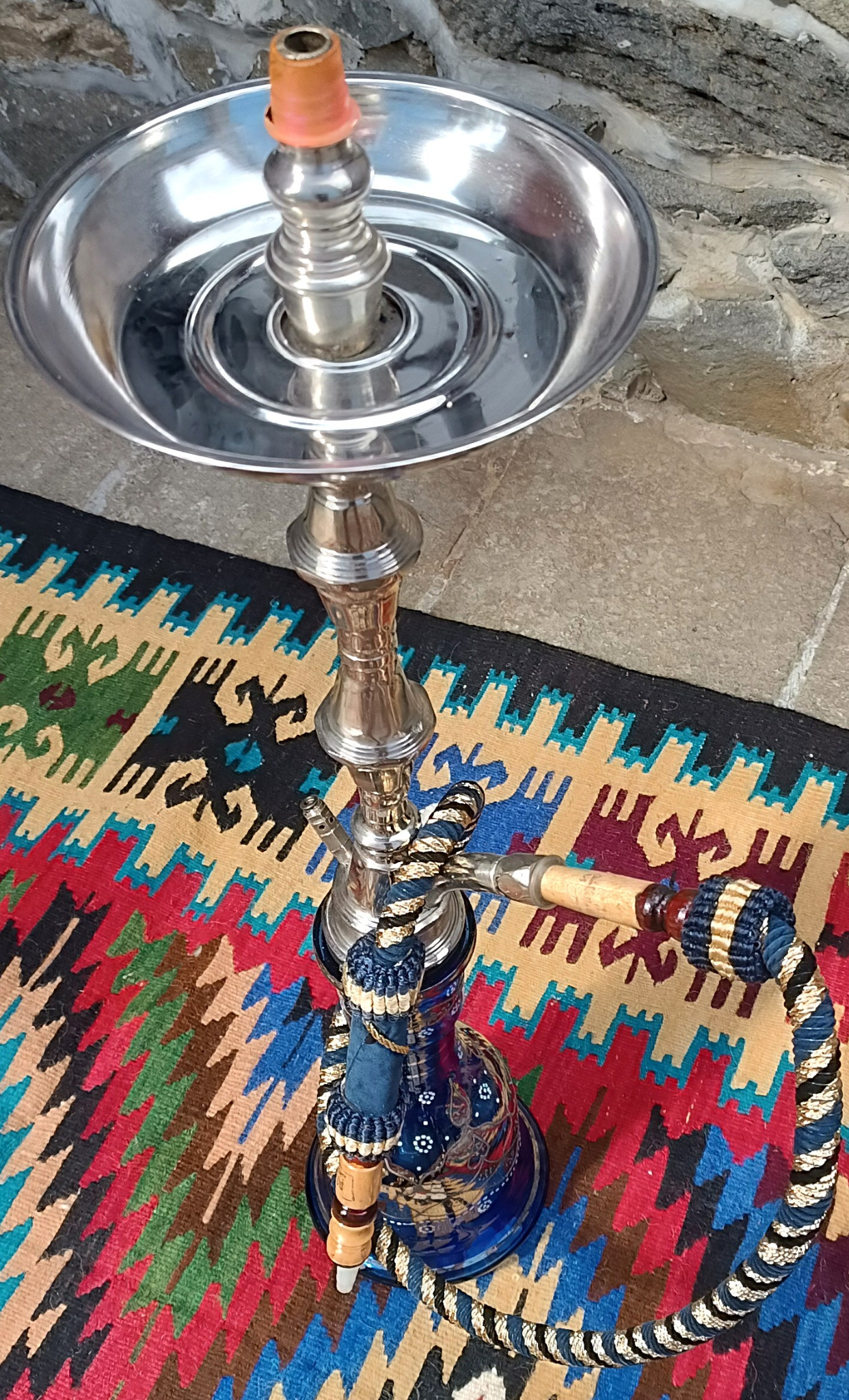
A traditional hookah appears to be a single decorative object, but it is assembled from several separate parts. Understanding their roles is essential when examining originality and completeness.
| Component | Construction and Collector Significance |
|---|---|
| Glass Base | The lower reservoir. Its shape, colour, decorative finish, rim and condition provide useful identifying characteristics. |
| Metal Stem | The central body connecting the upper assembly to the base. Its profile, joints and marks may provide evidence of manufacturing tradition. |
| Upper Bowl | Historically used to hold material for smoking. Surviving bowls vary in form, material and construction. |
| Metal Tray | Positioned near the top of the stem. Its diameter, surface finish and central connection are useful features to examine. |
| Braided Hose | A flexible component often covered in textile. Original braiding, cuffs and connections may contribute to the character of a surviving set. |
| Mouthpiece | May incorporate turned wood or other materials. Wear and surviving markings can be of documentary interest. |
| Valves and Connections | Help establish construction type, compatibility between parts and possible evidence of repairs or replacement. |
Why Materials Matter
Egyptian hookahs may incorporate different metals and alloys, as well as decorative surface finishes. A silver-coloured stem is not automatically made from stainless steel, solid silver or a specific metal alloy.
Some components may be polished or plated, while others may have been manufactured by casting, shaping or machining. Different production techniques can coexist in a single object.
Without material testing or close technical inspection, a description such as polished silver-coloured metal is more reliable than an unsupported claim about the exact composition.
For collectors, precision in terminology matters. Visual appearance, manufacturing method and chemical composition are related but separate kinds of evidence.
4. Yehia El Khawanky: A Name in Egyptian Hookah Craftsmanship
Yehia El Khawanky, also encountered as Yahia El-Khawanky or Yehia El-Khawanky Sons, is a historic Egyptian name associated with traditional hookahs and related craft and commercial activity.
A published Yehia El-Khawanky Sons catalogue states that the company’s history began in 1890. The catalogue presents the business as a producer of traditional hookahs and accessories and describes hand manufacturing as part of its heritage.
It also identifies locations in Cairo, including the El Korba area of Heliopolis and El Moez Street, connecting the name to the city’s longstanding commercial environment.
The catalogue includes models with decorative metal stems and recognisable Egyptian-style silhouettes. Model names and catalogue illustrations provide potential comparative material for collectors, but they should not be used to assign a precise model without matching construction details.
Additional evidence for the name comes from Numista, which documents an Egyptian advertising token associated with Yehia Elkhawanky Sons. The token bears the Arabic company name and is described in that catalogue as an advertising medallion.
Such an object offers independent comparative evidence for the spelling of the business name. It does not, however, date every surviving hookah bearing a similar inscription.
Important: The Company Date Is Not the Object’s Date
The year 1890 relates to the company history stated in its published materials. It does not mean that the hookah featured in this article was manufactured in the nineteenth century. The example in The Old Antiquarian collection was acquired around 2001–2006, while its exact production date remains unverified.
Yehia El Khawanky vs Khalil Mamoon
Another well-known name associated with Egyptian hookahs is Khalil Mamoon, also written as Khalil Maamoon or Khalil Mamoun.
These are separate names and should not be treated as interchangeable brands.
Because traditional Egyptian hookahs often share broad structural characteristics, their tall stems, circular trays and glass bases may look similar at first glance.
Identifying the maker of an individual example requires more specific evidence: Arabic inscriptions, distinctive fittings, documented catalogue comparisons and a reliable history of acquisition.
The presence of an Egyptian-style stem alone is not sufficient to classify an object as either El Khawanky or Khalil Mamoon.
5. Arabic Maker’s Marks: How to Identify an Egyptian Hookah
One of the most important areas of hookah identification is the examination of inscriptions on metal fittings.
Arabic lettering may record a producer’s name, a retailer, a workshop or other commercial information. In some circumstances it may also include decorative or formulaic text.
A trustworthy identification therefore requires more than recognising a few letters. The inscription should be examined in full and compared with documented examples.
The Mark on Our Vintage Hookah
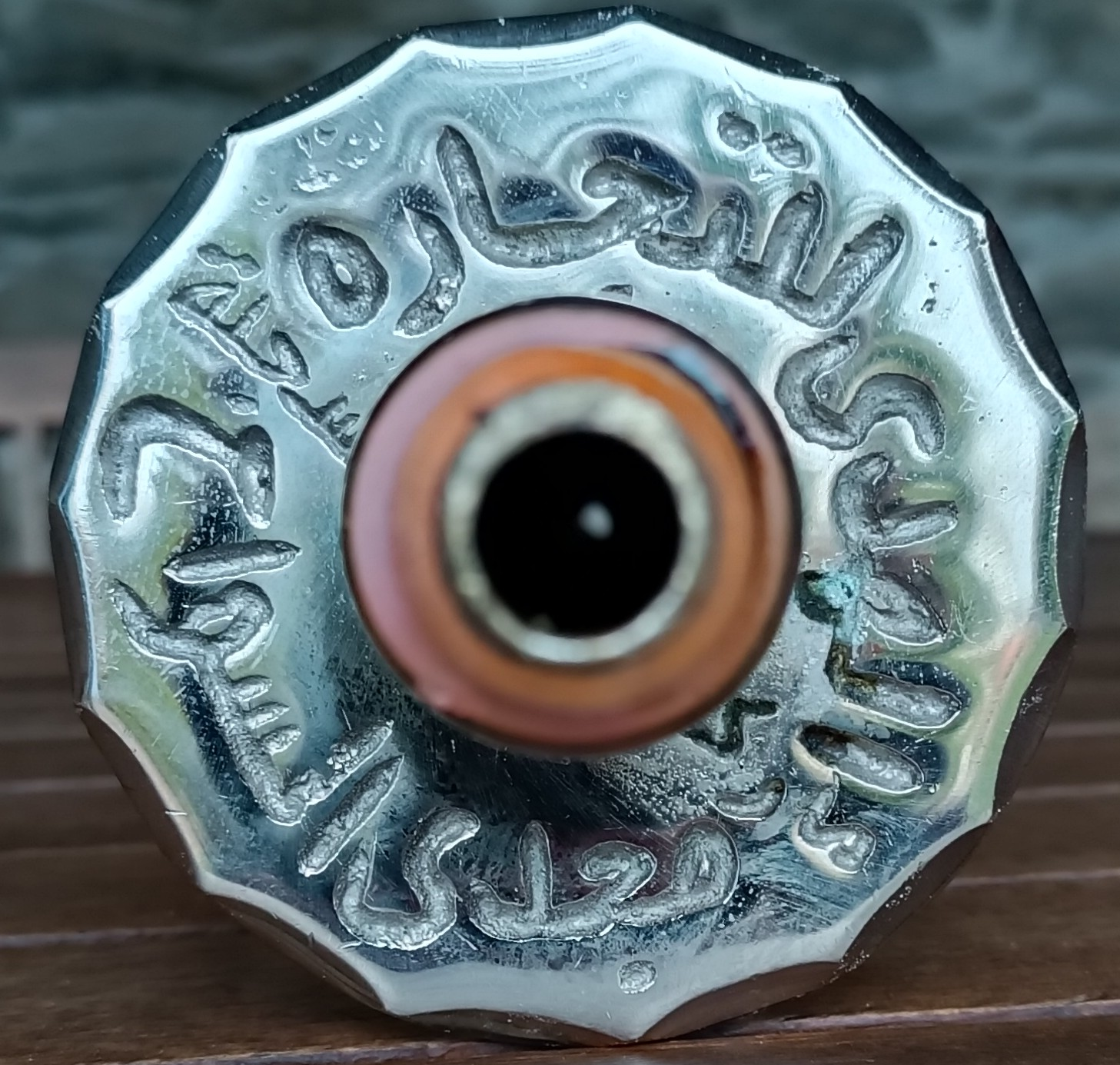
Our example features a polished, scalloped metal component with raised Arabic lettering arranged around a central opening.
The inscription is an important part of the attribution to Yehia El Khawanky. However, part of the lettering is obscured by the central fitting, so a complete and independently verified transcription cannot be established from this photograph alone.
The separate advertising token recorded by Numista identifies the company in Arabic as انجال يحيى الخوانكى, translated in the catalogue as Yehia Elkhawanky Sons.
This is valuable comparative information, but the wording on the token must not automatically be treated as a complete transcription of the inscription on our hookah.
The correct approach is to retain the original photograph, document the visible characters, compare them with verified sources and distinguish a reasonable attribution from a fully demonstrated identification.
What Can a Maker’s Mark Prove?
| Potential Evidence | Important Limitation |
|---|---|
| Identification of a commercial or maker’s name | The lettering must be correctly read and attributed. |
| Comparison with documented marks | Similar names do not necessarily establish an exact model. |
| Evidence that a marked part belongs to a manufacturing tradition | It may not identify the manufacturer of every other component. |
| Possible support for dating | A mark alone rarely establishes a precise manufacturing year. |
For serious collectors, a well-photographed mark is a starting point for research rather than a substitute for the research itself.
6. From Egypt to Bulgaria: The Personal Story Behind Our Hookah
Some vintage objects carry histories that cannot be reconstructed from auction listings or manufacturers’ catalogues. Their most valuable context survives through the people who originally acquired and preserved them.
The Egyptian hookah presented here has precisely such a history.
The current owner personally purchased the complete set in Egypt approximately 20–25 years ago, around 2001–2006.
Since that acquisition, the principal components have remained together. According to the owner, the cobalt-blue decorated glass base, polished metal body, broad circular tray, blue-and-gold braided hose and turned wooden mouthpiece are the original components supplied with the set.
The original carrying case has also been retained, together with non-consumable accessories and historical packaging that documents the collection’s early history.
This first-hand account is particularly interesting because many second-hand hookahs have passed through several owners, often with replacement hoses, bases or other components added over time.
The survival of a complete and consistently preserved set creates a stronger documentary record than the appearance of an isolated, unidentified object.
It remains important, however, to distinguish the date of acquisition from the date of manufacture. The hookah may have been made before it was purchased.
Its exact model designation and year of production have not been established. The personal purchase history provides a meaningful ownership timeline without requiring unsupported claims.
Today, the object forms part of The Old Antiquarian collection, where its construction, markings, materials and condition are documented through original photographs.
A Real Example from The Old Antiquarian Collection
The original set is documented in a separate product listing, including photographs of its components, Arabic inscription, braided hose and travel case. The product page provides current information about condition and availability.
7. The Cobalt-Blue Glass Base: A Distinctive Decorative Feature
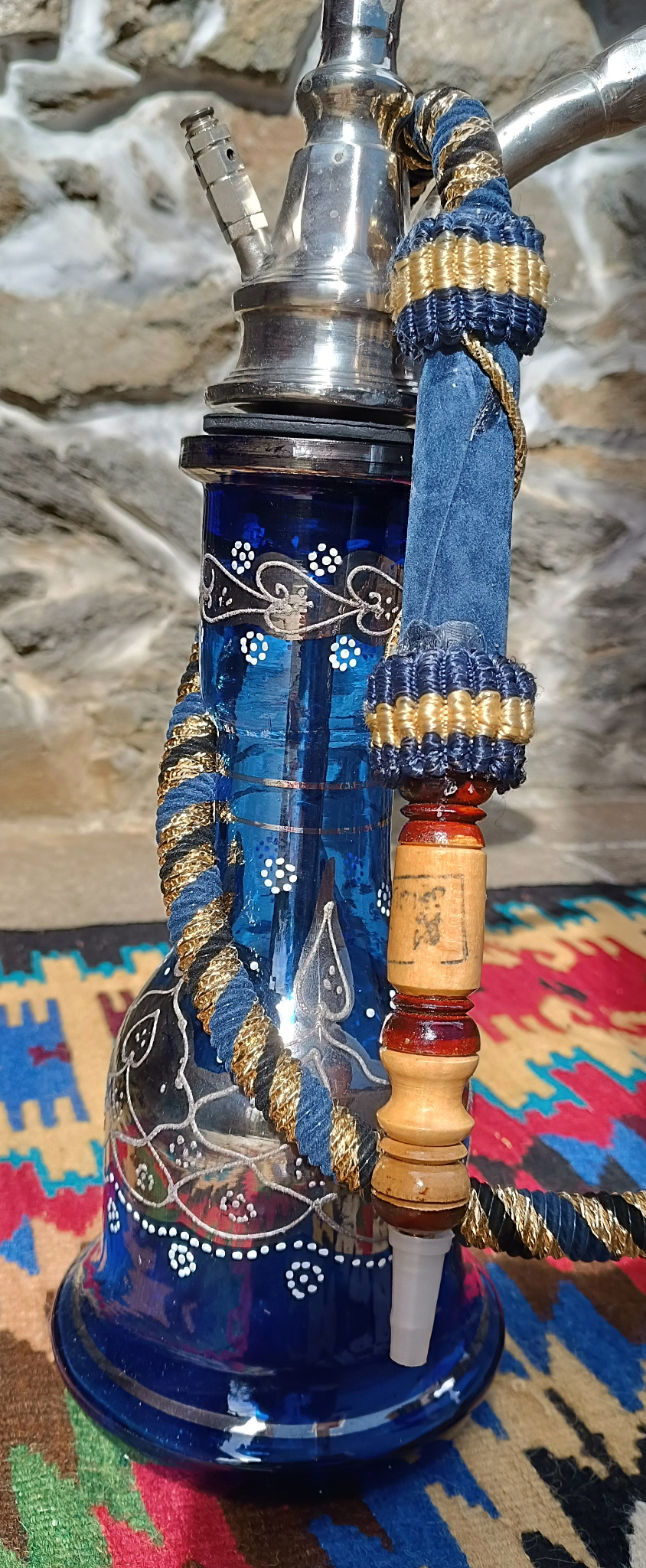
Although the tall metal stem defines the hookah’s overall silhouette, the deep cobalt-blue glass base gives this particular example its most memorable visual character.
The glass vessel has a relatively narrow upper neck, a gradually widening body and a flared lower section.
Its decoration combines small white dotted floral motifs with silver-toned scrolling patterns and ornamental lines.
Under natural light, the rich blue colour creates a striking contrast with the polished metal fittings and gold-coloured threads of the original hose.
The design illustrates why glass bases are important not only as functional components but also as elements of decorative craftsmanship.
What Collectors Should Examine
When evaluating a decorated glass hookah base, close attention should be paid to the rim, neck, body, lower edge and applied ornamentation.
Cracks, chips, repaired areas and incompatible fittings may affect both the condition and the collector appeal of a piece.
The presence of painted or applied decoration should also be documented before any cleaning is attempted, particularly when the durability of the surface finish is unknown.
One important distinction concerns manufacturing attribution: a complete Egyptian hookah may incorporate a metal stem and glass base supplied by different workshops.
Consequently, the attribution of the metal body to a particular producer does not automatically establish the manufacturer of the glass vessel.
For our example, the confirmed information concerns the owner’s original purchase and the survival of the same glass base within the set.
8. Metal Craftsmanship: Stem, Tray and Connections
Traditional Egyptian hookahs frequently use tall metal stems assembled from multiple shaped sections.
Their surfaces may be polished or decorated, while their fittings reflect the need to connect the central body to the reservoir, hose and upper components.
The example in The Old Antiquarian collection has a silver-coloured metal stem, a wide circular tray, a curved hose connector and shaped fittings.
Its appearance is consistent with the traditional Egyptian-style silhouette, although precise material composition and manufacturing technique have not been independently tested.
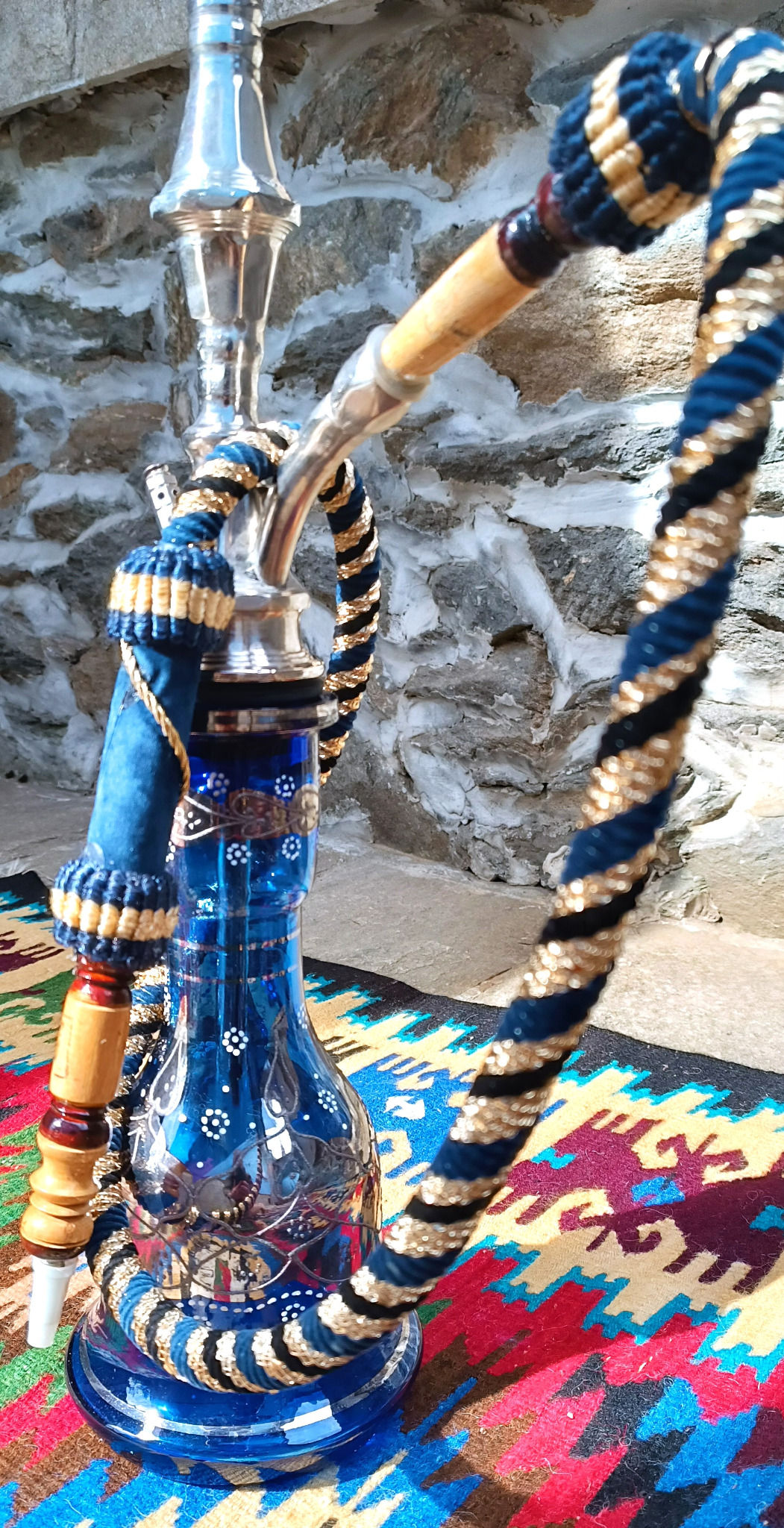
When examining vintage metalwork, collectors should assess the quality of the joints, the consistency of the surface finish, the presence of corrosion and any signs of structural damage.
They should also look for evidence that components fit naturally together without improvised alterations.
Excessively aggressive polishing can remove original surface finishes and weaken the visual evidence of age and craftsmanship.
A restrained conservation approach is therefore preferable to unnecessary restoration.
9. The Original Blue-and-Gold Braided Hose and Wooden Mouthpiece
Another distinctive feature of our Egyptian hookah is its traditional braided hose.
The hose has a dark-blue textile covering decorated with spiralling gold-coloured threads. Thick woven cuffs and ornamental sections add visual detail along its length.
The original wooden mouthpiece incorporates turned sections in lighter natural wood and deeper reddish-brown finishes.
One of the wooden elements retains a partially faded dark marking. Its individual characters are not sufficiently clear to support a firm interpretation or dating claim.
According to the owner, the hose and mouthpiece have remained with the set since the original purchase in Egypt.
This continuity is valuable to the object’s documentary history, particularly because hoses and mouthpieces can be more vulnerable to wear or replacement than metal stems.
Original Does Not Necessarily Mean Functional
For a collectible hookah, originality and safe functionality are separate questions.
An old hose may retain attractive textile decoration and a complete wooden mouthpiece while having deterioration or contamination within its internal structure.
Because the inner condition of this particular hose has not been professionally inspected, the set is presented primarily as a decorative and collectible object.
The original hose should be preserved without unnecessary bending, washing or modification.
10. Original Components, Travel Case and Historical Packaging
A central strength of this vintage set is the survival of its separate components and associated accessories.
Photographs show the decorated glass base, metal stem, tray, upper bowl, braided hose, mouthpiece and fittings arranged outside the carrying case.
This disassembled view is especially useful for collector documentation because it reveals elements that may be obscured when the hookah is fully assembled.
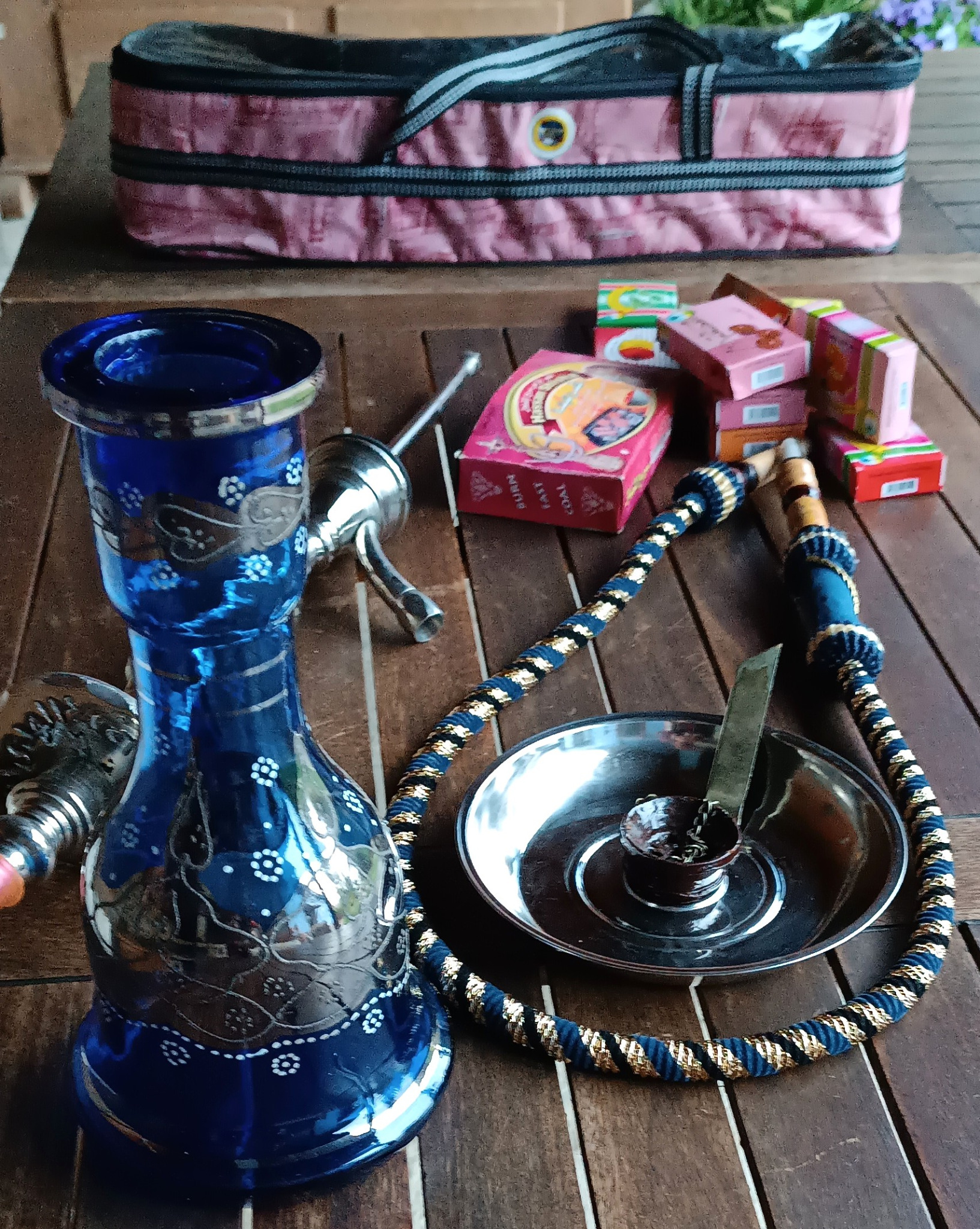
The Carrying Case as Part of the Ownership History
The original carrying case has a pink-and-black exterior, zip fastening and internal compartments designed to accommodate the separated components.
Although a case does not independently establish the age or manufacturer of a hookah, it can be an important part of a complete set.
In this instance, the owner confirms that it has been preserved with the hookah since the original acquisition.
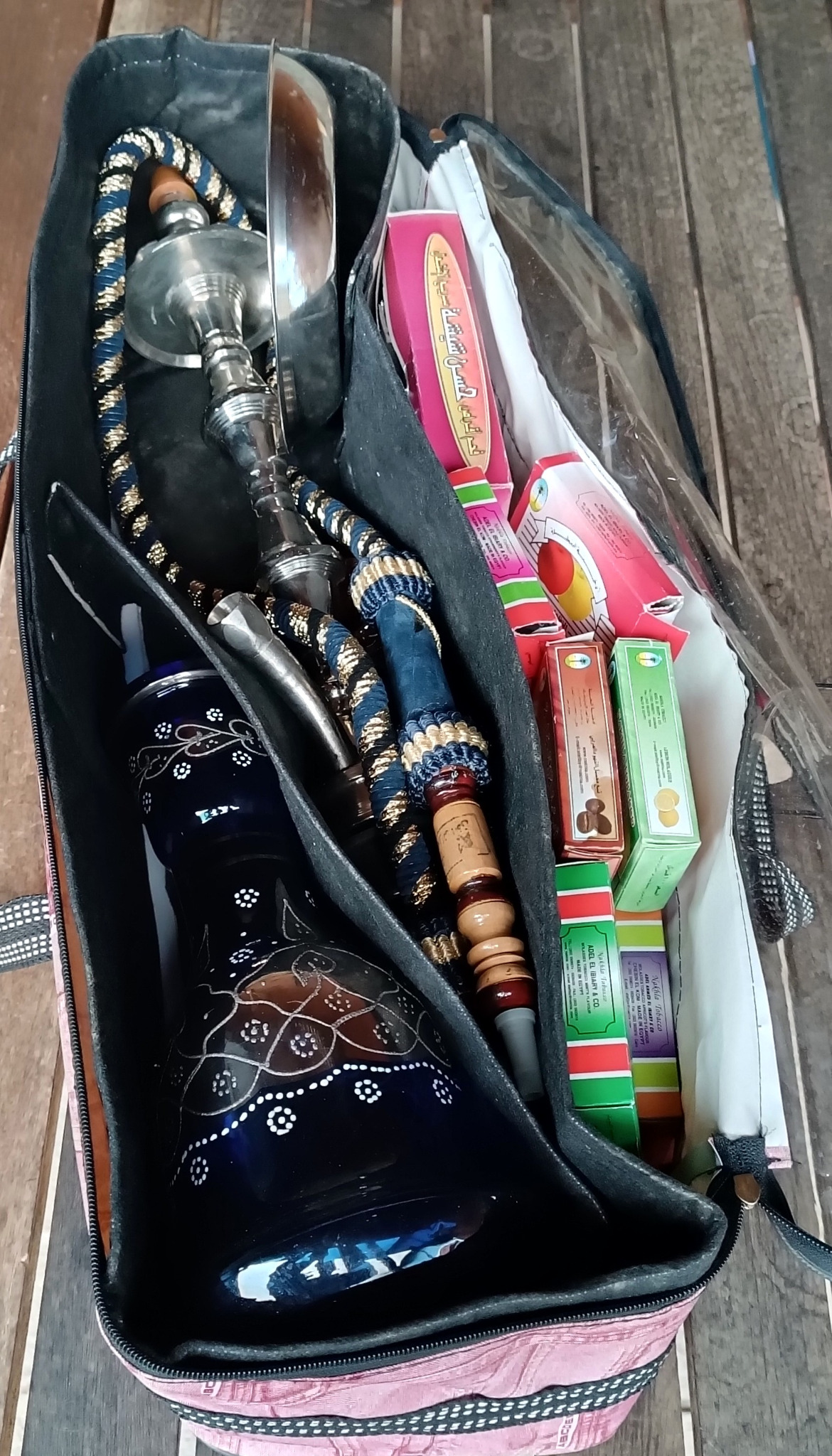
For historical collections, packaging, cases and accessories may provide information about how an object was transported, stored and used within its original context.
However, collectors should be careful not to assume that all items found together were necessarily manufactured by the same company.
Historical Nakhla and Hassan Shisha Packaging
The owner also preserved several old Egyptian packages associated with the original collection.
These include boxes bearing the names Nakhla Tobacco and Hassan Shisha, with colourful Arabic and English typography, fruit illustrations and traditional decorative motifs.
From a historical perspective, the packages are interesting examples of commercial graphic design and help document the environment in which the hookah was acquired.
They are not reliable evidence of the precise manufacture date of the metal or glass components, and their contents have not been independently verified.
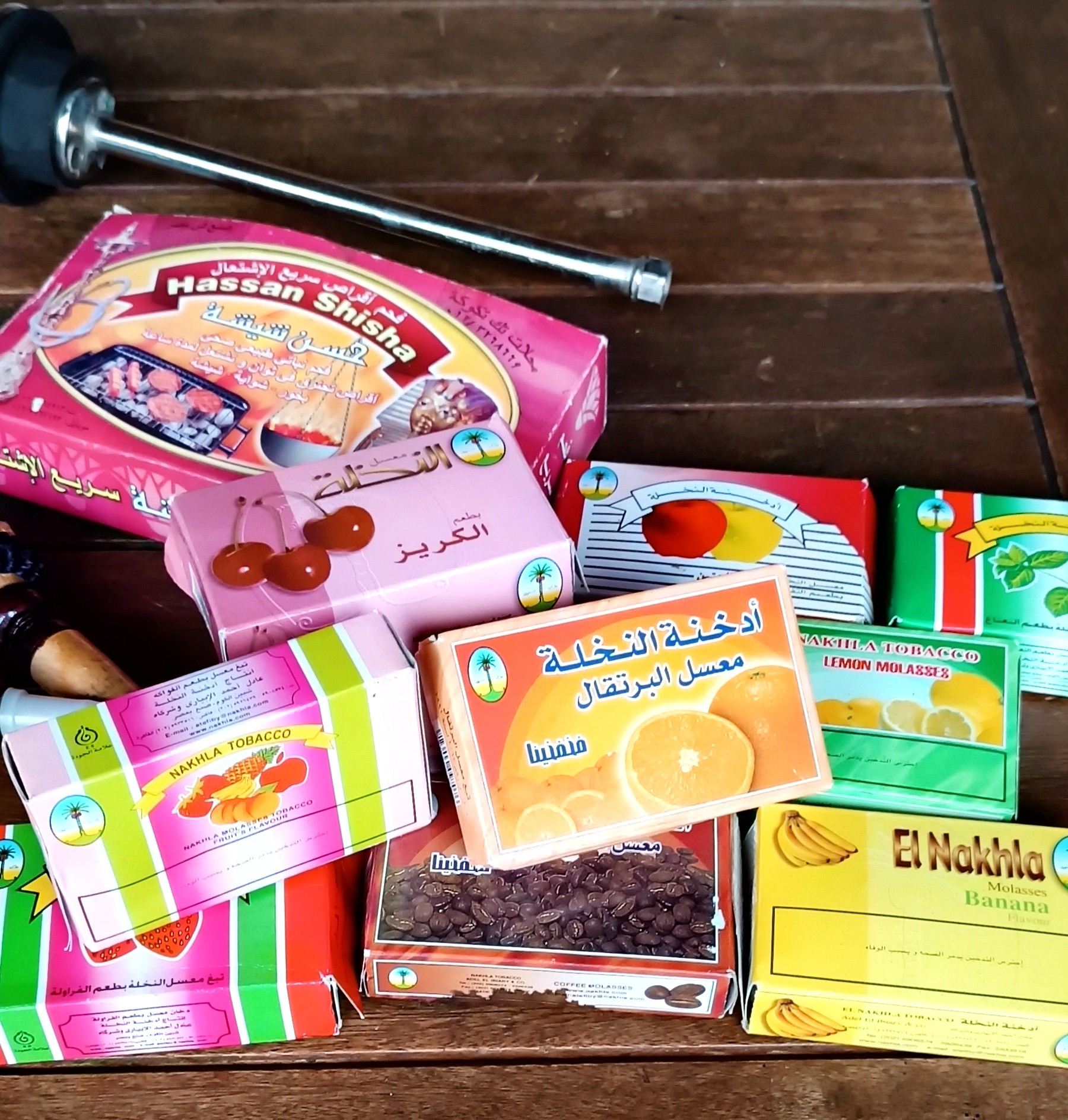
The packaging is presented strictly as historical and photographic material. It does not constitute a recommendation to use old tobacco or charcoal products.
Tobacco products and charcoal are excluded from the sale of the vintage hookah.
11. How to Identify an Authentic Vintage Egyptian Hookah
Identifying a collectible Egyptian hookah requires several kinds of evidence to be considered together.
No single decorative feature, mark or sign of wear should be treated as proof of age or authenticity.
| Feature | What to Examine | What It Cannot Prove Alone |
|---|---|---|
| Arabic Mark | Legibility, placement and comparison with documented examples. | Exact manufacturing year. |
| Metal Stem | Shape, joints, finish, workmanship and possible replacement parts. | A specific maker without additional evidence. |
| Glass Base | Condition, decoration, neck dimensions and compatibility. | That the glass and stem came from one workshop. |
| Hose | Braiding, woodwork, age-related wear and ownership history. | Present-day functional safety. |
| Patina | Consistent ageing of surfaces and materials. | Authenticity or age without supporting context. |
| Completeness | Presence and compatibility of the original components. | That every part was made by the same manufacturer. |
| Provenance | Purchase records, dated photographs and credible ownership accounts. | A precise factory date when no such record exists. |
Common Identification Mistakes
Mistake 1: Treating every Egyptian-style hookah as a particular brand. Many different makers and sellers have worked within the same decorative tradition.
Mistake 2: Dating an object by the founding year of the company. The age of a business cannot replace evidence for the age of a specific product.
Mistake 3: Assuming that matching-looking parts are original. Hookahs are assembled objects, and components may have been replaced during their working lives.
Mistake 4: Equating visible age with authenticity. Wear may be genuine, artificial, inconsistent or the result of storage conditions.
Mistake 5: Ignoring the history of ownership. A reliable first-hand account can establish valuable context even when a factory invoice has not survived.
12. Dating Egyptian Hookahs: A Practical Historical Timeline
Dating an Egyptian hookah is a process of examining evidence, not assigning a year solely from decorative appearance.
| Period | Historical Context |
|---|---|
| 16th–17th Centuries | Early accounts associated with the expansion of tobacco use and waterpipe traditions across parts of Asia and the Middle East. |
| 18th–19th Centuries | Continued development of regional waterpipe forms and urban coffeehouse culture. |
| 1890 | Starting year claimed by Yehia El-Khawanky Sons in its published company catalogue. |
| 20th Century | Ongoing development of Egyptian hookah production, commercial distribution and decorative design. |
| Circa 2001–2006 | The period in which the featured hookah was personally acquired in Egypt. |
| 2026 | Photographic documentation and research presentation of the surviving set by The Old Antiquarian. |
The most accurate description of the featured object is therefore a vintage Egyptian hookah acquired around 2001–2006, with its exact manufacturing date not established.
This wording protects the historical credibility of the collection and avoids confusing the company’s heritage with the object’s individual history.
13. What Determines the Collector Value of an Egyptian Hookah?
The monetary and historical value of a vintage hookah is not determined by age alone.
Two examples of a similar period can attract very different collector interest depending on the maker, completeness, decoration and documented history.
| Value Factor | Why It Matters |
|---|---|
| Maker and Attribution | A documented manufacturer or distinctive marking may increase research and collector interest. |
| Original Components | A coherent original set may be more informative than a mixed assembly of replacement parts. |
| Condition | Cracks, corrosion, missing components and irreversible repairs can affect appeal and value. |
| Decorative Quality | Glass colour, surface decoration, metalwork and textile details contribute to aesthetic significance. |
| Provenance | Reliable information about acquisition and ownership establishes context and can strengthen confidence. |
| Rarity and Demand | Scarce or particularly well-documented models may be more desirable, subject to genuine market demand. |
Asking Prices vs Real Market Values
A published asking price does not necessarily represent the amount for which a comparable hookah has sold.
For a meaningful valuation, collectors should examine completed sales of genuinely comparable items, noting their condition, component originality, size, attributed maker and photographic documentation.
An item with an uncertain brand attribution should not be valued as though its maker and exact model were conclusively established.
The featured hookah is particularly interesting because of its preserved components, distinctive cobalt-blue glass base and first-hand purchase history. These are genuine characteristics, independently of any particular sale price.
14. Egyptian Hookah Collector Checklist
10 Checks Before Acquiring a Vintage Hookah
- Request complete photographs. Examine the fully assembled object and its separate components.
- Inspect the marks. Seek close-up photographs of Arabic lettering from multiple angles.
- Examine the glass. Check the neck, rim, walls and base for chips, cracks or repairs.
- Assess the metal fittings. Look for corrosion, structural damage and altered joints.
- Review the hose. Note textile wear, damaged cuffs and the condition of the wooden mouthpiece.
- Confirm completeness. Establish exactly which components and non-consumable accessories are present.
- Ask about provenance. Record the known place, period and circumstances of acquisition.
- Separate attribution from proof. Do not treat uncertain markings as definitive evidence.
- Compare genuine market evidence. Consider condition and completed sales rather than asking prices alone.
- Evaluate preservation needs. Do not assume that an old hose or internal component is safe for functional use.
This approach is useful when researching Yehia El Khawanky, Khalil Mamoon and other traditional Egyptian hookahs.
A careful assessment should favour documented evidence and observable details over unsupported claims about rarity, age or authenticity.
15. Conservation, Display and Responsible Preservation
Traditional hookahs combine different materials, each with its own preservation requirements.
Glass Base Care
Place the glass reservoir on a stable surface and protect it from impacts and sudden temperature changes.
Older decorative coatings should not be cleaned with abrasive materials. If the ornamentation is fragile, it may be preferable to leave it undisturbed until an appropriate conservation method has been established.
Metal Component Care
Identify the surface finish before polishing. Some apparently solid metal components may carry plating or decorative coatings.
Harsh chemical treatments and aggressive polishing can remove original finishes, maker’s marks or historically significant surface evidence.
Dry, stable storage and careful handling are often preferable to unnecessary intervention.
Braided Hose and Wooden Mouthpiece
Protect original textile components from moisture, prolonged direct sunlight and sharp bending.
Avoid soaking wooden mouthpieces or treating old lacquered surfaces with strong cleaning products.
Where there are signs of mould, structural damage or significant material deterioration, professional advice may be appropriate.
Important Safety Information
The featured hookah is presented primarily as a decorative and collectible historical object. Its original hose and internal components have not been independently assessed for safe functional use.
The World Health Organization and other public-health authorities explain that passing tobacco smoke through water does not eliminate harmful substances. The historical or aesthetic interest of a waterpipe should not be confused with evidence that smoking through it is safe.
16. Frequently Asked Questions About Egyptian Hookahs
What makes an Egyptian hookah distinctive?
Traditional Egyptian hookahs are commonly associated with tall metal stems, shaped fittings, separate glass bases, circular trays and decorative hoses. Individual designs vary, and these features alone do not establish the manufacturer.
Who is Yehia El Khawanky?
Yehia El Khawanky is an Egyptian name associated with traditional hookah craftsmanship and trade. A published company catalogue for Yehia El-Khawanky Sons states that its history began in 1890.
Are Yehia El Khawanky and Khalil Mamoon the same company?
No. They are separate names associated with Egyptian hookah traditions. Similar appearance does not mean that two hookahs share the same maker.
Are all El Khawanky hookahs nineteenth-century antiques?
No. The company’s claimed founding date is not the production date of every surviving product. Individual examples require separate research and dating evidence.
How can I identify an Arabic maker’s mark on a hookah?
Photograph the inscription clearly, record the visible lettering and compare it with reliably documented examples. A partially obscured mark should not be presented as fully deciphered.
How old is The Old Antiquarian’s Egyptian hookah?
It was personally purchased in Egypt around 2001–2006, approximately 20–25 years before its documentation in 2026. Its precise manufacturing year has not been established and may precede the purchase.
Why is the original braided hose important?
A preserved original hose can contribute to the visual integrity and provenance of a vintage set. Its historical value does not imply that it remains safe for smoking.
Does a cobalt-blue glass base prove the hookah’s manufacturer?
No. Glass reservoirs and metal stems may have different manufacturing origins. The decorative colour and pattern are useful identifying features but do not, by themselves, establish the producer.
What determines the value of a vintage Egyptian hookah?
Maker attribution, condition, component originality, completeness, provenance, decorative quality and demand all matter. Comparable completed sales provide a stronger market reference than asking prices alone.
Can an old Egyptian hookah be used safely?
An old hookah’s internal materials and hose may have deteriorated, and a visual inspection cannot establish safe functionality. Waterpipe smoking also carries health risks regardless of the age or beauty of the device. Decorative preservation is recommended for the featured collectible.
17. Sources and Further Research
The historical sections of this guide draw on published materials concerning waterpipe history, Persian tobacco traditions, Cairo coffeehouses and the Yehia El Khawanky name.
- World Health Organization – Waterpipe Overview. Background on terminology, design, historical origins and the spread of waterpipe traditions.
- Encyclopaedia Iranica – Tobacco. Historical scholarship on tobacco use and related practices in Persia.
- Cairo Governorate – Cairo’s Famous Coffeehouses. Historical context for Cairo’s urban coffeehouses and their cultural significance.
- Yehia El-Khawanky Sons – Published Company Catalogue. Company materials stating an 1890 beginning and illustrating traditional hookah products. Hosted by an independent PDF platform.
- Numista – Yehia Elkhawanky Sons Advertising Token. An independently catalogued advertising medallion bearing the Arabic company name.
- World Health Organization – Waterpipe Tobacco Smoking and Health. Public-health information concerning waterpipe smoke and associated risks.
- The Old Antiquarian – Vintage Egyptian Yehia El Khawanky Hookah. The actual collectible, its original photographs, condition description and first-hand ownership account.
Research Note: The documentation of the featured hookah is based on original photographs and the current owner’s first-hand account. The maker attribution is distinguished from independently established facts. The company history, date of purchase and exact date of manufacture are separate historical questions.
Explore the Vintage Egyptian Hookah Featured in This Guide
The hookah discussed in this article is an original object from The Old Antiquarian collection, personally acquired in Egypt around 2001–2006.
Its decorated cobalt-blue glass base, original braided hose, metal components, Arabic inscription and carrying case are documented in the product gallery. Visit the listing for further photographs, condition information and current availability.
About The Old Antiquarian
The Old Antiquarian is a collection and editorial project dedicated to antique and vintage objects, their craftsmanship, historical context and cultural significance.
Our approach combines published historical research, original photography of real objects and respect for the personal stories through which collectible pieces have survived.
This article draws on historical sources, detailed photographs of the featured Egyptian hookah and the current owner’s direct account of its acquisition and preservation. It is intended for historical education and collector research, not for the promotion of tobacco consumption.
Author: The Old Antiquarian | Last Updated: October 28, 2026
