
Bulgarian Bridal Trousseau
The Ancestral Code: The Hidden Language of the Bulgarian Bridal Trousseau
Bulgarian embroidery, protective symbols, marriage traditions and ancestral memory preserved in a surviving bridal textile from the Veliko Tarnovo region.
Last Updated: September 2026
In the traditional Bulgarian home, textiles were far more than decoration. They accompanied everyday life, marriage, family celebrations and the passage from one generation to the next.
When a young woman prepared her bridal trousseau – the Bulgarian cheiz – she was not simply assembling useful objects for her future household.
The woven and embroidered textiles she carried into marriage could embody patience, craftsmanship, family identity and hopes for the life ahead: health, fertility, prosperity, continuity and protection of the new home.
Quick Answer
Bulgarian bridal trousseau embroidery combined practical craftsmanship with beauty, family memory and symbolic meaning. Red, contrasting light and dark tones, repeated geometric forms and enclosing borders could be associated in folk tradition with life, protection, fertility, balance and continuity. These meanings were not identical throughout Bulgaria, however, and traditional embroidery should not be read as a universal code in which every shape has one fixed translation.
Bulgarian Bridal Trousseau at a Glance
| Element | Traditional Association |
|---|---|
| Red | Life, vitality, warmth and protection |
| Light ground | Light, purity and renewal in folk interpretation |
| Geometric symmetry | Order, balance and stability |
| Diamond forms | Often associated with fertility and continuity in folk interpretation |
| Cross and star-like forms | Balance, orientation, light and protective associations |
| Repeated borders | Visual enclosure and a symbolic boundary around the decorated space |
| Hand embroidery | Skill, patience, preparation and family continuity |
What Was a Bulgarian Bridal Trousseau?
The bridal trousseau, commonly known in Bulgarian as cheiz, was the collection of clothing, textiles and household objects prepared for a young woman’s marriage and future home.
Its preparation could begin long before the wedding.
Depending on the family, region and period, it might include woven fabrics, embroidered towels, bedding, clothing, decorative cloths and other household textiles.
These objects had practical value, but they were also evidence of the labor invested by the bride and her family.
A finely made textile could demonstrate patience, skill, discipline and knowledge learned from previous generations.
The trousseau therefore occupied a special place between private family life and public tradition.
The Trousseau Before the Wedding
In a number of Bulgarian communities, the bridal trousseau was displayed before the wedding so that relatives, neighbors and other women could see the bride’s work.
Textiles might be arranged in the home or displayed in visible places before being transported to the new household.
The craftsmanship itself mattered.
Embroidery, weaving and careful finishing reflected not merely decorative taste, but years of learning and preparation.
Regional wedding traditions also included symbolic actions connected with the departure of the trousseau. In some places, relatives or companions of the groom were expected to give a symbolic payment before the bride’s belongings could be taken away.
Regional variation matters: Bulgarian wedding traditions differed considerably between regions, villages and historical periods. The display, inspection and symbolic transfer of the trousseau should therefore not be presented as one identical ritual practiced everywhere in Bulgaria.
Embroidery as a Language Without a Dictionary
Bulgarian embroidery – shevitsa – is often described as a visual language.
That description captures something important, but it can also be misleading if taken too literally.
Traditional embroidery was not a standardized alphabet in which every symbol always carried one fixed meaning.
A geometric form could acquire different associations according to its region, placement, color, object and family tradition.
Motifs were transmitted between generations, adapted by individual makers and recombined into new compositions.
What remained remarkably persistent was the belief that ornament could be more than ornament.
Embroidery could express identity, beauty and craftsmanship while also carrying protective, auspicious or spiritual associations.
A traditional textile could be useful, beautiful and protective at the same time.
The Geometry at the Heart of the Textile
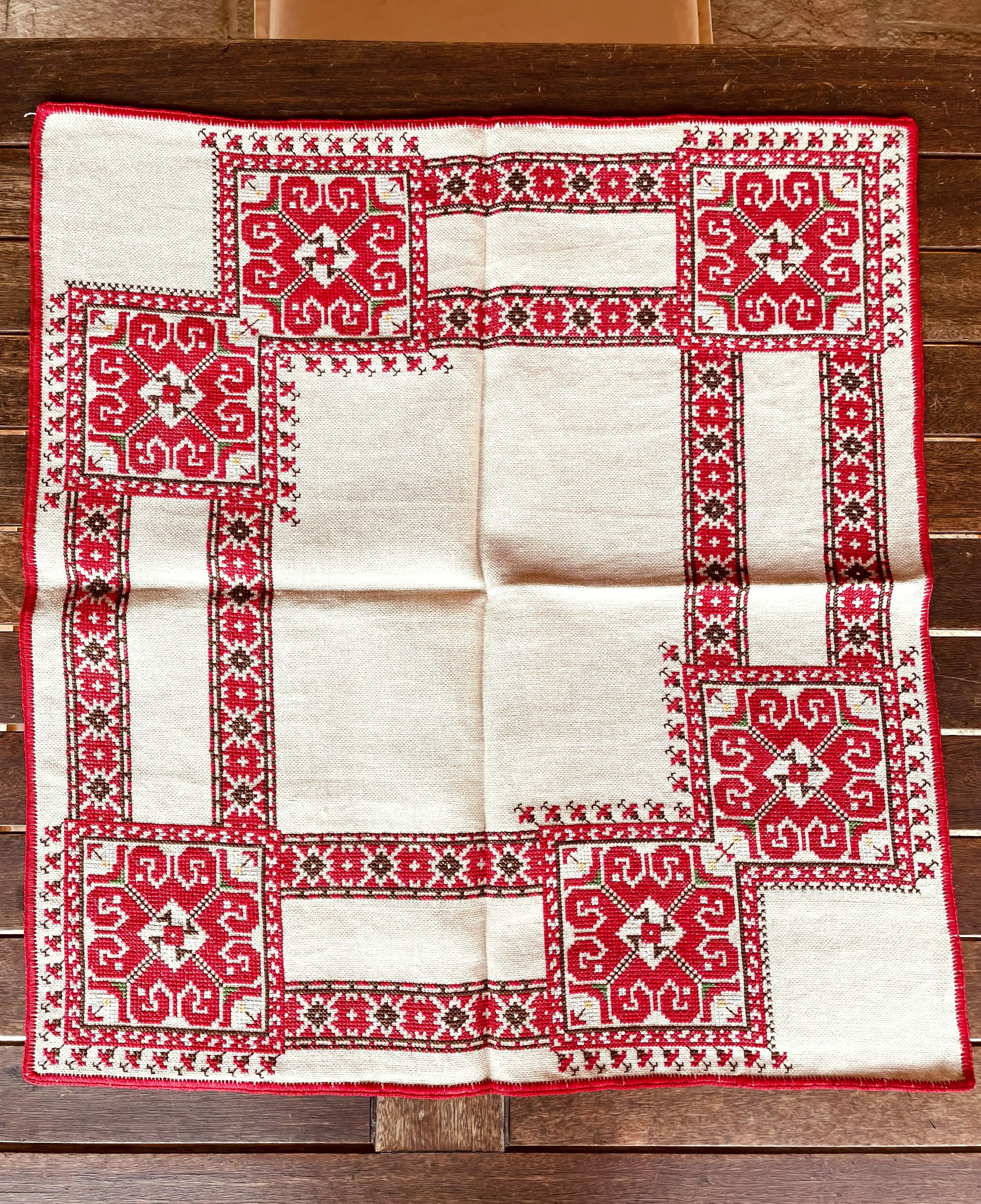
The surviving textile that inspired this article is organized around large square medallions, diamond-based structures, cross-like forms and repeated geometric borders.
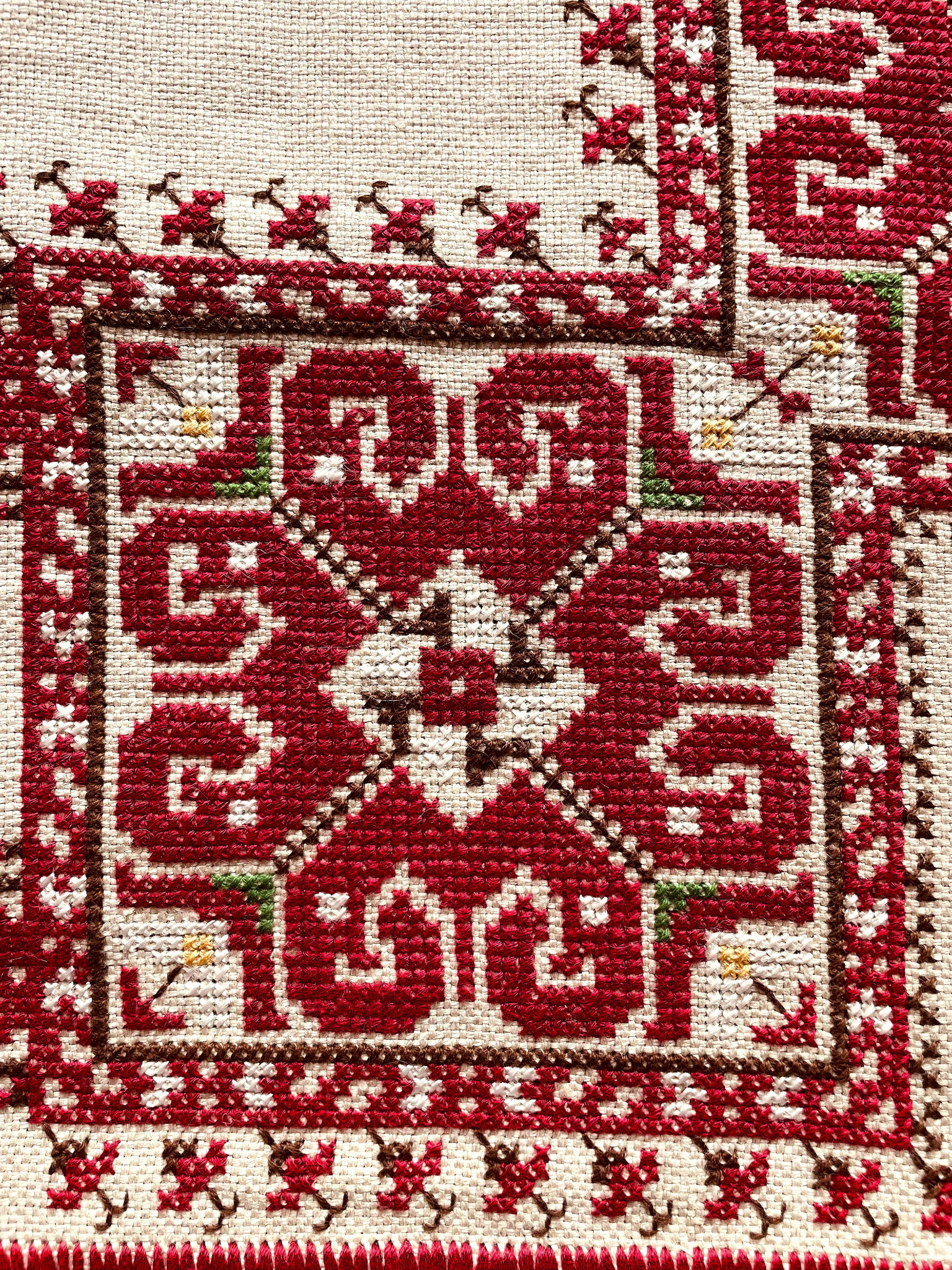
The strongest visual impression is one of deliberate order.
Shapes repeat, turn and contain one another. The eye is drawn toward the center of each medallion and then outward through surrounding bands of ornament.
In the context of a bridal textile, this ordered geometry becomes especially evocative.
Marriage marked the movement from one household into another and the beginning of a new domestic cycle.
The textile’s symmetry therefore invites interpretation through ideas of balance, continuity and stability.
The Square, the Rhombus and the New Household
Large square compositions dominate much of the embroidery.
In folk interpretations, the square is often associated with ideas of order, enclosure, stability and the earthly world.
Within and around these squares appear diamond or rhombus-like forms.
Such shapes have frequently been connected in Bulgarian folk interpretation with the feminine principle, fertility and continuation of the family.
That does not mean that every embroidered rhombus automatically carries exactly the same meaning.
Yet on a textile preserved through family tradition as part of a bridal trousseau, the relationship between geometric order, marriage and the continuation of the household becomes particularly meaningful.
Does the Embroidery Contain Kanatitsa?
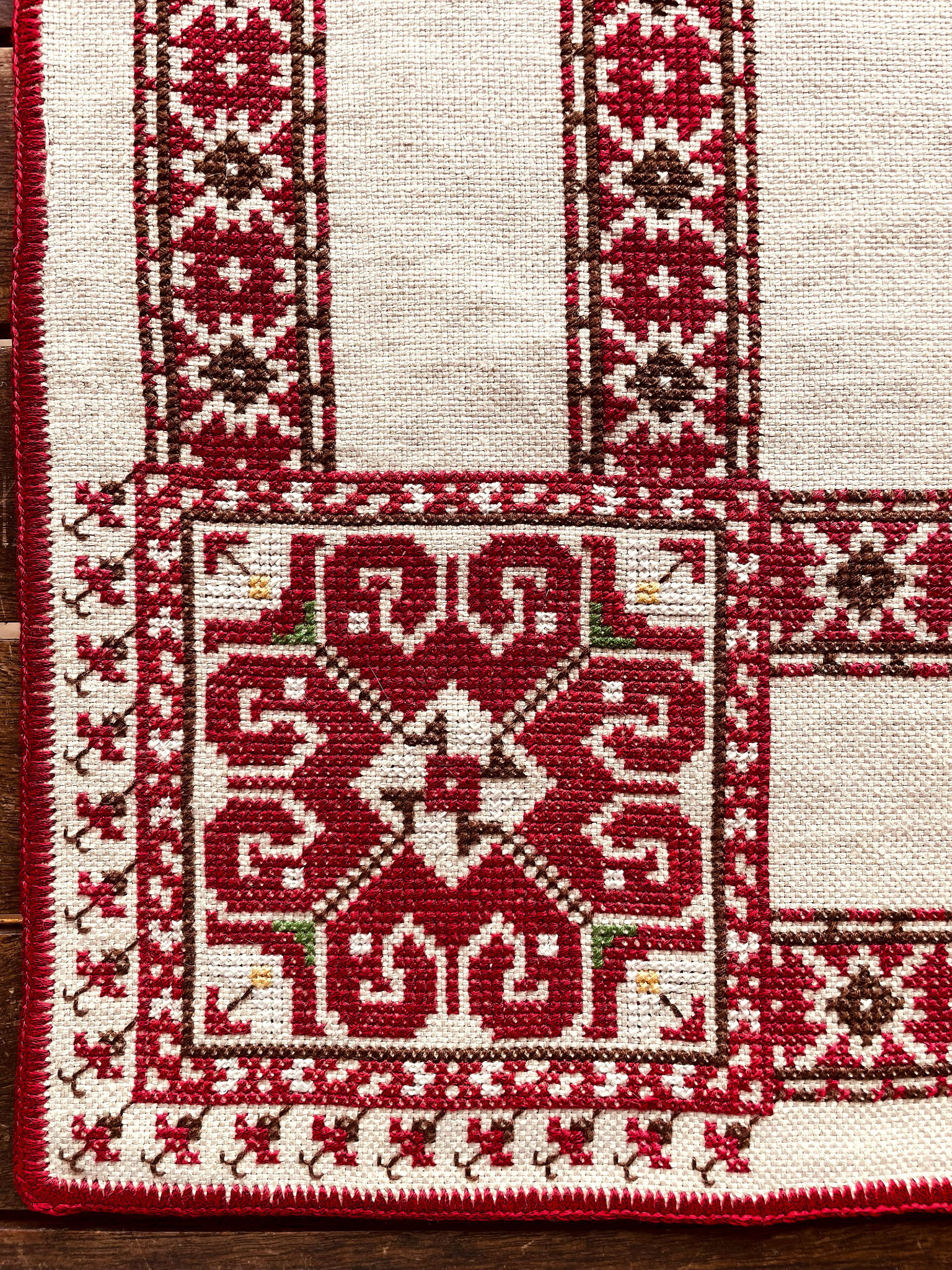
Some of the opposed triangular and diamond-based forms in the textile recall compositions associated today with the Bulgarian Kanatitsa motif.
Kanatitsa is commonly interpreted through ideas of wings, family, union and continuity, and modern Bulgarian explanations often connect its expanding geometric structure with successive generations.
Historic attribution, however, requires caution.
The appearance of a geometric form alone cannot prove that the woman who embroidered this particular textile called it Kanatitsa or intended one exact symbolic meaning.
It is therefore safer to place these elements within the broader tradition of Bulgarian geometric embroidery rather than assigning a definite historical motif name without documentary evidence.
Crosses, Stars and Balanced Forms
Cross-shaped and star-like forms are also visible within the composition.
Multi-directional motifs occur widely in Bulgarian decorative traditions and have been interpreted through ideas such as balance, direction, protection and the organization of space.
Solar associations are also present in Bulgarian folk art, although visual resemblance alone is not sufficient to identify a particular star-like form as a solar symbol.
What can be seen clearly in this textile is the maker’s repeated use of central points, axes, symmetry and opposing forms.
Red: Life, Vitality and Protection
Red is the dominant color of the embroidery.
Its importance reaches far beyond visual contrast.
In Bulgarian folk tradition, red has long been associated with life, blood, warmth, vitality and protection.
Red thread also appears in customs intended to guard people and households against illness, harmful influences or the evil eye.
This makes red especially meaningful in objects connected with important life transitions.
Marriage was one of those transitions.
For a young bride entering a new household, red could therefore combine aesthetic beauty with wishes for strength, life and protection.
The Border as a Protective Boundary
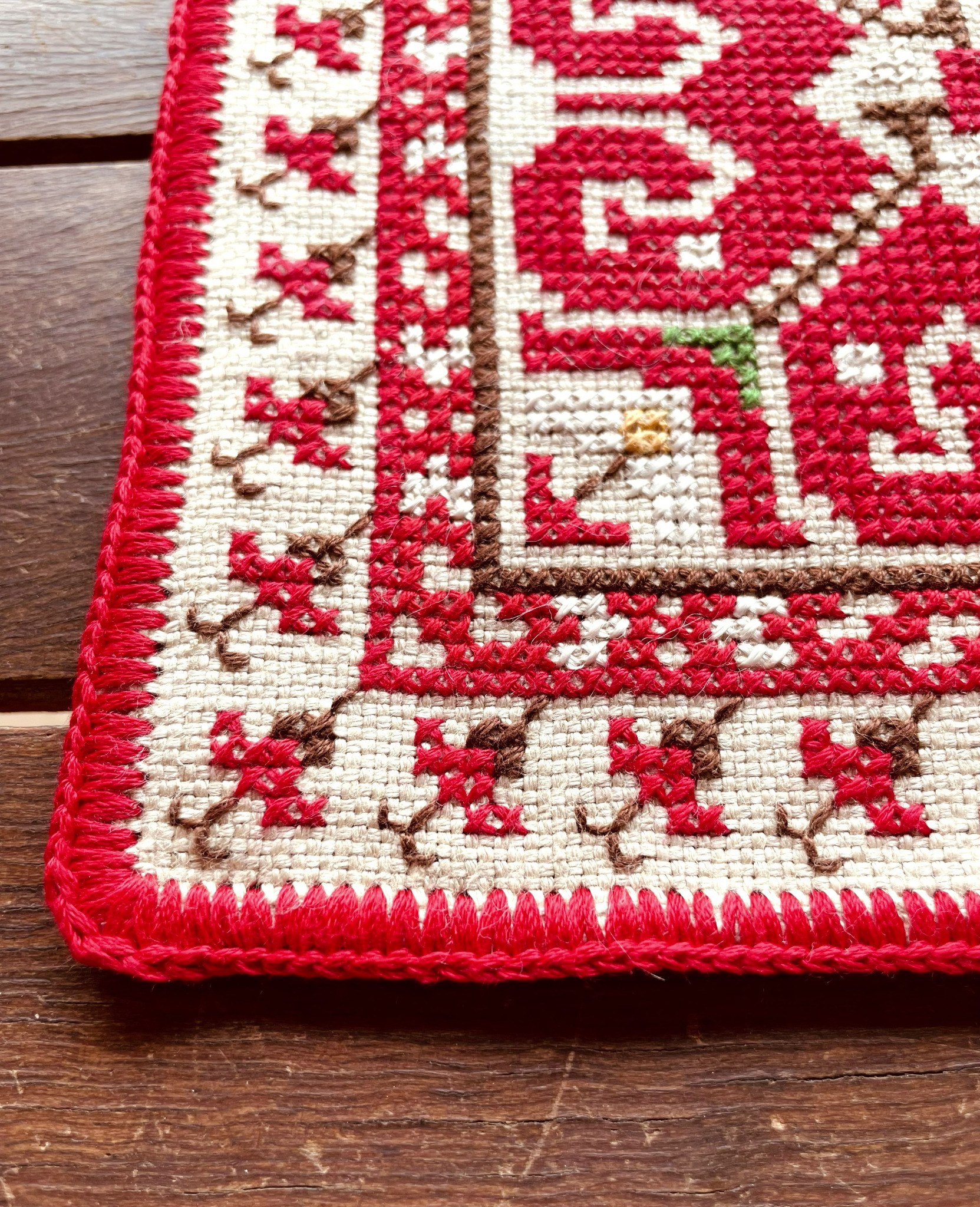
Borders naturally have a decorative function.
They frame a textile and bring visual order to the composition.
But boundaries also played an important role in traditional protective thinking.
On clothing, embroidery was frequently concentrated around openings and edges – places where the body symbolically met the outside world.
A household textile is not the same as a garment, and the meanings should not automatically be transferred from one object to another.
Yet the comparison remains interesting.
Here, the repeated border creates an unmistakable sense of an inside and an outside.
The central decorated area appears visually enclosed, ordered and protected.
White, Brown and the Visual Balance of the Design
The red ornament stands against a light woven ground and is balanced by brown and white details together with smaller green and yellow accents.
In folk interpretations, white can be associated with light, purity and renewal, while darker earth-like tones may suggest stability and grounding.
These interpretations should not be treated as universal rules.
Color meanings varied according to region, object and context.
What is immediately visible, however, is the artistic effect.
The restrained palette creates a strong rhythm in which red appears vivid against the pale ground while the darker stitches give structure to the geometric design.
Nature’s Palette – and the Limits of Identification
Traditional Bulgarian textile production possessed a rich knowledge of natural coloring.
Earlier generations used roots, bark, leaves and other natural materials to obtain different shades, often together with specialized preparation and fixing techniques.
Over time, industrial dyes became increasingly available and entered domestic textile production.
This distinction is particularly important for the textile examined here because it dates to approximately 1960.
Research Note: The dyes used in this textile have not been chemically analyzed. Its red, brown, green and yellow threads therefore cannot be identified as madder, walnut, nettle or any other specific natural dye solely from their appearance.
The history of natural dyes remains an important part of Bulgarian textile culture, but assigning a particular historical recipe to a twentieth-century textile without testing would be speculation.
Silk and Cotton: Texture, Light and Craftsmanship
According to the information accompanying the textile, the embroidery was worked with cotton and silk threads.
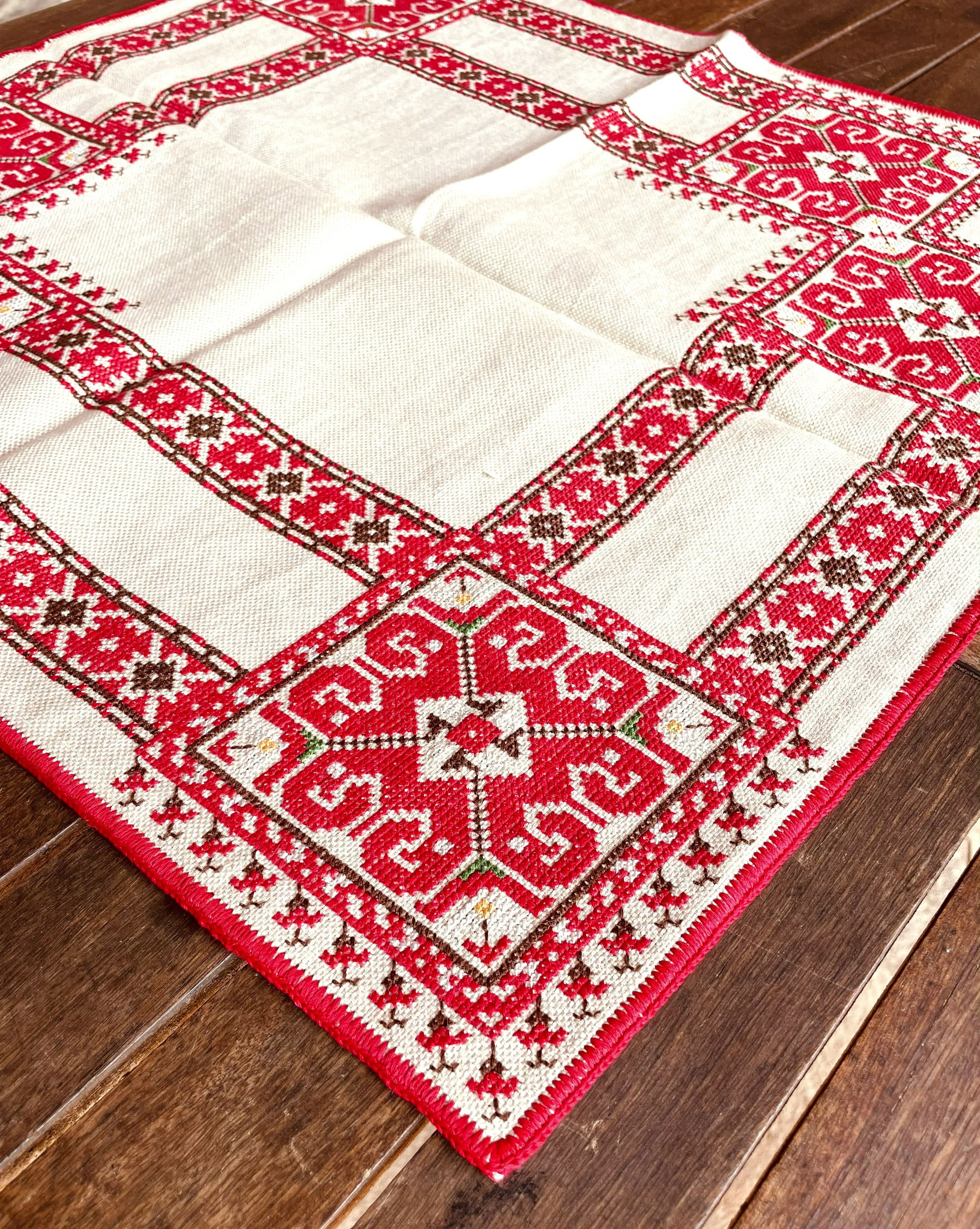
The two materials interact differently with light.
Cotton generally creates a softer, more matte effect, while silk can introduce a subtle sheen.
Used together in a dense geometric composition, these differences give the embroidery greater visual depth and allow details to change slightly as the viewing angle changes.
The effect is especially visible in close-up photographs, where the texture of individual stitches becomes part of the design itself.
Was Bulgarian Embroidery Magical?
To a modern reader, the word magical can sound exaggerated.
Traditional culture, however, did not always draw a clear line between aesthetics, household custom, religion, inherited belief and protection.
A color could be chosen because it was beautiful and because it was believed to protect.
A geometric form could create visual balance while also carrying an inherited association with well-being or fertility.
A household textile could be both useful and spiritually meaningful.
Ethnographers use the term apotropaic for symbols, colors or practices intended to repel harmful influences.
This protective dimension is an important part of Bulgarian folk culture.
It should not, however, be transformed into a rigid modern system in which every stitch is assigned a guaranteed magical function.
Embroidery, Taboos and Oral Tradition
Much of the knowledge surrounding embroidery was transmitted orally.
Older generations remembered rules, warnings and beliefs concerning when work should be started, how a woman should behave while working and what particular colors or forms might mean.
Such memories are historically valuable because folk knowledge was not preserved only in written records.
It also passed through mothers, grandmothers, neighbors and skilled women within the community.
At the same time, customs could differ significantly between individual villages and families.
Claims that every Bulgarian woman followed exactly the same rules about weekdays, moon phases or sewing after sunset should therefore be treated cautiously unless a specific regional tradition is documented.
What survives more consistently in oral memory is the belief that the intention, care and emotional state of the maker mattered.
The textile was being made for a future home and for people whose health, happiness and continuity mattered deeply to its maker.
A Textile Blessing for the New Family
Perhaps the best way to understand bridal embroidery is not as a secret code that can be completely translated today, but as a material blessing.
Hours of work were invested in an object destined for a woman’s future home.
Its geometry created order.
Its red thread carried strong protective associations.
Its enclosed forms suggested stability and continuity.
Its careful workmanship demonstrated preparation and patience.
And the finished textile crossed one of life’s most important thresholds together with the bride.
The people change. The house changes.
The world changes.
But the blessing remains in the thread.
A Surviving Textile from the Veliko Tarnovo Region
The object photographed throughout this article survives with family history connecting it to the Veliko Tarnovo region of Bulgaria.
According to the supplied family provenance, it formed part of a bridal trousseau and dates to approximately 1960.
The textile measures around 58 × 63 cm / 22.83 × 24.80 in.
Its hand embroidery combines large square geometric medallions with repeated ornamental bands, diamond structures, cross-like forms and meander-like elements.
Red dominates the composition, supported by brown and white with smaller green and yellow accents.
Object at a Glance
- Object: hand-embroidered decorative textile
- Origin: Bulgaria
- Region: Veliko Tarnovo region, according to family provenance
- Date: c.1960
- Context: bridal trousseau
- Size: approximately 58 × 63 cm / 22.83 × 24.80 in
- Technique: hand embroidery
- Threads: cotton and silk
- Main colors: red, brown and white with small green and yellow accents
- Decoration: square, diamond, cross-like and meander-like geometric forms
Why Provenance Matters with Folk Textiles
Domestic folk textiles rarely carry the kind of evidence collectors expect from factory-made antiques.
There may be no maker’s mark, serial number, printed label or written date.
Instead, much of their history survives through families.
A remembered bride, marriage, village, household or family relationship can therefore become an essential part of the object’s historical record.
Oral provenance should still be recorded carefully.
Rather than transforming family memory into absolute fact, responsible descriptions preserve its original status through phrases such as “according to family provenance” or “according to oral family history”.
Once this information disappears, it may be impossible to reconstruct.
Why Old Bulgarian Bridal Textiles Matter Today
Historic domestic textiles preserve a part of history that written documents often overlook.
Their makers were usually not famous artists.
Their names rarely entered catalogues or official archives.
Their work remained in family homes, chests, bedrooms and kitchens.
Yet these objects preserve evidence of craftsmanship, marriage traditions, expectations of domestic life, family memory and folk belief.
A surviving bridal textile is therefore not merely a decorative object from the twentieth century.
It is evidence of a personal transition between generations.
How to Examine an Old Bulgarian Embroidered Textile
-
Record the provenance.
Write down names, places, marriages and family stories while that information still survives. -
Examine both sides.
The reverse may reveal hand workmanship, construction details and later repairs. -
Study the threads in changing light.
Different fibers can reflect light differently. -
Examine the border and edges.
They may retain important evidence of original construction and use. -
Compare protected and exposed areas.
Differences can reveal fading and age-related change. -
Do not assign every motif a fixed meaning.
Regional and family interpretations could vary considerably. -
Do not identify dyes from color alone.
Scientific analysis is necessary for certainty. -
Avoid aggressive cleaning.
Historic fibers and dyes may respond unpredictably to modern detergents or bleaching. -
Preserve genuine age.
Natural wear and irregularities can form part of an object’s history.
Evidence vs. Interpretation
| What We Know | What Requires Caution |
|---|---|
| The textile is hand embroidered and is connected through family provenance with a bridal trousseau from the Veliko Tarnovo region. | The exact symbolic intention of every individual motif is unknown. |
| Bulgarian embroidery has documented symbolic and protective associations. | Geometric resemblance alone does not prove a particular named motif. |
| Bridal trousseaux formed an important part of traditional Bulgarian marriage culture. | Wedding customs did not take exactly the same form in every Bulgarian region. |
| Natural dyes have a long history in Bulgarian textile production. | The dyes in this c.1960 textile have not been scientifically identified. |
Frequently Asked Questions
What is a Bulgarian bridal trousseau?
A Bulgarian bridal trousseau, commonly known as cheiz, was a collection of clothing, textiles and household objects prepared for a young woman’s marriage and future home.
What does Bulgarian embroidery symbolize?
Traditional Bulgarian embroidery could express regional identity, craftsmanship and social context while also carrying protective or auspicious associations. Meanings differed according to region, object, color and family tradition.
Why is red common in Bulgarian embroidery?
Red has strong associations in Bulgarian folk tradition with life, vitality, warmth and protection. Red thread also appears in customs intended to protect people and households against harmful influences.
What does the diamond mean in Bulgarian embroidery?
Diamond and rhombus-like forms are often associated in folk interpretation with fertility, the feminine principle and continuity. These meanings should not be treated as universal for every textile or region.
Is this embroidery Kanatitsa?
Some elements resemble geometric compositions associated today with Kanatitsa, but the historic name and intended meaning of this particular pattern cannot be established from visual similarity alone.
Did Bulgarian embroidery have protective meaning?
Yes. Protective or apotropaic ideas form part of Bulgarian folk culture and are associated with certain colors, textile placements and decorative traditions. The precise interpretation, however, varied locally.
Were natural dyes used in Bulgarian embroidery?
Natural dyes have a long history in Bulgarian textile production. Industrial dyes later became widespread, so a textile dating to around 1960 should not automatically be assumed to contain naturally dyed threads.
Why are bridal trousseau textiles collectible?
They combine hand craftsmanship, social history, family memory and folk art. Age, provenance, regional context, materials, quality, condition and rarity can all influence collector interest.
Preserving More Than a Textile
Around 1960, the embroidered cloth featured here was created for a purpose very different from the one it serves today.
It was not intended for a museum, collector’s cabinet or online archive.
According to the family history that accompanied it, it belonged to the beginning of a marriage and a new household.
Decades later, the people and domestic world surrounding that moment have changed.
The textile remains.
Its stitches still preserve the rhythm of the maker’s hand. Its geometry still reflects order and repetition. Its red thread still carries associations deeply rooted in Bulgarian folk tradition.
That is why such objects deserve to be preserved not merely as decorative antiques, but as fragments of family memory and evidence of a disappearing material culture.
Sources & Further Research
- Institute of Ethnology and Folklore Studies with Ethnographic Museum at the Bulgarian Academy of Sciences – research into Bulgarian traditional culture, folk textiles and wedding customs.
- Bulgarian National Radio / Radio Bulgaria – cultural and ethnographic materials concerning Bulgarian embroidery, traditional dress, folk symbolism and wedding traditions.
- Ethnographic research documenting the preparation, display and transfer of bridal trousseaux in Bulgarian communities.
- Family provenance accompanying the textile featured in this article.
- Oral knowledge concerning embroidery, color and protective symbolism preserved through older generations.
- Direct visual examination of the textile’s embroidery, borders, materials and geometric composition.
Research & Interpretation Note
Traditional Bulgarian embroidery should not be reduced to a modern symbol dictionary in which every shape has one fixed translation.
Meanings varied between regions, communities, families and generations.
Where oral or family tradition survives, it deserves to be preserved alongside documentary and material evidence. Symbolic interpretations in this article are therefore presented as traditional associations rather than absolute identifications.
Last Updated: September 2026
Continue Exploring
Discover more research, collector guides and stories about antiques, historic textiles and folk traditions in
Stories & Knowledge
at The Old Antiquarian.
About The Old Antiquarian
The Old Antiquarian researches antiques, folk art, historic textiles and unusual objects from Europe’s historic crossroads.
Our aim is to preserve not only the physical object, but also the family memories, traditions, craftsmanship and cultural meanings that give it historical context.
Collectors united by history, not by borders.
