
Soviet S40-B pneumatic air horn
Soviet Pneumatic Air Horn from 1965: A Warsaw Pact-Era Military Mystery
Last Updated: September 2026
Some military objects survive because they were deliberately preserved. Others survive almost by accident – removed from obsolete machinery, placed on a depot shelf and forgotten while the military world around them disappears.
This large Soviet twin-tone pneumatic air horn appears to belong to the second group.
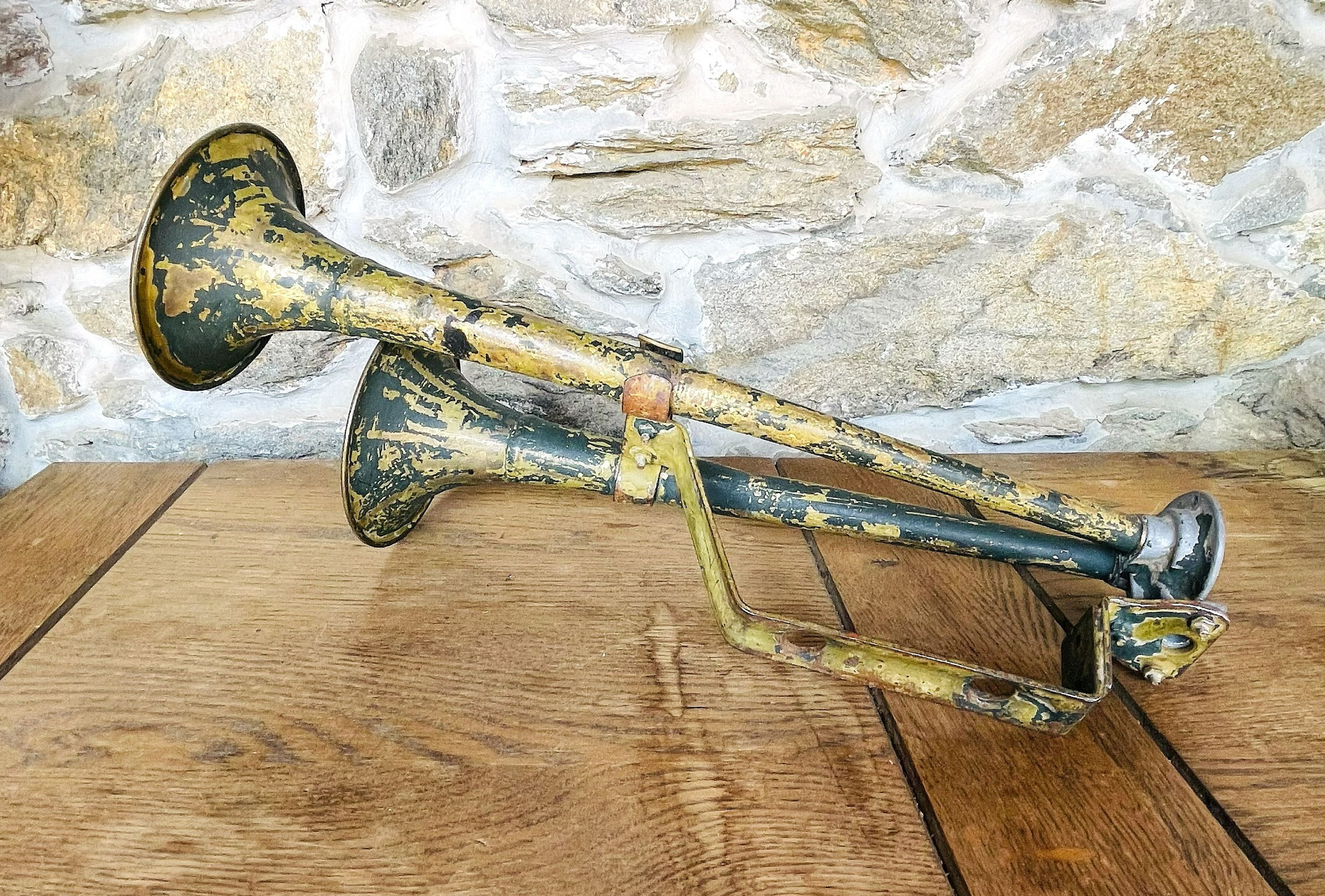
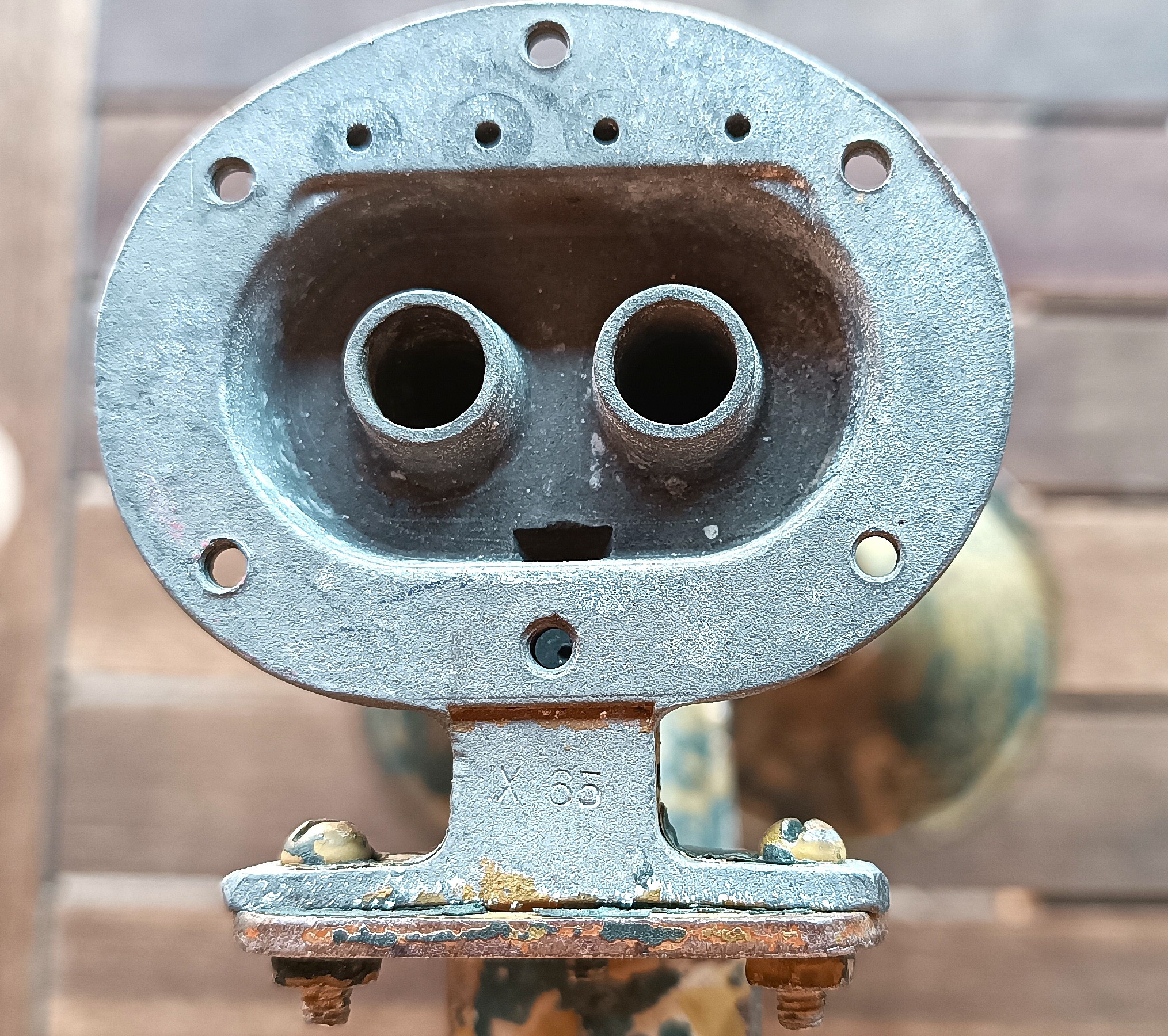
Its rear housing carries the stamped marking IX 65. Its two trumpet horns are different lengths. Beneath a later dark-green repaint survives an earlier lighter green coating. According to the provenance supplied with the object, it was eventually acquired from a military storage facility in Bulgaria.
We do not know which vehicle originally carried it. We do not know its unit, its driver or the roads it travelled.
But its date, construction, weight, paint and physical wear allow us to investigate the historical world through which an object of this type could have passed during the Cold War.
Quick Answer
This is a Soviet twin-tone pneumatic vehicle horn probably manufactured in September 1965. Its construction, dimensions and approximately 900 g weight are consistent with Soviet S40-series pneumatic signals, with the S40-B currently the strongest candidate.
The weight is especially significant: period documentation for the Ural-375 family lists an assembled S40-B pneumatic signal at approximately 0.93 kg, remarkably close to the approximately 0.90 kg measured for this example. According to supplied provenance information, the object later survived in Bulgarian military storage.
At a Glance
| Feature | Current Assessment |
|---|---|
| Object | Twin-tone pneumatic vehicle air horn |
| Origin | Soviet Union / USSR |
| Probable family | S40 series; probably S40-B or a closely related variant |
| Marking | IX 65 |
| Probable date | September 1965 |
| Long trumpet | Approx. 43 cm / 16.93 in |
| Short trumpet | Approx. 36 cm / 14.17 in |
| Bell diameter | Approx. 11 cm / 4.33 in each |
| Total weight | Approx. 900 g / 1.98 lb |
| Documented S40-B weight | Approx. 930 g in Ural-375 family parts documentation |
| Operation | Compressed air / pneumatic |
| Paint | At least two historic green paint layers |
| Provenance | According to supplied information, acquired from military storage in Bulgaria |
| Original vehicle | Not yet identified |
IX 65 – A Date Preserved in Metal
The most important chronological clue is stamped directly into the rear housing:
IX 65
The most plausible interpretation is IX = ninth month and 65 = 1965, giving a probable manufacturing date of September 1965.
This places the object firmly within the Cold War and within a period when the armed forces of the Warsaw Pact relied extensively on Soviet-designed trucks, artillery tractors, engineering vehicles and specialist machinery.
What the date tells us: this horn could not have participated in the Hungarian uprising of 1956 because it had not yet been manufactured. By contrast, it probably already existed three years before the Warsaw Pact intervention in Czechoslovakia in 1968.
Why Two Trumpets?
The two horns were deliberately produced at different lengths.
The longer trumpet measures approximately 43 cm / 16.93 in, while the shorter measures around 36 cm / 14.17 in.
When supplied with compressed air, the differently tuned trumpets create separate notes that combine into a powerful twin-tone warning signal.
On a heavy truck or specialist vehicle, such a signal had to be heard over engines, compressors, moving machinery, vehicle columns and the noise of military training grounds.
For generations of soldiers and conscripts who worked around Soviet-built military vehicles, the blast of a large pneumatic horn would have formed part of the everyday soundscape of military service.
The Strongest Technical Clue – S40-B
The most important technical comparison comes from period parts documentation for the Ural-375 family.
The catalogue records an assembled pneumatic warning signal with the part number S40-3721000-B, identified as type S40-B, for vehicles including the Ural-375, Ural-375D, Ural-375S, Ural-377 and Ural-377S.
Its listed weight is approximately 0.93 kg.
The horn examined here weighs approximately 0.90 kg / 1.98 lb.
Why the weight matters: the difference between the catalogued S40-B assembly and this object’s measured weight is only about 30 g. Weight alone cannot establish a model identification, but together with the twin-trumpet construction, dimensions and pneumatic housing it makes the S40-B identification substantially stronger.
This is more useful than identifying the horn purely by appearance. It gives us a measurable characteristic that can be compared with surviving technical documentation.
Related S40-series twin-tone pneumatic signals are also documented on other Soviet heavy vehicles, including KrAZ applications.
Until a factory model stamp or definitive vehicle-specific installation match is found, the most responsible identification remains:
Soviet S40-series twin-tone pneumatic horn, probably S40-B.
Which Vehicle Could Have Carried It?
This remains the most intriguing unanswered question.
No vehicle number, military unit marking or installation record survives with the horn, so assigning it to one particular truck would go beyond the evidence.
Period documentation explicitly lists the S40-B and gives an assembly weight of approximately 0.93 kg, remarkably close to this horn’s measured weight of around 0.90 kg.
Pneumatic twin-tone warning systems were also used on other Soviet heavy and specialist vehicles, making several vehicle families relevant to the investigation.
Period KrAZ-255 documentation records a related twin-tone pneumatic S40-series signal. This confirms that horns of the same general family were used on Soviet heavy trucks, but it does not establish this particular example as a KrAZ component.
There is another possibility that should not be overlooked.
Military components did not necessarily remain on one vehicle throughout their entire working life. Serviceable assemblies could be removed during overhaul, placed into spare-parts stocks and later fitted to another machine.
The horn may therefore have had more than one mechanical home during its working life.
A Possible Historical Journey
1968: Could It Have Witnessed Operation Danube?
Three years after the horn’s probable manufacture came one of the defining military and political events in the history of the Warsaw Pact.
In August 1968, Warsaw Pact forces entered Czechoslovakia and brought the Prague Spring reform movement to an end.
Bulgaria participated in the operation.
Bulgarian archival testimony identifies the 12th and 22nd Motor Rifle Regiments among the Bulgarian formations assigned to Operation Danube. Before the intervention, the units had been moved to Soviet territory and placed under the operational command created for the forthcoming action.
By then, this horn probably already existed.
Could it have been attached to a military truck travelling with a Soviet or Bulgarian formation during this period?
Chronologically – yes.
Historically proven – no.
Important historical distinction:
there is currently no document, photograph, vehicle number or unit marking connecting this individual horn with the 12th or 22nd Motor Rifle Regiment, with Operation Danube, or with any specific military operation. Its age allows the possibility; it does not prove participation.
That uncertainty is not a weakness in the story.
It is part of responsible historical research: the object can place us inside the period without allowing us to invent the exact journey it travelled.
Two Green Layers – A Service Life Written in Paint
Perhaps the most evocative physical evidence is the surviving finish.
The trumpet bodies and mounting bracket retain at least two distinct green coatings.
According to the object’s supplied history, the lighter green layer represents the earlier finish. Above it is a darker green repaint.
Where both layers have worn away, the underlying yellow metal of the trumpet bodies becomes visible.
The repaint cannot tell us exactly how long the horn remained in service. It does, however, establish one useful fact:
The object was painted and subsequently repainted.
That may have happened during routine maintenance, a repair programme, reassignment, refurbishment or continued military use.
It is therefore material evidence of at least one later intervention during the object’s life – although not proof of any particular unit, vehicle or period of service.
Why We Would Not Restore the Paint
The obvious temptation would be to remove the worn coatings and polish the yellow metal underneath.
From a historical perspective, that could erase some of the object’s most valuable evidence.
The earlier green finish, later repaint, scratches, worn edges, exposed metal, oxidised fasteners and IX 65 mark together form a physical archive of its working life.
Patina is not always damage.
Sometimes it is the only surviving record of an object’s working life.
Shield-82 – Seventeen Years After Manufacture
In 1982 Bulgaria hosted Shield-82, a major operational-strategic exercise of the armed forces of the Warsaw Pact.
Bulgarian archival records preserve official preparations for the exercise, while contemporary reporting described approximately 60,000 military personnel participating in ground, air and naval manoeuvres in Bulgaria and the Black Sea region.
The exercise began in late September 1982 and continued into the beginning of October.
By then, this horn would have been approximately seventeen years old.
For robust military vehicle equipment that had been maintained, repaired, repainted or transferred between machines, such an age would not automatically have meant retirement.
The surviving second paint layer makes the possibility of a long working life particularly interesting.
Could its twin-tone signal have been heard somewhere among the trucks and heavy vehicles associated with exercises such as Shield-82?
Chronologically and technically, it is plausible.
Historically, it remains unproven.
The Sound Remembered by Generations of Conscripts
Military history is often told through tanks, aircraft, generals, medals and political decisions.
Military service also had an everyday soundtrack.
Engines warming in a vehicle park. Compressors running. Metal doors closing. Workshop tools striking steel. Drivers preparing columns. Commands echoing across training grounds.
And suddenly, the unmistakable blast of a large pneumatic horn.
For generations of conscripts who worked around Soviet-designed trucks and specialist machinery, sounds of this type formed part of ordinary military life.
A technical component that seems insignificant in a parts catalogue may therefore carry a powerful human association for somebody who once heard it every day.
That is another form of Military Memory – not a battlefield or a medal, but a sound capable of returning decades later.
From Active Service to Forgotten Storage
At some point, the horn’s working life ended.
Perhaps its vehicle was withdrawn from service. Perhaps the horn was removed during repair. Perhaps it survived as a usable spare after the original machine was dismantled.
We cannot know from the object alone.
According to the supplied provenance, it eventually remained in Bulgarian military storage.
That storage may ultimately have saved it.
Many obsolete components disappeared as scrap following the end of the Cold War. Others remained on shelves, in workshops and in military depots long after the machines they served had vanished from active units.
This one survived.
A Second Life More Than Sixty Years Later
More than sixty years after the IX 65 marking was stamped into its housing, the horn has acquired an entirely different role.
For a military-vehicle restorer, it may eventually prove to be the missing period component required for a Ural-375, another Soviet heavy vehicle, or a machine using a compatible S40-series installation.
For a collector, it is a Cold War technical artifact with a visible date, unusual dimensions and strong traces of genuine working life.
For an interior, it can become a striking piece of industrial history without losing the surface that makes it historically meaningful.
And as an object of research, this relatively small mechanical component opens a much larger story – Soviet engineering, Warsaw Pact armies, vehicle parks, military exercises, repair workshops, spare-parts systems, repainting, storage depots and the disappearance of an entire military world.
Evidence vs. Possibility
| Question | Assessment |
|---|---|
| Soviet manufacture? | Very likely |
| September 1965? | Probable, based on IX 65 |
| S40-B? | Strong candidate, but not conclusively proven |
| Does the weight support S40-B? | Yes. Approx. 0.90 kg measured versus approx. 0.93 kg documented for the Ural-375 S40-B assembly |
| Ural-375 connection? | S40-B is specifically documented for the Ural-375 family; this individual horn’s vehicle remains unknown |
| KrAZ connection? | Related S40-series twin-tone pneumatic signals are documented on KrAZ heavy vehicles; this individual object’s origin is unproven |
| Military service? | Highly plausible given supplied military-storage provenance |
| Operation Danube, 1968? | Chronologically possible, not proven |
| Shield-82? | Chronologically plausible, not proven |
| Repainted? | Yes – at least two paint layers are physically visible |
| Military storage in Bulgaria? | According to supplied provenance |
Collector Checklist
- Record every stamp before cleaning. Small numbers, Roman numerals and inspection marks may contain dating information.
- Weigh the complete assembly. Period catalogue weights can provide surprisingly useful identification evidence.
- Measure each trumpet separately. Horn length and bell diameter can help distinguish variants.
- Photograph the mounting bracket. Installation geometry may eventually provide the best clue to the original vehicle.
- Preserve historic paint. Multiple coatings can provide evidence of repair, refurbishment or prolonged service.
- Search carefully for model markings. S40, S40-B, another S40-series designation or a factory mark could transform a probable identification into a firm one.
- Preserve provenance. Depot labels, photographs, paperwork and testimony can be as important as the mechanical object itself.
- Avoid aggressive cleaning. Sanding, blasting and chemical stripping can permanently destroy markings and original finishes.
Frequently Asked Questions
What is this Soviet twin-trumpet horn?
It is a twin-tone pneumatic vehicle warning horn designed to operate with compressed air. Its characteristics are consistent with the Soviet S40 family, with the S40-B currently the strongest candidate.
What does IX 65 mean?
The most plausible interpretation is the ninth month of 1965 – September 1965. Until factory documentation for this individual unit is found, the dating should remain described as probable rather than absolute.
Why is the 900 g weight important?
Period documentation for the Ural-375 family lists the complete S40-B pneumatic horn assembly at approximately 0.93 kg. This surviving example weighs approximately 0.90 kg. The close match supports the identification, although it cannot prove it by itself.
Was the S40-B used on the Ural-375?
Yes. Period parts documentation lists the S40-3721000-B pneumatic signal, type S40-B, for the Ural-375 family. However, there is no surviving evidence proving that this individual horn was mounted on a Ural-375.
Could this horn have come from a KrAZ?
Related twin-tone pneumatic S40-series equipment is documented on KrAZ heavy vehicles. A KrAZ connection is therefore relevant to the investigation, but the exact original vehicle of this horn has not been established.
Could it have been used during the 1968 invasion of Czechoslovakia?
The horn was probably already in existence, so this is chronologically possible. Bulgaria participated in Operation Danube, but no surviving evidence connects this individual object with the operation or with any specific Bulgarian or Soviet unit.
Could it still have been in service during Shield-82?
Yes in terms of age: the horn would have been approximately seventeen years old in 1982. A maintained military component could remain operational for many years, but there is no evidence that this particular example participated in Shield-82.
Why should the old green paint be preserved?
Because the surviving coatings document at least one repainting and therefore form part of the object’s material history. Removing them would erase physical evidence that cannot later be recovered.
Could it still be useful for a military vehicle restoration?
Potentially yes. Its value to a restorer would increase significantly if its exact S40 variant and original mounting application were confirmed. The pneumatic mechanism has not yet been tested.
The Mystery Is Not Finished
The most important unanswered question remains:
Which machine carried this horn?
The mounting bracket may eventually provide the answer.
Period workshop manuals, parts catalogues, archival photographs and surviving Ural, ZIL and KrAZ vehicles may allow the installation geometry to be compared in detail.
A former military driver or mechanic may even recognise the arrangement immediately.
That is why historical objects should be documented before restoration: sometimes the smallest surviving detail becomes the clue that completes the story.
Do You Recognize This Horn?
If you served with Soviet-built trucks or specialist military vehicles in Bulgaria or elsewhere in the former Warsaw Pact, we would be interested to hear from you.
Do you remember this type of twin-trumpet pneumatic signal? Do you recognize the mounting bracket? Was it fitted to a Ural, ZIL, KrAZ or another vehicle?
Personal memories, period photographs, workshop manuals and technical documents may help identify the machine from which this object came.
Explore More Military Memories
Sources & Further Research
-
Ural-375 family parts catalogue
– S40-3721000-B pneumatic signal, type S40-B, with a listed assembly weight of approximately 0.93 kg. -
KrAZ-255 parts documentation
– related twin-tone pneumatic S40-series warning equipment used on KrAZ heavy vehicles. -
Bulgarian National Radio Archive – Operation Danube, 1968
– archival testimony concerning Bulgarian participation and the 12th and 22nd Motor Rifle Regiments. -
Bulgarian State Archives – Decision No. 14 of 14 April 1982
– official material concerning preparations for the Warsaw Pact exercise Shield-82 in Bulgaria. -
UPI Archives – Shield-82, September 1982
– contemporary reporting describing approximately 60,000 participants in the ground, air and naval manoeuvres.
Research Note
When identifying historic military and technical objects, documented facts, technical matches and historical possibilities should be kept separate.
For this horn, the IX 65 marking, approximately 900 g weight, twin-trumpet construction, surviving paint layers and military-storage provenance create a strong body of evidence.
They do not yet establish the exact vehicle, military unit or events through which the object travelled.
Last Updated: September 2026
About The Old Antiquarian
The Old Antiquarian researches antiques, military memorabilia and unusual historical objects from Europe’s historic crossroads.
Our approach separates documented evidence from historical possibility. Marks, materials, repairs, wear, provenance and archival sources are considered together so that an object’s story can be explored without turning unanswered questions into invented facts.
This article is part of
Military Memories
– stories preserved in objects.
