
Ginori Porcelain
Ginori Porcelain: Doccia & Richard Ginori Marks, History, Dating, Identification & Value
Last Updated: September 17, 2026 | The Old Antiquarian
Doccia, Ginori and Richard Ginori are closely connected names in the same long Italian ceramic tradition, but they are not interchangeable in every historical context.
Doccia refers to the historic manufactory and locality near Florence; Ginori refers to the founding family and manufactory tradition; and Richard Ginori is the later company identity created after the 1896 merger with Società Ceramica Richard.
For collectors, the safest identification method combines the exact mark, porcelain body, form, decoration, manufacturing technique, production period, condition and comparison with documented examples.
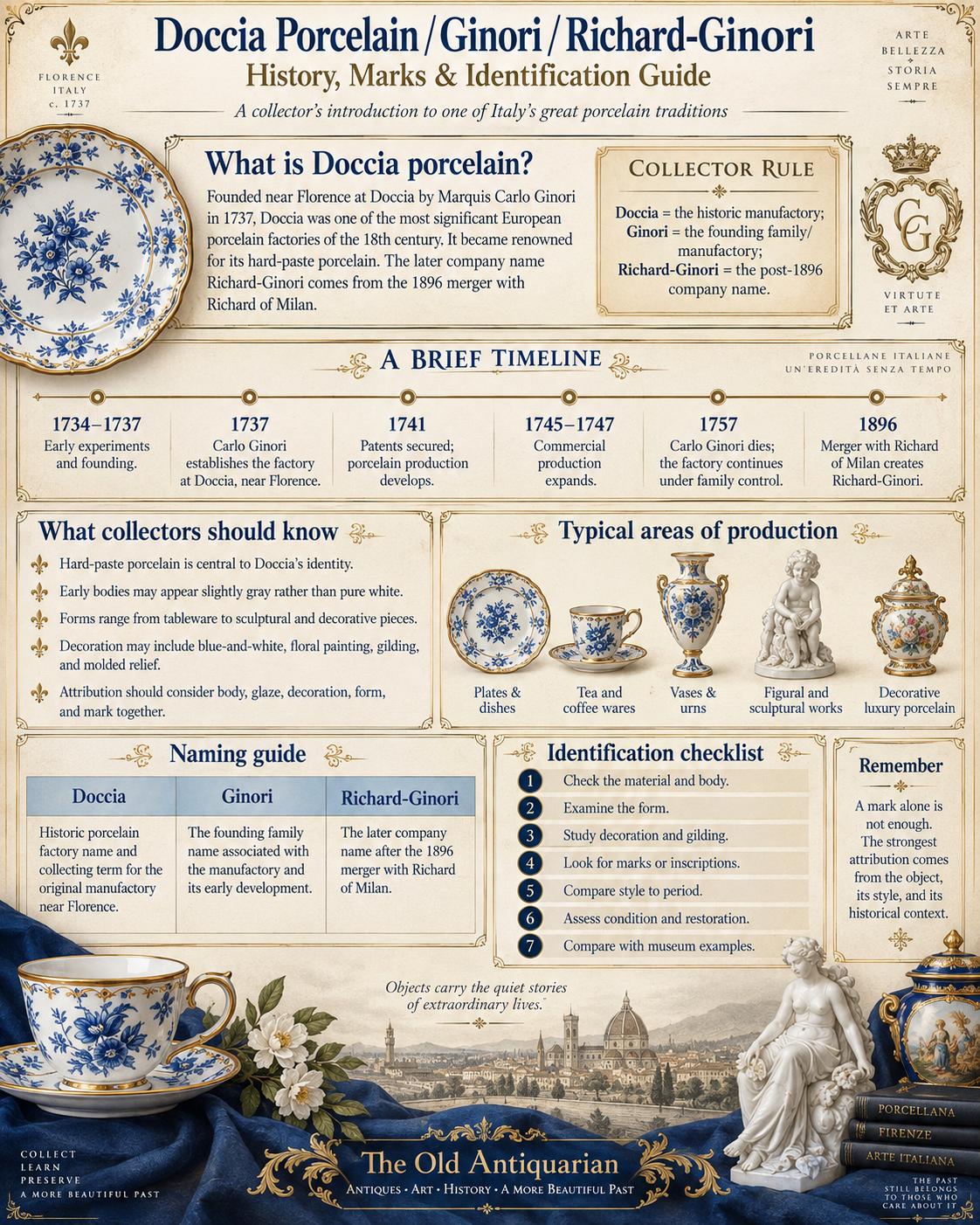
Ginori Porcelain at a Glance
| Question | Collector Answer |
|---|---|
| What is Doccia porcelain? | Porcelain associated with the historic Ginori manufactory at Doccia, near Florence. |
| Who founded Ginori? | Marquis Carlo Ginori established the porcelain enterprise at Doccia in the eighteenth century. |
| Why do some sources say 1735 and others 1737? | Ginori’s modern corporate history dates its foundation to 1735, while major museum cataloguing commonly uses 1737 for the historic Doccia manufactory and its established production history. |
| What is Richard Ginori? | The company identity formed after the Ginori manufactory joined Società Ceramica Richard in 1896. |
| Was early Doccia porcelain hard-paste? | Yes. Hard-paste porcelain is central to the historic Doccia tradition, although later Richard Ginori production also included other ceramic bodies. |
| Does a Ginori mark prove authenticity? | No. Marks must agree with the body, form, decoration, technique and expected period. |
| What objects were produced? | Tableware, tea and coffee wares, dishes, trays, vases, urns, decorative vessels, sculptural figures and later modern design pieces. |
| What determines value? | Exact period, model, designer or modeller where documented, decoration, rarity, condition, restoration, provenance and comparable completed sales. |
The object must support the mark. Never identify or date Ginori porcelain from the backstamp alone.
What Is Ginori Porcelain?
Ginori porcelain belongs to one of the most important traditions in
Italian porcelain.
Its history begins at Doccia, near Florence, where the Ginori family developed an ambitious porcelain manufactory during the eighteenth century.
Collectors encounter several names on museum labels, auction catalogues, reference books and backstamps:
Doccia, Ginori, Manifattura di Doccia,
Richard Ginori and, in the modern period, Ginori 1735.
These names describe different stages or ways of referring to a long manufacturing tradition rather than five completely unrelated factories.
Early Doccia production is especially important in European ceramic history because the manufactory became a major producer of hard-paste porcelain and also developed an ambitious sculptural programme alongside tableware and decorative objects.
Doccia vs Ginori vs Richard Ginori: What Is the Difference?
One of the most common search questions is whether Doccia, Ginori and Richard Ginori are the same thing.
The simplest answer is that they belong to the same historical manufacturing lineage, but each name is most useful in a different context.
| Name | Best Meaning | Best Collector Use |
|---|---|---|
| Doccia | The historic place and manufactory near Florence. | Especially useful for early and eighteenth-century production. |
| Ginori | The founding family and historical manufactory identity. | Useful across eighteenth- and nineteenth-century factory history. |
| Manifattura di Doccia | Historic descriptive name for the Doccia manufactory. | Often appears in scholarly and museum contexts. |
| Richard Ginori | The later company identity created after the 1896 merger. | Best for post-1896 production, marks and design history. |
| Ginori 1735 | The modern brand identity referring back to the eighteenth-century origin of the house. | Current production and modern company history. |
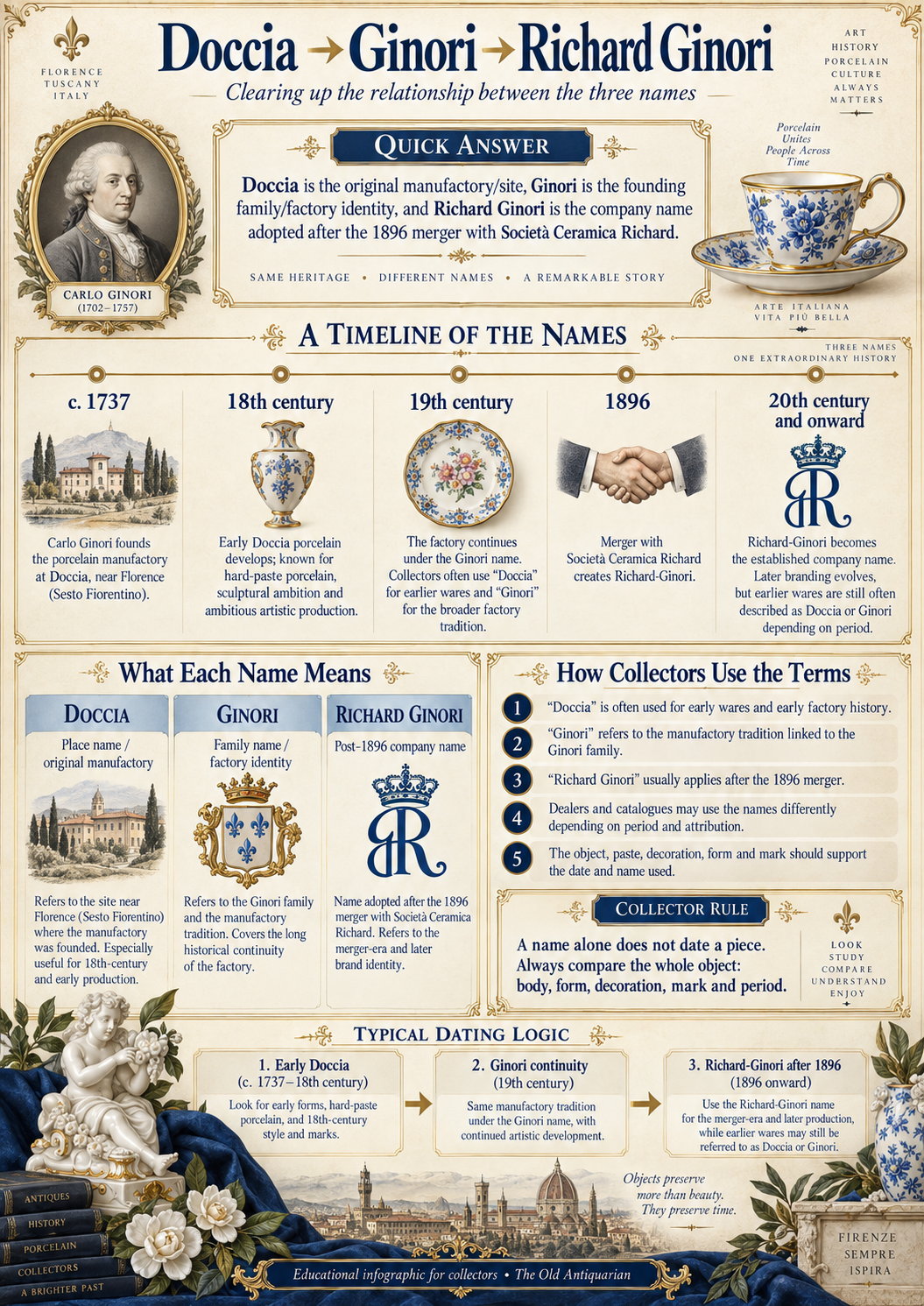
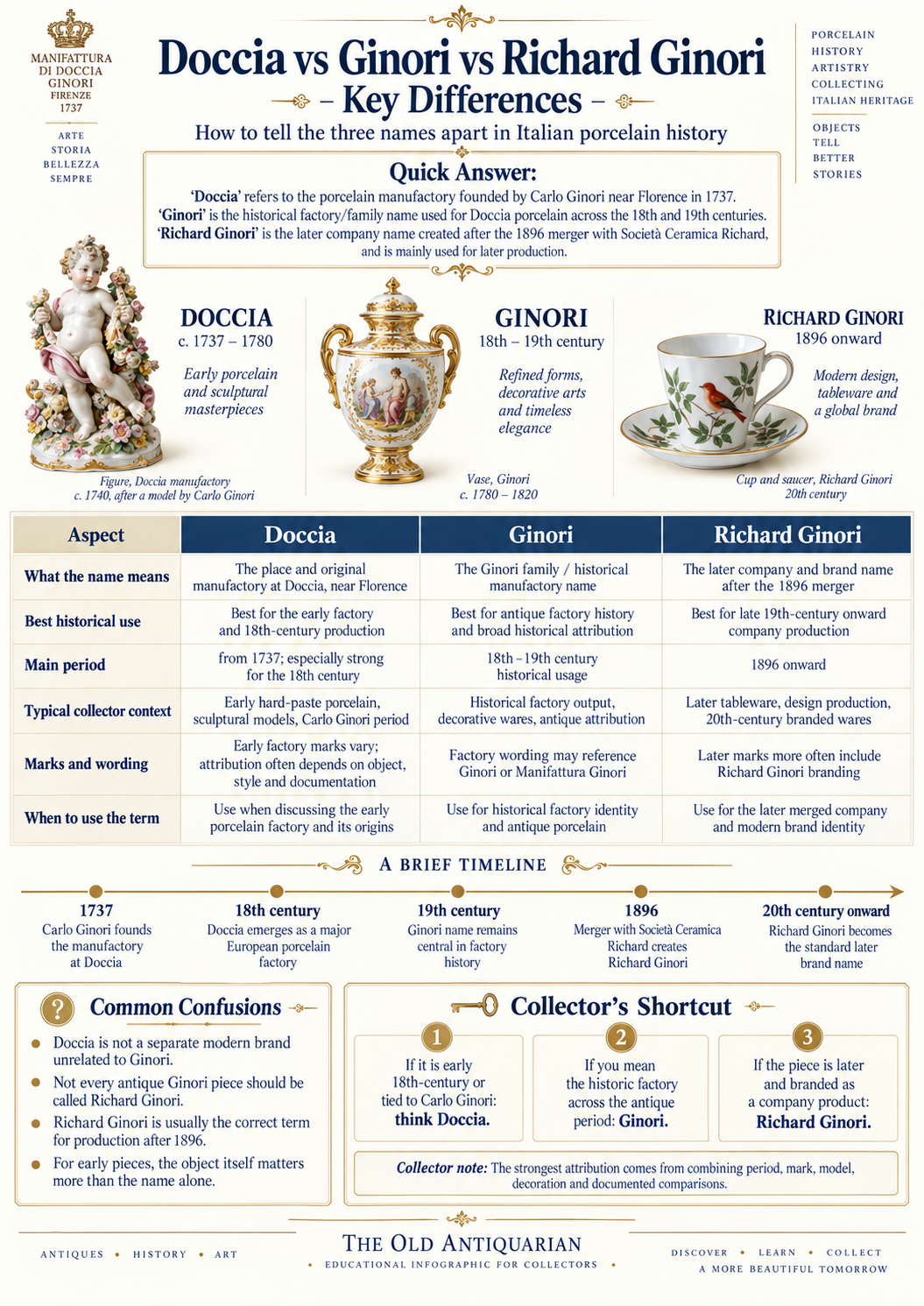
Why Do Some Sources Say Ginori Was Founded in 1735 and Others 1737?
Collectors frequently encounter both dates, and the difference can appear confusing.
The safest approach is to preserve the terminology used by the source being consulted.
The modern Ginori 1735 company traces its foundation to 1735, when Carlo Ginori began the porcelain enterprise at Doccia.
Major museum scholarship, including The Metropolitan Museum of Art, commonly catalogues the historic
Doccia Porcelain Manufactory as 1737–1896 and treats 1737 as a key point in its established development.
The Met also notes that Carlo Ginori was experimenting with ceramics before that date, that patents were secured in 1741, and that the factory began producing on a commercial scale during the mid-1740s.
Do not force every object into a single simplified “founded in” formula.
For broad company history, “Ginori traces its origins to 1735” is appropriate.
For museum-style discussion of early Doccia production, the 1737 chronology is also well documented.
History of Doccia and Ginori Porcelain
Early Experiments and Carlo Ginori
Carlo Ginori was not simply a financial patron.
Historical research presents him as deeply involved in experiments with porcelain bodies, glazes and enamels.
The early factory drew on specialist knowledge from outside Tuscany while developing a distinctive Florentine identity.
By the 1740s, Doccia was producing technically ambitious hard-paste porcelain.
Its output ranged from practical wares to objects intended to demonstrate artistic and technical skill.
Sculpture became particularly important, with the manufactory adapting prestigious models associated with classical and Florentine art.
Mid-Eighteenth-Century Expansion
The surviving output shows that Doccia did not follow one single decorative formula.
Early production included polychrome enamels, gilding, blue-and-white decoration, European floral painting and designs shaped by wider international influences.
A documented Doccia dish of about 1745 in The Metropolitan Museum of Art, for example, uses cobalt-blue decoration inspired by Chinese porcelain while the stylised floral treatment also recalls İznik ceramics.
This illustrates how international visual languages were adapted rather than simply copied.
After Carlo Ginori
After Carlo Ginori died in 1757, the manufactory continued under family control.
Through the eighteenth and nineteenth centuries the factory expanded its repertoire, revisited earlier forms and responded to changing Neoclassical, Romantic, Historicist and international decorative tastes.
1896 — Richard Ginori
The year 1896 is fundamental when reading Richard Ginori marks.
The Ginori manufactory joined the Milanese Società Ceramica Richard, creating the
Società Ceramica Richard-Ginori.
From this point onward, the Richard Ginori name became central to later company identity.
The Twentieth Century and Modern Design
The twentieth century added an important modern-design chapter.
Richard Ginori collaborated with leading designers, most famously Gio Ponti, whose work brought classical references, modern geometry and a new decorative language into the factory’s production.
| Period | Historical Orientation | Collector Focus |
|---|---|---|
| 1730s–1757 | Carlo Ginori and formative Doccia production. | Body, early forms, sculptural models, documented decoration and early marks or inscriptions. |
| Later 18th century | Continued Ginori family production and stylistic expansion. | Form, decoration, model history and period comparison. |
| 19th century | Expanded range, historicism, tableware and decorative production. | Factory wording, impressed marks, model information and style. |
| 1896 onward | Richard-Ginori company period. | Company marks, factory location, material, pattern, designer and production context. |
| 20th century | Industrial production and important modern design collaborations. | Exact backstamp, pattern, designer, material and production period. |
| Modern Ginori 1735 | Contemporary luxury brand continuing the historic manufacturing identity. | Do not describe modern production as antique simply because the name refers to 1735. |
Ginori and Richard Ginori Marks
Searches for Richard Ginori marks, Ginori porcelain marks and
Doccia porcelain marks are among the most useful starting points for identification,
but the exact mark should be treated as evidence rather than a final answer.
Depending on period and object, collectors may encounter painted symbols, impressed wording,
printed backstamps, factory names, place names, country-of-origin wording, pattern or model numbers,
decorator information and other production marks.
For the broader method of reading factory symbols, typography, secondary numbers and backstamps,
see our
Porcelain Marks Identification Guide
.
| Mark Type | What It May Indicate | What to Check |
|---|---|---|
| Painted symbol | Possible factory, decorator or production reference. | Exact shape, colour, application method and documented historical comparison. |
| Impressed GINORI wording | Historical factory attribution. | Lettering, body, form, period and associated numbers. |
| DOCCIA / place wording | Association with factory location or production identity. | Typography, printing technique and accompanying symbols. |
| RICHARD GINORI | Later company identity. | Exact logo, crown or emblem where present, wording, factory and material. |
| ITALY / Made in Italy | Country or export wording. | Use as a broad chronological clue only; never as an exact date by itself. |
| Numbers | Shape, model, pattern, decoration, mould or production information. | Never assume that a number is a year without documentation. |
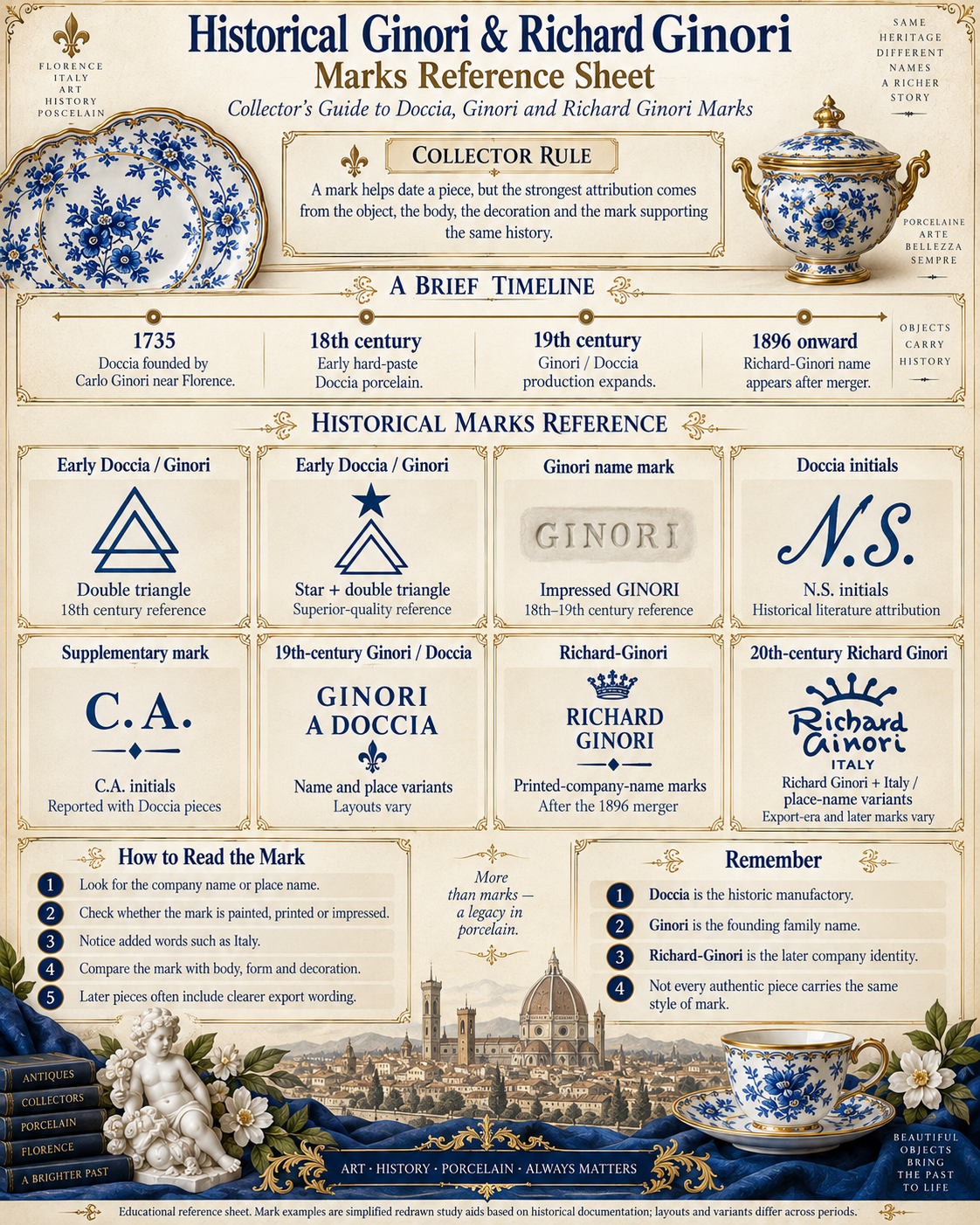
A convincing-looking mark can still be misread, copied, reused or applied to a later object.
Authentication depends on whether the complete object is historically consistent with the mark.
How to Date Ginori Porcelain by Marks and Period
Dating Ginori porcelain usually means establishing a credible production range rather than extracting one exact year from a single backstamp.
A mark becomes much more useful when the form, body, decoration and documented factory history all point toward the same period.
For the general methodology behind porcelain dating, see
How to Date Antique Porcelain
.
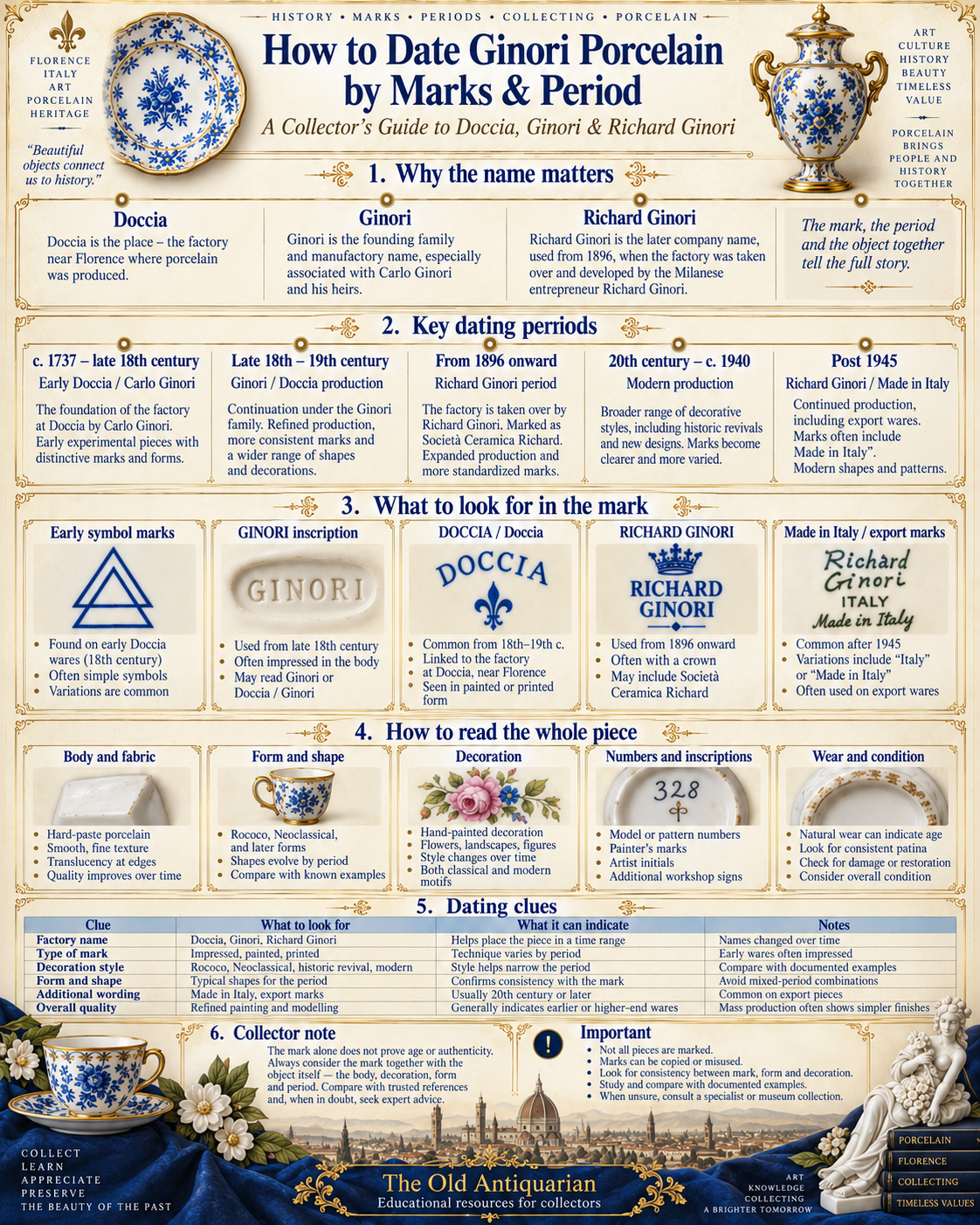
| Dating Evidence | Questions to Ask | Reliability |
|---|---|---|
| Exact mark variant | Is the typography, symbol, colour and application method documented for the proposed period? | High when well documented. |
| Factory wording | Does it say Ginori, Doccia, Richard Ginori, Italy or another location/company form? | Useful, but transitions can overlap. |
| Model / shape | Is the object form documented in factory, museum or period catalogues? | High when model history is known. |
| Decoration | Does the painting, gilding or printed decoration fit the proposed period? | Supporting evidence. |
| Material | Is the ceramic body appropriate for this factory, product and period? | Essential. |
| Designer / artist | Can the design be documented to a named collaborator or production period? | Potentially very strong. |
| Country wording | Is export wording present? | Broad clue, not an exact date. |
| Condition and wear | Is wear consistent with use, shape and decoration? | Supporting only. |
How to Identify Authentic Antique Ginori Porcelain
Identification should move from the complete object toward the mark, not from the mark toward a predetermined conclusion.
This method is especially important with an old, famous and continuously evolving manufacturer.
If you are still learning the general process, our
Antique Porcelain Identification Guide
explains the same multi-factor approach across different factories.
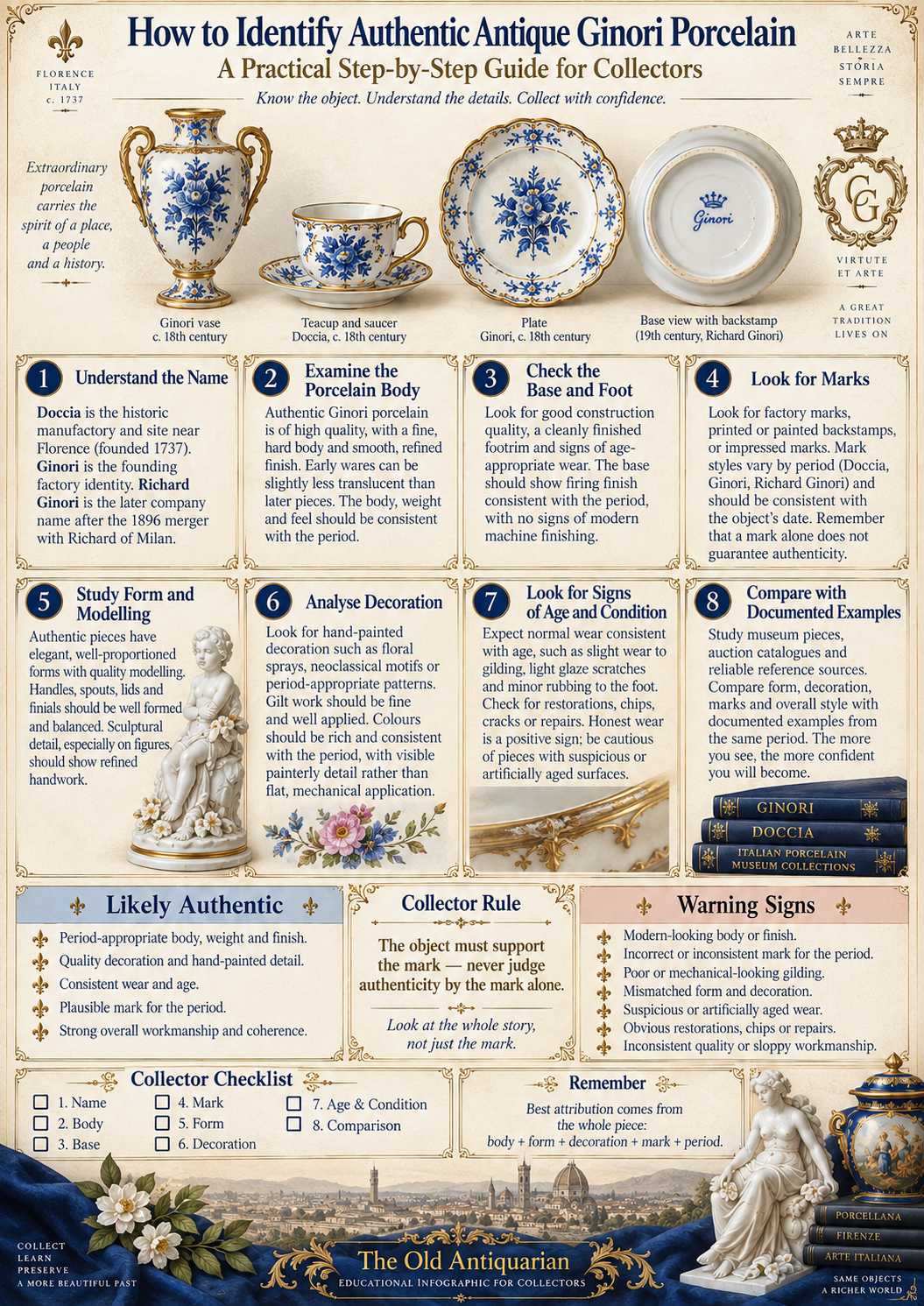
Identify the name in context.
Is the object being described as Doccia, Ginori, Richard Ginori or modern Ginori 1735?
Identify the ceramic body.
Do not assume every Richard Ginori object is porcelain simply because of the manufacturer name.
Inspect the entire base.
Photograph the foot, unglazed areas, marks, numbers and secondary inscriptions.
Record the exact mark.
Note lettering, colour, crown, symbols, application method and every accompanying number.
Study the form.
Compare handles, rims, feet, finials, proportions and sculptural modelling with documented examples.
Analyse decoration.
Determine whether it is hand-painted, printed, underglaze, overglaze, gilded or mixed technique.
Inspect condition.
Look for chips, hairlines, repainting, regilding, overspray, replacement components and old restoration.
Compare documented examples.
Museum collections, factory history and specialist references carry more weight than unsourced marketplace descriptions.
Ginori Porcelain Body and Manufacturing Clues
Historic Doccia is strongly associated with hard-paste porcelain.
Early examples can differ visibly from later, more refined porcelain, and some eighteenth-century pieces may show a body that is not the brilliant white collectors sometimes expect.
The Metropolitan Museum of Art has noted a grey tone and some coarseness in the paste of certain early Doccia trays, characteristics that support an early manufacturing date.
This is an important reminder that “old porcelain” does not always look perfectly white, thin or uniform.
Later Richard Ginori history is broader than porcelain alone.
The company produced multiple ceramic bodies and industrial products in different periods, so material identification remains essential.
Manufacturer name ≠ ceramic body. Identify whether the individual object is porcelain, earthenware, stoneware or another ceramic material before cataloguing it.
Ginori Porcelain Styles and Decorative Periods
Three centuries of production mean that there is no single “Ginori style.”
Objects associated with Doccia and Ginori can reflect Baroque, Rococo, Neoclassical, Empire, Romantic, Historicist, Art Nouveau, Art Deco and modern design influences.
Style is therefore useful for orientation, but it should never be used as a substitute for factory history or mark research.
A later historicist object may deliberately revive an eighteenth-century form.
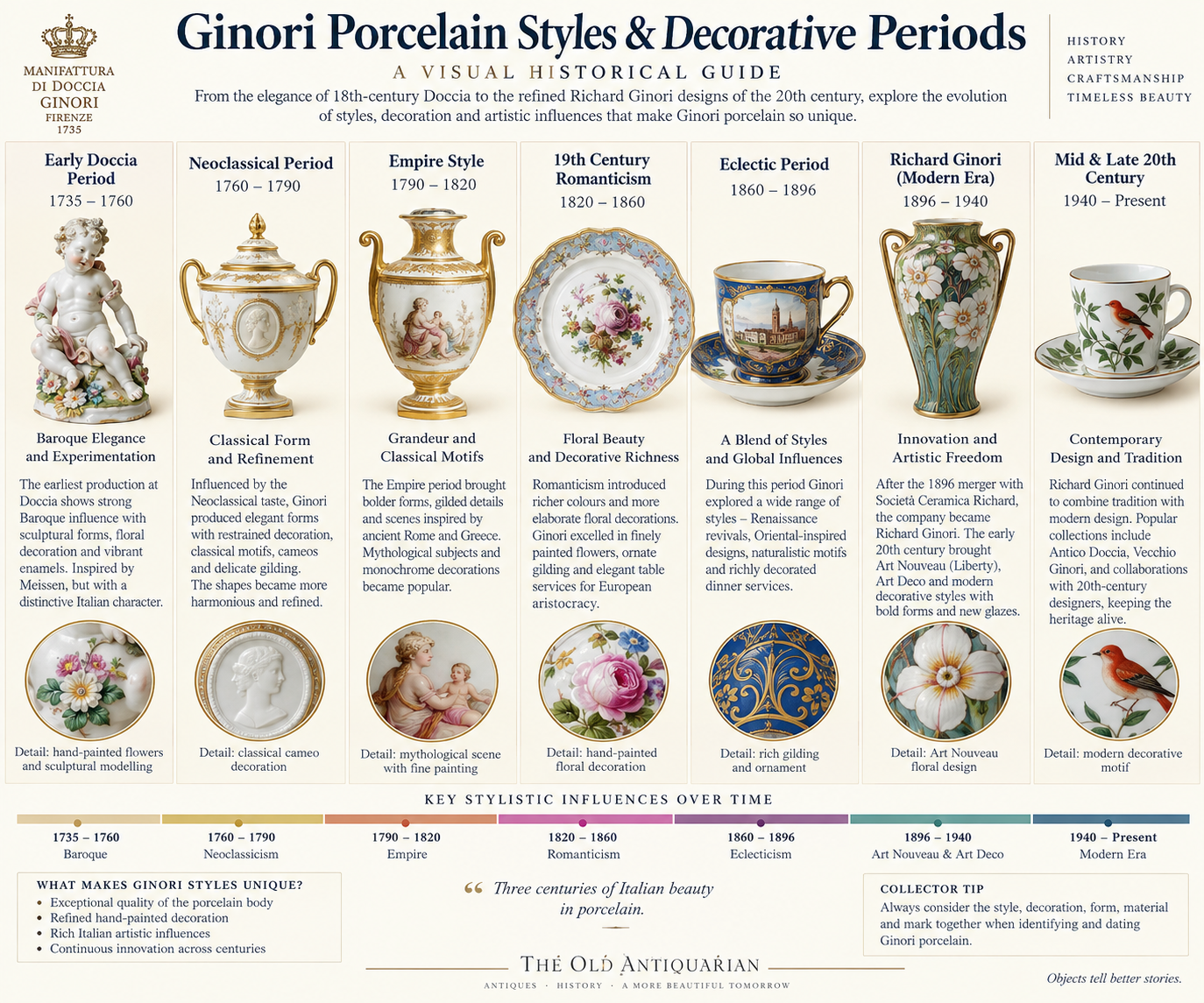
| Broad Style | Typical Collector Clues | Caution |
|---|---|---|
| Baroque / Rococo | Sculptural modelling, curves, flowers, elaborate handles and ornamental forms. | Later revival pieces may imitate earlier shapes. |
| Neoclassical | Classical profiles, medallions, restrained symmetry and ancient-inspired subjects. | Common across more than one period. |
| Empire | Monumental forms, gilding, classical imagery and formal symmetry. | Decoration should be compared with body and mark. |
| Romantic / Naturalistic | Flowers, landscapes, richer colour and decorative tableware. | Floral painting alone cannot establish maker or date. |
| Historicist / Eclectic | Revival forms, varied ornament, complex gilding and references to earlier periods. | Often intentionally mixes historical vocabulary. |
| Art Nouveau / Art Deco | More modern line, stylisation, geometric or highly designed decorative schemes. | Designer attribution requires documentation. |
| Modern Ginori | Historic designs coexist with contemporary collaborations and luxury tableware. | Historic-looking design does not mean antique. |
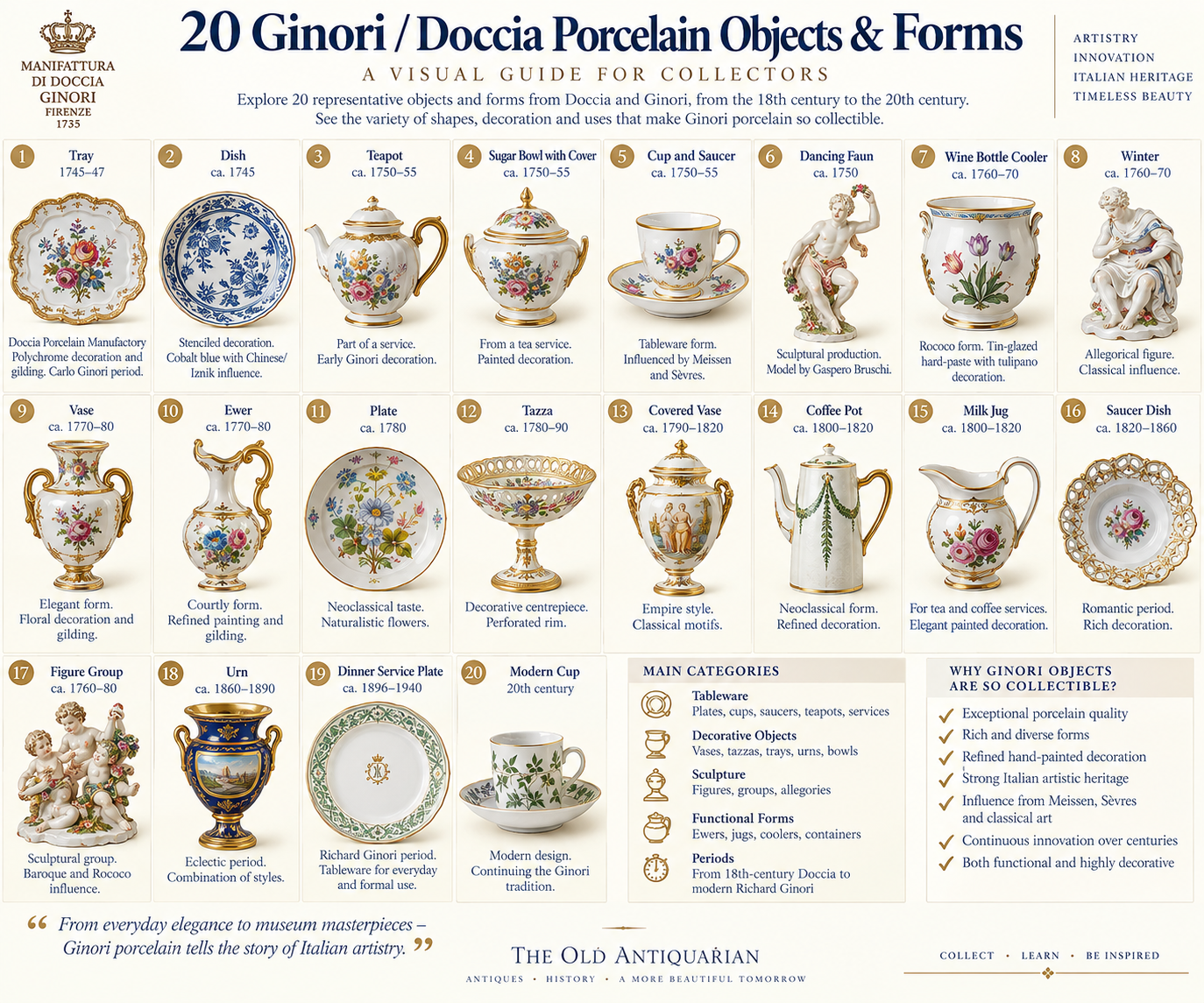
Ginori and Doccia Porcelain Objects and Forms
The range of production is one reason Ginori is such a useful subject for collectors.
A collection can include both practical tableware and ambitious sculpture, with very different criteria for attribution and value.
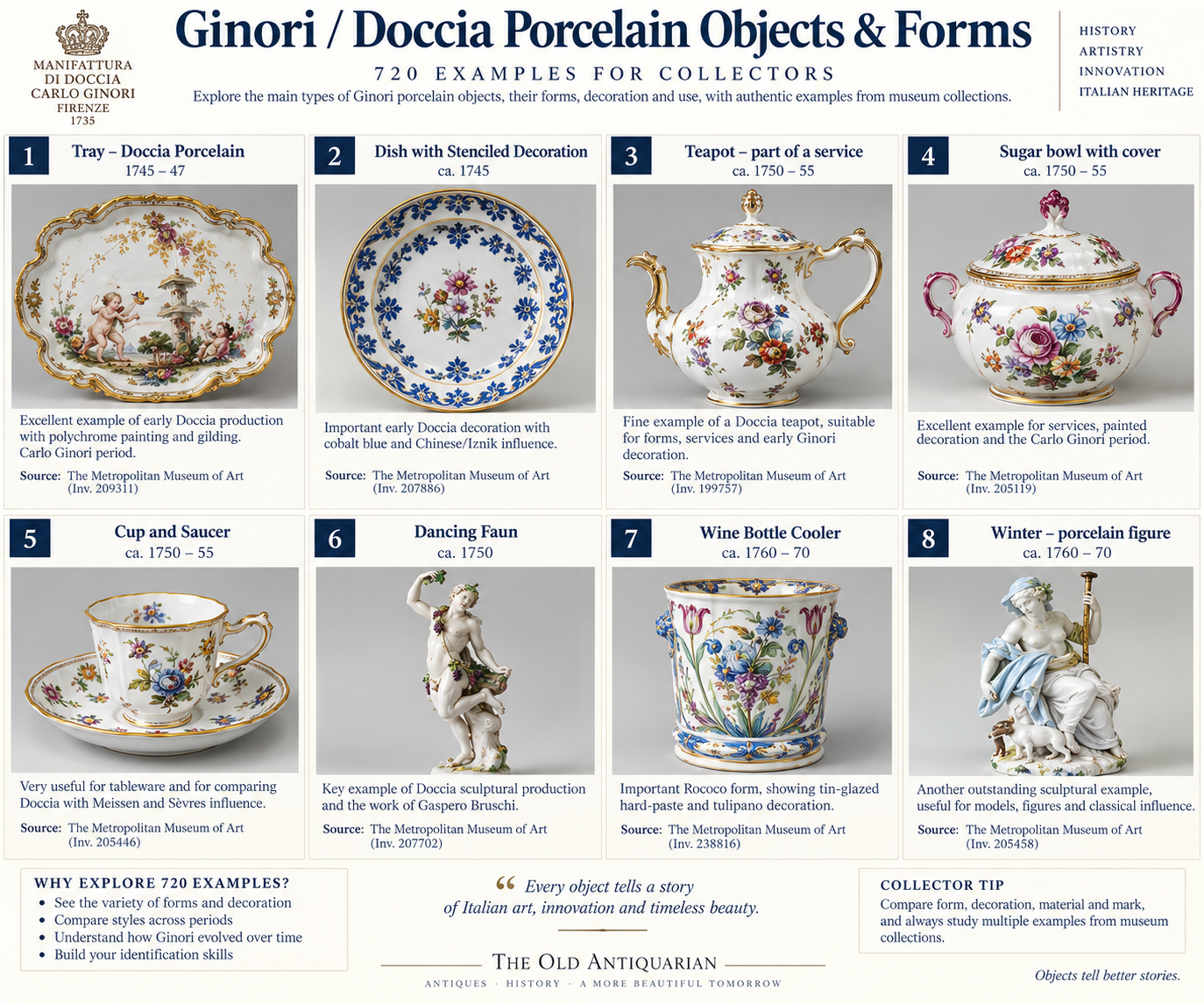
| Object Type | Identification Clues |
|---|---|
| Tray / serving dish | Profile, rim, moulding, decoration, underside and any incised numbers. |
| Plate / dish | Body, foot ring, painted or printed decoration and border construction. |
| Tea and coffee wares | Handle shape, spout, finial, saucer profile, service completeness and pattern. |
| Covered vessels | Lid fit, finial, handles, body shape and whether components belong together. |
| Vases and urns | Model, proportion, handles, pedestal, decoration, gilding and restoration. |
| Sculptural figures | Modeller or source model where documented, anatomy, base, firing, size and losses. |
| Decorative centrepieces | Complexity, applied elements, completeness and evidence of replacement parts. |
| Modern tableware | Backstamp, pattern, designer, factory, date range and material. |
Richard Ginori in the Twentieth Century
After the 1896 merger, Richard Ginori entered a period in which historic manufacturing knowledge coexisted with wider industrial production and modern design.
This makes twentieth-century material especially interesting but also means that “Richard Ginori” should not automatically be treated as synonymous with “eighteenth-century Doccia porcelain.”
Gio Ponti’s association with Richard Ginori is one of the most important chapters in twentieth-century Italian decorative arts.
His work demonstrates that later Ginori objects may be collectible because of design history, not because they are eighteenth- or nineteenth-century antiques.
For collectors this distinction is crucial:
historically important twentieth-century design can be highly collectible without being antique in the strict market sense.
Later Copies, Revivals and Misattributions
A factory with a long history may reproduce, reinterpret or revive earlier forms.
A later Ginori object inspired by an eighteenth-century design is not automatically a fake.
Collectors should distinguish between:
- original historical production;
- later factory production of an older model;
- historicist revival designs;
- modern reproductions;
- incorrect marketplace attribution;
- altered or misleading marks;
- deliberate counterfeit objects.
“Later production,” “reproduction,” “revival,” “copy,” “misattribution” and “fake” are not interchangeable terms.
Condition and Restoration
Condition can materially affect both historical integrity and market demand.
Ginori sculpture, elaborate handles, finials and gilded surfaces may be particularly vulnerable.
Small chips and polished losses can be easy to overlook.
Look for joins, glue, overspray and colour differences.
Fingers, flowers, attributes and projecting details are frequent damage points.
Differentiate natural wear from later regilding.
Restoration may become clearer under strong directional or ultraviolet examination.
Amateur glue and repainting can damage both evidence and value.
How Much Is Ginori Porcelain Worth?
There is no single “Ginori value.”
The same factory name can appear on objects separated by generations, different materials, designers, patterns, models and production methods.
A meaningful valuation therefore starts only after the object has been identified as precisely as possible.
| Value Factor | Why It Matters |
|---|---|
| Exact period | Early Doccia, nineteenth-century Ginori and twentieth-century Richard Ginori belong to different collecting contexts. |
| Exact model / pattern | Demand can vary dramatically within the same manufacturer. |
| Artist / modeller / designer | Documented authorship can substantially change historical importance. |
| Decoration | Hand painting, specialist enamelling and fine gilding can distinguish higher-level production. |
| Rarity | Scarce forms, variants, sizes and documented short production runs may be more collectible. |
| Condition | Damage, missing elements, repainting and restoration affect market comparison. |
| Completeness | Services, pairs and objects with original lids or companion pieces require different comparisons. |
| Provenance | Reliable documentation can strengthen attribution and significance. |
| Completed sales | Realised prices for genuinely comparable objects are more useful than unsold asking prices. |
Compare like with like:
exact maker + period + model/pattern + size + decoration + condition + restoration + completeness + provenance + recent completed sales.
Ginori Collector Checklist
- Photograph the complete object.
- Photograph the entire underside, not only the central logo.
- Record every word, letter, symbol and number.
- Identify the ceramic body before calling it porcelain.
- Distinguish Doccia, Ginori and Richard Ginori terminology.
- Compare the exact mark variant with reliable references.
- Identify the object form or model where possible.
- Determine whether decoration is hand-painted, printed or mixed.
- Look for restoration, replacement parts and regilding.
- Compare with museum and factory examples.
- Use a production range unless an exact date can be documented.
- Use completed comparable sales for market research.
Do You Have Ginori, Doccia or Richard Ginori Porcelain?
Clear photographs can reveal important clues.
For identification or valuation, photograph the complete object, the entire base, every mark and number, important decorative details and any visible damage or restoration.
Include dimensions and any known provenance.
Frequently Asked Questions About Ginori Porcelain
Is Doccia porcelain the same as Ginori porcelain?
They belong to the same historical manufacturing tradition. “Doccia” is especially useful for the historic manufactory and early production near Florence, while “Ginori” refers to the founding family and broader manufactory identity.
Is Richard Ginori the same as Ginori?
Richard Ginori is the later company identity created after the 1896 merger between the Ginori manufactory and Società Ceramica Richard.
Earlier objects should not automatically be described as Richard Ginori.
Was Ginori founded in 1735 or 1737?
Both dates appear in authoritative contexts for different reasons.
Ginori 1735 traces the company’s origin to 1735, while museum cataloguing commonly treats 1737 as a key date for the historic Doccia manufactory.
Preserve the chronology and terminology appropriate to the source and object being discussed.
What are the most useful Richard Ginori marks?
Collectors may encounter company names, printed backstamps, impressed wording, emblems, place names, Italy or Made in Italy wording, pattern numbers and other production marks.
The exact variant matters more than the general appearance.
Does a Richard Ginori crown mark prove authenticity?
No. A mark is only one part of attribution.
The ceramic body, form, decoration, manufacturing method and expected production period must agree with it.
How can I date Ginori porcelain?
Combine the exact mark with company wording, model or pattern information, form, material, decoration, designer attribution where documented and factory history.
Natural wear can support an assessment but should never be used as the primary dating method.
Is all Ginori porcelain antique?
No.
The manufacturing tradition continued through the nineteenth and twentieth centuries and survives today.
Modern Ginori 1735 objects are not antiques merely because the brand name refers to an eighteenth-century origin.
Is all Richard Ginori ceramic ware porcelain?
No.
Richard Ginori’s wider ceramic history includes more than one ceramic body.
Identify the individual object’s material before cataloguing it as porcelain.
What is early Doccia porcelain known for?
Early Doccia is particularly important for hard-paste porcelain, technically ambitious tableware and a significant programme of sculptural production.
Decoration can range from polychrome enamels and gilding to blue-and-white work and international decorative influences.
Can an unmarked Doccia piece be authentic?
Yes.
Some documented museum pieces are unmarked.
In such cases attribution depends much more strongly on material, construction, form, decoration, provenance and documented comparison.
Does “Made in Italy” give an exact date?
No.
Country wording may help establish broad production context, especially on later export wares, but should not be converted into an exact manufacturing year without supporting documentation.
Are Gio Ponti Richard Ginori pieces collectible?
Documented Gio Ponti designs are an important part of twentieth-century Richard Ginori design history.
Correct attribution should be based on the exact design, mark, period and reliable documentation.
How do I know if a Ginori mark is fake?
Do not judge the mark in isolation.
Compare its typography, colour, method of application and expected period with the material, model, decoration and manufacturing quality of the object.
If those elements conflict, further research is needed.
What makes Ginori porcelain valuable?
Important factors include production period, exact model, rarity, documented artist or designer, decorative quality, condition, restoration, completeness, provenance and collector demand.
Age alone does not determine value.
Continue Exploring
Sources & Further Research
-
Ginori 1735 – Official History / FAQ
— company history tracing the manufactory’s origin to Doccia in 1735. -
Ginori 1735 – Manifattura Ginori: La Nostra Storia
— official historical overview of the manufactory and its design tradition. -
The Metropolitan Museum of Art – Doccia Tray, 1745–47
— detailed scholarship on Carlo Ginori, early Doccia production, hard-paste porcelain and commercial development. -
The Metropolitan Museum of Art – Doccia Dish, ca. 1745
— hard-paste porcelain and early cobalt-blue decorative influences. -
The Metropolitan Museum of Art – Doccia Sugar Bowl, ca. 1750–55
— documented early Doccia porcelain under Carlo Ginori. -
The Metropolitan Museum of Art – Dancing Faun, ca. 1750
— an important example of Doccia sculptural production. -
Italian Ministry of Culture – Museo Richard-Ginori della Manifattura di Doccia
— museum history, the 1896 Richard-Ginori transition and the historic collection. -
Direzione regionale Musei nazionali Toscana – Richard Ginori Museum & Archive
— museum collection history and twentieth-century design context.
Final Collector Principle
Doccia, Ginori and Richard Ginori should be understood as a historical sequence, not as three unrelated labels.
The strongest attribution is reached when
name + material + exact mark + model + form + decoration + period + condition + documentation
all point toward the same conclusion.
When the evidence supports only a broad period or factory tradition, careful qualified attribution is more accurate than false precision.
