
Bulgarian Kitenik Rug from the 1970s – History, Symbols & Weaving
THE OLD ANTIQUARIAN · ETHNOGRAPHIC TEXTILE STUDY
Bulgarian Kitenik from the 1970s: History, Weaving, Symbols & Preservation
A detailed study of a handwoven Bulgarian kitenik measuring approximately 200 × 145 cm (78.7 × 57.1 in), exploring its family history between Vidin and Byala, Ruse region, its construction, ornament, cultural meaning and responsible second life.
Last Updated: October 2026 · The Old Antiquarian
Quick Answer: What Is a Bulgarian Kitenik?
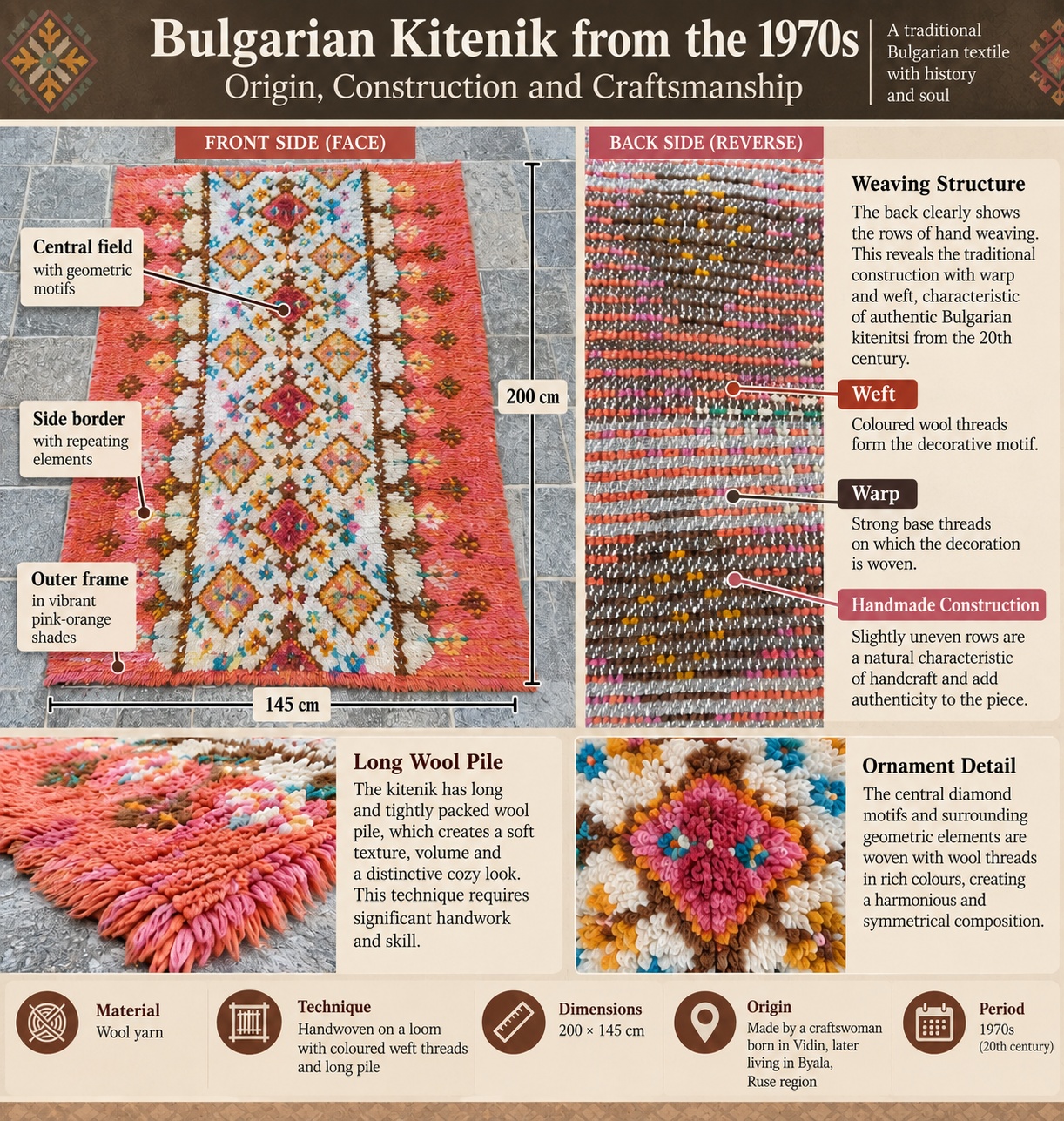
A Bulgarian kitenik is a traditional woven household textile characterised, in many examples, by a raised or long-pile surface. The example studied here dates by family history to the 1970s and measures approximately 200 × 145 cm (78.7 × 57.1 in). It combines a dense wool pile with a highly organised geometric composition in cream, coral pink, brown, yellow, turquoise, green and purple.
According to the surviving family history, it was made by a woman born in Vidin who later lived in Byala, Ruse region. Its front preserves the decorative design, while the reverse reveals the woven structure behind the pile and offers important evidence for understanding how the textile was made.
The symbols can be studied within the wider context of Bulgarian folk textiles, but their exact spiritual meaning should not be presented as certain unless supported by regional documentation or testimony from the original weaver.
Bulgarian Kitenik at a Glance
| Object | Handwoven Bulgarian kitenik |
| Period | 1970s, according to family history |
| Dimensions | Approx. 200 × 145 cm / 78.7 × 57.1 in |
| Material | Wool pile; the precise fibre composition of the foundation has not been laboratory tested |
| Construction | Handwoven textile with a long, raised pile |
| Family Origin | Associated with a craftswoman born in Vidin and later living in Byala, Ruse region, Bulgaria |
| Colours | Cream, coral pink, brown, yellow, turquoise, green, purple and orange |
| Decoration | Diamond, cross-shaped, radiating and stylised geometric or plant-like motifs |
| Condition | Well-preserved vintage textile with expected evidence of age and use |
More Than a Rug: The Biography of an Object
Old textiles often survive longer than the people who made them. For this reason, a vintage Bulgarian kitenik from the 1970s can be understood as much more than a floor covering. It can function as a material archive preserving evidence of handwork, domestic life, personal taste, inherited skill and family memory.
This particular textile is especially interesting because part of its human story has survived. According to information passed down with the object, the woman who made it was born in Vidin and later lived in Byala in the Ruse region.
There is no surviving written archive independently documenting every stage of that history, so it is important to describe it correctly: this is family-recorded origin and oral history, rather than an independently proven archival attribution.
That distinction does not make the information unimportant. Quite the opposite. Oral history can disappear within a single generation. Recording it now preserves the relationship between the textile, the person who made it and the places connected with her life.
Research principle: a responsible study separates what the object physically demonstrates from family tradition, comparative ethnographic evidence and later symbolic interpretation.
What Do We Know — and What Should Remain an Interpretation?
| Evidence Level | What We Can Say |
|---|---|
| Visible & measurable | Dimensions, pile, colours, composition, reverse structure, borders, edges and visible condition. |
| Family history | A 1970s date and association with a woman born in Vidin who later lived in Byala, Ruse region. |
| Ethnographic context | Bulgarian textile traditions make extensive use of geometric, stylised and plant-inspired ornament, repetition, symmetry and colour. |
| Interpretation | Possible associations between diamonds, crosses, radiating motifs, colours and ideas such as fertility, protection, harmony or continuity. |
| Not established | A precise regional weaving school, direct attribution to Chiprovtsi or Troyan, the intended spiritual meaning of every motif, and the exact composition of the dyes. |
What Exactly Is a Kitenik?
The word kitenik belongs to the vocabulary of Bulgarian traditional household textiles. Rather than describing a single universal weave, it refers to a group of textiles associated with a soft, raised or long-haired surface and domestic use.
Examples were used in the home as coverings, bedding textiles, decorative furnishings and floor coverings. Their practical function did not prevent them from becoming visually complex objects in which the maker could demonstrate skill, colour sense and control of repeated ornament.
For an international audience, the term should not simply be translated as kilim. A kilim is generally understood as a flatwoven rug, while the object examined here has a clearly raised, long-pile surface. For this reason, Bulgarian kitenik is the most accurate name, accompanied where useful by descriptions such as handwoven Bulgarian wool rug or traditional Bulgarian pile textile.
From Vidin to Byala: Why Family History Matters
The origin of a handmade household textile is not always preserved through factory labels, signatures or formal documents. Often the most important surviving source is the family that kept it.
In this case, the connection between Vidin and Byala gives the textile a human biography. We do not need to invent a separate “Vidin school” to make the story significant. What matters is the more credible and more personal fact: a woman carried her knowledge of weaving with her as her life moved from one Bulgarian region to another.
Traditional skills travel with people. Marriage, migration, family relationships and contact with neighbouring communities can all influence domestic craft. Techniques and motifs therefore do not always fit neatly within modern administrative borders.
The kitenik is most useful to us as an individual historical object — one that connects textile technique with the biography of its maker.
The Reverse: The Hidden Architecture of the Textile
The colourful pile dominates the front, but the reverse can be just as important when studying an old handwoven textile.
The surviving photograph of the reverse shows repeated horizontal woven rows, light foundation threads and coloured areas corresponding with parts of the decoration visible on the front.
This helps demonstrate that the ornament is not a printed or painted surface effect. Colour is integrated into the textile’s construction.
The small variations visible in the spacing and transitions are compatible with hand production. They should not, however, be used by themselves to prove age. Dating and authentication should consider construction, fibres, design, condition, family origin and comparative examples together.
Front vs Reverse: What Can Each Side Tell Us?
| Front | Reverse |
|---|---|
| Shows the decorative composition and pile | Reveals woven construction |
| Colours appear fuller and more sculptural | Shows rows, colour transitions and foundation structure |
| Best for studying overall ornament | Useful for studying workmanship and repairs |
| Shows wear to the wool pile | May reveal weakened areas or structural intervention |
The Ornament: When Geometry Becomes a Visual Language
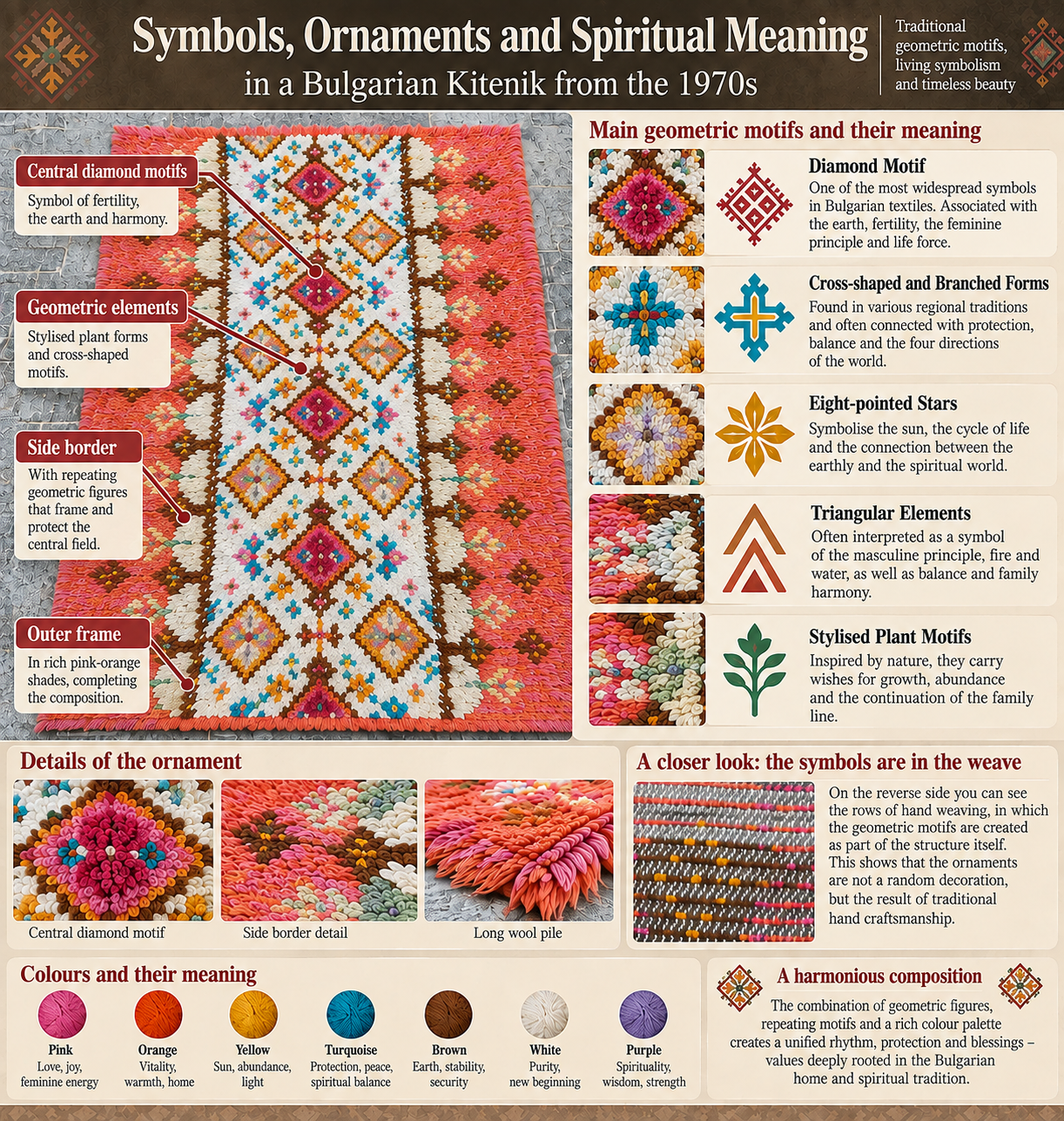
The design of this Bulgarian kitenik is organised around a strong longitudinal axis. Rich pink and magenta diamond-shaped medallions repeat through the centre. On either side are lighter fields enlivened by brown, yellow, turquoise, green and purple details, while broad coral-pink side areas frame the composition.
The most important visual principles are repetition, symmetry, rhythm and contrast.
Several families of motifs can be identified visually:
- central diamond-shaped medallions;
- larger lateral diamond compositions;
- cross-shaped and branching geometric elements;
- small radiating or star-like motifs;
- stylised plant-like forms;
- repeated border motifs;
- small contrasting colour accents linking the larger design fields.
Did Bulgarian Kiteniks Have Spiritual Meaning?
This is one of the most fascinating questions — and one of the areas where responsible interpretation matters most.
Bulgarian weaving traditions can indeed carry cultural meanings beyond simple decoration. The best documented example is the carpet-making tradition of Chiprovtsi, recognised by UNESCO as intangible cultural heritage.
In that tradition, weaving is connected with beliefs, verbal formulas and ritual practices. Weavers traditionally make wishes or say prayers before beginning a carpet, while skills, stories and working practices are transmitted between generations.
But there is an essential distinction: this kitenik is not a Chiprovtsi kilim.
Evidence from Chiprovtsi can help us understand the wider cultural environment of Bulgarian weaving, but it should not be used to assign every ritual practice or symbolic meaning documented there to an unrelated textile.
The more defensible interpretation is broader. Traditional weaving was not simply mechanical production. Making a large textile required memory, repetition, judgement, patience, colour selection and sustained manual skill. Such objects became closely integrated into domestic and family life.
In that sense, their spiritual significance may lie not only in individual symbols but also in the human intention, labour, continuity and family memory contained within the object itself.
The Diamond: Symbol or Structure?
Diamond-shaped forms are widespread in traditional Balkan and Bulgarian textile decoration.
Modern interpretations frequently associate the diamond with ideas such as the earth, fertility, femininity, family continuity or abundance. These interpretations can offer useful comparative context, but they should not be treated as a universal dictionary applying identically to every Bulgarian textile.
In this particular kitenik, one role of the diamond can be stated with confidence: it is a major structural device in the composition. The repeated diamonds establish the centre, organise visual rhythm and guide the eye through the length of the textile.
Kanatitsa and Elbetitsa: Why Identification Requires Caution
Popular online discussions of Bulgarian folk symbolism frequently label almost every branching diamond as a Kanatitsa and almost every radiating eight-part form as an Elbetitsa.
That approach can be misleading.
Named motifs belong to particular traditions and should ideally be supported by regional documentation, museum parallels or reliable historical evidence.
Visual similarity alone is not enough to prove that the original weaver used a particular name or intended a particular sacred meaning.
For this kitenik, it is therefore more responsible to describe what can actually be seen: diamond-shaped, cross-shaped, branching, radiating, triangular and plant-like geometric forms.
Collector’s rule: resemblance to a famous folk symbol is the beginning of research, not the end of it.
Colour as Memory
One of the most striking features of this 1970s Bulgarian kitenik is its vivid palette.
A light cream field provides the central ground. Coral, salmon and pink dominate the outer areas, while brown, ochre yellow, turquoise, green, purple and magenta are used to define individual motifs.
Colour performs both a decorative and structural function. It separates forms, strengthens symmetry, creates rhythm and allows small motifs to remain visible within the dense wool pile.
| Colour | Visual Role in This Kitenik |
|---|---|
| Cream / White | Creates the main central ground and contrast. |
| Coral / Pink | Defines the outer frame and strongest central accents. |
| Brown | Outlines motifs and visually stabilises the design. |
| Yellow / Ochre | Provides bright edging and contrast around medallions. |
| Turquoise / Green | Creates small high-contrast accents across the light field. |
| Purple | Adds depth to the central and lateral motifs. |
The photographs alone do not allow us to determine whether the dyes are natural, synthetic or mixed. By the second half of the twentieth century, synthetic dyes were already widely available, so colour should never be used by itself as evidence of age or regional origin.
The 1970s: Why Everyday Textiles Now Matter Historically
Objects made in the 1970s occupy an interesting position. For some people they still appear too recent to be considered historically important; for others they are simply old-fashioned household objects.
Yet more than five decades have now passed.
The generation that made and used these textiles is disappearing, and with it can disappear information about local terminology, working methods, family traditions, colour preferences and the circumstances in which individual objects were created.
Preserving a 1970s kitenik does not mean pretending that it is an ancient archaeological object. It means recognising that the history of everyday domestic life is also history.
Condition: What Should You Examine on an Old Bulgarian Kitenik?
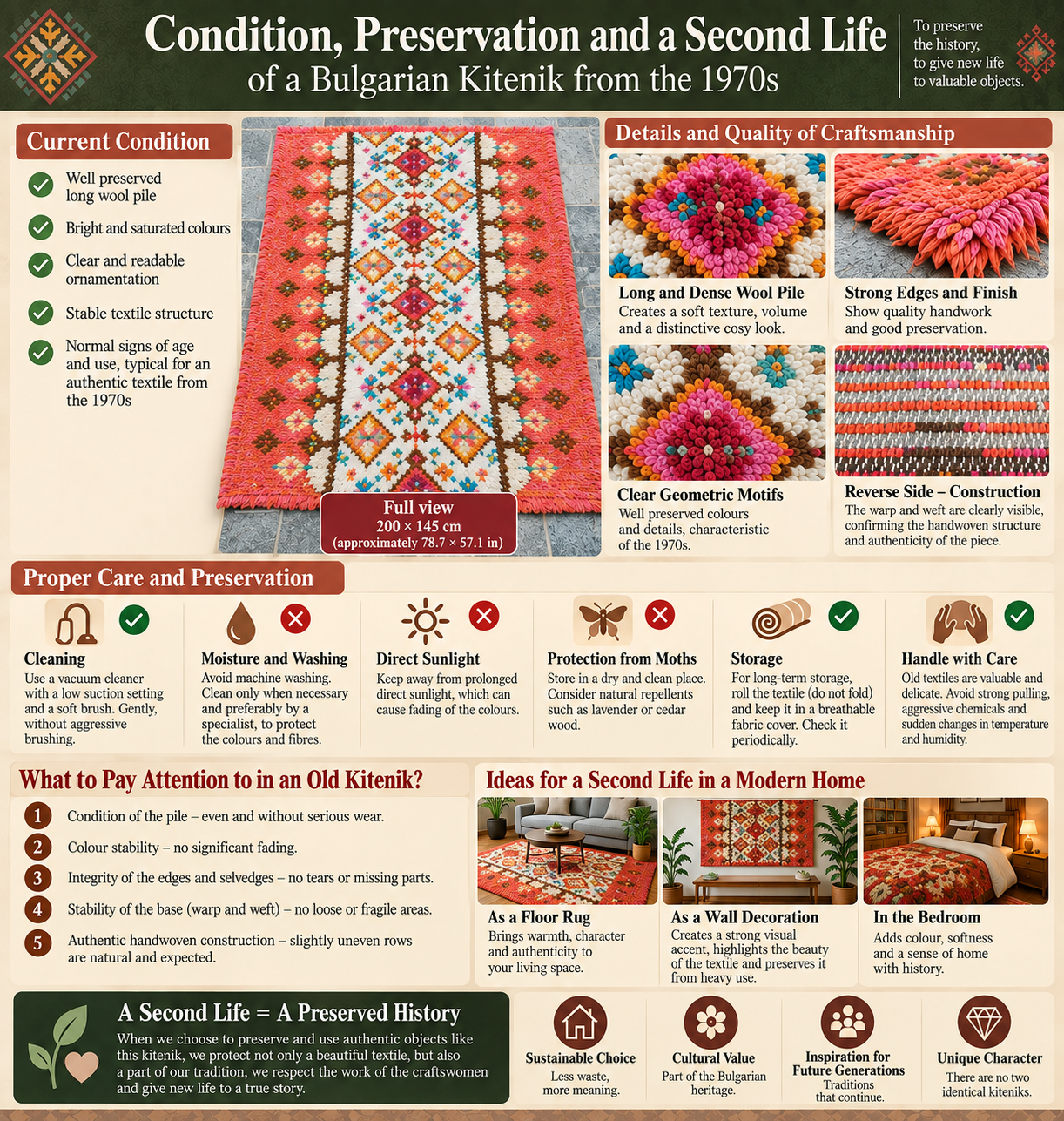
In the photographs, this example retains a substantial long pile, clearly legible decoration and strong colour contrast.
That is encouraging, but the condition of a historic textile should never be judged only from its most attractive surface.
A careful examination should include:
- whether the pile is even or heavily worn in particular areas;
- the stability of the woven foundation;
- tears, thinning or missing fibres;
- evidence of clothes moths or carpet beetles;
- signs of damp, mould or persistent odour;
- old repairs;
- fading or colour instability;
- the original edges and finishing;
- later backing, adhesives or other modern intervention.
How Should an Old Wool Kitenik Be Preserved?
With historic textiles, the safest intervention is often the smallest necessary intervention.
Preventive textile conservation focuses on protecting fibres from light, moisture, pests, dust, sharp folds, crushing and unnecessary handling.
For a broader practical guide, see
How to Store Antique Rugs, Textiles and Historic Clothing
.
1. Do Not Machine Wash It
Household washing can cause shrinkage, distortion, fibre damage and colour bleeding in old textiles.
Before wet cleaning, stain treatment or dry cleaning, the fibres, dyes, previous repairs and structural condition should first be understood.
2. Vacuum Only with Care
A rotating household turbo brush can catch and pull long pile.
If surface cleaning is appropriate, use controlled low suction and avoid pulling loose pile, edges or damaged areas. Fragile historic textiles may require specialist conservation cleaning.
3. Protect It from Strong Direct Sunlight
Light damage is cumulative. It can fade dyes and gradually weaken fibres.
If the kitenik is displayed on a wall or used decoratively, avoid long-term placement in strong direct sunlight.
4. Watch for Moths and Other Textile Pests
Wool can attract clothes moths and carpet beetles.
Inspect periodically for larvae, webbing, shed skins, loose fibres, new holes or powdery debris, particularly in dark and undisturbed areas.
Do not apply household insecticides directly to a historic textile.
5. Avoid Sharp Long-Term Folds
Permanent folds concentrate stress on the same fibres and can eventually distort or weaken a textile.
For a sufficiently stable large rug or pile textile, conservation guidance commonly favours rolling around a suitably wide archival-quality support rather than repeated sharp folding.
Pile textiles should be rolled in a way that avoids crushing the raised surface and should be supported across their full width.
A Second Life Without Erasing the First
At The Old Antiquarian, giving an old object a “second life” does not mean transforming it until its original identity disappears.
A complete historic textile does not need to be cut into cushions, permanently glued to furniture, repainted or radically redesigned in order to belong in a contemporary home.
Its original form is itself part of the evidence.
Second life does not mean destroying the first.
The most respectful reuse gives an old object a new context while preserving its construction, identity and history.
As a Statement Rug
At approximately 200 × 145 cm (78.7 × 57.1 in), this kitenik can work as a strong visual focal point in a living room, bedroom or quiet seating area.
For a collectible textile, a low-traffic area is preferable to a busy entrance or corridor, where repeated footfall would gradually flatten and wear the pile.
As Textile Wall Art
Its strong symmetry and colour make the kitenik visually effective as a textile panel.
Wall display can reduce foot wear, but a heavy textile must be supported properly across its width. A few nails, clips or isolated hooks can concentrate too much weight on small areas.
In a Bedroom or Quiet Interior
A vintage Bulgarian kitenik can also work beside a bed, in a reading area or as a carefully placed textile accent where its pile and colours can be appreciated without excessive abrasion.
Why Cutting an Old Textile Can Destroy Historical Information
Interior design trends sometimes encourage old rugs to be cut into cushions, upholstery panels or decorative fragments.
For an ordinary modern textile, that may simply be a design choice. For a surviving handmade object with known family history, the consequences are different.
Cutting may permanently remove:
- the complete original composition;
- the original dimensions;
- evidence of weaving technique;
- original edges and finishing;
- information about construction;
- part of the object’s documented family origin;
- the possibility of studying the textile as a complete work in the future.
Before altering an old textile, it is safer to document and understand it first. The same principle applies to many antiques; see
What Not to Do to an Antique Before Valuation or Sale
.
What Determines the Value of a Vintage Bulgarian Kitenik?
Age alone does not determine market or collector value.
Two Bulgarian textiles dating from approximately the same decade can differ considerably depending on quality, rarity, design, condition and what is known about their history.
| Factor | Why It Matters |
|---|---|
| Authenticity | Original handwork generally carries more historical interest than a later decorative imitation. |
| Origin & Family History | Reliable information can transform an anonymous textile into a better documented object. |
| Condition | Pile wear, tears, pests, staining, repairs and foundation stability all matter. |
| Design | Complex, balanced and visually distinctive compositions can increase decorative and collector interest. |
| Colour | A strong, well-preserved palette can increase visual appeal, although colour alone does not establish age. |
| Size | Dimensions affect display possibilities, shipping and the potential buyer market. |
| Rarity | An unusual composition, documented maker or well-supported regional origin may increase interest. |
For inherited textiles, preserve photographs, handwritten notes and family information whenever possible. Context that appears insignificant today may become essential evidence later.
Collector Checklist: How to Document an Old Kitenik
- Photograph the complete front.
- Photograph the complete reverse.
- Take close-ups of the pile and weaving structure.
- Photograph edges and corners.
- Record repairs, wear and losses.
- Measure length and width accurately.
- Record what is genuinely known about the maker.
- Write down where the textile was made, used or stored if known.
- Preserve old family photographs and handwritten notes.
- Do not wash or aggressively restore it before assessment.
Do You Have an Old Rug, Kitenik or Historic Textile?
Do not rush to wash, cut, repair or discard it. Clear photographs of the complete textile, reverse, edges, weave and condition — together with any known family history — can provide important clues about origin, technique, period and collector interest.
For the types of rugs and historic textiles considered by The Old Antiquarian, see
Textiles, Rugs & Traditional Objects We Buy
.
Frequently Asked Questions About Bulgarian Kiteniks
What is a Bulgarian kitenik?
A Bulgarian kitenik is a traditional woven household textile associated with a raised or long-haired surface. Examples may have plain or richly patterned decoration and were used in domestic interiors as coverings and furnishings.
Is a kitenik the same as a kilim?
Not exactly. A kilim is generally a flatwoven textile, while many kiteniks, including the example studied here, have a substantial raised wool pile. For this reason, the Bulgarian term kitenik is worth preserving rather than replacing it with “kilim.”
Are old Bulgarian kiteniks always made entirely from wool?
No assumption should be made without examining the textile. The visible pile may be wool while the foundation or structural threads can differ. Fibre identification may require close physical examination or testing.
How can you recognise a handwoven kitenik?
Study both front and reverse, the woven rows, transitions between colours, pile structure, finishing, borders and small variations in handwork. No single irregularity proves authenticity or age by itself.
What do the diamond motifs mean?
Diamond motifs are widespread in traditional textiles and have been given many symbolic interpretations. In this specific textile, their compositional role is clear, but the exact symbolic intention of the original weaver cannot be established from appearance alone.
Is this motif a Kanatitsa?
A secure identification should not be based only on visual resemblance. Named traditional motifs require suitable regional and historical context. It is more accurate to describe the visible form first and treat the symbolic name as a hypothesis unless supported by reliable evidence.
Can an old Bulgarian wool rug be washed at home?
Important vintage textiles should not automatically be machine washed or soaked. Old dyes, fibres and repairs may respond unpredictably to water and detergents.
Should an old kitenik be folded or rolled?
Sharp long-term folds can weaken fibres. Where the structure and condition allow, a large pile textile may be safer stored carefully rolled around a suitable wide support with conservation-quality protective material.
Can a vintage kitenik be displayed on a wall?
Yes, but its weight should be distributed evenly. Avoid hanging a heavy textile from a small number of nails, clips or hooks.
Does family history matter?
Yes. Information about who made or owned a textile, where a family lived and how the object was used can provide valuable historical context, especially when the information is recorded before it disappears.
Are Bulgarian kiteniks collectible?
They can attract interest as traditional textiles, folk art, vintage interior objects and examples of Bulgarian domestic craftsmanship. Collector interest depends on authenticity, quality, design, condition, rarity, origin, documentation and current demand.
Continue Exploring
How to Store Antique Rugs, Textiles and Historic Clothing
— preventive care for rugs, garments and historic fabrics.
What Not to Do to an Antique Before Valuation or Sale
— why documentation should come before aggressive cleaning or restoration.
How to Sell Inherited Antiques and Collections
— how to preserve family information and historical context before dispersing inherited objects.
Textiles, Rugs & Traditional Objects We Buy
— guidance for antique rugs, traditional textiles, embroidery and historic clothing.
Sources & Further Research
This study combines direct visual analysis of the textile and its recorded family history with wider comparative research into Bulgarian weaving and professional textile conservation.
- UNESCO Intangible Cultural Heritage – The Tradition of Carpet-Making in Chiprovtsi; used as comparative context for Bulgarian weaving, intergenerational transmission and documented ritual practices.
- Canadian Conservation Institute – preventive conservation guidance for historic textiles and rolled storage of carpets and pile textiles.
- The Old Antiquarian – research guidance on documenting, storing and assessing historic rugs, textiles and inherited objects.
Methodological note: evidence relating to Chiprovtsi and other regional Bulgarian textile traditions is used for comparison only. It should not be interpreted as an attribution of this kitenik to Chiprovtsi, Troyan or any other specific weaving centre without additional evidence.
Conclusion: An Object Lives While Its Story Is Remembered
The simplest description would be “an old Bulgarian rug from the 1970s.”
But that description leaves out almost everything that makes the object interesting.
Behind the textile was a person. There were hours at the loom, repeated decisions about colour and pattern, knowledge acquired over time, a home in which the finished piece existed and decades during which somebody considered it worth preserving.
There is also a journey: from the life of a woman born in Vidin to another chapter in Byala, Ruse region, and finally to the present, where the textile can be photographed, studied and documented rather than reduced to an anonymous piece of old household furnishing.
We may never know exactly what its maker thought as she formed each diamond, branching motif or colour transition.
We do not need to invent that missing part of the story.
What matters is preserving what the object can still genuinely tell us.
That is the real meaning of a second life for an old object: not erasing its past, but finding a new place for it without losing its memory.
ABOUT THE AUTHOR
The Old Antiquarian
The Old Antiquarian combines more than 35 years of practical experience with antiques and collectibles with historical, comparative and museum-based research. Our aim is not only to identify and evaluate old objects, but to preserve their context, origin and human history — because a surviving object can carry evidence that disappears when its story is lost.
