
Norwegian Porcelain & Ceramics: Makers, Marks & Design
Norway · Porcelain · Ceramics · Faience · Flintware · Makers · Scandinavian Design
Norwegian ceramic history includes much more than porcelain alone. Early makers such as Herrebøe Fajansefabrikk and Hans Nicolai Bruun produced tin-glazed faience in the 18th century; Egersunds Fayancefabrik became an important industrial ceramic manufacturer in the 19th century; Porsgrunds Porselænsfabrik established Norway’s best-known historic porcelain tradition from the late 19th century; and Figgjo and Stavangerflint became major names in 20th-century Norwegian and Scandinavian design. Correct identification begins by establishing the material before studying the maker, mark, form, decoration, designer and period.
| Norwegian Ceramics at a Glance | Collector Reference |
|---|---|
| Early artistic faience | Herrebøe and Hans Nicolai Bruun – 18th century |
| Major 19th-century industrial maker | Egersunds Fayancefabrik |
| Best-known historic Norwegian porcelain maker | Porsgrunds Porselænsfabrik |
| Important Scandinavian Mid-Century maker | Figgjo |
| Major post-war flintware and ceramics maker | Stavangerflint |
| Main materials | Porcelain, faience, flintware, stoneware and vitroporcelain |
| Historic span | From 1759 to the present |
| Best identification method | Material + maker + mark + form + decoration + designer + period |
“Norwegian ceramics” does not automatically mean “Norwegian porcelain.” Herrebøe, Egersund, Porsgrund, Figgjo and Stavangerflint worked with different ceramic bodies and technologies at different times.
Norwegian ceramic history is more diverse than the search term Norwegian porcelain might suggest. A Norwegian collection can include 18th-century Rococo faience, 19th-century industrial tableware, true porcelain, flintware, studio ceramics and internationally recognised Scandinavian Mid-Century design.
This guide therefore focuses on Norwegian porcelain and ceramics as a national collecting field: the principal manufacturers, materials, marks and design traditions. Porsgrund is included here only in its wider Norwegian context. For detailed anchor marks, backstamps, dating, patterns, designers and value, use our dedicated
Porsgrund Porcelain marks and dating guide
.
Norwegian Porcelain vs Faience vs Flintware vs Stoneware
Before trying to identify a Norwegian factory mark, establish what the object is made from. This is particularly important because historic factory names and modern marketplace descriptions do not always use ceramic terminology precisely.
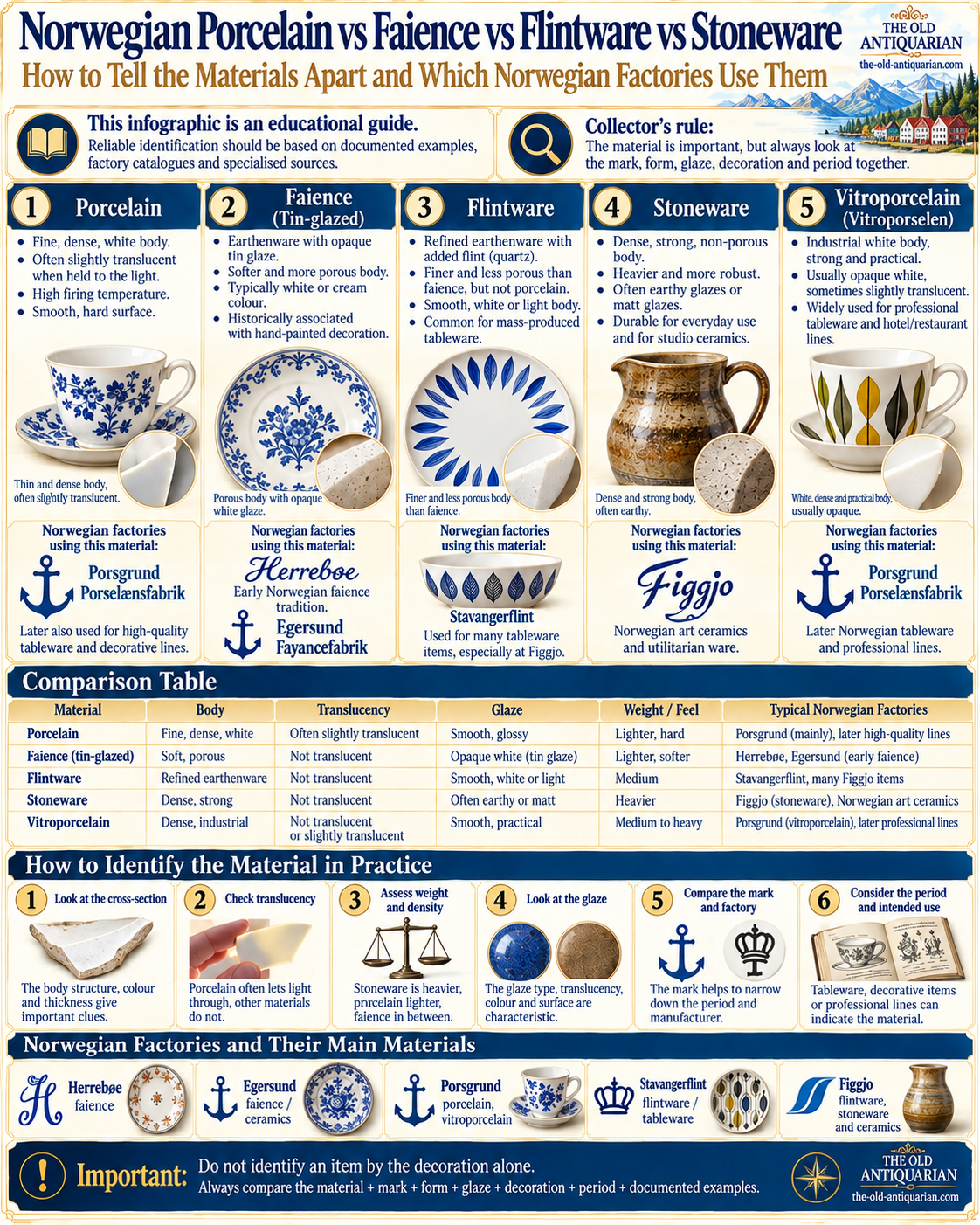
| Material | General Characteristics | Norwegian Context |
|---|---|---|
| Porcelain | Dense, vitrified and usually white ceramic body; fine surface and sometimes slightly translucent | Most strongly associated historically with Porsgrund |
| Tin-glazed faience | Porous earthenware body covered by an opaque white tin glaze | Herrebøe and Hans Nicolai Bruun in the 18th century |
| Flintware / flintgods | Refined light-coloured earthenware, often with clear glaze and transfer or printed decoration | Important for Egersund, Stavangerflint and parts of Figgjo production |
| Stoneware | Dense, durable high-fired ceramic body, usually non-translucent | Used in parts of Norwegian industrial and studio ceramic production |
| Vitroporcelain / vitroporselen | Strong, vitrified industrial ceramic body suited to durable tableware | Particularly important in the development of Figgjo professional tableware |
the Norwegian word fajanse has sometimes been used more broadly than the strict technical meaning of traditional tin-glazed faience. In historic Norwegian ceramic writing it may also appear in contexts involving English-style flintware. A factory name containing “Fajansefabrik” therefore does not prove that every object was made from traditional tin-glazed faience.
What is true faience?
Traditional faience is an earthenware body covered with an opaque tin glaze. Because the unfired glaze absorbs pigment, hand-painted decoration has a distinctive direct quality. Cobalt blue and manganese violet were among the colours particularly suited to the technique.
The 18th-century products of Herrebøe and Hans Nicolai Bruun belong to this wider northern European faience tradition.
What is flintware?
Flintware developed from the more industrialised earthenware traditions associated with Britain. The body is generally lighter and more refined than ordinary coarse earthenware and usually carries a transparent glaze rather than an opaque tin glaze.
This distinction is particularly useful when examining Egersund or Stavangerflint pieces that are sometimes described simply as “faience” in commercial listings.
A blue-and-white pattern can appear on porcelain, faience, flintware, transfer-printed earthenware and other ceramic bodies.
Norwegian Porcelain & Ceramics Timeline
| Date / Period | Maker or Development | Why It Matters |
|---|---|---|
| 1759 | Herrebøe Fajansefabrikk | One of Norway’s earliest major faience manufacturers |
| c. 1760 | Hans Nicolai Bruun, Drammen | Another important early Norwegian faience tradition |
| 1770s–c. 1780 | Decline of the early Norwegian faience factories | Marks the end of Norway’s principal 18th-century faience phase |
| 1847 | Egersund Potteri begins production | Start of an important industrial ceramic tradition |
| 1867 | New faience production at Egersund | Expansion into industrial tableware and refined ceramic bodies |
| 1885 | Porsgrunds Porselænsfabrik established | Beginning of Norway’s best-known historic porcelain manufacturer |
| 1887 | First Porsgrund porcelain firing | Beginning of commercial porcelain production |
| 1941 | Figgjo established | Beginning of an important modern Norwegian design company |
| 1946 | Stavanger Fajansefabrikk established | Foundation of the company later known as Stavangerflint |
| 1949 | Production begins at Stavanger | Post-war flintware and ceramic production expands |
| 1967 | Egersund joins Porsgrund | Part of the consolidation of Norwegian ceramic manufacturing |
| 1968 | Figgjo and Stavangerflint merge | Two important post-war ceramic traditions become one company |
| 1979 | Egersund closes; Stavanger production ends | End of two major historic manufacturing operations |
| Today | Norwegian ceramic heritage continues | Porsgrund and Figgjo remain especially recognisable historic names |
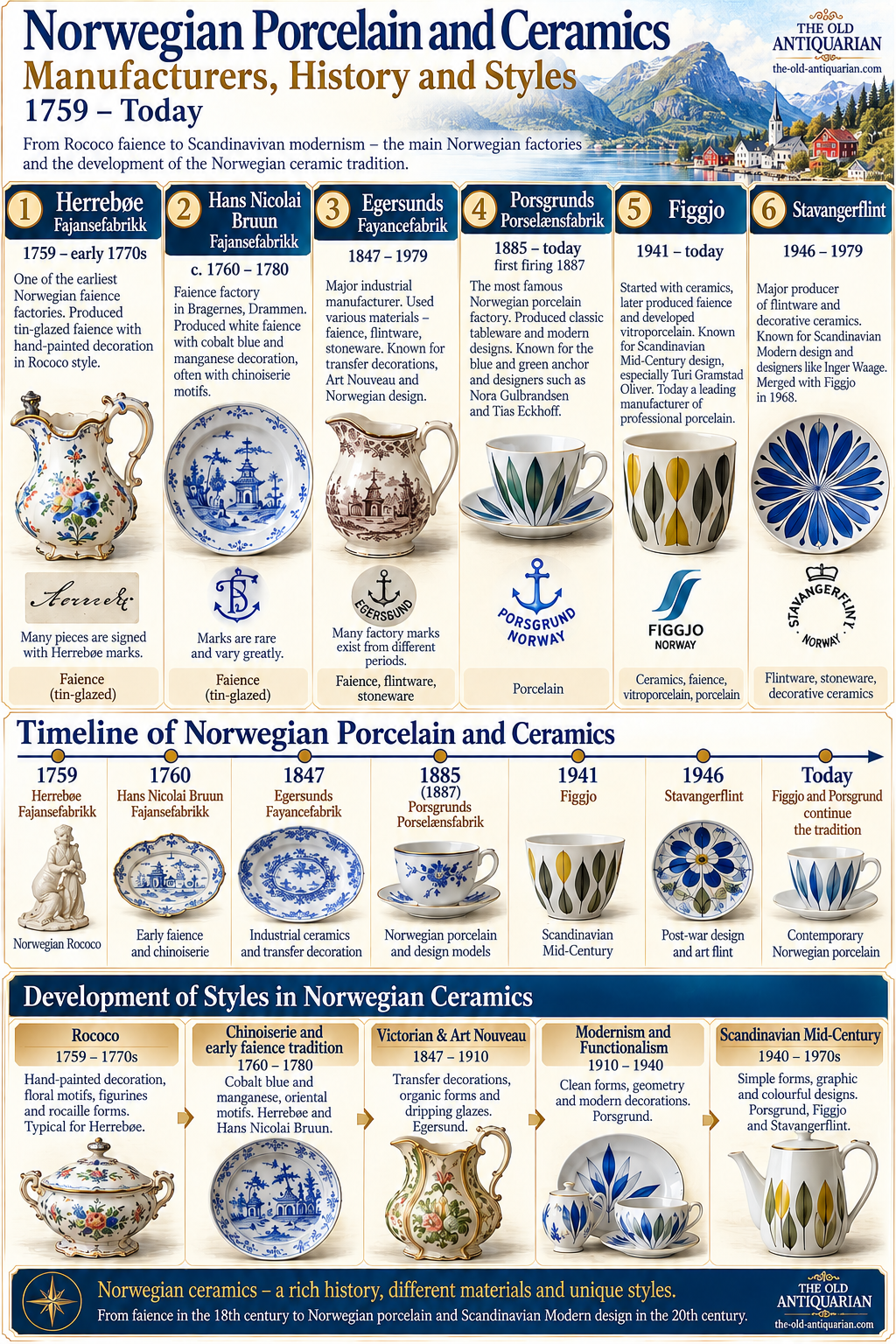
Major Norwegian Porcelain and Ceramics Manufacturers
| Manufacturer | Period | Main Materials | Collector Focus |
|---|---|---|---|
| Herrebøe Fajansefabrikk | 1759–1770s | Tin-glazed faience | Rococo forms, hand painting, rarity and early Norwegian ceramic history |
| Hans Nicolai Bruun | c. 1760–c. 1780 | Faience | Cobalt and manganese decoration, chinoiserie motifs and museum attribution |
| Egersunds Fayancefabrik | 1847–1979 | Industrial ceramics, flintware and stoneware-type bodies | Transfer decoration, factory marks, Art Nouveau and 20th-century design |
| Porsgrunds Porselænsfabrik | Established 1885; production from 1887 | Porcelain | Norwegian porcelain, design history and factory backstamps |
| Figgjo | From 1941 | Ceramics, faience and later vitroporcelain | Scandinavian Mid-Century patterns, designers and professional tableware |
| Stavangerflint | 1946–1979 | Flintware, stoneware and other ceramic bodies | Post-war design, Inger Waage and decorative tableware |
Herrebøe Fajansefabrikk – Norway’s Early Rococo Faience
Herrebøe Fajansefabrikk was established in 1759 at Idd near Halden. It represents one of the most important early chapters in Norwegian decorative ceramics.
Herrebøe pieces are faience rather than porcelain. The factory used local clay and opaque white tin glaze, with much of the decoration painted by hand. Surviving objects include dishes, plates, tureens, tea and coffee vessels, flower pots, writing accessories and other domestic or decorative forms.
Rococo ornament is particularly important. Moulded decoration, naturalistic flowers, blue painting, manganese tones and figurative motifs can all appear.
early Norwegian faience should not be authenticated from a monogram alone. Body, glaze, form, moulding, painting style and comparison with museum examples are essential.
Hans Nicolai Bruun’s Faience Factory in Drammen
Hans Nicolai Bruun’s factory was established on Bragernes in Drammen at approximately the same time as Herrebøe. The enterprise was laid out in 1759 and was operating as a faience factory by around 1760.
The production appears to have been more limited than Herrebøe’s. Surviving pieces include plates and dishes with opaque white glaze and painted decoration in cobalt blue or manganese violet.
One of the best-known decorative themes is a pagoda-like building, reflecting the European taste for chinoiserie during the period.
Because production was relatively limited and marks are not a simple universal dating system, confident attribution depends heavily on documented museum comparisons.
Egersunds Fayancefabrik – Industrial Norwegian Ceramics
The Egersund story begins in 1847 with Egersund Potteri. The business developed into one of Norway’s major ceramic manufacturers and remained in production until 1979.
The name “Fayancefabrik” can be misleading to modern collectors. Egersund production included different ceramic bodies, and not every piece is traditional tin-glazed faience.
Transfer Printing and Industrial Tableware
Industrial decoration became increasingly important during the 19th century. Transfer-printed designs made decorated tableware more affordable than labour-intensive hand painting and helped ceramics reach a broader section of Norwegian society.
The factory produced both practical household wares and decorative objects, and its long life means that Egersund pieces can vary dramatically in material, style and market interest.
Art Nouveau and Design
Around the turn of the 20th century, Egersund also developed a stronger artistic identity. Organic forms, specialised glazes and designer involvement created a distinct area of interest beyond ordinary tableware.
| When Examining Egersund | Why It Matters |
|---|---|
| Factory wording | Marks and company naming changed over a long production history |
| Ceramic body | Not every piece uses the same material |
| Transfer vs hand decoration | Helps place the object within a production tradition |
| Shape | Artistic and designer-led forms may have different collector interest |
| Pattern or decoration | Documented designs can help narrow identification |
Porsgrunds Porselænsfabrik – Norway’s Historic Porcelain Name
Porsgrunds Porselænsfabrik was established in 1885, with the first porcelain firing taking place in 1887. It became Norway’s best-known historic producer of porcelain tableware, vases and decorative objects.
Porsgrund also became important in Norwegian design through figures such as Nora Gulbrandsen, Tias Eckhoff, Konrad Galaaen and Eystein Sandnes.
Because Porsgrund marks, anchor variants, PORSGRUND / PORSGRUNN wording, patterns and dating form a large specialist subject of their own, this country guide intentionally does not reproduce that full chronology. Continue with our
complete Porsgrund Porcelain marks, dating, patterns and value guide
for detailed identification.
this page treats Porsgrund as one part of Norwegian ceramic history. Detailed searches for Porsgrund marks, dating, anchor backstamps, patterns, designers and value belong to the dedicated Porsgrund reference.
Figgjo – Norwegian Mid-Century and Modern Tableware
Figgjo was established in 1941. In its earliest years it was a relatively small ceramic factory using local clay. By 1949 production had been reorganised toward industrial faience, and later vitroporcelain became particularly important.
Figgjo became one of the most recognisable names in Norwegian post-war tableware design. Functional shapes were often paired with clean, memorable surface decoration.
Ragnar Grimsrud
Ragnar Grimsrud played a central role in the transformation of Figgjo into a modern industrial design company. His work established forms that could be combined with multiple decorative schemes.
Turi Gramstad Oliver
Turi Gramstad Oliver worked for Figgjo from 1960 to 1980 and became one of the company’s best-known decoration designers. Her documented designs include Lotte, Clupea, Arden, Market and Daisy.
with Figgjo, the designer of the physical form and the designer of the decoration may be different people. A pattern name should not automatically be treated as a model name.
Stavangerflint – Flintware and Post-War Norwegian Design
Stavangerflint was founded in 1946 as Stavanger Fajansefabrikk A/S. Production began in 1949, and the company adopted the Stavangerflint name in 1952.
The company became strongly associated with refined industrial ceramic bodies, tableware, decorative wares and post-war Norwegian design.
The term flint helped distinguish its principal ceramic body from traditional porcelain and more porous ordinary earthenware.
Inger Waage and Art Ware
Inger Waage is one of the most important names associated with Stavangerflint. The factory developed studio and decorative production alongside mass-manufactured tableware, making designer attribution particularly relevant for collectors.
Stavangerflint merged with Figgjo in 1968. Production at Stavanger continued until 1979, when manufacturing was consolidated at Figgjo.
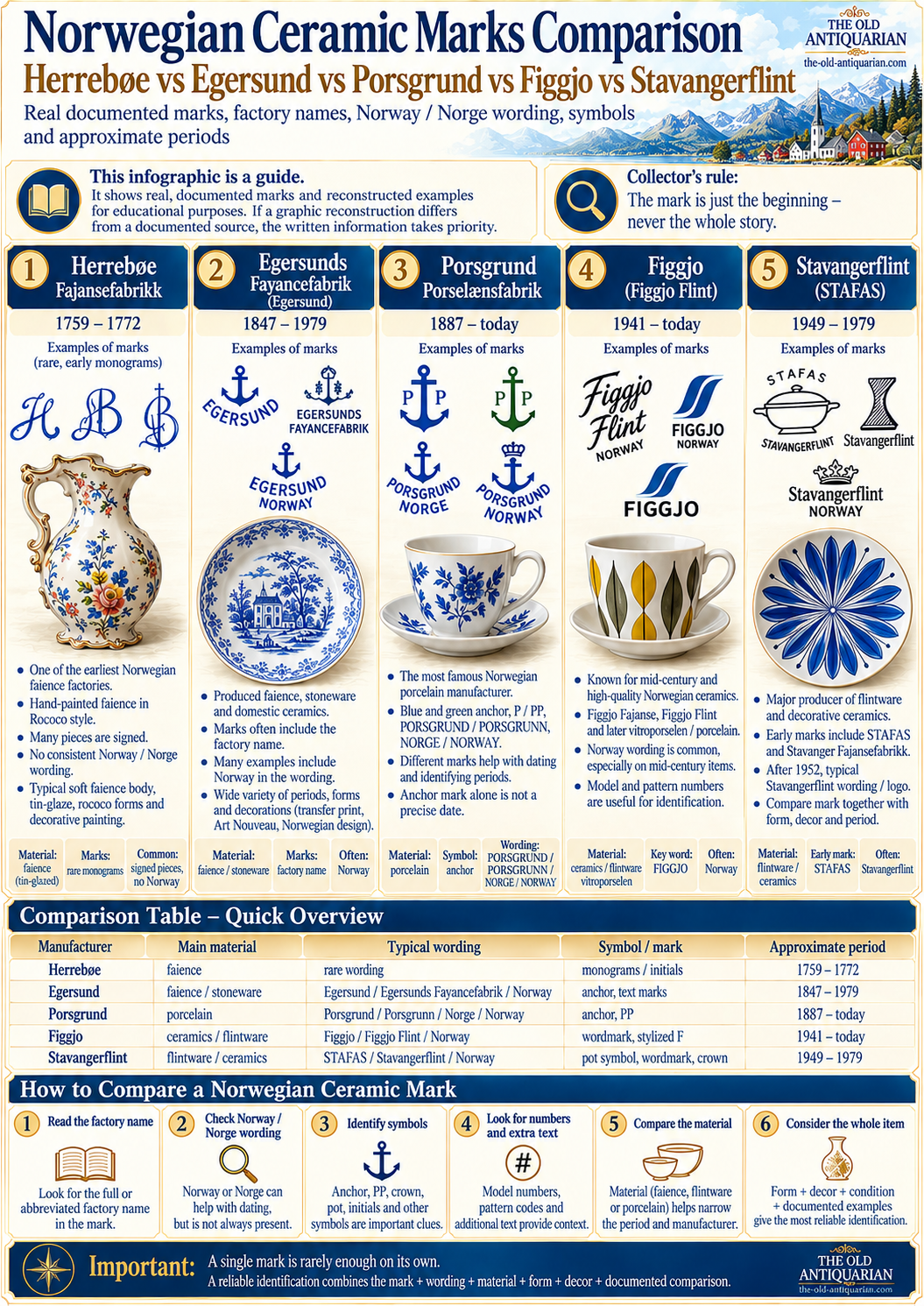
Norwegian Ceramic Marks: What Should Collectors Look For?
There is no single “Norwegian porcelain mark.” Each manufacturer developed its own systems of factory wording, symbols, logos, monograms, country-of-origin wording and production codes.
| Maker | Typical Identification Clues | What Else to Check |
|---|---|---|
| Herrebøe | Rare hand-applied marks, monograms or signatures | Faience body, tin glaze, Rococo shape and painted decoration |
| Hans Nicolai Bruun | Attribution may rely more heavily on documented forms and decoration than on a standard factory stamp | Faience body, cobalt or manganese painting and museum parallels |
| Egersund | Factory-name marks, text marks and changing industrial stamps | Material, form, pattern and production period |
| Porsgrund | Anchor motifs, P / PP, factory wording and Norway / Norge wording | Exact mark family, pattern, form, numbers and documented date range |
| Figgjo | Figgjo, Figgjo Fajanse, Figgjo Flint, Norway and later logos | Form, pattern name, decorator or designer and period |
| Stavangerflint | STAFAS, Stavangerflint wording, logo variants and Norway wording | Model, decoration, material and production period |
A Norway or Norge mark indicates country of origin, but it does not by itself identify the factory, date, pattern or market value.
mark + factory wording + material + form + decoration + model + designer + production period + documented comparison
Norwegian Ceramic Styles: Rococo to Scandinavian Modern
Norwegian ceramics reflect wider European artistic movements while developing a distinctive national identity. Understanding the broad style can help determine whether a proposed factory and production period are plausible.
| Style / Period | Associated Makers | Typical Characteristics |
|---|---|---|
| Rococo – 18th century | Herrebøe | Moulded ornament, floral painting, rocaille forms and figurative decoration |
| Chinoiserie and early faience | Herrebøe, Hans Nicolai Bruun | Cobalt blue, manganese violet, pagodas and Oriental-inspired motifs |
| 19th-century industrial tableware | Egersund | Transfer printing, practical services and increasingly mechanised production |
| Art Nouveau | Egersund | Organic forms, artistic glazing and stronger designer involvement |
| Interwar modernism | Porsgrund | Geometric forms, functionalism and modern decorative ideas |
| Scandinavian Mid-Century | Porsgrund, Figgjo, Stavangerflint | Functional shapes, clean lines and strong graphic decoration |
| Post-war art ceramics | Stavangerflint | Hand painting, studio production and decorative art ware |
| Contemporary professional tableware | Figgjo | Functional design, durability and Scandinavian restraint |
Norwegian Blue-and-White Ceramics vs Delft Blue
Blue-and-white decoration is one of the easiest visual traps in ceramic identification. Cobalt-blue flowers, landscapes and ornamental borders occur across Chinese porcelain, Dutch Delftware, British ceramics and Scandinavian production.
A Norwegian blue-and-white plate is therefore not Delftware simply because it is blue and white.
| Feature | Norwegian Ceramics | Historic Delftware |
|---|---|---|
| Country | Norway | Netherlands |
| Main collecting periods | 18th–20th centuries and later | Especially 17th–18th centuries |
| Materials | Faience, porcelain, flintware, stoneware and other bodies | Traditionally tin-glazed earthenware |
| Marks | Depend on the individual Norwegian maker | Historic pottery marks, owner marks and many unmarked pieces |
| Blue decoration | One of many possible styles | A central and internationally recognised part of the tradition |
For the Dutch tradition, factory marks, Royal Delft dating codes and Delftware identification, continue to our separate
Delft Blue and Delftware guide
.
the Norwegian guide targets Norwegian makers, materials and design history. Delft dating, Royal Delft marks and Dutch Delftware value belong to the dedicated Delft reference and are not duplicated here.
How to Identify an Unknown Norwegian Ceramic Piece
Porcelain, tin-glazed faience, flintware, stoneware or vitroporcelain?
Include every word, symbol, number, painter’s mark and old label.
Look for Porsgrund, Egersund, Figgjo, Stavangerflint, Norway, Norge or other wording.
Shape, handle, foot, rim, lid and proportions can help identify a model family.
Is it hand painted, transfer printed, screen printed, underglaze or overglaze?
Numbers may relate to shape, pattern, decoration or manufacturing control.
Especially useful for 20th-century Porsgrund, Figgjo and Stavangerflint.
Document chips, cracks, repairs, glaze wear and missing parts.
Museum collections, factory archives and specialist references should take priority over marketplace listings.
What Affects the Value of Norwegian Porcelain and Ceramics?
There is no meaningful single price for “Norwegian ceramics.” The market for an 18th-century Herrebøe faience object is completely different from the market for a common post-war tableware piece.
The same is true within individual manufacturers. A documented designer model, an unusual form or an early production period may attract a different collecting audience from standard everyday ware.
| Value Factor | Why It Matters |
|---|---|
| Manufacturer | Different factories belong to different historic and collecting markets |
| Material | Rare early faience, porcelain and mass-produced flintware should not be valued together |
| Period | Early or historically significant production can be more difficult to find |
| Designer | Documented designer attribution can increase specialist interest |
| Pattern or model | Some recognised series have stronger international demand |
| Rarity | Short production runs and unusual forms can materially affect desirability |
| Condition | Chips, cracks, restoration and repainting affect comparable market value |
| Completeness | Correct lids, pairs and complete services may be more desirable |
| Provenance | Original labels, receipts or documented ownership can add useful context |
| Completed sales | Comparable sold results are more useful than unsold asking prices |
Compare like with like: same maker, material, period, model, designer, size, condition and completeness.
Norwegian Ceramics Collector Checklist
Before Buying
Confirm the material, read the entire mark, identify the factory, inspect the condition and determine whether the seller’s attribution is supported by documented examples.
Before Selling
Photograph the full item, base, marks, numbers, decoration, damage and measurements. Record any labels, boxes or provenance before cleaning or restoration.
| Check | What to Record |
|---|---|
| Material | Porcelain, faience, flintware, stoneware or vitroporcelain |
| Maker | Full factory name or most likely manufacturer |
| Mark | Complete backstamp, symbol, wording and colour |
| Numbers | Model, decoration and other production codes |
| Form | Object type, measurements, handle, foot and lid |
| Decoration | Technique, colours, pattern and painter’s marks |
| Designer | Only when supported by reliable documentation |
| Condition | Chips, cracks, repairs, crazing, wear and restoration |
| Provenance | Labels, receipts, catalogues or known ownership history |
Do You Have Norwegian Porcelain or Ceramics?
For identification or valuation, photograph the whole object, its base and factory mark, all numbers or initials, the decoration, exact dimensions and any visible damage or restoration. For a service, include a group photograph showing all surviving pieces.
Frequently Asked Questions
What is the best-known Norwegian porcelain manufacturer?
Porsgrunds Porselænsfabrik is Norway’s best-known historic porcelain producer. It was established in 1885 and made its first porcelain firing in 1887.
What is the oldest important Norwegian faience factory?
Herrebøe Fajansefabrikk was established in 1759 near Halden and represents one of Norway’s most important early traditions of artistic faience.
Is Herrebøe porcelain?
No. Herrebøe is historically associated with tin-glazed faience rather than true porcelain.
Is Egersund porcelain?
Egersunds Fayancefabrik produced several kinds of ceramics during its long history. Collectors should not automatically classify every Egersund object as porcelain or traditional tin-glazed faience.
Is Figgjo porcelain?
Modern Figgjo is strongly associated with durable professional porcelain and vitroporcelain tableware. Historically, however, the company began as a ceramic factory and later developed industrial faience and other ceramic bodies.
What is Stavangerflint?
Stavangerflint was a Norwegian post-war ceramic manufacturer known for flintware, tableware, decorative ceramics and important designers and artists.
What does Norway on a ceramic mark mean?
Norway indicates country of origin. It does not, by itself, identify the manufacturer, pattern, date or value.
How do I identify a Norwegian pottery mark?
Read the full factory wording and compare the mark with the material, form, decoration, production period and documented examples. A symbol or word alone is rarely sufficient.
Is Norwegian blue-and-white pottery Delft?
Not automatically. Delftware is a specific Dutch ceramic tradition. Similar blue-and-white decoration appears on Norwegian faience, porcelain and other ceramics.
Which Norwegian ceramics are associated with Mid-Century Modern design?
Porsgrund, Figgjo and Stavangerflint are particularly important for collectors interested in 20th-century Norwegian and Scandinavian design.
Are Norwegian ceramics valuable?
Some can be. Value depends on the maker, material, period, designer, model or decoration, rarity, condition, completeness, provenance and current collector demand.
Related Collector Guides
Sources & Further Research
| Source | Useful For |
|---|---|
|
Store norske leksikon – Herrebøe Fajansefabrikk |
Early Norwegian faience, factory history, production and Rococo forms |
|
Store norske leksikon – Hans Nicolai Bruuns fajansefabrikk |
Drammen faience, production dates, cobalt and manganese decoration |
|
Store norske leksikon – Egersunds Fayancefabrik |
Egersund history, materials, industrial ceramics and factory development |
|
Porsgrunds Porselænsfabrik – Official History |
Foundation in 1885, first firing in 1887 and porcelain production |
|
Store norske leksikon – Figgjo |
Figgjo history, vitroporcelain, designers and merger with Stavangerflint |
|
Figgjo – Official History |
Modern Norwegian porcelain production and company heritage |
|
Store norske leksikon – Stavangerflint |
Stavangerflint history, flintware, designers and 1968 merger |
|
Store norske leksikon – Faience |
Technical distinction between traditional faience and Norwegian use of the term for flintware |
the infographics in this guide are educational orientation tools. Ceramic marks changed over time, and some marks exist in multiple variants. When a reconstructed mark differs from a reliable museum, factory archive or specialist reference, the documented source takes priority.
About The Old Antiquarian
The Old Antiquarian combines more than 35 years of practical experience with antiques and collecting with historical, museum and comparative research. When examining ceramics, we consider the material, manufacturer, factory mark, form, glaze, decoration, designer attribution, production period, condition, restoration and documented comparisons as parts of one identification system.
Conclusion: How Should Norwegian Porcelain and Ceramics Be Identified?
Norwegian ceramic history cannot be reduced to a single porcelain factory. It begins with rare 18th-century faience, develops through the industrial production of Egersund, expands into true porcelain at Porsgrund and reaches the internationally recognised Scandinavian design traditions of Figgjo and Stavangerflint.
The first important distinction is therefore the material. A Herrebøe faience piece should not be described as porcelain, and an industrial flintware object should not automatically be classified in the same way as a Porsgrund porcelain piece.
For collectors, the most reliable sequence is:
material → manufacturer → mark → form → decoration → model → designer → period → condition → documented comparison.
That method allows an early Norwegian faience piece, a Victorian-era Egersund object and a Mid-Century Figgjo service to be understood in their correct historical and collecting contexts rather than grouped together simply because they were made in Norway.
