
Dutch Copperware: Antique Originals vs Vintage Reproductions (1950s–1970s)
THE OLD ANTIQUARIAN | ANTIQUE METALWARE & COLLECTOR RESEARCH
Last Updated: October 28, 2026 | Original Collection Photography | Dutch Copperware History, Dating, Identification & Conservation
Dutch Copperware: Antique Originals vs Vintage Reproductions, 1950s–1970s
An old copper kettle can tell us something about a household in which water was once heated over a fire. A similar kettle made generations later might have been intended chiefly to decorate a kitchen. And a copper coal scuttle with a lion-head mount and a blue-and-white ceramic grip can bring together two very different traditions: the working fireplace equipment of the past and the nostalgic decorative taste of the mid-twentieth century.
This is what makes Dutch copperware so rewarding to investigate. The same familiar forms appear across centuries, but their purpose, construction, materials and meaning can change considerably.
The Netherlands has a long history of domestic copper and brass work. Museum collections preserve cooking cauldrons, water kettles, vessels for stoves and containers used around the hearth. Many have separate iron handles, riveted fittings, repaired sections and practical shapes developed for particular heating arrangements.
By the middle of the twentieth century, traditional copper objects were also attractive as furnishings. A coal scuttle might still hold coal, but it could also stand beside a fireplace as a decorative accessory. Smaller cauldrons could serve as planters or display pieces. Blue-and-white ceramic handles, lion masks and deliberately traditional silhouettes reinforced the impression of a historic European home.
The distinction is important: an antique original, a genuine vintage object and a reproduction of an older design are not interchangeable terms. A Dutch copper scuttle manufactured in the 1960s may be an authentic vintage object, even if its shape imitates a nineteenth-century vessel. That does not make it a fake. It means its own period and design history should be described accurately.
The challenge is that familiar identification clues can mislead. Dark patina does not necessarily mean great age. Rivets do not automatically establish hand manufacture in the nineteenth century. A Delft-style ceramic handle does not prove production by a Delft pottery. Even an original country-of-origin label can establish less than collectors sometimes hope.
In this guide, we examine antique Dutch copperware, traditional household forms, the revival of decorative copper in the 1950s–1970s and the practical differences collectors should investigate. Three groups of objects from The Old Antiquarian provide close-up examples: an old gooseneck copper kettle, a pair of Dutch copper coal scuttles and a small three-legged vintage cauldron.
Quick Answer: How Can You Tell Antique Dutch Copperware from Vintage Reproductions?
Antique Dutch copperware was often made for a practical household task: boiling water, preparing food, carrying fuel or controlling embers. Useful clues include the construction of the body, handle fittings, riveted repairs, evidence of heating, functional wear and documented comparisons with historic examples.
Vintage Dutch copperware from the 1950s–1970s may use similar traditional shapes, but its decorative appeal can be more prominent. Copper coal scuttles with lion-head mounts, blue-and-white Delft-style ceramic handles, pedestal bases and country-of-origin labels are among the types encountered.
No single feature proves the age of a copper vessel. Patina, hammer marks, rivets, traditional silhouettes and Delft-inspired decorations occur in both older and later work. Reliable identification requires the complete object: material, shape, construction, original function, markings, provenance, condition and historical comparison.
Dutch Copperware at a Glance
| Period | Typical Copper Objects | Collector Interpretation |
|---|---|---|
| 17th–18th centuries | Cooking cauldrons, suspended kettles, working hearth vessels and domestic copperware. | Examine historic manufacture, functional construction and documented provenance. |
| 19th century | Water kettles, stove kettles, cooking vessels, ember pots and fireplace accessories. | Iron fittings, joint construction, repairs and functional design may provide evidence. |
| 1900–1940s | Continued practical manufacture alongside increasingly decorative household metalware. | Traditional and industrial methods coexist; shape alone is unreliable. |
| 1950s–1960s | Traditional-looking copper vessels and decorative fireplace equipment. | Revival design, mixed materials and increased decorative appeal. |
| 1970s | Rustic copper accessories, coal scuttles, miniature cauldrons and Delft-style details. | Period decorative tastes and vintage domestic design. |
| Today | Antiques, vintage originals, disclosed reproductions and modern historic-style products. | Verify actual age, original purpose, maker, material and market demand. |
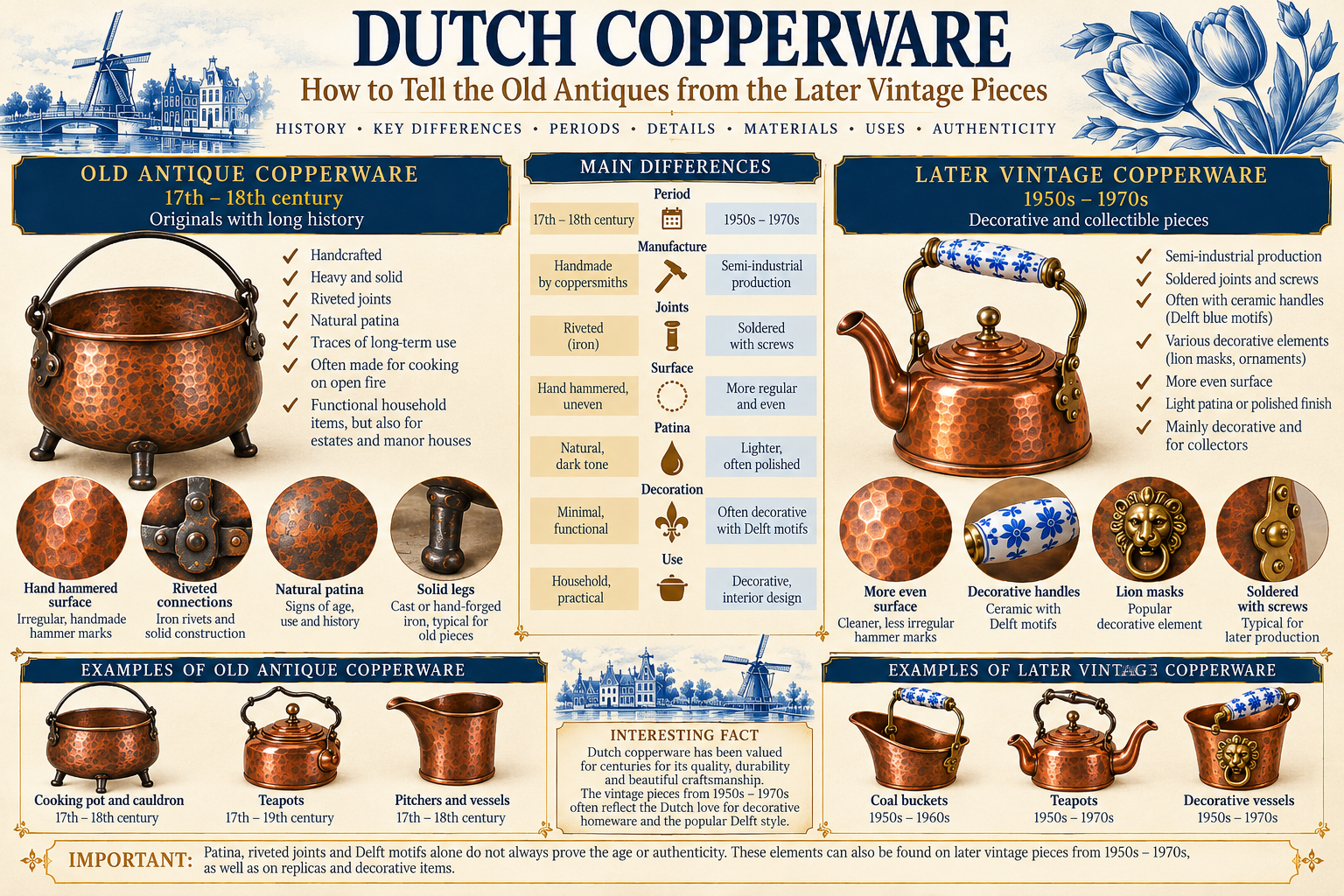
The Essential Collector’s Rule
An old-fashioned design is not proof of an old manufacturing date. Establish when the individual object was made, not merely when its shape first appeared.
Copperware in the Historic Dutch Home: Before Decoration Became the Main Purpose
For centuries, the central requirements of domestic metalware were practical. A vessel might need to hang over a fire, stand above burning fuel, retain hot water or allow someone to handle hot contents with reasonable control.
Copper was useful because it transfers heat efficiently and can be worked into different forms. Yet the finished object was not always made entirely from copper. Iron, brass, wood, ceramic and protective interior coatings could be combined according to function.
The distinction between copper and brass deserves particular attention. Copper is normally associated with a reddish appearance; brass is a copper alloy that often appears more yellow or golden. Historic vessels sometimes combine both, and colour can be altered considerably by oxidation, polishing or surface finishes.
A substantial historical example is preserved by the Rijksmuseum in Amsterdam. Its copper cooking cauldron, dated approximately 1550–1650 and attributed to the Low Countries, includes inserted repairs secured by riveting. This establishes that riveted repair work is genuinely present in historic domestic copperware.
The Museum Boijmans Van Beuningen records another useful comparison: a Dutch cooking kettle dated to approximately 1575–1675, with a hammered metal body, a wrought-iron handle and a visible relationship between its different metals.
These are more meaningful examples than the general assumption that an irregular surface must be several hundred years old. They allow the collector to examine a construction method in a securely catalogued historical context.
How the Hearth Shaped the Vessel
A kettle made to hang over an open fire is different from a vessel designed to sit inside a stove opening. The position of the heat source affects the base, suspension, proportions and handling arrangements.
This becomes particularly clear in nineteenth-century Dutch museum collections, where specialised stove kettles appear alongside more familiar water and tea kettles.
The Zuiderzeemuseum documents a copper steekketel, or insertion kettle, dated to the nineteenth century. It was designed to fit into a stove so that water could be kept hot throughout the day.
Such a form reflects a particular domestic technology. It is not simply a decorative variation of the ordinary kettle.
Repairs as Historical Evidence
A heavily used household vessel could be repaired rather than discarded. Added patches, altered handles or repaired seams may tell us about its working life.
An old repair is not automatically a defect without historical interest. In certain objects it contributes to the story of long-term domestic use.
Nevertheless, repaired construction does not by itself establish the original manufacturing date. A later vessel could also have experienced extensive use and repairs.
Traditional Dutch Copperware: Vessel Types and Historical Names
Correct identification begins by establishing the object’s actual form and probable original function. The term copper pot is too broad for many historic vessels.
Dutch museum terminology provides several useful categories.
| Dutch / English Name | Purpose | Identification Clues |
|---|---|---|
| Waterketel
Water kettle |
Heating water. | Pouring spout, handle, lid and a body suited to the heating arrangement. |
| Theeketel
Tea-water kettle |
Heating water for tea. | Can include a bail handle, spout and ceramic or other grip details. |
| Steekketel / insteekketel
Stove insertion kettle |
Maintaining hot water in a stove. | Specialised body designed to fit into a stove opening. |
| Kookketel
Cooking cauldron |
Cooking or heating liquids and food. | May include iron handles, riveted fittings and rounded bases. |
| Doofpot / kooltjespot
Ember-extinguishing pot |
Extinguishing or preserving embers by limiting oxygen. | Lid and functional closure are important; some have three feet. |
| Coal scuttle / coal hod | Carrying and pouring coal at the fireplace. | Raised pouring lip, handle and body suited to tipping contents. |
| Decorative copper planter | Display or secondary household use. | May reproduce a much older cauldron or fireplace-vessel design. |
The Doofpot Is Not Simply a Coal Bucket
A traditional Dutch doofpot is a specific vessel associated with extinguishing hot embers or burning fuel by restricting the oxygen supply.
The Kijk & Luistermuseum collection, documented through Collectie Gelderland, includes a three-legged copper doofpot dated approximately 1820–1850. It has a brass lid, handle and feet.
Its construction helps explain the original purpose. But a later small copper pot with three feet is not automatically a doofpot, and an open-topped coal scuttle should not be described as one without further evidence.
Function is as important as appearance.
Case Study 1: An Antique Copper Kettle with a Gooseneck Spout
The first object from The Old Antiquarian collection is a remarkable old copper kettle with a cylindrical body, detachable stepped lid, curved gooseneck spout and movable iron bail handle.
Its interest lies in the relationship between functional engineering and graceful design. The arched handle allows the vessel to be lifted, the lid provides access to the interior, and the long curved spout directs water away from the body.
Unlike purely ornamental vessels, the design strongly suggests a historic practical purpose. Yet identifying the function is not identical to establishing the year it was made.
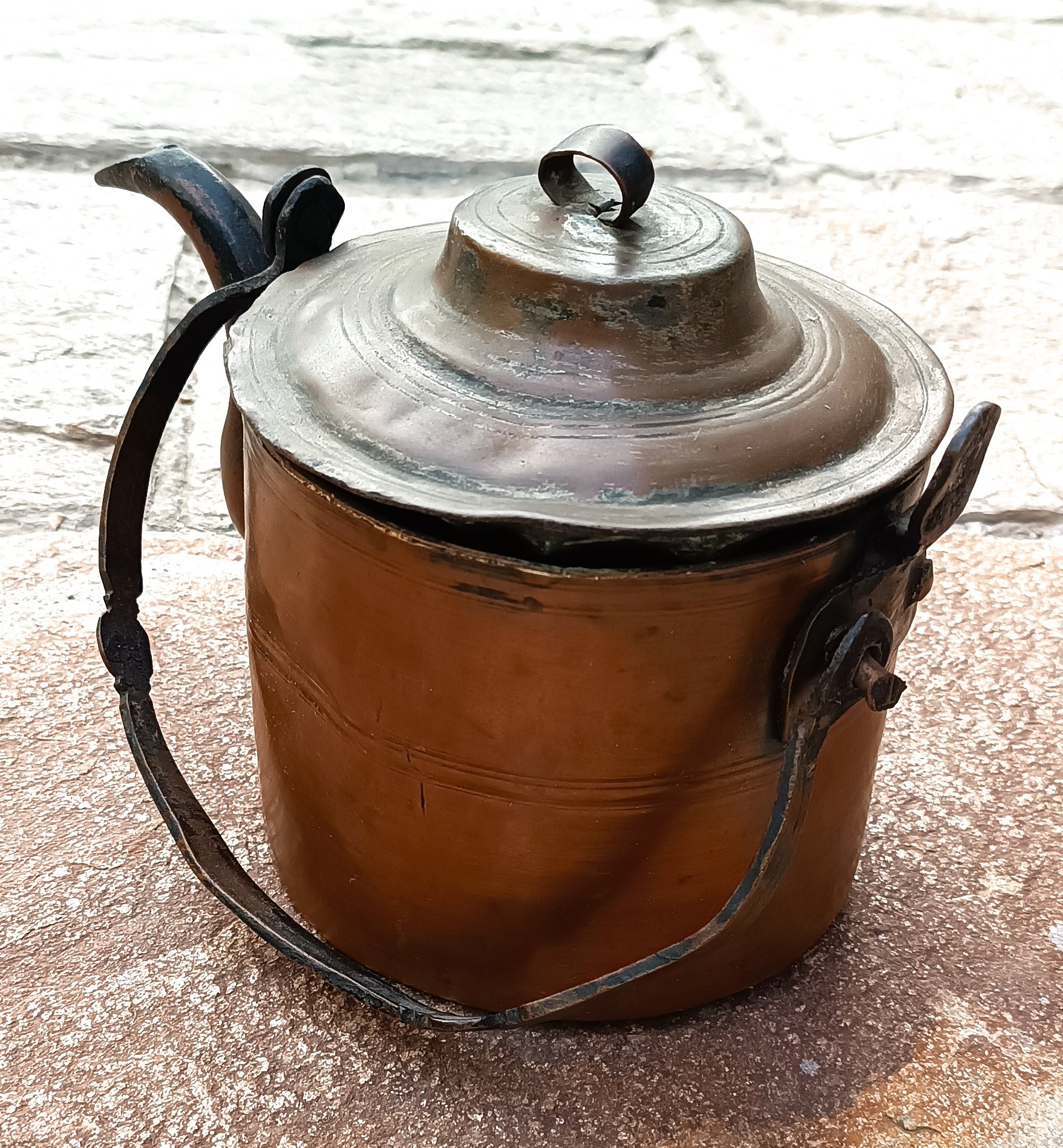
The Stepped Lid and Concentric Rings
The kettle’s lid has a series of concentric profiles. Seen from above, these rings create an appealing geometric rhythm.
Such details can have both structural and decorative roles. Forming and shaping the sheet metal creates changes in contour while giving the object its finished appearance.
It would be unwise, however, to identify a manufacturer or exact decade merely from these concentric rings. Similar features can appear in different workshops and periods.
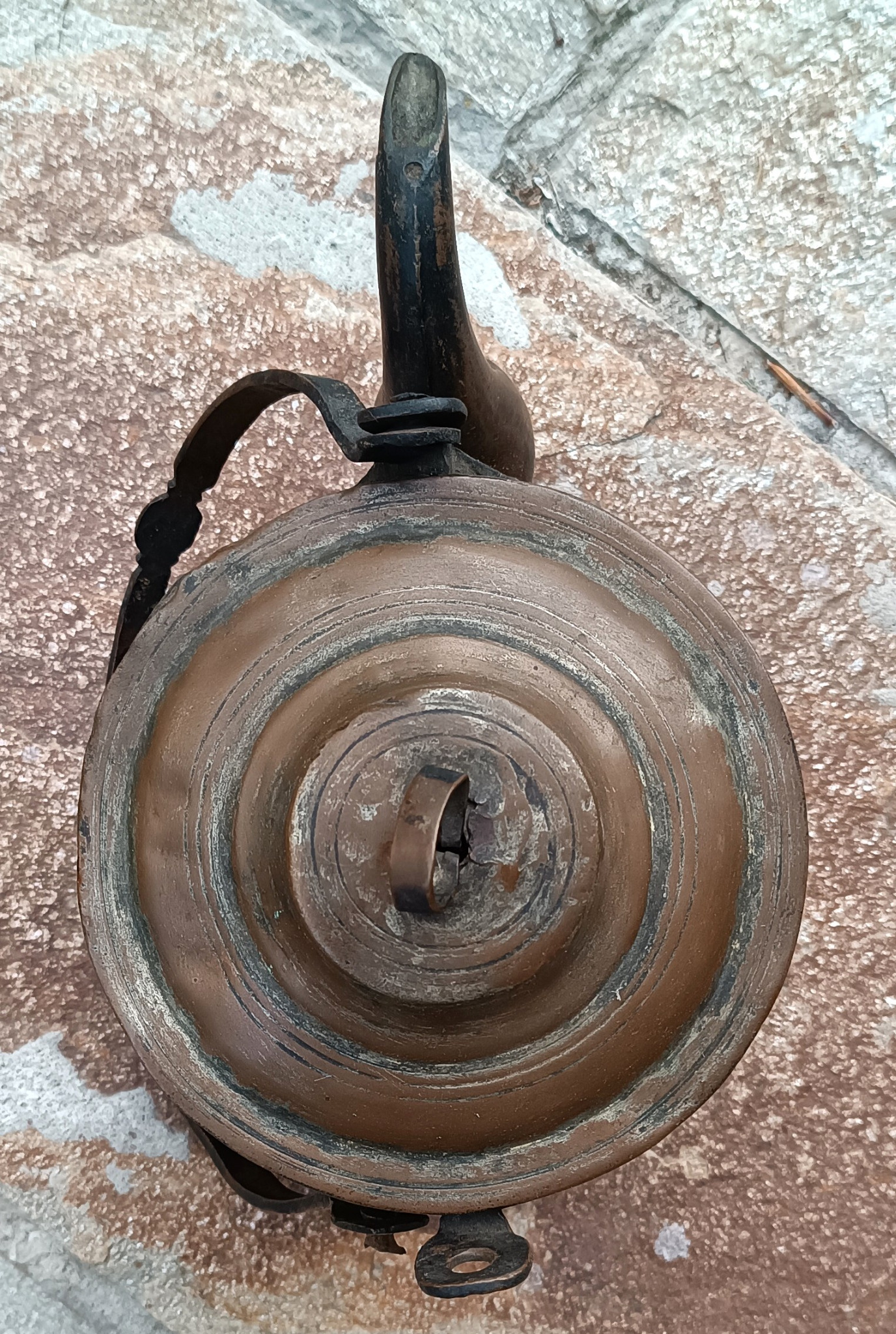
The Gooseneck Spout and Riveted Iron Handle
The kettle’s most memorable feature is its long, curved spout, sometimes described as bird-shaped or gooseneck.
That description refers to the shape, not to one exclusively Dutch historical model. Similar curved spouts occur in different European metalworking traditions.
The movable iron handle and its fittings provide further evidence of how the vessel was designed to be carried. The metal mounts and riveted attachments deserve particularly close examination.
Historical Dutch museum examples confirm that combining copper or brass vessels with iron handles was a recognised practical solution. They do not establish that this specific kettle came from the same maker or period.
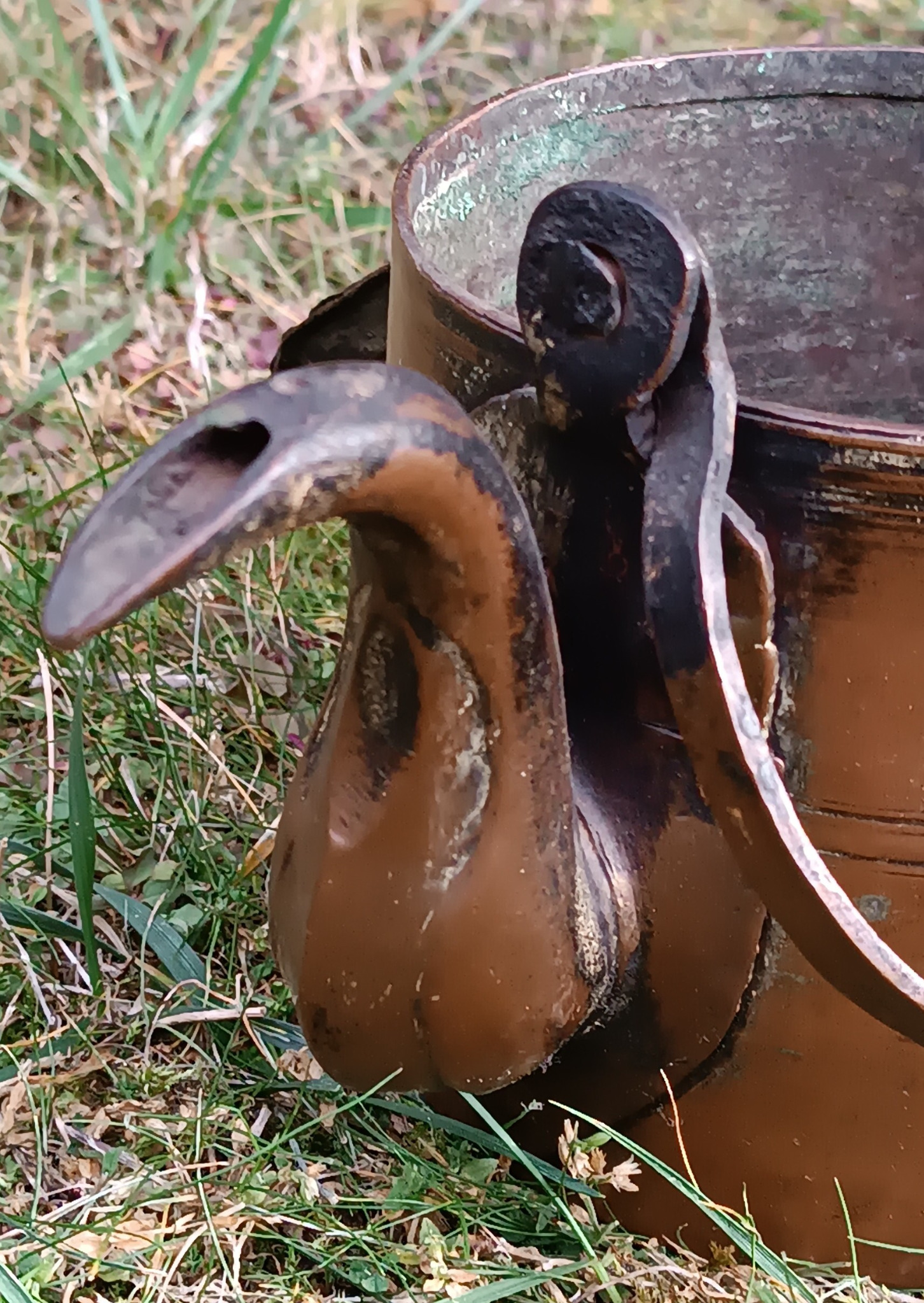
Date, Maker and Possible Dutch Origin
The kettle is catalogued by The Old Antiquarian as an antique European copper water kettle, tentatively dated circa 1850–1910.
Its possible Dutch origin is a working attribution based on style and construction comparisons, not a verified factory identification.
No precise maker, town of manufacture or independently documented production year has been established.
The condition includes aged patina, surface wear and visible oxidation, including inside the vessel. It is therefore treated as a decorative historical collectible rather than suitable working cookware.
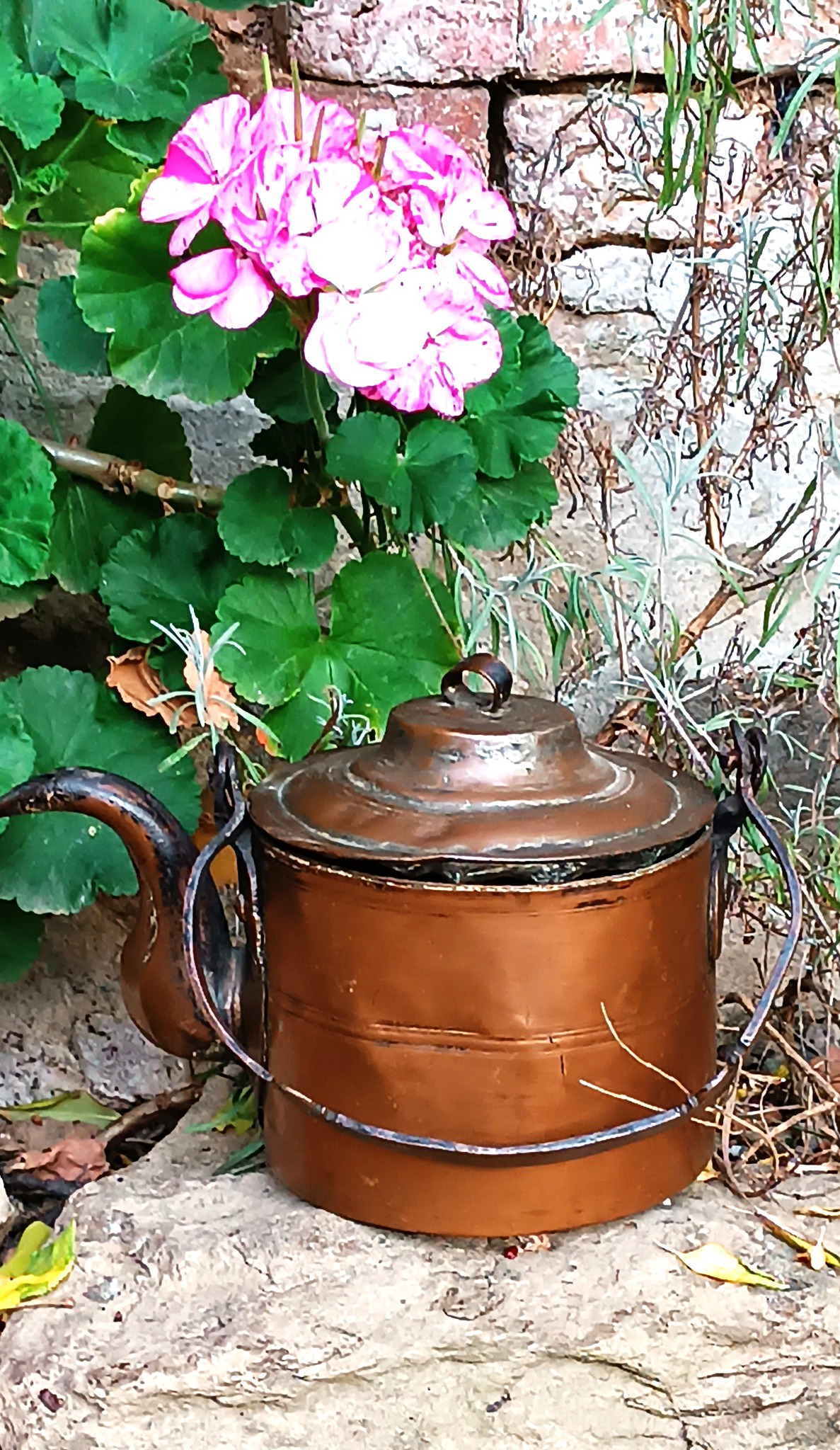
For the individual vessel, its photographs and documented condition, see the Antique Copper Kettle with Gooseneck Spout and Iron Handle in The Old Antiquarian collection.
The Copperware Revival: Changing Interior Taste from the 1950s to the 1970s
The twentieth century brought substantial changes to domestic heating, kitchen equipment and interior decoration.
As modern appliances and household arrangements developed, traditional copper forms increasingly served two markets: practical household use and nostalgic decoration.
This transformation cannot be assigned to one universal date. Coal fires, traditional kitchens and modern appliances coexisted for decades, depending on country, region and household circumstances.
The 1950s: Familiar Materials in the Post-War Home
During the post-war years, household furnishings reflected both modern aspirations and continued appreciation for familiar materials.
Copper and brass could introduce warmth and a sense of domestic continuity, particularly where traditional furnishings, fireplaces and wooden interiors remained important.
Old-fashioned shapes did not necessarily disappear when new technology arrived. A traditional kettle or coal vessel could be retained, replaced with a similar product or chosen because of its decorative appeal.
Not every copper accessory encountered today can be dated specifically to the 1950s. The decade is part of a wider transition, and exact dates require evidence from individual objects.
The 1960s: Mixed Materials and Historic-Style Decoration
By the 1960s, historicising and traditional decorative designs had an established place alongside modern interior styles.
Some copper accessories combined warm metal bodies with contrasting fittings. Brass-coloured mounts, lion masks and blue-and-white ceramic grips gave familiar fireplace forms a more elaborate appearance.
Such features evoke historic European decorative traditions. Their presence does not mean that the individual object was made during the period which inspired the design.
Surviving vintage market examples of copper coal scuttles with Delft-style grips are regularly described as mid-twentieth-century pieces. However, trade descriptions vary, and without period factory catalogues these dates should remain approximate.
The 1970s: Rustic Interiors and the Appeal of the Old Hearth
In the 1970s, traditional forms could serve as visible decorative statements.
A copper coal scuttle might be used to hold kindling, magazines or dried flowers rather than coal. A small three-legged cauldron could function as a plant container. A kettle might remain on display long after it ceased to be used for boiling water.
These changes gave copperware a new role: preserving the atmosphere of older domestic life within a modern interior.
The resulting objects are meaningful evidence of twentieth-century taste in their own right. A genuine copper scuttle made in the 1960s or 1970s does not need to be misrepresented as Victorian to be collectible.
A Note on Fashion and Dating
The 1950s, 1960s and 1970s are useful historical contexts for the revival of traditional copper forms. They are not universally applicable production dates. Period styles overlap, older patterns may continue in manufacture, and similar pieces can have very different histories.
Case Study 2: A Pair of Vintage Dutch Copper Coal Scuttles
The second group of objects consists of two coal scuttles in complementary sizes.
They share a distinctive helmet-shaped profile with a raised pouring lip, rounded copper-coloured body, decorative lion-head mounts and arched metal handles fitted with blue-and-white ceramic grips.
The arrangement is visually effective. The copper-toned body supplies warmth, the lion heads add sculptural interest, and the white ceramic handles introduce the bright blue motifs associated with Dutch decorative taste.
The scuttles are an especially useful case study because the traditional functional shape and more decorative elements can be considered separately.
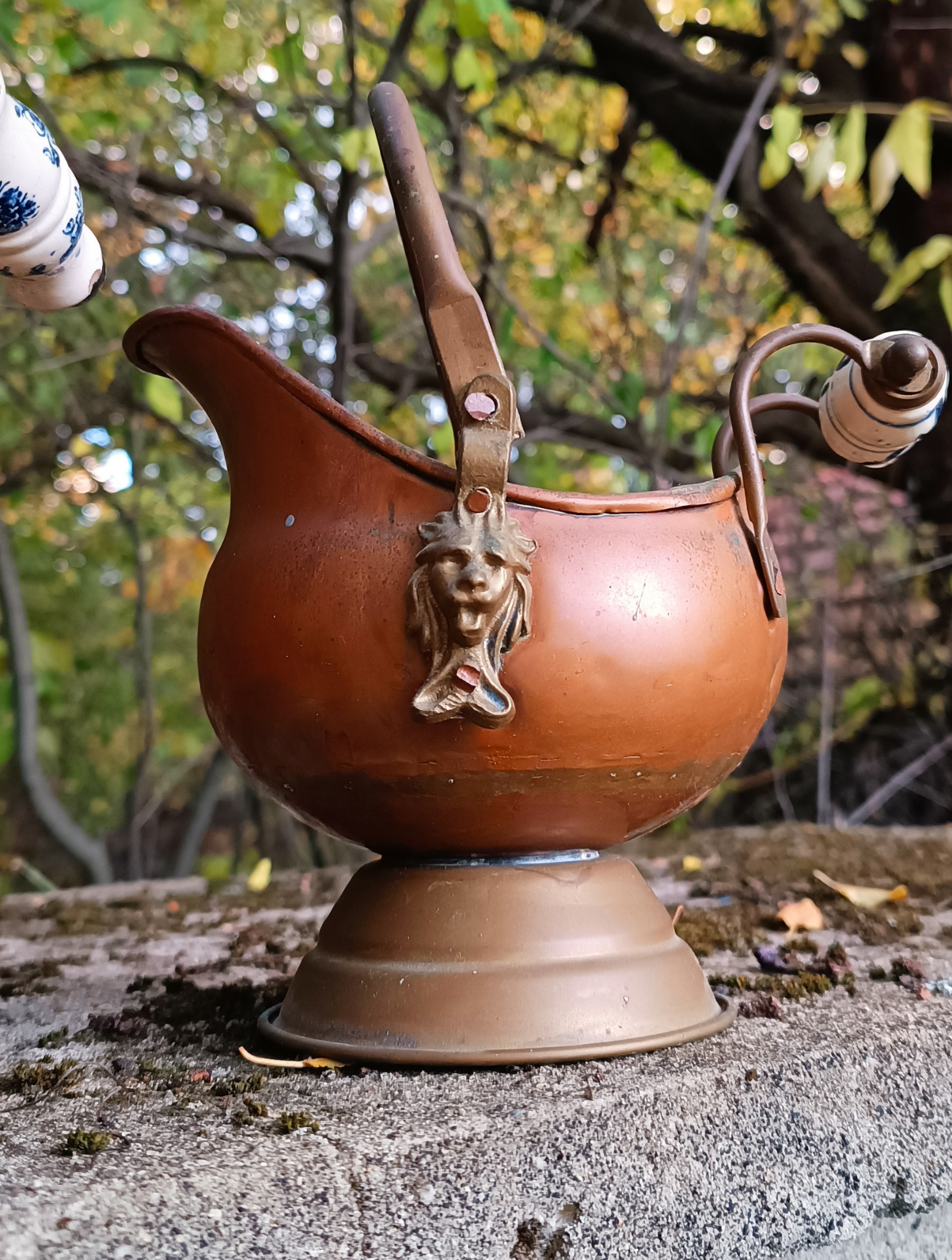
Why the Raised Pouring Lip Matters
The projecting upper lip of a coal scuttle allows the contents to be tipped toward a fireplace or stove more easily.
In working household equipment, that shape answered a practical need. In decorative or later historic-style examples, it also became a recognisable visual reference to an earlier way of life.
A similar pouring lip can therefore appear on vessels separated by many decades. It helps identify the form, not the exact manufacturing date.
Comparing Two Different Sizes
The pair illustrates a useful collecting point: related vessels may have similar decorative fittings without being identical in size.
The dimensions, proportions and attachment arrangements need to be compared individually. They can indicate whether objects were originally sold as a matched range, acquired separately or brought together later.
A similar appearance alone does not prove simultaneous manufacture or common ownership from new.
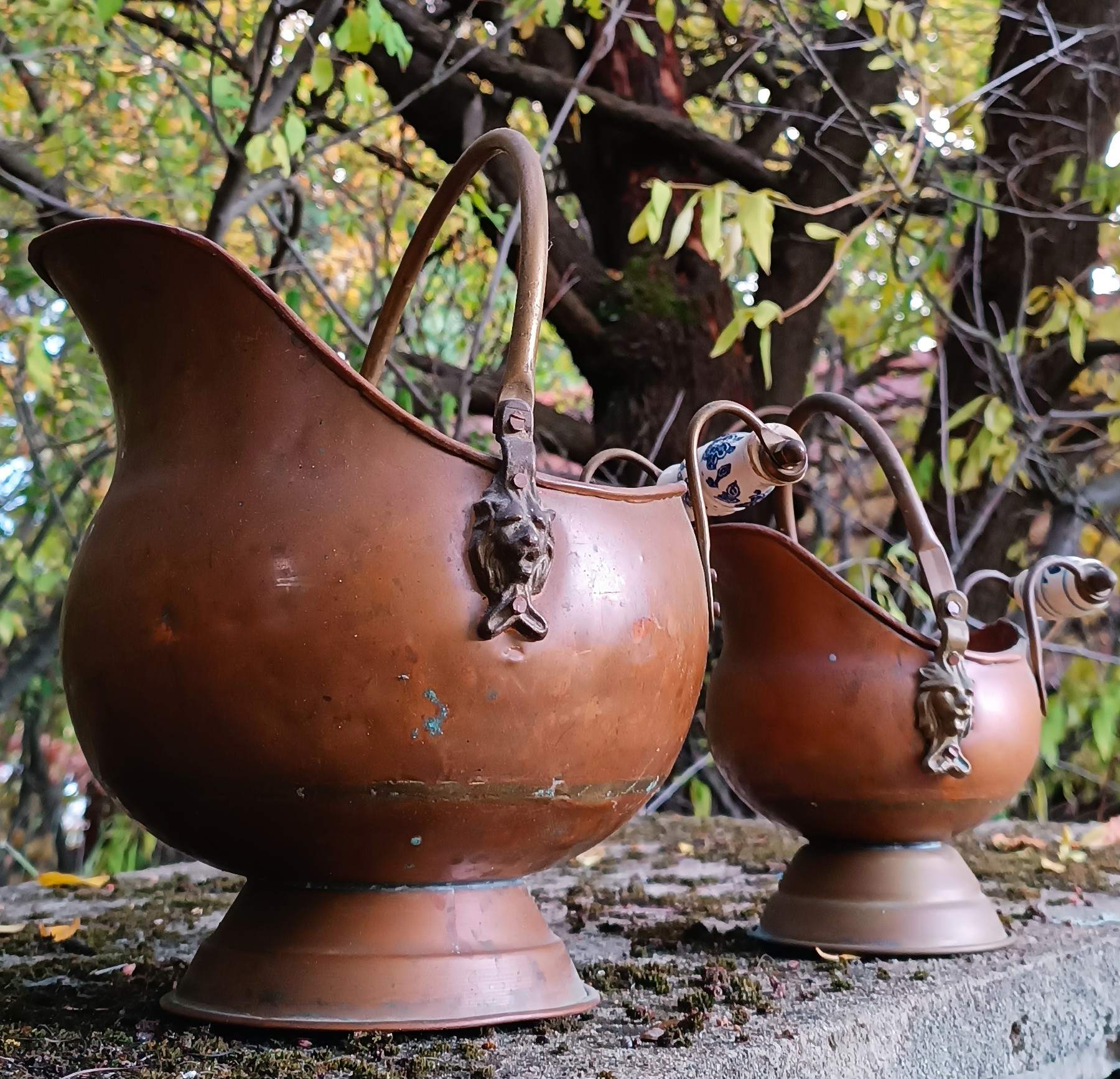
Probable Period and Documented Origin
The Old Antiquarian catalogues the pair as vintage Dutch copper coal scuttles, tentatively circa 1950–1970.
That dating is based on their overall style and comparison with similar mid-twentieth-century decorative fireplace accessories. It is not an independently verified manufacturing date.
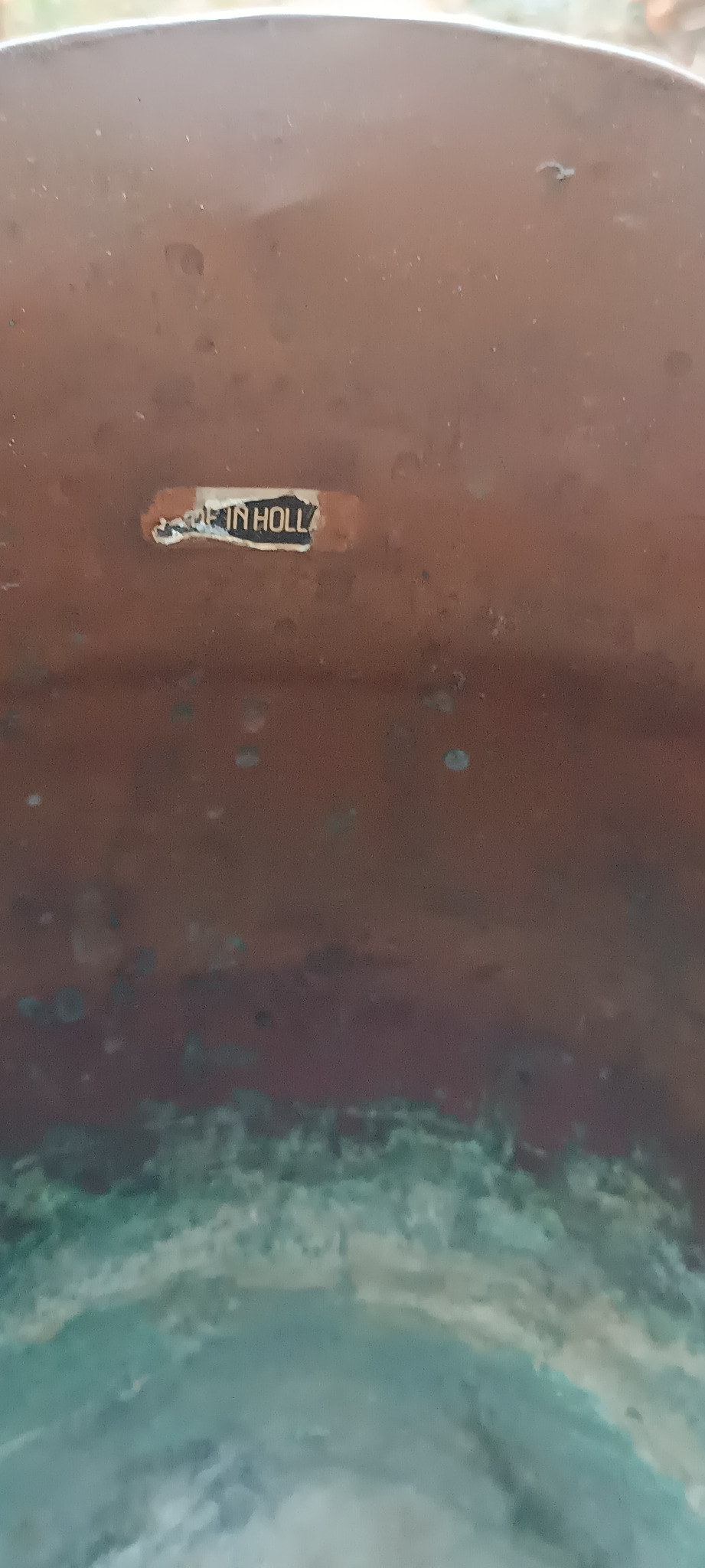
One of the vessels retains a surviving fragment of an interior paper label consistent with the wording Made in Holland.
This is a stronger indication of Dutch origin for the labelled object than decorative style alone. It does not identify the factory or precise year, and it does not automatically establish the origin of the other vessel.
The full pair and its individual condition photographs can be viewed in the Vintage Dutch Copper Coal Scuttles with Delft-Style Handles and Lion Heads collection listing.
Delft-Style Ceramic Handles and Lion Masks: Decoration Is Not a Date
The blue-and-white handles are among the most recognisable details on vintage Dutch fireplace accessories.
Their floral decoration recalls Delfts blauw, or Delft Blue, the celebrated Dutch blue-and-white ceramic tradition.
But one distinction must be maintained throughout any serious identification: Delft-style decoration is not the same as verified manufacture by a historic Delft pottery.
The specialist Dutch Delftware research platform documents how Delft-style ceramics were made in other Dutch towns and abroad. During later periods, the blue-and-white appearance became a widespread decorative language rather than an exclusive geographical designation.
Indeed, a nineteenth-century copper tea kettle in the Zuiderzeemuseum collection has white ceramic details with blue decoration, demonstrating that the combination of copper and blue-and-white ceramics is not exclusively a 1960s invention.
Floral Ceramic Decoration
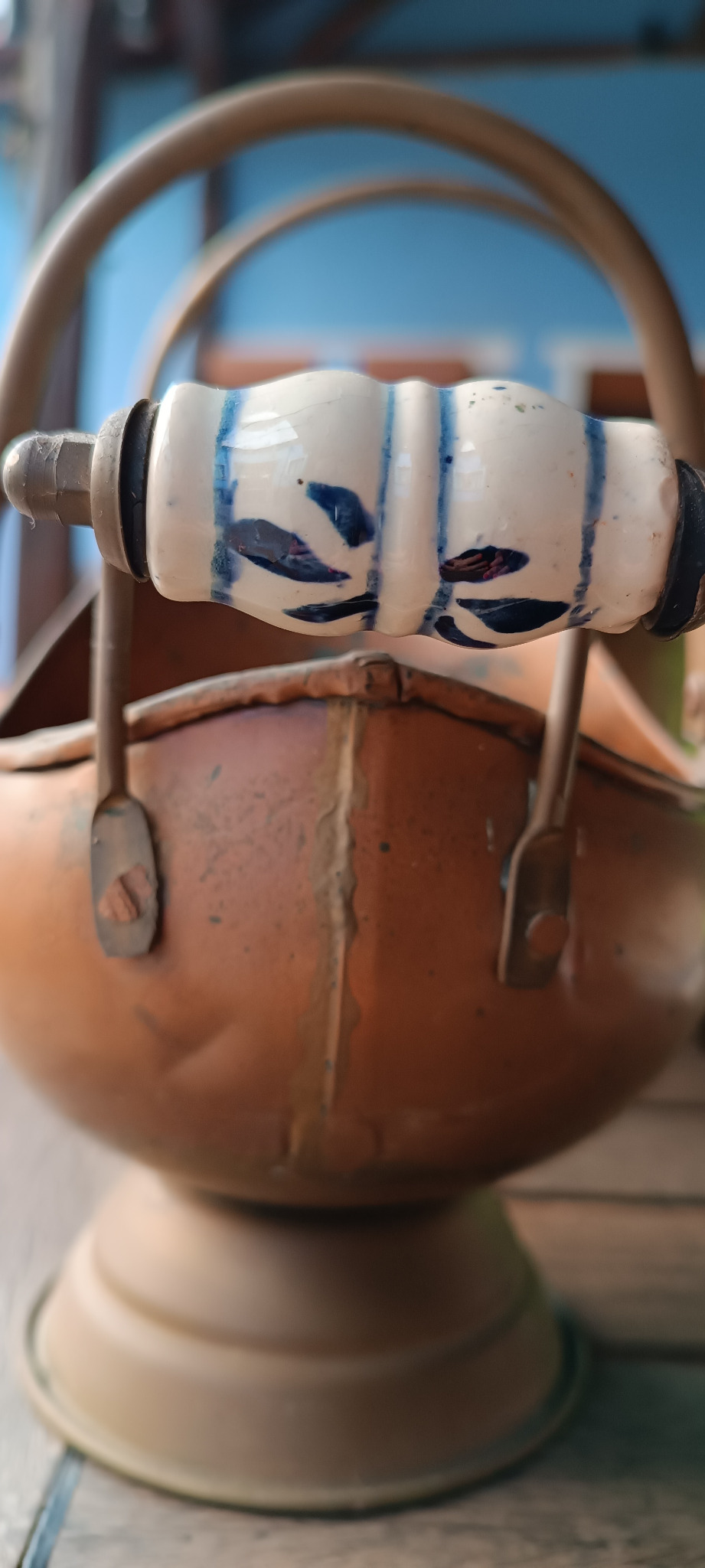
The handle shown here includes cobalt-blue floral motifs over a light ceramic surface.
The pattern creates a strong contrast with the reddish copper body and golden-coloured fittings.
This appearance is attractive, but the photograph alone cannot conclusively establish whether the decoration was painted freehand, transfer-applied or finished using another manufacturing method.
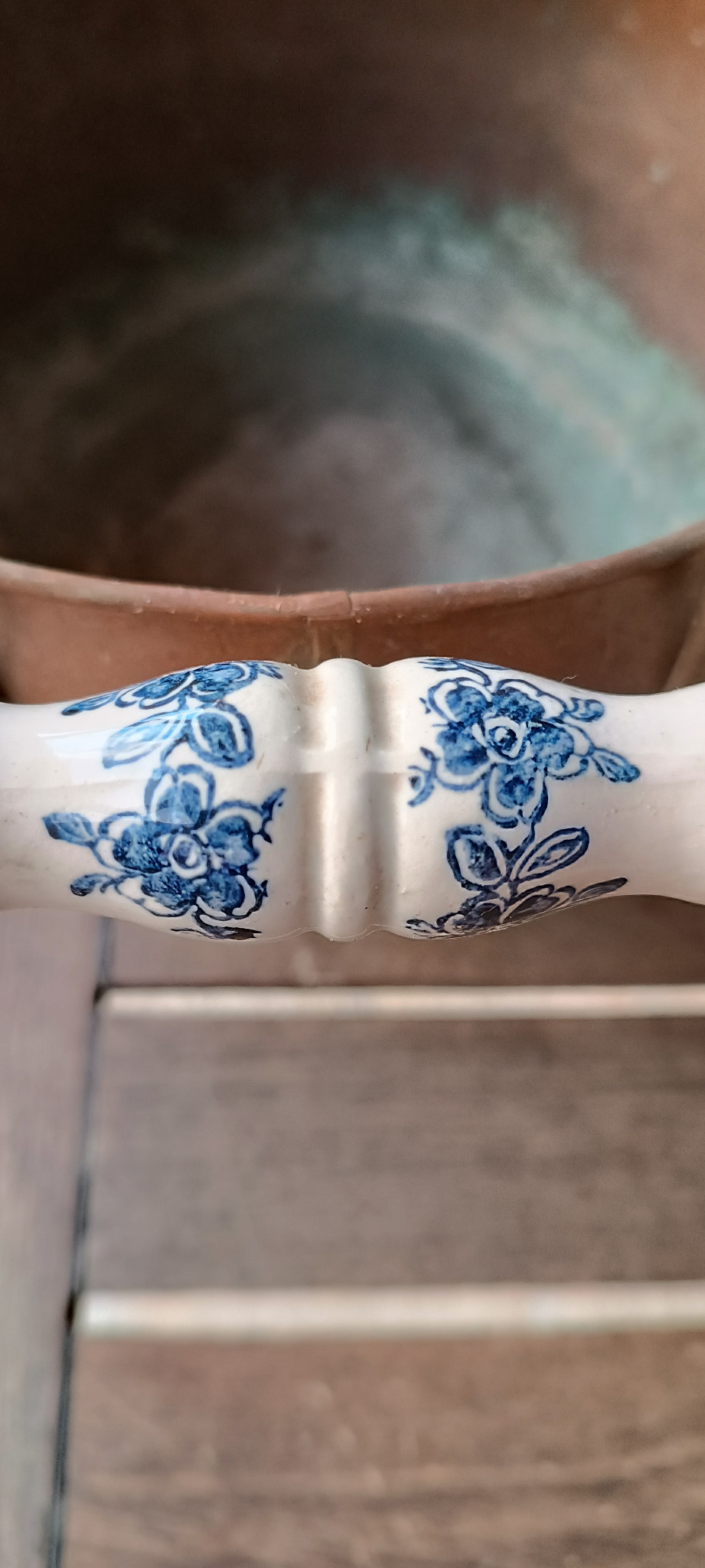
Why the Reverse Side Also Matters
The back of a handle may reveal attachment methods, screws, brackets and evidence of replacement or repair.
These details deserve attention because a ceramic grip might have been replaced during the working life of a fireplace accessory.
A visually matching handle does not always establish that all components are original to the same period.
What Do the Lion-Head Mounts Signify?
Lion heads and lion-mask mounts have a much older history in European decorative arts, appearing on furniture, architectural fittings and metalwork.
On a copper coal scuttle, the motif provides a sense of historical grandeur and can serve as a decorative surround for a handle fitting.
But an old decorative motif is not an old manufacturing date. A lion-mask mount could be produced and attached decades or centuries after the style it evokes.
A responsible description is therefore vintage copper coal scuttle with decorative lion-head mounts and Delft-style ceramic handles, unless stronger evidence supports a more specific attribution.
The Original Made in Holland Label: What Does It Prove?
A particularly informative detail survives inside one of the photographed coal scuttles: part of a paper label carrying lettering consistent with Made in Holland.
Original labels are often lost during cleaning, prolonged use or resale. Their survival can provide evidence of how an object was originally presented or marketed.
This label supports Dutch origin for the individual marked vessel, provided it belongs to the object and has not been added later.
It does not give an exact manufacturing date, identify the workshop or prove that every apparently matching object was produced in the same factory.
Why You Should Preserve Old Labels
The tendency to clean a copper vessel thoroughly can inadvertently destroy one of its most informative features.
A fragile paper label should not be soaked, scraped or polished. Photograph it clearly before undertaking any cleaning or handling that could affect it.
Its surviving wording, shape, paper and method of attachment may all be worth documenting.
At the same time, a label is evidence to interpret, not a substitute for examining the object itself.
Country-of-Origin Evidence vs Manufacturing Date
Made in Holland indicates the stated country of origin. Without an identifiable manufacturer, dated catalogue, model number or other corroborating evidence, the label should not be converted into a precise production year.
Case Study 3: A Small Vintage Three-Legged Copper Cauldron
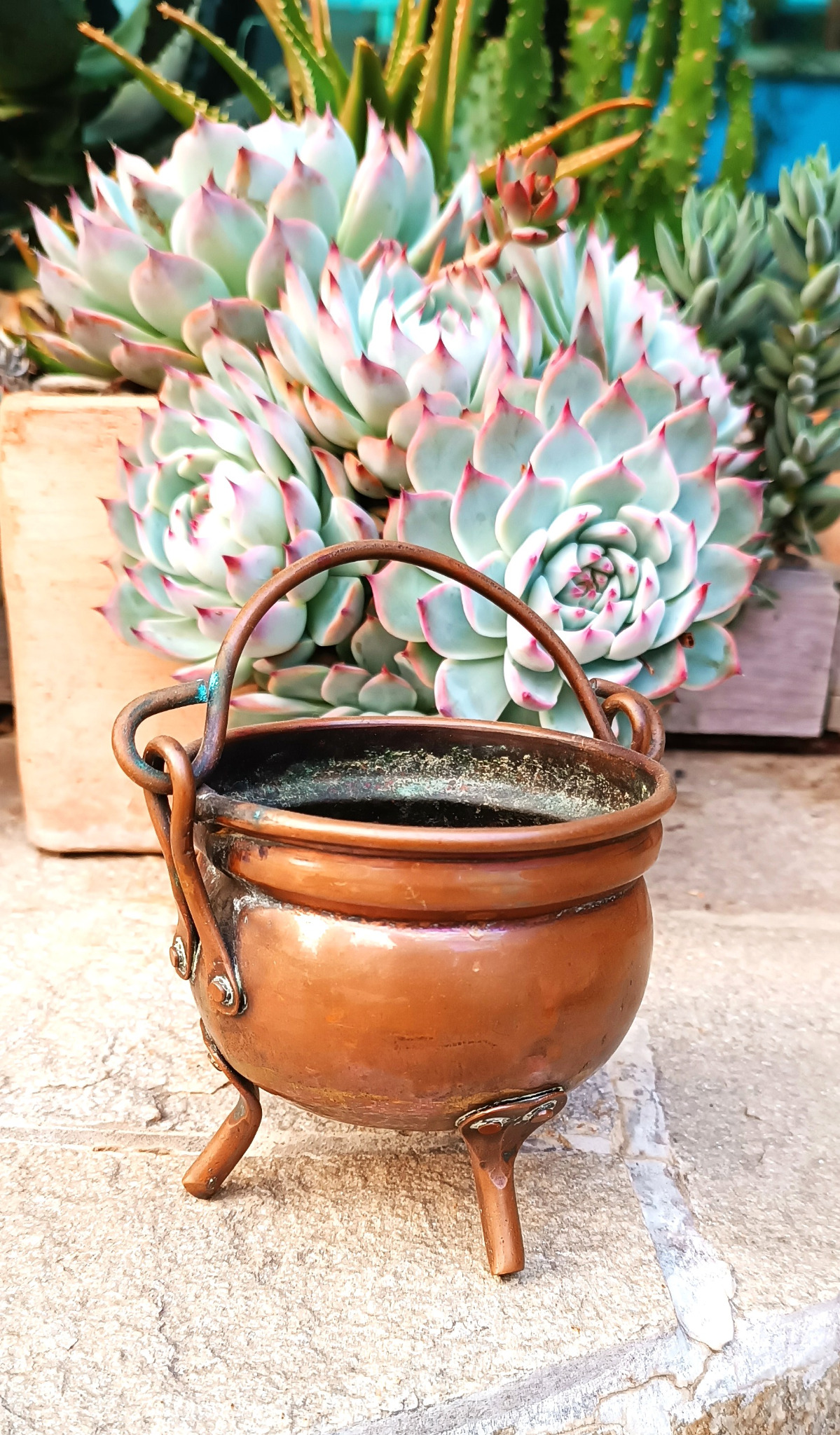
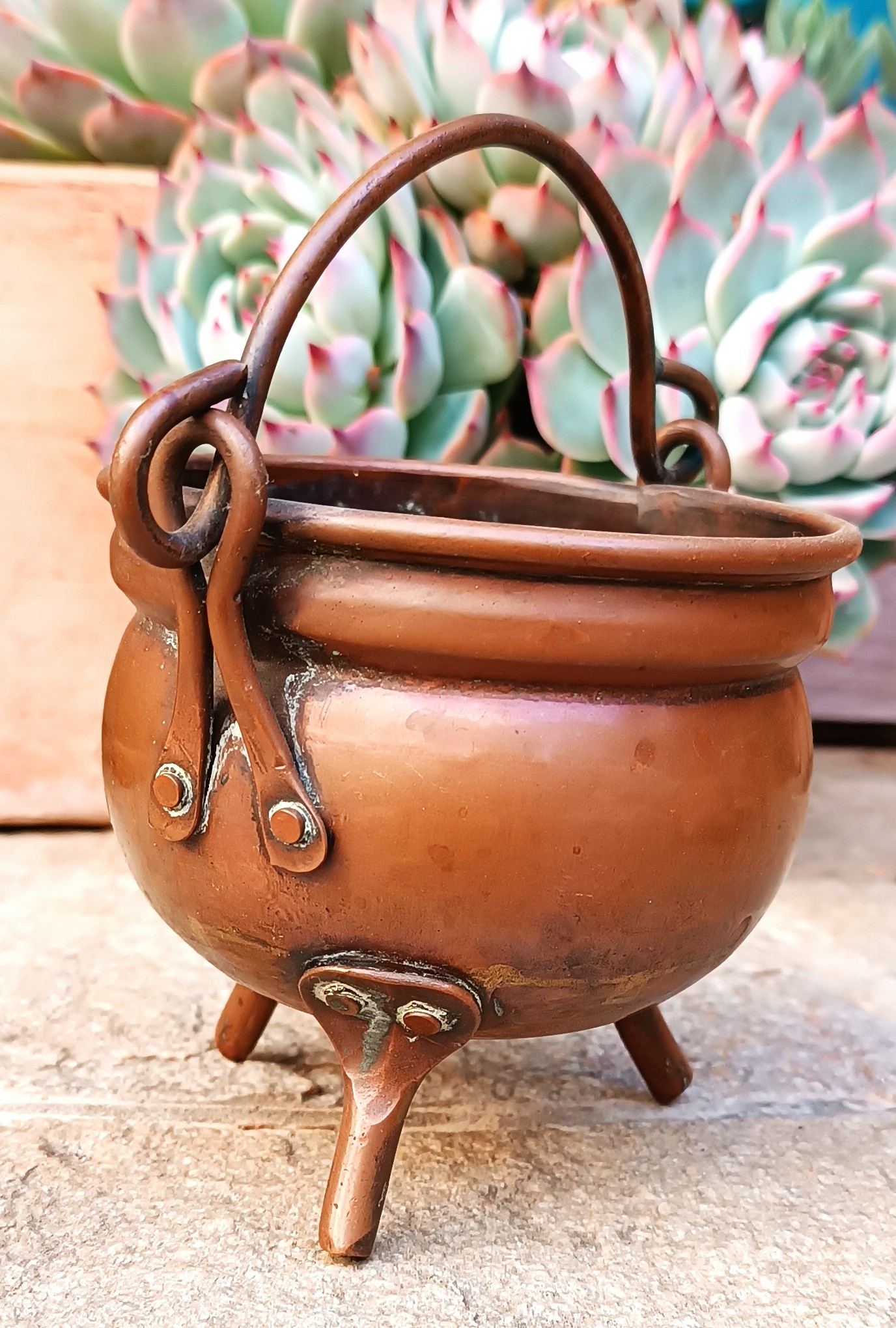
The third object is a compact copper-coloured cauldron with an open rounded body, rolled rim, movable arched handle and three separate supporting legs.
Its shape recalls traditional hearth vessels, where raised legs could support a pot above a suitable heat source.
In miniature or later decorative forms, that practical silhouette may survive even when the object was not intended for everyday cooking.
This is an excellent example of why it is important to distinguish the history of a design from the actual production date of a particular object.
Riveted Feet and the Underside
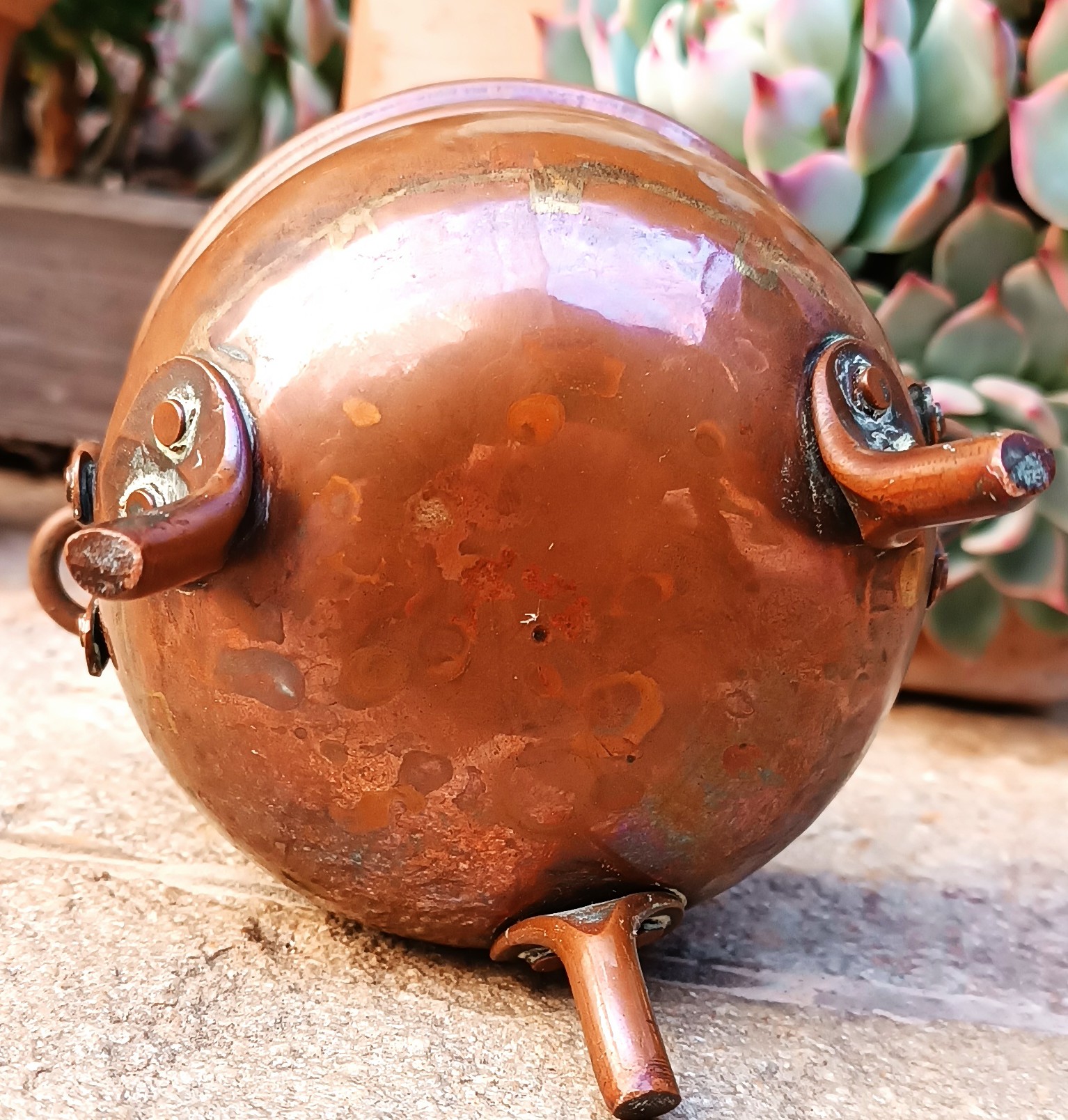
The bottom of the cauldron is one of the most revealing areas.
Here, the photograph shows the rounded underside, visible leg attachments and areas of oxidation.
The riveted fittings help explain how the supporting legs are connected to the vessel. They may also provide evidence of manufacturing sequence, repair or alteration.
Rivets are not, however, exclusive to antique handwork. They continued to be used in numerous twentieth-century household and decorative products.
The Swing Handle and Supporting Legs
The arched handle is another historic-looking feature. It creates a connection with older suspended kettles and portable cooking pots.
Yet this small vessel’s precise original use has not been independently established. It may have been decorative from the beginning, used as a container or inspired by a working hearth-pot form.
The safest identification is based on what can actually be observed: a small copper-coloured vessel with a rolled rim, swing handle and three separately attached feet.
Working Date and Provenance
The Old Antiquarian identifies this object as a vintage three-legged copper cauldron, tentatively circa 1930–1960.
It was brought from the Netherlands, but its country of manufacture is not confirmed.
The exact metal composition has also not been independently tested; the visible surface is consistent with copper-coloured metal, likely copper.
Its estimated period is based on physical appearance and comparison rather than a maker’s date stamp.
See the individual Vintage Three-Legged Copper Cauldron with Swing Handle for the full object description and condition information.
Antique vs Vintage Copperware: The Differences That Matter
The following comparison brings together the distinctions that are most useful when examining a Dutch or Dutch-style copper vessel.
It is important to read the table as a guide to possible patterns, not an automatic dating test. Genuine antiques can have regular surfaces, and later products can be hammered, riveted and deeply patinated.
| Feature | Traditional Antique Copperware | Later Vintage / Revival Pieces | Important Caution |
|---|---|---|---|
| Original purpose | Often cooking, water heating or fireplace work. | May be functional, decorative or both. | A historic shape may remain practical in later periods. |
| Manufacture | Handworking and traditional metal-forming methods are common. | Industrial and craft methods may be combined. | Later handwork is still genuine handwork. |
| Rivets | May join fittings, patches or repairs. | May be structural or decorative. | Rivets cannot date an object alone. |
| Handles | Iron, brass or mixed-material fittings. | Metal handles, ceramic grips and historic-style fittings. | Older decorative ceramic handles also exist. |
| Surface | May show wear, hammering, corrosion or historic repairs. | May be polished, hammered, lacquered or patinated. | Darkness and irregularity do not prove age. |
| Decorative motifs | Can range from restrained to elaborate. | Lion masks, Delft-style ceramics and traditional ornaments. | Motifs can be reproduced across centuries. |
| Patina | May reflect historic use and changing conditions. | Can develop naturally or be deliberately applied. | Patina is not an exact clock. |
| Labels | May have maker stamps or historic identification. | May retain country-of-origin labels or retail information. | Country wording rarely supplies a precise year. |
| Condition | May include lengthy use, old repairs and replacements. | May have decades of genuine wear. | Wear is evidence of a life, not necessarily centuries. |
| Best dating evidence | Provenance, documented types, construction and marks. | Labels, catalogues, model comparisons and known history. | Use several consistent clues. |
Five Visual Clues That Are Often Overinterpreted
Hammer marks: irregular surface marks may result from handwork, intentional decorative hammering or later finishing. Their pattern and context matter.
Riveted construction: rivets can be old, recent, structural or decorative. Examine their purpose and relationship to the object.
Dark patina: natural oxidation depends on conditions, not simply the passage of time. A newer vessel can be dark, while an older one can be bright after polishing.
Traditional forms: a cauldron with three legs may look medieval, but similar forms continued to be made in later centuries.
Delft-style decoration: blue flowers on white ceramic may be highly characteristic, but they do not establish a Delft pottery, an antique date or even the country of manufacture without other evidence.
Original, Vintage, Reproduction or Fake: Understanding the Terms
Confusion over these words can lead to incorrect descriptions and unrealistic valuations.
An item can be authentically vintage and also a reproduction of an older form. These are different questions.
| Term | Meaning | Copperware Example |
|---|---|---|
| Antique original | An object genuinely manufactured in the historical period attributed to it. | A documented nineteenth-century working water kettle. |
| Authentic vintage | An original object from a later period with its own historic and design interest. | A copper coal scuttle made in the 1960s. |
| Period reproduction | An item produced later using an earlier model or style. | A 1970s cauldron made to resemble a much older hearth pot. |
| Modern reproduction | A contemporary object copying or reviving historical design. | A newly produced decorative copper bucket with traditional fittings. |
| Fake or deliberate misrepresentation | An object intentionally altered or represented deceptively. | A modern vessel given a false maker’s mark and sold as a rare antique. |
The value of responsible identification lies in describing what the object actually is.
A well-preserved 1960s copper scuttle can be a desirable vintage decorative accessory without claiming that it was made in 1860.
Likewise, a traditional-looking three-legged pot may be historically interesting as an example of revival design, even when its precise workshop cannot be named.
How to Identify and Date Dutch Copperware: A Practical Method
When investigating a copper vessel, it is tempting to begin by searching its silhouette online. A more useful approach is to record the object systematically before comparing it with outside examples.
- Identify the form. Is it a water kettle, cooking cauldron, coal scuttle, ember pot, stove vessel or decorative planter?
- Measure it. Record height, diameter, width including the spout and height with the handle raised.
- Examine the material. Distinguish likely red copper, brass, iron and other components. Do not assume an untested metal composition.
- Inspect the body. Look for seams, forming marks, rolled rims, separate bases and the relationship between components.
- Examine the rivets and fittings. Determine whether they are structural, decorative, repaired or possibly replaced.
- Check the base and interior. Record any soldering, scratches, corrosion, residue, wear or evidence of previous heating.
- Photograph every label and mark. A partial paper label can be as important as a stamped inscription.
- Analyse the decoration. Identify lion masks, ceramic handles or historic-style motifs without immediately assigning an early date.
- Establish provenance. Where was the vessel acquired? Is that its place of manufacture or merely the place of purchase?
- Compare documented objects. Begin with museum collections and original records before relying on marketplace descriptions.
- Assess condition and restoration. Look for replacements, polished surfaces, altered handles and repairs.
- Assign a justified date range. A broad, evidence-based estimate is preferable to an unsupported exact year.
Three Objects, Three Different Levels of Certainty
| Collection Object | Working Date | Origin Evidence | Outstanding Question |
|---|---|---|---|
| Gooseneck copper kettle | Possibly c. 1850–1910. | Possible Dutch origin, unverified. | Exact maker, date and production location. |
| Pair of copper coal scuttles | Probably c. 1950–1970. | Partial Made in Holland label on one vessel. | Manufacturer, exact dates and history of the pair. |
| Three-legged vintage cauldron | Possibly c. 1930–1960. | Acquired in the Netherlands; manufacture unverified. | Exact original purpose, metal composition and maker. |
THE DATING FORMULA
Object form + material + construction + fittings + marks or labels + provenance + documented comparisons + condition = a defensible attribution.
Dutch Copperware Value: Which Antique and Vintage Pieces Are Collectible?
There is no reliable universal price for Dutch copperware.
A documented nineteenth-century kettle, a decorative 1960s coal scuttle and a small twentieth-century cauldron may attract different buyers and belong to different market categories.
The value of an old working vessel may depend heavily on age, provenance and original construction. A vintage decorative piece may appeal primarily because of its proportions, visual character, original labels and suitability for an interior.
Neither collecting category should automatically be dismissed in favour of the other.
What Determines Copperware Value?
| Factor | Why It Matters |
|---|---|
| Documented age | An evidenced date is more meaningful than an antique appearance. |
| Maker and provenance | A trustworthy label, mark or ownership record may strengthen attribution. |
| Craftsmanship | Quality of shaping, joining, finishing and functional design can affect demand. |
| Original condition | Original fittings, complete lids, handles and historically significant surfaces matter. |
| Decorative appeal | Lion masks, ceramic grips and attractive forms influence interior demand. |
| Rarity and size | Unusual sizes or uncommon historic forms can affect collector interest. |
| Restoration and damage | Repairs, deformation, lost labels and replaced components may change value. |
| Completed sales | Comparable realised prices offer stronger market evidence than asking prices. |
Is an Antique Copper Kettle Worth More Than a Vintage Coal Scuttle?
Not necessarily. An older item is not automatically rarer, better made or more sought after.
The antique kettle may interest collectors of historical domestic metalware, while the coal scuttles may appeal to buyers furnishing traditional or rustic interiors.
The two markets overlap but are not identical.
Does a Made in Holland Label Increase Value?
An authentic original label can add useful provenance information and may strengthen collector confidence.
But the presence of a country label does not automatically make a common decorative object rare or valuable.
Why Asking Prices Are Not Enough
Online shops and marketplaces show how sellers describe and position objects. Their prices do not necessarily reveal what comparable items actually sell for.
For a useful comparison, consider objects of similar age, dimensions, material, decoration, condition and documented origin.
A highly polished but unmarked decorative coal scuttle is not automatically comparable with a museum-quality early cooking cauldron.
For a broader explanation of the appraisal process, see Professional Antique Valuation at The Old Antiquarian.
ASKING PRICE ≠ REALISED MARKET VALUE
Compare like with like, account for condition and use completed sales where reliable examples are available.
How to Clean, Preserve and Safely Display Antique Copperware
One of the quickest ways to remove historical evidence from a copper object is to polish it aggressively before establishing what it is.
A bright appearance may be suitable for certain contemporary copper products, but an antique vessel can retain original finishes, ageing, repairs and labels that should be understood before treatment.
The Canadian Conservation Institute explains that polishing is an abrasive process which removes tarnish and some surface metal. Repeated polishing can reduce surface detail.
What Should You Avoid?
Before Cleaning a Historical Copper Vessel
- Do not use wire brushes, sandpaper or abrasive pads.
- Do not apply aggressive household acids or polishing mixtures without understanding the object.
- Do not remove labels, old repairs or historic fittings.
- Do not polish through decorative finishes or an intentional surface treatment.
- Do not soak an object with paper labels, vulnerable joints or unknown repairs.
- Do not assume all green corrosion can be safely treated at home.
Patina vs Active Corrosion
Copper can acquire red-brown, dark brown, black and greenish surface compounds through oxidation and environmental exposure.
Some tarnish or patina may be relatively stable. Other corrosion processes can remain active and damage the underlying object.
Powdery, recurring, bright green corrosion in archaeological copper alloys can indicate a serious conservation problem, although an exact diagnosis should never be made from colour alone.
Where active corrosion or fragile original surfaces are suspected, consult a qualified metals conservator rather than experimenting with household chemicals.
Storage and Handling
Stable copper objects should be stored in a clean environment with controlled humidity, away from unnecessary moisture, chemical fumes and abrasive contact.
The Canadian Conservation Institute recommends appropriate humidity control, clean storage and suitable protective materials for copper and other metal collections.
For vessels with ceramic handles, avoid carrying heavy weight by a grip that may already have small cracks or loose fittings.
Small fragile paper labels deserve separate attention. They should be documented and protected against accidental wetting or rubbing.
Can an Antique Copper Kettle Be Used for Drinking Water?
A historic copper vessel should not automatically be regarded as food-safe.
Older interiors may contain damaged tinning or other coatings, unknown solder, previous repairs and corrosion.
Health Canada advises against cooking or storing food in scratched or uncoated copper cookware and notes that older protective coatings may present additional concerns.
The three collection objects discussed here are presented for decorative and collectible purposes. They should not be used for heating, food preparation or beverage service without an appropriate professional safety assessment.
For general preservation advice, see What Not to Do to an Antique Before Valuation or Sale.
Dutch Copperware Collector Checklist
Before buying, selling or dating an antique-looking copper vessel, a collector should be able to describe more than its general appearance.
- Photograph the object from front, side, back and above.
- Record the complete underside and interior.
- Measure height, diameter, width and handle dimensions.
- Identify its probable original purpose.
- Distinguish copper, brass, iron and ceramic components where possible.
- Study seams, rolled edges, rivets and soldered areas.
- Examine any iron handle for old wear or replacement.
- Look for evidence of heating, working use or historic repair.
- Document all marks, paper labels and inscriptions.
- Examine decorative lion heads and Delft-style handles without assigning an automatic date.
- Distinguish the place of purchase from the country of manufacture.
- Research museum examples of the same vessel type.
- Check whether all fittings are original or replacements.
- Record cracks, dents, corrosion, repairs and missing components.
- Avoid aggressive cleaning before identification.
- Use a broad date range when evidence does not justify precision.
- Compare completed sales of similar objects rather than unrelated asking prices.
- Preserve any known family history, receipt, original packaging or documented provenance.
THE OLD ANTIQUARIAN
Do You Own Antique or Vintage Dutch Copperware?
A traditional copper kettle, unusual cauldron, vintage coal scuttle or inherited fireplace accessory may have a history worth exploring.
Useful photographs include the complete vessel, its underside, rivets, handle fittings, any country-of-origin label, visible repairs and condition details. Measurements and known ownership history can be equally important.
The Old Antiquarian provides identification and valuation guidance informed by over 35 years of practical experience with antiques, vintage objects and historical collecting.
Request Antique Identification & Valuation
A preliminary photographic opinion does not replace physical examination or constitute a guaranteed authentication certificate.
Frequently Asked Questions About Antique and Vintage Dutch Copperware
1. How can you tell if Dutch copperware is antique?
Examine its original function, construction, materials, rivets, fittings, markings, wear and provenance. Compare the whole vessel with documented museum examples. No single feature establishes age conclusively.
2. What is antique Dutch copperware?
The term generally refers to historic copper vessels made in the Netherlands, including cooking cauldrons, water kettles, stove vessels and hearth accessories. Specific dates and makers require evidence.
3. Are copper vessels with rivets always handmade antiques?
No. Rivets were used in both earlier and later manufacture. Their function and construction should be considered alongside the rest of the object.
4. Does hammered copper mean an object is old?
No. Hand-hammered finishes and deliberately hammered decoration have continued into modern production. Hammer marks need historical and technical context.
5. How old are Dutch copper kettles with iron handles?
The combination has a long history, with museum examples from several periods. An individual kettle must be dated through its specific form, construction and supporting evidence.
6. What is a gooseneck copper kettle?
A copper vessel with a long, curved pouring spout resembling a bird’s neck. The term describes a shape, not an exclusive maker or production period.
7. What is a Dutch steekketel?
A kettle designed to fit into a stove so that water could be maintained at a useful temperature. The Zuiderzeemuseum preserves a documented nineteenth-century example.
8. What is a Dutch doofpot?
A vessel used to extinguish hot embers or burning fuel by restricting oxygen. Some historic examples have lids and three legs.
9. When were Dutch copper coal scuttles popular?
Traditional coal scuttles served practical fireplace needs, while decorative versions continued to appear during the twentieth century. Similar objects are often associated with the mid-century and 1970s revival of historic-style interiors.
10. Are coal scuttles with Delft-style handles from the 1960s?
Some comparable pieces are attributed to the 1950s–1970s, but similar decoration exists in other periods. Exact manufacturing dates require stronger evidence.
11. Does a Delft Blue ceramic handle prove Dutch manufacture?
No. Delft-style motifs have been reproduced by different makers inside and outside the Netherlands. A verified maker’s mark or provenance record is needed for a stronger attribution.
12. What do lion heads on copper scuttles mean?
They are decorative motifs with older European precedents. Their presence alone does not prove a nineteenth-century date or a specific manufacturer.
13. What does Made in Holland mean on copperware?
It indicates a stated Dutch country of origin. An original label supports provenance for the marked object but normally does not reveal its exact maker or production year.
14. Is vintage Dutch copperware a reproduction?
It can be. A genuine vintage object may reproduce an older historical design. That does not make it a fake if its actual manufacturing period is described accurately.
15. Does a dark patina prove great age?
No. Patina depends on environment, moisture, handling, cleaning and surface treatment. It is one clue among many, not a precise clock.
16. Are three-legged copper cauldrons always antique?
No. Three-legged designs have long historical precedents, but small versions were also made as later household or decorative objects.
17. Was the three-legged cauldron in this guide made in Holland?
It was acquired in the Netherlands, but its original country of manufacture has not been confirmed. Its working date is approximately 1930–1960.
18. Can a copper coal scuttle be used as a planter?
It may be displayed as a planter or decorative container, but prolonged direct contact with moisture and soil can encourage corrosion. A separate liner is preferable, with precautions to keep moisture away from the metal and original labels.
19. Should antique copper be polished?
Not automatically. Polishing removes surface material and can destroy historically significant patina or finishes. Research the object before deciding on treatment.
20. Is green corrosion on copper dangerous for the object?
Some green surface compounds may be stable, while others can indicate active corrosion. Powdery or recurring deposits deserve examination by a qualified conservator.
21. Can an old copper kettle still be used for boiling water?
An antique kettle should not be used for food or beverages without a professional assessment of its lining, solder, corrosion and overall safety. Decorative use is the safer default for uncertain historic objects.
22. Are antique Dutch copper kettles valuable?
Some are, but the value depends on documented age, condition, maker, craftsmanship, rarity and current collector demand. Age alone does not establish value.
23. Are vintage copper coal scuttles collectible?
Yes. Original vintage scuttles can appeal to collectors of European decorative arts and to buyers interested in rustic or traditional interior design.
24. Is copperware more valuable when it has original labels?
Original labels can strengthen identification and provenance, but value still depends on the entire object and the market for comparable examples.
25. What photographs are needed to identify vintage copperware?
Photograph the full object, underside, interior, handles, rivets, seams, labels, marks, wear and any repairs. Include dimensions and known ownership history.
Conclusion: Two Histories, One Enduring Material
Dutch copperware reflects more than the history of a metal. It reveals the changing relationship between domestic work, craftsmanship, interior design and collecting.
The antique gooseneck kettle recalls a time when household utensils were closely shaped by the requirements of heat and everyday use.
The pair of decorative coal scuttles illustrates a later chapter: the continuing attraction of historical silhouettes, combined with lion-head ornaments and Delft-inspired ceramic grips.
The small three-legged cauldron offers a final reminder that traditional forms can outlive their original purpose by generations.
An accurate collector’s description should not try to make every attractive copper object older than it is. Genuine vintage manufacture deserves recognition as part of its own design period.
When a vessel’s origin or age remains uncertain, a carefully qualified attribution is more valuable than an unsupported claim.
The best research combines close examination, documented historic parallels, respect for original surfaces and a realistic understanding of the market.
The Final Collector’s Principle
Identify the form. Understand its original purpose. Examine the construction and metal. Preserve the marks and labels. Compare historical evidence. Distinguish antique from vintage. Evaluate condition before value.
Sources, Museum Collections & Further Research
The historical background in this guide draws on museum records of documented Dutch and Low Countries metalware, research into Delft-style ceramics, conservation guidance and original photographs from The Old Antiquarian collection.
Dates attached to museum objects refer to those particular objects. They are not automatically transferred to privately collected vessels that resemble them.
- Rijksmuseum, Amsterdam — Kookketel van koper, c. 1550–1650. Historic copper cooking vessel attributed to the Low Countries, with inserted sections secured by riveting. Object number BK-NM-1811.
- Museum Boijmans Van Beuningen — Cooking Kettle, c. 1575–1675. Dutch metalworking example documenting hammered metal, wrought iron and the structural relationship between different materials.
- Zuiderzeemuseum — Theeketel, 1800–1900. Copper kettle with white ceramic elements and blue decoration; a useful historic comparison for the combination of copper and blue-and-white ceramics.
- Zuiderzeemuseum — Steekketel of insteekketel, 1800–1900. Copper stove-insertion kettle designed to provide hot water throughout the day.
- Zuiderzeemuseum — Kookketel, 1800–1900. Historical kettle combining yellow copper, red copper, tinned interior surfaces and iron handle fittings.
- Collectie Gelderland / Kijk & Luistermuseum — Waterketel, 1820–1850. Historical brass-and-copper water kettle with a hinged spout cover and construction adapted to heating on a stove.
- Collectie Gelderland / Kijk & Luistermuseum — Doofpot, 1820–1850. Three-legged copper ember pot with brass components, used for extinguishing burning fuel.
- Dutch Delftware — Has Delftware Been Copied? Specialist historical account of the spread of Delft-style decoration and its manufacture inside and outside Delft.
- Dutch Delftware — Marks and Identification. Explanation of makers’ marks, authentic Delftware and the limitations of decorative terminology.
- Canadian Conservation Institute — The Cleaning, Polishing and Protective Waxing of Brass and Copper. Conservation guidance explaining why polishing can remove historic surface material.
- Canadian Conservation Institute — Storage of Metals. Guidance on humidity, storage conditions and preventing corrosion in historic metal collections.
- Health Canada — The Safe Use of Cookware and Bakeware. Practical safety guidance on copper cookware, protective coatings and damaged cooking surfaces.
- The Old Antiquarian — Original Object Photography and Collection Documentation, October 2026. Twelve individual photographs of the antique gooseneck kettle, pair of vintage Dutch coal scuttles and small three-legged cauldron, together with an educational identification infographic. The working dates given for these private objects are qualified estimates and should not be confused with verified museum dating.
Research and Attribution Notes
The historic museum objects establish documented construction methods and vessel types, not the precise date of the privately held examples pictured in this guide.
The antique gooseneck kettle is tentatively dated to circa 1850–1910. Its Dutch attribution remains possible rather than confirmed.
The coal scuttles are tentatively attributed to the mid-twentieth century, approximately 1950–1970. One retains an incomplete label consistent with Made in Holland.
The three-legged cauldron was brought from the Netherlands and is tentatively dated to circa 1930–1960. Its maker and country of production remain unidentified.
Delft-style ceramic grips, lion-head mounts, rivets, hammering and patina are meaningful descriptive features, but none should be treated as independent proof of age or exact factory origin.
ABOUT THE OLD ANTIQUARIAN
Historical Objects, Careful Research and Over 35 Years of Experience
The Old Antiquarian is an independent antiques and vintage collecting project informed by more than 35 years of practical experience with historical objects.
Our approach combines close observation of materials, craftsmanship, construction and condition with museum collections, specialist research, documented provenance and comparative market evidence.
Copperware is a particularly revealing subject. A riveted handle, an old paper label or a well-used base can sometimes provide more useful information than a brilliantly polished surface.
But it is equally important to respect the identity of later objects. A beautifully made vintage scuttle from the 1960s is part of the history of decorative design, even when its appearance draws on much older traditions.
We believe that antiques are more than decorative possessions. They preserve evidence of craftsmanship, changing domestic life and the people who owned and used them. Responsible collecting begins with understanding those histories rather than replacing uncertainty with attractive assumptions.
The Old Antiquarian | Original Collection Photography & Historical Research | Updated October 28, 2026
