
The Engineer Who Stitched a Storm | Wiehler Gobelin Story
Quick Answer: What Is the Story Behind This Wiehler Gobelin Tapestry?
According to the personal history preserved with this piece, a Wiehler Gobelin tapestry depicting an approaching storm over Lake Mondsee was hand-stitched during the 1980s in Polski Trambesh, Bulgaria, by an engineer employed at the town’s old brick factory. He spent approximately eight months completing the work as a hobby and a way to relax. He lived with and cared for his elderly father, and the two enjoyed watching sports together while the engineer embroidered. Their home had a garden filled with roses. His father eventually lived to the remarkable age of 101.
Sometimes the most remarkable part of an old object is not what it depicts, but the life of the person who created it.
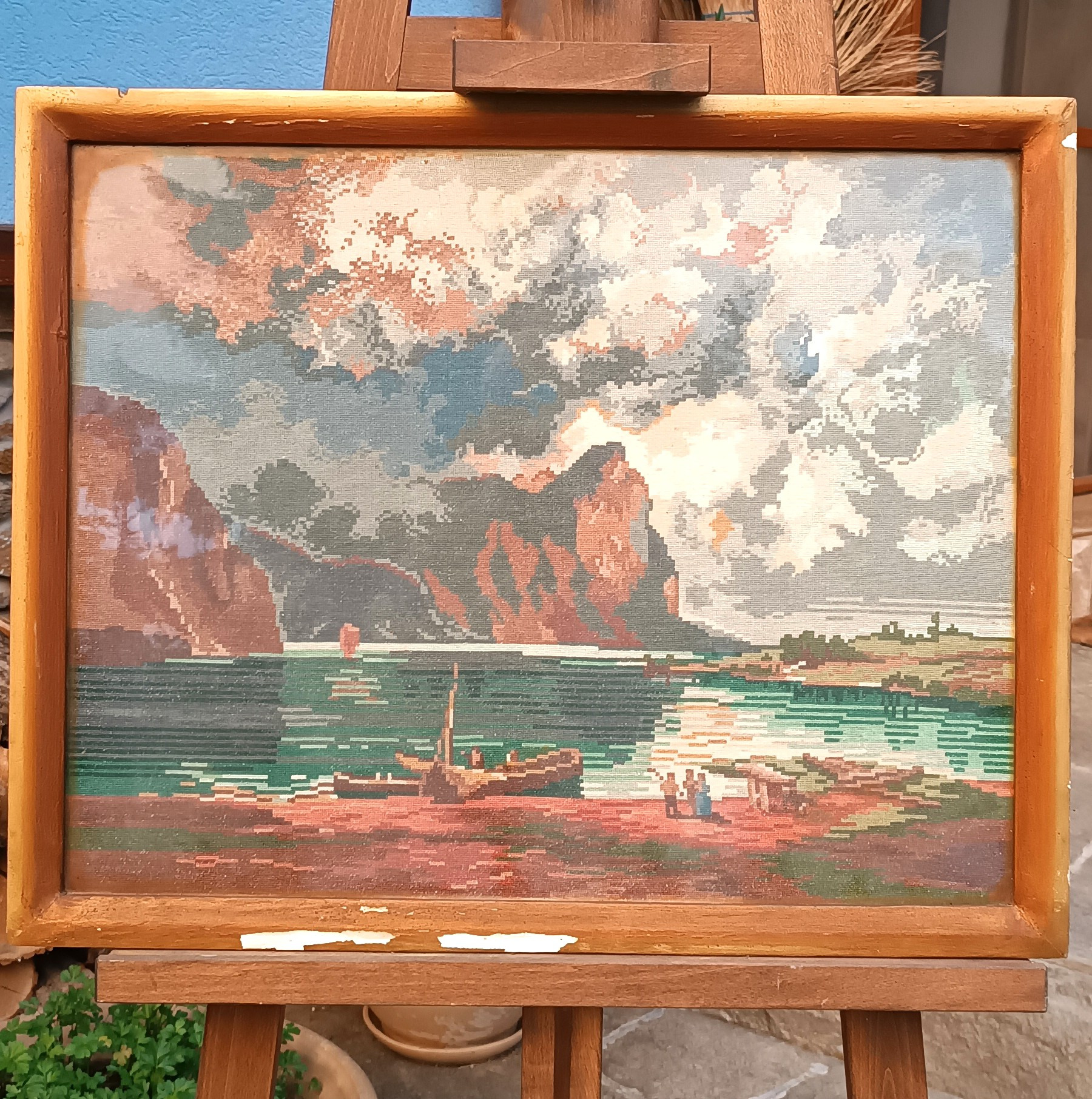
At first glance, this is an atmospheric piece of vintage European needlework: towering rocky cliffs, a small boat beside the water and a dramatic sky filled with approaching storm clouds.
Yet behind the landscape lies a different story. It is the story of an engineer in 1980s Bulgaria, his unexpected creative pastime, his devotion to an elderly father and a quiet family home with a garden full of roses.
This personal account reached The Old Antiquarian together with the tapestry itself. It allows us to consider the object not only as a decorative work, but also as a small surviving record of everyday life, patience and family relationships.
The Tapestry at a Glance
| Feature | Information |
|---|---|
| Title | Storm over Lake Mondsee |
| Original design title | Aufziehendes Gewitter am Mondsee |
| Design publisher | Wiehler Gobelin, Germany |
| Artistic source | After Anton Hansch, Austrian landscape painter |
| Stitching location | Polski Trambesh, Veliko Tarnovo region, Bulgaria, according to the preserved account |
| Period of execution | 1980s, according to the object’s history |
| Maker of this example | An engineer employed at the local brick factory |
| Time spent | Approximately eight months |
| Technique | Reportedly hand-embroidered; exact stitch structure not independently established |
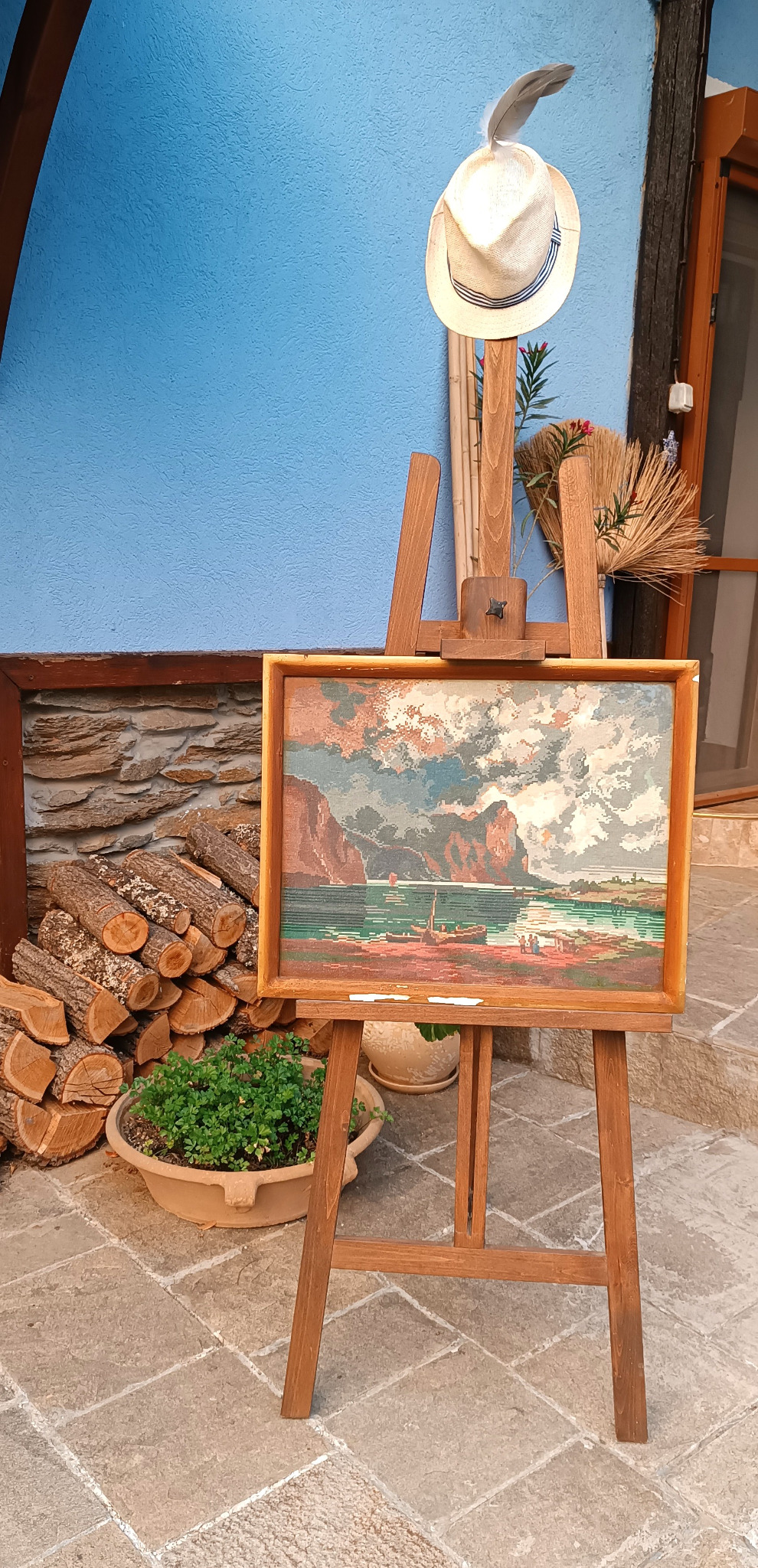
| Framed dimensions | 60 × 50 cm / approximately 23.6 × 19.7 in |
| Presentation | Vintage wooden frame with glass |
One Home, Two Men and a Garden Full of Roses
Our story takes us to the town of Polski Trambesh, in the Veliko Tarnovo region of Bulgaria, during the 1980s.
An engineer working at the town’s old brick factory had an unusual passion outside his professional life. He enjoyed hand-stitching pictorial tapestries.
According to the history preserved with the tapestry, the engineer shared his home with his elderly father. Only the two of them lived there, and their property had a garden filled with roses.
The son cared for his father, who eventually reached the extraordinary age of 101 years.
They shared an interest in sports. While watching sporting events together, the engineer would work on his tapestry. Embroidery was not his profession; it was his personal hobby, a source of enjoyment and a way to relax from the demands of everyday work.
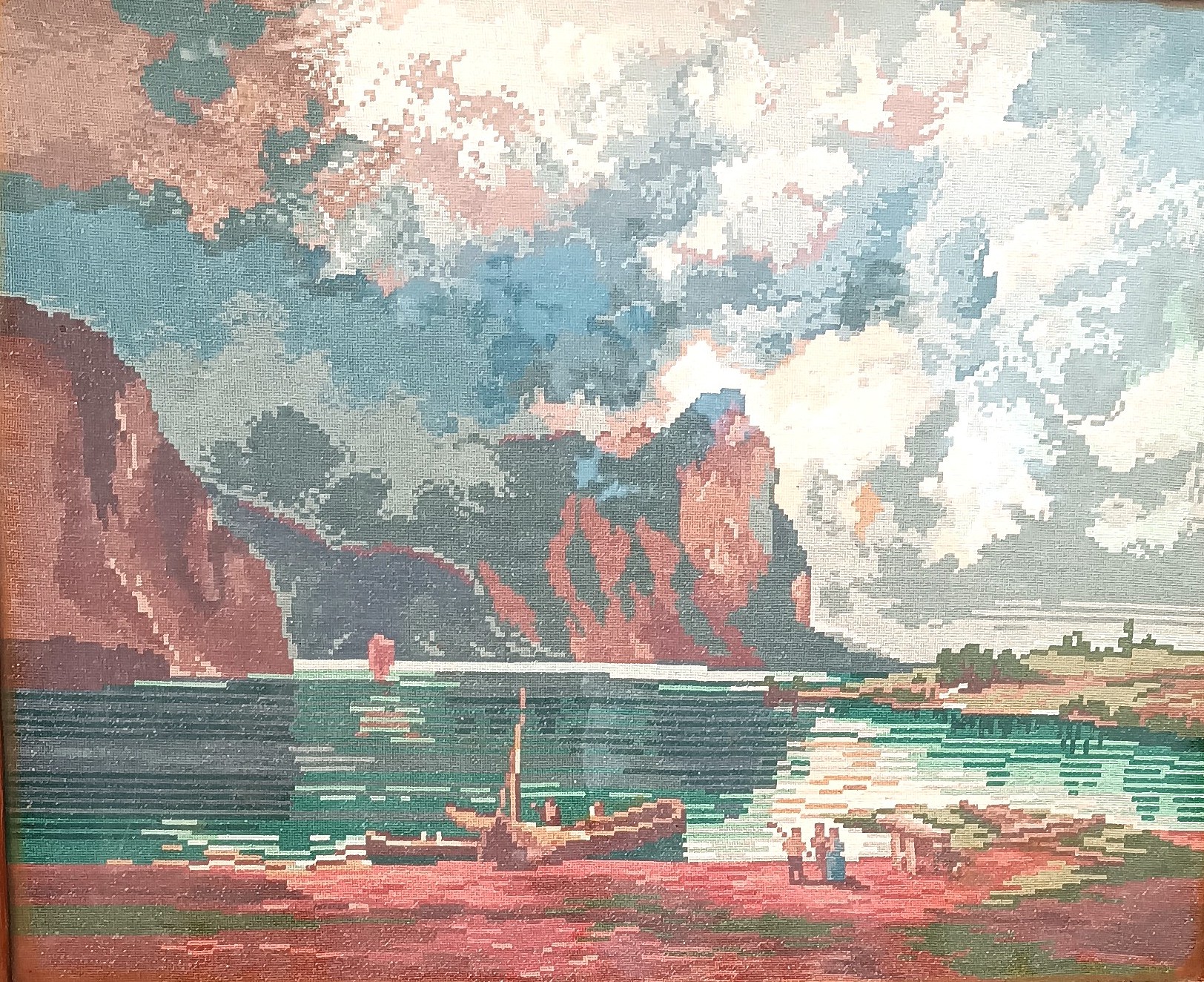
Over approximately eight months, the landscape gradually took shape. From many individual stitches emerged the cliffs, the water, the boat and the storm clouds that dominate the composition.
Today, the picture offers a glimpse of a much larger personal story: working life, family care, a shared home and the quiet satisfaction of making something beautiful by hand.
These personal details come from the account preserved with the tapestry. The names of the engineer and his father, and the precise dates of their lives, have not yet been independently verified through archival documents. The story is therefore presented as recorded personal history rather than a fully documented biography.
An Engineer by Profession, an Embroiderer by Choice
One of the most interesting aspects of this tapestry is the contrast between the maker’s profession and his chosen form of relaxation.
Historically, domestic embroidery has often been associated with women’s work, yet needlecraft has never belonged exclusively to one gender. The engineer’s story is a reminder that an individual’s creative interests cannot be predicted simply from occupation or social expectations.
Embroidery requires attention, consistency and an ability to follow complex visual patterns. These qualities may appear compatible with a technical way of thinking, although we have no evidence that the engineer chose his hobby because of his profession.
What we do know from the preserved account is more personal: he embroidered because he enjoyed it.
Eight Months of Patience: How a Tapestry Takes Shape
Detailed pictorial needlework is a gradual process. Shapes, shadows, light and colour transitions emerge through the careful arrangement of individual stitches.
A complex landscape requires the embroiderer to follow the pattern closely, distinguish between similar shades and maintain consistency throughout the design.
The total time depends on the canvas or fabric, stitch size, experience, design complexity and hours devoted to the work. Eight months is a meaningful detail in this object’s history, but it does not allow us to calculate the exact number of hours spent stitching.
What Goes Into a Detailed Needlework Landscape?
| Element | Its Role |
|---|---|
| Pattern | Guides the composition and colour placement. |
| Textile ground | Provides the structure for the needlework. |
| Threads | Create the colours, shading and details. |
| Stitch technique | Influences texture, density and appearance. |
| Time and concentration | Allow the image to develop gradually and consistently. |
Why Can Embroidery Be a Form of Relaxation?
For the engineer in Polski Trambesh, embroidery was a peaceful pastime. His experience offers an interesting connection to modern research on traditional needlecraft.
A 2024 review published in Issues in Mental Health Nursing, titled Healing Stitches: A Scoping Review on the Impact of Needlecraft on Mental Health and Well-Being, examined 25 studies of activities including sewing, embroidery, knitting, crochet and quilting.
The researchers identified themes involving mental well-being, social connection, a sense of achievement and the relationship between crafts, personal identity and cultural heritage.
Such findings help explain why repetitive, attentive handwork may be enjoyable and meaningful. They do not prove that embroidery has a particular medical benefit for every individual, nor can they establish the engineer’s psychological state decades ago.
The Human Dimension: In this story, needlework and family time existed together. The engineer could pursue a creative hobby while spending time with the father he cared for. This is a personal account, not a claim that everyone experienced needlework in the same way.
Storm over Lake Mondsee: The Wiehler Gobelin Design
The landscape is associated with the German needlework company Wiehler Gobelin, which offers a design titled Aufziehendes Gewitter am Mondsee, meaning an approaching thunderstorm over Lake Mondsee.
According to the official Wiehler catalogue, the design is based on a work by the Austrian landscape painter Anton Hansch. The catalogue gives a design size of 55 × 45 cm and specifies 25 colours.
Those measurements describe the catalogue design, not necessarily the visible textile area of every completed and framed example. The Bulgarian tapestry measures approximately 60 × 50 cm including its frame.
What Does the Landscape Depict?
The composition combines dramatic natural scenery with small elements of human activity. Dark clouds gather above the cliffs, while the lake reflects pale light. A boat and tiny figures along the shoreline provide a sense of scale.
Muted greens, terracotta reds, blue-greys and creams create the atmospheric effect. The dramatic sky contrasts with the small human presence near the water.
One possible artistic interpretation is the contrast between the power of nature and the relative fragility of human life. This remains an interpretation of the image, not a documented statement of the painter’s or embroiderer’s intentions.
Three Different Stories Within One Tapestry
| Level | Historical Role |
|---|---|
| Original artwork | Based on a landscape by Anton Hansch, according to the Wiehler catalogue. |
| Needlework design | Published as a stitchable design by Wiehler Gobelin. |
| Individual execution | Reportedly hand-stitched by an engineer in Polski Trambesh during the 1980s. |
The painter of the original composition, the publisher of the embroidery design and the person who stitched a particular tapestry are not the same kind of creator. Accurate descriptions should distinguish all three roles rather than attribute the completed needlework directly to the original painter.
Domestic Creativity in 1980s Bulgaria
The engineer’s story opens a small window onto private life in socialist-era Bulgaria: the relationship between work and leisure, creative activities at home, and the responsibilities shared between generations.
It would be misleading to suggest that embroidery was necessarily a common hobby among Bulgarian engineers. This account concerns one individual rather than a documented national trend.
What makes it valuable is its specificity. We know about the engineer’s work, his interest in embroidery, the care he provided for his father, their shared enjoyment of sports and the roses growing in the garden of their home.
Such details give depth to the broader idea of everyday life in the twentieth century. They remind us that social history also belongs to ordinary families, quiet hobbies and objects made without any expectation of public recognition.
What Can Be Verified, and What Remains Part of the Story?
When documenting vintage objects, it is useful to distinguish manufacturer records, direct examination and personal accounts. These sources are valuable in different ways and should not be treated as interchangeable.
| Information | Evidence |
|---|---|
| Wiehler design after Anton Hansch | Confirmed by the manufacturer’s catalogue. |
| 55 × 45 cm and 25 colours | Catalogue specifications for the design. |
| Engineer in Polski Trambesh | Personal history passed on with the tapestry. |
| Eight months of stitching | Preserved personal account. |
| Father who lived to 101 | Personal account; independent archival confirmation has not yet been established. |
| 60 × 50 cm including frame | Measurements supplied for the surviving object. |
| Exact stitch ratio and thread composition | Require additional physical examination. |
Why Does the Human Story Matter to Collectors?
The same embroidery pattern may have been completed by many people. Two finished works can look remarkably similar, yet the circumstances of their creation may differ considerably.
A preserved personal account can give an individual object a more meaningful context. It helps us understand who made it, why they devoted time to it and what place it occupied in everyday life.
That does not automatically make the tapestry rare or guarantee an increased market value. Collectors still need to consider craftsmanship, materials, originality, condition, size, documented provenance and demand.
Nevertheless, the story of the engineer is important because it preserves something that the image alone cannot communicate: the personal meaning of the work to its maker.
A Second Life for a Hand-Embroidered Tapestry
A vintage tapestry does not need to be altered to find a place in modern life. Its craftsmanship and individual history may make it especially appealing as an authentic decorative object.
- Classic interiors: A framed landscape can become a focal point in a library, study or traditional living room.
- Rustic and farmhouse settings: The landscape and wooden frame complement natural timber, stone and vintage furnishings.
- Eclectic interiors: Traditional needlework can create a striking contrast with modern, minimalist furniture.
- Gallery walls: Combine it with antique prints, historical photographs and other framed artworks.
- Photography and film: An authentic period object can serve as decorative material for vintage-inspired scenes.
- Cultural exhibitions: The tapestry and its personal history can help illustrate twentieth-century domestic creativity.
- Family and cultural memory: Preserving the maker’s story gives future custodians a deeper connection to the object.
How Should a Vintage Framed Tapestry Be Preserved?
Historic textiles are vulnerable to prolonged light exposure, moisture, dust, pests and mechanical stress. Glass provides some physical protection, but it does not guarantee that a framed textile is safe from fading or moisture damage.
- Avoid direct sunlight and prolonged exposure to strong light.
- Keep the tapestry away from damp walls, fireplaces and radiators.
- Maintain reasonably stable indoor temperature and humidity.
- Ensure the frame is securely mounted and appropriately supported.
- Do not apply water or household cleaning products directly to the embroidery.
- Avoid dismantling old framing without a good reason or suitable expertise.
- Consult a textile conservator if there is evidence of mould, deterioration or unstable mounting.
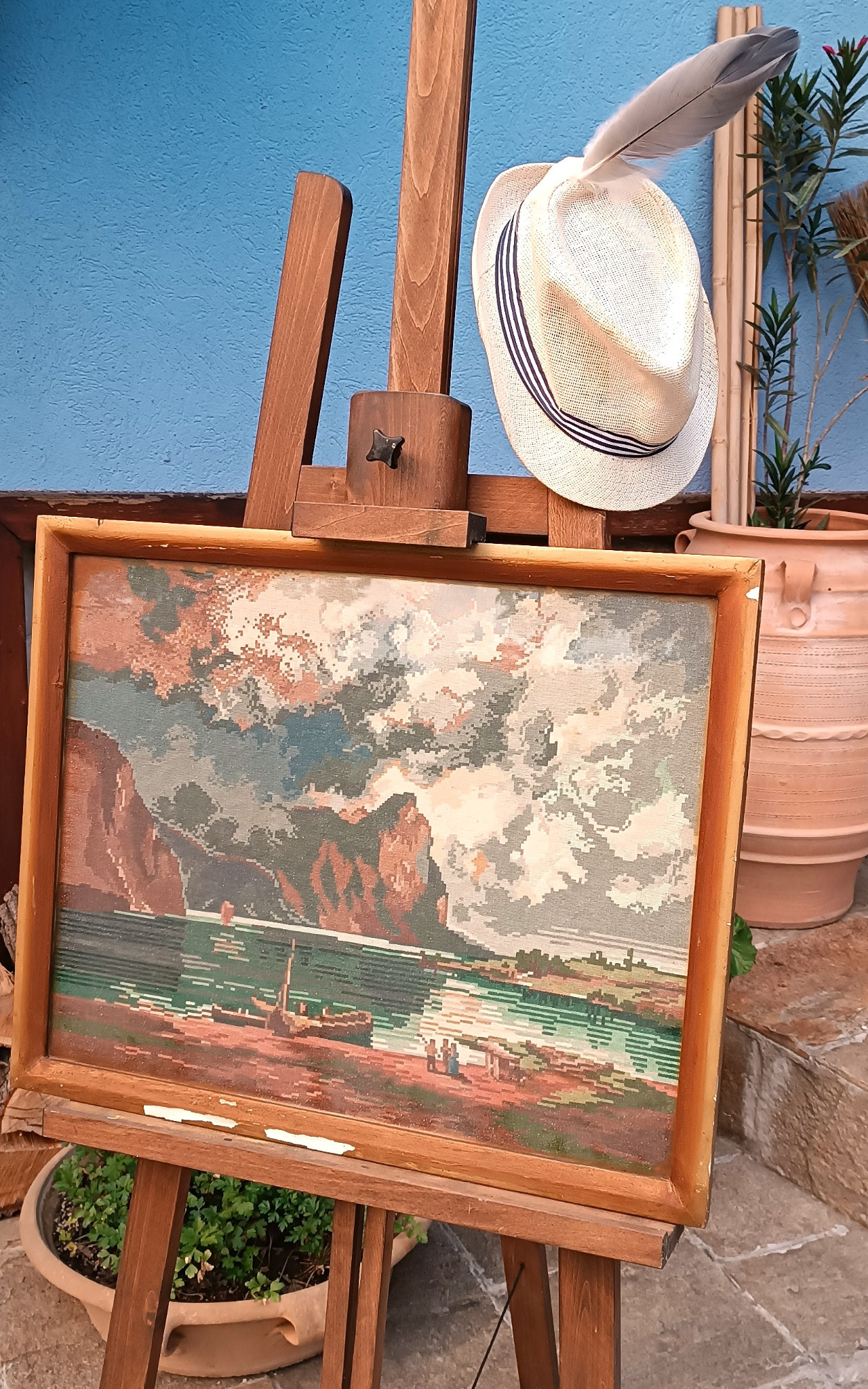
Condition Note: The wooden frame of this particular tapestry displays visible age-related wear, including areas of finish loss along its lower edge. These details should be recorded before considering any restoration or refinishing.
For an introduction to responsible preservation, see our guide to what conservation means. Detailed recommendations for historic textiles are also available from the Canadian Conservation Institute.
Collector Checklist: Before Buying a Vintage Embroidered Tapestry
Collectors of Wiehler Gobelin and other pictorial needlework should examine the object itself, rather than relying on the design name alone.
- Identify the exact design and compare it with documented reference material.
- Examine the stitch structure, textile ground and reverse where accessible without risking damage.
- Check for stains, fading, missing stitches, distortions and repairs.
- Inspect the frame, glass, backing and mounting system.
- Record measurements of both the textile and the complete frame separately.
- Preserve any reliable information about the maker, family history or previous ownership.
Frequently Asked Questions
What Is Storm over Lake Mondsee?
It is a landscape needlework design offered by Wiehler Gobelin under the German title Aufziehendes Gewitter am Mondsee, based on a work by Austrian painter Anton Hansch.
Who Made This Particular Tapestry?
According to the history preserved with the piece, it was hand-stitched by an engineer working at the old brick factory in Polski Trambesh, Bulgaria, during the 1980s. His name has not yet been established.
How Long Did the Embroidery Take?
The preserved account states that the engineer completed the tapestry over approximately eight months. The exact number of working hours is unknown.
Why Did the Engineer Enjoy Embroidery?
Embroidery was his personal hobby and way of relaxing. He enjoyed watching sports with his elderly father while working on the tapestry.
Is the Exact Stitch Ratio Known?
No. The available photographs are insufficient to establish an exact stitch ratio such as 1:4. A closer examination of the textile and, where possible, its reverse would be needed.
Does Its Personal Story Increase Its Value?
The history adds cultural and personal interest, but market value still depends on quality, condition, materials, originality, documented provenance and buyer demand. A compelling story does not guarantee a particular selling price.
Conclusion: A Storm in the Picture, Peace in the Making
The landscape shows a storm gathering above a lake. Yet the account of its creation is not a story of turmoil. It is a story of quiet enjoyment.
An engineer spent approximately eight months on a hobby he loved. He lived with his father, cared for him and shared moments watching sports. Their home had a garden filled with roses.
The resulting tapestry is more than a decorative reproduction of a European landscape. It survives as an object connected to patience, personal creativity, family care and everyday life in twentieth-century Bulgaria.
And that is why, at The Old Antiquarian, we believe old objects deserve to be preserved together with the stories that give them meaning.
The Old Antiquarian: Sometimes the most valuable part of an old object is the human experience that survives through it.
Related Guides
- What Is Vintage? – understanding the age and character of twentieth-century collectible objects.
- What Is Conservation? – preserving original materials and historic character.
- Folk Art & Traditions – exploring European textiles, embroidery and traditional craftsmanship.
Continue Exploring
Discover more personal histories, forgotten craftsmanship and remarkable finds in our Stories Behind Objects collection.
Sources & Further Research
- Personal History Preserved with the Tapestry. The account of the engineer from Polski Trambesh, his father, the family home with roses and the approximately eight months of embroidery, as provided to The Old Antiquarian. These details have not been independently established through archival records.
- Wiehler Gobelin. Aufziehendes Gewitter am Mondsee. Official catalogue information identifying the artistic source as Anton Hansch, with design dimensions of 55 × 45 cm and 25 colours.
- Le Lagadec, D., Kornhaber, R., Johnston-Devin, C. & Cleary, M. (2024). Healing Stitches: A Scoping Review on the Impact of Needlecraft on Mental Health and Well-Being. Issues in Mental Health Nursing, 45(10), 1097–1110.
- Canadian Conservation Institute. Caring for Textiles and Costumes. Preventive conservation guidelines for the protection of historic textiles.
Your Object May Have a Story Worth Preserving
An old tapestry, painting, textile or family heirloom may preserve a story that deserves to be remembered. If you own a vintage or historic object, you can share photographs and any information you know about its origins.
About The Old Antiquarian
With more than 35 years of practical experience in antiques, vintage objects and collecting, The Old Antiquarian explores historic objects as expressions of craftsmanship, cultural heritage and human memory.
This article combines photographs of an original object, the personal history preserved with it, manufacturer catalogue information and published research. Details that remain unverified are distinguished from documented facts.
