
The Weavers’ Code: A Timeless Conversation with Eight Chiprovtsi and Kotel Carpets
Discover the ancient thread of Bulgarian memory, the sacred geometry of symbols, and the quiet dialogue between past and present, woven into eight unique Chiprovtsi and Kotel rugs.
Taking Up the Yarn: When Space Expands
There are moments when time ceases to be a straight line. You enter your home, unfold one rug, then another, then a third… and suddenly the room is no longer merely four walls. Space expands, the air becomes lighter, and it fills with the fragrance of dried thyme, mountain wool, wood ash, and a quiet, centuries-old wisdom.
At that moment, I realise that I am no longer alone.
Around me sit the women whose hands wove these eight rugs. Some lived more than a century ago, at the turn of the nineteenth and twentieth centuries; others were master weavers of the 1960s and 1970s. Different eras, different destinies, yet the same spirit. All of them become my guests beyond time. Seated upon their own creations, with their hair gathered back and calm, warm eyes, they begin their gentle, intimate conversation.
A conversation that is neither about everyday life nor its burdens. It is a conversation about weaving blessings into the work. For the Bulgarian Chiprovtsi and Kotel rug has never been merely a floor covering or a decoration for the home. It is a living map of the soul, a sacred code, a prayer expressed through colours and forms, woven to protect, to heal, to guide, and to carry the family line through the trials of time.
Each of these women tells the story of her rug. And the larger the rug, the longer their shared life at the loom had been — the more days, thoughts, shared moments, joys, tears, and blessings had been woven into its threads.
Here is the story of the eight guardians and their coded messages to us — the observers of today.
The First Rug: The Floral Prayer for Abundance and Healing
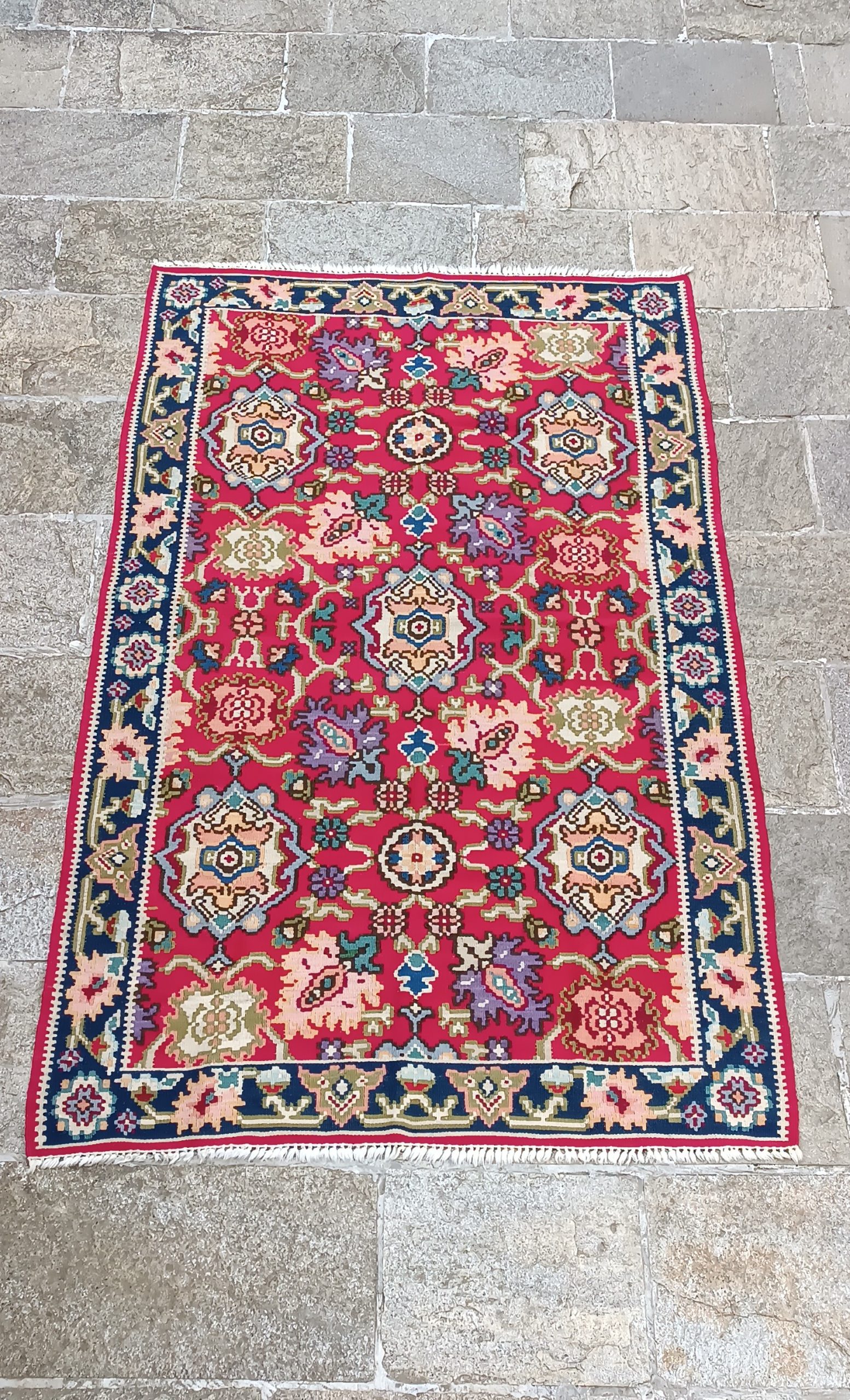
(Chiprovtsi/Kotel floral composition with central rosettes and a scarlet background)
The Weaver’s Story
The woman with the brightest eyes speaks first. Her rug has a vivid scarlet field upon which large, richly decorated rosettes and floral ornaments seem to float.
“I wove this rug when our first child was born,” she says with a smile. “Every day, I sat behind the loom thinking of health. That is why I used so much scarlet red — a colour that burns away every impure force and awakens life. And these colourful rosettes in the centre are like open windows towards heaven. Whenever my child stepped upon them, I would weave a blessing into the rug: may her steps be light, may her path be filled with flowers.”
The Sacred Code of Symbols and Colours
Scarlet (Red): The primal energy of life, the fire of the hearth, and the blood of the family line. In Bulgarian tradition, red awakens the innate strength for survival and self-affirmation.
Central Rosettes (Stars/Flowers): They symbolise the balance between the four directions of the world and the spirit. They act as energetic gateways — harmonising the space and bringing spiritual healing.
Dark Blue Border: Blue represents the heavenly canopy, divine protection, and wisdom. The border surrounds the red energy, keeping it within the home and preventing its blessings from flowing away.
The Second Rug: The Garden of the Eternal Family
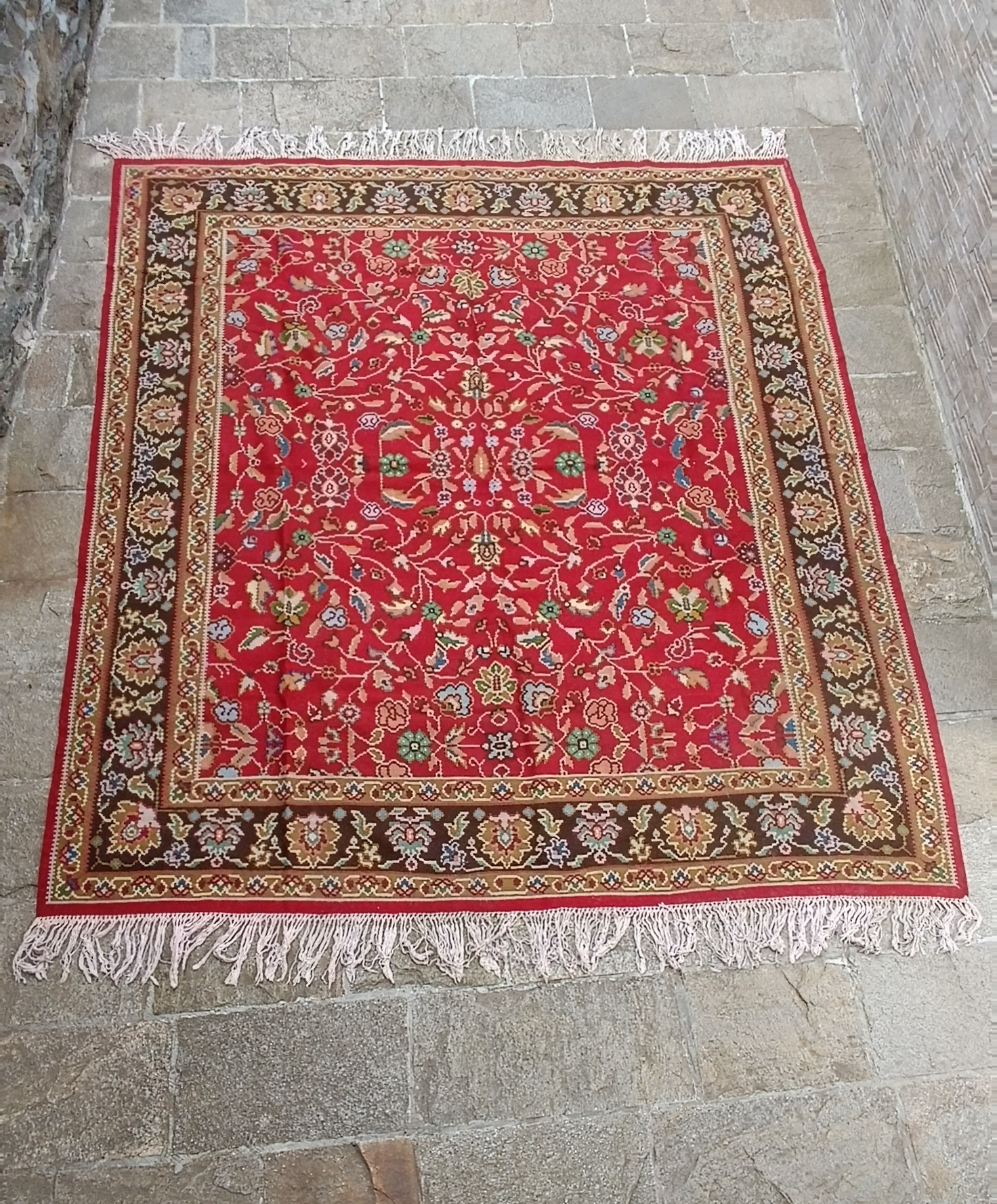
(Kotel-type “Garden” / Large rug with woven floral vines and symmetrical ornaments)
The Weaver’s Story
The second guest is an elderly woman with deep wrinkles around her eyes, radiating extraordinary calm. Her rug is large and monumental, with an uninterrupted, dense network of vines, little flowers, and embroidered-looking motifs.
“I wove it for more than a year,” she shares quietly. “The four seasons are woven into it. I began in spring, passed through the scorching summer, gathered the harvest in autumn, and in winter the yarn kept my hands warm. Every branch here is a person from our family. Every bud is a child yet to be born. I wove and blessed: branch out, my family, blossom, never fade! Even when a storm breaks one branch, may the root remain strong.”
The Sacred Code of Symbols and Colours
The Network of Vines (The Tree of Life): A symbol of ancestral memory and continuity. When the observer gazes into this endless interweaving, the mind becomes calm and reconnects with its roots.
Burgundy and Brown: The colours of Mother Earth, soil, and stability. They awaken a feeling of security, grounding, and belonging.
Delicate Green and Yellow Accents: Hope (green) and divine light (yellow), which sustain the flow of life even during the darkest periods.
The Third Rug: The Light of the Central Sun
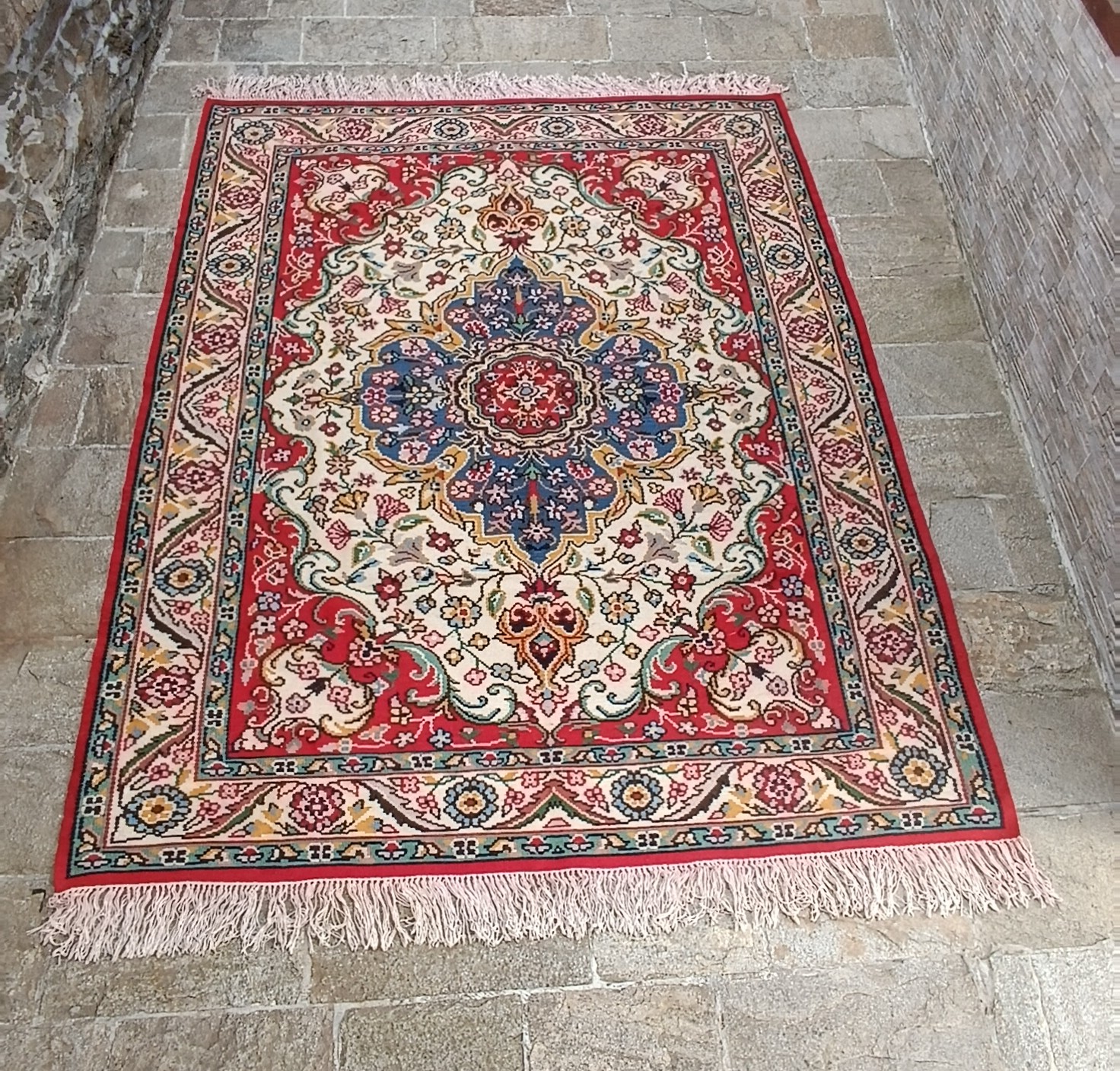
(Fine Kotel/Chiprovtsi rug with a large central medallion and a light-coloured field)
The Weaver’s Story
The third craftswoman carries gentleness in her expression. Her creation shines with exceptional elegance — a light, almost ivory central background, in the middle of which glows a magnificent blue-and-red medallion.
“This was my prayer for clarity,” she tells me. “There were times of doubt and darkness. I did not know which direction to take. Then I sat down and began weaving from the outer edge towards the centre. Every counted thread brought me closer to my own sun. When I completed the central medallion, I understood that the answer had always been within me. I wove this rug to remind my children: wherever they may wander in the world, they carry light within their centre.”
The Sacred Code of Symbols and Colours
The Central Medallion (The Centre of the Universe / The Soul): A focal point for meditation and awareness. During moments of chaos in life, gazing towards the central medallion restores inner understanding and balance.
Light Beige/Cream Field: Purity of intention, the divine emptiness in which new possibilities can emerge.
Arabesque Waves in the Border: The water of life, moving smoothly through trials without resistance.
The Fourth Rug: The Geometry of Protection – Kanatitsa and Diamonds
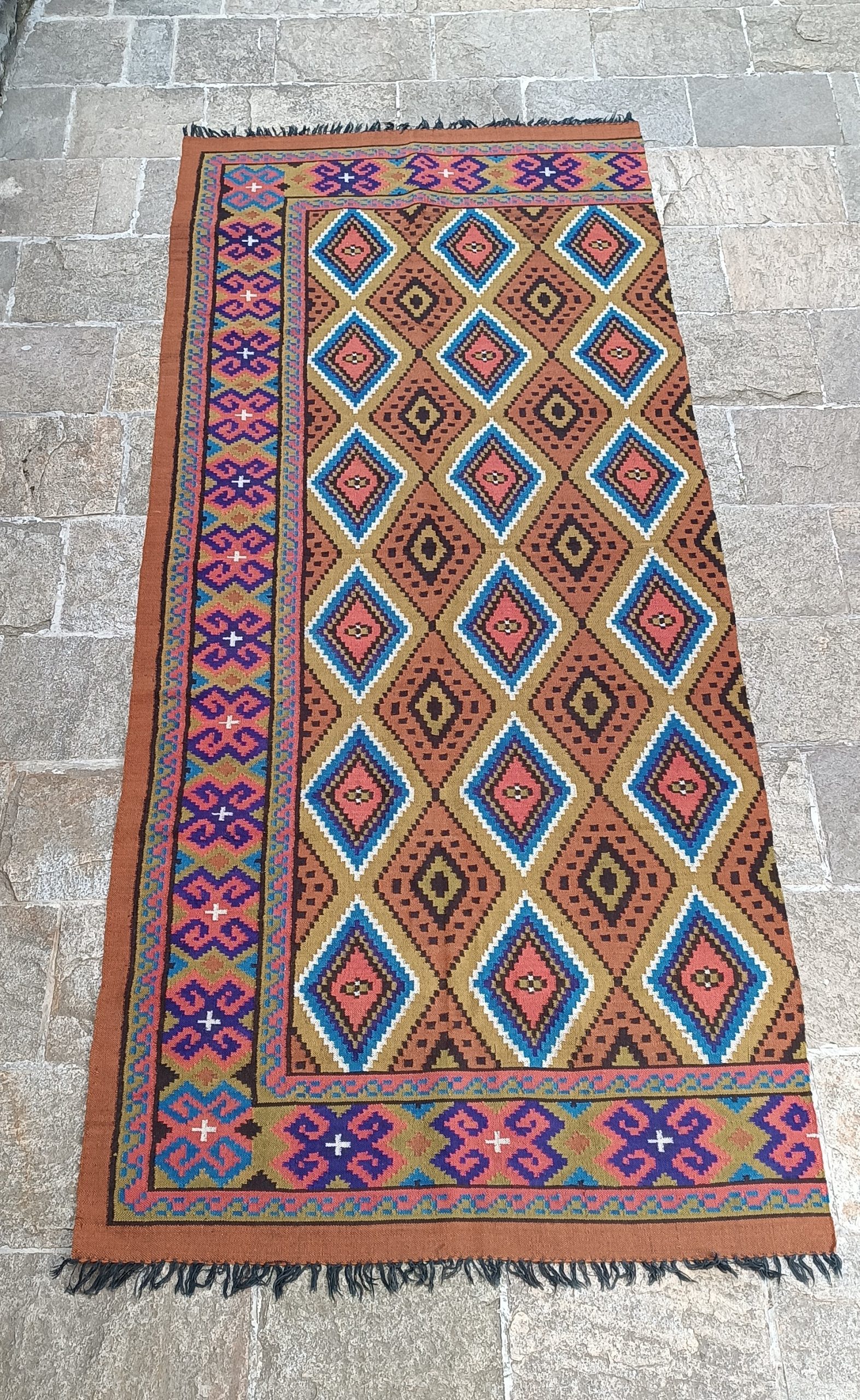
(Chiprovtsi runner with geometric diamond-shaped motifs)
The Weaver’s Story
The fourth woman holds her back straight and strong. Her rug is elongated, covered with rhythmically repeated diamonds in ochre, blue, red, and earthy tones.
“This is the pathway of life,” she says firmly. “I wove it for my son when he was setting out on a journey. The diamond is not merely a shape — it is a shield. Sharp on the outside, to deflect evil eyes and words, and empty within, to preserve space for goodness. I repeated the diamonds one after another, like footsteps. I blessed them as I wove: may every step be secure, every choice wise.”
The Sacred Code of Symbols and Colours
The Diamond (The Feminine Principle and Fertility): A fundamental element of Chiprovtsi ornamentation. A sign of conception, birth, and protection of new life.
Ochre and Mustard Yellow: They symbolise maturity, the abundance of autumn, and wisdom gained through experience.
Dark Cyan and Blue: Depth of thought, a spiritual shield against envy and negative energies.
The Fifth Rug: The Great Gathering of the Family
(Classic Chiprovtsi rug with a red field and large central geometric diamonds)
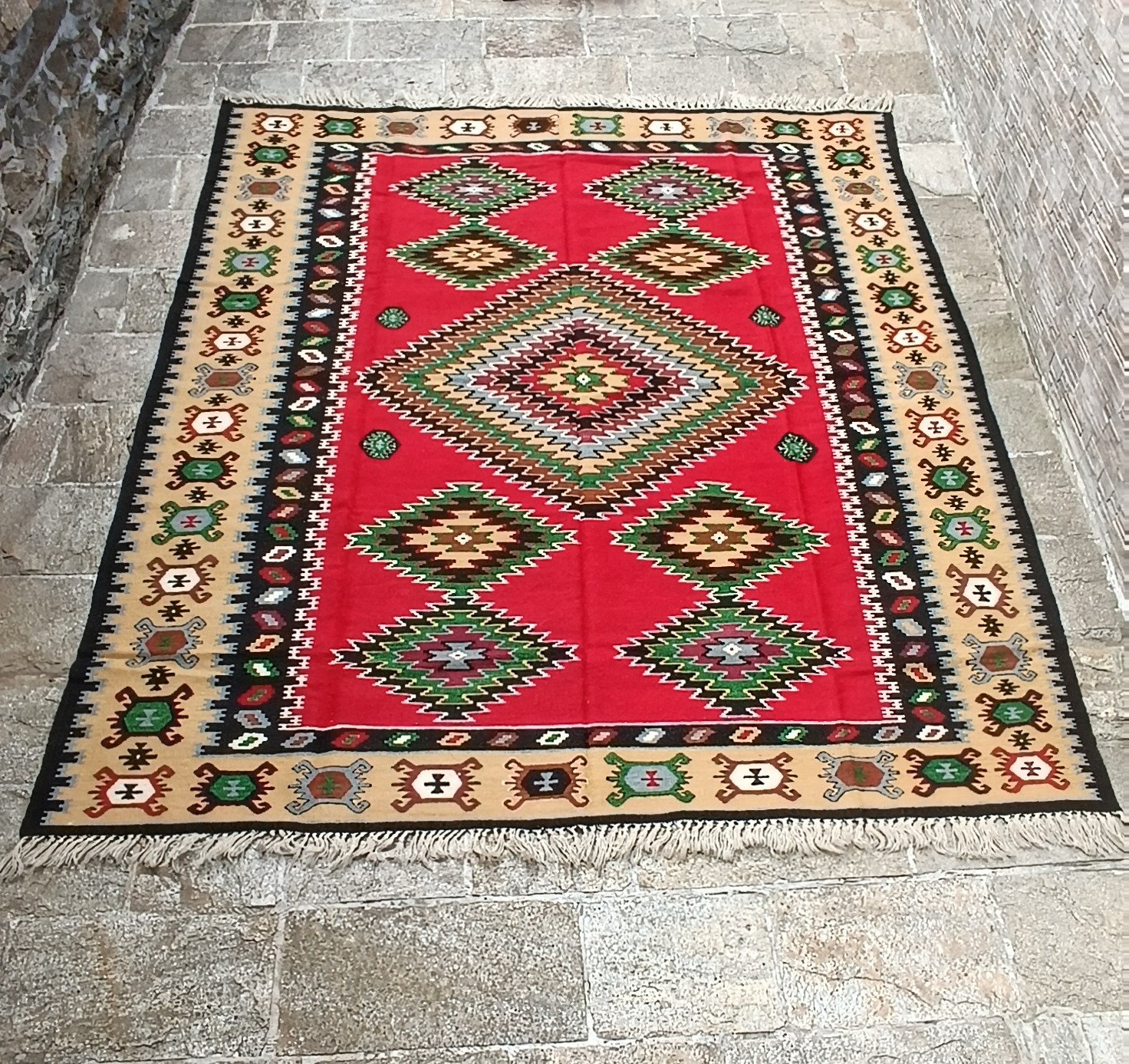
The Weaver’s Story
The fifth craftswoman smiles with her entire face. Her rug is large, powerful, and full of solemn grandeur. The red field is dominated by an enormous diamond-shaped centre, surrounded by smaller diamonds and richly decorated borders.
“I wove it for a wedding,” she shares with emotion. “A large rug for a large home. When you weave for two people who are coming together, you must weave harmony into it. Every small symbol around the great diamond is a relative, a neighbour, a friend. I blessed this rug to gather people around the hearth, so that there would be song, bread upon the table, and nobody would ever feel alone.”
The Sacred Code of Symbols and Colours
The Large Central Diamond with Graduated Steps: It symbolises the ascent along the spiritual ladder and the union of the masculine (an upward-pointing triangle) and feminine (a downward-pointing triangle) principles.
Light Green and Beige in the Ornaments: Harmony with nature, renewal of feelings, and longevity of the union.
The Border with Repeated Miniature Kanatitsa Motifs: Uninterrupted protection of the home from all four directions.
The Sixth Rug: The Web of Fate
(Rug with a continuous diamond pattern — the “Baklavi” type)
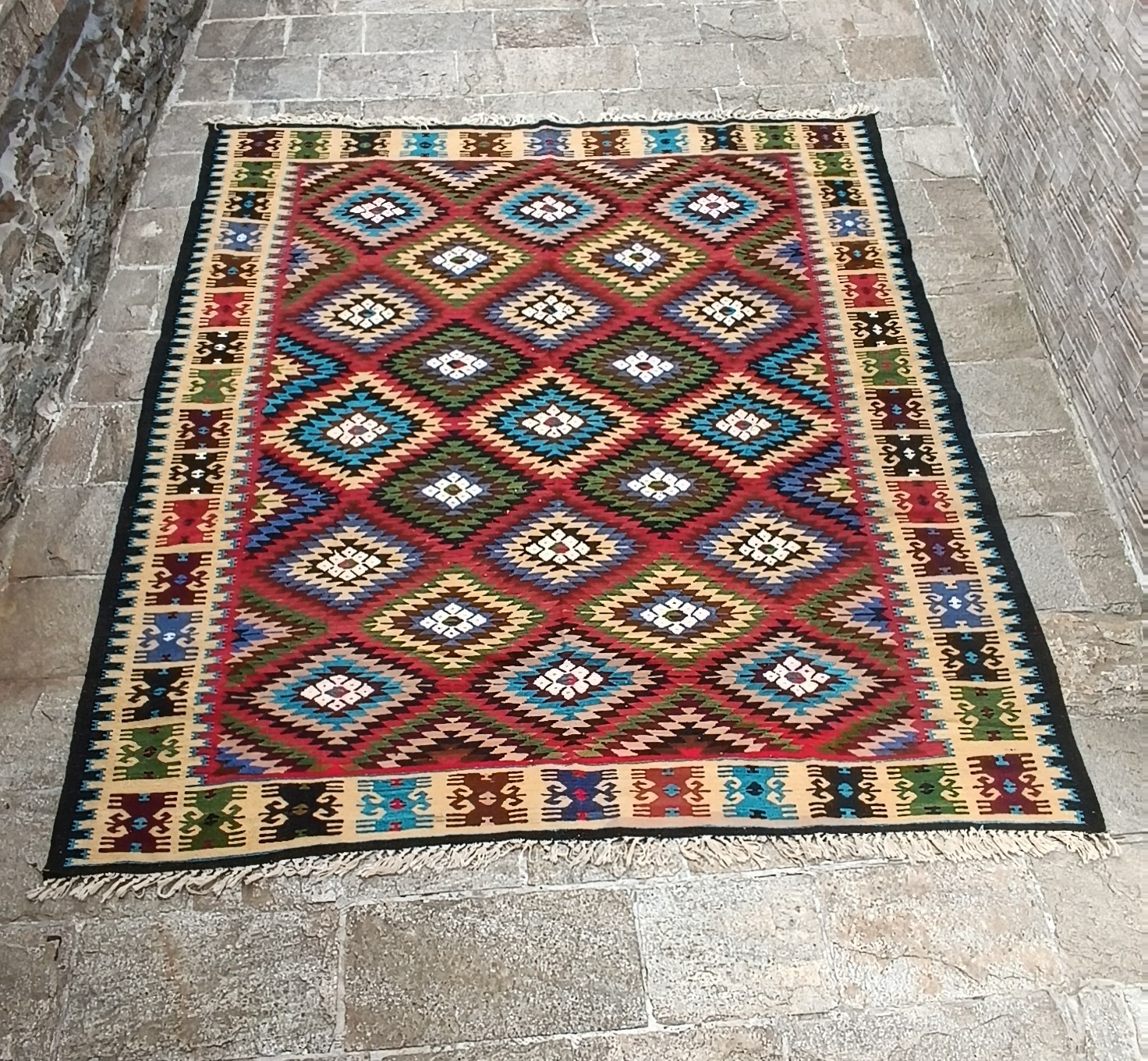
The Weaver’s Story
The sixth guest has the most precise, swift fingers. Her rug is a true masterpiece of symmetry — the entire field is covered with a geometric network of diamonds, each containing a smaller diamond with a white “eye” in its centre.
“This is the rug of awareness,” she says, looking directly into my eyes. “Life seems like complete confusion when you look at it closely — a thread here, a thread there. But when you step back, you see that everything is order and perfection. I wove these Baklavi diamonds and blessed them: when a person steps here, may they understand that every mistake has been a lesson, and that we are all woven into one common, beautiful web.”
The Sacred Code of Symbols and Colours
The Baklavi Diamonds (The Web of the Universe): They symbolise the matrix of existence, where every action influences the whole.
The White “Eye” in the Centre of Each Diamond: Pure consciousness, the observer within us who remains untouched by external storms.
The Contrast Between Red, Green, and Blue: A balance between passion (red), ancestral harmony (green), and higher truth (blue).
The Seventh Rug: The Guardian’s Seal
(Detail of a Chiprovtsi/Kotel rug with vertical rows of hexagonal and octagonal medallions)
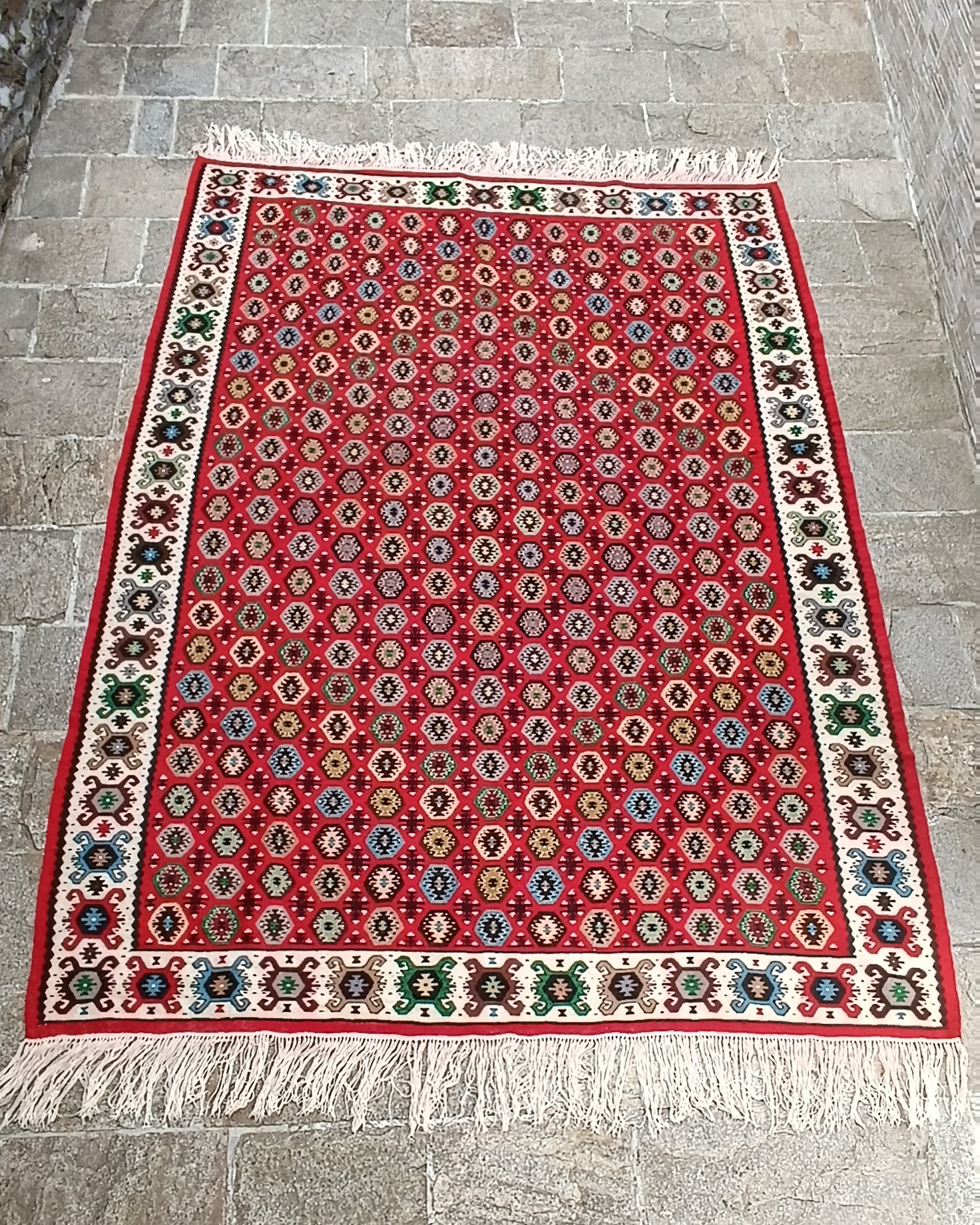
The Weaver’s Story
The seventh craftswoman is quiet, her palms marked by decades of work. Her creation is exceptionally interesting — rows of hexagonal capsules, each preserving an ancient symbol within itself, resembling a family banner or seal.
“Each of these seals is a coded promise,” she whispers. “I wove them during the 1960s, when the world was rushing to forget the past. But I knew that roots must never be cut. Every hexagon here is a treasure chest. I blessed them: may these signs wait. Even a hundred years from now, when someone looks upon them, may they feel warmth and know that they are protected.”
The Sacred Code of Symbols and Colours
The Hexagon (The Honeycomb / The Gate): A symbol of diligence, perfect order in nature, and protected personal space.
The Inner Anthropomorphic/Geometric Figures: The ancient “guardian spirits” of the home, stopping negative vibrations.
Turquoise and Pastel Green: The colours of etheric healing, peace of mind, and the opening of the heart chakra.
The Eighth Rug: The Eternal Bridge – Kanatitsa of the New Era
(Elongated rug / runner with large Kanatitsa motifs and vivid contrasts) /
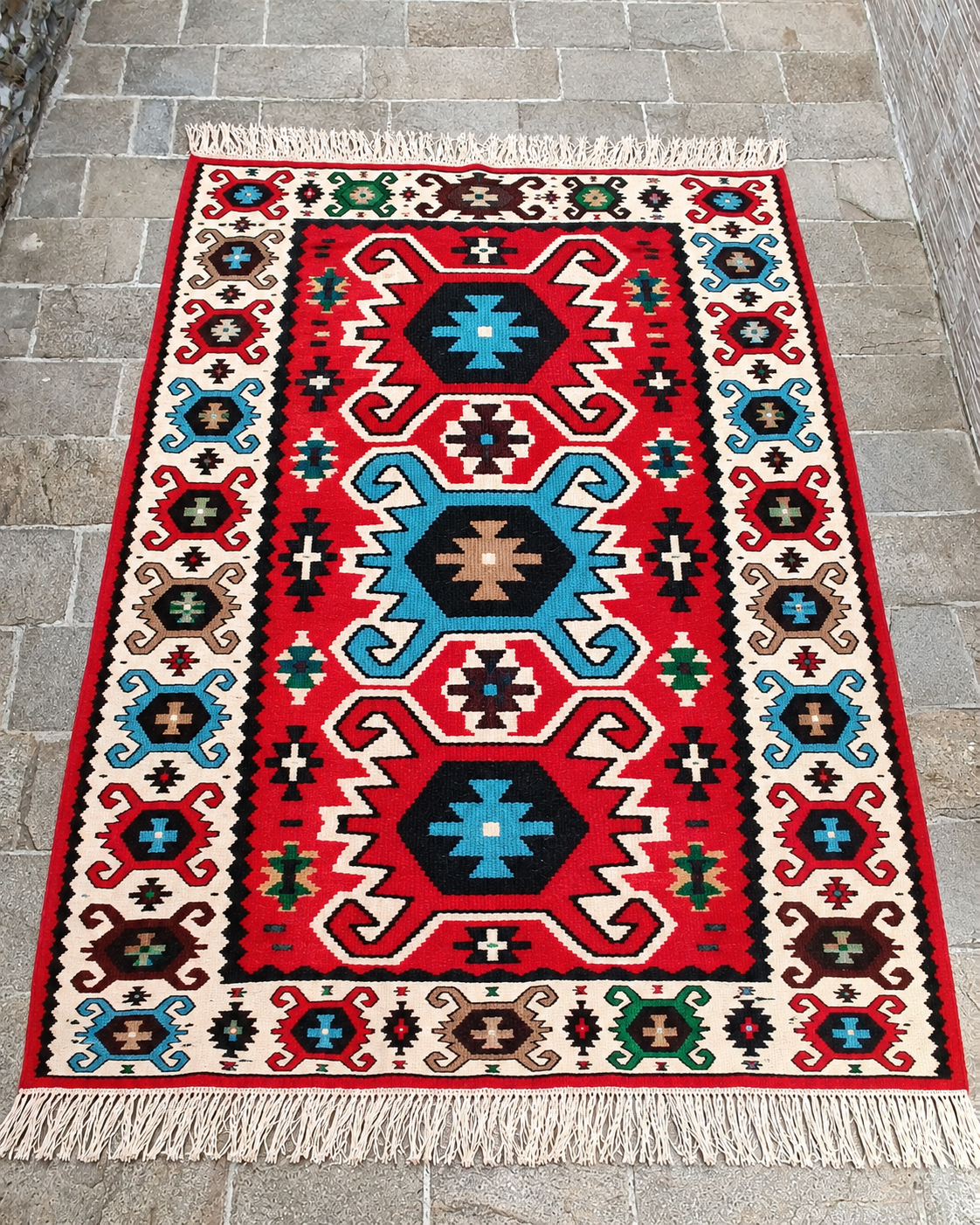
The Weaver’s Story
The last, eighth guest is the youngest of them all — a woman who wove during the 1970s. Her creation is a powerful, vibrant rug of considerable size (236 × 300 cm), adorned with monumental Kanatitsa motifs in vivid blue, red, and white tones.
“I wove in a new era, but according to the ancient rules,” she says proudly. “This rug is so large because I gathered into it the dreams of our entire family for the future. The Kanatitsa you see here is the symbol of eternity. I wove it and blessed it: may the Bulgarian spirit never be broken. May our daughters and granddaughters be strong, free, and confident as they walk upon this land!”
The Sacred Code of Symbols and Colours
The Great Kanatitsa (The Wings of Eternity): The most powerful Bulgarian symbol of protection, eternal life, and union with the divine. Its name derives from the word for “wing”. The triple Kanatitsa carries blessings for generations to come.
Deep Cyan Blue and Vivid Scarlet: A powerful energetic contrast that awakens vitality, creativity, and the body’s protective forces.
The Light White Border: The path of the spirit, which remains pure regardless of the trials it passes through.
Comparative Matrix of the Sacred Codes in the Rugs
For a quick understanding of the symbolism and energetic influence of the different ornaments and colours, use the following table:
| Rug | Main Symbol | Dominant Colours | Spiritual Message / Code | When Is Its Energy Awakened? |
|---|---|---|---|---|
| Rug 1 | Floral rosettes, scarlet field | Red, blue, pink | Healing, vitality, joy | When physical strength and life energy are needed |
| Rug 2 | Garden (Tree of Life) | Burgundy, brown, green | Ancestral memory, longevity, continuity | When seeking a connection with one’s roots and family |
| Rug 3 | Central solar medallion | Ivory, blue, red | Inner centre, enlightenment, clarity | During moments of doubt and important decisions |
| Rug 4 | Geometric diamonds (Shield) | Ochre, blue, brown | Protection on the journey, stability, balance | When beginning a new journey or a new chapter |
| Rug 5 | Large stepped diamond | Red, green, yellow | Union of masculine and feminine, wedding blessing | For harmonising relationships between partners |
| Rug 6 | Network of Baklavi diamonds with an “eye” | Multicoloured, red, blue | Everything is connected; higher cosmic order | When overcoming feelings of chaos and loneliness |
| Rug 7 | Hexagonal ancestral seals | Red, white, turquoise | Preserving ancestral secrets, etheric healing | When deep inner peace and protection are needed |
| Rug 8 | Monumental Kanatitsa | Blue, red, white | Wings for the soul, eternity, prosperity | For awakening personal strength, creativity, and inspiration |
The Sweet and Wise Conversation: The Guardians’ Advice for Today’s World
We sit in silence. The coffee grows cold, but the warmth in the room is almost tangible. The eight women look at me with that motherly love which asks for nothing in return.
I ask them silently: “How should we live today, when the world is so fast, so noisy, and so confused?”
They smile. Their answer comes not through words, but as a quiet revelation passing through the threads of the rugs:
“Do not rush to finish the fabric.” Life is woven knot by knot, day by day. If you hurry towards the end, you will miss the pattern. Rejoice in every colour, even the darkest one — it makes the bright colours shine more strongly.
“Protect your centre.” Just as every rug has its medallion or principal diamond, you too must have your unshakable inner centre. Whatever storms rage outside, return to your centre.
“Weave blessings with kindness.” Everything you touch with your hands and thoughts becomes “woven” into your reality. Cook with blessings, clean with love, speak with compassion. Your words are the yarn of your tomorrow.
“Be a bridge, not a wall.” Like the Kanatitsa — spread your wings, connect the past with the future, embrace what is different, protect your family, but open your door to the guest.
Conclusion: The Observer and the Creator Become One
When my guests quietly withdraw back into the flow of time, the room regains its familiar dimensions. But I am no longer the same.
I look at these eight Chiprovtsi and Kotel rugs and see that they are not merely historical artefacts or beautiful interior accents. They are living maps of consciousness. Every time I step upon them or look at them, their sacred code is unlocked. The century in which they were created disappears. The hand of the craftswoman from a hundred years ago meets my hand today.
We are one thread. One fabric. One family.
If you too have an old Bulgarian rug in your home, pause for a moment. Think of the woman who wove it. Hear the blessings she whispered into it. And remember: you are the dream fulfilled by her hands.
Frequently Asked Questions (SEO & FAQ)
1. What Is the Difference Between Chiprovtsi and Kotel Rugs?
Chiprovtsi rugs are distinguished by their flat weave (double-sided), strictly geometric ornaments (Kanatitsa, Baklavi, Candlesticks), and characteristic colour palette (scarlet red, black yarn, ochre, dove blue). Kotel rugs often include more elaborate floral and botanical motifs (“Gardens”, “Curled Vessels”), rich compositions with central medallions, and exceptionally fine yarn, while their colour palette is extremely varied.
2. What Does the Kanatitsa Symbol Represent in Bulgarian Rugs?
The Kanatitsa is one of the oldest solar and protective symbols in the world. In the Bulgarian carpet-weaving tradition, it symbolises eternity, the wings of the soul, the continuation of the family line, and complete protection from evil forces. Its different variations (small diamond, double and triple Kanatitsa) mark the different stages in the development of the family and ancestral line.
3. How Can We Unlock the Energy of an Authentic Rug at Home?
An authentic rug carries the energy of the intention with which it was woven. To harmonise your space, set aside moments of silence around the rug, maintain it with care and respect for its natural materials (wool and cotton), and regard it as a spiritual guardian of the home rather than merely an object.
