
Royal Vienna Porcelain Identification
Royal Vienna Porcelain: Beehive Mark, Identification, Dating & Value Guide
Last Updated: September 15, 2026
|
The Old Antiquarian
Royal Vienna porcelain is a widely used collector and market term,
but it was not the simple official name of one historic factory.
Vienna’s porcelain manufactory was founded by
Claudius Innocentius Du Paquier in 1718,
came under imperial ownership in 1744,
and continued until 1864.
The best-known historic mark of the imperial period is the
Bindenschild, or Austrian shield.
English-speaking collectors often call an inverted version of this shield the
“Beehive Mark.”
However, a beehive-like mark alone does
not prove that a piece is authentic Imperial Vienna porcelain.
Reliable identification requires the mark, porcelain body, form,
decoration, numbers, period consistency, condition and documented comparisons
to agree.
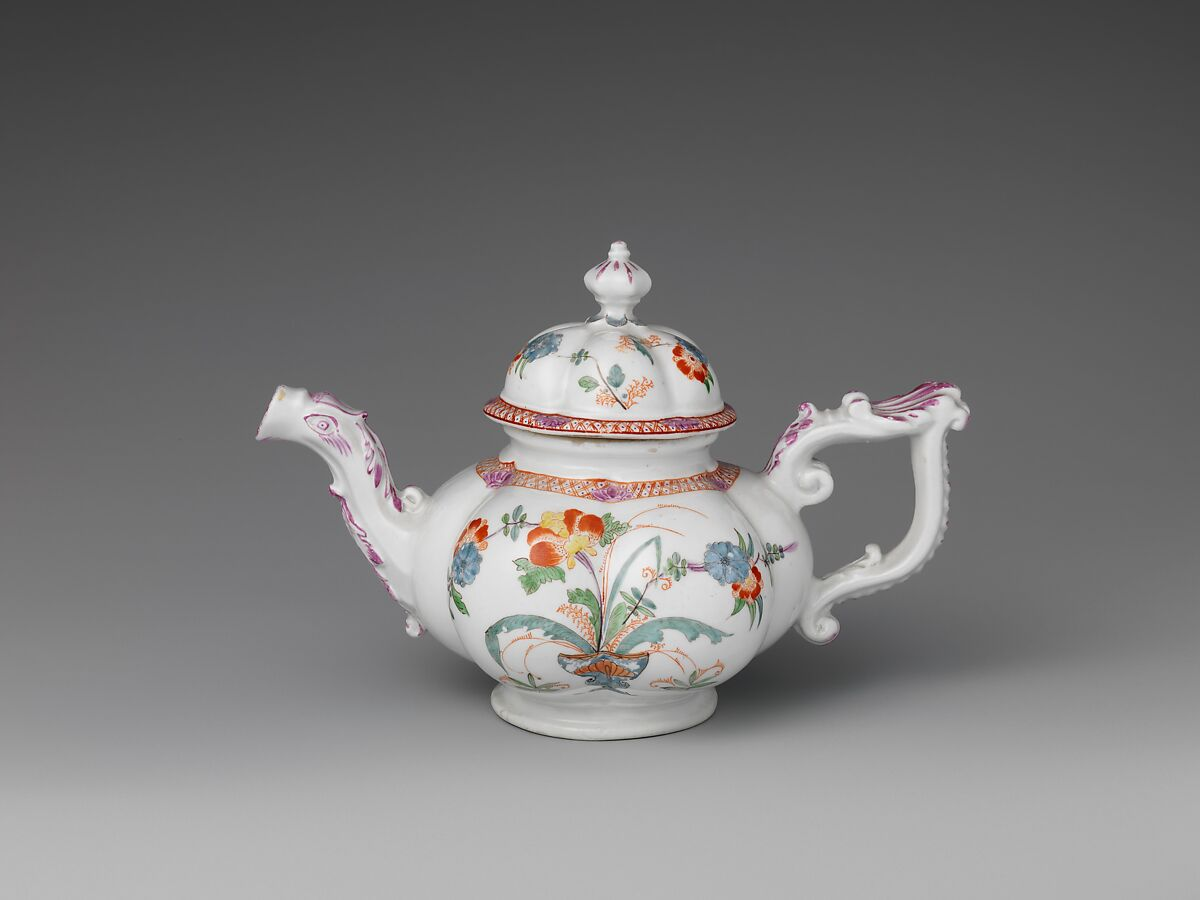
c. 1735–1740. An early example of Austrian hard-paste porcelain
before the manufactory came under imperial ownership in 1744.
Royal Vienna Porcelain at a Glance
| Question | Collector’s Answer |
|---|---|
| When did Vienna porcelain begin? | 1718, under Claudius Innocentius Du Paquier. |
| When did it become an imperial manufactory? | 1744. |
| When did the historic manufactory close? | 1864. |
| What is the famous Vienna mark? | The Bindenschild, or Austrian shield. |
| What is the “Beehive Mark”? | A collector nickname for the Bindenschild when the shield is viewed upside down. |
| Is Royal Vienna the official factory name? | No. It is widely used today as a collector and trade term. |
| Does a Beehive Mark prove authenticity? | No. Later Vienna-style pieces can carry similar or intentionally evocative marks. |
| What affects value? | Maker and period, object type, rarity, artistic quality, condition, restoration, provenance and comparable completed sales. |
ROYAL VIENNA ≠ AUTOMATICALLY IMPERIAL VIENNA
Authenticate the entire object:
mark + porcelain body + form + decoration + technique + numbers +
period consistency + condition + documented comparison.
If you are beginning with an unidentified piece, start with our
complete Antique Porcelain Guide,
which explains how material, maker, marks, form, technique and condition work together.
What Does “Royal Vienna Porcelain” Actually Mean?
For English-speaking collectors, Royal Vienna can be a confusing term.
It is often used in auction listings, dealer descriptions and online marketplaces,
yet it does not automatically identify porcelain made by the historic Imperial Vienna manufactory.
In practice, “Royal Vienna” may describe either an object attributed to historic Vienna production
or a later piece made in a Vienna-inspired decorative style.
That later category can include finely painted plates, vases, urns and cabinet pieces
with classical subjects, portrait medallions, coloured grounds and extensive gilding.
Some are attractive and collectible in their own right; they simply should not be
catalogued as eighteenth-century Imperial Vienna without supporting evidence.
when a seller says “Royal Vienna,” ask:
historic Imperial Vienna, or a later Vienna-style object?
That distinction changes the research path completely.
History of Vienna Porcelain: 1718–1864
Vienna entered the European hard-paste porcelain story remarkably early.
In 1718, Claudius Innocentius Du Paquier received an imperial privilege
to manufacture porcelain in Vienna.
The enterprise became the second major European manufactory able to produce true hard-paste porcelain
after Meissen.
In 1744, the private manufactory passed into imperial ownership.
From that point until its closure in 1864,
Vienna porcelain developed through several artistic and administrative phases,
moving from Rococo and courtly production toward Neoclassicism,
Empire and nineteenth-century historicist taste.
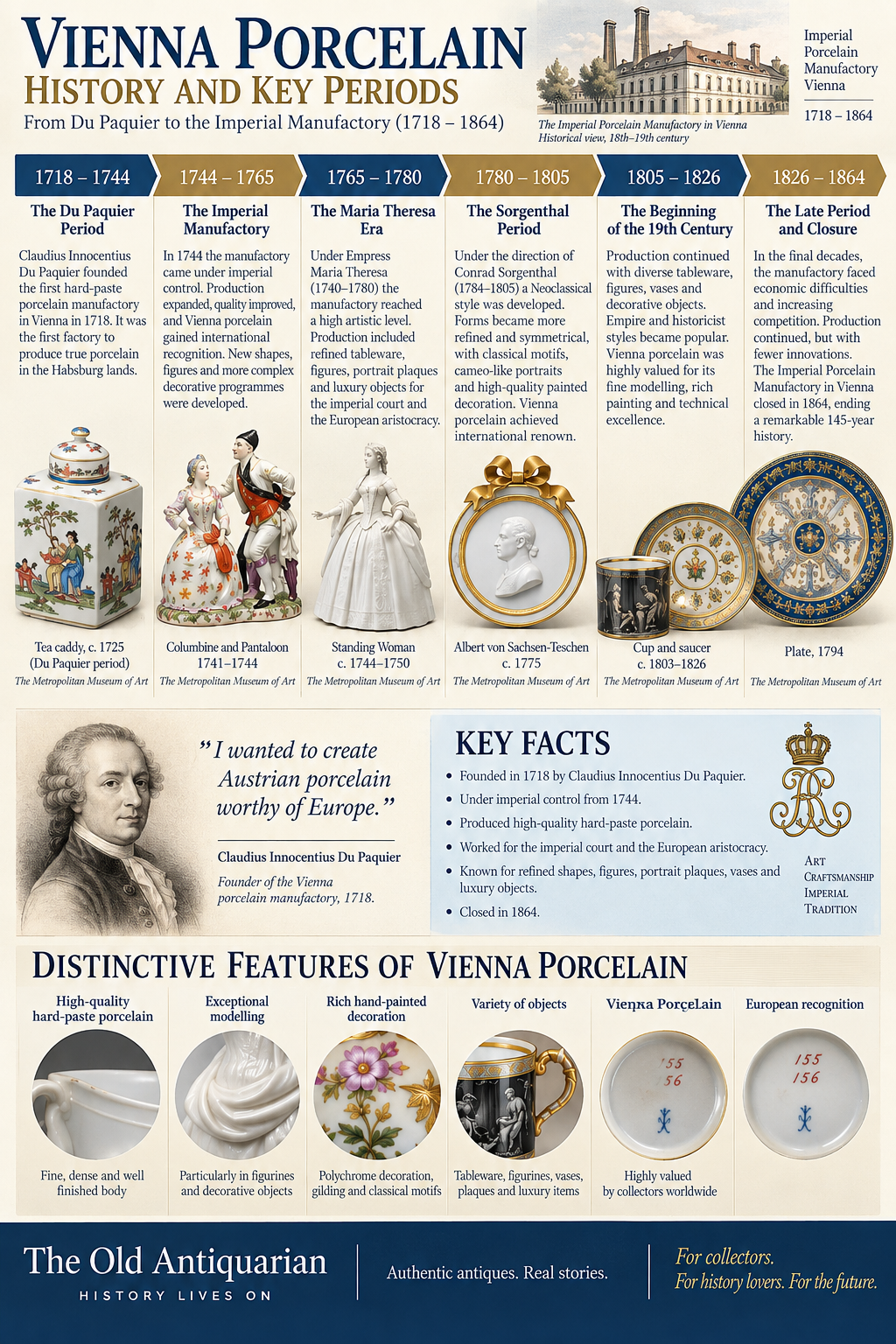
For precise institutional dating, use the verified chronology in the table below;
illustrated portraits and quotations in educational graphics should not be treated as primary historical evidence.
Verified Vienna Porcelain Timeline
| Period | Historical Phase | Collector Significance |
|---|---|---|
| 1718–1744 | Claudius Innocentius Du Paquier private manufactory. | Earliest Vienna hard-paste porcelain; many objects require attribution from the whole object rather than a simple factory mark. |
| 1744–1784 | Early imperial period under successive administrators and directors. | Bindenschild becomes a key identification clue; figurines, services and court porcelain flourish. |
| 1784–1805 | Conrad Sörgel von Sorgenthal period. | A celebrated phase of Neoclassical design, refined painting, classical subjects and rich gilding. |
| 1805–1827 | Matthäus Niedermayer period. | Empire-era forms, portraiture, landscapes and luxury tableware remain important. |
| 1827–1864 | Final directors and late manufactory period. | Later historic production must be distinguished from Vienna-style wares made after the historic manufactory closed. |
The Du Paquier Period, 1718–1744
Du Paquier porcelain occupies a special place in European ceramic history.
The factory produced hard-paste porcelain for elite Viennese patrons,
including tablewares, decorative vessels and small sculpture.
Its decoration reflects both Baroque taste and the intense European fascination
with Asian porcelain.
Chinoiserie, floral painting, exotic figures and adaptations of Chinese forms
can all appear in early Vienna production.
Because early objects are not best approached through a single universal backstamp,
museum comparison becomes particularly important.
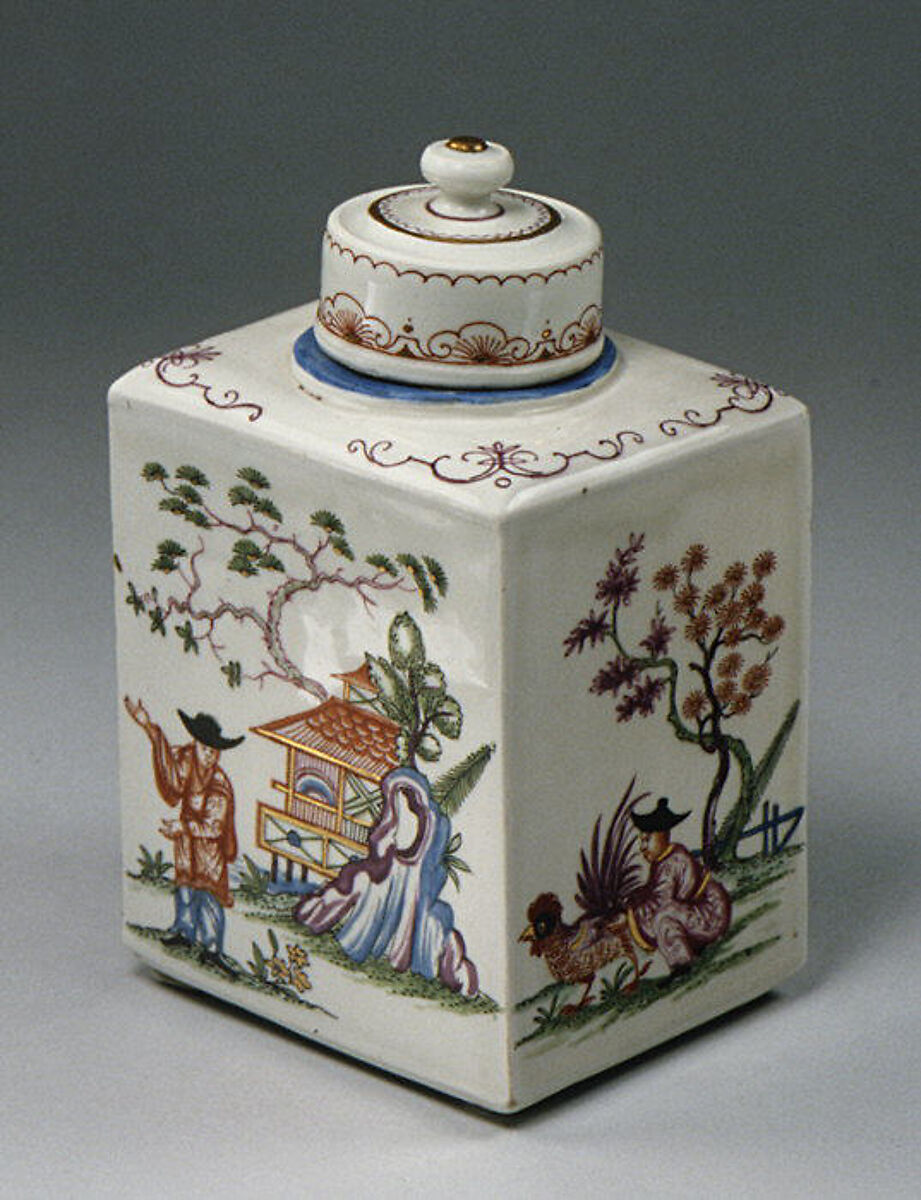
The chinoiserie decoration illustrates the East Asian influence on early European porcelain.
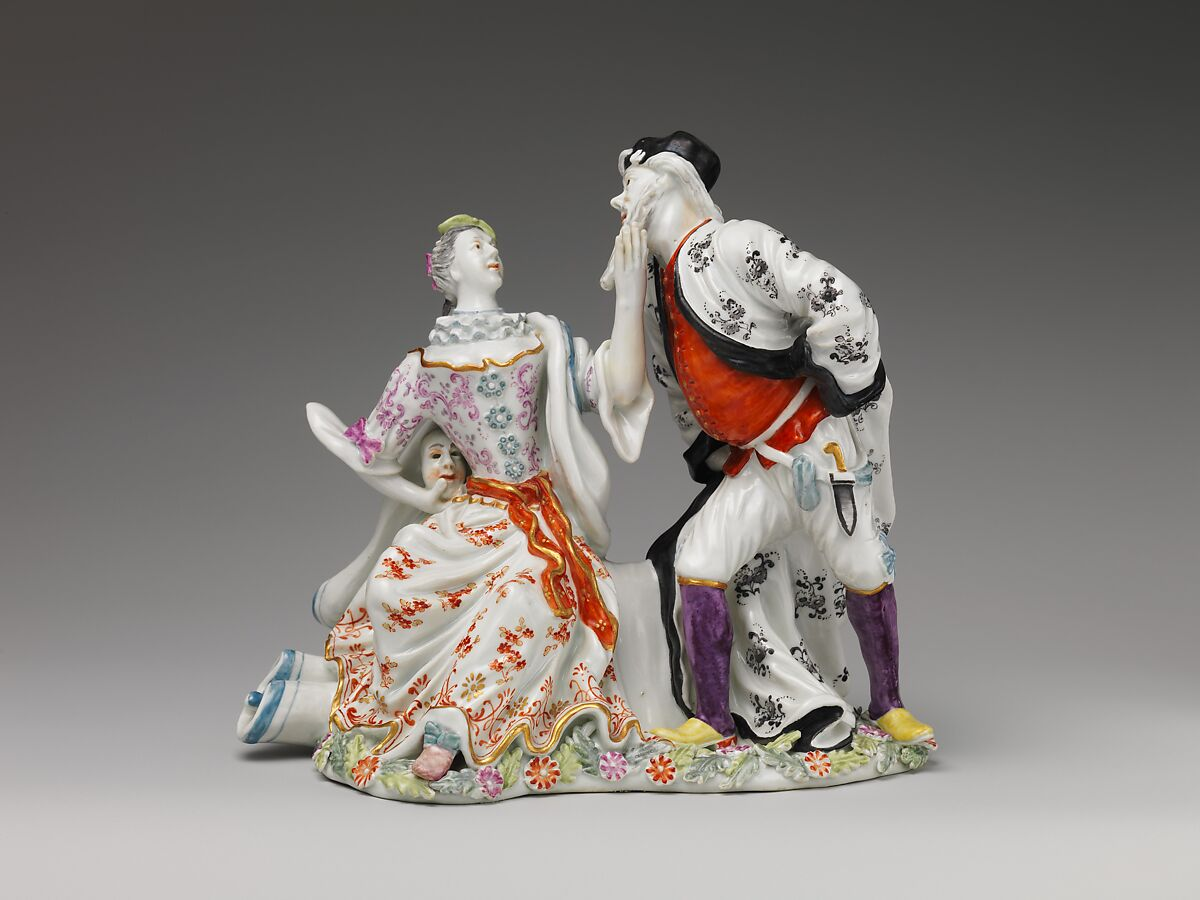
A documented example of Du Paquier-period Vienna porcelain sculpture.
do not reject an early Vienna object simply because it lacks the later Imperial Vienna Bindenschild.
For Du Paquier porcelain, body, form, modelling, decoration, provenance and documented museum parallels
can be more informative than the presence or absence of one familiar mark.
Imperial Vienna Porcelain After 1744
When the manufactory passed into imperial ownership in 1744,
Vienna porcelain entered a new institutional phase.
Production served courtly and aristocratic demand and included table services,
figures, portrait plaques, luxury accessories and highly finished decorative works.
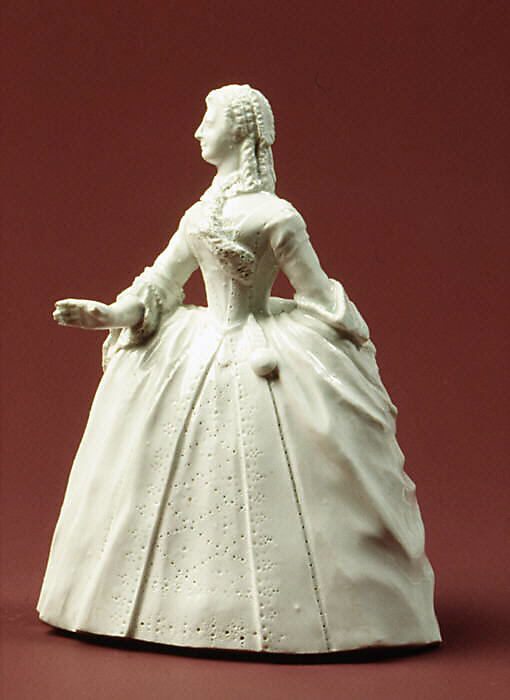
Luxury Objects and Court Culture
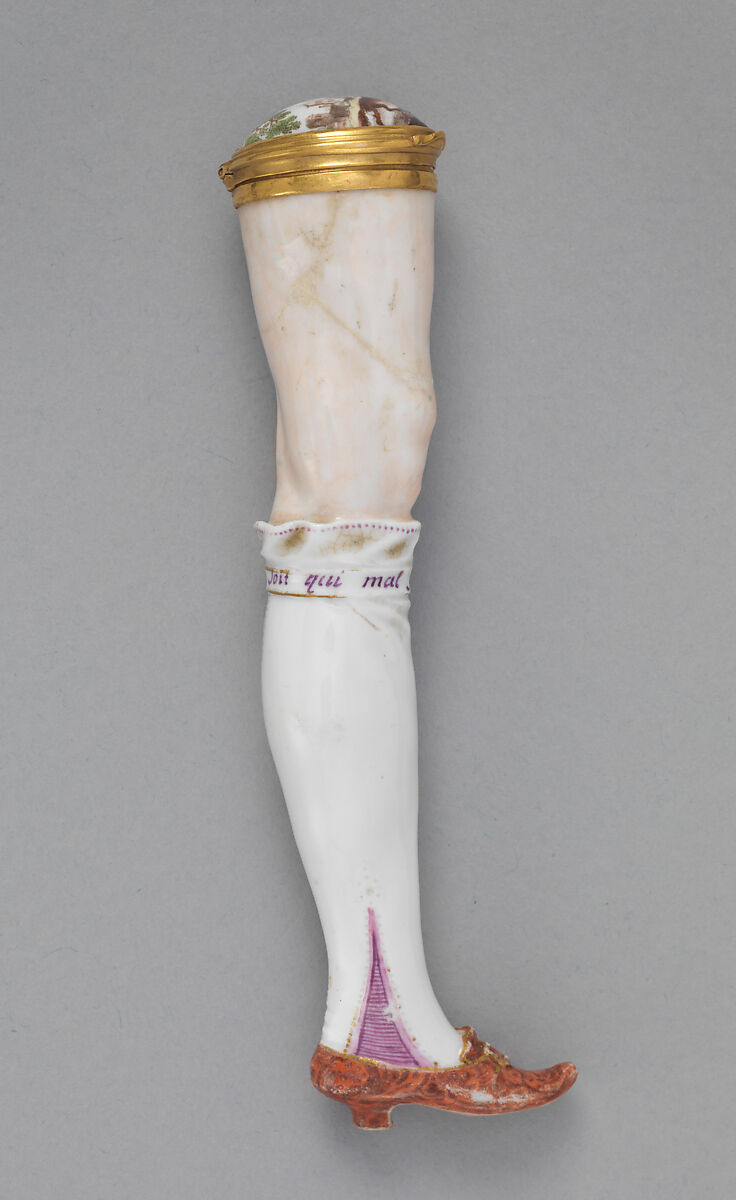
The unusual form demonstrates the breadth of luxury objects produced beyond conventional tableware.
Portraiture and Neoclassical Taste
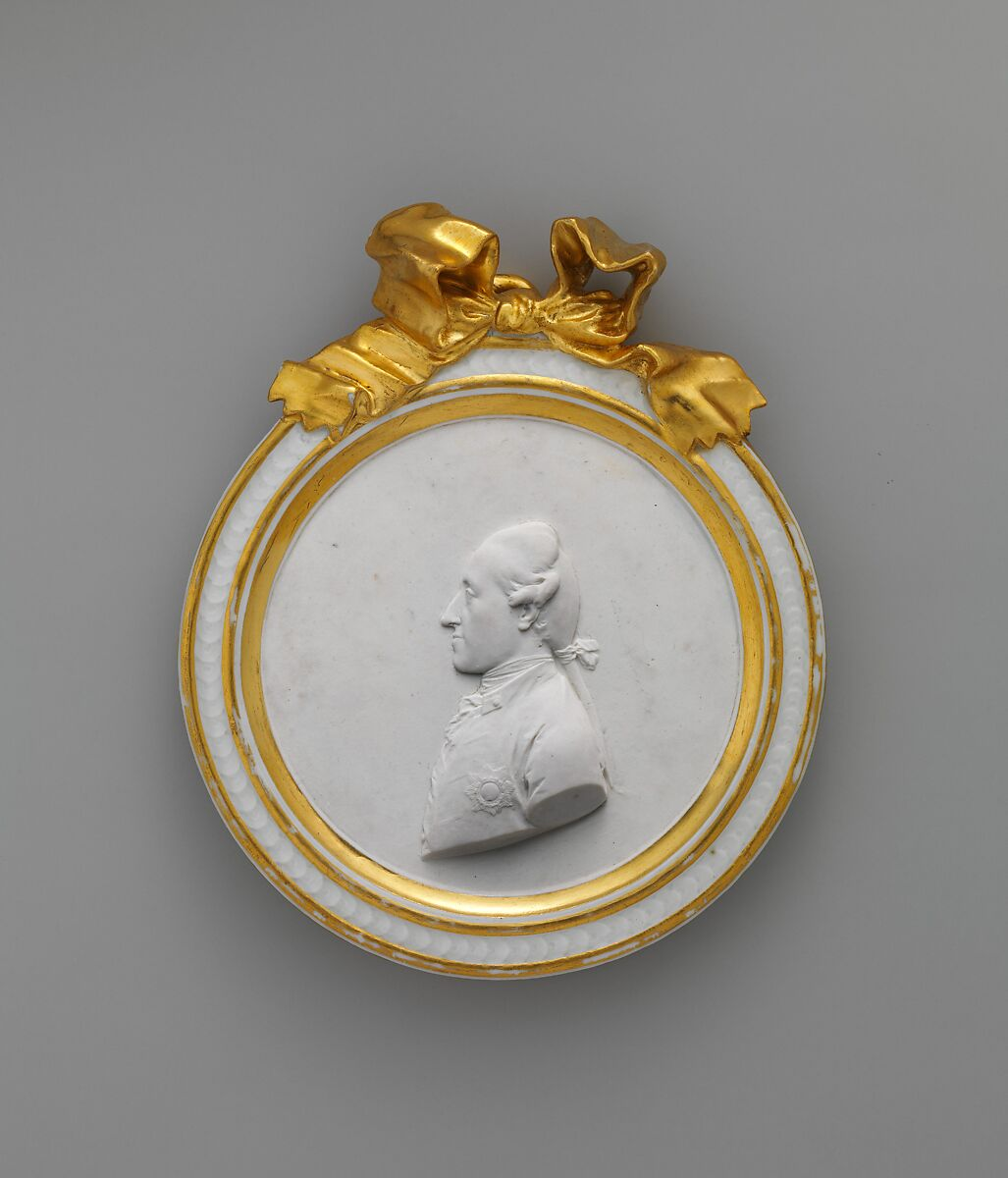
Portrait porcelain, medals and courtly commemorative objects form an important part of Vienna’s artistic production.
Royal Vienna Porcelain Marks: Bindenschild and the “Beehive Mark”
The most important historic mark associated with Imperial Vienna is the
Bindenschild, the Austrian banded shield.
Collectors in English-speaking markets often refer to it as the
Vienna Beehive Mark because the shield can resemble a beehive when viewed upside down.
That nickname has created generations of confusion.
The historical symbol is a shield, not a literal beehive,
and later decorators and manufacturers used related or deliberately evocative marks.
This is why searching only for “a blue beehive” is not a reliable authentication method.
A convincing attribution must explain why the
mark, porcelain body, form, decoration, technique, numbers and period
all belong together.
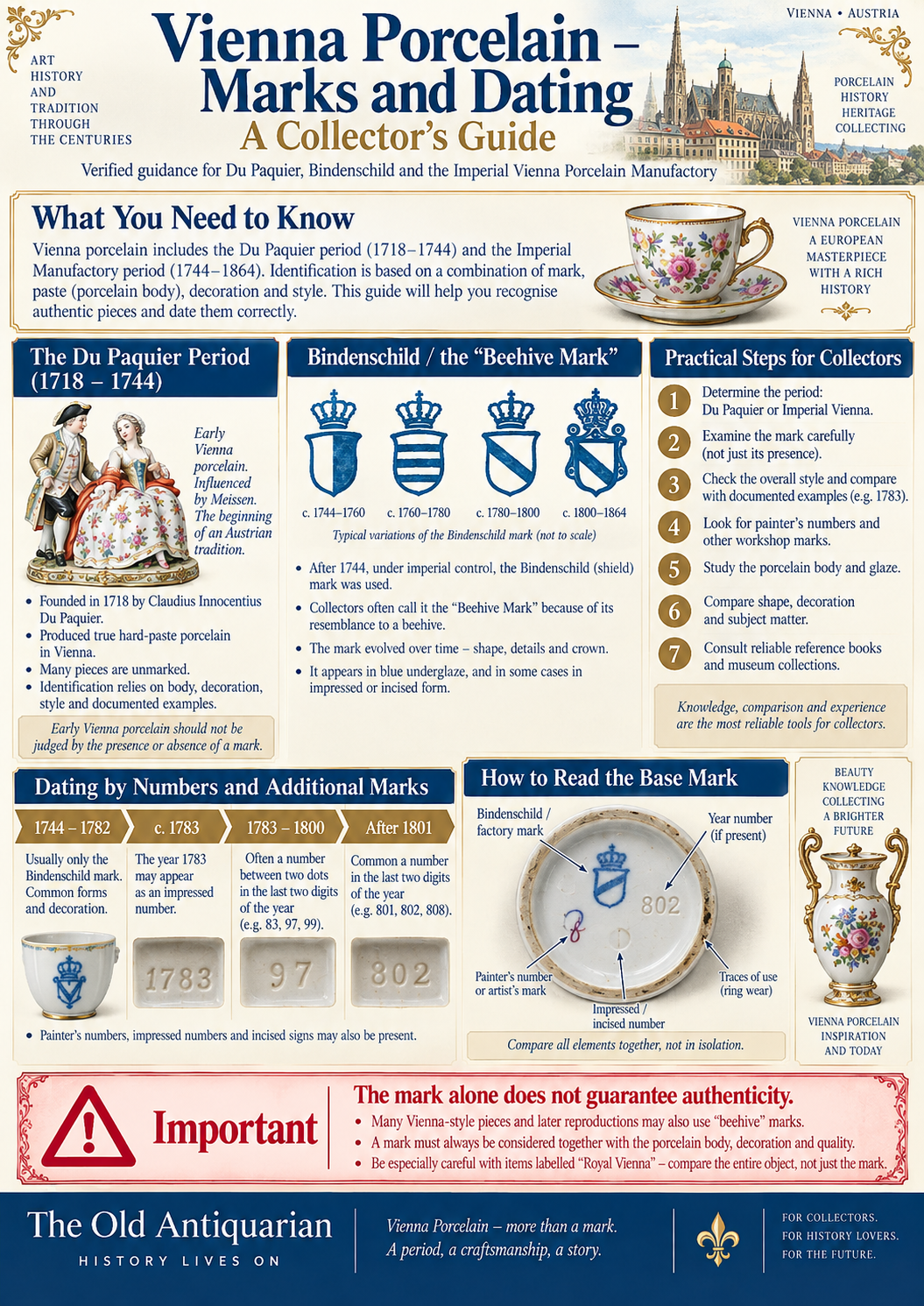
Correction for collectors: MAK documentation indicates systematic year stamps from
1784; illustrated mark variants are orientation aids rather than archival facsimiles.
For the broader method of reading symbols, painted marks, impressed numbers and backstamps,
see our
Porcelain Marks Identification Guide.
How to Date Vienna Porcelain
Vienna porcelain should not be dated from the general appearance of the shield alone.
A much stronger method is to examine the entire base and record
every painted, impressed and incised element.
MAK documentation notes that the manufactory did not have a precise system of
year stamps before 1784.
Museum collections preserve later objects where the underglaze-blue Bindenschild
appears together with year stamps, worker numbers, painter numbers and other marks.
| Documented Base Element | Museum Example | What It Shows |
|---|---|---|
| Bindenschild + 95 | MAK, object dated around 1795. | The year stamp can sit beside additional production and painter information. |
| Bindenschild + 97 | Wien Museum, object dated c. 1797–1799. | Other impressed, painted and incised signs may appear on the same base. |
| Bindenschild + 99 | MAK, object dated around 1799. | The exact number is useful only when read within the documented Vienna system. |
| Bindenschild + 800 | Wien Museum, c. 1797–1799 / transition around 1800. | Three-digit year notation is encountered around the turn of the century. |
| Bindenschild + 802 | Wien Museum, dated 1802–1804. | A second impressed number may identify another factory function or worker. |
| Bindenschild + 808 | Wien Museum, documented 1808 object. | The complete base is more informative than the central shield alone. |
exact mark + year/worker marks + form + porcelain body + decoration + technique + documented factory history
For a full step-by-step methodology, continue with
How to Date Antique Porcelain.
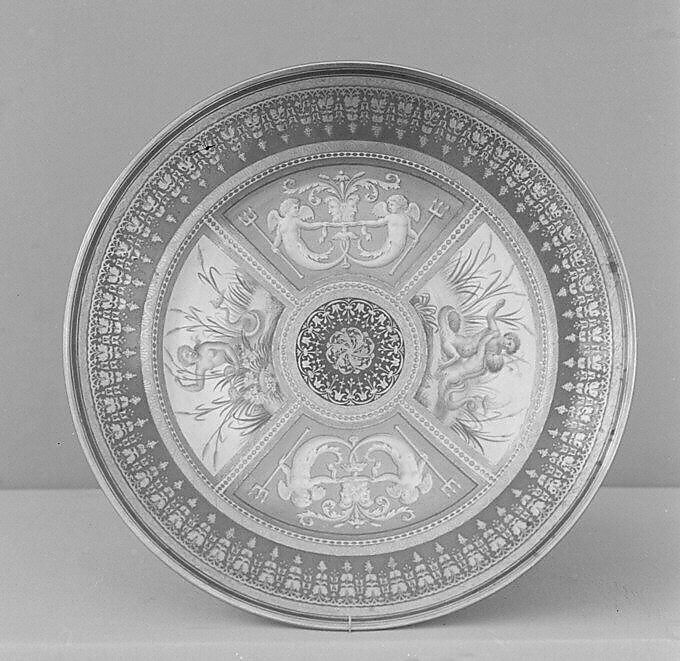
Precisely dated museum objects provide particularly valuable comparison points for style and technique.
Vienna Porcelain Marks Reference Sheet
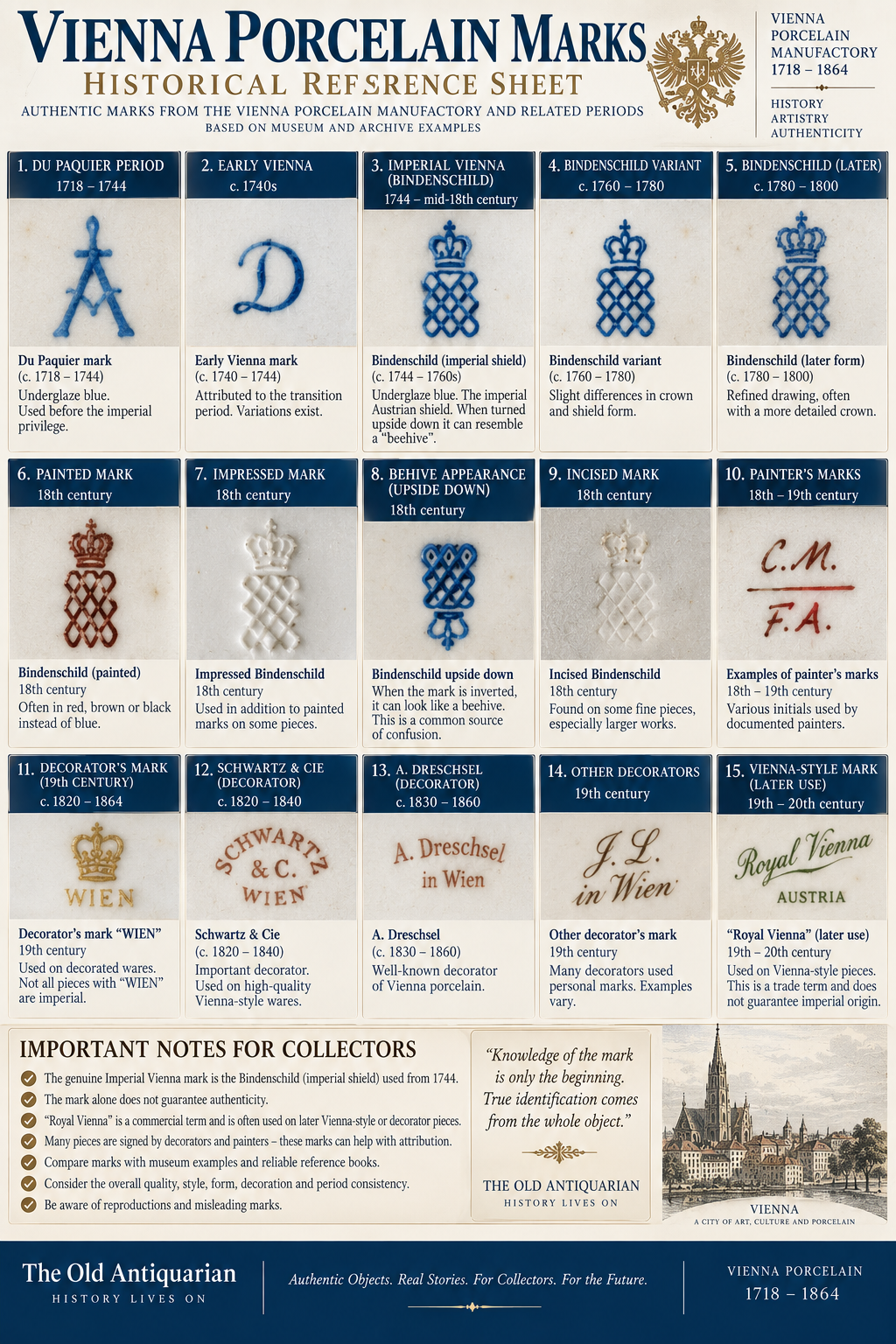
Some illustrated early and decorator marks are schematic and must not be treated as authenticated archival facsimiles.
For an important attribution, compare the exact base with documented MAK, Wien Museum or other museum examples.
Royal Vienna vs Imperial Vienna vs Later Vienna-Style Porcelain
The historic Vienna manufactory closed in 1864,
but the visual language associated with Vienna porcelain remained desirable.
Later decorators and manufacturers continued to produce portrait plates,
urns, vases and cabinet wares inspired by eighteenth- and early nineteenth-century Vienna.
Some later pieces are exceptionally well painted and highly collectible.
The issue is not whether they are “good” porcelain;
the issue is whether they are being correctly described.
A later Vienna-style object should not become Imperial Vienna simply because its base carries
a shield or beehive-like device.
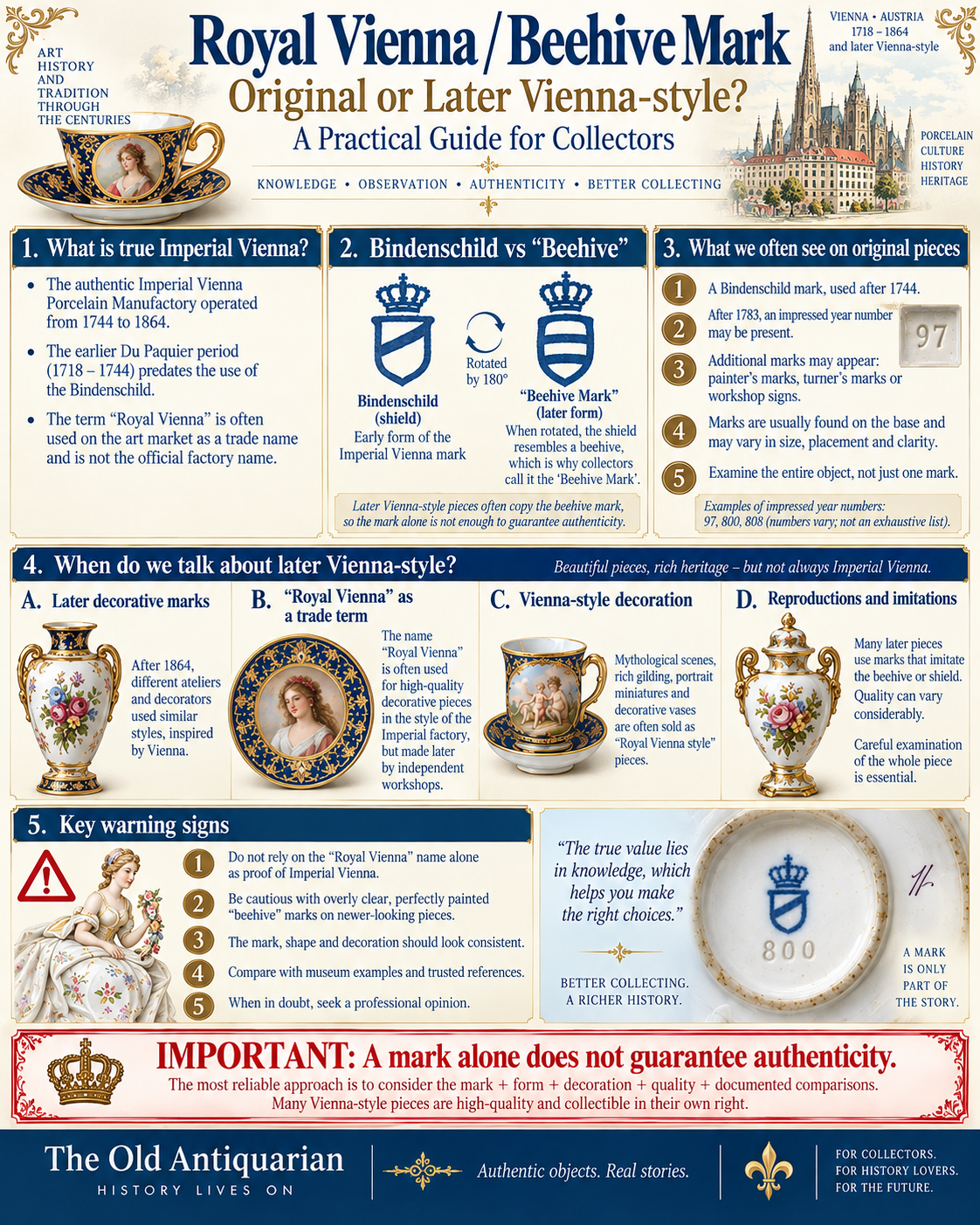
Use the diagrams as orientation, not as substitutes for direct museum comparison.
| Feature | Historic Imperial Vienna | Later Vienna-Style |
|---|---|---|
| Historical period | 1744–1864. | Frequently later 19th or 20th century. |
| “Royal Vienna” wording | Not the simple official historic factory name. | Often used commercially or stylistically. |
| Shield / beehive-like mark | Must correspond to documented Imperial Vienna practice. | May imitate or reference historic Vienna imagery. |
| Decoration | Must make sense for the specific production period. | Often uses portraits, mythology, coloured grounds and rich gilding inspired by Vienna. |
| Collector value | Can be substantial depending on object, period, rarity and condition. | Can also be significant when the later maker, decorator and artistic quality are desirable. |
Popular Vienna Porcelain Objects, Figurines & Decorative Styles
Historic Vienna production was remarkably varied.
Collectors encounter tableware, figures, vases, plaques,
luxury accessories and court commissions,
as well as decoration ranging from chinoiserie and flowers
to classical subjects, landscapes and elaborate gilding.
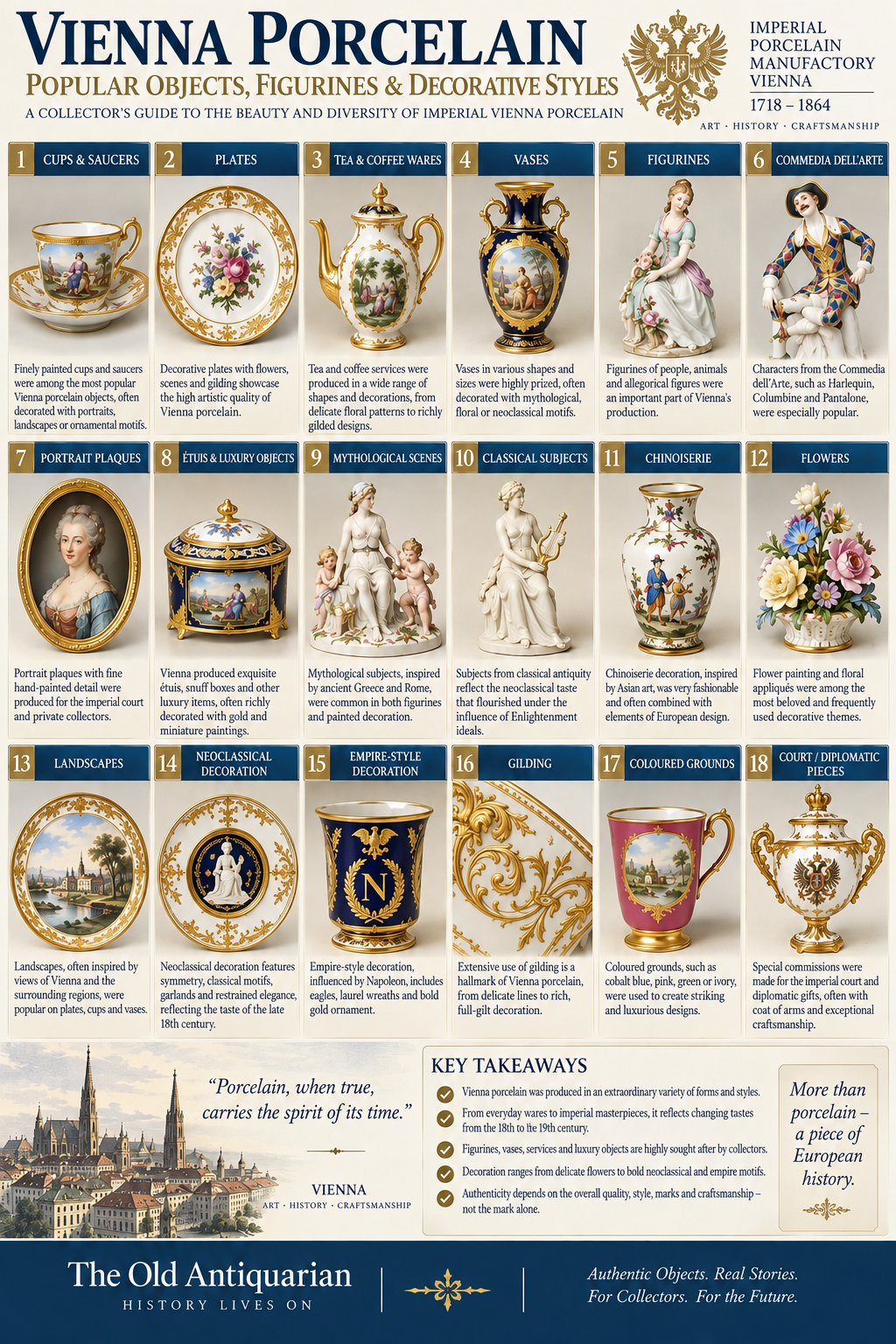
The illustrated objects represent categories and styles rather than exact historic models.
| Collecting Area | What to Examine |
|---|---|
| Cups & saucers | Exact base marks, year numbers, painter numbers, matching decoration and gilding. |
| Plates | Border design, centre decoration, painting quality, classical subjects and period consistency. |
| Tea & coffee wares | Completeness, lids, handles, matching components and coherent mark periods. |
| Figurines | Modelling, anatomy, hands, faces, drapery, missing details and restoration. |
| Commedia dell’Arte | Character identification, documented models and quality of sculptural modelling. |
| Portrait plaques | Identity of sitter, modelling quality, frame or mount, provenance and date. |
| Chinoiserie | Especially relevant to early Du Paquier production and Asian-inspired European decoration. |
| Neoclassical porcelain | Symmetry, antique subjects, restrained forms, portrait medallions and fine painted decoration. |
| Empire-period wares | Strong coloured grounds, architectural motifs, landscapes and sophisticated gilding. |
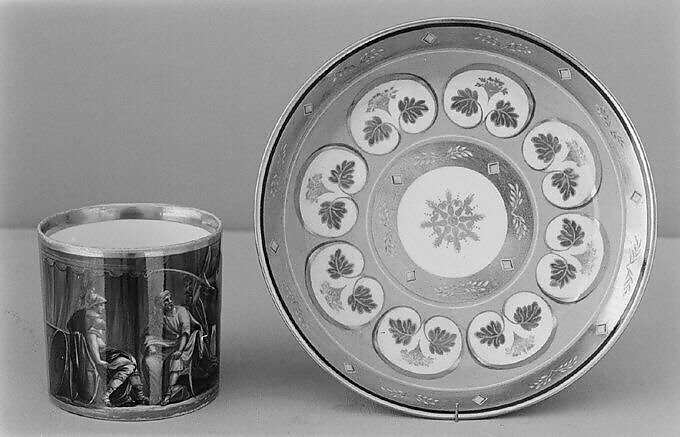
illustrating the sophisticated decorative character of early nineteenth-century production.
How to Identify Authentic Vienna Porcelain
Authentication works best as an evidence chain.
Do not begin with the assumption that a familiar-looking mark has already identified the piece.
Start with the object itself, then test whether the marks support what the material,
form and decoration are telling you.
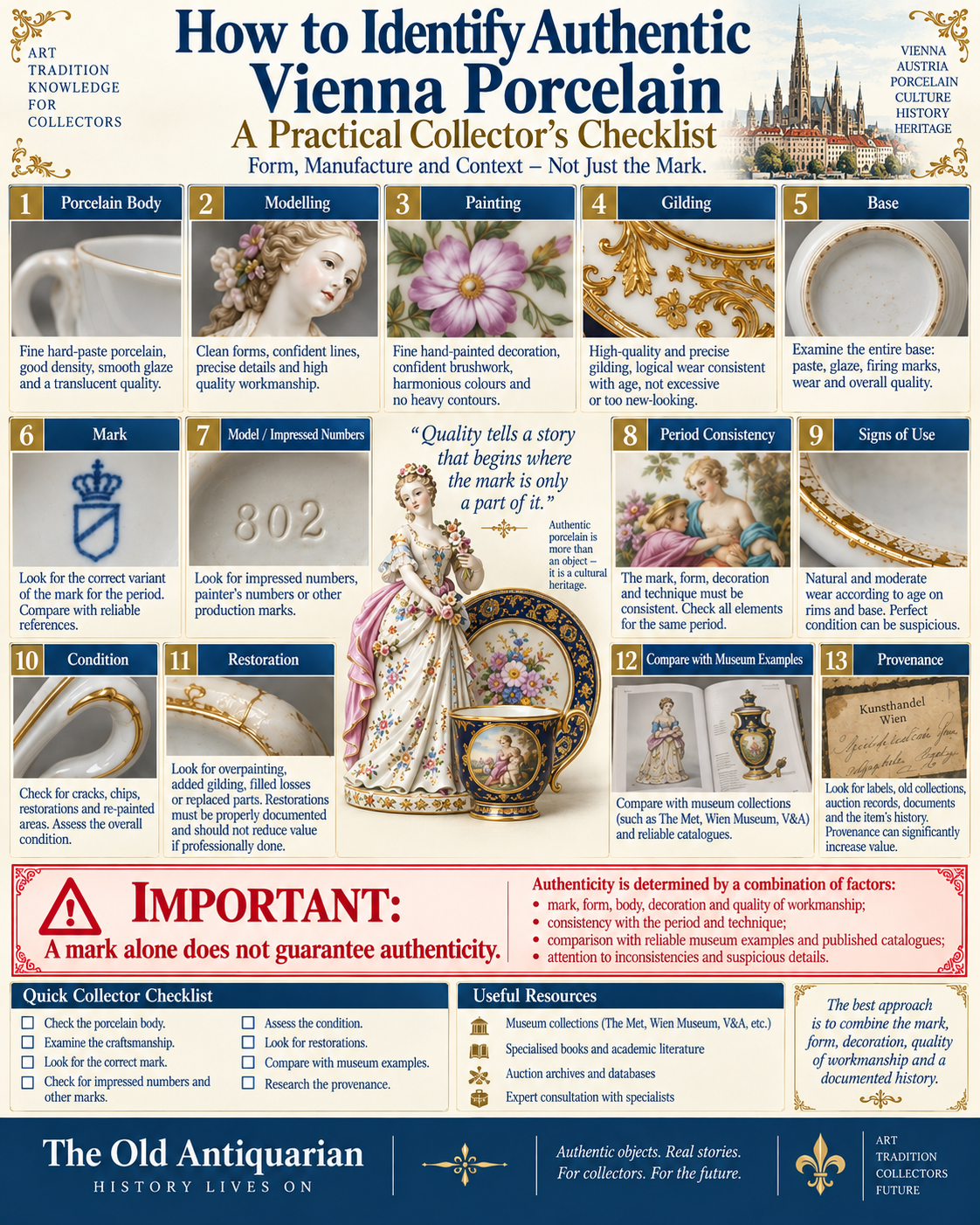
The mark is evidence—not the conclusion.
| Check | What to Look For | Why It Matters |
|---|---|---|
| Porcelain body | Dense, refined hard-paste porcelain consistent with the proposed period. | Material should support—not contradict—the attribution. |
| Modelling | Facial features, hands, drapery, moulding and proportions. | Weak modelling can reveal a later or lower-quality object. |
| Painting | Brushwork, tonal transitions, anatomy, flowers and landscape details. | Artistic quality can matter greatly to both attribution and value. |
| Gilding | Natural wear, original application and possible regilding. | Later restoration can alter the original surface. |
| Complete base | Main mark plus every number, initial and incised sign. | Secondary marks may be more diagnostic than the central shield. |
| Period consistency | Do mark, form, painting and technique belong to the same historical period? | A major contradiction is an important warning sign. |
| Condition | Chips, cracks, hairlines, missing details, staining and gilding loss. | Condition affects interpretation, desirability and market value. |
| Restoration | Glue, filler, overspray, repainting, regilding and replacement parts. | Repairs can hide construction details or alter value substantially. |
| Museum comparison | Compare with documented MAK, Wien Museum and major museum objects. | A catalogued institutional object is stronger evidence than an online marketplace listing. |
| Provenance | Old labels, invoices, collection history, catalogues and exhibition records. | Reliable documentation can materially strengthen an attribution. |
The same evidence-based process is explained more broadly in our
Complete Guide to Identifying Antique Porcelain.
Royal Vienna Porcelain Value: What Is It Worth?
There is no reliable universal Royal Vienna price chart.
Two visually similar porcelain plates can have dramatically different values
if one is documented Imperial Vienna and the other is a later Vienna-style decorator piece.
Valuation must therefore begin with identity, not price.
Only after maker, period and object type are reasonably established
does it make sense to compare market results.
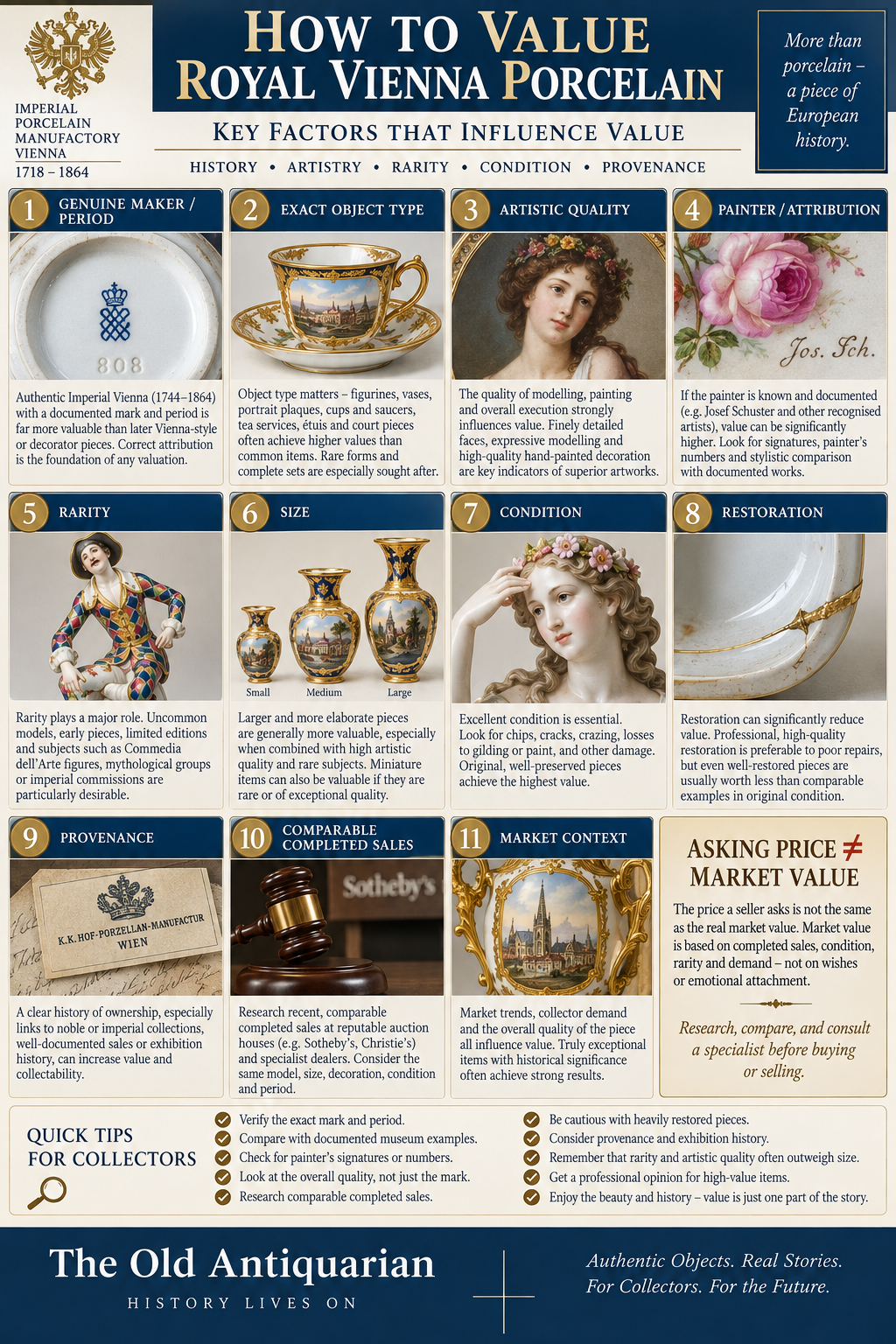
Historic Imperial Vienna refers to the imperial manufactory period
1744–1864; 1718–1744 is the Du Paquier period.
| Value Factor | Why It Matters |
|---|---|
| Genuine maker and period | Correct attribution is the foundation of meaningful valuation. |
| Exact object type | A figure, plaque, cup, vase or court object belongs to a different comparison market. |
| Artistic quality | Exceptional modelling, painting and gilding can materially increase desirability. |
| Documented painter / attribution | Useful only when the attribution is supported by reliable evidence. |
| Rarity | Scarce documented models and historically important objects may attract stronger demand. |
| Size | Size matters, but rarity and quality can outweigh physical scale. |
| Condition | Chips, cracks, losses and worn decoration can materially affect buyer interest. |
| Restoration | Impact depends on rarity, location, extent and quality of the repair. |
| Provenance | Documented collection history can increase confidence and historical interest. |
| Comparable completed sales | They show what buyers actually paid for genuinely comparable objects. |
Compare completed sales of objects with the same or closely related
maker, period, model, size, decoration, condition and restoration history.
Condition, Damage & Restoration
For fine Vienna porcelain, condition can be a major part of value.
Inspect handles, finials, rims, figure extremities, gilded surfaces,
old joins and the underside under neutral light.
| Issue | Collector Check |
|---|---|
| Hairline cracks | Use gentle side lighting; inspect handles, rims, bases and stress points. |
| Old restoration | Look for filler, glue lines, colour changes, overspray and replaced sections. |
| Regilding | Newer gold may appear brighter, thicker or inconsistent with surrounding wear. |
| Paint wear | Distinguish natural handling wear from aggressive cleaning or later repainting. |
Before repairing valuable porcelain, read our
Porcelain Restoration Guide.
For preventive care and display, see
How to Store Porcelain Safely.
Vienna Porcelain vs Meissen, KPM Berlin & Nymphenburg
Vienna belongs within the broader history of elite Central European hard-paste porcelain,
but it should not be confused with German court manufactories simply because
their wares share eighteenth-century origins, luxury craftsmanship and prestigious marks.
| Tradition | Historic Starting Point | Famous Collector Clue | Key Warning |
|---|---|---|---|
| Vienna | 1718; imperial from 1744. | Bindenschild / so-called Beehive Mark. | Later Vienna-style marks can cause misattribution. |
| Meissen | 1710. | Crossed swords. | Crossed-swords marks have been widely copied. |
| KPM Berlin | Royal manufactory from 1763. | Blue sceptre. | The exact sceptre and associated marks must agree with the object. |
| Nymphenburg | Founded in Bavaria in 1747. | Wittelsbach lozenge shield. | Shield mark, model, form and artist history must be read together. |
For comparison, explore our verified guides to
Meissen porcelain,
KPM Berlin,
Nymphenburg porcelain
and
Rosenthal porcelain.
Royal Vienna Collector Checklist
- Photograph the entire object from several angles.
- Photograph the complete underside, not only the central mark.
- Record every painted, impressed and incised number.
- Determine whether the proposed date falls within Du Paquier, Imperial Vienna or later Vienna-style production.
- Do not treat the words “Royal Vienna” as the historic factory name.
- Identify the symbol as a shield before thinking of it as a “beehive.”
- Compare the exact mark with documented museum examples.
- Examine porcelain quality, glaze and modelling.
- Study hand painting and gilding under magnification.
- Check for restoration, regilding and replacement parts.
- Ask whether the form and decoration make sense for the claimed period.
- Research old labels, invoices and provenance.
- Compare completed sales—not just dealer asking prices.
- For important objects, confirm the attribution from more than one reliable source.
Send clear photographs of the complete object, the entire base,
all marks and numbers, dimensions and any damage or previous restoration.
Good photographs are the starting point for meaningful identification.
Royal Vienna Porcelain FAQ
What is Royal Vienna porcelain?
Royal Vienna is a collector and trade term often associated with historic Vienna porcelain
and later Vienna-style decorative wares. The original Vienna manufactory began under
Du Paquier in 1718, became an imperial manufactory in 1744 and closed in 1864.
What is the Royal Vienna Beehive Mark?
The “Beehive Mark” is the popular collector nickname for the Vienna Bindenschild
when the shield is viewed upside down. Historically, the symbol is a shield, not a beehive.
Does every Beehive Mark mean genuine Royal Vienna?
No. Similar shield or beehive-like marks appear on later Vienna-style porcelain.
The entire object must support the proposed maker and period.
When did Vienna porcelain begin?
Claudius Innocentius Du Paquier received the privilege to manufacture porcelain in Vienna in 1718.
The manufactory entered imperial ownership in 1744.
When did Vienna porcelain start using year stamps?
MAK documentation indicates that the manufactory did not use a precise systematic year-stamp system
before 1784. Later museum objects preserve year stamps such as 95, 97, 99, 800, 802 and 808
together with other production marks.
What does 802 mean on Vienna porcelain?
Wien Museum records documented Vienna pieces carrying a Bindenschild and year stamp 802
from the early 1800s. Never interpret a number in isolation; check the complete base,
object form and museum parallels.
Is later Royal Vienna-style porcelain worthless?
No. High-quality later portrait plates, vases and decorative wares can be collectible.
Their value depends on the actual maker or decorator, artistic quality,
rarity, condition and collector demand.
Are painter signatures important?
They can be important when the artist or painter can be reliably documented.
A signature should not increase attribution confidence unless the object,
period and supporting evidence are consistent.
Does restoration reduce Royal Vienna porcelain value?
Often, but not by a fixed percentage.
The effect depends on rarity, historical importance,
the location and extent of repair and the quality of restoration.
How do I find the market value of Royal Vienna porcelain?
First identify the maker, period and exact object.
Then compare genuinely similar completed sales by model, date,
size, decoration, condition and restoration history.
Dealer asking prices alone do not establish market value.
Related Porcelain Guides
Antique Porcelain: Complete Collector’s Guide
Porcelain Marks & Backstamps Identification
How to Identify Antique Porcelain
Meissen Porcelain Identification Guide
Sources & Further Research
For chronology, documented objects and historical mark evidence,
this guide prioritizes museum and institutional sources.
- MAK – Museum of Applied Arts, Vienna: Vienna Porcelain Manufactory archive, production chronology and museum collection.
- The Metropolitan Museum of Art: Du Paquier and Imperial Vienna porcelain object records and the exhibition “Imperial Privilege: Vienna Porcelain of Du Paquier, 1718–44.”
- Wien Museum: catalogued Imperial Vienna objects with underglaze-blue Bindenschild, year stamps, impressed numbers and painter or workshop marks.
- Historic catalogues and specialist literature: used as supporting evidence where their information can be reconciled with museum and archival documentation.
porcelain marks are not static logos.
Hand-applied marks vary, production systems change and later decorators can imitate historic symbols.
Whenever a potentially valuable object is involved, compare its exact base with
a documented museum object rather than relying on a generic marks chart.
The Old Antiquarian combines more than 35 years of practical experience
with antiques and collecting with historical, museum and comparative research.
For porcelain, we treat maker, exact mark, material, model,
decoration, production technique, condition, restoration,
provenance and market evidence as connected clues rather than isolated answers.
Continue Exploring
Explore more identification, history, collecting and conservation research in our
Stories & Knowledge
library.
Final Collector Principle
Royal Vienna porcelain rewards careful research because its most famous feature—
the so-called Beehive Mark—is also one of the easiest clues to misunderstand.
A blue shield may point you in the right direction,
but it cannot tell the whole story.
The strongest attribution is reached when
the porcelain body, exact mark, numbers, form, decoration,
technique, condition and documented history all support the same period and origin.
Only after that should value enter the discussion.
Identify the object. Verify the history. Then determine the value.
