
Dresden Porcelain
Dresden Porcelain: History, Marks, Makers, Figurines, Dating & Value Guide
Last Updated: September 14, 2026
|
By The Old Antiquarian
Dresden porcelain is not the name of one single porcelain factory.
The term is commonly used for porcelain produced or decorated by a network of manufacturers,
painting studios and decorating workshops associated with Dresden and Saxony.
Important names include Carl Thieme / Potschappel, Sächsische Porzellan-Manufaktur Dresden,
Helena Wolfsohn, Richard Klemm and Ambrosius Lamm.
To identify Dresden porcelain correctly, examine the exact mark, maker or decorator,
porcelain body, form, model number, hand-painted decoration, gilding, condition,
restoration and documented historical references together.
A Dresden mark alone does not prove maker, age or authenticity.
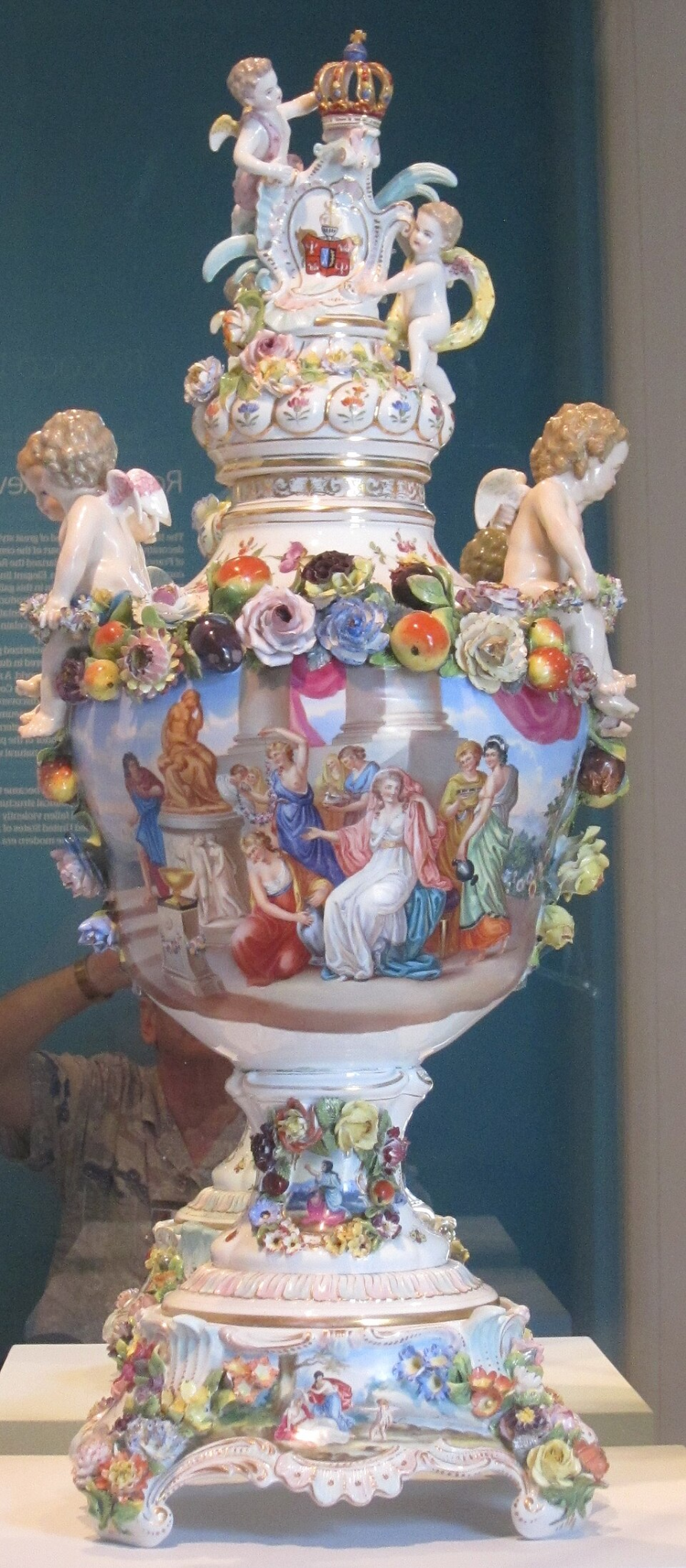
c. 1875–1890. Applied flowers, figural painting, putti and extensive gilding illustrate
the elaborate decorative tradition associated with late-19th-century Dresden porcelain.
Dresden Porcelain at a Glance
| Collector Question | Reference Answer |
|---|---|
| Is Dresden one factory? | No. Dresden porcelain encompasses multiple manufacturers and decorating workshops. |
| Is Dresden the same as Meissen? | No. Meissen is a specific historic manufactory; Dresden is a broader manufacturing and decorating tradition. |
| Major Dresden manufacturer | Carl Thieme, founded at Potschappel near Dresden in 1872. |
| Important decorating names | Helena Wolfsohn, Richard Klemm, Ambrosius Lamm and other Dresden porcelain painters. |
| Typical decoration | Polychrome hand painting, applied flowers, Rococo Revival modelling, figural scenes, cobalt grounds and gilding. |
| Popular objects | Figurines, vases, urns, cups, tea and coffee services, baskets and elaborate cabinet pieces. |
| Key mark | SP Dresden is associated with Sächsische Porzellan-Manufaktur Dresden; the trademark was registered in 1901. |
| Main value factors | Maker, model, date, rarity, decoration, quality, condition, restoration, provenance and comparable completed sales. |
A piece marked Dresden should not automatically be attributed to Carl Thieme,
Meissen or any other specific manufacturer.
Dresden became an important center for porcelain painting and decoration,
and many workshops decorated white porcelain blanks made elsewhere.
Correct attribution therefore requires identifying both the
porcelain manufacturer and, where possible, the
decorating workshop.
For the wider German context, begin with our
German Porcelain Guide.
For the broader research method covering porcelain bodies, marks, makers and value,
see the
Complete Antique Porcelain Guide.
What Is Dresden Porcelain?
Dresden porcelain is best understood as a regional porcelain tradition rather than a single brand.
During the nineteenth and early twentieth centuries, Dresden developed into an important center for
porcelain painting, decorating and luxury decorative arts.
Numerous Porzellanmalerei workshops purchased undecorated white porcelain,
sometimes called blanks or whiteware, from established manufactories.
Skilled painters then transformed those pieces with flowers, figures, landscapes,
Rococo-inspired ornament, cobalt grounds and extensive gilding.
Other Dresden-area firms went further.
The manufactory founded by Carl Thieme at Potschappel in 1872
developed into an important producer of porcelain in its own right.
“Dresden” on a porcelain base can indicate a geographical or decorating association.
It does not automatically identify who made the porcelain body.
The History of Dresden Porcelain
Dresden occupies a central place in the history of European porcelain.
At the beginning of the eighteenth century, experiments associated with
Johann Friedrich Böttger and
Ehrenfried Walther von Tschirnhaus
helped solve the technological problem of producing European hard-paste porcelain.
Successful true porcelain was produced experimentally in 1708,
and the Saxon porcelain manufactory that became Meissen was formally established in 1710.
Meissen and Dresden should nevertheless be distinguished.
Meissen developed as a specific royal manufactory,
while Dresden later became especially important as a commercial and artistic center
for porcelain merchants, painters, decorators and specialist workshops.
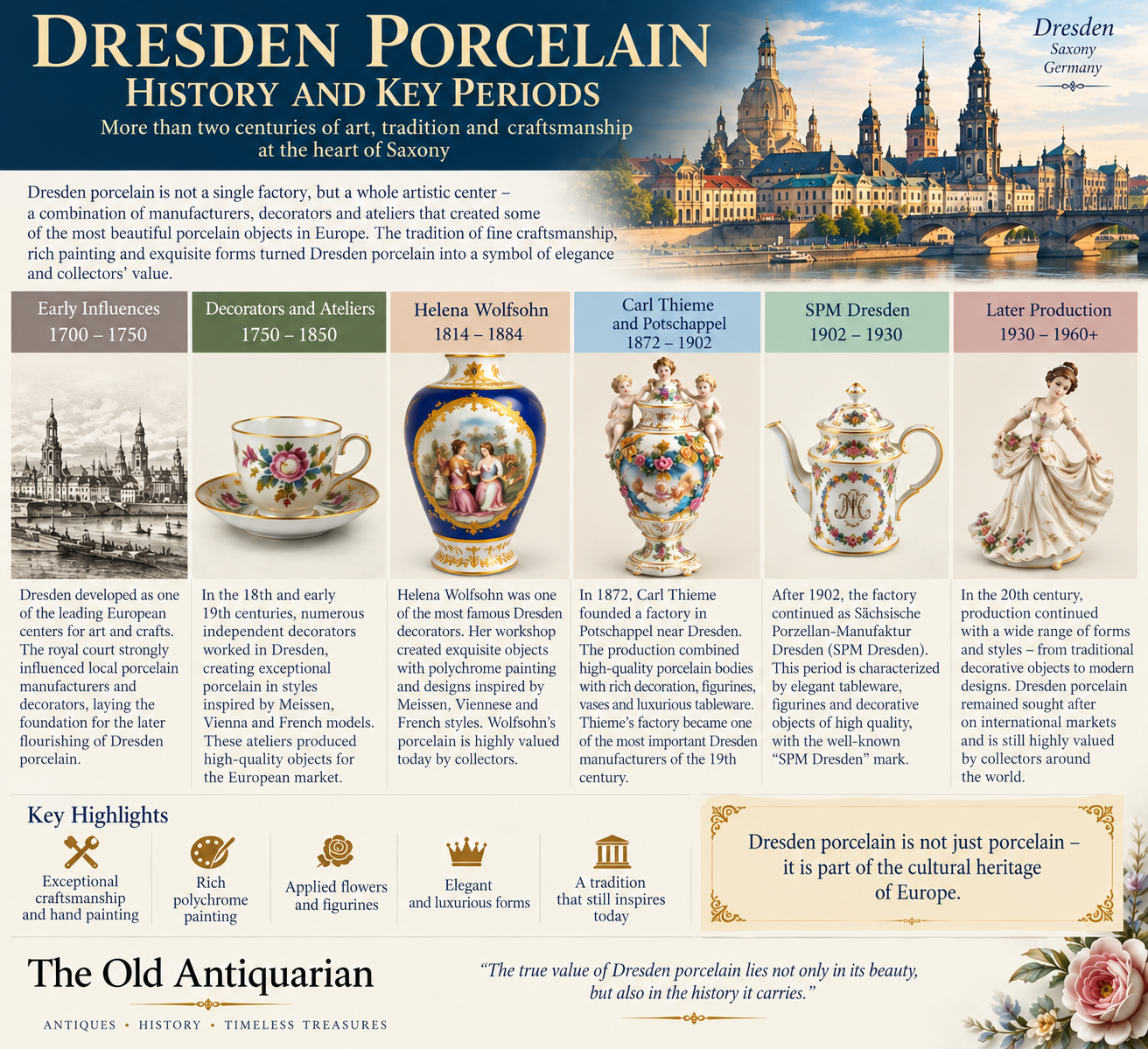
For historical dating, use the verified chronology in the article below rather than treating illustrated timeline dates as primary-source evidence.
Verified Dresden Porcelain Timeline
| Date | Event | Collector Significance |
|---|---|---|
| 1708 | Successful experimental production of European hard-paste porcelain in Saxony. | Foundation of the Saxon porcelain tradition. |
| 1710 | The royal porcelain manufactory that became Meissen is established. | Beginning of Europe’s first major true hard-paste porcelain manufactory. |
| 1843 | Helene Wolfsohn publicly develops her Dresden antiques and porcelain business. | Important documented Dresden decorating tradition. |
| 1869 | After Helene Wolfsohn’s death, her daughter Emilie Elb continues the business. | Explains why later porcelain can legitimately carry the Wolfsohn company name. |
| 1869 | Richard Klemm establishes a porcelain decorating studio near Dresden. | One of the important historic Dresden decorating houses. |
| 1872 | Carl Thieme opens a porcelain factory at Potschappel near Dresden. | Dresden tradition includes substantial porcelain manufacture as well as decoration. |
| 1874 | Flower modeller Karl August Kuntzsch joins Thieme. | Important for the elaborate applied-flower tradition associated with the manufactory. |
| c. 1881 | The Wolfsohn firm begins using a crown/D-type mark after earlier use of the AR monogram. | Useful evidence when researching Wolfsohn-associated decoration. |
| 1887 | Ambrosius Lamm establishes his Dresden porcelain decorating business. | Associated with floral, Watteau-type and mythological decoration. |
| 1888 | Karl August Kuntzsch takes over the Thieme business after Carl Thieme’s death. | Continuation and expansion of Potschappel production. |
| 1901 | The SP Dresden trademark is officially registered. | Major reference point for Sächsische Porzellan-Manufaktur Dresden. |
Dresden Porcelain vs Meissen Porcelain
Dresden and Meissen are closely connected geographically and historically,
but collectors should never use the names interchangeably.
| Feature | Dresden Porcelain | Meissen |
|---|---|---|
| Meaning | Broad regional manufacturing and decorating tradition. | One specific historic porcelain manufactory. |
| Historic center | Dresden and surrounding Saxon workshops. | Meissen, Saxony. |
| Marks | Many different factory and decorator marks. | Most famous for the crossed-swords trademark. |
| White porcelain blanks | Some studios decorated blanks made by other manufacturers. | Meissen produced its own porcelain body. |
| Collector priority | Identify the exact maker and/or decorator. | Identify the exact swords-mark variant, model and production period. |
For crossed-swords marks and authentication, continue with our
Meissen Porcelain Identification Guide.
Major Dresden Porcelain Manufacturers and Decorators
Understanding Dresden porcelain requires separating manufacturers from decorating workshops.
Some businesses made porcelain; others specialized primarily in painting and decorating blanks made elsewhere.
In certain cases, business models changed over time.
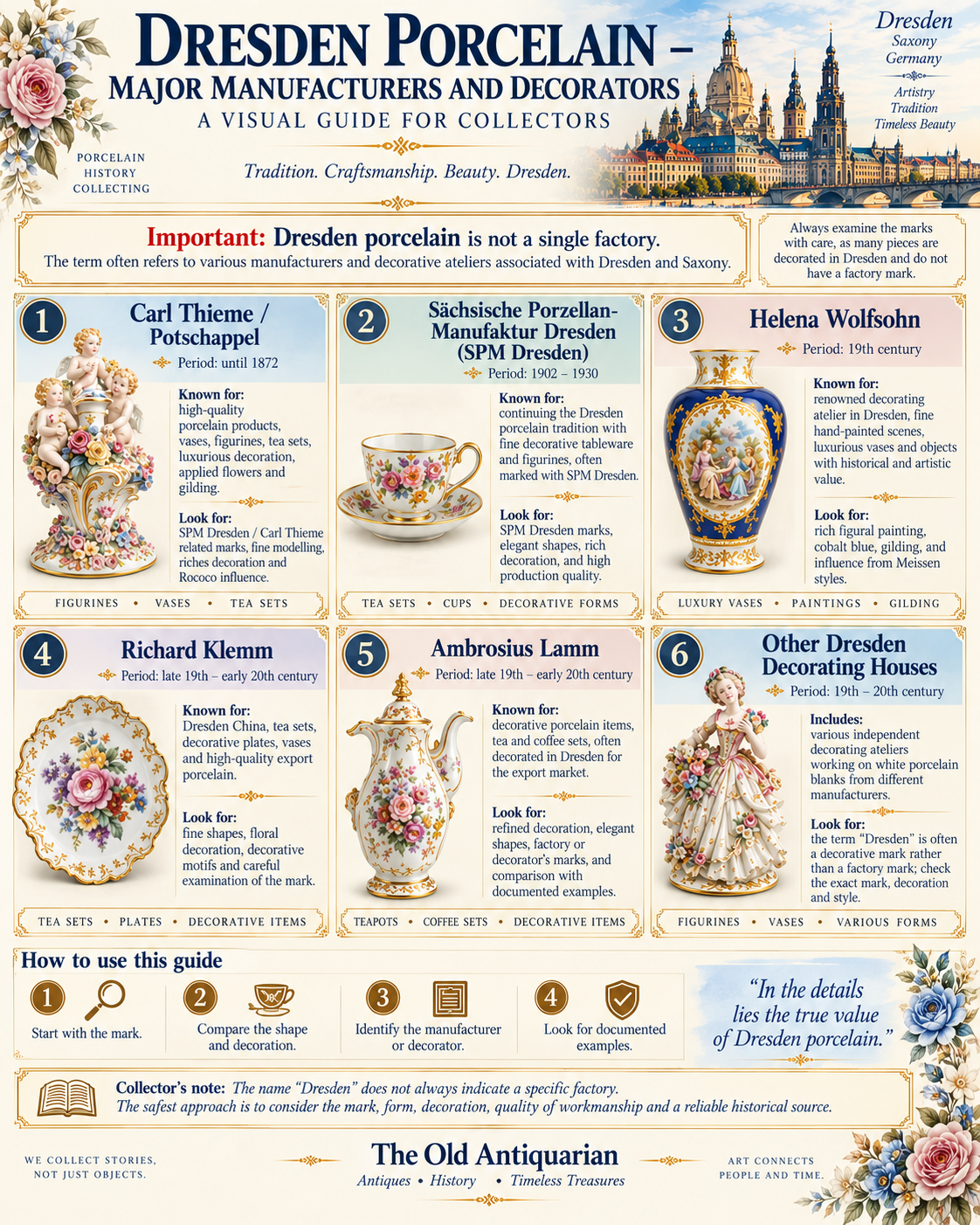
Use the verified chronology below for historical dating; illustrated dates and marks are orientation aids rather than archival evidence.
| Name | Historical Role | Collector Associations |
|---|---|---|
| Carl Thieme / Potschappel | Porcelain manufacturer founded in 1872. | Figurines, applied flowers, ornate vases, tableware and elaborate gilding. |
| Sächsische Porzellan-Manufaktur Dresden | Continuation of the Potschappel manufacturing tradition. | SP Dresden trademark and high-quality decorative porcelain. |
| Helena Wolfsohn | Important Dresden antiques and porcelain decorating business. | Historicist painting, Meissen/Sevres/Vienna influences, rich gilding and luxurious decoration. |
| Richard Klemm | Porcelain decorating studio established in 1869. | Floral decoration, tableware and historicist Dresden, Meissen and Vienna-inspired styles. |
| Ambrosius Lamm | Dresden decorating studio established in 1887. | Alt-Dresden flowers, Watteau-type scenes and mythological decoration. |
| Other Dresden ateliers | Independent painters, decorators and commercial decorating houses. | Another reason the word Dresden should never be treated as one factory mark. |
Carl Thieme and the Potschappel Porcelain Manufactory
In 1872 Dresden porcelain painter Carl Gottlieb Thieme
established the Sächsische Porzellan-Fabrik von Carl Thieme at
Potschappel near Dresden.
This distinction matters because Thieme was not simply a porcelain decorator:
the enterprise developed into a true porcelain manufactory.
In 1874 Thieme employed flower modeller Karl August Kuntzsch.
Kuntzsch later took control of the business after Thieme’s death in 1888
and helped establish the lavish applied-flower decoration that remains closely associated
with the Potschappel tradition.
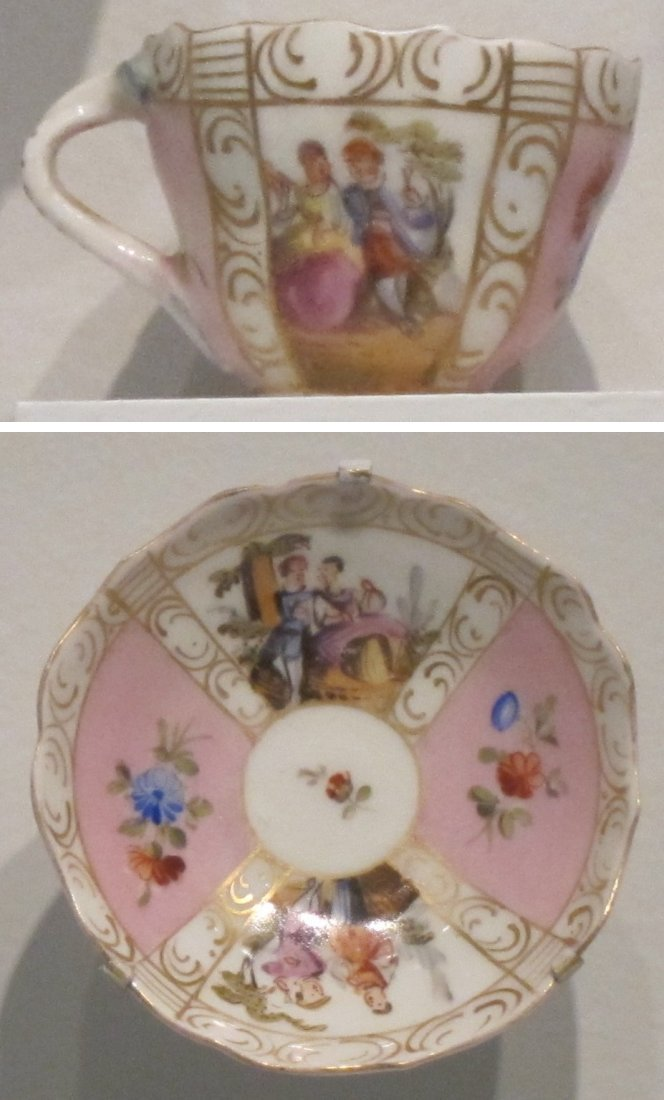
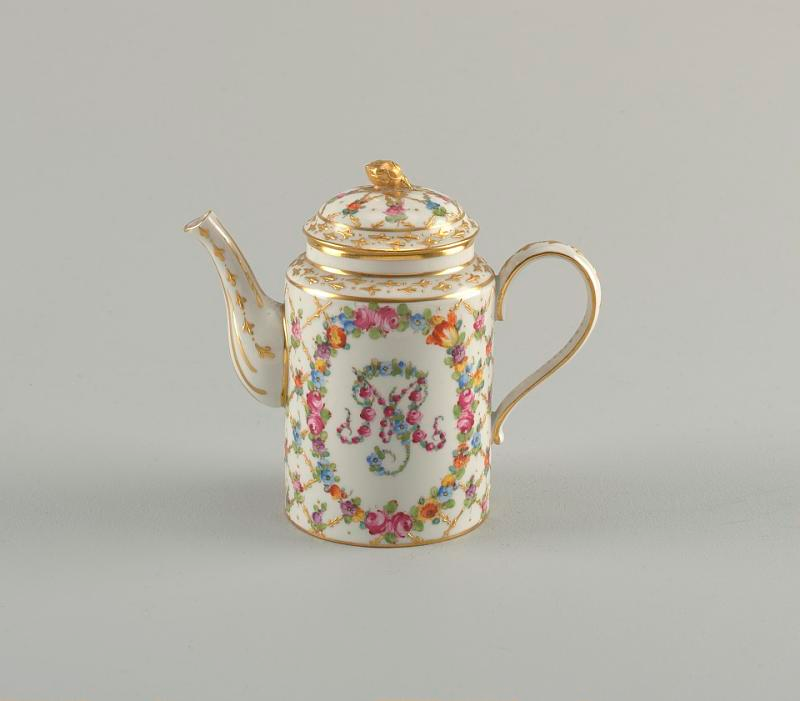
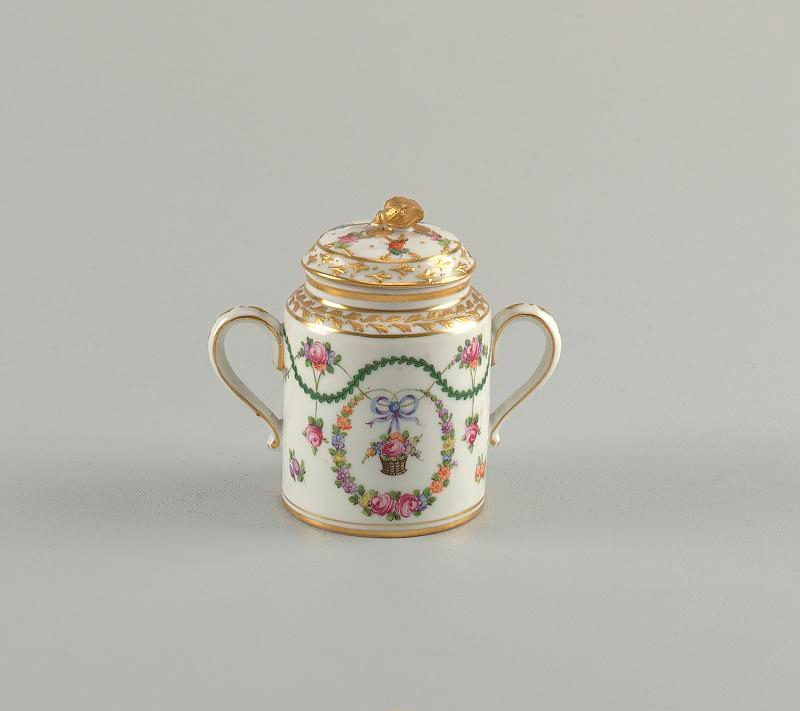
Applied flowers can be exceptionally useful when assessing quality and condition.
Inspect every petal and leaf carefully—small restorations or losses may be easy to overlook.
Helena Wolfsohn and the Dresden Decorating Tradition
Helene Wolfsohn (1798–1869) was an antiques dealer and proprietor of a successful
Dresden porcelain-painting business.
Her documented commercial activity involving antiques and porcelain dates from 1843.
After her death in 1869, her daughter Emilie Elb continued the business.
This is an essential collector distinction because porcelain dated after 1869 may legitimately
be associated with the Helena Wolfsohn firm even though Helene herself was no longer alive.
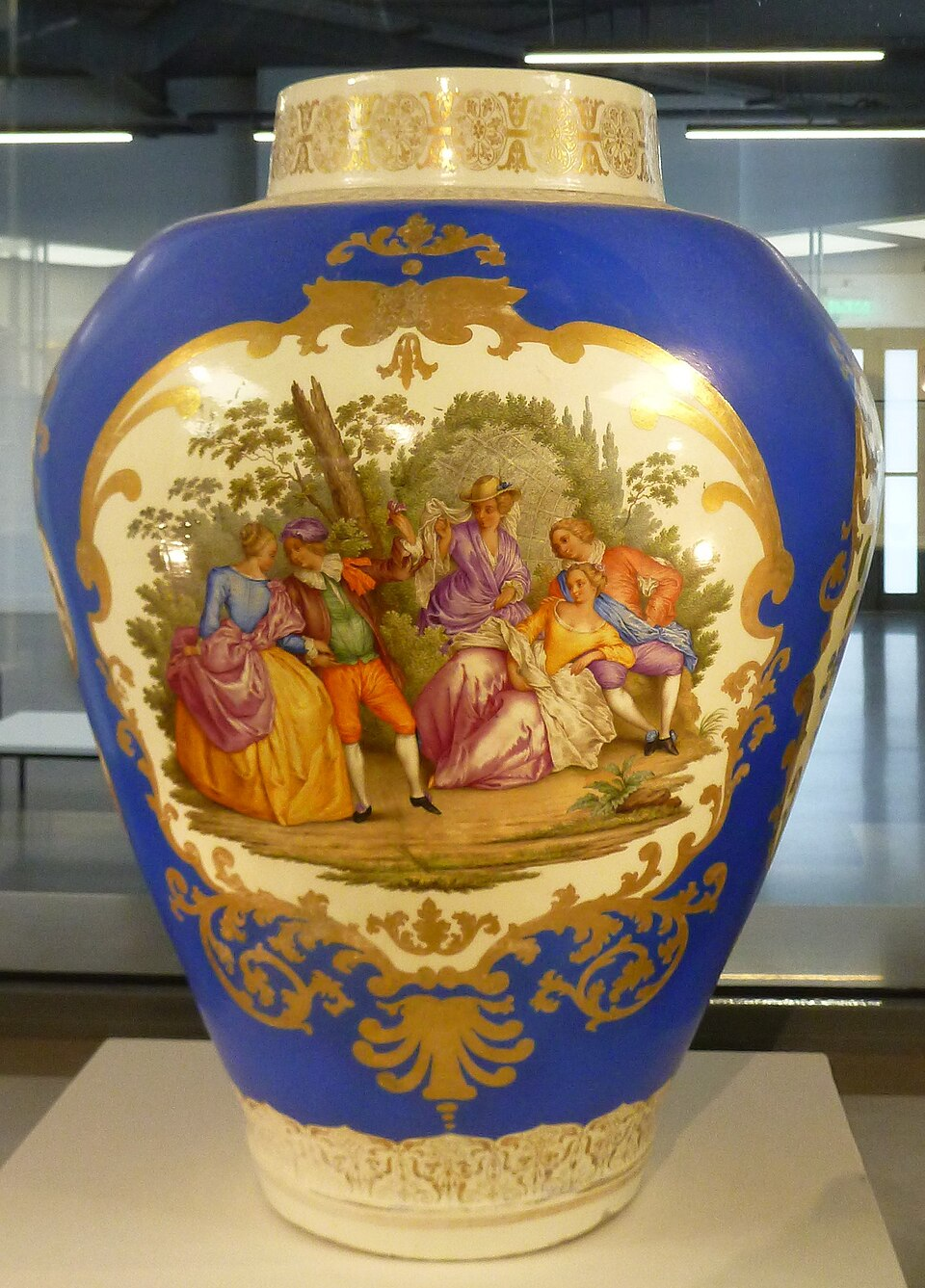
with cobalt ground, polychrome figural decoration and gilding.
The firm continued after Helene Wolfsohn’s death.
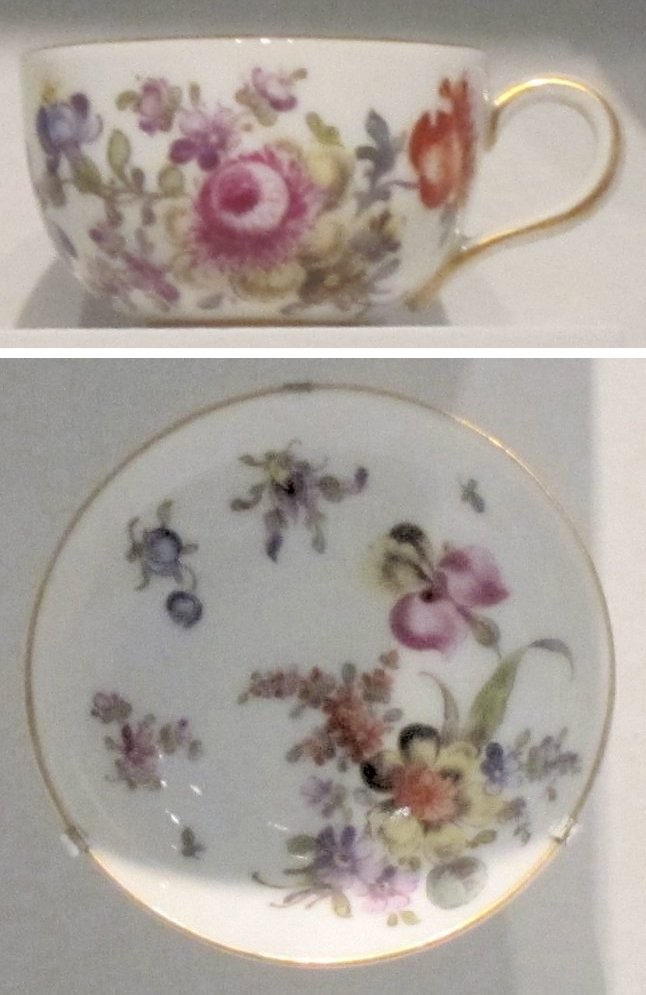
decorated with polychrome flowers and gilt borders.
Helena Wolfsohn Marks
The Wolfsohn business illustrates why marks must be treated historically.
The firm used an AR / Augustus Rex-style monogram during part of its earlier production.
According to the Saxon biographical record, a crown-and-D style mark was used from approximately 1881,
with the D referring to Dresden.
A mark resembling a famous eighteenth-century royal or Meissen-related symbol therefore does not automatically
make the object eighteenth-century Meissen.
The porcelain body, decoration, mark technique and documented business history must agree.
Dresden Porcelain Marks: What Collectors Should Know
There is no universal Dresden porcelain mark.
Collectors encounter factory marks, decorators’ marks, painted monograms,
printed backstamps, impressed model numbers and various secondary production marks.
The most useful first step is to photograph the entire underside.
Do not crop the image to show only the most obvious logo.
A small impressed number, handwritten code or secondary mark may be just as important.
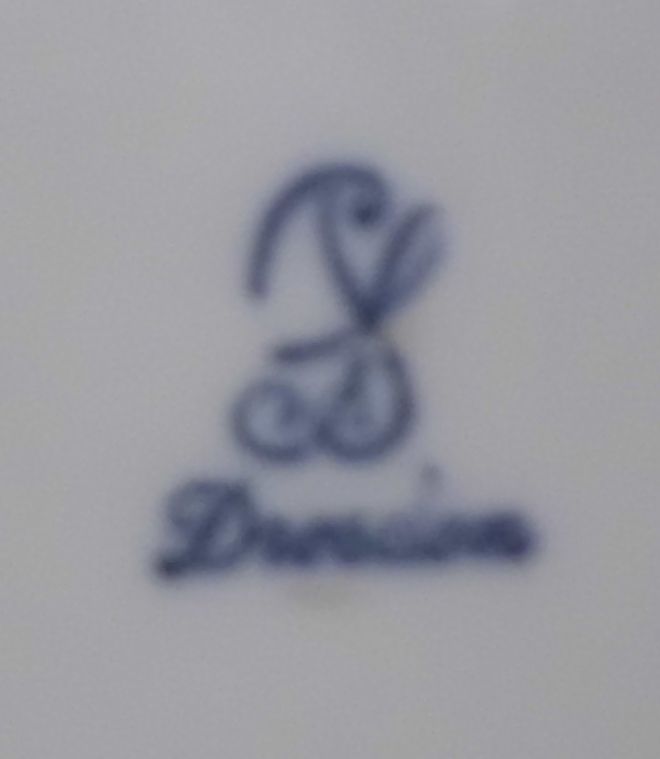
The manufacturer records official registration of the SP Dresden trademark in 1901.
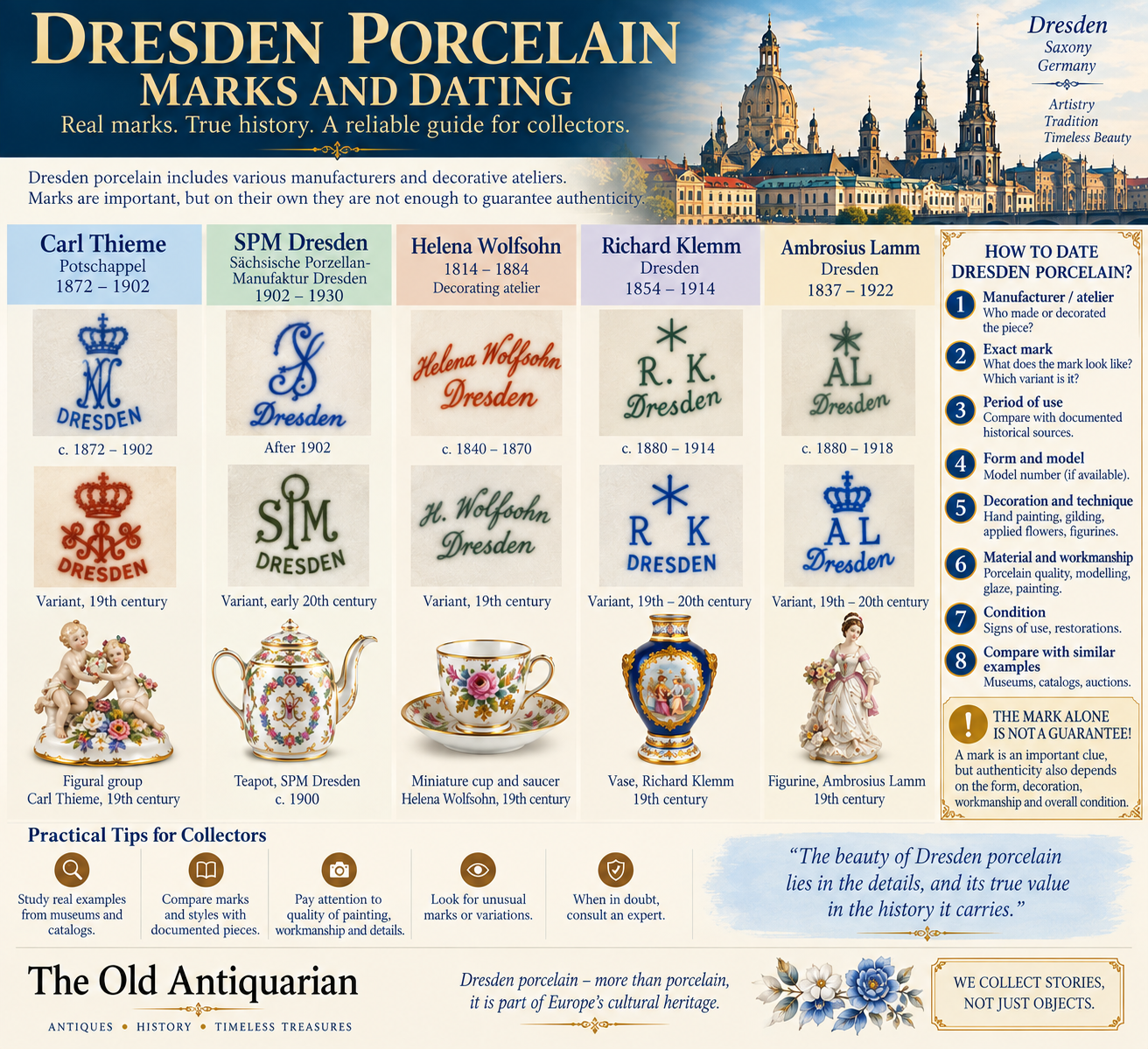
The illustrated marks are orientation aids; exact historical variants should always be verified against documented factory, museum and archival examples.
| Marking | Possible Meaning | Collector Warning |
|---|---|---|
| SP Dresden | Associated with Sächsische Porzellan-Manufaktur Dresden. | Compare the exact mark and physical object before assigning a date. |
| Dresden + crown | May indicate one of several Dresden decorating traditions. | A crown does not identify one universal Dresden factory. |
| AR monogram | Historically encountered on porcelain associated with several contexts, including early Wolfsohn decoration. | Do not automatically attribute it to 18th-century Meissen. |
| RK / Klemm-type mark | May point toward Richard Klemm decoration. | The original blank may have been made by another manufacturer. |
| Painted or impressed number | Model, mould, shape, decoration or production reference. | Never assume that a number is a year until its function is documented. |
The strongest attribution combines:
exact mark + maker or decorator + porcelain body + form + model + decoration + technique + condition + documented history.
For the full method, use our
Porcelain Marks Identification Guide.
How to Date Dresden Porcelain
Dating Dresden porcelain requires more than matching a logo with an online chart.
The same business can use multiple marks, and a decorating studio can work on porcelain produced elsewhere.
Marks can also remain in use for overlapping periods.
exact mark + maker/decorator + model number + form + porcelain body + decoration + technique + documented workshop history
| Step | Question |
|---|---|
| 1. Maker or decorator | Who actually made or decorated the object? |
| 2. Exact mark | Which exact variant appears on the base? |
| 3. Model / shape | Is the form documented in a factory or auction reference? |
| 4. Material | Does the porcelain body fit the proposed origin and period? |
| 5. Decoration | Is the painting, gilding and modelling historically consistent? |
| 6. Wear | Is natural wear consistent across the object? |
| 7. Documentation | Do museum, factory or archival examples support the attribution? |
See our
How to Date Antique Porcelain
guide for a broader explanation of mark evolution, country wording and model-number research.
Dresden Porcelain Figurines, Vases and Popular Styles
Collectors often recognize Dresden porcelain first by its elaborate appearance.
The most characteristic historicist pieces frequently combine elegant modelling,
strong Rococo influence, flowers, figures and generous gilding.
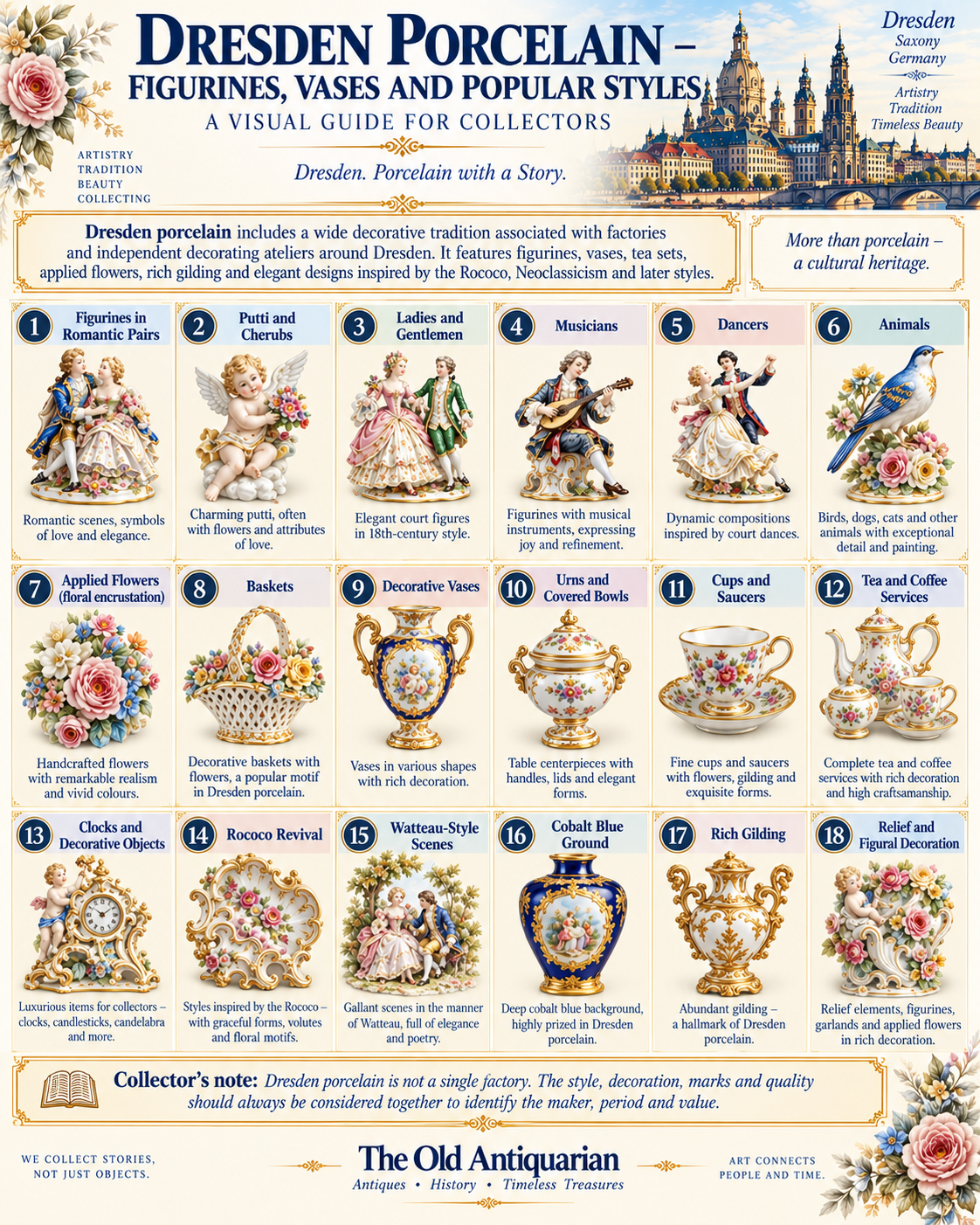
The illustrated pieces represent collecting categories rather than exact documented historical models.
Romantic Couples and Court Figures
Courtly couples, elegantly dressed ladies and gentlemen, musicians and dancers
reflect the nineteenth-century revival of eighteenth-century Rococo imagery.
Do not use the subject alone to date a figurine:
successful historic styles remained fashionable long after the original Rococo period.
Putti and Cherubs
Putti appear on freestanding figures, elaborate vases, clocks and sculptural compositions.
Hands, wings, fingers and small attributes are particularly vulnerable to damage and restoration.
Applied Porcelain Flowers
Applied flowers are among the most recognizable features of elaborate Potschappel porcelain.
Individually modelled petals and leaves can create extraordinary realism,
but they are also among the first areas a collector should inspect for losses and rebuilding.
Watteau-Style Scenes
Romantic garden scenes depicting elegant couples are commonly described by collectors as
Watteau-style.
The term identifies an artistic influence or decorative genre;
it does not mean that Antoine Watteau personally designed the porcelain scene.
Cobalt Grounds and Gilding
Deep cobalt blue grounds combined with figural reserves and rich gold ornament occur on many
luxury nineteenth-century porcelain wares.
Quality varies considerably, so decoration must be evaluated together with modelling,
porcelain quality and maker attribution.
How to Identify Dresden Porcelain
The safest method starts with physical evidence rather than a famous-looking mark.
Photograph and document the object before deciding who made it.
| Feature | What to Examine | Why It Matters |
|---|---|---|
| Porcelain body | Density, refinement, color and translucency where applicable. | Must be consistent with the proposed manufacturer and period. |
| Form and modelling | Faces, hands, drapery, handles, flowers and relief work. | Crisp modelling can help distinguish quality and documented forms. |
| Hand painting | Brushwork, shading, color transitions and small variations. | Can distinguish hand decoration from later printed or mixed techniques. |
| Applied flowers | Petals, leaves, joins and replacements. | Important for workmanship and condition. |
| Gilding | Quality, natural wear and possible regilding. | Later restoration can alter originality and market value. |
| Base | Complete underside, foot, firing evidence and all inscriptions. | Often contains more useful information than the main logo alone. |
| Mark | Color, wording, symbol, application method and exact graphic form. | May help identify maker, decorator and period. |
| Model number | Painted, impressed or incised numbers. | Can connect the object with documented factory models. |
| Condition | Chips, cracks, losses and natural wear. | Essential for both authentication and value. |
| Restoration | Glue, filler, overspray, repainting and reconstructed parts. | May materially affect collector value. |
For a broader step-by-step method, see
How to Identify Antique Porcelain.
What Is Dresden Porcelain Worth?
There is no reliable universal Dresden porcelain price guide.
The words Dresden, Germany, a crown or an ornate Rococo appearance
cannot determine value by themselves.
A documented Carl Thieme figural group in excellent condition belongs to a different market
from an unidentified twentieth-century decorative figure,
even when both are casually described online as “Dresden porcelain.”
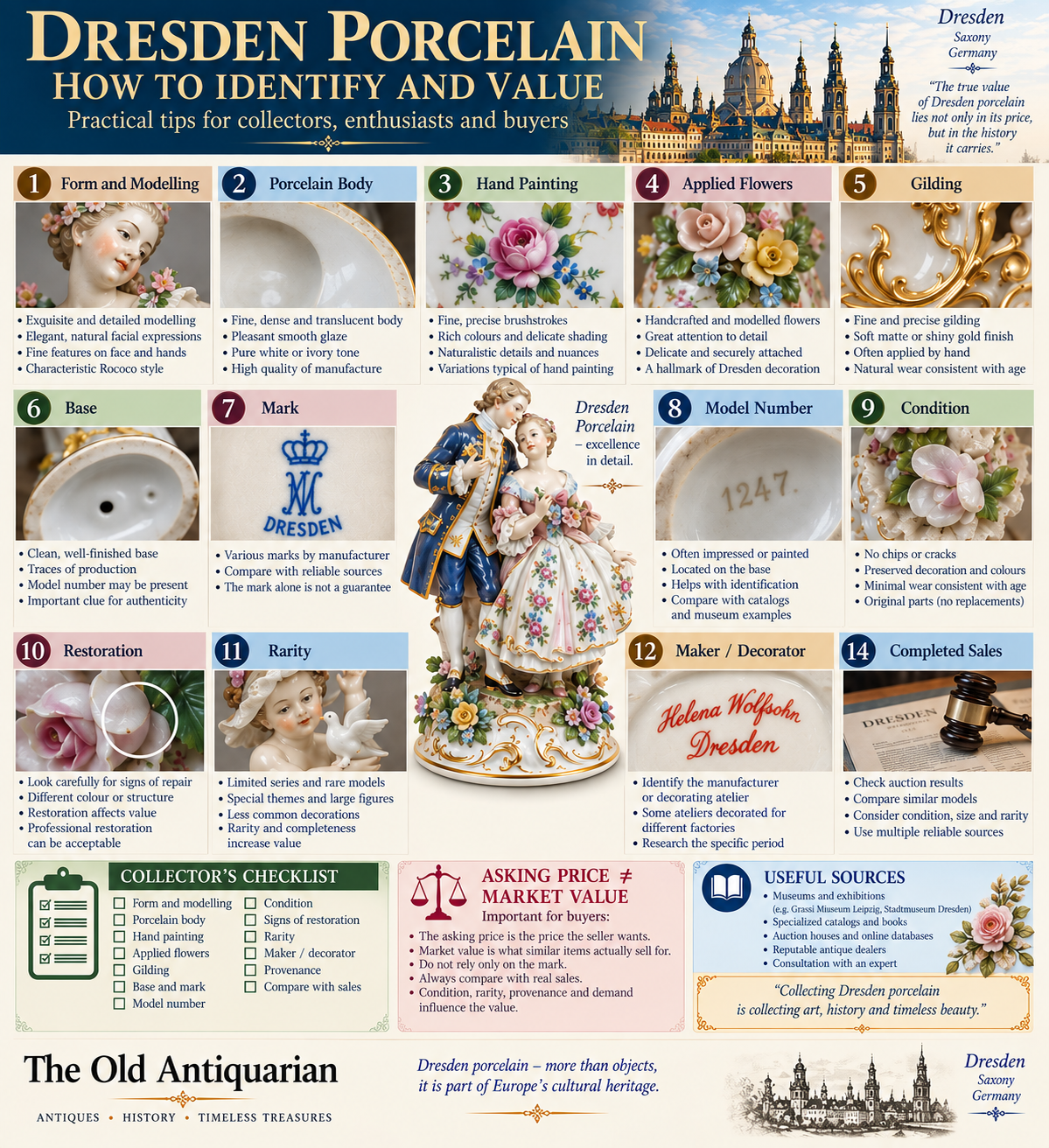
Value should be based on the complete object and genuinely comparable completed sales.
| Value Factor | Why It Matters |
|---|---|
| Maker / decorator | Documented and sought-after workshops generally have stronger collector recognition. |
| Exact model | Rare or complex figures may have a different market from common decorative wares. |
| Period | Age matters when combined with maker, model and rarity. |
| Artistic quality | Fine modelling and exceptional hand painting can strongly influence demand. |
| Applied flowers | Complex decoration is desirable when substantially complete. |
| Condition | Cracks, chips, missing flowers and broken fingers can significantly change value. |
| Restoration | Impact depends on rarity, extent, location and quality of the restoration. |
| Provenance | Reliable ownership or collection history can strengthen confidence and significance. |
| Completed sales | Shows what buyers actually paid for comparable objects. |
Compare completed sales for the
same maker, model or closely related form, approximate period, size, decoration and condition.
Does Old Dresden Porcelain Automatically Have High Value?
No. Age is only one element.
An early object can still be relatively common, damaged or heavily restored.
Conversely, a later piece may attract substantial collector interest because of an unusual model,
exceptional workmanship or documented rarity.
Are Dresden Porcelain Figurines Valuable?
Some are highly collectible, but the exact maker and model are crucial.
A label such as “Dresden figurine” is too broad for meaningful valuation.
Identify the manufacturer or decorating house before comparing market results.
Condition, Damage and Restoration
Dresden porcelain can be especially vulnerable because its artistic appeal often depends on
small projecting components.
Applied flowers, fingers, feathers, bows, instruments, handles and finials are easily damaged.
| Problem | What to Check | Possible Effect |
|---|---|---|
| Flower losses | Tips of petals and leaves. | Common but potentially important on elaborate pieces. |
| Cracks | Base, handles, necks and joins. | Structural damage can materially reduce value. |
| Old glue repairs | Yellowing adhesive and uneven joins. | Usually less desirable than intact original condition. |
| Professional restoration | Overspray, filler and reconstructed elements. | Impact depends on extent, quality and rarity. |
| Regilding | Uneven color or unexpectedly fresh gold. | Can reduce originality. |
Before attempting repairs, read
How to Restore Porcelain.
For long-term display and storage, see
How to Store Porcelain.
Dresden and Other German Porcelain Manufacturers
Dresden belongs within a much larger German porcelain story.
For collectors, comparing different manufacturing traditions is especially useful because marks,
materials and artistic styles can otherwise be confused.
| Maker / Tradition | Region | Collector Focus |
|---|---|---|
| Dresden | Saxony | Multiple manufacturers and decorating workshops; identify the specific maker or decorator. |
| Meissen | Saxony | Crossed swords, historical models, figurines and exceptional hard-paste porcelain. |
| KPM Berlin | Berlin / Prussia | Blue sceptre mark, plaques, vases and refined hand-painted porcelain. |
| Nymphenburg | Bavaria | Wittelsbach shield, Bustelli figurines, model numbers and exceptional Rococo sculpture. |
| Rosenthal | Bavaria | Historic marks, artistic porcelain, figurines, tableware and later modern design. |
| Hutschenreuther & Bavarian Porcelain | Bavaria | Hutschenreuther, Seltmann Weiden, Schumann Arzberg, Heinrich, Tirschenreuth, Mitterteich and other regional makers. |
Dresden Porcelain Collector Checklist
- Photograph the complete object from several angles.
- Photograph the entire underside, not only the main mark.
- Record every word, letter, number and symbol.
- Determine whether the mark belongs to a manufacturer or decorator.
- Compare the exact mark variant with documented historical references.
- Look for model, mould or shape numbers.
- Examine porcelain quality and modelling.
- Study hand painting, gilding and applied flowers.
- Check fingers, flowers, wings, handles and finials for losses.
- Look for glue, filler, overspray, repainting and regilding.
- Do not date the object from Rococo style alone.
- Compare with museum, factory and archival examples.
- Use completed sales rather than asking prices when researching value.
For a useful preliminary assessment, photograph the complete object,
the full underside, every mark and number, dimensions and any chips, cracks or restoration.
Dresden Porcelain FAQ
Is Dresden porcelain one factory?
No. Dresden porcelain is a broad term covering several manufacturers,
porcelain painters and decorating workshops associated with Dresden and Saxony.
Is Dresden porcelain the same as Meissen?
No. Meissen is a specific porcelain manufactory founded in 1710.
Dresden became a broader center of porcelain production, painting, decorating and trade.
What is the SP Dresden mark?
SP Dresden is associated with Sächsische Porzellan-Manufaktur Dresden at Potschappel.
The manufactory records the official registration of the SP Dresden trademark in 1901.
What does a crown Dresden mark mean?
Crown-based Dresden marks were associated with more than one decorating tradition.
The precise crown, letters, wording, color and application method must be compared with documented examples.
A crown alone does not identify one universal Dresden factory.
How can I identify antique Dresden porcelain?
Start with the entire base and exact mark.
Then examine the porcelain body, form, model number, decoration,
modelling, gilding, condition and restoration before comparing the piece with documented historical examples.
Are all Dresden porcelain figurines antique?
No. Historic Rococo and eighteenth-century-inspired forms were reproduced for long periods.
A figurine’s style is not enough to establish its production date.
Are Dresden porcelain figurines valuable?
Some can be highly collectible, but value depends on the exact maker or decorator,
model, age, rarity, artistic quality, condition, restoration, provenance and current market demand.
Do small chips on applied flowers matter?
Yes. Applied flowers are fragile and minor losses are common,
but completeness becomes increasingly important on rare, high-quality or elaborate pieces.
Condition should always be compared with similar examples.
Does restoration destroy Dresden porcelain value?
Not necessarily. Restoration usually affects value,
but the size of the effect depends on the rarity of the object,
the location and extent of the repair and the quality of the restoration.
How do I find the market value of Dresden porcelain?
Identify the exact maker or decorator and model first.
Then compare recent completed sales of genuinely similar pieces with comparable size,
period, decoration and condition.
Do not rely only on active online listings.
Continue Exploring German & Antique Porcelain
German Porcelain – History, Marks & Major Manufacturers
Meissen Porcelain – Crossed Swords Marks & Identification
KPM Berlin Porcelain – Blue Sceptre Marks & Identification
Nymphenburg Porcelain – Marks, Bustelli Figurines & Value
Rosenthal Porcelain – Marks & Identification
Bavaria Porcelain – Hutschenreuther, Rosenthal, Seltmann & Other Makers
Sources & Further Research
Historical chronology and manufacturer information for this guide were checked against
official manufactory histories, museum collections, regional archives and specialist porcelain research.
Useful reference authorities include:
- Sächsische Porzellan-Manufaktur Dresden – official manufactory history of Carl Thieme, Karl August Kuntzsch and SP Dresden.
- Sächsische Biografie / Institut für Sächsische Geschichte und Volkskunde – archival biography and business history of Helene Wolfsohn.
- The Metropolitan Museum of Art – early Meissen and European hard-paste porcelain research and collection records.
- Staatliche Kunstsammlungen Dresden / Porzellansammlung – Saxon porcelain collections and historical context.
- Cooper Hewitt, Smithsonian Design Museum – documented Carl Thieme / Potschappel porcelain objects.
- Porcelain Marks & More and specialist mark literature – supplementary research on Dresden decorating workshops and historical mark variants.
Historic porcelain marks can overlap, workshops can change ownership,
and the maker of a white porcelain blank may differ from the workshop that decorated it.
For important objects, attribution should be based on multiple independent sources rather than a single online mark chart.
The Old Antiquarian combines more than 35 years of practical experience with antiques and collectibles
with historical, museum and comparative research.
When examining porcelain, we treat the maker, exact mark, model, material,
decoration, craftsmanship, production period, condition, restoration,
provenance and market evidence as interconnected clues rather than relying on one isolated feature.
Final Collector Takeaway
The greatest challenge—and one of the greatest pleasures—of collecting Dresden porcelain
is that the word Dresden is only the beginning of the investigation.
Behind it may stand a porcelain manufactory, an independent decorating studio,
a specialist painter or a combination of manufacturer and decorator.
The strongest identification is reached when
the mark, maker, model, porcelain body, decoration, workmanship, condition and documented history all tell the same story.
And when value becomes the question, add one final piece of evidence:
what genuinely comparable objects have actually sold for.
Identify first. Verify the history. Value the exact object.
