
Old Paris Porcelain:Identification & Value
French Porcelain Identification Guide
Old Paris Porcelain (Vieux Paris): History, Marks, Makers, Identification & Value
Last Updated: September 17, 2026 | The Old Antiquarian
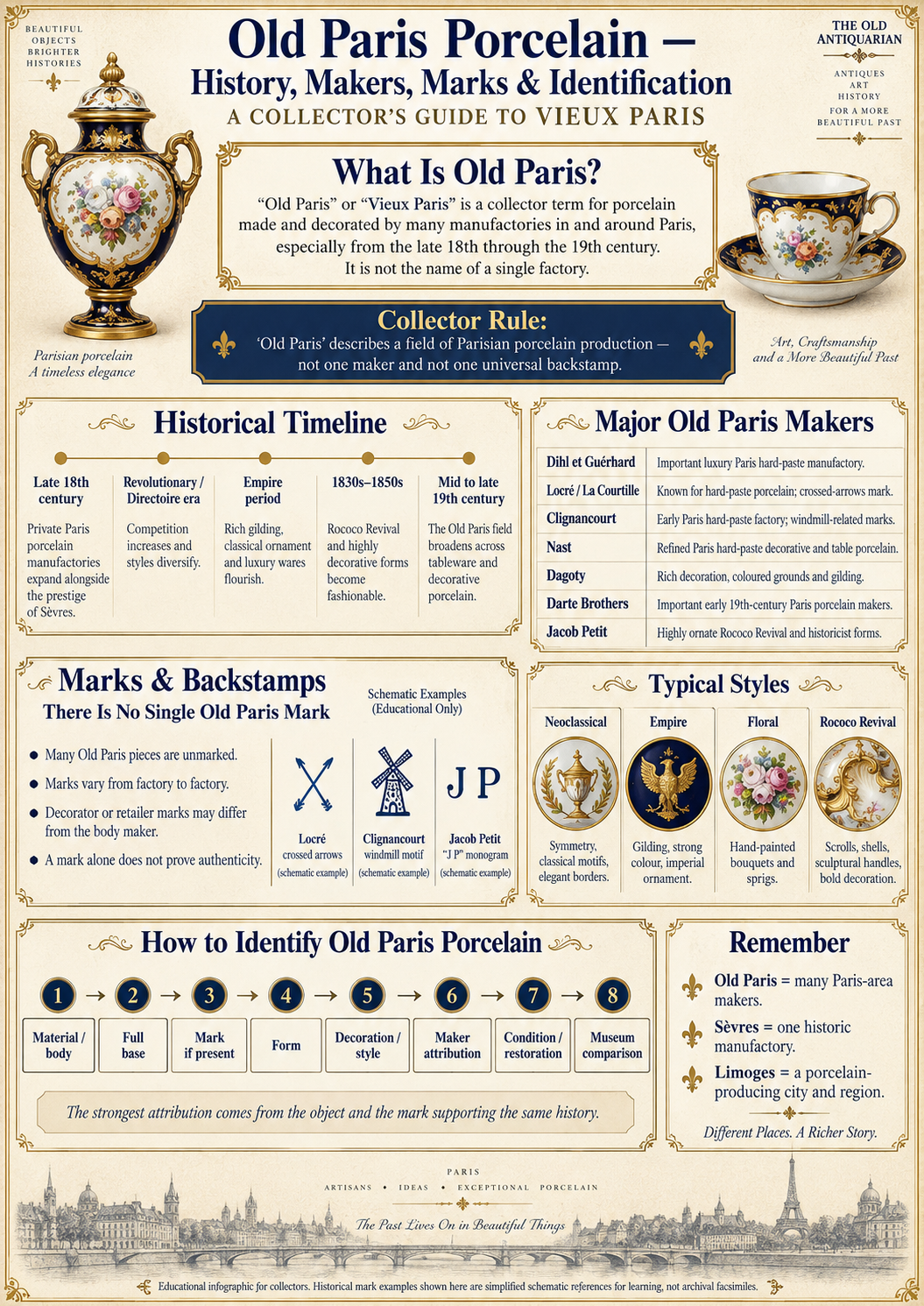
Old Paris porcelain, also called Vieux Paris, is not the name of one factory. It is a collector and market term for porcelain made and decorated by many Paris-area manufactories, workshops and decorators, especially from the late eighteenth through the nineteenth century. Important names include Dihl et Guérhard, Locré / La Courtille, Clignancourt, Nast, Dagoty, Darte and Jacob Petit. Because many pieces are unmarked, reliable identification combines material, form, decoration, marks where present, manufacturing details, period, condition and documented museum comparisons.
| At a Glance | Old Paris / Vieux Paris Porcelain |
|---|---|
| What it means | A broad collector term covering numerous Paris-area porcelain makers and decorators |
| Main collecting period | Especially late 18th to 19th century |
| Typical material | Many leading Paris manufactories focused on hard-paste porcelain |
| Single Old Paris mark? | No |
| Are unmarked pieces common? | Yes |
| Common styles | Neoclassical, Empire, Restoration, Romantic, Rococo Revival and eclectic 19th-century styles |
| Best identification method | Body + form + base + mark + decoration + maker + condition + documented comparison |
Old Paris belongs within the broader history of French porcelain, but it requires a different identification strategy from a single named manufactory such as Sèvres. “Old Paris” can be a useful regional attribution, but the strongest research always tries to move one step further and identify the actual maker, decorator, period or workshop when evidence allows.
What Is Old Paris Porcelain?
Old Paris porcelain or Vieux Paris porcelain is a retrospective collector term used for porcelain associated with many manufactories, decorators and workshops operating in and around Paris. It is not a historical factory name and there is no one Old Paris logo that authenticates the category.
That distinction matters because two pieces described as “Old Paris” may come from different makers, decades and artistic movements. One may be a restrained late-eighteenth-century hard-paste cup; another may be an elaborate mid-nineteenth-century Rococo Revival vase. The correct question is therefore not only “Is this Old Paris?” but also “Which Paris maker or period does this object fit?”
Old Paris Porcelain History
Paris became a major porcelain centre during the closing decades of the eighteenth century. The Metropolitan Museum of Art notes that numerous Paris factories were founded during this period and that many concentrated on hard-paste porcelain while competing artistically and commercially with Sèvres. Some enjoyed the protection of members of the royal family, which helped them operate within the privileged porcelain economy of pre-Revolutionary France.
After the French Revolution, private Paris manufactories entered a more open commercial environment. During the Empire and Restoration periods they produced porcelain for elite domestic use, diplomatic display, luxury retail and export. By the 1830s and 1840s, historicist taste encouraged increasingly elaborate Rococo Revival and decorative forms, associated especially with makers such as Jacob Petit.
| Period | Typical Context | Collector Clues |
|---|---|---|
| Late 18th century | Expansion of private Paris hard-paste manufactories | Neoclassical forms, refined gilding, royal-protection marks, factory-specific symbols |
| Revolutionary / Directoire | Increased competition and stylistic experimentation | Classical motifs, experimental grounds, political and allegorical subjects |
| Empire | Paris luxury arts flourish under Napoleonic taste | Strong gilding, imperial motifs, architectural symmetry, dark grounds |
| Restoration / Romantic | More varied domestic and decorative production | Flowers, landscapes, portraits, ornamental services |
| 1830s–late 19th century | Historicist and Rococo Revival production broadens | Bold moulding, sculptural handles, polychrome decoration, applied flowers, novelty forms |
Major Old Paris Porcelain Makers
“Old Paris” becomes much more useful when narrowed to a named factory. The following makers are among the most important documented Paris porcelain producers encountered in museum collections and the antiques market.
| Maker | Approx. Period | Known For | Identification Note |
|---|---|---|---|
| Dihl et Guérhard | 1781–c. 1824 | High-quality hard-paste porcelain, painted scenes, experimental colours, luxury wares | One of the most important private Paris manufactories; exact mark and model comparison is essential |
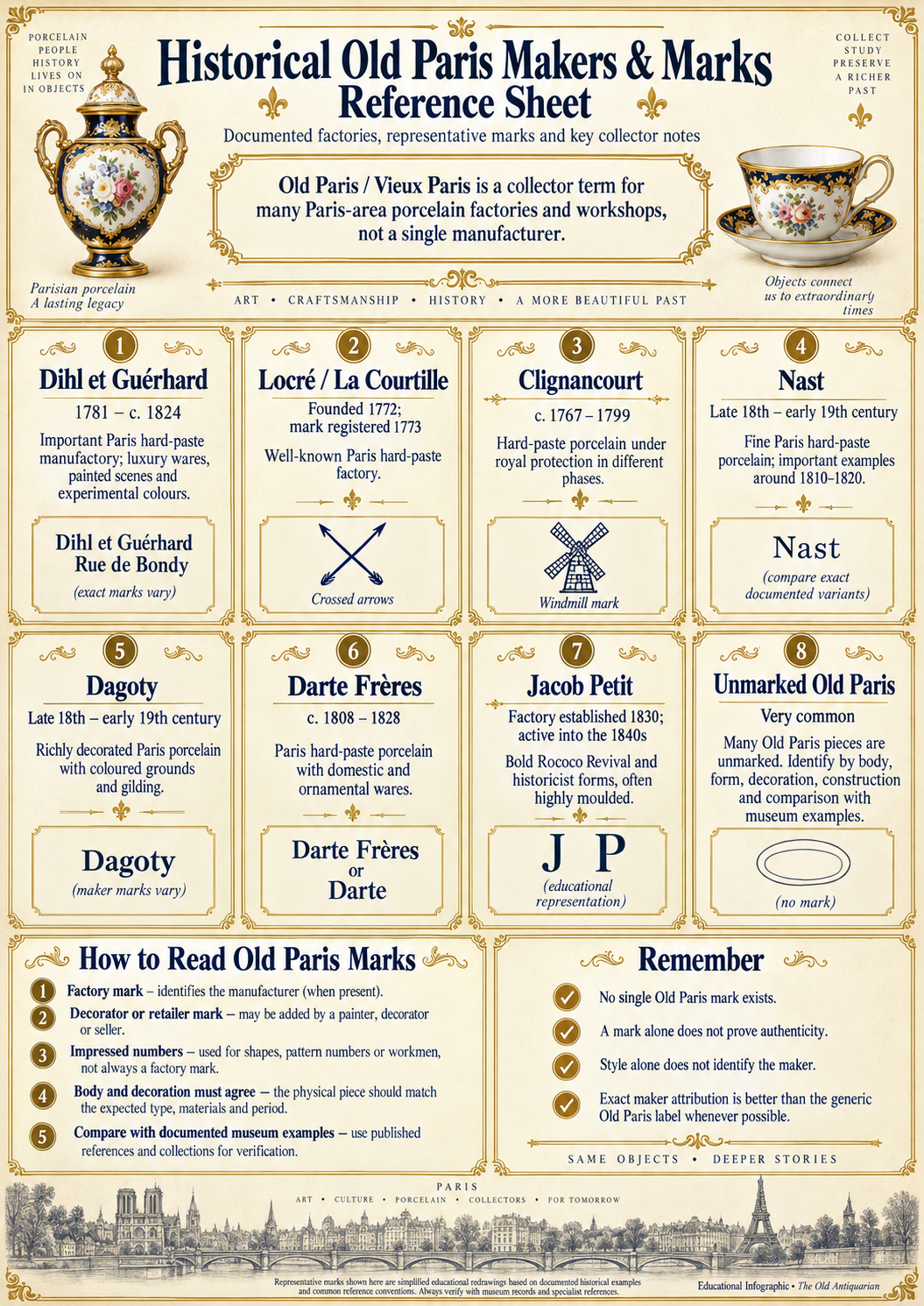
| Locré / La Courtille | Founded 1772 | Hard-paste tablewares, figures and refined domestic porcelain | Crossed-arrows mark is associated with the factory; compare exact historic variants |
| Clignancourt | Late 18th century | Hard-paste wares, floral decoration and royal-protection production | Documented marks changed over time; do not rely on one simplified symbol |
| Nast | Late 18th–early 19th century | Refined hard-paste decorative and table porcelain | Marked examples exist; compare exact mark, body and form |
| Dagoty | Late 18th–early 19th century | Rich grounds, gilding and painted decoration | Maker-specific variants matter more than generic “Paris” wording |
| Darte Frères | Early 19th century | Domestic and ornamental hard-paste porcelain | Use factory history, mark and shape together |
| Jacob Petit | 19th century | Bold Rococo Revival and historicist forms, elaborate moulding, novelty wares and clock cases | Marked examples can be attributed more precisely than generic Vieux Paris |
Old Paris Porcelain Marks: Is There a Vieux Paris Backstamp?
No single Old Paris mark exists. This is the most important point when researching the base of a piece. Different manufactories used different painted symbols, names, monograms, impressed marks, workman signs and numbers; other pieces were left unmarked.
Start by photographing the entire underside, not just the most obvious logo. A small painted initial, impressed number or retailer’s inscription may help separate manufacture, decoration and later sale. For the broader terminology, see What Are Porcelain Marks? and the procedural Porcelain Marks Identification Guide.
| Mark Situation | Possible Meaning | Best Practice |
|---|---|---|
| No visible mark | Common in the Old Paris field | Rely more heavily on body, form, construction, decoration and museum comparisons |
| Painted factory symbol | May identify a specific Paris manufactory | Compare exact shape, colour, position and period |
| Impressed number / letter | May indicate model, mould, workman or production information | Never assume a number is a date without documentation |
| Decorator / retailer mark | May identify decoration or sale rather than porcelain manufacture | Separate body maker from decorator where possible |
| Prestigious copied mark | Could imitate Sèvres or another celebrated source | The object must confirm the mark |
Old Paris Styles & Decorative Periods
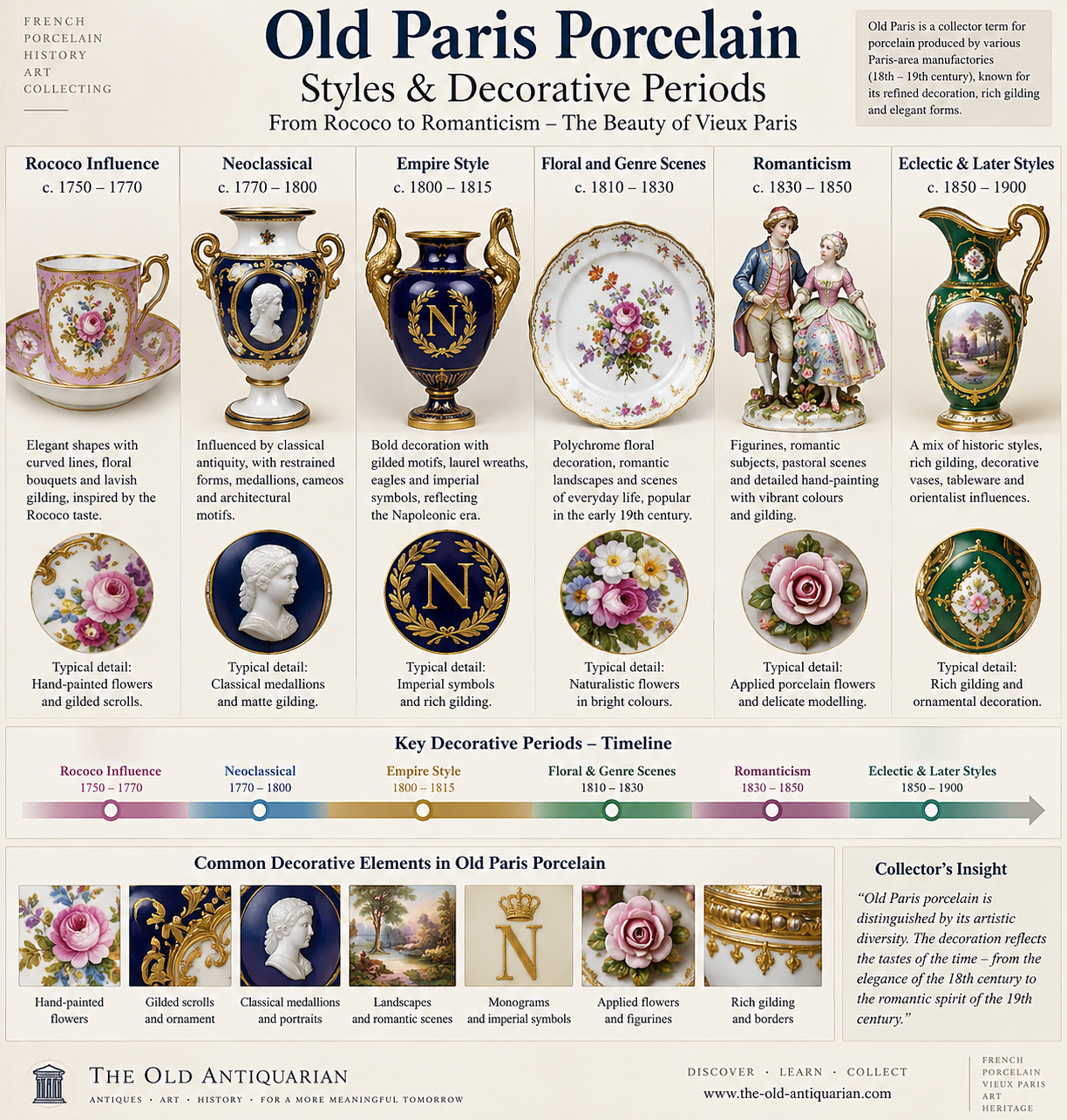
Old Paris porcelain is stylistically diverse because the category spans many factories and decades. Decorative style is useful for narrowing a period, but it should never be treated as a factory signature.
| Style | Typical Features | Collector Caution |
|---|---|---|
| Neoclassical | Symmetry, antique motifs, medallions, architectural ornament, restrained borders | Used by many factories |
| Empire | Heavy gilding, laurel, classical and imperial motifs, strong colour contrasts | Period/style must agree with construction and body |
| Floral / genre | Bouquets, sprigs, landscapes, portraits and narrative scenes | Very widespread; quality matters more than motif alone |
| Romantic | Pastoral scenes, figures, sentimental subjects, vivid colour | Do not assign a maker from subject matter alone |
| Rococo Revival / Eclectic | Scrolls, shells, sculptural handles, applied flowers, bold polychrome ornament | Strongly associated with 19th-century historicism, but not exclusive to Jacob Petit |
What Objects Were Made in Old Paris Porcelain?
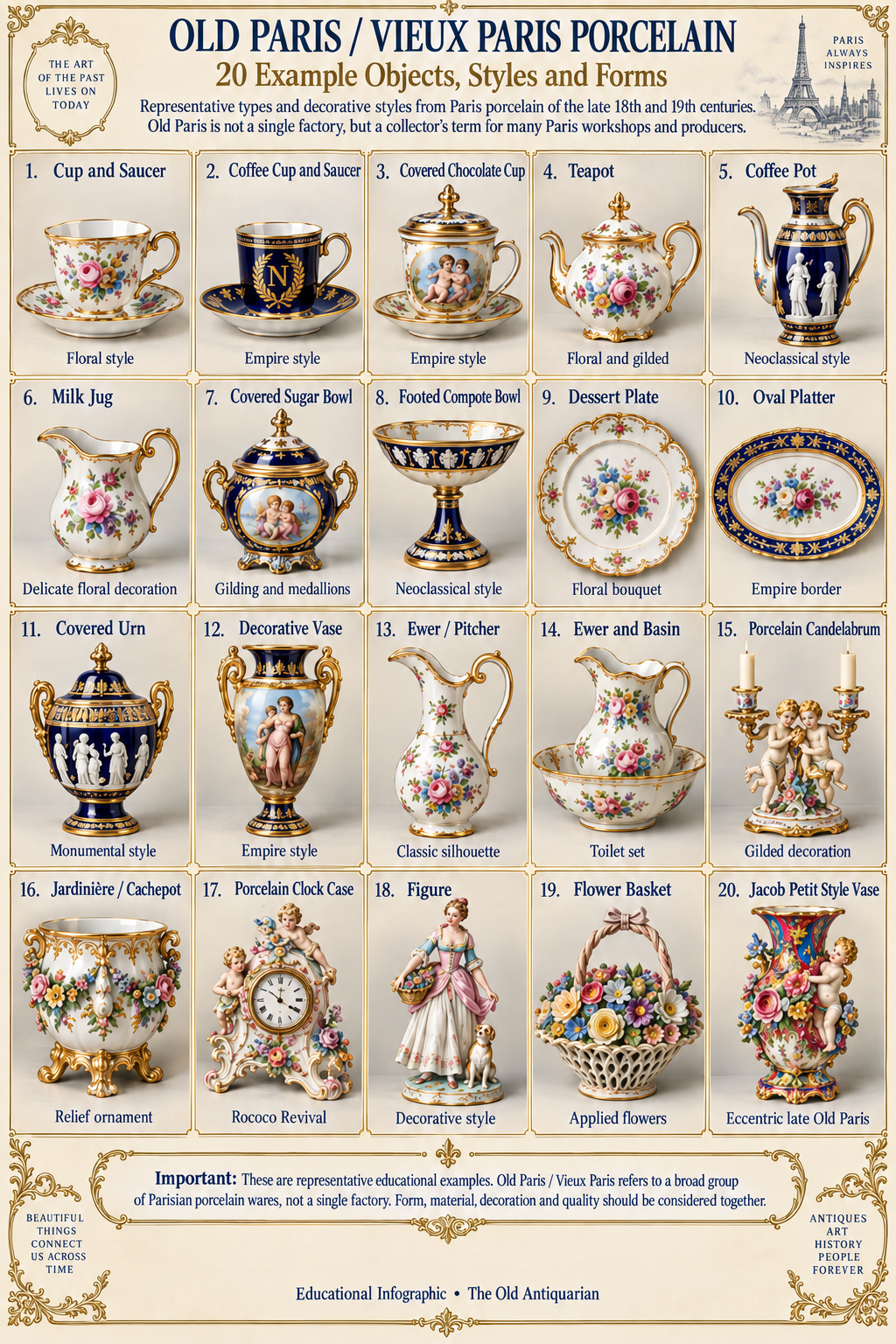
Paris manufactories produced everything from practical tablewares to ambitious decorative objects. Representative forms include cups and saucers, teapots, coffee pots, chocolate cups, sugar bowls, dessert plates, ewers and basins, jardinières, urns, ornamental vases, clock cases, figures and applied-flower objects.
The visual range is important for identification because form often reflects period and intended use. An Empire coffee service, a Restoration-era ewer and a Rococo Revival vase should not be judged by the same stylistic expectations.
How to Identify Authentic Old Paris Porcelain
Because no single mark defines Old Paris, authentication works best as a sequence of checks. Start with the ceramic body and construction, then move toward decoration and marks.
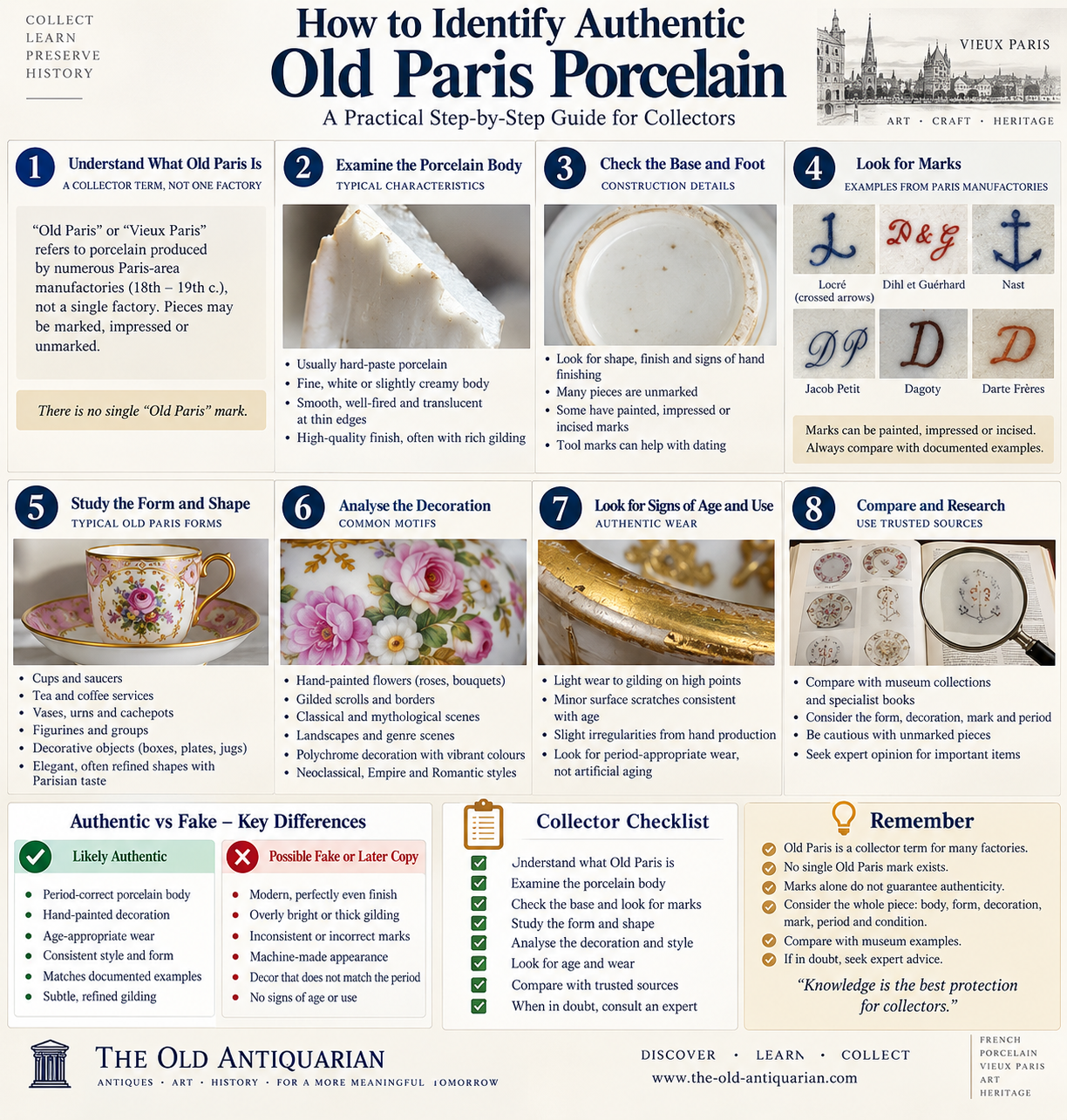
How to Date Old Paris Porcelain
Old Paris porcelain should usually be dated to a range rather than an exact year unless a documented factory mark, model or provenance provides stronger evidence. The exact version of a maker’s mark, the object form, stylistic period and manufacturing technique should support one another.
| Dating Clue | What to Ask | Weight |
|---|---|---|
| Exact maker mark | Can this specific version be tied to a documented factory period? | High |
| Form / model | Does the shape appear in museum or factory references? | High |
| Decoration | Does it fit Neoclassical, Empire, Romantic or Revival taste? | Supporting |
| Manufacturing technique | Do body, glaze, moulding and construction fit the proposed period? | High |
| Wear / restoration | Is the wear natural and are later interventions visible? | Supporting |
For the broader method, see How to Date Antique Porcelain.
Old Paris vs Sèvres vs Limoges
These names are often grouped together because all belong to French porcelain history, but they describe different kinds of origin.
| Name | What It Is | Typical Period | Best Identification Logic |
|---|---|---|---|
| Old Paris / Vieux Paris | Broad collector term for many Paris-area factories and decorators | Especially late 18th–19th century | Find the specific maker if possible; there is no universal mark |
| Sèvres | A specific historic manufactory | From 1756 at Sèvres | Exact factory history, material, mark system, model and decoration |
| Limoges | A city and porcelain-producing region with many manufacturers | Late 18th century onward | Identify the specific manufacturer or decorator accompanying the Limoges designation |
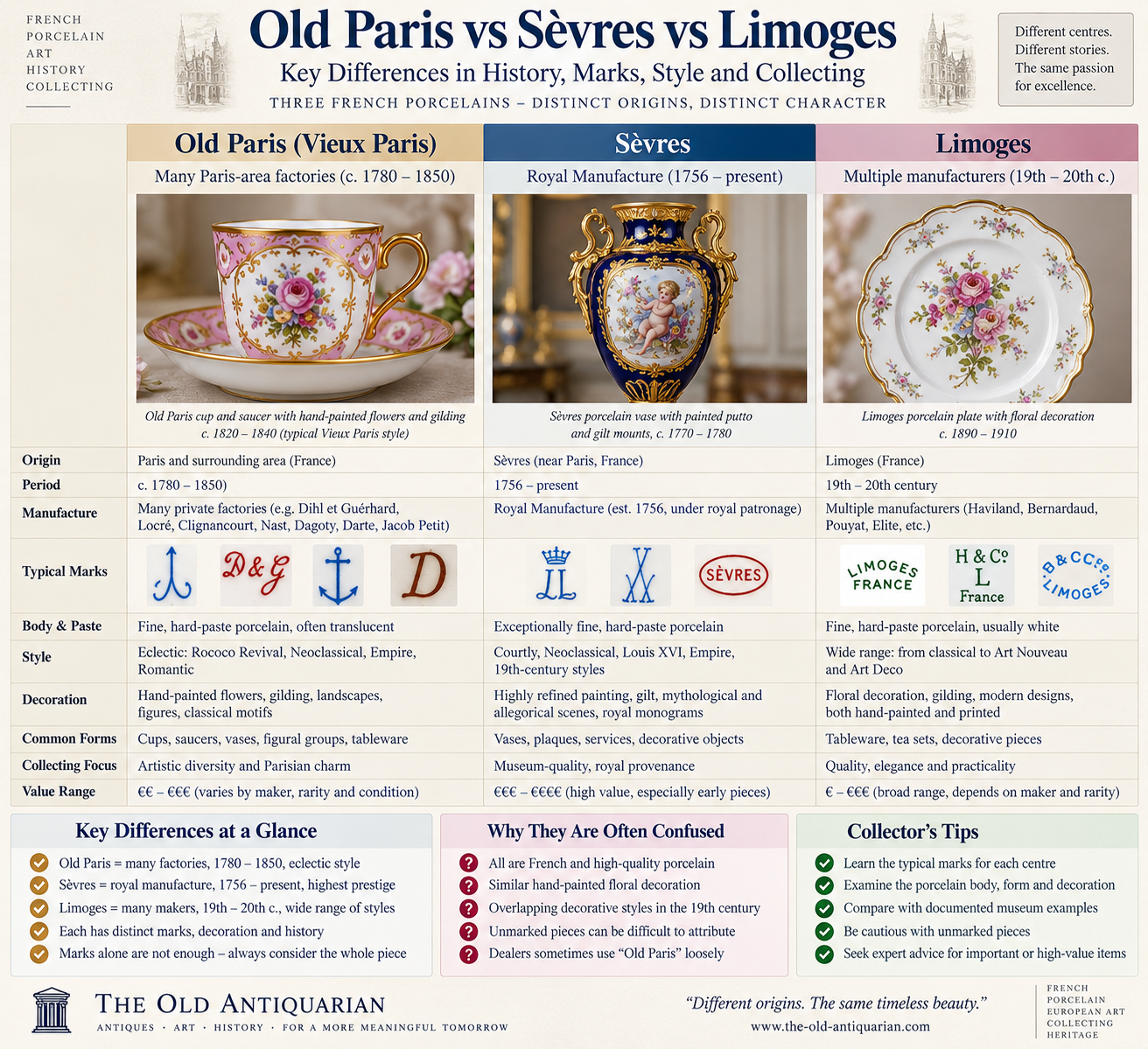
For Limoges specifically, continue with How to Identify Limoges Porcelain.
Copies, Later Decoration & Misattribution
Because “Old Paris” is broad, the term is sometimes used too loosely in sales descriptions. A nineteenth-century French-style vase may be labelled Vieux Paris without evidence that it was made in Paris, and a copied prestigious mark can create an even stronger but still unsupported attribution.
A later copy is not automatically fraudulent. The important question is whether the object is described honestly. Our guide What Is a Copy? explains the difference between a later copy, a replica and an object deliberately represented as something it is not.
Condition & Restoration
Old Paris objects often combine fragile handles, finials, moulded ornament, gilding and painted surfaces. Common issues include rim chips, hairlines, regilding, overpainting, repaired handles, replacement lids, restored applied flowers and old adhesive repairs.
Do not judge condition from the front alone. Examine the underside, joins, handle attachments, lid seating, foot rim and areas beneath mounts. For historically significant pieces, restoration should be documented accurately rather than hidden.
How Much Is Old Paris Porcelain Worth?
There is no single Old Paris porcelain value because the category ranges from anonymous tablewares to identified Paris manufactories and highly elaborate decorative objects. Value depends on the exact maker or attribution, model, period, quality, rarity, condition, restoration, provenance and completed comparable sales.
| Value Factor | Why It Matters |
|---|---|
| Maker attribution | A secure Dihl et Guérhard or Jacob Petit attribution is more specific than generic “Old Paris” |
| Form / rarity | Technically ambitious or uncommon models can attract stronger collector interest |
| Decoration | Fine painting, unusual subjects, quality gilding and complex grounds can matter |
| Pair / set | Matched pairs and complete services may differ greatly from single pieces |
| Condition | Cracks, restoration, losses, regilding and replacement parts can materially affect value |
| Provenance | Reliable collection history, labels and publication history may strengthen attribution |
| Completed sales | Real market evidence should match maker, model, size, period, decoration and condition as closely as possible |
Old Paris Collector Checklist
- Do not treat Old Paris as a single factory.
- Photograph the entire object and full underside.
- Record every painted, impressed and incised sign.
- Confirm material and firing are compatible with the proposed period.
- Identify form and construction details.
- Use style to narrow a period, not to prove a maker.
- Look for maker-level evidence where possible.
- Separate factory, decorator and retailer marks.
- Inspect gilding and painted decoration for later work.
- Check for repairs, replacement lids, handles and applied elements.
- Compare with museum objects and specialist references.
- Use completed sales, not asking prices, for value.
Frequently Asked Questions About Old Paris Porcelain
What does Old Paris porcelain mean?
It is a collector term for porcelain made and decorated by numerous Paris-area manufactories and workshops, especially in the late eighteenth and nineteenth centuries.
Is Vieux Paris the same as Old Paris?
Yes. Vieux Paris is the French expression commonly used in the antiques market for the same broad collecting field.
Is Old Paris one factory?
No. It includes many different Paris manufactories and decorators.
Is there an Old Paris porcelain mark?
There is no universal Old Paris mark. Some pieces carry maker-specific or decorator marks, while others are unmarked.
Which makers are associated with Old Paris?
Important names include Dihl et Guérhard, Locré / La Courtille, Clignancourt, Nast, Dagoty, Darte and Jacob Petit.
Is Old Paris the same as Sèvres?
No. Sèvres is one specific historic manufactory; Old Paris is a broad category covering many Paris-area makers.
Is Old Paris the same as Limoges?
No. Limoges is a city and porcelain-producing region in central France with many manufacturers. Old Paris refers to Paris-area production.
Is Old Paris porcelain always hand painted?
No. Many important pieces are hand decorated, but the category is too broad for a universal rule.
How do I date Old Paris porcelain?
Combine the exact mark, material, form, decoration, manufacturing technique and documented maker history. Usually a date range is more responsible than an exact year.
Is Old Paris porcelain valuable?
It can be, but value depends on maker, form, rarity, decoration, condition, restoration, provenance and recent comparable sales.
Have an Old Paris or Unidentified French Porcelain Piece?
Send clear photographs of the complete object, the full underside, every mark and number, dimensions, decoration and any chips, cracks or restoration. The strongest attribution is reached when the material, form, decoration and marks support the same history.
Related Guides
French Porcelain
History, makers, marks and identification.
Limoges Porcelain
Manufacturers, backstamps and regional identification.
Porcelain Marks
Backstamps, factory marks and secondary signs.
Identify Porcelain Marks
A practical mark-identification workflow.
How to Date Porcelain
Dating through marks, material, form and technique.
Sources & Further Research
- The Metropolitan Museum of Art – Dihl et Guérhard Vase — Paris hard-paste porcelain and private manufactories in the late eighteenth century.
- The Metropolitan Museum of Art – Dihl et Guérhard Teapot — documented Paris hard-paste porcelain, c. 1788.
- The Metropolitan Museum of Art – Nast Ewer — documented early-nineteenth-century Paris porcelain.
- The Metropolitan Museum of Art – Dagoty Cup and Saucer — documented Dagoty porcelain from Paris.
- British Museum – Locré & Russinger’s Factory — factory history and marks.
- British Museum – Clignancourt Factory — factory history and mark development.
- British Museum – Darte Brothers’ Factory — Paris porcelain manufacture in the early nineteenth century.
- British Museum – Jacob Petit’s Factory — nineteenth-century Paris porcelain and elaborate historicist forms.
About The Old Antiquarian
The Old Antiquarian combines more than 35 years of practical experience with antiques and collecting with historical, museum and comparative research. Our porcelain guides treat marks as evidence rather than automatic answers, combining material, form, decoration, manufacturing technique, condition and documented historical context.
Final Collector Principle
The strongest identification moves from Old Paris → period → maker/workshop → material → form → decoration → exact mark → condition → documented comparison. When the exact factory cannot be established, a careful “Old Paris / Paris porcelain, maker unknown” attribution is more accurate than inventing a maker.
