
Vincennes Porcelain Identification
French Porcelain Identification Guide
Vincennes Porcelain: History, Marks, Identification, Dating & Value
Last Updated: September 16, 2026 | The Old Antiquarian
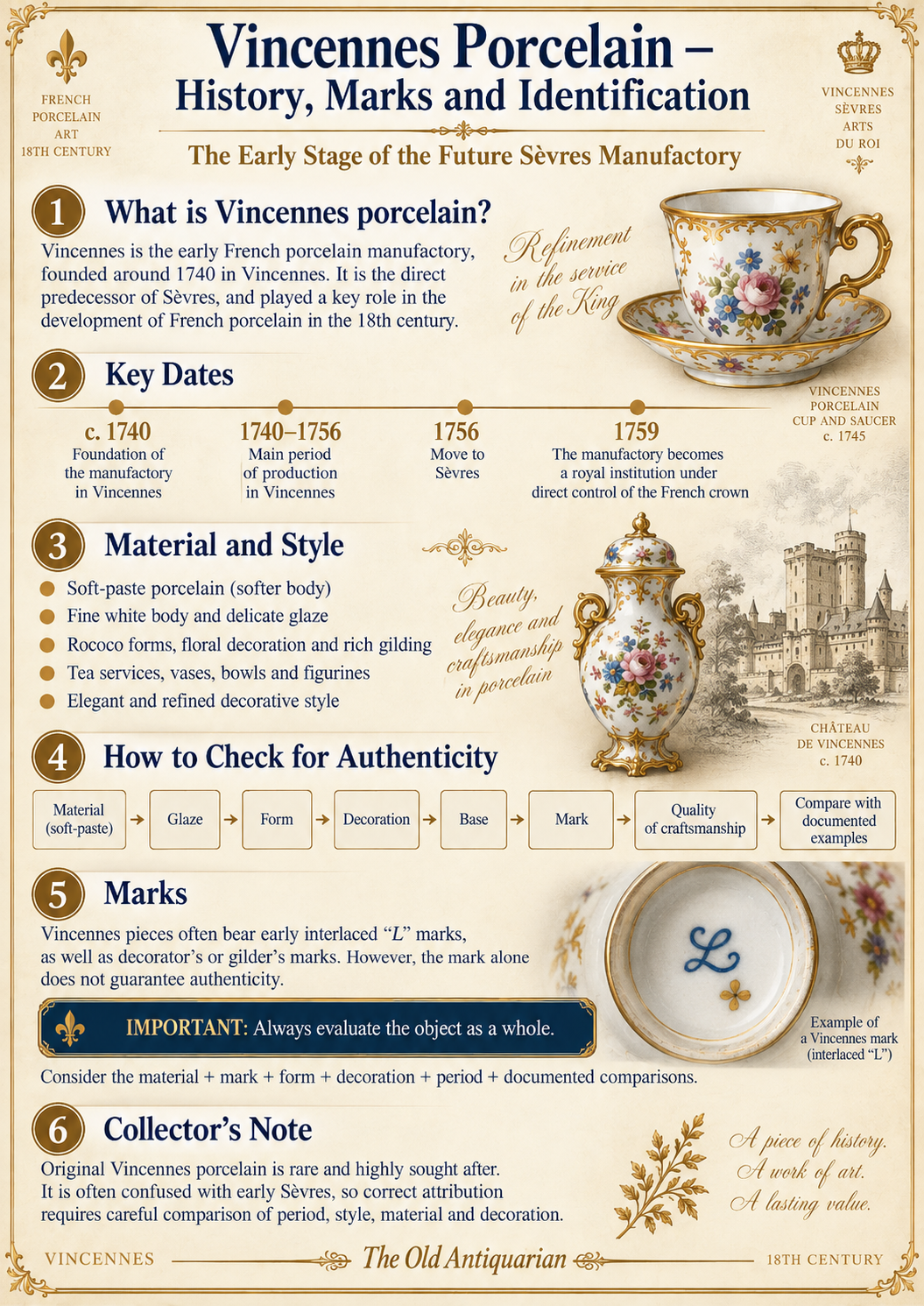
Vincennes porcelain is the early phase of the French royal porcelain manufactory that moved from the Château de Vincennes to Sèvres in 1756. Founded as a soft-paste porcelain workshop in 1740, Vincennes developed into one of the most important luxury porcelain enterprises in eighteenth-century France. Identification should never depend on an interlaced “L” mark alone: the porcelain body, glaze, form, decoration, mark, date-letter system, craftsmanship and documented comparisons must agree.
| At a Glance | Vincennes Porcelain |
|---|---|
| Main period | c. 1740–1756 |
| Location | Château de Vincennes, near Paris |
| Material | Soft-paste porcelain |
| Key transition | The manufactory moved to Sèvres in 1756 |
| Royal control | Full Crown control from 1759, after the move to Sèvres |
| Best-known mark | Interlaced “L” royal cipher; date letters appear during the later Vincennes period |
| Best identification method | Material + form + decoration + mark + period + documented comparison |
Vincennes sits at the heart of the history of French porcelain. It is especially important because it is not an unrelated predecessor that simply disappeared: the manufactory itself was transferred to Sèvres in 1756. Understanding that continuity helps collectors make sense of early marks, soft-paste bodies and decorative features that can otherwise make Vincennes and early Sèvres difficult to separate.
What Is Vincennes Porcelain?
Vincennes porcelain is eighteenth-century French soft-paste porcelain made by the manufactory established at the Château de Vincennes in 1740. The enterprise emerged during a period when European courts and manufacturers were trying to compete with both imported Asian porcelain and the successful hard-paste porcelain being produced at Meissen in Saxony.
The Vincennes manufactory was initially a private initiative, but royal patronage became increasingly important. In 1745 it received a royal privilege that strengthened its position among French porcelain makers. By the early 1750s, Vincennes had moved beyond imitation toward a distinctive French luxury style associated with inventive Rococo forms, sophisticated painted decoration, gilding and technically ambitious objects.
In 1756 the manufactory transferred from Vincennes to a new site at Sèvres. The institution was then brought under full control of the French Crown in 1759. That sequence matters: 1759 is a Sèvres-stage event, not a date for a factory still operating at Vincennes.
Vincennes Porcelain History: 1740–1756
The official history of Sèvres records the foundation of a soft-paste porcelain workshop at Vincennes in 1740. Early experimentation took place within the royal château, and the young enterprise benefited from the wider French ambition to establish a prestigious domestic porcelain industry.
The Metropolitan Museum of Art notes that the 1745 privilege allowed production of porcelain “in the manner of Saxony,” helping explain the clear influence of Meissen on some early Vincennes forms and decoration. By about 1752, however, the work of model designer Jean-Claude Duplessis and the influence of painter François Boucher helped move the manufactory toward a recognisably French decorative language.
| Date / Period | Development | Why It Matters for Identification |
|---|---|---|
| 1740 | Soft-paste workshop established at Vincennes. | Beginning of the Vincennes phase. |
| 1745 | Royal privilege strengthens the manufactory. | Useful context for early painted and gilded luxury wares. |
| Late 1740s–early 1750s | Rapid development of forms, colours, gilding and painted decoration. | A critical period for stylistic comparison. |
| 1753 | A date-letter system begins to appear with the interlaced “L” cipher. | Important for later Vincennes dating, but letters must be interpreted carefully. |
| 1756 | The manufactory moves to Sèvres. | The key historical boundary between Vincennes and Sèvres production. |
| 1759 | The Sèvres manufactory comes under full Crown control. | A Sèvres-era milestone, not a Vincennes production date. |
What Is Vincennes Porcelain Made Of?
Vincennes is fundamentally a soft-paste porcelain tradition. The official Sèvres history describes the workshop founded in 1740 specifically as a soft-paste porcelain enterprise, while museum collections consistently catalogue Vincennes objects from the period as soft-paste porcelain.
This point is crucial when authenticating an object. A piece claimed to be Vincennes should not be judged from its backstamp while ignoring the ceramic body. The colour and texture of the body, glaze behaviour, foot, thickness and firing characteristics must be consistent with eighteenth-century French soft-paste porcelain.
For a broader introduction to material identification, see our complete guide to identifying antique porcelain.
What Objects Did Vincennes Produce?
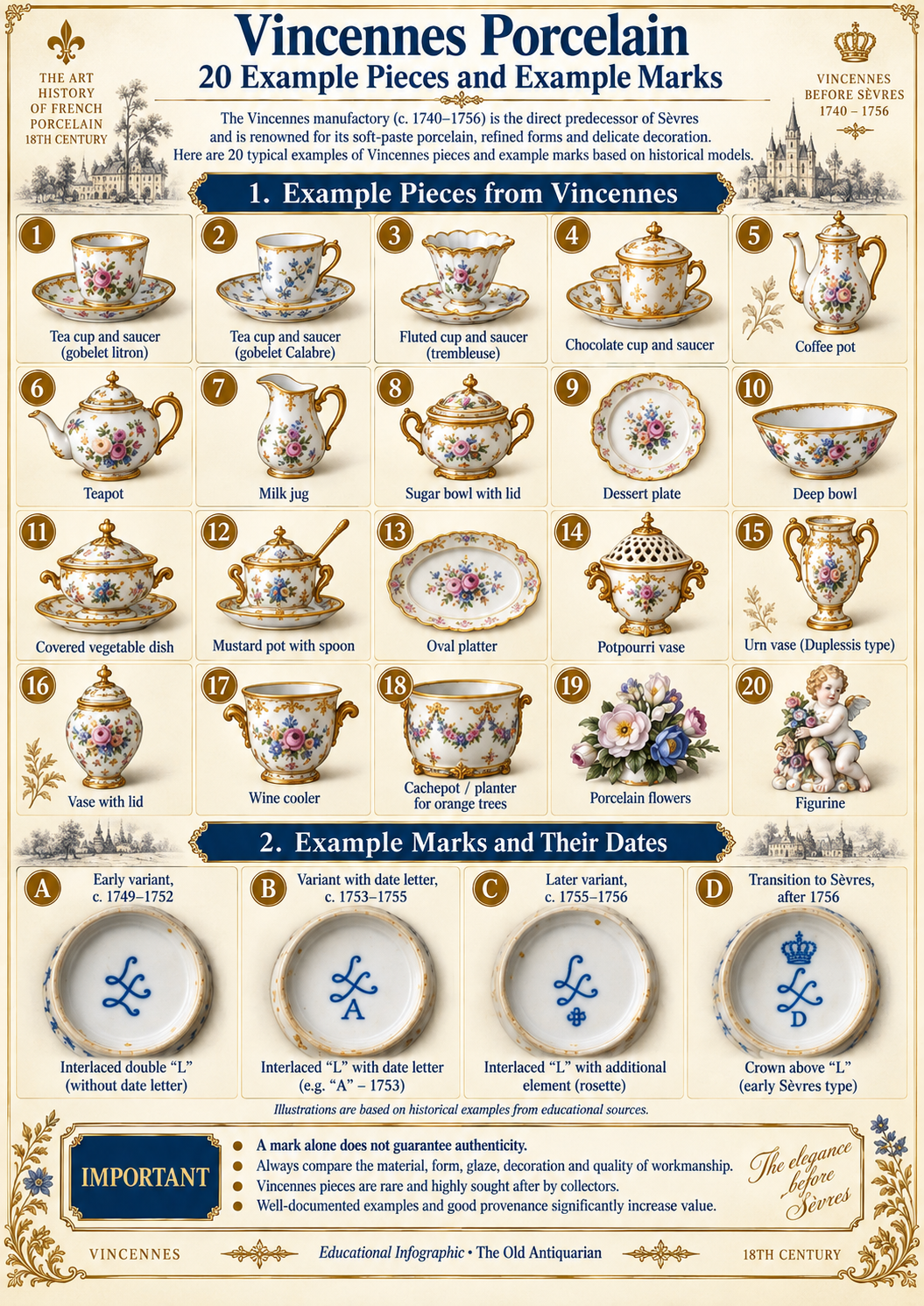
Vincennes produced far more than cups and plates. Museum collections document tea and drinking vessels, coolers, serving pieces, elaborate vases, sculptural groups and technically ambitious decorative objects. Form is therefore one of the strongest identification clues.
| Object Type | Documented Examples | What to Examine |
|---|---|---|
| Cups & saucers | Gobelet litron, gobelet Calabre, covered cups | Profile, handle, foot, painted reserves, date marks |
| Coolers | Wine coolers and glass coolers | Form, cartouches, landscapes, gilding, handles |
| Serving wares | Mustard pots, trays, bowls, ewers and basins | Silver-inspired forms, moulding, painted decoration |
| Vases | Urne Duplessis, vase le boitteux, pot-pourri forms | Model, sculptural complexity, mounts, pierced work, ground colours |
| Figures & sculptural decoration | Figural groups and porcelain flowers | Modelling, mould seams, bases, firing, painted detail |
Vincennes Decoration, Colours & Rococo Style
Early Vincennes production shows the influence of Meissen and other luxury porcelain traditions, but the manufactory soon developed a distinctive French character. Surviving museum objects demonstrate refined floral painting, pastoral and figural scenes, gilded borders, coloured grounds and increasingly inventive Rococo forms.
Jean-Claude Duplessis is associated with some of the manufactory’s most sophisticated shapes, including the urne Duplessis. The Metropolitan Museum also records how Vincennes forms could be inspired by contemporary French silver, showing that porcelain design developed within a wider luxury decorative-arts culture rather than in isolation.
Rococo curves, inventive handles, sculptural profiles and asymmetric movement.
Flowers, landscapes, figures, pastoral subjects and finely controlled enamel work.
Gold borders and ornament can be integral to the design, not merely added decoration.
Coloured grounds developed into a major feature of French luxury porcelain.
Vincennes Porcelain Marks: What Should You Look For?
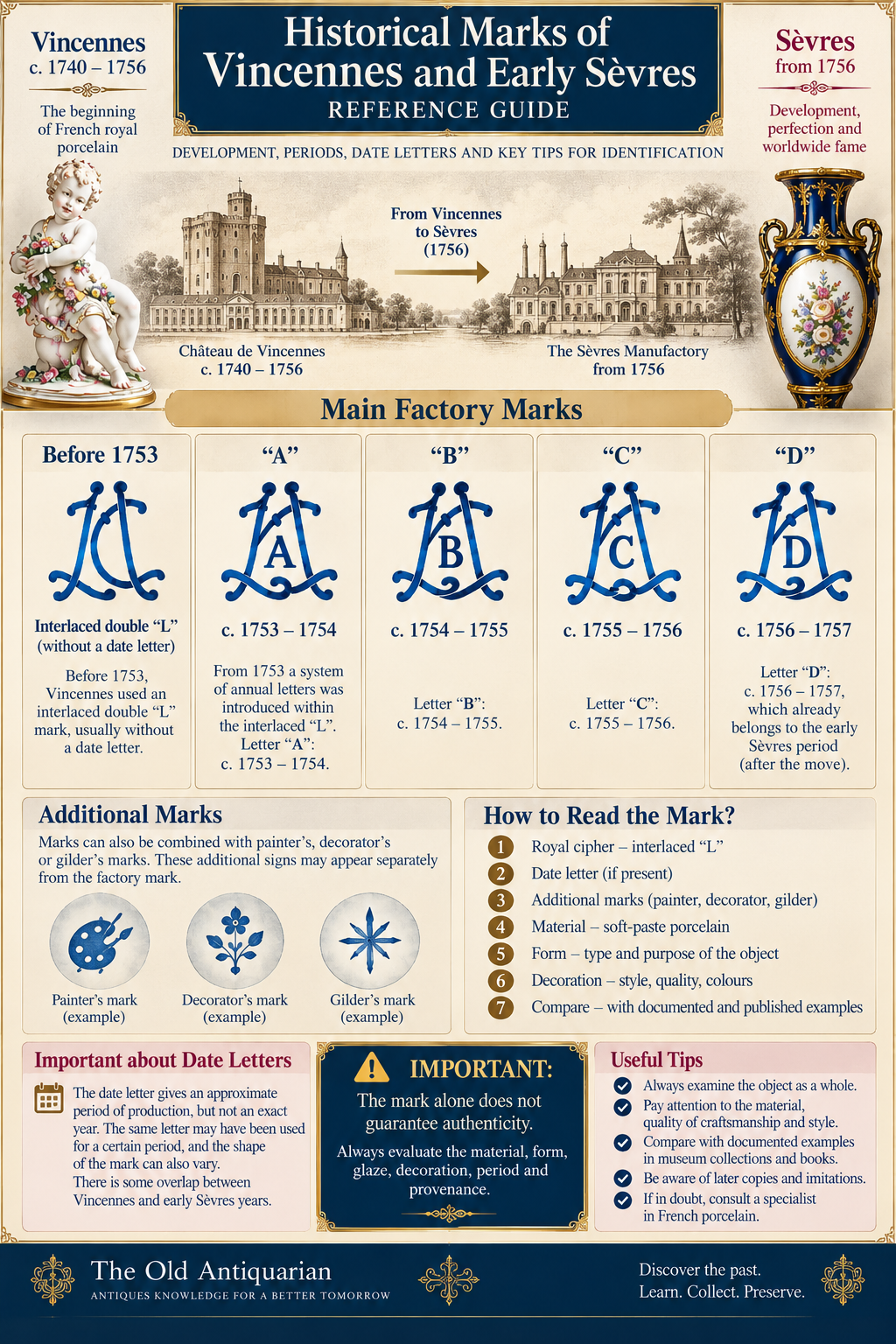
The best-known Vincennes factory mark is the interlaced double “L” royal cipher. Official Sèvres mark documentation records the royal cipher for the Vincennes period and notes that marks were typically painted on the glazed surface, usually in blue and exceptionally in gold.
However, Vincennes marks are not a single fixed logo. The official Sèvres reference notes that the interlaced “L” cipher may be accompanied by points, a fleur-de-lis or small floral elements, and that a crown appears above the cipher on some Vincennes and early Sèvres pieces. Additional painted or incised marks may relate to decorators, painters, gilders or production workers.
This is why collectors should learn to separate the factory cipher from secondary signs. Our porcelain marks guide explains how factory marks, backstamps, decorator marks, impressed symbols and production codes perform different functions.
| Mark / Sign | What It May Indicate | Collector Caution |
|---|---|---|
| Interlaced “L” cipher | Royal factory mark associated with Vincennes and continued at Sèvres. | Does not by itself distinguish Vincennes from later Sèvres. |
| Date letter | Helps place decoration within the date-letter system introduced in the 1750s. | Historic systems can overlap calendar years; check specialist references. |
| Painter / decorator mark | May identify the person responsible for painted decoration. | Attributions have been revised as archival research advances. |
| Gilder mark | May relate to gilding work. | Do not assume every secondary painted symbol is a gilder mark. |
| Incised sign | May relate to forming, production or workshop practice. | Compare the exact sign with documented examples. |
How Do Vincennes Date Letters Work?
The date-letter system is one of the most useful — and most easily oversimplified — parts of Vincennes and early Sèvres research. The Metropolitan Museum records that the factory began using date letters during 1753, painted inside the interlaced “L” cipher. It also notes that during the first years of the system a letter could cover a period spanning parts of two calendar years rather than mapping neatly to January–December.
| Period | Marking Practice | How to Use It |
|---|---|---|
| 1740–1752 | Royal cipher used without the later systematic date-letter sequence. | Rely heavily on form, decoration, material and documented parallels. |
| 1753–1756 | Interlaced “L” cipher can be accompanied by a date letter. | Use the letter as one dating clue, not a stand-alone year stamp. |
| From 1756 | The marking tradition continues after the move to Sèvres. | The presence of interlaced “L” marks does not automatically make a piece Vincennes. |
For the wider methodology behind factory mark chronology, see How to Date Antique Porcelain.
How to Identify Authentic Vincennes Porcelain
A convincing Vincennes attribution should be built from several independent clues. The strongest method is to move from the physical object toward the mark, rather than beginning with the mark and forcing the object to fit it.
If you are working from an unknown backstamp, the procedural Porcelain Marks Identification Guide provides a broader step-by-step system for reading marks before assigning a factory or date.
Vincennes vs Sèvres: What Is the Difference?
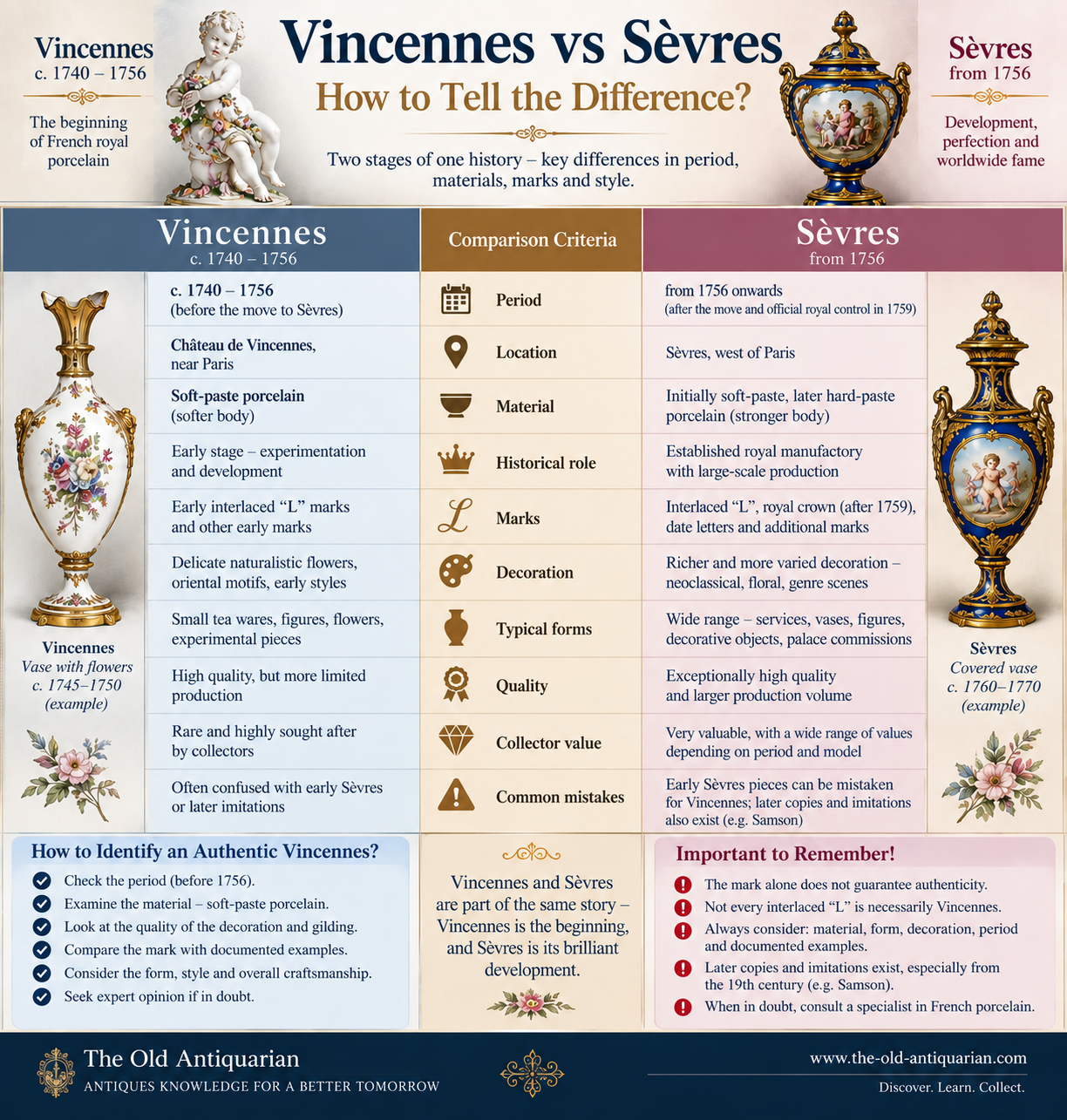
The distinction is historical rather than simply stylistic. Vincennes describes the manufactory before the 1756 move; Sèvres describes its continuation at the new site. Because craftsmen, forms, materials, marks and decorative practices crossed that transition, early Sèvres can sometimes look very close to late Vincennes.
| Criterion | Vincennes | Sèvres |
|---|---|---|
| Core period | c. 1740–1756 | From 1756 onward |
| Location | Château de Vincennes | Sèvres, west of Paris |
| Body | Soft-paste porcelain | Initially soft-paste; hard-paste added later |
| Interlaced “L” | Yes | Yes — the marking tradition continues |
| Royal control | Royal support and privilege | Full Crown control from 1759 |
| Common mistake | Assuming every early interlaced-L piece is Vincennes | Assuming every interlaced-L mark automatically proves Sèvres |
For the broader national context — including Sèvres, Limoges and later French production — continue with What Is French Porcelain?.
Are There Fake or Imitation Vincennes Marks?
Later porcelain makers, decorators and copyists repeatedly borrowed the visual language of eighteenth-century French porcelain. As a result, the market contains later historicist wares, reproductions, decorative imitations and misleading marks that can resemble Vincennes or Sèvres.
It is useful to be precise with terminology. A later object made in the style of Vincennes is not automatically a counterfeit. The important distinction is whether the piece is correctly described, when it was made, and whether its marks or presentation are intended to create a false eighteenth-century attribution.
The glossary article What Is an Original? explains why originality is a broader question than whether a familiar mark is present.
Condition, Restoration & Later Decoration
Condition is especially important with eighteenth-century porcelain. Chips, hairlines, losses to applied flowers, restored handles, replaced covers, regilding, overpainting and old museum-style repairs can all affect both interpretation and market value.
A particularly useful reminder comes from museum cataloguing itself: an eighteenth-century porcelain body can carry later decoration. That means collectors should date the object, the decoration and any restoration separately when evidence suggests they may not be contemporary.
Before cleaning or repairing a potentially important piece, compare the approaches explained in restoration and conservation. For historically significant porcelain, compatible and minimally invasive treatment is generally preferable, with reversibility where practicable.
How Much Is Vincennes Porcelain Worth?
There is no single “Vincennes porcelain value.” Market value depends on the exact object and on how securely it can be identified. An asking price for a visually similar vase is not a substitute for evidence from completed sales of genuinely comparable pieces.
| Value Factor | Why It Matters |
|---|---|
| Attribution | Documented Vincennes is a different market category from “Vincennes style” or an uncertain attribution. |
| Model / form | Rare, complex or historically documented forms may attract stronger collector interest. |
| Decoration | Quality, subject, ground colour, gilding and documented decorator can matter. |
| Condition | Cracks, chips, losses, repainting and restoration can materially affect desirability. |
| Provenance | Reliable ownership history, old labels, publications or exhibition history can strengthen confidence. |
| Comparable sales | Completed sales should match maker, period, form, decoration, condition and attribution as closely as possible. |
If you are trying to understand a specific object rather than the general market, the professional antique valuation page explains what photographs and background information are most useful.
Vincennes vs Limoges: Do Not Confuse the Names
Vincennes and Limoges belong to French porcelain history but represent very different things. Vincennes refers to the eighteenth-century manufactory that moved to Sèvres in 1756. Limoges is a porcelain-producing city and region, not one single factory. Its importance in hard-paste porcelain developed later and involved many different manufacturers.
If an object is marked “Limoges France,” do not route it into Vincennes/Sèvres research simply because both are French. Use the dedicated Limoges porcelain identification guide to identify the actual manufacturer and backstamp.
Vincennes Collector Checklist
- Photograph the complete object from all sides.
- Photograph the entire underside before taking a close-up of the main mark.
- Record every painted, impressed and incised symbol.
- Confirm that the body is compatible with soft-paste porcelain.
- Identify the exact form or model where possible.
- Compare decoration, ground colour, gilding and painting with documented examples.
- Do not date the piece from the interlaced “L” cipher alone.
- Check whether a date letter and secondary marks are present.
- Look for restored handles, lids, flowers, cracks, losses, regilding or overpainting.
- Separate the date of the porcelain body from the date of later decoration when necessary.
- Prefer museum catalogues, official factory mark references and specialist publications over seller descriptions.
- For value, compare completed sales of genuinely comparable objects rather than asking prices.
Frequently Asked Questions About Vincennes Porcelain
Is Vincennes porcelain the same as Sèvres porcelain?
They are different phases of the same manufactory history. The workshop operated at Vincennes before the manufactory moved to Sèvres in 1756. Early Sèvres therefore continues many materials, marks, craftsmen and decorative traditions established at Vincennes.
When was Vincennes porcelain made?
The Vincennes phase is generally dated from about 1740 to 1756. The move to Sèvres in 1756 is the key historical dividing point.
What is the Vincennes porcelain mark?
The most famous mark is the interlaced double “L” royal cipher. Later Vincennes pieces may also carry date letters and additional painted or incised signs. The exact configuration must be compared with documented examples.
Does an interlaced “L” mark prove Vincennes?
No. The cipher continued at Sèvres and has also been imitated. A reliable attribution requires the mark to agree with the body, form, decoration, technique, period and documented parallels.
What type of porcelain is Vincennes?
Vincennes is associated with soft-paste porcelain. Hard-paste porcelain belongs to a later stage of French development and should not be projected backward onto the Vincennes period.
How can I date a Vincennes porcelain mark?
Check whether the interlaced “L” cipher is accompanied by a date letter or secondary marks, then compare the exact combination with current museum and specialist references. Do not assume that every date letter maps neatly to one calendar year.
Are all Vincennes pieces marked?
Marking practice varies, particularly in early production. The absence of a familiar mark does not automatically exclude Vincennes, just as the presence of a copied mark does not prove it.
What objects did Vincennes make?
Documented production includes cups and saucers, serving pieces, coolers, ewers and basins, mustard pots, vases, pot-pourri forms, figures and other luxury decorative porcelain.
Is Vincennes porcelain valuable?
Well-documented eighteenth-century examples can be important collector objects, but value varies widely. Exact model, period, decoration, condition, restoration, provenance and comparable completed sales all matter.
Where should I compare a suspected Vincennes mark?
Begin with official Sèvres mark documentation and museum collections such as The Metropolitan Museum of Art, then consult specialist publications on Vincennes and Sèvres marks and decorators.
Have a Piece That May Be Vincennes or Early Sèvres?
For an initial review, photograph the complete object, the whole base, every mark and number, the decoration, dimensions, and any chips, cracks or restoration. Historical attribution is strongest when the object and the mark tell the same story.
Related Guides
History, regions, makers and identification.
Limoges Porcelain
Marks, makers and regional identification.
Porcelain Marks
Backstamps, factory marks and secondary signs.
How to Date Porcelain
Marks, form, material and production clues.
Identify Antique Porcelain
Complete collector identification method.
Antique Porcelain Guide
Central porcelain knowledge hub.
Continue Exploring
For definitions of authenticity, marks, restoration, provenance and other collecting terminology, browse the Antique & Collector’s Glossary.
Sources & Further Research
- Sèvres – The History — official history of the manufactory from Vincennes to Sèvres.
- Sèvres – Marks Reference — official historical marks reference including the Vincennes and early Sèvres periods.
- The Metropolitan Museum of Art – Vincennes Potpourri Vase, 1754 — useful for date-letter and object documentation.
- The Metropolitan Museum of Art – Urne Duplessis, c. 1752 — documented Vincennes form and material.
- The Metropolitan Museum of Art – Vincennes Wine Cooler, c. 1751–52 — early style, royal privilege and Meissen influence.
- French Porcelain Society – Decorator and Date Marks on 18th-Century Vincennes and Sèvres Porcelain — specialist research for advanced mark interpretation.
About The Old Antiquarian
The Old Antiquarian combines more than 35 years of practical experience with antiques and collecting with historical, museum and comparative research. Our porcelain guides are designed to move from broad identification toward precise manufacturer, form, period and condition analysis — without treating a single mark as proof.
Final Collector Principle
For Vincennes porcelain, the strongest attribution is reached when material + form + glaze + decoration + mark + date system + condition + documented comparison all point toward the same history.
