
Royal Naples Porcelain: History & Value
Italian Porcelain • Naples • Ferdinand IV • Real Fabbrica Ferdinandea
Royal Naples Porcelain: Real Fabbrica Ferdinandea Marks, Crowned N, History, Identification & Value
Last Updated: September 17, 2026 | The Old Antiquarian
Royal Naples porcelain belongs to one of the most important chapters in the history of
Italian porcelain:
the royal factory founded under Ferdinand IV in Naples in 1771,
known in collector literature as the
Royal Porcelain Manufactory, Naples
and closely associated with the name
Real Fabbrica Ferdinandea.
Royal Naples porcelain generally refers to the royal porcelain production established in Naples under Ferdinand IV in 1771 after the earlier Capodimonte factory had closed.
The later Naples factory produced both soft-paste and
hard-paste porcelain, as well as important sculptural and biscuit work.
A Crowned N is historically documented on Real Fabbrica Ferdinandea objects,
but the mark alone does not prove eighteenth-century authenticity.
Reliable identification requires
mark + material + form + modelling + decoration + period + condition + documented comparison.
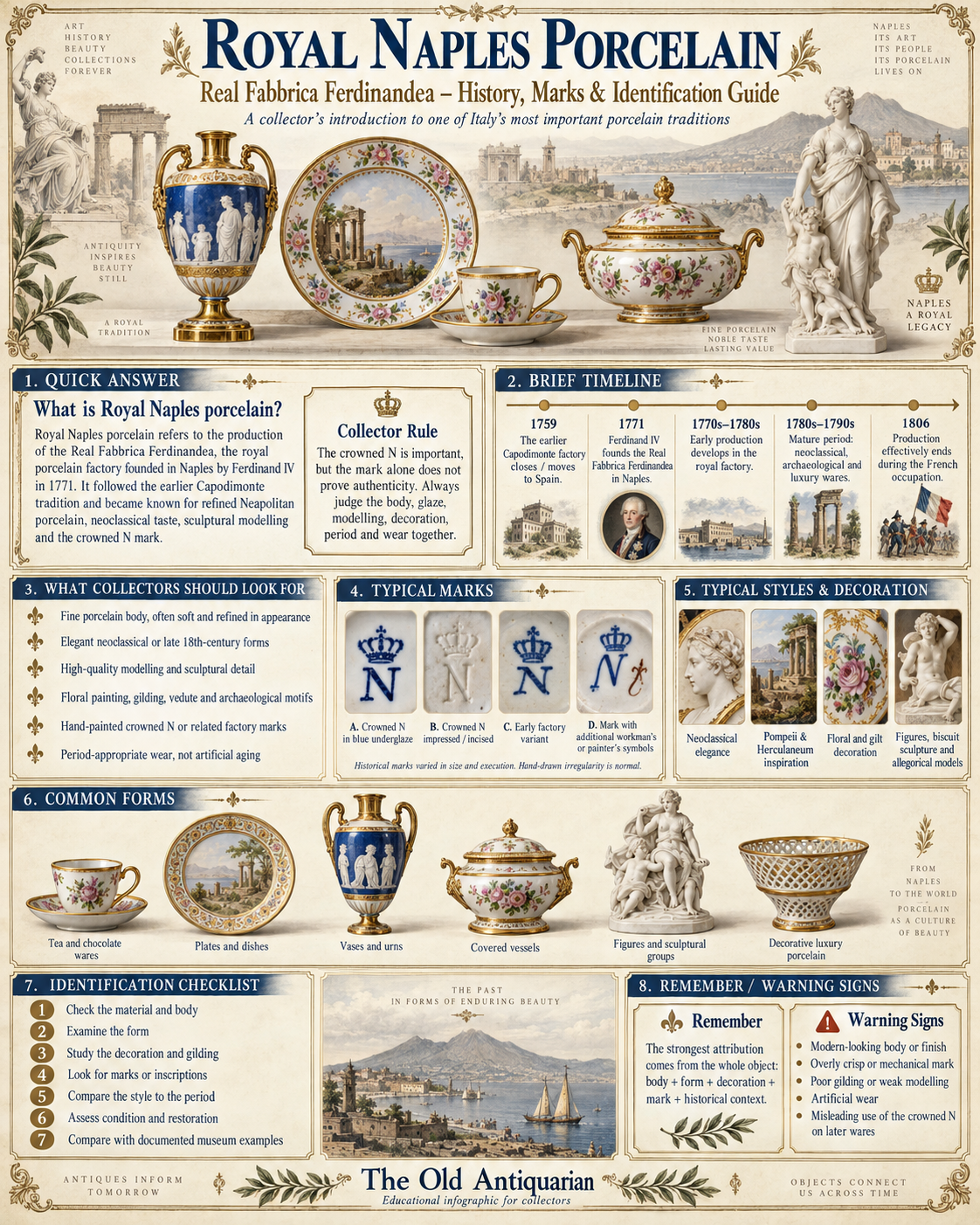
Royal Naples Porcelain at a Glance
The royal porcelain factory was revived in Naples by Ferdinand IV in 1771.
It followed the earlier Bourbon porcelain tradition of Capodimonte, but it was a new and independent Naples enterprise.
Documented museum objects include both soft-paste and hard-paste porcelain, plus biscuit sculpture.
A Crowned N is a clue—not automatic proof of age, factory or value.
the strongest Royal Naples attribution comes from the whole object,
not from the Crowned N alone.
Definition
What Is Royal Naples Porcelain?
Royal Naples porcelain refers to porcelain associated with the royal Bourbon factory
established in Naples under Ferdinand IV in 1771.
It belongs within the wider history of
Italian porcelain
,
but it should not be treated as simply another name for every porcelain object made in Naples.
The factory produced refined tableware,
cups, saucers, teapots, coffeepots, sugar bowls,
plates, vases, decorative objects and ambitious sculpture.
Museum collections also preserve important
biscuit porcelain
and hard-paste figures alongside soft-paste tablewares.
“Royal Naples,” “Royal Porcelain Manufactory, Naples” and “Real Fabbrica Ferdinandea”
can overlap in collector and museum discussions, but context matters.
Always describe the exact period and object rather than relying on one broad market name.
Essential distinction
Capodimonte vs Royal Naples vs Real Fabbrica Ferdinandea
One of the most important distinctions in Neapolitan porcelain is the difference between
the earlier Capodimonte factory and the
later Naples royal factory under Ferdinand IV.
The Capodimonte factory belonged to the reign of Charles VII of Naples.
When Charles inherited the Spanish throne in 1759,
the earlier factory was closed and key workers and materials were transferred to Spain.
In 1771, Ferdinand IV revived royal porcelain manufacture in Naples by establishing
a new factory near the royal palace.
The Met explicitly describes this as an independent enterprise,
although technical and stylistic links with Capodimonte remained.
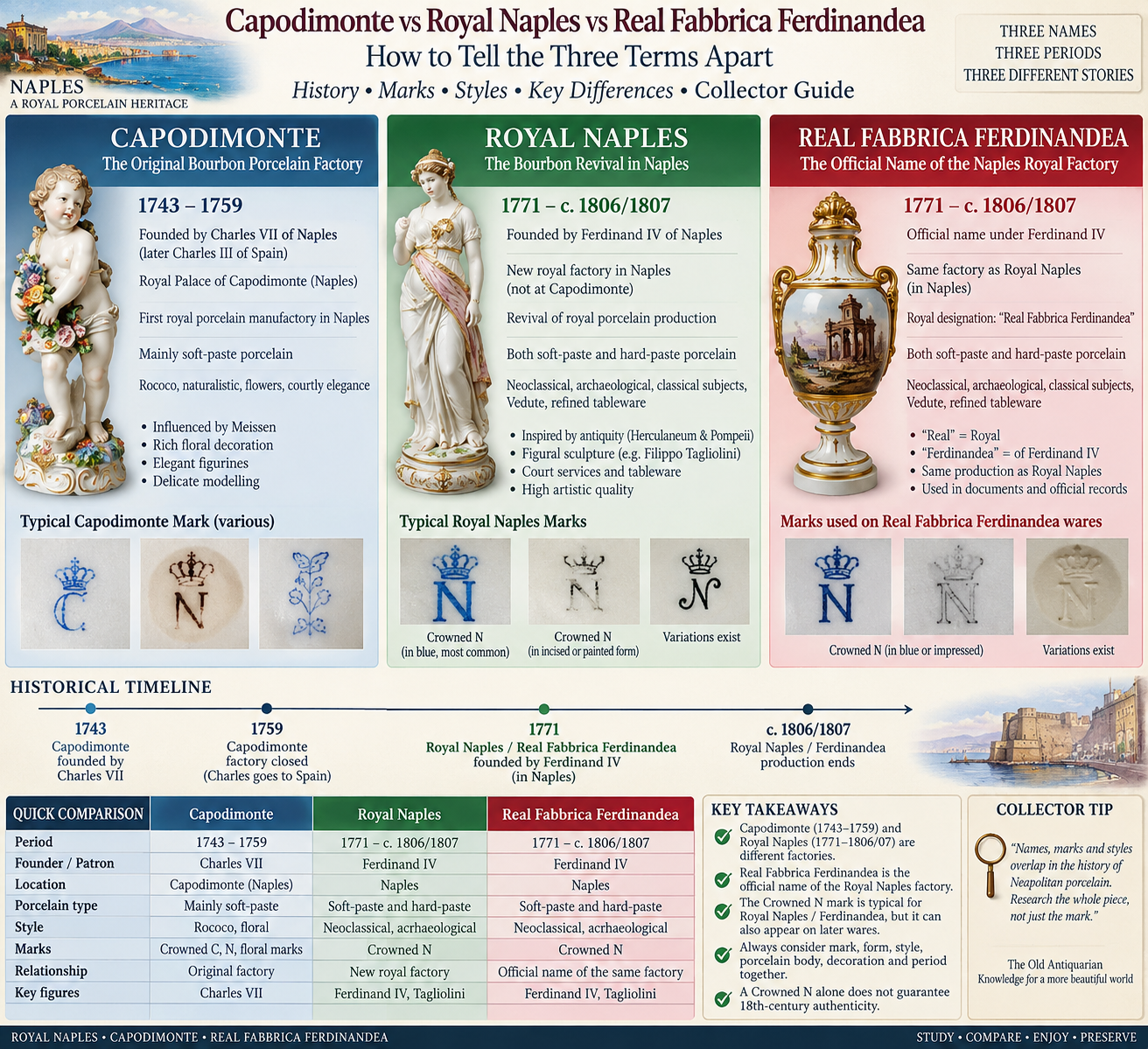
| Feature | Capodimonte | Royal Naples / Real Fabbrica Ferdinandea |
|---|---|---|
| Main historical phase | Earlier Bourbon production before 1759. | New royal Naples factory founded under Ferdinand IV in 1771. |
| Patron | Charles VII of Naples. | Ferdinand IV of Naples. |
| Relationship | Earlier royal factory. | Independent later enterprise with some technical and stylistic continuity. |
| Collector risk | Later “Capodimonte” wares are often confused with eighteenth-century production. | Later Crowned N marks are often confused with original Ferdinandea production. |
History
History of the Royal Naples Porcelain Factory
1759 – the earlier Capodimonte factory closes
The earlier royal porcelain manufactory at Capodimonte came to an end when Charles VII
became Charles III of Spain in 1759.
The production was dismantled,
and workers and materials were taken to Spain.
1771 – Ferdinand IV revives royal porcelain production
Twelve years later, Ferdinand IV established a new royal porcelain factory in Naples.
This was not merely the old Capodimonte establishment reopened under another label.
It was a new royal enterprise with its own development,
although connections to the earlier Neapolitan tradition remained visible.
Late eighteenth century – artistic maturity
The later eighteenth century brought increasingly sophisticated modelling,
Neoclassical taste,
classical and archaeological subjects,
landscape and view decoration,
luxury tableware and ambitious sculptural work.
1806–1807 – the royal factory comes to an end
The factory effectively ceased under the political upheaval associated with the French occupation
and Joseph Bonaparte’s accession in Naples.
Museum catalogues commonly frame the Ferdinand IV period as
ca. 1771–ca. 1807,
while documentary discussions may use 1806 as the practical closure date.
“Royal Naples / Real Fabbrica Ferdinandea, Ferdinand IV period, ca. 1771–1806/07”
is often safer than forcing every object into one exact terminal year.
Name and identity
What Does “Real Fabbrica Ferdinandea” Mean?
The name Real Fabbrica Ferdinandea
is associated with the royal porcelain production of Ferdinand IV.
In English-language collecting,
the same historical production is often described as
Royal Naples porcelain
or the
Royal Porcelain Manufactory, Naples.
For search and catalogue purposes,
these names can overlap.
For attribution,
however,
the best practice is to state:
factory + period + material + object type + mark + documentation.
Marks
Royal Naples Porcelain Marks
The most famous mark associated with Royal Naples and Real Fabbrica Ferdinandea is the
Crowned N.
However,
Naples porcelain marks require the same disciplined approach as every other major European factory mark.
A mark may be painted,
impressed,
incised or accompanied by additional symbols,
numbers or workmen’s marks.
The exact execution,
colour,
position,
porcelain body and object type all matter.
For the general method of reading factory marks,
see our
Porcelain Marks Identification Guide
.
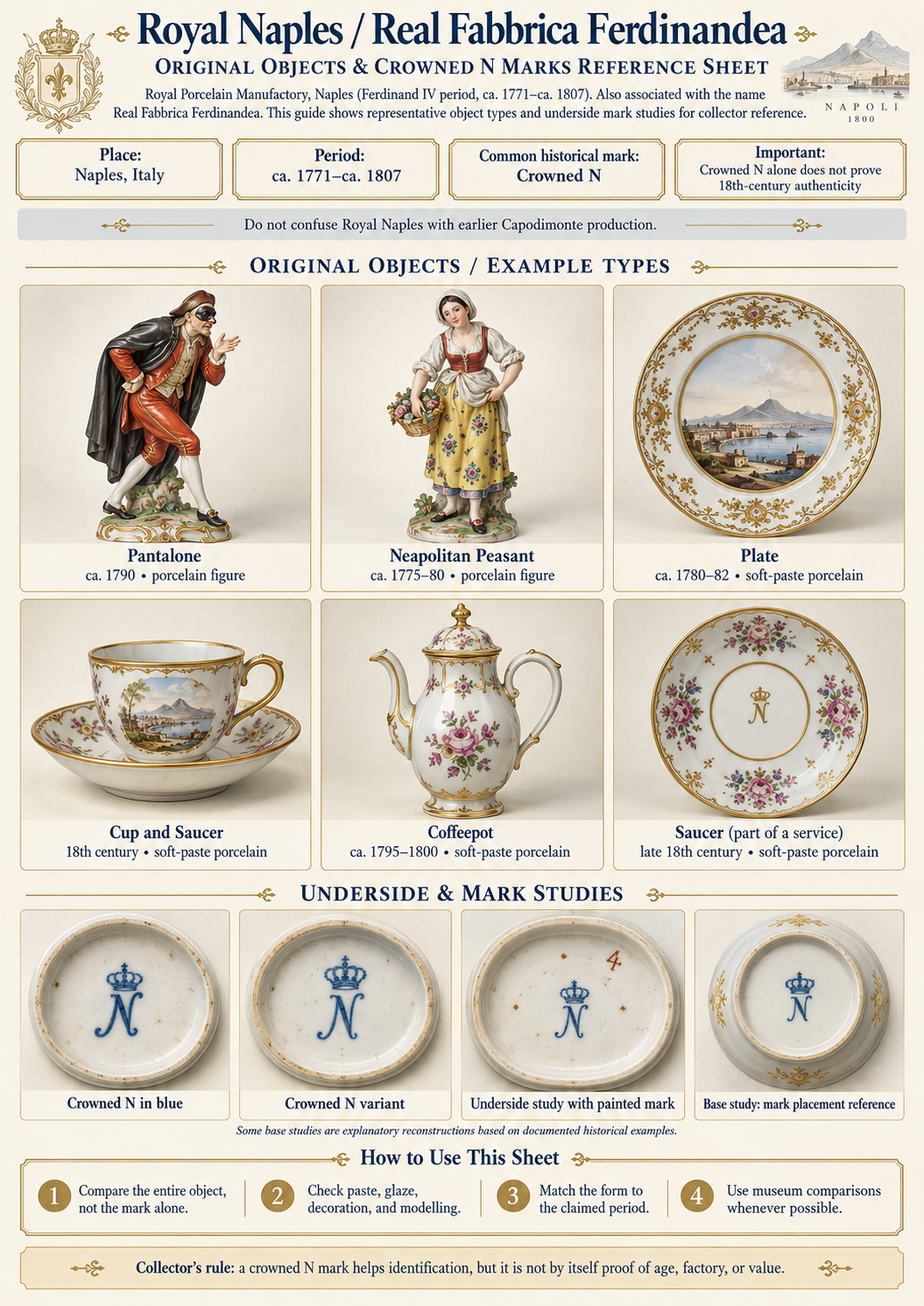
Crowned N explained
What Does the Crowned N Porcelain Mark Mean?
The Crowned N is historically documented on objects attributed to the
Real Fabbrica Ferdinandea.
The Italian national cultural catalogue,
for example,
records a late eighteenth-century figurine attributed to the factory
with a blue Crowned N under the base.
That makes the Crowned N an important historical clue.
It does not,
however,
make every Crowned N object an eighteenth-century Royal Naples piece.
Later Italian workshops and later wares also used Crowned N imagery.
A genuine attribution must be supported by the material,
model,
form,
decoration,
manufacturing technique,
condition and documented comparisons.
| What you see | What it can tell you | What it cannot prove by itself |
|---|---|---|
| Blue Crowned N | Historically documented on Ferdinandea production. | Exact date or eighteenth-century authenticity. |
| Impressed symbol | May relate to manufacture, mould or production process. | Factory identity without comparison. |
| Additional painted mark | May relate to decoration or workshop practice. | Named artist without documentation. |
| Later Crowned N | May indicate a later Naples or Capodimonte-style tradition. | Royal Ferdinandea origin. |
Dating
How to Date Royal Naples Porcelain
The safest approach is to date Royal Naples porcelain by a
cluster of evidence
rather than one mark chart.
Begin with the complete underside,
then compare the porcelain body,
form,
decoration,
model,
manufacturing technique and documented museum examples.
For the general process,
continue to our
Complete Guide to Dating Antique Porcelain
.
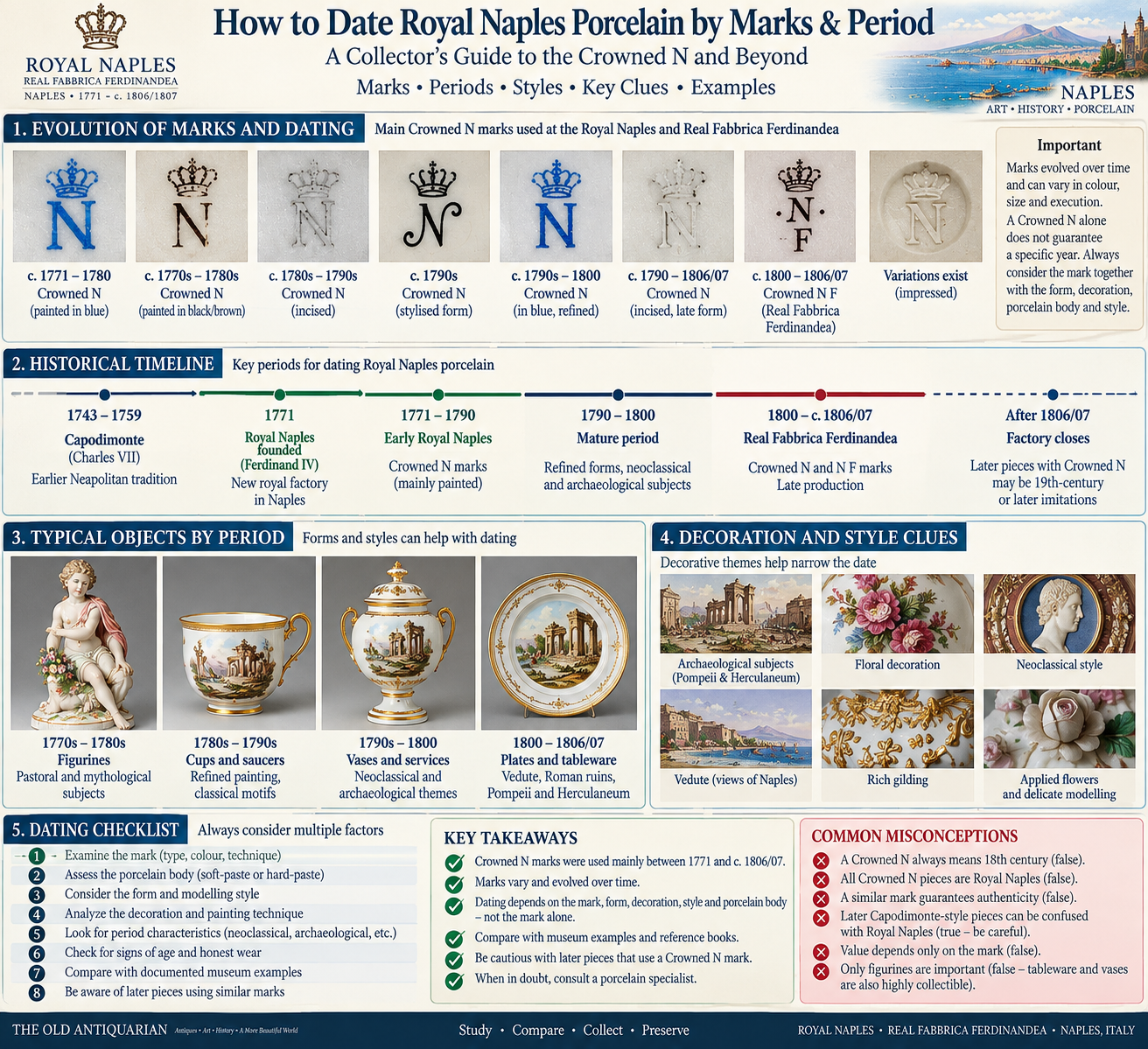
| Dating clue | Why it matters | Reliability |
|---|---|---|
| Exact mark variant | May narrow the historical context when independently documented. | High when securely referenced. |
| Porcelain body | Soft-paste and hard-paste examples both occur. | Essential. |
| Form and modelling | Can be matched to museum or catalogue examples. | Very high. |
| Decoration | Helps place the object within floral, Neoclassical, archaeological or view traditions. | Medium to high. |
| Modeller attribution | A documented modeller can greatly narrow the context. | Very high when proven. |
| Wear | Can support age but is easy to overinterpret. | Supporting only. |
Materials
Soft-Paste vs Hard-Paste Royal Naples Porcelain
One of the most useful corrections for collectors is this:
Royal Naples was not limited to one single porcelain body.
The Metropolitan Museum of Art catalogues several Royal Naples objects,
including a Neapolitan peasant,
plate,
teapot,
coffeepot and service pieces,
as soft-paste porcelain.
At the same time,
figures such as Pantalone and Woman
are catalogued as
hard-paste porcelain.
The factory also produced important
biscuit sculpture,
especially in association with the Neoclassical sculptural tradition.
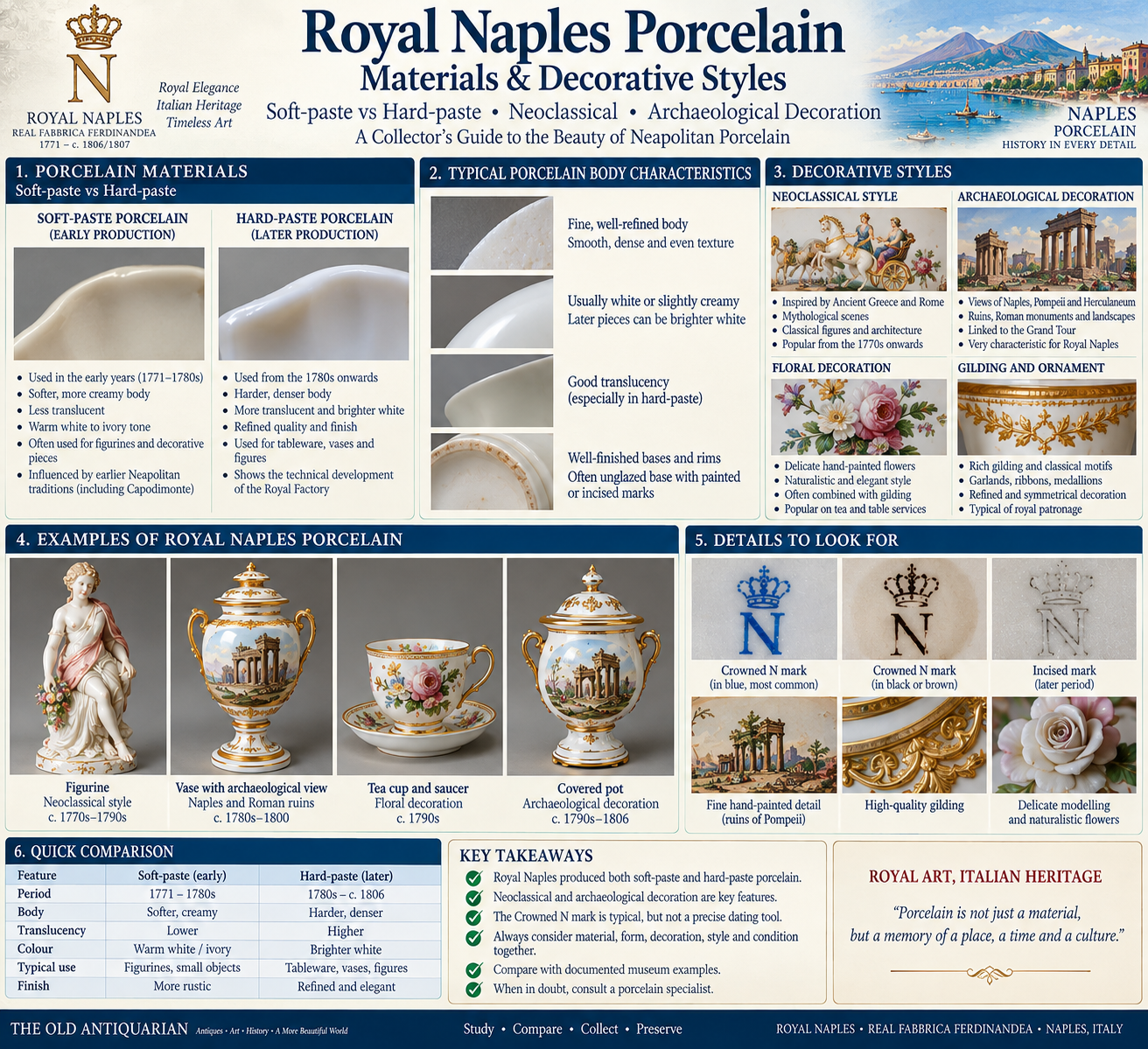
never identify Royal Naples from colour or translucency alone.
Soft-paste,
hard-paste and biscuit examples all exist within the wider Ferdinandea story.
Sculpture
Filippo Tagliolini and Royal Naples Sculpture
One of the most important names associated with the Real Fabbrica Ferdinandea is
Filippo Tagliolini.
Italian cultural records associate him with the factory from around 1780
and credit him with an important role in its sculptural and Neoclassical development.
Documented works and attributed models include
mythological subjects,
portrait sculpture,
figural groups
and biscuit compositions.
Italian museum catalogues also preserve multiple objects attributed to Tagliolini,
including late eighteenth-century figures and groups.
However,
collector attribution should remain object-specific.
A classical biscuit figure is not automatically “by Tagliolini”
simply because it looks Neoclassical.
“in the style of,” “after a model associated with,” and “attributed to”
are not equivalent to a fully documented signed or archival attribution.
Decoration
Royal Naples Porcelain Styles and Decoration
Royal Naples developed a refined visual language that often reflects
late eighteenth-century court taste.
Collectors may encounter
Neoclassical forms,
landscape views,
rich gilding,
floral painting,
classical figures,
archaeological scenes
and sculptural subjects.
| Decoration | Typical characteristics | Identification caution |
|---|---|---|
| Neoclassical | Symmetry, classical profiles, urns, ancient costume and restrained geometry. | Neoclassical styles were revived later. |
| Archaeological | Ancient ruins, classical ornament and motifs inspired by excavated antiquity. | Subject alone does not prove factory. |
| Vedute | Views of Naples, architecture, landscapes and sites. | Compare painting quality and documented services. |
| Floral | Hand-painted flowers, garlands and naturalistic sprays. | Common across many European factories. |
| Gilding | Borders, classical ornament, medallions and luxury finishing. | Regilding can obscure original condition. |
| Biscuit sculpture | Unglazed white sculptural surfaces with classical emphasis. | Later copies are common. |
Archaeological taste
Pompeii, Herculaneum and the Neoclassical Taste of Naples
The archaeological discoveries around Naples helped shape the visual culture
of late eighteenth-century Europe.
Royal Naples porcelain participated in this broader fascination with antiquity through
classical architecture,
mythological subjects,
ancient costume,
ruins
and archaeological ornament.
This makes archaeological decoration particularly characteristic of the period,
but it should be used as
supporting evidence,
not as a standalone factory test.
Forms
20 Royal Naples / Ferdinandea Porcelain Objects and Forms
The factory’s production was much broader than figurines.
Royal Naples collectors encounter tableware,
sculpture,
covered vessels,
cups,
services,
plates,
urns,
vases
and specialist decorative forms.
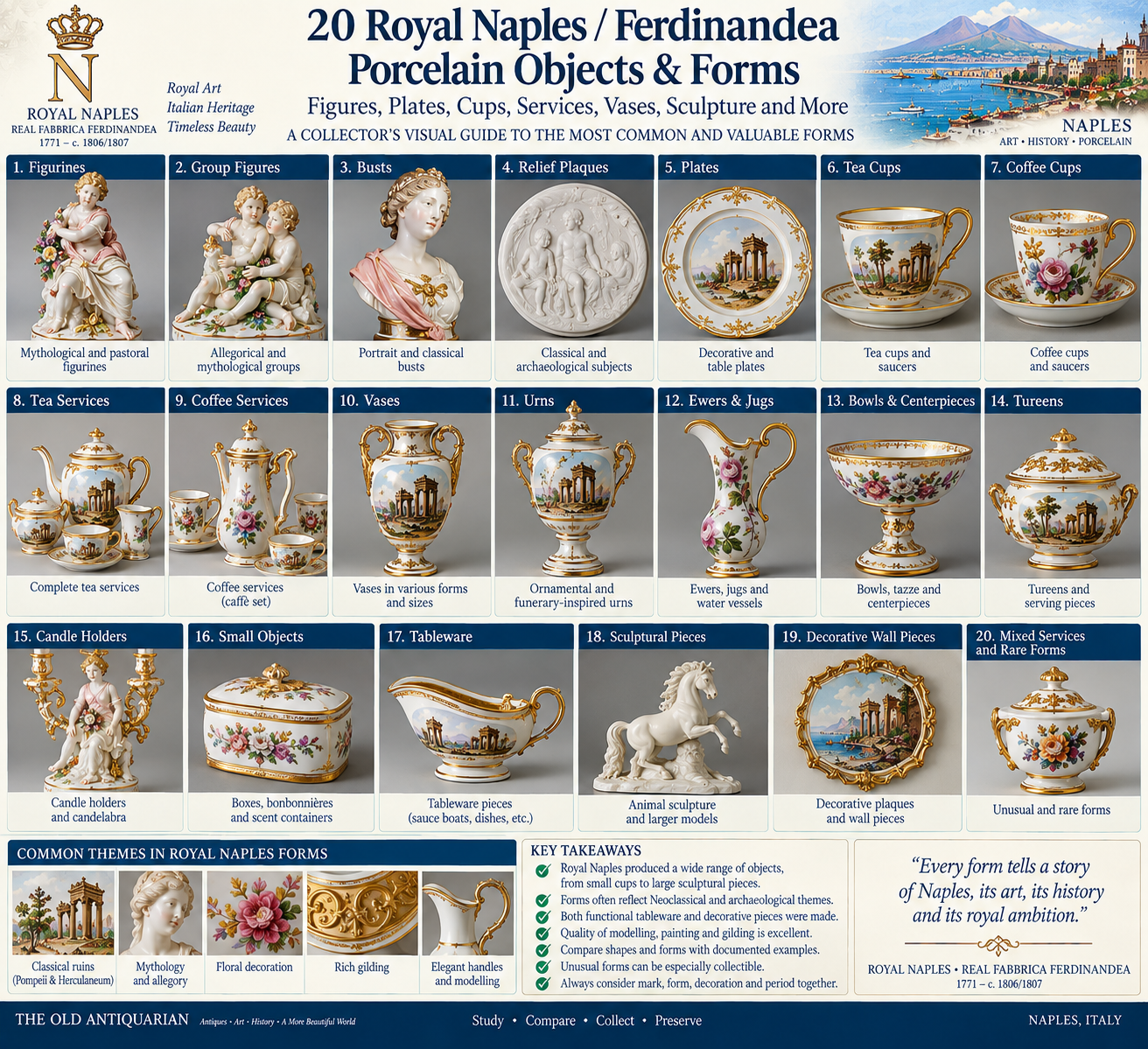
Mythological,
pastoral,
social,
allegorical and portrait subjects.
Plates,
cups,
saucers,
bowls and serving forms.
Teapots,
coffeepots,
chocolate pots,
sugar bowls and service cups.
Decorative and display pieces with painted or gilded ornament.
Classical and Neoclassical compositions.
Covered vessels,
tazzas,
plaques,
centrepieces and luxury decorative objects.
Authentication
How to Identify Authentic Royal Naples Porcelain
The safest method is to begin with the whole object
before interpreting the mark.
This is the same principle used throughout our
Antique Porcelain Identification Guide
.
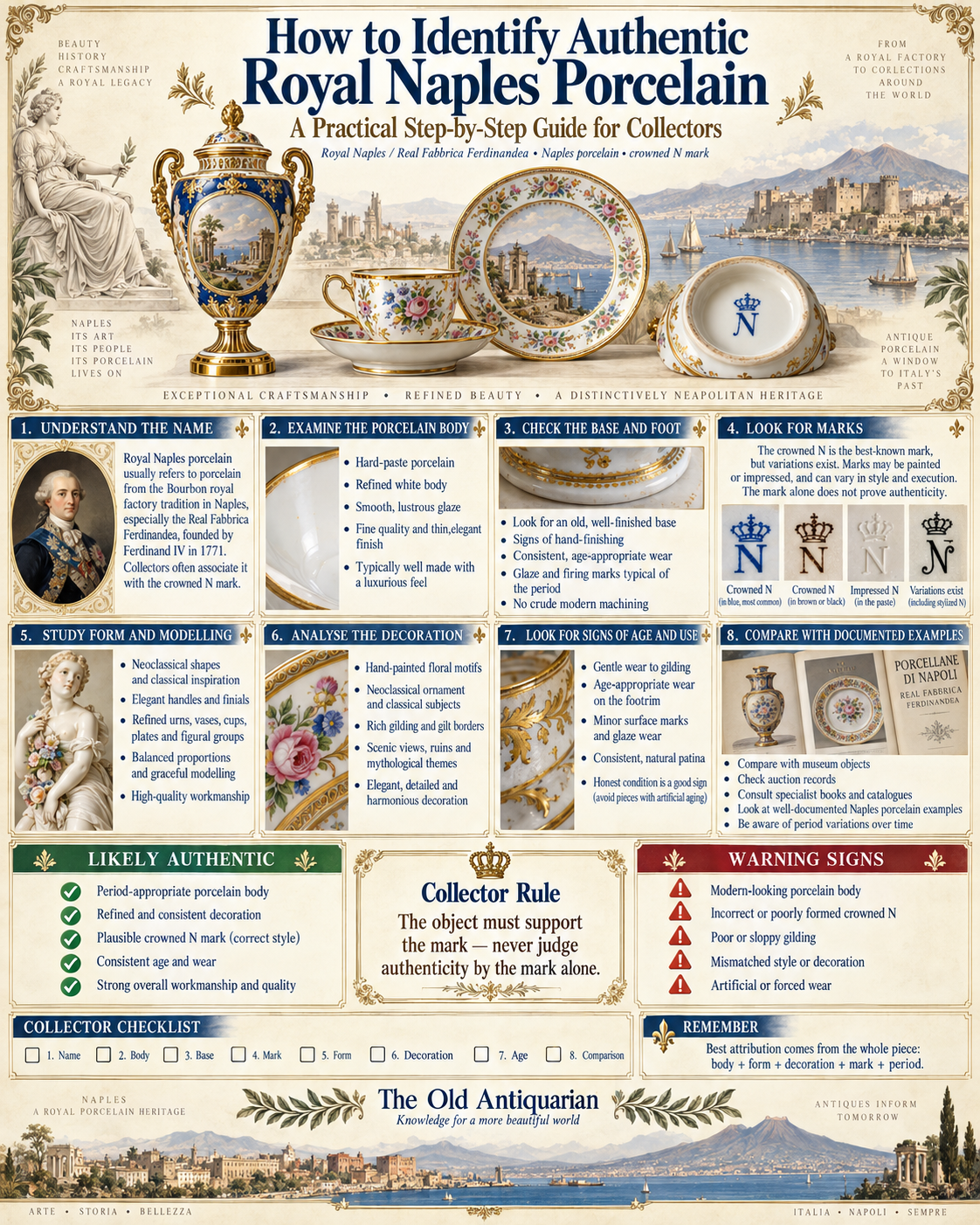
Identify the historical context.
Is the claim Capodimonte,
Royal Naples,
Ferdinandea
or a later Naples tradition?
Examine the material.
Determine whether the body is soft-paste,
hard-paste,
biscuit
or another ceramic material.
Study the entire base.
Photograph the foot,
wear,
marks,
numbers and secondary inscriptions.
Read the mark exactly.
Do not convert every crown and N into an eighteenth-century Ferdinandea attribution.
Study form and modelling.
Look at proportion,
handles,
finials,
sculptural anatomy,
moulding and construction.
Analyse decoration.
Hand painting,
gilding,
landscape views,
classical motifs
and archaeological decoration all need context.
Inspect condition.
Look for repainting,
regilding,
overspray,
replacements,
chips and restored sculptural details.
Compare documented examples.
Museum collections and specialist catalogues matter more than marketplace resemblance.
Later wares
Later Crowned N Porcelain and Capodimonte-Style Wares
One of the greatest traps in Italian porcelain collecting is the assumption that
every Crowned N means eighteenth-century Royal Naples.
The Crowned N continued to appear in later Italian ceramic traditions,
including nineteenth- and twentieth-century production.
Some later objects are legitimate historic ceramics in their own right;
others were made in an intentionally revivalist or “Capodimonte-style” vocabulary.
A later object should be described according to its actual maker,
period,
material and production context.
The problem is incorrect attribution—not merely later manufacture.
Condition
Condition and Restoration
Royal Naples sculptural pieces can be particularly vulnerable.
Fingers,
flowers,
handles,
finials,
thin drapery,
applied ornaments
and projecting details may have been repaired or replaced.
Check fingers,
flowers,
staffs,
weapons,
animals and projecting details.
Look for joints,
glue,
overspray and colour differences.
Separate natural wear from later regilding.
Check grinding,
filler,
chips and unusual polishing.
Look for repainting and retouching.
Inspect for staining,
surface abrasion,
breaks and restoration.
Value
Royal Naples Porcelain Value
There is no single “Royal Naples porcelain value.”
The market depends on what the object actually is.
A documented eighteenth-century sculptural group,
a service piece,
a rare vase,
a later Crowned N reproduction
and a damaged decorative object belong to very different markets.
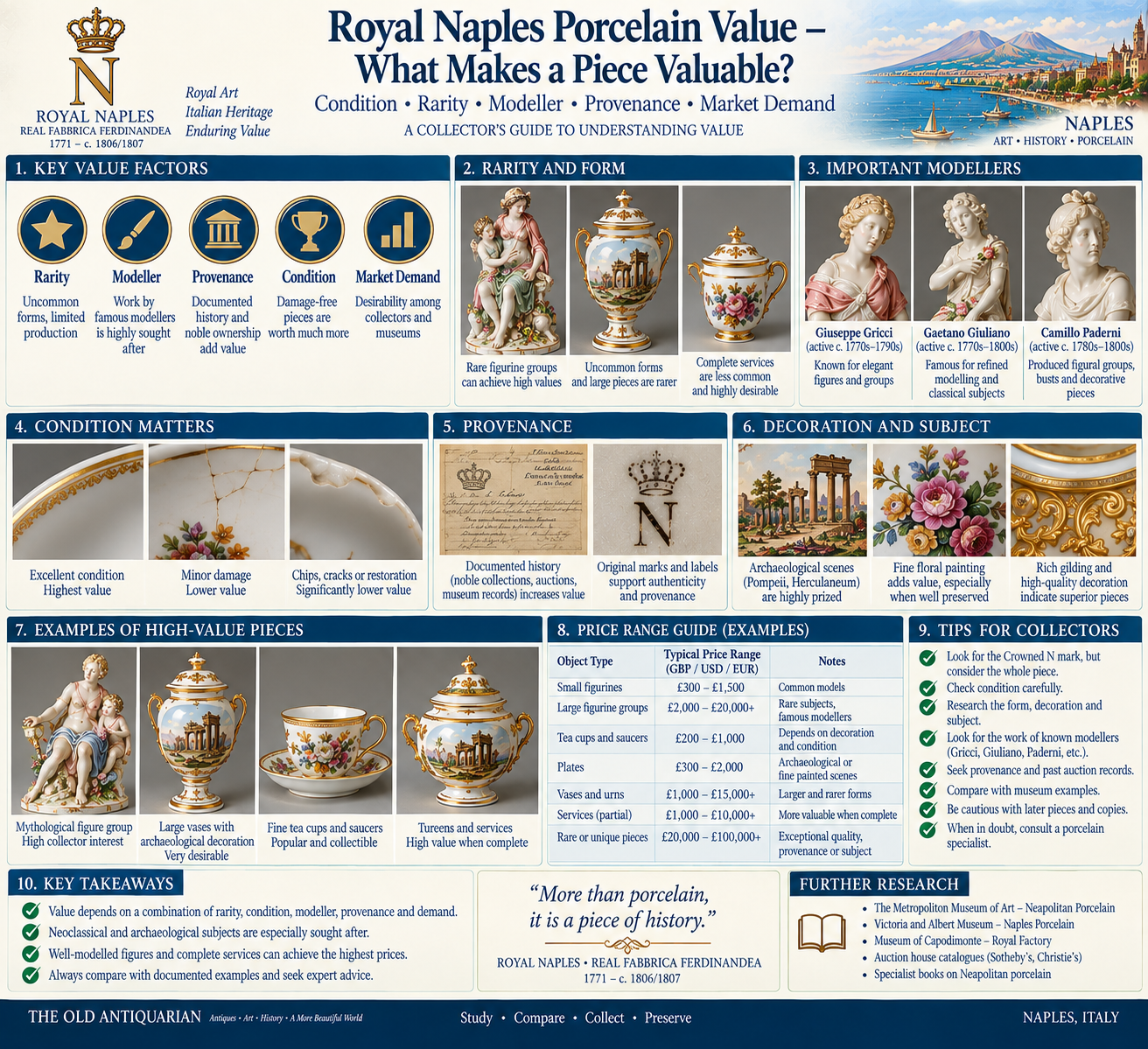
| Value factor | Why it matters |
|---|---|
| Exact attribution | Royal Ferdinandea, later Naples and modern Capodimonte-style production are not equivalent markets. |
| Period | Secure eighteenth-century attribution may materially affect collector interest. |
| Model / form | Rare documented models can differ greatly from common forms. |
| Modeller | Documented association with an important modeller such as Tagliolini can be significant. |
| Decoration | Fine views, archaeological subjects, hand painting and refined gilding can distinguish stronger examples. |
| Condition | Repairs, losses, cracks, regilding and replacement elements affect desirability. |
| Completeness | Original covers, pairs, sets and intact sculptural groups matter. |
| Provenance | Reliable collection, auction, museum or exhibition history can strengthen attribution and significance. |
| Completed sales | Actual realised prices are more meaningful than online asking prices. |
Compare:
exact factory + period + model + dimensions + decoration + modeller + condition + restoration + completeness + provenance + recent completed sales.
For the broader valuation method,
continue to
Professional Antique Valuation
.
Royal Naples Collector Checklist
- Photograph the entire object.
- Photograph the full underside.
- Record every mark exactly.
- Do not treat every Crowned N as eighteenth century.
- Identify the actual ceramic body.
- Compare the form with museum examples.
- Study modelling quality.
- Identify the decoration technique.
- Check gilding and painted views carefully.
- Look for restoration and replacement parts.
- Separate Capodimonte from the later Royal Naples factory.
- Use a date range when the exact year cannot be demonstrated.
- Verify any modeller attribution.
- Compare completed sales before estimating value.
Do You Have Royal Naples or Crowned N Porcelain?
Send clear photographs of the complete object,
the underside,
every mark and number,
dimensions,
decoration
and any chips,
cracks
or restoration.
Royal Naples Porcelain FAQ
What is Royal Naples porcelain?
Royal Naples porcelain generally refers to the royal porcelain manufacture established
in Naples under Ferdinand IV in 1771,
after the earlier Capodimonte factory had closed.
Is Royal Naples the same as Capodimonte?
No.
They belong to the same broader Bourbon porcelain history,
but the Ferdinand IV factory established in 1771 was a new enterprise in Naples.
What is Real Fabbrica Ferdinandea?
It is a name associated with the royal porcelain manufacture under Ferdinand IV
and is commonly used in specialist and collector literature for the later Naples royal production.
What does a Crowned N mark mean?
A Crowned N is historically documented on Real Fabbrica Ferdinandea objects,
but similar marks were also used later.
It is therefore an identification clue,
not independent proof of age.
Does every Crowned N piece date to the eighteenth century?
No.
Later Italian porcelain can also carry Crowned N marks.
The material,
form,
decoration,
manufacturing technique
and documented comparisons must agree with the proposed period.
Was Royal Naples porcelain soft-paste or hard-paste?
Both are documented.
The Met catalogues multiple Ferdinandea-period objects in soft-paste porcelain
and other figures in hard-paste porcelain.
Biscuit sculpture is also documented.
Who was Filippo Tagliolini?
Filippo Tagliolini was an important sculptor and modeller associated with the
Real Fabbrica Ferdinandea.
Documented Italian cultural records connect him with the factory’s late eighteenth-century sculptural and Neoclassical production.
What decoration is typical of Royal Naples?
Collectors encounter floral painting,
rich gilding,
Neoclassical ornament,
classical subjects,
archaeological imagery,
landscape views
and sculpture.
No single decorative theme proves attribution.
How can I date Royal Naples porcelain?
Use the exact mark together with material,
form,
model,
decoration,
modelling,
manufacturing technique
and documented museum examples.
Most objects should be dated to a defensible range rather than an invented exact year.
Are all Royal Naples figures by Tagliolini?
No.
A modeller attribution must be documented.
Visual similarity alone is not sufficient.
What makes Royal Naples porcelain valuable?
Value depends on the exact attribution,
period,
rarity,
model,
modeller,
decoration,
condition,
restoration,
completeness,
provenance
and current collector demand.
Are later Crowned N objects worthless?
No.
Later Naples and Capodimonte-style ceramics can have their own collector market.
They simply should not be valued or described as original eighteenth-century Royal Naples unless the evidence supports that attribution.
Related Guides
Sources & Further Research
-
The Metropolitan Museum of Art – Pantalone, ca. 1790
— history of the Ferdinand IV factory,
its relationship with Capodimonte,
hard-paste porcelain
and Aniello Ingaldo. -
The Metropolitan Museum of Art – Neapolitan Peasant, ca. 1775–80
— documented soft-paste Royal Naples porcelain. -
The Metropolitan Museum of Art – Plate, ca. 1780–82
— documented soft-paste Royal Naples tableware. -
The Metropolitan Museum of Art – Woman, ca. 1785–95
— documented hard-paste Royal Naples porcelain. -
The Metropolitan Museum of Art – Teapot, ca. 1790–1800
— documented soft-paste Royal Naples porcelain. -
The Metropolitan Museum of Art – Coffeepot, ca. 1795–1800
— documented late eighteenth-century Royal Naples soft-paste porcelain. -
Catalogo generale dei Beni Culturali – Dama con ventaglio, 1790–1799
— Real Fabbrica Ferdinandea attribution,
Filippo Tagliolini attribution
and documented blue Crowned N under the base. -
Catalogo generale dei Beni Culturali – Aristotle and Alexander, 1796–1804
— biscuit sculpture attributed to Filippo Tagliolini and the Real Fabbrica Ferdinandea.
The Core Collector Principle
Royal Naples porcelain is identified by convergence of evidence.
A strong attribution is built when
factory history + material + form + modelling + decoration + exact mark + period + condition + documented comparison
all support the same conclusion.
When the evidence only supports a date range or qualified attribution,
careful wording is more reliable than invented certainty.
