
Bulgarian M36 Helmet: History, Types & Identification
✦ THE OLD ANTIQUARIAN ✦
HISTORICAL COLLECTIBLES & RESEARCH
The Story of a Single Helmet: The Bulgarian M36
1936 – The End of the 20th Century
WORLD WAR II • TYPES A, B & C • MILITARY SERVICE
POSTWAR REFURBISHMENT • COLLECTOR IDENTIFICATION
Last Updated: October 14, 2026
Quick Answer: What Is the Bulgarian M36 Helmet?
The Bulgarian M36 helmet is a steel combat helmet developed in the mid-1930s and introduced into service with the Bulgarian Army in 1936. Used during World War II and retained in Bulgarian military service and storage for decades afterwards, it became one of the most distinctive pieces of Bulgarian military equipment of the twentieth century.
Collectors recognise three principal variants — Type A, Type B and Type C — distinguished by shell shape, rolled or unrolled rims, rivet arrangements and leather suspension systems. Many surviving helmets were repainted and refurbished after the war, making correct identification of original and replacement components particularly important.
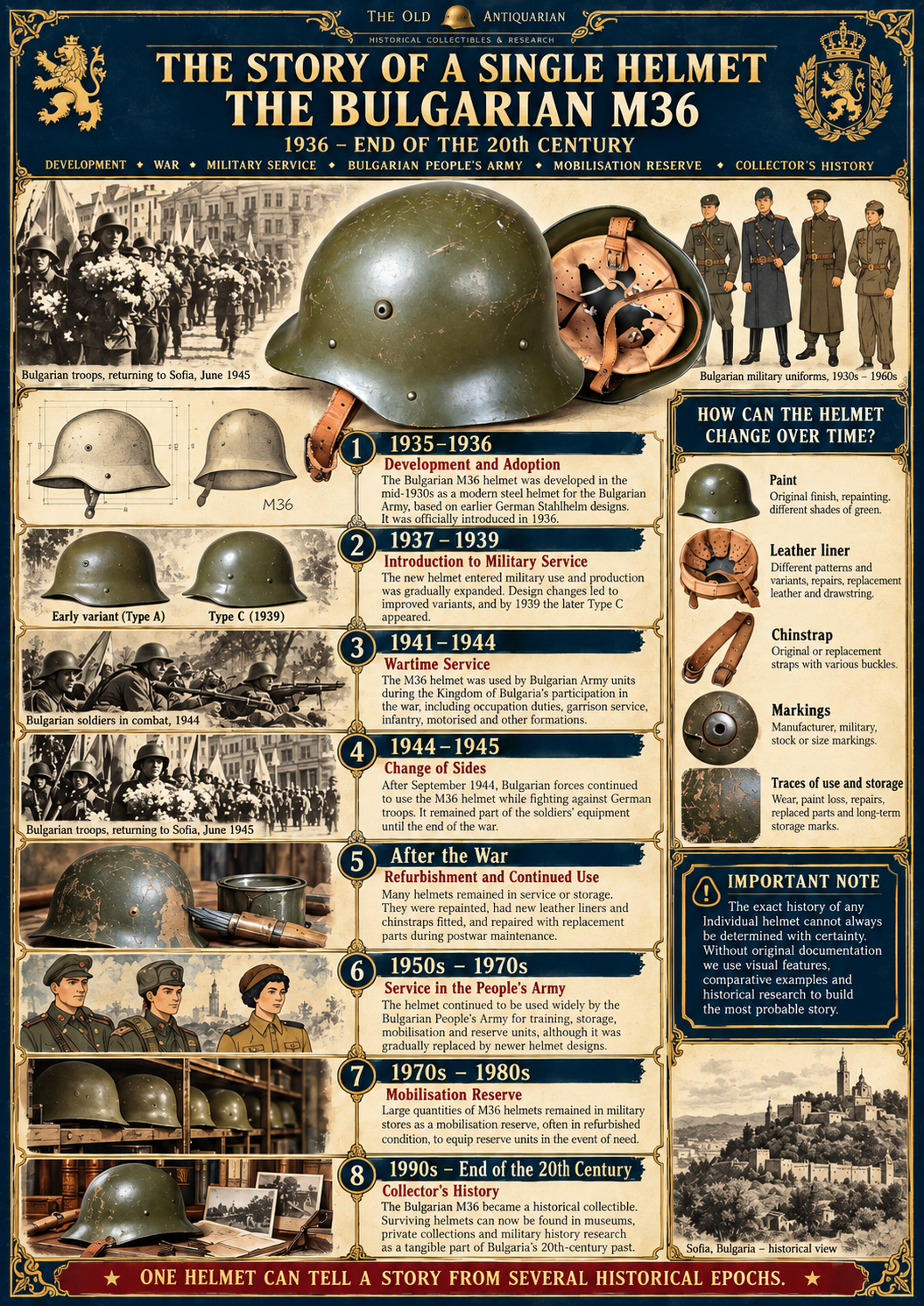
Some historical objects tell the story of a single event. Others survive long enough to witness several entirely different eras.
The Bulgarian M36 steel helmet belongs to the second category.
Designed for the army of the Kingdom of Bulgaria, the M36 witnessed the Second World War, the political transformation of September 1944, the formation of the Bulgarian People’s Army and the long decades of the Cold War.
An individual helmet might have been manufactured before the war, repainted years later, issued with a replacement liner, returned to storage and eventually discovered by a collector.
Each intervention becomes another layer in its biography.
At The Old Antiquarian, we believe military objects should be studied not only as equipment, but also as witnesses to the people and historical circumstances surrounding them.
✦ The Bulgarian M36 at a Glance ✦
| Official Model | Bulgarian Steel Helmet, Model 1936 |
| Country | Kingdom of Bulgaria |
| Development | Mid-1930s |
| Introduction | 1936 |
| Material | Pressed steel shell |
| Main Variants | M36 A, M36 B and M36 C — collector terminology |
| Distinctive Feature | Raised longitudinal crown ridge |
| Primary Wartime User | Bulgarian Army |
| Later Service | Bulgarian People’s Army and military reserves |
| Collector Interest | Type, originality, condition, markings, liner, paint and provenance |
CHAPTER I · THE BEGINNING
1. Origins: Why Bulgaria Developed the M36 Helmet
During the First World War, Bulgarian soldiers used steel helmets belonging to the German Stahlhelm family. These offered a distinctive form of military head protection and remained part of the Bulgarian Army’s equipment after the conflict.
The Treaty of Neuilly-sur-Seine, signed in 1919, severely restricted Bulgaria’s armed forces. During the following decade, however, political conditions in Europe changed and military modernisation again became an important national priority.
By the mid-1930s, Bulgaria was pursuing a new steel helmet designed for its own armed forces. Introduced in 1936, the M36 belonged to the generation of military helmets developed as armies prepared for the possibility of modern mechanised warfare.
Its profile was influenced by the wider European Stahlhelm tradition, yet its shape was distinct. The shell had a strongly flared lower edge, a characteristic central ridge and side ventilation fittings.
The M36 was not simply a renamed German helmet. It developed its own manufacturing history and several construction variants.
A Distinctive Steel Silhouette
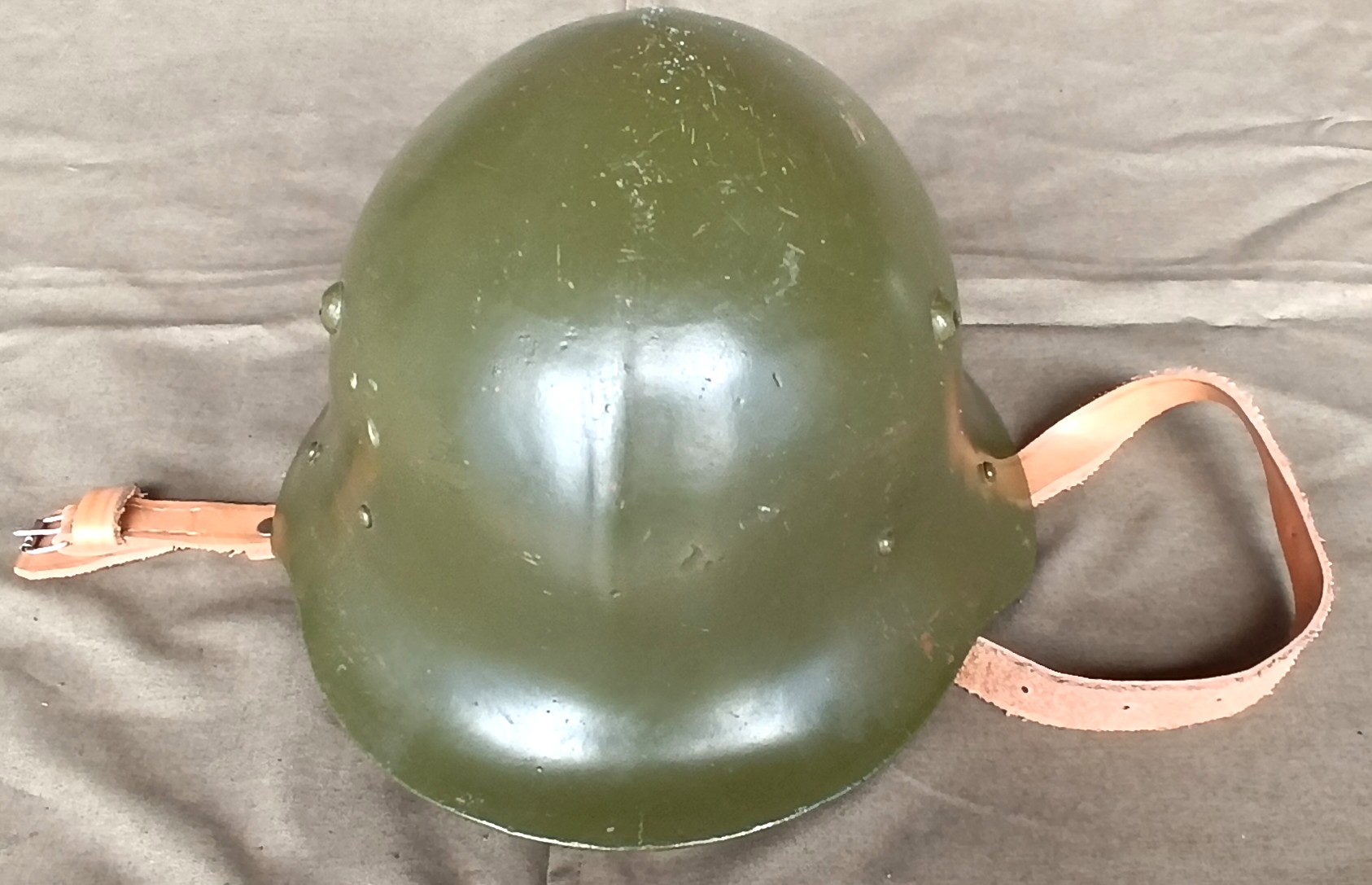
The longitudinal ridge running across the crown is one of the most recognisable characteristics of the M36. Together with the flared sides, it creates a silhouette that can often be distinguished from contemporary military helmet designs.
The shell was intended to reduce the risk of injury from battlefield fragments and related hazards. Its exact ballistic capabilities should not be exaggerated without comparable technical tests.
CHAPTER II · THE PASSAGE OF TIME
2. Historical Timeline: From 1936 to the End of the 20th Century
The history of the M36 is unusually long for a helmet associated with World War II. Its story extends far beyond the military operations of the 1940s.
| Period | Historical Development |
|---|---|
| 1935–1936 | Development and official adoption of the M36 steel helmet. |
| 1937–1939 | Introduction into military service and development of additional construction variants. |
| 1940 | The helmet is part of the equipment associated with the Royal Bulgarian Army during the Southern Dobruja period. |
| 1941–1944 | Service during Bulgaria’s participation in World War II alongside the Axis alliance. |
| 1944–1945 | Continued use during Bulgarian military operations against Germany. |
| After 1945 | Retention, repair, repainting and reuse of older helmets. |
| 1950s–1970s | Military service and storage within the Bulgarian People’s Army. |
| 1970s–1980s | Further military refurbishment and continued reserve storage. |
| 1990s onwards | Increasing appearance in military surplus collections, museums and private historical collections. |
Historical Perspective: A helmet manufactured during the Kingdom of Bulgaria could have continued its existence under an entirely different political system, carrying several successive layers of military use.
CHAPTER III · THE WAR YEARS
3. The Bulgarian M36 During World War II
The military history of the M36 must be understood within the changing role of Bulgaria during World War II.
The same general helmet design served in an army that experienced two very different wartime periods: Bulgaria’s alliance with the Axis powers and, after September 1944, the campaign against Nazi Germany.
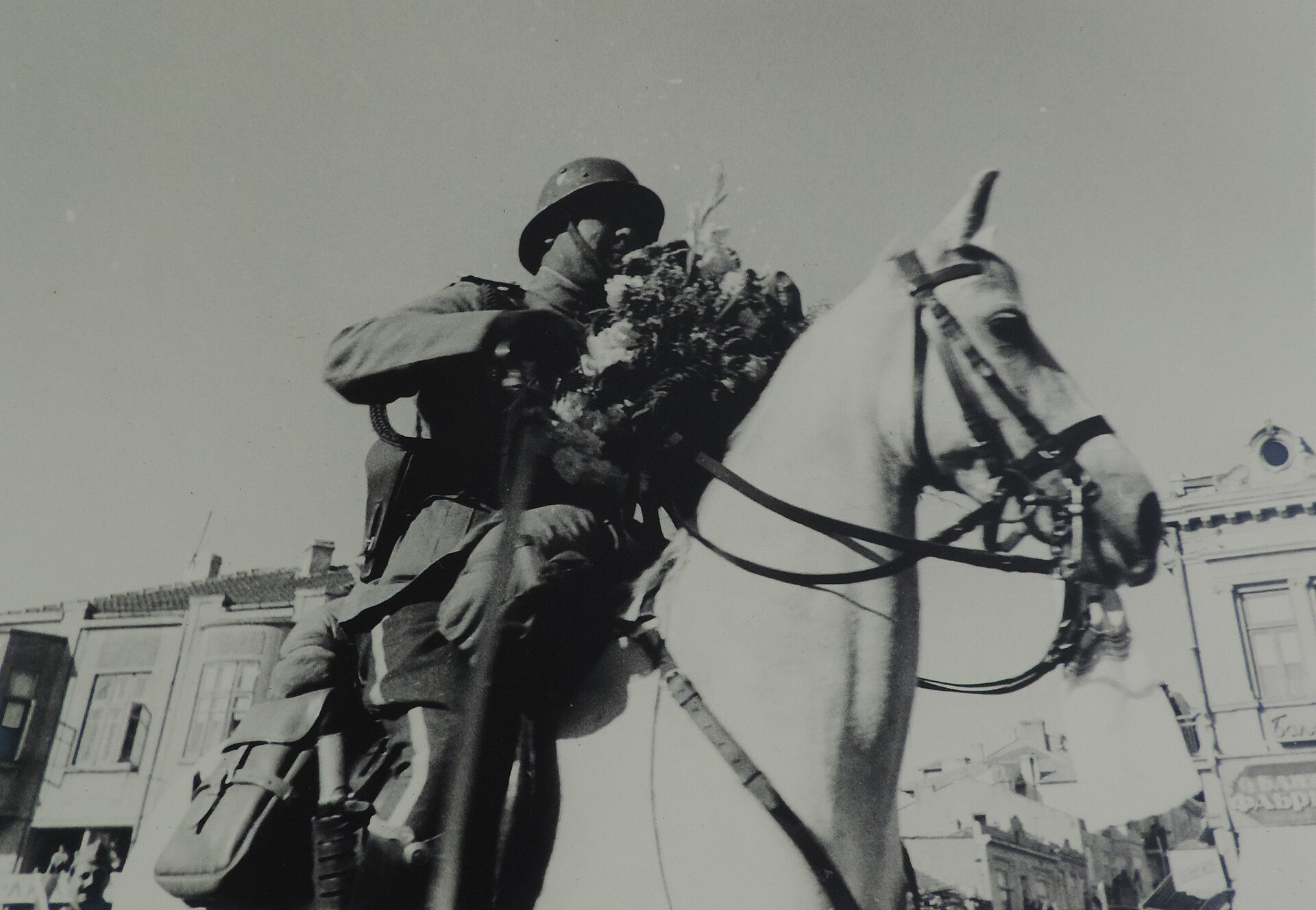
1940: The Return of Southern Dobruja
In September 1940, the Treaty of Craiova returned Southern Dobruja from Romania to Bulgaria. The arrival of Bulgarian troops was accompanied by public ceremonies and considerable national emotion.
Historical photographs from the period provide valuable evidence for the appearance of the Royal Bulgarian Army immediately before Bulgaria joined the Tripartite Pact.
1941–1944: Wartime Garrison and Occupation Service
Bulgaria joined the Tripartite Pact on 1 March 1941. Following the Axis invasion of Yugoslavia and Greece, Bulgarian military forces took part in the occupation and administration of territories in the Balkans.
The army undertook garrison, communications, security and other military duties. The M36 was part of the equipment associated with Bulgarian troops during this period.
The Bulgarian National Museum of Military History documents this phase of occupation as part of the country’s wider wartime history.
September 1944: A Change of Sides
In September 1944, Bulgaria underwent a fundamental political transformation. Following the Soviet declaration of war and the events surrounding 9 September, Bulgarian military forces joined the campaign against Germany.
The M36 continued to serve Bulgarian soldiers during this new phase of the conflict.
This continuity is historically remarkable: a helmet introduced under the monarchy remained in use as the country’s armed forces changed their wartime alignment.
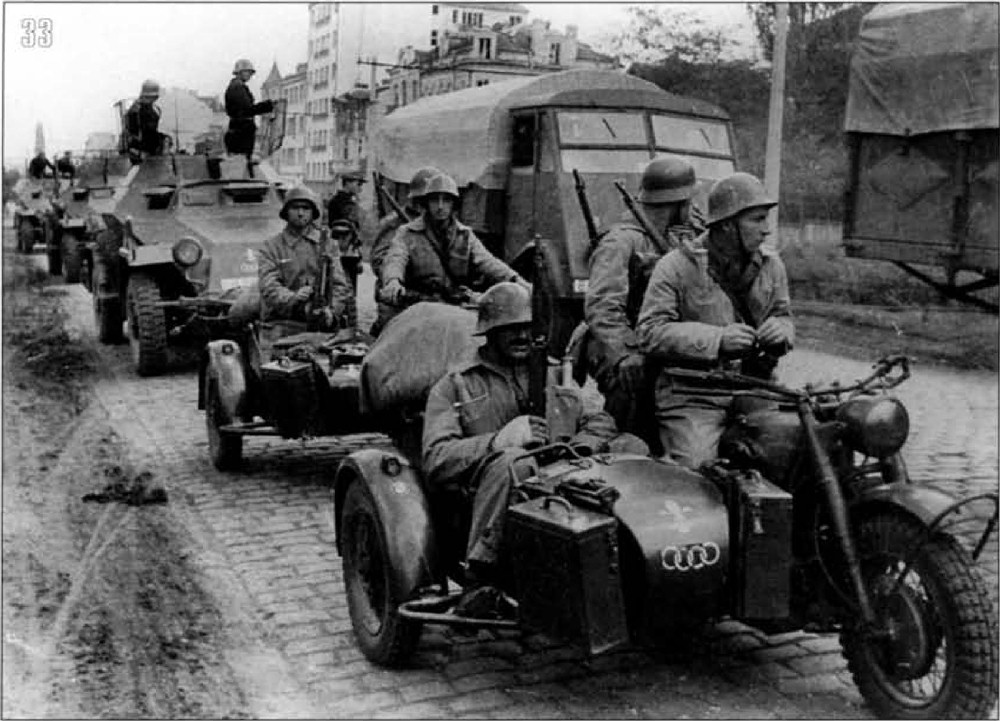
The Bulgarian Campaign in Yugoslavia, 1944
Bulgarian infantry, artillery, motorised and armoured formations participated in the autumn campaign of 1944, including operations around Niš, Kosovo, Stratsin and Kumanovo.
Surviving photographs show the range of vehicles, uniforms and equipment associated with the period.
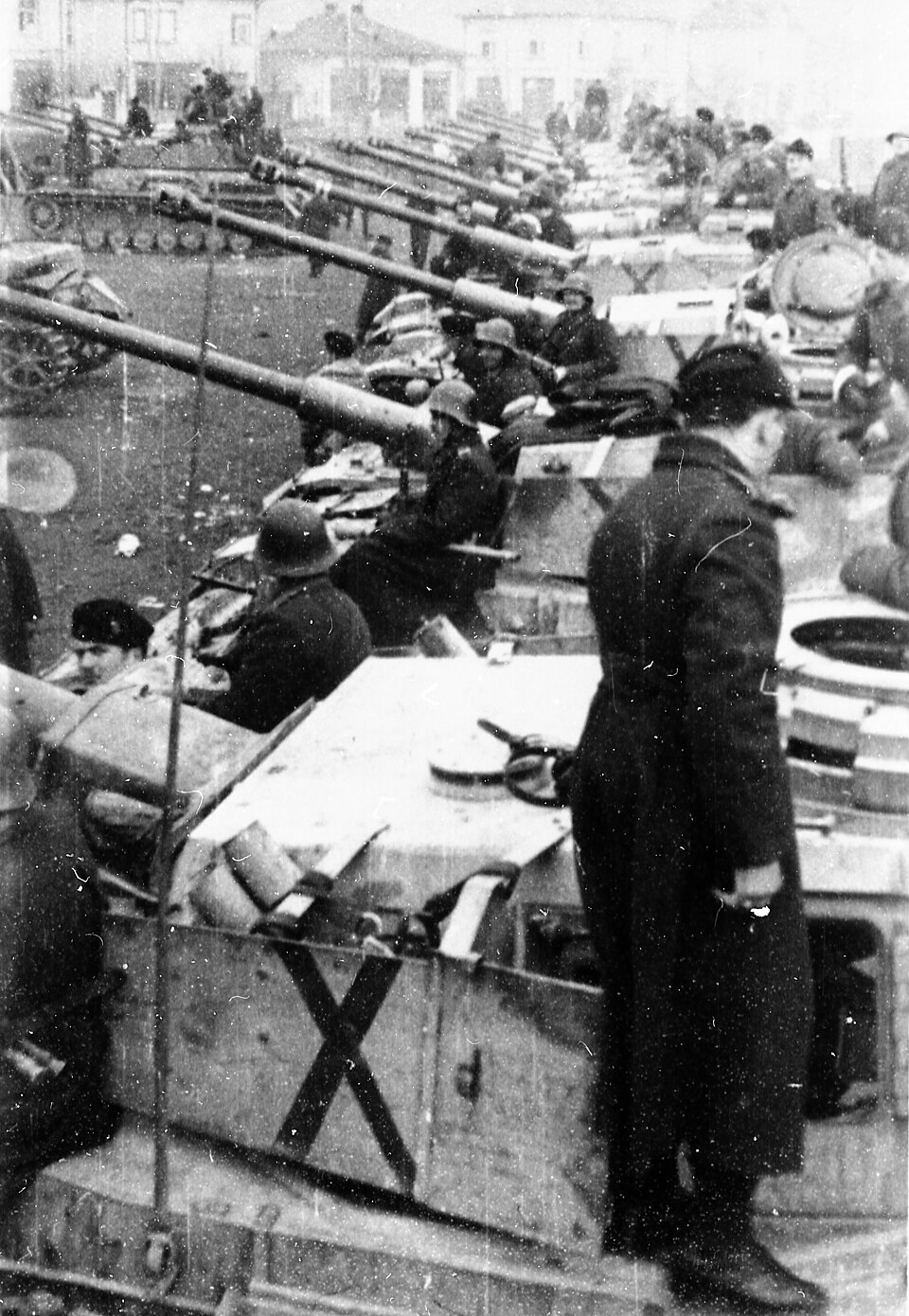
The Bulgarian Armoured Brigade and Panzer IV
The Bulgarian Army operated a range of armoured vehicles, including German-built Panzer IV tanks. Their presence in the 1944 campaign illustrates the complex military relationships and equipment transfers of the period.
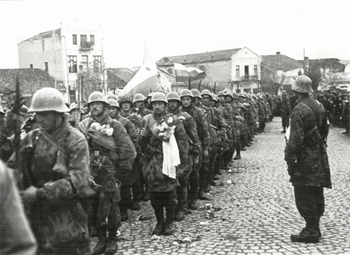
Bulgarian Paratroopers at Strazhin and Kumanovo
The Bulgarian Parachute Battalion was established in 1943 and later participated in the fighting against German forces.
Its actions during the Stratsin–Kumanovo offensive operation in October 1944 became an important chapter in Bulgarian airborne history.
The fighting at Strazhin on 18 October 1944 was particularly significant for the formation.
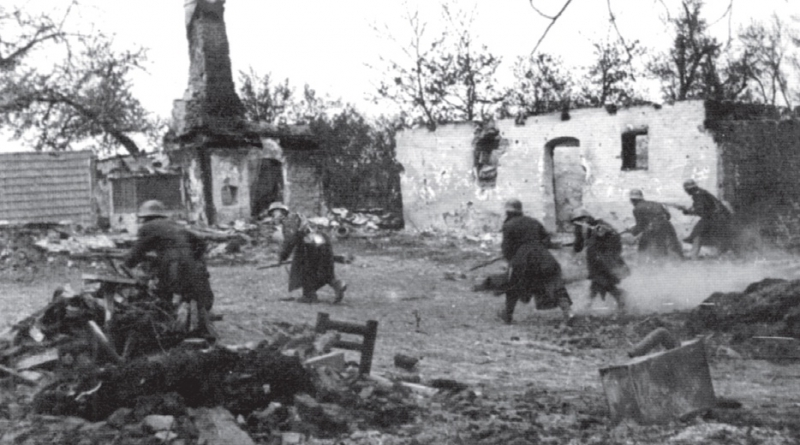
1945: The Battle Along the Drava
During the final months of World War II, the First Bulgarian Army fought in Hungary as part of the operations against Germany.
The Drava Defensive Operation of March 1945 became one of the important military episodes of this campaign.
The men involved faced difficult terrain, demanding weather conditions and intense fighting. Their helmets were everyday pieces of equipment, not the collector’s objects they would eventually become.
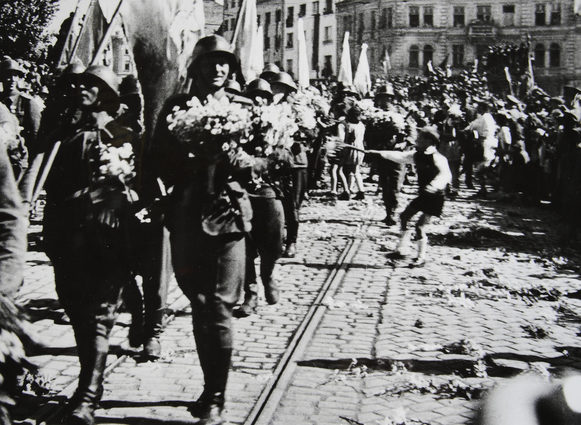
17 June 1945: The Army Returns to Sofia
On 17 June 1945, formations of the First Bulgarian Army received a ceremonial welcome in Sofia after the end of the European war.
The return of the soldiers marked the conclusion of a long and difficult campaign.
For the men who had worn them, the steel helmets were reminders of military service and personal experiences. For later generations, they became objects through which that history could still be studied.
✦ HISTORICAL PERSPECTIVE ✦
One helmet design accompanied Bulgarian soldiers through two opposing phases of World War II — and survived to serve another generation.
CHAPTER IV · THE COLLECTOR’S REFERENCE
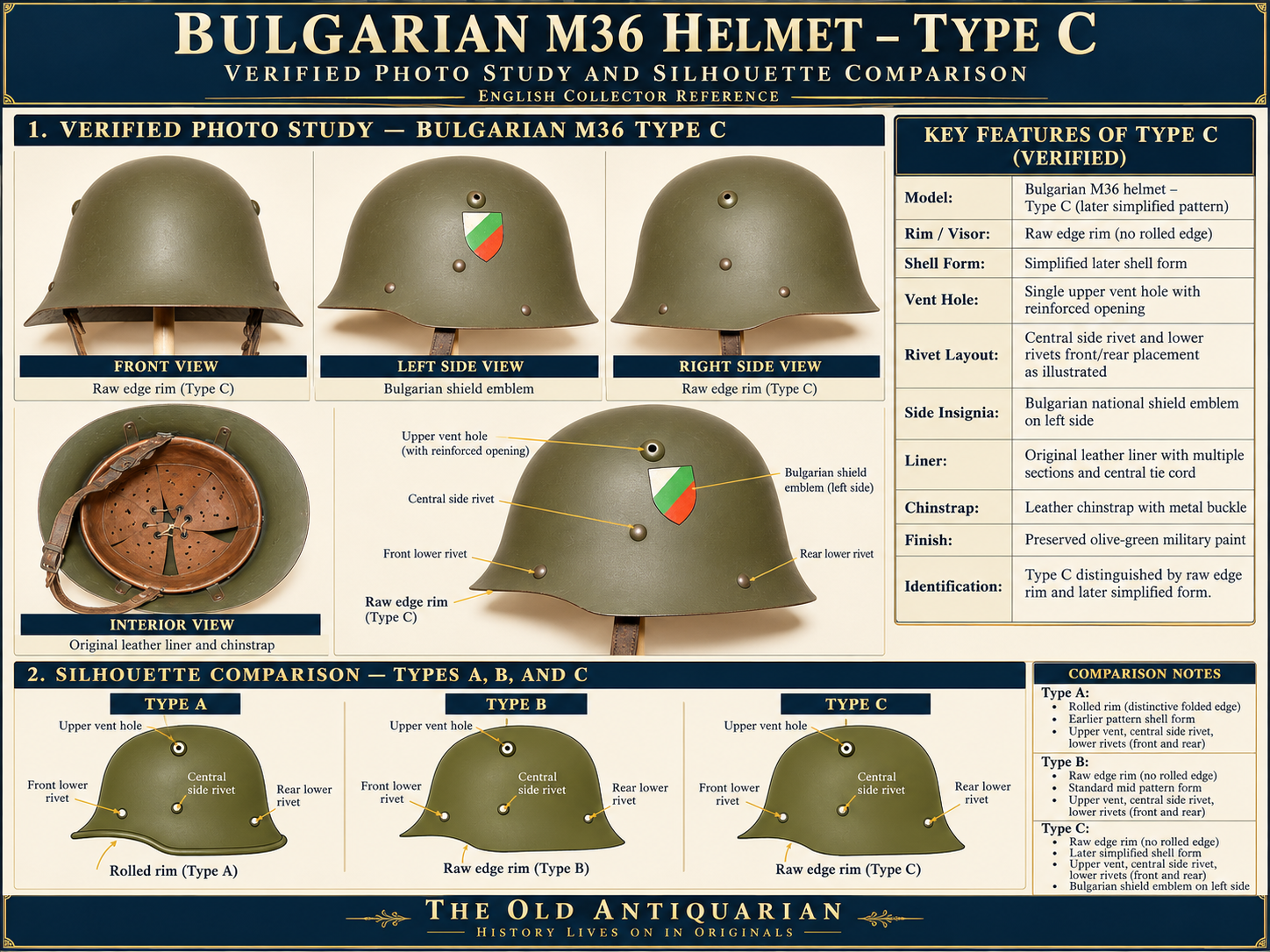
4. Bulgarian M36 Types A, B and C: Identification
The Bulgarian M36 is generally divided into three principal variants by military helmet collectors.
The terms Type A, Type B and Type C are widely accepted in collector literature, although it is not certain that they were the official contemporary designations used by the Bulgarian Army.
Understanding the physical differences is essential for identifying surviving examples.
| Feature | Type A | Type B | Type C |
|---|---|---|---|
| General Design | Early pattern | Transitional pattern | Later simplified pattern |
| Shell Rim | Rolled | Unrolled | Unrolled |
| Liner Attachment | Four large rivets | Three or four large rivets | Four smaller rivets with spring brackets |
| Shell Profile | Deeper, heavier | Similar to A | Shallower, more compact |
| Original Liner | Early seven-tongue leather pattern | Several early configurations | Often six perforated leather tongues |
| Collector Availability | Less common | Especially uncommon | Most frequently encountered |
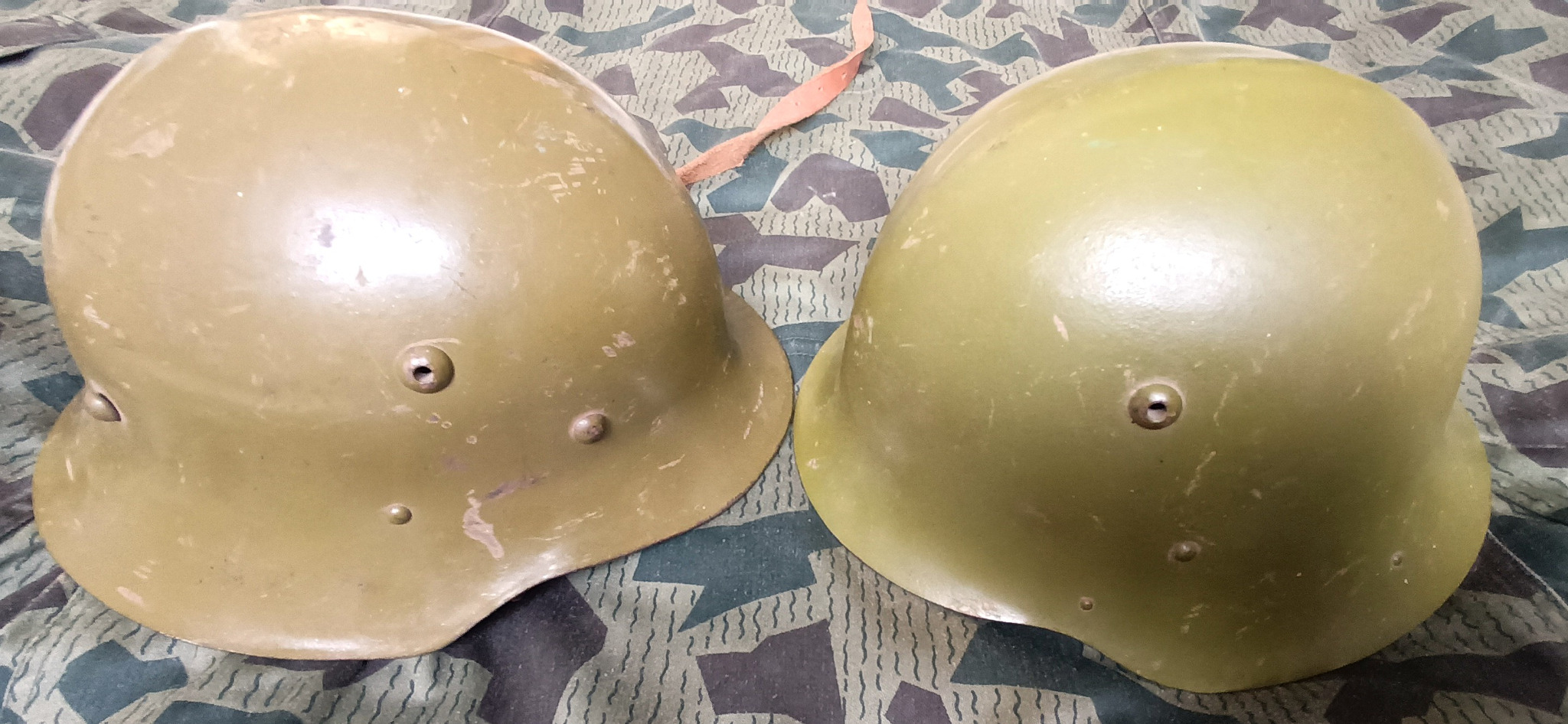
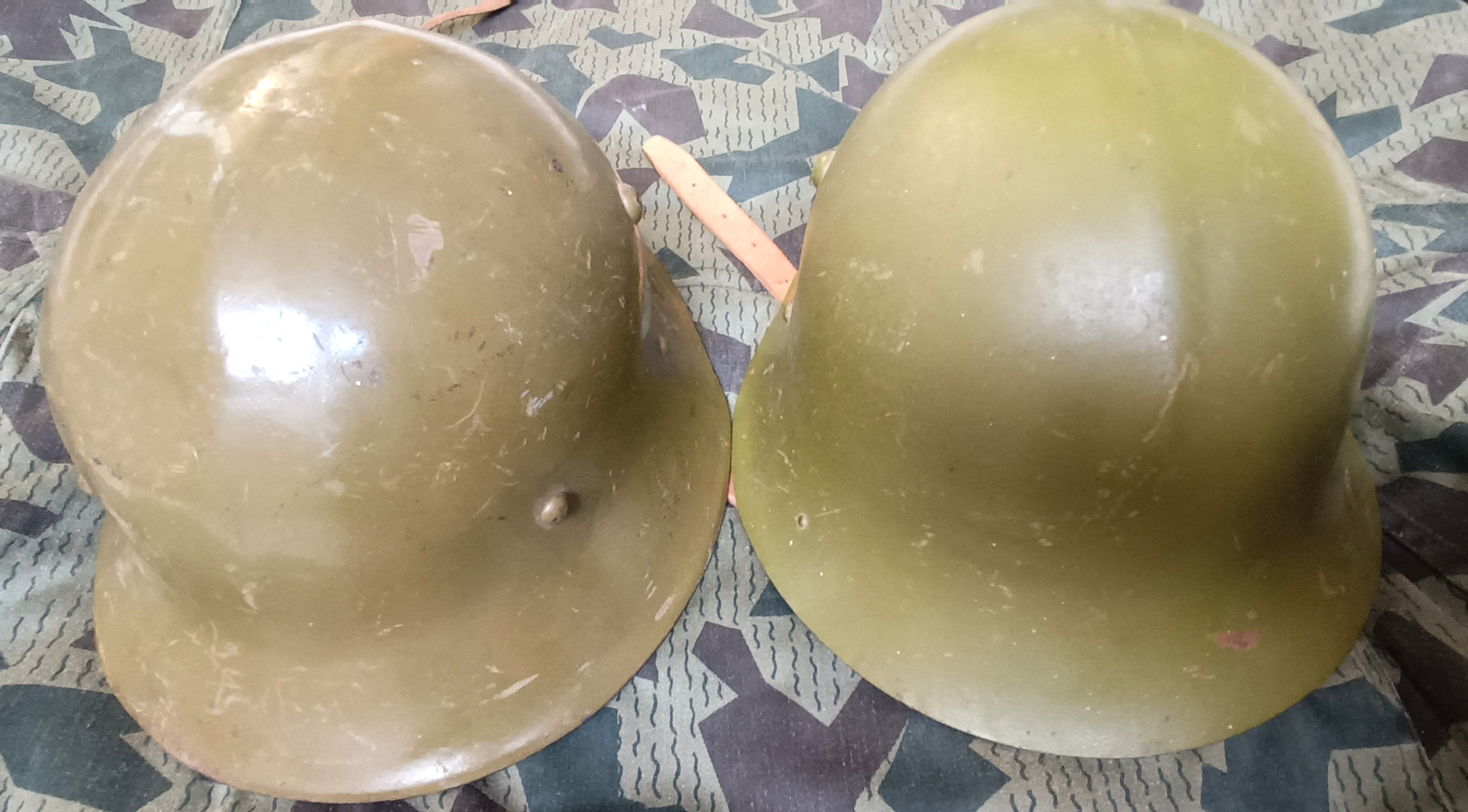
Photographic Comparison: M36 Type A on the Left, Type C on the Right
These two original comparison photographs show actual surviving Bulgarian M36 helmets side by side. The Type A (M36A) is on the left, while the Type C (M36C) is on the right. Examining both helmets at the same scale makes differences in shell depth, brim curvature, rivet positions and the transition from crown to rim easier to recognise.
The most reliable distinction is the shell construction: the M36A has a rolled steel rim, whereas the M36C has an unrolled edge and a different liner attachment arrangement. Paint colour alone is not a reliable dating method because both helmets may have been repainted during military service.
Type A — The Original Rolled-Rim Pattern
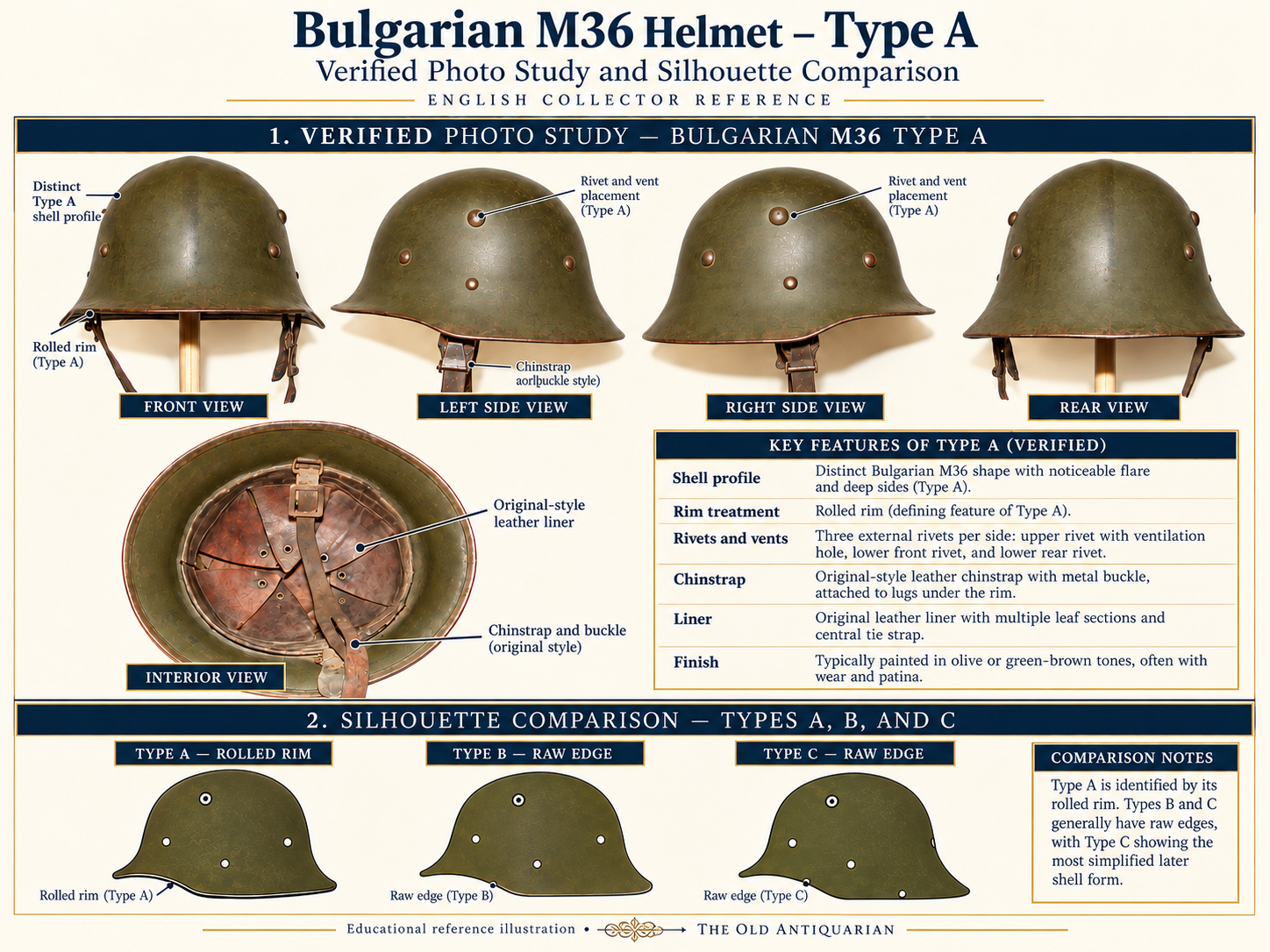
The M36 Type A is the early rolled-rim model. The edge of its steel shell is folded under, a characteristic that distinguishes it from the later Type B and C helmets.
Four large domed rivets secure the original style of liner band, while two separate smaller rivets are used for the chinstrap fittings.
Documented early liners have seven leather tongues with reinforced openings for the adjustment cord.
Type B — The Transitional Helmet
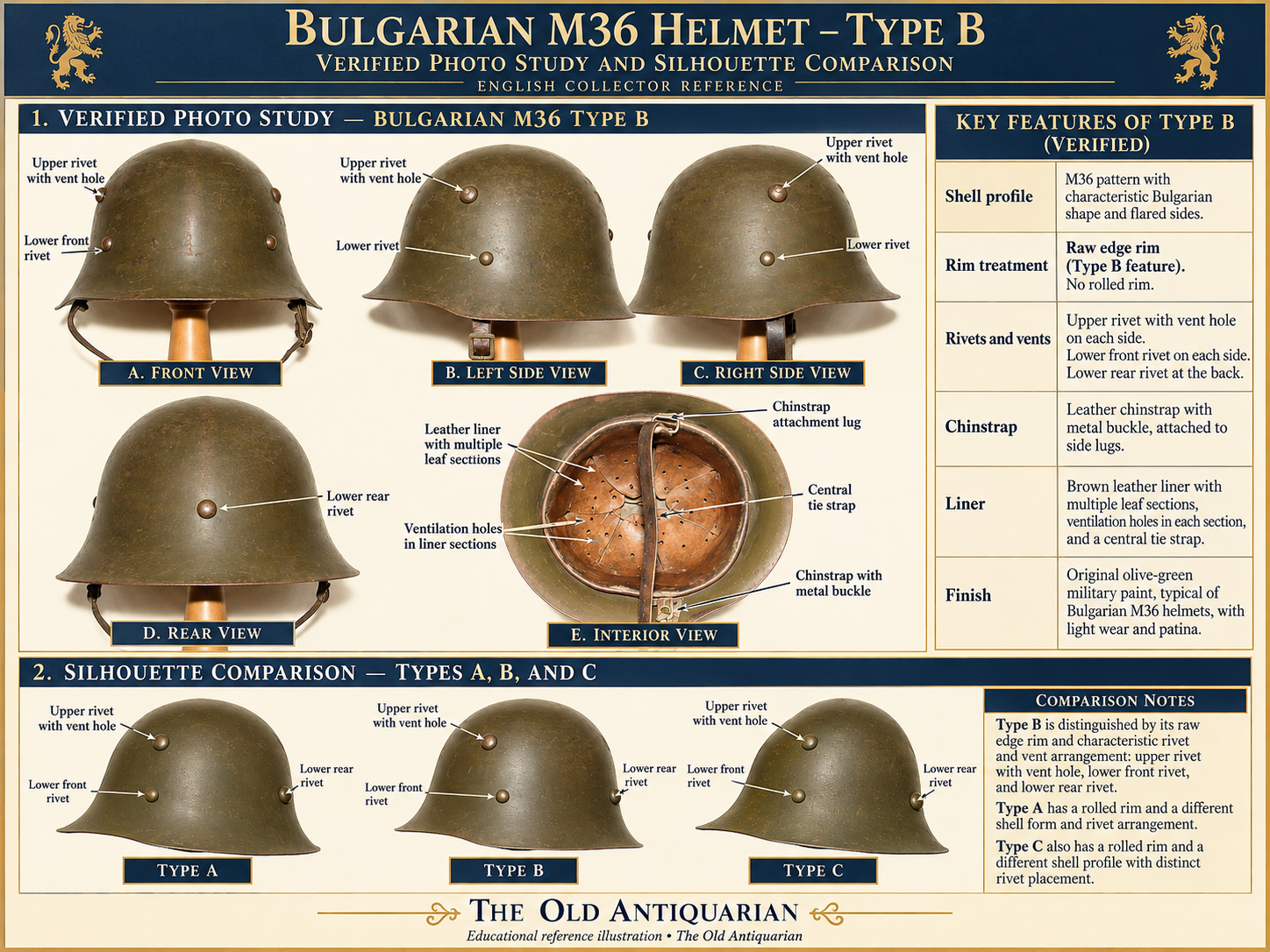
Type B retained much of the general shape of Type A but introduced an unrolled steel edge.
Many examples have three large liner attachment rivets, although four-rivet versions also exist.
This means the number of rivets alone cannot identify every Type B helmet. The shell edge, proportions and complete suspension arrangement must also be considered.
Type B is considered especially uncommon among surviving collector examples, but precise factory production figures remain uncertain.
Type C — The Long-Serving Later Pattern
Type C, generally associated with the design changes introduced around 1939, is the most frequently encountered M36 variant.
It has a more compact shell, an unrolled rim and a distinctive suspension arrangement using four springing metal brackets.
Original examples commonly have six leather liner tongues with ventilation perforations.
Its long military service explains the large number of surviving helmets with later paint, replacement liners or other refurbishment features.
CHAPTER V · FACTORIES AND PRODUCTION
5. Who Manufactured the Bulgarian M36 Helmet?
One of the most interesting questions surrounding the M36 concerns its manufacturing history.
Traditional references identify early manufacturing connections with Czechoslovakia and later domestic production associated with the Bulgarian state military works in Kazanlak.
Czechoslovak firms commonly mentioned in specialist literature include Sandrik at Dolné Hámre and Brüder Gottlieb und Brauchbar at Brno.
The Question of German Manufacture
Older collector books also mention Eisenhüttenwerk Thale in Germany as a possible manufacturer.
However, recent studies of surviving helmets have questioned this attribution. Convincing examples bearing the expected German factory identification, or sufficient contemporary production documents, have not been established in the research consulted.
The existence of such production cannot be ruled out absolutely, but it should not be treated as proven.
| Location | Connection | Research Status |
|---|---|---|
| Brno, Czechoslovakia | Early production | Supported by specialist attribution |
| Dolné Hámre, Czechoslovakia | Early production | Reported in historical literature |
| Kazanlak, Bulgaria | Domestic manufacture | Well-established industrial connection |
| Thale, Germany | Claimed foreign manufacture | Disputed and insufficiently documented |
Who Designed the Bulgarian M36 Helmet?
The available specialist references do not establish a single named civilian designer for the Bulgarian M36. Its development is generally attributed to Bulgarian military requirements and technical work carried out under the army’s authority. Claims that a particular commission designed every detail, or that Tsar Boris III personally directed the engineering, require specific archival confirmation.
The new helmet was influenced by the German First World War Stahlhelm but was substantially modified, especially in the profile of the lower brim, the ventilation fittings and the raised longitudinal ridge along the crown. This resemblance should not be confused with the Soviet SSh-36, which is a different helmet despite the similar year designation.
Accounts of early Bulgarian production also describe a press imported from Germany for the state military works in Kazanlak around late 1935. The origin of machinery is not proof that all helmets made with it were manufactured in Germany. The attribution of actual German-made M36 shells remains disputed.
How Many M36 Helmets Were Produced?
Exact production totals are not securely established from the published records available for this guide.
Although estimates appear in collector literature, specific numerical claims should not be repeated as official factory statistics without supporting procurement documents or production registers.
The surviving population of helmets is also affected by battlefield losses, repairs, storage, disposal and postwar refurbishment.
Estimated Production Shares: Why Type C Is More Common
A commonly repeated collector estimate assigns around 70% or more of overall M36 production to the later Type C. Some popular breakdowns also suggest approximately 25% Type A and 3–4% Type B. These figures are useful for explaining perceived scarcity, but they are not authenticated factory statistics and should not be presented as exact production totals.
| Collector Variant | Frequently Quoted Approximation | Evidence Status |
|---|---|---|
| Type A | About 25% | Unverified collector estimate |
| Type B | About 3–4% | Unverified collector estimate |
| Type C | 70% or more | Widely cited, not an official total |
Survival rates are not necessarily the same as original production shares. The prolonged service and storage of Type C, combined with wartime losses and later refurbishment, affect the number of helmets collectors encounter today. Type B remains especially uncommon in the surviving material.
CHAPTER VI · ENGINEERING AND CRAFTSMANSHIP
6. Construction: Steel Shell, Leather Liner and Chinstrap
The construction of the M36 reflects the military engineering priorities of the interwar period.
A steel shell provided the outer protective surface, while the interior suspension distributed weight and kept the wearer’s head separated from the metal.
Steel Shell and Ventilation
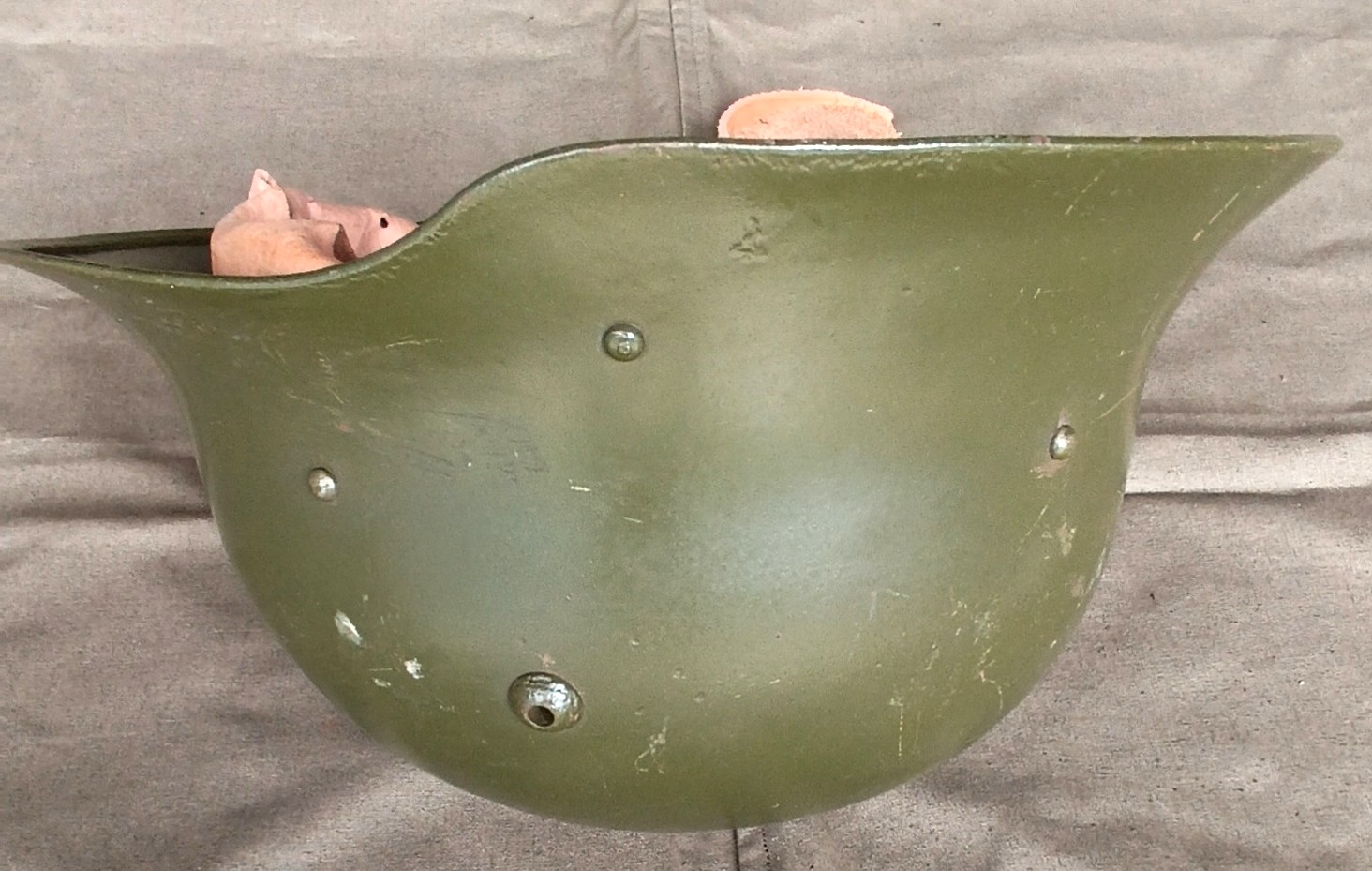
The shell was formed from steel and included ventilation fittings positioned on the sides. These fittings are useful identification details, although their appearance must be evaluated together with the rest of the construction.
Leather Suspension Systems
The original interior consisted of a leather liner secured to a supporting band. The design permitted adjustment through a drawstring passing through openings in the leather tongues.
The suspension also maintained a space between the steel shell and the wearer’s head, a basic principle of military helmet construction.
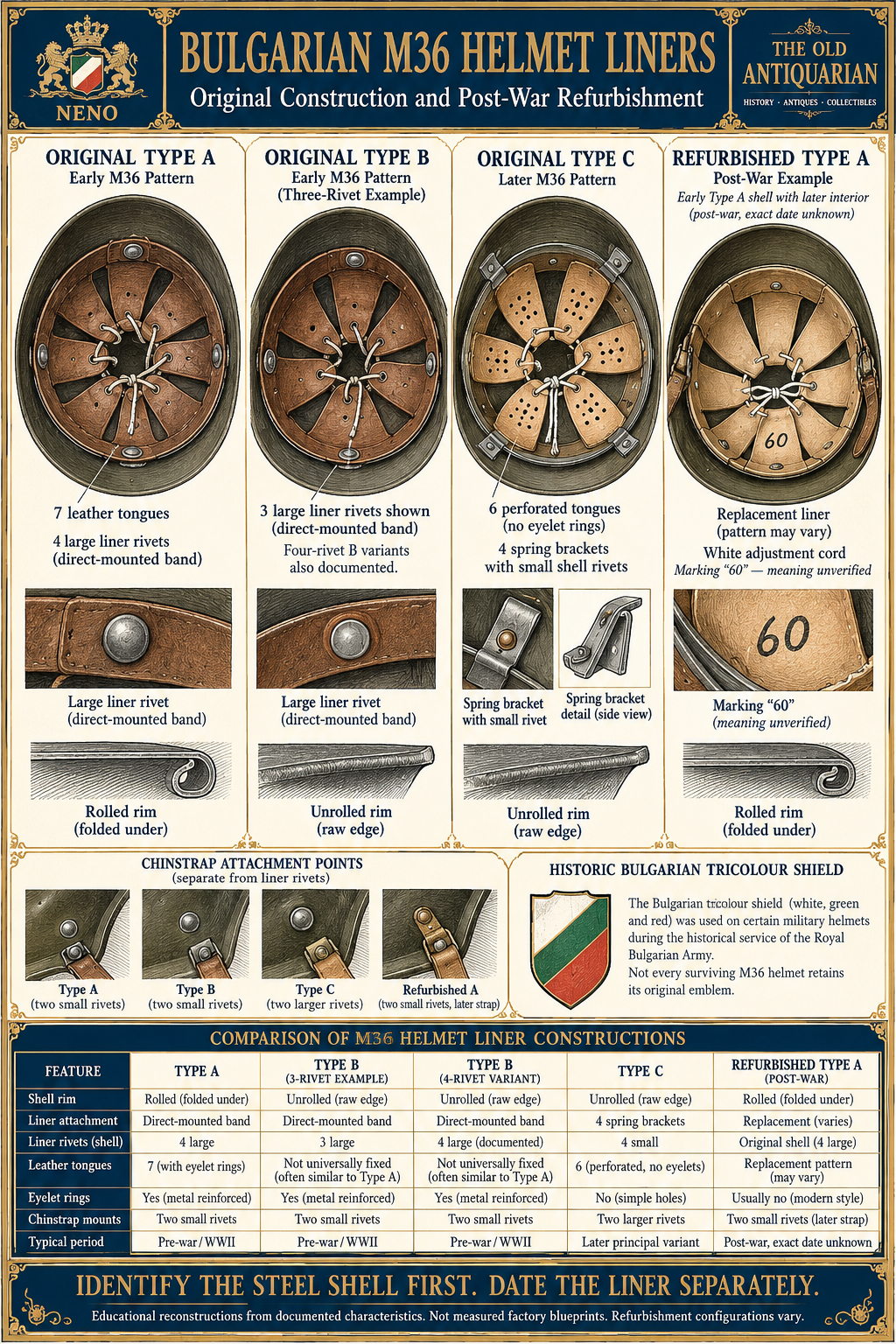
The important differences between early and later interiors include the number of leather tongues, rivet arrangements and the use of spring-supported mounting brackets.
Original Liners vs Postwar Replacement Liners
A major challenge in M36 identification is that many helmets were fitted with replacement interiors.
An early steel shell may therefore have a later leather liner, a replacement drawstring or new chinstrap fittings.
The correct approach is to date the shell and the interior separately rather than assuming they were manufactured at the same time.
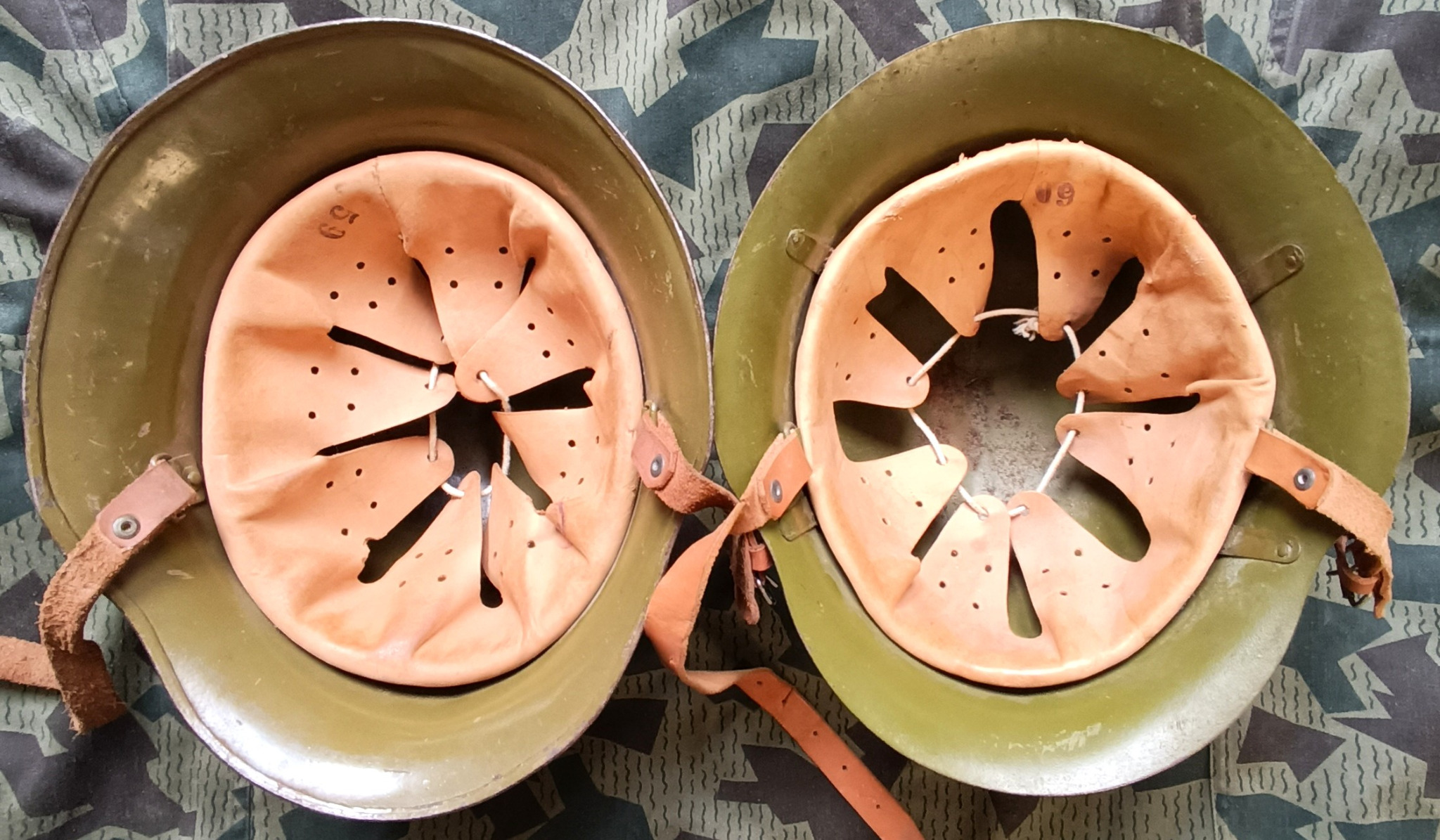
Actual M36A and M36C Interiors: A Side-by-Side Study
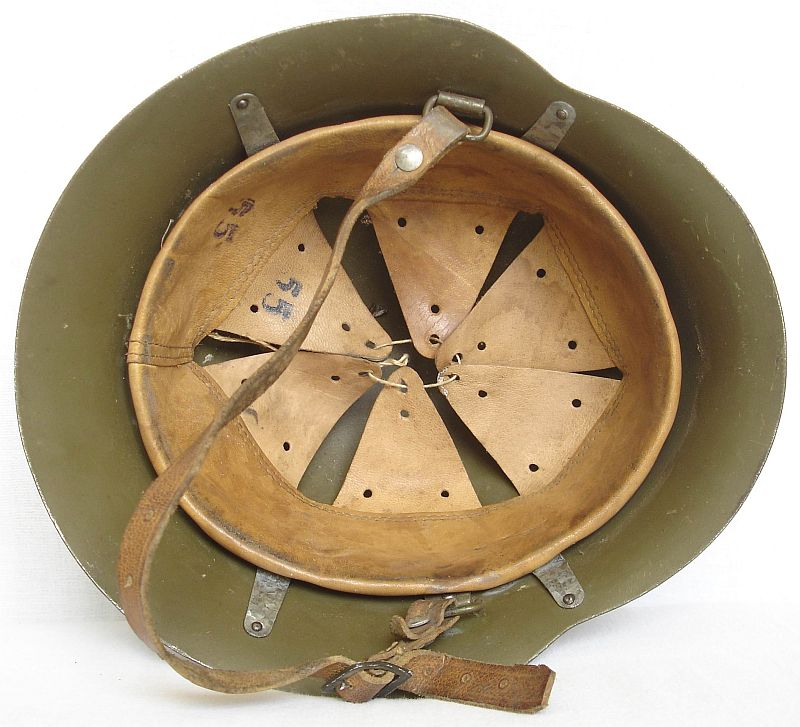
The next photograph compares the inside of the two surviving helmets: M36 Type A on the left and M36 Type C on the right. Both have pale tan leather liners with six perforated tongues, adjustment cords and leather chinstraps. The internal mounting brackets and construction of the steel shell are important identification details.
This comparison also illustrates a frequent collecting pitfall. An early Type A steel shell can carry a later six-tongue liner after refurbishment; it should not be reclassified as Type C merely because its leather resembles the later pattern.
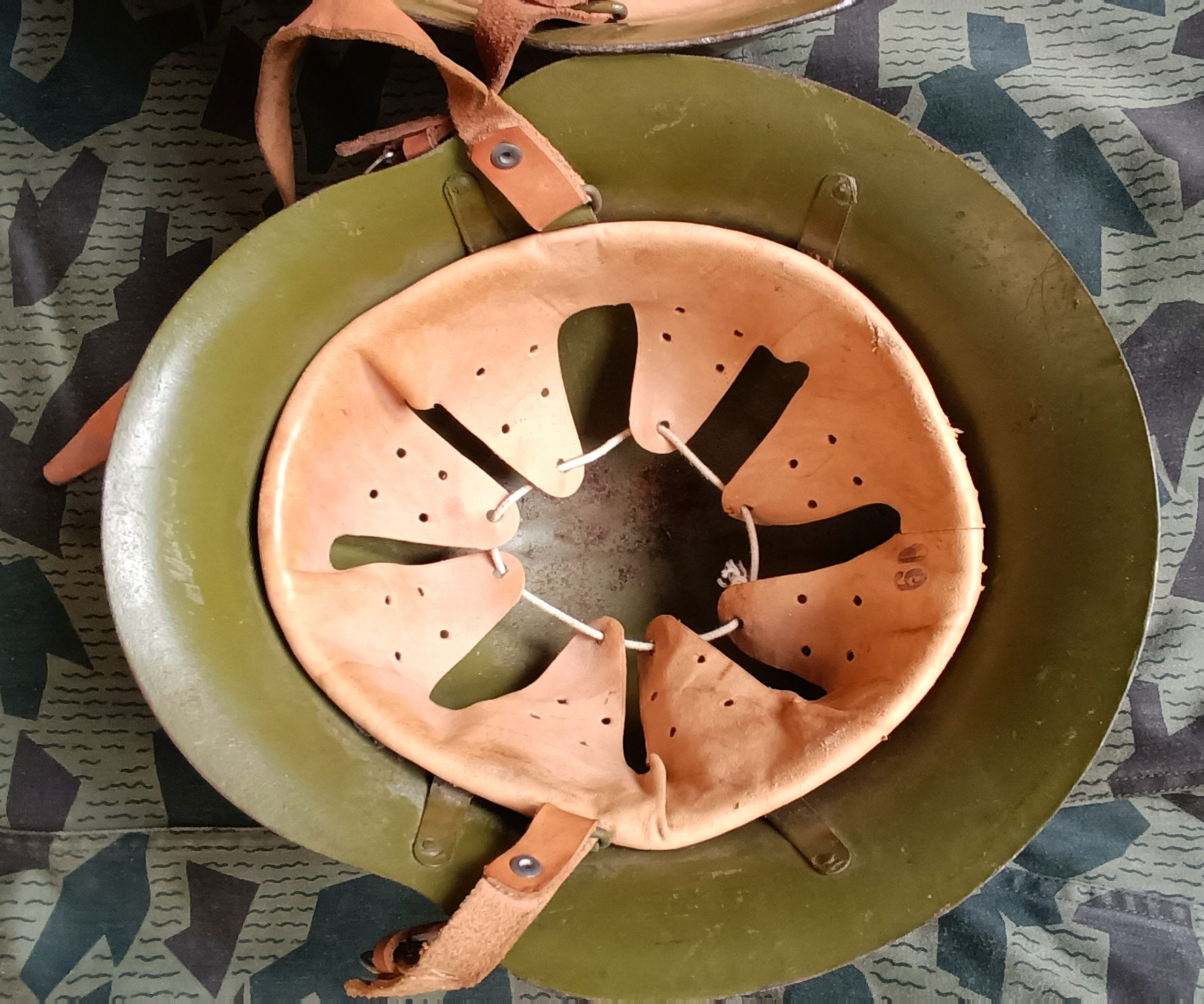
The Type C Leather Liner and Spring Brackets
In this closer view of the M36C, the six perforated leather tongues are linked by a light drawstring. Metal brackets visible around the inside of the shell help secure the suspension. The dark marks on the leather cannot be used to establish a particular production year without corroborating documentation.
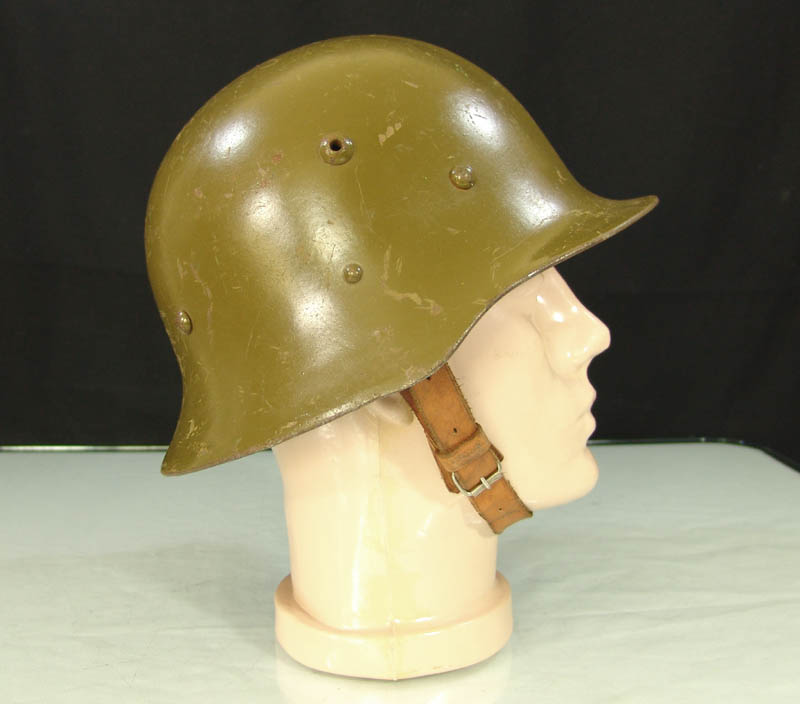
The Chinstrap
The chinstrap helped keep the helmet in position during movement. Earlier constructions could include split leather sections and fittings influenced by Central European military equipment.
Later replacement straps sometimes adopted different buckles or simpler leather arrangements.
When studying a surviving helmet, the chinstrap should never be assumed original merely because the leather looks old.
CHAPTER VII · AN OBJECT THAT SURVIVED
7. The Old Antiquarian Collection Study: M36 Type A
The surviving helmet photographed for this article illustrates the difference between an authentic historical object and an untouched original configuration.
This example is identified as a Bulgarian M36 Type A with later Bulgarian People’s Army refurbishment.
Its early-pattern shell survives with later military paint and replacement interior components.
The exact factory, manufacturing year and date of refurbishment have not been independently established. The helmet is therefore best understood through the physical evidence that remains visible.
The Surviving Steel Shell
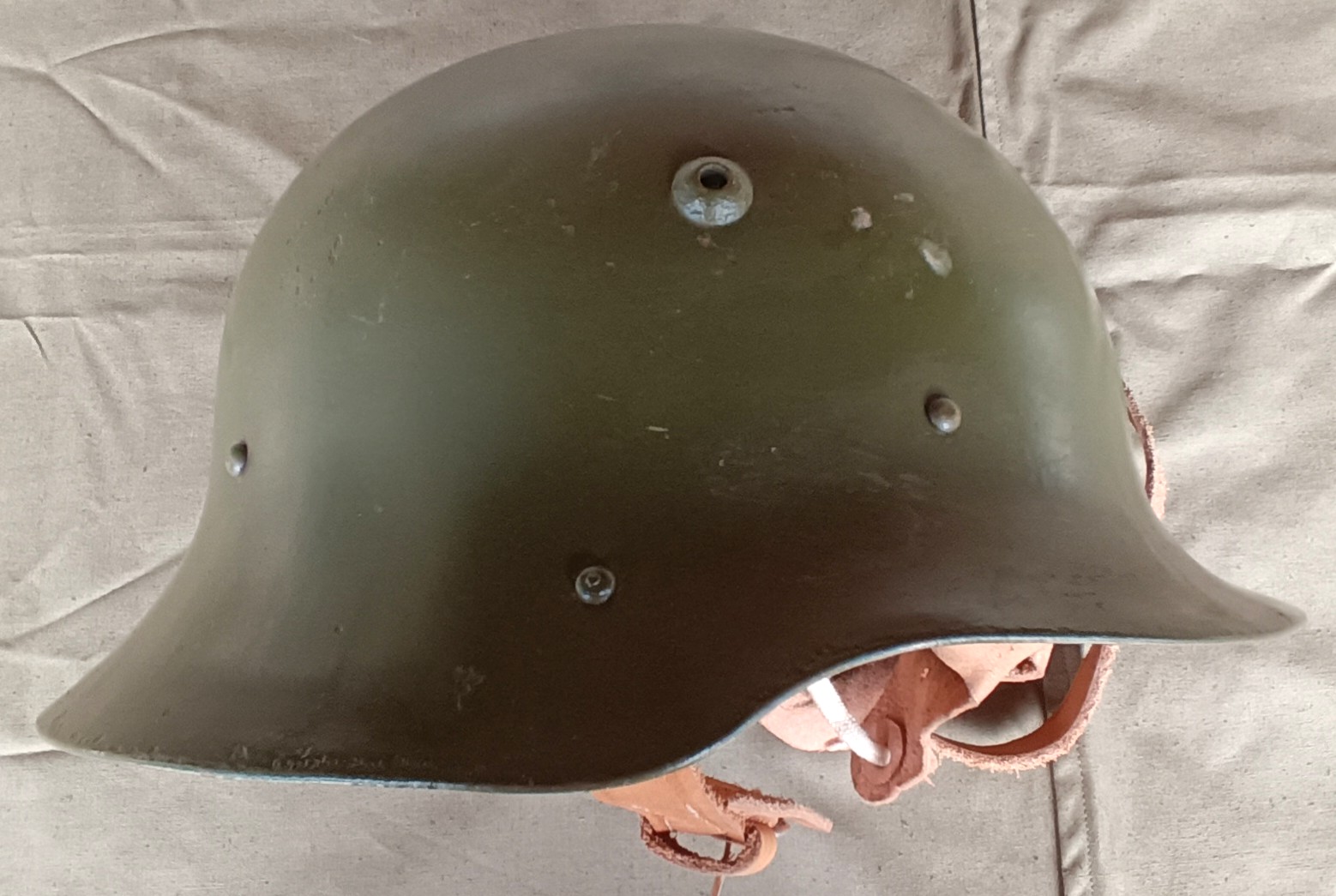
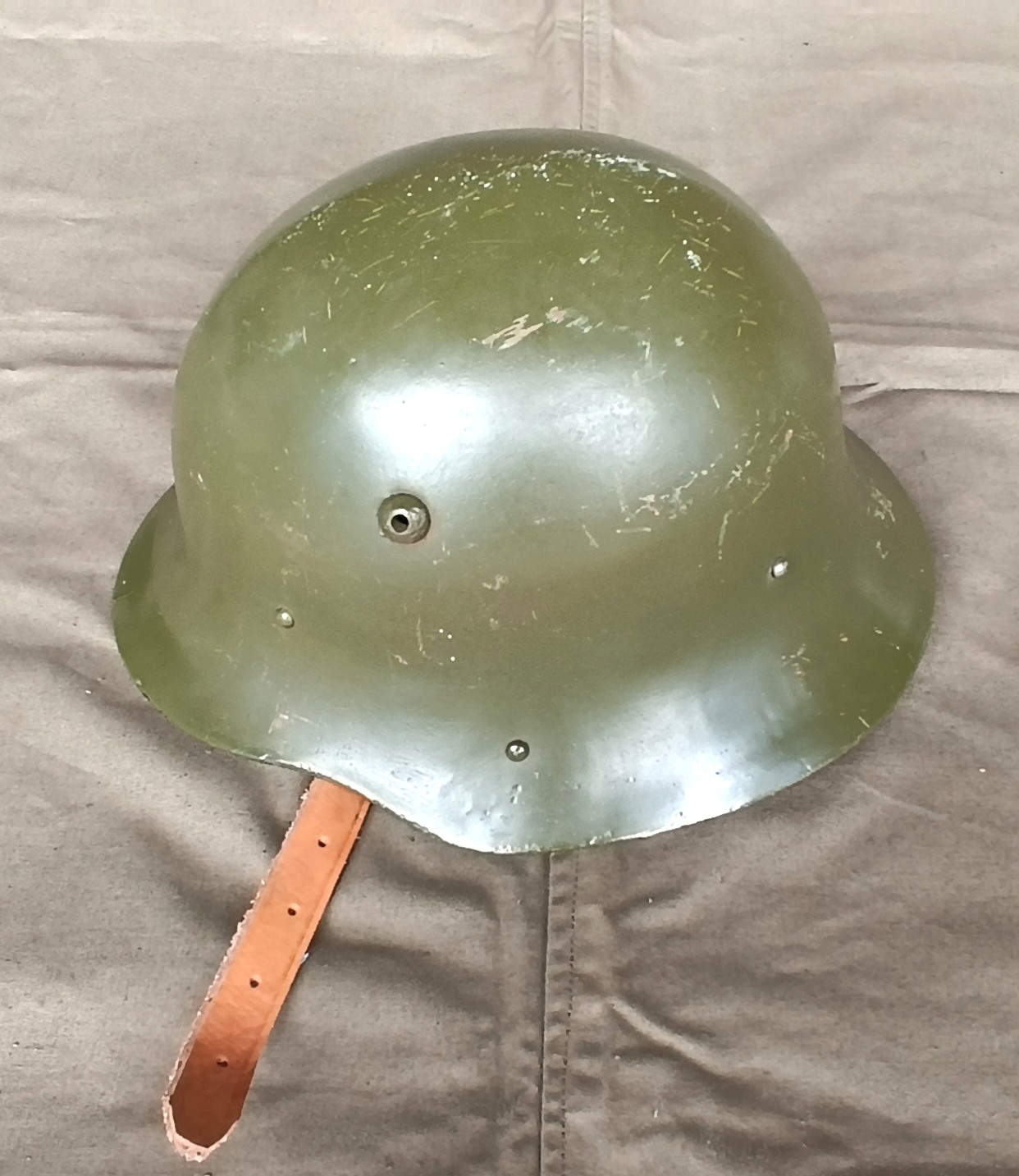
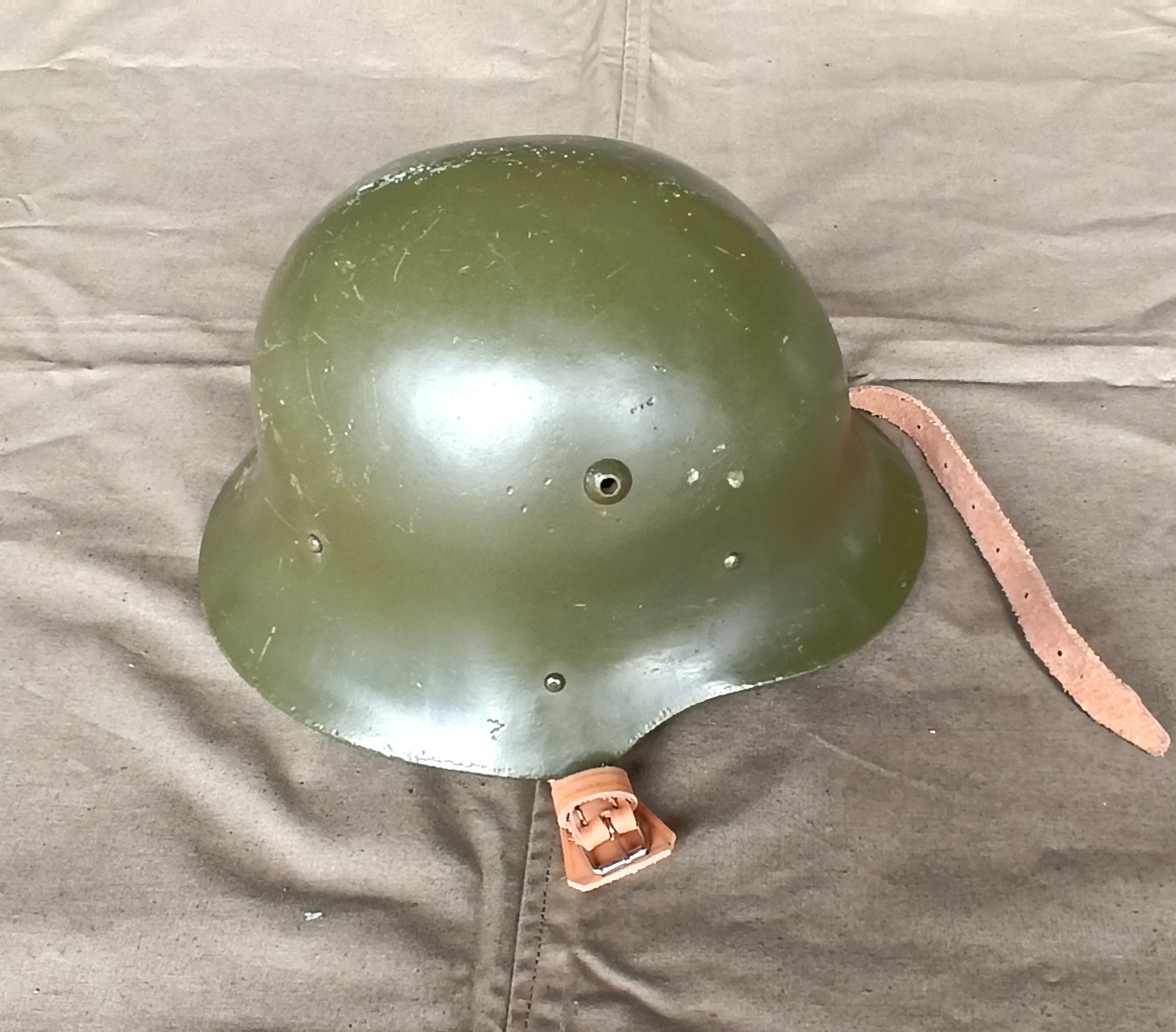
The broad flared rim, rolled edge and characteristic shape support the identification of the shell as the early Type A pattern.
The current surface finish belongs to the helmet’s later military history and should not be described as untouched wartime paint.
Front View: The Characteristic Silhouette
Rivets, Ventilation and Later Chinstrap
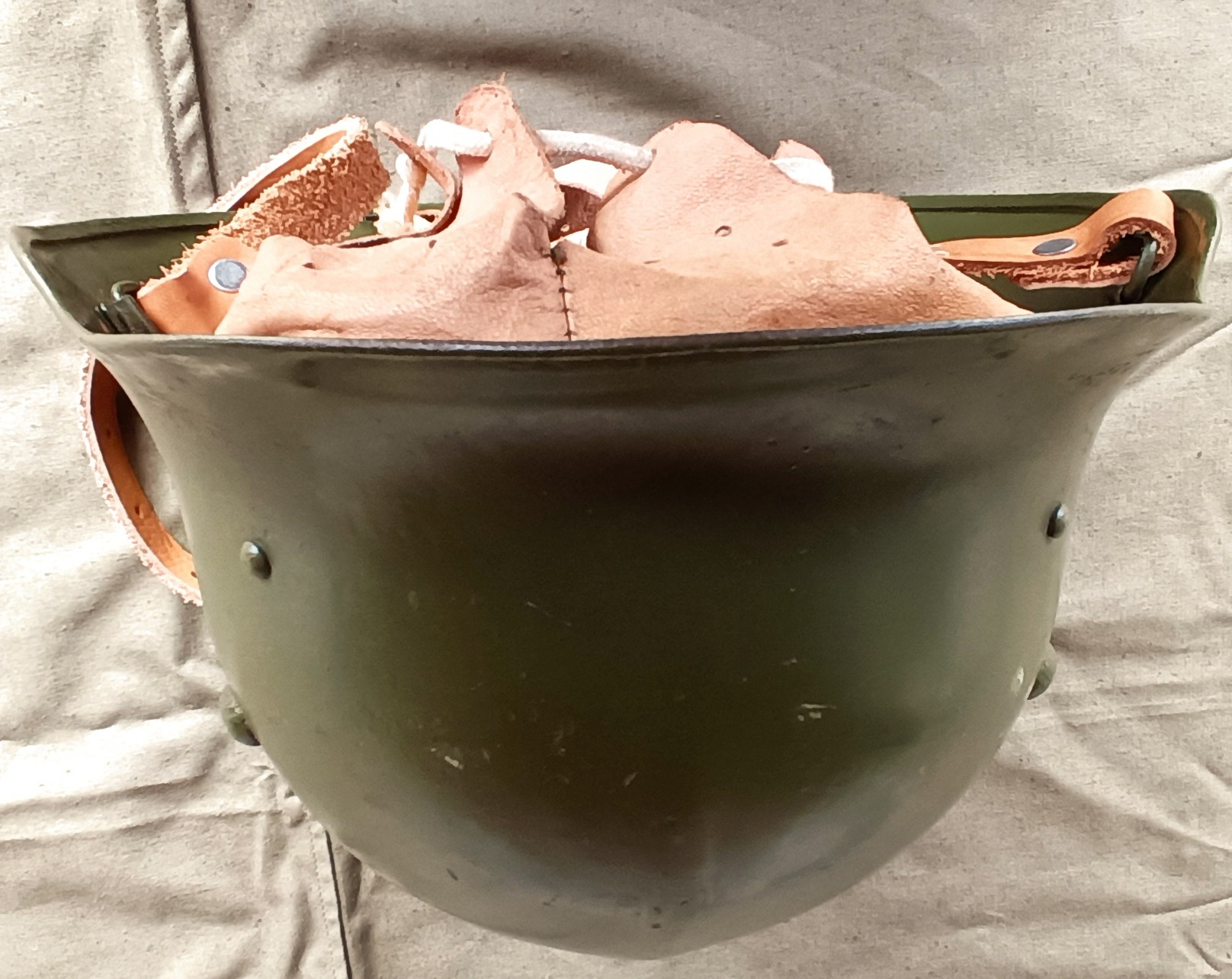
The Refurbished Leather Liner
The present leather liner demonstrates how an early shell could continue its military life after its original internal components were replaced.
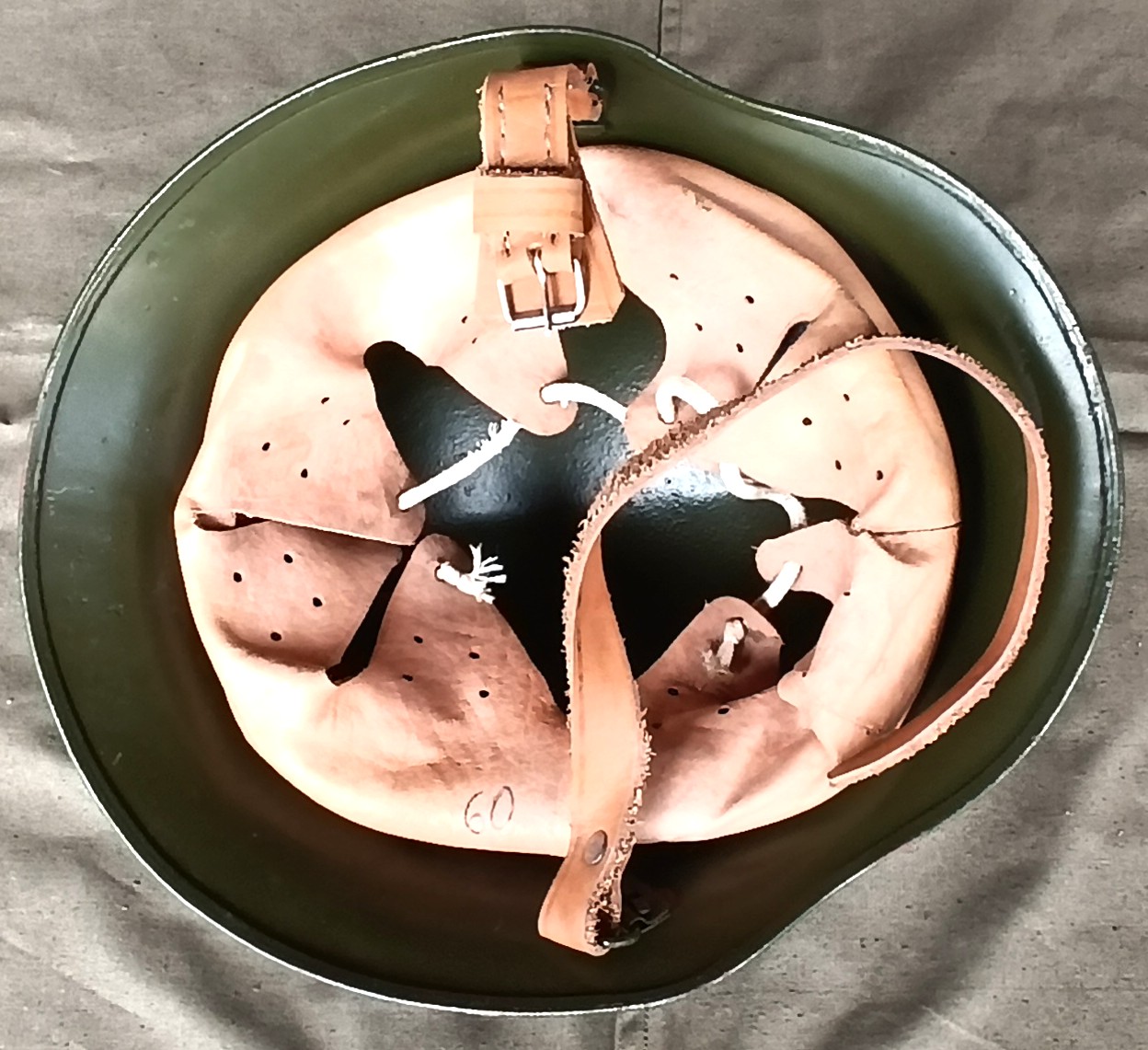
Additional M36A Interior Photograph: Six-Tongue Replacement Liner
The following overhead photograph shows the Type A helmet’s olive-green shell, riveted chinstrap fittings, six-tongue perforated leather liner and adjustment cord. The original rolled-rim shell and the possible later liner must be evaluated as separate historical components.
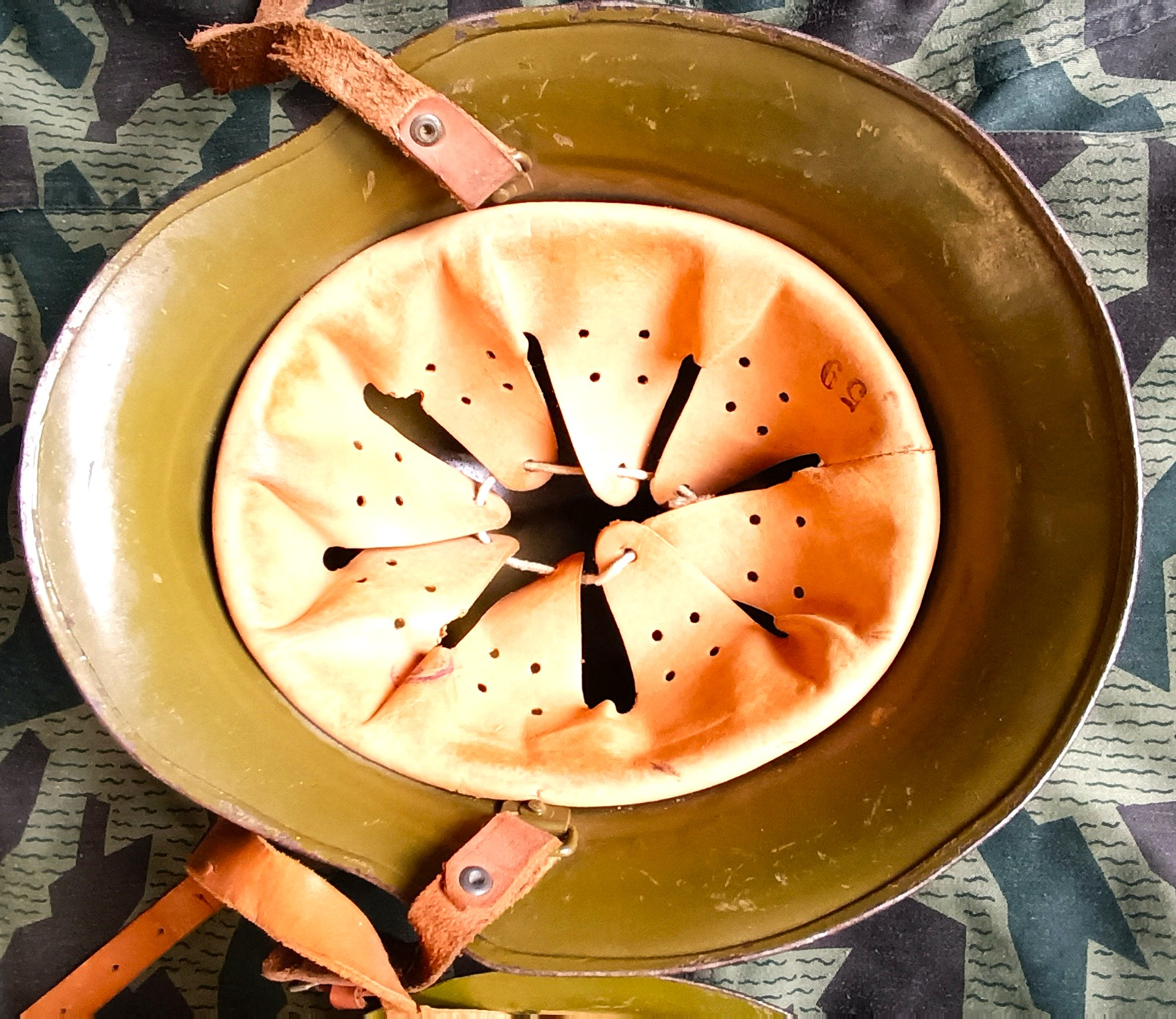
The Handwritten Number “60”
One of the small but interesting details of the collection example is the handwritten number 60 visible inside the leather liner.
It may relate to sizing or an internal service notation. However, its precise meaning has not been verified from military documentation.
It should therefore not be used as proof of a specific manufacturing or refurbishment date.
Size Mark “59”, Possible Inspection Stamp and Rolled Steel Rim
A separate close-up reveals the ink-stamped number 59 on a leather liner tongue, as well as an additional partially preserved purple mark. The number 59 most plausibly relates to a size designation; it must not be automatically read as the manufacturing year 1959.
The other mark may be an inspection, military acceptance or production-control stamp, but its function has not been confirmed from the photograph alone. The photograph also provides a detailed reference for the inward-rolled steel rim that is characteristic of the M36 Type A shell.
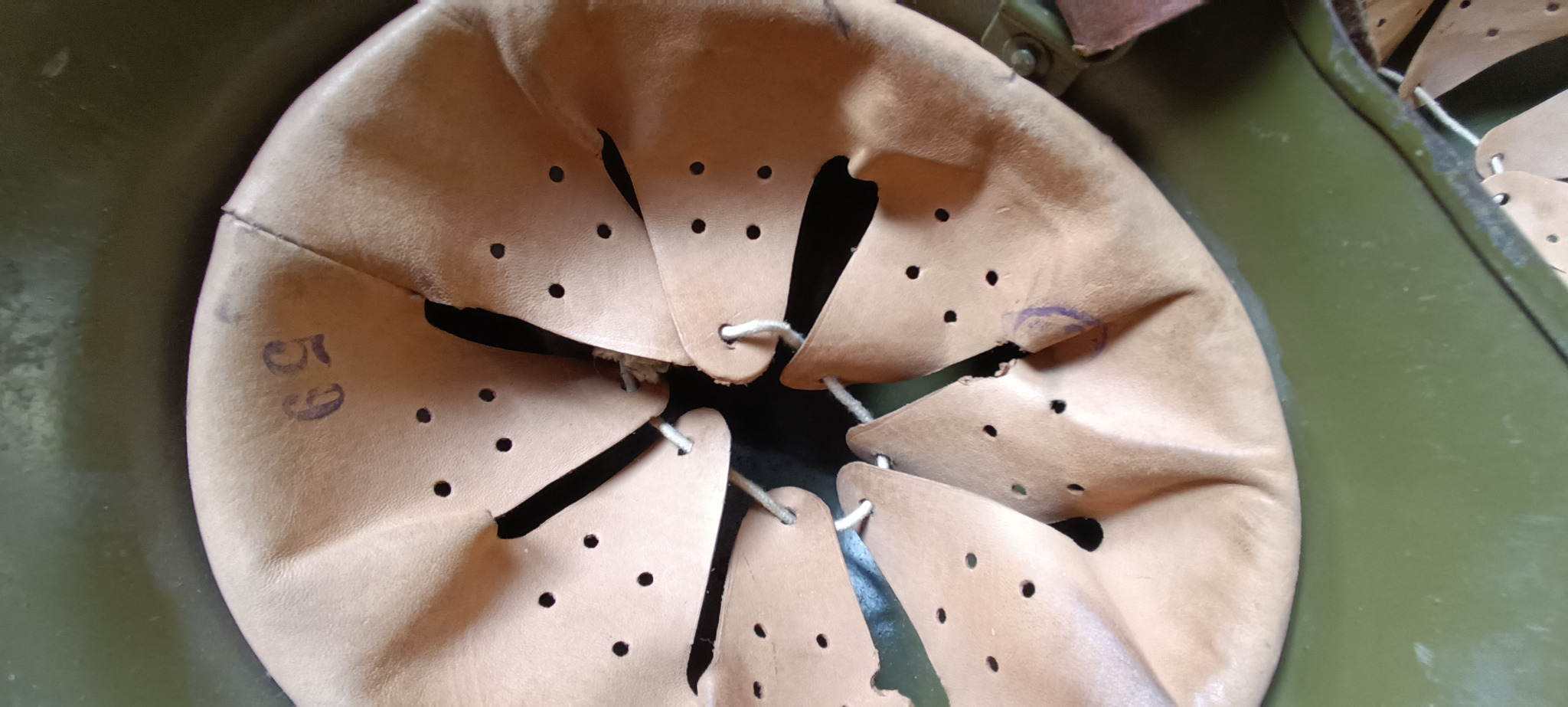
Marking clarification: This new photograph documents “59”, while an earlier image in the guide was described as having a “60” notation. They should not be conflated, and neither number independently proves the age of the steel shell or the date of refurbishment.
✦ Collector’s Insight: Authenticity vs Originality
A military-refurbished helmet may still be a completely authentic historical object. Its steel shell can belong to an earlier period while its paint, liner and chinstrap reflect later service. This distinction is central to understanding authenticity in antique and military collecting.
CHAPTER VIII · ANOTHER MILITARY LIFE
8. Postwar Service and Bulgarian People’s Army Refurbishment
The end of World War II did not mean that every M36 helmet disappeared from service.
Existing steel helmets remained useful military equipment. Many were retained in storage, repainted, repaired or fitted with replacement leather components.
During the following decades, the Bulgarian People’s Army continued to use older military equipment alongside newer designs.
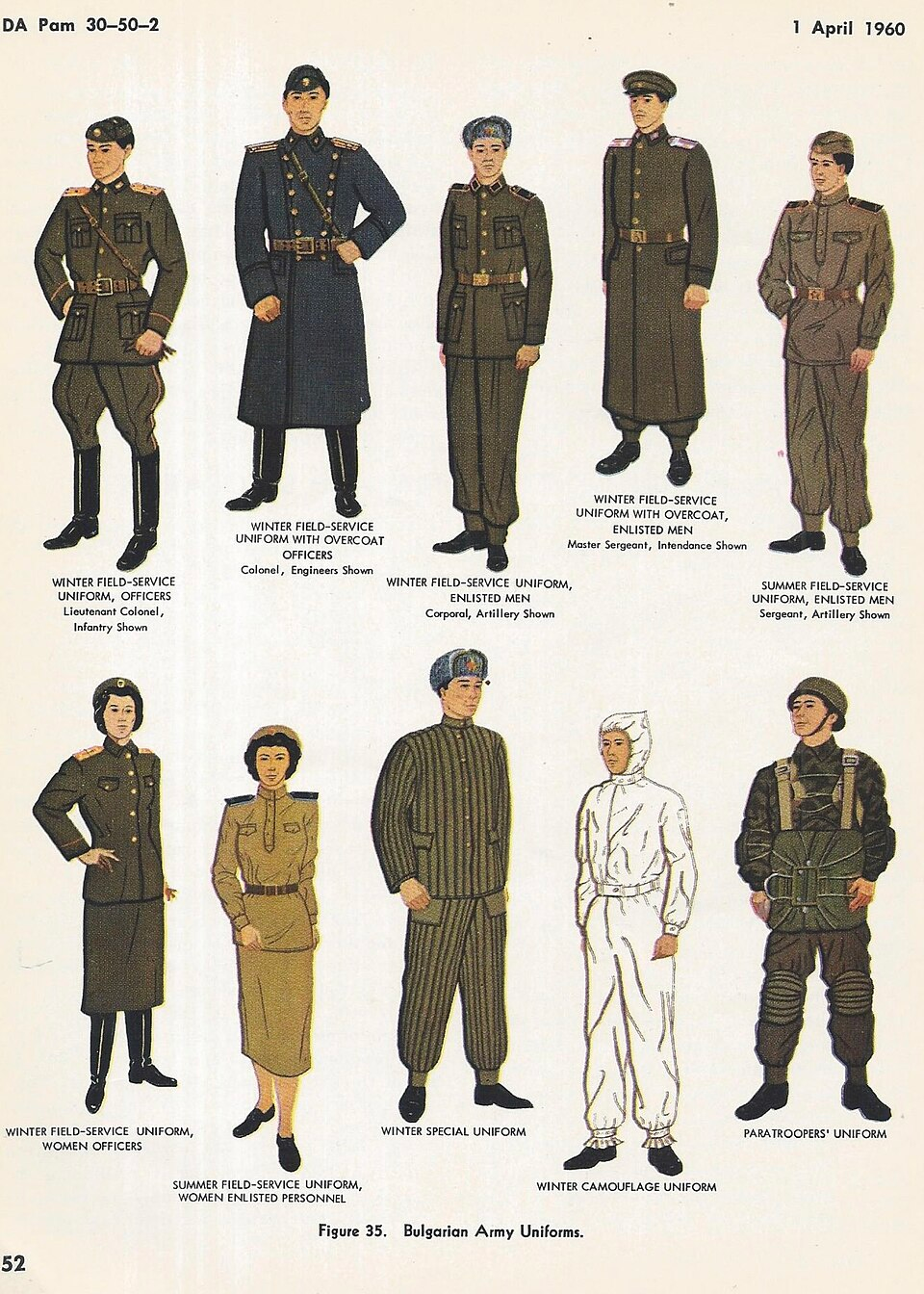
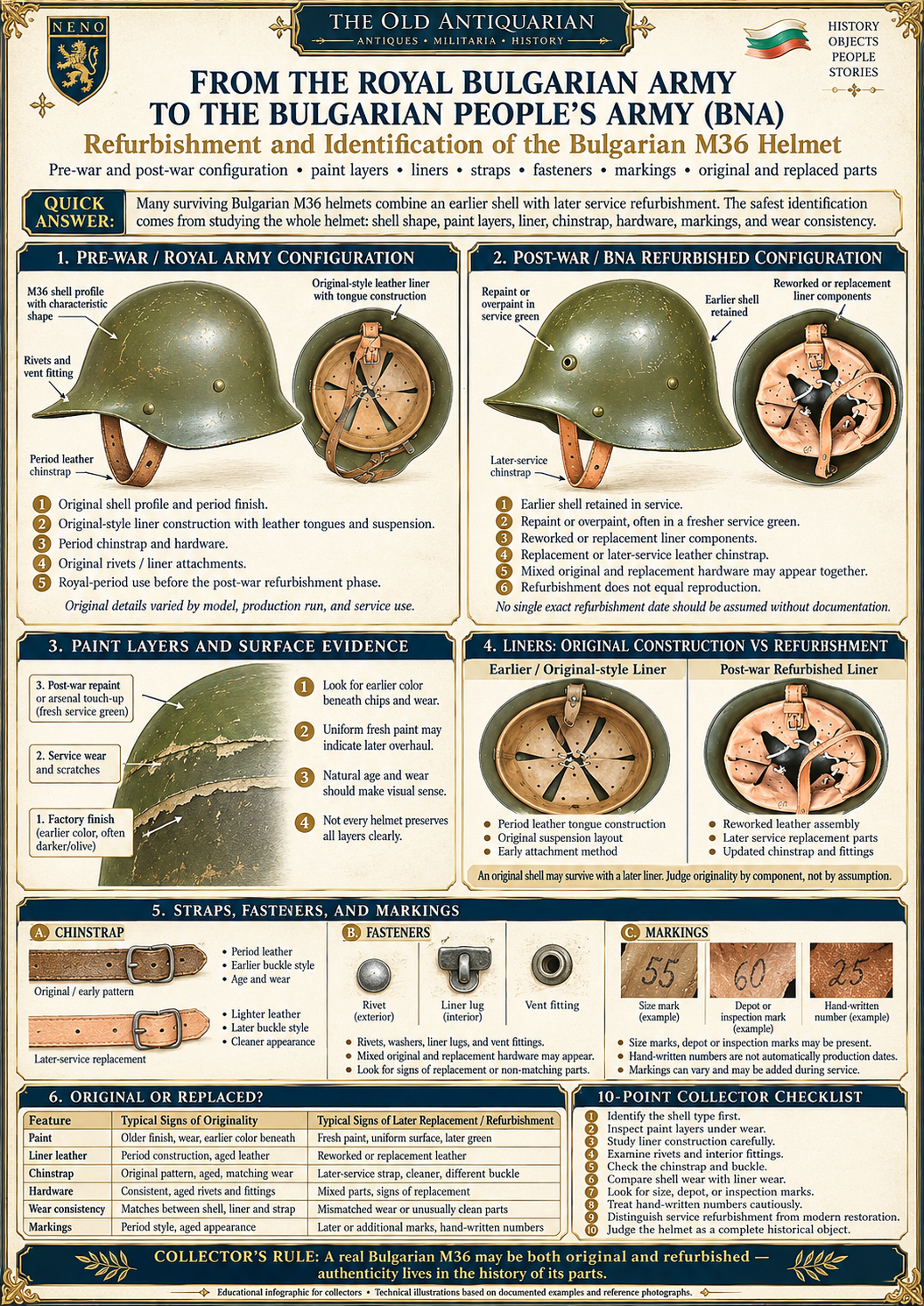
How Were M36 Helmets Refurbished?
Postwar refurbishment could include repainting, replacement of leather liners, installation of new chinstraps and repairs to the internal suspension system.
Some helmets retained early shells while receiving later military components.
Specialist research describes more standardised refurbishment patterns that may belong to maintenance programmes during the 1970s and 1980s. Exact dates require corroboration from official military or factory records.
| Component | Possible Change | What It Can Tell Us |
|---|---|---|
| Steel Shell | Original shell retained | May be older than current fittings |
| Paint | Repainting in military green | Can conceal earlier coatings |
| Leather Liner | Replacement leather | May identify refurbishment |
| Chinstrap | New strap or buckle | May belong to later service |
| Insignia | Painted shield, star or removal | Reflects different periods of use |
| Markings | Stock or inspection notations | Useful but require interpretation |
Wartime Decals and Later Military Insignia
Original wartime M36 helmets could carry a Bulgarian national shield with diagonal white, green and red bands, enclosed by a dark border.
During later military service, some helmets received painted national shields, communist red stars or no insignia at all.
A symbol cannot always date the steel shell. Later paint or insignia may have been applied to an older helmet.
The layers should be studied as part of the object’s history, not automatically removed.
CHAPTER IX · THE EUROPEAN CONTEXT
9. Bulgarian M36 vs Other World War II Steel Helmets
The Bulgarian M36 belonged to an important generation of protective steel helmets introduced or developed around the Second World War.
Different countries adopted different solutions for shell geometry, suspension, mass production and maintenance.
| Country & Model | Construction | Distinctive Features |
|---|---|---|
| Bulgaria — M36 | Pressed steel with internal suspension | Raised ridge and flared lower profile |
| Germany — M35/M40 | Deep steel shell and liner band | Extended side and rear coverage |
| USSR — SSh-40 | Pressed steel shell | Rounded form, standardised production |
| United States — M1 | Steel shell and separate liner | Two-piece construction |
| United Kingdom — Mk II | Shallow shell, wide brim | Broad overhead coverage |
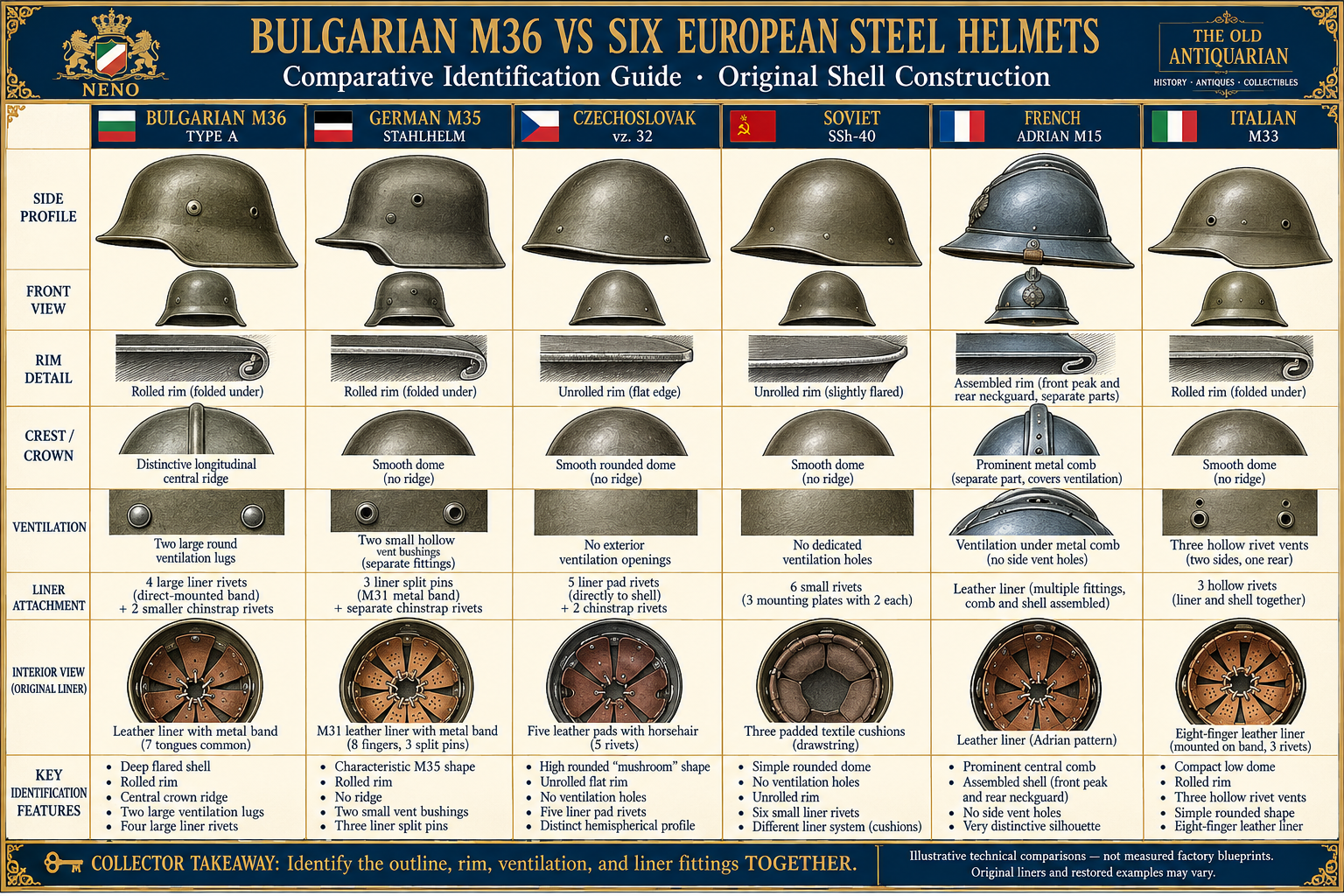
Was the Bulgarian M36 Better Than the German Stahlhelm?
There is no reliable universal ranking based solely on appearance or construction.
Ballistic performance depends on steel properties, impact conditions, projectile or fragment characteristics, impact angle and other technical factors.
Without comparative testing under equivalent conditions, it would be misleading to claim that the M36 offered better or worse protection than any particular foreign helmet.
Its historical importance lies in its distinctive Bulgarian design and exceptionally long history of use.
CHAPTER X · COLLECTOR’S FIELD GUIDE
10. How to Identify an Authentic Bulgarian M36 Helmet
Reliable identification begins with the physical object. No single marking, colour or component should be considered decisive without examining the helmet as a whole.
✦ Collector Identification Checklist
- Identify the shell profile. Examine the crown ridge, lower brim and proportions.
- Inspect the rim. Determine whether it is rolled or unrolled.
- Count the liner rivets. Check their size, number and placement.
- Examine ventilation fittings. Record their condition and construction.
- Inspect the suspension. Identify the liner band and mounting system.
- Study the leather. Examine the number of tongues, stitching and drawstring holes.
- Check the chinstrap. Look at the buckle, leather and attachment points.
- Observe the paint. Look for signs of more than one coating.
- Examine insignia. Distinguish decals from painted or modern reproductions.
- Record markings. Photograph numbers, inspection marks, initials and stamps.
- Look for repairs. Note replacement rivets, stitching and refurbished components.
- Investigate provenance. Preserve any family, military or archival documentation.
Does an Authentic M36 Need a Factory Stamp?
No. Many genuine M36 steel shells have no obvious stamped manufacturer’s code.
Markings sometimes appear on leather liner components instead, although these may themselves have been replaced during maintenance.
Possible stock or factory-related markings must be interpreted cautiously, especially when the exact date of a refurbishment is unknown.
Authentic, Original, Refurbished or Replica?
| Description | Meaning |
|---|---|
| Period-Original | Historically consistent original shell, finish and fittings |
| Military-Refurbished | Genuine historical helmet altered through later military maintenance |
| Collector-Restored | Historical object later altered for repair, presentation or display |
| Modern Replica | Modern object intended to resemble an earlier helmet |
Collectors should always distinguish genuine historical objects from later replicas, and understand how repairs affect originality.
CHAPTER XI · RARITY AND COLLECTOR VALUE
11. Is the Bulgarian M36 Helmet Rare or Valuable?
The Bulgarian M36 is a recognised subject in military collecting, but not every example is equally rare or valuable.
The later Type C is generally more frequently encountered, while early Type A and transitional Type B examples attract interest from collectors studying the development of the design.
Condition and originality may be just as important as the variant itself.
| Feature | Collector Significance |
|---|---|
| Early Type A | Interest in early construction and original components |
| Type B | Less commonly encountered transitional variant |
| Type C | Widely collected, often more accessible |
| Original Wartime Paint | Can strengthen interest when authenticated |
| Original National Decal | Important historical detail when genuine |
| Complete Liner and Chinstrap | Supports completeness and period identification |
| Documented Provenance | May add substantial historical interest |
Market asking prices can vary significantly and should not be confused with completed sales.
A meaningful valuation requires comparison with helmets of the same variant, condition, completeness and degree of originality.
For further guidance, see our professional antique valuation resource.
CHAPTER XII · PRESERVING THE EVIDENCE
12. Conservation: How to Preserve a Historical M36 Helmet
A surviving helmet contains historical evidence in its materials, paint layers, markings and repairs.
Excessive cleaning or restoration can destroy evidence that would otherwise help identify its history.
- Keep the helmet in a dry environment with stable humidity.
- Avoid direct sunlight and excessive heat.
- Do not scrape or polish original paint.
- Avoid attempting to expose concealed earlier insignia.
- Do not force aged leather straps into position.
- Document all markings before conservation.
- Consult a specialist when corrosion or fragile materials require treatment.
The surface of a military object may contain valuable evidence of age and use. Our guide to historical patina explains why original surfaces should be respected.
Safety Note: A historical M36 should be treated as a collectible artifact, not as dependable modern protective equipment. Its age, uncertain material condition and possible previous impacts make it unsuitable for present-day ballistic or occupational protection.
COLLECTOR QUESTIONS & ANSWERS
Frequently Asked Questions About the Bulgarian M36 Helmet
When was the Bulgarian M36 helmet introduced?
The M36 was introduced into Bulgarian military service in 1936 after development during the mid-1930s.
What are the main Bulgarian M36 variants?
Collectors distinguish Types A, B and C according to their shell rims, rivets, dimensions and suspension systems.
How do I recognise a Type A helmet?
The most useful starting features are the rolled shell rim, early shell profile and four large liner attachment rivets.
Which M36 type is the rarest?
Type B is generally considered especially uncommon among surviving examples, although precise original production figures remain uncertain.
Was the M36 manufactured in Germany?
German production is mentioned in older sources, but the attribution remains disputed and requires stronger documentary evidence.
Is a postwar-refurbished M36 still authentic?
Yes. An authentic historical shell may have later military paint, leather suspension or chinstrap components. It should simply be described accurately as refurbished.
What does a marking such as “60” mean?
It may relate to size or an internal service notation, but its meaning cannot be established confidently without additional evidence.
Did Bulgaria use the M36 after World War II?
Yes. Surviving helmets demonstrate prolonged military use and storage, including postwar maintenance and refurbishment.
How much is a Bulgarian M36 helmet worth?
Value depends on the variant, original components, insignia, condition, provenance and comparable completed sales.
Can a restored M36 still be collected?
Yes. Restored and refurbished helmets have historical and educational value when their condition and alterations are disclosed accurately.
Who designed the Bulgarian M36 helmet?
No single civilian designer has been established with reliable documentation in the sources consulted. The design emerged from the Bulgarian Army’s interwar equipment programme, influenced by but distinct from the German Stahlhelm tradition.
What does “59” mean on an M36 leather liner?
It is plausibly a size marking, but the precise system and the accompanying unidentified ink stamp require verification. It should not automatically be interpreted as 1959.
How many M36 helmets were produced?
Reliable complete production totals remain unavailable. Collector estimates frequently state that around 70% were Type C, while Types A and B were less common, but detailed percentage breakdowns are not official factory statistics.
HISTORICAL DOCUMENTATION
Sources, References and Further Research
This guide combines museum history, specialist collector research and examination of a surviving Bulgarian M36 Type A helmet.
- National Museum of Military History — Bulgaria in World War II. Institutional history of Bulgaria’s participation in the conflict.
- National Museum of Military History — Military Calendar, October. Bulgarian military operations during the autumn of 1944.
- Steel Helmets of the World Wars — Bulgarian M36-A. Early construction and manufacturing research.
- Steel Helmets of the World Wars — Bulgarian M36-B. Transitional helmet configurations.
- Steel Helmets of the World Wars — Bulgarian M36-C. Later suspension arrangements and postwar refurbishment.
- Brendon’s Helmets — Bulgarian M36A. Photographic collector reference.
- Weitze — Bulgarian M36A-51: construction and collector nomenclature. Discusses the estimated Type C production share and the limits of available historical evidence. These commercial collector notes are not official factory statistics.
- United States Holocaust Memorial Museum — Bulgaria. Historical context of Bulgaria’s wartime position.
- Hristo P. Dermendzhiev, “Bulgarian Military Helmets” (Българските военни каски), Voennoistoricheski Sbornik, No. 2, 2004, pp. 57–62. Cited historical research; the original publication should be consulted for disputed details.
Research note: Certain manufacturing attributions, exact production figures and dates of individual refurbishment programmes remain incompletely documented. Educational infographics illustrate typical features and should not be treated as substitutes for factory records or physical authentication. Historical photograph identifications and licensing should be confirmed against the original archival sources.
THE OLD ANTIQUARIAN · HISTORICAL RESEARCH
About the Research
The Old Antiquarian is an independent antiques and collectibles project built on more than 35 years of experience in collecting, studying and working with historical objects.
Our editorial approach combines physical examination, historical comparison, documentary research and respect for the original materials and stories associated with surviving artifacts.
Through Military Memories, we explore the human stories preserved by military equipment, photographs, medals, documents and objects that have travelled through Europe’s historic crossroads.
Related Collector Guides
- Why Military Objects Matter
- What Is Authenticity?
- What Is Patina?
- What Is a Replica?
- Professional Antique Valuation
Continue Exploring
Discover more historical research in our Military Memories archive, or explore antique and vintage military collectibles, historical medals and badges and historical photographs and postcards.
