
Porsgrund Porcelain: Marks, Dating, Patterns & Value
Norwegian Porcelain · Porsgrund · Marks · Dating · Patterns · Designers · Value
Porsgrunds Porselænsfabrik is one of Norway’s most important porcelain manufacturers. Established in Porsgrunn in 1885, the factory completed its first firing in 1887 and has produced dinnerware, vases, decorative porcelain and design objects ever since. Collectors can often narrow the production period by studying the exact anchor mark, the spelling PORSGRUND or PORSGRUNN, wording such as NORGE or NORWAY, decoration or model numbers, form, pattern and designer. Early blue-anchor pieces, later green-anchor marks, historic patterns such as Bogstad Strå, and documented designs by Nora Gulbrandsen, Tias Eckhoff, Konrad Galaaen and Eystein Sandnes are especially important areas of research.
| Porsgrund at a Glance | Collector Reference |
|---|---|
| Full historic name | Porsgrunds Porselænsfabrik |
| Country | Norway |
| Location | Porsgrunn |
| Established | 1885 |
| First porcelain firing | 1887 |
| Early mark | Blue anchor with P letters, broadly 1887–1911 |
| Green anchor | Important documented family from 1911 onward, with several later variants |
| Historic wording | PORSGRUND, PORSGRUNN, NORGE, NORWAY and later Made in Norway variants |
| Important patterns | Bogstad Strå, Nisseserviset, Bondemønster and many later designer series |
| Important designers | Nora Gulbrandsen, Konrad Galaaen, Tias Eckhoff, Eystein Sandnes, Anne-Marie Ødegaard, Grete Rønning and others |
| Material | High-fired porcelain; specific bodies and production systems vary by series and period |
| Best identification method | Mark + body + form + pattern + decoration + numbers + designer + condition + documentation |
The anchor is a starting point, not a complete attribution. Reliable Porsgrund identification combines the exact mark with wording, porcelain body, form, pattern, decoration, numbers, designer evidence, condition and documented factory history.
Porsgrund occupies a distinctive position in Scandinavian porcelain history. Unlike many European factories best known for eighteenth- or nineteenth-century court porcelain, Porsgrund developed into a major Norwegian producer whose history connects late nineteenth-century industrial manufacture with interwar modernism, Scandinavian mid-century design and continuing contemporary production.
For a broader framework on how collectors examine an unknown object before moving to a factory-specific attribution, see our
complete guide to identifying antique porcelain
.
Porsgrund Porcelain History: From 1885 to Norwegian Design Icon
Porsgrunds Porselænsfabrik was established in 1885 in Porsgrunn, Norway. The initiative came from businessman Johan Jeremiassen, and the factory’s first porcelain firing took place in 1887.
From the beginning, the company produced porcelain for the Norwegian domestic market, including tableware, vases and decorative objects. Over time, Porsgrund became closely connected with Norwegian industrial and artistic design, employing major designers and maintaining long-running decorated services that became familiar in Norwegian homes.
The factory’s history is now represented at the Porcelain Museum in Porsgrunn, where collections, models, decorations and manufacturing history document more than a century of production.
| Year / Period | Development | Collector Significance |
|---|---|---|
| 1885 | Porsgrunds Porselænsfabrik established | Beginning of the company’s documented history |
| 1887 | First firing | Start of porcelain production and early blue-anchor period |
| 1887 | Bogstad Strå enters production | One of Porsgrund’s longest-running historic patterns |
| 1898 | Nisseserviset introduced | Long-running Norwegian Christmas service |
| 1911 | Green anchor replaces the earlier blue anchor in an important mark family | Major dating transition for collectors |
| 1928–1945 | Nora Gulbrandsen serves as artistic director | Important interwar modernist period |
| 1932 | Bondemønster introduced | One of the factory’s enduring decorative services |
| 1947 | Konrad Galaaen joins Porsgrund | Beginning of an important post-war design period |
| 1949 | Tias Eckhoff joins the factory | Major Scandinavian modern design influence |
| 1952 | Spire launched; Eckhoff becomes artistic leader | Key Norwegian mid-century design moment |
| 1957 | Eystein Sandnes becomes artistic leader | Expansion of functional modern tableware |
| 1960 | Grete Rønning joins Porsgrund | Associated with later decorative services including Marguerite |
| Today | Historic and contemporary series continue | Collectors must distinguish original periods from later production and relaunches |
a Porsgrund design may have a nineteenth- or twentieth-century origin while individual pieces were produced much later. The date of the design and the date of the physical object are not automatically the same.
Porsgrund Porcelain Marks & Backstamps
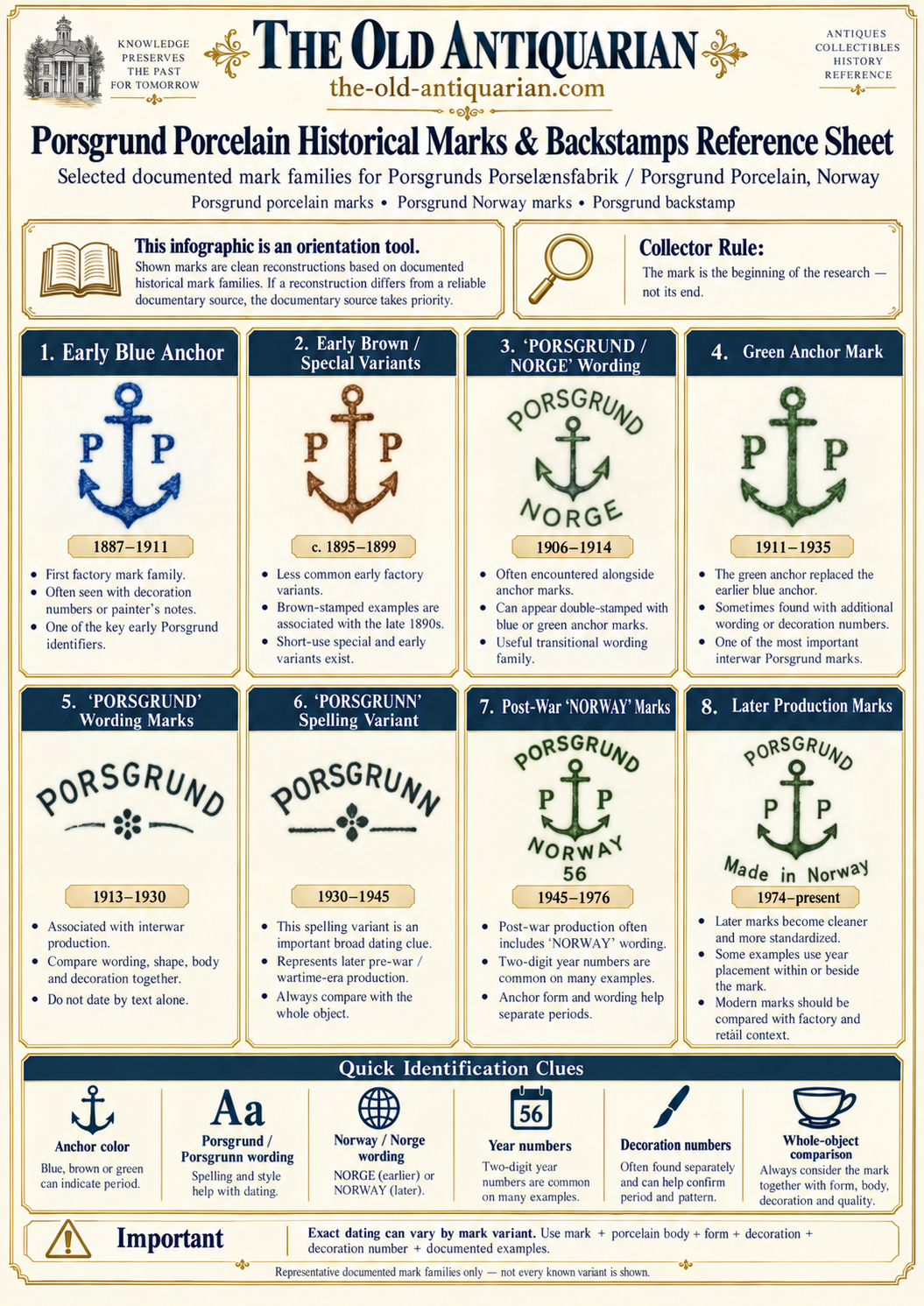
The anchor is the most recognisable symbol associated with Porsgrund, often accompanied by a P on each side. However, the exact colour, lettering, country wording and additional numbers changed over time.
This means that identifying a general “Porsgrund anchor” is only the first step. Collectors should compare the exact version of the mark rather than treating every anchor as equivalent.
The same principle applies across porcelain collecting. Our
Porcelain Marks & Backstamps Guide
explains how factory marks, country wording, pattern numbers and secondary marks should be analysed together.
| Mark Family | Broad Period | Important Clues |
|---|---|---|
| Blue anchor | 1887–1911 | Early factory mark; usually anchor with P on each side |
| Brown early marks | Especially 1890s | Less common early variants; some used with decoration numbers |
| PORSGRUND / NORGE transitional mark | 1906–1914 | May occur together with blue or green anchor marks |
| Green anchor | 1911–1935 | Important early green-anchor family replacing the blue mark |
| PORSGRUND wording | 1913–1930 | Historic spelling ending in ND |
| PORSGRUNN wording | 1930–1945 | Later spelling ending in NN |
| Green PORSGRUND / NORWAY | 1945–1976 | May include a two-digit year beneath the mark |
| Later green factory marks | 1974–1996 | PORSGRUND and NORWAY, sometimes with year information |
| Elongated green mark | From 1996 | Later standardised mark family; may include Made in Norway or Norway |
| Round green mark | Documented from 2013 | Later factory branding incorporating 1885 |
Porsgrund used several variants, double stamps and additional markings. Specialist references do not always assign exactly the same date range to every variant, so mark charts should be used as orientation rather than as automatic certificates of age.
Porsgrund Blue Anchor vs Green Anchor vs Later Marks
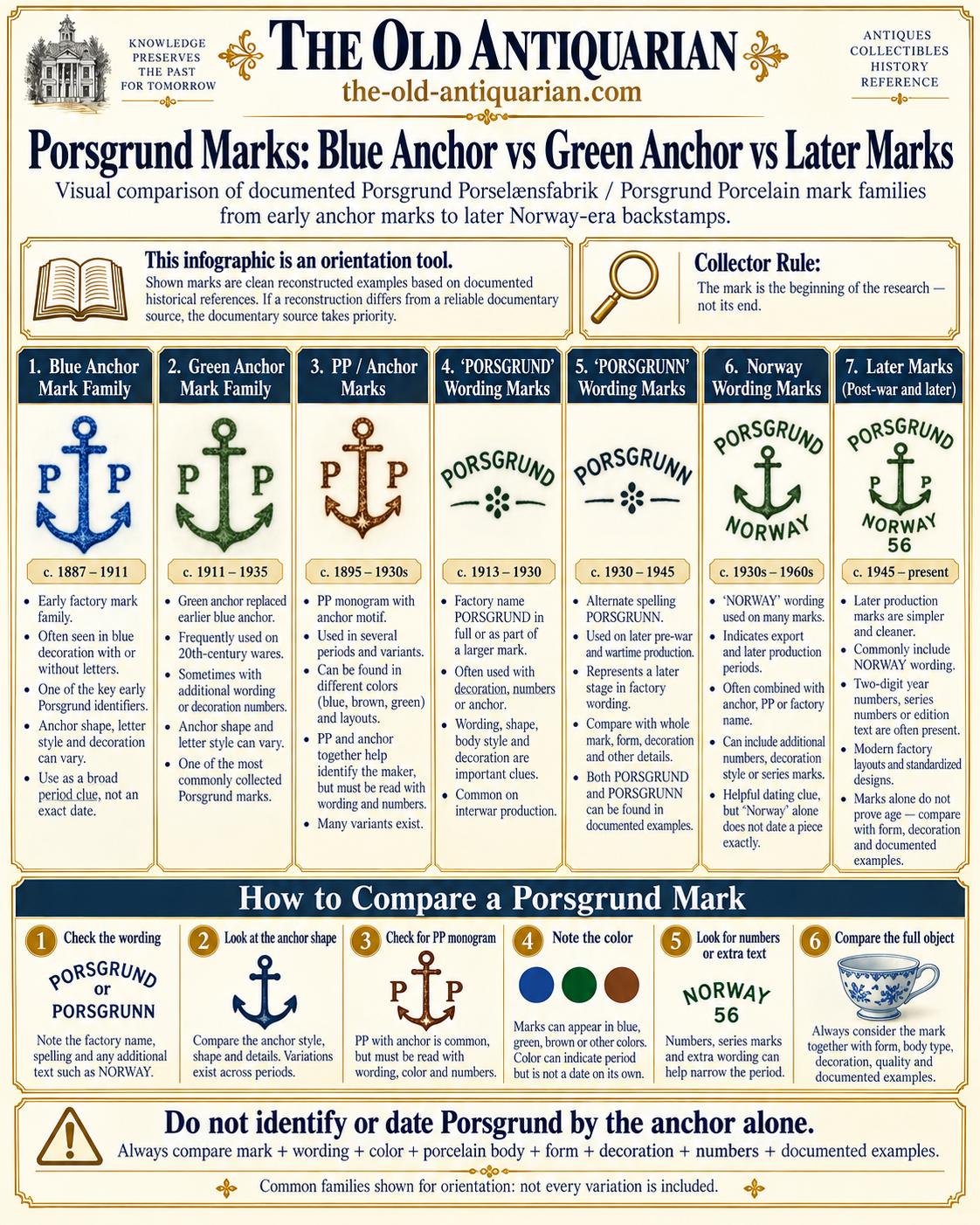
What does the blue Porsgrund anchor mean?
The blue anchor is associated with the earliest principal factory-mark period, broadly 1887–1911. It is therefore an important clue when examining late nineteenth- or very early twentieth-century Porsgrund.
However, a blue mark does not automatically prove that every object carrying an anchor is from that period. The exact anchor form, surrounding letters, decoration number, porcelain body and decoration should agree with the proposed date.
What does the green anchor mean?
A major green-anchor family replaced the earlier blue anchor from 1911 and is documented through approximately 1935. Later green anchor and green factory marks were also used, which is why colour alone cannot provide an exact date.
An early green anchor from the 1911–1935 period must be distinguished from post-war and later green marks by lettering, anchor shape, numbers and factory wording.
PORSGRUND vs PORSGRUNN: Why the Spelling Matters
Collectors often ask why some pieces read PORSGRUND while others read PORSGRUNN. The difference can be useful as part of the dating process.
A documented factory-mark family using PORSGRUND is associated broadly with 1913–1930, while a corresponding PORSGRUNN spelling variant is documented for approximately 1930–1945.
This is an unusually useful SEO and collector clue because people frequently search the exact word they see beneath a piece without knowing whether the spelling has chronological importance.
| Wording | Broad Collector Use | Caution |
|---|---|---|
| PORSGRUND | Important historic factory wording, including a 1913–1930 mark family | Also appears in other mark configurations and later branding |
| PORSGRUNN | Useful mark-family clue for approximately 1930–1945 | Never date from spelling without checking the complete mark |
| NORGE | Useful on early twentieth-century transitional/export markings | Context and accompanying anchor matter |
| NORWAY | Especially important on post-war and export-era marks | Used across more than one later period |
| Made in Norway | Associated with later production systems | Does not identify one exact year |
How to Date Porsgrund Porcelain by Marks
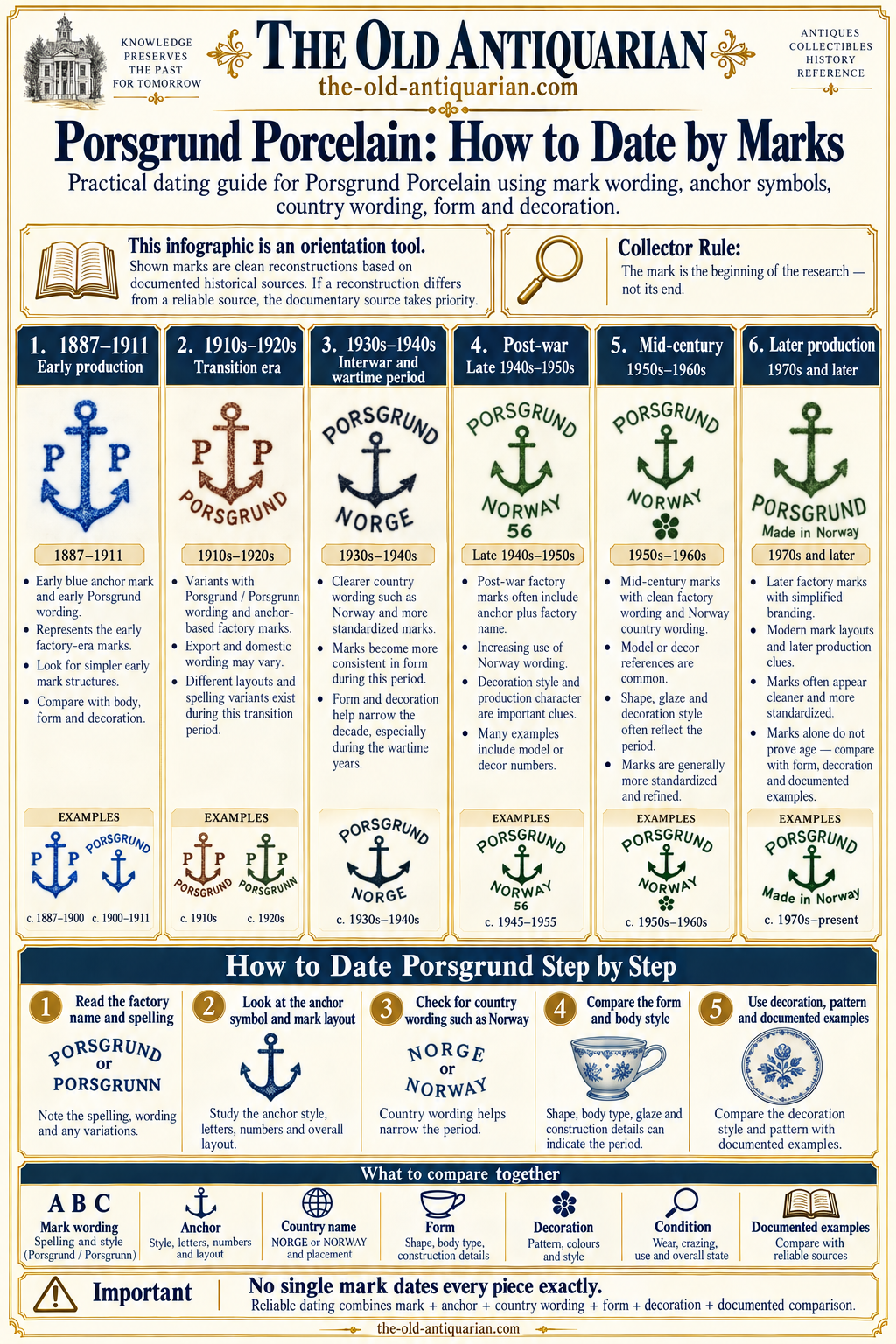
Dating Porsgrund is usually a process of narrowing a production period rather than reading one universal year code. Some post-war marks may contain useful year numbers, but many earlier objects require comparison of several independent clues.
exact mark + anchor style + wording + country name + numbers + form + pattern + designer + decoration + documented factory history
Record P, PP, anchor, PORSGRUND / PORSGRUNN and every additional word.
Blue, green and other variants can narrow the likely mark family.
NORGE, NORWAY and Made in Norway can help establish historical context.
Decoration, form, year or production numbers should not be assumed to have the same function.
A documented introduction date can establish an earliest possible production date.
Use factory histories, catalogues, museum collections and specialist mark references.
This same evidence-based method is explained more broadly in our
complete guide to dating antique porcelain
.
Porsgrund Decoration Numbers, Model Numbers & Additional Marks
One of the most useful but misunderstood areas of Porsgrund research is the system of additional numbers found alongside or near factory marks.
Decoration numbers were used from the beginning of production in 1887. Specialist records show that early decoration-number sequences can sometimes establish the earliest documented use of a design, but they do not necessarily reveal when that decoration stopped being made.
Underglaze decorations used their own number systems from the early twentieth century, and from 1902 a printing method was introduced in which decoration numbers could begin with a zero.
| Additional Mark | Possible Meaning | How to Use It |
|---|---|---|
| Decoration number | Identifies a decorative design or production reference | May establish the earliest documented use; not necessarily an end date |
| Model / shape number | Identifies the physical form | Compare with catalogues or documented examples |
| Painter initials | Can identify an individual decorator on certain hand-painted wares | Especially useful where factory documentation exists |
| Two-digit year | Appears on some post-war marks | Can be highly useful when part of a documented mark system |
| Quality / secondary marks | May indicate factory grading or other internal information | Do not confuse with model or year numbers |
| Retailer or external mark | May identify a seller or distributor | Useful for provenance but not automatically the manufacturer |
never crop the photograph tightly around the anchor. Secondary numbers, painter marks and wording elsewhere on the underside may be more useful than the central logo.
How to Identify Genuine Porsgrund Norway Porcelain
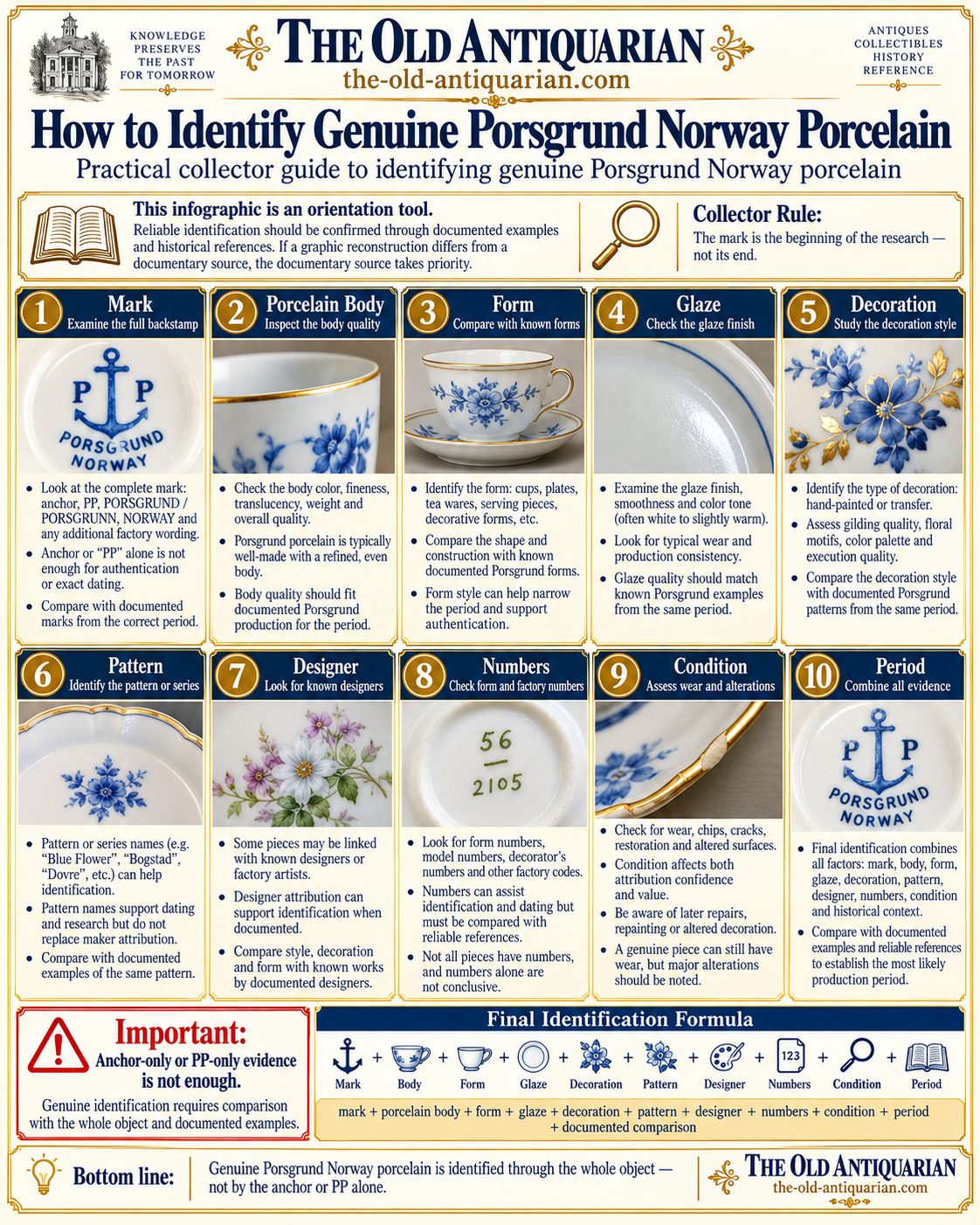
Porsgrund identification should begin with the complete underside, but it should not end there. The porcelain body, weight, form, glaze, decoration technique, pattern, numbers and condition should all make sense for the proposed period.
| Clue | What to Examine | Why It Matters |
|---|---|---|
| Factory mark | Anchor, P / PP, wording, colour and layout | Establishes the likely factory and broad period |
| Porcelain body | Colour, fineness, thickness, translucency and firing quality | Should be consistent with documented Porsgrund production |
| Form | Rim, handle, foot, lid, silhouette and proportions | Can identify a documented series or designer |
| Glaze | Surface, gloss, firing characteristics and later alteration | Can support or contradict the expected period |
| Decoration | Hand painting, underglaze work, printing, gilding or mixed technique | Important for pattern identification and dating |
| Pattern | Name, decoration number and placement | Helps distinguish series that use similar forms |
| Designer | Documented form or decoration attribution | Important for historical significance and collector demand |
| Numbers | Decoration, model, shape, year or control numbers | May provide additional production evidence |
| Condition | Chips, cracks, wear, regilding and restoration | Affects both attribution confidence and market comparison |
| Documentation | Catalogues, museum examples and factory references | Final test of a proposed attribution |
mark + porcelain body + form + glaze + decoration + pattern + designer + numbers + condition + period + documented comparison
Porsgrund Patterns & Decorations
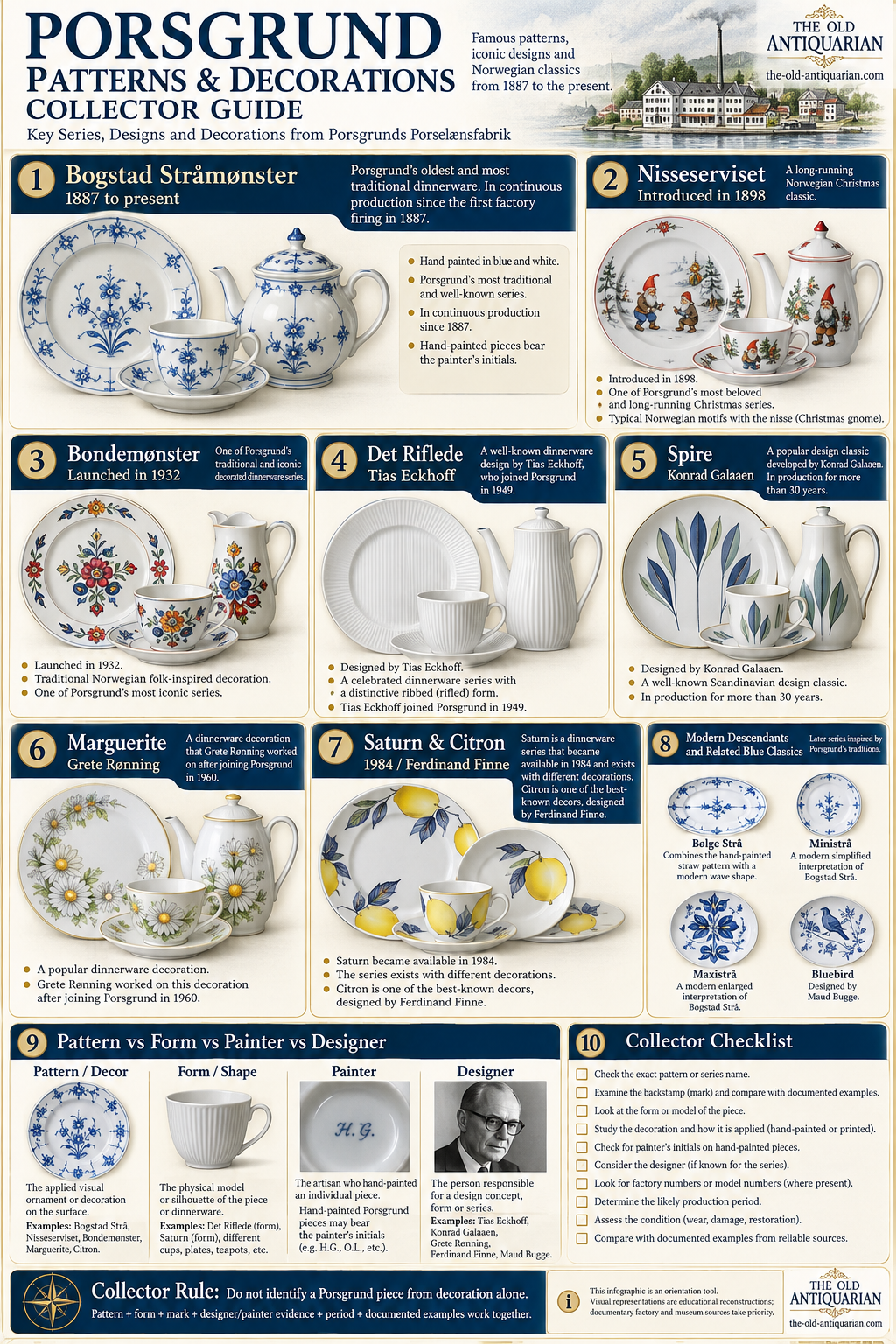
Patterns are one of the strongest search and collector areas for Porsgrund because several services remained in production for decades—or even for generations.
Bogstad Strå / Bogstad Stråmønster
Bogstad Strå is one of Porsgrund’s most important historic services. The factory states that it has been produced since the first firing in 1887 and remains hand painted in Porsgrunn.
The design belongs to the wider European straw-pattern tradition, but Porsgrund’s version developed its own Norwegian identity. Hand-painted pieces carry painter initials, making the decorator another potentially useful research clue.
Nisseserviset
The Christmas-themed Nisseserviset was introduced in 1898 and developed into a long-running Norwegian seasonal classic.
Bondemønster
Bondemønster was introduced in 1932. It uses a colourful folk-inspired decorative language and remained one of Porsgrund’s recognisable decorated services.
Det Riflede
The refined ribbed tableware known as Det Riflede is associated with industrial designer Tias Eckhoff. Here the form itself is central to the design identity, so collectors should distinguish the physical model from any decoration applied to it.
Spire
Konrad Galaaen’s Spire was launched in 1952 and remained in production for more than three decades. Modern relaunches mean that the Spire name alone cannot establish the production date of an individual piece.
| Series / Pattern | Documented Introduction | Collector Note |
|---|---|---|
| Bogstad Strå | 1887 | Historic hand-painted straw-pattern service; continuing tradition |
| Nisseserviset | 1898 | Norwegian Christmas classic |
| Bondemønster | 1932 | Folk-inspired decorative service |
| Spire | 1952 | Konrad Galaaen design; later relaunched |
| Askeladden | 1964 | Associated with Eystein Sandnes; important post-war functional design |
| Eystein | 1969 | Eystein Sandnes service with characteristic modernist vocabulary |
| Marguerite | Later 20th century | Decoration associated with Grete Rønning |
| Saturn / Citron | Saturn available from 1984 | Citron is a documented decoration by Ferdinand Finne |
A pattern is the visual decoration; a form or model is the physical shape; a designer may have created the shape, the decoration or both. Keep these categories separate when cataloguing a piece.
Porsgrund Designers: Nora Gulbrandsen, Tias Eckhoff, Konrad Galaaen & More
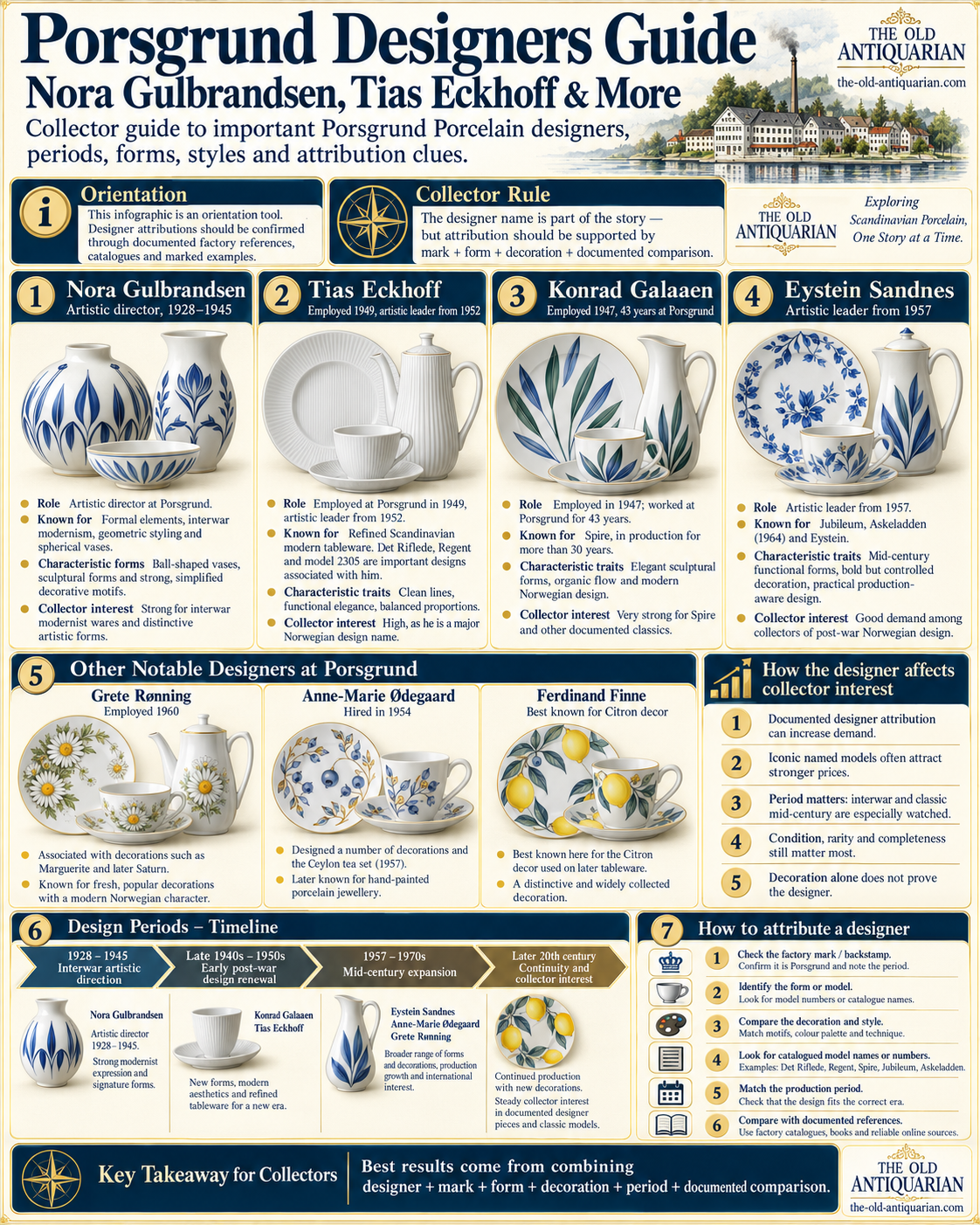
Porsgrund is especially important within Norwegian collecting because its history is closely connected with major twentieth-century industrial designers.
| Designer | Porsgrund Context | Important Collector Associations |
|---|---|---|
| Nora Gulbrandsen | Artistic director, 1928–1945 | Interwar modernism, formal geometry, spherical vases and distinctive artistic porcelain |
| Konrad Galaaen | Joined 1947; worked at PP for 43 years | Spire, sculptural and modern forms |
| Tias Eckhoff | Joined 1949; artistic leader from 1952 | Det Riflede, Regent, model 2305 and Scandinavian functionalism |
| Anne-Marie Ødegaard | Joined 1954 | Decorations, Ceylon tea service and hand-painted porcelain jewellery |
| Eystein Sandnes | Artistic leader from 1957; later chief designer | Jubileum, Askeladden, Eystein and production-conscious functional design |
| Grete Rønning | Joined 1960 | Decorations including Marguerite; associated with later tableware development |
| Ferdinand Finne | Artist associated with decorative designs | Citron decoration on the Saturn service |
Why does designer attribution matter?
A documented designer can transform a piece from generic vintage tableware into an identifiable object within Norwegian design history. This can affect scholarly interest, museum relevance and collector demand.
However, attribution must be documented. Similar decoration does not prove that a piece was designed by Gulbrandsen, Eckhoff, Galaaen or Sandnes.
confirm a designer attribution through documented factory catalogues, museum records, recognised specialist literature or reliable factory sources—not through visual resemblance alone.
Condition, Wear & Restoration
Condition can materially affect both identification and value. Tableware was made to be used, so light utensil marks or normal wear may be entirely consistent with age. More serious problems include rim chips, hairlines, cracks, missing lids, regilding, repainting and structural restoration.
| Condition Issue | Where to Check | Why It Matters |
|---|---|---|
| Rim chips | Cups, plates, bowls and lids | May materially affect collector desirability |
| Hairline cracks | Handles, rims and bases | Can become structural damage |
| Gilding wear | Edges, handles and high points | Normal wear may be acceptable; heavy loss affects comparison |
| Repainting | Floral decoration and restored areas | Can obscure original condition |
| Replacement lid | Teapots, tureens and covered vessels | Completeness and fit matter |
| Restoration | Handles, spouts, rims and broken bodies | Extent and quality should always be disclosed |
Before repairing or aggressively cleaning an interesting Porsgrund piece, read
What Not to Do Before an Antique Valuation or Sale
.
Old labels, painter marks and existing restoration can all contain useful evidence.
What Affects Porsgrund Porcelain Value?
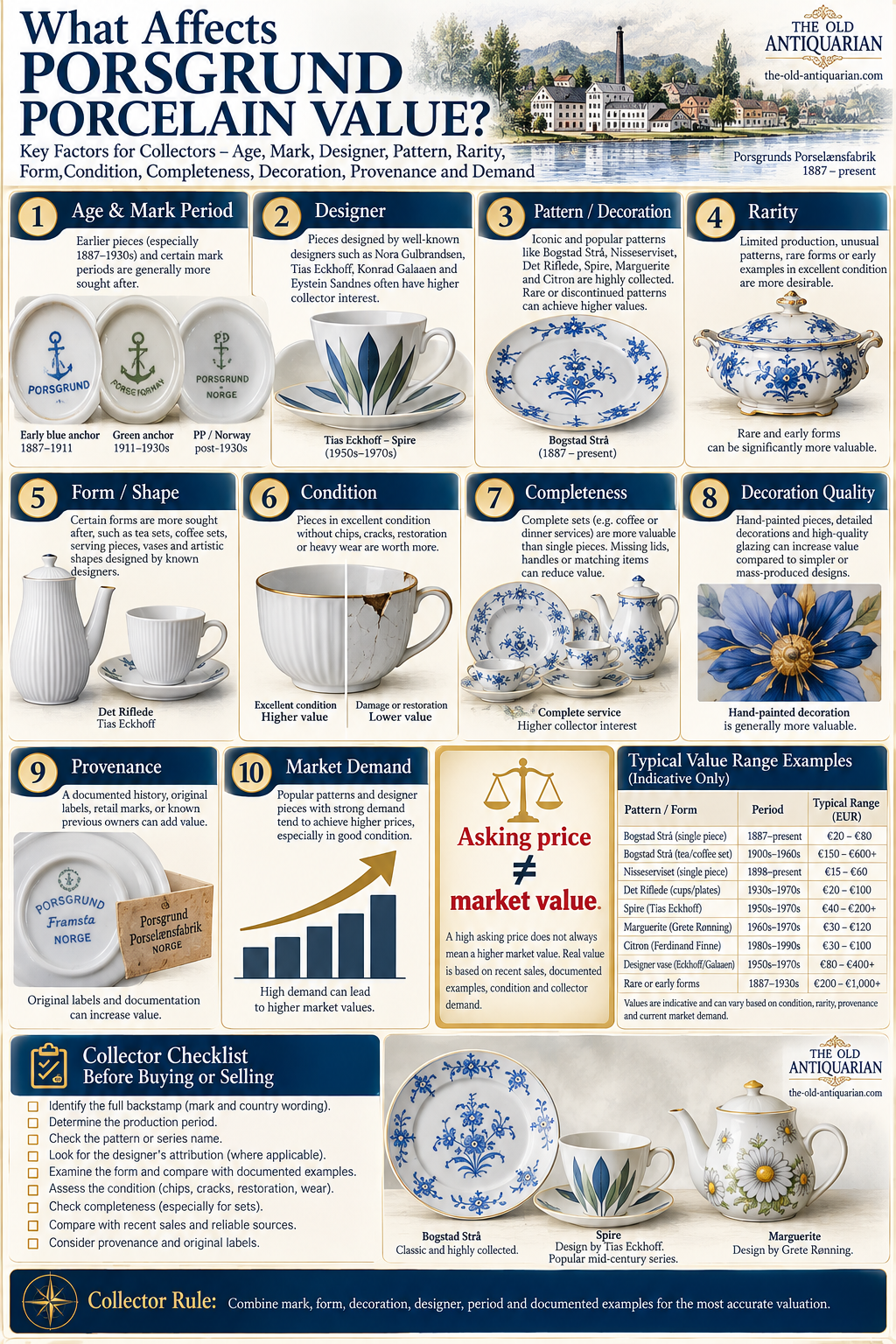
There is no single value for “Porsgrund Norway.” The market ranges from common later tableware to rare early objects and important pieces connected with documented designers.
| Value Factor | Why It Matters |
|---|---|
| Production period | Early and historically important periods may be less common than routine later production |
| Exact mark | Helps establish the period and correct market comparison |
| Designer | Documented work by recognised Norwegian designers may attract specialist interest |
| Pattern | Demand varies significantly between services and decorations |
| Rarity | Unusual models, sizes or short production runs may be harder to find |
| Form | Decorative vases and distinctive designer objects may differ in demand from routine tableware |
| Decoration quality | Hand painting and difficult decorative techniques can be significant |
| Condition | Chips, cracks, repairs and repainting affect comparability |
| Completeness | Original lids, pairs and complete services may carry additional interest |
| Provenance | Old labels, invoices, collection history or exhibition history can strengthen context |
| Market demand | Design fashion and collector interest change over time |
| Completed comparable sales | Provide stronger market evidence than unsold asking prices |
Compare like with like: exact mark + period + pattern or model + designer + size + decoration + condition + restoration + completeness + provenance + recent completed sales.
They should not be treated as a current price list or a valuation of an individual Porsgrund object.
For an object-specific assessment, continue to our
Professional Antique Valuation
service once the mark, period, pattern, designer and condition have been documented.
Porsgrund Collector Checklist – Buy, Sell & Authenticate
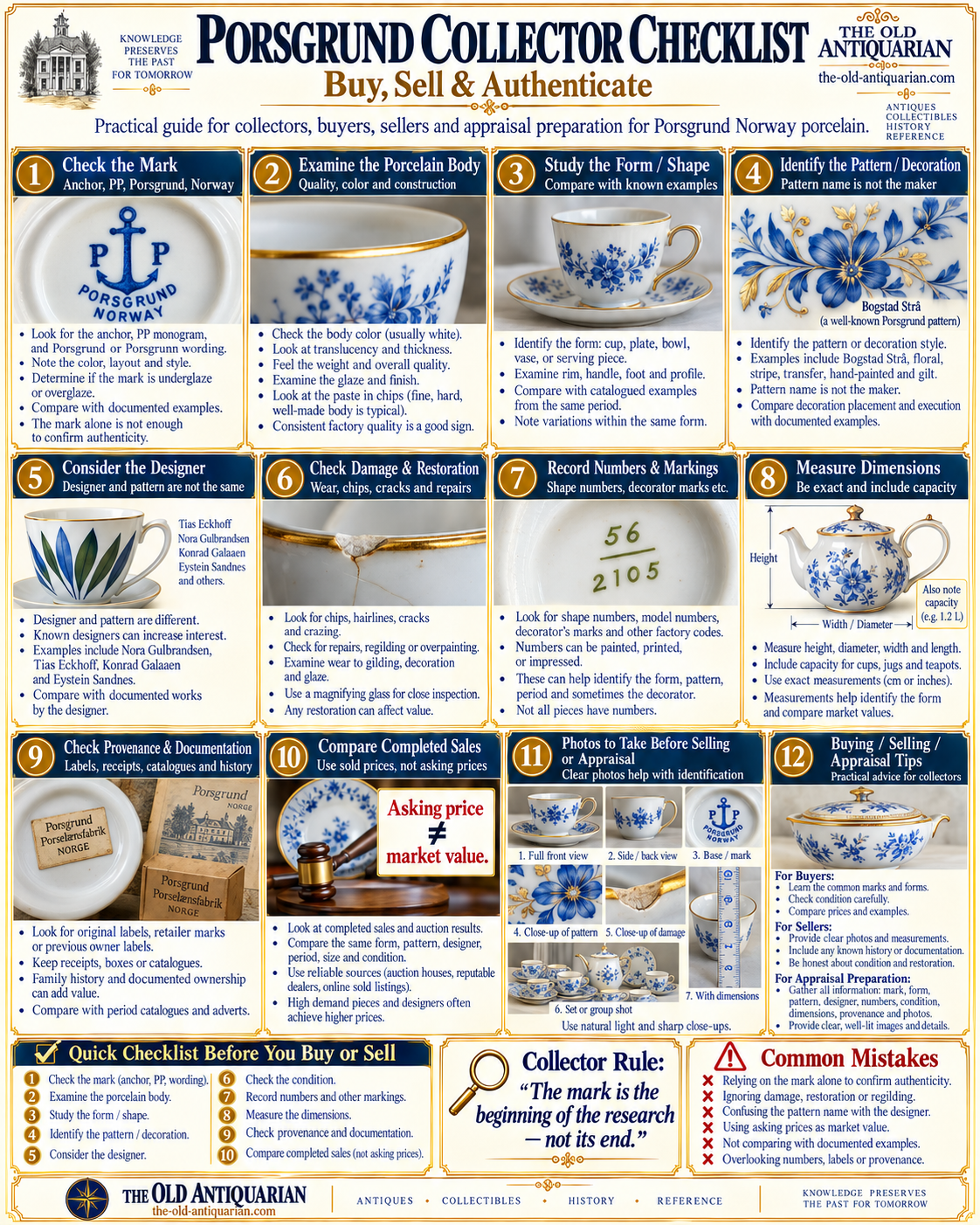
Front, back, sides and overall profile.
Include the complete anchor, lettering, numbers and labels.
Height, width, diameter and capacity where relevant.
Do not assume the decoration name is the model name.
Use documented attribution rather than visual similarity.
Decoration and model numbers can be important dating evidence.
Photograph chips, cracks, repairs, regilding and repainting.
Keep labels, receipts, boxes, catalogues and family documentation.
Only compare sales after the object has been identified accurately.
Do You Own Porsgrund Norway Porcelain?
Send clear photographs of the complete piece, underside, factory mark, every number or painter’s initial, pattern, dimensions and visible damage. For sets, include one photograph showing the complete group and separate photographs of representative marks.
Frequently Asked Questions About Porsgrund Porcelain
Is Porsgrund porcelain Norwegian?
Yes. Porsgrunds Porselænsfabrik was established in Porsgrunn, Norway, in 1885 and began porcelain production with its first firing in 1887.
How old is Porsgrund Porcelain?
The factory dates to 1885, while porcelain production began in 1887. Individual pieces can therefore range from late nineteenth-century objects to contemporary production.
What is the earliest Porsgrund porcelain mark?
The blue anchor with a P on each side is the principal early factory mark family and is broadly associated with 1887–1911.
What does a green anchor on Porsgrund porcelain mean?
An important green-anchor mark family replaced the earlier blue anchor from 1911 and is documented through approximately 1935. Later green marks also exist, so colour alone does not provide an exact date.
What is the difference between Porsgrund and Porsgrunn on a mark?
The spelling can help narrow the mark family. PORSGRUND is documented on a major 1913–1930 mark, while PORSGRUNN occurs on a related mark family from approximately 1930–1945.
What does NORGE or NORWAY mean on Porsgrund porcelain?
Country wording can help establish the production context. NORGE occurs on certain earlier transitional marks, while NORWAY becomes particularly important on post-war and export-era backstamps.
Can Porsgrund porcelain be dated from the mark alone?
Not reliably in every case. Some marks narrow the period strongly and certain later marks contain year information, but the best dating combines the exact mark with wording, numbers, form, pattern, designer and decoration.
What is Bogstad Strå?
Bogstad Stråmønster is one of Porsgrund’s oldest and most traditional services. The factory states that it has been produced since the first firing in 1887 and continues to be hand painted.
Which Porsgrund designers are most important?
Important documented names include Nora Gulbrandsen, Konrad Galaaen, Tias Eckhoff, Eystein Sandnes, Anne-Marie Ødegaard and Grete Rønning, among others.
Is Porsgrund by Tias Eckhoff collectible?
Tias Eckhoff is an important figure in Norwegian industrial design and worked at Porsgrund from 1949. Documented models associated with him, including Det Riflede, are an established area of Scandinavian design collecting.
Is Nora Gulbrandsen Porsgrund porcelain valuable?
Documented Nora Gulbrandsen pieces can attract specialist interest because of her importance to interwar Norwegian design, but value still depends on the exact object, period, rarity, condition, restoration and market demand.
How much is Porsgrund Norway porcelain worth?
There is no universal price. Value depends on the exact mark period, pattern or model, designer, rarity, form, condition, completeness, provenance and recent completed sales of genuinely comparable pieces.
Does an anchor mark prove that Porsgrund porcelain is genuine?
No. The anchor is an important factory clue, but reliable attribution requires the complete mark and the object’s body, form, decoration, numbers and historical context to agree.
Related Guides
Sources & Further Research
Porsgrund is unusually well suited to documented research because factory history, specialist mark references, museum collections and Norwegian design histories can be compared with the physical object.
| Source | Used For |
|---|---|
|
Porsgrunds Porselænsfabrik – About Porsgrund |
Factory foundation, first firing, historic production, Bogstad Strå and design history |
|
Porsgrund – Frequently Asked Questions |
Bogstad Strå 1887, Nisseserviset 1898 and Bondemønster 1932 |
|
Porsgrund – Bogstad Stråmønster |
History, hand painting and continuing production of Bogstad Strå |
|
Porsgrund – Designers |
Nora Gulbrandsen, Tias Eckhoff, Konrad Galaaen, Grete Rønning and documented designer history |
|
Nordisk Porselen – Porsgrund Marks |
Detailed chronology of blue anchor, green anchor, PORSGRUND, PORSGRUNN, Norway and later mark variants |
|
Nordisk Porselen – Decoration Numbers |
Historic decoration-number systems and dating cautions |
|
Store norske leksikon – Porsgrunds Porselænsfabrik |
Factory design history, Galaaen, Eckhoff, Ødegaard and Sandnes |
|
Norsk biografisk leksikon – Eystein Sandnes |
Sandnes design history, Askeladden, Eystein and his Porsgrund career |
|
Telemark Museum – Porcelain Museum |
Museum context, factory heritage, models, decoration and production history |
Porsgrund mark chronology contains transitional and overlapping variants. Where a simplified infographic date conflicts with a well-documented exact backstamp or factory source, the documentary source should take priority.
About The Old Antiquarian
The Old Antiquarian combines more than 35 years of practical experience with antiques and collecting with museum, historical and comparative research. Our porcelain guides identify objects through the complete evidence chain: material, factory mark, form, model, decoration, artist or designer, condition, restoration, provenance and documented comparison.
Conclusion: How to Research Porsgrund Porcelain Correctly
Porsgrund Porcelain is much more than a Norwegian anchor mark. Its history connects nineteenth-century industrial porcelain, traditional hand-painted services, interwar artistic experimentation and some of the most important names in Scandinavian mid-century design.
An early blue-anchor plate, a Nora Gulbrandsen vase, a Tias Eckhoff service, a Konrad Galaaen Spire piece and a later Porsgrund Norway cup may all be authentic factory products, while belonging to completely different periods and collector markets.
The strongest attribution therefore follows the complete evidence chain:
mark → wording → porcelain body → form → pattern → decoration → numbers → designer → period → condition → documentation.
Only after those elements have been established should market value be researched through genuinely comparable completed sales.
