
Traditional Shaggy Wool Rugs: The Great Wool Belt
The Great Wool Belt: Five Regions, One Ancient Need for Warmth
What connects Norwegian fishermen, Finnish weavers, Bulgarian kitenik makers, Anatolian pastoral communities, Caucasian carpet weavers, and Amazigh artisans in the Atlas Mountains? These peoples developed distinct textile traditions across enormous geographical distances. Yet many of their woolen rugs, bedding textiles, and long-pile covers reveal striking similarities in appearance and practical purpose.
From Scandinavian rya and Finnish ryijy to Bulgarian kitenik, Greek flokati, Anatolian tülü, and thick Amazigh wool rugs, traditional textiles offer an extraordinary window into the relationship between animals, climate, household life, craftsmanship, and cultural memory.
This historical and ethnographic guide explores the materials, weaving structures, regional names, traditional uses, and cultural significance of these remarkable textiles. It also examines an important question: do their similarities reveal a shared historical origin, or did different communities independently develop comparable solutions to the same practical needs?
Quick Answer: What Is the Great Wool Belt?
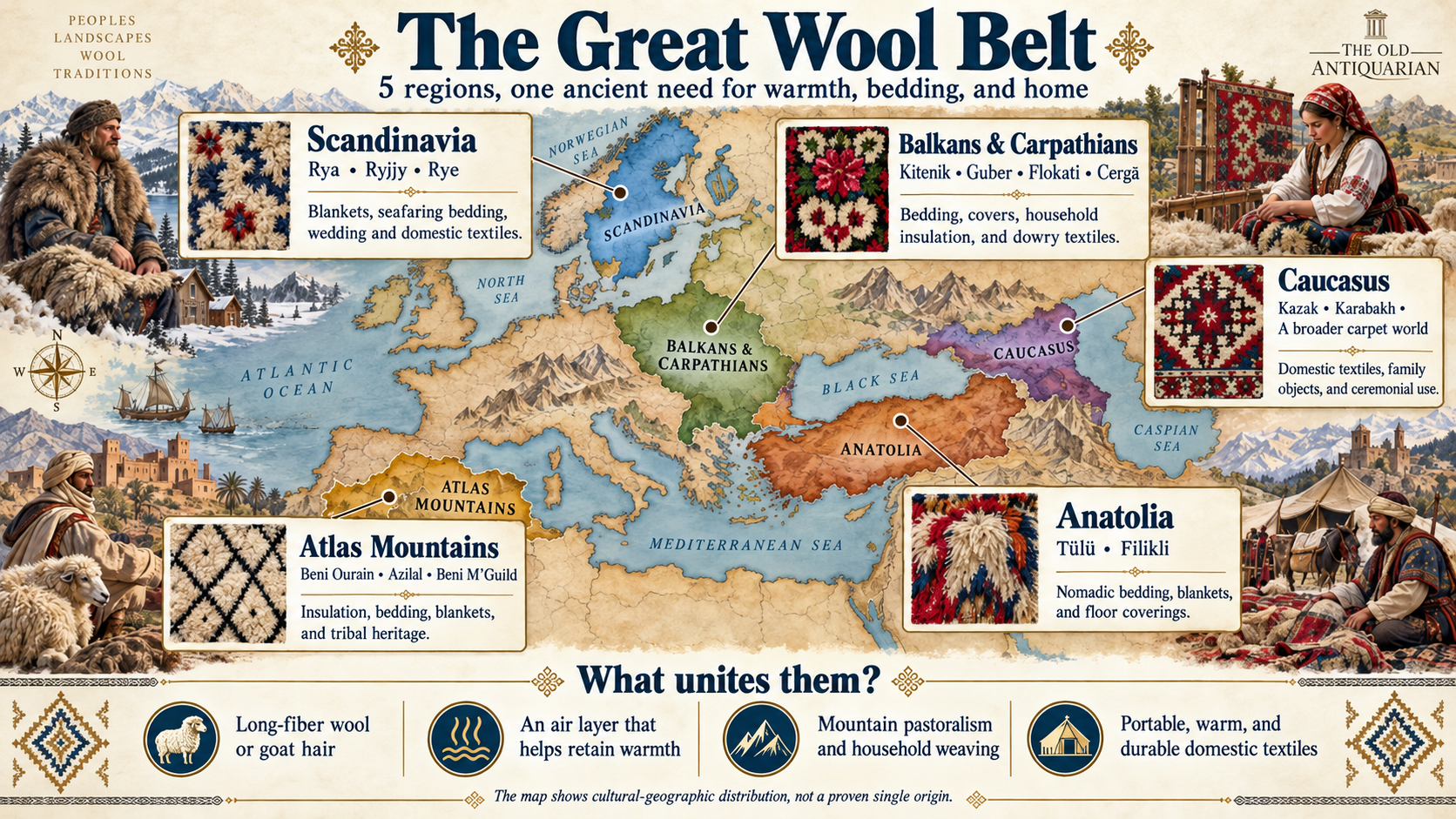
The Great Wool Belt is a comparative cultural and geographical concept used in this study to explore traditional shaggy wool rugs, long-pile bedding textiles, and related weaving practices across Scandinavia, the Balkans and Carpathians, Anatolia, the Caucasus, and the Atlas Mountains.
These traditions include Scandinavian rya, Finnish ryijy, Bulgarian kitenik and guber, Greek flokati, Anatolian tülü and filikli, and various Caucasian and Amazigh carpet traditions. Their historical functions include warmth, bedding, blankets, floor coverings, domestic comfort, family heritage, and portable household furnishings.
The Great Wool Belt is not an established UNESCO classification, a proven migration route, or evidence of a single common origin. It is a framework for comparing how distinct communities used wool, goat hair, weaving skills, and locally available resources to meet related human needs.
The Great Wool Belt at a Glance: Five Textile Regions
| Region | Textile Traditions | Traditional Functions |
|---|---|---|
| Scandinavia & Northern Europe | Rya, rye, ryijy | Bedcovers, boat bedding, wedding textiles, household furnishings |
| Balkans & Carpathians | Kitenik, guber, halishte, flokati, velentza, cergă | Bedding, blankets, domestic insulation, dowry textiles |
| Anatolia | Tülü, filikli, hopan | Pastoral bedding, blankets, covers, portable furnishings |
| Caucasus | Kazak, Karabakh, Shirvan, Quba and other traditions | Domestic carpets, ceremonial textiles, family heritage |
| Atlas Mountains | Beni Ourain, Azilal, Beni M’Guild, Marmoucha | Wool rugs, bedding, domestic furnishings, cultural expression |
IMPORTANT HISTORICAL DISTINCTION
A similar appearance does not prove that two rugs were made using the same technique, the same animal fibre, or a shared ancestral design. The map is an artistic educational illustration, not a photographic catalogue of authenticated historical objects. Individual traditions must be studied through their own construction, terminology, provenance, and documentary evidence.
1. Did Traditional Shaggy Wool Rugs Share a Common Origin?
Imagine a wool-covered bed inside a Scandinavian fishing household, a colourful Bulgarian kitenik spread across a wooden bed, an Anatolian long-pile textile used by a pastoral family, and a thick Amazigh wool rug in a mountain home. These objects may look surprisingly related. Yet their makers belonged to different societies, followed different traditions, and worked with different materials and techniques.
Their similarities can be examined through three explanations: comparable environmental needs, cultural transmission through human contact, and independent technological development.
Similar Needs in Different Climates
Cold winters, mountainous landscapes, available livestock, and the need for durable household furnishings all encouraged the development of insulating textiles. Wool was an important renewable fibre in many pastoral economies. When a community required warm bedding or a comfortable surface for sitting and sleeping, a thick woven textile with a raised pile was one practical possibility.
Migration, Trade, and the Movement of Craft Knowledge
Seasonal herding, trade networks, marriage, migration, and the movement of craftspeople can carry textile knowledge between regions. Such processes deserve attention when comparing the Balkans, Anatolia, and the Caucasus. However, the existence of contact does not establish that every long-pile textile descended from a single prototype.
An Important Comparative Research Paper
In 1998, Sevim Arslan published Tülü–Gabbeh–Ryijy in Arış Dergisi. The paper compares Anatolian tülü, Iranian gabbeh, and Finnish ryijy textiles, demonstrating that long-pile weaving traditions from distant regions can be studied comparatively through structure, materials, patterns, and use.
This is an important scholarly precedent, but it should not be extended into an unsupported claim that every shaggy rug across Europe, Asia, and North Africa developed from the same source.
THE CENTRAL RESEARCH PRINCIPLE
Compare function, construction, fibres, finishing, local terminology, historical period, and documented provenance before suggesting a cultural connection. Visual resemblance alone is not enough.
2. Why Does Long Wool Keep You Warm? Fibre Structure, Air, and Finishing
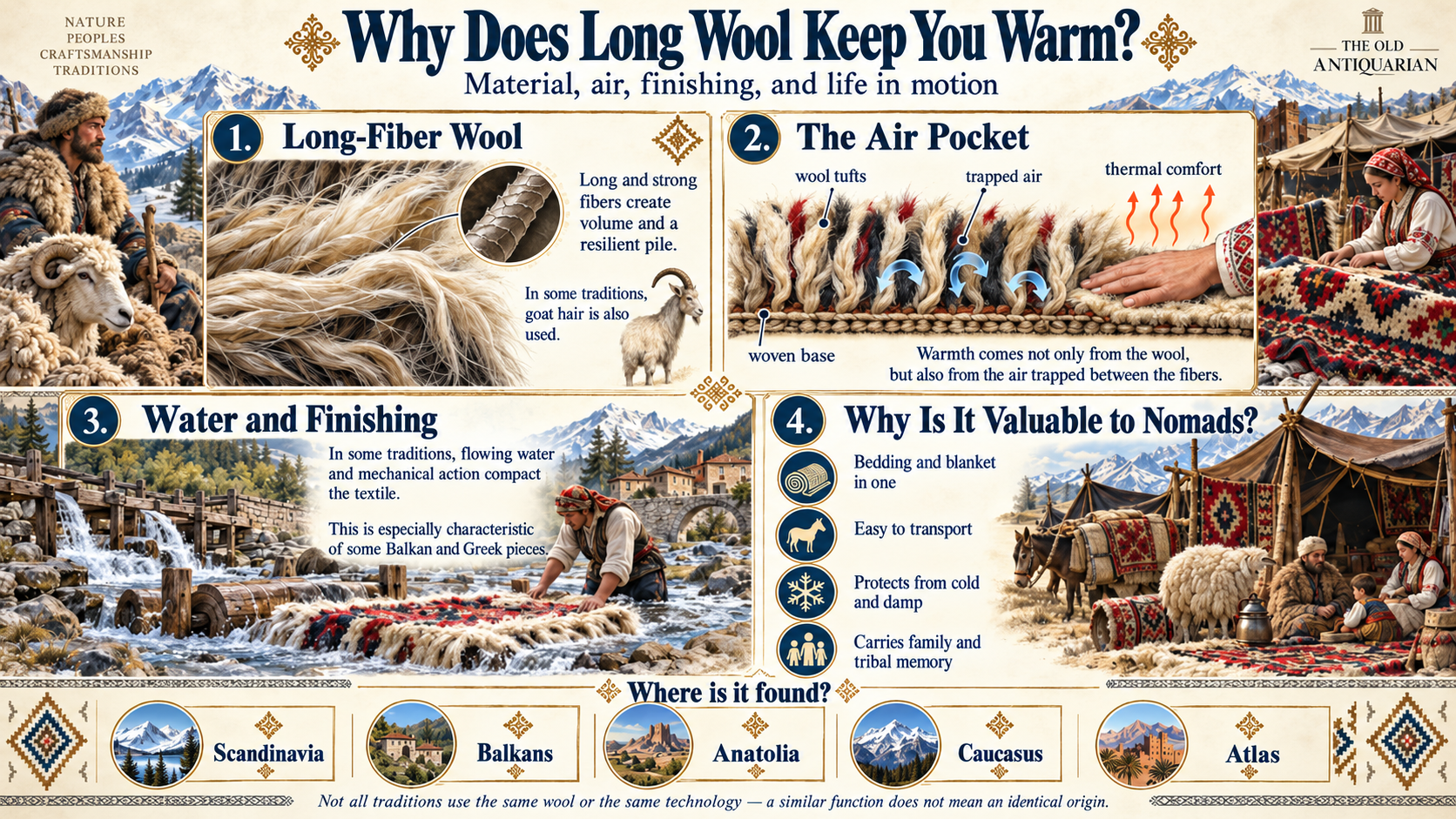
One of the strongest functional connections between traditional shaggy wool rugs is the use of animal fibres to create thick, comfortable textile surfaces. Wool has a complex natural structure, and its thermal properties result from several interacting factors rather than one supposedly magical substance.
Long-Fibre Wool and a Resilient Pile
Some historical textile makers favoured long, strong wool fibres because they could be used to form substantial tufts and a durable pile. In other cases, finer wool or different combinations of fibres were preferred. The exact choice depended on local sheep, available materials, spinning practices, and the intended use of the textile.
A long pile can create greater loft and a soft surface, but long fibres do not automatically make every rug warmer or better than a shorter-pile alternative. Density, compression, airflow, moisture, and the construction of the backing all influence performance.
The Air Pocket: A Key to Thermal Comfort
Wool fibres possess natural crimp and elasticity. A bulky wool structure can retain numerous small spaces containing air. Relatively still air slows heat transfer, which helps explain why loft and textile thickness can contribute to insulation. The same broad physical principle is important in many forms of insulating clothing and bedding.
Thermal comfort is nevertheless situational. A rug compressed beneath a sleeping person behaves differently from a fluffy blanket containing more uncompressed air. Wetness, wind, contact with cold surfaces, and the surrounding environment also matter.
Does Lanolin Make Wool Rugs Warm?
Lanolin is a naturally occurring waxy substance associated with raw sheep fleece. Its amount varies between fleeces, and part of it is removed during washing and wool processing. It should therefore not be assumed that every antique wool rug contains a large quantity of retained lanolin.
Lanolin alone does not explain a wool textile’s insulating performance. Fibre arrangement, trapped air, fabric thickness, and actual conditions of use are more important to understanding warmth.
Flowing Water and Traditional Wool Finishing
In some mountain textile traditions, finishing involved water and mechanical movement. Tumbling, agitation, and friction can compact or full woollen structures, altering their texture, density, and stability. This is especially relevant to the historical manufacture of certain Greek flokati rugs.
An account published in The Athenian in 1974 describes flokati textiles being processed in water-driven installations fed by mountain streams. This is a valuable historical description of a particular production practice, not evidence that all long-pile textiles worldwide used the same finishing method.
| Property | Why It Matters | Important Qualification |
|---|---|---|
| Long fibres | Can help form substantial pile and durable tufts | Not every rug uses the same wool or fibre length |
| Trapped air | Can reduce heat transfer through the textile | Compression, airflow, and moisture affect performance |
| Lanolin | A natural component of raw sheep fleece | Part may be removed in wool processing |
| Water finishing | May compact or alter woollen structures | Not a universal method across regions |
| Goat hair and mohair | Can provide long fibres for specific textiles | Different from sheep wool |
FIBRE STRUCTURE + TRAPPED AIR + THICKNESS + CONSTRUCTION
These factors help explain the insulating properties of wool textiles. Lanolin, pile length, and water finishing should not be treated as universal explanations for every regional rug tradition.
3. Scandinavia: Rya, Rye, and Ryijy from Bedding to Textile Art
Sweden: Rya and the Long-Knotted Pile
A Swedish rya is a woven textile with a long knotted pile. The Nationalmuseum in Sweden notes that rya textiles have existed in the Nordic countries since the Middle Ages and were originally used as bedcovers with their pile facing down toward the sleeper.
This historical arrangement is important. Modern observers often assume that the visible fluffy surface of a rug was always intended primarily as decoration. In earlier contexts, the pile could instead face the body as part of a practical bedding arrangement.
During the twentieth century, rya weaving became strongly associated with Scandinavian design. Textile artist Viola Gråsten helped reinterpret the technique through bold compositions and expressive colours. The Nationalmuseum preserves her Jam-Jam rya rug, manufactured in 1950.
Norway: Boat Rya and Maritime Bedding
Norwegian coastal communities developed distinctive uses for long-pile wool bedding. Traditional båtryer, or boat rya textiles, are associated with the practical requirements of fishermen and coastal travellers. They could provide a comfortable layer for sitting, resting, or sleeping in cold maritime conditions.
The maritime context distinguishes Norwegian boat bedding from mountain pastoral rugs. Both may make use of wool’s insulating characteristics, but their histories should not be reduced to a single nomadic explanation.
Finland: Ryijy, Weddings, and Family Memory
The Finnish ryijy tradition demonstrates how a useful bedcover could become a highly valued ceremonial and artistic textile. According to an exhibition by Hämeenlinna City Museum, the inventory of Häme Castle in 1547 recorded 55 ryijy rugs. Such textiles served as warm blankets and could also be used in payments and transfers of value.
By the late eighteenth century, Finnish ryijy designs increasingly included colourful flowers, birds, and trees of life. Some were used as wedding covers, displayed as family treasures, or incorporated into funeral customs. Their history reveals a gradual movement from household necessity to symbolic cultural object.
THE SCANDINAVIAN TRANSFORMATION
The long-pile textile could function as bedding, become part of family and wedding customs, and later enter the world of modern design. Its meaning changed even as aspects of its traditional construction survived.
4. Balkans and Carpathians: Bulgarian Kitenik, Greek Flokati, and Romanian Cergă
The Balkans and Carpathians form one of the richest regions for comparing mountain weaving, domestic wool textiles, and pastoral traditions. Different communities developed pile rugs, thick blankets, covers, and other textile forms using locally available wool, goat hair, and regional techniques.
Bulgaria: The Traditional Kitenik
A Bulgarian kitenik is a traditional pile textile, frequently described in English as a shaggy or tufted wool rug. Historic examples may feature dense raised surfaces, geometric designs, bold floral motifs, natural wool colours, or decorative borders.
Kiteniks could be used for household furnishing, covering beds or benches, and creating comfortable surfaces for domestic life. They should be understood within Bulgaria’s wider traditions of woven rugs, household covers, wool blankets, and regional textile craftsmanship.
Related Bulgarian terms include guber and halishte. These names may overlap in everyday usage but should not automatically be treated as technically identical. When identifying an old textile, the material, reverse, pile construction, original edges, and known regional terminology all matter.
Where Were Bulgarian Kiteniks Made?
The Troyan region provides an important documented example. The Museum of Traditional Crafts and Applied Arts in Troyan preserves and presents regional weaving practices, including tufted or fleecy rugs and other household textiles. The Rhodope Mountains also belong to the broader historical context of Bulgarian pastoral life and domestic wool weaving.
However, individual kiteniks should not be attributed to a specific village or region solely because their decoration looks familiar. Family histories, movement of textiles between households, repairs, and changing production practices complicate simple regional classifications.
For a detailed examination of pile, borders, reverse, original edges, condition, and provenance, explore our Bulgarian Kitenik Identification and Collector Guide.
Greece: Flokati and the Power of Mountain Water
Greek flokati is one of the best-known shaggy wool textile traditions. Historically associated with mountain communities, including parts of the Pindus range, Epirus, and Thessaly, traditional flokati was valued as a substantial woollen furnishing and bedding textile.
Its finishing is especially distinctive. Historical accounts describe woven textiles being processed through water-driven movement, which could compact the structure and alter the pile. The 1974 account in The Athenian describes water installations fed by mountain streams and the repeated tumbling of flokati textiles during finishing.
The Metsovo Folk Art Museum holds a woollen flokati rug catalogued as object GE-940-2 and dated to the early twentieth century. Such museum evidence is particularly valuable because it connects traditional terminology with an actual documented textile.
Pastoral Communities and Seasonal Movement
Seasonal livestock movements were important in different parts of the Balkans. Vlach and Aromanian communities, alongside many other pastoral populations, participated in regional networks through which raw materials, household goods, and practical knowledge could circulate. These historical contacts are important, but they do not mean that every Balkan shaggy textile should be assigned to one ethnic group.
North Macedonia: Yanbol Textiles
Textiles described as yanbol appear in specialist comparative research examining Balkan collections and similarities with weaving traditions around Konya in Anatolia. These studies are relevant because comparisons based on recorded museum objects can provide stronger evidence than superficial resemblance alone.
Romania: Cergă and Carpathian Wool Blankets
In Romania, thick woollen blankets known as cergă are associated with regional traditions, including those of Maramureș. Some local examples have pronounced wool surfaces and are linked to methods of finishing and fulling. Their construction and function may differ from both Bulgarian kiteniks and Greek flokati, even when the resulting textiles share a substantial woollen texture.
| Country | Traditional Names | Key Research Context |
|---|---|---|
| Bulgaria | Kitenik, guber, halishte | Domestic pile textiles, regional weaving, family and collector heritage |
| Greece | Flokati, velentza | Mountain wool textiles; documented water finishing for flokati |
| North Macedonia | Yanbol | Museum objects and comparisons with Anatolian weaving |
| Romania | Cergă | Carpathian wool blankets and regional finishing traditions |
BULGARIAN KITENIK IS NOT THE SAME AS A CHIPROVTSI KILIM
Traditional Chiprovtsi carpets are flat-woven, double-sided textiles. They represent an important Bulgarian weaving tradition but should not be confused with long-pile kiteniks. The difference in construction matters for identification, historical research, and cataloguing.
5. Anatolia: Tülü, Filikli, and the Portable Pastoral Home
Anatolian tülü textiles are among the most compelling comparisons for traditional long-pile rugs elsewhere. Some have loosely arranged, substantial tufts that resemble fleece and create a visually striking surface. Their technical characteristics vary, and they must not all be classified as identical products.
Karapınar: A Documented Centre of Tülü Weaving
Karapınar, in the Konya region of central Anatolia, is particularly important to the study of tülü. Sedef Acar and Ecem Tosun examined its weaving traditions in their 2017 paper Karapınar Tülüleri ve Günümüzdeki Durumu, discussing historical development, materials, techniques, motifs, production, and local uses.
Regional textile terminology includes tülü and related names such as filikli and hopan. These names and their meanings should be interpreted in their local context rather than treated as universal categories.
Tülü or Filikli: Sheep Wool or Goat Hair?
Not every Anatolian long-pile textile is made exclusively from sheep wool. Some related traditions use goat hair, including mohair from Angora goats. Fibre identification is therefore essential. A long, lustrous pile may look visually similar to sheep wool while behaving differently at the fibre level.
Why Portability Mattered
Certain pastoral communities used long-pile textiles as bedding, blankets, covers, and temporary floor furnishings. Textiles can be folded or rolled and moved with household possessions, making them useful in ways that more permanent furnishings are not.
The Anatolian comparison is therefore important not only because of appearance, but also because similar practical needs could influence textile production. Still, a woven fleece-like rug is structurally different from an intact sheepskin with its natural hide backing.
6. The Caucasus: Diverse Carpet Traditions and Shared Textile Knowledge
The Caucasus occupies an important place in the history of woven carpets and household textiles. Regional names such as Kazak, Karabakh, Shirvan, and Quba are familiar to collectors, but they represent a wide variety of historical types, constructions, and cultural settings.
Are All Caucasian Carpets Shaggy?
No. Some Caucasian knotted rugs have a substantial wool pile, but many others have shorter pile or are flat-woven. Their inclusion in the Great Wool Belt is therefore comparative: the region represents an extensive carpet-making culture that shares the use of wool, domestic furnishing, and traditional craftsmanship, rather than one uniform long-pile technology.
Multiple Communities and Complex Attributions
Carpet weaving in the Caucasus developed within a multiethnic and multilingual historical environment. Designs, weaving techniques, and commercial descriptions crossed boundaries over time. Modern national names do not always correspond neatly to the circumstances in which a historical carpet was made.
The Carpet as a Family and Ceremonial Object
UNESCO’s documentation of traditional Azerbaijani carpet weaving describes a family-based craft transmitted through practice. It includes both pile and pile-less surfaces, the use of different looms and fibres, and carpets associated with household furnishings and major family events.
This is an important reminder that carpets may carry social meanings that cannot be understood from their appearance alone. A textile can be part of daily life, ceremonial practice, and intergenerational memory at the same time.
7. Atlas Mountains: Amazigh Rugs and Morocco’s Wool-Weaving Heritage
The Atlas Mountains mark the southwestern extent of this comparative study. Across the Moroccan Atlas, diverse Amazigh communities developed distinctive weaving practices that reflect local materials, visual traditions, and household needs. The historical term Berber rugs remains common in the international antiques and design market, while Amazigh identifies the peoples and cultural traditions more directly.
Beni Ourain: Wool Rugs of the Middle Atlas
Traditional rugs associated with Beni Ourain communities are often recognised for natural light-coloured wool, dark geometric lines, and a substantial pile. Some were made for domestic environments where thick wool textiles had practical value during cold mountain seasons.
Azilal: Expressive Colour and Local Variation
Textiles associated with the Azilal region of the High Atlas frequently display varied colour combinations and lively abstract or geometric arrangements. Construction, materials, and pile length differ between examples, and the name alone does not establish a precise workshop, date, or historical technique.
Beni M’Guild and Marmoucha
Other Moroccan weaving traditions include those associated with Beni M’Guild and Marmoucha. Their rugs form part of a broader regional carpet world, within which local identity, wool selection, colour, construction, and intended use may vary considerably.
Weaving, Identity, and Women’s Craftsmanship
Traditional weaving can preserve family skills and community identity while also providing opportunities for artistic expression and economic activity. Contemporary documentation of Moroccan craft traditions shows that the relationship between inherited knowledge and modern markets remains important.
A MOROCCAN RUG IS NOT AUTOMATICALLY A GREEK FLOKATI
Thick wool pile does not establish that a textile was manufactured using the same water-finishing methods as traditional Greek flokati. Historical comparisons must distinguish fibre, structure, finishing, and cultural provenance.
8. Why Were Thick Wool Textiles Valuable to Nomadic and Pastoral Communities?
In some pastoral societies, families moved seasonally between grazing areas. Portable possessions needed to serve several practical functions while remaining suitable for transport. Woven woollen bedding and floor coverings could be useful in such environments.
A single textile might serve as bedding, a blanket, a sitting surface, or part of the arrangement of a temporary dwelling. Not every traditional shaggy rug originated in a nomadic community, but the broader connection between textile mobility and pastoral life is an important subject for historical research.
| Function | Practical Value | Cultural Significance |
|---|---|---|
| Bedding | An additional layer above a cold or hard surface | Part of personal and household space |
| Blanket | Provides an extra insulating layer | Daily comfort and domestic continuity |
| Floor covering | Improves comfort and defines a living area | Hospitality and family life |
| Portable furnishing | Can be rolled and moved when condition allows | Part of a mobile home |
| Dowry or gift | A durable household textile | Family relationships and inheritance |
| Ceremonial use | Special furnishings for certain events | Local rituals and community memory |
Sheep, Wool, and the Household Economy
For many pastoral communities, sheep provided several resources, including milk, meat, and wool. Shearing made it possible to obtain a recurring source of textile fibre while the animal remained part of the flock. The resulting textiles could embody substantial labour in sorting, spinning, dyeing, weaving, and finishing.
A Woven Rug Is Not a Sheepskin
Long-pile rugs sometimes resemble natural animal fleece. However, a woven pile textile is not identical to a sheepskin. A sheepskin retains its natural hide backing, whereas a woven rug has a constructed textile foundation that holds the pile through knots, loops, or other methods.
THE RUG AS A PORTABLE PART OF HOME
A household may move, but its textiles can preserve the skills, labour, and memories of the people who made and used them.
9. Comparison Table: Are Traditional Shaggy Wool Rugs Made the Same Way?
The short answer is no. Similar-looking pile textiles can be produced from different fibres, using different structures, and for different historical purposes. Technical comparison is particularly valuable when attempting to identify an old rug or distinguish an authentic traditional textile from a modern decorative product.
| Textile Type | Typical Structural Context | Key Distinction |
|---|---|---|
| Rya / Ryijy | Woven foundation with long knotted pile | Historical bedding use; later ceremonial and decorative roles |
| Bulgarian Kitenik | Pile textile with regional and household variations | Different local terminology, designs, and construction details |
| Greek Flokati | Woven wool textile with pronounced pile | Documented traditional water finishing |
| Romanian Cergă | Thick wool blanket with local variants | Carpathian blanket and finishing traditions |
| Anatolian Tülü / Filikli | Long tufts of wool or goat hair | Different animal fibres and constructions |
| Caucasian Carpets | Various knotted-pile and flat-woven techniques | Not all have long pile |
| Amazigh Rugs | Regional wool pile-weaving traditions | Different local identities, motifs, and techniques |
COLLECTOR RULE: SHAGGY IS A DESCRIPTION, NOT AN ATTRIBUTION
The English term shaggy rug describes a textile’s pile appearance. It does not establish age, geographical origin, weaving community, material, or authenticity.
10. Historical Timeline: From Functional Bedding to Collectible Textile Art
| Period | Development or Documentary Example |
|---|---|
| Middle Ages | Evidence of long-pile rya traditions in the Nordic countries. |
| 1547 | The inventory of Häme Castle records 55 Finnish ryijy textiles. |
| 18th–19th centuries | Regional weaving traditions and complex decorative patterns are documented in surviving collections. |
| Early 20th century | Surviving museum examples provide evidence for traditional pile rugs and bedding textiles. |
| 1950 | Viola Gråsten’s Jam-Jam rya marks the development of modern Scandinavian textile design. |
| Later 20th century | Traditional-looking shaggy rugs gain an international role in interior design markets. |
| 21st century | Museums, researchers, weavers, and collectors continue documenting and preserving regional textile heritage. |
This timeline brings together separate regional histories. It should not be interpreted as a single chronological route by which one original rug design spread across every region.
11. Shared Cultural Heritage: How Traditional Wool Textiles Connect Communities
The history of traditional wool textiles is more than a story about yarn and weaving. It is also a history of household labour, animal husbandry, family relationships, local knowledge, artistic expression, and the way people adapt to their environment.
Weaving Skills Passed Between Generations
In many weaving communities, knowledge was shared within families and local craft networks. Skills could include preparing wool, spinning, dyeing, setting up the loom, arranging the pile, selecting motifs, and completing the textile. An old rug can preserve evidence of this work through its construction, edges, knots, colour variations, and repairs.
What Has UNESCO Recognised?
UNESCO has recognised several distinct carpet-making traditions on its Representative List of the Intangible Cultural Heritage of Humanity. These inscriptions celebrate living craftsmanship and community knowledge rather than establishing a unified historical origin for shaggy rugs.
| UNESCO Tradition | Inscription | Importance |
|---|---|---|
| Traditional Azerbaijani Carpet Weaving | 2010 | Family transmission, weaving skills, and ceremonial and domestic uses |
| Carpet-Making in Chiprovtsi, Bulgaria | 2014 | Community weaving knowledge and double-sided flat-woven carpets |
| Traditional Wall-Carpet Craftsmanship in Romania and Moldova | 2016 | Artistic traditions, family transmission, and community identity |
These UNESCO-listed practices should not be presented as equivalent to long-pile shaggy weaving. They demonstrate something broader: traditional carpet craftsmanship remains an important means by which communities express identity and pass knowledge from one generation to the next.
Similar Human Needs, Distinct Cultural Answers
What connects these regional traditions most convincingly is not an unproven ancestral carpet but a recurring relationship between people, livestock, local materials, household life, and the desire for warmth and comfort. The same broad need can produce very different cultural and technological answers.
12. Collector’s Guide: How to Identify and Value an Old Shaggy Wool Rug
An old long-pile rug should be examined as a complete textile object, not merely as a colourful decorative surface. Its historical and collector interest may depend on material, construction, region, date, ornamentation, condition, originality, and provenance.
Ten Important Checks Before Buying or Selling
- Photograph the entire textile from the front.
- Photograph the reverse to reveal its construction.
- Measure the length and width accurately.
- Examine pile length, density, and consistency.
- Inspect original edges, bindings, and fringes.
- Identify the likely fibres without assuming all pile is sheep wool.
- Look for moth damage, holes, stains, and weak areas.
- Record later repairs, patches, and altered sections.
- Preserve family history, labels, and old photographs.
- Compare documented museum objects and relevant confirmed market sales.
What Determines the Value of a Traditional Wool Rug?
| Value Factor | Why It Matters |
|---|---|
| Documented provenance | May strengthen historical attribution and cultural context. |
| Age and period | Relevant when supported by construction and reliable documentation. |
| Material and technique | Help establish the textile’s historical and technical identity. |
| Ornamentation | Can contribute to artistic interest and regional research. |
| Rarity | Depends on the specific tradition, type, and surviving examples. |
| Condition | Losses, insect damage, staining, and repairs may affect collector appeal. |
| Comparable sales | Completed sales are generally more informative than unsupported asking prices. |
Why the Reverse Is So Important
The pile side shows how a textile was intended to be seen or used, but the reverse can reveal how it was made. It may expose the foundation weave, knotting, later repairs, replaced yarn, original edges, and other details hidden by the wool pile.
Should You Clean an Antique Wool Rug Before Valuation?
Avoid automatic machine washing, bleaching, aggressive scrubbing, or unassessed wet cleaning. Historic dyes, weakened fibres, and previous repairs may react unpredictably to moisture and detergents. Photograph the textile first and preserve its original construction.
For further preventive care, consult our guide to storing antique rugs, historic textiles, and traditional clothing.
PRESERVATION BEFORE IMPROVEMENT
Do not cut, dye, heavily wash, or reconstruct an old textile simply to make it look more attractive before it has been properly examined. Alterations can destroy evidence of the original weaving and affect historical significance.
Do You Own an Old Wool Rug, Bulgarian Kitenik, or Historic Textile?
The Old Antiquarian considers selected antique rugs, traditional wool textiles, woven household objects, and inherited textile collections with historical, regional, or collector interest. Send clear photographs showing the entire item, front and reverse, pile, original edges, dimensions, condition, and any available family history.
Explore Textile Identification & Initial Review →
An initial review based on photographs is not an authentication certificate or a guarantee of purchase.
13. Frequently Asked Questions About Traditional Shaggy Wool Rugs
What is a traditional shaggy wool rug?
It is a broad descriptive term for a wool rug with a prominent or long pile. Historic examples differ in material, construction, regional name, function, and origin.
What is the Great Wool Belt?
It is a comparative concept examining wool textile traditions across Scandinavia, the Balkans, Anatolia, the Caucasus, and the Atlas Mountains. It is not proof of one common historical origin.
Why does long wool help keep you warm?
Bulky wool structures can retain air between fibres, helping reduce heat transfer. Actual thermal comfort depends on thickness, density, compression, moisture, and use.
Does lanolin make antique wool rugs warmer?
Not by itself. Fibre structure, trapped air, and textile thickness play important roles. Some lanolin is removed when raw wool is cleaned and processed.
Are Scandinavian rya and Finnish ryijy the same?
They are related Nordic long-pile textile traditions, but historical uses, constructions, decorative practices, and cultural contexts vary by place and period.
Is a Bulgarian kitenik the same as a Greek flokati?
Not necessarily. Both can have prominent wool pile, but their construction, finishing, regional terminology, and historical context may differ.
Why were Greek flokati rugs processed in flowing water?
Traditional water-driven finishing used mechanical movement to alter and compact woven wool structures. This process is documented for certain Greek flokati production methods.
What is the difference between Anatolian tülü and filikli?
Tülü is a broader regional term for certain long-pile textiles. Some filikli textiles are associated with long goat hair, including mohair, rather than exclusively sheep wool.
Are all Caucasian carpets shaggy?
No. Caucasian carpet traditions include many knotted rugs with different pile heights as well as flat-woven textiles.
How can I identify an old Bulgarian kitenik?
Examine the material, pile, reverse, edges, weaving structure, ornamentation, condition, dimensions, and provenance. Pattern alone is not sufficient to prove age or region.
Are old shaggy wool rugs valuable?
Some can have collector or decorative value, but age alone does not determine price. Provenance, craftsmanship, rarity, condition, originality, and market demand all matter.
14. Conclusion: Five Regions, Distinct Cultures, and a Shared Human Need
From the cold maritime landscapes of Norway to the mountains of Morocco, people have repeatedly transformed animal fibres into useful household textiles. In some regions, long-pile fabrics served as bedding. In others, they became floor coverings, ceremonial objects, dowry gifts, family heirlooms, or works of textile art.
Their materials and methods were not identical. Different weaving communities developed distinct solutions to local conditions, and available historical evidence does not justify treating every traditional shaggy rug as the descendant of a single ancient prototype.
The value of the Great Wool Belt lies in the comparison itself. It invites us to see how the same broad human needs — warmth, shelter, bedding, comfort, and cultural continuity — can inspire related yet independently meaningful traditions.
An old Bulgarian kitenik, a Scandinavian rya, a Greek flokati, an Anatolian tülü, or a wool rug from the Atlas Mountains can be more than an attractive furnishing. It may preserve evidence of the people who made it, the household that used it, and the skills that passed from one generation to the next.
FROM WOOL TO HERITAGE
A sheep can provide wool. Human skill, labour, and memory transform that wool into cultural heritage.
Continue Exploring: Antique Rugs and Historic Textiles
15. Sources & Further Research
This article draws on museum collections, specialist textile research, historical accounts, technical wool-processing information, and official documentation of intangible cultural heritage. Sources support particular regional descriptions; they do not collectively establish the Great Wool Belt as one proven historical culture.
- Nationalmuseum, Sweden — Rya Rug “Jam-Jam”. Museum documentation of Nordic rya history and Viola Gråsten’s 1950 textile design.
- Museet Kystens Arv, Norway — Båtryer. Historical context for Norwegian long-pile boat bedding.
- Hämeenlinna City Museum — Kannuksenpyörä: Häme Ryijy Rug. Museum research concerning Finnish ryijy, the 1547 Häme Castle inventory, and ceremonial uses.
- Museum of Traditional Crafts and Applied Arts, Troyan. Official description of Bulgarian weaving, tufted rugs, fleecy textiles, and regional crafts.
- Metsovo Folk Art Museum — GE-940-2 Flokati. Museum record for a woollen flokati rug dated to the early twentieth century.
- The Athenian, 1974 — Greece’s Shaggy Rug Story. Historical description of flokati production and traditional water finishing.
- Arslan, Sevim, 1998 — Tülü–Gabbeh–Ryijy. Arış Dergisi, Issue 4, pp. 44–53. A comparative study of Anatolian, Iranian, and Finnish textiles.
- Acar, Sedef & Tosun, Ecem, 2017 — Karapınar Tülüleri ve Günümüzdeki Durumu. Research on the historical, structural, and regional features of Karapınar tülü.
- The Metropolitan Museum of Art — Carpet with a Geometricized Medallion Design. A documented historical carpet relevant to Caucasian textile research.
- Smithsonian Folklife Festival — Moroccan Weaving. Documentation of traditional Moroccan weaving and local craftsmanship.
- UNESCO — Traditional Art of Azerbaijani Carpet Weaving. Inscribed in 2010.
- UNESCO — The Tradition of Carpet-Making in Chiprovtsi. Bulgarian flat-woven carpet tradition, inscribed in 2014.
- UNESCO — Traditional Wall-Carpet Craftsmanship in Romania and the Republic of Moldova. Inscribed in 2016.
- The Woolmark Company — Scouring and Carbonising. Technical background on wool processing and the removal of wool grease.
A NOTE ON HISTORICAL ACCURACY
Traditional textile names vary by region and historical period. The Great Wool Belt is presented as a comparative research concept, not an established theory of common ancestry. The two infographics are original educational artworks and do not replace authenticated museum photographs or object-level documentation.
About The Old Antiquarian
The Old Antiquarian combines more than 35 years of practical experience with antiques, vintage objects, traditional textiles, and collectibles with historical research, museum comparisons, and careful examination of craftsmanship and provenance.
Our aim is to help identify, appreciate, and preserve objects that carry artistic, historical, and family significance. Traditional textiles deserve attention not only as decorative furnishings, but also as evidence of the lives, skills, and cultural knowledge of earlier generations.
Editorial historical and ethnographic research based on the cited sources. This article does not claim original archaeological fieldwork or laboratory testing and does not replace an individual professional appraisal.
THE FINAL COLLECTOR RULE
Fibre + Construction + Ornamentation + Historical Period + Condition + Provenance + Reliable Comparisons = A Stronger Foundation for Understanding Traditional Wool Textiles.
