
Winterling Bavaria Porcelain: Marks, Dating & Value
Quick Answer: What Is Winterling Bavaria Porcelain?
Winterling Bavaria refers to German porcelain associated with members of the Winterling family and their porcelain manufacturing businesses in Bavaria. The name appears on tableware, coffee and tea services, dinner sets, plates, bowls, serving pieces and decorative porcelain produced primarily during the twentieth century.
The most important historical distinction is between Heinrich Winterling in Marktleuthen, established in 1903, and Gebrüder Winterling in Röslau, where porcelain production began in 1907. Although related by family, these were separate companies with different histories, factory networks and marking systems.
To identify and date Winterling porcelain accurately, examine the complete factory backstamp, manufacturing location, porcelain body, shape, pattern, decoration, period and condition. The words Bavaria, Germany or W. Germany do not establish an exact production date or market value on their own.
Winterling Bavaria at a Glance
| Feature | Historical and Collector Information |
|---|---|
| Country | Germany |
| Historical region | Bavaria, particularly Upper Franconia |
| Heinrich Winterling | Marktleuthen, established in 1903 |
| Gebrüder Winterling | Röslau, porcelain production from 1907 |
| Related manufacturing sites | Schwarzenbach, Kirchenlamitz, Windischeschenbach and Bruchmühlbach |
| Factory marks | Winterling, crowned W, Marktleuthen, Röslau, Bavaria, Germany, W. Germany and other variations |
| Typical objects | Tea and coffee services, dinnerware, plates, bowls, jugs, vases and decorative items |
| Decorative references | Indisch Blau, Fleuri and various floral patterns |
| Associated porcelain name | Eschenbach, associated with Windischeschenbach |
| Collector value | Depends on attribution, shape, decoration, rarity, condition, completeness and comparable completed sales |
Winterling belongs to the wider history of German porcelain manufacturing, a field that includes numerous regional factories, changing ownership structures, export marks and decorative traditions. If you are new to researching porcelain, our complete guide to antique porcelain explains the broader identification method.
Do You Own Winterling Bavaria Porcelain?
Have you inherited a German porcelain dinner service, coffee set, vase or collection? Discover how to research its maker and historical period, request a professional opinion, explore selling options or browse our antique porcelain collection.
An initial review based on photographs is not an authenticity certificate or a guarantee of purchase.
Winterling Bavaria is not the name of one single historical porcelain factory. The complete object must support the proposed factory attribution, production period and pattern identification.
The History of Winterling Bavaria Porcelain
The Winterling name emerged during a period of substantial industrial growth in the German porcelain industry. During the late nineteenth and early twentieth centuries, northern Bavaria developed an extensive network of porcelain manufacturers supplying domestic customers, hospitality businesses and international markets.
Among the important towns in this industrial region were Marktleuthen, Röslau, Selb, Schwarzenbach and Kirchenlamitz. Individual manufacturers established their own factories, adopted changing trademarks, expanded production and developed large ranges of tableware and decorative objects.
The Winterling family became associated with more than one porcelain business. This explains why pieces marked Winterling, Winterling Bavaria or Gebrüder Winterling should not automatically be attributed to the same factory or dated according to one universal timeline.
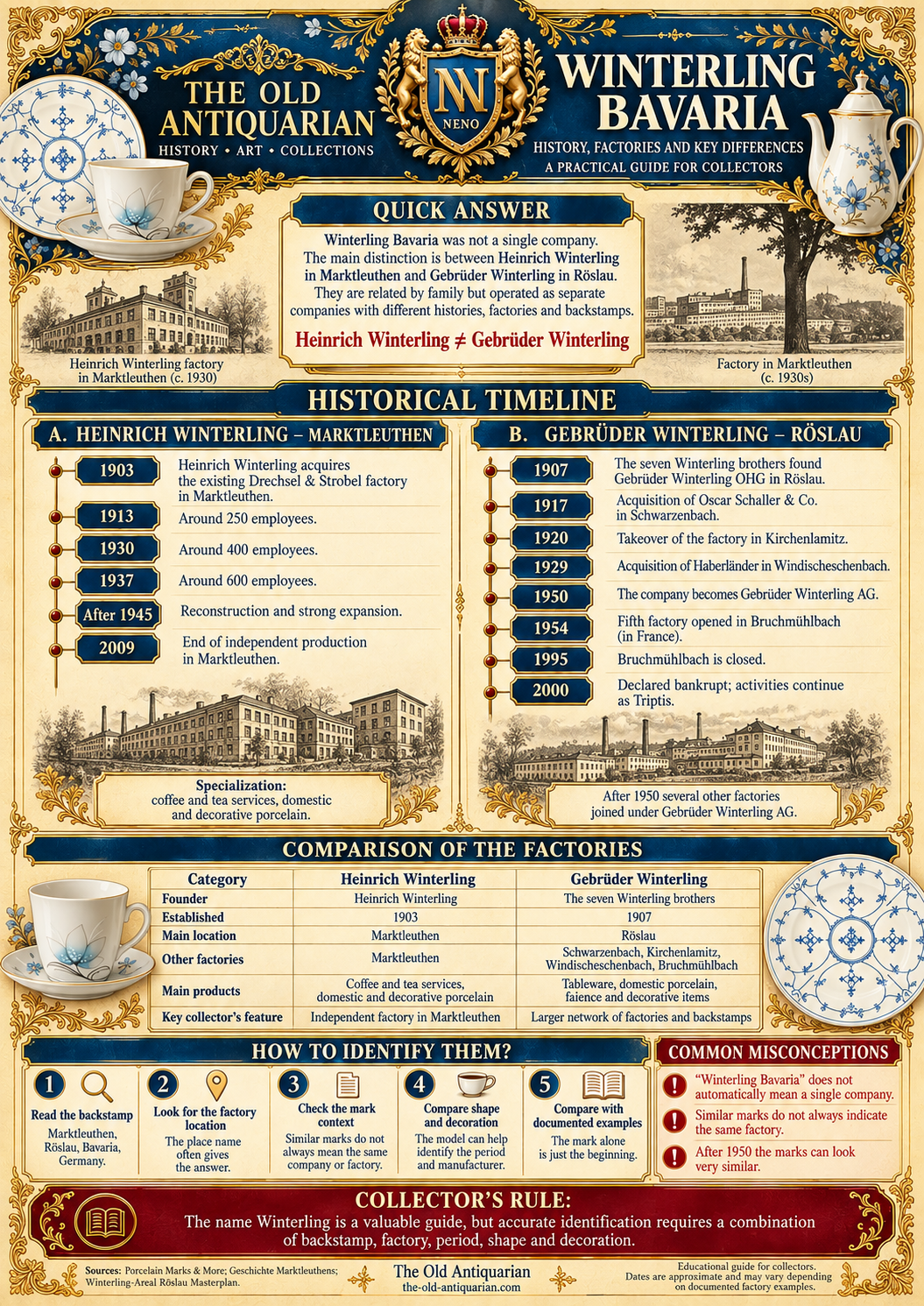
Heinrich Winterling vs Gebrüder Winterling
Heinrich Winterling – Marktleuthen (1903–2009)
The history of Heinrich Winterling in Marktleuthen began in 1903, when Heinrich Winterling acquired the existing Drechsel & Strobel porcelain factory. Drechsel & Strobel had been founded in 1897, meaning that the manufacturing site was older than the Winterling business established there.
The company developed a particular association with coffee and tea services, complete dinner sets, domestic porcelain, giftware and decorative objects. Its expanding workforce illustrates the scale of its industrial development: specialist historical records give approximately 250 employees in 1913, 400 in 1930 and 600 in 1937.
Heinrich Winterling continued manufacturing through changing economic conditions during the twentieth century. The business experienced serious difficulties in its final years, with activity ending around 2009–2010. Collectors should therefore distinguish early, mid-century and late production rather than treating everything marked Heinrich Winterling as antique.
Gebrüder Winterling – Röslau (1907–2000)
The seven Winterling brothers established Gebrüder Winterling OHG in Röslau in 1907, using a newly constructed porcelain factory. The company soon expanded and developed connections with several other porcelain-producing towns.
In 1917 it acquired Oscar Schaller & Co. in Schwarzenbach. In 1920 it took over and converted a former textile factory in Kirchenlamitz. In 1929 it acquired Porzellanfabrik Eduard Haberländer in Windischeschenbach. These developments formed an increasingly complex manufacturing network with related business names and factory marks.
In 1950 the business became Gebrüder Winterling AG, and its factory structure and marks changed. A further facility opened in Bruchmühlbach, Rhineland-Palatinate, Germany, in 1954, producing earthenware until its closure in 1995. This matters because not every ceramic object associated with the wider Winterling enterprise is necessarily porcelain.
In November 2000, the company was declared bankrupt. The Röslau facility subsequently came under Triptis Porzellan, which continued using the Winterling name on some later porcelain. Collectors must therefore be cautious when interpreting late twentieth-century and post-2000 marks.
Heinrich Winterling and Gebrüder Winterling were related by family but were separate companies. Similar-looking backstamps, particularly in later periods, should never be treated as automatic evidence of identical factory origin.
| Characteristic | Heinrich Winterling | Gebrüder Winterling |
|---|---|---|
| Main location | Marktleuthen | Röslau |
| Beginning | 1903 | 1907 |
| Business structure | Independent Marktleuthen manufacturer | Expanded manufacturing group |
| Related sites | Marktleuthen | Schwarzenbach, Kirchenlamitz, Windischeschenbach, Bruchmühlbach |
| Major transition | Production ended around 2009–2010 | AG from 1950; bankruptcy in 2000 |
| Collector relevance | Identify the exact Marktleuthen mark | Identify the precise factory and corporate period |
Winterling Bavaria Historical Timeline
| Year | Historical Event |
|---|---|
| 1897 | Drechsel & Strobel establishes a porcelain factory in Marktleuthen. |
| 1903 | Heinrich Winterling acquires the Marktleuthen factory. |
| 1907 | Gebrüder Winterling begins porcelain production in Röslau. |
| 1917 | Acquisition of Oscar Schaller & Co. in Schwarzenbach. |
| 1920 | Expansion into Kirchenlamitz. |
| 1929 | Acquisition of Eduard Haberländer in Windischeschenbach. |
| 1934 | Additional documented Heinrich Winterling marks begin to appear. |
| 1950 | Gebrüder Winterling becomes a joint-stock company. |
| 1954 | Bruchmühlbach earthenware facility opens in Germany. |
| 1977 | Willy Pragher photographs the Marktleuthen factory. |
| 1979 | Documented Röslau Qualitäts-Porzellan mark variants begin. |
| 1986–1988 | Date assigned to a museum-documented Winterling Fleuri cup and saucer. |
| 1995 | Bruchmühlbach production facility closes. |
| 2000 | Gebrüder Winterling AG is declared bankrupt; Triptis becomes involved with Röslau production. |
| 2009–2010 | Final period of Heinrich Winterling’s operations in Marktleuthen. |
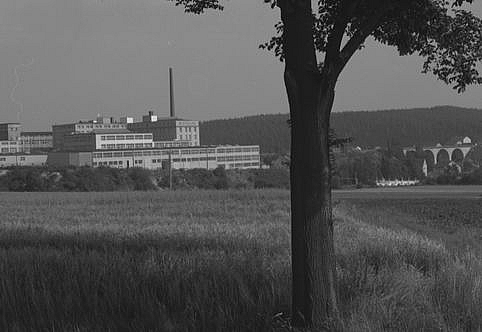
An Authentic Photograph of the Winterling Factory in 1977
Historical images provide valuable evidence of the industrial landscape in which Winterling porcelain was made. An archival photograph taken by Willy Pragher on August 4, 1977, documents the Winterling porcelain factory in Marktleuthen and its surrounding landscape.
_-_LABW_-_Staatsarchiv_Freiburg_W_134_Nr._109375a.jpg)
The photograph documents the factory’s appearance in 1977. It does not establish the manufacturing date of an individual porcelain object. Collectors should use factory photographs to understand industrial history and confirm geographical context, while dating individual pieces through their marks, forms and decorations.
Winterling Bavaria Porcelain Marks and Backstamps
Winterling porcelain marks are among the most important clues when researching a cup, saucer, plate, vase or dinner service. However, the Winterling family businesses used several different marking systems, and marks sometimes changed after corporate reorganizations or shifts in production.
Some historic Winterling marks feature a crowned W, wreaths, crossed elements, company names, geographical references and words such as Bavaria or Germany. The correct attribution depends on the exact graphic composition, typography, additional wording and documented period of use.
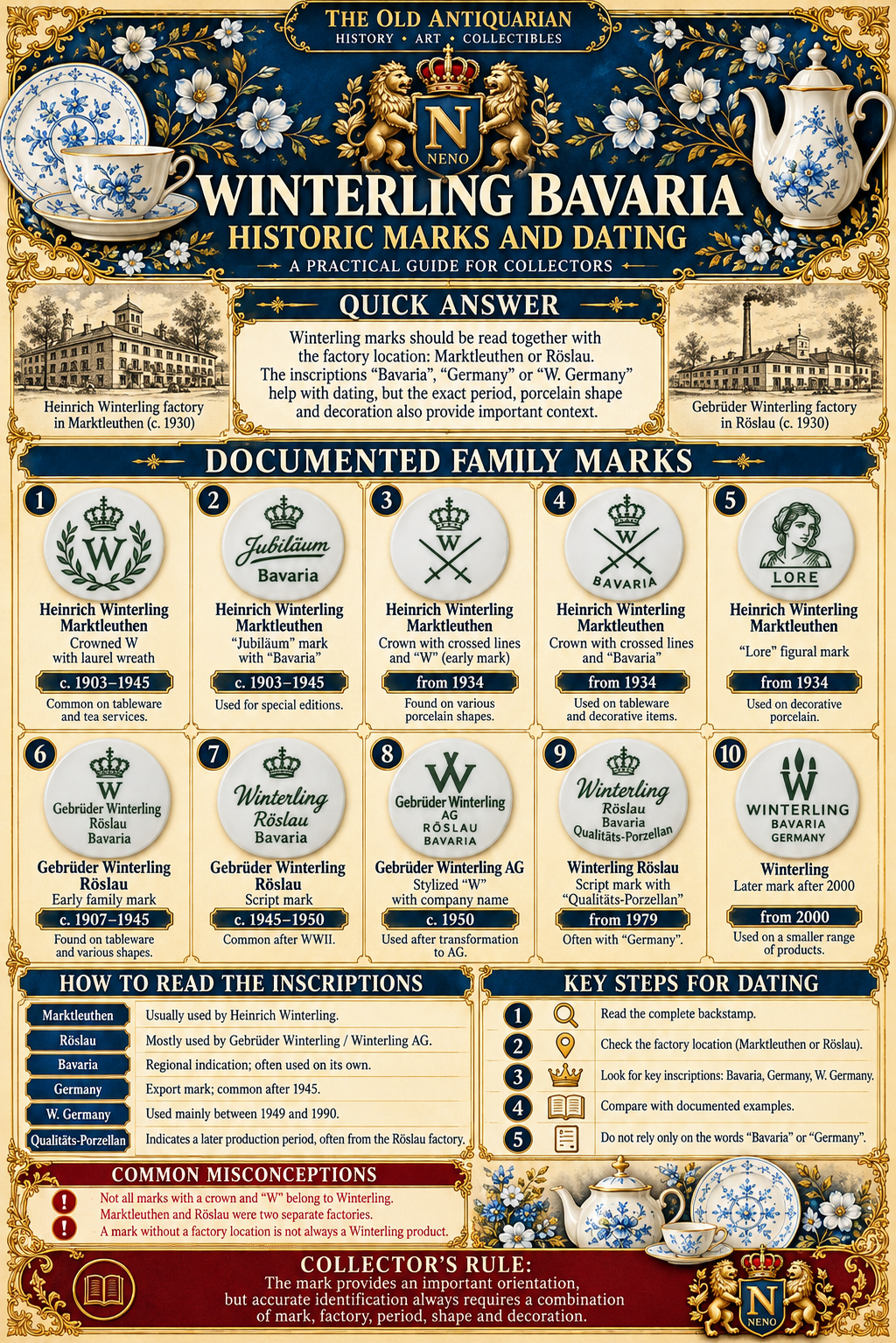
Heinrich Winterling Marktleuthen – Marking Periods
| Mark Description | Documented Period | Collector Note |
|---|---|---|
| Crowned W and wreath | 1903–1945 | Recorded in blue and green variations; compare exact details. |
| Jubiläum / Bavaria | 1903–1945 for documented examples | Associated with a series or mould name. |
| Crown and crossed elements | From 1934 | Check the complete original mark, not just the crossed motif. |
| Lore trademark | From 1934 | A documented trademark associated with this manufacturer. |
| Later Winterling marks | After 1950 | Several later variants are documented, including modern branding. |
Gebrüder Winterling Röslau – Marking Periods
| Mark Description | Documented Period | Collector Note |
|---|---|---|
| Early Röslau factory marks | 1907–1945 | Compare original mark drawings and factory wording. |
| Post-war marks | 1945–1950 | Transition before the AG corporate structure. |
| Gebrüder Winterling AG variants | From 1950 | Associated with the reorganized company. |
| Winterling Röslau Bavaria Qualitäts-Porzellan | From 1979 | Recorded with additional Germany wording in certain variants. |
| Winterling name in the Triptis period | From 2000 | The Winterling name can also appear on later production. |
Some porcelain marks are incorrectly attributed to Winterling because they resemble a known company mark. Do not assume that a crown, a W or crossed decorative elements automatically identify the factory. Compare the exact documented design, complete wording and physical object.
For authentic historical mark examples, consult Porcelain Marks & More – Marktleuthen and Porcelain Marks & More – Röslau. For the general methodology, our porcelain marks identification guide explains how to investigate complete backstamps.
How to Date Winterling Bavaria Porcelain
Dating Winterling porcelain requires several layers of evidence. An authentic backstamp may establish an approximate production period, but a reliable conclusion also considers the factory location, the porcelain shape, pattern, decoration and manufacturing techniques. Exact years should not be claimed when the historical record only supports a date range.
What Do Bavaria, Germany and W. Germany Mean?
| Inscription | What It Can Indicate | Dating Caution |
|---|---|---|
| Marktleuthen | Factory location associated with Heinrich Winterling. | The location alone does not identify a single decade. |
| Röslau | Important location for Gebrüder Winterling and later production. | The company and exact mark period must still be determined. |
| Bavaria | Regional designation. | Not a factory name or exact date code. |
| Germany | Country-of-origin wording, often used in export contexts. | Appears across many periods and manufacturers. |
| W. Germany | Commonly associated with West German production, particularly 1949–1990. | A historical clue, not a guaranteed year range for every individual piece. |
| Qualitäts-Porzellan | German wording meaning quality porcelain. | Relevant to documented later Röslau marks, not an independent dating code. |
Eight Steps for Dating Winterling Porcelain
- Photograph the complete factory backstamp.
- Identify the most likely manufacturing location.
- Compare the precise mark with authenticated historical examples.
- Determine whether the object is porcelain or another ceramic material.
- Examine the vessel’s shape, proportions, handle, rim and foot.
- Research the pattern, decoration and application technique.
- Record impressed, painted or printed numbers without assuming they are dates.
- Compare documented factory history, catalogues and museum examples before assigning a date range.
For a wider explanation of dating methods, see How to Date Antique Porcelain.
How to Identify Original Winterling Bavaria Porcelain
A porcelain item should not be declared authentic simply because it carries a convincing Winterling mark. Its factory attribution must be supported by the material, manufacturing technique, form, decoration, pattern and age. This is especially important when researching inherited dinner services, replacement pieces, mixed sets and porcelain sold through online marketplaces.
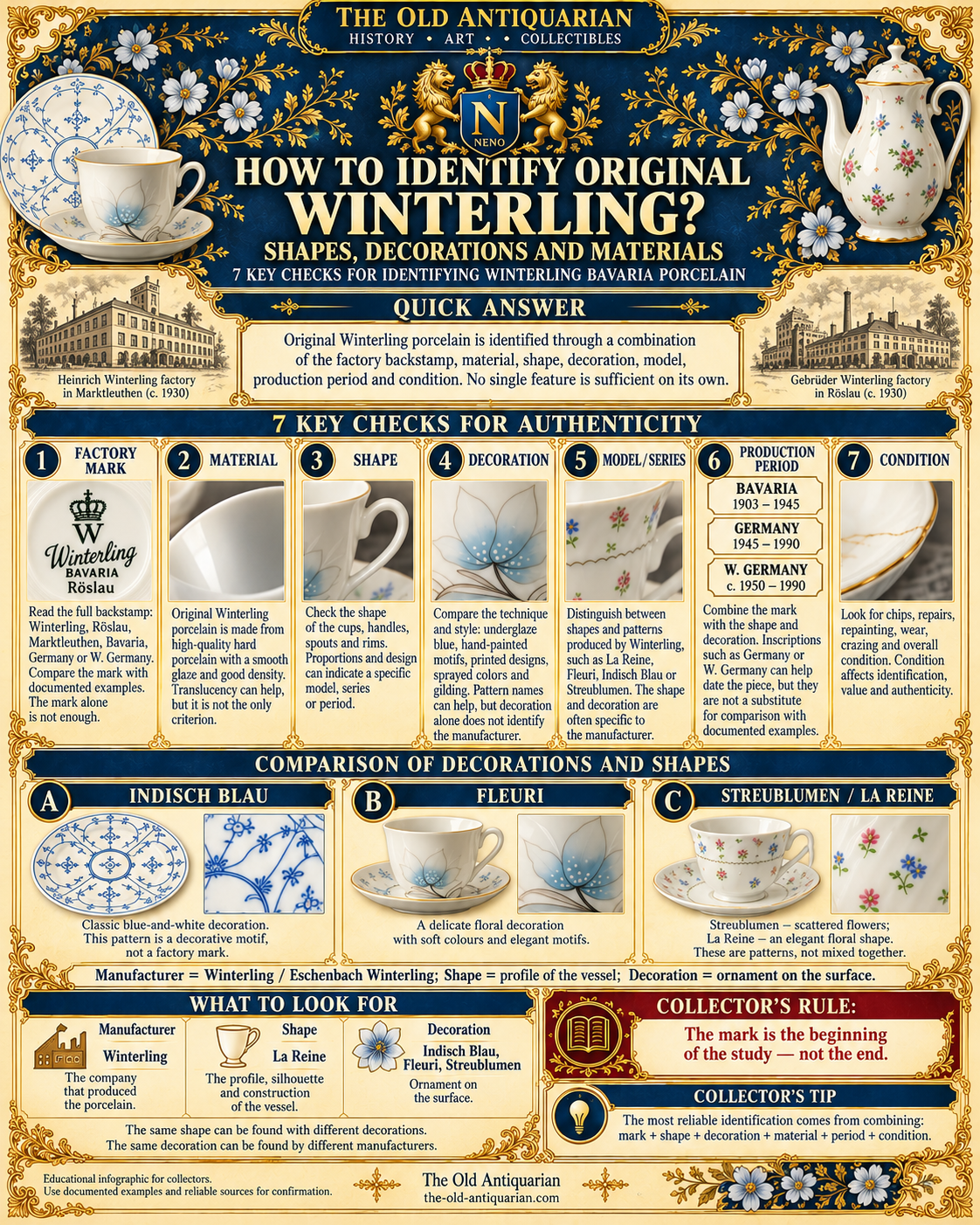
The Seven-Point Identification Method
| Check | What to Examine |
|---|---|
| 1. Factory backstamp | Complete mark, typography, symbols, location and secondary numbers. |
| 2. Porcelain material | Ceramic body, glaze quality, density, exposed foot and translucency when appropriate. |
| 3. Shape and form | Cup profile, handles, rims, spouts, moulded features and proportions. |
| 4. Decoration | Transfer-printed designs, underglaze decoration, hand-painted details and gilding. |
| 5. Pattern and series | Exact design, shape name, model number or documented factory series. |
| 6. Production period | Agreement between historical mark, shape, decorative technique and factory history. |
| 7. Condition | Wear, chips, cracks, repairs, repainting and replacement components. |
Backstamp + factory + porcelain body + shape + decoration + period + condition + documented comparison
Winterling Bavaria Patterns and Decorative Styles
Winterling porcelain was produced in a variety of forms and decorative styles. Floral prints, blue-and-white patterns, relief details, coloured decoration and gilded rims appear across German twentieth-century porcelain, but their presence alone cannot establish Winterling manufacture.
Collectors should distinguish three different concepts: manufacturer, meaning the business or factory responsible for the item; shape, meaning the vessel’s physical design; and decoration, meaning the pattern or ornament applied to it.
Winterling Fleuri – A Museum-Documented Example
A useful example of late twentieth-century Winterling production is the Fleuri porcelain cup and saucer documented in the collection of Museum Rotterdam. The museum dates this object to 1986–1988. It features white porcelain decorated with a delicate pale-blue floral motif, restrained outlines and a complementary saucer design.
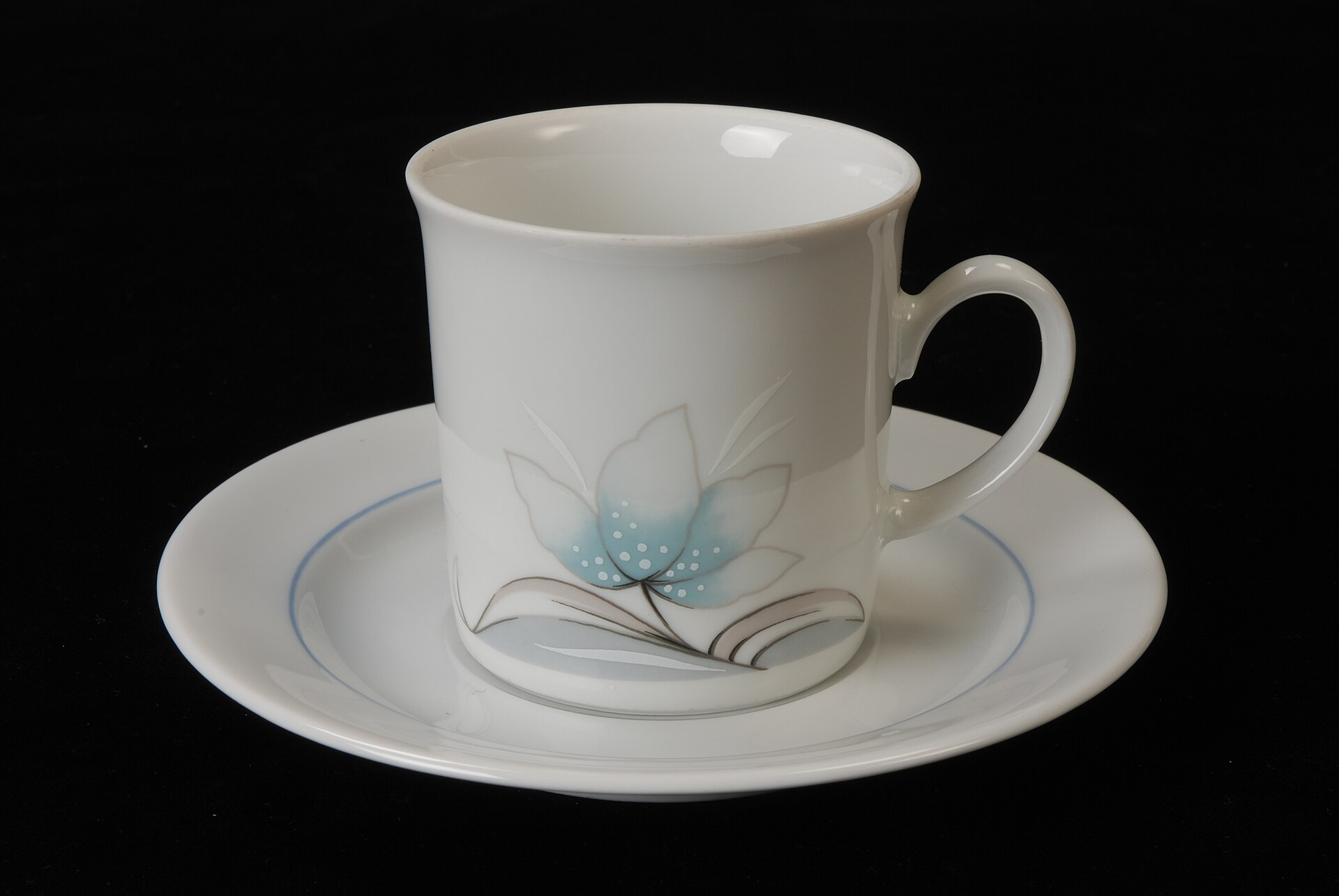
The museum’s dating applies to this documented cup and saucer, not automatically to every piece with a similar floral motif. An item should be dated according to its own factory backstamp, shape and decoration. This distinction is essential when identifying vintage Winterling Fleuri services.
Winterling Indisch Blau – Blue and White Porcelain
Indisch Blau is a traditional blue-and-white decorative style found on German and other European tableware. The term is associated with stylized flowers, curved stems, symmetrical ornaments and decorative arrangements related to longstanding continental European blue-and-white traditions.
The Winterling name appears on examples using this decorative tradition, including pieces associated with later Röslau production. However, Indisch Blau is not an exclusive Winterling pattern. A blue-and-white plate should not be attributed to Winterling without examination of its base mark and manufacturing details.
A traditional decorative motif may be produced by several different factories. Similar patterns can appear on objects made decades apart, so the original backstamp and the object’s construction remain essential evidence.
Eschenbach, Streublumen and La Reine
Eschenbach is associated with porcelain manufacturing in Windischeschenbach, a factory location connected to the broader Gebrüder Winterling history after the acquisition of Eduard Haberländer in 1929. Understanding this relationship helps collectors research porcelain marked Eschenbach alongside records of the wider Winterling company network.
Names such as La Reine and Streublumen describe different features. La Reine can refer to a service shape, while Streublumen is a German term for scattered flowers, a decorative motif used in porcelain ornamentation. These concepts should not be confused with the name of the manufacturer.
| Name | Category | Collector Explanation |
|---|---|---|
| Winterling | Manufacturer / brand | A business name requiring factory-level identification. |
| Eschenbach | Manufacturer / brand | Associated with the Windischeschenbach porcelain tradition. |
| La Reine | Service shape | Refers to the physical profile or form of a service. |
| Streublumen | Decoration | A scattered-flower decorative arrangement. |
| Indisch Blau | Decoration | Traditional blue-and-white ornamentation used by different makers. |
| Fleuri | Decoration | A floral decorative name represented by a documented Winterling museum object. |
20 Typical Winterling Bavaria Porcelain Items and Shapes
The Winterling businesses were associated with a broad range of tableware and domestic porcelain. Tea services, coffee services, dinner sets, serving dishes and decorative forms help illustrate the importance of shape when identifying a historical item. A single decorative pattern can appear on several shapes, while similar shapes can carry different factory backstamps.
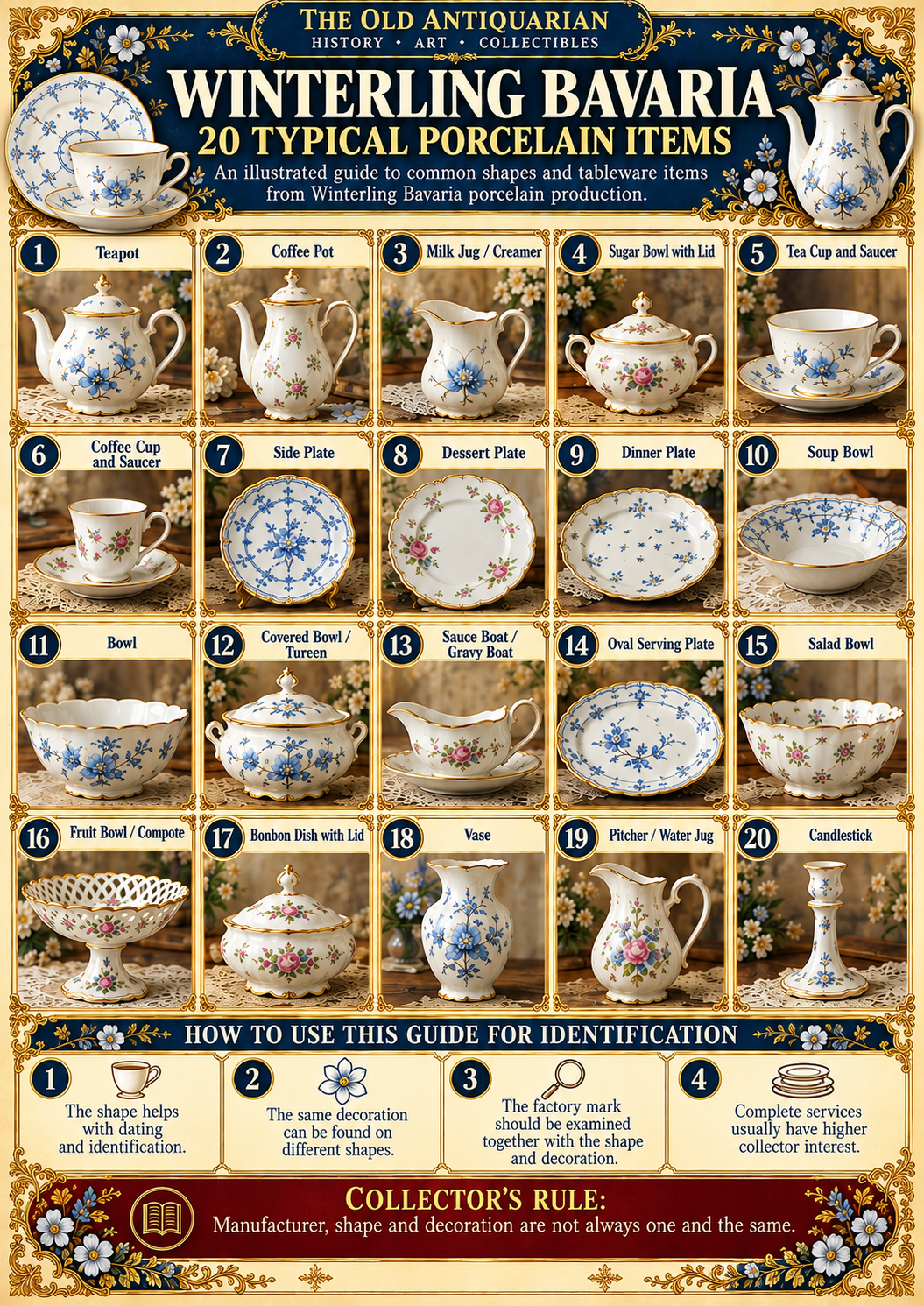
| No. | Porcelain Item | Identification Clue |
|---|---|---|
| 1 | Teapot | Spout, handle, lid and body profile. |
| 2 | Coffee Pot | Height, spout shape and lid. |
| 3 | Milk Jug / Creamer | Rim, spout and small-scale form. |
| 4 | Sugar Bowl with Lid | Original lid and paired handles. |
| 5 | Tea Cup and Saucer | Cup depth, rim and saucer match. |
| 6 | Coffee Cup and Saucer | Capacity, profile and matching decoration. |
| 7 | Side Plate | Diameter and rim profile. |
| 8 | Dessert Plate | Size, decorative layout and moulded rim. |
| 9 | Dinner Plate | Full diameter and pattern consistency. |
| 10 | Soup Bowl | Depth, opening and foot design. |
| 11 | Bowl | Purpose, dimensions and rim construction. |
| 12 | Covered Bowl / Tureen | Body, lid, handles and completeness. |
| 13 | Sauce Boat | Spout, handle and matching stand. |
| 14 | Oval Serving Plate | Length, width and border design. |
| 15 | Salad Bowl | Open form and serving capacity. |
| 16 | Fruit Bowl / Compote | Pedestal, pierced details and profile. |
| 17 | Bonbon Dish with Lid | Small covered decorative form. |
| 18 | Vase | Height, mouth, foot and surface decoration. |
| 19 | Pitcher / Water Jug | Handle, pouring lip and capacity. |
| 20 | Candlestick | Base, socket and decorative form. |
These are general porcelain item categories rather than a claim that every illustrated object is a documented Winterling production model. For a confident attribution, compare the exact vessel shape and factory backstamp with period catalogues or verified historical examples.
Condition, Damage and Restoration
Condition is a major factor in both identification and valuation. Everyday porcelain may survive with surface wear, worn gilding, tiny rim chips or damage caused by frequent use. More serious problems include cracks, structural repairs, replacement lids, repainting and extensive restoration.
When examining a Winterling service, inspect cup rims, handles, saucer edges, pouring spouts, covered vessels and the underside of plates. Use indirect lighting to look for cracks and later surface treatments. If an item appears valuable or unusually rare, obtain advice before attempting repairs or aggressive cleaning.
| Condition Issue | Collector Significance |
|---|---|
| Chips | Usually reduce desirability, especially on cup rims and exposed edges. |
| Cracks | May substantially affect value and structural integrity. |
| Worn gilding | Effect depends on extent, pattern and market expectations. |
| Crazing or staining | Should be described accurately and not confused with guaranteed age. |
| Restoration | Later work can affect authenticity, originality and market comparability. |
| Missing components | Affect completeness and the value of services and covered vessels. |
Winterling Bavaria Porcelain Value: What Is It Worth?
Is Winterling Bavaria porcelain valuable? Some pieces have collector interest, but there is no reliable universal price for all Winterling porcelain. Common twentieth-century tableware, individual replacement pieces, complete dinner services and unusual decorative objects may appeal to different buyers and command different prices.
The main valuation factors are the precise manufacturer, factory period, shape, decoration, rarity, condition, completeness, provenance and current demand. Collectors should compare genuinely similar objects rather than using the highest asking price found online.
Eight Factors That Influence Winterling Porcelain Value
| Factor | Why It Matters |
|---|---|
| 1. Production period | Early and late production may attract different collector markets. |
| 2. Factory | The specific manufacturing business establishes historical context. |
| 3. Rarity | Unusual shapes or decorations may attract specialist demand. |
| 4. Shape | A decorative vase and an ordinary dinner plate should not be valued identically. |
| 5. Decoration | Pattern, colourway, craftsmanship and gilding may influence interest. |
| 6. Condition | Cracks, chips and repairs often lower comparability with undamaged pieces. |
| 7. Completeness | A matching original service may differ in value from an incomplete set. |
| 8. Completed sales | Realized sales provide stronger market evidence than unsold listings. |
An asking price represents what a seller hopes to receive. A meaningful valuation should compare documented completed sales of objects with similar factory attribution, shape, pattern, period, size, condition, restoration and completeness.
How to Compare Winterling Prices Correctly
| Comparison | Example |
|---|---|
| Appropriate | Two cups with the same shape, similar pattern, dimensions and condition. |
| Partially appropriate | Two related coffee services with different completeness or restoration histories. |
| Not appropriate | A rare decorative vase compared with a common dinner plate solely because both have Winterling marks. |
If you need an object-specific assessment, The Old Antiquarian provides professional antique valuation guidance, including porcelain and ceramics. An individual opinion requires photographs and information about the actual object.
Winterling Bavaria Collector Checklist
Before buying, selling or requesting an appraisal of Winterling Bavaria porcelain, document the object carefully. Clear photographs, accurate measurements, complete backstamp images and honest condition notes are often more useful than an unverified estimate of age or price.
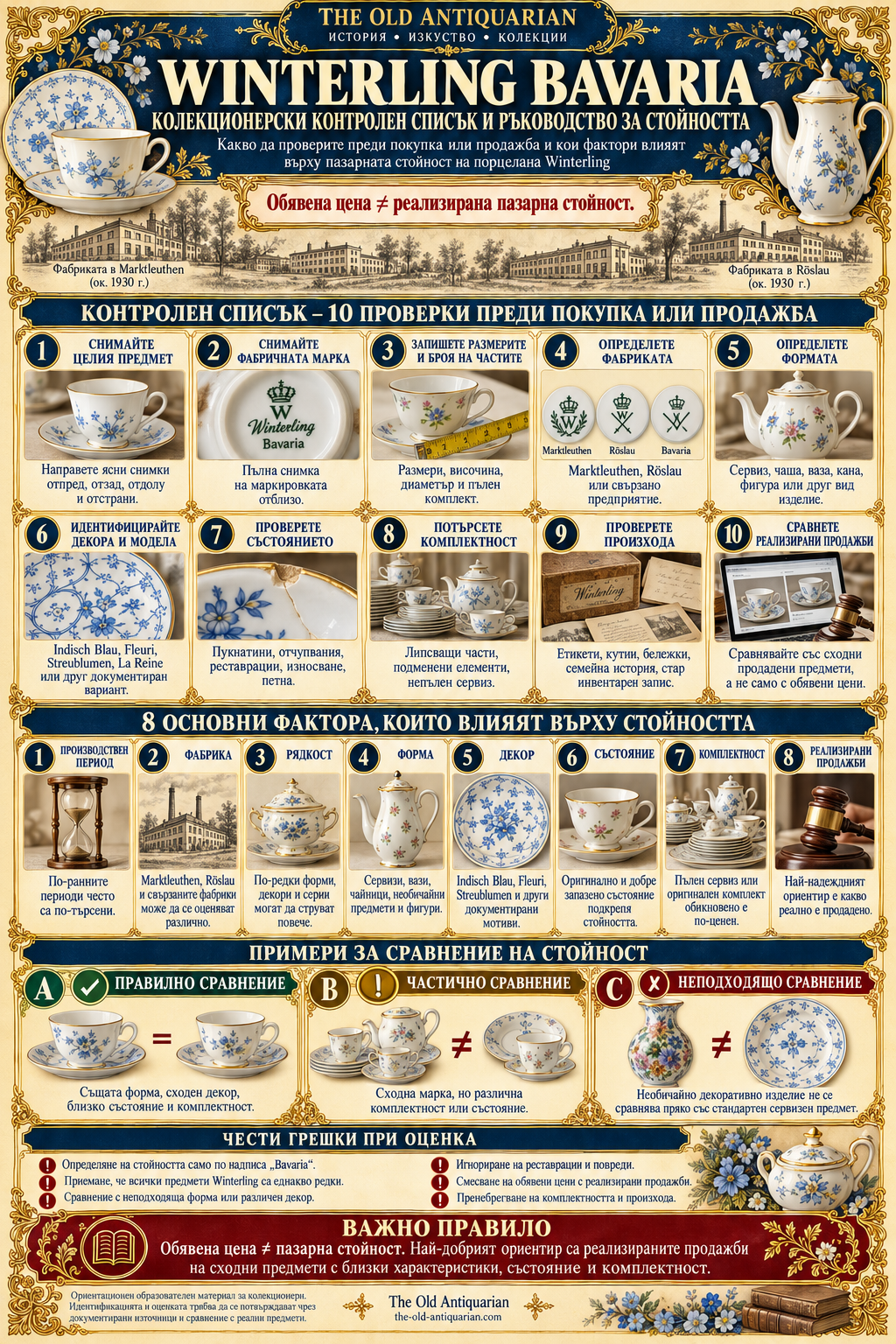
10 Checks Before Buying or Selling
- Photograph the complete item from every important angle.
- Photograph the entire underside and factory backstamp.
- Record dimensions and the number of pieces.
- Identify the likely Winterling factory or related manufacturer.
- Determine the precise object type and shape.
- Research the pattern, decoration and possible model name.
- Inspect chips, cracks, restoration, wear and repainting.
- Check whether the service is complete and original.
- Preserve labels, original boxes, documents and ownership information.
- Compare documented completed sales of similar objects.
Common Mistakes When Identifying Winterling Porcelain
| Common Mistake | Correct Approach |
|---|---|
| Treating all Winterling porcelain as one factory | Separate Marktleuthen and Röslau histories before dating. |
| Assuming a crowned W is proof of Winterling manufacture | Compare the exact historical backstamp and physical object. |
| Treating Bavaria as a factory name | Recognize Bavaria as a region and search for the specific manufacturer. |
| Dating a piece from one word alone | Read Germany and W. Germany alongside the mark, shape and decoration. |
| Confusing pattern with manufacturer | Distinguish Indisch Blau, Fleuri or Streublumen from factory attribution. |
| Assuming all Winterling porcelain is rare | Research the exact model, production volume and collector demand. |
| Using unsold asking prices as market value | Use comparable realized sales and document condition. |
Request a Professional Valuation of Your Winterling Porcelain
Do you own an inherited Winterling Bavaria tea set, dinner service, cup, vase or decorative object? Send photographs of the complete item, underside, factory mark, measurements and condition. The Old Antiquarian combines more than 35 years of practical antiques experience with historical and comparative research.
An initial review is subject to the available evidence and does not constitute a formal certificate of authenticity.
Frequently Asked Questions About Winterling Bavaria
What is Winterling Bavaria porcelain?
Winterling Bavaria refers to German porcelain associated with historical Winterling family manufacturing businesses, especially Heinrich Winterling in Marktleuthen and Gebrüder Winterling in Röslau.
Are Heinrich Winterling and Gebrüder Winterling the same factory?
No. They were separate companies with a family relationship, different primary manufacturing sites and distinct historical developments.
When was Heinrich Winterling founded?
Heinrich Winterling began operating in Marktleuthen in 1903 after acquiring the earlier Drechsel & Strobel porcelain factory, established in 1897.
When did Gebrüder Winterling begin producing porcelain?
Gebrüder Winterling began porcelain production in Röslau in 1907, later expanding into additional manufacturing sites.
How can I date Winterling Bavaria porcelain marks?
Compare the complete backstamp with documented factory marks, then verify the likely period through shape, decoration, material and factory history.
What does Winterling Bavaria Germany mean?
The wording combines the manufacturer or brand name with regional and national information. It does not provide an exact production date without the complete mark and object.
What does W. Germany mean on Winterling porcelain?
W. Germany is commonly associated with West German production and export wording, particularly between 1949 and 1990, but the individual object’s period must still be independently checked.
Does a crowned W always indicate Winterling?
No. Similar historic signs exist and some marks have been incorrectly attributed. Compare every visual element with authenticated original examples.
What is Winterling Fleuri porcelain?
Fleuri is a floral decorative name represented by a Winterling cup and saucer dated 1986–1988 in the Museum Rotterdam collection. That date belongs to the documented object rather than every similar design.
Is Indisch Blau exclusive to Winterling?
No. Indisch Blau is a traditional blue-and-white decorative style used by several German and European manufacturers.
Is Eschenbach connected with Winterling?
Yes. The historical connection includes the Windischeschenbach factory acquired by Gebrüder Winterling in 1929.
Is Winterling Bavaria porcelain valuable?
Value varies according to the specific item, factory, age, rarity, pattern, condition, completeness and comparable completed market sales.
Where can I sell Winterling porcelain?
You can submit photographs and information about your porcelain through The Old Antiquarian’s porcelain buying and antique valuation pages for an initial review.
Related Guides and Further Reading
Complete Guide to Antique Porcelain
How to Identify Antique Porcelain
Sources, Historical References and Further Research
This guide uses specialized historical porcelain references, archival material and museum-documented examples. The purpose is to distinguish confirmed historical facts from approximate dating clues and educational visual illustrations.
- Porcelain Marks & More – Marktleuthen – historical information about Drechsel & Strobel, Heinrich Winterling and documented factory marks.
- Porcelain Marks & More – Röslau – Gebrüder Winterling, related factories, company chronology and documented marking periods.
- Marktleuthen Historical Chronology – regional and industrial historical context.
- Winterling-Areal Röslau Masterplan – historical and industrial site research.
- Landesarchiv Baden-Württemberg / Willy Pragher – original August 4, 1977 photograph of the Marktleuthen factory, CC BY 4.0.
- Museum Rotterdam – Winterling Fleuri porcelain cup and saucer, object no. 90848-1.A-B, dated 1986–1988; museum collection and Wikimedia Commons image reference.
The archival factory photograph and museum-documented porcelain photograph are historical visual references. The five illustrated infographics are educational materials created for collectors. Stylized backstamps, porcelain shapes and factory scenes must not be mistaken for individually authenticated original marks, factory catalogue illustrations or archival photographs. Exact dating requires comparison with documented sources.
About the Author – The Old Antiquarian
The Old Antiquarian combines more than 35 years of practical experience with antiques, decorative art and collecting with historical research, manufacturer identification and comparative market analysis.
Our approach to antique and vintage porcelain examines the complete backstamp, ceramic body, manufacturing technique, shape, decoration, pattern, period, condition, restoration and available historical documentation. This article is an educational reference and does not replace an object-specific professional appraisal.
Conclusion: Understanding Winterling Bavaria Porcelain
Winterling Bavaria occupies an important place in the history of twentieth-century German porcelain. Its family connections, separate manufacturing companies, expanding factory networks, historical backstamps and wide range of tableware make it a rewarding subject for collectors and researchers.
The most reliable identification begins with separating Heinrich Winterling in Marktleuthen from Gebrüder Winterling in Röslau. From there, collectors can compare the complete factory mark, manufacturing period, material, shape and decoration with documented evidence. When estimating market value, condition, completeness and comparable completed sales matter more than an impressive but unverified asking price.
Factory + complete backstamp + porcelain body + shape + decoration + production period + condition + documented comparisons = a stronger foundation for identifying, dating and valuing Winterling Bavaria porcelain.
