
What Is Japanese Porcelain? History, Identification & Collecting Guide
Japanese porcelain is one of the world’s most admired and collectible ceramic traditions. Celebrated for its exceptional craftsmanship, elegant hand-painted decoration, refined forms, and vibrant colours, it has fascinated collectors for more than four centuries. From the delicate beauty of Kakiemon to the richly decorated Imari style and the artistic brilliance of Kutani, Japanese porcelain reflects a unique blend of technical mastery, artistic expression, and cultural heritage.
Today, antique Japanese porcelain remains highly sought after by collectors, museums, and auction houses around the world. Fine vases, tea services, plates, bowls, chargers, incense burners, figurines, and decorative objects continue to command strong prices because of their rarity, artistic quality, historical significance, and international appeal.
Whether you have inherited a porcelain vase, discovered an old tea set, or simply wish to learn more about Japanese ceramics, understanding their history and identifying their distinctive styles is the first step towards recognising their true importance and value.
If you are new to porcelain collecting, we recommend starting with our complete guides What Is Porcelain?, Types of Porcelain Explained, and Porcelain vs Faience vs Ceramic before exploring the fascinating world of Japanese porcelain.
The History of Japanese Porcelain
Although China invented true porcelain centuries earlier, Japan quickly developed its own distinctive ceramic traditions after the discovery of porcelain stone in the early seventeenth century. What began as an attempt to master Chinese technology soon evolved into one of the world’s most original artistic traditions.
The birthplace of Japanese porcelain is generally considered to be the town of Arita on the island of Kyushu. Skilled Korean potters brought to Japan during the late sixteenth century introduced advanced firing techniques that transformed Japanese ceramics forever.
Within only a few decades, Japanese workshops were producing porcelain of extraordinary quality that attracted attention far beyond Asia.
During Japan’s Edo Period (1603–1868), Dutch merchants of the Dutch East India Company exported large quantities of Japanese porcelain to Europe. Royal families, wealthy merchants, and aristocratic collectors eagerly purchased these luxurious wares, helping Japanese porcelain become one of the most fashionable decorative arts of the seventeenth and eighteenth centuries.
Its popularity also inspired many of Europe’s greatest porcelain manufacturers, including Meissen, Chelsea, Chantilly, Saint-Cloud, and Sèvres, whose early designs were heavily influenced by Japanese decorative styles.
Why Is Japanese Porcelain So Famous?
Japanese porcelain is admired because it combines technical excellence with remarkable artistic sensitivity. Unlike many other porcelain traditions, Japanese artists often embraced simplicity, asymmetrical compositions, generous white space, and designs inspired directly by nature.
Collectors value Japanese porcelain for its:
- Exceptional craftsmanship
- Beautiful hand-painted decoration
- Distinctive regional styles
- Elegant proportions
- Historical significance
- Outstanding artistic quality
- Excellent long-term collector demand
Every region developed its own artistic identity, allowing collectors to recognise many Japanese porcelains simply from their decoration, colour palette, glaze, and painting style.
How to Identify Japanese Porcelain
Correctly identifying Japanese porcelain requires much more than reading the mark on the base. Professional appraisers evaluate numerous characteristics together before determining the object’s age, origin, and authenticity.
Experts carefully examine:
- Porcelain quality
- Glaze finish
- Painting techniques
- Colour palette
- Gold decoration
- Shape and proportions
- Base and foot rim
- Natural signs of ageing
- Porcelain marks
Traditional Japanese decoration frequently includes cherry blossoms, chrysanthemums, peonies, cranes, dragons, phoenixes, bamboo, pine trees, waves, temples, geisha, samurai, landscapes, and other motifs deeply connected with Japanese culture.
Specialists also determine whether an object remains an original or whether it could instead be a later copy, replica, or even a fake.
No single characteristic proves authenticity. The porcelain body, glaze, decoration, construction, condition, historical context, and porcelain marks must always be considered together.
The Most Famous Types of Japanese Porcelain
Unlike many European porcelain traditions, Japanese porcelain developed through a number of regional styles, each with its own history, artistic identity, and manufacturing techniques. Understanding these styles is one of the most valuable skills for collectors because they often provide the first clues when identifying an antique porcelain object.
Arita Ware (有田焼)
Arita ware is considered the birthplace of Japanese porcelain. Produced in the town of Arita since the early seventeenth century, it became Japan’s first true porcelain and laid the foundation for the country’s entire porcelain industry.
Early Arita porcelain often features elegant blue-and-white decoration inspired by Chinese porcelain, while later examples include richly coloured enamel decoration created for both the Japanese domestic market and European export.
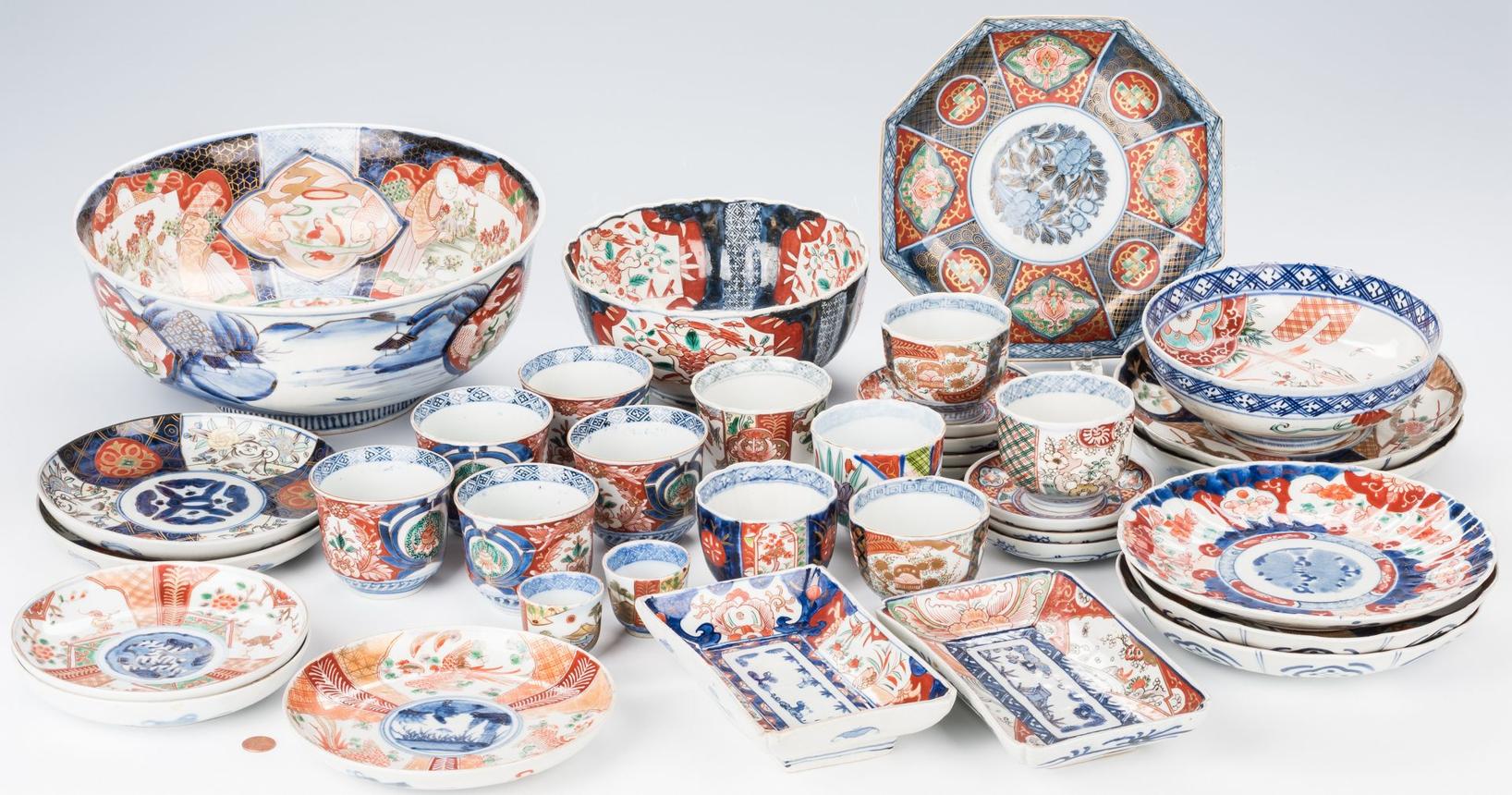
Imari Ware (伊万里焼)
Imari porcelain takes its name from the port of Imari, from which porcelain produced around Arita was exported throughout the world.
Collectors immediately recognise traditional Imari by its spectacular combination of:
- deep cobalt blue;
- iron-red enamels;
- rich gilding;
- floral decoration;
- birds and mythical creatures;
- highly decorative compositions.
During the seventeenth and eighteenth centuries, Imari porcelain became enormously popular in Europe and strongly influenced many leading European factories.
Kutani Ware (九谷焼)
Kutani porcelain is celebrated for its vibrant colours and bold artistic decoration. Traditional Kutani artists used rich green, yellow, purple, dark blue, and red enamels to create dramatic landscapes, flowers, birds, animals, and scenes from Japanese history and mythology.
Unlike the restrained elegance of many Chinese porcelains, Kutani often displays energetic compositions filled with colour and movement.
Kakiemon Ware (柿右衛門)
Kakiemon porcelain is admired for its refined simplicity. Characterised by a beautifully milky white porcelain body, delicate asymmetrical decoration, and generous areas of undecorated porcelain, Kakiemon became one of Japan’s most influential artistic styles.
Its graceful birds, flowering branches, animals, and symbolic plants inspired many European porcelain manufacturers during the eighteenth century.
Nabeshima Ware (鍋島焼)
Produced exclusively for the ruling Nabeshima family, Nabeshima porcelain represents one of the highest achievements of Japanese ceramic art.
Unlike export porcelain, Nabeshima pieces were never intended for commercial sale. Their exceptional painting, perfectly balanced designs, and outstanding craftsmanship make surviving examples highly prized by collectors today.
Satsuma Ware (薩摩焼)
Although much Satsuma ware is technically earthenware rather than porcelain, collectors frequently encounter it alongside Japanese porcelain because of its similar decorative appeal.
Fine Satsuma pieces are recognised by their ivory-coloured crackled glaze, elaborate hand-painted scenes, extensive gold decoration, and extraordinary level of artistic detail.
During the late nineteenth century, Satsuma became one of Japan’s most successful export ceramics and remains extremely popular among collectors.
Japanese Export Porcelain
From the mid-seventeenth century onwards, Japanese porcelain became one of Europe’s most fashionable luxury imports. Dutch merchants transported thousands of porcelain objects from Japan to wealthy European clients, many of whom had previously relied almost exclusively on Chinese porcelain.
Export porcelain often featured:
- large decorative vases;
- tea and coffee services;
- dinner services;
- decorative plates;
- covered jars;
- ornamental figures.
Many export pieces were specifically designed to satisfy European tastes while preserving traditional Japanese craftsmanship.
The popularity of Japanese export porcelain influenced decorative arts throughout Europe and helped inspire factories such as Meissen, Chelsea, Chantilly, and Saint-Cloud.
Japanese Porcelain Marks
Like Chinese porcelain, Japanese porcelain frequently bears marks on its base. These may identify the kiln, workshop, manufacturer, artist, region, or production period.
Some marks are painted in underglaze blue, while others are impressed, stamped, or written in red, black, or gold enamels.
Learning to interpret these marks requires careful comparison with documented examples because many manufacturers altered their marks repeatedly throughout history.
For a complete explanation of porcelain backstamps and factory identification, see What Are Porcelain Marks?.
Just like Chinese porcelain, Japanese porcelain should never be authenticated solely by its mark. Specialists always compare the mark with the porcelain body, decoration, glaze, craftsmanship, and historical consistency before reaching a conclusion.
How to Tell Antique Japanese Porcelain from Modern Reproductions
One of the greatest challenges facing collectors today is distinguishing genuine antique Japanese porcelain from modern reproductions. Thanks to advances in ceramic manufacturing, contemporary factories can produce remarkably convincing copies of historic Japanese styles. While many modern reproductions are honestly sold as decorative pieces, others imitate famous antiques closely enough to confuse inexperienced buyers.
Professional identification therefore relies on examining the entire object rather than focusing on a single feature. Specialists compare the porcelain body, glaze, decoration, painting style, craftsmanship, firing techniques, natural ageing, and porcelain marks before determining authenticity.
During examination, experts typically assess:
- Porcelain body and density
- Weight and wall thickness
- Glaze quality
- Brushwork and painting technique
- Colour palette
- Natural wear
- Foot rim and base
- Manufacturing methods
- Porcelain marks
- Historical consistency
Only after evaluating all these characteristics together can an object be confidently identified as an original, a later copy, a replica, or a deliberate fake.
How to Recognise Hand-Painted Japanese Porcelain
One of the defining characteristics of fine Japanese porcelain is its extraordinary hand-painted decoration. For centuries, master artists spent many years perfecting their painting techniques before decorating porcelain intended for wealthy Japanese families or international export.
Unlike transfer-printed decoration, genuine hand painting usually displays subtle variations that reveal the artist’s individual brushwork.
Collectors often look for:
- Natural brush strokes
- Fine painted outlines
- Slight differences between repeated flowers or birds
- Layered enamel colours
- Exceptional attention to detail
- Balanced but never perfectly identical decoration
Japanese artists frequently painted traditional motifs including:
- Cherry blossom (Sakura)
- Chrysanthemums
- Peonies
- Dragons
- Phoenixes
- Cranes
- Koi carp
- Bamboo
- Mount Fuji
- Flowing rivers and waterfalls
- Samurai
- Geisha
- Temple landscapes
These themes remain among the most recognisable features of antique Japanese porcelain.
The Most Collectible Japanese Porcelain
Collectors around the world actively seek many different forms of Japanese porcelain. While rarity and condition always influence value, several categories remain consistently popular at auction.
- Imari vases
- Kakiemon porcelain
- Kutani decorative pieces
- Arita export porcelain
- Nabeshima porcelain
- Hand-painted tea services
- Decorative chargers
- Covered jars
- Incense burners
- Porcelain figurines
- Temple vessels
- Scholar’s objects
Museum-quality examples produced during the Edo Period are among the most valuable Japanese ceramics available to collectors today.
What Determines the Value of Japanese Porcelain?
No single characteristic determines the value of antique Japanese porcelain. Professional appraisers consider a wide range of factors before estimating market value.
- Age
- Manufacturer or kiln
- Regional style
- Artistic quality
- Rarity
- Condition
- Original decoration
- Historical significance
- Documented provenance
- International collector demand
Specialists also determine whether an object has undergone previous restoration or conservation. Poor restoration, overpainting, or inappropriate repairs may significantly reduce both historical integrity and market value.
Pieces that remain in excellent original condition, retain their factory marks, and possess documented provenance generally achieve the strongest auction results.
How to Care for Antique Japanese Porcelain
Antique Japanese porcelain has survived for centuries thanks to the remarkable quality of its manufacture, but it remains vulnerable to accidental damage. Proper handling, cleaning, and storage are essential if you wish to preserve both its beauty and its collector value for future generations.
Collectors should always support porcelain from its strongest structural points. Handles, spouts, lids, finials, and decorative projections should never be used to lift an object, as these are often the first areas to break.
To help preserve antique Japanese porcelain:
- Handle objects with clean, dry hands.
- Avoid sudden temperature changes.
- Keep porcelain away from direct sunlight.
- Protect it from vibration and accidental impacts.
- Display valuable pieces inside secure cabinets whenever possible.
- Use padded shelves for heavy vases and chargers.
- Never stack valuable porcelain without protective padding.
- Dust regularly using a soft microfiber cloth.
- Avoid abrasive cleaners and household chemicals.
- Never place antique porcelain in a dishwasher.
If an object becomes damaged, professional conservation is often preferable to unnecessary restoration. Where restoration is required, it should always be carried out using reversible conservation techniques that respect the object’s historical integrity.
When Should You Request a Professional Appraisal?
If you own a Japanese porcelain object and would like to determine its authenticity, age, kiln, regional style, condition, or approximate market value, obtaining a professional appraisal is often the safest approach.
Professional advice is particularly valuable before:
- Buying expensive antique porcelain
- Selling inherited collections
- Sending objects to auction
- Restoring damaged porcelain
- Obtaining insurance
- Dividing family collections
- Donating objects to museums or institutions
Professional appraisers examine far more than the porcelain mark. They evaluate the porcelain body, glaze, decoration, painting techniques, construction methods, natural ageing, historical consistency, provenance, and overall condition before estimating authenticity and market value.
➡️ Request a Professional Antique Valuation
Frequently Asked Questions
Is all Japanese porcelain antique?
No. Japanese porcelain continues to be produced today. Only older pieces with genuine historical significance are considered antiques.
How can I tell whether Japanese porcelain is hand-painted?
Hand-painted decoration usually displays natural brush strokes, slight variations between repeated motifs, layered colours, and subtle artistic differences that cannot easily be reproduced by mechanical printing.
Are Japanese porcelain marks always reliable?
Porcelain marks provide valuable clues, but they should never be used as the only method of identification. Specialists always compare the mark with the porcelain body, decoration, glaze, manufacturing techniques, and historical consistency.
Which Japanese porcelain styles are the most collectible?
Collectors particularly seek Arita, Imari, Kakiemon, Kutani, and Nabeshima porcelain. Exceptional examples from the Edo Period are especially desirable.
Can damaged Japanese porcelain still be valuable?
Yes. Rare pieces with historical importance may remain highly valuable despite minor damage. However, poor restoration or inappropriate repairs often reduce collector value significantly.
Conclusion
Japanese porcelain represents one of the world’s greatest ceramic traditions. Combining remarkable technical skill with extraordinary artistic sensitivity, it has fascinated collectors for more than four centuries. From the refined elegance of Kakiemon to the richly decorated splendour of Imari and the vibrant colours of Kutani, Japanese porcelain continues to inspire admiration across the globe.
Correct identification requires careful examination of every aspect of an object—including its porcelain body, glaze, decoration, craftsmanship, historical context, provenance, and porcelain marks. Understanding these characteristics allows collectors to distinguish authentic antiques from later reproductions and to appreciate the remarkable history behind each piece.
Whether you are beginning your collecting journey or researching a treasured family heirloom, learning about Japanese porcelain opens the door to one of the richest artistic traditions in the history of decorative arts.
Continue Learning
- What Is Porcelain?
- Types of Porcelain Explained
- Porcelain vs Faience vs Ceramic
- What Are Porcelain Marks?
- What Is Chinese Porcelain?
- What Is Russian Porcelain?
- What Is a Maker’s Mark?
- What Is Restoration?
- What Is Conservation?
- What Is an Original?
- What Is a Certificate of Authenticity?
Explore Related Collections
