
Coalport Porcelain : Identification Guide
Coalport Porcelain: History, Marks, Patterns, Figurines & Value Guide
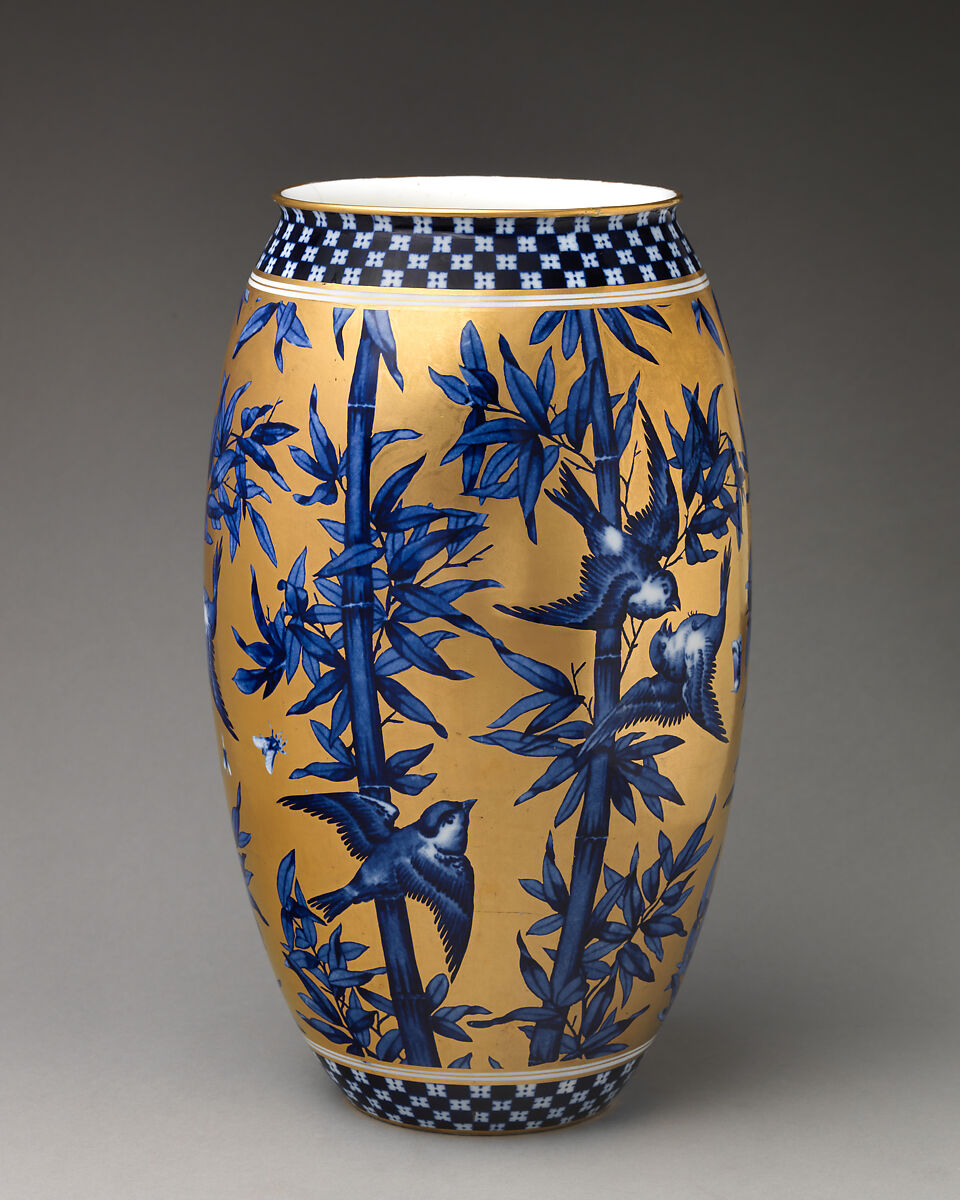
Coalport porcelain occupies a distinctive place in the history of British ceramics. From the elegant wares associated with John Rose and the early nineteenth-century Coalport works to elaborate Victorian exhibition pieces, richly gilded vases and later collectible bone china figurines, the Coalport name encompasses more than two centuries of changing taste, craftsmanship and ceramic production.
For collectors, however, identifying Coalport is not simply a matter of finding the word Coalport underneath a piece. Early wares may be unmarked, factory marks evolved considerably, decorative styles changed, and the historical use of the name Coalbrookdale can create additional confusion.
This guide explains how to identify and date Coalport porcelain by examining its marks, porcelain body, shapes, patterns, decoration, pattern numbers, craftsmanship and condition. It also explores Coalport figurines, the difference between Coalport and Coalbrookdale, and the factors that can make particular pieces desirable to collectors.
Coalport was an important English porcelain manufacturer associated with the Ironbridge and Coalport area of Shropshire from the late eighteenth century. Antique Coalport can include early soft-paste porcelain, richly decorated nineteenth-century tableware and ornamental wares, elaborate Coalbrookdale-style floral pieces, later fine bone china and collectible figurines.
Identification should never depend on a backstamp alone. The most reliable approach combines the mark + period + porcelain body + form + decoration + pattern number + condition + provenance.
Shropshire, England
Late 18th century
John Rose
Fine porcelain, elaborate decoration and later bone china
Early wares, rare patterns, exhibition pieces, decorative porcelain and figurines
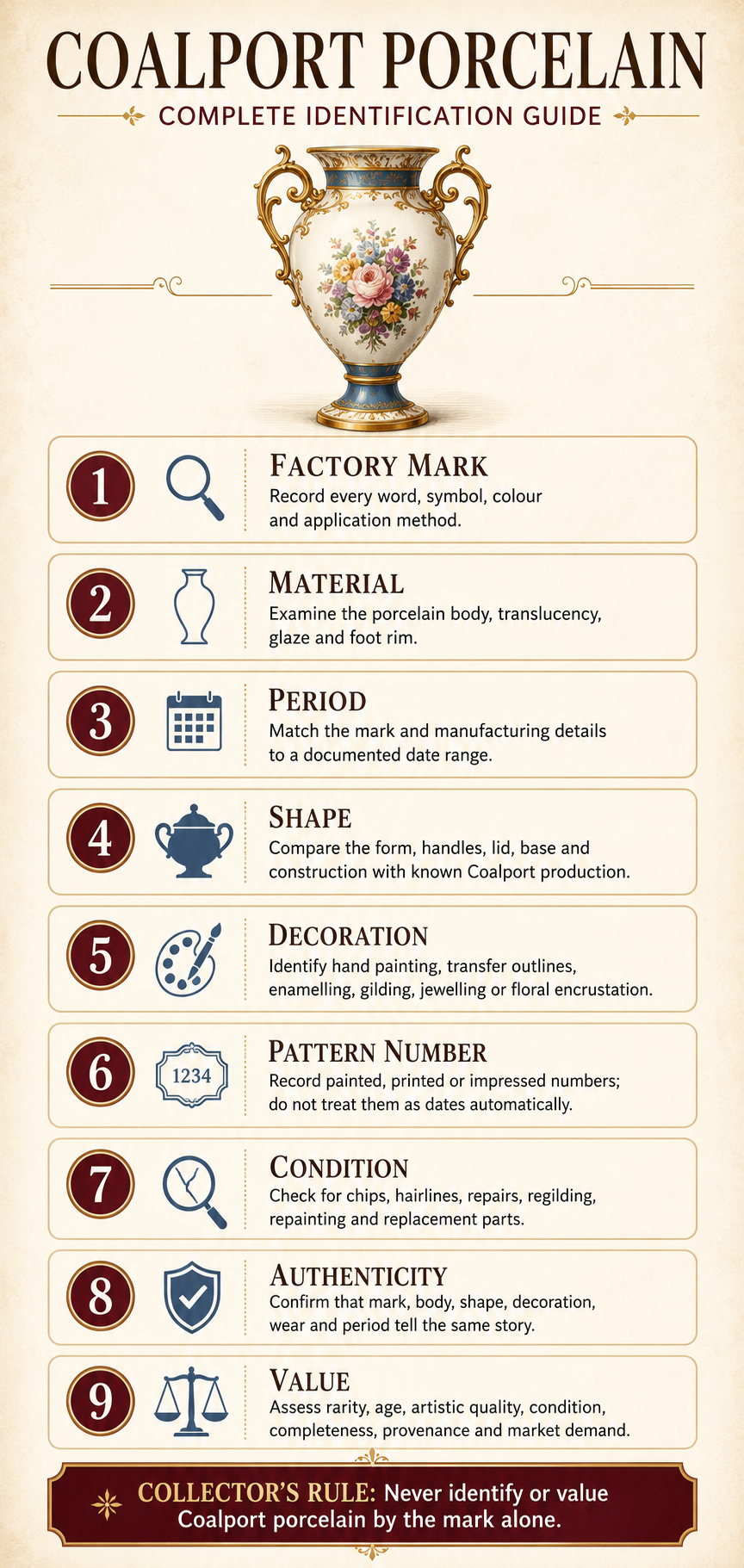
Coalport Porcelain at a Glance
| Feature | What to Look For | Why It Matters |
|---|---|---|
| Mark | Painted, printed, impressed or later factory backstamps | May help establish manufacturer and approximate period |
| Porcelain body | Fine body, translucency, colour, weight and firing characteristics | Helps distinguish periods and production types |
| Decoration | Hand painting, gilding, floral work, landscapes, cobalt grounds and jewelling | Can strongly affect desirability and attribution |
| Pattern number | Painted or impressed numbers, often on the underside | May connect a piece with a documented decoration or service |
| Shape | Tea wares, vases, urns, dessert wares, ornamental forms and figures | Form should be consistent with the proposed date |
| Condition | Chips, cracks, restoration, staining, crazing and gilding loss | One of the strongest influences on market value |
| Provenance | Old labels, invoices, exhibition history and documented ownership | Can strengthen attribution and collector interest |
What Is Coalport Porcelain?
Coalport is one of the important names in English ceramic history. Its development is closely connected with the extraordinary concentration of industrial innovation around the Ironbridge Gorge and the River Severn in Shropshire.
The story is particularly associated with John Rose, whose porcelain-making enterprise developed around the end of the eighteenth century. Production eventually became established at Coalport, and the factory grew into an important manufacturer of tableware and ornamental porcelain.
Like many historic English ceramic businesses, Coalport did not remain stylistically static. Its products evolved with changing fashions, technology, ownership and international competition. Consequently, an early nineteenth-century Coalport object may look dramatically different from a late Victorian vase or a twentieth-century Coalport figurine.
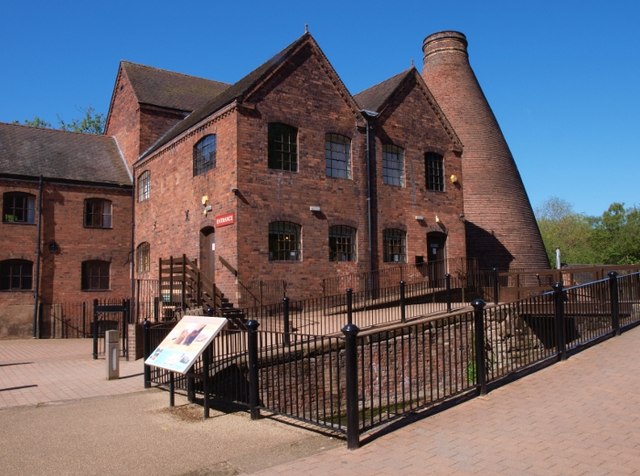
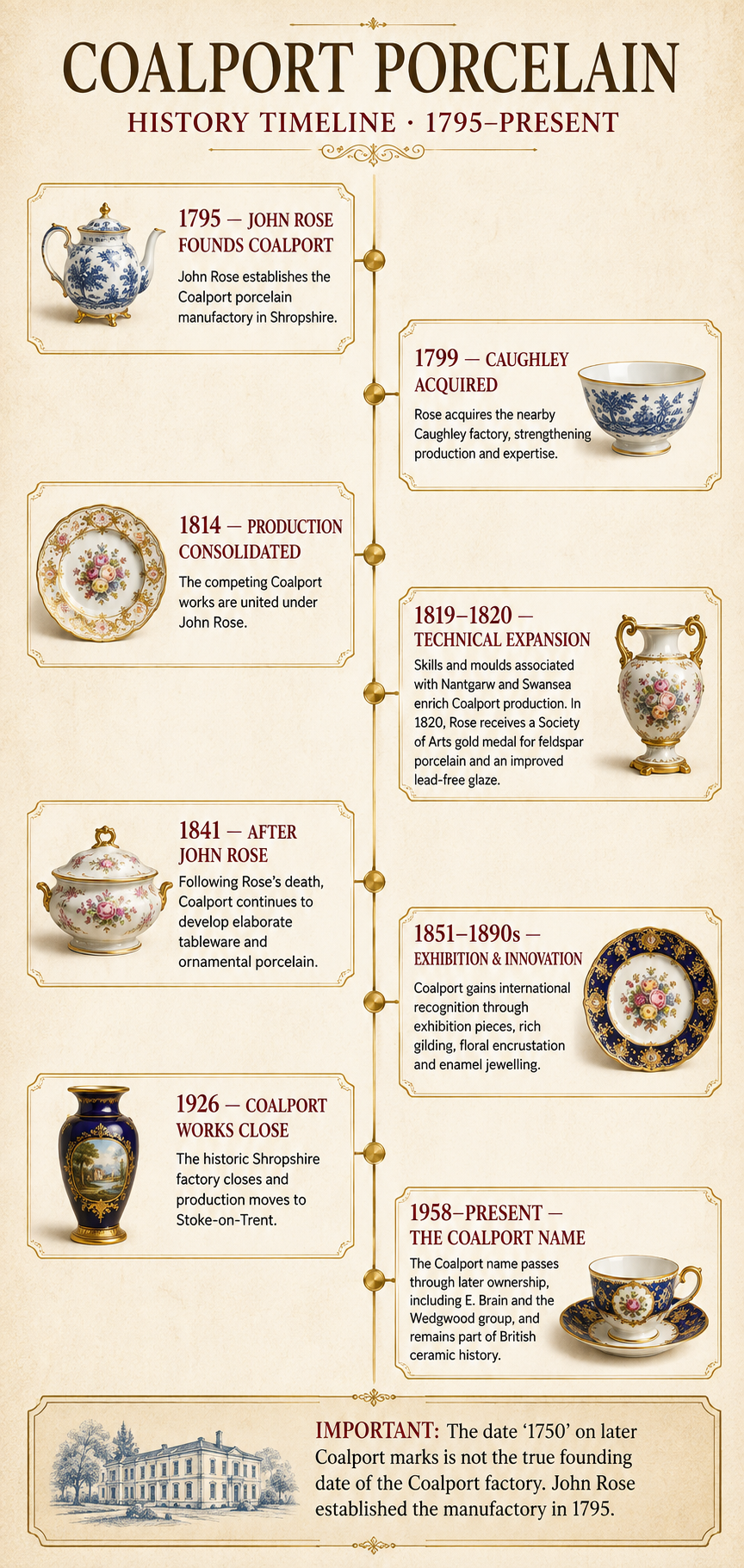
Coalport History: From John Rose to the Modern Era
Understanding Coalport’s chronology is essential because the factory’s porcelain, marks and decorative vocabulary changed considerably over time.
| Period | Development | Collector Relevance |
|---|---|---|
| Late 18th century | John Rose becomes associated with porcelain manufacture in Shropshire. | Foundation period; early attribution can require specialist knowledge. |
| Early 19th century | Coalport develops as an important English porcelain producer. | Early porcelain and sophisticated hand decoration are particularly interesting to collectors. |
| 19th century | Production expands across tableware and increasingly elaborate ornamental porcelain. | Large variety of patterns, forms and decorative techniques. |
| Victorian era | Highly decorative porcelain, floral modelling, gilding, rich grounds and exhibition-quality pieces become important. | Some of the most visually spectacular Coalport wares belong to this period. |
| Early 20th century | Production adapts to changing markets and tastes. | Marks and stylistic evidence become increasingly useful for dating. |
| Later 20th century | Coalport becomes widely associated with fine bone china and collectible figurines. | Collector series create a distinct modern Coalport collecting field. |
Early Coalport Porcelain
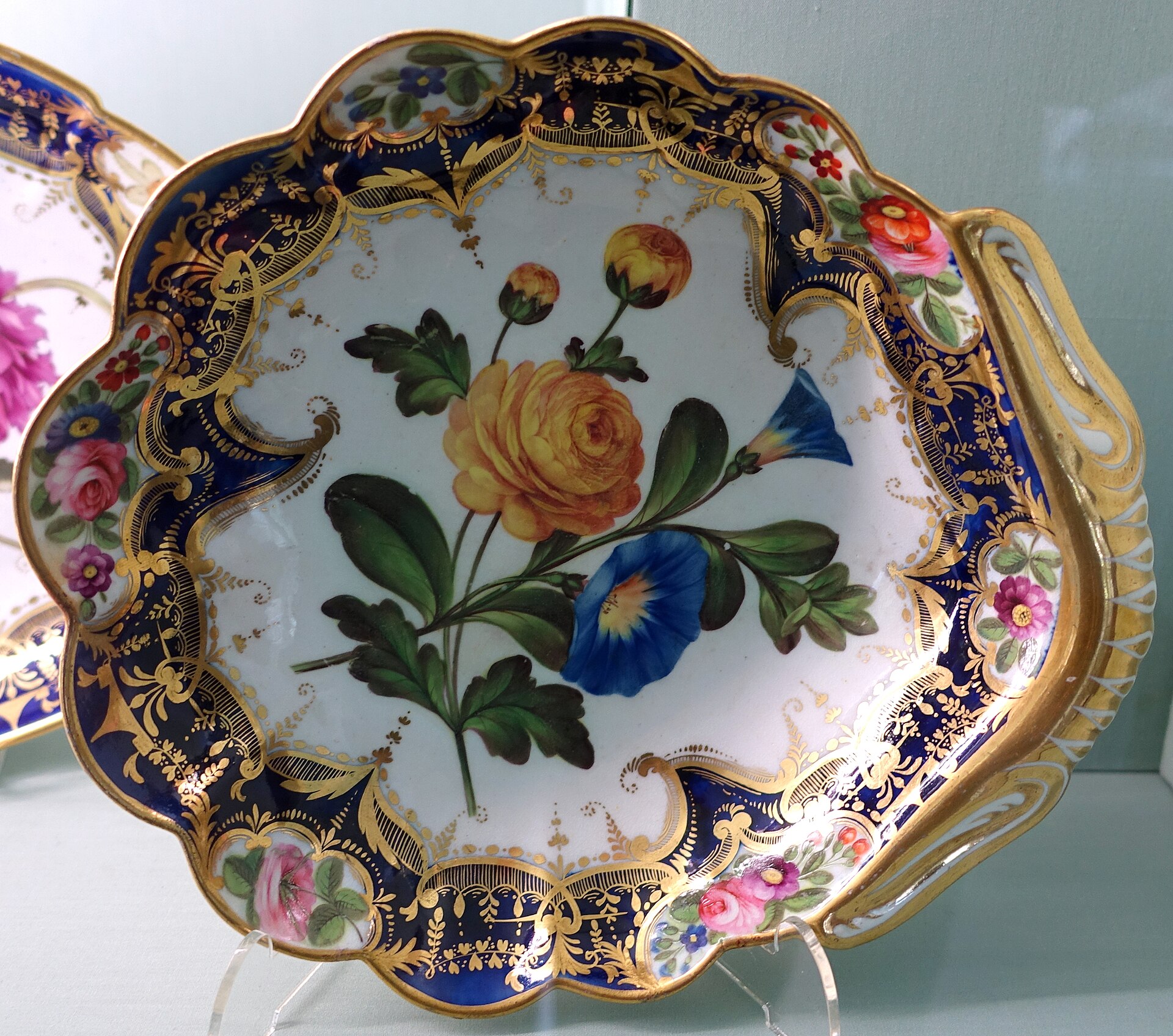
Early Coalport is particularly fascinating because identification may depend more heavily on the porcelain itself than on a convenient printed factory name. Collectors should study the body, potting, shape, glaze and decoration together.
The early factory operated within a competitive English porcelain market in which manufacturers borrowed, adapted and responded to fashionable European and British decorative traditions. Fine floral painting, gilding, landscapes and elaborate border designs therefore need to be interpreted in their broader historical context.
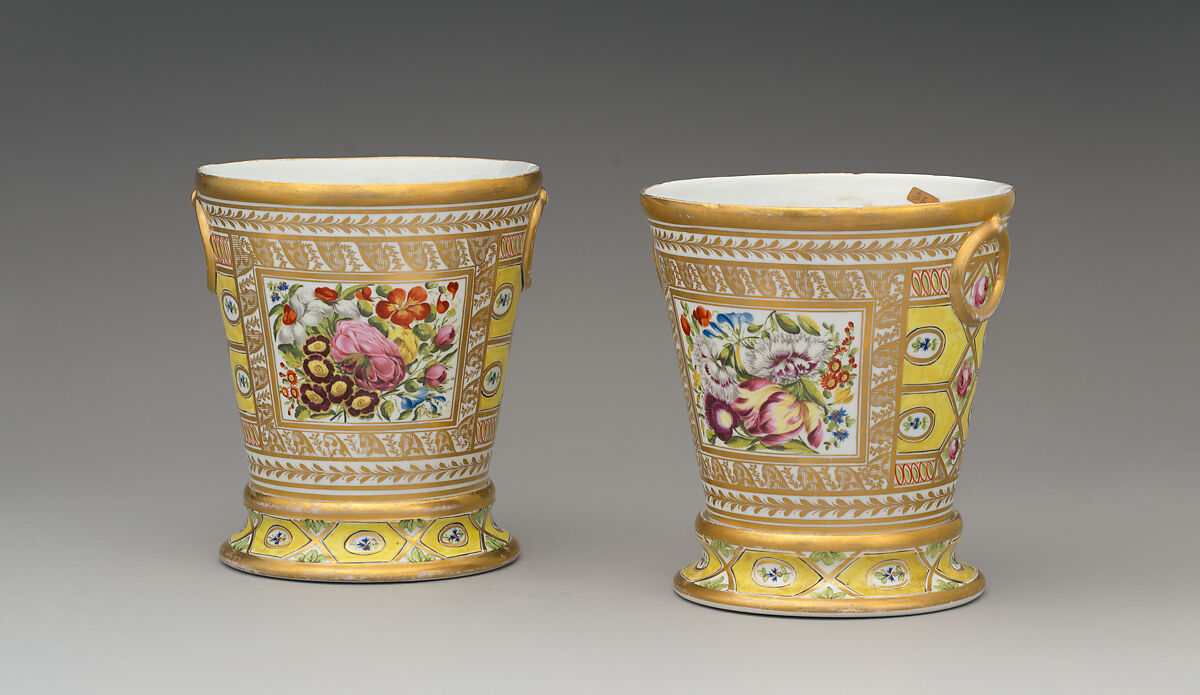
Objects associated with skilled decorators are especially useful for understanding the artistic ambitions of early Coalport production. Fine painting was not merely supplementary decoration: on important pieces it was central to the object’s visual identity.
Coalport Marks and Backstamps
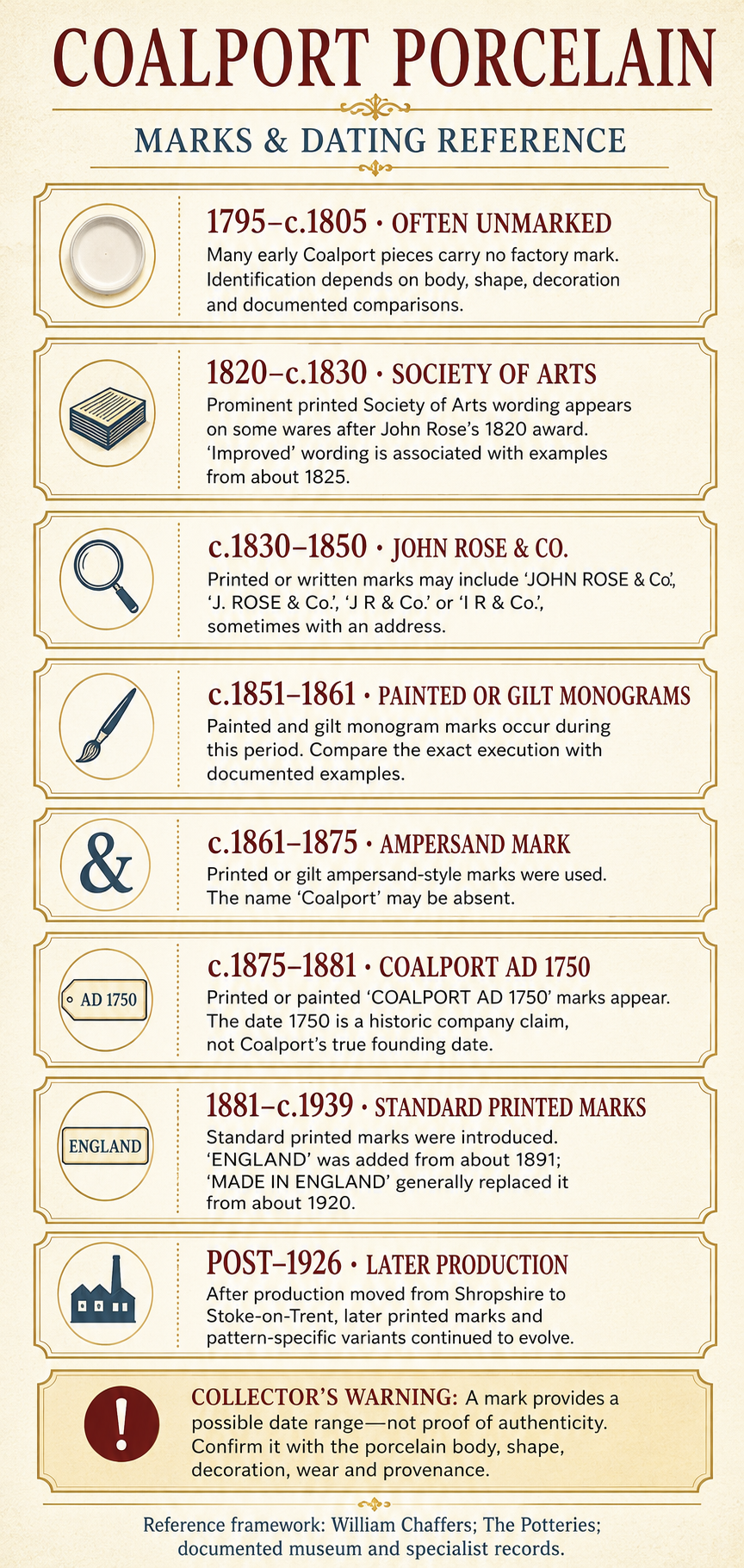
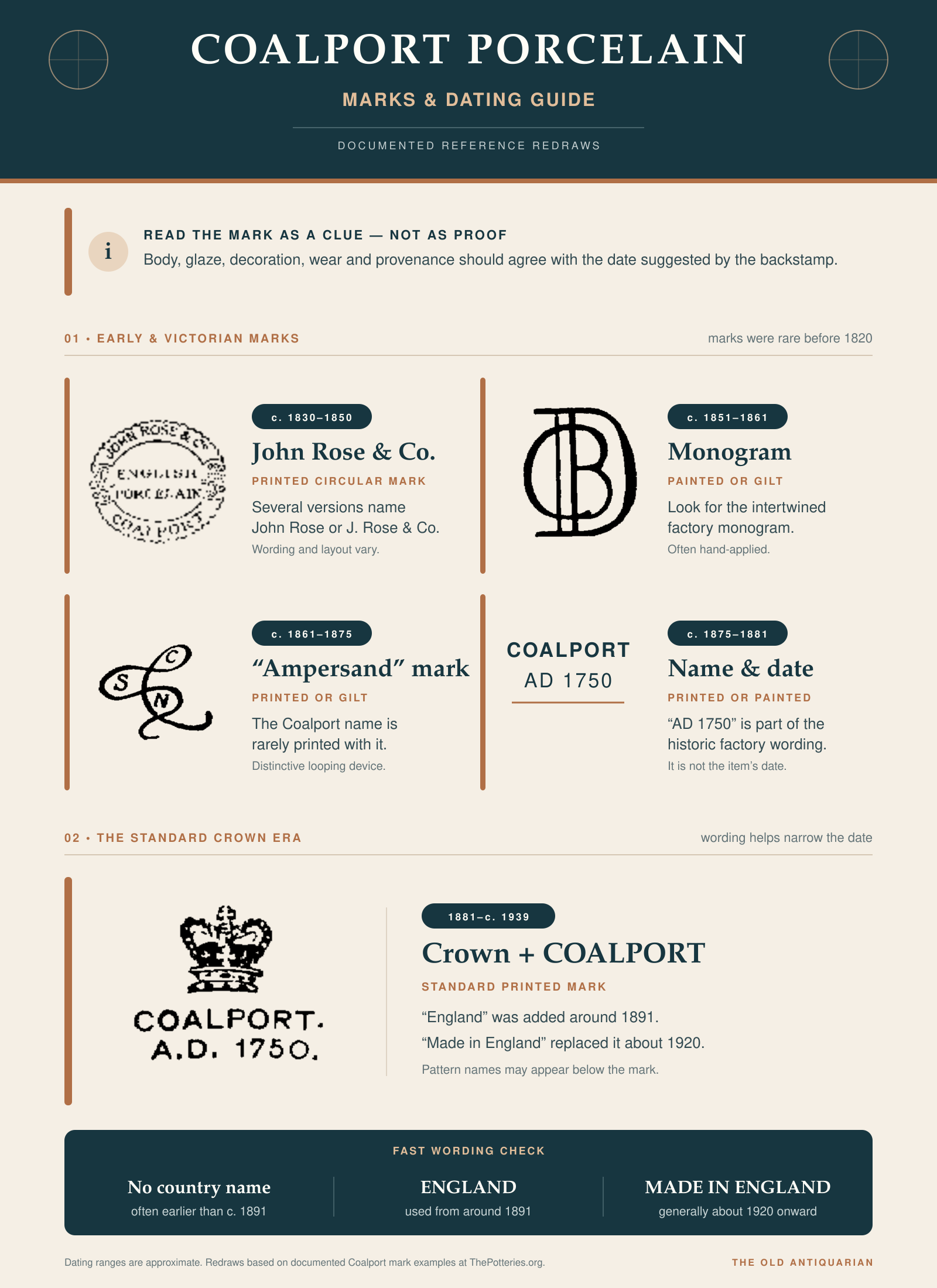
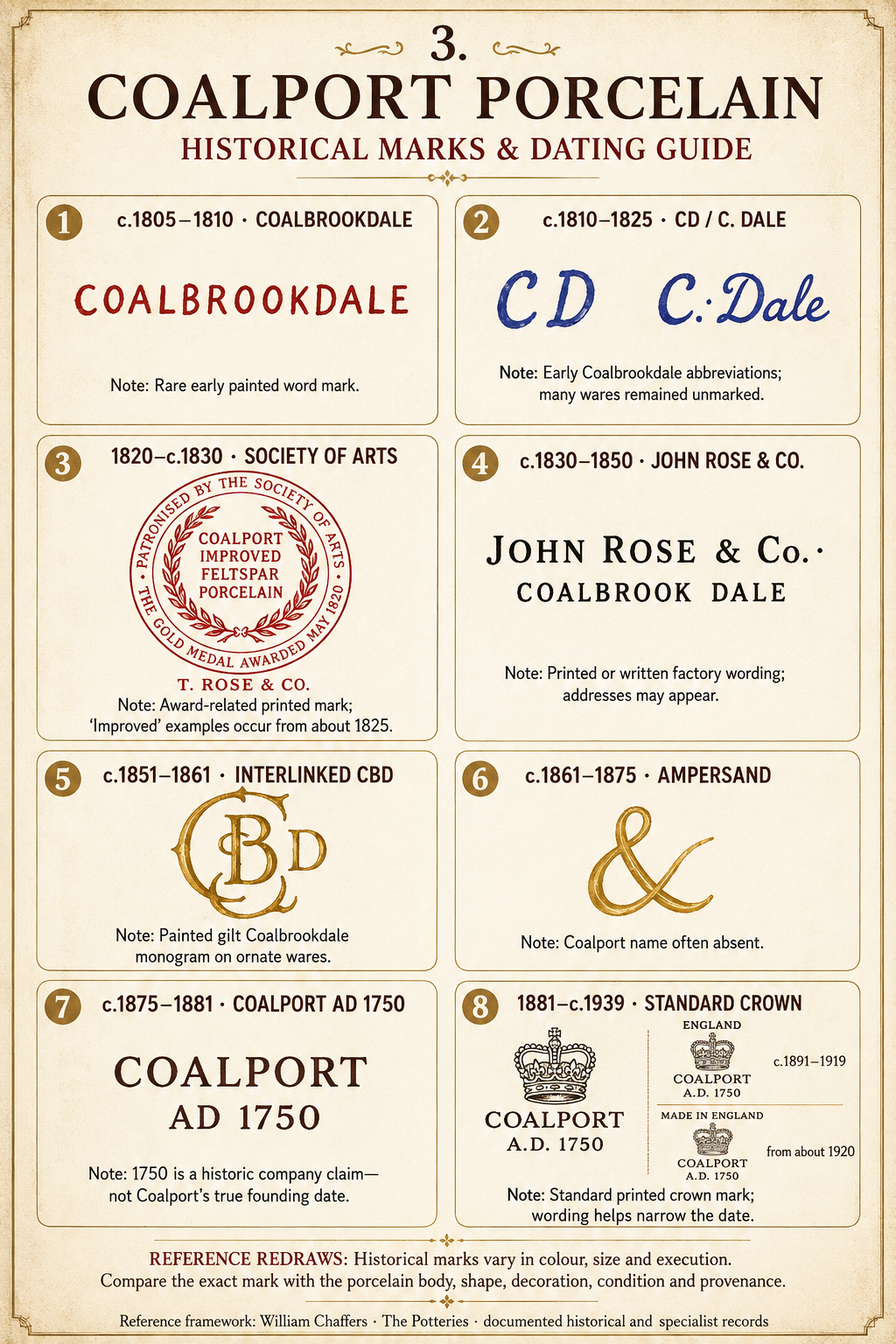
Coalport marks are among the most searched aspects of the factory, but they must be interpreted carefully. Marks changed with time and may include factory names, crowns, country-of-origin wording, printed devices, impressed information, pattern numbers and other production references.
Early porcelain can present a greater identification challenge because not every piece carries the kind of explicit factory backstamp expected on later wares.
If you are unfamiliar with the terminology, our detailed guide to
porcelain marks and backstamps
explains how painted, printed and impressed marks should be interpreted.
How to Examine a Coalport Mark
2. Identify how it was applied → printed, painted, impressed or incised.
3. Examine the typography → lettering and layout can change between periods.
4. Record country wording → England and other export wording may help narrow the period.
5. Record pattern and shape numbers → do not assume every number is a date.
6. Compare the porcelain → body, shape and decoration must make historical sense for the mark.
7. Compare with documented references → use museum collections, specialist catalogues and reliable historical examples.
For a broader explanation of this method, see our
guide to dating antique porcelain
.
It explains why the mark, material, decoration, manufacturing technique and natural wear should be evaluated together.
Can Coalport Marks Be Faked?
Any valuable historic porcelain name can be misattributed, copied or reproduced. A convincing mark therefore does not prove that the complete object belongs to the period implied by the mark.
Warning signs include a backstamp inconsistent with the porcelain body, decoration that belongs to a different period, suspiciously artificial wear, incorrect lettering or a mark that appears historically incompatible with the object’s form.
Our broader
porcelain marks identification guide
explains why professional identification should always extend beyond the logo itself.
How to Identify Authentic Coalport Porcelain
The safest way to identify Coalport is to treat the object as a collection of evidence rather than searching for one decisive clue.
This principle applies to antique porcelain generally. As explained in our
complete guide to identifying antique porcelain
,
specialists compare the body, translucency, glaze, decoration, marks, manufacturing techniques and natural wear before reaching an attribution.
| Step | Examine | Question to Ask |
|---|---|---|
| 1 | Mark | Does the backstamp correspond with a documented Coalport period? |
| 2 | Porcelain body | Is the body appropriate for the proposed date? |
| 3 | Shape | Does the form correspond with known Coalport production? |
| 4 | Decoration | Is it hand painted, transfer decorated, gilded, jewelled or a combination? |
| 5 | Numbers | Are there pattern, shape or decorator references? |
| 6 | Wear | Does ageing appear natural and consistent? |
| 7 | Condition | Are there cracks, chips, repainting or restoration? |
| 8 | Comparison | Can the piece be matched with documented museum or specialist examples? |
Coalport in the Victorian Era
During the nineteenth century Coalport developed an increasingly rich decorative vocabulary. Victorian consumers demanded porcelain capable of functioning both as tableware and as conspicuous interior decoration, and Coalport produced objects ranging from refined services to elaborate ornamental forms.
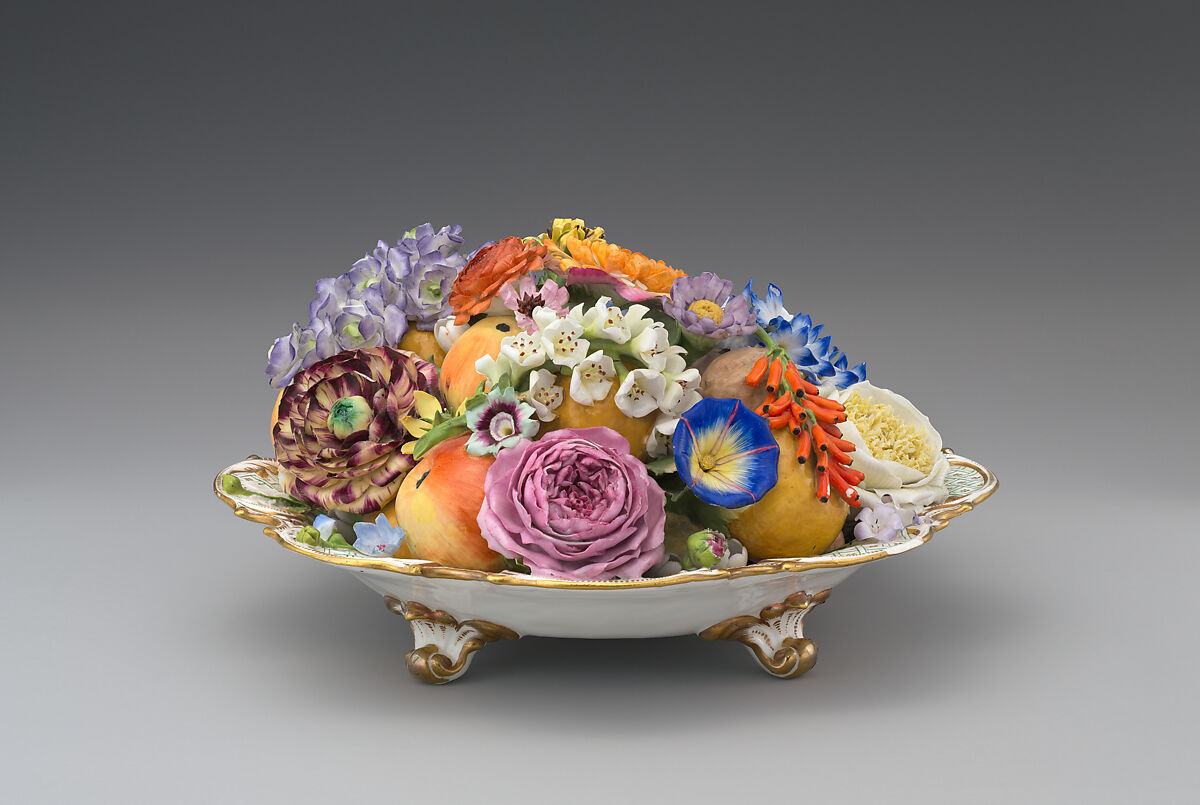
Richly coloured grounds, elaborate gilding, floral painting, landscapes, sculptural flowers and historically inspired forms can all occur. Some objects deliberately evoke prestigious Continental porcelain traditions while retaining a distinctly English manufacturing context.
Coalport Patterns and Decorative Techniques
Decoration is one of the most useful—and most visually rewarding—areas of Coalport study. Collectors encounter everything from restrained floral borders to extremely elaborate ornamental pieces.
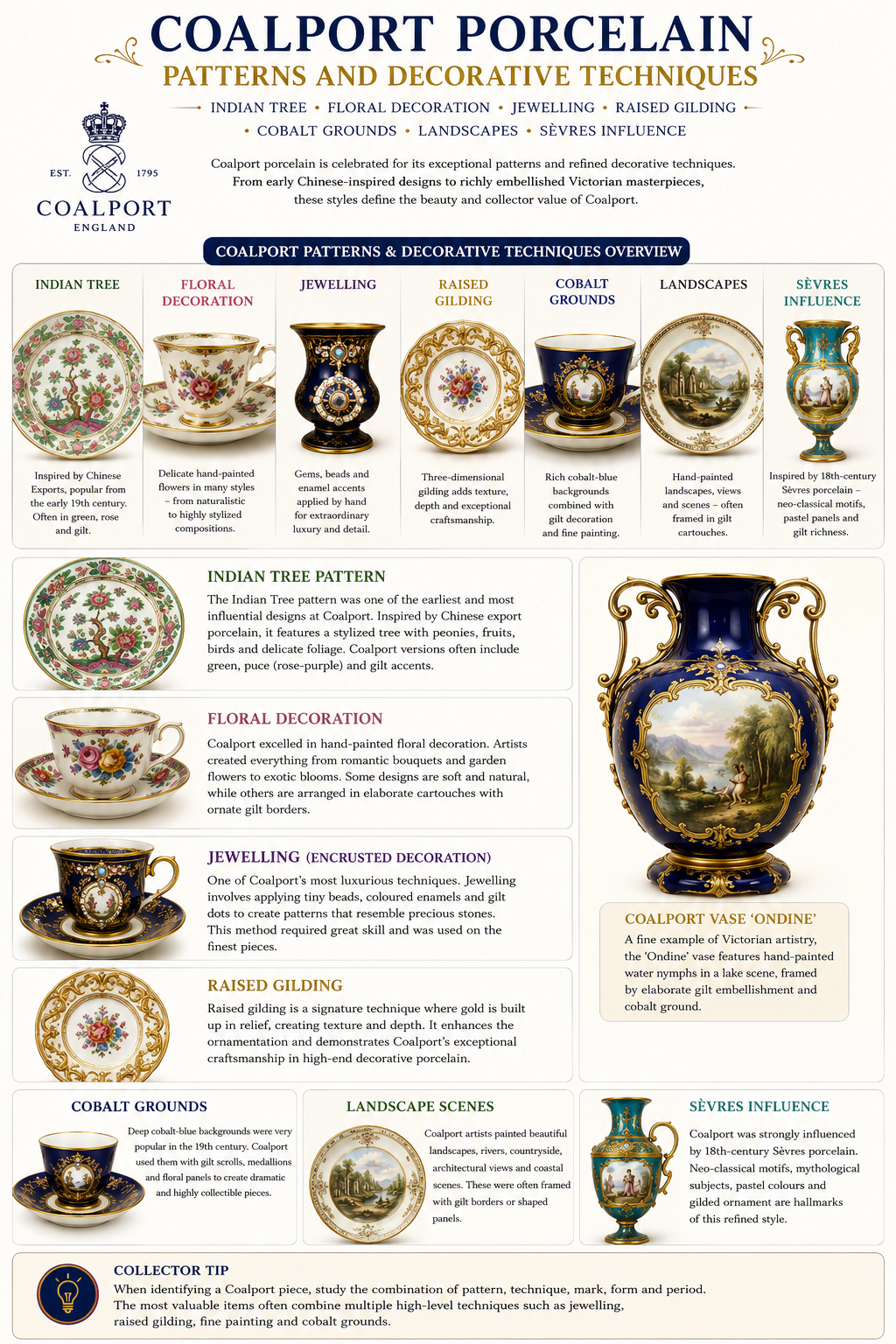
Among the names and techniques associated with Coalport collecting are Indian Tree, floral painting, applied floral decoration, jewelling, raised gilding, cobalt grounds, landscapes and Sèvres-inspired decoration.
Collectible Coalport China Patterns
Coalport produced a very large number of patterns and decorative schemes during its long history. Some are known primarily through pattern numbers, while others became recognisable named designs. Collectors may encounter names such as English Garden, Palladian and Indian Tree alongside numerous floral, gilded and richly coloured decorations.
A familiar pattern name does not automatically make a Coalport piece rare or valuable. The production period, form, colourway, decoration, completeness, condition and current collector demand should all be considered. Pattern identification is most reliable when the decoration agrees with the backstamp and any pattern information on the underside.
Coalport English Garden
Coalport English Garden is one of the named patterns encountered by collectors of later Coalport china. When identifying a piece, examine the complete backstamp and any printed or painted pattern information rather than relying only on the floral appearance of the decoration.
English Garden can be encountered on different forms of tableware and decorative china. For collectors assembling or replacing a service, matching the pattern, shape, colour, gilding, dimensions and backstamp period is important because two genuine Coalport pieces are not necessarily from the same original set.
Coalport Palladian
Coalport Palladian is another named design searched for by collectors researching Coalport china and replacement pieces. As with other Coalport patterns, identification should begin with the complete object: compare the decoration with the factory backstamp, pattern wording, form and any additional numbers or production references.
When evaluating Palladian pieces, check especially for matching components, gilding wear, chips, cracks, staining and restoration. A complete and consistently matched group should be assessed differently from individual replacement pieces assembled from different production periods.
Indian Tree
Indian Tree became one of the recognisable decorative names encountered in British ceramics. Variations generally feature stylised flowering branches and exotic botanical motifs inspired by Asian decorative traditions as interpreted through European ceramic design.
Collectors should not assume that every Indian Tree object is Coalport. The pattern concept was used by more than one manufacturer, so the factory mark and production characteristics remain essential.
Floral Decoration
Flowers occur throughout Coalport production in many forms: delicately painted bouquets, botanical sprays, richly coloured borders and three-dimensional applied flowers.
The distinction between a competent factory decoration and exceptionally fine hand painting can matter considerably when assessing collector quality.
Jewelling
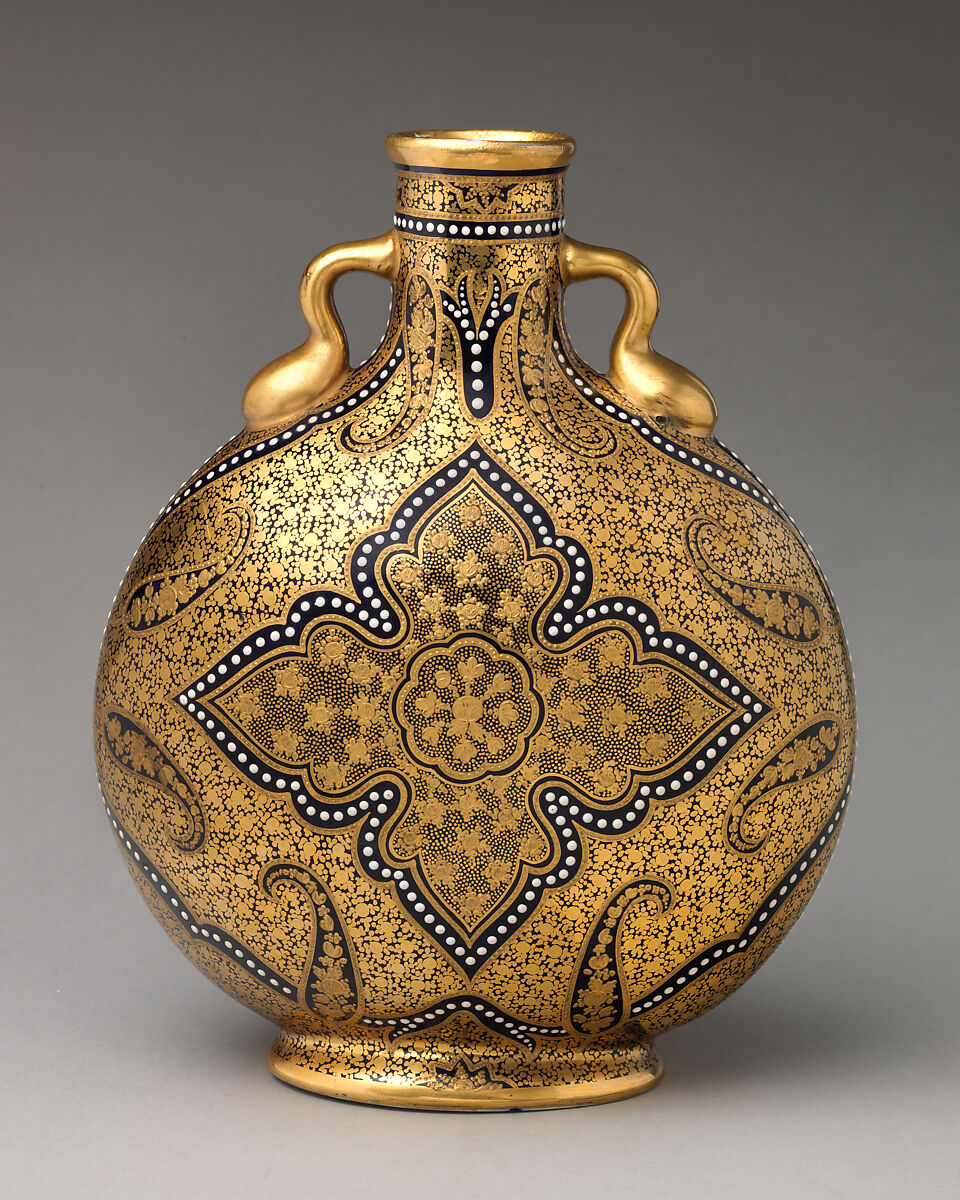
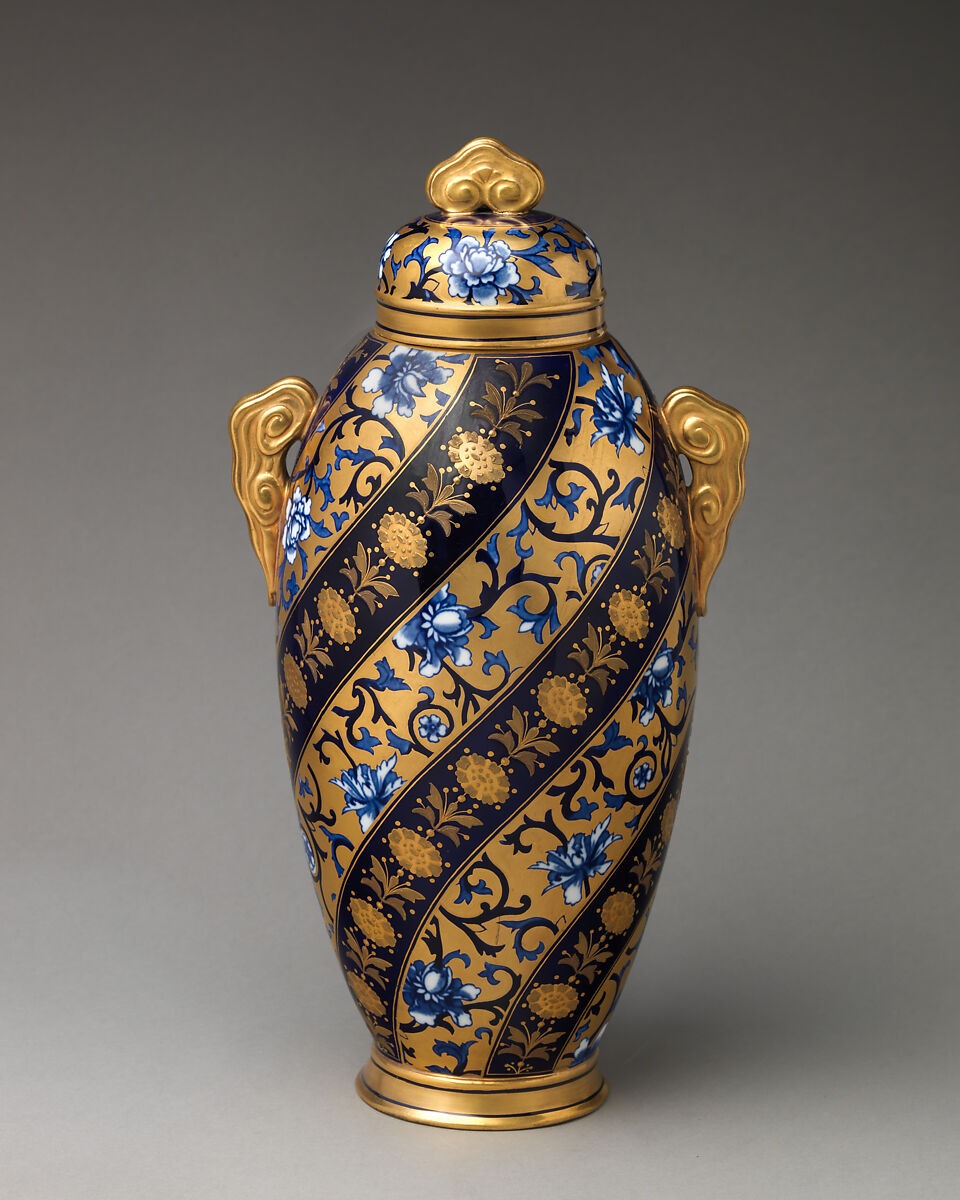
Jewelled decoration uses small raised enamel-like dots or elements to create a jewel-like surface effect. When combined with rich grounds and gilding, the technique can produce exceptionally luxurious porcelain.
Raised and Tooled Gilding
Gold decoration can range from relatively simple rims to complex raised, tooled or patterned gilding. On high-quality Coalport, gilding may form an important part of the artistic composition rather than merely finishing an edge.
Cobalt Grounds
Deep cobalt blue provides a dramatic background for gilding, painted reserves and ornamental borders. Such combinations were especially effective on decorative vases and presentation pieces.
Landscapes and Painted Reserves
Finely painted landscapes may appear within framed reserves surrounded by coloured grounds and gilding. On particularly accomplished pieces, the quality of the painting itself can be an important component of desirability.
Sèvres Influence
Like several nineteenth-century English factories, Coalport responded to the prestige of French porcelain, especially the decorative language associated with Sèvres. Rich coloured grounds, gilded framing, painted reserves and elaborate ornamental forms could evoke Continental luxury.
Influence, however, should not be confused with origin. A Sèvres-inspired Coalport piece remains English porcelain, and correct identification depends on its complete manufacturing context.
Coalport Pattern Numbers: What Do the Numbers Mean?
Numbers found underneath Coalport porcelain can be extremely useful, but they are also easy to misinterpret. A painted or impressed number should not automatically be treated as a year.
Depending on the object and period, numbers may relate to a pattern, shape, model, decoration or internal factory reference.
| Marking | Possible Meaning | Collector Advice |
|---|---|---|
| Pattern number | Decoration or service pattern | Compare with documented Coalport pattern references |
| Shape / mould number | Factory form or model | Useful when comparing identical forms with different decoration |
| Decorator mark | Workshop or individual production reference | May require specialist research |
| Painted numerals | Can have several factory purposes | Never assume they represent a date without evidence |
Coalport vs Coalbrookdale: What Is the Difference?
One of the most confusing questions for collectors is the relationship between
Coalport and Coalbrookdale. The two names are closely
connected with the same historic ceramic-producing area of Shropshire, but they
should not automatically be treated as two completely separate porcelain factories.
In the collecting market, the term Coalbrookdale is often associated
with particularly elaborate nineteenth-century Coalport ornamental wares, especially
pieces covered with applied flowers, sculptural elements and richly modelled decoration.
Historical descriptions and commercial terminology can vary, which is why identification
should rely on the object itself rather than the name alone.
| Feature | Coalport | Coalbrookdale |
|---|---|---|
| Meaning | The principal historic factory and brand name | A historically connected geographical and collecting term |
| Collector usage | Used broadly for Coalport porcelain | Frequently associated with elaborate nineteenth-century ornamental wares |
| Typical objects | Tableware, dessert services, vases, urns, ornamental porcelain and later figurines | Flower-encrusted vases, baskets, centrepieces and highly decorative forms |
| Decoration | Extremely varied across more than two centuries | Often associated with applied flowers and highly sculptural decoration |
| Identification | Mark + body + shape + decoration + period | Historical context + construction + decoration + documented comparison |
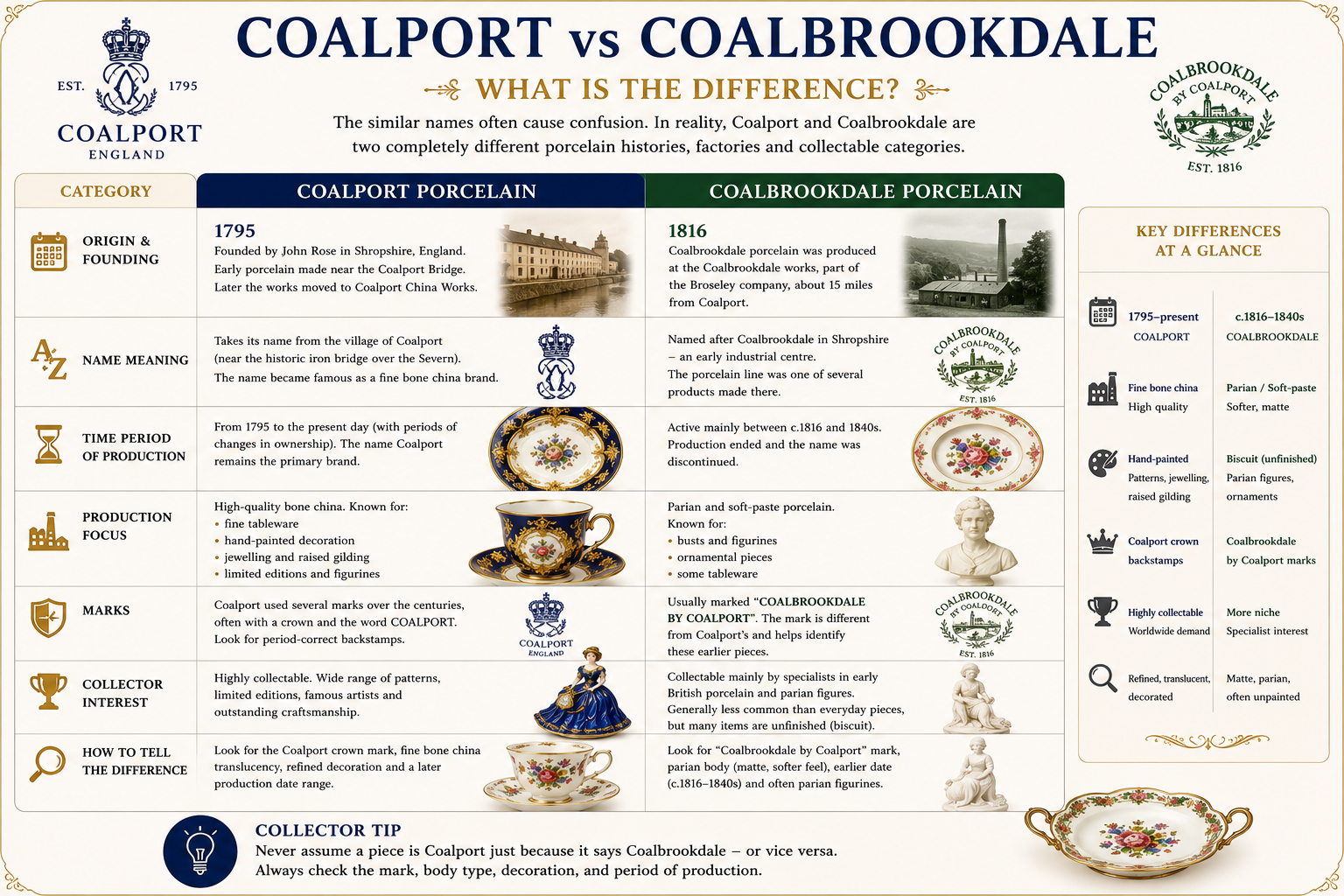
clue rather than proof of attribution. Examine the porcelain body, construction,
decoration, marks and period before identifying an object.
Coalport Figurines and Collector Series
Although early Coalport is strongly associated with tableware and ornamental porcelain,
many modern collectors know the name through its bone china figurines.
These later figures form a collecting field of their own and should not be evaluated
according to exactly the same criteria as an early nineteenth-century Coalport vase
or dessert service.
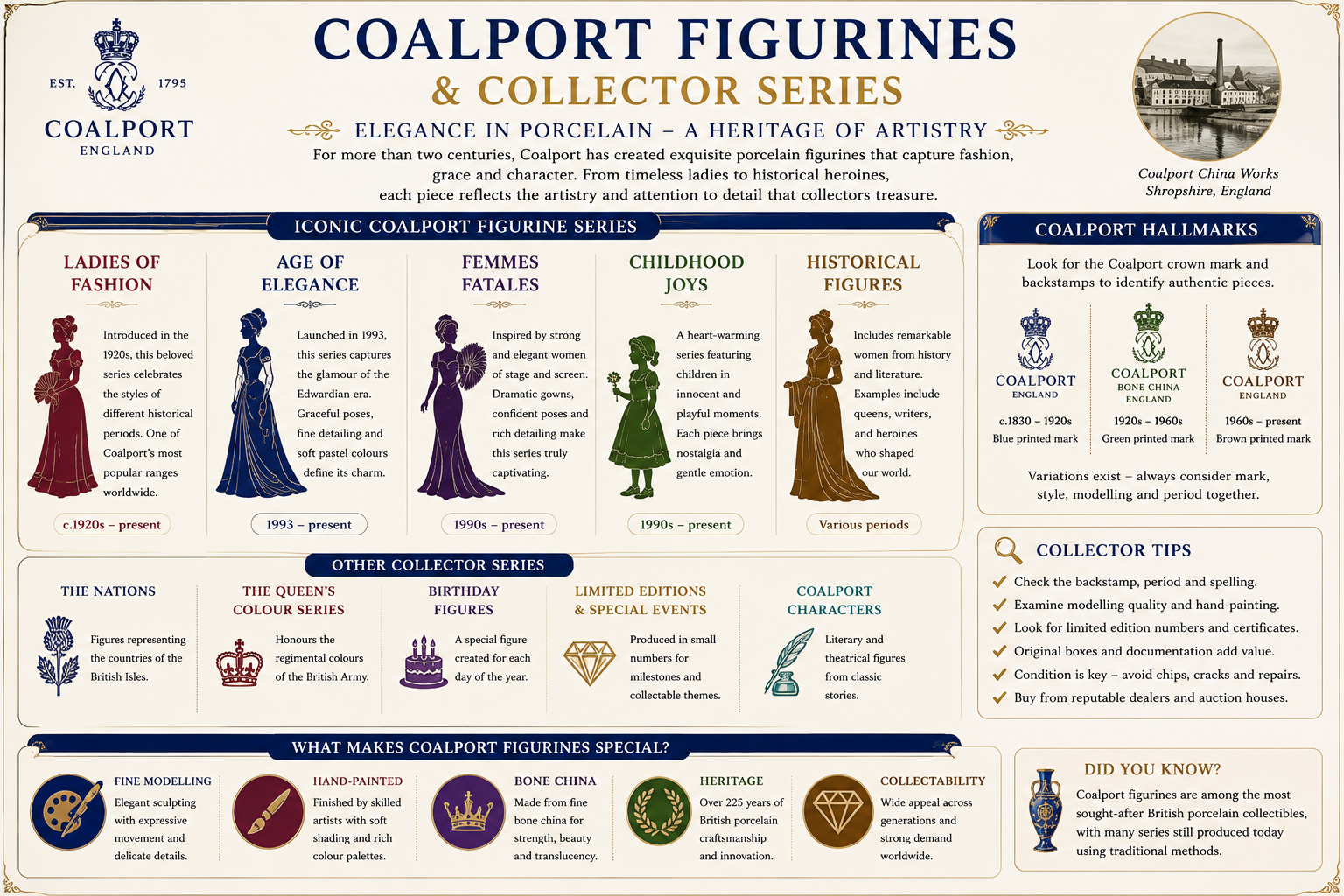
Coalport produced numerous decorative figures, including elegant ladies, literary
and historical subjects, childhood themes and limited collector editions. Well-known
series encountered by collectors include Ladies of Fashion,
Age of Elegance, Femmes Fatales and
Childhood Joys.
How to Identify a Coalport Figurine
Begin with the underside of the base. Depending on period and series, information may
include the Coalport name, figure title, model or edition details and other production
information.
Then examine the modelling itself. Quality examples normally display carefully finished
faces, hands, clothing and accessories. Painted decoration should complement the modelling
rather than disguise poorly defined detail.
| Check | Why It Matters |
|---|---|
| Backstamp | Helps confirm manufacturer and approximate production period |
| Figure name | May identify a documented collector series |
| Edition information | Can distinguish limited production from standard production |
| Modelling | Fine details are an important indicator of manufacturing quality |
| Decoration | Check painting, gilding and consistency of finish |
| Condition | Fingers, flowers, hats, lace effects and other projections are vulnerable to damage |
| Original packaging | Boxes and documentation can increase collector appeal |
The Coalport Ondine Vase
Some Coalport objects demonstrate how far the factory could move beyond conventional
tableware. Figurative and sculptural porcelain was particularly effective as a vehicle
for technical virtuosity and artistic display.
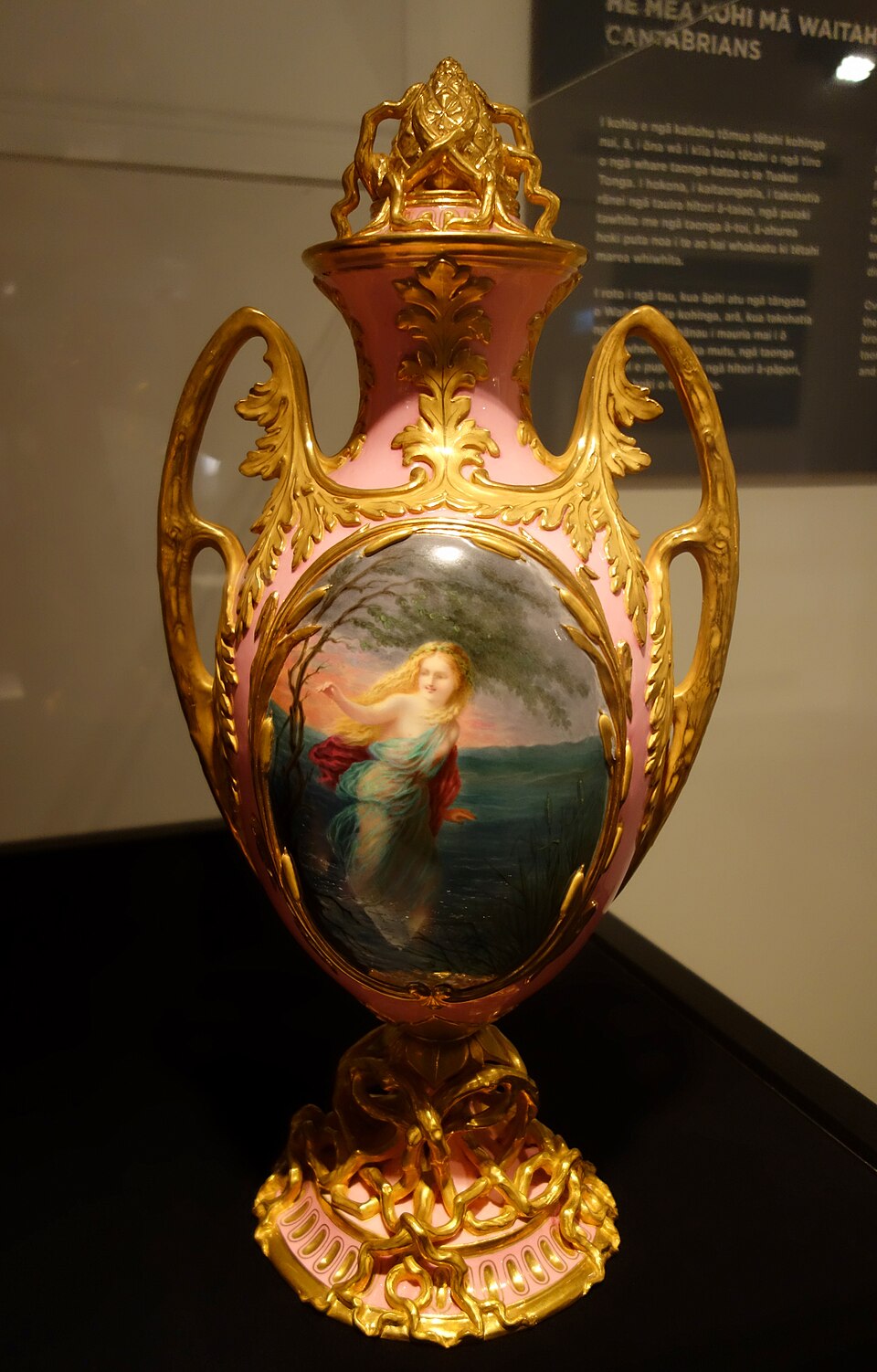
For collectors, such unusual forms deserve particularly careful examination.
Complex modelling, surviving applied details, original gilding, documented exhibition
history and provenance can all become significant.
How to Date Coalport Porcelain
There is rarely one universal shortcut for dating every Coalport object. The strongest
dating method combines several independent clues.
MARK
→ identify the complete backstamp and how it was applied.
PERIOD
→ establish when that mark or wording was used.
MATERIAL
→ determine whether the porcelain body is compatible with the proposed date.
SHAPE
→ compare the object’s form with documented period examples.
DECORATION
→ examine painting, transfer printing, gilding, jewelling and applied ornament.
PATTERN / SHAPE NUMBER
→ record every number without automatically treating it as a date.
WEAR
→ examine whether wear is natural and consistent with construction and use.
REFERENCE
→ compare the complete object with reliable documented examples.
Country-of-Origin Wording
Wording such as England or later country-of-origin information can
provide useful chronological evidence, particularly on wares intended for export.
However, collectors should avoid converting one wording feature into an exact date
without considering the rest of the mark.
Backstamps can remain in use for periods of time, transitional examples exist, and
different products may not always follow a perfectly simple chronological sequence.
Small Coalport Teapots and Tableware
Not every collectible Coalport object is a monumental exhibition piece. Cups,
saucers, plates, teapots, dessert wares and other domestic objects reveal an equally
important part of the factory’s history.
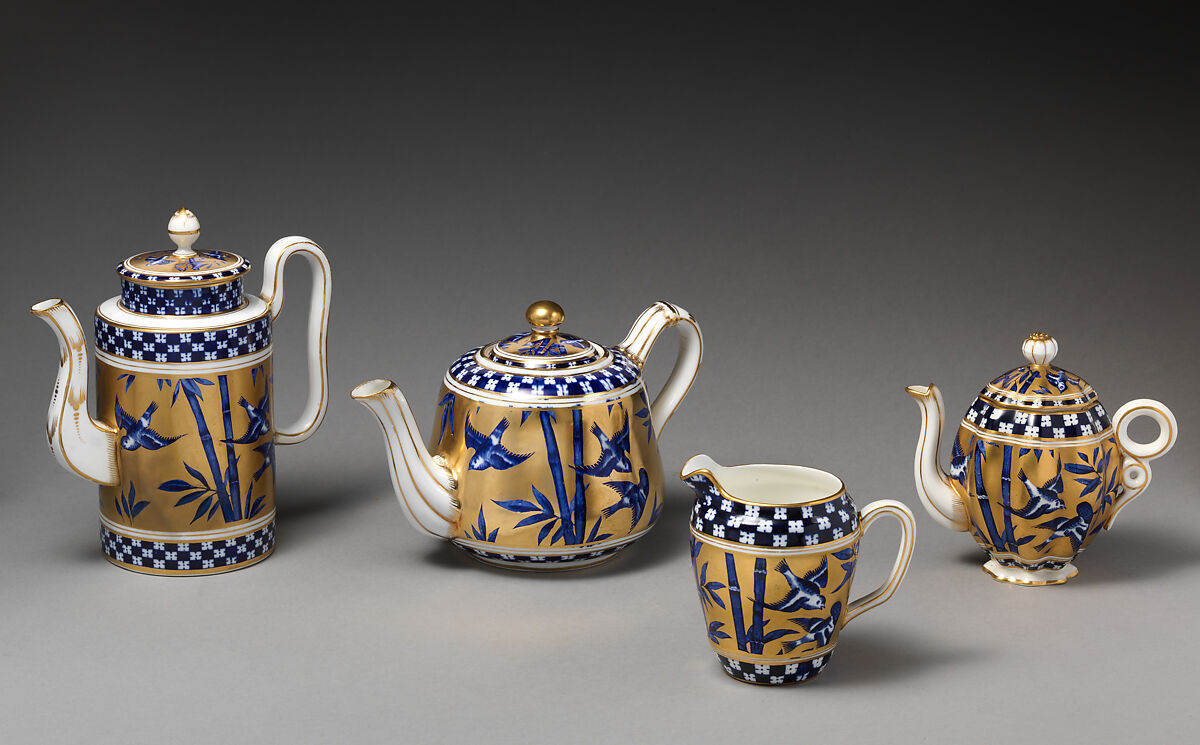
When evaluating tableware, completeness can become especially important. A single
cup may be attractive, but a complete documented service with matching pattern
numbers and consistent condition can occupy a very different position in the
collector market.
What Makes Coalport Porcelain Valuable?
There is no fixed price for “Coalport porcelain.” Two authentic Coalport objects can
have dramatically different market values because collectors are purchasing much more
than the factory name.
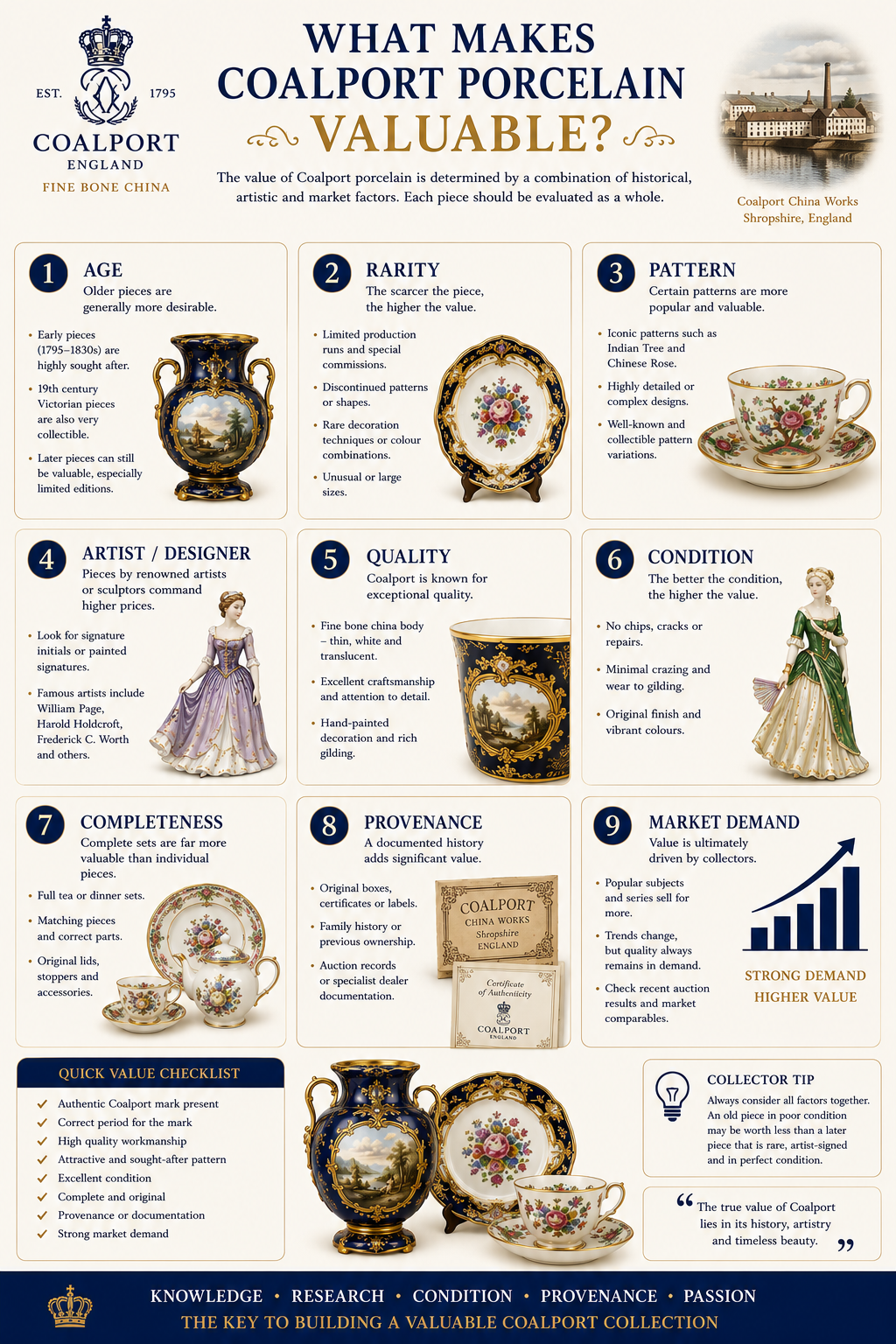
The most important factors are generally age, rarity, pattern, artist or
decorator, quality, condition, completeness, provenance and current market demand.
Is Coalport china valuable? Some examples certainly can be, but the Coalport name by itself does not establish value. Early or unusual porcelain, rare forms, exceptional hand-painted or richly gilded pieces, desirable patterns, documented artist-decorated wares and important objects with strong provenance may attract greater collector interest. Common later tableware or figurines may be much more modestly valued, particularly when damaged or incomplete.
1. Age
Early Coalport can attract considerable specialist interest, particularly when attribution
is secure. Age alone, however, does not make an object valuable. An ordinary damaged
piece can be worth less than a later object of exceptional quality or rarity.
2. Rarity
Scarcity matters when it is combined with collector demand. Unusual shapes, rare
decorations, special commissions and limited-production objects may command greater
interest than commonly encountered wares.
3. Pattern
Some patterns and decorative combinations are considerably more desirable than others.
A documented pattern can also make research easier and strengthen identification.
4. Artist or Decorator
A documented association with an important painter, modeller or designer can transform
the significance of a piece. Signatures and inscriptions must nevertheless be
authenticated rather than accepted automatically.
5. Quality
Compare the fineness of the porcelain, quality of potting, modelling, painting,
gilding and finishing. Exceptional craftsmanship can distinguish an important
Coalport object from routine production.
6. Condition
Condition is often one of the strongest determinants of value. Look carefully for
chips, cracks, hairlines, staining, crazing, replaced components, repainting,
restoration and loss of gilding.
7. Completeness
Matching lids, stands, saucers and other original components matter. With services,
the number of surviving matching pieces can significantly influence desirability.
8. Provenance
Old invoices, collection labels, exhibition records, historic photographs and
documented ownership can provide evidence that strengthens an object’s history.
Good provenance is especially significant for unusual or important pieces.
9. Market Demand
Collector preferences change. A category that commanded exceptional prices decades
ago may behave differently today, while rare or visually striking pieces can retain
strong specialist demand.
How Much Is Coalport Porcelain Worth?
This is best answered by identifying the object first and valuing it second.
A factory name alone is insufficient for a meaningful valuation.
| Type of Coalport | Typical Collector Considerations |
|---|---|
| Early porcelain | Attribution, rarity, decoration, provenance and condition |
| 19th-century ornamental porcelain | Scale, complexity, modelling, hand painting, gilding and restoration |
| Coalbrookdale-type floral wares | Completeness of applied flowers and quality of restoration |
| Tableware | Pattern, completeness, condition and current demand |
| Signed or artist-decorated pieces | Artist attribution, quality and authenticity of signature |
| Collector figurines | Series, edition, rarity, condition, box and certificate |
| Exceptional exhibition or presentation pieces | Documentation, rarity, artistic quality and provenance |
For meaningful comparison, examine recent sales of genuinely comparable pieces with
similar date, size, decoration, condition and provenance.
Condition: What Collectors Should Check
Porcelain can conceal damage surprisingly well, particularly when restoration has
been professionally executed. Examine the object in strong, diffuse light and inspect
both the decorated surfaces and structurally vulnerable areas.
| Problem | Where to Look | Possible Effect |
|---|---|---|
| Chips | Rims, feet, handles, flowers and projections | Usually reduces value |
| Hairline cracks | Rims, handles and stress points | Can significantly affect desirability |
| Restoration | Handles, necks, bases and applied decoration | Impact depends on importance and extent |
| Gilding wear | Edges and frequently handled surfaces | Light natural wear may be acceptable; severe loss matters |
| Staining | Glaze cracks and porous areas | Can substantially reduce visual appeal |
| Replacement parts | Lids, finials, handles and stands | May materially affect originality |
Coalport Collector Checklist
Before buying, selling or valuing Coalport porcelain, check:
✓ Is there a factory mark or backstamp?
✓ Is the mark appropriate for the proposed period?
✓ What type of porcelain body is present?
✓ Does the shape correspond with known Coalport production?
✓ Is the decoration hand painted, printed or mixed?
✓ Is there gilding, jewelling or applied decoration?
✓ Are pattern or shape numbers present?
✓ Is there an artist or decorator signature?
✓ Are all original components present?
✓ Are there chips, cracks or hairlines?
✓ Has the object been restored or repainted?
✓ Is there documented provenance?
✓ Can the object be compared with reliable reference examples?
✓ Are comparable realised sale results available?
Common Mistakes When Identifying Coalport
Even experienced collectors can make mistakes when an attractive object seems to fit
a familiar Coalport style. Several errors occur repeatedly.
Dating from the decoration alone: styles can be revived and copied.
A Victorian-looking pattern does not automatically prove Victorian manufacture.
Assuming every number is a date: many numbers relate instead to
patterns, shapes or production information.
Trusting the backstamp alone: the entire object must agree with
the proposed attribution.
Ignoring restoration: sophisticated restoration may be difficult
to see in ordinary photographs.
Confusing Coalport and Coalbrookdale terminology: historical,
geographical and commercial terminology can overlap.
Using online asking prices as valuations: an unsold asking price
does not establish what collectors are actually paying.
Frequently Asked Questions About Coalport Porcelain
Is Coalport porcelain valuable?
Some Coalport porcelain can be valuable, but the Coalport name alone does not determine
price. Age, rarity, pattern, artistic quality, condition, completeness, provenance and
collector demand all matter.
What is the Coalport English Garden pattern?
English Garden is a named Coalport pattern encountered on later tableware and decorative china. Identification should be confirmed from the complete decoration, backstamp and any pattern wording or production information on the base rather than from the floral design alone.
Is Coalport English Garden valuable?
Value varies considerably. The English Garden name alone does not make a piece rare or expensive. Form, completeness, condition, production period and collector demand are more important. Matching services and difficult-to-replace pieces should be compared with recent sales of genuinely comparable examples.
What is the Coalport Palladian pattern?
Palladian is a named Coalport design encountered by collectors and people searching for replacement china. Confirm identification through the backstamp, pattern information and complete decoration, and check that pieces presented as a set are consistent in shape, colour, gilding and production period.
How can I identify Coalport porcelain?
Start with the backstamp, then examine the porcelain body, shape, decoration, pattern
numbers, manufacturing characteristics and condition. Compare the complete object with
documented examples rather than relying on one feature.
How can I date a Coalport mark?
Compare the complete mark—including wording, symbols, typography and method of
application—with documented historical examples. Then verify that the object’s
material, form and decoration are consistent with the proposed period.
Is all old Coalport marked?
No. Early porcelain can be more difficult to identify and some pieces may not carry
the explicit printed Coalport backstamps familiar from later production.
What is the difference between Coalport and Coalbrookdale?
Coalport is the principal historic factory name. Coalbrookdale is closely connected
with the same Shropshire ceramic landscape and is frequently encountered in connection
with elaborate nineteenth-century ornamental wares. The terminology should be
interpreted historically rather than assuming two entirely unrelated porcelain traditions.
What do numbers on Coalport porcelain mean?
They may represent pattern, shape, model or other factory information. A number should
not automatically be interpreted as a production year.
Are Coalport figurines collectible?
Yes. Coalport produced numerous collector figures and series. Rarity, edition,
condition, original box and documentation can influence desirability.
Does restoration reduce the value of Coalport?
Usually, but the effect varies considerably. Minor professional restoration to a rare
museum-quality object is different from extensive restoration to a commonly available
piece. The nature and extent of the work should always be disclosed.
How do I know whether my Coalport is authentic?
Do not rely solely on the logo. Compare the mark, porcelain body, manufacturing
technique, shape, decoration and ageing. Particularly valuable or unusual objects
should be examined by a specialist.
Related Porcelain Guides
Coalport belongs to the much wider history of European porcelain. If you are researching
an unidentified object, these guides may also help:
How to Identify Antique Porcelain
— a practical method for examining body, glaze, decoration, marks and condition.
How to Identify Porcelain Marks
— understanding factory marks, backstamps and makers’ marks.
How to Date Antique Porcelain
— combining marks, material, style and manufacturing evidence to establish age.
Sources & Further Research
Reliable Coalport identification should be based on multiple sources rather than
unverified online mark charts. Particularly useful evidence includes museum collections,
historic factory material, specialist ceramic literature, documented auction catalogues
and surviving objects with secure provenance.
Important institutional resources for further research include the
Victoria and Albert Museum, The Metropolitan Museum of Art,
the collections associated with Ironbridge Gorge, and other major
museum collections of British ceramics.
points, not certificates of authenticity. A mark should always be evaluated together
with the physical characteristics of the porcelain.
Final Identification Method
MARK
→ PERIOD
→ MATERIAL
→ SHAPE
→ DECORATION
→ PATTERN / MODEL NUMBER
→ ARTIST
→ CONDITION
→ RARITY
→ PROVENANCE
→ COMPARABLE EXAMPLES
→ VALUE
Conclusion
Coalport porcelain cannot be reduced to a single crown mark, pattern or decorative
style. Its long history encompasses early English porcelain, refined Regency and
Victorian tableware, elaborate Coalbrookdale-associated floral pieces, ambitious
ornamental works and later bone china collector figurines.
That diversity is precisely what makes Coalport fascinating to study.
The strongest identification begins with the mark but does not end there. Examine
the porcelain body, shape, decoration, pattern number, craftsmanship,
condition and provenance, and then compare those characteristics with
reliable documented examples.
For valuation, remember the same principle: authenticity comes first.
Only after an object has been correctly identified and approximately dated does it
make sense to assess rarity, condition, artistic quality and current market demand.
Do You Have a Coalport Porcelain Piece?
If you would like help identifying or valuing your Coalport porcelain,
send clear photographs of the object, its base, marks and any visible damage.
About The Old Antiquarian
The Old Antiquarian is dedicated to the identification, study and appreciation
of antiques, historic objects and decorative arts. Our guides combine practical
collecting experience with historical research and comparison with documented
museum and reference examples.
Last Updated: 7 September 2026
