
Aynsley Porcelain : Identification Guide
Aynsley Porcelain: History, Marks, Patterns, Dating, Identification & Value
Last updated: 7 September 2026 | By The Old Antiquarian
Aynsley porcelain is admired for its fine English bone china, elegant teacups, richly gilded cabinet pieces, floral decoration and celebrated patterns such as Orchard Gold, Pembroke and Wild Tudor. Yet identifying an Aynsley piece accurately requires more than recognising the name on the base. The backstamp, country wording, porcelain body, shape, decoration, pattern information and condition must all tell a consistent story.
Quick Answer
To identify Aynsley porcelain, begin with the mark on the underside, but never rely on the logo alone. Check whether the backstamp says England or Made in England, look for Bone China or Fine Bone China, record any pattern name or number, and compare the piece’s shape, decoration, gilding and natural wear with documented examples. Aynsley roots date to 1775 in Longton, Staffordshire, while the historic Portland Works was built in 1861. Pieces range from genuine antiques to twentieth-century vintage bone china and later branded production, so the complete object—not one printed mark—must guide identification and dating.
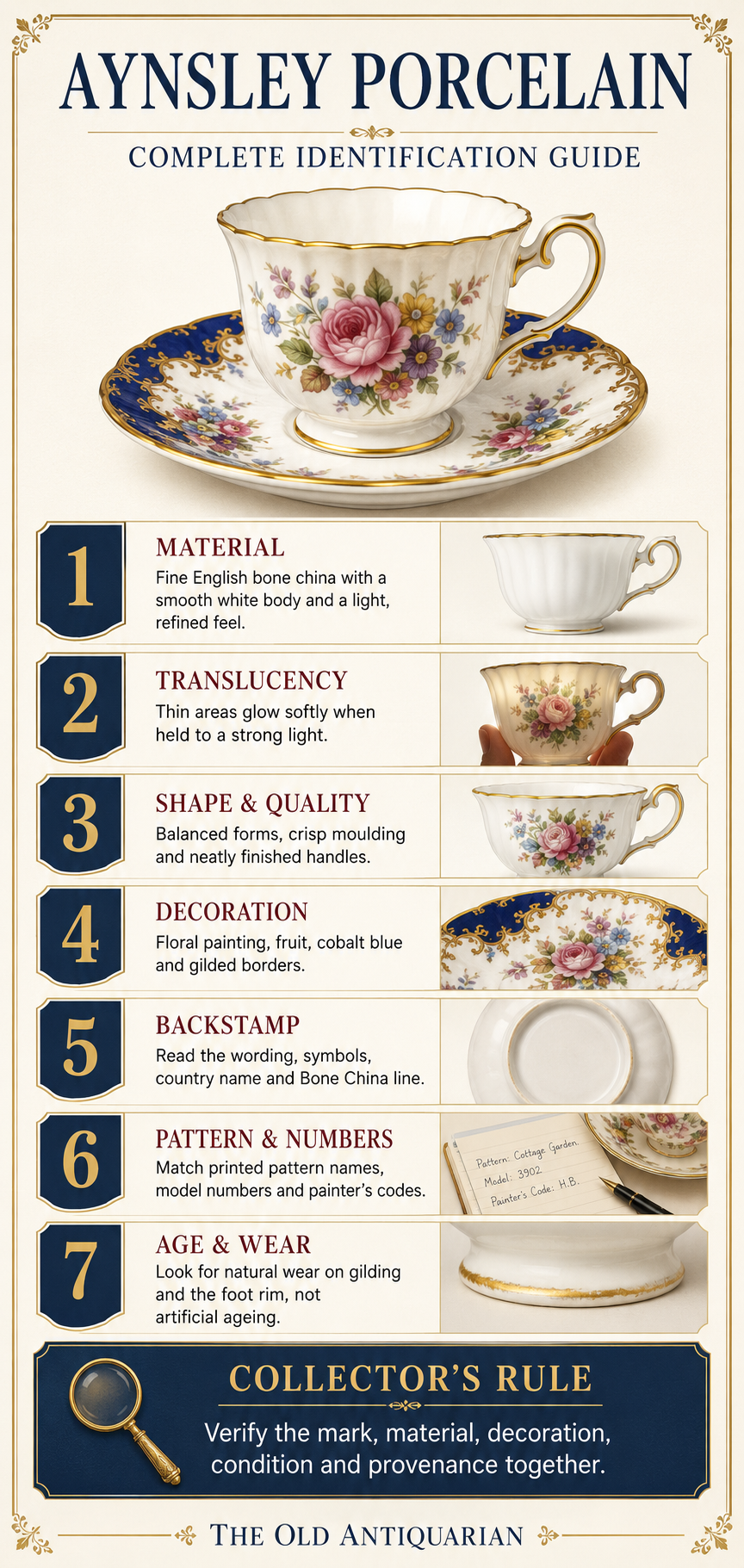
| Aynsley Porcelain at a Glance | |
|---|---|
| Historic name | John Aynsley & Sons; later Aynsley China Ltd. |
| Origins | 1775, Lane End—now Longton—in Staffordshire, England |
| Historic factory | Portland Works, Sutherland Road, Longton, built in 1861 |
| Best known for | Fine bone china tableware, teacups, cabinet pieces, giftware, floral designs and gilding |
| Recognisable patterns | Orchard Gold, Pembroke, Wild Tudor and numerous named or numbered floral designs |
| Useful dating clues | Backstamp design, country wording, material wording, pattern information, shape and decoration |
| Main value factors | Authenticity, rarity, age, decoration, recognised painter, condition, completeness, provenance and demand |
| Important warning | A crown, the Aynsley name or “Est. 1775” does not by itself prove age, English manufacture or value |
What Is Aynsley Porcelain?
Aynsley is a historic name in the Staffordshire ceramic industry. The firm became especially associated with refined English bone china: a light, strong and often translucent ceramic body that suited thin teacups, elegant tableware and highly finished decorative objects. If you are new to the material, our guides to what porcelain is, the principal types of porcelain and English porcelain and bone china provide useful background.
Not every object connected with the long Aynsley history should automatically be described in exactly the same way. The earliest family business was associated with lustre ware and ceramic decoration, whereas the twentieth-century name became internationally familiar through bone china tableware and giftware. This is one reason why material, manufacturing period and mark should be considered together.
The History of Aynsley China
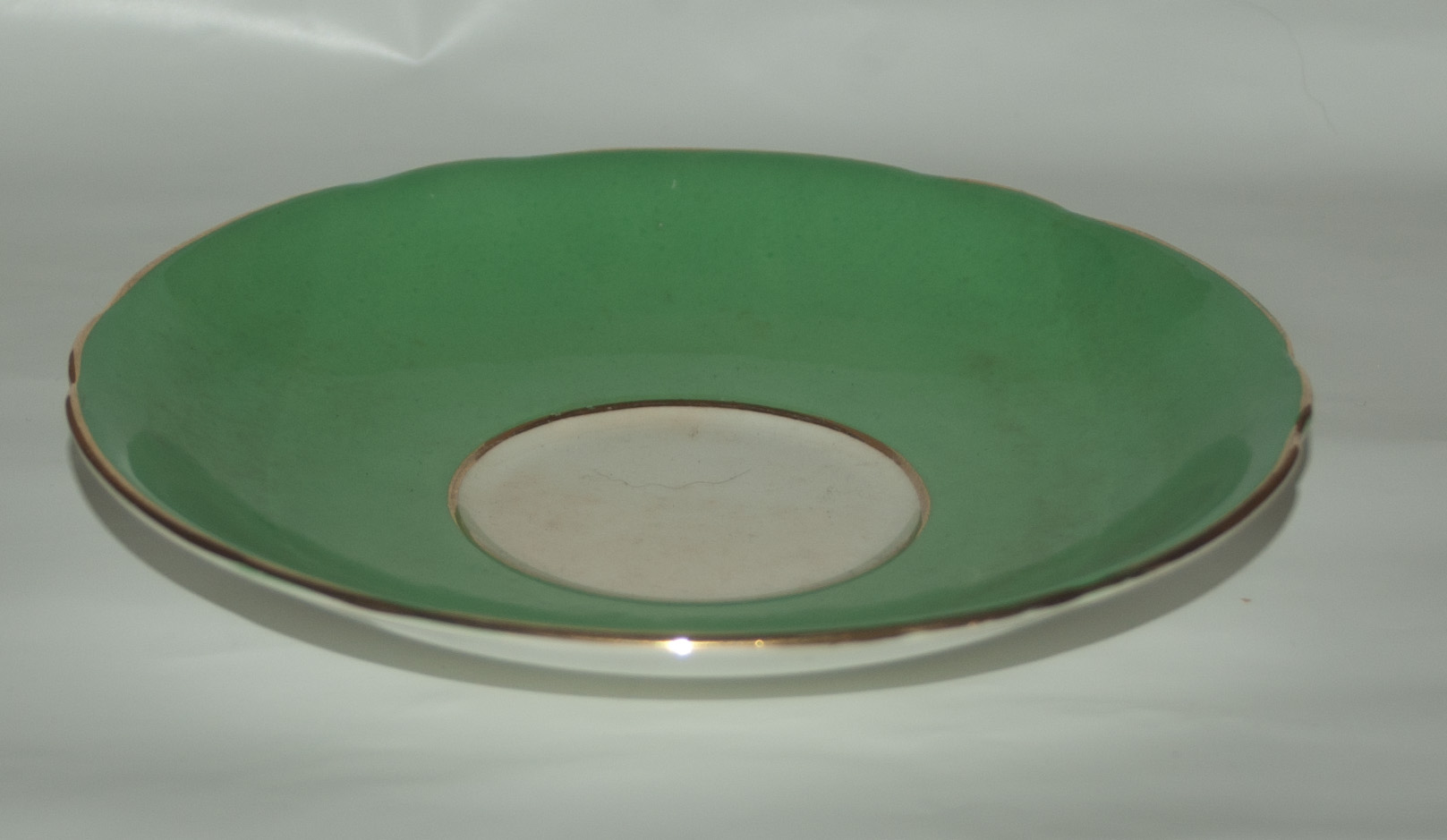
1775: The Longton Origins
The Aynsley story begins in 1775 with John Aynsley at Lane End, the area now known as Longton in Stoke-on-Trent. Contemporary historical summaries describe the early business as connected with lustre ware and ceramic decoration. The date “1775” later became an important part of the company’s identity and appears in the wording of some backstamps, but it records the founding tradition of the business—not the manufacture date of the individual object carrying the mark.
1861: Portland Works
In 1861 John Aynsley II built the purpose-designed Portland Works on Sutherland Road, Longton. The date and location are documented by Staffordshire Past Track and in the historical record of John Aynsley & Sons. The factory became the physical centre of the company’s later growth and remains a key landmark in the history of Longton’s ceramic industry.

Twentieth-Century Expansion and Ownership Changes
The business became a limited company in 1933 and was officially listed on the Stock Exchange in 1948. In October 1970 it was taken over by Waterford Glass, and the name changed to Aynsley China Ltd. in 1971. A management group acquired the company from Waterford in 1987. These corporate changes matter to collectors because factory identity, pattern use, packaging and backstamp wording can evolve after changes in ownership.
Belleek Pottery Group acquired Aynsley in 1997. The original Stoke-on-Trent factory closed in 2014, ending production at the historic Longton site. The closure was reported by BBC News. Later pieces bearing the Aynsley name should therefore be assessed carefully for actual country of manufacture rather than being assumed to have been made at Portland Works.
How to Identify Authentic Aynsley Porcelain
Reliable identification is an evidence-based process. Start with the entire object and move gradually toward the details. This prevents a common mistake: finding a familiar mark online and ignoring contradictions in the body, decoration, shape or country wording.
- Examine the form. Record whether the object is a cup, saucer, trio, plate, teapot, vase, bowl or giftware piece. Look at the handle, foot rim, lid and finial.
- Assess the ceramic body. Fine bone china is usually smooth, light for its size and gently translucent at thinner edges, although thickness and shape affect the result.
- Study the decoration. Determine whether it appears hand painted, transfer printed, enamelled, gilded or made with a combination of techniques.
- Turn the object over safely. Photograph the complete backstamp, pattern name, numbers, painter’s signature and any retailer or export wording.
- Read every word. “England”, “Made in England”, “Bone China” and “Fine Bone China” are more useful when considered together than in isolation.
- Compare cup and saucer. A genuine cup and a genuine saucer can still be a mismatched marriage. Compare shape, pattern, colour, gilding and mark period.
- Check condition and restoration. Damage does not make a piece fake, but it changes value and can conceal important construction details.
Never Use the Mark Alone
A backstamp can identify a manufacturer or narrow a period, but it is not a certificate of authenticity. Marks can be copied, reapplied, misunderstood or found on later licensed production. Our complete porcelain marks and backstamps guide explains how marks should be compared with material, glaze, decoration and manufacturing evidence.
Aynsley Marks and Backstamps
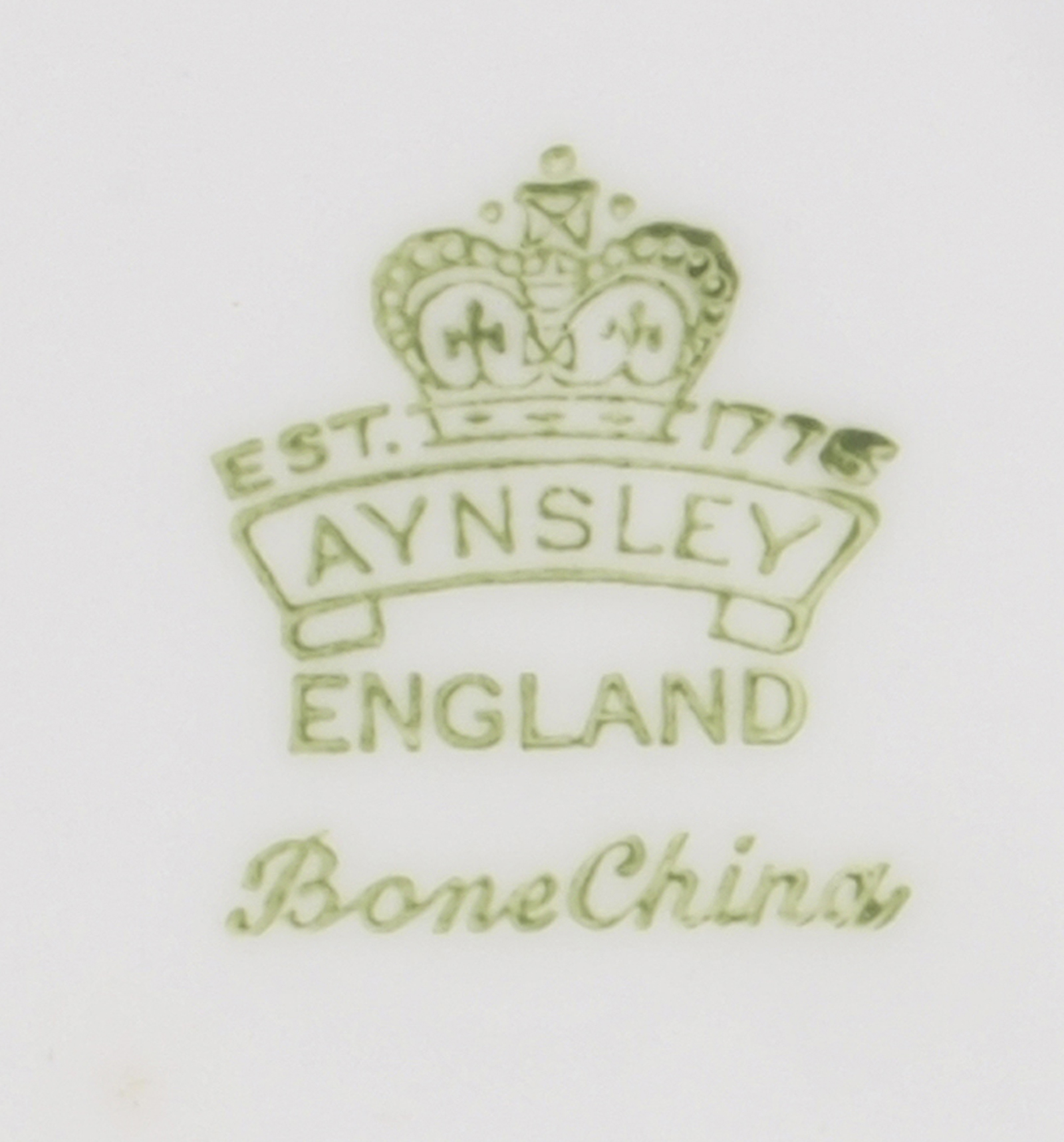
Aynsley used many printed, painted and impressed markings during its long history. They may contain the Aynsley name, a crown or decorative device, the words England, Made in England, Bone China or Fine Bone China, together with pattern names, pattern numbers, decorator information or registration references.
The historical pottery record notes that “England” was added after 1891. This makes country wording a valuable first checkpoint, especially for export wares. It is not, however, a precise date code: older styles could overlap, the absence of a word can result from wear or an incomplete impression, and later marks may retain traditional imagery.
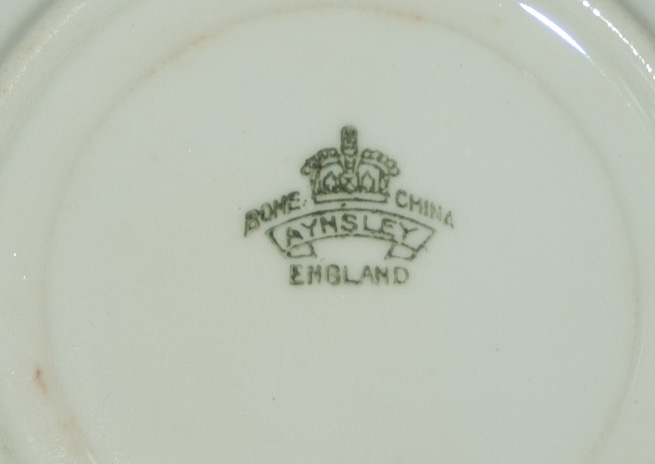
| Backstamp Feature | What It May Tell You | Important Limitation |
|---|---|---|
| Aynsley or John Aynsley & Sons | Identifies the historic firm or brand family | The name alone does not establish date or country of manufacture |
| England | Commonly supports production after 1891 and an English origin | It normally provides a broad period, not an exact year |
| Made in England | Explicit country-of-origin wording found on many twentieth-century wares | Logo form, material and pattern still need comparison |
| Bone China / Fine Bone China | Describes the ceramic body and usually supports twentieth-century or later tableware | It is not a guarantee of age, rarity or hand painting |
| Est. 1775 | Refers to the firm’s founding tradition | It never means that the object was made in 1775 |
| Pattern name or number | Can identify a design, shape or production reference | Numbers require comparison with documented examples; do not guess |
| Artist name or initials | May identify a decorator on hand-painted wares | Verify that the signature belongs to the decoration and is period-correct |
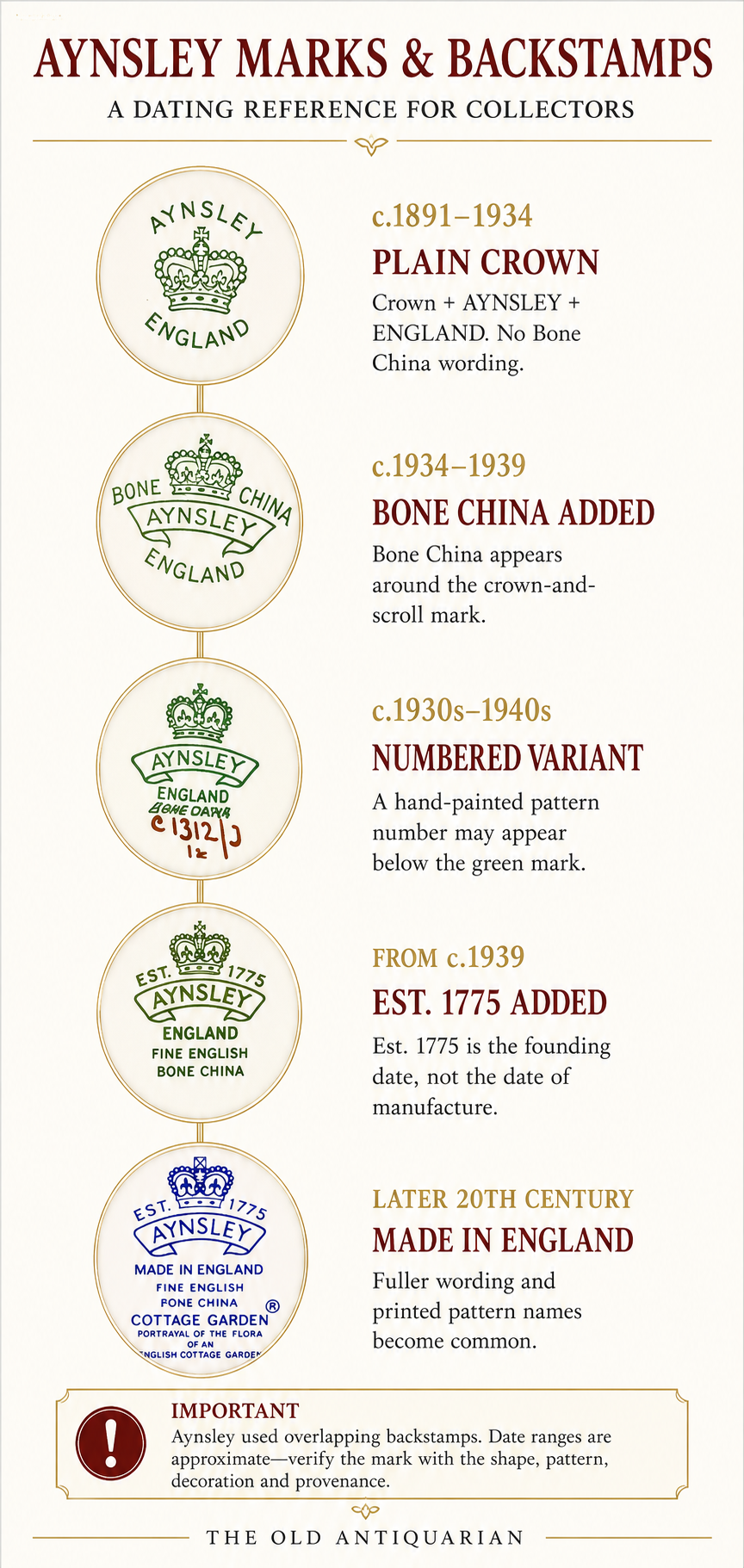
How to Read an Aynsley Backstamp
Read the mark in layers. First identify the maker’s name and principal symbol. Next record the country wording and material description. Then look for the pattern name, painted number, printed number, decorator’s signature and any retailer or commemorative text. Photograph the mark straight-on in diffuse daylight; also take one angled photograph if an impressed number is difficult to see.
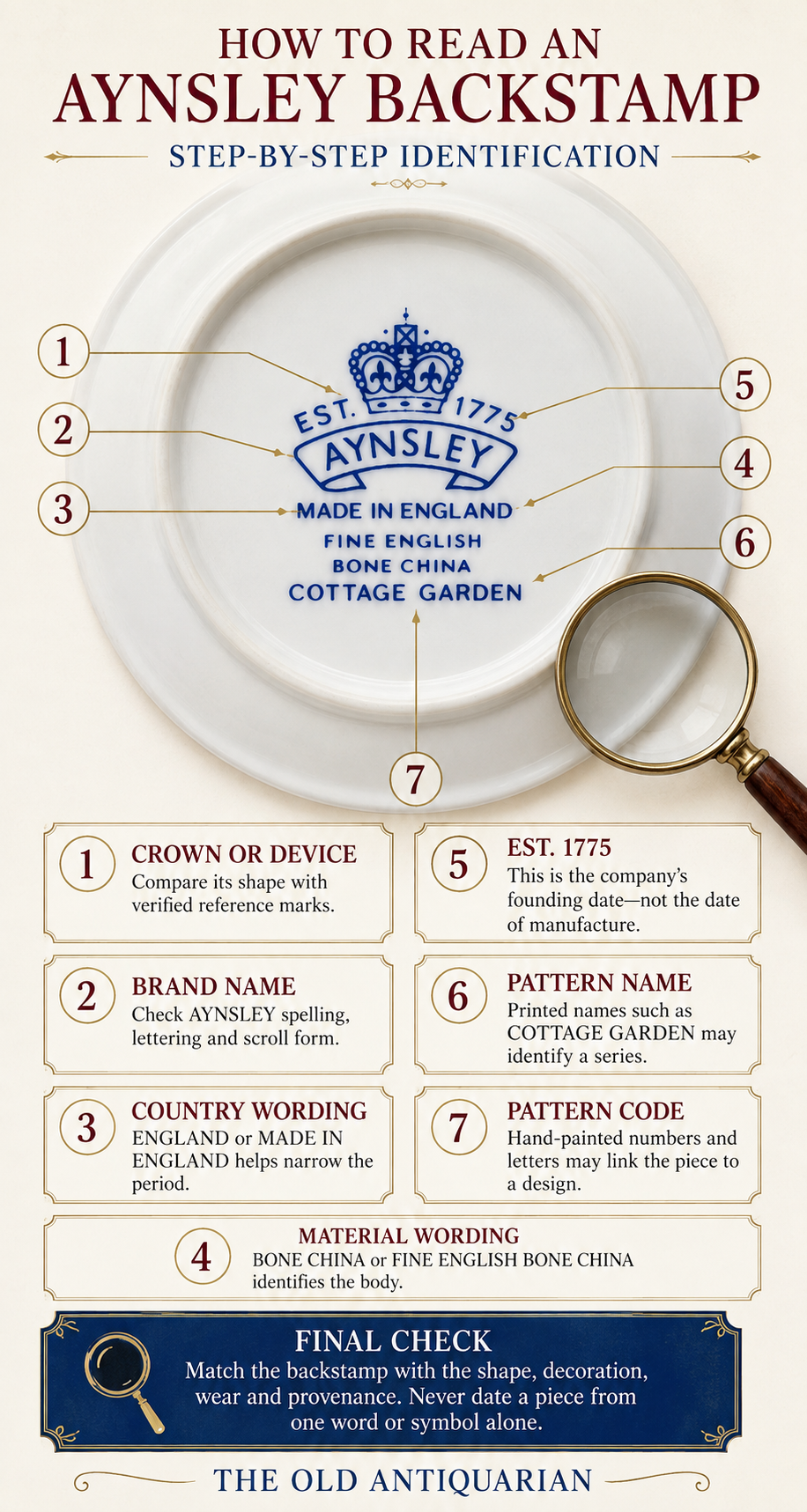
How to Date Aynsley Porcelain
Dating Aynsley is usually a process of narrowing the likely production period rather than discovering one exact year. Begin with the mark, then test the proposed date against the form, decoration, material and wear. Our wider guide to dating antique porcelain explains this multi-factor method in detail.
| Dating Clue | Question to Ask | How to Use It |
|---|---|---|
| Country wording | Does the mark say England or Made in England? | Use it to establish a broad earliest period, then compare the full logo |
| Material wording | Is Bone China or Fine Bone China stated? | Compare with the actual body; wording should agree with appearance and weight |
| Shape | Does the handle, foot, lid or silhouette fit an antique, Art Deco or later form? | Compare with catalogued pieces of the same pattern or shape |
| Decoration | Is it hand painted, transfer printed, gilded or mixed technique? | Decoration method and fashion can support a broad period |
| Pattern details | Is there a pattern name, number or registered design reference? | Research the exact reference; avoid dating by pattern popularity alone |
| Natural wear | Is wear consistent with handling and use? | Wear should appear logically on rims, handles, feet and exposed gilding |
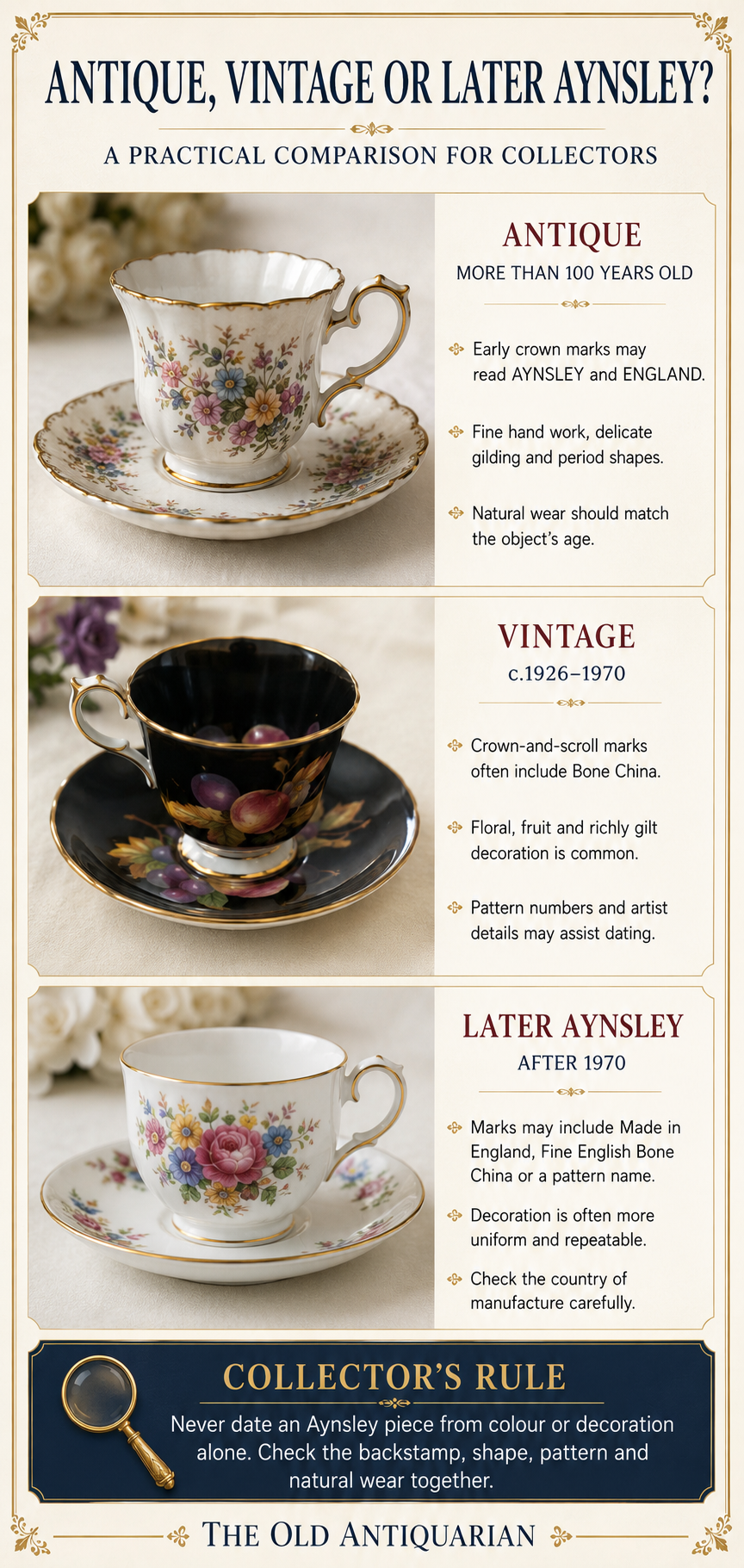
Antique, Vintage or Later Aynsley?
In general collecting language, an antique is normally at least 100 years old. In 2026, that places the moving threshold around 1926. “Vintage” is less rigid and is commonly used for later twentieth-century production, while “later” or “modern” describes more recent branded wares. These are market conventions rather than Aynsley factory categories.
Age should never be inferred from style alone. A traditional floral pattern can continue for decades, and a later commemorative or giftware piece may intentionally use historic-looking decoration. Country wording and the exact backstamp remain essential.
Famous Aynsley Patterns and Decorations
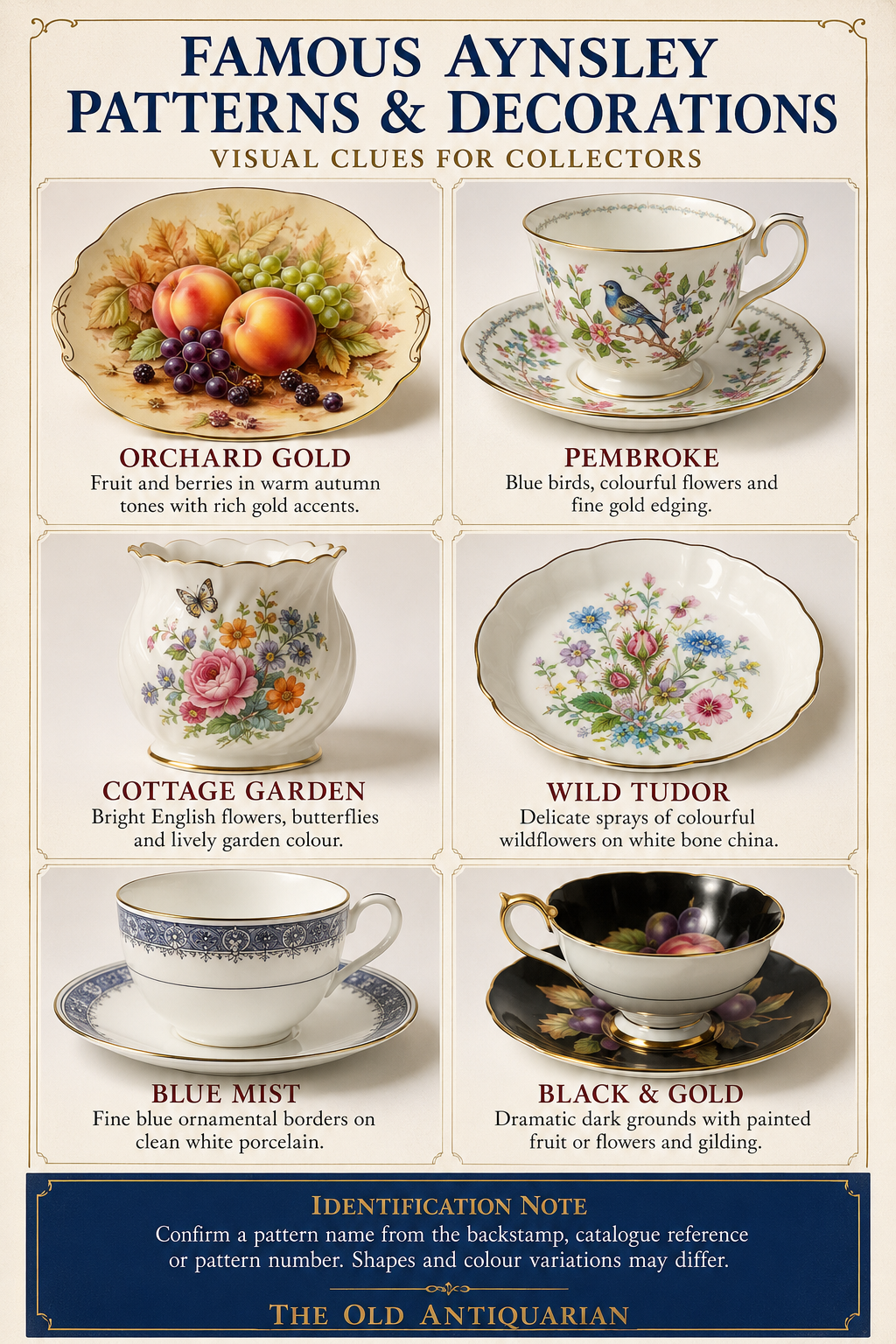
Aynsley produced a vast range of named and numbered designs. Pattern identification can help research a piece, but collectors should distinguish between a pattern, a colourway, a shape and an artist-painted variation. Two items carrying the same broad pattern name may differ in ground colour, gilding, form or painting quality.
Aynsley Bone China Pattern Numbers: How to Identify a Pattern
Aynsley bone china pattern numbers can be extremely useful when identifying an unfamiliar cup, saucer, plate or tea service. Depending on the piece and production period, a pattern reference may appear as a printed, painted or handwritten number on the underside, sometimes alongside the main Aynsley backstamp.
Do not assume that every number on the base is automatically a pattern number. Aynsley pieces can carry different production references, and a number should be matched with the decoration, shape, colourway, backstamp and documented examples before a pattern identification is considered reliable.
How to Research an Aynsley Pattern Number
- Photograph the complete Aynsley backstamp.
- Record every printed, painted, handwritten or impressed number.
- Photograph the complete decoration and colourway.
- Record the object type and dimensions.
- Search for documented Aynsley examples carrying the same number.
- Compare the pattern, shape and backstamp period—not the number alone.
This method is particularly useful for designs that do not carry a familiar printed pattern name such as Orchard Gold, Pembroke or Wild Tudor. Many collectible Aynsley designs are encountered primarily through their pattern or production references rather than a widely recognised commercial name.
Rare and Discontinued Aynsley China Patterns
Collectors frequently search for discontinued Aynsley china patterns when replacing pieces from an older tea service or researching an unidentified design. A discontinued pattern is simply one that is no longer in regular production; this does not automatically make it rare or valuable.
Rarity depends on how long the design was produced, how widely it was sold, the particular colourway and shape, survival rates and present collector demand. Some discontinued Aynsley patterns remain relatively easy to find, while uncommon numbered designs, unusual colour combinations, short-lived decorations and specialised forms can be considerably harder to replace.
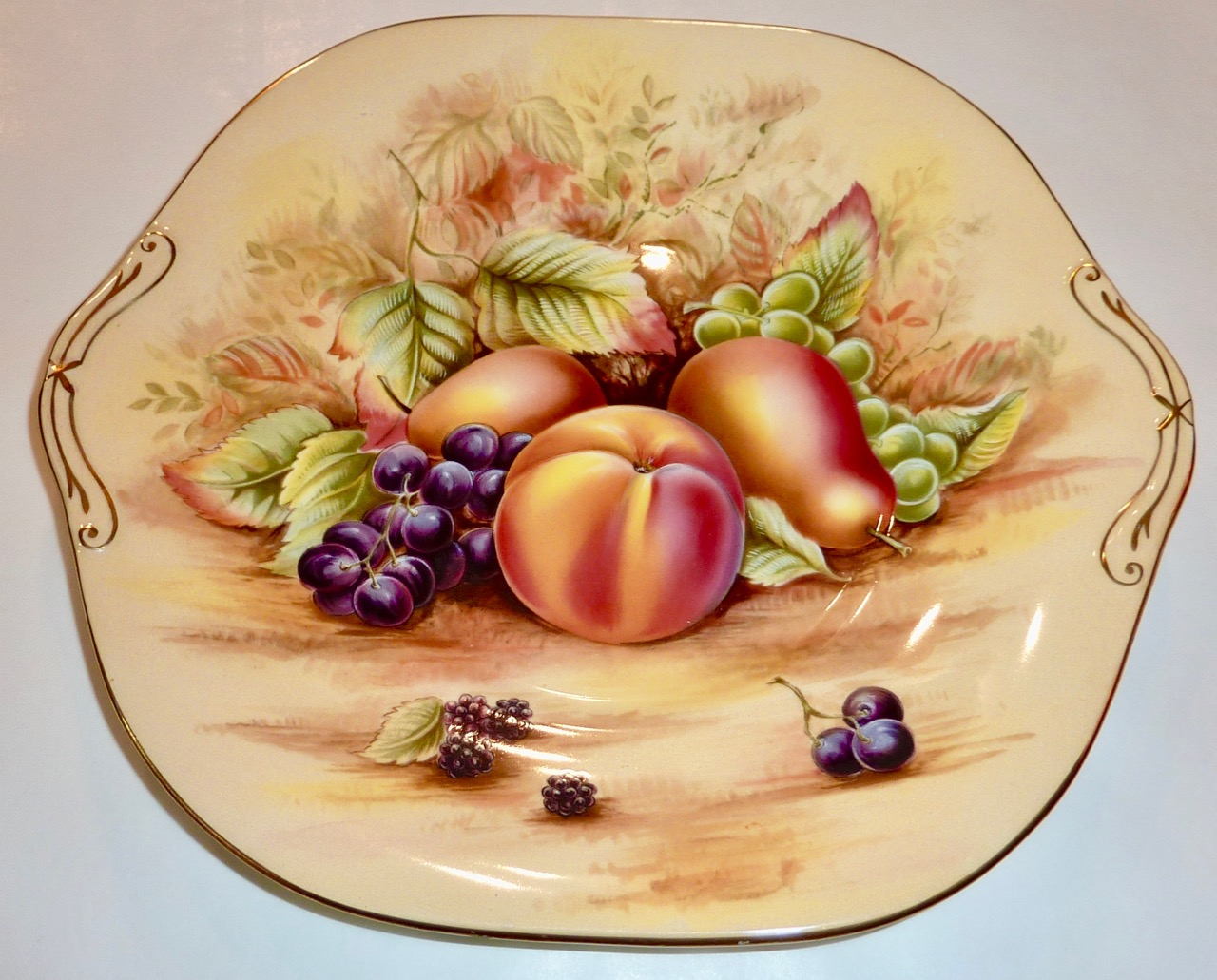
Orchard Gold
Known for abundant still-life fruit—often apples, peaches, grapes, berries and foliage—combined with rich colour and gilded detail. Hand-painted and signed examples can attract particular interest, but the decoration technique and signature should be verified individually.
Pembroke
A colourful decorative design featuring birds, flowers and foliage, frequently enhanced with gold. Check the backstamp because the pattern appeared across different object types and production periods.
Wild Tudor
A recognisable floral design with mixed wildflowers and foliage. It appears on bowls, dishes, vases and giftware, so value depends strongly on form, condition and completeness rather than the name alone.
Floral and Gilded Wares
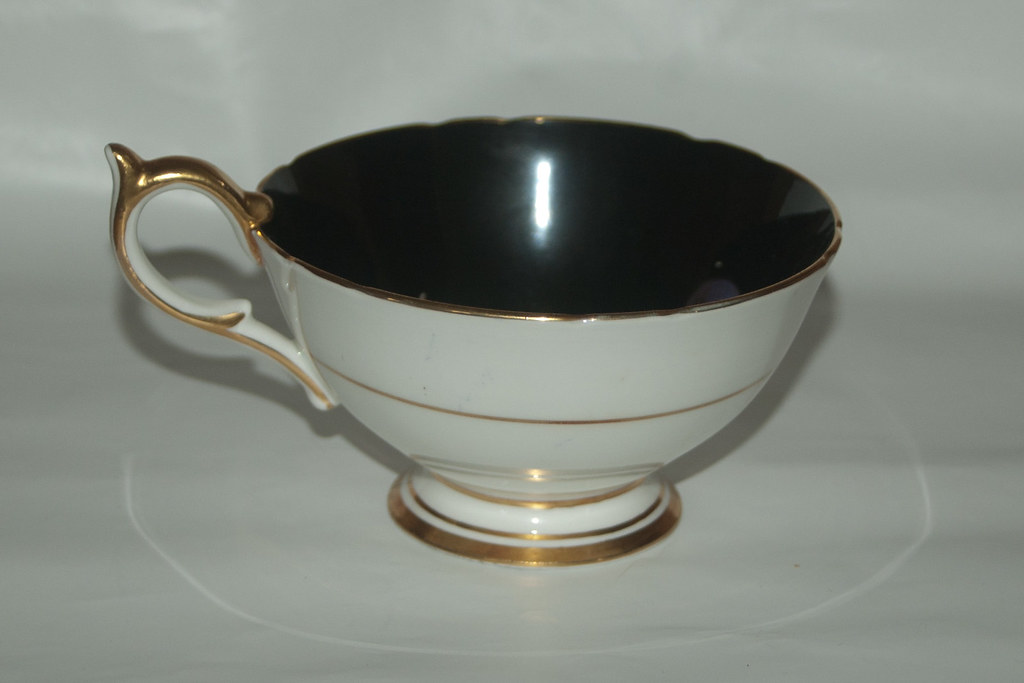
Many Aynsley cups and decorative pieces are identified by a number rather than a famous name. Black grounds, cobalt borders, coloured interiors, botanical sprays and gold rims occur in numerous combinations.
Aynsley Orchard Gold
Orchard Gold is one of the most searched-for Aynsley designs. Collectors should inspect whether the fruit decoration is fully hand painted, transfer assisted or printed, and whether a painter’s name is present. Richly painted cabinet cups, unusual shapes, strong gilding and well-preserved signed pieces may be more desirable than common giftware, but no single feature determines value.
Aynsley Pembroke
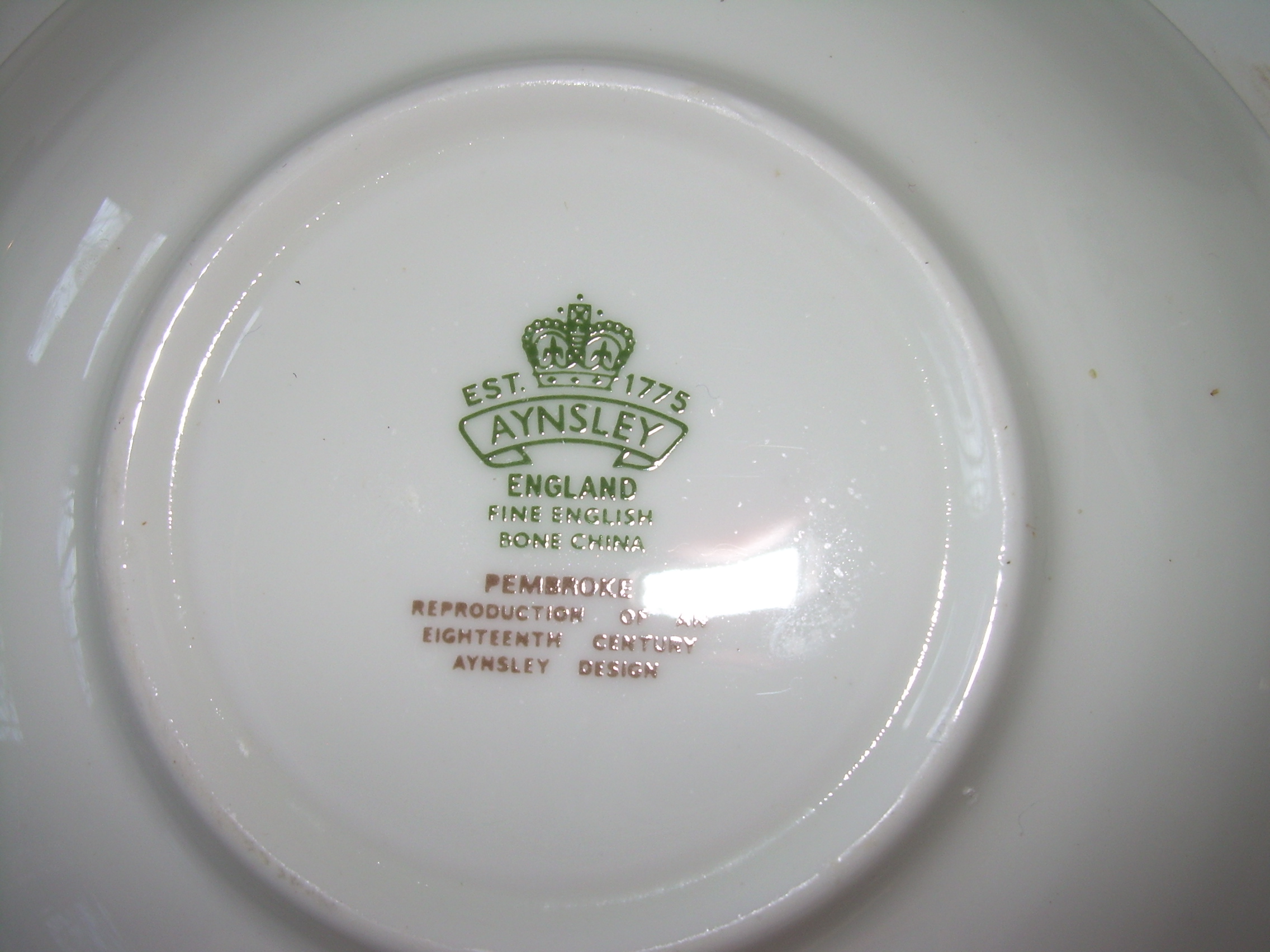
Pembroke is instantly recognisable to many collectors, but identification should still begin on the base. Pattern wording, factory mark and country statement help distinguish genuine marked production from visually similar decorative ware.
Aynsley Wild Tudor
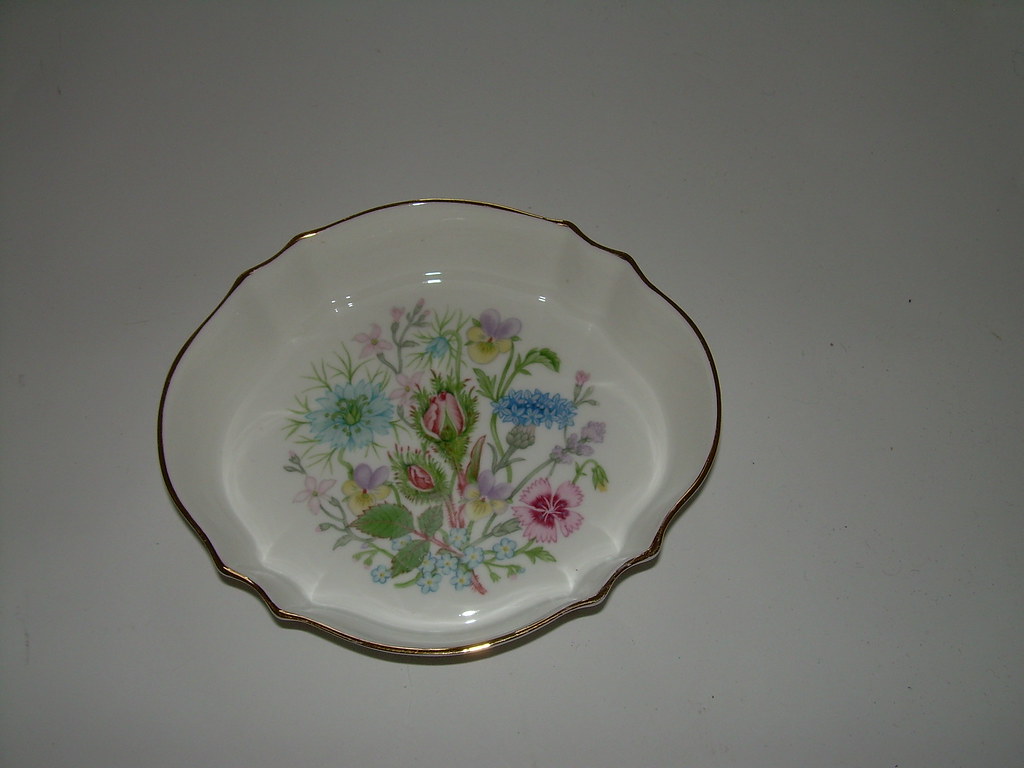
Wild Tudor was used across a broad giftware range. Before buying a group, check that colour, gilding, base mark and pattern scale agree. A set assembled from different periods may look attractive but should not be described as an original matching set without evidence.
What Aynsley Pieces Do Collectors Look For?
Collector interest is not limited to one pattern. Quality, form and rarity can be more important than fame. The following areas are frequently researched:
- Cabinet cups and saucers with rich grounds, fine gilding or artist-painted decoration;
- complete trios and tea services with matching pattern, colourway and backstamp period;
- Orchard Gold pieces, especially strong hand-painted examples and unusual forms;
- Art Deco and geometric forms with distinctive handles and bold colour combinations;
- early teapots and tableware with historically consistent marks and construction;
- rare shapes or discontinued patterns that are difficult to replace;
- documented artist-decorated pieces with verifiable signatures;
- objects with provenance, original boxes, invoices or family documentation.
Is Aynsley Porcelain Valuable?
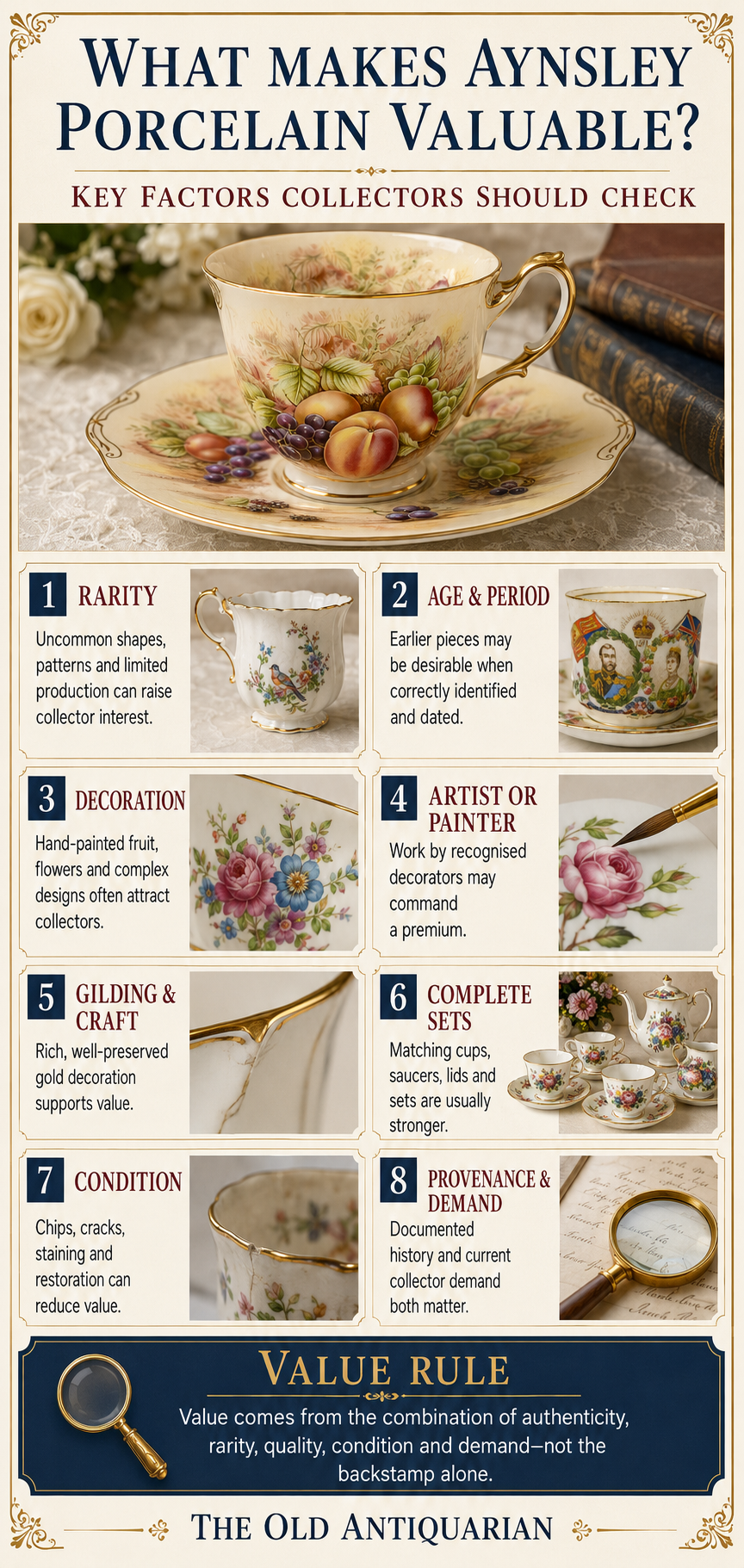
Some Aynsley pieces are valuable, but the name alone does not guarantee a high price. Common later giftware may remain affordable, while rare early forms, outstanding hand-painted decoration, recognised painters, unusual colourways, complete services and well-preserved cabinet pieces can attract stronger collector interest.
Online asking prices are not reliable evidence of market value. For a responsible assessment, compare recent sold results for the same pattern, form, dimensions, mark period and condition. The broader principles are explained in our antique porcelain appraisal guide.
| Value Factor | Why It Matters | What to Verify |
|---|---|---|
| Authenticity | Collector value begins with correct attribution | Mark, body, shape, decoration and period must agree |
| Rarity | Uncommon shapes, patterns and colourways can draw stronger demand | Use catalogues and sold comparables, not seller claims |
| Age and period | Earlier wares may be scarcer, but age alone is insufficient | Backstamp, construction and style should support the date |
| Decoration | Skilled hand painting and complex gilding add artistic interest | Distinguish painted, transfer-assisted and printed decoration |
| Painter or artist | Recognised decorators can command a premium | Confirm the signature and compare documented work |
| Completeness | Matching trios, lids and services are often more desirable | Check pattern, colour, dimensions and mark period |
| Condition | Cracks, chips, staining, wear and restoration can reduce value | Inspect in daylight, angled light and UV where appropriate |
| Provenance and demand | Documented history and current collecting trends affect the market | Preserve invoices, labels, catalogues and family records |
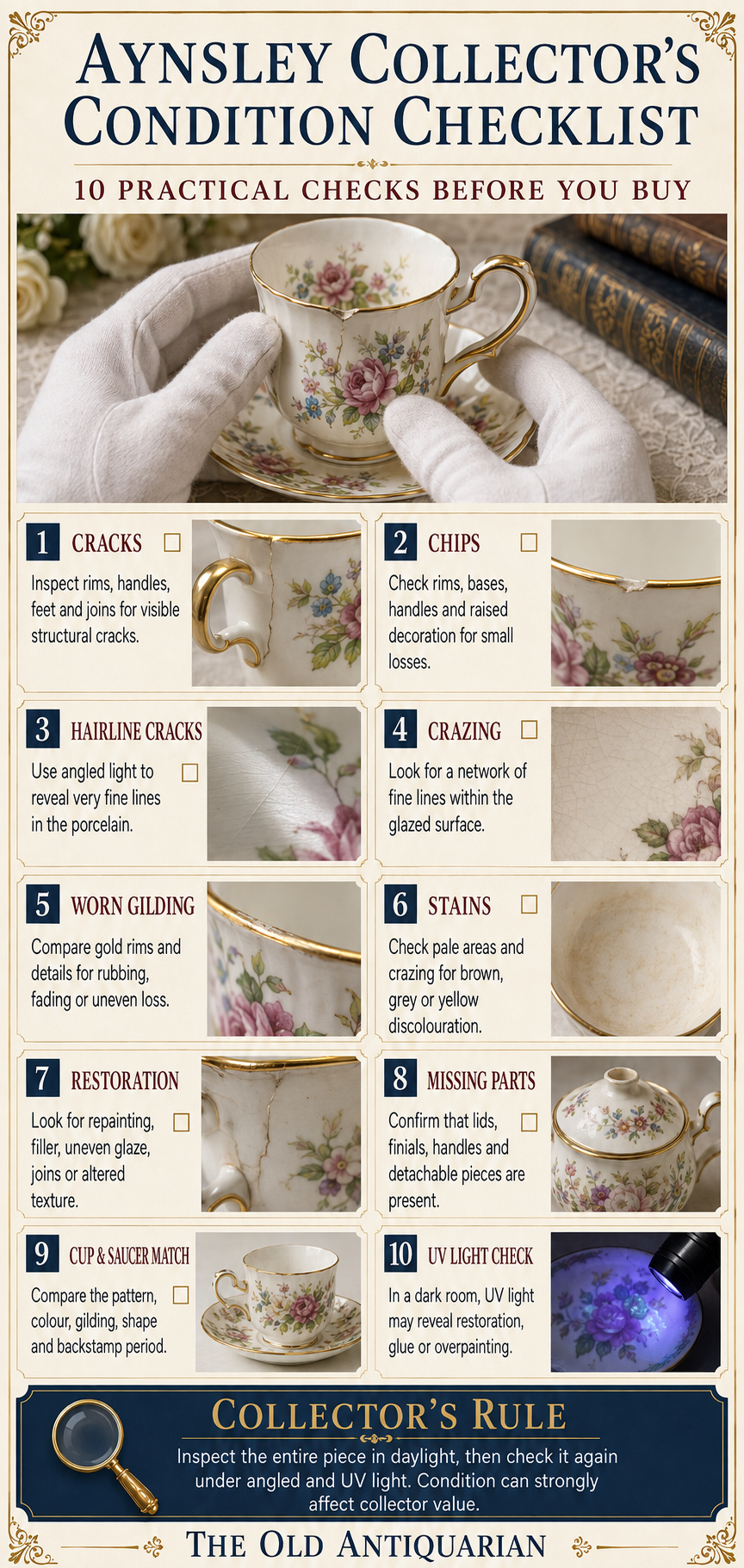
Aynsley Collector’s Condition Checklist
Condition can change both the desirability and safe use of a piece. Inspect the whole object in diffuse daylight, then use angled light to reveal subtle surface changes. A UV torch can help locate some repairs, adhesives and overpainting, but fluorescence is not automatic proof of restoration and absence of fluorescence does not guarantee originality.
| Check | Where to Look | Why It Matters |
|---|---|---|
| Cracks | Handles, joins, feet, spouts and rims | Structural cracks can worsen during handling |
| Chips | Rims, foot rings, finials and raised decoration | Even small losses affect completeness and value |
| Hairlines | Hold under angled light and inspect both sides | Fine cracks may be almost invisible face-on |
| Crazing | Glazed surfaces, especially pale areas | It can trap staining and indicate glaze stress |
| Worn gilding | Rims, handles and raised edges | Uneven rubbing affects appearance and originality |
| Stains | Crazed areas, interiors and foot rings | Brown, grey or yellow discolouration may be difficult to reverse |
| Restoration | Colour changes, smooth filler, seams and overspray | Extent and quality of repair influence value |
| Missing parts | Lids, finials, stoppers, handles and detachable fittings | Replacement parts may not match the original |
| Cup and saucer match | Pattern, colourway, gilding, shape and backstamp | Matched marriages are common in the secondary market |
| UV inspection | Examine in a dark room with eye-safe handling | Some glues, fills and overpainting fluoresce differently |
How to Avoid Mismatched or Misidentified Aynsley
- Do not assume every crown mark belongs to Aynsley.
- Do not date an object from “Est. 1775”.
- Do not assume every Aynsley-branded piece was made in England.
- Do not identify a pattern solely from colour or one floral motif.
- Do not treat a cup and saucer as an original pair until their shapes, decoration and mark periods agree.
- Do not describe transfer decoration as fully hand painted without close examination.
- Do not hide damage or restoration when buying, selling or requesting a valuation.
A sound identification should be repeatable: another collector should be able to look at the same mark, body, shape and decoration and understand how the conclusion was reached. If any major feature contradicts the proposed date or pattern, pause and research further.
How to Care for Aynsley Bone China
Fine bone china is strong for its weight, but thin rims, handles, lids and applied details remain vulnerable. Preventive care is always safer than repair.
- Support teapots and large pieces from beneath; never carry them only by the handle.
- Remove and wrap lids separately during transport.
- Avoid dishwashers, abrasive pads, metal polish and strong household chemicals.
- Do not rub gilding aggressively or try to make old gold look “new”.
- Avoid prolonged soaking, especially where there is crazing, staining, restoration or a hairline crack.
- Use acid-free tissue or soft separators between stacked plates and saucers.
- Keep display cabinets stable and away from direct sunlight, vibration and sudden temperature changes.
- If a valuable piece breaks, keep every fragment and seek advice before applying adhesive.
For detailed preservation advice, see our guide to storing antique porcelain and ceramics and our specialist overview of porcelain restoration.
Collector Checklist Before Buying
Identification
- Photograph the complete mark
- Record dimensions
- Confirm country wording
- Check pattern name or number
Authenticity
- Compare body and glaze
- Check shape and construction
- Identify decoration technique
- Question contradictions
Condition
- Inspect rims and handles
- Use angled light
- Look for restoration
- Confirm every part is present
Value
- Use recent sold results
- Compare the exact form
- Allow for damage
- Preserve provenance
Need Help Identifying or Valuing Your Aynsley Porcelain?
Send clear photographs of the complete object, underside, backstamp, dimensions and any damage or restoration. The Old Antiquarian offers professional guidance backed by more than 35 years of experience with antiques and collectible objects.
Frequently Asked Questions About Aynsley Porcelain
What is Aynsley porcelain?
Aynsley is a historic English ceramic name associated especially with fine bone china tableware, teacups, decorative pieces and giftware produced in Longton, Staffordshire. Its roots date to 1775, and the Portland Works was built in 1861.
How can I identify an Aynsley mark?
Look on the underside for the Aynsley name, country wording, material description, pattern information and numbers. Compare the full backstamp with the porcelain body, shape and decoration rather than relying on the logo alone.
What does “Est. 1775” mean on Aynsley china?
It refers to the traditional founding date of the Aynsley business. It is not the manufacture date of the individual piece.
When was “England” added to Aynsley marks?
Historical pottery records state that “England” was added after 1891. This is a useful broad dating clue, but the entire mark and object must still be examined.
Is all Aynsley porcelain antique?
No. Aynsley produced over a long period. Some pieces are antique, many are twentieth-century vintage bone china, and others are later branded production. The backstamp, country wording, shape and decoration help distinguish them.
What are the most famous Aynsley patterns?
Orchard Gold, Pembroke and Wild Tudor are among the best-known names. Aynsley also produced numerous floral, botanical, gilded and numbered designs.
How do I identify an Aynsley bone china pattern number?
Photograph the complete backstamp and record every printed, painted, handwritten or impressed number on the base. Compare the number with the decoration, colourway, shape and documented Aynsley examples. Do not assume that every number is a pattern number, because other production references may also appear on Aynsley pieces.
Are discontinued Aynsley china patterns valuable?
Not necessarily. A discontinued pattern is simply no longer in regular production. Value depends on rarity, collector demand, form, decoration, age, condition and completeness. Some discontinued patterns remain common, while unusual numbered designs, colourways and difficult-to-find replacement pieces may attract stronger interest.
Is Aynsley Orchard Gold hand painted?
Many collectible examples include hand-painted work, but decoration can vary by object and production period. Examine brushwork, printing, signatures and the mark before describing a piece as fully hand painted.
Is Aynsley porcelain valuable?
Some examples can be valuable, particularly rare forms, fine hand-painted pieces, recognised artist-decorated wares and complete sets in excellent condition. Common later giftware may be modestly priced. Value depends on authenticity, rarity, quality, condition and demand.
How can I tell whether an Aynsley cup and saucer match?
Compare pattern scale, colour, gilding, cup shape, saucer well and backstamp period. Two genuine Aynsley components are not necessarily an original pair.
Does restoration reduce Aynsley value?
Restoration often affects value, but the impact depends on the rarity of the object, the extent of damage and the quality of the work. Disclose restoration and avoid amateur repairs before evaluation.
Can UV light detect porcelain repairs?
UV light may reveal some adhesives, fillers, varnishes or overpainting because they fluoresce differently. It is a supporting test, not definitive proof, and should be interpreted with normal-light examination.
How should I photograph Aynsley porcelain for identification?
Provide the full object from several angles, the underside, a sharp close-up of the backstamp, dimensions and clear photographs of any chips, cracks, stains or restoration. Photograph removable lids separately as well.
Sources and Further Research
- Staffordshire Past Track — Aynsley China Ltd., Portland Works
- The Potteries — John Aynsley & Sons historical record and marks
- Historic England — Aynsley China Works photographic record
- BBC News — Closure of the Aynsley factory in Longton, 2014
- Potteries Auctions — Collector’s Guide to Aynsley China
- Potteries Auctions — Aynsley marks, identification and value guide
Research note: Backstamp dates are approximate unless supported by a documented factory date code, registered design, catalogue or provenance. Online marks charts should be treated as comparison tools rather than substitutes for examining the object.
Continue Exploring Antique Porcelain
- What Is Porcelain?
- What Is English Porcelain?
- How to Identify Porcelain Marks and Backstamps
- How to Identify Antique Porcelain
- How to Date Antique Porcelain
- How Is Antique Porcelain Valued?
- How to Store Antique Porcelain and Ceramics
- Stories & Knowledge
Educational notice: This guide provides general identification and collecting information. Important attributions, authentication and market valuations should be based on examination of the individual object and appropriate specialist research.
