
Russian & Soviet Porcelain:Identification Guide
Russian & Soviet Porcelain: History, Marks, Factories, Identification & Value Guide
Russian and Soviet porcelain spans nearly three centuries of artistic, political and industrial history. From the refined court porcelain created for the Russian imperial family in the eighteenth century to revolutionary propaganda plates, Soviet figurines, Lomonosov tableware, Dulevo sculpture and the unmistakable blue-and-white tradition associated with Gzhel, Russian porcelain is one of the most varied fields of European collecting.
For collectors, however, identifying Russian porcelain can be difficult. Factory names changed, political systems changed, marks evolved, old shapes were reused, artists moved between periods, and some historic manufacturers continued production long after the Imperial era.
This guide explains the history of Russian and Soviet porcelain, the major factories, important porcelain marks, dating clues, Imperial and Soviet production, famous decorative styles, figurines, condition, rarity and the factors that influence collector value.
Quick Answer
The most important starting point when identifying Russian or Soviet porcelain is the factory mark, but a mark should never be considered alone. Reliable identification combines the mark with the porcelain body, production period, shape, decoration, artist or modeller, quality, condition and provenance.
Imperial Russian porcelain is particularly associated with the Imperial Porcelain Factory in St Petersburg, founded in 1744, as well as important private manufactories such as Gardner and later Kuznetsov. After the Russian Revolution, the former Imperial factory entered a completely different artistic and political era, eventually becoming associated with GFZ, LFZ and Lomonosov porcelain.
Other important names encountered by collectors include Dulevo, Verbilki, Gardner, Kuznetsov and Gzhel.
Russian & Soviet Porcelain at a Glance
| Period / Tradition | Approximate Era | Important Names | Collector Clues |
|---|---|---|---|
| Early Imperial | 1744–early 19th century | Imperial Porcelain Factory, Gardner | Court commissions, monograms, hand painting, sculptural work |
| 19th-century Imperial | 1800s–1917 | Imperial Factory, Gardner, Popov, Kuznetsov | Imperial marks, elaborate gilding, military and palace subjects |
| Early Soviet | 1917–1930s | State Porcelain Factory / GFZ | Propaganda porcelain, avant-garde decoration, revolutionary symbols |
| Soviet | 1930s–1991 | LFZ/Lomonosov, Dulevo and other factories | Tableware, figurines, factory logos, export marks and Soviet decoration |
| Gzhel tradition | Historic tradition to modern production | Gzhel-area workshops and factories | Strong cobalt-blue decoration on white ceramic or porcelain bodies |
| Modern Russian | After 1991 | Historic factories and contemporary producers | Modern marks, revived historic designs and contemporary production |
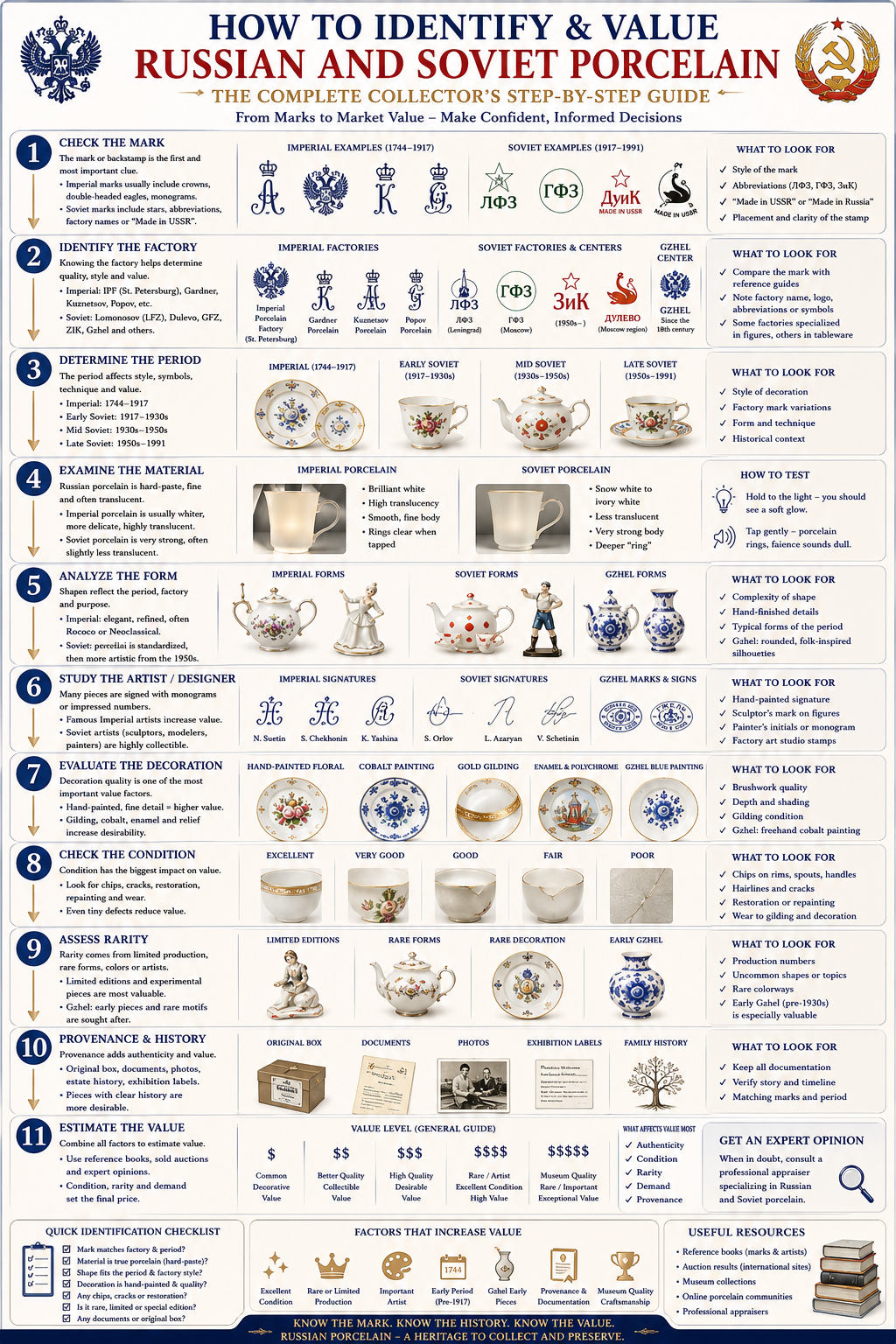
A Short History of Russian Porcelain
Russia’s great porcelain story begins in the eighteenth century. The factory that became the Imperial Porcelain Factory was established in St Petersburg in 1744 during the reign of Empress Elizabeth Petrovna. The development of a Russian porcelain formula is closely associated with Dmitry Vinogradov, whose work helped establish domestic hard-paste porcelain production.
This achievement was much more than a technical success. Porcelain was among the most prestigious luxury materials of eighteenth-century Europe, and establishing domestic production placed the Russian court within the wider world of European royal manufactories.
During the following generations, Russian porcelain developed its own artistic identity. Court services, presentation pieces, sculpture, portraits, landscapes, military subjects and richly decorated tableware reflected both European artistic influences and specifically Russian imperial culture.
Collectors who would like a broader introduction to materials, factory marks and identification can also consult our
complete guide to antique porcelain.
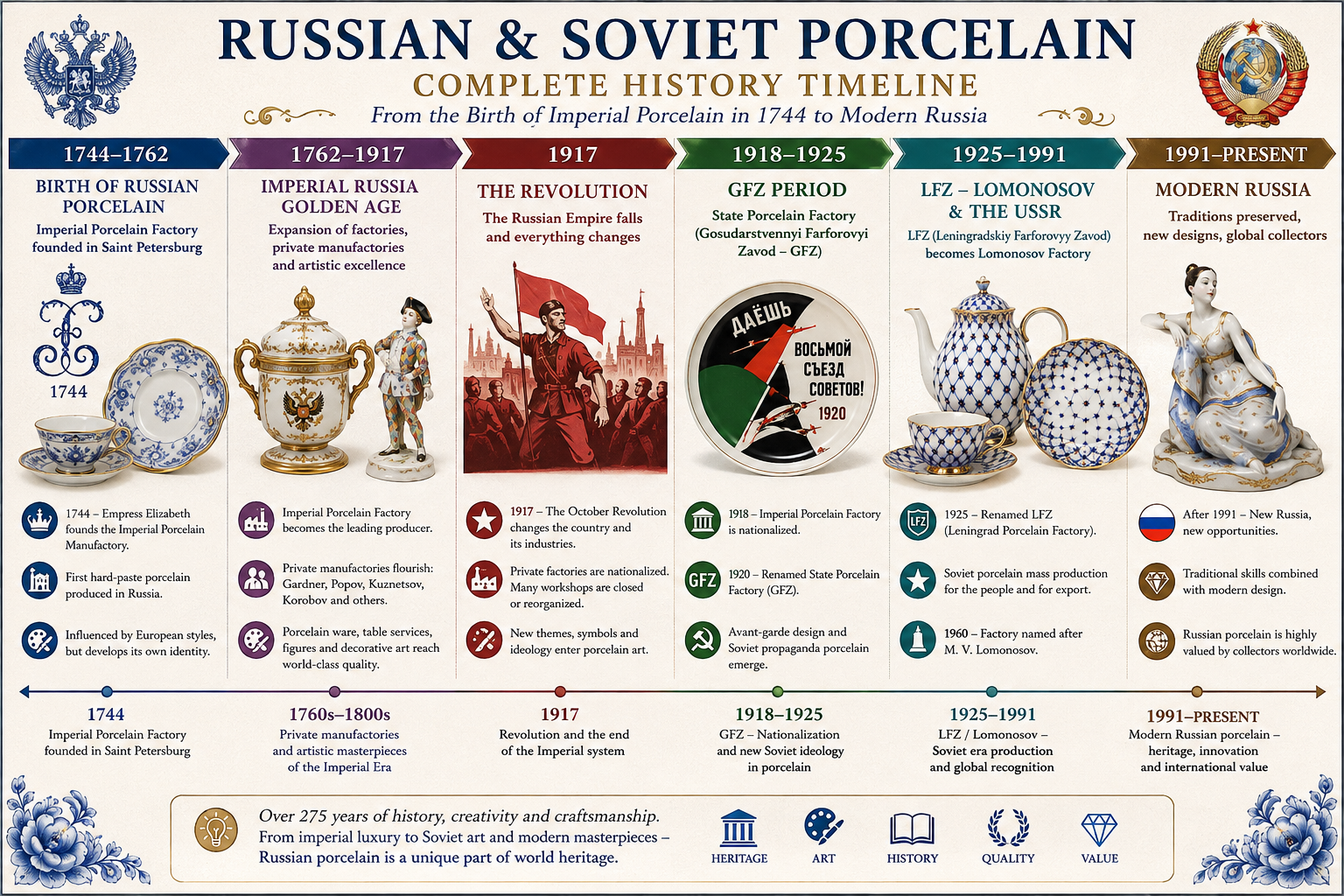
The Imperial Porcelain Factory: The Beginning of Russian Porcelain
The Imperial Porcelain Factory occupies a central place in the history of Russian decorative arts. Established in 1744, it became the country’s first successful porcelain manufactory and remained closely connected with the Imperial Court.
Early production was technically demanding and prestigious. As the factory developed, it became capable of producing increasingly ambitious services, vessels and sculpture. During the reign of Catherine II, Russian porcelain entered a particularly important artistic phase in which Neoclassical taste, court patronage and large-scale commissions shaped production.
The factory’s work changed repeatedly under successive rulers. For today’s collector, those political reigns are useful because Imperial marks often incorporate royal monograms, crowns, initials or symbols that can help establish a broad production period.
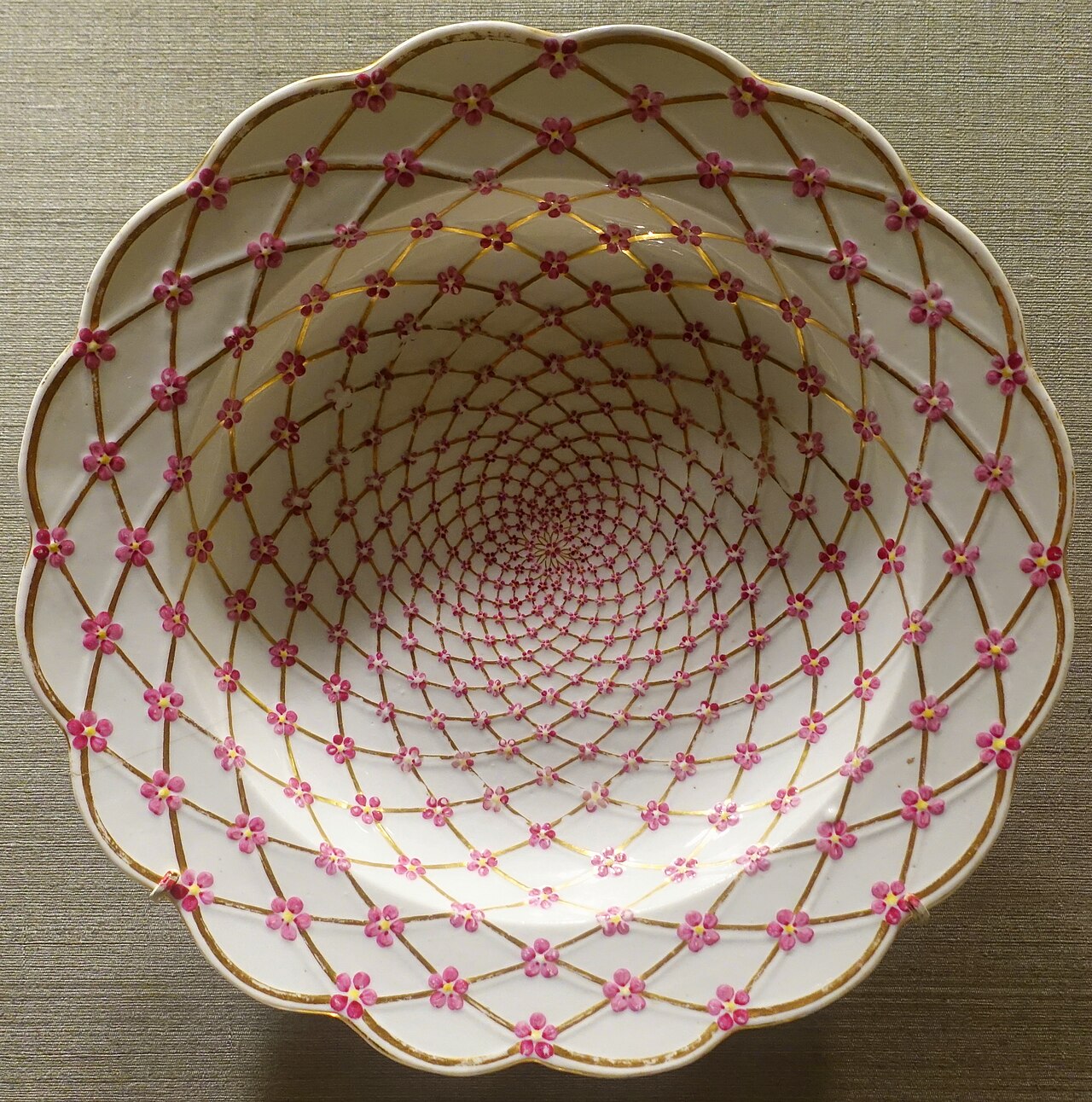
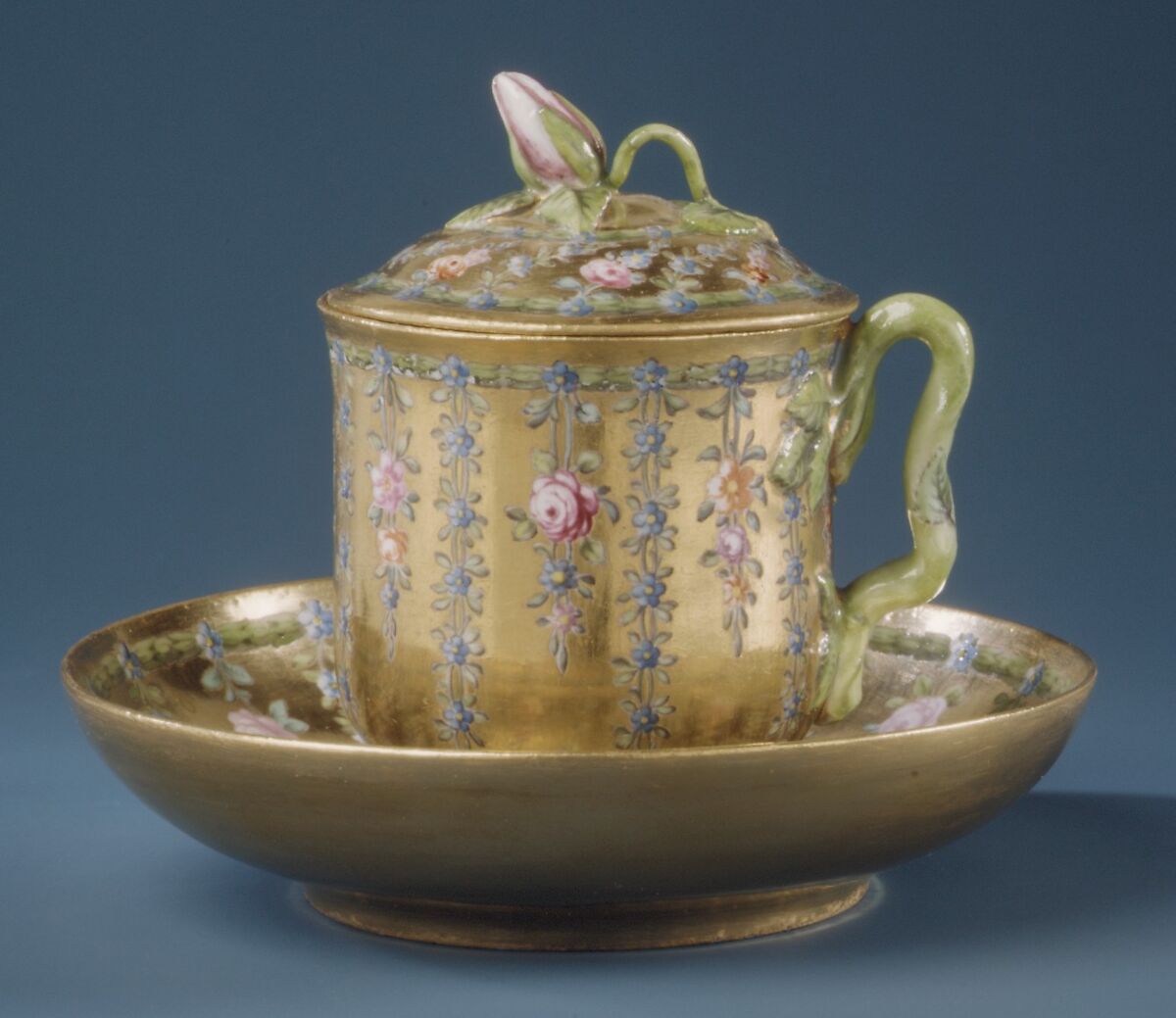
Surviving eighteenth-century porcelain is particularly valuable for understanding how quickly Russian craftsmen mastered the material. Early court pieces often combine a fine white body with carefully controlled decoration and forms intended for elite settings.
Imperial Russian Porcelain Marks
Marks are among the most useful clues for identifying Imperial Russian porcelain, but they must be interpreted carefully. Different reigns, factories and production periods used different systems, and authentic pieces may also carry painters’ marks, numbers or additional inscriptions.
Imperial monograms can help narrow the date, but collectors should compare the exact design, execution, colour and placement with documented examples. A convincing monogram on an object whose body, decoration and manufacturing technique belong to another period is a warning sign.
Our broader guide to
identifying porcelain marks and backstamps
explains why marks should always be studied together with material, glaze, shape and decoration.
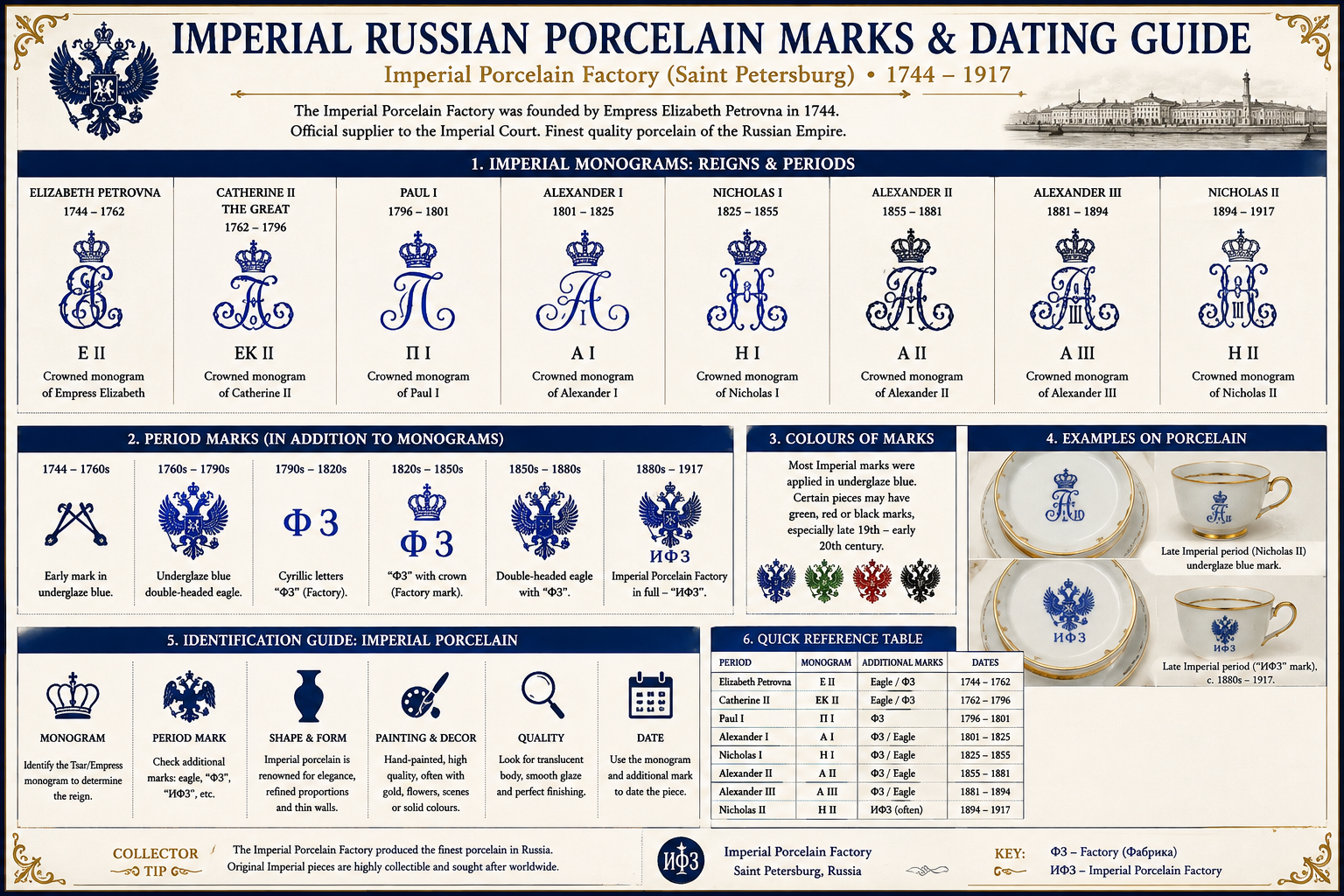
What to Examine on an Imperial Porcelain Mark
- the exact monogram or symbol;
- whether the mark is painted, printed, impressed or underglaze;
- colour and quality of execution;
- placement on the base;
- additional numbers or painter’s signs;
- the porcelain body and foot rim;
- whether the decoration corresponds to the suggested reign;
- natural wear and evidence of later alteration.
Russian Porcelain Sculpture and Figurines
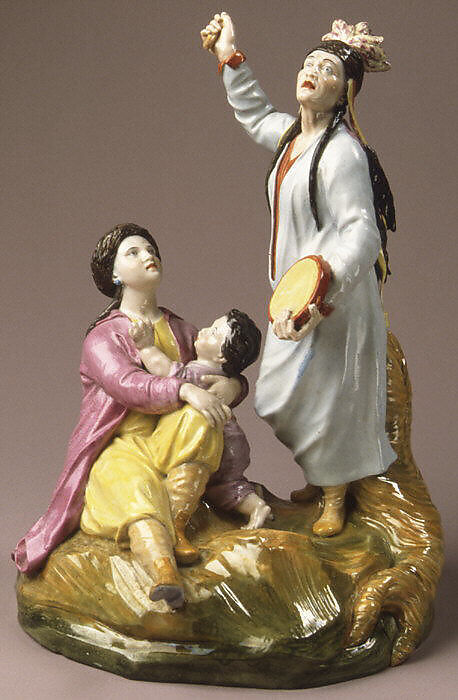
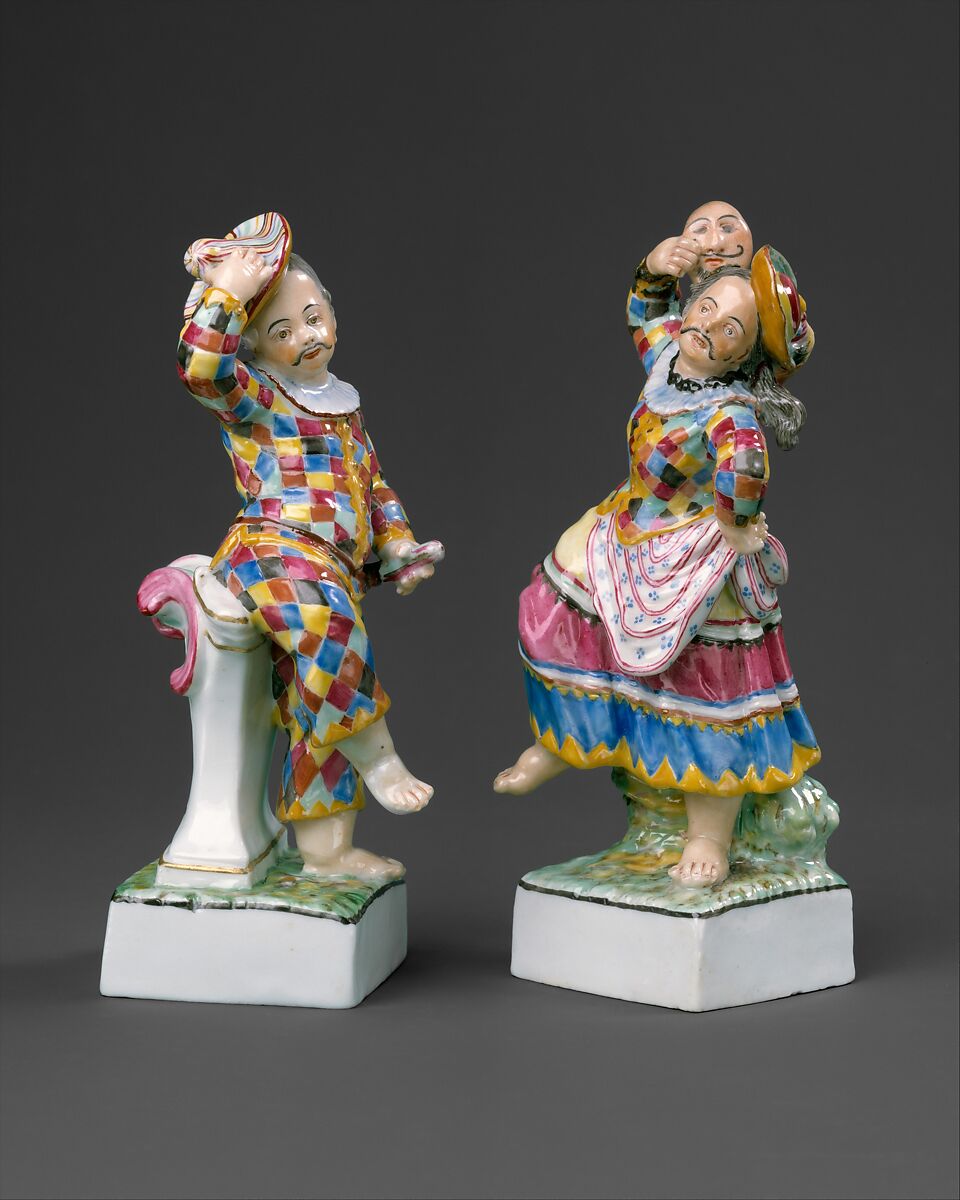
Porcelain sculpture became an important part of Russian production. Figurines could represent courtly subjects, occupations, ethnic dress, theatrical characters, allegorical figures or scenes from everyday life.
For collectors, figurines require particularly careful examination because modelling quality can reveal as much as the mark. Fingers, facial modelling, clothing, bases, painted details and the treatment of unglazed surfaces can all help distinguish high-quality historical production from later copies.
Gardner Porcelain
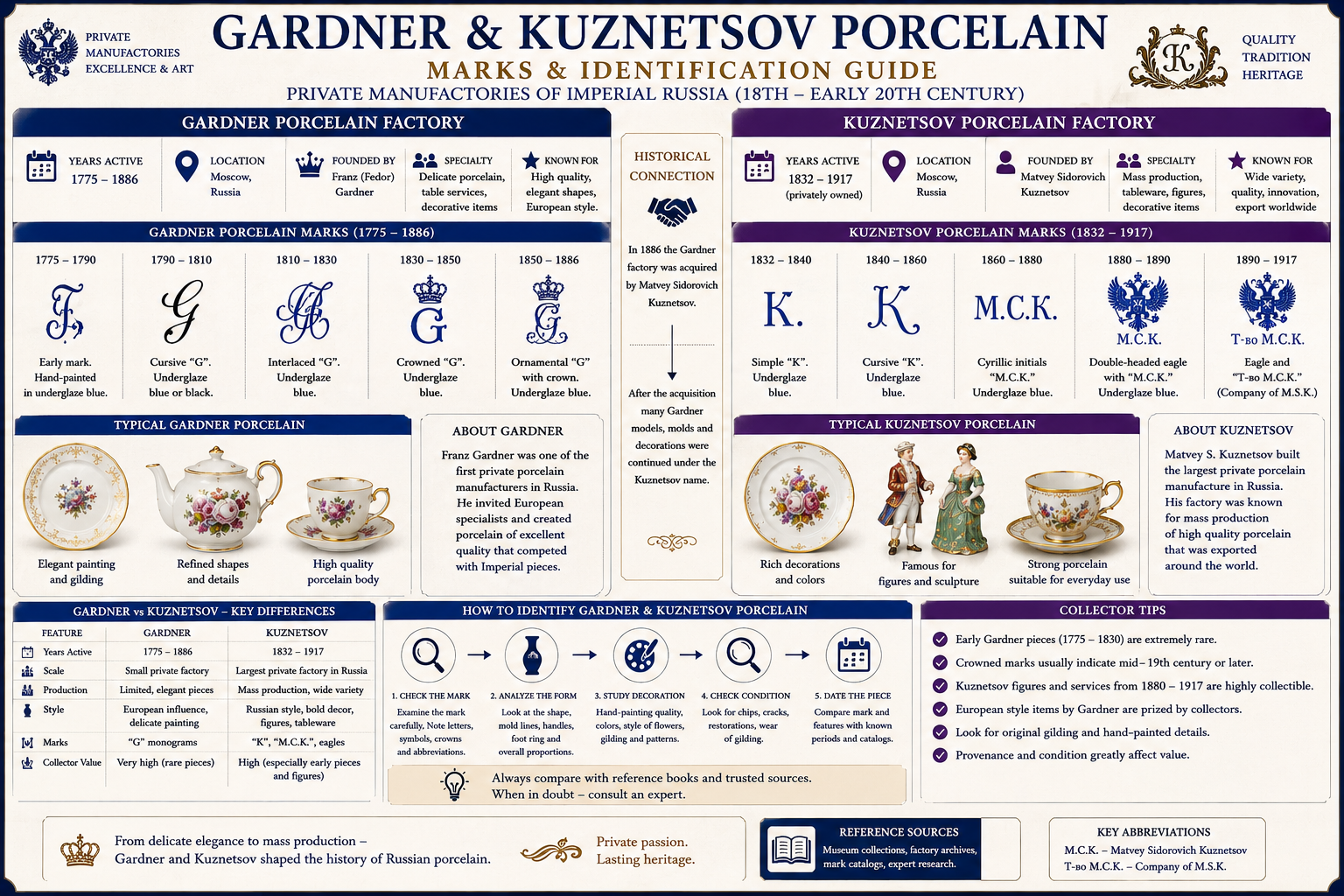
The Gardner manufactory is one of the essential names in private Russian porcelain. Founded in the eighteenth century, Gardner developed a reputation for high-quality tableware and sculpture and became an important competitor to court-connected production.
Gardner pieces are encountered with different marks and decorative treatments, which makes accurate dating dependent on more than recognising the factory name. Collectors should examine the precise mark version, porcelain quality, form and decoration together.
Gardner and Kuznetsov: Why Collectors Must Know Both Names
Gardner and Kuznetsov are closely connected in the later history of Russian porcelain. Kuznetsov developed into one of the great industrial names of Russian ceramics and eventually acquired the Gardner enterprise.
That history matters when identifying porcelain because the appearance of a Gardner-related mark does not automatically mean that a piece belongs to the earliest Gardner period. Ownership history, mark evolution and production style must all be considered.
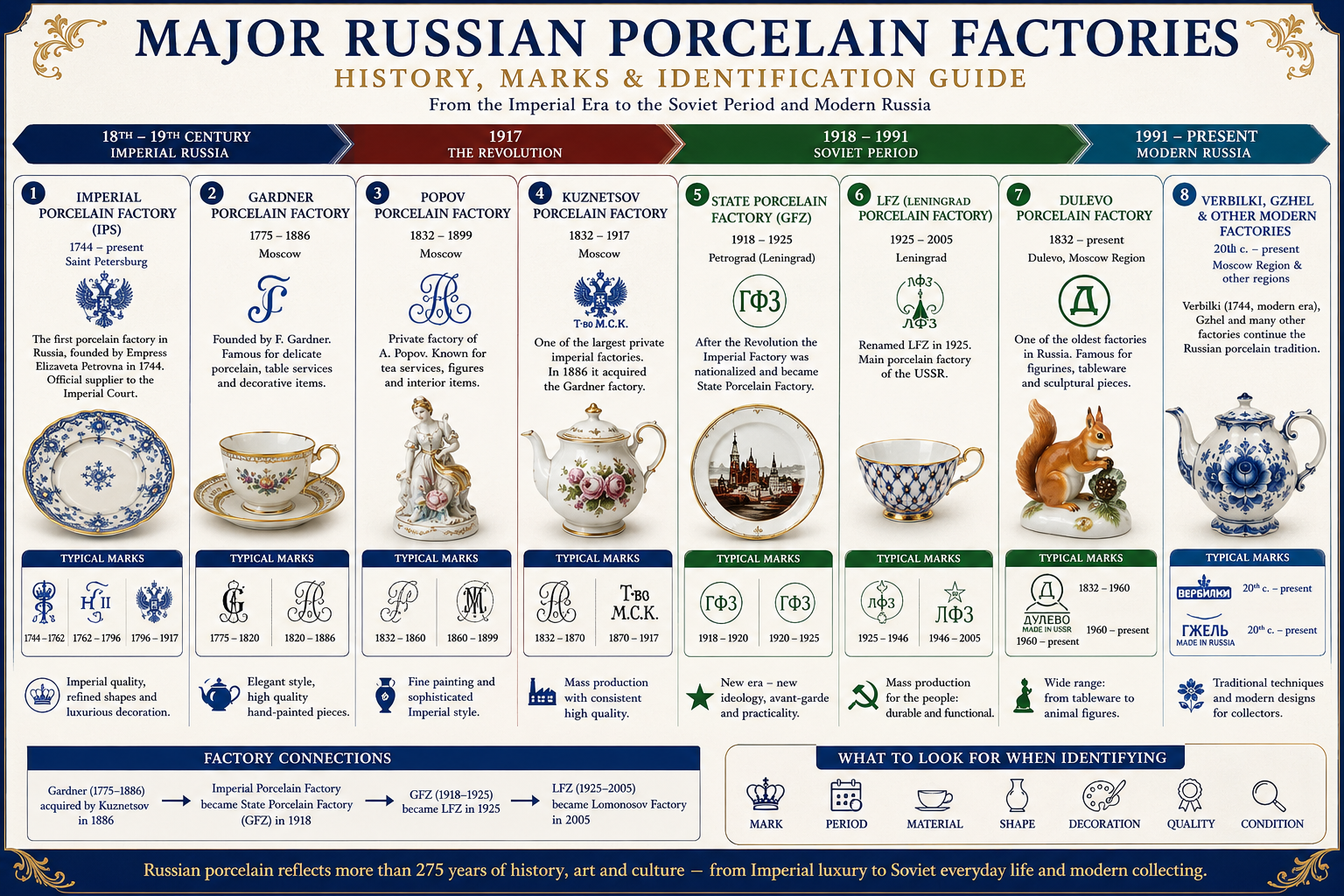
Major Russian Porcelain Factories
The history of Russian porcelain cannot be reduced to one factory. Imperial, private and later state-controlled manufactories created very different types of wares for court, domestic, export and ideological purposes.
| Factory / Tradition | Why It Matters | Typical Collector Interest |
|---|---|---|
| Imperial Porcelain Factory | Russia’s historic court manufactory | Imperial services, monograms, sculpture, presentation porcelain |
| Gardner | Major private Imperial-era manufacturer | Figurines, tableware, early marks, historic services |
| Popov | Important private porcelain production | Decorative and table porcelain, marks and early forms |
| Kuznetsov | Large industrial porcelain and ceramics enterprise | Marks, export ware, Gardner connections, tableware |
| GFZ / State Porcelain Factory | Early post-Revolution transformation | Propaganda and avant-garde porcelain |
| LFZ / Lomonosov | Major Soviet continuation of the St Petersburg factory | Cobalt Net, tableware, sculpture and export porcelain |
| Dulevo | Major nineteenth- and twentieth-century producer | Figurines, services, folk-inspired decoration and Soviet wares |
| Gzhel | Historic ceramic-producing region and decorative tradition | Cobalt-blue decoration, folk forms and later porcelain |
Russian Imperial Porcelain During the 19th Century
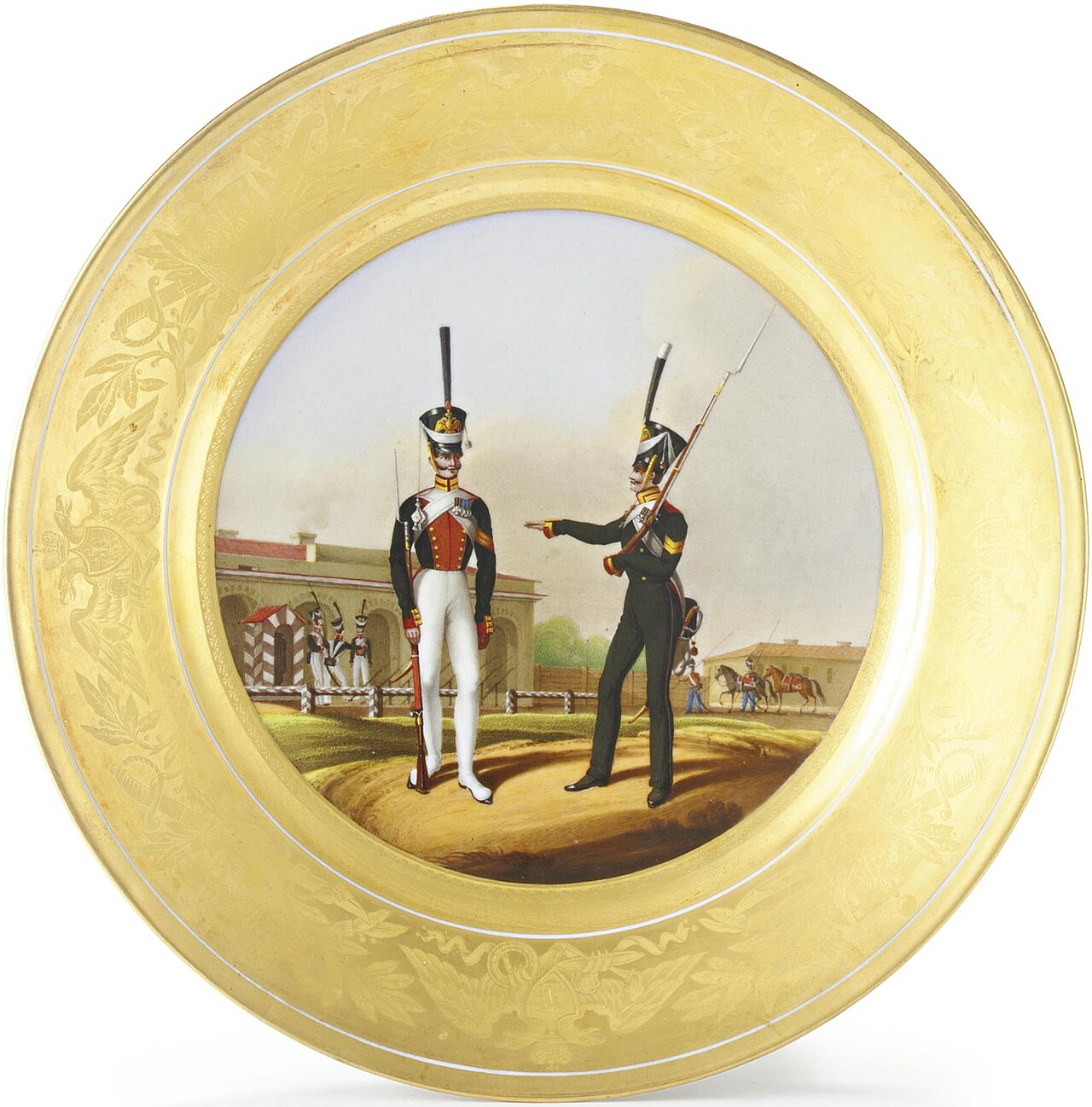
Nineteenth-century Imperial porcelain can be extraordinarily sophisticated. Court commissions included monumental services, portrait and military plates, topographical subjects, elaborate gilding and highly controlled painting.
Military porcelain is particularly interesting because uniforms, regiments, inscriptions and Imperial marks may provide multiple historical clues. When these elements agree, they can help establish both subject and period.
From Imperial Russia to Soviet Porcelain
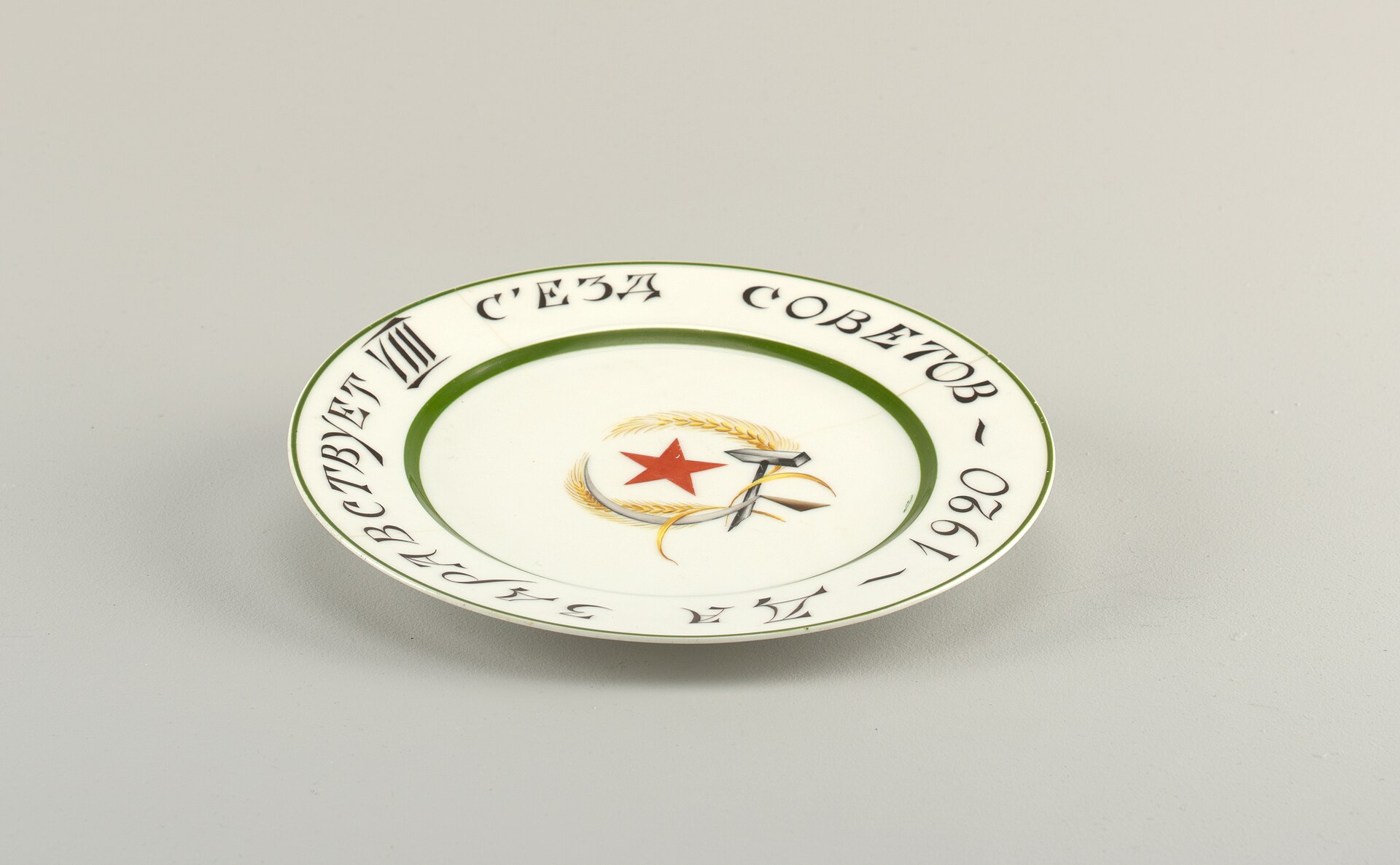
The Revolution of 1917 did not simply end one chapter of Russian porcelain history; it transformed the meaning of porcelain itself.
A manufactory that had served the Imperial Court was redirected toward the cultural aims of the new Soviet state. Existing porcelain blanks could become surfaces for entirely new imagery: revolutionary slogans, workers, political symbols, commemorative inscriptions and avant-garde compositions.
This early Soviet period produced some of the most historically distinctive porcelain of the twentieth century.
GFZ and the Birth of Soviet Porcelain
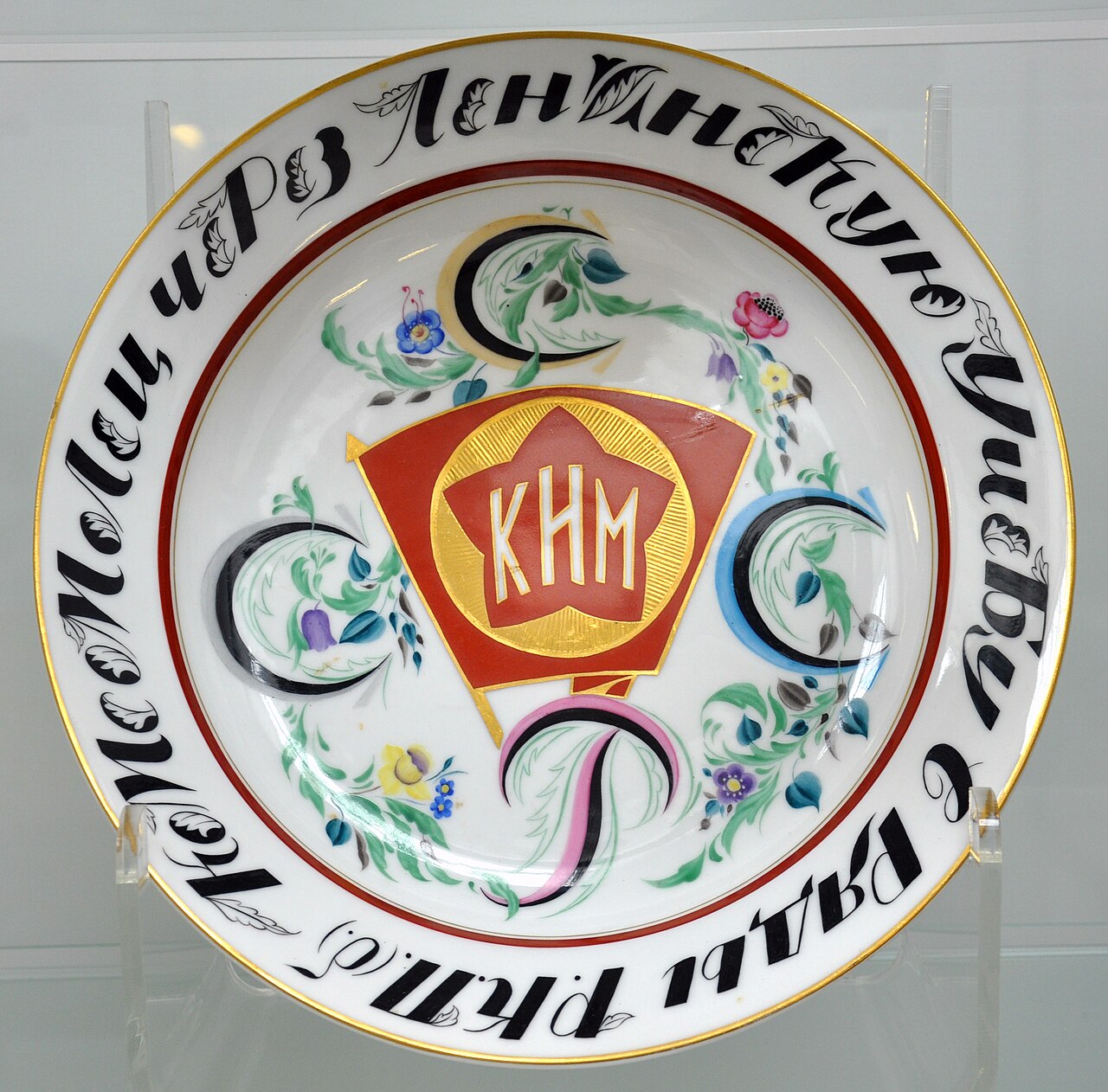
After the Revolution, the former Imperial factory entered the State Porcelain Factory period, commonly encountered by collectors through the abbreviation GFZ derived from its Russian name.
The artistic programme changed dramatically. Artists experimented with typography, revolutionary imagery, geometric abstraction and new approaches to traditional porcelain decoration.
Sergey Chekhonin became one of the central artistic figures associated with this transformation. The result was not merely mass-produced political ware: the finest early Soviet porcelain combined sophisticated design with the technical legacy of the former Imperial manufactory.
Collector’s Rule: Never Date Russian Porcelain by the Mark Alone
A convincing identification should produce agreement between mark + factory + period + porcelain body + shape + decoration + artist + condition + provenance. If one major element contradicts the others, investigate further before assigning a date or value.
How to Date Russian and Soviet Porcelain
Dating Russian porcelain works best as a process of cross-checking evidence. The mark may establish a possible period, while the form, decoration, material and production technique either support or challenge that conclusion.
For a detailed explanation of this methodology, see our
guide to dating antique porcelain.
| Clue | What It Can Reveal | Important Warning |
|---|---|---|
| Factory mark | Factory and approximate production period | Marks can be copied or misread |
| Imperial monogram | Possible reign and court association | Must correspond with body, form and decoration |
| Artist / modeller | Workshop, artistic period and sometimes rarity | Signatures require verification |
| Decoration | Artistic movement and likely period | Historic styles were sometimes revived |
| Porcelain body | Quality and manufacturing tradition | Material alone cannot provide an exact date |
| Provenance | Ownership history and historical context | Documents themselves must be credible |
Do You Own Russian or Soviet Porcelain?
If you have a Russian porcelain plate, figurine, vase, tea service or an unidentified piece with an Imperial, Soviet, LFZ, Lomonosov, Dulevo, Gardner, Kuznetsov or other factory mark, clear photographs of the object and its base are the best place to begin.
Continue to Part 2: Soviet porcelain marks, LFZ & Lomonosov, Dulevo figurines, Gzhel, Imperial vs Soviet identification, fakes and reproductions, value factors, collector checklist, FAQ, sources and expert notes.
Soviet Porcelain Marks: GFZ, LFZ and Lomonosov
The political transformation of Russia after 1917 also transformed the identity of its most important porcelain factory. For collectors, this makes Soviet porcelain marks particularly useful because changes in factory names, abbreviations, symbols and backstamps can help establish an approximate production period.
Three names are especially important when researching porcelain connected with the historic St Petersburg factory:
GFZ, LFZ and Lomonosov.
The terminology encountered on porcelain reflects different phases in the factory’s twentieth-century history. Collectors may encounter Cyrillic abbreviations, factory emblems, Soviet symbols, export markings and later Lomonosov-related backstamps.
However, a familiar-looking Soviet mark should never be treated as automatic proof of age. Compare its exact design with the shape, decoration, porcelain body and manufacturing quality of the object.
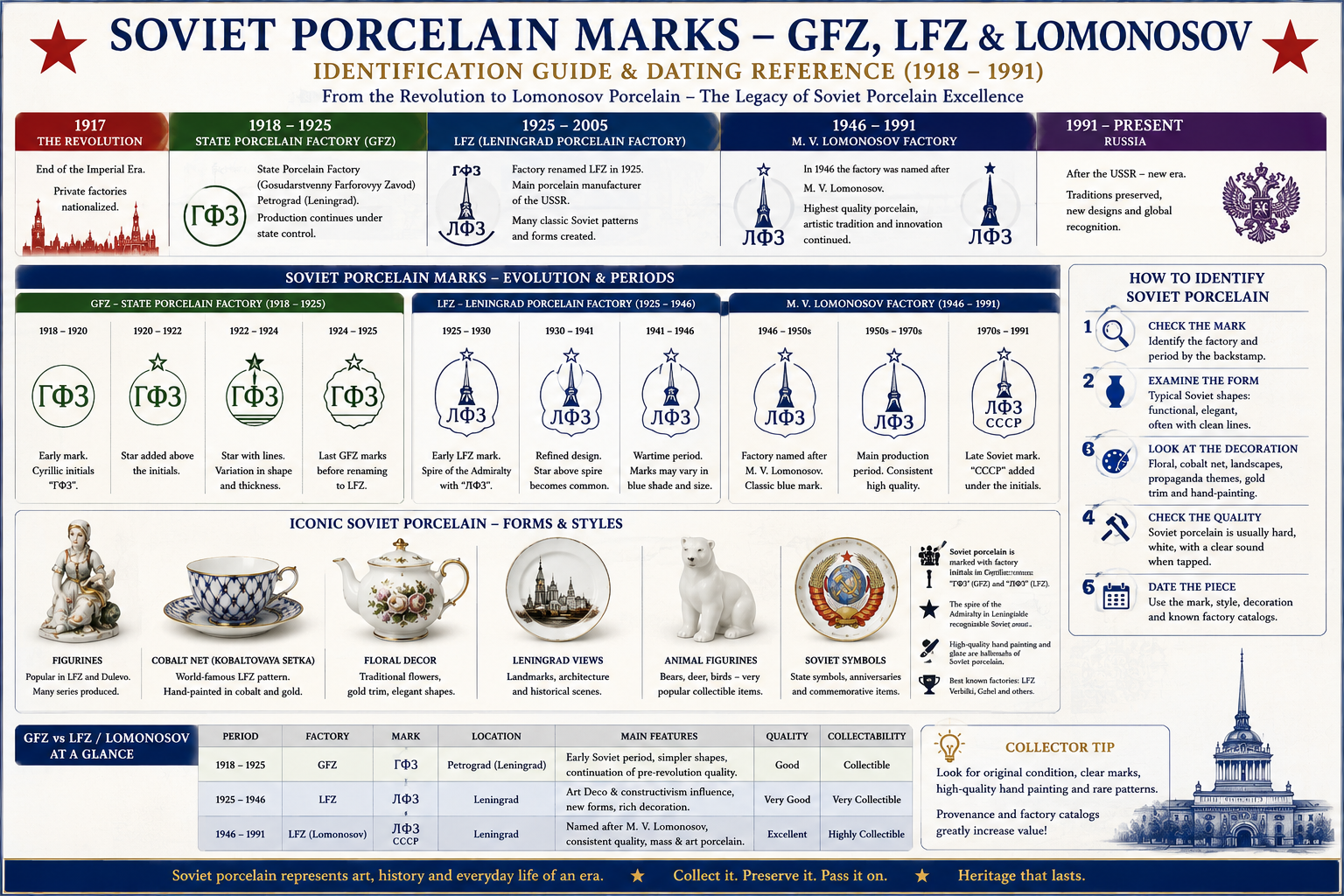
What Can a Soviet Porcelain Mark Tell You?
| Feature | Possible Information | What to Check |
|---|---|---|
| Factory abbreviation | Manufacturer or factory period | Exact lettering and symbol design |
| Factory emblem | Factory identity and sometimes period | Shape, colour and printing technique |
| Made in USSR | Soviet-period export context | Whether it belongs with the primary factory mark |
| Numbers | Shape, pattern or production references | Do not automatically interpret them as dates |
| Painter / artist mark | Possible decorator or workshop information | Compare with documented signatures |
LFZ and Lomonosov Porcelain
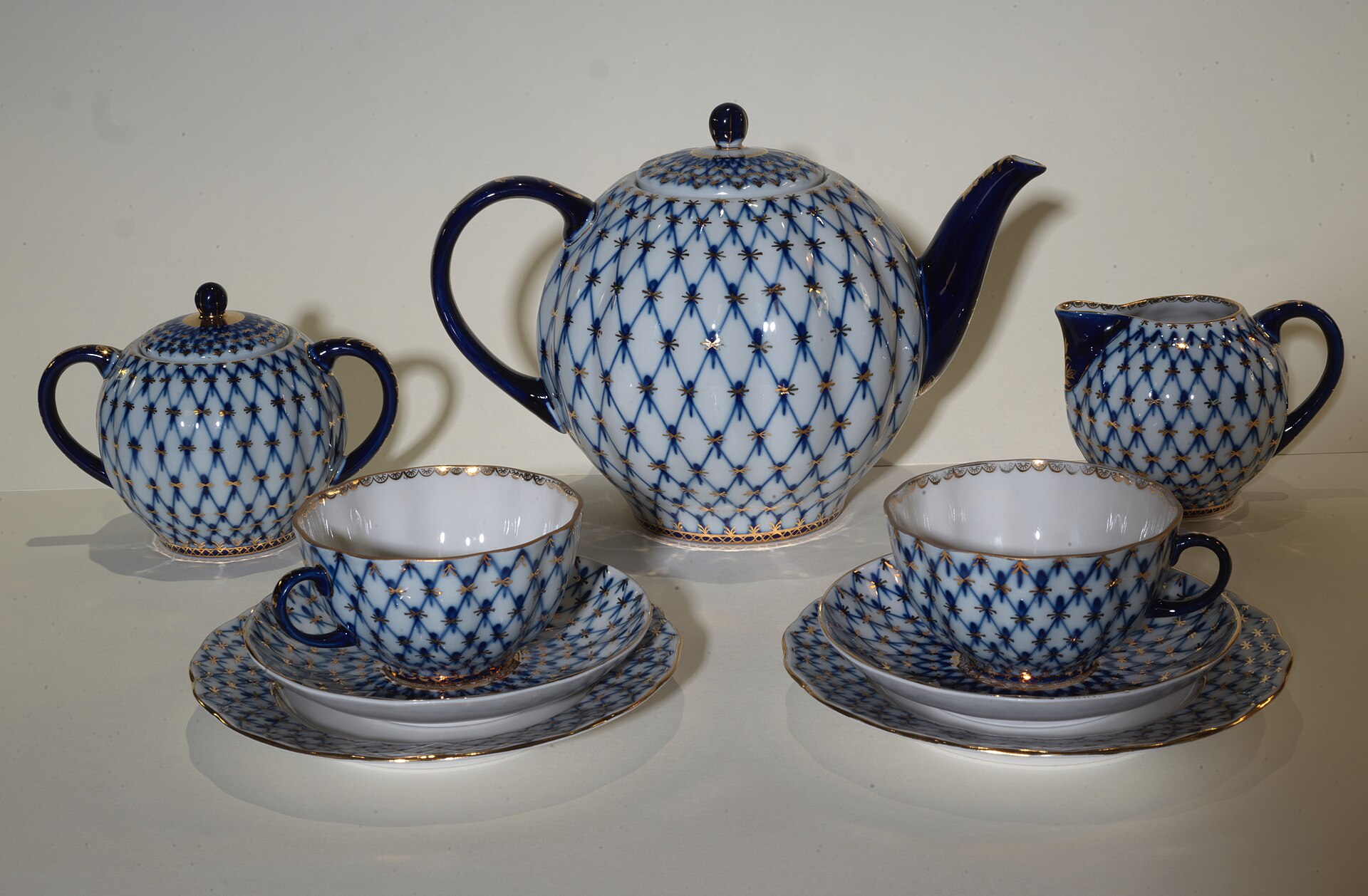
For many collectors outside Russia, Lomonosov porcelain is one of the most recognizable names associated with Soviet-era Russian porcelain.
The factory produced an enormous range of objects, from everyday tableware to sophisticated artistic porcelain and sculpture. Consequently, the word “Lomonosov” does not by itself indicate rarity or high value. Production period, designer, pattern, form, condition and scarcity remain essential.
One of the best-known decorative patterns associated with the factory is Cobalt Net, with its distinctive geometric network of cobalt-blue lines enriched with gold.
Is All Lomonosov Porcelain Valuable?
No. This is an important distinction for new collectors.
Lomonosov and LFZ produced porcelain across a long period and in substantial quantities. Common tableware may remain affordable, while unusual early pieces, rare patterns, artist-designed works, scarce figurines, limited production and examples with exceptional provenance can attract considerably greater collector interest.
The factory name establishes who produced an object. It does not establish its market value by itself.
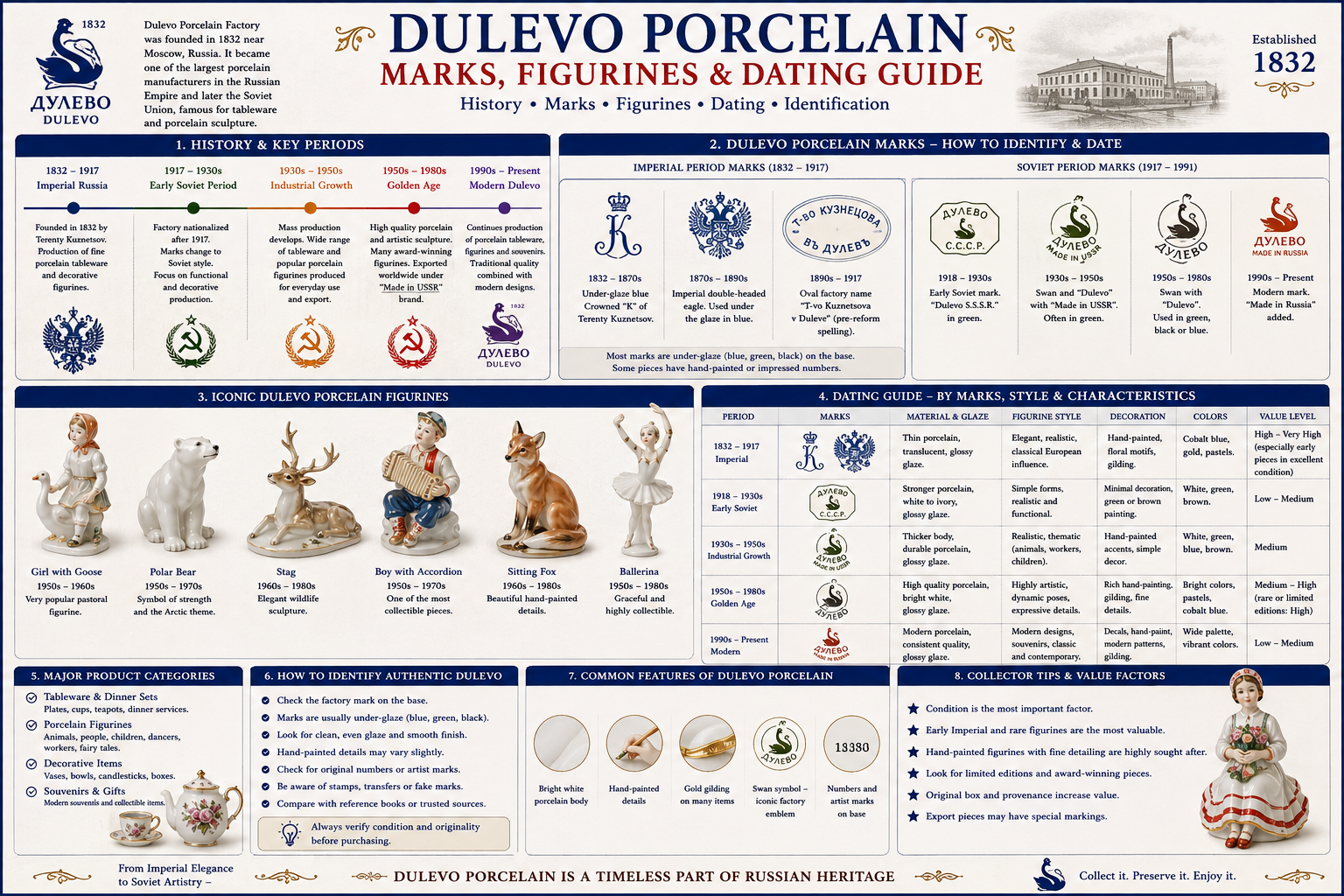
Dulevo Porcelain
Dulevo is another major name in Russian and Soviet ceramics. The factory traces its history to 1832 and became especially important for its extensive production of table porcelain, decorative wares and figurines.
Dulevo porcelain is particularly interesting because its history crosses political periods. Collectors can encounter pre-Revolutionary production, Soviet pieces and later wares, meaning the exact factory mark and artistic characteristics are essential for dating.
During the Soviet era, Dulevo became particularly well known for colourful porcelain sculpture and figurines representing people, folk subjects, occupations, animals and characters inspired by different cultures of the Soviet Union.
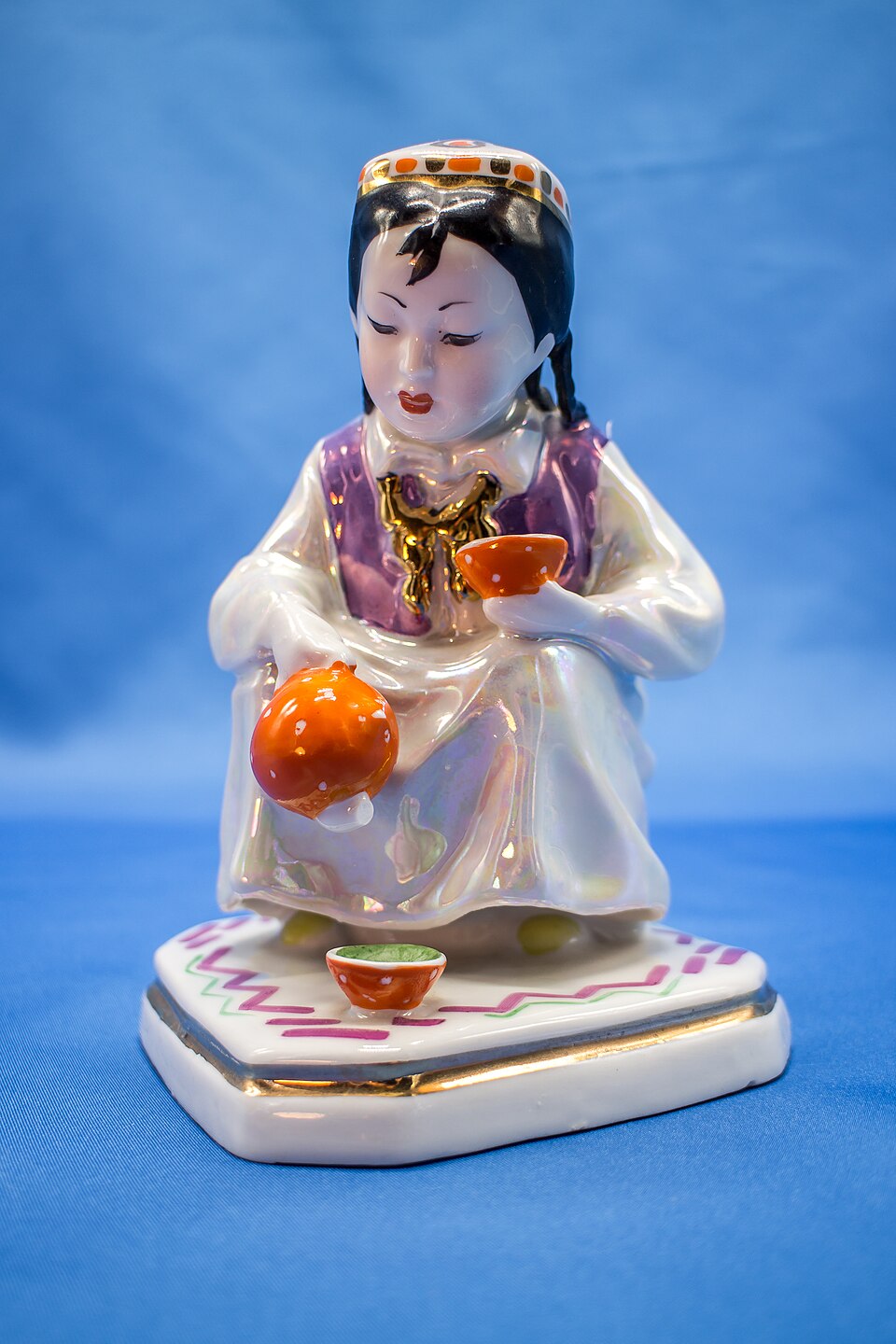
How to Identify Dulevo Porcelain
Begin with the factory mark, but then examine the complete object. Dulevo pieces vary enormously in quality, age and collectability.
- Look carefully at the exact factory mark and its colour.
- Check whether the mark is printed, painted or applied under the glaze.
- Examine model and production numbers.
- Study the modelling quality of figurines.
- Look for artist or modeller information where present.
- Compare decoration with documented production from the same period.
- Inspect fingers, flowers and projecting elements for restoration.
- Check the unglazed foot and natural wear.
Gzhel Porcelain: The Blue-and-White Russian Tradition
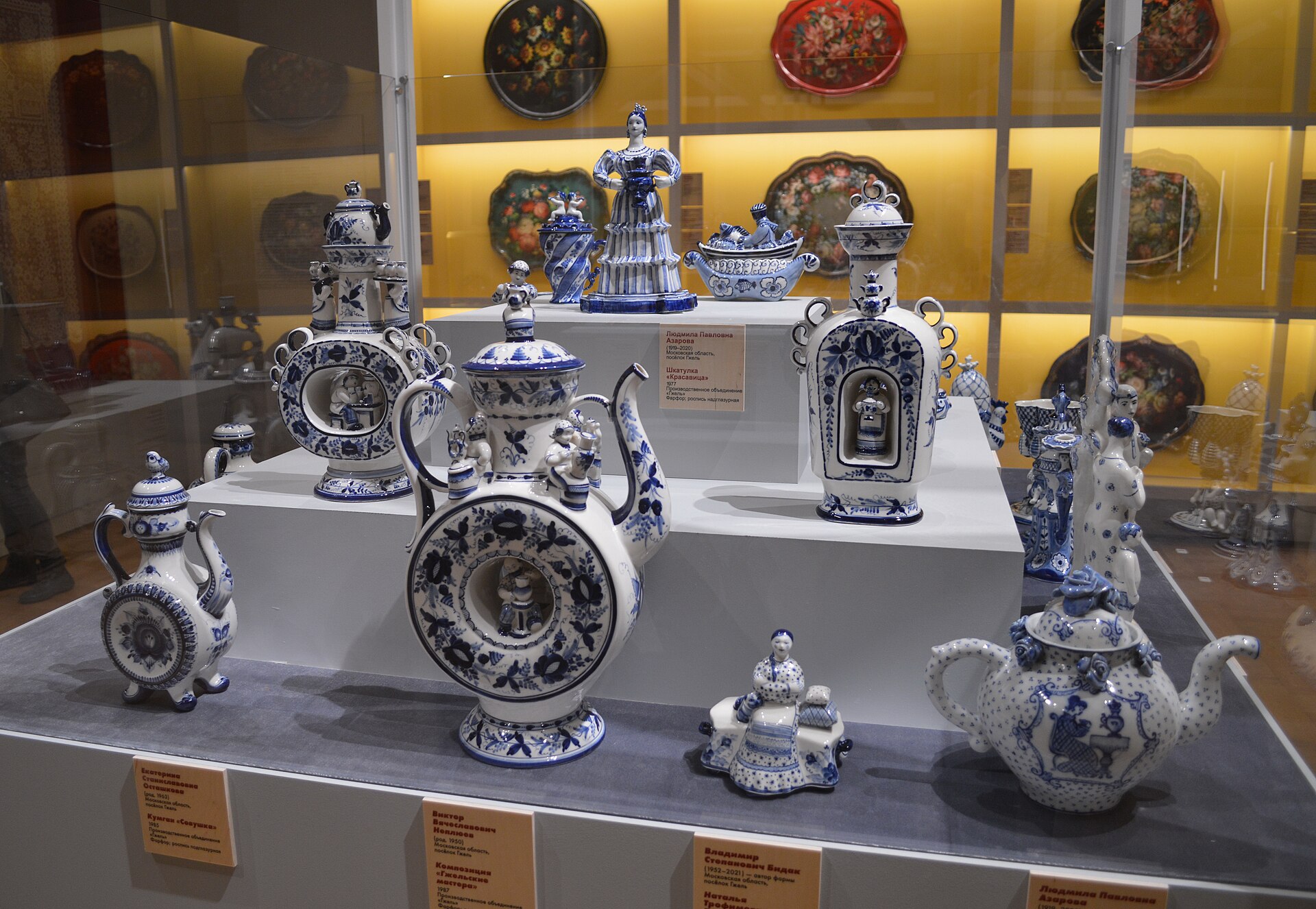
Few Russian ceramic traditions are as visually recognizable as Gzhel. The name is associated with a historic ceramic-producing region near Moscow and, especially in modern popular culture, with brilliant cobalt-blue decoration against a white ground.
Yet collectors should be careful with terminology. “Gzhel” is broader than the name of a single historic porcelain factory. It refers to a regional ceramic tradition involving different workshops, enterprises, materials and periods.
This distinction is important because a blue-and-white Russian object is not automatically old, rare or even necessarily porcelain.
How to Recognize Gzhel-Style Porcelain
Typical later Gzhel-style decoration uses cobalt blue over a white ground, often with expressive tonal brushwork ranging from very pale blue to deep cobalt.
Common subjects include flowers, leaves, landscapes, architectural details, folk-inspired forms and ornamental scrollwork. Figurines and sculptural vessels are also encountered.
Do not identify a piece as valuable antique Gzhel solely because it is blue and white. Determine the material, manufacturer, mark and approximate period first.
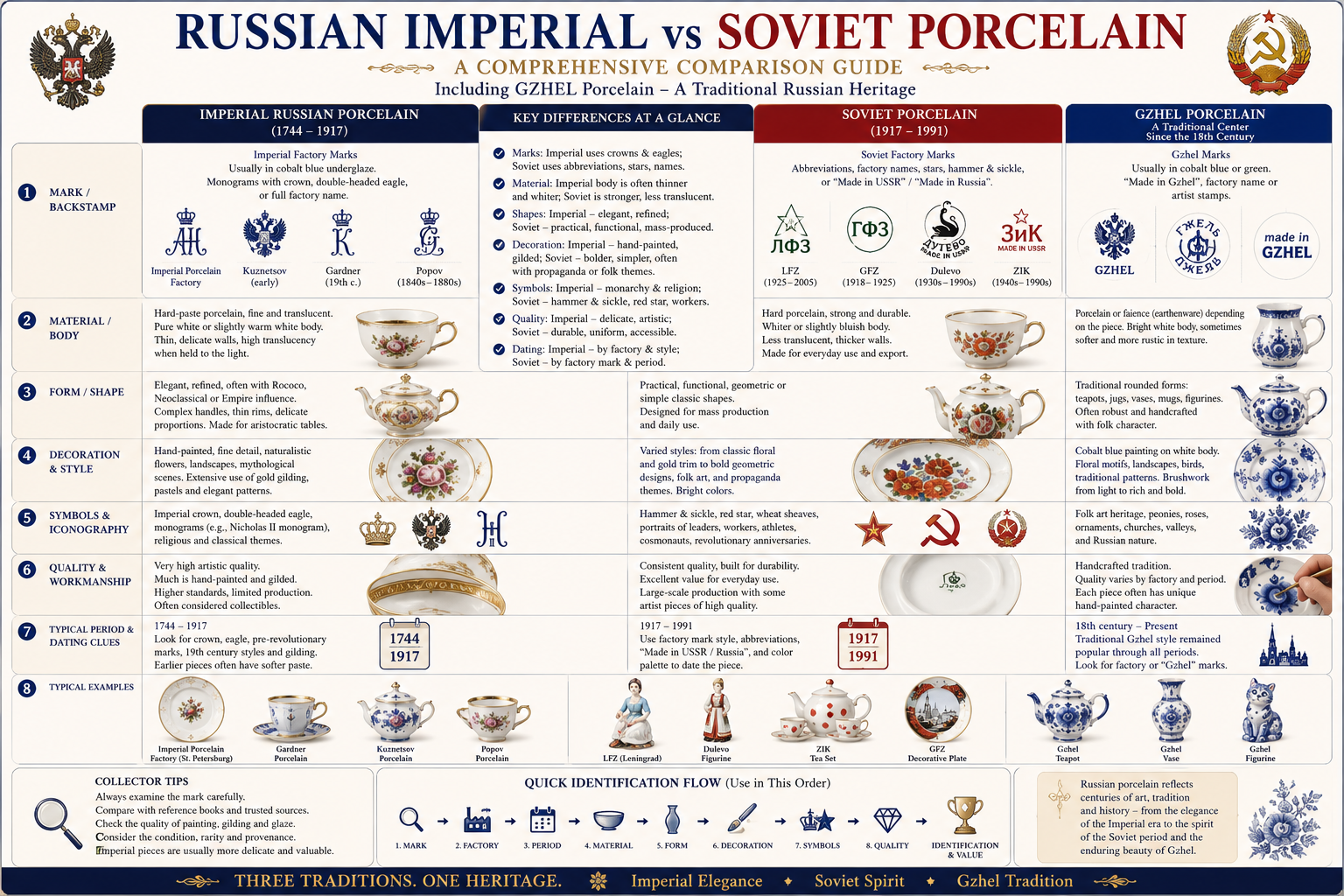
Imperial Russian vs Soviet Porcelain: How to Tell the Difference
One of the most useful skills for collectors is learning to distinguish Imperial Russian porcelain from Soviet porcelain.
The distinction cannot always be made by decoration alone. Historical forms were reused, older artistic traditions survived political change, and later porcelain sometimes deliberately referenced earlier styles.
| Characteristic | Imperial Russian | Soviet | Gzhel Tradition |
|---|---|---|---|
| Marks | Imperial monograms, crowns and factory marks | Factory abbreviations, logos, Soviet and export marks | Varies by workshop and manufacturer |
| Decoration | Courtly, floral, military, landscape, Neoclassical and historicist | Avant-garde, propaganda, floral, folk, decorative and industrial designs | Especially associated with cobalt-blue ornamental painting |
| Symbolism | Imperial monograms, crowns, court and military imagery | Stars, political imagery, Soviet themes and state symbolism | Regional and folk decorative language |
| Typical Collecting Focus | Court porcelain, services, sculpture and rare commissions | Early propaganda porcelain, artist pieces, figurines and patterns | Quality painting, unusual forms, age and documented makers |
How to Identify Russian and Soviet Porcelain Step by Step
When an unidentified Russian porcelain object appears at an auction, estate sale, antique shop or family collection, resist the temptation to begin by searching only for a matching mark.
Instead, use a repeatable identification sequence.
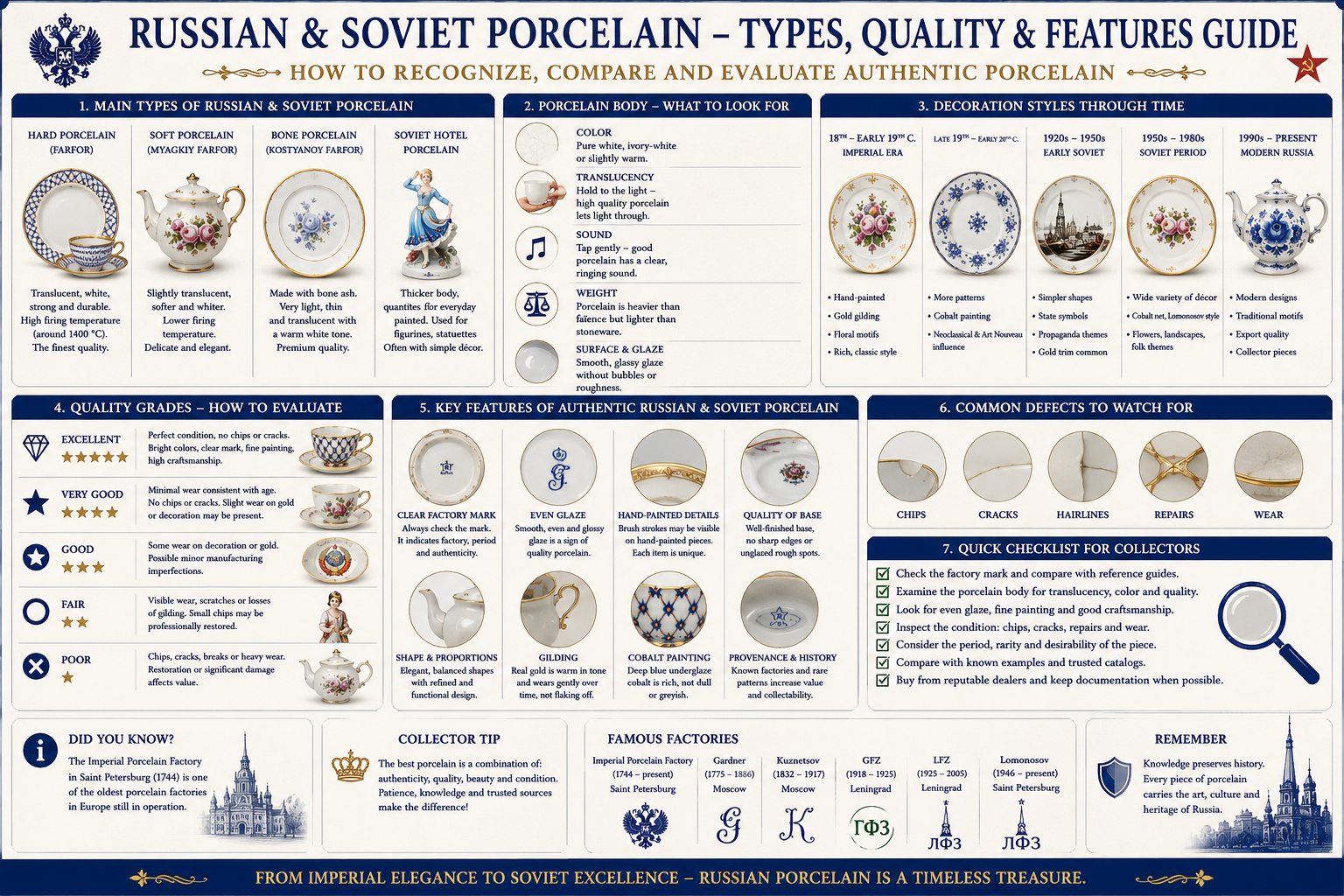
- Photograph the entire object. Record front, back, sides, base and details.
- Examine the mark. Record every letter, symbol, number and colour.
- Identify the likely factory. Compare the mark with reliable documented references.
- Establish the possible period. Determine when that exact mark version was used.
- Check the porcelain body. Examine colour, translucency, thickness and foot rim.
- Study the form. Compare shape and construction with known factory production.
- Analyze the decoration. Determine whether it is hand painted, printed, transfer decorated, gilded or mixed.
- Look for an artist or modeller. Signatures can substantially affect attribution and collector interest.
- Check condition. Look for chips, cracks, regilding, repainting and restoration.
- Assess rarity and provenance. A rare form with documented history can be much more important than a common example from the same factory.
For more detail on this process, our
guide to dating antique porcelain
explains how marks, shapes, glaze, decoration and manufacturing techniques can be combined to estimate age.
How to Identify Fake Russian Porcelain Marks
The desirability of Imperial Russian porcelain has inevitably encouraged reproductions, misleading attributions and false or later-added marks.
A mark that resembles an Imperial monogram is therefore only the beginning of authentication.
Warning Signs to Investigate
- A supposedly eighteenth-century mark on a clearly modern porcelain body.
- Artificially worn or scratched marks.
- Decoration inconsistent with the claimed factory or reign.
- Modern transfer decoration presented as early hand painting.
- Imperial symbols combined with forms belonging to a much later period.
- Fresh gilding on an allegedly heavily used antique object.
- Artificial staining intended to simulate age.
- A famous mark with noticeably weak modelling or painting.
- Marks that appear to sit unnaturally over later surface wear.
This is why our general
antique porcelain identification guide
recommends evaluating the complete object rather than accepting the backstamp alone.
Important
A copied mark does not make a reproduction authentic. The mark, porcelain body, glaze, manufacturing technique, form, decoration and natural ageing must tell the same historical story.
What Makes Russian Porcelain Valuable?
There is no reliable fixed price list for Russian or Soviet porcelain. Two objects carrying marks from the same factory can have dramatically different values.
Collectors pay for a combination of authenticity, rarity, artistic quality, historical importance, condition and provenance.
| Value Factor | Why It Matters | Potential Importance |
|---|---|---|
| Manufacturer | Important historic factories attract established collector demand | High |
| Period | Early or historically important production may be scarcer | High |
| Artist / modeller | Recognized artistic authorship can transform collector interest | Very High |
| Rarity | Rare models and decorations may have few surviving examples | Very High |
| Condition | Damage and restoration can significantly influence desirability | Very High |
| Provenance | Documented history can strengthen authenticity and significance | Potentially Exceptional |
| Market demand | Collector preferences influence achievable prices | Variable |
Which Russian and Soviet Porcelain Can Be Especially Collectible?
Rather than assuming that all old Russian porcelain is valuable, collectors should look for combinations of rarity, artistic importance and historical significance.
Categories deserving closer research may include:
- early Imperial Porcelain Factory pieces;
- documented Imperial court commissions;
- rare eighteenth-century Gardner porcelain;
- important Imperial military and presentation porcelain;
- early revolutionary and propaganda porcelain;
- works connected with documented artists and designers;
- rare Soviet figurines and sculptural models;
- unusual Dulevo figures with identifiable modeller or artist;
- scarce LFZ/Lomonosov patterns and artistic porcelain;
- complete services in excellent condition;
- objects with strong museum, exhibition or family provenance.
Condition: One of the Biggest Factors in Value
Porcelain is durable but brittle. A valuable object may have survived for generations while accumulating chips, cracks, hairlines, worn gilding or restoration.
Not every defect destroys collector value. An extremely rare Imperial object can remain important despite restoration. But when two comparable pieces exist, collectors generally prefer the example retaining more of its original condition.
Check Carefully For
- rim chips;
- hairline cracks;
- restored handles and spouts;
- repaired fingers on figurines;
- replacement lids;
- regilding;
- overpainting;
- staining;
- star cracks;
- professional or amateur restoration.
Provenance: When History Adds Value
Provenance is the documented ownership and history of an object. In Russian porcelain, strong provenance can be especially important for pieces potentially associated with court commissions, important collections, exhibitions or historically significant owners.
Useful evidence may include old invoices, photographs, collection labels, exhibition catalogues, archival correspondence, auction records and documented family history.
Provenance should itself be verified. An old-looking handwritten note is evidence to investigate, not automatic proof.
Russian Porcelain Collector Checklist
Before buying, selling or valuing Russian porcelain, ask:
- ☐ Can I identify the factory mark?
- ☐ Does the exact mark correspond to the proposed period?
- ☐ Is the object actually porcelain?
- ☐ Does the form match documented factory production?
- ☐ Is the decoration hand painted, printed or transfer decorated?
- ☐ Are there artist, modeller or decorator marks?
- ☐ Does the wear look natural?
- ☐ Are there chips, cracks or restoration?
- ☐ Is the model or pattern uncommon?
- ☐ Is the object part of a complete set?
- ☐ Is there documented provenance?
- ☐ Have I compared it with museum and specialist references?
How to Photograph Russian Porcelain for Identification
Good photographs can dramatically improve preliminary identification. Do not send only a close-up of the factory mark.
Photograph:
- the entire object from the front;
- the reverse;
- both sides;
- the complete underside;
- a sharp close-up of every mark;
- numbers and signatures;
- decoration details;
- damaged or restored areas;
- the foot rim;
- any labels, boxes or documents.
Photographs taken in natural indirect daylight are usually more useful than images taken with strong flash or heavy digital filters.
Have Russian or Soviet Porcelain to Identify?
If you own Imperial Russian porcelain, Gardner, Kuznetsov, LFZ/Lomonosov, Dulevo, Gzhel or an unidentified Russian or Soviet porcelain object, send clear photographs of the complete piece, its base and all visible marks.
A professional evaluation can help establish the likely manufacturer, production period, authenticity, condition and approximate collector value.
Frequently Asked Questions About Russian & Soviet Porcelain
How can I identify Russian porcelain marks?
Start by photographing the complete backstamp and recording every monogram, crown, Cyrillic letter, symbol, number and colour. Compare the exact mark with documented examples, then confirm the attribution through the porcelain body, shape, decoration and manufacturing technique. A factory mark alone is not sufficient proof of authenticity.
How can I tell if Russian porcelain is Imperial?
Imperial Russian porcelain may carry marks associated with a particular ruler or historic factory, but the entire object must be historically consistent. Porcelain quality, shape, decoration, gilding, construction and natural wear should correspond with the proposed production period.
What do LFZ marks mean?
LFZ is associated with the Leningrad porcelain factory period of the historic St Petersburg manufactory. Because marks changed over time, collectors should identify the exact version rather than simply recognizing the letters.
Is Lomonosov porcelain valuable?
Some Lomonosov porcelain is collectible, but values vary enormously. Common tableware may be readily available, whereas scarce patterns, unusual forms, early production, artist-designed works and rare figurines can be considerably more desirable.
Is Soviet porcelain collectible?
Yes. Soviet porcelain has an international collector market. Early revolutionary porcelain, important artistic designs, rare figurines, unusual factory production and well-documented pieces are among the areas that attract specialist interest.
How do I identify Dulevo porcelain?
Examine the exact factory mark, production numbers, porcelain body, decoration and modelling. On figurines, artist or modeller information can be particularly important. Different periods of Dulevo production should not be treated as equivalent.
Is all blue-and-white Russian porcelain Gzhel?
No. Cobalt-blue decoration on a white ground is strongly associated with the Gzhel tradition, but colour alone does not establish origin. The factory, material, mark, form and period must also be identified.
Does an Imperial crown or monogram prove that porcelain is antique?
No. Historic marks can be copied, imitated or added later. An Imperial-looking mark must agree with the object’s material, production technique, decoration, form and natural ageing.
Can damaged Russian porcelain still be valuable?
Yes. Rarity and historical importance can outweigh condition problems in exceptional objects. Nevertheless, chips, cracks, missing parts, repainting and restoration generally affect market value and should always be disclosed.
What Russian porcelain is most worth researching?
Early Imperial porcelain, rare Gardner pieces, important Kuznetsov production, early Soviet propaganda porcelain, documented artist-designed works, scarce figurines and objects with strong provenance deserve particularly careful research.
Final Thoughts
Russian and Soviet porcelain cannot be understood through factory marks alone. Its history stretches from eighteenth-century Imperial patronage through private manufactories, revolution, avant-garde experimentation, Soviet industrial production and regional traditions such as Gzhel.
That complexity is precisely what makes the field so rewarding.
A small monogram beneath a plate may point toward an Imperial reign. A Cyrillic factory symbol can reveal a Soviet production period. An apparently ordinary figurine may turn out to be connected with an important modeller. A family document can transform an attractive porcelain object into something with a traceable historical story.
The most reliable approach is therefore always the same:
study the mark, identify the factory, establish the period, examine the material and decoration, assess condition, research provenance and only then consider value.
For further research, explore our
Stories & Knowledge
collection and our
complete guide to antique porcelain.
Sources & Further Research
Reliable porcelain identification should be based on documented museum collections, historical catalogues, specialist literature and comparison with authenticated objects rather than marketplace descriptions alone.
- The State Hermitage Museum – Russian decorative arts and Imperial Porcelain Factory collections.
- The Metropolitan Museum of Art – Russian Imperial and Soviet porcelain collections.
- Major museum collection catalogues and documented exhibition records.
- Historic factory catalogues and specialist reference works on Russian porcelain marks.
- Documented auction archives may be useful for market comparison when attribution and condition are comparable.
About The Old Antiquarian
The Old Antiquarian is dedicated to the study, identification and appreciation of antiques, historic objects and collectible art from Europe’s cultural crossroads.
Our guides combine decades of practical experience with museum references, documented historical sources and comparative study of authentic objects.
Editorial principle: marks are evidence, not conclusions. Authentication and valuation should consider the complete object and its historical context.
Last Updated: August 2026
