
Nymphenburg Porcelain: Marks,Dating & Value
Nymphenburg Porcelain: History, Marks, Bustelli Figurines, Dating & Value Guide
Last Updated: September 2026 | The Old Antiquarian
Quick Answer
Nymphenburg is one of Germany’s most important historic porcelain manufactories.
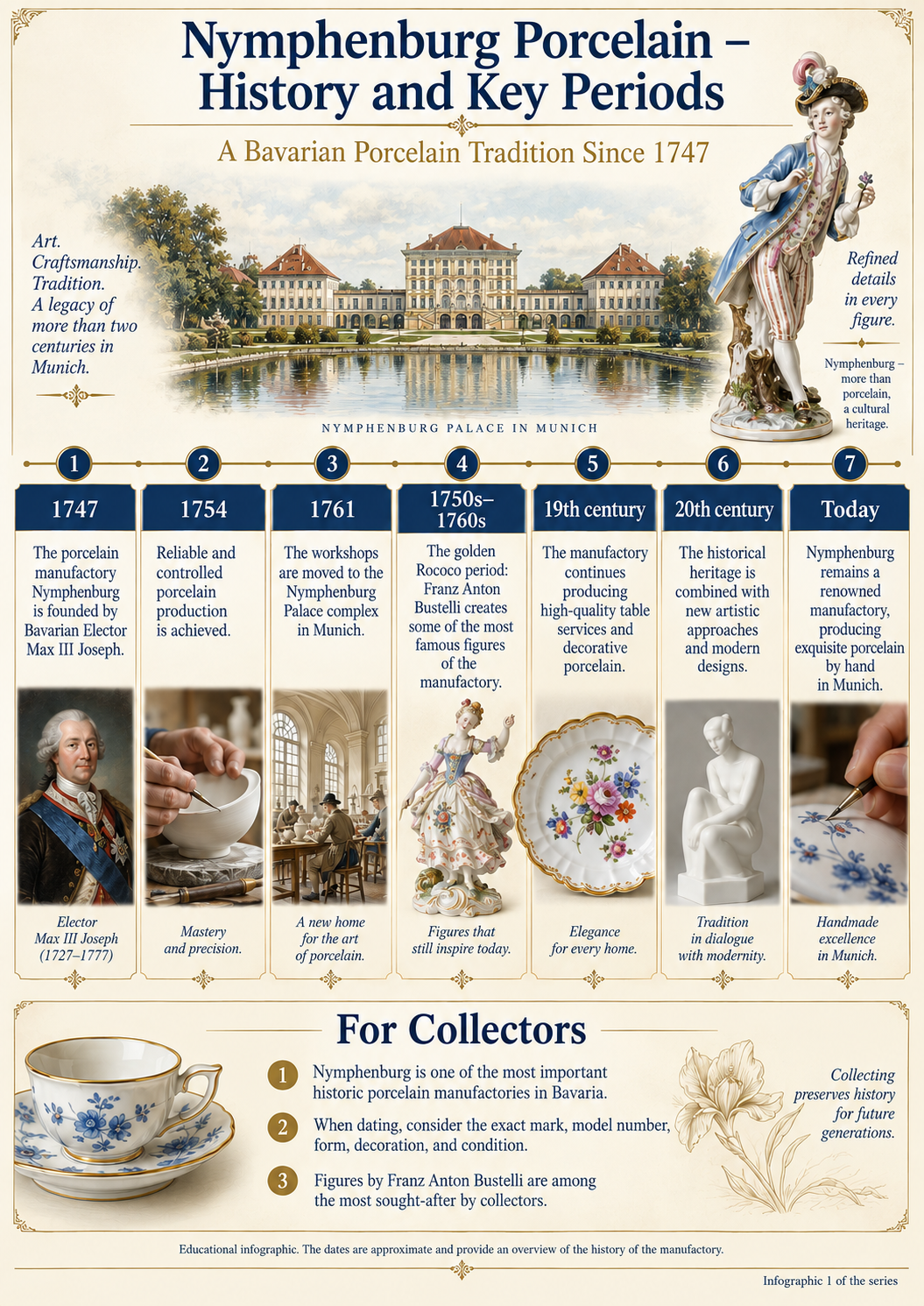
Founded in Bavaria in 1747 under Elector Max III Joseph, the manufactory achieved controlled porcelain production in 1754 and moved its workshops to the Nymphenburg Palace complex in Munich in 1761.
Collectors recognize Nymphenburg especially by its Wittelsbach lozenge shield mark, refined hard-paste porcelain, exceptional modelling and historic artists such as Franz Anton Bustelli and Dominikus Auliczek. However, a mark alone should never be used to establish an exact date or authenticity. The exact mark variant, model number, form, artist, decoration, porcelain body and condition must be considered together.
At a Glance
Nymphenburg Porcelain – Key Facts
| Feature | Collector Reference |
|---|---|
| Founded | 1747 |
| Founder | Elector Max III Joseph of Bavaria |
| Early Location | Neudeck near Munich |
| Controlled Porcelain Production | Achieved in 1754 |
| Nymphenburg Palace Workshops | From 1761 |
| Famous Modeller | Franz Anton Bustelli |
| Later Artistic Director | Dominikus Auliczek |
| Characteristic Mark | Wittelsbach lozenge shield |
| Material | Hard-paste porcelain |
| Collecting Focus | Bustelli figures, Commedia dell’Arte, animals, tableware, rare models and hand-painted porcelain |
What Is Nymphenburg Porcelain?
Nymphenburg porcelain is produced by the historic Porzellan Manufaktur Nymphenburg in Munich, Bavaria. Its history is closely connected with the Bavarian ruling house of Wittelsbach and with the development of European hard-paste porcelain during the eighteenth century.
Unlike the word Bavaria, which usually describes a geographical origin rather than a single maker, Nymphenburg identifies a specific historic manufactory.
This distinction matters when reading porcelain marks. A piece marked simply “Bavaria” should not automatically be attributed to Nymphenburg.
For a broader explanation of Bavarian makers, marks and dating, see our
Bavaria Porcelain Identification Guide
.
A NYMPHENBURG MARK IS EVIDENCE — NOT THE ENTIRE ANSWER
Correct identification combines the mark, model number, form, porcelain body, modelling, decoration, condition and documented history.
History
The History of Nymphenburg Porcelain
1747 – The Electoral Porcelain Manufactory
The history of Nymphenburg porcelain begins on 1 November 1747, when Elector Max III Joseph of Bavaria established an electoral porcelain manufactory at Neudeck near Munich.
European porcelain was still a technologically demanding luxury material. Producing a stable porcelain body required control over raw materials, preparation and firing, and the early manufactory experienced considerable technical difficulties.
1754 – A Turning Point
The decisive breakthrough came in 1754, when controlled porcelain production was successfully achieved under Joseph Jakob Ringler.
The same year also marked another major event in Nymphenburg history: sculptor Franz Anton Bustelli joined the manufactory.
1761 – The Workshops Move to Nymphenburg Palace
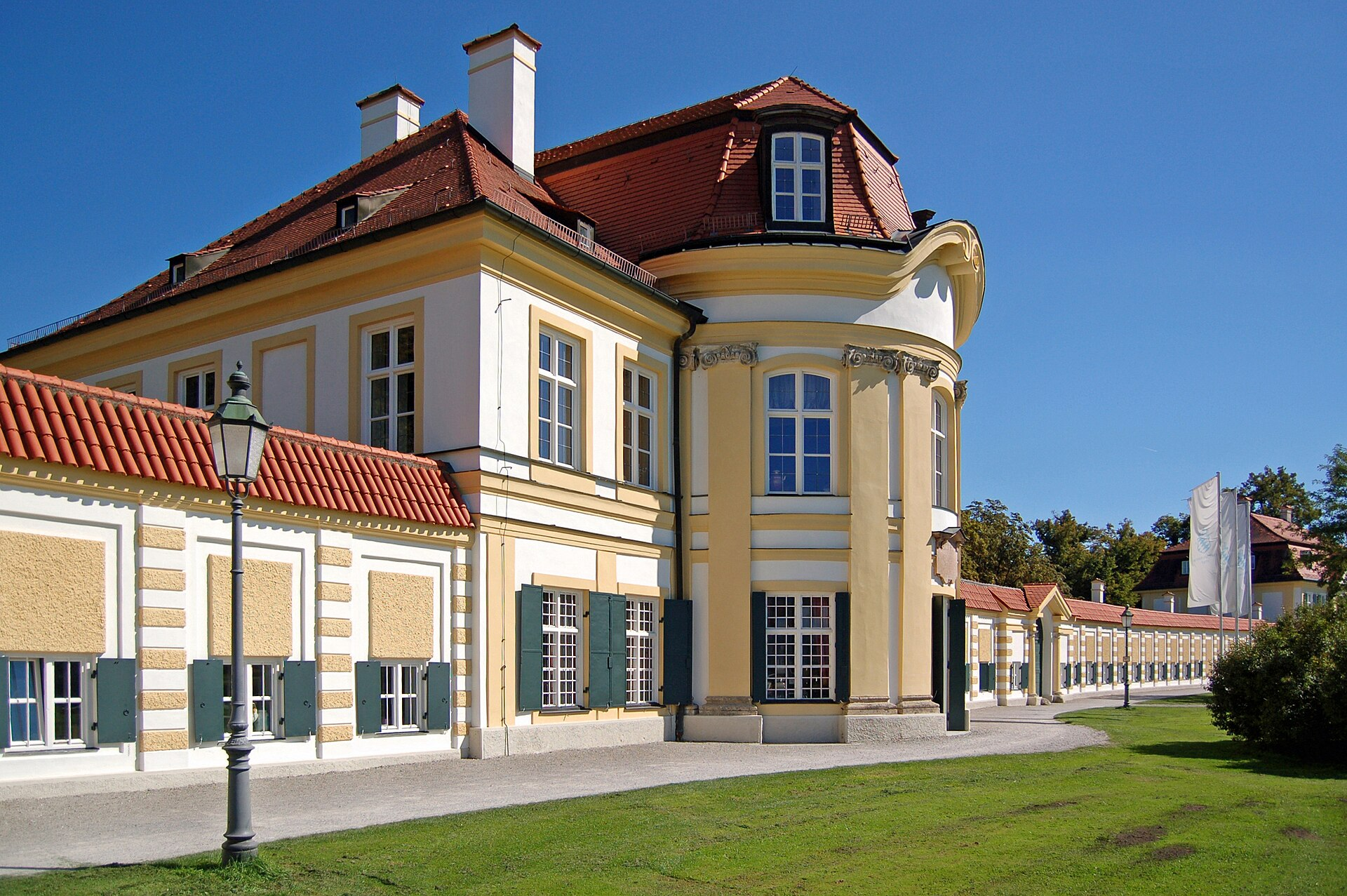
In 1761 the porcelain workshops were transferred from the Au district to the northern roundel of the Nymphenburg Palace complex.
This location became the permanent home of the manufactory. Nymphenburg porcelain continues to be produced there in Munich.
Nymphenburg Today
The manufactory continues to emphasize traditional hand production. Modelling, mould making, forming, firing, painting and gilding remain specialist workshop disciplines rather than merely automated industrial processes.
This continuity is particularly important for collectors: an old design can remain part of the manufactory’s repertoire long after the original model was created.
The Rococo Master
Franz Anton Bustelli and Nymphenburg Porcelain
No artist is more closely associated with eighteenth-century Nymphenburg porcelain than Franz Anton Bustelli.
Bustelli joined the manufactory as a figure modeller on 3 November 1754 and worked there until his death in 1763. During this relatively short period he created approximately 150 designs and helped establish Nymphenburg as one of the great centres of European Rococo porcelain sculpture.
His figures are distinguished by movement, asymmetry, elegant proportions and unusually expressive interaction between individual characters.
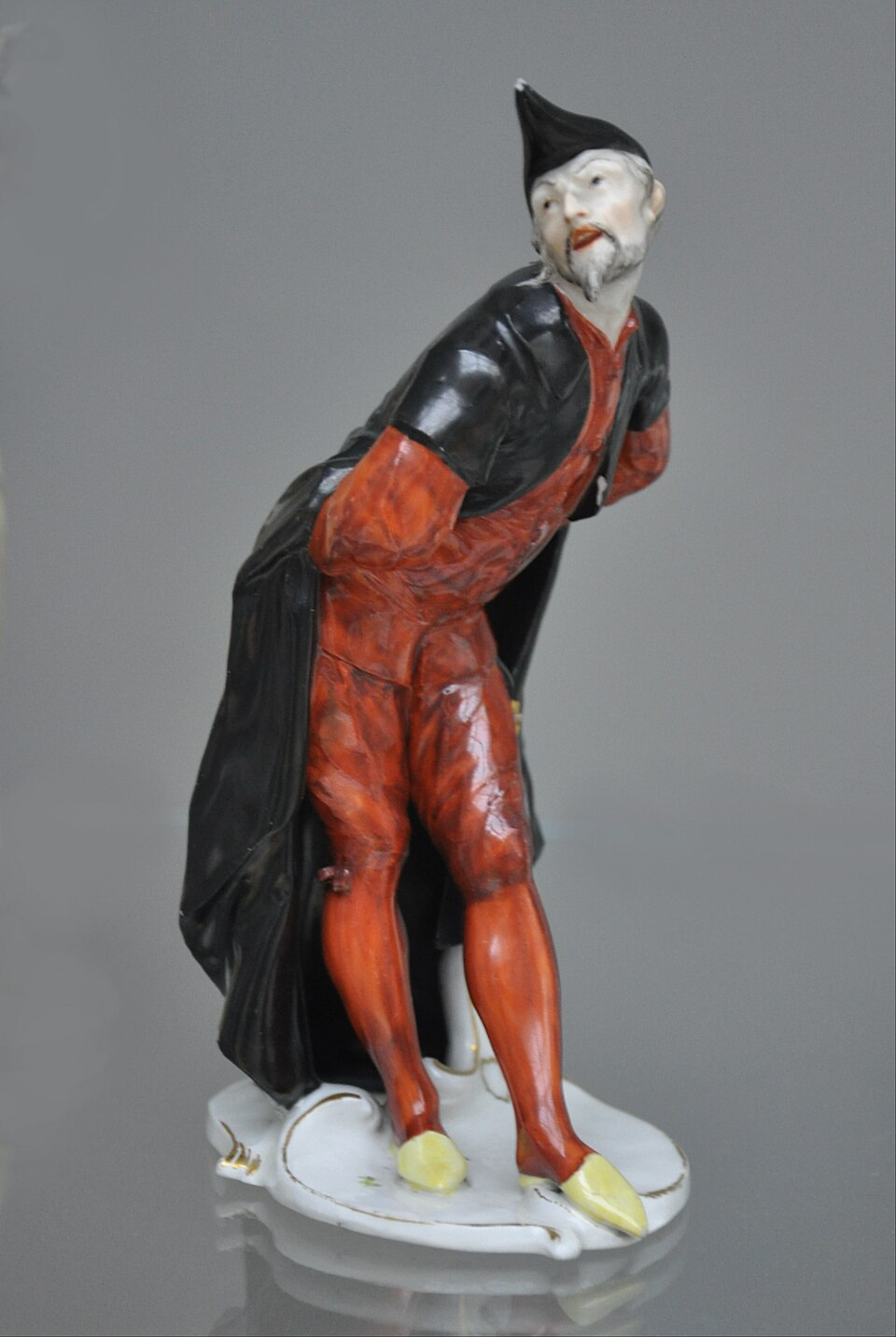
Bustelli’s Commedia dell’Arte
Bustelli’s best-known achievement is his group of 16 Commedia dell’Arte characters, inspired by the Italian improvised theatre tradition.
The figures are not conceived merely as isolated statuettes. Their gestures, glances and poses form relationships between characters and allow the complete ensemble to function almost like a theatrical performance in porcelain.
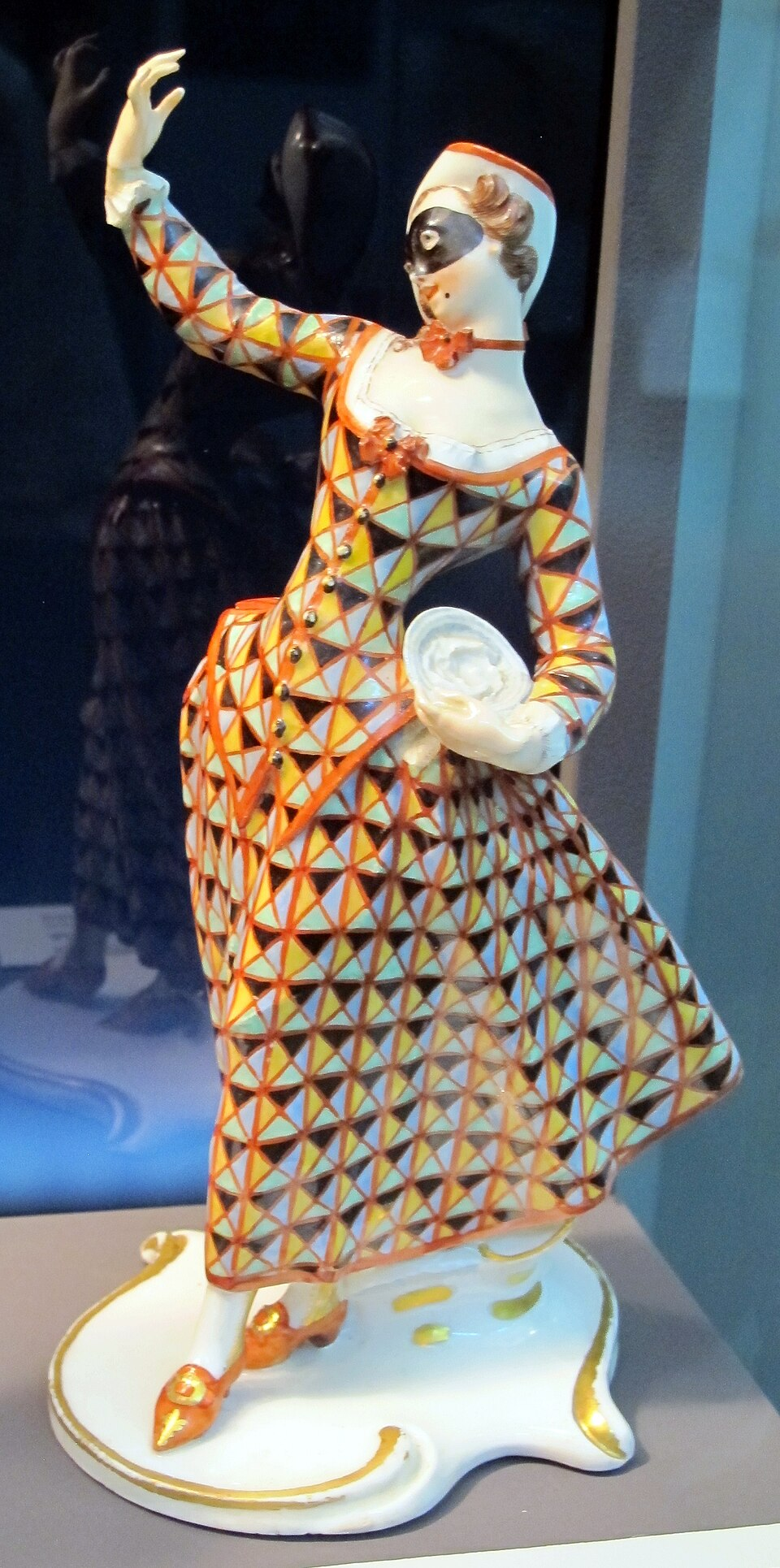
Important distinction:
a figurine being “after a model by Franz Anton Bustelli” does not automatically mean that the physical object was made around 1760. Historic Nymphenburg models have remained in production over long periods. The date of the original design and the production date of the individual porcelain figure must be treated separately.
Dominikus Auliczek – Bustelli’s Artistic Successor
After Bustelli’s death, another major sculptor shaped the artistic development of Nymphenburg: Dominikus Auliczek.
Auliczek came to Munich in 1762 and began working for the manufactory in 1763. He became Bustelli’s artistic successor and later served as inspector and artistic director.
His work demonstrates a different artistic temperament. While Bustelli is celebrated for Rococo theatricality and movement, Auliczek’s production includes highly observed animal sculpture and later Neoclassical designs.
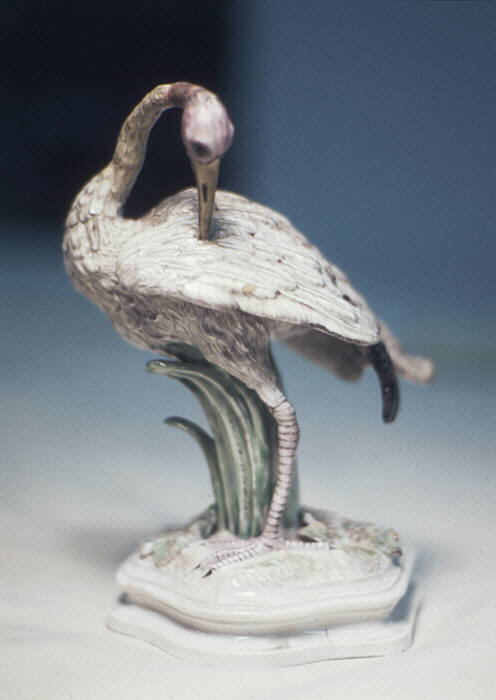
Animal figures require particularly careful condition inspection. Legs, beaks, horns, ears, tails, foliage and applied flowers are especially vulnerable to damage and restoration.
Collector Categories
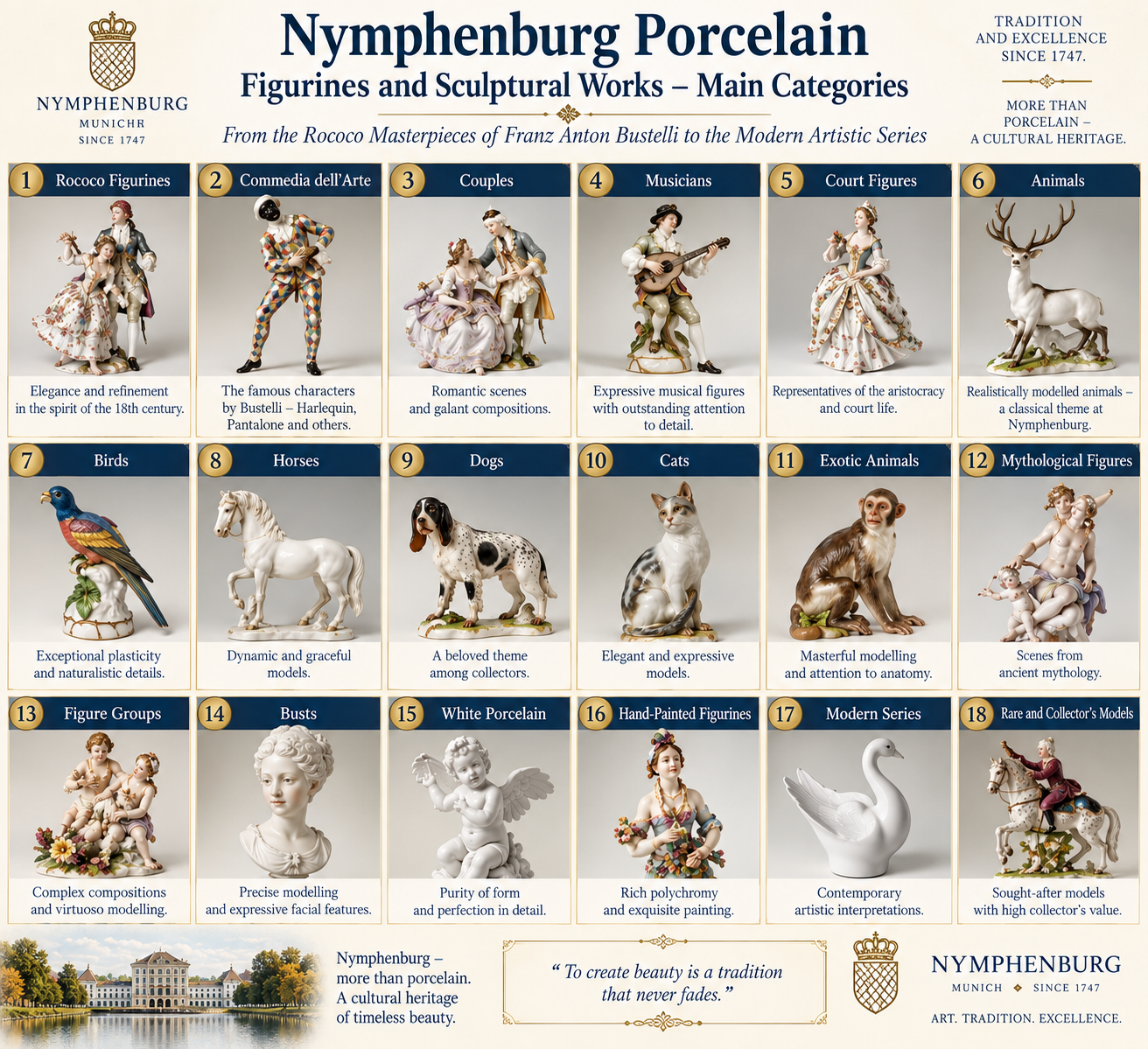
Nymphenburg Figurines and Sculptural Porcelain
Nymphenburg’s sculptural production extends far beyond Bustelli’s Commedia dell’Arte.
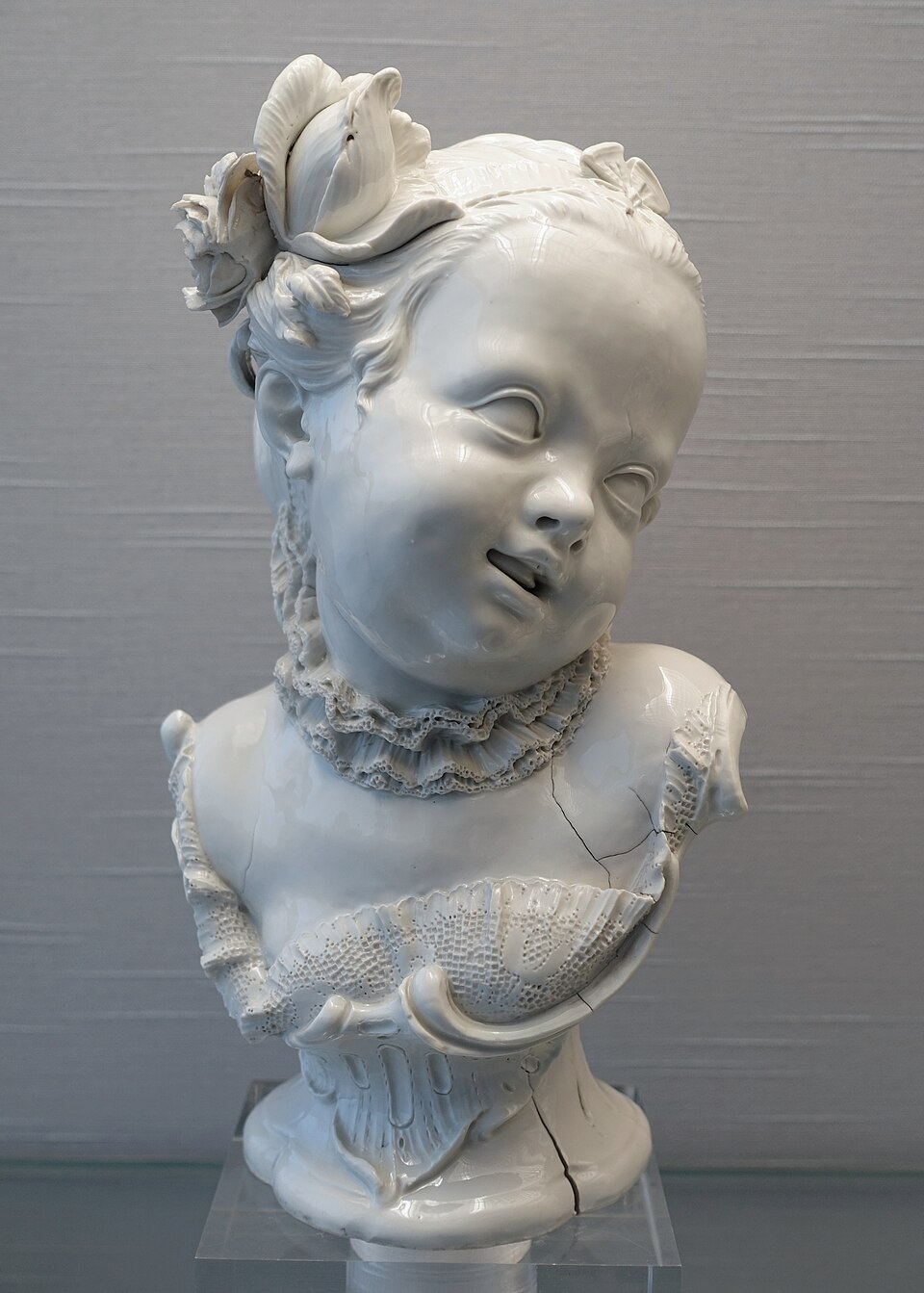
Collectors may encounter court figures, couples, musicians, mythological subjects, birds, horses, dogs, other animals, portrait busts, white porcelain figures and later artist editions.
For every figurine, record the exact model number, measurements, mark, colourway and condition before comparing it with reference examples.
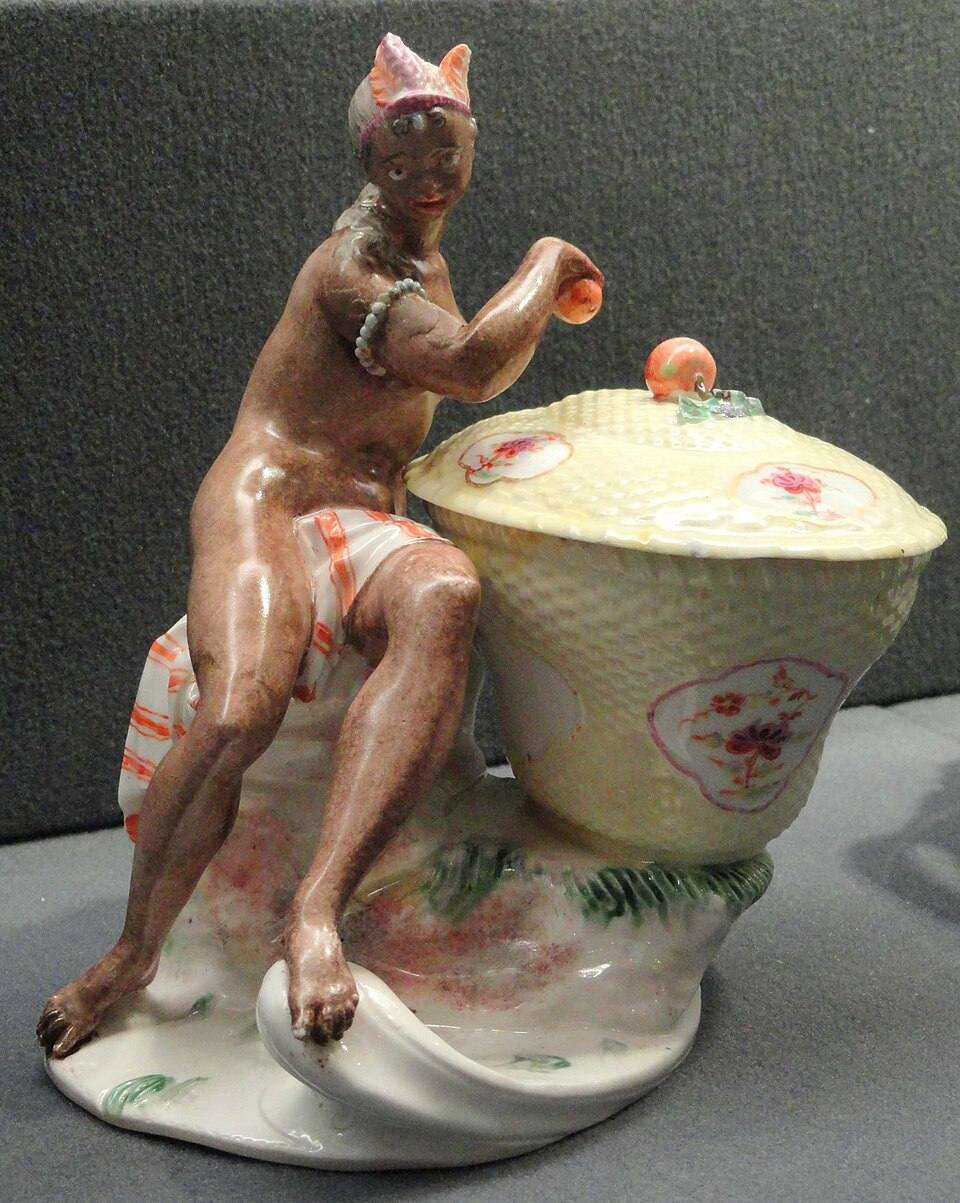
Nymphenburg Produced More Than Figurines
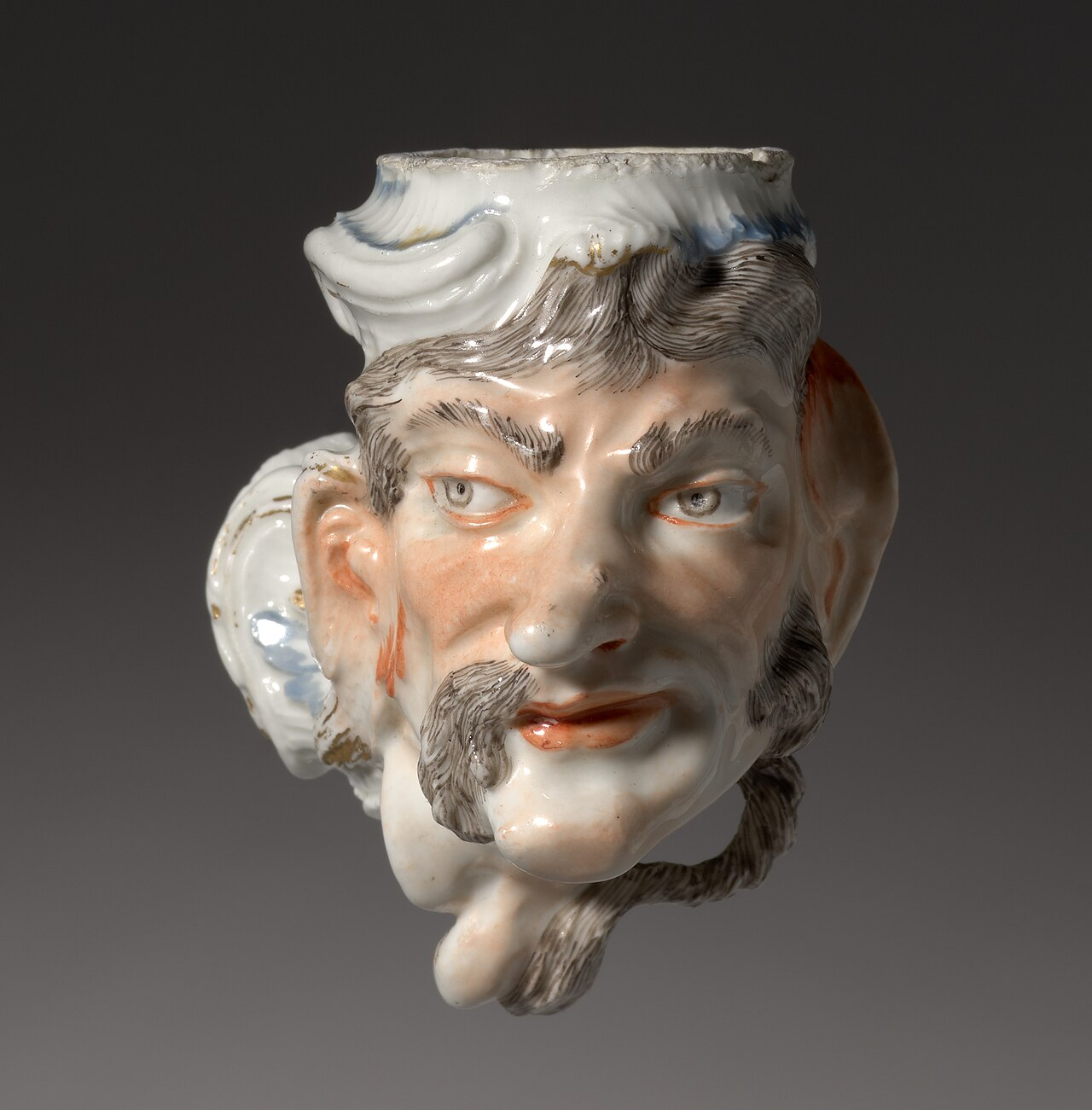
Collectors should avoid thinking of Nymphenburg solely in terms of table services and freestanding figurines.
During the eighteenth century, porcelain was used for a wide variety of luxury and personal objects. Some early Nymphenburg pieces therefore appear in forms that can surprise modern collectors.
Nymphenburg Tableware and Decorative Porcelain
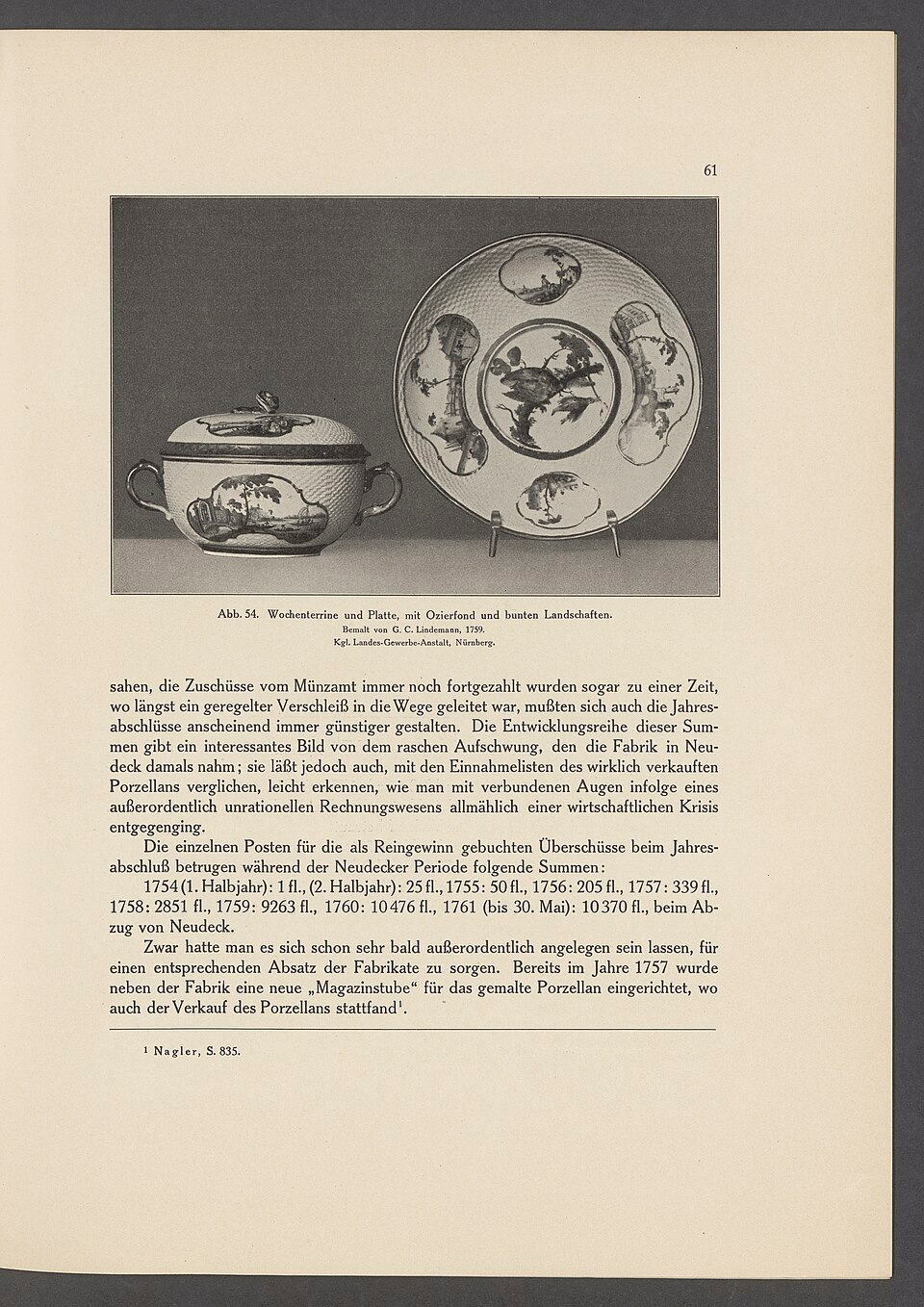
Alongside figurative sculpture, Nymphenburg produced refined table services, plates, bowls, cups, tureens, boxes and other decorative vessels.
When researching tableware, pay particular attention to the exact shape, model number, painted decoration, gilding and whether all parts genuinely belong together.
Why Historical Reference Material Matters
Historical publications, museum catalogues and documented collections are invaluable when studying early Nymphenburg porcelain.
They can connect an object with a known form, decorator, service or period.
Marks & Identification
Nymphenburg Porcelain Marks – The Wittelsbach Shield
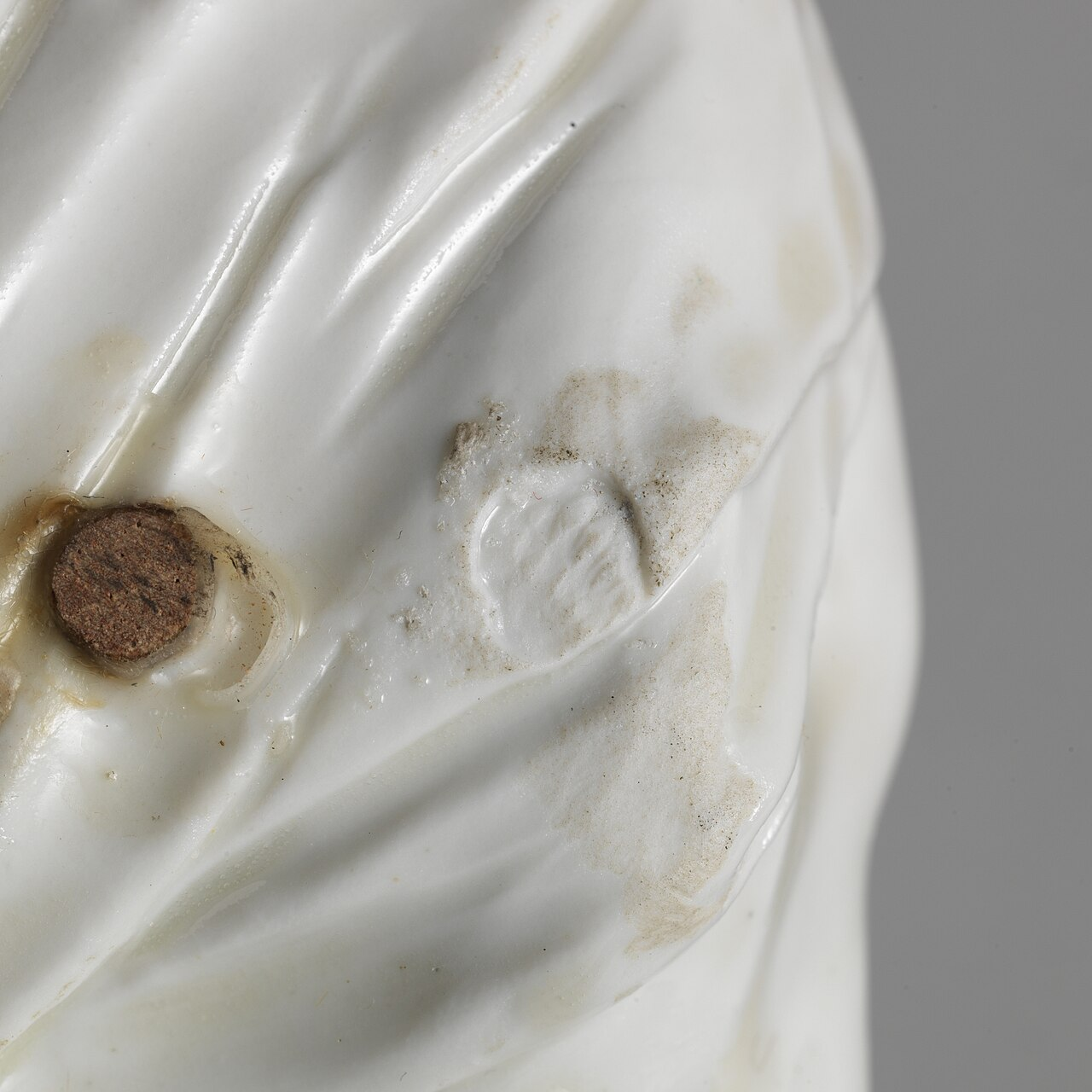
The best-known Nymphenburg porcelain mark is the Wittelsbach lozenge shield, derived from the heraldry of Bavaria’s ruling house.
From 1754, the shield was used as an identifying sign on Nymphenburg porcelain. Its heraldic form and execution changed repeatedly over the following centuries, making the exact variant useful for approximate dating.
Official Nymphenburg Mark Milestones
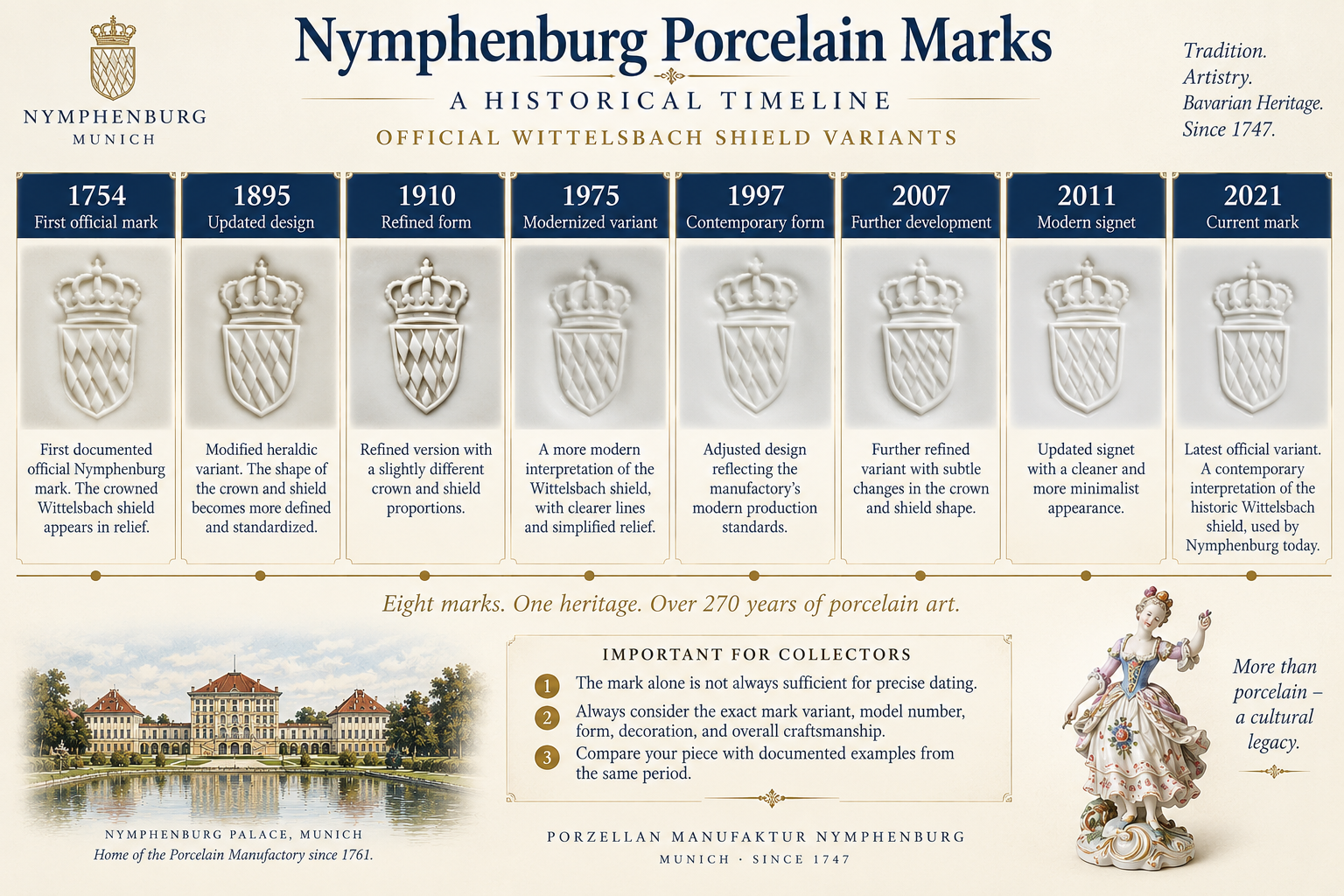
The manufactory’s published historical mark reference identifies important signet variants beginning in the following years:
| Published Mark Milestone | Collector Use |
|---|---|
| 1754 | Earliest official Wittelsbach shield reference in the manufacturer’s published mark chronology. |
| 1895 | A later documented heraldic variant. |
| 1910 | Another documented development of the shield signet. |
| 1975 | Later twentieth-century mark development. |
| 1997 | Modern documented mark variant. |
| 2007 | Further development in the official mark sequence. |
| 2011 | Published contemporary signet milestone. |
| 2021 | Latest milestone included in the official historical mark overview. |
Collector warning:
the presence of a Wittelsbach-style shield does not automatically prove that a porcelain object is genuine Nymphenburg. Famous marks can be copied, misread or imitated. The object itself must support the mark.
For a broader explanation of factory marks, backstamps and secondary symbols, see our
Porcelain Marks Identification Guide
.
Nymphenburg Model Numbers – What Do the Numbers Mean?
Model numbers are among the most valuable identification clues on Nymphenburg porcelain.
The manufactory documents that its figures carry a model number. Depending on the object, this may appear together with a size designation such as I or II and an additional number associated with the moulder.
Tableware pieces may carry a three- or four-digit model number together with a single-digit size number.
| Marking | Possible Function |
|---|---|
| Model Number | Identifies a particular design, figure or form. |
| I / II | May indicate a size version on certain figures. |
| Moulder Number | Can relate to the craftsman involved in forming the piece. |
| Tableware Size Number | May distinguish different sizes of the same tableware form. |
Do not assume that every number is a year.
Model, size and production numbers are far more common than literal production dates.
Dating
How to Date Nymphenburg Porcelain
The safest method is not to search for one clue that supposedly provides an exact year. Instead, build a chronological case from several independent features.
NYMPHENBURG DATING FORMULA
exact shield variant + model number + form + modeller + decoration + manufacturing technique + documented history
| Step | What to Check |
|---|---|
| 1 | Photograph the entire underside, not only the shield. |
| 2 | Compare the exact Wittelsbach mark variant. |
| 3 | Record every impressed, painted and handwritten number. |
| 4 | Identify the model and its original designer if possible. |
| 5 | Study painting, gilding, glaze and manufacturing quality. |
| 6 | Compare with documented museum, factory and catalogue references. |
For the general methodology behind this process, read
How to Date Antique Porcelain
.
Craftsmanship
How Nymphenburg Porcelain Is Made
Traditional manufacture is central to Nymphenburg’s identity.
The manufactory continues to describe its porcelain as completely handmade in Munich using techniques passed down through generations.
| Workshop Stage | Collector Relevance |
|---|---|
| Model Room | Original artistic designs establish the form. |
| Mould Making | Complex figures may require numerous individual moulds. |
| Forming | Porcelain components are shaped and prepared. |
| Bossing / Assembly | Separate parts are joined and details refined by hand. |
| Firing | Controls vitrification, strength and final porcelain character. |
| Painting | Hand decoration can strongly influence artistic and collector interest. |
| Gilding | Gold details are another important indicator of quality and condition. |
Authenticity
How to Identify Authentic Nymphenburg Porcelain
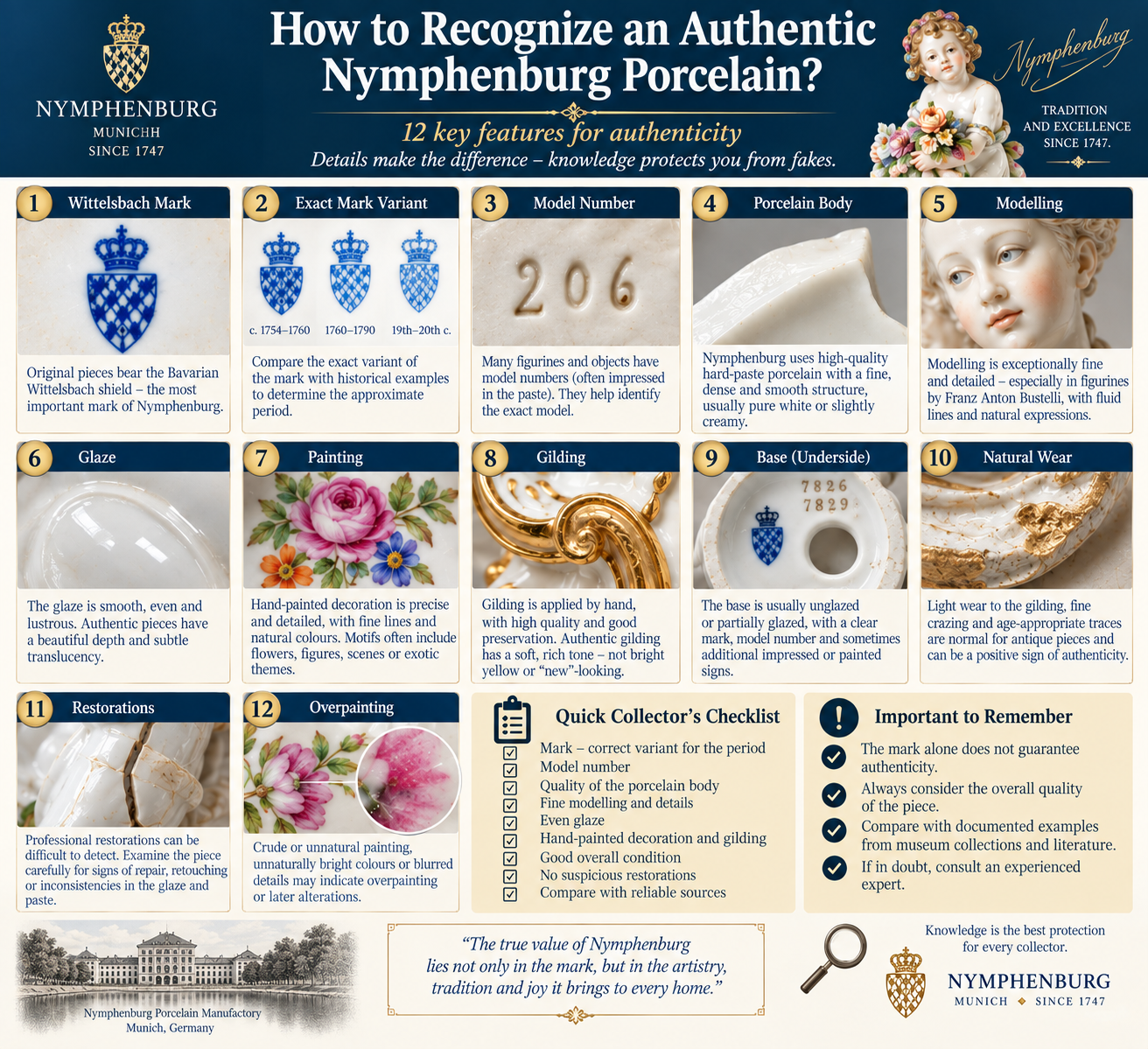
Authenticity is established by consistency. The mark, porcelain body, model, decoration and condition should all make sense together.
| Feature | What to Examine |
|---|---|
| Wittelsbach Mark | Exact shape, execution and compatibility with the proposed period. |
| Model Number | Whether it corresponds with the documented model. |
| Porcelain Body | Fine, dense hard-paste porcelain and careful finishing. |
| Modelling | Crisp detail, convincing anatomy and refined transitions. |
| Glaze | Quality, consistency and compatibility with the piece. |
| Painting | Brushwork, colour, style and whether later overpainting is present. |
| Gilding | Application quality and natural wear. |
| Base | Mark, model numbers, wear and evidence of alteration. |
| Restoration | Glue, filler, overspray, replaced parts and reconstructed details. |
| Provenance | Old labels, invoices, collection records or exhibition history. |
For a wider discussion of porcelain body, glaze, ageing and copied marks, see our
Complete Guide to Identifying Antique Porcelain
.
Collector Value
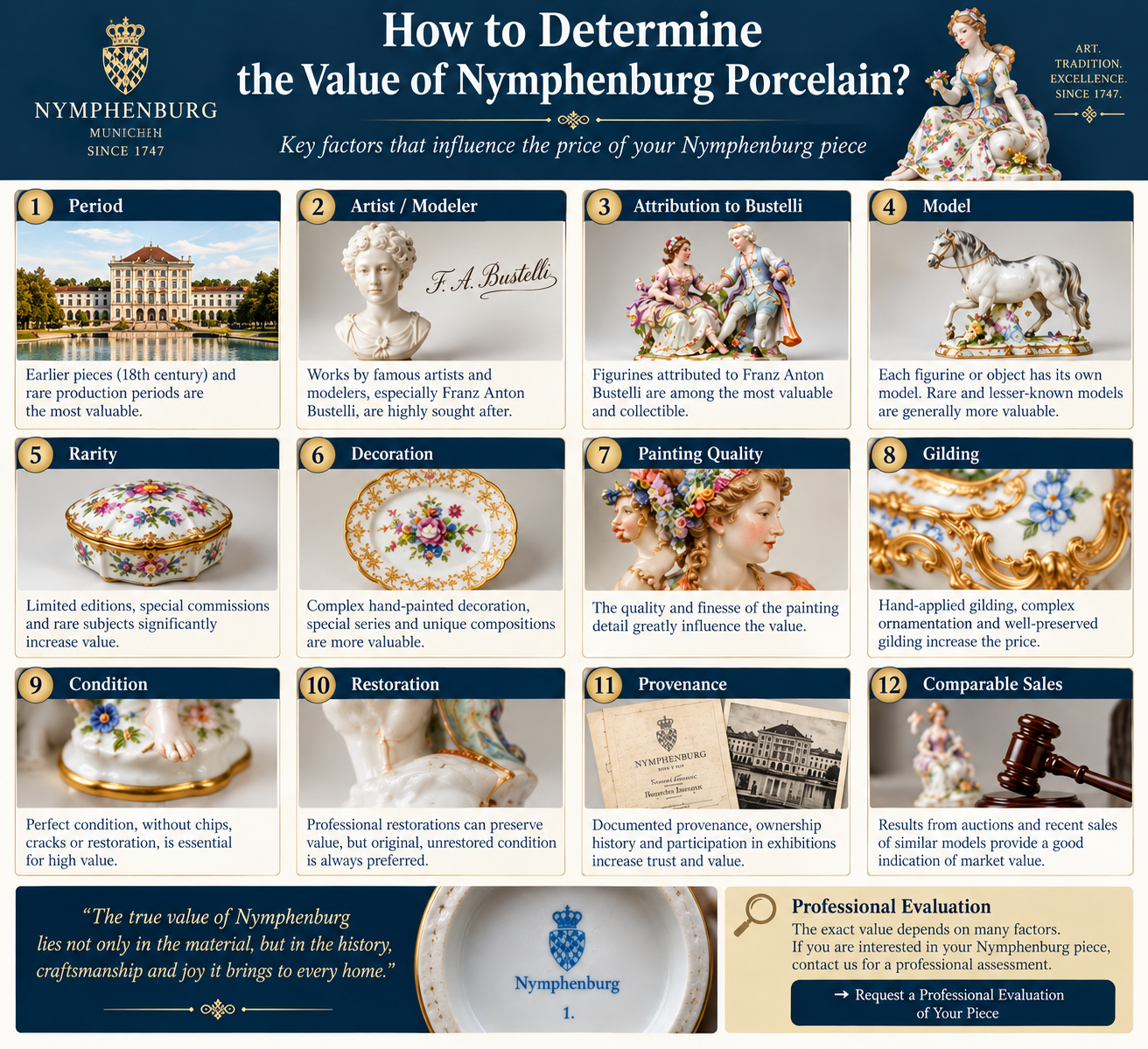
What Determines the Value of Nymphenburg Porcelain?
There is no reliable universal price list for Nymphenburg porcelain.
The same historic design may exist in different production periods, colourways, sizes and conditions.
Value is therefore the result of several factors acting together.
| Factor | Why It Matters |
|---|---|
| Production Period | Early and historically important production may attract stronger collector interest. |
| Artist / Modeller | Documented designs by important artists can be more desirable. |
| Bustelli Association | Bustelli models occupy a particularly important place in Nymphenburg collecting. |
| Model | Certain subjects and model numbers have stronger demand. |
| Rarity | Uncommon variants and limited production can increase interest. |
| Decoration | Complex hand painting and specialist decoration may add desirability. |
| Gilding | Quality and preservation matter more than simply the amount of gold. |
| Condition | Chips, cracks and losses usually reduce value. |
| Restoration | Its effect depends on rarity, extent and quality of the repair. |
| Provenance | Documented ownership and collection history can strengthen an object’s significance. |
| Comparable Sold Examples | Recent completed sales provide a better market reference than asking prices alone. |
Asking Price vs. Sold Price
One of the most common valuation mistakes is comparing an object only with high asking prices found online.
An asking price represents what a seller hopes to receive. A completed sale shows what a buyer was actually prepared to pay under those particular market conditions.
The strongest comparison is an object with:
- the same model number;
- the same or closely related production period;
- the same size;
- a comparable colourway or decoration;
- similar condition;
- similar restoration history;
- comparable provenance.
Collector Principle
Compare like with like. A later Bustelli-model figure should not automatically be valued against an eighteenth-century example simply because the underlying design is the same.
Collector Checklist
12 Steps for Examining Nymphenburg Porcelain
| 1. Photograph the complete object | Front, back, sides and underside. |
| 2. Photograph the mark | Use sharp, even light and photograph straight down. |
| 3. Record all numbers | Include impressed, painted and handwritten markings. |
| 4. Measure the object | Height, width, depth and diameter where appropriate. |
| 5. Identify the model | Compare with factory and museum documentation. |
| 6. Research the modeller | Bustelli, Auliczek or another documented artist. |
| 7. Examine the decoration | Painting, gilding and later alterations. |
| 8. Inspect fragile details | Fingers, flowers, ears, horns, tails, handles and foliage. |
| 9. Check for cracks and chips | Use strong side lighting. |
| 10. Look for restoration | Glue, filler, repainting, overspray and replacement parts. |
| 11. Research provenance | Old labels, invoices, catalogues and collection records. |
| 12. Compare the market | Use genuinely comparable completed sales. |
The Old Antiquarian
Do You Have Nymphenburg Porcelain?
Send clear photographs of the complete object, the underside, the Wittelsbach mark, every model number and any visible damage or restoration. For figurines, include the exact height and photographs from several angles.
Frequently Asked Questions
Nymphenburg Porcelain FAQ
When was Nymphenburg porcelain founded?
The Electoral Porcelain Manufactory was founded in Bavaria in 1747 under Elector Max III Joseph.
When did Nymphenburg successfully begin producing porcelain?
Controlled porcelain production was successfully achieved in 1754 after the manufactory’s difficult experimental years.
When did Nymphenburg move to the palace complex?
The workshops moved to the northern roundel of the Nymphenburg Palace complex in Munich in 1761.
What is the main Nymphenburg porcelain mark?
The most characteristic mark is the Wittelsbach lozenge shield. Its exact heraldic form changed during the manufactory’s long history.
Does a Nymphenburg mark prove authenticity?
No. The mark is an important clue, but the porcelain body, form, model number, decoration, craftsmanship and condition must also correspond with documented Nymphenburg production.
Who was Franz Anton Bustelli?
Bustelli was the great Rococo modeller associated with Nymphenburg. He worked at the manufactory from 1754 until his death in 1763 and created approximately 150 designs.
What are the Nymphenburg Commedia dell’Arte figures?
They are a celebrated group of 16 theatrical characters designed by Franz Anton Bustelli and are among the best-known achievements of European Rococo porcelain sculpture.
Are all Bustelli-model figurines from the eighteenth century?
No. The original model may date from the eighteenth century while an individual porcelain example may have been produced much later. The object itself must be dated.
What do numbers on Nymphenburg porcelain mean?
They may identify the model, size, moulder or another production reference. They should not automatically be interpreted as a production year.
Who was Dominikus Auliczek?
Auliczek began working at Nymphenburg in 1763 and became Bustelli’s artistic successor. His work includes notable animal sculpture and later Neoclassical designs.
How can I tell whether a Nymphenburg figurine has been restored?
Look for differences in gloss, colour and surface texture, as well as glue lines, filler, overspray, reconstructed fingers, flowers, horns, tails or other fragile details.
Is Nymphenburg porcelain valuable?
Some pieces can be highly collectible, particularly important models, early examples, rare variants and objects with strong condition and provenance. Other later or more common pieces may have considerably more modest market values.
How is Nymphenburg porcelain valued?
Period, modeller, model number, rarity, decoration, condition, restoration, provenance and recent comparable sales should all be considered together.
Continue Exploring
Related Porcelain Guides
For the wider regional context, read our
Bavaria Porcelain: Marks, Makers, Dating & Value Guide
.
For a complete overview of major factories, materials and collecting principles, continue with our
Guide to Antique Porcelain
.
If your main challenge is the mark on the underside, see
Porcelain Marks Identification
.
For step-by-step age research, visit
How to Date Antique Porcelain
.
Sources & Further Research
Sources and Reference Material
The historical chronology, porcelain marks and manufacturing information in this guide have been checked against official manufactory documentation and museum records.
- Porzellan Manufaktur Nymphenburg – House Wittelsbach and the history of the manufactory;
- Porzellan Manufaktur Nymphenburg – historical Wittelsbach shield marks;
- Porzellan Manufaktur Nymphenburg – porcelain stamps and model-number system;
- Porzellan Manufaktur Nymphenburg – Franz Anton Bustelli;
- Porzellan Manufaktur Nymphenburg – Dominikus Auliczek;
- Porzellan Manufaktur Nymphenburg – workshops and handmade production;
- The Metropolitan Museum of Art – Pantaloon by Franz Anton Bustelli, circa 1760;
- The Metropolitan Museum of Art – Crane by Dominikus Auliczek, circa 1767;
- Germanisches Nationalmuseum – Nymphenburg and Bustelli reference objects;
- Victoria and Albert Museum – Bustelli and Nymphenburg figurative porcelain;
- Gardiner Museum – eighteenth-century Nymphenburg decorative porcelain;
- historic catalogues and documented museum collections of German porcelain.
Research note:
the date of a historical model and the manufacturing date of an individual object are not necessarily the same. Nymphenburg has preserved and reused historic forms, so every object should be dated from the complete combination of mark, model number, technique, decoration and documented history.
About the Author
The Old Antiquarian
The Old Antiquarian combines more than 35 years of practical experience with antiques and collectibles with historical, museum and comparative research. When examining porcelain, we consider the maker, mark, model, material, decoration, craftsmanship, condition, restoration and provenance as interconnected evidence rather than relying on any single characteristic.
With Nymphenburg, the mark begins the investigation — the craftsmanship completes it.
The strongest identification is reached when the exact Wittelsbach shield, model number, form, modeller, porcelain body, decoration, condition and documented history all support the same attribution and production period.
Last Updated: September 2026
