
Shelley China Dating & Value
Shelley China: Marks, Backstamps, Patterns, Dating & Value – Complete Collector Guide
Last Updated: September 15, 2026
|
By The Old Antiquarian
Shelley China is highly collectible English china associated with the
historic Foley works in Staffordshire and the earlier names
Wileman, Wileman & Co. and Foley.
Joseph Ball Shelley joined the business in 1862, Wileman & Co. was established
in the early 1870s, and the Shelley name began appearing prominently from around 1910.
The company later became Shelley Potteries Ltd. and remained a family business until 1966.
To identify Shelley correctly, examine the
exact backstamp, body, shape, pattern, registration or shape numbers,
decoration, wear and condition together.
A Shelley mark alone is not enough to prove authenticity or an exact date.
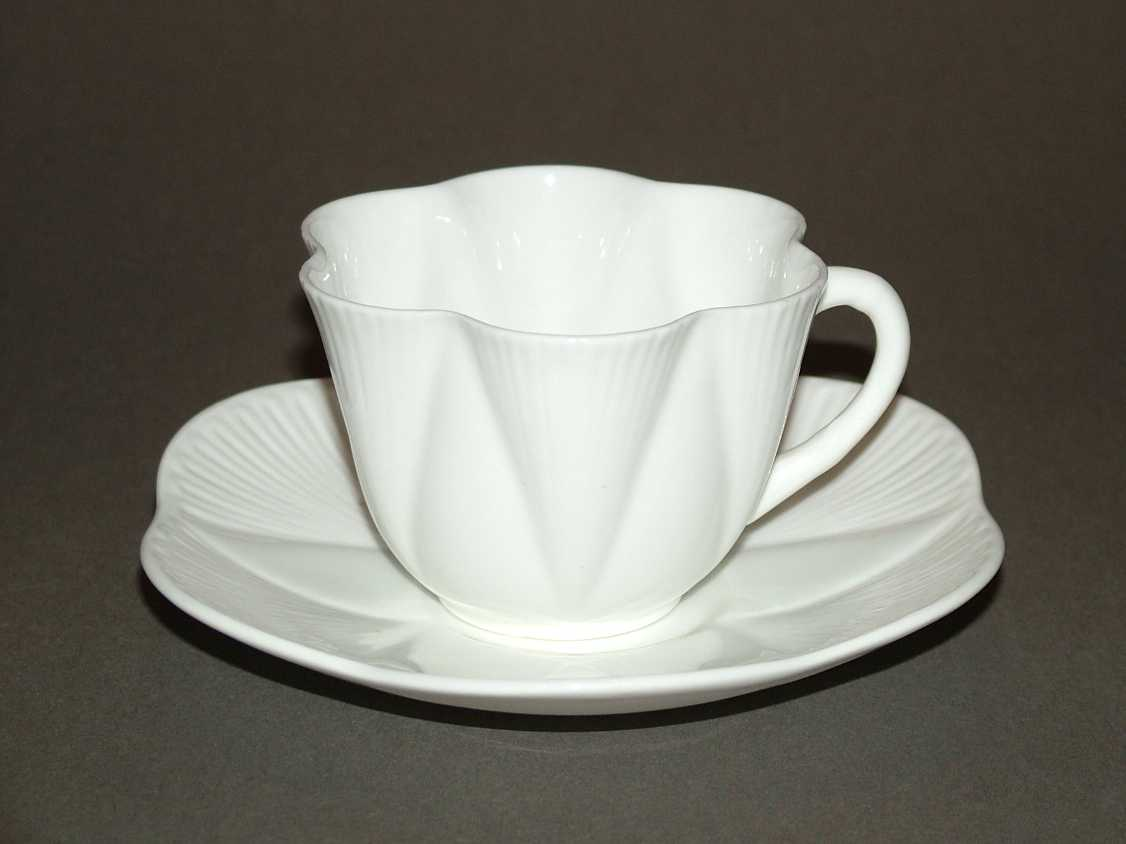
Rowland Morris and registered in 1896; it remained an important part of production
until the Shelley factory closed in 1966.
Shelley China at a Glance
| Collector Question | Quick Answer |
|---|---|
| Where was Shelley made? | At the Foley works in the Staffordshire Potteries, England. |
| What came before Shelley? | Historic pieces may carry Wileman, Wileman & Co., Foley or related marks. |
| When did Joseph Ball Shelley join? | 1862. |
| When was Wileman & Co. formed? | 1872, when James Wileman and Joseph Ball Shelley became partners at the china works. |
| When did the Shelley name appear? | The Shelley trade name and shield backstamp began appearing around 1910. |
| When was Shelley Potteries Ltd. established? | 1929, following an earlier company-name change in 1925. |
| When did independent Shelley production end? | 1966. |
| Famous Shelley shape? | Dainty, registered in 1896, is among the most famous. |
| Famous Art Deco shapes? | Vogue, Mode and later Eve are strongly associated with Eric Slater. |
| What determines value? | Period, rarity, shape, pattern, colourway, completeness, condition, restoration, provenance and comparable completed sales. |
BACKSTAMP ≠ COMPLETE IDENTIFICATION
Read the mark together with the body, shape, pattern, decoration,
numbers, natural wear, condition and documented references.
Shelley belongs to the wider tradition of
English porcelain and bone china,
but its unusual history means that an authentic piece may not necessarily say “Shelley” on the base.
Earlier Wileman and Foley-related wares form an essential part of the same collecting story.
What Is Shelley China?
Shelley China is a celebrated name in twentieth-century English ceramics,
especially admired for elegant tea wares, fine china and bone china,
graceful cup shapes, floral patterns, Art Deco designs and distinctive children’s wares.
For collectors, however, Shelley begins before the word Shelley appears prominently
on the base. The factory history is closely connected with the names
Wileman, Wileman & Co. and Foley.
This makes Shelley collecting particularly interesting—but also creates one of its most common
identification problems.
an early Wileman piece can belong to the historical development that eventually became Shelley
even though the word “Shelley” is absent from its backstamp.
History of Shelley China – From Wileman to Shelley Potteries
The Shelley story developed around the Foley works between Fenton and Longton
in the Staffordshire Potteries.
Joseph Ball Shelley joined the Wileman business in 1862,
initially working as a travelling representative.
In 1872, James Wileman took Joseph Shelley into partnership in the china works,
which traded as Wileman & Co.
When Wileman later withdrew from the china business, the Shelley family continued operating
the works while retaining the Wileman & Co. name for many years.
Around 1910, Shelley began replacing Foley as the prominent trade name,
and the now-familiar Shelley name began to appear on backstamps.
In 1925 the registered company name moved away from Wileman & Co.,
and in 1929 the business became Shelley Potteries Ltd.
Independent production ultimately ended in 1966.
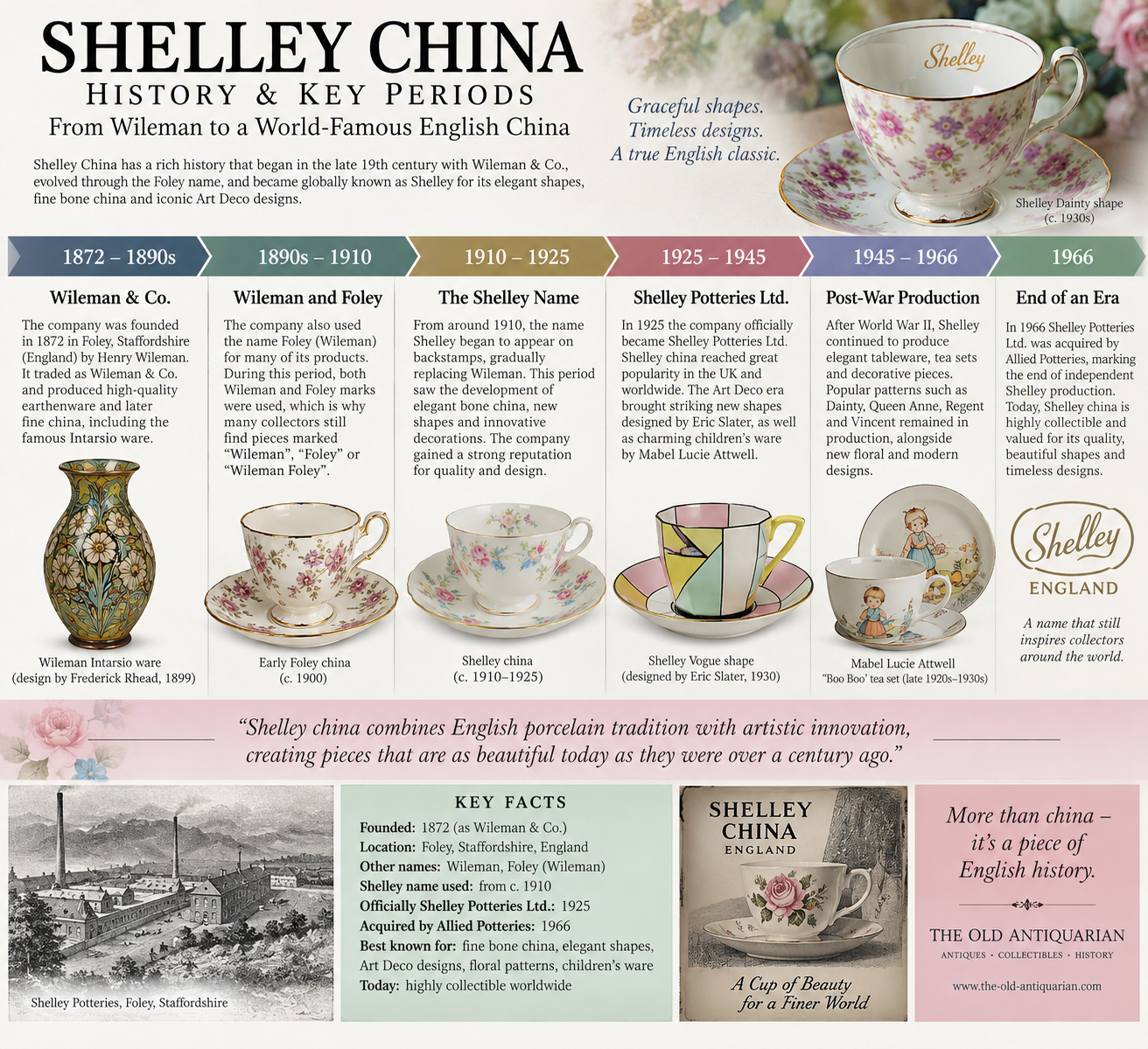
For precise historical dating, use the documented chronology in the table below rather than relying on a graphic alone.
Shelley & Wileman Timeline
| Date | Development | Collector Significance |
|---|---|---|
| 1862 | Joseph Ball Shelley joins the Wileman business. | The Shelley family enters the factory story before the Shelley brand appears on wares. |
| 1872 | James Wileman and Joseph Shelley operate the china works as Wileman & Co. | Historic Wileman marks are essential to Shelley collecting. |
| 1896 | Dainty shape is registered; Frederick Rhead becomes Art Director. | Dainty becomes one of the most enduring shapes associated with the factory. |
| c. 1910 | Shelley replaces Foley as the major trade name; Shelley shield marks appear. | A critical transition for backstamp identification. |
| 1919 | Eric Slater joins and works alongside his father Walter Slater. | Important for later modern and Art Deco production. |
| 1925 | Registered company name changes from Wileman & Co. to Shelleys. | Useful historical context when interpreting marks. |
| 1926 | Important Mabel Lucie Attwell designs and nursery wares are registered. | Begins one of Shelley’s most famous designer associations. |
| 1929 | Shelley Potteries Ltd. is established. | Company wording and backstamps should be read in historical context. |
| 1930 | Vogue and Mode Art Deco shapes appear under Eric Slater. | Among the most recognisable modern Shelley forms. |
| 1932 | Harmony Ware is introduced. | An important area for collectors of Shelley Art Deco and decorative pottery. |
| 1965–1966 | The name Shelley China Ltd. is used shortly before the business changes ownership. | Marks from the final period should not be confused with earlier Shelley production. |
Wileman, Foley and Shelley – Are They the Same?
They are connected, but the words do not mean exactly the same thing.
Wileman refers to the earlier business and family,
Foley was closely associated with the location and trade identity of the works,
while Shelley became the dominant trade and company name in the twentieth century.
This is why collectors can encounter an object that is historically relevant to Shelley collecting
but carries a Wileman or Foley-related mark rather than a Shelley shield.
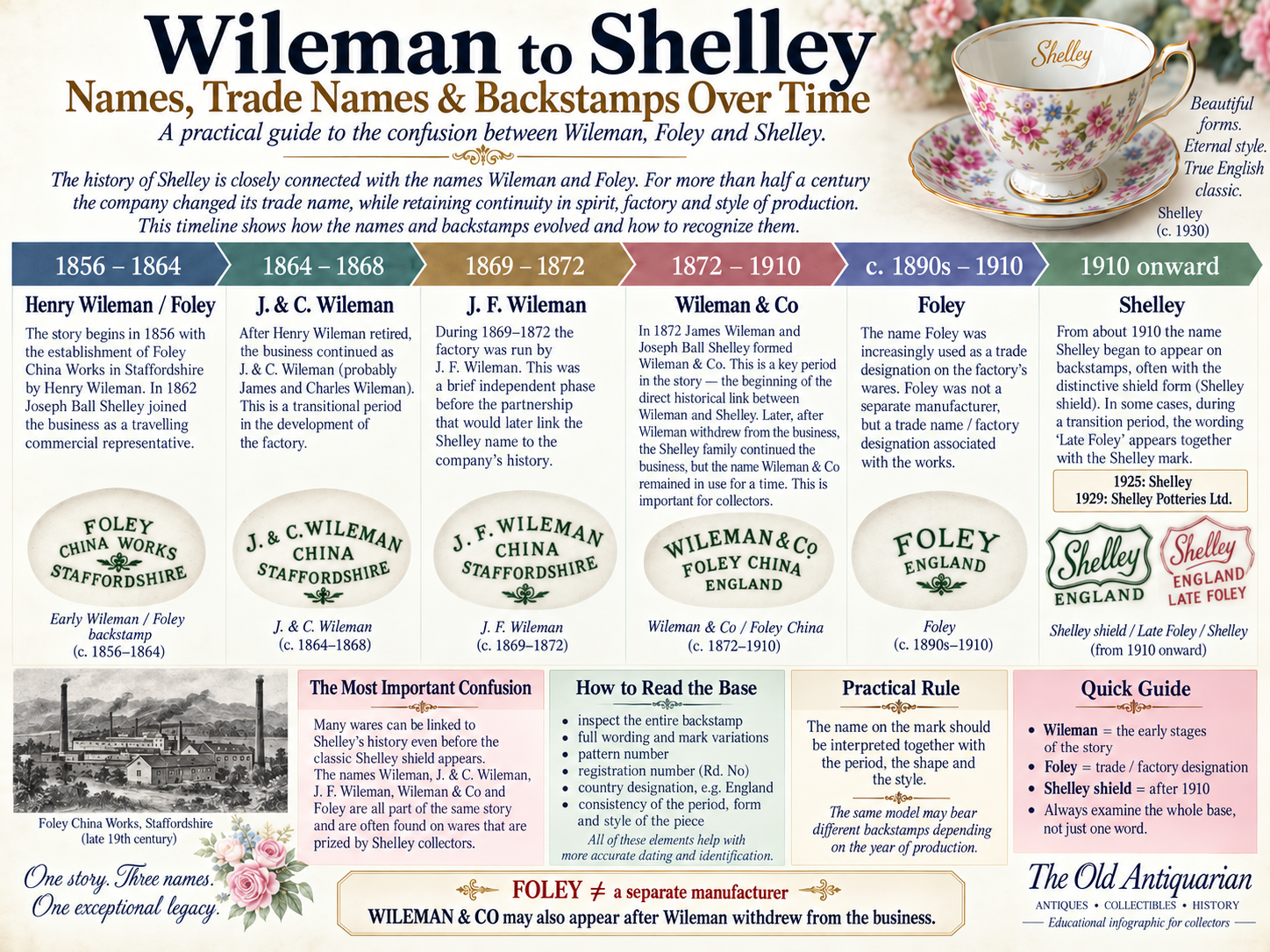
Backstamp dates should be treated as approximate research ranges because overlapping marks and variations occur.
“Foley = a completely separate Shelley-era manufacturer.”
The Foley wording must be interpreted with the exact mark, period and object.
Other Staffordshire makers also used geographical Foley wording, so context matters.
Shelley China Marks & Backstamps – How to Date Them
The backstamp is often the first clue collectors examine.
It may contain a company name, the word England, a shield or script Shelley logo,
pattern information, registration numbers or other production details.
But Shelley marks evolved gradually and can overlap.
A useful dating method therefore starts by identifying the
exact wording and mark style, then checks whether the body,
shape, decoration and additional numbers belong to the same period.
If you are unfamiliar with ceramic marks in general, our
Porcelain Marks & Backstamps Guide
explains how factory marks, model numbers, decorators’ marks and secondary symbols should be read.
| Broad Period | What You May Encounter | How to Use It |
|---|---|---|
| 19th century–c. 1910 | Wileman, Wileman & Co., Foley-related wording and multiple mark styles. | Identify the exact company wording before assuming the object is later Shelley. |
| From c. 1910 | Shelley name and shield-form marks; transitional “Late Foley” wording may appear. | Useful transition evidence, but compare the exact form and object. |
| 1920s–1930s | Numerous Shelley marks on highly collectible tea wares and Art Deco designs. | Pattern and shape information can help narrow identification. |
| Post-war–1966 | Later Shelley wording and fine/bone china marks occur in several forms. | Do not date solely from colour or one word; compare against the full object. |
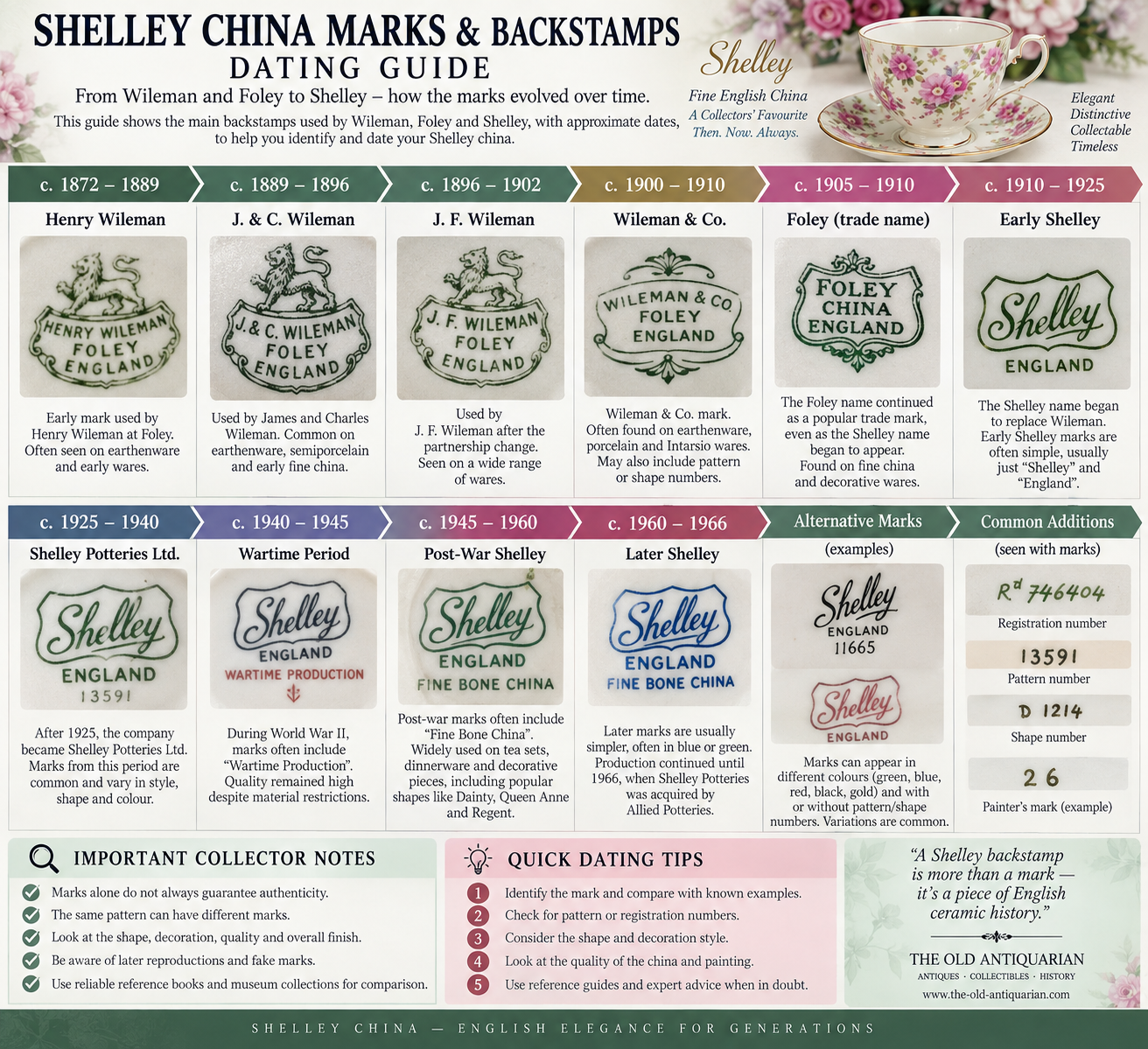
Approximate periods are useful for orientation, but exact mark variants should always be checked against specialist documentation.
Historical Shelley & Wileman Marks Reference Sheet
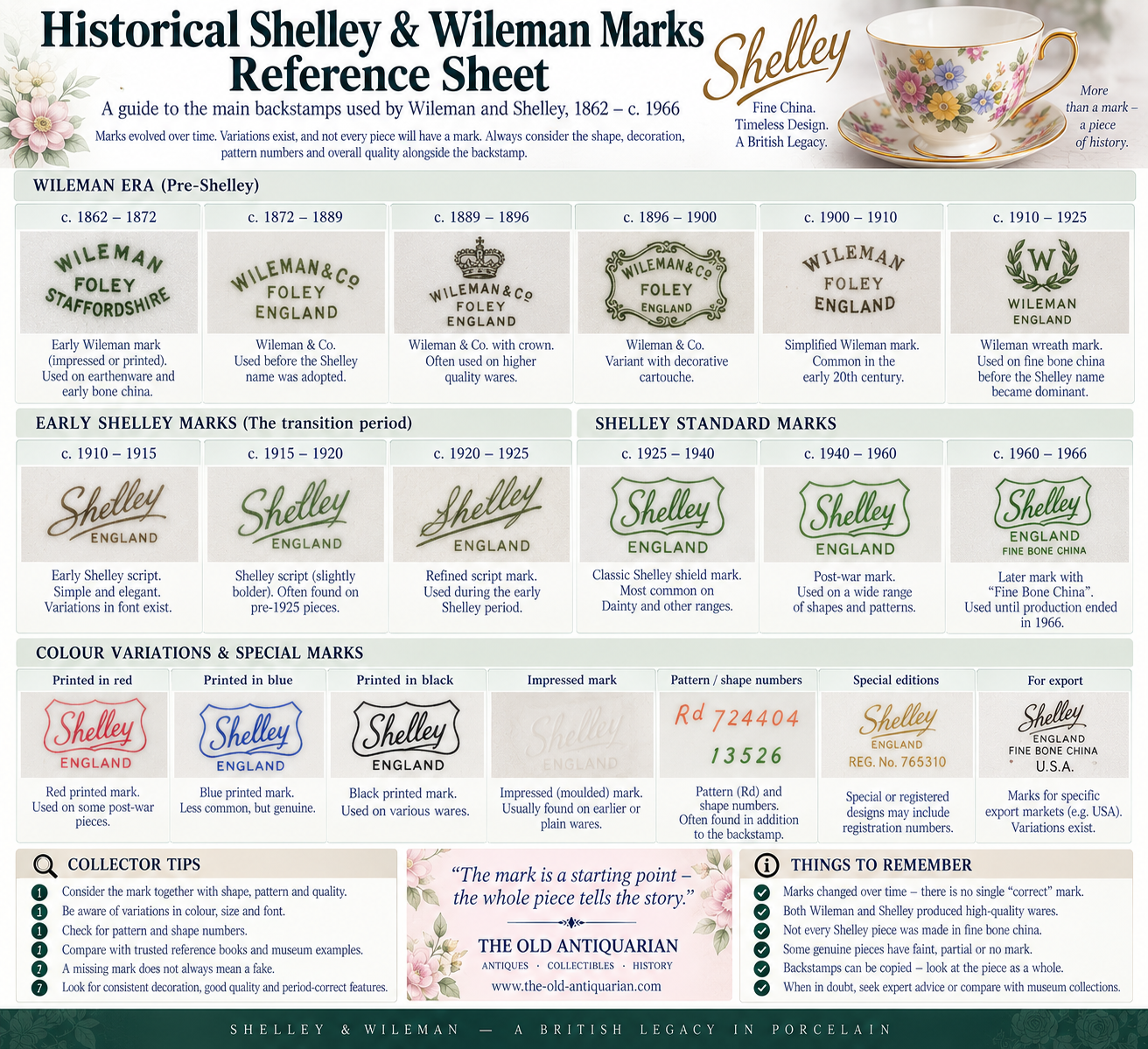
The illustrated marks are collector-orientation visuals, not a substitute for an authenticated archival backstamp catalogue.
For an important attribution, compare the exact base with documented Wileman and Shelley examples.
Collector research documents fake Shelley-style backstamps,
non-Shelley objects carrying copied marks,
and genuine Shelley blanks that were decorated outside the factory.
The complete object must confirm the mark.
Shelley Pattern Numbers, Registration Numbers & Shape Codes
Numbers on the underside of Shelley China are extremely useful,
but they are also one of the easiest areas to misunderstand.
A number is not automatically a manufacturing year.
| Marking | Likely Function | Collector Use |
|---|---|---|
| Pattern number | Identifies a decoration or pattern reference. | Useful for matching pieces and researching documented patterns. |
| Registration number / Rd No. | Relates to British design registration. | Can establish when a design was registered, but not necessarily the exact year an individual piece was made. |
| Shape number / code | References a form, mould or model. | Useful when comparing cups, jugs, teapots and other documented shapes. |
| Painter / decorator mark | Workshop or individual production information. | Only attribute an artist when supporting documentation exists. |
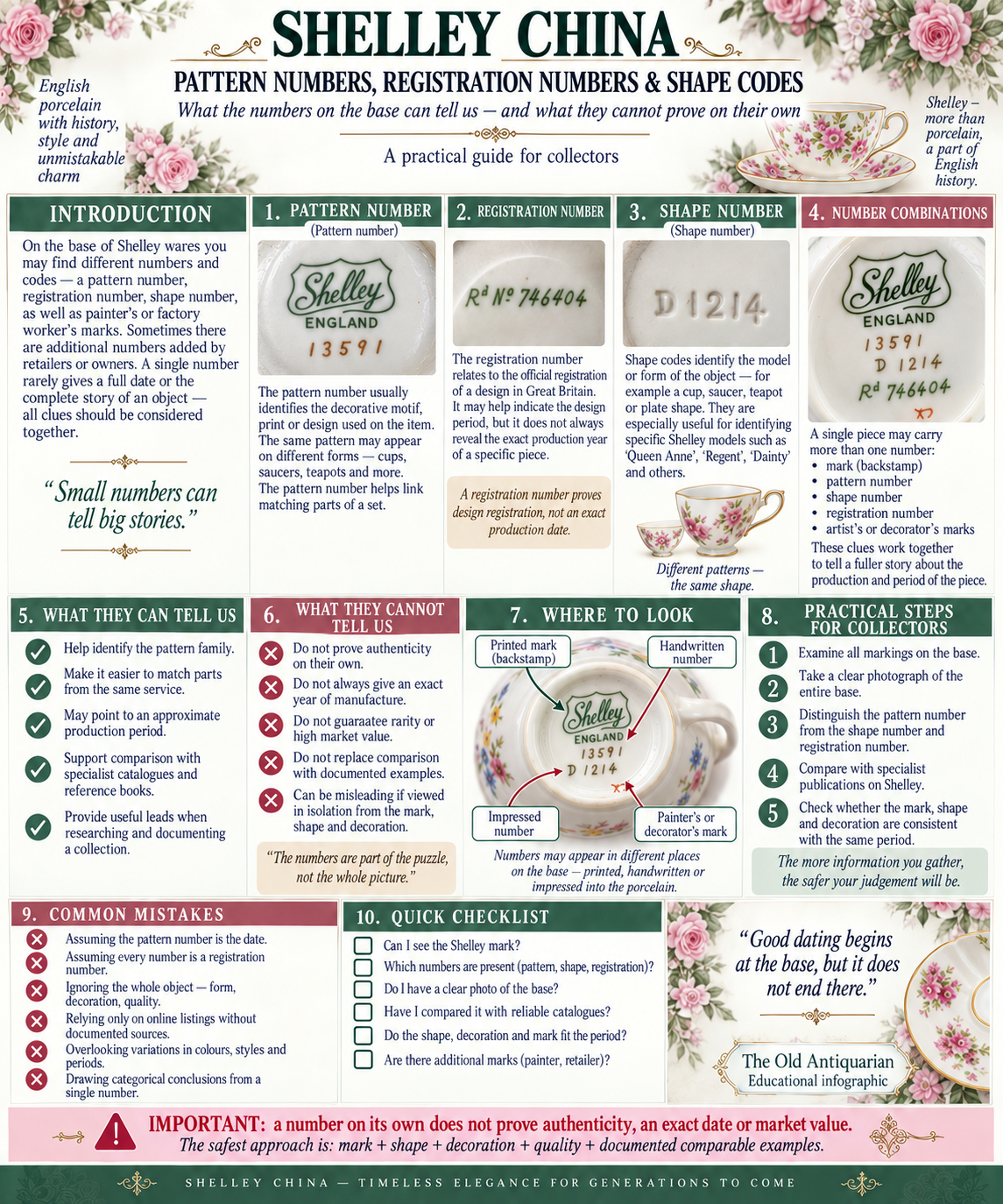
Numbers are strongest when interpreted together with the complete backstamp,
shape and decoration.
For a wider methodology on combining factory marks, styles, numbers and manufacturing clues,
continue with our
guide to dating antique porcelain.
Famous Shelley China Shapes
Shape identification is particularly important with Shelley.
A famous decoration on the wrong form can reveal a mistake,
while a rare documented shape can materially increase collector interest.
Dainty
The Dainty shape was designed by Rowland Morris and registered in
1896.
Initially associated with Dainty White, the form was later decorated in numerous patterns
and proved especially successful internationally.
Its extraordinary longevity makes it one of the central shapes in Shelley collecting.
Queen Anne
The Queen Anne shape was registered in 1926 and became an important canvas
for a wide range of decorative patterns.
As with all Shelley shapes, a pattern should not automatically be assumed to have been used
throughout the entire lifespan of the form.
Vogue & Mode
In 1930 Eric Slater helped take Shelley into a much more adventurous modern direction.
The angular Vogue and Mode shapes were paired with bold geometric
and stylised floral designs.
Their production was comparatively short,
which contributes to their strong appeal among Art Deco collectors.
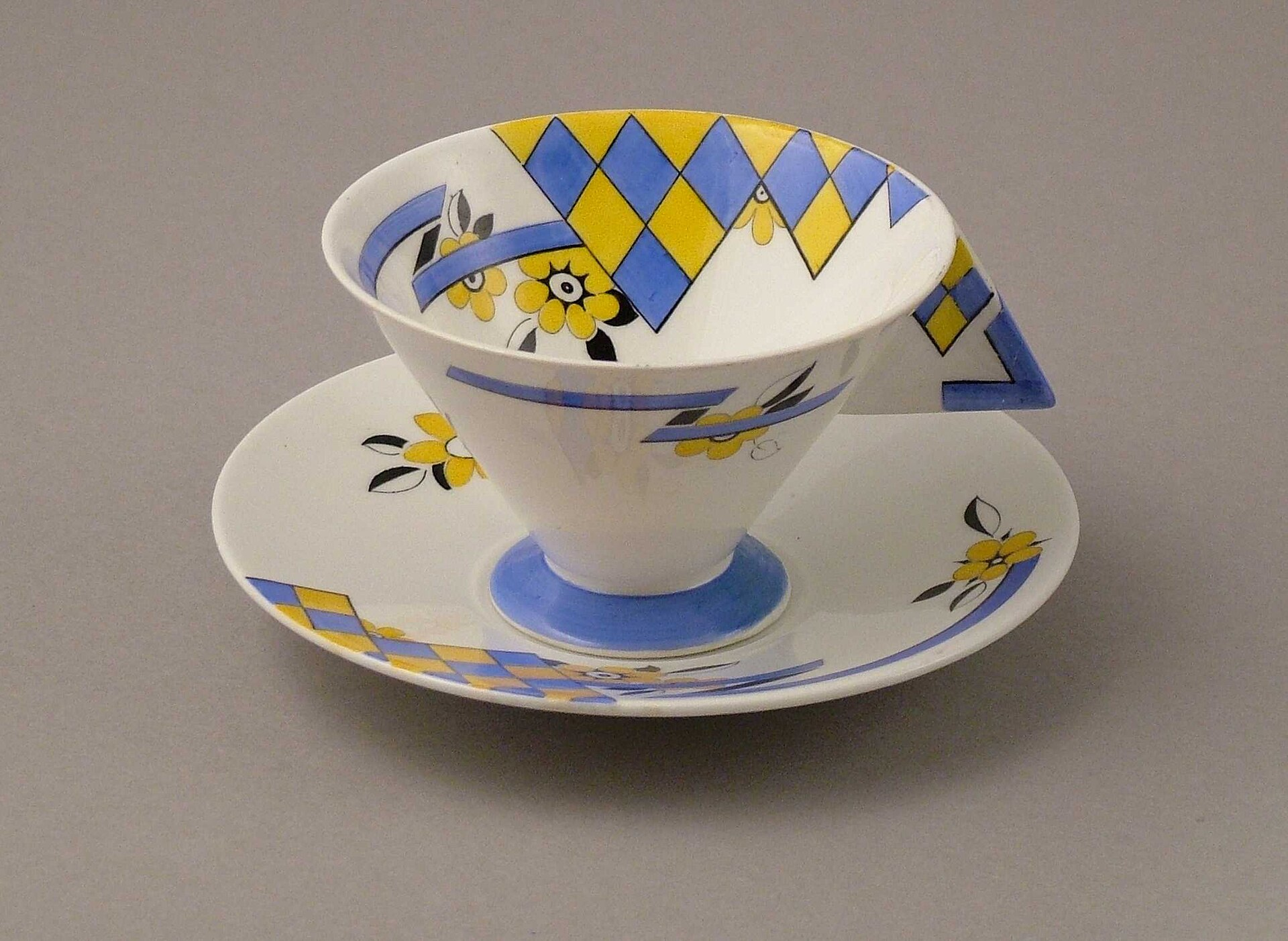
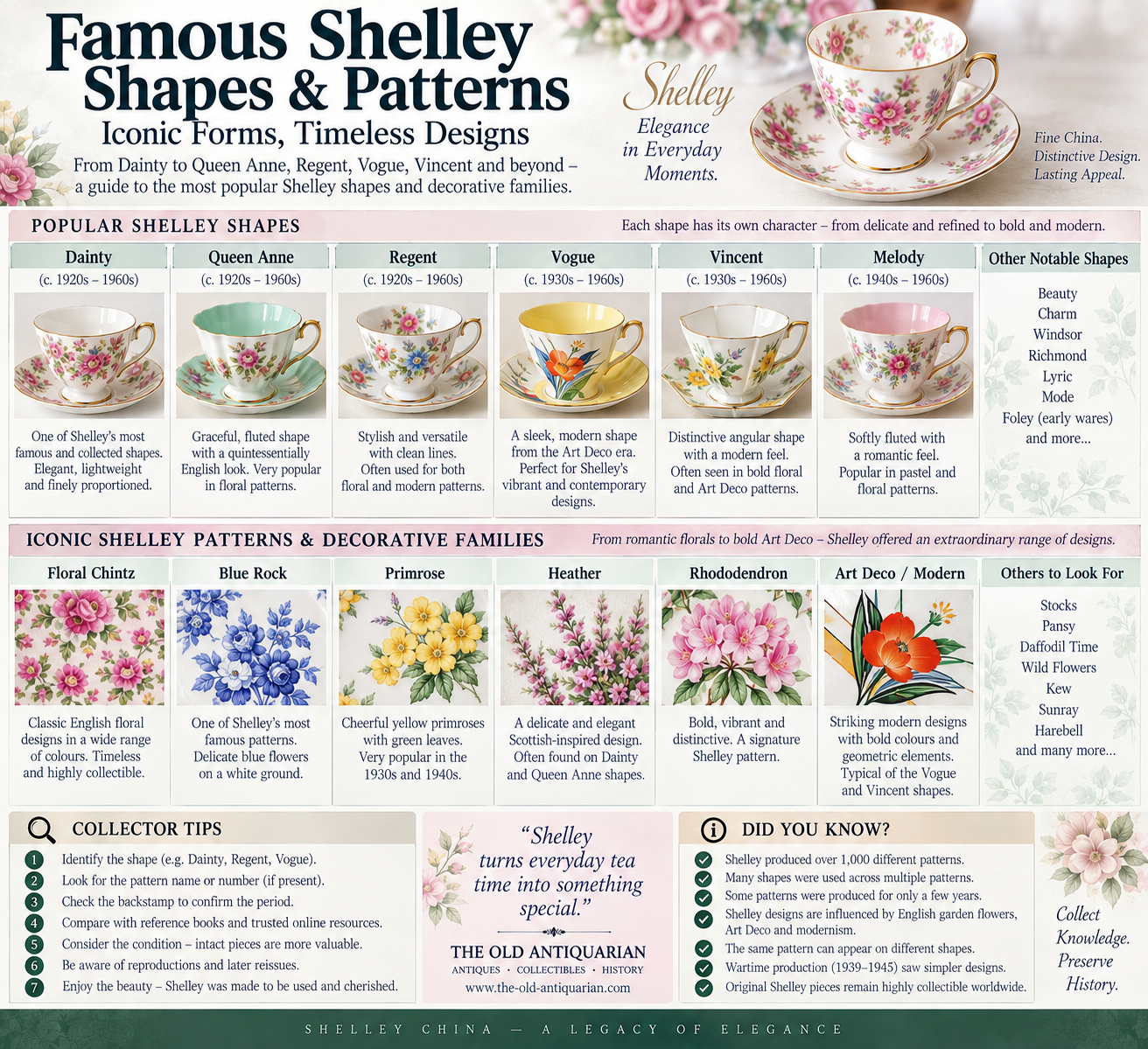
Illustrated forms and patterns are educational representations and should be confirmed against specialist pattern and shape references.
Shelley Art Deco & Eric Slater
For many collectors, Shelley Art Deco represents the factory at its most distinctive.
Eric Slater joined the firm in 1919 and later became one of the defining designers
of its modern period.
The Vogue and Mode shapes introduced around 1930 deliberately broke with conventional
English tea ware.
They used angular silhouettes, strong geometry and modern colour combinations.
In March 1932 the Eve shape addressed practical criticisms of the earlier designs,
and Slater subsequently developed other successful forms including Regent.
Harmony Art Ware
Shelley introduced Harmony Ware in 1932.
The range developed through several treatments under Eric Slater’s guidance
and is particularly associated with modern decorative pottery and strong colour effects.
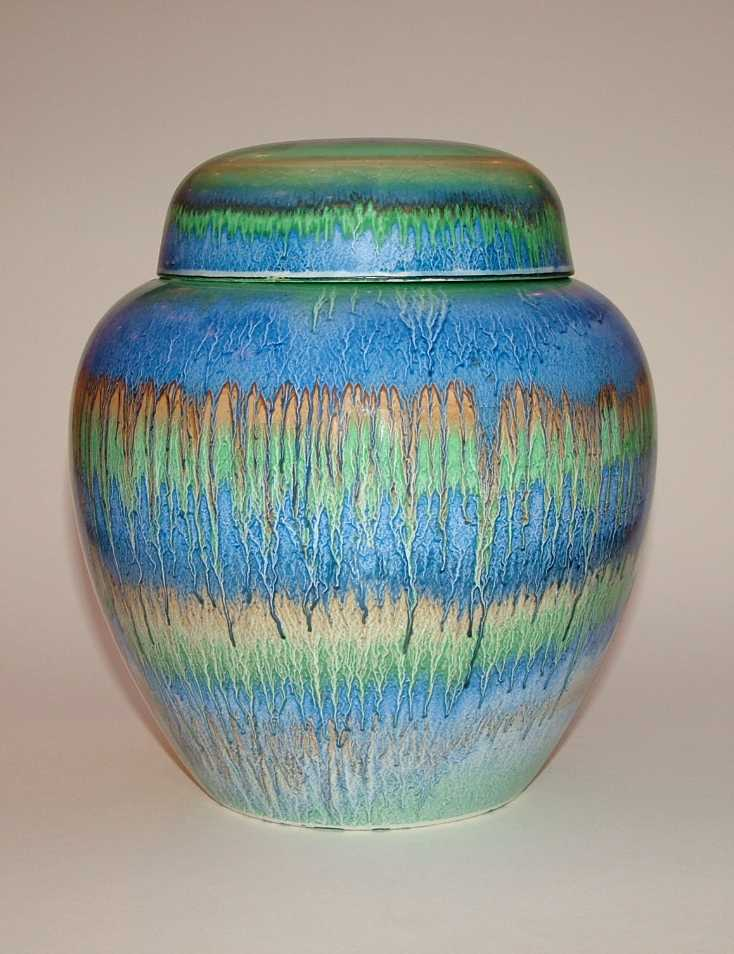
Harmony Ware was introduced in 1932 and developed under the artistic influence of Eric Slater.
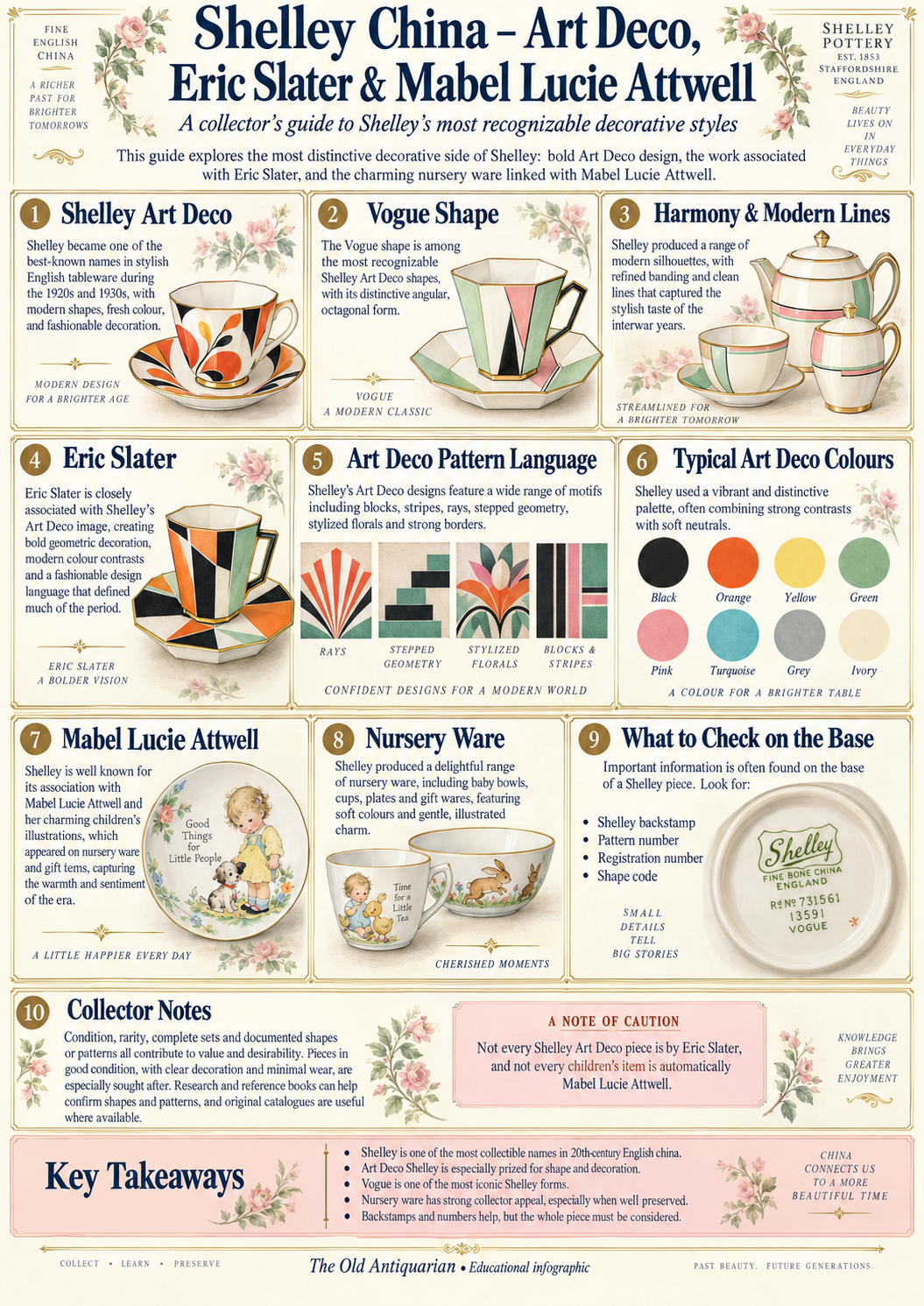
Designer attribution should always be supported by documented shape, pattern or historical evidence.
Mabel Lucie Attwell & Shelley Nursery Ware
Illustrator Mabel Lucie Attwell created one of the most distinctive
and charming branches of Shelley collecting.
Documented design registrations from 1926 include children’s illustrations and
the famous novelty pieces associated with the Boo Boo characters.
Registered examples include the mushroom-form teapot and sugar bowl
and the distinctive Boo Boo milk jug.
Their playful sculptural forms make them immediately recognisable,
but they have also encouraged later copies and misleadingly decorated objects.
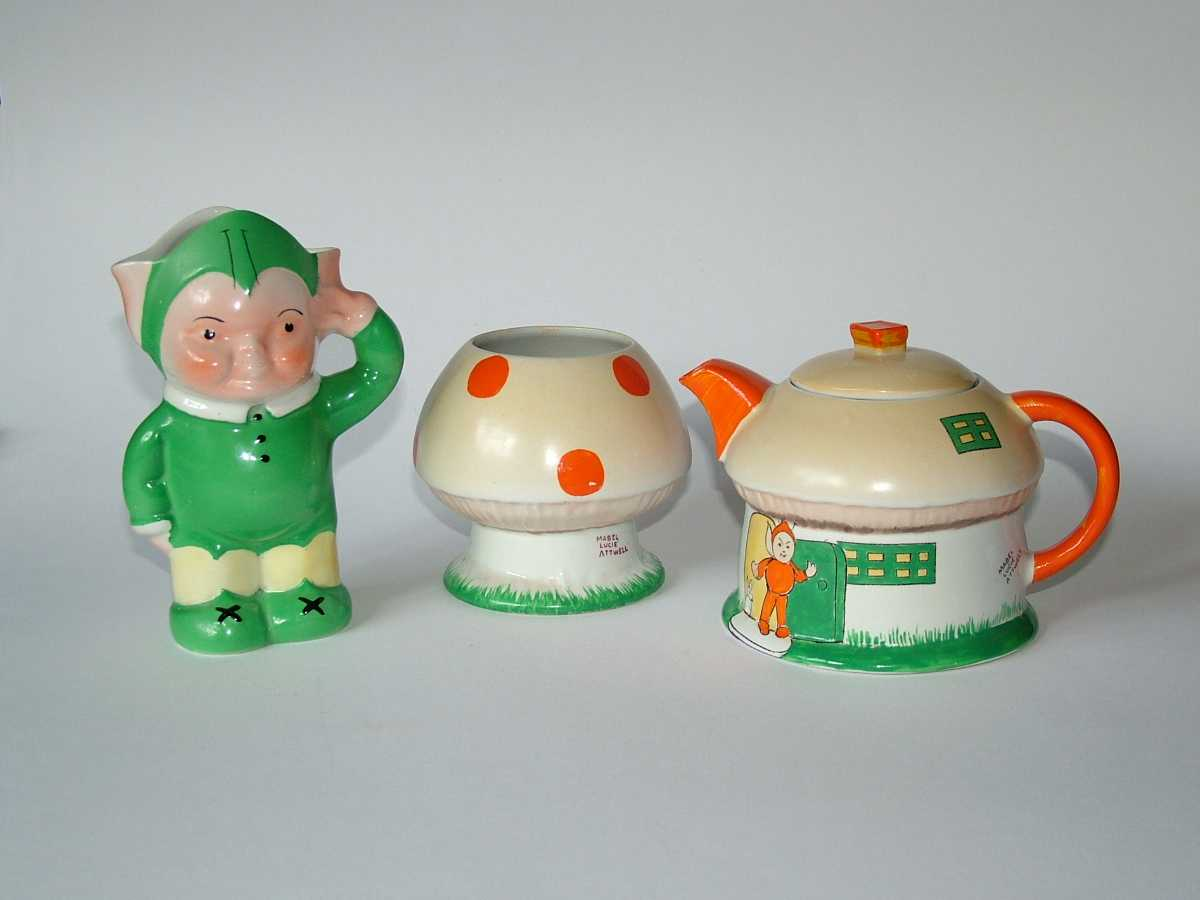
The registered novelty forms date from the mid-1920s and are among the most recognisable Shelley children’s wares.
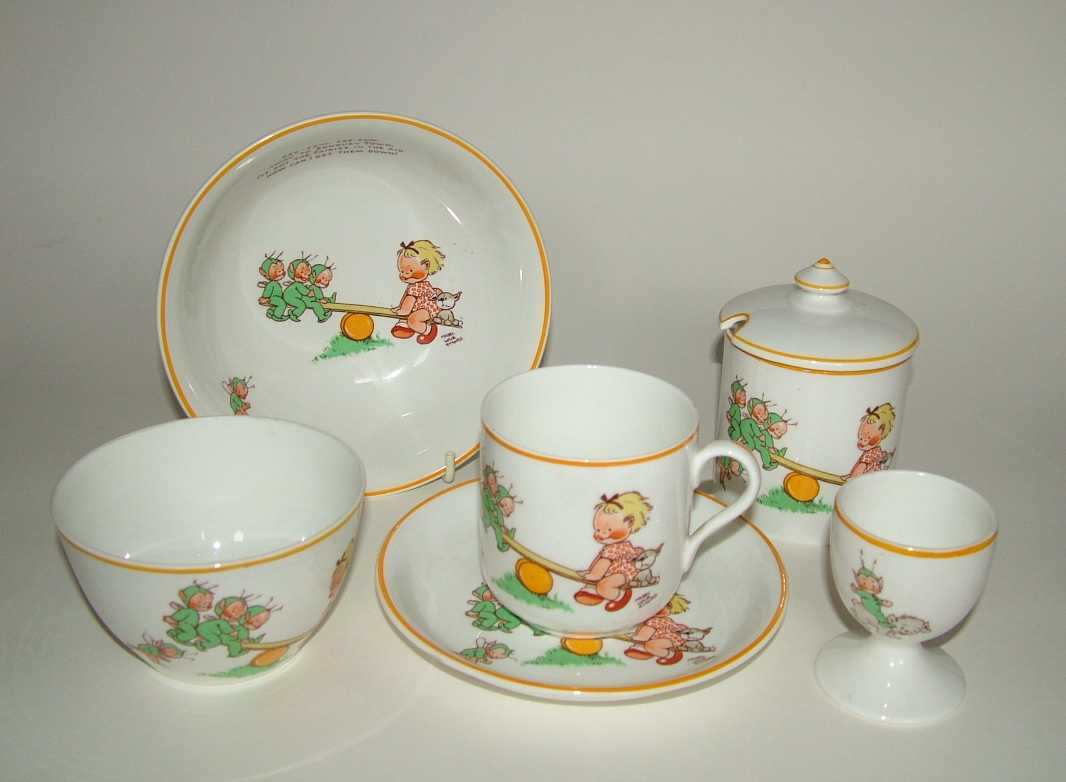
Understanding Attwell’s Illustration Style
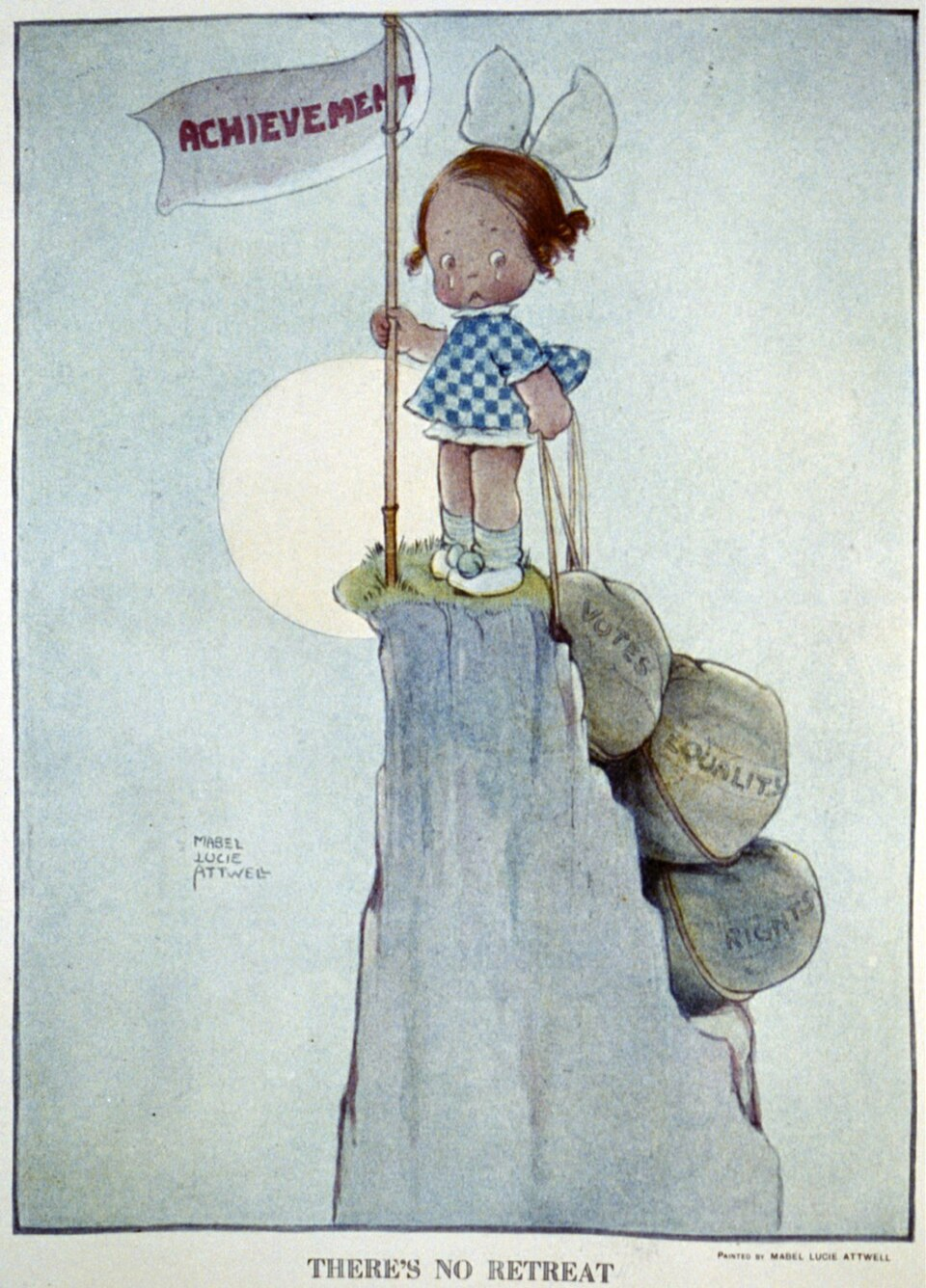
This is not a Shelley ceramic object; it is included to show Attwell’s established illustration style before her later collaboration with Shelley.
How to Identify Authentic Shelley China
Reliable Shelley identification is an evidence-building process.
Begin with the complete object rather than the logo.
Then ask whether the mark, material, form, decoration and production clues
all support the same attribution.
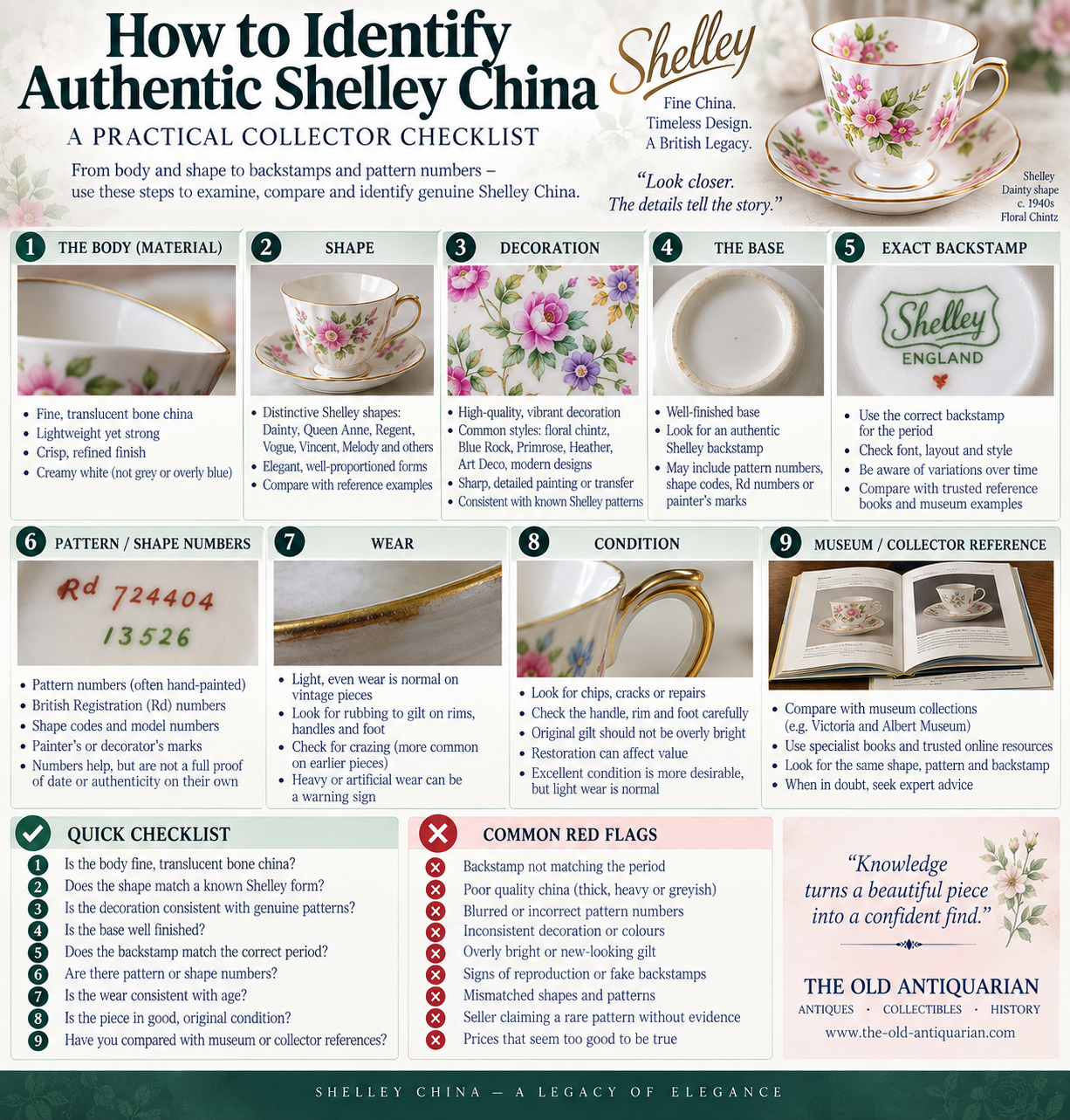
The exact backstamp is only one part of the identification process.
| Check | What to Examine | Why It Matters |
|---|---|---|
| 1. Body | Colour, refinement, weight, translucency and foot rim. | The ceramic body should be consistent with the claimed product and period. |
| 2. Shape | Compare silhouette, handle, rim, foot and proportions. | Known Shelley shapes are one of the strongest cross-checks. |
| 3. Decoration | Pattern, colourway, transfer, hand work and gilding. | Decoration must make sense on the claimed shape and period. |
| 4. Complete base | Photograph everything—not only the Shelley name. | Secondary numbers may be essential. |
| 5. Exact backstamp | Lettering, shield form, country wording, colour and application. | Helps establish a plausible production period. |
| 6. Numbers | Pattern, shape, registration and secondary marks. | Can connect the object with catalogued patterns and forms. |
| 7. Wear | Foot wear, gilding wear and handling scratches. | Wear should develop logically where the piece was handled. |
| 8. Condition | Chips, hairlines, cracks, repainting and repairs. | Condition affects both interpretation and value. |
| 9. Documented comparison | Specialist books, factory research and recognised collector references. | Reliable comparison is stronger than marketplace listings. |
For the same evidence-based approach across other manufacturers, see our
complete antique porcelain identification guide.
Fake Shelley Marks & Later Decoration
Shelley collectors should be particularly cautious with unusually desirable
Mabel Lucie Attwell subjects, rare-looking Art Deco decoration and unexpected shapes.
Specialist Shelley research has documented several categories of problematic objects:
completely non-Shelley wares carrying false marks,
genuine Shelley bodies decorated outside the factory,
and later reproductions or copies.
a backstamp that does not match the quality of the object;
a famous decoration on an undocumented shape;
poor-quality or unusually large marks;
modern-looking transfers;
decoration that conflicts with the pattern number;
or a seller relying entirely on the word “Shelley” without identifying the shape and pattern.
Shelley China Value – What Is It Worth?
There is no single Shelley China price list that can reliably value every piece.
The market distinguishes sharply between common later tea wares,
rare Wileman material, desirable Dainty colourways,
short-lived Art Deco shapes, Mabel Lucie Attwell pieces,
complete services and damaged examples.
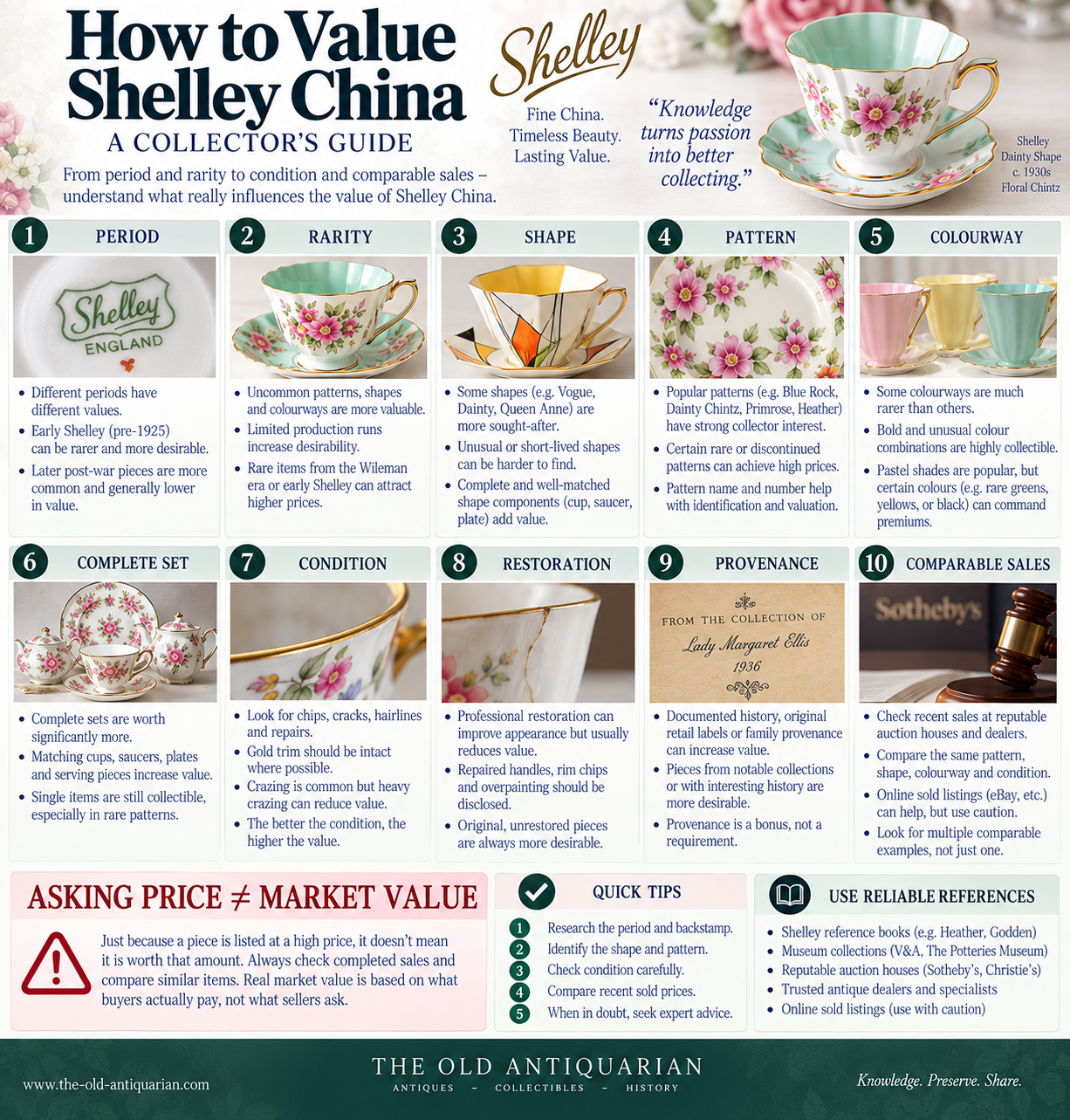
Meaningful appraisal begins with correct identification and genuinely comparable completed sales.
| Value Factor | Why It Matters |
|---|---|
| Period | Early Wileman and important historic Shelley periods may have stronger collector interest. |
| Rarity | Uncommon shapes, patterns and colourways can command premiums. |
| Shape | Dainty, Vogue and other identifiable forms belong to different collecting markets. |
| Pattern | Popularity and scarcity vary enormously between patterns. |
| Colourway | Some documented colour combinations are harder to find than others. |
| Completeness | Matched trios, tea sets and complete services are generally easier to market than incomplete sets. |
| Condition | Chips, cracks, staining, flaking and gilding loss can materially reduce demand. |
| Restoration | Impact depends on rarity, extent, location and quality of repair. |
| Provenance | Original labels, collection history and documented ownership can strengthen confidence. |
| Comparable completed sales | Realised prices for genuinely similar pieces are the strongest market evidence. |
A high online listing does not prove that collectors will pay that price.
Compare completed sales of the same shape, pattern, colourway,
period and condition whenever possible.
Condition, Damage & Restoration
Shelley is often collected as functional tea ware,
which means handles, rims, saucer wells, spouts and gilded edges deserve careful inspection.
| Issue | Where to Check |
|---|---|
| Hairlines | Handles, cup rims, spouts and stress points. |
| Gilding wear | Rims, handles and raised edges touched during normal use. |
| Decoration loss | Especially relevant to nursery ware and heavily handled pieces. |
| Restoration | Look for glue, filler, overspray, repainting and replaced handles or lids. |
| Crazing or staining | Assess severity and whether it affects structural integrity or appearance. |
Before repairing a valuable piece, read our
antique porcelain restoration guide.
For long-term display and storage, see
How to Store Porcelain Safely.
Shelley vs Other English China & Porcelain Makers
Shelley should be studied within the wider Staffordshire and English ceramic tradition.
Several major English factories produced fine floral tea wares,
bone china and richly decorated cabinet pieces,
so an unidentified cup should never be attributed from decoration alone.
| Maker | Often Associated With | Useful Identification Clues |
|---|---|---|
| Shelley | Elegant tea wares, Dainty, Art Deco, nursery ware. | Wileman/Shelley history, shape, exact backstamp, pattern and registration numbers. |
| Royal Worcester | Decorative porcelain, hand painting, fruit painting. | Distinct factory marks and documented date-code systems. |
| Royal Albert | Floral bone china and large tea-service market. | Pattern name, backstamp, country wording and shape. |
| Aynsley | Fine bone china, floral decoration and fruit designs. | Backstamp, pattern, body and decorative technique. |
| Spode | Historic tableware and transfer-printed patterns. | Backstamp, pattern number, Copeland wording and form. |
| Minton | Luxury ceramics, artistic decoration and Victorian production. | Factory marks, date clues, pattern numbers and decoration. |
For the broader national context, continue with our
English Porcelain Guide.
You can also compare Shelley with
Royal Worcester,
Royal Albert
and
Aynsley.
Shelley China Collector Checklist
- Photograph the entire object from several angles.
- Photograph the complete underside without cropping the secondary marks.
- Record the exact Wileman, Foley or Shelley wording.
- Record every number, letter and symbol.
- Identify the ceramic body before assuming every Shelley-related piece is fine bone china.
- Identify the cup, jug, plate or teapot shape.
- Research the pattern and colourway.
- Check whether registration or shape numbers correspond to documented examples.
- Compare the decoration with the proposed production period.
- Inspect rims, handles, spouts and gilding for wear or restoration.
- Be cautious with rare Mabel Lucie Attwell and Art Deco claims.
- Compare with specialist Shelley references rather than online listings alone.
- Use completed comparable sales when estimating value.
- For important pieces, seek an experienced second opinion.
Send clear photographs of the complete object, the entire underside,
all backstamps and numbers, dimensions and any damage or restoration.
The complete base is particularly important for Shelley identification.
Shelley China FAQ
Is Shelley China valuable?
Some Shelley China can be highly collectible, but value varies greatly.
Rare shapes, desirable patterns and colourways, early Wileman pieces,
Art Deco wares and selected Mabel Lucie Attwell designs can attract strong interest.
Condition and completed comparable sales remain essential.
How can I identify Shelley China?
Begin with the complete base and exact backstamp.
Then compare the body, shape, pattern, decoration,
pattern or registration numbers, wear and condition with documented examples.
Is Wileman the same as Shelley?
Wileman and Shelley are different names from connected stages of the same factory history.
Joseph Ball Shelley entered the Wileman business in the nineteenth century,
and Wileman & Co. remained in use long before Shelley became the dominant trade name.
What does Foley mean on Shelley-related china?
Foley is associated with the Staffordshire location and historic trade identity of the works.
It should not automatically be interpreted as a specific date or as proof of Shelley manufacture.
Always read the complete wording and object.
When did Shelley marks begin?
The Shelley name began appearing prominently as a trade name and backstamp around 1910,
with transitional marks and variations occurring over time.
What is the Shelley Dainty shape?
Dainty is one of Shelley’s best-known shapes.
Designed by Rowland Morris and registered in 1896,
it remained in production for approximately seventy years.
What are Shelley Vogue and Mode?
Vogue and Mode are distinctive Art Deco tea-ware shapes associated with Eric Slater
and introduced around 1930.
Their angular forms and modern decoration make them particularly recognisable.
What does an Rd number mean on Shelley China?
An Rd or registration number relates to British design registration.
It can help establish when a design was registered,
but it does not automatically give the manufacturing date of the individual object.
Did Mabel Lucie Attwell design for Shelley?
Yes. Documented Shelley-related Mabel Lucie Attwell designs were registered in 1926,
including nursery designs and novelty forms associated with the famous Boo Boo range.
Are there fake Shelley marks?
Yes. Specialist collector research documents false Shelley-style backstamps,
non-Shelley objects carrying copied marks and genuine Shelley pieces that were decorated outside the factory.
This is why the entire object must agree with the mark.
How do I find the market value of Shelley China?
First establish the exact period, shape, pattern and colourway.
Then compare genuinely similar completed sales with comparable condition and completeness.
An online asking price is not the same as market value.
Related English Porcelain & Identification Guides
English Porcelain – History, Bone China, Marks & Identification
Antique Porcelain – Complete Collector Guide
Porcelain Marks & Backstamps Identification
How to Identify Antique Porcelain
Sources & Further Research
For chronology, registered designs, documented shapes,
factory history and known problems with reproductions,
this guide prioritises specialist Shelley research and British pottery history sources.
- Shelley Group / Shelley.co.uk – factory chronology, designers, shapes, registered numbers, products, reproductions and collector research.
- The Potteries – Staffordshire pottery history, Wileman company chronology, works history and historical marks.
- National and international Shelley collector research – pattern, shape, registration-number and backstamp studies.
- Major auction archives – used only for documented object comparison and completed-sale research, not as primary factory-history evidence.
historical backstamps were applied in multiple forms and colours,
and specialist references do not always assign identical narrow dates to every variation.
For this reason, this guide uses broad documented periods and recommends comparing
the exact object rather than treating any single online mark chart as definitive.
The Old Antiquarian combines more than 35 years of practical experience
with antiques and collecting with historical, museum and comparative research.
When studying English china, we treat the maker, exact backstamp,
material, shape, pattern, registration or model numbers,
decoration, condition, restoration, provenance and market evidence
as connected clues rather than isolated answers.
Continue Exploring English Porcelain
Shelley forms part of an exceptionally rich English ceramic tradition.
Continue with our
complete guide to English porcelain
or explore the wider
Stories & Knowledge
library.
Final Collector Principle
Shelley China is a perfect example of why porcelain identification cannot begin and end with a logo.
Its story passes through Wileman, Foley and Shelley;
its most famous forms remained in production for different lengths of time;
and the same factory produced everything from refined floral tea ware
to radical Art Deco designs and whimsical nursery pieces.
The strongest identification is reached when the
backstamp, body, shape, pattern, numbers, decoration,
wear and documented history all point in the same direction.
Only after the object has been correctly identified should market value be considered.
Identify the shape. Read the complete base. Verify the pattern. Then determine the value.
