
Kotel Rugs: History, Weaving & Bulgarian Carpet Traditions
THE OLD ANTIQUARIAN · BULGARIAN TEXTILE HERITAGE · HISTORICAL RESEARCH
The Kotel Rug: A Living History of Bulgarian Carpet Weaving
From mountain sheep and traditional looms to intricate floral ornaments, generations of women weavers, historic cooperatives and a remarkable surviving carpet.
Last Updated: October 15, 2026 · By The Old Antiquarian
Quick Answer: What Is a Kotel Rug?
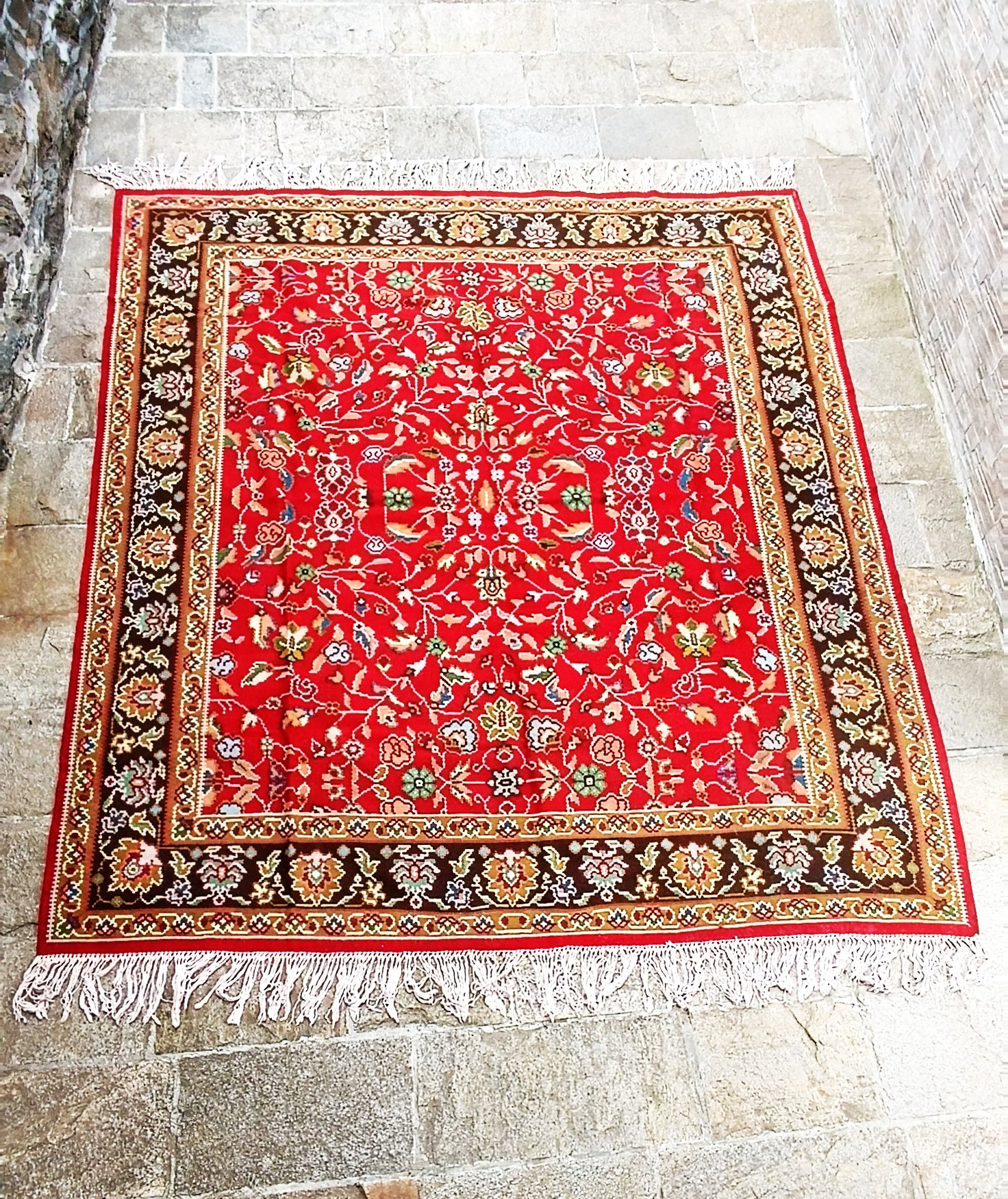
A Kotel rug is a traditional Bulgarian handwoven carpet associated with the town of Kotel in the eastern Balkan Mountains. The region developed one of Bulgaria’s most important carpet-weaving traditions, distinguished by its particular arrangement of warp threads, richly detailed patterns, skilled craftsmanship and long connection with sheep breeding and the wool trade. Classical geometric compositions gradually developed alongside elaborate floral designs. A surviving example from The Old Antiquarian Collection provides the central case study for this historical guide.
At a Glance
| Feature | Historical Context |
|---|---|
| Origin | Kotel, eastern Balkan Mountains, Bulgaria |
| Weaving tradition | Handwoven carpets on a vertical loom, with a characteristic paired-warp technique in many Kotel examples |
| Historical material | Primarily wool, with construction varying according to period and product |
| Traditional motifs | Geometric stars, bands and named regional patterns; later floral compositions |
| Important cooperative | Kotlenski Kray, founded in 1933 |
| Museum | Old Kotel Carpets and Fabrics exhibition, Galatan School, Kotel |
| Featured object | Red floral Kotel-style rug with dark botanical borders, white fringes and a surviving handwritten green label |
| Object dating | Exact production date and workshop not independently established |
1. Kotel: A Mountain Town Built on Wool and Craftsmanship
The history of Kotel carpet weaving begins with geography. Located in the eastern Balkan Mountains, Kotel developed within a landscape of mountain pastures, sheep-breeding communities, trading routes and skilled textile workers. Sheep breeding supplied wool not only for household use but also for important regional crafts, particularly weaving and the manufacture of woollen cloth.
Under Ottoman rule, wool production, clothing manufacture and trade became essential to the economic life of the region. Merchants and shepherds maintained connections beyond the mountains, including the pastoral territories of Dobruja and commercial centres throughout the Ottoman Empire.
The Historical Museum of Kotel describes the town as one of Bulgaria’s earliest and most significant carpet-weaving centres. The weaving tradition developed from relatively simple household textiles towards increasingly elaborate decorative carpets.
An extraordinary illustration of the region’s pastoral wealth survives at the Kyorpeev House Museum. According to its official historical presentation, the house was built by Radil Kyorpeyu, a wealthy resident associated with extensive sheep holdings in Dobruja. Such evidence reveals the economic world in which wool-based crafts flourished, although it does not identify the origin of the wool used in any particular surviving rug.
Collector’s historical note: A handmade carpet was never simply a decorative object. It connected shepherding, wool preparation, spinning, dyeing, weaving, household furnishing and regional commerce in one remarkable chain of labour.
2. How the Kotel Carpet-Weaving Tradition Developed
Traditional Kotel weaving was not created in a single year or by one identifiable founder. It developed through successive generations of artisans who adapted weaving knowledge to available materials, household needs, local preferences and changing markets.
The historical sequence preserved in the Galatan School Museum begins with ordinary woven rugs and striped household textiles. More complex transitional forms eventually led to the richly ornamented classical Kotel carpet.
The museum preserves celebrated historical patterns known in Bulgarian as Dineni Kori (Watermelon Rinds), Ogarlitsi (Necklaces), Fuchila and Kadryavi Zvezdi (Curly Stars). These evocative names formed part of a practical design vocabulary shared among generations of weavers.
Surviving museum examples, some approximately 150–200 years old, demonstrate the remarkable development of this tradition. Later designs incorporated increasingly complex ornamental arrangements, including floral elements documented in the early twentieth century.
This evolution is particularly important when examining a carpet such as the one featured here. Its dense floral vocabulary should not automatically be regarded as the earliest form of Kotel design. Rather, it belongs to a broader decorative tradition that developed and changed over time.
3. The Art of Weaving: What Makes Kotel Carpets Different?
A traditional Kotel carpet is woven on a loom rather than produced by a modern industrial printing process. The textile grows gradually as the weaver interlaces coloured yarns through a prepared foundation of warp threads.
The Galatan School displays a traditional vertical carpet loom. The weaver works directly on the pattern, controlling the tension and placement of the yarn while building its ornaments row by row.
The Paired-Warp Technique
One of the most distinctive technical differences between the Kotel and Chiprovtsi traditions concerns the arrangement of the warp threads.
Museum curator Vera Taskova has explained that Kotel weavers frequently work with the warp threads arranged in pairs, rather than the more closely grouped arrangement associated with traditional Chiprovtsi carpets. This approach allows especially fine ornamental details but also gives the cloth a different structure when examined against the light.
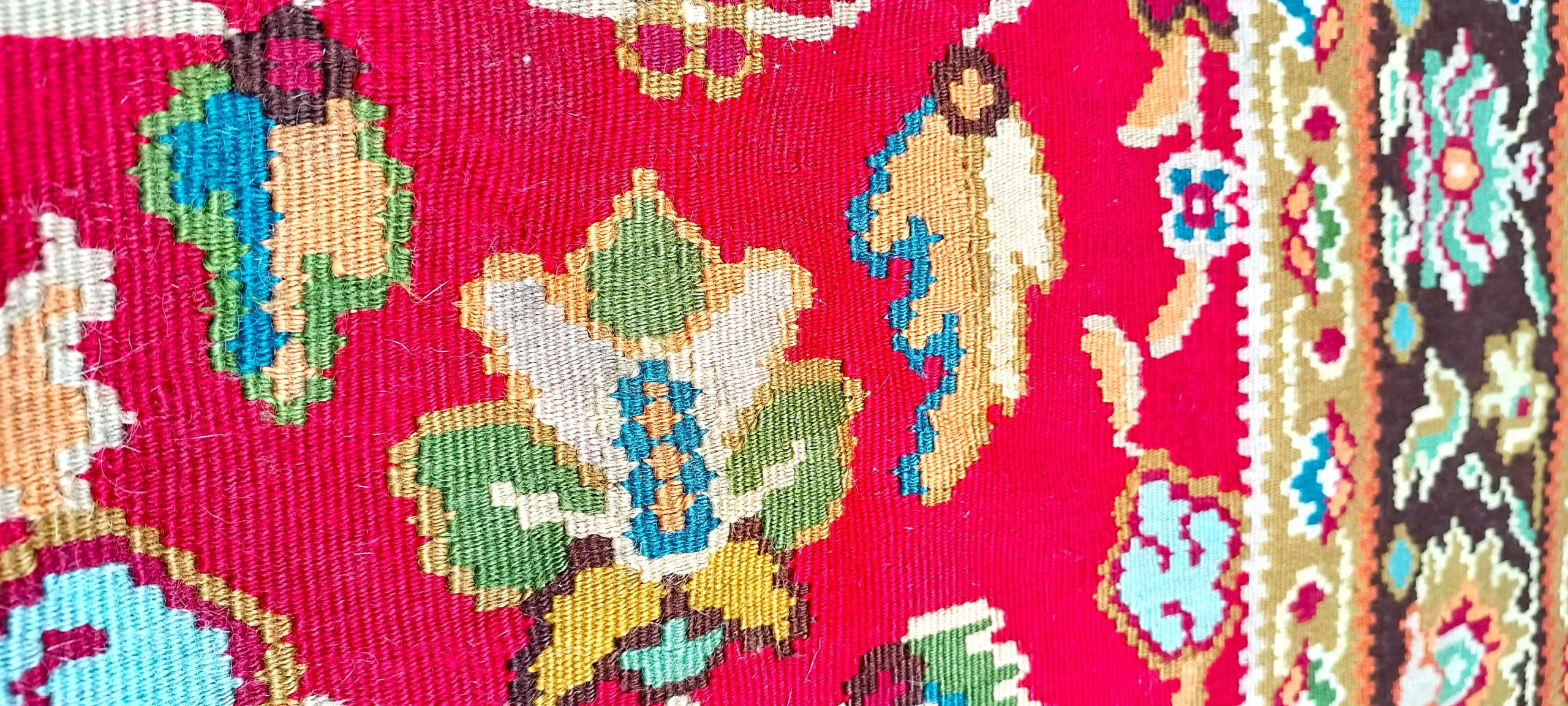
The technique requires extraordinary control. The weaver must balance ornament precision, warp tension and overall structural stability. Fine open spaces may form part of the traditional construction, but excessively large gaps can weaken a textile.
| Characteristic | Kotel | Chiprovtsi |
|---|---|---|
| Traditional loom | Vertical carpet loom | Vertical carpet loom |
| Construction | Characteristic paired-warp grouping in many historical examples | Closely arranged foundation threads in the traditional method |
| Historical ornament | Elaborate named patterns and later floral compositions | Strong geometric compositions, stepped forms and stylised motifs |
| UNESCO status | Important Bulgarian regional heritage; not separately inscribed under the Chiprovtsi designation | Tradition of carpet-making in Chiprovtsi inscribed in 2014 |
These distinctions describe historical tendencies, not absolute rules. Later workshops could reproduce patterns from other regions, and construction must be examined directly before identifying a particular carpet with confidence.
For another perspective on the imagination and symbolism of both traditions, explore The Weavers’ Code, a literary interpretation of eight Bulgarian rugs published by The Old Antiquarian.
4. From Sheep’s Fleece to Finished Carpet: Preparing the Wool
The manufacture of a traditional woollen carpet begins long before the weaving itself. Sheep have to be raised and shorn, and the fleece must be prepared before it can become yarn.
Historically, wool preparation could involve sorting the fleece, removing impurities, washing, drying, opening or combing the fibres, and spinning them into yarn. The exact tools and sequence varied with local practice and the intended textile.
After spinning, yarns had to be prepared for dyeing and weaving. Different thicknesses and degrees of twist were chosen according to their function within the cloth. The weaver needed suitable working yarns as well as a carefully arranged and tensioned warp.
A spinning wheel or spindle produces yarn; a loom weaves that yarn into cloth. These are separate stages of textile production. Historical Kotel households and workshops used spinning and wool-processing equipment alongside specialised looms for different woven products.
Why Wool Matters
Wool offers resilience, flexibility, warmth and excellent dye absorption. Its naturally crimped fibres contribute to the character of traditional textiles, while the quality of spinning influences both durability and the final woven surface.
Because the wool supply was tied to farming, shepherding and trade, every carpet represented the combined efforts of several people. Women were central to the weaving process, while men also contributed through animal husbandry, transporting wool, commerce and other stages of the regional textile economy.
The connections between sheep breeding, climate and household textiles are explored further in our Great Wool Belt historical guide, which compares distinct woollen traditions across Europe, Anatolia and North Africa.
5. Natural Dyes: How Traditional Weavers Created Their Colours
Before ready-made synthetic dyes became widespread, dyers used a variety of natural substances obtained from plants, wood, roots, insects and other materials. The final shade depended on the water, dye concentration, temperature, fibre preparation and mordants used to help certain colours bind to the wool.
Examples of materials associated with historical plant dyeing include onion skins, walnut husks, madder roots, yellow-dyeing plants and blue-dye sources such as woad or indigo. Nettles and other green plants could also be explored by traditional dyers, although achieving a durable green was not as simple as boiling green leaves. Greens often required carefully controlled combinations or successive dye baths.
| Natural Material | Possible Shades | Important Qualification |
|---|---|---|
| Onion skins | Yellow, gold, orange-brown | Shade varies with variety and dye bath |
| Walnut husks | Brown and dark brown | A well-documented traditional dye source |
| Madder root | Red, brick red, orange-red | Result depends strongly on preparation |
| Woad or indigo | Blue | Requires specialised dyeing chemistry |
| Nettles and local foliage | Variable pale yellow, olive or greenish tones | Not proof of a stable historical green recipe |
| Combined dye baths | Mixed greens and intermediate shades | Multiple colouring stages may be involved |
An interview with Kotel museum curator Vera Taskova documents a particularly revealing historical transition: surviving carpets include examples coloured with natural dyes, chemical dyes and mixtures of both. This is important because the presence of traditional patterns does not mean that all the yarns in a particular carpet were naturally dyed.
Important distinction: The vivid red, turquoise, green and other colours visible in the featured rug cannot be assigned to specific natural or synthetic dyes without appropriate examination or testing. Historical recipes explain the craft; they are not laboratory evidence about this individual object.
6. The Language of Kotel Patterns: Geometry, Flowers and Colour
The ornamental vocabulary of Kotel carpets is one of the tradition’s greatest achievements. Its historical designs combine repetition, symmetry, carefully measured rhythm and highly individual decisions about proportion and colour.
Traditional pattern names such as Watermelon Rinds, Necklaces and Curly Stars demonstrate how weavers recognised and transmitted designs through a shared regional vocabulary. A named pattern made the design easier to discuss, teach, remember and reproduce.
Over time, floral ornaments became increasingly important. Flowers, leaves, curved stems and repeated botanical forms could be woven into a densely decorated central field or arranged within borders surrounding a simpler composition.
The Featured Carpet’s Floral Composition
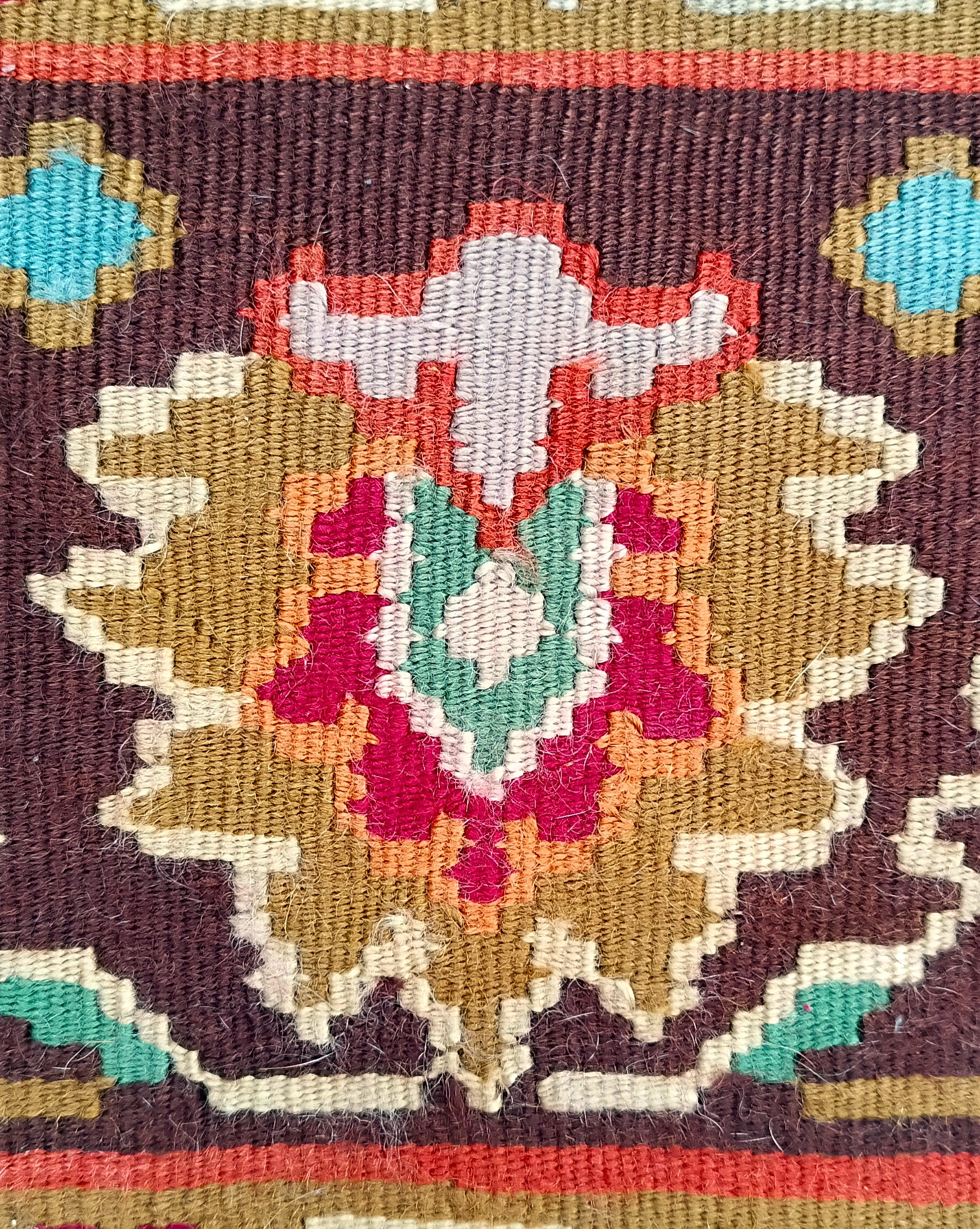
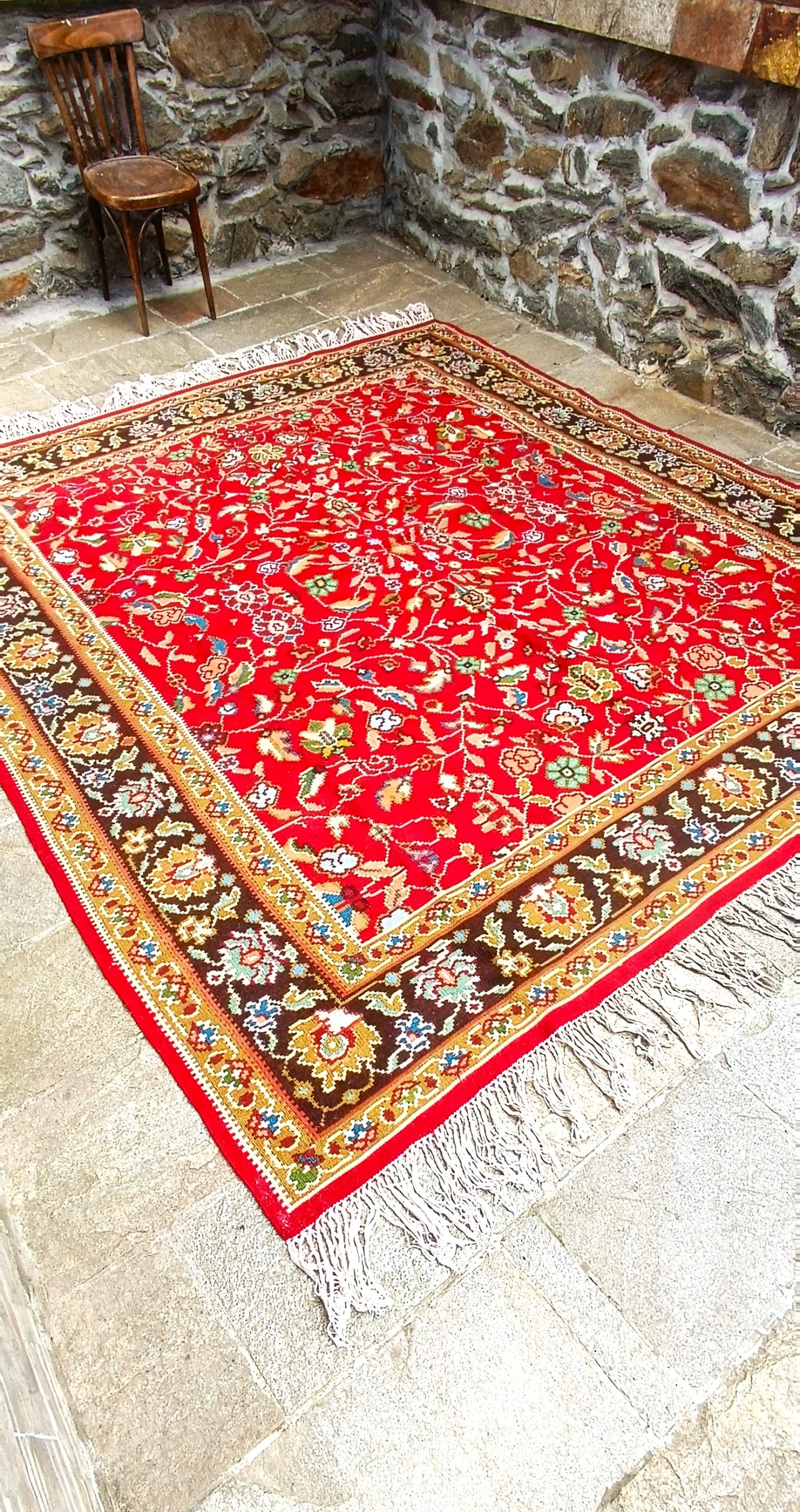
The rug examined here has a strong red central field containing a finely balanced arrangement of stylised flowers, foliage and intertwined stems. The floral imagery is organised around a central axis, while the dark ornamental border provides visual depth and contrast.
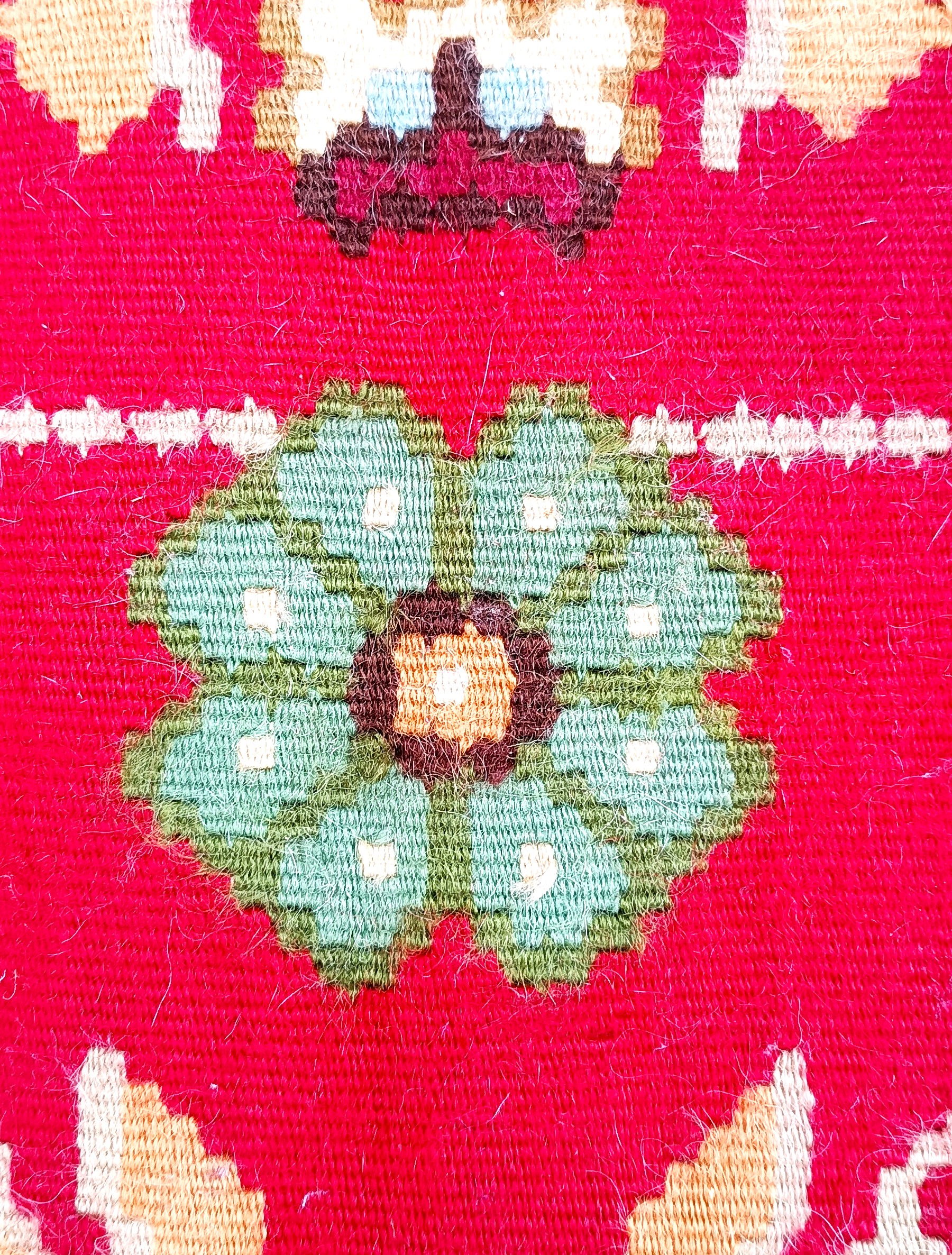
The most striking feature is the relationship between its delicate interior pattern and the outer bands. Cream, turquoise, green, yellow and pink elements punctuate the red field. A richly decorated dark brown border is framed by narrower decorative strips.
It is tempting to give each flower a fixed meaning: protection, marriage, fertility, prosperity or remembrance. Such themes are familiar within the wider study of traditional folk art, but the precise intention of this rug’s original designer cannot be established from the pattern alone.
A responsible historical interpretation distinguishes the visible design from later symbolic readings. The carpet expresses artistic choices and inherited techniques, even when the original meaning of a particular ornament remains unknown.
7. How Did a Weaver Remember Such Complicated Designs?
One of the most fascinating questions about traditional carpet weaving is how a skilled craftswoman could reproduce an intricate composition over many days or weeks of work.
The answer lies in the combination of training, visual memory, counting, repetition, working examples and practical understanding of the loom.
Experienced weavers learned to recognise patterns as organised groups of shapes rather than as thousands of unrelated coloured threads. A border could be repeated according to a familiar sequence, while the central field followed a carefully balanced composition.
Some designs could be copied from existing carpets or drawings. Others were adapted through experience and workshop practice. The weaver constantly monitored alignment, spacing, symmetry and tension.
Small mistakes could disturb the rhythm of the entire composition. Correction often required undoing part of the work, making patience and concentration essential qualities of the craft.
Mastery meant much more than moving yarn through a loom. It required the ability to imagine how a two-dimensional design would emerge gradually from a complex structure of interlaced threads.
8. Women, Families and the Transmission of Weaving Knowledge
Generations of women preserved Kotel carpet weaving through practical experience. Children grew up watching textile work at home, becoming familiar with wool preparation, tools, colour combinations and the language of ornament.
The transmission of knowledge was often personal: observing an experienced craftswoman, learning basic techniques, repeating simpler designs and gradually mastering more demanding compositions.
Weaving could also connect household identity with social standing. A finely made carpet reflected considerable labour and technical ability and could become a prized family possession.
Men participated in the wider economic system through shepherding, wool-related trades, transport and commerce. The final carpet was therefore often the product of a community’s combined economic activities, even when the weaving itself was performed predominantly by women.
Women Weavers Remembered by Name
The Galatan School Museum preserves the work of two notable Kotel textile artists, Stoyanka Mileva and Petranka Chehlarova. Their woven icons and historical compositions demonstrate how the inherited craft could develop beyond floor carpets into ambitious artistic works.
Their presence in the museum is a reminder that carpet weaving was both a domestic tradition and an artistic discipline capable of highly individual expression.
Although particular family lineages may be documented in local archives, it would be inappropriate to invent a family history for the featured rug without a traceable name, workshop record or reliable provenance.
9. Carpets in the Bulgarian Home: Dowries, Furnishings and Family Pride
Traditional woven carpets served practical and ceremonial roles. They could warm floors, furnish guest rooms, decorate family interiors, accompany significant occasions and become valued objects passed between generations.
In Bulgarian domestic life, the bridal trousseau, or cheiz, frequently included textiles prepared or collected for a new household. Depending on regional custom and family means, these could include woven blankets, coverings, towels, embroidered pieces and decorative carpets.
Not every carpet was produced specifically for a dowry. Some were woven for a household’s everyday needs, others commissioned from skilled makers, and still others intended for sale.
Fine rugs occupied a special position because they combined usefulness with beauty. Their production demanded time, material and training, making them a meaningful measure of the labour invested in a home.
For further cultural context, explore The Old Antiquarian’s Folk Art & Traditions collection, devoted to inherited textiles, craftsmanship and household heritage.
10. From Household Craft to Cooperative Production
As the market for handmade textiles expanded, carpet weaving became increasingly organised beyond the individual household. Commercial orders required consistency in size, quality, pattern and delivery.
The Kotel weaving cooperative Kotlenski Kray was established in 1933, before the establishment of Bulgaria’s socialist political system after the Second World War.
During the socialist period, craft production operated within a changing environment of cooperatives, state economic structures, workshops and planned distribution. Organised weaving could involve model specifications, production records, quality inspections and payment procedures.
Carpets could be intended for private homes, public buildings, domestic commerce or distribution beyond the immediate region. The historical reputation of Kotel textiles also connected the local craft with markets outside Bulgaria.
It is important not to treat all twentieth-century Kotel carpets as products of one enterprise. Home weaving, commercial workshops and cooperative activity could coexist or change over time, and surviving labels must be interpreted individually.
Was Private Carpet Weaving Allowed During Socialism?
There is no sound basis for claiming that every form of private household weaving was universally prohibited during the socialist decades. The legal and economic status of home-based production, commercial sales and cooperative work depended on the period and the circumstances.
Families continued to use and preserve handmade textiles, while cooperatives and organised production played an important role in supplying the wider market. Identifying the precise relationship between an individual weaver and a particular enterprise requires documentary evidence.
11. A Surviving Green Label: A Clue to the Carpet’s Past
Among the most intriguing features of the rug in The Old Antiquarian Collection is a small green handwritten label attached to the textile.
The label retains faint marks and possible numbers. It may be associated with production, inventory, ownership or another stage in the carpet’s history, but the inscription cannot currently be read with sufficient certainty to identify a particular person or organisation.
A name resembling Donka has been suggested as a possible reading, along with numerical markings, but neither interpretation should be presented as verified.
Similarly, the existence of a label does not by itself prove that the carpet was woven by a named craftswoman, produced by Kotlenski Kray or manufactured during a specific socialist-era year.
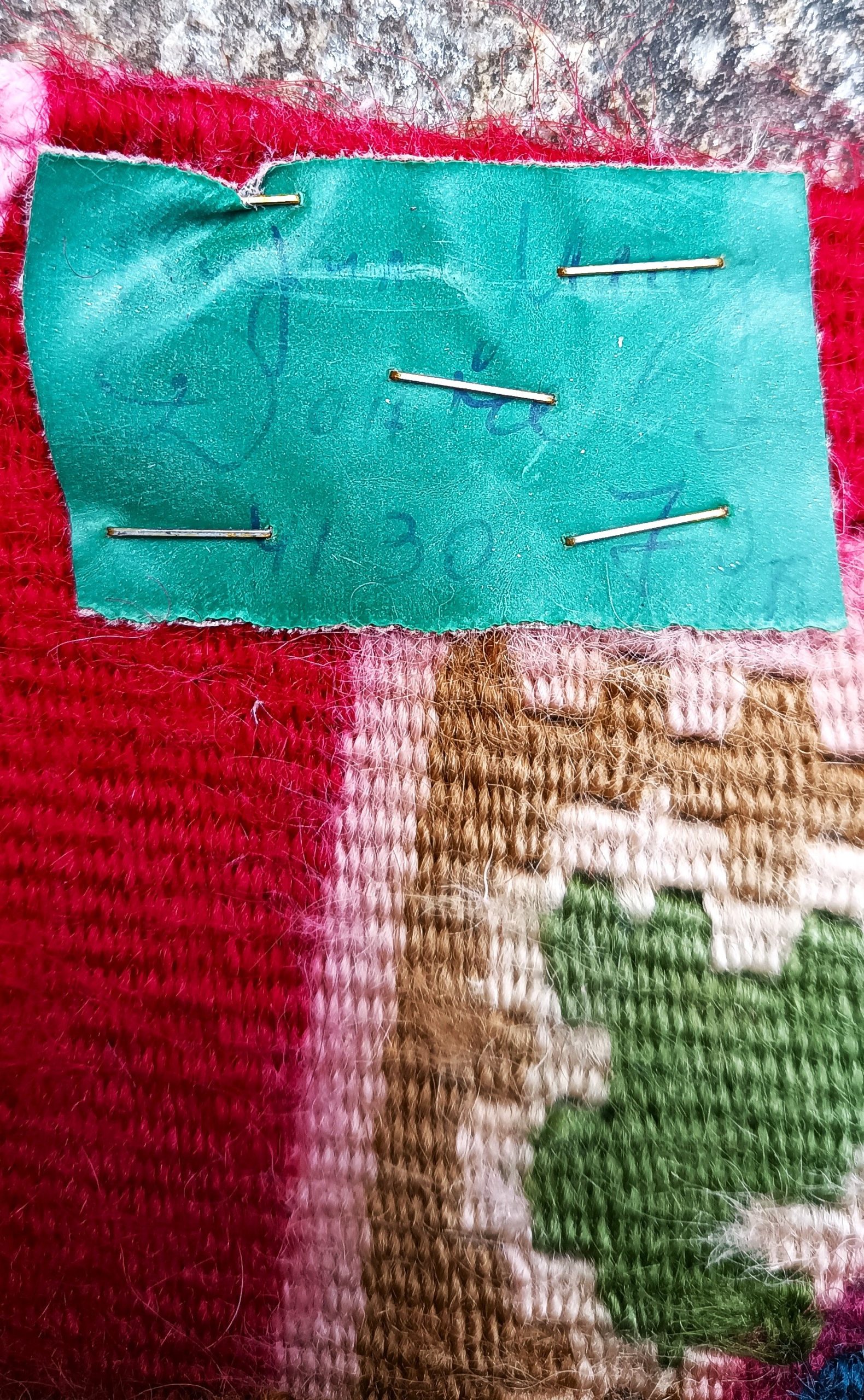
For collectors, such details deserve preservation. Removing the label or discarding accompanying documentation could destroy the very evidence needed for a future attribution.
Because the label is attached with metal fasteners, any signs of corrosion, staining or fibre damage should be assessed by a textile conservator before intervention.
12. Examining the Rug’s Front and Reverse
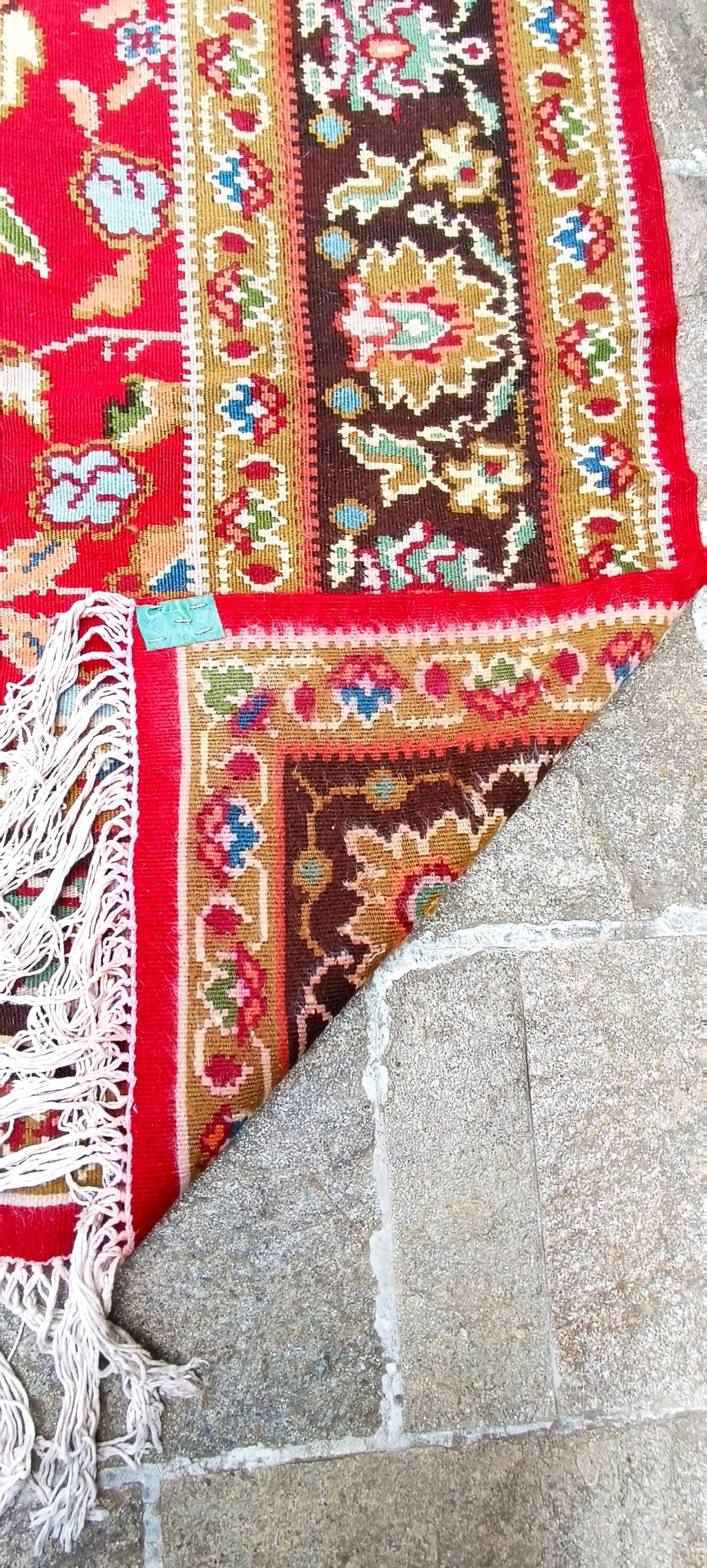
The photographed carpet offers several useful clues to its construction. The folded corner reveals a patterned reverse corresponding to the elaborate design visible on the front.
This is consistent with the reversible character of many traditional flatwoven carpets. However, a full technical classification requires careful examination of the warp, weft, joins, selvages and any areas of repair.
The white fringes and finished edges also form part of the object. They should not automatically be trimmed, replaced or treated as insignificant decoration.
13. The Kotel Rug Today: Museums, Festivals and Cultural Pride
Although the economic conditions that once supported large-scale handmade carpet production have changed, Kotel’s textile traditions remain an important part of the town’s identity.
The Old Kotel Carpets and Fabrics exhibition at the Galatan School preserves historical designs, weaving techniques and the work of distinguished textile artists. The building itself dates from 1869 and survived the destructive Kotel fire of 1894.
Local celebrations also help introduce this heritage to new generations. The Festival of Ethnicities, Colours and the Kotel Carpet brings together weaving demonstrations, traditional dyeing, crafts, music and cultural presentations.
The tenth festival edition took place from July 31 to August 2, 2026, at Izvorite Park in Kotel. Its programme included demonstrations of weaving and natural wool dyeing alongside exhibitions and cultural activities.
Such events remind visitors that the Kotel carpet is not merely a decorative product of the past. It represents a living connection between local craftsmanship, family memory, regional identity and the preservation of traditional skills.
14. A Rug in a Historic Interior: Why Its Setting Matters
Photographing a textile in an appropriate setting can help communicate its original decorative purpose. In the following image, the featured carpet lies across a stone-paved floor within a rustic interior.
The simple surroundings allow the richness of the red floral field to stand out. The wooden chair, stone walls and natural textures provide a visual context for appreciating the rug as part of a furnished space rather than as an isolated pattern.
This setting is a modern photographic presentation, not documentation of the carpet’s original household or historical location.
15. How to Examine an Old Kotel Rug: Collector Checklist
Before identifying, valuing or restoring an old Bulgarian carpet, examine:
- The complete pattern, dimensions and overall proportions.
- The construction of the warp and weft.
- The reverse, edges, fringes and any repairs.
- The regularity of the weave and transitions between colours.
- Signs of wear, fading, moth activity or structural weakness.
- Any labels, inscriptions, inventory numbers or family records.
- Comparisons with documented museum carpets.
- Whether claims about age, region or dyes are supported by evidence.
Preserving a Historic Carpet
Keep old woollen textiles away from persistent dampness, direct sunlight, insects and excessive handling. Avoid aggressive washing, strong detergents or mechanical brushing on vulnerable areas.
If cleaning or restoration is necessary, seek advice from a conservator experienced with historical flatwoven textiles. Original fringes, old repairs and attached labels may be important parts of the carpet’s material history.
Frequently Asked Questions About Kotel Rugs
What is a Kotel rug?
A Kotel rug is a traditional Bulgarian woven carpet associated with the Kotel region, known for its regional weaving methods, historical patterns and decorative craftsmanship.
How does Kotel weaving differ from Chiprovtsi weaving?
A major traditional distinction is the characteristic paired-warp arrangement found in many Kotel carpets, which supports particularly detailed ornamental work. Design and colour differences also exist, but technique is essential to reliable identification.
Are all Kotel rugs made with natural dyes?
No. Historical Kotel carpets may contain natural dyes, synthetic dyes or combinations of both. A particular rug’s dye composition cannot be established from photographs alone.
Are Kotel rugs UNESCO-listed?
The Bulgarian tradition specifically inscribed on UNESCO’s Representative List in 2014 is carpet-making in Chiprovtsi. Kotel has its own important carpet-weaving tradition, but the Chiprovtsi inscription should not be described as a separate UNESCO listing for Kotel carpets.
When was the Kotlenski Kray cooperative established?
According to a Bulgarian National Radio interview with a Kotel museum curator, the cooperative was founded in 1933.
What does the green handwritten label mean?
It may be a production, inventory or ownership record, but the inscription has not been securely deciphered and cannot currently be assigned to a specific weaving workshop or person.
How can I date an old Kotel carpet?
Dating requires assessment of weaving construction, materials, dyes, documented pattern comparisons, condition, provenance and any surviving labels or archival records. The appearance of a traditional motif is not sufficient to establish a production year.
Where can I see historic Kotel carpets?
The Old Kotel Carpets and Fabrics exhibition at the Galatan School in Kotel preserves historical woven carpets, named regional patterns and examples of later textile art.
Historical Sources and Further Reading
The historical information in this article has been informed by the following museum, cultural and institutional sources. Observations about the featured rug are based on the original photographs held by The Old Antiquarian.
- Historical Museum of Kotel — Old Kotel Carpets and Fabrics, Galatan School. Historical carpet patterns, weaving techniques and notable textile artists.
- Historical Museum of Kotel — Kyorpeev House. Wool-based crafts, regional economic history and the nineteenth-century household.
- Bulgarian National Radio — Kotel Keeps Carpet Making Tradition Alive. Interview with museum curator Vera Taskova on paired-warp weaving, historic dyes and the Kotlenski Kray cooperative.
- UNESCO — The Tradition of Carpet-Making in Chiprovtsi. Inscribed in 2014; useful for distinguishing the two regional traditions.
- Kotel Municipality — Tenth Festival of Ethnicities, Colours and the Kotel Carpet, 2026. Official information about contemporary cultural preservation.
About This Research
The Old Antiquarian combines more than 35 years of experience with antiques and collecting with documentary research, comparative study and original object photography. Our aim is to preserve the history of craftsmanship without confusing documented evidence with attractive but unverified stories.
The rug featured here belongs to The Old Antiquarian Collection. Its precise date, the identity of its maker and the original purpose of its handwritten label remain subjects for further research.
Related Guides and Further Exploration
- The Weavers’ Code: Eight Chiprovtsi and Kotel Carpets
- Traditional Shaggy Wool Rugs: The Great Wool Belt
- Folk Art & Traditions
- Carpets and Textiles Collection
Have an Old Bulgarian Rug?
An inherited Kotel or Chiprovtsi carpet may preserve more than a decorative pattern. Its structure, materials, labels, repairs and family history can help uncover the story of the people who made and preserved it.
For questions about an old rug, its identification or its historical context, please contact The Old Antiquarian.
Every woven thread belongs to a larger story. Every surviving carpet keeps part of that story alive.
