
Arzberg Porcelain Marks, History, Dating & Value Guide
THE OLD ANTIQUARIAN · GERMAN PORCELAIN LIBRARY
Arzberg Porcelain: History, Marks, Dating, Designers & Value
From Bavarian Factory Heritage to Icons of Modern German Design
Last Updated: October 15, 2026 | By The Old Antiquarian
Quick Answer: What Is Arzberg Porcelain?
Arzberg porcelain is a German porcelain brand originating in Arzberg, Bavaria, in 1887, when Christoph Schumann founded a separate porcelain factory. The manufacturer later became internationally recognised for modern functional tableware, particularly Form 1382 by Hermann Gretsch (1931) and Form 2000 by Heinrich Löffelhardt (1954).
Collectors encounter historic Arzberg backstamps featuring factory names, crowned emblems, Bavaria or Germany inscriptions, green cursive lettering, and later modern trademarks. Identifying the correct period requires examining the complete mark together with the porcelain’s shape, decoration, numbers, production history and condition.
Important: Arzberg and Schumann Arzberg are two different porcelain factory histories. Arzberg became part of Rosenthal GmbH in 2013. Beginning in 2024, selected collections were progressively transferred to the Rosenthal and Thomas brands.
Arzberg Porcelain at a Glance
| Manufacturer / Brand | Arzberg / Porzellanfabrik Arzberg |
| Origin | Arzberg, Upper Franconia, Bavaria, Germany |
| Founded | 1887 |
| Founder | Christoph Schumann |
| Important Designers | Hermann Gretsch, Heinrich Löffelhardt, Michael Sieger, Hans-Wilhelm Seitz and others |
| Famous Designs | Form 1382, Form 2000, Tric, Cucina, Joyn |
| Historical Marks | Schönwald–Arzberg, PA Arzberg Bavaria, Porzellanfabrik Arzberg, Arzberg script marks and later brand marks |
| Rosenthal Connection | Arzberg brand acquired in 2013 |
| 2024 Brand Changes | Form 1382 and Joyn to Rosenthal; Tric and Cucina to Thomas; Form 2000 discontinued |
| Collector Priorities | Exact mark, model, designer, production period, rarity, condition, completeness and provenance |
Among the numerous porcelain manufacturers that shaped German ceramic history, Arzberg occupies a distinctive position. Its reputation rests not only on skilled industrial production but also on the idea that beautifully designed everyday porcelain should be practical, durable and accessible.
The history of Arzberg connects nineteenth-century Bavarian porcelain manufacture with twentieth-century functionalism, German industrial design, international collecting and modern corporate restructuring.
Yet this history can be confusing. Several porcelain factories operated in Arzberg, and the Schumann family was connected with more than one business. Manufacturers changed owners, trademarks evolved, and successful forms remained in production for decades.
This guide examines the historical evidence behind Arzberg porcelain, with particular attention to authentic factory marks, important designers, correct dating and collector identification.
1. History of Arzberg Porcelain: 1887 to the Present
The Arzberg brand traces its origins to the porcelain factory founded by Christoph Schumann in 1887. Although his family was already associated with porcelain production in the town, Christoph’s business developed as a separate enterprise.
Around 1892, the factory passed to Theodor Lehmann and Roßberg. Lehmann subsequently became the sole owner. In 1902 the works became connected with Porzellanfabrik Schönwald AG, and in 1927 the Schönwald business merged with Porzellanfabrik Kahla AG.
The interwar years brought the most important artistic transformation. Under the influence of designers such as Hermann Gretsch, Arzberg moved towards modern functional porcelain and established the design identity for which it remains best known.
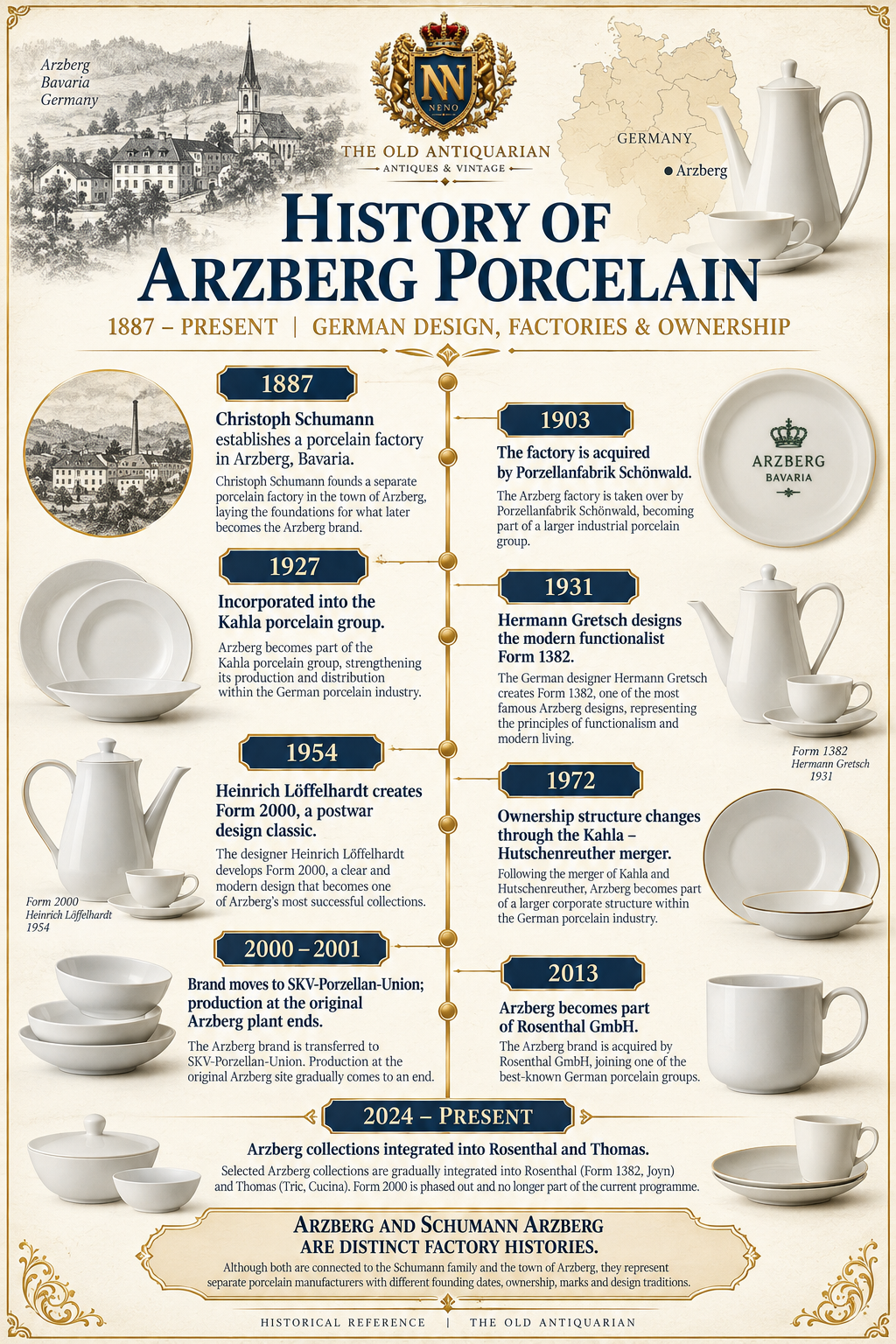
Arzberg Factory and Brand Timeline
| Year / Period | Historical Development |
|---|---|
| 1887 | Christoph Schumann establishes his own porcelain factory in Arzberg, Bavaria. |
| c. 1892 | The factory passes to Lehmann and Roßberg; subsequently operated by Theodor Lehmann. |
| 1902–1903 | Integration into the Schönwald porcelain business; historical references differ slightly in recording the corporate transition. |
| 1927 | Schönwald AG merges with Kahla AG; Arzberg becomes associated with the Kahla porcelain group. |
| 1931 | Hermann Gretsch designs Form 1382, a landmark of modern functionalist tableware. |
| 1936 | Form 1382 receives recognition at the Milan Triennale, strengthening Arzberg’s international design reputation. |
| 1945–1950s | Postwar production continues in a changing German industrial and economic environment. |
| 1954 | Heinrich Löffelhardt creates Form 2000, an important postwar design classic. |
| 1972 | The West German Kahla organisation merges with Hutschenreuther AG. |
| Late 1990s–2000s | Further restructuring brings Winterling and SKV Porzellan-Union connections; manufacture and company organisation change. |
| 2013 | Rosenthal GmbH acquires the Arzberg brand following the insolvency of Arzberg Porzellan GmbH. |
| 2024 onwards | Selected Arzberg designs are gradually integrated into the Rosenthal and Thomas ranges with changed base stamps. |
For collectors, a change in company ownership does not necessarily mean that a design immediately disappeared or that every factory mark changed on the same date. Corporate history, trademark history and the production date of an individual object must be considered separately.
2. Arzberg Porcelain Marks and Backstamps
Arzberg porcelain marks changed repeatedly as the factory developed through different corporate structures. Some marks included the manufacturer name; others incorporated initials, regional inscriptions, symbols or designations relating to associated companies.
A common mistake is to assume that one familiar Arzberg logo was used continuously from the nineteenth century to the present. In reality, different historical marking families must be examined separately.
The following table provides a research framework. Dates indicate documented or commonly cited ranges rather than exact production dates for every object.
Historical Arzberg Marks Before 1945
| Approximate Period | Mark / Factory Wording | Collector Interpretation |
|---|---|---|
| 1887–early 1900s | Early factory names connected with Christoph Schumann, Lehmann & Roßberg and Theodor Lehmann | Check documented examples; do not assume that all early pieces were unmarked. |
| c. 1919–1927 | PSAA and Schönwald–Arzberg markings | Associated with Porzellanfabrik Schönwald, Abteilung Arzberg; supported by museum documentation. |
| c. 1928–1946 | Crowned PA emblem with Arzberg Bavaria wording | Important interwar marking family; exact variant and use period need comparison. |
| c. 1930–1947 | Porzellanfabrik Arzberg / Arzberg (Bayern) | Text-based mark documented on Form 1382 examples; continued beyond 1945. |
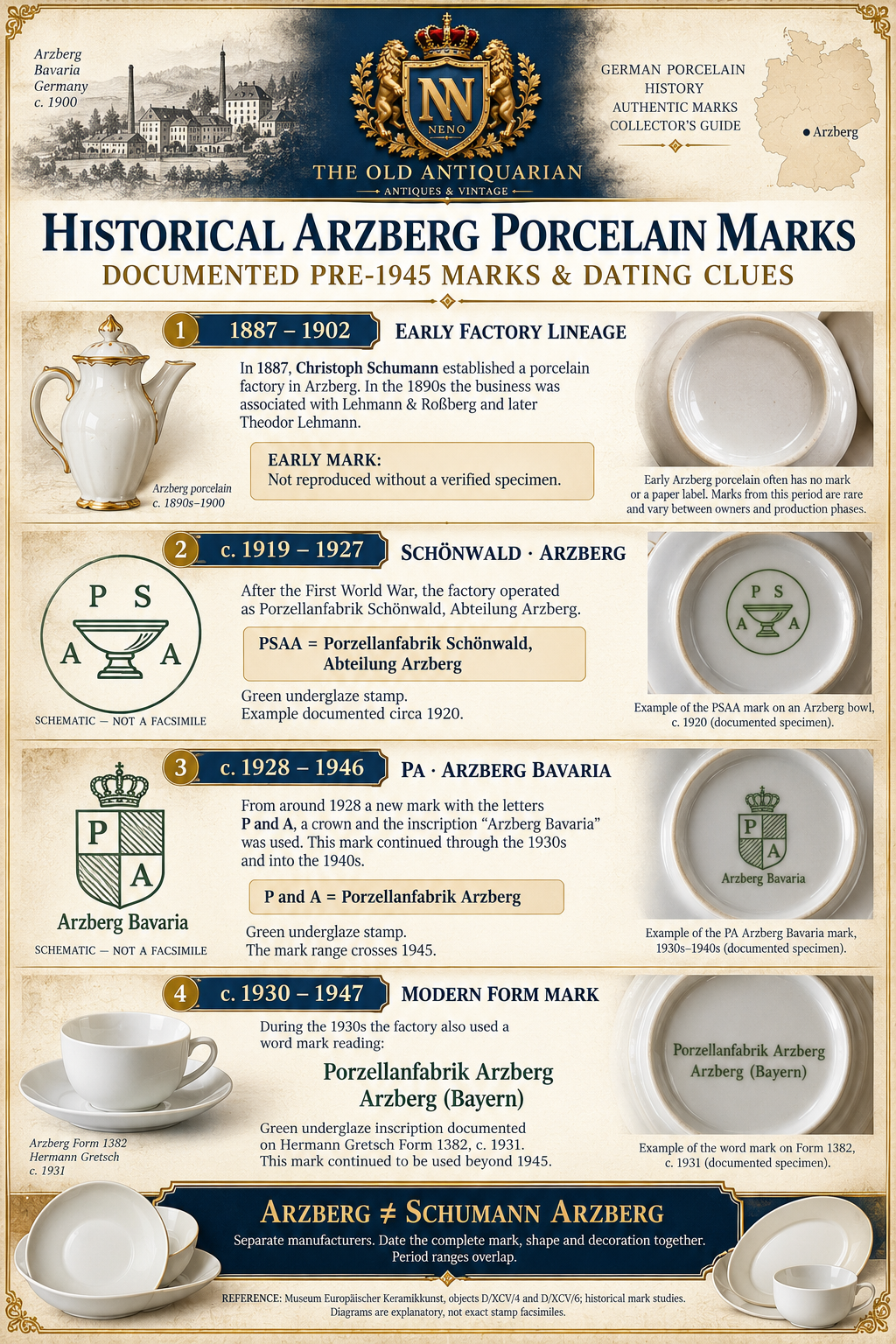
An especially useful museum reference is the collection of the Museum Europäischer Keramikkunst. It documents Form 1382 porcelain with a green underglaze mark reading Porzellanfabrik Arzberg / Arzberg (Bayern), associated with approximately 1930–1947.
Another museum example documents the PSAA Schönwald–Arzberg mark on a bowl from around 1920. These are stronger identification references than undated illustrations circulating online.
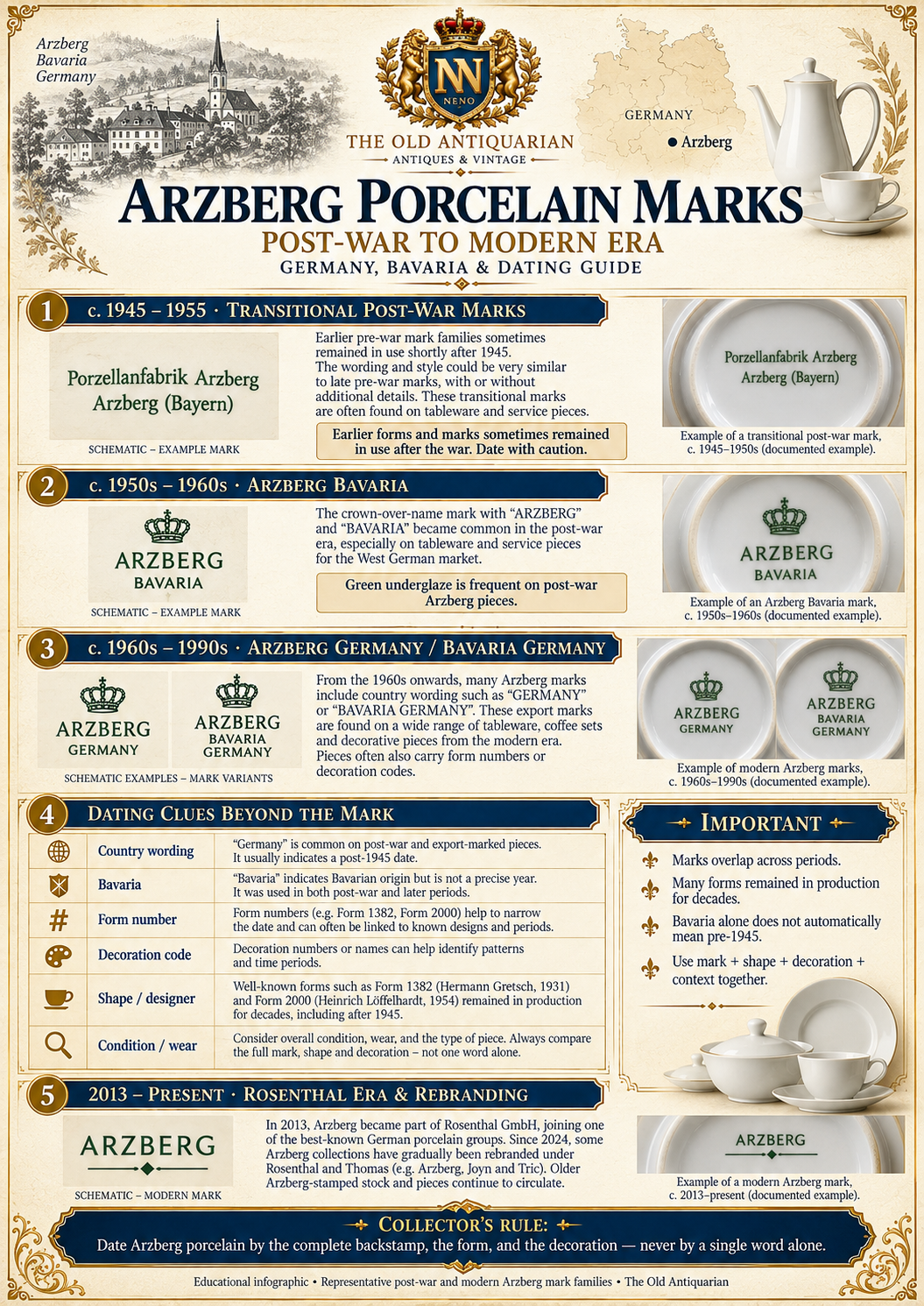
Arzberg Marks from 1945 to the Modern Era
Postwar Arzberg marks include continuations of earlier marking traditions, distinctive printed Arzberg lettering, marks with country-of-origin wording and later modern brand identities.
The form of the lettering can be significant. However, collectors should not assume that every green mark belongs to one period or that every object marked Germany was necessarily manufactured after World War II.
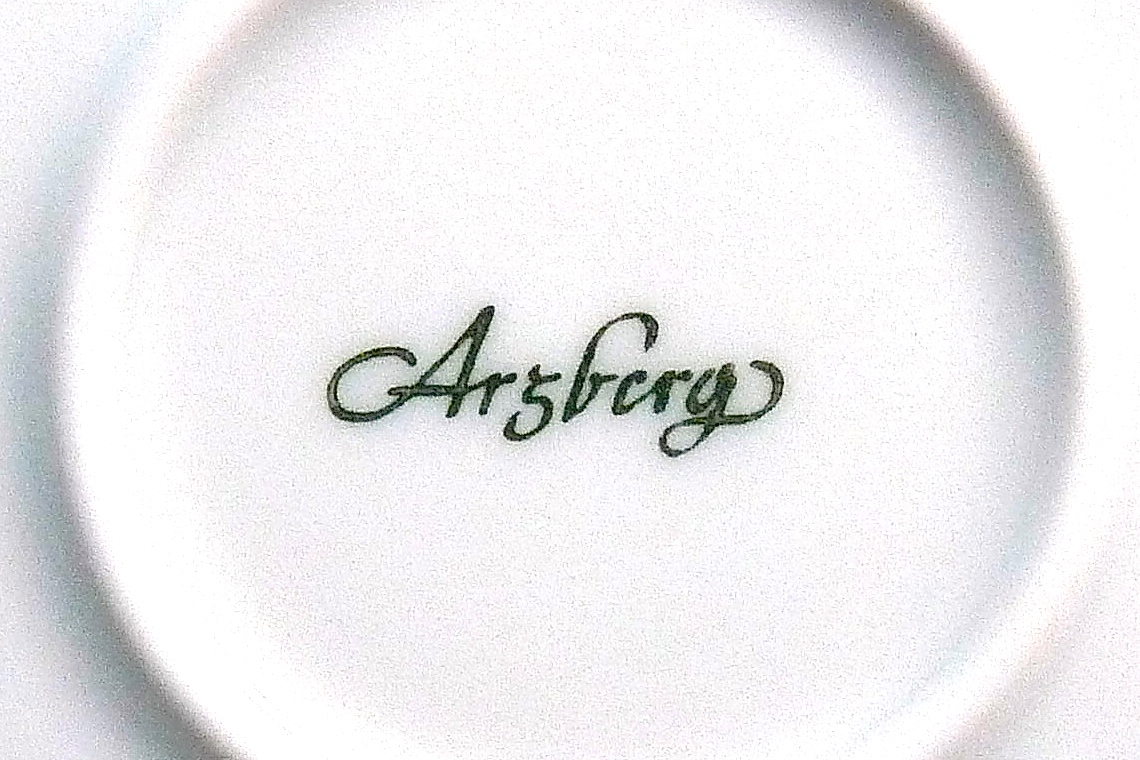
Authentic Green Arzberg Script Mark
The following photograph documents a real Arzberg porcelain mark with the manufacturer’s name printed in green cursive lettering. The source identifies it with the 1950s–1960s.

Collector’s Rule: A Mark Is Evidence, Not a Complete Date
Compare the exact lettering, symbol, layout, application technique, numbers and documented historical examples. Then test the proposed date against the porcelain form and decoration. A genuine historic design may have been manufactured many decades after its introduction.
For the full identification method, see our Complete Guide to Porcelain Marks and Backstamps.
3. How to Date Arzberg Porcelain
The most reliable way to date Arzberg porcelain is to combine several independent clues. The manufacturer’s name alone is not enough because both historical marks and successful forms remained in use across long periods.
| Evidence | What to Examine | Dating Limitation |
|---|---|---|
| Factory Mark | Exact symbol, lettering, logo and application | Some versions overlap or remain in use. |
| Country Wording | Bavaria, Germany or additional export wording | Country names are not exact date codes. |
| Form Number | 1382, 2000 or another documented form designation | Design date is not manufacturing date. |
| Decoration | Colourway, pattern, gilding, transfer or painted design | Decorations may be reused or reissued. |
| Numbers | Impressed, printed or painted references | Numbers may identify moulds or decoration, not years. |
| Documentation | Historic catalogues, museum holdings and factory records | Closest comparison must match the actual object. |
Does Bavaria Mean Antique?
No. Bavaria is a geographical designation, not an automatic indication that porcelain is old. It appears on the products of numerous manufacturers and was used during different historical periods.
An inscription reading Arzberg Bavaria should be evaluated according to its complete factory mark rather than the word Bavaria alone. For the wider context, see our Bavaria Porcelain Identification Guide.
Does Germany Mean Postwar Production?
Not necessarily. Germany appeared in export and country-of-origin markings before and after World War II. It is a useful clue only when combined with manufacturer-specific documentation, mark style, historical context and the form of the object.
Likewise, a porcelain service designed in 1931 may have been produced in the 1960s, 1990s or considerably later. Never describe a piece as made in 1931 simply because it belongs to Form 1382.
Our broader How to Date Antique Porcelain guide explains this process in greater detail.
4. Arzberg vs Schumann Arzberg: Two Different Manufacturers
One of the most important distinctions in German porcelain collecting concerns the difference between Arzberg porcelain and Schumann Arzberg porcelain.
The factories share a geographical connection with Arzberg, Bavaria, and a historical relationship with the Schumann family. They should nevertheless be treated as separate businesses.
The Schumann & Riess porcelain factory was established in 1881 by Christian Heinrich Schumann and Riess. In 1892 it became associated with the company name Carl Schumann. Christoph Schumann, another member of the family, established the separate factory in 1887 that became the historical foundation of the Arzberg brand.
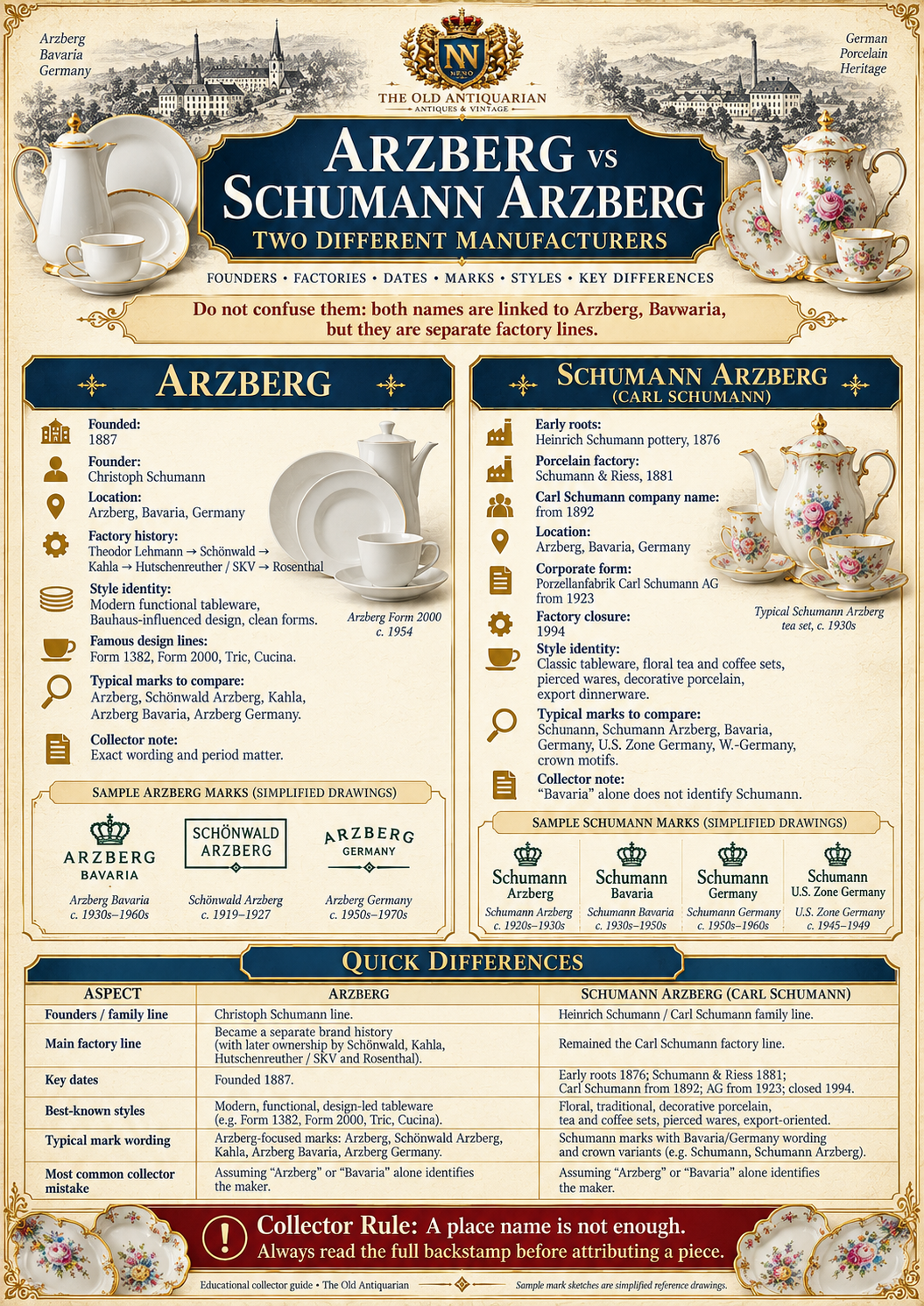
| Feature | Arzberg | Schumann Arzberg |
|---|---|---|
| Historical Foundation | 1887 | 1881 porcelain factory |
| Family Connection | Christoph Schumann | Christian Heinrich and Carl Schumann |
| Design Reputation | Functional modernist porcelain | Decorative and floral porcelain, pierced tableware |
| Known Collections | Form 1382, Form 2000, Tric, Cucina | Wild Rose, White Rose and decorative Schumann patterns |
| Later History | Brand acquired by Rosenthal in 2013 | Carl Schumann factory closed in 1994 |
Collector rule: A porcelain mark reading Bavaria or Arzberg does not automatically identify Carl Schumann. The complete manufacturer inscription and documented mark variant must be checked.
For the other factory line, read our dedicated Schumann Arzberg Porcelain: Marks, Bavaria, Dating & Value Guide.
5. Hermann Gretsch and Heinrich Löffelhardt: Two Design Classics
Arzberg’s most important contribution to twentieth-century design was its approach to functional porcelain. Instead of relying exclusively on elaborate ornament, the manufacturer became known for carefully considered shapes that combined everyday practicality with visual clarity.
Hermann Gretsch — Form 1382 (1931)
Hermann Gretsch designed Form 1382 in 1931. The service became a defining example of modern German porcelain, with practical proportions, balanced shapes and an emphasis on usability.
The design was developed in an era when functionalist principles were transforming European architecture, furniture and everyday objects. Its visual language has connections with the broader modernist and Bauhaus-influenced movement, although Gretsch’s individual work and professional history should be understood on their own terms.
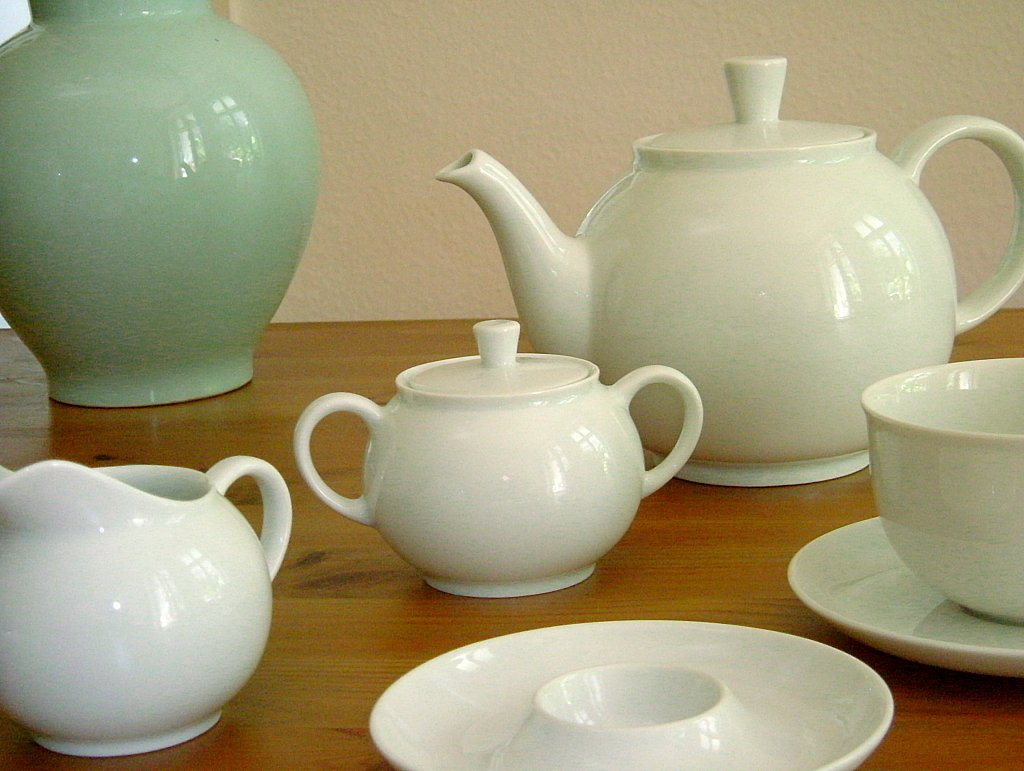

Form 1382 included a broad range of tableware. The smooth curves of teapots, cups, serving pieces and bowls demonstrate the designer’s concern for proportion and practical use.
The service’s historical importance was strengthened by international recognition. Museum research documents a gold medal at the Milan Triennale in 1936 and subsequent presentation in the design context of New York’s Museum of Modern Art.
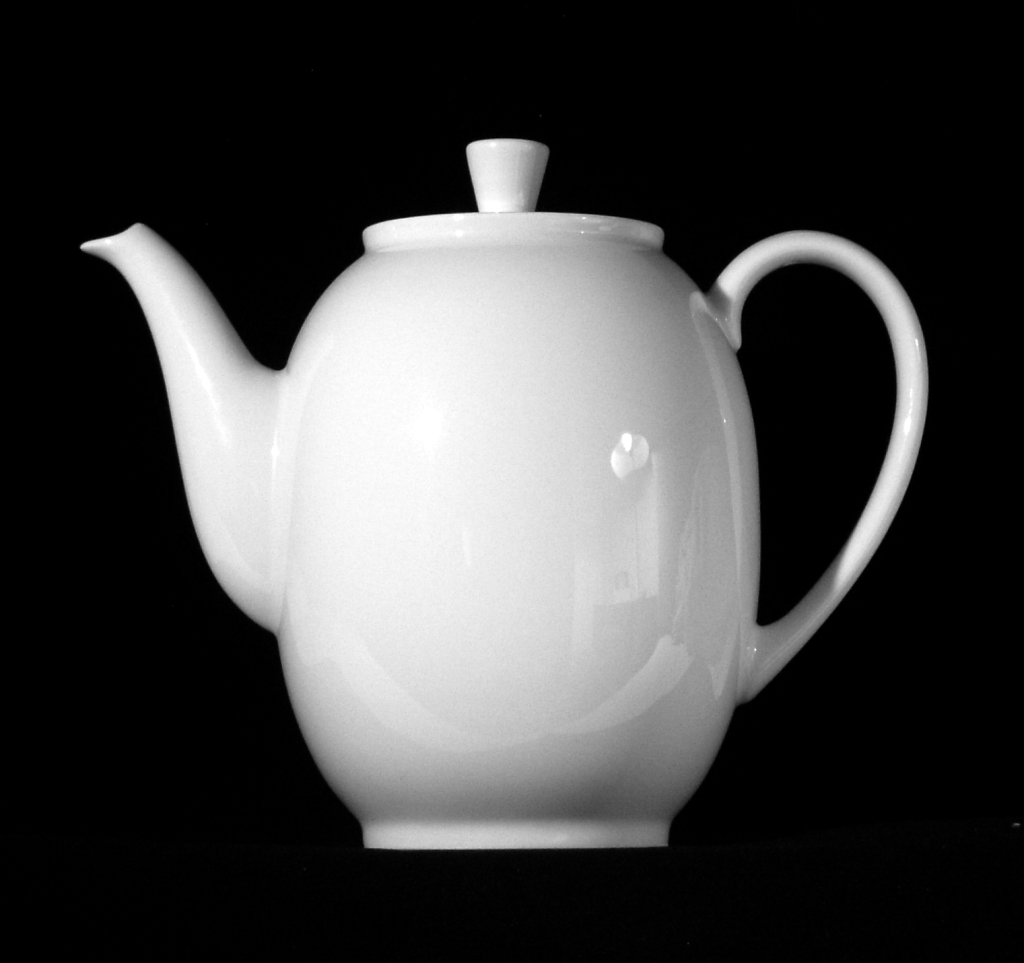
Form 1382 Coffee Pot

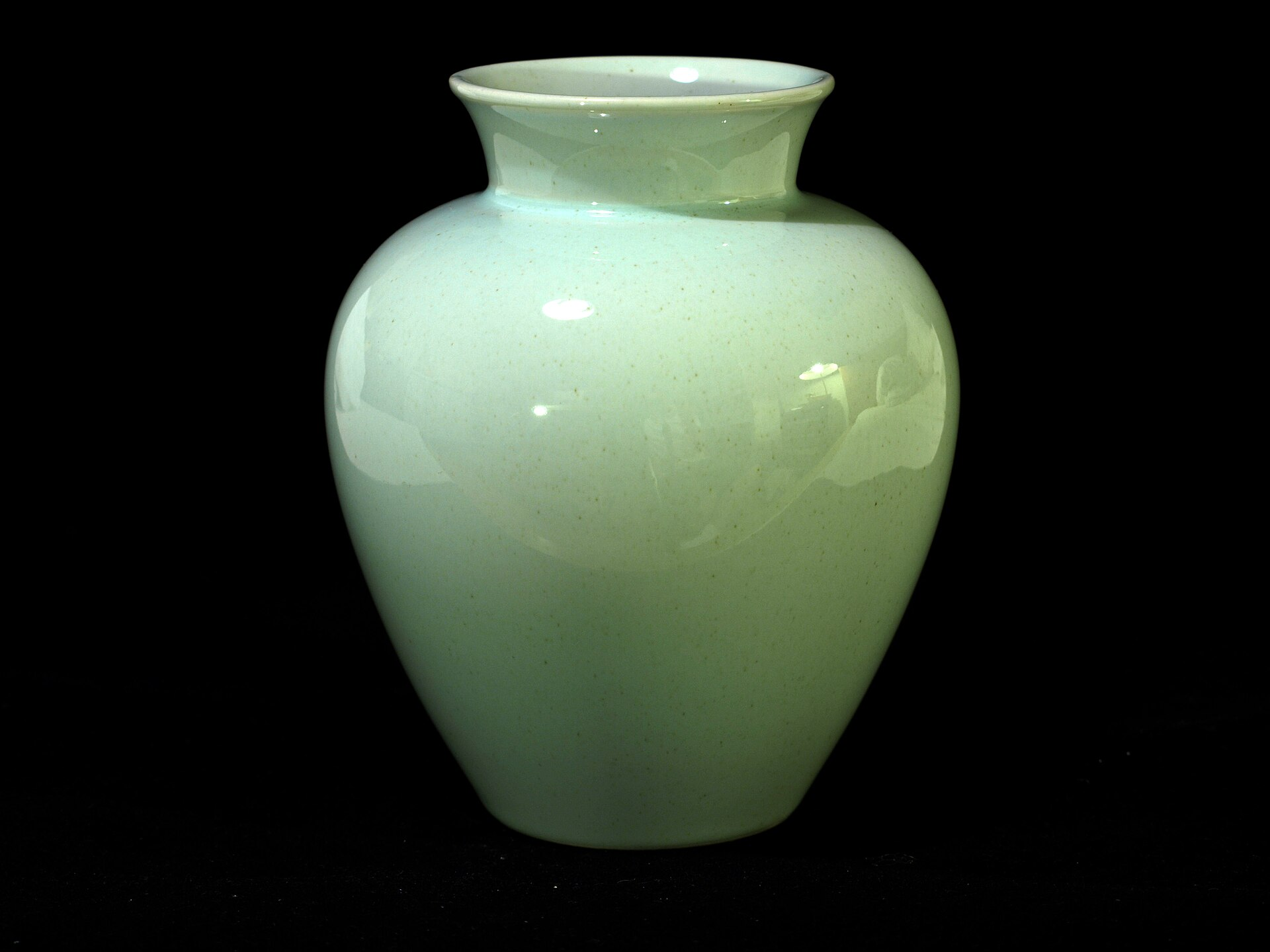
Form 1382 Green Porcelain Vase
Arzberg’s visual identity was not limited to white tableware. Coloured glazes and decorative variations also appeared within its production history. The pale green vase shown below demonstrates how simple volume and a restrained glaze can create a distinctive decorative object.

Heinrich Löffelhardt — Form 2000 (1954)
In 1954, Heinrich Löffelhardt introduced Form 2000, another major milestone in the history of Arzberg porcelain. Its elegant, carefully proportioned forms reflect the priorities of postwar German design.
Where Form 1382 is associated with the functionalist breakthrough of the early 1930s, Form 2000 represents a later expression of modernity. Both collections reject unnecessary complexity, but they embody different design periods.
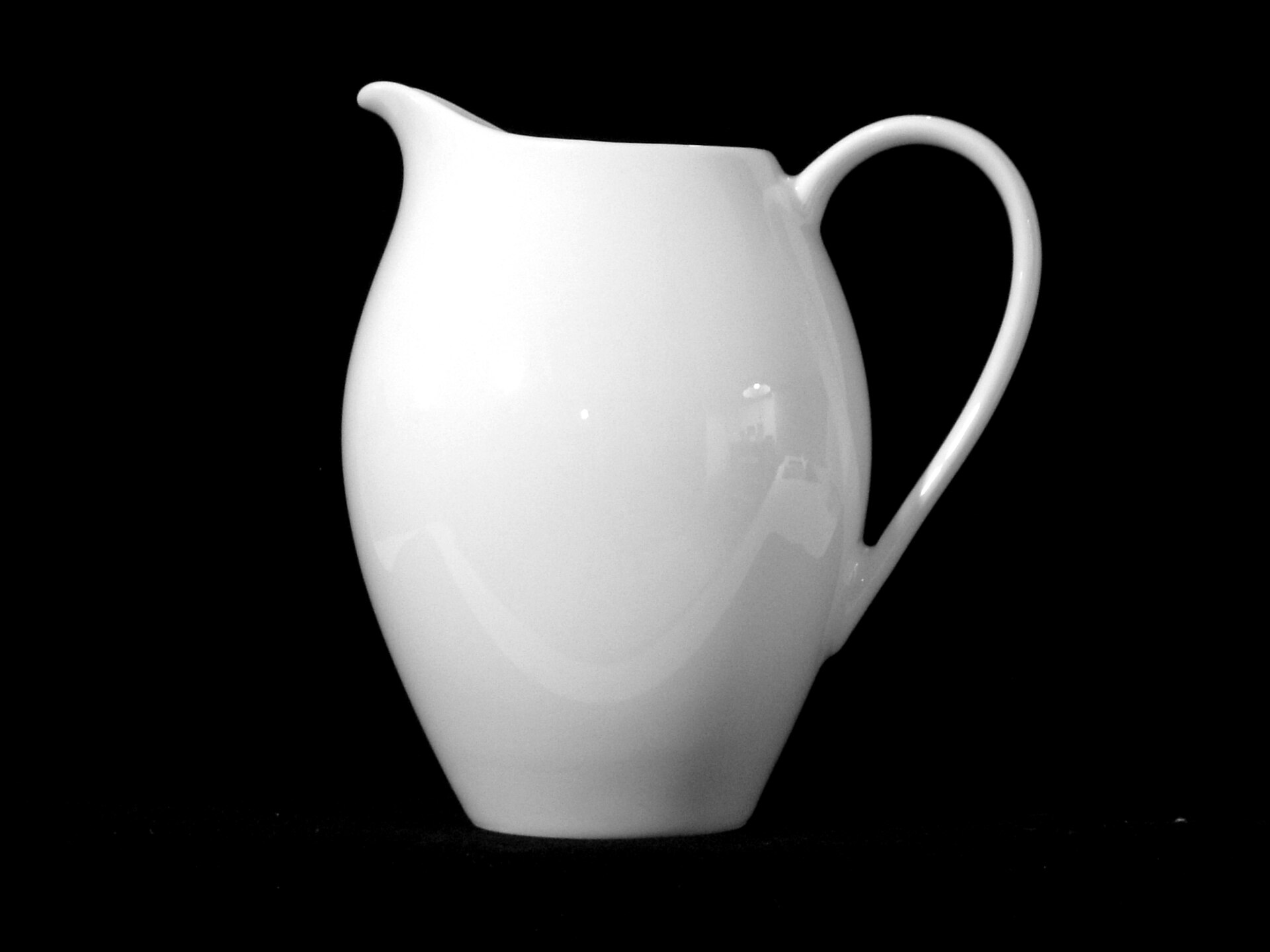

The National Gallery of Victoria holds documented Form 2000 examples, including a cup and saucer manufactured in 1968. This demonstrates an essential distinction: 1954 is the design year, not the manufacturing date of every Form 2000 object.
Form 1382 vs Form 2000
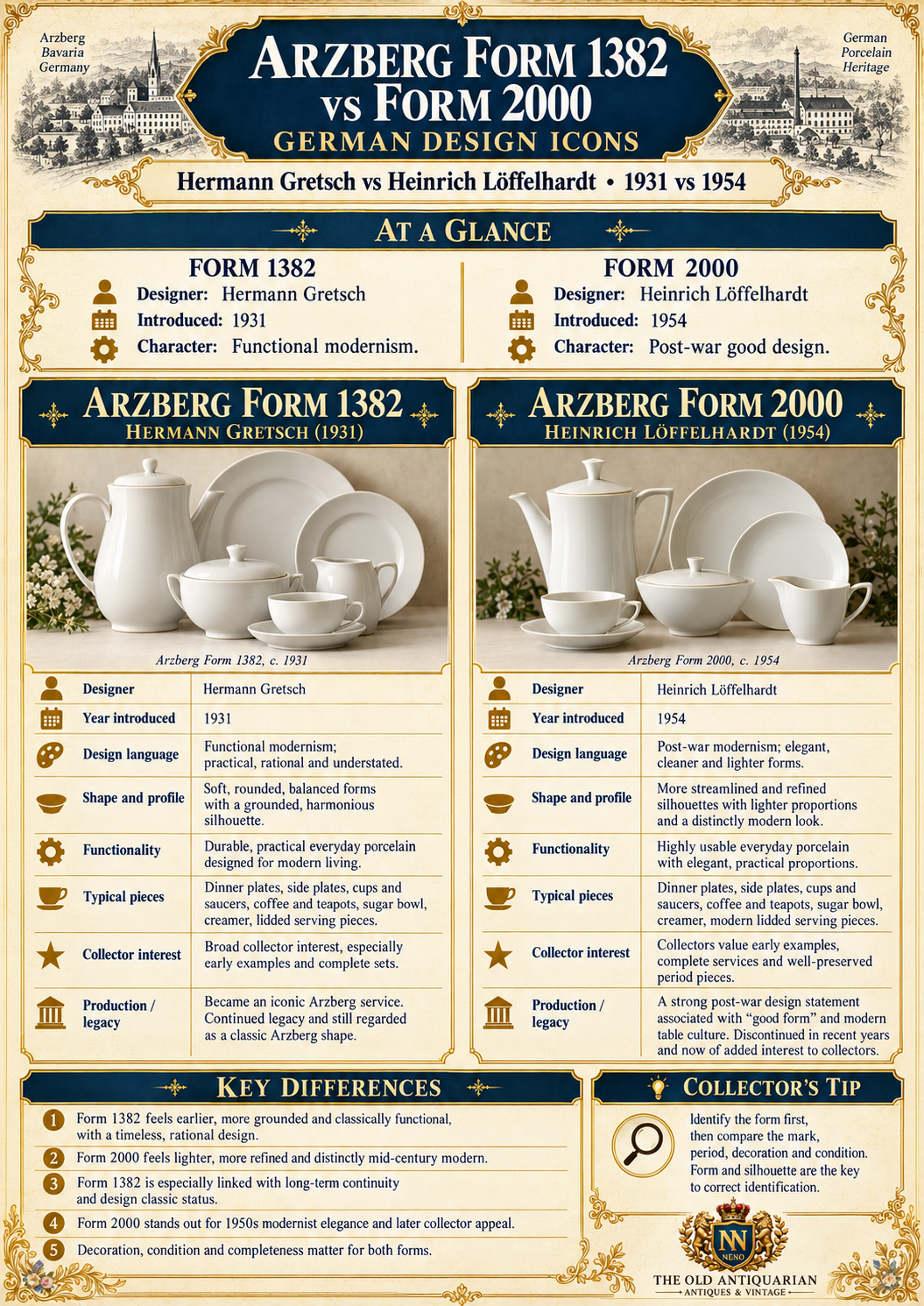
| Feature | Form 1382 | Form 2000 |
|---|---|---|
| Designer | Hermann Gretsch | Heinrich Löffelhardt |
| Introduction | 1931 | 1954 |
| Historical Context | Interwar functionalism | Postwar modernism |
| Design Character | Balanced, restrained, practical | Streamlined, elegant, practical |
| Collecting Focus | Historical design, decorations, early examples, complete services | Mid-century design, production variants, complete services, condition |
| Modern Brand Status | Integrated into Rosenthal range | Discontinued under the 2024 reorganisation |
6. Arzberg Porcelain Products, Forms and Collections
Although Arzberg is especially associated with white modernist tableware, its production history includes a wider variety of decorative and functional porcelain.
Collectors may encounter tea and coffee pots, cups, saucers, milk jugs, sugar bowls, dinner plates, covered dishes, serving platters, vases and specialised dining accessories.
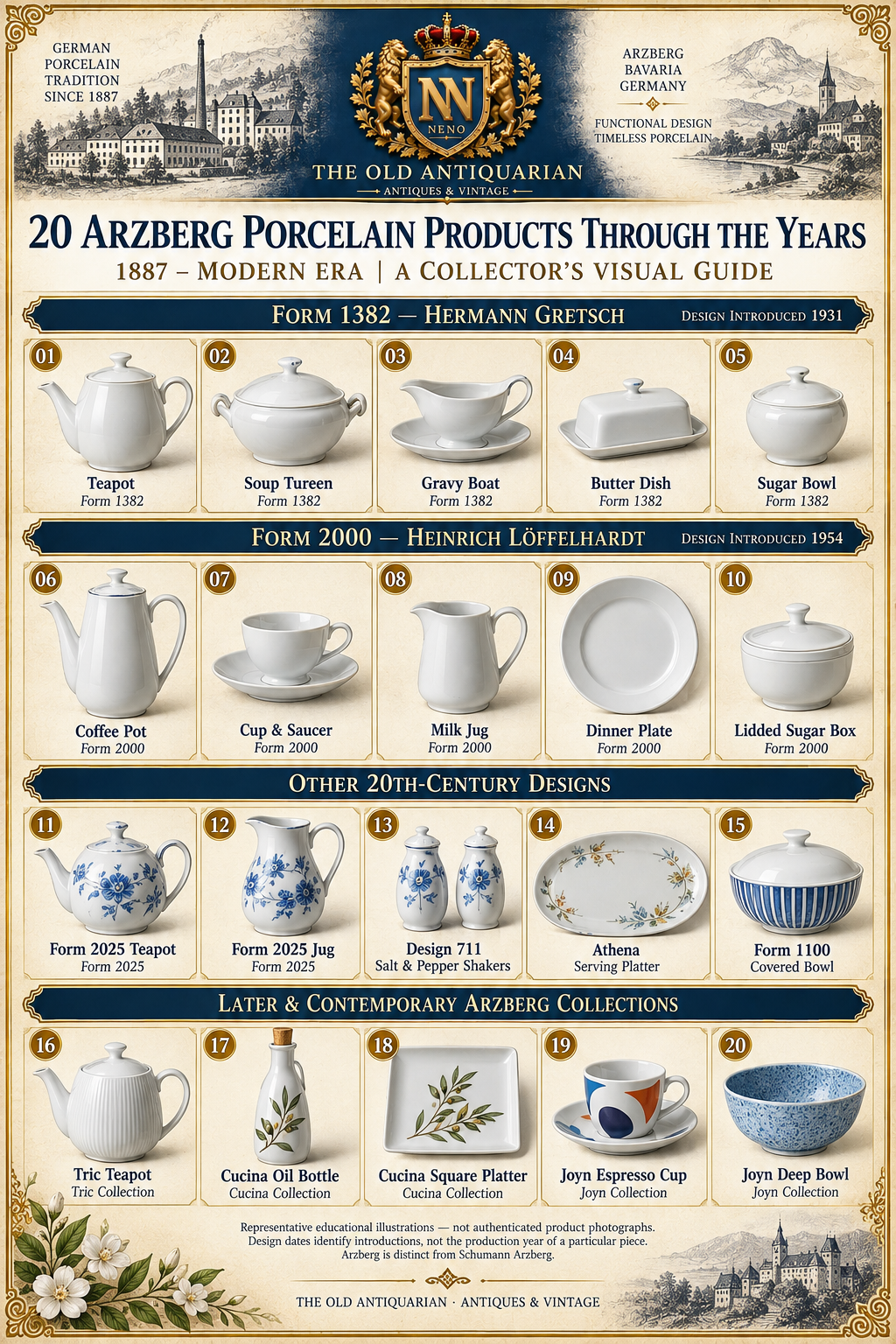
The illustrated selection demonstrates the functional diversity associated with the brand. However, a precise attribution of any individual shape, decoration or combination to a named historical collection must be verified against original Arzberg catalogues or documented museum objects.
Important Arzberg Collections
| Collection | Designer / Context | Collector Interest |
|---|---|---|
| Form 1382 | Hermann Gretsch, 1931 | Historic functionalist design and period variations |
| Form 2000 | Heinrich Löffelhardt, 1954 | Postwar modernist tableware and discontinued production |
| Tric | Michael Sieger | Versatile contemporary geometric tableware |
| Cucina | Hans-Wilhelm Seitz | Practical modern everyday tableware |
| Joyn | Contemporary Arzberg collection | Modern shapes, decorative finishes and evolving brand stamps |
An important collecting principle is that the same design can exist in several production periods. An early object and a later factory-made example may be equally genuine, but their collector appeal and market values can differ significantly.
7. Arzberg, Rosenthal and Thomas: Changes Since 2013
The modern history of Arzberg includes a significant change in brand ownership. Following the insolvency of Arzberg Porzellan GmbH, Rosenthal acquired the brand in 2013.
In February 2024, Rosenthal announced a restructuring under which important Arzberg collections would be marketed within the Rosenthal and Thomas ranges.
| Arzberg Collection | Brand Following Reorganisation | Collector Note |
|---|---|---|
| Form 1382 | Rosenthal | Compare older Arzberg stamps with later Rosenthal branding. |
| Joyn | Rosenthal | Brand transition may produce differing base stamps. |
| Tric | Thomas | Existing Arzberg-marked stock may still circulate. |
| Cucina | Thomas | Later branding does not necessarily mean a different design. |
| Form 2000 | Discontinued | Discontinuation is historically relevant but does not guarantee increasing value. |
Rosenthal has explicitly stated that the transition began gradually in 2024 and that Arzberg-stamped and newly branded examples may coexist in circulation. Therefore, collectors should not assume that every object carrying an Arzberg stamp was necessarily manufactured before 2024.
For current company information, consult the official Rosenthal Arzberg information page and the official Arzberg website.
8. Is Arzberg Porcelain Valuable?
Arzberg porcelain can be collectible and valuable, but not every piece is rare or expensive. Market interest depends on the design, production period, condition, completeness, decoration and availability of comparable objects.
The historical importance of a design does not automatically translate into a high market price for every example. Some Arzberg forms were produced in substantial quantities over many years.
| Value Factor | Why It Matters |
|---|---|
| Production Period | Early documented examples may attract more specialist interest than common later production. |
| Designer and Form | Recognised designs can appeal to industrial-design collectors. |
| Decoration | Scarcer documented colourways and patterns may influence demand. |
| Condition | Chips, cracks, heavy wear, staining and restoration can reduce desirability. |
| Completeness | Matched sets and pieces with original lids may be more desirable than incomplete examples. |
| Provenance | Documented ownership, exhibitions or significant historical use can support interest. |
| Market Evidence | Completed sales of genuinely comparable objects provide a better guide than asking prices. |
Which Arzberg Pieces May Interest Collectors Most?
Potentially interesting collecting areas include well-documented early Form 1382 examples, historically significant Form 2000 pieces, unusual decorations, scarce serving shapes and complete services in excellent condition.
Discontinued collections may also attract attention, but discontinuation alone does not establish rarity or investment value.
Valuation principle: Compare the same maker, form, approximate period, size, decoration and condition. An asking price is not proof of a completed market sale.
For a wider explanation, see How Is Antique Porcelain Valued?.
9. How to Care for and Preserve Arzberg Porcelain
Arzberg porcelain was designed for practical use, but historic examples deserve careful handling. The safest preservation method depends on the age, decoration, glaze, structural condition and any earlier repairs.
Clean plain, undamaged porcelain gently with mild methods suitable for its finish. Avoid abrasive cleaners, metal tools, unnecessary soaking and sudden temperature changes. Do not assume that older porcelain can safely be placed in a dishwasher or microwave simply because a modern version of the same collection allows it.
Protect vulnerable handles, spouts, lids and thin edges. When storing plates, use appropriate protective separators and avoid excessive stacking pressure.
For more detailed preservation advice, visit our Antique Porcelain and Ceramics Care Guide.
10. Arzberg Porcelain Collector Checklist
Before identifying, buying, selling or valuing an Arzberg piece, work through the following questions:
- Photograph the entire object from several angles.
- Photograph the complete underside and factory backstamp.
- Record all printed, impressed and painted markings.
- Check whether the manufacturer is Arzberg or Schumann Arzberg.
- Identify the porcelain form and possible designer.
- Separate the design introduction year from the production date.
- Compare decoration and colourway with documented examples.
- Inspect rims, handles, spouts, lids and foot rings for damage.
- Check for restoration, replaced components and mismatched pieces.
- Compare completed sales rather than relying only on advertised prices.
- Record dimensions and any available provenance.
- Keep clear photographs and source references with your collection records.
The strongest attribution is supported by several independent pieces of evidence, not by a single familiar logo.
11. Arzberg Porcelain — Frequently Asked Questions
1. Is Arzberg porcelain German?
Yes. Arzberg originated in the Bavarian town of Arzberg, Germany, in 1887.
2. Who founded Arzberg porcelain?
Christoph Schumann founded the separate porcelain factory in 1887 that became the historical foundation of the Arzberg brand.
3. Is Arzberg the same as Schumann Arzberg?
No. They represent separate porcelain factory histories, despite their shared town and Schumann family connections.
4. How can I identify an Arzberg porcelain mark?
Record the complete manufacturer’s name, symbols, lettering, country wording and additional numbers. Compare the exact variant with documented factory or museum references and the porcelain form.
5. What does Arzberg Bavaria mean?
It indicates an association with Arzberg in Bavaria, Germany. The phrase alone does not establish an exact production year.
6. How old is Arzberg porcelain marked Germany?
The inscription Germany alone is insufficient for precise dating. It must be evaluated with the complete mark, form, decoration and historical production evidence.
7. What is Arzberg Form 1382?
Form 1382 is a German functionalist porcelain design created by Hermann Gretsch in 1931. It became one of Arzberg’s best-known collections.
8. What is Arzberg Form 2000?
Form 2000 is a modernist tableware design introduced by Heinrich Löffelhardt in 1954. It is an important example of postwar German industrial design.
9. Does 1382 mean the porcelain was made in 1931?
No. Form 1382 was designed in 1931, but individual pieces were produced during many later years.
10. Is Arzberg porcelain still made?
Selected former Arzberg collections continue under Rosenthal and Thomas branding, while other collections, including Form 2000, have been discontinued. The company also describes a more limited partner-network continuation of the Arzberg brand.
11. When did Rosenthal acquire Arzberg?
Rosenthal GmbH acquired the Arzberg brand in 2013.
12. Why does an Arzberg design sometimes have a Rosenthal or Thomas mark?
Beginning in 2024, selected Arzberg ranges were progressively rebranded under Rosenthal and Thomas. Different base stamps can therefore occur on related designs.
13. Is Arzberg porcelain valuable?
Some pieces are collectible, especially documented historic forms, unusual decorations, early production and complete well-preserved services. Value must be assessed individually.
14. Is all Arzberg porcelain antique?
No. Arzberg designs were manufactured over many decades, and numerous examples are vintage or modern rather than antique.
12. Sources, References & Further Research
This guide combines manufacturer information, documented museum objects, historical factory research and collector identification principles. Historical mark dates may overlap, and uncertain attributions should not be treated as exact factory records.
- Arzberg — The History & Story of Arzberg. Official brand history and design milestones.
- Rosenthal — The Arzberg Brand. Official information about brand integration and base-stamp changes.
- Rosenthal GmbH, 29 February 2024. Corporate announcement concerning Rosenthal and Thomas branding.
- Museum Europäischer Keramikkunst — Arzberg Object D/XCV/4. Historical factory genealogy and Schönwald–Arzberg mark documentation.
- Museum Europäischer Keramikkunst — Hermann Gretsch and Form 1382. Designer biography and documented porcelain backstamp.
- National Gallery of Victoria — Form 2000 Sugar Box. Museum collection record for Löffelhardt’s design.
- National Gallery of Victoria — Form 2000 Cup and Saucer. Documented example manufactured in 1968.
Photograph Credits and Licensing
The five documentary photographs used in this article are reproduced from Wikimedia Commons under their respective Creative Commons Attribution-ShareAlike licences:
- Form 1382 service — Bastian Frank, CC BY-SA 2.5.
- Historical Arzberg backstamp — Schoener alltag, CC BY-SA 3.0.
- Form 2000 jug — Bastian Frank, CC BY-SA 3.0.
- Form 1382 vase — Oimel, CC BY-SA 3.0.
- Form 1382 coffee pot — Bastian Frank, CC BY-SA 3.0.
The original Wikimedia Commons file pages provide the licence conditions. Attribution and ShareAlike obligations apply, including appropriate indication of modifications where relevant.
Illustration note: The six historical and educational infographics were created for The Old Antiquarian. Their schematic marks, porcelain forms and historical scenes are artistic reconstructions rather than authenticated photographic evidence. Use original museum photographs and factory references for precise identification.
About the Author — The Old Antiquarian
The Old Antiquarian combines more than 35 years of practical experience with antiques and collecting with historical research and comparative object study.
Our approach to porcelain identification combines the complete factory mark, material, form, decoration, physical condition, historical context and documented reference examples. We distinguish confirmed evidence from hypotheses and avoid assigning exact dates, makers or market values without sufficient support.
Need Help Identifying Arzberg Porcelain?
If you own an Arzberg coffee service, porcelain vase, dinner set or inherited collection, clear photographs of the object and its complete backstamp can help establish the correct manufacturer, design and likely production period.
Contact The Old Antiquarian about your porcelain or collection
Related Guides
- Schumann Arzberg Porcelain — Marks, Bavaria, Dating & Value
- Bavaria Porcelain — Marks, Makers, Dating & Value
- How to Identify Porcelain Marks and Backstamps
- How to Date Antique Porcelain
- How Is Antique Porcelain Valued?
- Complete Guide to Antique Porcelain — History, Marks and Manufacturers
Continue Exploring
Explore the broader history of porcelain production, factory marks, antique identification and collecting through The Old Antiquarian’s Antique & Collector’s Glossary.
Conclusion: Understanding Arzberg Porcelain
Arzberg porcelain is an important part of Germany’s industrial and design heritage. From its nineteenth-century factory origins to internationally recognised functionalist collections and the modern Rosenthal era, its history reflects the changing relationship between craftsmanship, manufacturing and everyday life.
For collectors, the essential lesson is to distinguish the manufacturer’s history from the age of a particular object. A genuine Arzberg mark, a famous designer name or a well-known form can offer useful evidence, but none should be interpreted in isolation.
The Collector’s Principle
Identify the manufacturer. Examine the mark. Recognise the form. Verify the period. Preserve the history.
