
Bakamski with Sofra Rug: Chiprovtsi History & Symbols
THE OLD ANTIQUARIAN · OBJECT STORIES · BULGARIAN TEXTILE HERITAGE
Bakamski with Sofra – A Time Capsule from the Golden Age of Bulgarian Carpet Weaving
A story of time, women who preserve tradition, sacred geometry, and the white flowers that continue to bloom within the threads.
Original collection study and personal reflection · Last Updated: October 28, 2026 · The Old Antiquarian
Quick Answer: What Is a Bakamski with Sofra Rug?
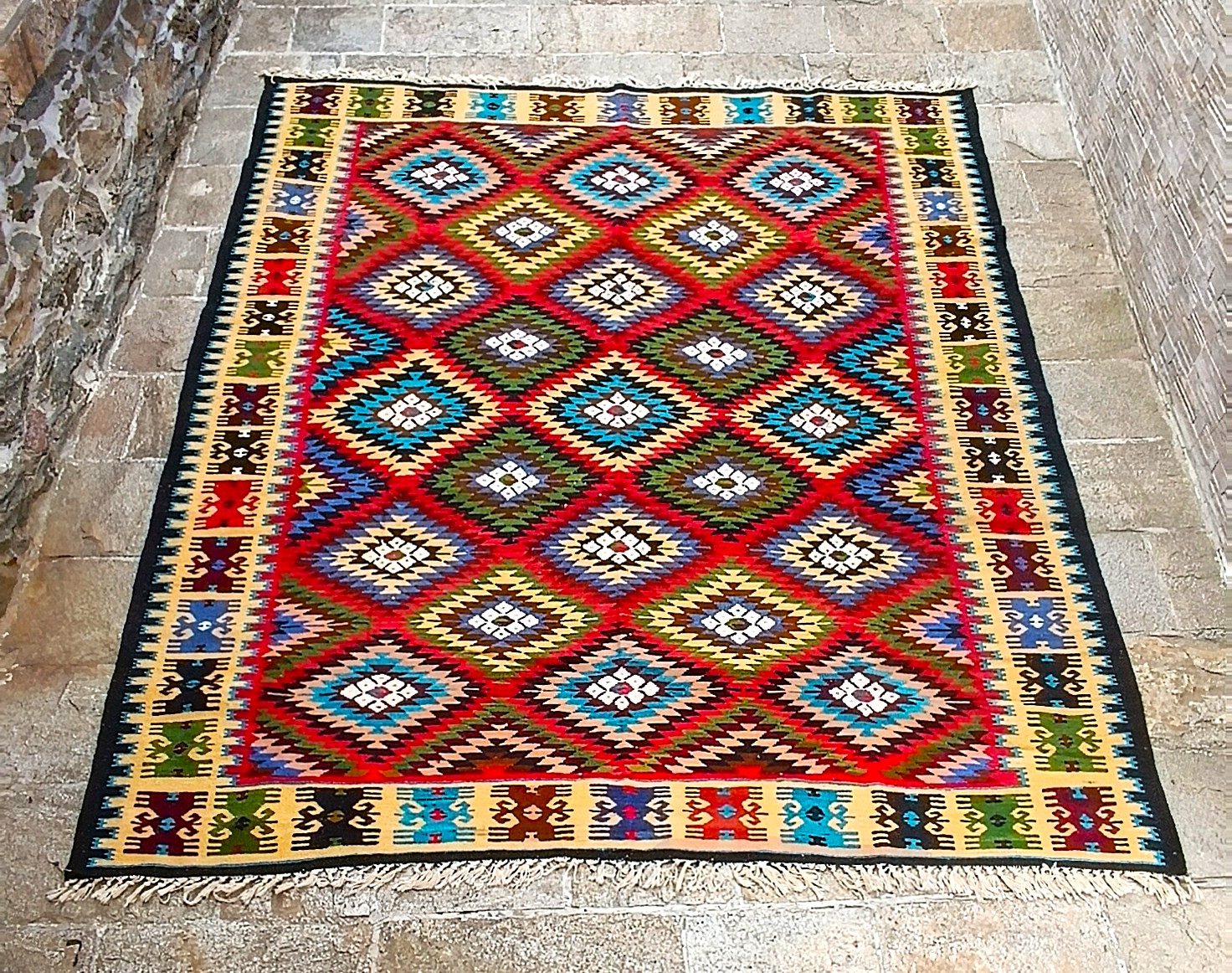
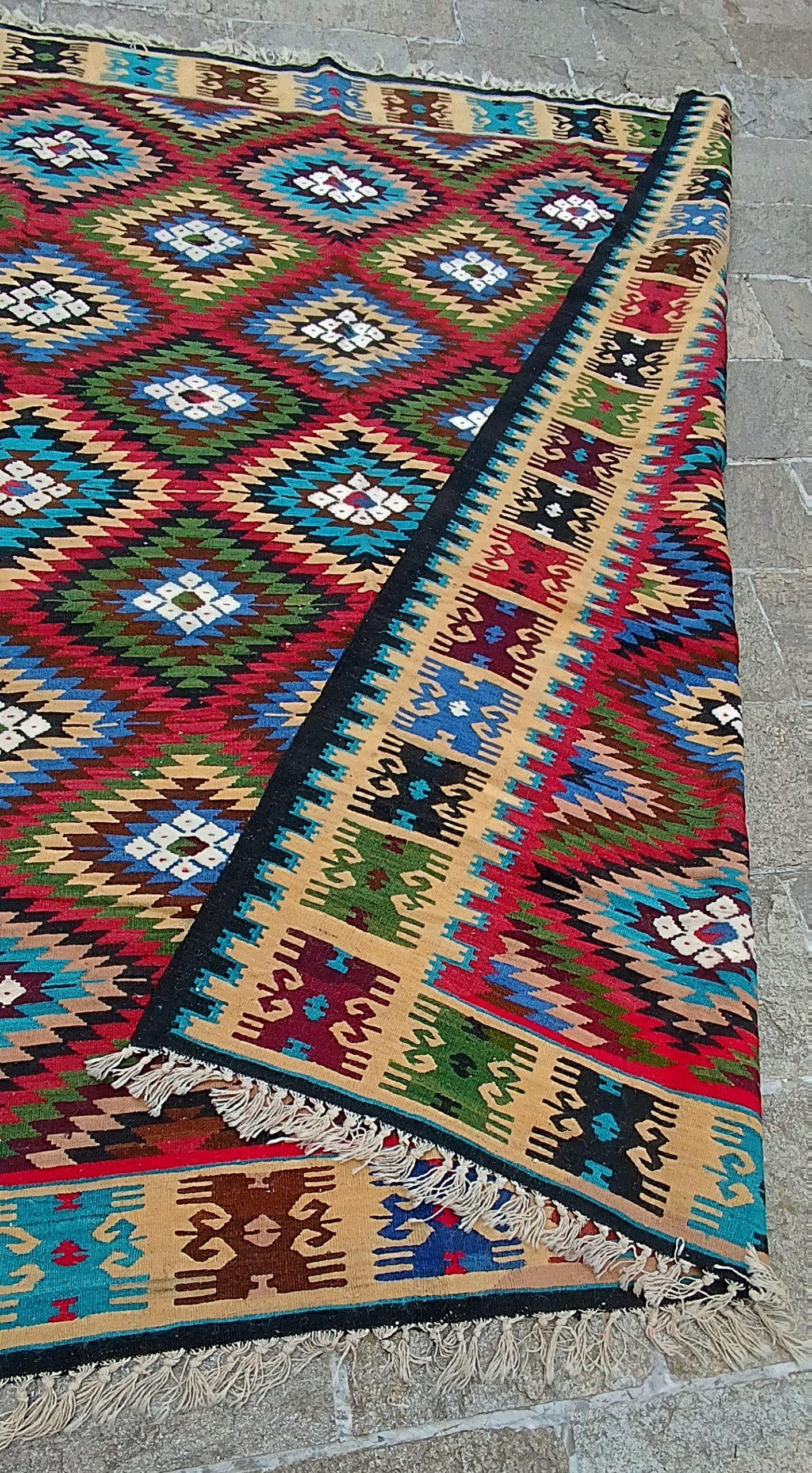
A Bakamski with Sofra rug is a Bulgarian Chiprovtsi flatwoven kilim featuring the historic Bakamski, also known as Garibalda, geometric design together with a central floral motif traditionally called Sofra. The example in The Old Antiquarian Collection dates to approximately 1970–1985. It displays multicoloured stepped diamonds with white Sofra rosettes, a cream ornamental border featuring Pileta and Karakachka motifs, and white fringes. According to its collection provenance, it is handwoven with factory-spun wool yarn on a wool warp with a wool weft, retains its original state-issued seal, and has never been used. Its twentieth-century date must be distinguished from the centuries-old history of the design.
At a Glance – The Rug in Our Collection
| Feature | Collection Details |
|---|---|
| Object | Traditional Bulgarian Chiprovtsi handwoven flatweave (kilim) |
| Design name | Bakamski with Sofra; historic design family also called Garibalda |
| Approximate date | 1970–1985, according to collection provenance |
| Weaving | Handwoven, flat and reversible |
| Materials | Factory-spun wool yarn; wool warp and wool weft |
| Main field | Repeating multicoloured stepped diamonds with white Sofra rosettes |
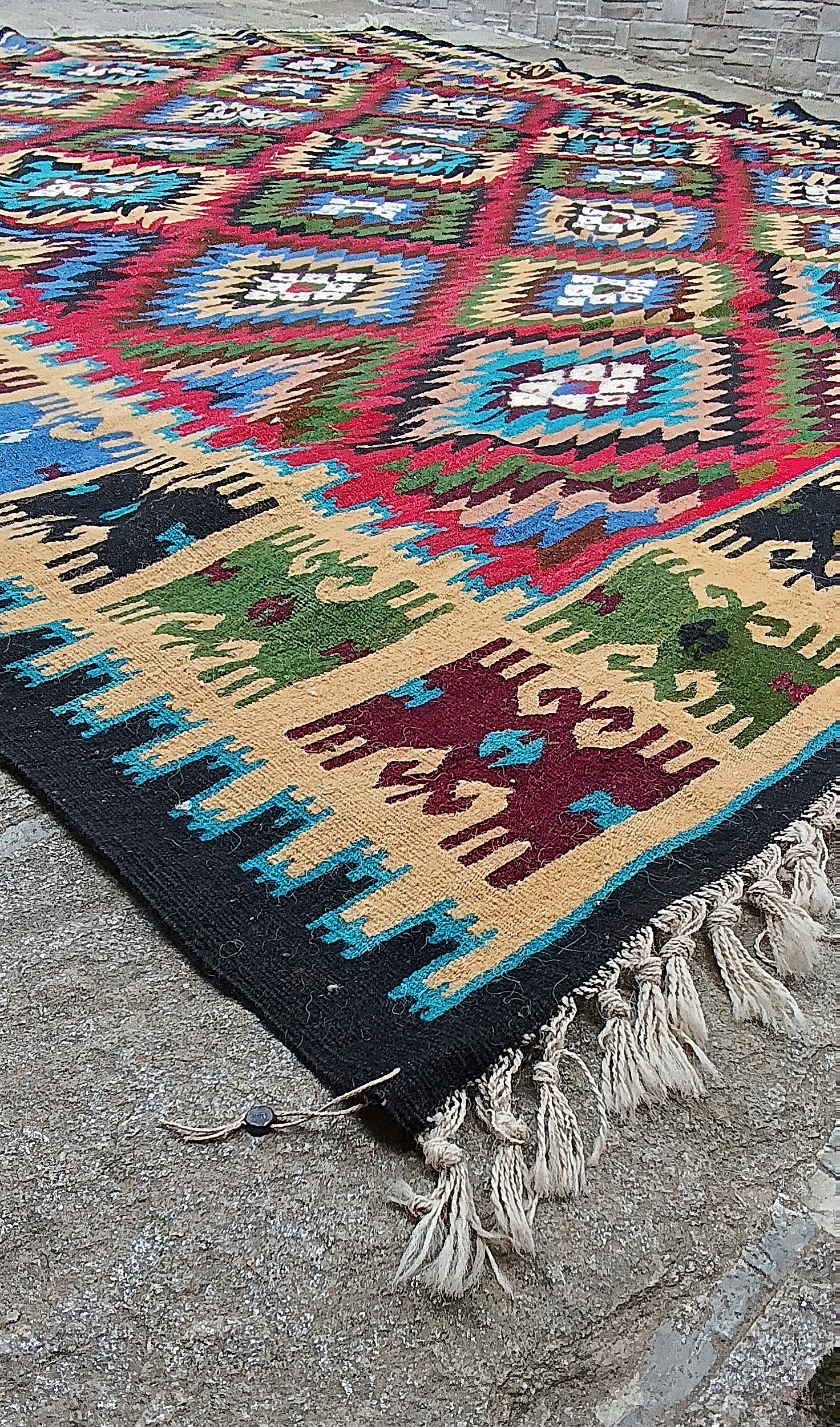
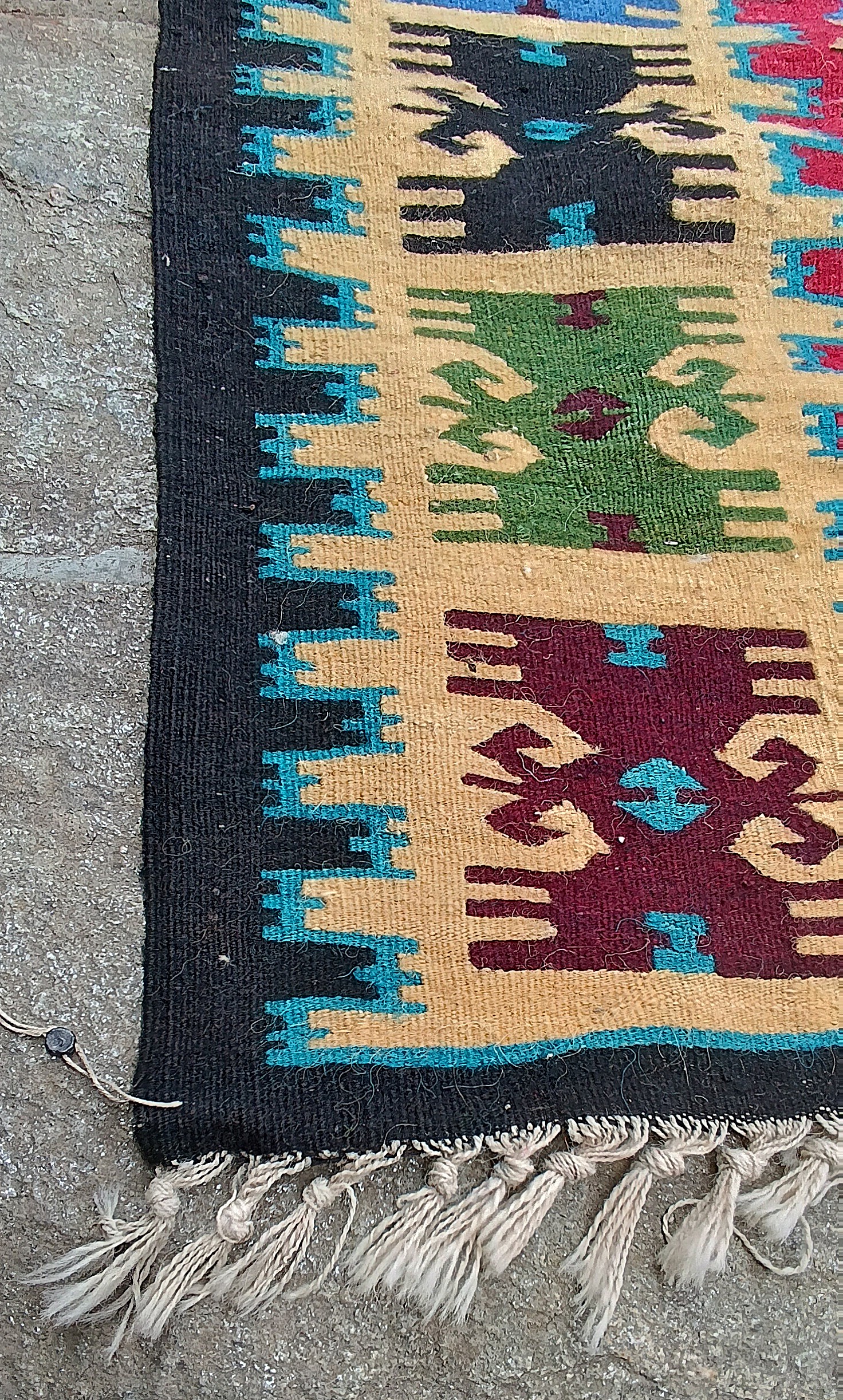
| Border motifs | Pileta (Birds) and Karakachka, using names preserved by weavers |
| Marking | Original state-issued seal retained, according to the object’s history |
| Condition | Reportedly unused; never walked upon |
| Collection | The Old Antiquarian, Bulgaria |
When Time Becomes Beauty
There are objects that do not simply pass through time. They gather time within themselves.
There are creations that remain silent for decades, carrying their beauty, their history, their invisible memory, almost as though they are waiting for that extraordinary moment when someone will unfold them, look at them, and recognise them.
And then time disappears.
Past and present merge. Everything that once existed seems to continue living in another dimension — the dimension in which human hands leave traces of love, inspiration, and creation.
This is how I experience this extraordinary Bulgarian Chiprovtsi rug.
I look at it and see diamonds. I move closer and see flowers. Closer still, I discover the threads — each one separate, each one different, each one belonging exactly where it should.
And suddenly everything comes alive.
The colours begin to move. The diamonds seem to breathe. White flowers bloom one after another, while the pale decorative border embraces this entire colourful universe with extraordinary calm.
How natural! How harmonious!
And how much it resembles life.
I have named this rug “Bakamski with Sofra.”
Its name brings together one of the oldest geometric traditions of Chiprovtsi carpet weaving and the little white flower that lives at the heart of every great diamond.
A rug in which geometry becomes movement, movement becomes rhythm, and rhythm becomes prayer.
An Extraordinary Witness to Its Time
My rug belongs to the period around 1970–1985, when the centuries-old traditions of Bulgarian carpet weaving continued to flourish within the structures of organised craft and textile production.
According to the information preserved with this particular example, it was woven using factory-spun wool yarn, with a wool foundation and a wool weft.
Wool upon wool.
How natural those words sound to me. A thread born of the earth and the living world, transformed through human skill into something capable of outliving its maker.
The rug retains a state-issued seal — a small material witness to an era of organised production and the control of manufactured goods.
But what moves me most is something else.
No one has ever walked upon it.
For so many years, this rug existed without fulfilling its usual purpose.
It has not carried the footsteps of generations. It has not participated in the noise of an ordinary household. It has not gathered memories of children playing across its surface, nor has it felt the familiar weight of furniture and everyday life.
It remained in expectation.
And the more I think about this, the more extraordinary its destiny becomes.
It seems to have preserved that first moment of completion: when the weaver finished the final threads, stepped back, looked at her creation, and realised that it now had a life of its own.
A life that could continue without her.
The collector’s distinction
The Bakamski design belongs to an old weaving tradition; this individual rug dates to approximately 1970–1985. They are different historical dates. The seal and reported unused condition belong to the evidence for this object, not to the origins of the entire pattern family. The exact workshop and individual weaver have not been identified.
The Bakamski Pattern – A Story That Began Centuries Ago
To understand my rug, I had to travel backwards in my imagination.
Far backwards.
To a time when the world had not yet learned our modern haste; when almost every object demanded enormous patience and craftsmanship was passed from person to person, from hand to hand, from generation to generation.
Chiprovtsi.
A small town nestled among the slopes of Bulgaria’s western Balkan Mountains.
A place where nature, labour, and human imagination created one of the most remarkable textile traditions in the country.
Accounts of Chiprovtsi carpet production reach back to the seventeenth century, although the development of its designs and weaving practices belongs to a much longer history of human craftsmanship.
Among the earliest recognised Chiprovtsi carpet types is Bakamski, also known as Garibalda.
These early rugs are associated with strong geometric organisation: triangles, diamonds, repeated angular figures, and a disciplined rhythm of colour. Their traditional palette included ochre, brown, blue, green, and other colours obtained through natural dyeing.
The name Bakamski is traditionally associated with bakam, a dye-producing wood used to obtain dark and reddish shades. Even the name itself preserves a memory of the days when colour did not arrive ready-made in a workshop.
It had to be created.
It had to be drawn from wood, bark, leaves, or roots. Watched, adjusted, and carefully guided until it reached the shade the craftswoman could already see in her imagination.
This was a kind of alchemy.
The earth provided the material. Water helped transform it. Fire supplied the heat. And human hands turned it all into beauty.
Over the centuries, Chiprovtsi carpet weaving passed through different artistic phases. Geometric compositions became more elaborate. Colour palettes grew richer. New designs, variations, and combinations appeared.
Yet the old patterns did not disappear.
They continued to live.
Colours changed. Dimensions changed. New yarns and dyes became available. But the underlying ideas survived.
And this is precisely why my rug interests me so deeply.
It was woven in the second half of the twentieth century, yet it carries the compositional memory of a much older design.
The past was not simply copied.
It was continued.
It was translated into the language of another era.
And in that way, it received a new life.
A remarkable contemporary reminder of this legacy came in October 2026, when the Regional Ethnographic Museum in Plovdiv presented an exhibition devoted to Bakamski–Garibalda rugs, bringing together examples associated with a span from the late seventeenth century to the early twentieth century. It is a powerful illustration of the importance of this historic design within Bulgarian carpet heritage.
For a wider introduction to the town, its weaving techniques and history, see our complete guide to Chiprovtsi rugs, weaving and UNESCO heritage.
Geometry – The Language in Which the Universe Speaks to Us
What fascinates me most is the central field.
So many diamonds!
They are arranged in a diagonal rhythm, almost as if they approach one another, pass one another, interweave, and meet again.
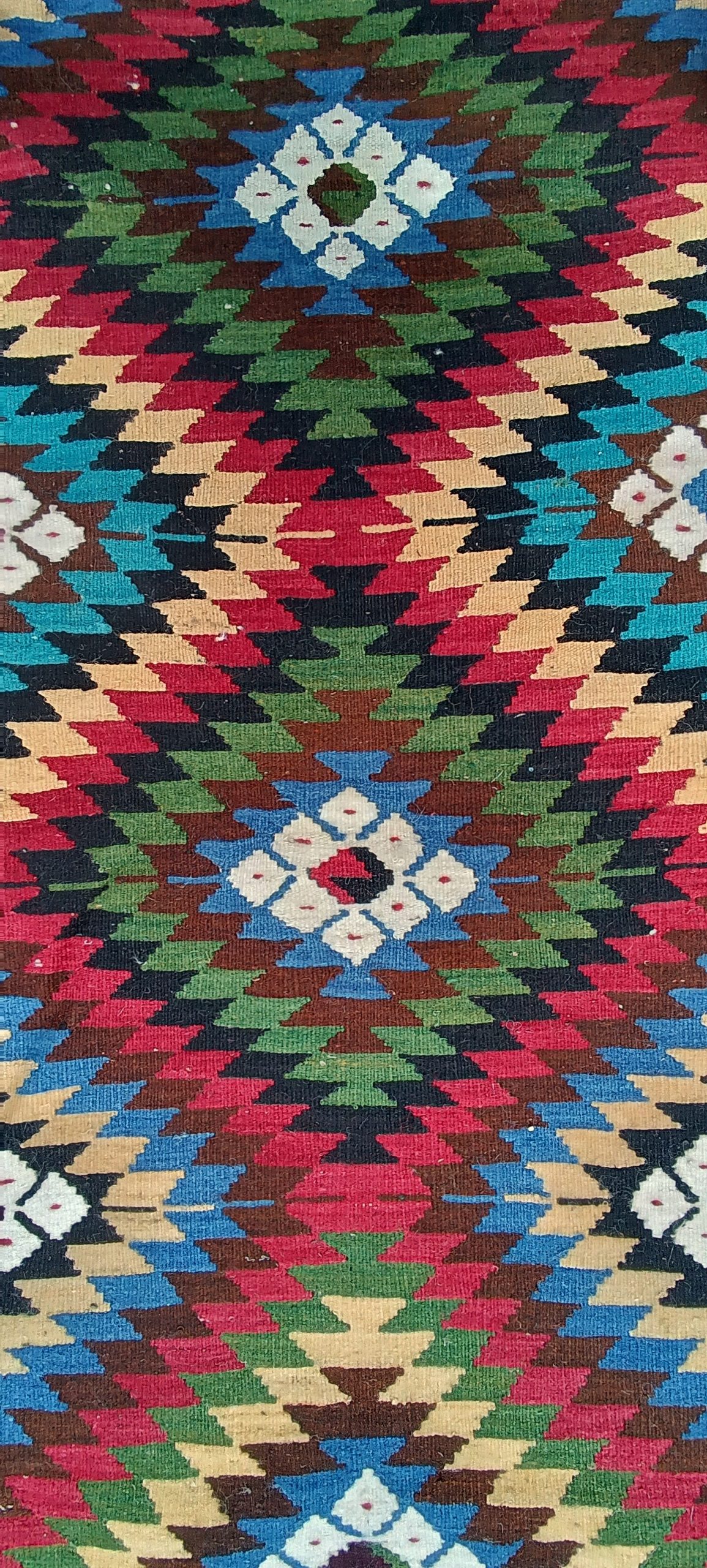
Their outlines are jagged, built from small stepped transitions. The colours change, but the geometric principle repeats.
And it is precisely this repetition that creates the sensation of infinity.
I can follow one diamond, then another, then another… And without noticing, my eyes begin to move as though I have entered a great dance.
How familiar that feeling is!
It is how I hear folk music.
There is rhythm. There is repetition. There is order. Yet there is never stillness.
Every return of the melody is new.
Every movement in the dance resembles the previous one, yet is subtly different.
I discover the same thing in this rug.
The Scientific View of This Beauty
The geometry of Chiprovtsi and Pirot carpets is also a subject of scientific research.
In a study published in 2017, researchers Radostina Atanassova and Rossitsa Vassileva examined the symmetrological characteristics of handwoven carpets from northwestern Bulgaria and Serbia. Their work describes how traditional patterns can be studied through two-dimensional symmetry, coloured symmetry, and the arrangement of triangular and other geometric shapes.
How extraordinary!
What the weavers created through instinct, experience, memory, and extraordinary skill can also be described in the language of mathematics.
And here one of the most beautiful paradoxes of folk art emerges.
Science can explain the geometry. But human experience gives it a soul.
For me, the diamonds in this rug are a kind of map of life.
Every figure has a centre.
Every centre belongs to a larger structure.
Every structure is connected to the others.
Everything seems to remind us that no human being exists entirely apart from the world.
We belong to families, generations, communities, nature, and time.
And however independent we may feel, we remain connected by invisible threads.
Just like the figures in this rug.
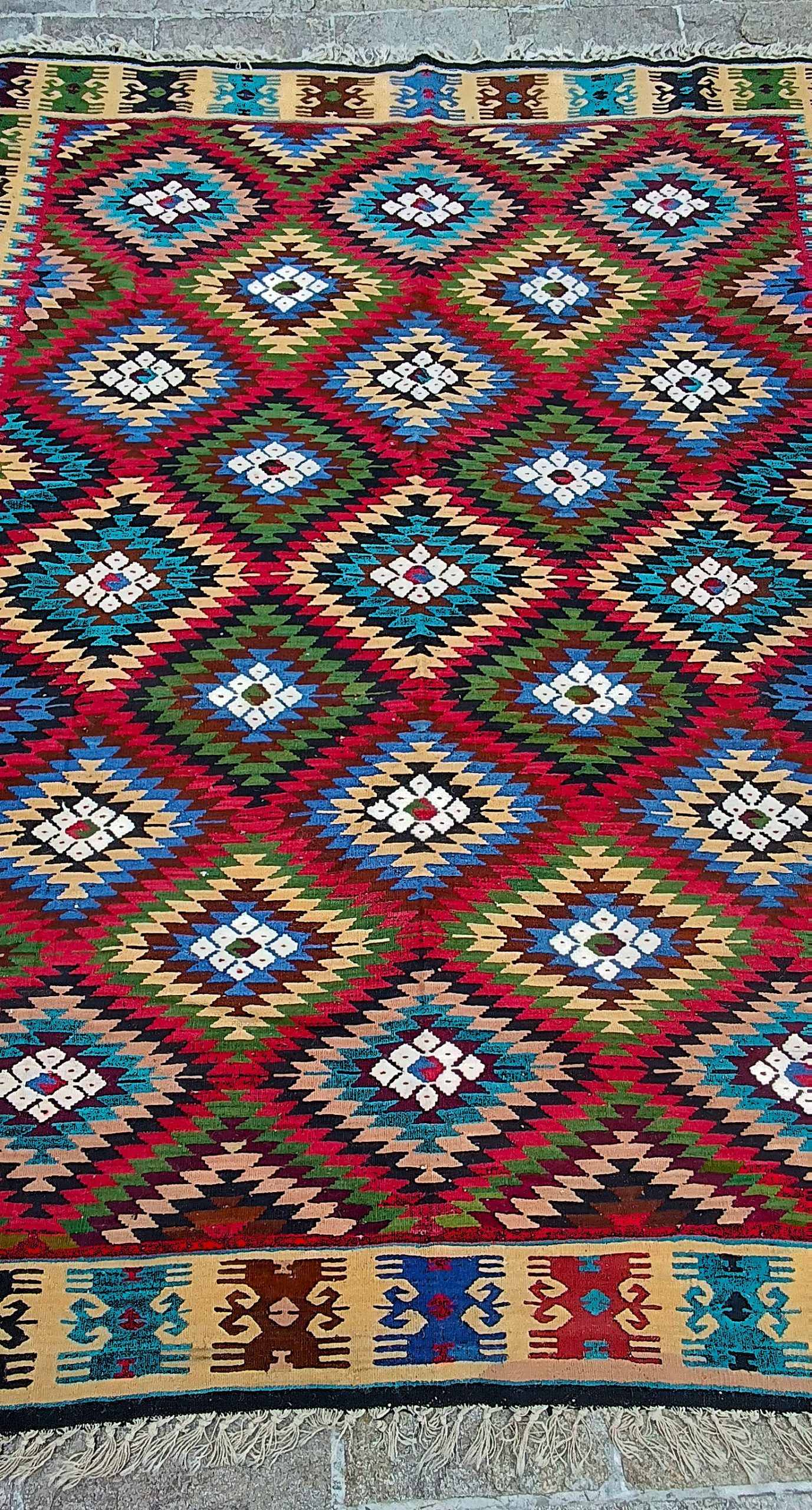
The Sofra – The White Flower at the Heart of the Diamond
And now I come to the most tender part of this extraordinary composition.
The white flowers.
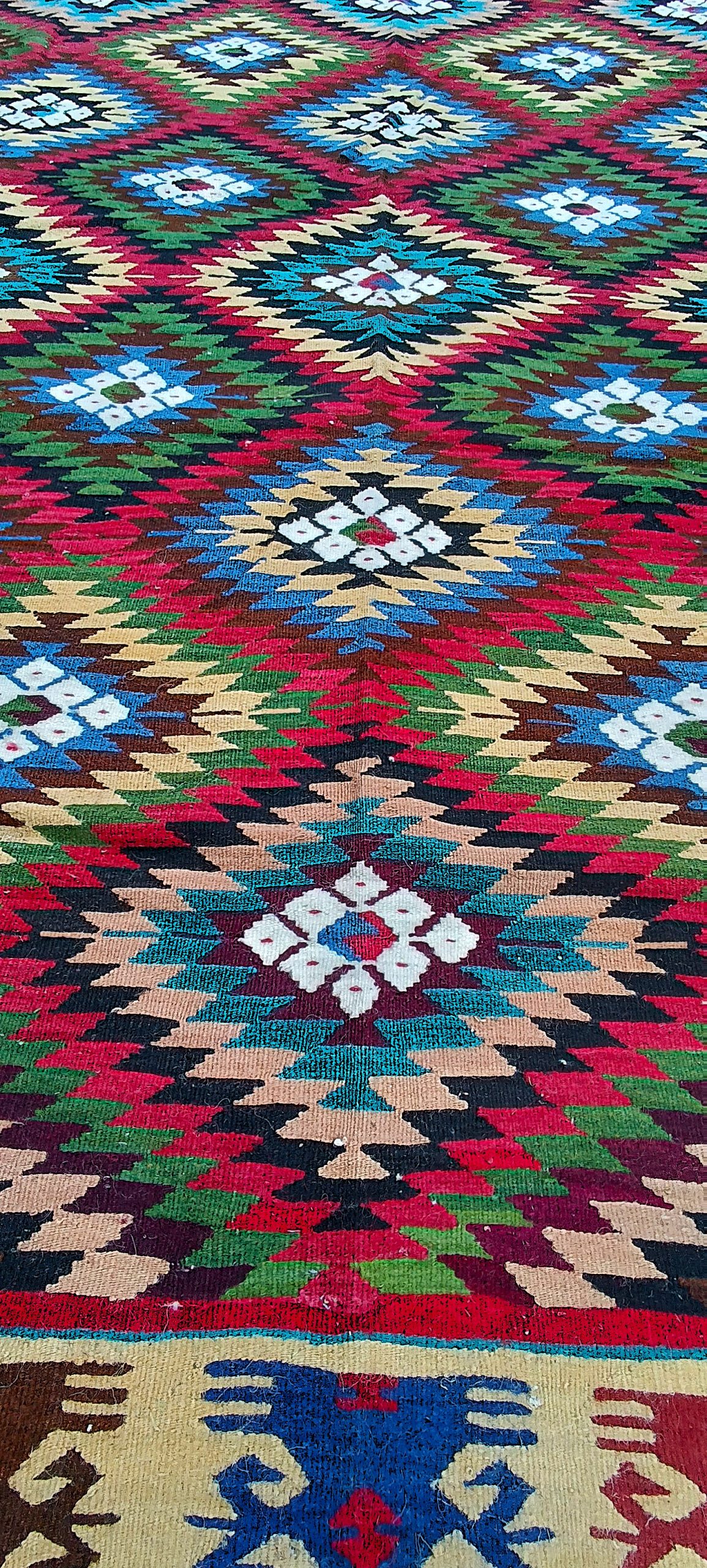
At the centre of the large stepped diamonds are small, geometrically stylised rosettes — bright, distinct, and arranged with astonishing precision.
The weavers preserve the name “Sofra” for this motif.
Sofra.
What a simple word!
And how much life it contains!
The traditional sofra is a low table around which the family gathers to share food, labour, happiness, and the worries of the day.
Around it, generations meet.
The older people tell stories. The younger ones listen.
Children learn gratitude and respect.
There, bread is broken. Blessings are spoken. Human beings do not merely eat: they participate in one of the oldest rituals of existence — sharing.
And suddenly I understand why this little white flower attracts me so powerfully.
It is at the centre.
The colours and jagged diamonds unfold around it, yet the flower itself remains still.
As though it is telling me that whatever happens in the world outside, every human being needs a place to return to.
A home.
A family.
Love.
Within the spiritual reading of traditional weaving, the diamond is associated with the earth, fertility, the feminine principle, and the preservation of life.
The white flower at its heart becomes an image of blossoming — life being born, growing, and continuing.
And Sofra brings these meanings together.
It is the centre around which life gathers.
I think of the woman sitting at her loom.
Did she think of her home as she wove each white flower?
Did she make a wish for health and happiness?
Did she see the faces of her children?
I do not know.
But I know that in folk art, beauty was never entirely separated from life.
And perhaps that is why these little white flowers seem so alive.
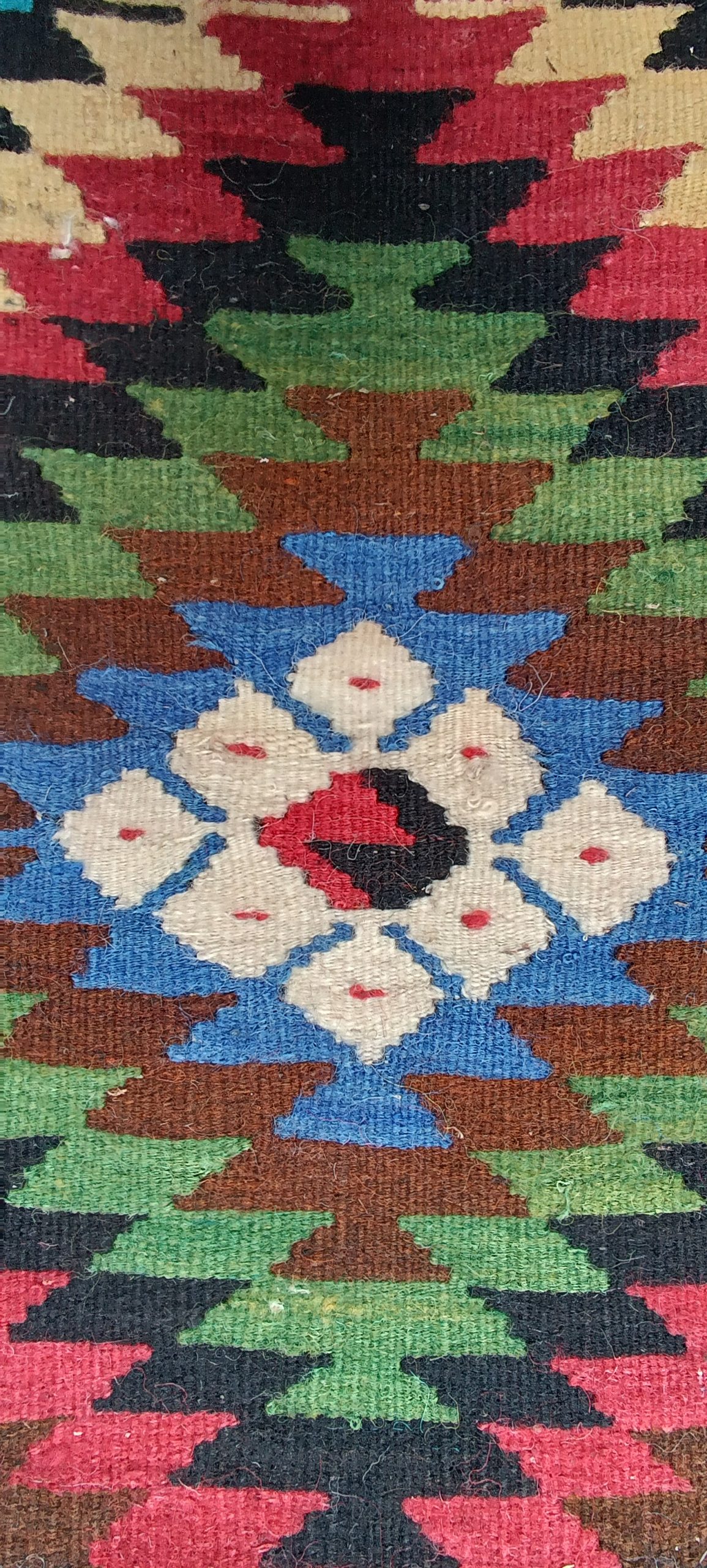
The Border – Guardian Birds and Karakachka, Mother of Life
After exploring the central field, my eyes return to the pale border.
It is like a boundary between two worlds.
Within lies the colourful, almost endless geometry of the diamonds. Around it runs a light-coloured band where green, red, burgundy, blue, and dark figures alternate in a steady rhythm.
These are motifs known to the weavers as “Pileta” and “Karakachka.”
Traditional names that carry the living memory of the craft.
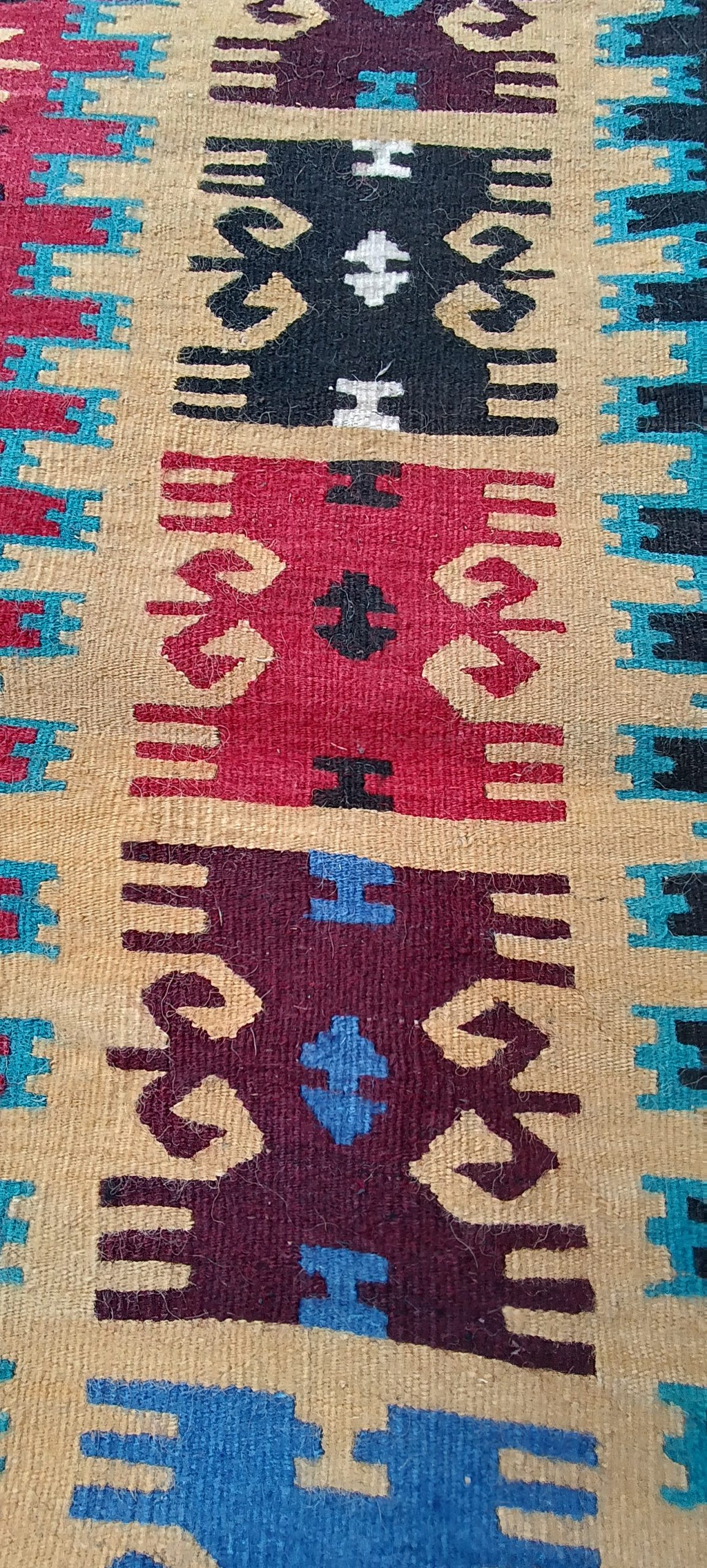
Pileta – Messengers Between Earth and Sky
In folk imagination, the bird is an extraordinary creature.
It lives on earth, but belongs to the sky as well.
It may rise above forests, mountains, and houses, see the world from above, and return once more to the place where its nest awaits.
That is why the bird appears in so many legends, songs, rituals, and blessings.
It is a messenger.
A mediator between the visible and the invisible.
A symbol of hope, good news, freedom, peace, and a safe return home.
In the pale border of this rug, the Pileta appear in a continuous sequence.
And I see them as guardians.
Not as guards afraid of the world, but as little beings watching over a cherished space with love.
They surround the diamonds, the white flowers, and the Sofra.
They embrace the home.
Is that not beautiful?
The rug itself seems to have a nest.
And within it, everything belongs.
Karakachka – The Woman Who Creates and Preserves
And among these figures we discover Karakachka.
One of the oldest and most characteristic images in the Chiprovtsi weaving tradition.
She is a strongly stylised female figure associated with fertility, motherhood, the feminine principle, and the continuation of the family line.
Her geometric silhouette has travelled through generations, retaining its presence within the ornamental language of the craft.
How natural that the woman should appear here!
For the woman creates.
She gives life.
She gathers her family.
She turns a space into a home.
And this same woman, sitting before the loom, transforms thread into beauty.
For me, Karakachka is the image of a mother protecting her world.
Sometimes with words.
Sometimes with silence.
Sometimes with bread placed on the sofra.
And sometimes with a rug that will remain long after she is gone.
The Border as a Blessing
And when I look at the entire composition, I begin to understand why the border moves me so deeply.
It does not merely frame the central field.
It embraces it.
As a mother’s arms embrace her child.
As a family protects its loved ones.
As tradition embraces generations.
To me, this pale band is a kind of amulet.
Pileta bring good tidings. Karakachka protects life. And at the centre, the Sofra blossoms — the heart of the home.
In these figures I hear a wish for health, love, fertility, protection, and abundance.
And how wonderful that they are different colours!
Each has its own individuality.
Yet together they form harmony.
Like people.
Like a family.
Like the world.
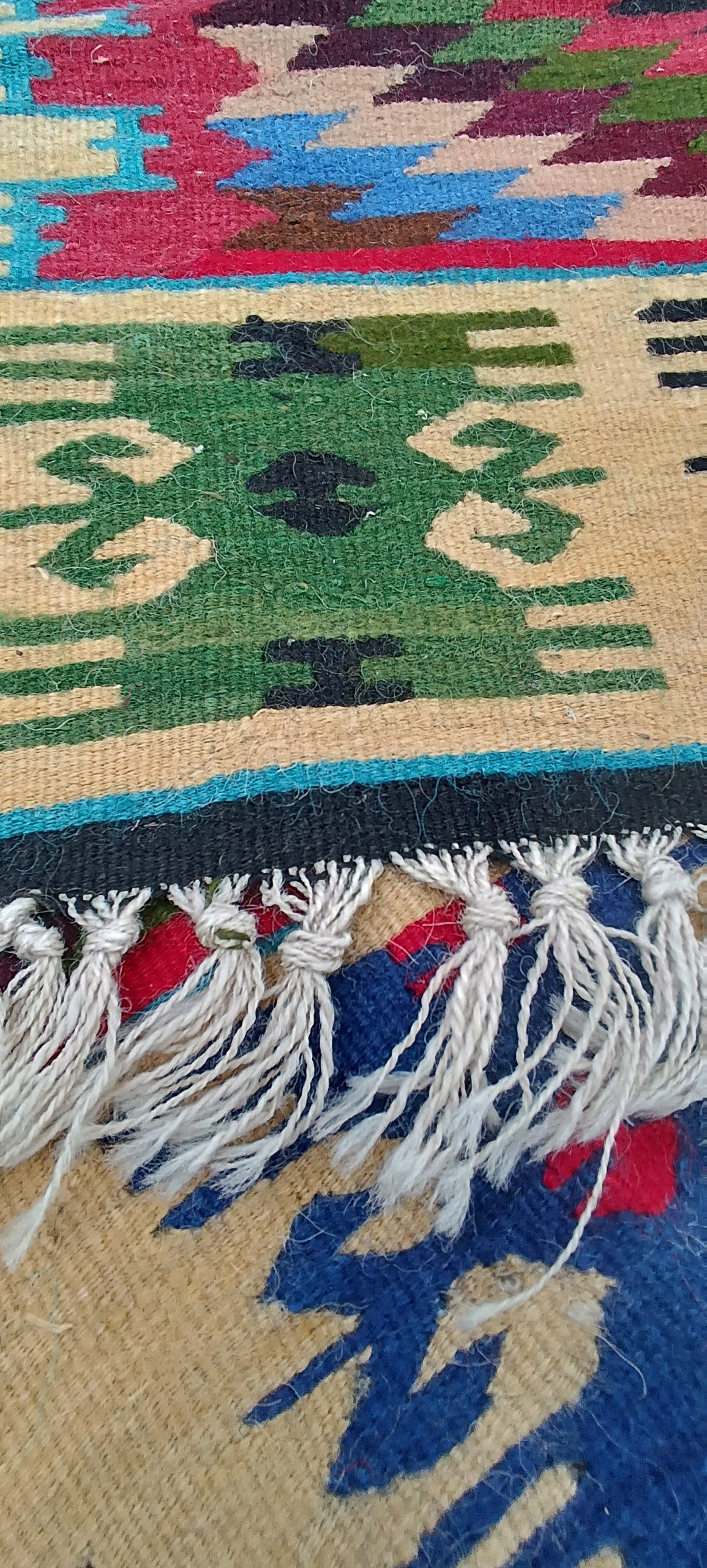
Colours – When Matter Begins to Sing
There is something special about the colours of this rug.
They do not remain still.
They converse.
They flow into one another, oppose one another, complement one another, and give one another strength.
Sometimes, when I look at them for a long time, I almost feel that I can hear music.
Red is strong, courageous, alive.
Blue carries space and depth.
Green reminds me of nature’s freshness, of grass after rain, and of life’s endless renewal.
Ochre and warm beige return me to the earth, to wheat, to bread, to the light inside old Bulgarian homes.
Brown creates a feeling of stability and roots.
Black gives depth to the composition, allowing the other colours to shine.
And this is how I read their spiritual message.
| Colour | Its Spiritual Resonance in My Interpretation |
|---|---|
| Red | Life, love, strength, fire, the heart |
| Blue and turquoise | Sky, freedom, spiritual openness, purity |
| Green | Nature, renewal, health, fertility |
| Ochre and yellow | Sunlight, abundance, blessing, prosperity |
| Brown | Earth, endurance, roots, ancestral memory |
| Black | Depth, silence, the beginning of creation |
| White | Purity, harmony, blessing, inner light |
Of course, the material world has its own laws.
Colour in a rug depends on the dye, the wool, the spinning of the yarn, and the way light falls upon the woven surface.
But human perception adds another layer.
Emotion.
Memory.
Meaning.
And so one colour can be both a physical phenomenon and an experience.
It can belong to science and to the soul.
And that is what makes a handmade object so extraordinary.
From Natural Dyes to the Bright Palette of the Twentieth Century
Earlier Bakamski rugs are known for comparatively restrained, earthy colours.
Their beauty grew from natural dye materials and an extraordinary knowledge of wool.
As the centuries passed, the palette gradually widened.
The development of textile production and the spread of synthetic dyes made stronger and more varied colours possible.
This was an important change in carpet weaving.
Yet colours never exist alone.
The weaver must combine them.
She must feel which will support one another, which will create contrast, which will bring movement, and which will offer rest.
And this is where artistic talent becomes visible.
My rug is a beautiful example of an old geometric tradition continuing within the colour language of the twentieth century.
It carries the ancient rhythm of the diamonds, yet its vibrant colours belong to a more recent artistic sensibility.
Tradition did not become frozen.
It continued to create.
Wool on Wool – The Science of a Thread
The closer I look, the more I admire not only the ornament but the material itself.
Wool.
So ordinary at first glance.
And so extraordinary when we begin to understand its structure.
Wool fibres are made primarily of the protein keratin. Their natural crimp, elasticity, and ability to absorb and release moisture vapour contribute to their flexibility and distinctive insulating properties.
The scientific explanation also involves the air trapped between the fibres. These pockets of air help reduce heat transfer.
And so nature provides a material that people have used for thousands of years.
Then the weaver arrives.
And transforms it.
How Was This Rug Woven?
Chiprovtsi rugs are traditionally made on a vertical loom.
The warp is the system of tensioned threads through which the weft is passed.
The coloured weft builds the visible fields and designs.
When the yarn is carefully compacted, a dense, smooth textile is produced.
Reversible weaving is among the most remarkable qualities of the Chiprovtsi tradition.
The ornament appears on both sides because it has not been printed or added onto a finished surface.
It belongs to the structure itself.
This is the true magic of the craft.
The ornament is not added to the rug. The ornament is the rug.
In this particular example, factory-spun wool yarn was used together with traditional handweaving.
Here, old and new do not contradict each other.
Organised textile production supplied materials. Human hands still performed the demanding artistic work.
And this meeting of tradition and modern production belongs to the story of Bulgarian craftsmanship in the twentieth century.
The State-Issued Seal – A Small Witness to an Era
Among the distinctive features of this rug is one that might seem insignificant at first.
The seal.
A small object that contributes nothing to the beauty of the diamonds, yet forms part of the rug’s material biography.
It takes us into another time.
An era of organised production, cooperatives, standards, and quality control.
A time when a traditional craft had to find its place within a changing economic and social world.
And despite everything, craftsmanship continued.
Women sat before their looms.
Threads passed through their hands.
Ornaments came alive.
For me, the seal is another thread in the story.
It does not replace artistry.
But it helps us understand the time in which that artistry existed.
And that matters.
I would never separate it from the rug.
I would preserve it as carefully as I preserve the colours — as part of the whole.
For collectors, it is worth remembering that the presence of a seal does not, by itself, establish the precise workshop, year, or certification standard. Such details depend on the marking itself and any surviving records. In this collection, the reported 1970–1985 dating is preserved as provenance information.
Untouched Beauty – Why Condition Matters
There is one detail to which my thoughts continually return.
No one has ever walked upon this rug.
Sometimes I wonder which is more moving: an old object carrying the traces of life, or an object that has preserved the expectation of life.
Both destinies are beautiful.
One tells its story through everything it has experienced.
The other through what has remained unexperienced.
From a collector’s perspective, the unused condition of a handwoven rug is especially interesting.
It may allow us to observe the original composition, weave structure, fringes, edges, and surviving colours more clearly.
When additional historic evidence survives, such as a seal or original marking, the object may tell us more about the circumstances of its production and journey through time.
But I do not measure its value only through condition.
For me, it is also a question of care.
Someone once created this textile.
Someone preserved it.
Someone chose to protect it rather than use it.
And so it passed through the decades and reached the present.
It is as though a whole succession of human decisions formed an invisible chain.
Another thread.
And another.
Until, at last, it became part of The Old Antiquarian Collection.
The Mystical Side of Bakamski – A Prayer Woven into Matter
I have always felt that folk art contains something more than beauty.
It has memory.
It has rhythm.
It has a quiet, almost invisible connection to human consciousness.
Perhaps that is because, in traditional life, work and spirituality were never so sharply separated.
Birth, sowing, harvest, bread, marriage, and the home — all belonged to the great ritual of life.
And so did weaving.
In Chiprovtsi, women preserved customs, prayers, wishes, and songs that accompanied the creation of carpets.
Even the official UNESCO documentation describes how weavers say prayers, make wishes before beginning a rug, sing, and tell stories while working at the loom.
They transmitted more than technical knowledge.
They passed down an attitude towards life.
And the more I reflect upon this, the more strongly I feel that the loom was never merely a tool.
It was a place of creation.
A woman stood before it with everything she carried within herself.
Her worries.
Her hopes.
Her love.
The memories of the mother who taught her to weave.
The voices of generations.
And through the movements of her hands, she transformed this invisible inner universe into something visible.
A rug.
The Diamond as a Sacred Space
In a spiritual reading of geometric ornament, the diamond is associated with the earth, fertility, family, and the protection of the generations.
Its enclosed shape creates the feeling of a protected space.
A boundary.
A home.
And when the diamonds repeat, it is as though an entire community of little worlds comes into being.
Each with its own centre.
Each with its white flower.
Each separate, yet connected to the others.
And this reminds me of something essential.
We are separate worlds, too.
We carry our own history, consciousness, and dreams.
Yet we exist together.
Connected through life.
Through our ancestors.
Through love.
Through those invisible laws that make the world a whole.
And so, to me, the Bakamski rug resembles a cosmic map.
Not a chart of the stars that can be measured by an instrument.
But a map of relationships.
Of connectedness.
Of humanity’s eternal longing to discover its place in the infinite.
Sofra as the Centre of the Universe
If the diamond is the world, Sofra is its heart.
The little white flower.
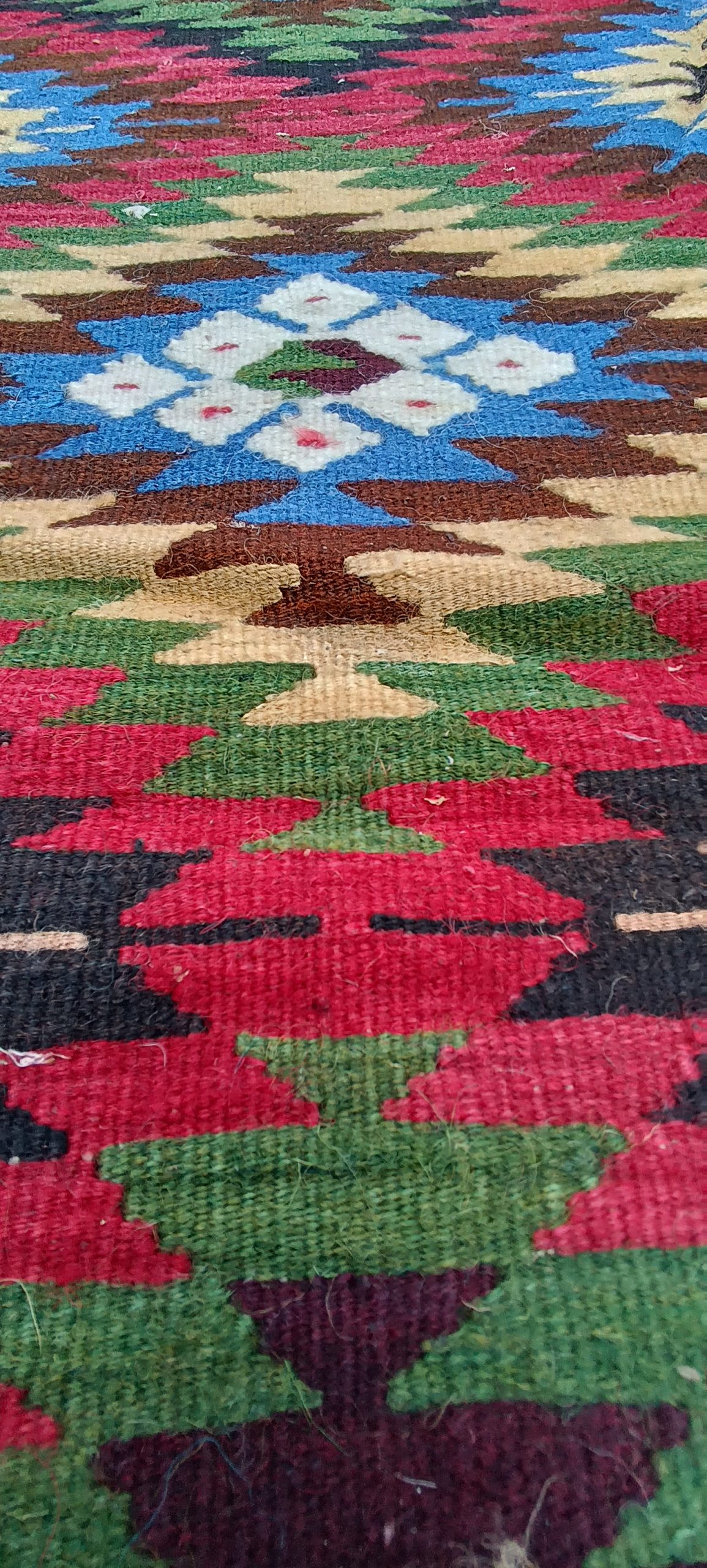
The place around which everything gathers.
So modest.
So bright.
So necessary.
And then I understand something that brings me immense joy.
The centre of the world does not need to be far away.
We do not need to search for it beyond the stars.
Sometimes it is in our own home.
At the table where loved ones gather.
In the bread we share.
In a child’s smile.
In a mother’s quiet care.
In the blessing of an elderly woman.
In these ordinary gestures that actually create the most extraordinary miracle of all — life.
Women Who Preserve Tradition – The Unbroken Thread
I think of the women who have woven the Bakamski pattern through the centuries.
How many were there?
How many hands passed among the threads?
How many mothers taught their daughters?
How many young girls sat before the loom for the first time, uncertain of their movements, only to become master weavers years later?
I do not know.
But when I look at this rug, I feel that in some way they are all present.
For no craftswoman begins with nothing.
She receives knowledge.
She receives tradition.
She receives a language of shapes, colours, and movements.
Then she adds something of her own.
Her rhythm.
Her sensitivity.
Her love.
And passes everything onwards.
That is how folk art lives.
Not through remaining unchanged, but through continuity.
And that is why it can be ancient and contemporary at the same time.
Old and new.
Familiar and extraordinary.
Chiprovtsi Carpet Weaving and UNESCO
In 2014, the tradition of carpet-making in Chiprovtsi was inscribed on UNESCO’s Representative List of the Intangible Cultural Heritage of Humanity.
The recognition belongs to the living craft, to knowledge and practices transmitted across generations.
To the women who weave.
To their songs and prayers.
To the way they choose colours, create ornaments, and preserve their skills.
For me, the greatest value of this recognition is precisely this: the world has recognised not only beautiful rugs, but the people behind them.
The women who preserve tradition.
Those who can create an entire world through a single thread.
Why This Bakamski with Sofra Rug Matters to a Collector
When an object becomes part of a collection, it begins a new life.
It is no longer simply something made for a practical purpose.
It becomes evidence.
A document.
A material memory of time and humanity.
This rug matters to our collection for several reasons.
Above all, it presents a historic Bakamski design in an example made during the second half of the twentieth century.
It shows how old geometry could continue evolving through new colour combinations.
It is constructed with a wool warp and a wool weft, an important feature of its particular construction.
It retains its state-issued seal.
It has not been used.
And its many ornaments allow us to explore the richness of Chiprovtsi weaving, from the complete composition to the smallest detail.
But there is one more reason.
Perhaps the most important to me.
This rug allows us to have a conversation with the past.
Not through imaginary historical scenes, but through real material, real weaving, real colours, and surviving traces of production.
To observe.
To compare.
To investigate.
To ask questions.
And to learn how to see.
Collector’s Checklist – What Should Be Documented?
For a rug like this, I would preserve not only the textile itself but every fragment of information about its history.
- The original seal and the way it is attached to the rug.
- Detailed photographs of both faces of the textile.
- Close-up photographs of the white Sofra motifs and stepped diamonds.
- Documentation of Pileta and Karakachka in the cream-coloured border.
- Photographs of the fringes, edges and wool structure.
- Recorded provenance concerning its date, materials and unused condition.
- The oral explanations of weavers concerning the traditional names and meanings of the ornaments.
This is not merely documentation.
It is care for memory.
For sometimes the smallest detail becomes the most important thread connecting us to the past.
What affects the collector’s value of a vintage Bulgarian kilim?
The documented history of an individual object matters alongside its design, construction, dimensions, materials, colour preservation, condition, alterations and surviving labels or seals. An unused rug may be especially interesting, but condition alone does not establish market value. Comparisons should involve authenticated examples of similar age, quality and provenance rather than assuming every Bakamski design has the same value.
How to Preserve the Rug for Future Generations
Beauty needs care.
Especially when it is created from natural materials.
Wool is strong and elastic, yet remains sensitive to unsuitable storage conditions.
Direct sunlight can fade colours.
Excessive humidity can damage the textile.
Dust, insects, and harsh cleaning also present risks.
For a valuable unused rug, I would avoid unnecessary wear, aggressive washing, and prolonged exposure to strong sunlight.
If it must be stored, careful rolling with appropriate support is generally preferable to keeping it sharply folded, because hard creases may place stress on the fibres.
For professional cleaning or conservation, I would seek the assistance of a specialist in historic textiles.
And I would certainly preserve the seal.
For it, too, belongs to the story.
When I Return to the White Flowers
And once again I stand before the rug.
I look at it from a distance.
I see the whole.
Then I come closer.
One diamond.
Another.
And another.
At the heart of each — a white flower.
I do not know why, but I begin to smile.
Something in this geometry seems to remind me of a very simple law of life.
However complicated the world may be, its beauty is built from small things.
From individual gestures.
From attention.
From perseverance.
From patience.
From love.
The weaver knew this.
She could not create the entire rug in a single movement.
She had to begin with one thread.
Then add another.
And another.
Repeat.
Observe.
Correct.
Continue.
Until one day all the threads came together into something greater than themselves.
How much this resembles human life!
We weave too.
Every day.
With our thoughts.
With our words.
With our actions.
With the way we treat others.
And perhaps the most important thing is never to forget what we are weaving into our own fabric.
What colours we choose.
What feelings we leave behind.
What traces will remain after us.
This rug was created decades ago.
Yet its message sounds astonishingly contemporary to me.
Preserve your centre.
Care for your home.
Protect love.
Be part of the world without losing yourself.
And continue creating beauty.
For beauty is one of the ways in which humanity speaks to eternity.
And sometimes eternity answers us very quietly.
Through a single white flower, woven in wool.
Frequently Asked Questions
What is a Bakamski rug?
Bakamski, also known as Garibalda, is a historic type of Bulgarian Chiprovtsi carpet distinguished by geometric motifs, especially triangular and diamond-based compositions. It belongs to one of the oldest documented design traditions in Chiprovtsi weaving.
What does Sofra mean in this rug?
According to the traditional naming preserved by weavers, Sofra refers to the white geometric floral motif in the centre of the diamond. Its symbolic meaning is associated with the family table, the shared hearth, togetherness, fertility and continuity of life.
What do Pileta motifs symbolise?
Pileta means birds or chicks. In the traditional interpretation passed down by the weavers, these ornaments are associated with good tidings, peace, protection and the connection between earth and sky.
What is Karakachka?
Karakachka is a traditional stylised female figure in the Chiprovtsi ornamental vocabulary. Its inherited symbolic associations include femininity, motherhood, fertility and the continuation of the family line.
Why is a Chiprovtsi rug reversible?
Because the decorative design is formed within the flatwoven structure itself. Interlacing the warp and coloured weft creates patterns visible on both faces, rather than designs printed or embroidered on a finished textile.
How old is the Bakamski with Sofra rug in The Old Antiquarian Collection?
According to the collection provenance, this particular example dates to approximately 1970–1985. It has wool warp and wool weft, retains its original seal, and is reported to have remained unused.
Does an old Bakamski design mean the rug itself is centuries old?
No. The historical age of the design and the age of an individual rug are different. This particular textile was produced in the twentieth century while continuing a much older artistic tradition.
Does an original seal prove the exact manufacturing year?
Not by itself. A seal can be important historical evidence, but an exact year, maker or cooperative attribution requires readable markings and supporting documentation.
When was Chiprovtsi carpet weaving recognised by UNESCO?
The tradition was inscribed on UNESCO’s Representative List of the Intangible Cultural Heritage of Humanity in 2014, recognising the living knowledge, practices and transmission of the craft.
Related Guides and Collection Stories
The Bakamski with Sofra rug is one part of our continuing exploration of Bulgarian textiles. Readers interested in the broader weaving tradition can continue with our Chiprovtsi rug history and weaving guide. For two different personal collection stories, discover the Chiprovtsi Bombichki rug and The Unexpected Christmas Gift – The Christmas Star.
Sources and Further Research
- UNESCO – The Tradition of Carpet-Making in Chiprovtsi. Representative List of the Intangible Cultural Heritage of Humanity, inscription 2014, nomination No. 00965. Official UNESCO record.
- Radostina Atanassova and Rossitsa D. Vassileva. “Chiprovtsi–Pirot hand-woven carpets from NW Bulgaria and Serbia: symmetrological characteristics of the ornaments.” Geologica Balcanica, 46(2), 2017, pp. 27–31. Read the scientific study.
- Bulgarian National Radio – Radio Plovdiv. Report on the exhibition “Bakamski – Garibalda (The Oldest Bulgarian Carpets)” at the Regional Ethnographic Museum in Plovdiv, October 7, 2026. Exhibition report.
- Elisa Art – Rug Making History. Traditional Chiprovtsi carpet periods, early Bakamski and Garibalda names, geometric motifs and natural colour palettes. Carpet-making history.
- Woolmark – What Is the Wool Fibre? Scientific explanation of wool’s keratin structure, elasticity, natural crimp and moisture-management properties. Wool fibre guide.
- Canadian Conservation Institute – Textiles and Costumes. Preventive conservation and guidance on rolled storage, environmental risks and care of historic textiles. CCI conservation resources.
Primary source for the individual rug: The Old Antiquarian Collection – object provenance, photographs, reported dating, wool-on-wool construction, retained seal and unused condition. Traditional names and symbolic interpretations of Sofra, Pileta and Karakachka are preserved through oral knowledge communicated by weavers.
Interpretive approach: The historical and material descriptions are distinguished from the author’s spiritual and poetic readings. The symbolic passages express both the living tradition of the craft and a personal response to the object; they are not presented as archaeological proof of prehistoric origins.
About the Author and the Collection
The Old Antiquarian is devoted to historical objects, cultural heritage, traditional craftsmanship and the personal stories that connect the past with the present.
This article belongs to our collection series on Bulgarian handwoven rugs — objects we study not only as historical evidence but also as creations that preserve the beauty of the human spirit.
Last Updated: October 28, 2026
Some objects preserve history. Others help us discover ourselves within it.
