
Chiprovtsi Rugs: History, Weaving & UNESCO Heritage
THE OLD ANTIQUARIAN · BULGARIAN TEXTILE HERITAGE
The Chiprovtsi Rug: Centuries of Wool, Weaving and Human Craftsmanship
From mountain sheep and traditional vegetable dyes to the vertical loom, geometric patterns and a historic wool rug preserved in a family dowry.
Historical & Ethnographic Research · Last Updated: October 14, 2026
Quick Answer: What Is a Chiprovtsi Rug?
A Chiprovtsi rug, also known as a Chiprovtsi kilim or Chiprovski kilim, is a traditional Bulgarian handwoven, flat, double-sided textile distinguished by its geometric ornamentation, carefully balanced colours and production on a vertical weaving loom.
Earlier Chiprovtsi rugs were traditionally woven with wool warps and wool wefts. Cotton warp threads became widely used during the first decades of the twentieth century, while wool remained important for the patterned weft.
In 2014, the tradition of carpet-making in Chiprovtsi was inscribed on UNESCO’s Representative List of the Intangible Cultural Heritage of Humanity.
Some historical objects preserve knowledge that written documents alone cannot fully convey. An old rug may reveal how wool was prepared, how colours were combined, how geometric patterns were remembered and reproduced, and how valuable household textiles passed from one generation to another.
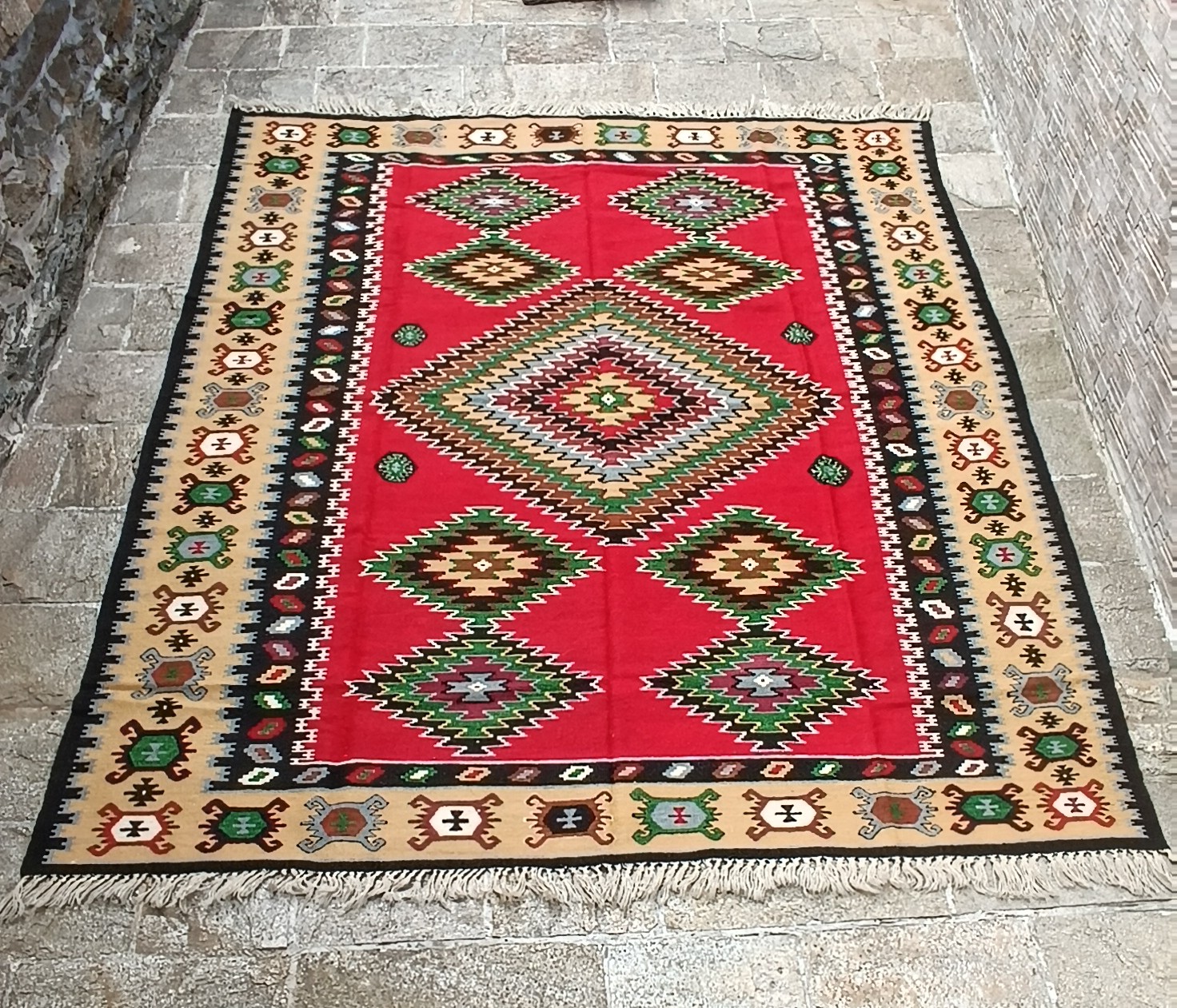
The rug presented in this study is a particularly interesting example. It comes from a family dowry in the Chiprovtsi region of northwestern Bulgaria and is now part of The Old Antiquarian Collection.
Its construction is especially significant: both the warp and the weft are wool. The pale fringes are not separately attached decoration. They are extensions of the original wool warp threads that were stretched on the loom and left beyond the woven surface when the completed rug was removed.
These characteristics allow us to explore an older weaving technology through an actual surviving object rather than relying exclusively on historical descriptions.
Throughout this article, we will distinguish what is known about the wider Chiprovtsi tradition from what can be established about this particular rug. Its exact date of manufacture, the identity of its weaver and the composition of its dyes remain undetermined.
At a Glance: The Old Chiprovtsi Rug in Our Collection
| Characteristic | Description |
|---|---|
| Type | Traditional Bulgarian Chiprovtsi kilim |
| Regional origin | Chiprovtsi region, northwestern Bulgaria |
| Preserved history | Originated from a family dowry, according to the information accompanying the rug |
| Warp | Wool |
| Weft | Wool |
| Weaving technique | Traditional handwoven, double-sided flatweave |
| Approximate dimensions | 245 × 390 cm, according to the available photographic record; physical measurement recommended for confirmation |
| Main design | Large central stepped diamond and smaller symmetrical geometric motifs |
| Colours | Red, cream, green, black, ochre, burgundy, brown and pale blue |
| Fringes | Twisted and knotted extensions of the wool warp threads |
| Date | Not conclusively established |
| Collection | The Old Antiquarian |
1. Chiprovtsi: The Mountain Town That Turned Wool into Art
Chiprovtsi is situated in northwestern Bulgaria, near the western Balkan Mountains. Its history is associated with mining, metalworking, goldsmithing, trade and, above all, a remarkable textile tradition.
Over the centuries, local households developed sophisticated methods of transforming sheep’s wool into durable and beautifully ornamented woven textiles.
The town’s history includes the Chiprovtsi Uprising of 1688 and the devastation that followed. The later development of carpet-making must be understood within the region’s recovery, changing economy and connections with neighbouring Balkan communities.
When Did Chiprovtsi Carpet-Making Begin?
The exact beginnings of the craft remain difficult to establish. Traditional weaving techniques are older than many surviving textiles, and woollen objects are vulnerable to decay.
Historical interpretations frequently emphasise the seventeenth and eighteenth centuries and the wider western Balkan carpet-making tradition, including connections with nearby Pirot.
What is clearer is the importance of Chiprovtsi weaving during the eighteenth and nineteenth centuries, when carpets became a significant regional product and reached markets far beyond the immediate area.
The economic success of the craft rested upon several complementary resources: sheep farming, household labour, knowledge of wool processing, skilled weavers and established commercial networks.
Why Was Chiprovtsi an Important Weaving Centre?
The mountain environment supported livestock farming, while weaving enabled households to transform locally available wool into products with considerable added value.
The craft spread beyond the town itself into surrounding communities. Yet the name Chiprovtsi became closely associated with this particular type of handwoven, flat, double-sided rug.
2. From Sheep to Yarn: Wool Preparation and Spinning
A Chiprovtsi rug begins long before the first thread is placed on the loom.
Its production depends upon a sequence of operations involving sheep farming, shearing, sorting, cleaning, drying, combing, spinning, twisting and, when required, dyeing.
These activities once formed part of the rural economy of the wider region. Wool was used not only for carpets but also for clothing, blankets, household fabrics and other everyday necessities.
How Was Wool Traditionally Prepared?
| Stage | Traditional Process | Purpose |
|---|---|---|
| Shearing | Removing the fleece from sheep | Obtaining raw wool |
| Sorting | Separating wool according to quality and fibre characteristics | Selecting suitable material for different yarns |
| Washing | Removing dirt and some natural grease | Preparing fibres for further work |
| Drying | Allowing cleaned wool to dry | Avoiding retained moisture |
| Carding or combing | Separating and aligning fibres | Preparing wool for more consistent spinning |
| Spinning | Drawing and twisting fibres into yarn | Creating continuous, workable threads |
| Plying | Twisting strands together where needed | Increasing strength and stability |
| Dyeing | Colouring selected yarns | Preparing the palette for weaving |
Spinning Tools Are Different from Weaving Looms
Traditionally, wool could be spun using a distaff and spindle, while spinning wheels became useful for producing yarn more efficiently.
These tools create yarn. The vertical loom is used later to weave the finished fabric.
This distinction matters particularly when discussing older all-wool rugs. The warp threads must withstand considerable tension throughout the weaving process. Their preparation and twisting therefore require care.
How Important Was Sheep Farming?
The traditional weaving economy depended upon reliable access to wool. Sheep farming therefore supported not only food production but also a specialised textile industry.
Some local recollections describe very large sheep populations in the wider Chiprovtsi area in earlier times. Such oral accounts demonstrate the remembered importance of livestock farming, but should not be treated as precise historical census figures without dated records.
3. Natural Dyes: How Plants Coloured Traditional Chiprovtsi Rugs
Before synthetic dyes became widely available, traditional textile colouring relied upon knowledge of plants, minerals, imported dye materials, water quality and practical dyeing recipes.
The colour of wool could vary according to the chosen material, the duration of the dyeing process, the temperature and any mordants used to help bind or modify the colour.
Historical descriptions of Chiprovtsi dyeing mention onion skins, walnut leaves and husks, quince leaves, dye woods, indigo and other natural materials. Nettle is also mentioned in accounts of traditional dyeing.
Which Plants Produced Which Colours?
| Natural Material | Possible Colours | Important Qualification |
|---|---|---|
| Onion skins | Yellow, golden, ochre, copper tones | Results depend on the recipe and mordant |
| Nettle | Yellowish or muted greenish tones | Does not necessarily produce bright green |
| Walnut leaves | Olive, brown and earthy tones | Shade varies with treatment |
| Walnut husks | Brown to very dark brown | Useful for dark natural colours |
| Quince leaves | Beige and ochre-related shades | Recorded in local dyeing accounts |
| Dye woods | Reddish, brown or dark shades | Colour depends on the wood species |
| Indigo | Blue | Historically traded; not necessarily locally produced |
| Undyed sheep’s wool | White, cream, grey, brown | Natural fleece colours require no added dye |
What Is a Mordant?
A mordant is a substance used in many dyeing processes to help bind or modify a colour. Alum is a familiar example, while iron compounds may darken or alter certain plant-dyed shades.
This explains why the same plant may produce different colours depending on how it is processed.
The spread of synthetic dyes during the nineteenth and twentieth centuries expanded the colours available to carpet-makers. Their use became increasingly important in later production.
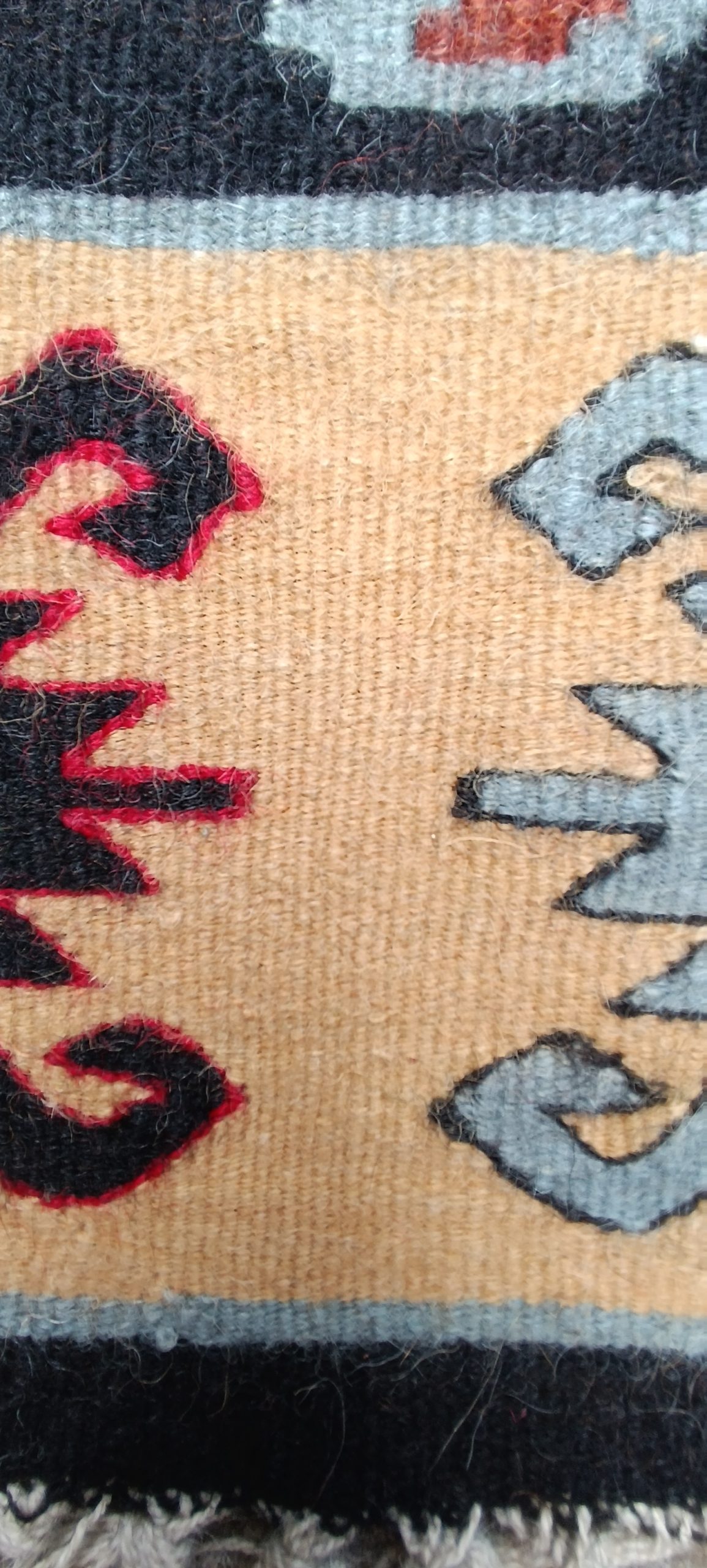
Collector’s note: Our Chiprovtsi rug has a vivid red field with green, pale-blue, black and ochre geometric motifs. These colours should not automatically be described as naturally dyed. Identifying the exact dyes used in this individual rug would require appropriate material analysis.
4. How Is a Chiprovtsi Rug Woven? The Vertical Loom
Traditional Chiprovtsi rugs are made on a vertical handloom.
The warp threads are stretched between the loom’s structural elements, creating the foundation through which the coloured weft yarn is interlaced.
UNESCO describes a characteristic process in which the weaver holds groups of warp threads with one hand, introduces the weft yarn and uses a small beater to tighten the woven fabric.
With each completed section, the coloured weft forms part of the geometric pattern. The design is therefore created within the structure of the textile itself.
Why Are Chiprovtsi Rugs Double-Sided?
Unlike a knotted-pile carpet, a traditional Chiprovtsi kilim is a flatwoven textile. It has no raised knotted pile forming a separate decorative surface.
The coloured design is formed directly by the woven yarns, allowing the ornamentation to be visible on both sides.
This reversible construction is particularly useful for floor coverings and domestic textiles because both faces of the fabric can be displayed.
Why Is Warp Tension So Important?
Even tension is essential. If the warp is too loose or uneven, the coloured weft can pull the structure out of alignment, distorting both the border and the central geometric motifs.
Correct warping, controlled tension and consistent beating are therefore fundamental to the quality of the finished kilim.
5. How Did Weavers Remember and Reproduce Complex Geometric Patterns?
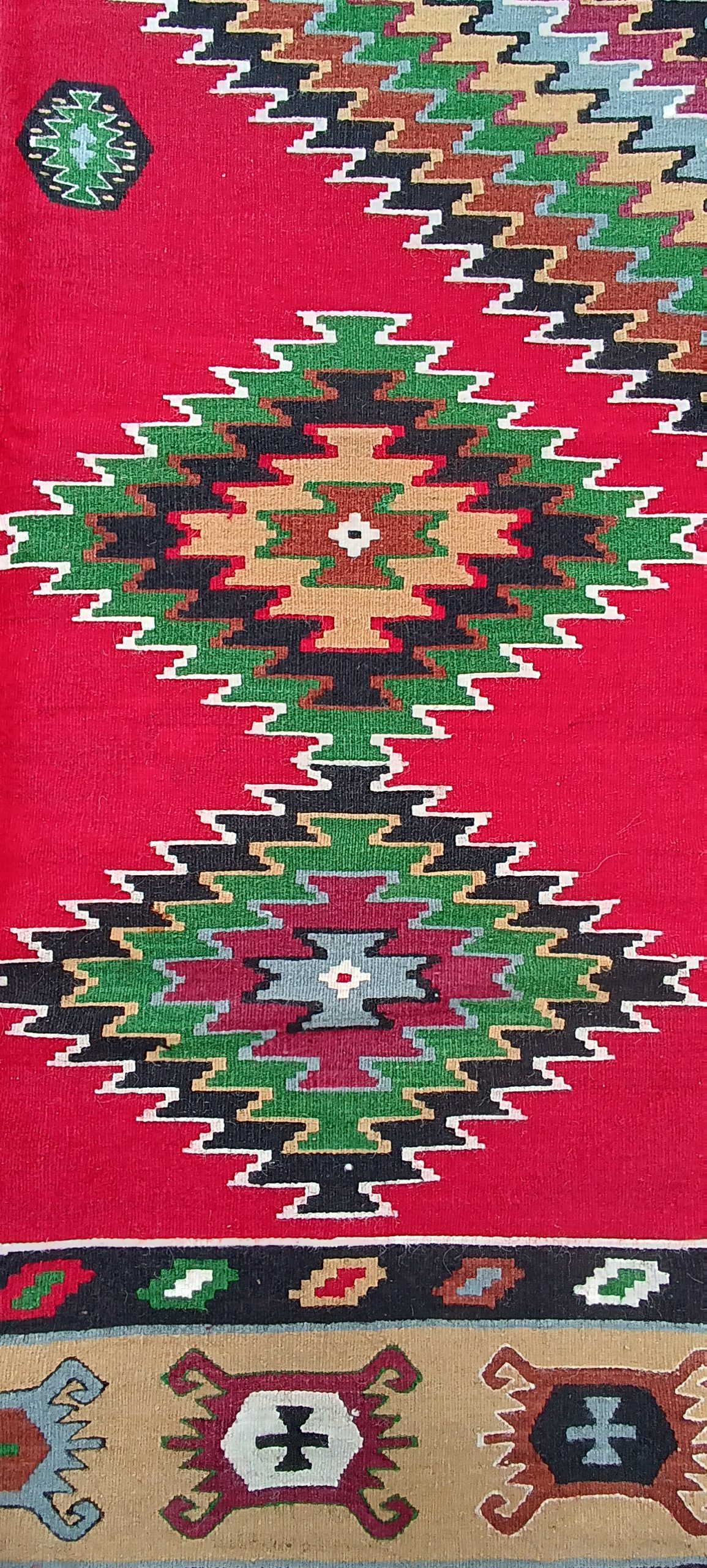
The large central diamond of the rug in our collection is an impressive example of geometric planning.
It consists of multiple concentric stepped outlines that gradually expand and contract while retaining a remarkably balanced composition.
How could a weaver reproduce such a design over a textile several metres long?
The answer lies in memory, counting, repetition, observation and years of practical experience.
A Large Diamond Is Built from Small Repeated Decisions
Each stepped line requires the weaver to increase or decrease a coloured section in a controlled sequence.
Once the principle is learned, it can be repeated, mirrored and combined with other forms to create a larger symmetrical design.
Traditionally, younger family members learned by observing experienced women at work, gradually progressing from simple shapes to more elaborate compositions.
However, it would be inaccurate to assume that every Chiprovtsi rug was woven entirely from memory. Drawn patterns, workshop examples and established models could also assist the process, particularly in organised production.
How Long Did It Take to Weave a Chiprovtsi Rug?
The time required depends on size, yarn thickness, weaving density, design complexity, the number of colours and the number of people working on the loom.
In a Bulgarian National Radio interview published in 2019, the experienced weaver Velika Stoeva described approximately ten to twelve days of work per square metre as an illustrative rate for skilled handweaving.
This should be treated as a practical testimony rather than a universal production standard. Large or complicated rugs can vary considerably.
Nor does loom time represent the entire labour invested in the object. Wool preparation, spinning, dyeing, warping and finishing all require additional work.
6. The Women, Men and Families Behind the Craft
The familiar image of a woman weaving at a vertical loom is central to Chiprovtsi’s cultural identity.
Yet the making of a rug has traditionally involved more than one activity and often more than one person.
UNESCO notes that women traditionally performed the weaving, while men commonly participated in wool production, processing and dyeing.
Within households, different stages could involve parents, grandparents and children. The skills were passed down not only through explanation but also through watching, imitating and repeating actions until they became familiar.
The Transmission of Knowledge
Girls often learned from their mothers and grandmothers. They gradually became familiar with yarn handling, colour changes, warp counting and the repeated geometric forms of the local tradition.
Experienced weavers taught beginners to maintain a consistent surface, recognise mistakes early and preserve the symmetry of complex designs.
On large rugs, several women might work side by side. Their movements had to remain coordinated to produce a consistent fabric.
This explains why weaving knowledge cannot be completely preserved through written instructions alone. It includes physical skills, judgement and habits learned over many years.
Songs, Prayers and Weaving Traditions
The official UNESCO account also records verbal traditions associated with the beginning and progress of weaving.
Weavers could offer prayers and wishes for successful work, sing songs or tell stories while sitting at the loom.
These customs remind us that rug-making was not simply a mechanical production process. It was embedded in the social and cultural life of the community.
7. Geometric Motifs, Colours and the Individual Weaver’s Artistic Vision
Chiprovtsi rugs are famous for their geometric ornamentation and strongly stylised forms.
Some traditional motifs have been associated with plants, birds, animals, human figures or everyday objects that have gradually been transformed into abstract patterns.
One of the best-known names in Bulgarian rug ornamentation is kanatitsa, a geometric motif often discussed in connection with family continuity, protection and prosperity.
However, not every diamond-shaped ornament should automatically be identified as kanatitsa, and symbolic interpretations may differ between periods, families and modern researchers.
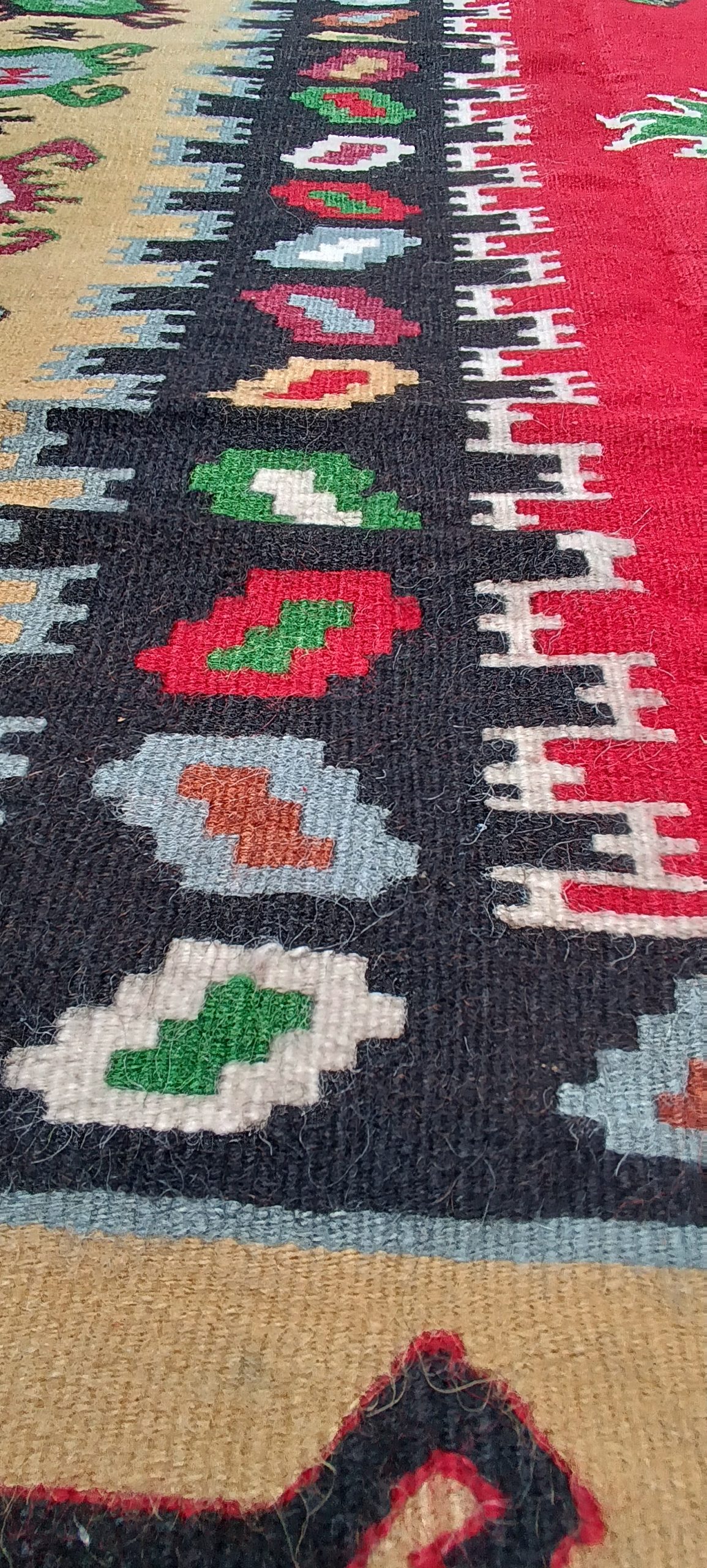
Our Rug: A Composition Organised Around One Large Diamond
The most striking element in our example is its large central stepped diamond.
The design expands through repeated bands of black, green, cream, pale blue, brown and burgundy before returning towards its centre.
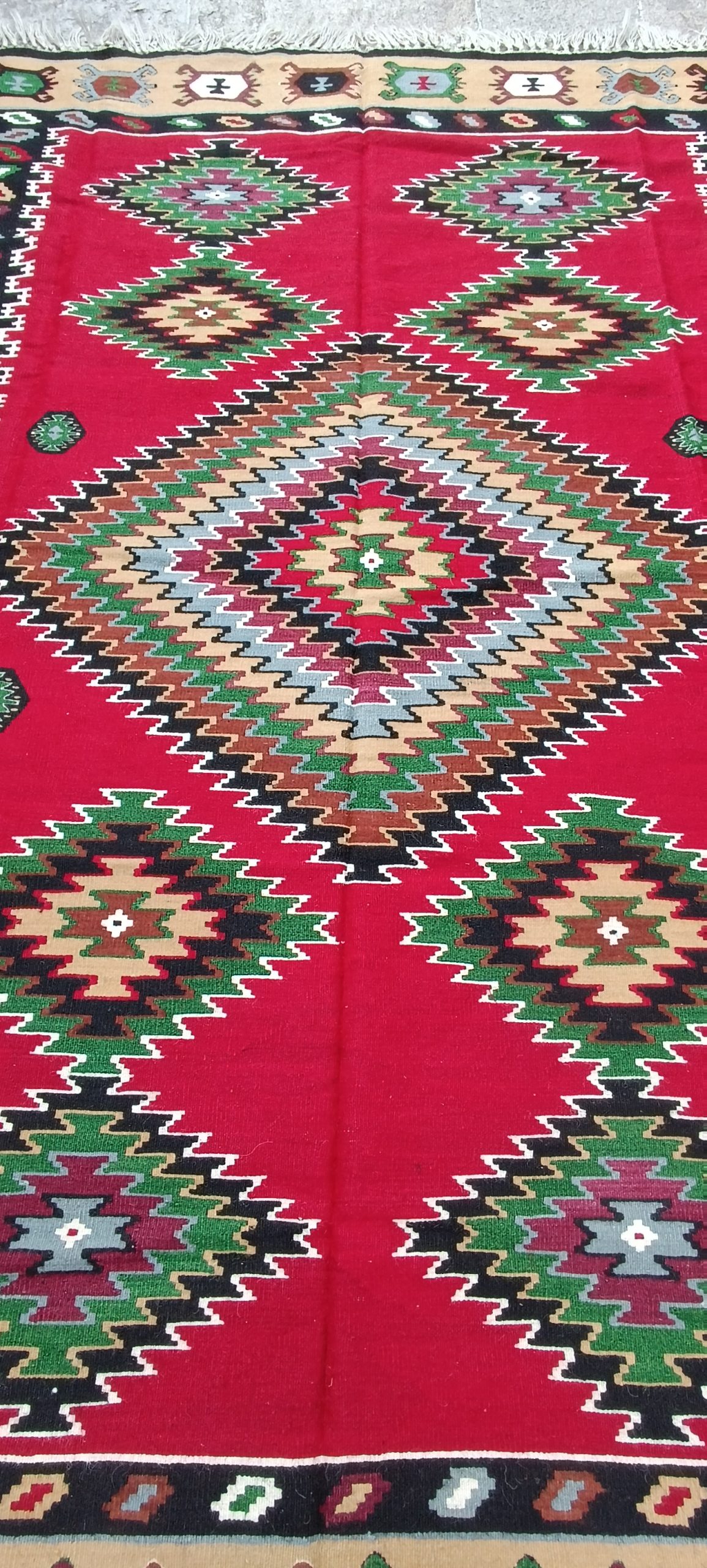
Smaller diamond-shaped motifs are arranged in symmetrical groups above and below the principal figure.
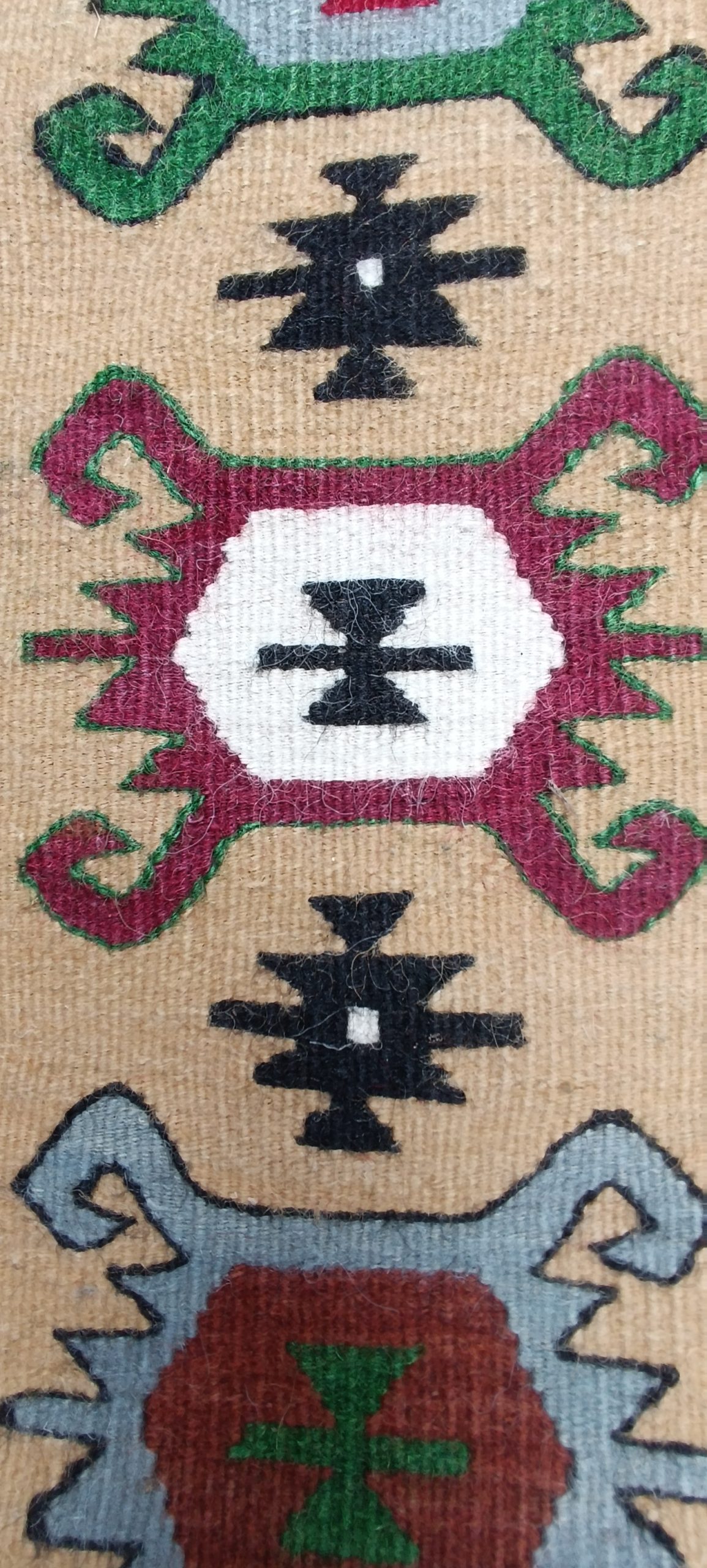
A narrow dark inner border separates the vivid red field from the wide cream-coloured outer border, which contains repeating stylised ornaments.
What Do the Colours Mean?
| Colour | Visual Role | Possible Traditional Associations |
|---|---|---|
| Red | Dominant background | Life, celebration and prosperity |
| Green | Contrast within the motifs | Nature, growth and renewal |
| Cream and ochre | Borders and separating areas | Earth and natural materials |
| Black | Outlining and visual structure | Boundaries or protection in some interpretations |
| Pale blue | Additional geometric bands | Sky or water in certain symbolic readings |
These are interpretative associations, not proven universal meanings. A colour may have been chosen for visual balance, available yarn, customer preference or the personal taste of the weaver.
The artistic individuality of the maker deserves as much attention as the inherited design tradition.
The weaver of our rug selected the proportions of the central diamond, the arrangement of smaller motifs and the relationship between the dark inner band and the cream outer border. Her decisions created the particular harmony of this textile.
8. Chiprovtsi Rugs in the Home, Family Life and Bridal Dowry
Chiprovtsi rugs were not produced exclusively for commercial sale.
They also belonged to the domestic world of family homes, festive interiors, gifts and the preparation of a new household.
A bridal dowry, or cheiz in the Balkan context, could contain household textiles and other valuable possessions prepared for marriage and family life.
A large handwoven rug represented considerable resources: wool, preparation, dyeing and a substantial amount of skilled labour.
Such textiles could be preserved for many years and passed from one generation to the next.
The Preserved History of Our Rug
The rug featured in this article was obtained from the Chiprovtsi region, where it had been part of a family dowry.
This is the provenance information preserved with the object. It provides a meaningful connection between the textile and the family traditions of the region.
We do not possess a dated inscription identifying its maker or year of manufacture. It would therefore be inappropriate to invent a precise age or a personal biography for the unknown weaver.
Nevertheless, the association with a family dowry gives the object additional historical context and helps explain why valuable handmade textiles were preserved across generations.
This approach reflects the wider philosophy of The Old Antiquarian: remarkable objects matter not only because of their appearance or market value, but also because of the human stories they carry.
10. Why Did UNESCO Recognise Chiprovtsi Carpet-Making?
In 2014, UNESCO inscribed the tradition of carpet-making in Chiprovtsi on its Representative List of the Intangible Cultural Heritage of Humanity.
The inscription is not simply a celebration of the finished carpet.
It recognises a living system of knowledge: preparing and dyeing wool, weaving on a vertical loom, reproducing inherited designs, maintaining community traditions and passing the necessary skills from one generation to another.
UNESCO also highlights the social importance of weaving, including traditional prayers, stories, songs and the shared participation of family members.
The value of this heritage lies in its continued practice. A weaving tradition cannot be preserved by storing old carpets alone; it also requires people who know how to make them.
Important distinction: UNESCO’s recognition concerns the carpet-making tradition. It does not automatically certify the age, originality or precise origin of every individual rug described as Chiprovtsi.
11. Why Are the Fringes Important? Understanding the Wool Warp
One of the most revealing features of our old Chiprovtsi rug is found not in its central geometric design but at its ends.
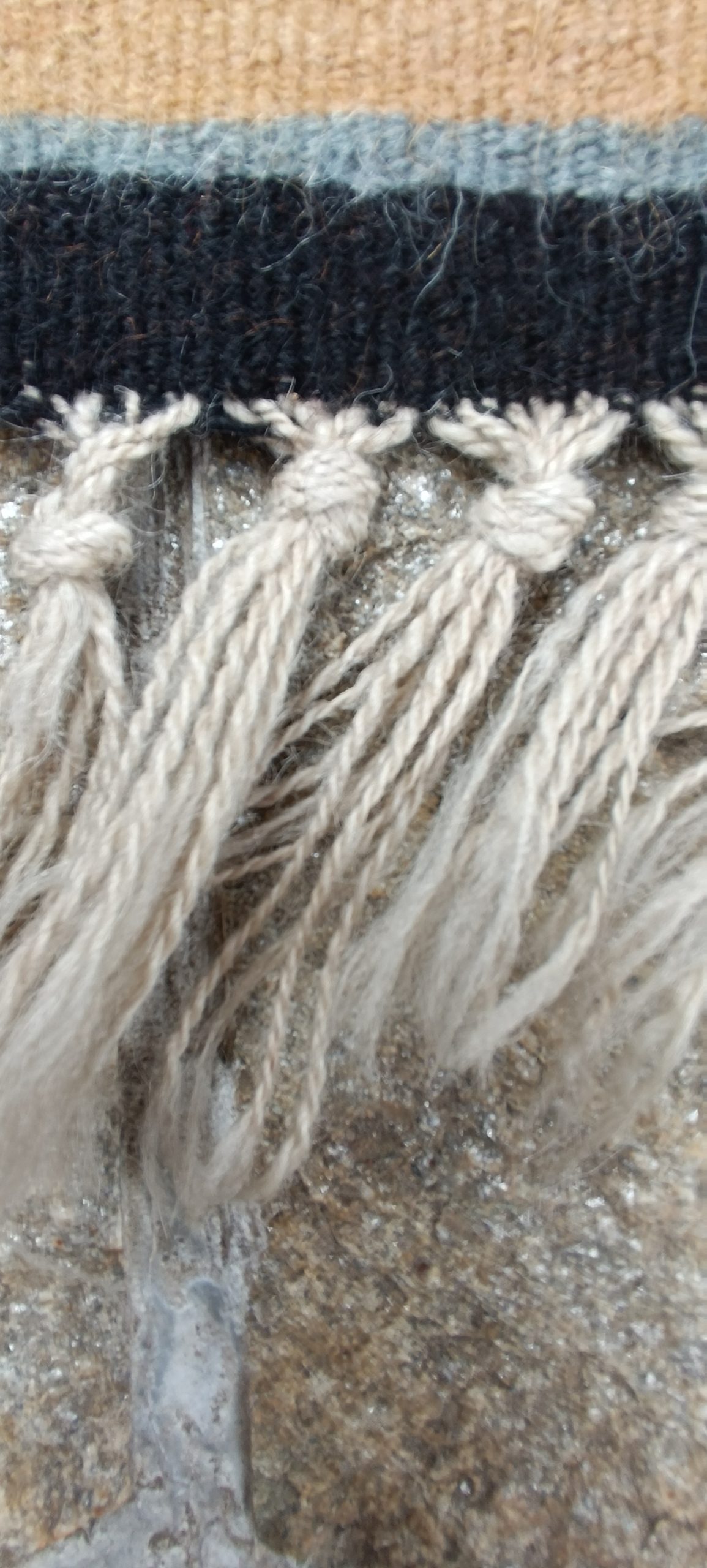
The off-white wool fringes are extensions of the original warp threads.
These threads were stretched on the vertical loom while the rug was being woven. When the weaving was complete, the warp threads were cut to release the finished textile.
The remaining free ends could then be twisted and secured with knots, forming the familiar fringes.
In other words, the fringes are directly connected to the construction of the rug. They are not merely a decorative accessory sewn onto its surface.
Why Does an All-Wool Construction Matter?
The Municipality of Chiprovtsi explains that earlier rugs were woven entirely from wool, while cotton warps became widely used during the first decades of the twentieth century.
Our rug’s wool warp and wool weft therefore reflect the older all-wool weaving technology.
This is historically significant, but it is not enough to assign the rug to the nineteenth century or any other specific period. Later weavers could continue using traditional materials and techniques.
The Front and Reverse: Evidence of Double-Sided Weaving
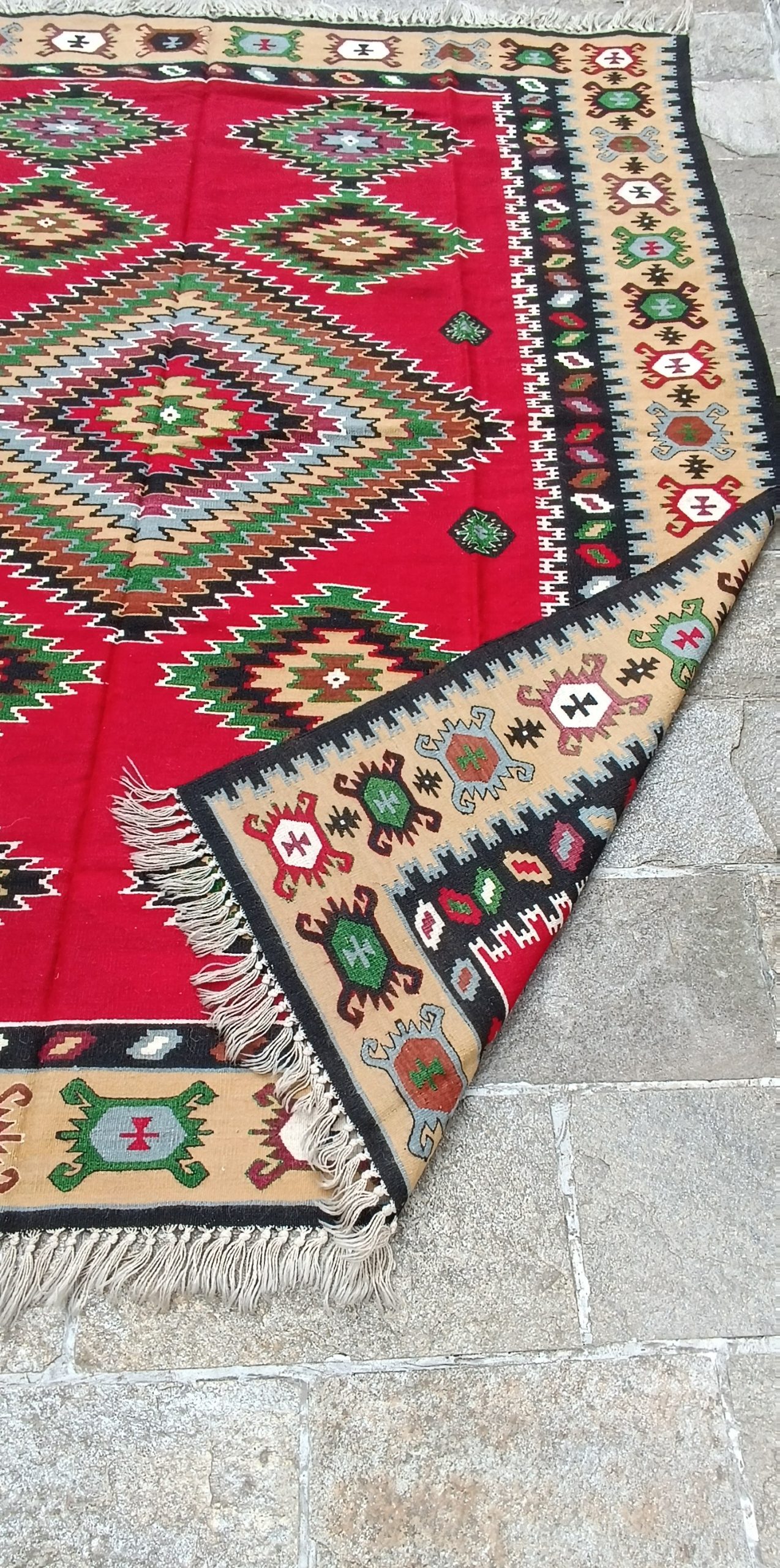
The folded corner of the rug makes its double-sided structure particularly easy to understand.
The geometric motifs remain visible on both faces because the design forms part of the woven textile rather than being attached after production.
Examining the reverse is also important for collectors. It may reveal details of weaving structure, old repairs, changes in tension and later interventions that are less apparent from the front.
12. How Old Is This Rug? Dating, Collector Research and Preservation
The rug in our collection has several important characteristics: a reported family-dowry origin in the Chiprovtsi region, wool warp and weft, reversible flatweaving, carefully structured geometric ornamentation and preserved warp fringes.
These features provide valuable historical and technical evidence.
They do not, however, establish its exact date of manufacture.
Collector’s Checklist: What Should Be Examined?
- Warp and weft fibre composition
- Yarn thickness and twist
- Weaving density and consistency
- Technique of colour transitions
- Comparison with dated museum examples
- Condition of borders and fringes
- Evidence of repairs or later alterations
- Recorded family history and provenance
- Old photographs, inscriptions, labels or documents
- Specialist fibre or dye analysis where appropriate
How Should an Old Chiprovtsi Rug Be Preserved?
Old wool textiles may be vulnerable to moisture, insects, prolonged direct sunlight, inappropriate washing and excessive mechanical stress.
Valuable or fragile examples should not be exposed to aggressive detergents, machine washing, bleaching or amateur restoration.
Before any substantial cleaning or repair, the textile’s condition should be assessed. When necessary, consult a professional textile conservator.
Our article on what not to do before an antique valuation or sale explains why documenting an object before intervention is often the safest first step.
Age-related evidence should not automatically be treated as a defect. Original construction, past repairs and signs of use may form part of an object’s historical record.
Conclusion: One Old Rug, Generations of Human Knowledge
The Chiprovtsi rug is much more than a geometric design woven into coloured wool.
It represents the relationship between mountain sheep farming, wool preparation, natural dyeing, precise handweaving and the transmission of craftsmanship across generations.
The old rug featured here gives this history a tangible form.
It is a specific surviving object with a preserved story: its origin in a family dowry from the Chiprovtsi region, its wool warp and wool weft, and its original warp threads continuing into the fringes.
We do not know the name of the woman who wove it, or precisely when she completed its final row.
But we can still examine her work: the carefully balanced central diamond, the repeated borders, the colour transitions and the wool threads transformed into a durable double-sided textile.
This is why historical objects deserve preservation. They carry the knowledge of people whose names may no longer survive in written records.
Frequently Asked Questions About Chiprovtsi Rugs
What is a Chiprovtsi rug?
A Chiprovtsi rug is a traditional Bulgarian handwoven flatweave, distinguished by its double-sided construction, geometric motifs and production on a vertical loom.
Are all Chiprovtsi rugs made entirely of wool?
No. Earlier rugs were traditionally made with wool warp and weft, but cotton warps became widely used during the first decades of the twentieth century.
Why do wool fringes matter?
When original, the fringes are extensions of the warp threads cut to release the rug from its loom. They can therefore help document the textile’s construction.
How are Chiprovtsi rugs woven?
They are woven by hand on a vertical loom. The coloured weft threads are interlaced with the warp to create a smooth, reversible fabric with geometric ornamentation.
What natural dyes were traditionally used?
Traditional dyeing accounts mention onion skins, walnut leaves and husks, quince leaves, nettle, indigo and dye woods. Actual colours depend upon the recipe and processing conditions.
How did weavers remember the geometric designs?
Through practical teaching, counting, repetition, observation and experience. Drawn models and weaving patterns could also be used, particularly in organised production.
What is the kanatitsa motif?
Kanatitsa is a recognised geometric motif associated with Bulgarian textile traditions. It is frequently interpreted in relation to family continuity or protection, although individual meanings require historical context and not every diamond pattern is a kanatitsa.
Were Chiprovtsi rugs made for family dowries?
Traditional rugs and household textiles could form valuable parts of family possessions and dowries. The rug featured in this article comes from a family dowry in the Chiprovtsi region, according to its preserved history.
Were rugs still woven at home during the socialist period?
Family weaving skills continued alongside organised workshop and cooperative production. Household weaving for personal use must be distinguished from private commercial activity, which was governed by changing regulations.
When did UNESCO recognise Chiprovtsi weaving?
UNESCO inscribed the tradition of carpet-making in Chiprovtsi on its Representative List of the Intangible Cultural Heritage of Humanity in 2014.
Does a wool warp prove that a Chiprovtsi rug is nineteenth-century?
No. A wool warp is consistent with earlier all-wool technology, but it does not by itself establish a particular production date. Later rugs may also have been woven using traditional materials.
How can an old Chiprovtsi rug be preserved?
Protect it from excessive moisture, insects, direct sunlight and aggressive cleaning. Important or fragile rugs should be assessed by a qualified textile conservator before major cleaning or repair.
Sources, References & Further Research
- UNESCO – The Tradition of Carpet-Making in Chiprovtsi. Official description of the living tradition, vertical looms, weaving skills and intergenerational transmission.
- UNESCO – Decision 9.COM 10.9. Official decision concerning the 2014 inscription.
- Regional Centre for the Safeguarding of Intangible Cultural Heritage in South-Eastern Europe – Bulgaria. English overview of the Chiprovtsi weaving tradition.
- Municipality of Chiprovtsi – Chiprovtsi Carpets: Traditions and Modernity. Historical information on wool and cotton construction, weaving techniques, ornamentation and nineteenth-century markets. Bulgarian-language source.
- Bulgarian National Radio – Interview with Weaver Velika Stoeva. Traditional dyeing, geometric symbolism, colour choices and the labour involved in weaving. Bulgarian-language source.
- Petar Parchevich School, Chiprovtsi – Historical Overview. Local historical context, education and the Manual Labour weaving cooperative. Bulgarian-language source.
- Bulgarian News Agency – Bulgaria in UNESCO. English-language overview of Bulgarian UNESCO heritage, including Chiprovtsi carpet-making.
- UNESCO – Photographic Documentation of Chiprovtsi Carpet-Making. Official images documenting weavers, looms, patterns, natural dyes and traditional teaching.
Research note: This article distinguishes documented historical information from the preserved provenance of the individual rug in The Old Antiquarian Collection. Its family-dowry origin is based on the history supplied with the object. The exact date, original maker and dye composition have not been independently established.
Continue exploring traditional craftsmanship, textile heritage and historical collecting in our Folk Art & Traditions collection.
