
Chiprovtsi Bombichki Rug: History, Symbolism & a Personal Story
THE OLD ANTIQUARIAN · OBJECT STORIES · BULGARIAN TEXTILE HERITAGE
The Chiprovtsi “Bombichki” Rug: A Woven Universe of Geometry, Memory and Love
A remarkable red Bulgarian kilim, the meaning of its repeating ornaments, and the deeply personal journey that brought the first rug into our collection.
Original collection study and first-person account · Prepared: October 20, 2026 · The Old Antiquarian
Quick Answer: What Is a Chiprovtsi “Bombichki” Rug?
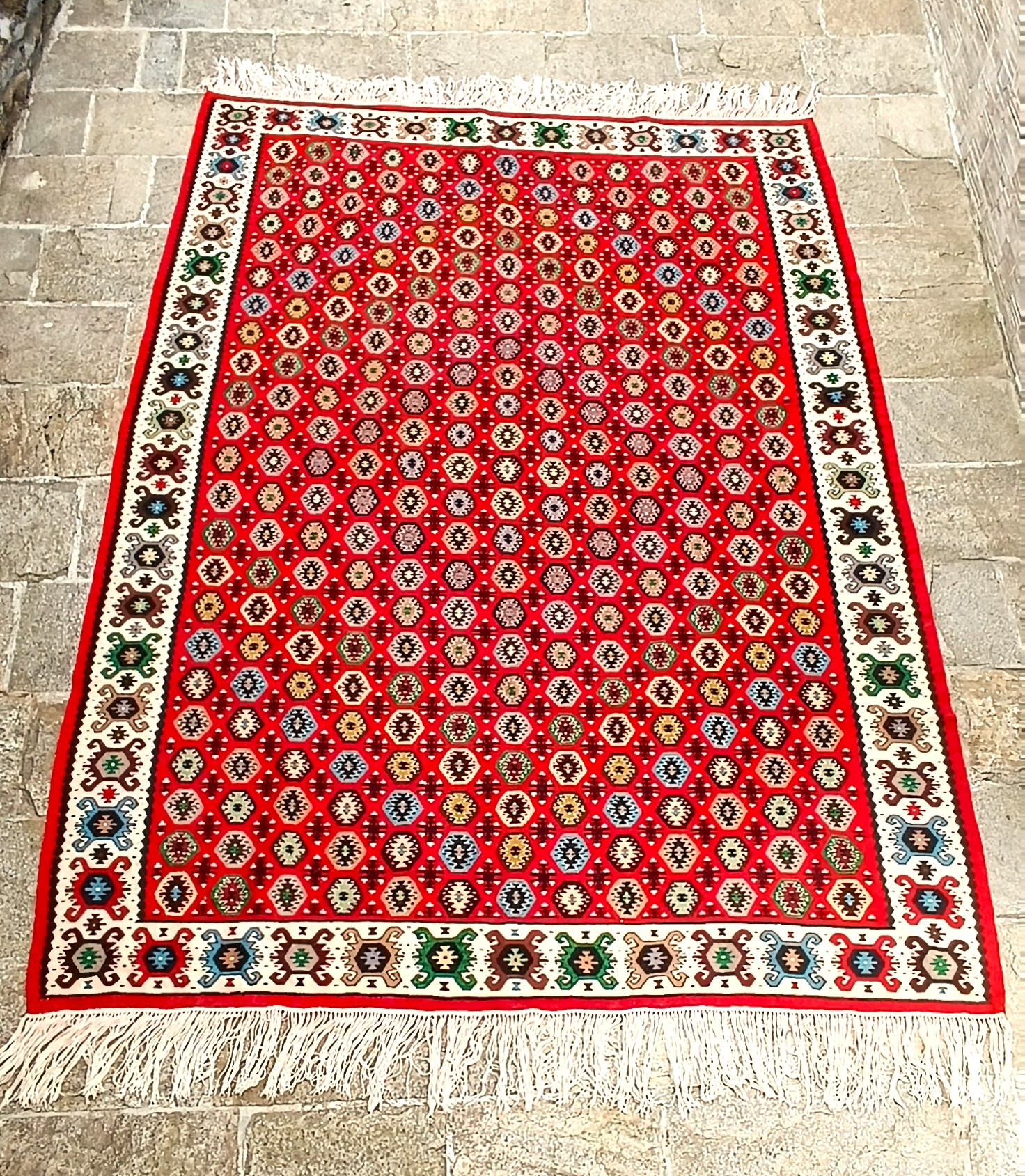
The Chiprovtsi “Bombichki” rug is a traditional Bulgarian reversible flatwoven kilim featuring a dense repetition of small, angular, diamond-like geometric ornaments. Our example measures 325 × 203 cm and has a vivid red field, multicoloured motifs, a wide cream border and white fringes. The seller confirmed a cotton warp foundation; wool is used in the patterned weaving tradition. This is the first rug acquired for The Old Antiquarian collection. Its exact age and the identity of its weaver have not been established.
At a Glance: The Rug in Our Collection
| Object | Traditional Bulgarian Chiprovtsi flatwoven rug (kilim) |
|---|---|
| Named design | Bombichki (“little bombs”), a recognised local pattern name |
| Dimensions | 325 × 203 cm |
| Main field | Rich red with compact multicoloured stepped motifs |
| Border | Cream ground with symmetrical stylised ornaments |
| Structure | Reversible, non-pile flatweave |
| Materials | Cotton warp, as confirmed by the carpet dealer; wool patterned weft is consistent with the tradition but has not been independently fibre-tested |
| Date and maker | Not documented; no precise date or weaver attribution claimed |
| Collection significance | First rug acquired for The Old Antiquarian |
1. The Bombichki Pattern: A Universe of Repeating Geometry
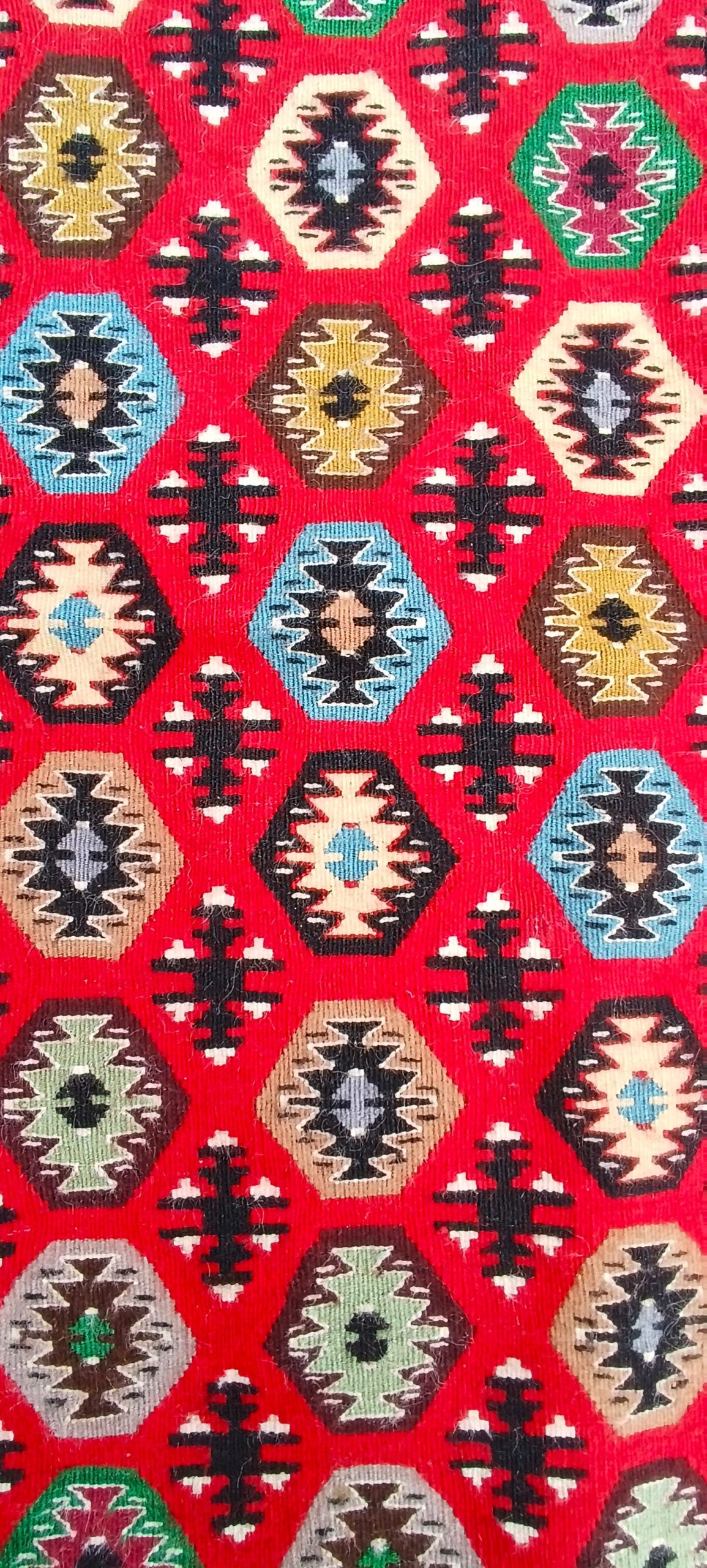
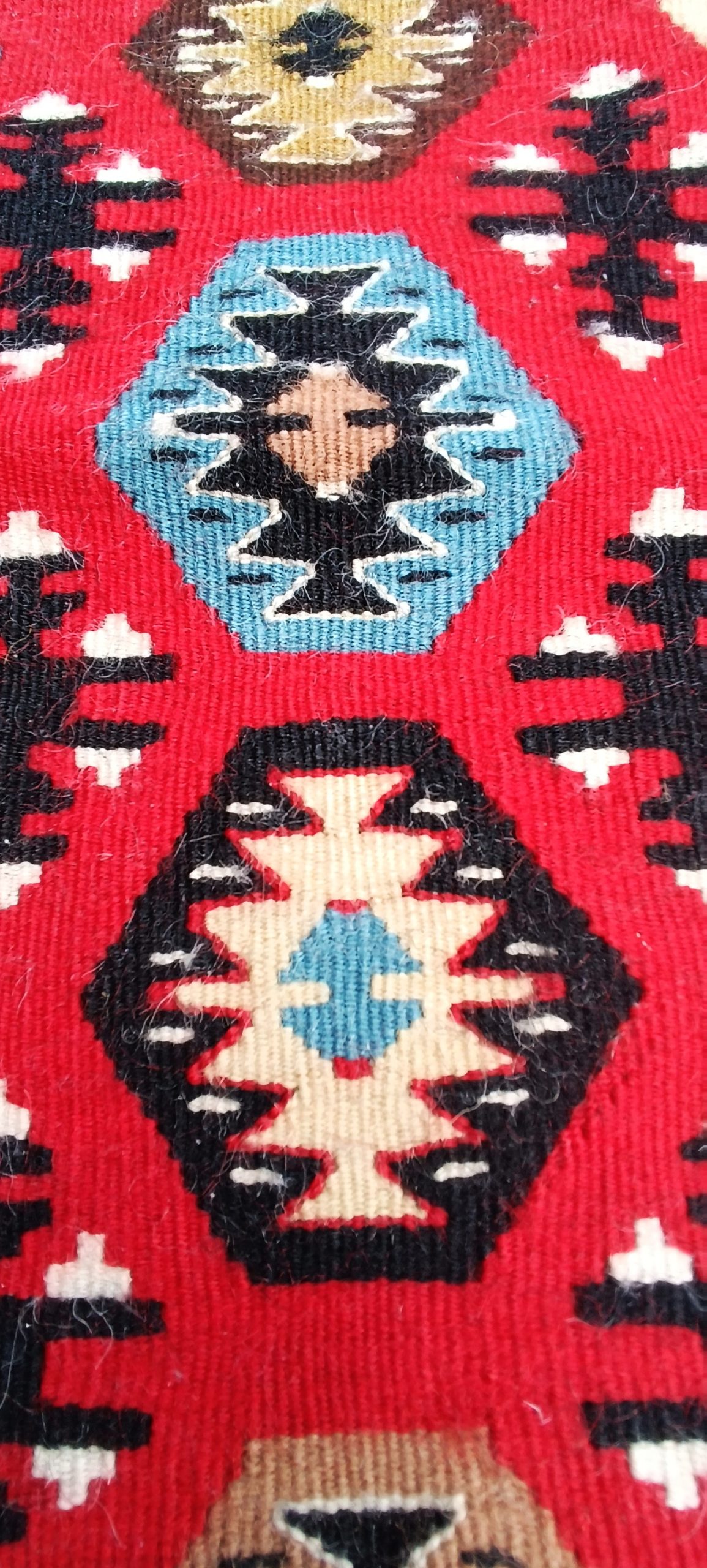
Some rugs reveal their design in a single glance. This one keeps unfolding. From a distance, its red field seems to shimmer. Step closer and the apparent movement resolves into carefully ordered rows of small, stepped polygons and diamonds. Turquoise, ochre, cream, green, brown and black appear in measured alternation, separated by small dark cross-like figures.
The name Bombichki, or “little bombs,” is used for an established Chiprovtsi carpet pattern. Its visual impact comes not from a single monumental medallion but from repetition, contrast and painstakingly controlled geometry. An individual motif is small; together, hundreds of them form a vivid textile landscape.
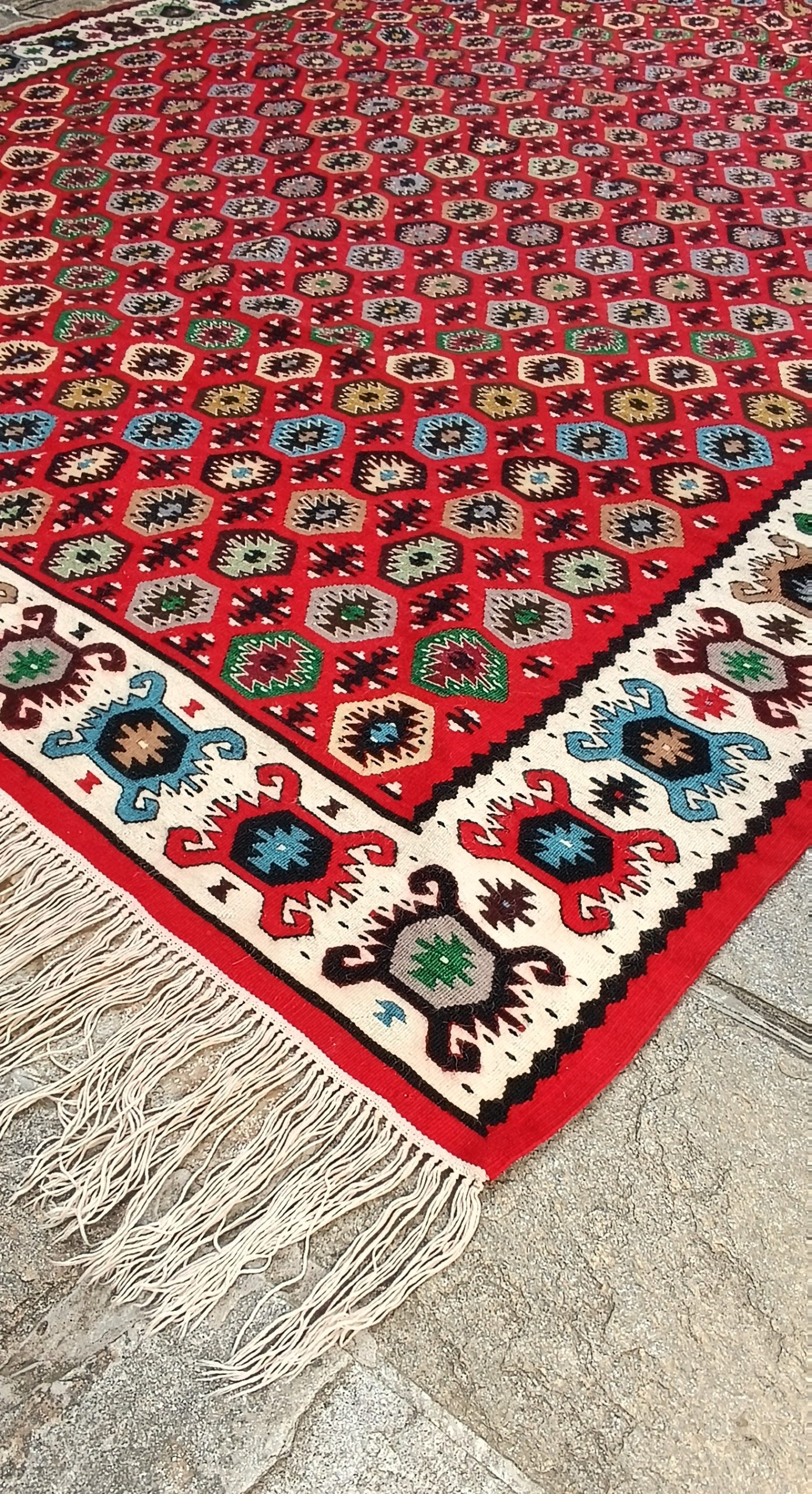
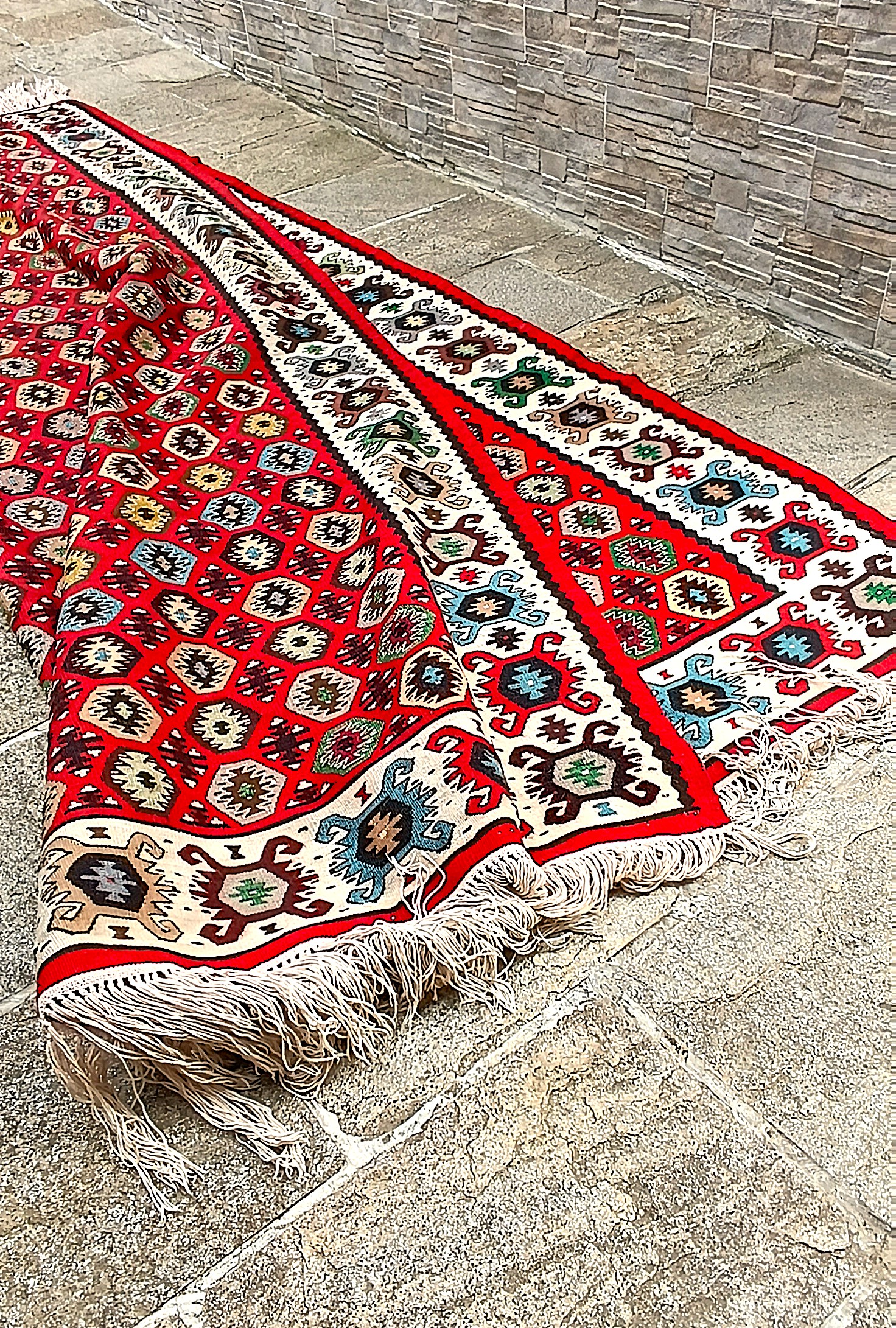
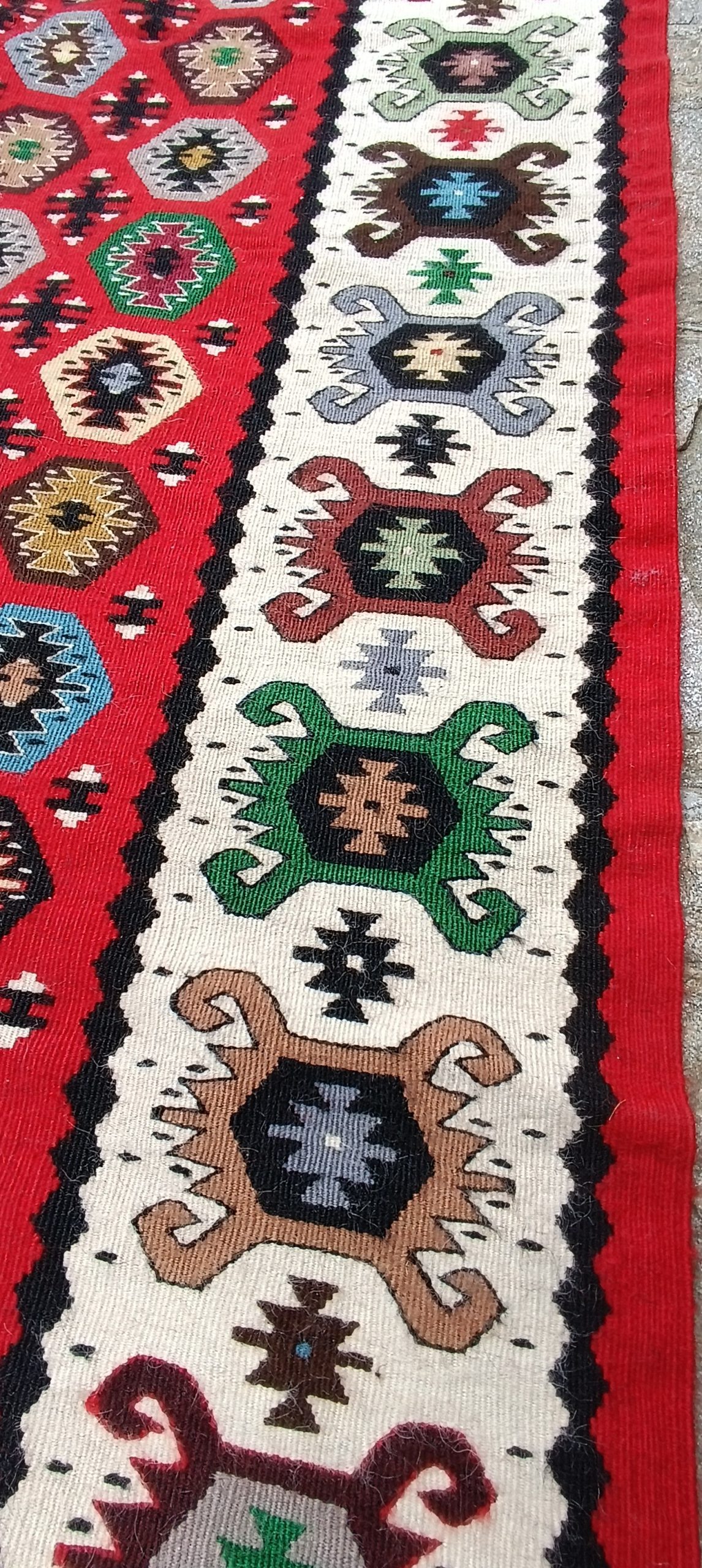
The photograph of the whole rug shows two distinct visual zones: a highly animated central field and a light-coloured border in which larger curving, stepped figures are given more breathing space. This contrast brings compositional order to an otherwise exuberant surface.
Why is the design called “Bombichki”?
Pattern names in Bulgarian weaving often arise from local speech, remembered associations and the everyday vocabulary of makers. Names such as “birds,” “cabbages” or “vines” show how concrete imagery enters ornament. Bombichki is also a vernacular design name, but its exact historical etymology should not be presented as proven.
There are differing explanations. Its small sharply outlined forms invite comparisons with radiating bursts of energy. A contemporary Chiprovtsi carpet maker also explicitly connects the name with the region’s historical experiences of conflict. Neither explanation, on its own, establishes when the name originated or what every earlier weaver intended by it. The motif should therefore be approached as both a recognisable design and a subject for further local oral-history research.
2. Chiprovtsi: A Living Weaving Heritage
Chiprovtsi lies in northwestern Bulgaria, close to the western Balkan Mountains. The town has a long history of crafts, commerce and textile production. The precise beginnings of its carpet-making tradition are difficult to date, but written accounts commonly discuss its development from the seventeenth century and its expansion during the eighteenth and nineteenth centuries.
Over generations, the women of Chiprovtsi developed an exacting skill: weaving patterned, reversible carpets on vertical looms. The craft belonged not simply to workshops but to households and the cultural life of the community. Designs were learned through observation and practice; technical judgement grew from years of experience.
In 2014, UNESCO inscribed the tradition of carpet-making in Chiprovtsi on its Representative List of the Intangible Cultural Heritage of Humanity. The recognition concerns the living skills, knowledge, social practices and transmission of weaving, rather than awarding UNESCO status to this particular rug or to every individual pattern.
UNESCO’s account also describes something often absent from technical manuals: women telling stories, singing, expressing wishes and sharing work at the loom. Knowledge has passed between mothers, grandmothers and daughters, sometimes as several generations work together on the same large carpet.
For a fuller historical overview of looms, wool processing, dyes and the development of the craft, read our related research: Chiprovtsi Rugs: History, Weaving & UNESCO Heritage.
3. Kanatitsa, Protection and the Meaning We Find in Geometry
The geometric vocabulary of Chiprovtsi carpets invites symbolic readings. Among the best-known motifs is the Kanatitsa, often understood in local explanations as a winged geometric form connected with family, continuity or the idea of protection. Triangle-based arrangements also appear in interpretations of related motifs.
The small stepped forms of Bombichki can be compared visually with this wider vocabulary. Yet visual similarity is not documentary proof that the Bombichki pattern is a chronologically later or more complex stage of Kanatitsa. Nor can an individual rug, without further evidence, be securely assigned a single ancient, Proto-Bulgarian or Slavic meaning.
| Reading | What can responsibly be said |
|---|---|
| Visible pattern | Repeated stepped, diamond-like forms and small cross-like separators are directly observable. |
| Family and continuity | These are meaningful traditional or contemporary interpretations of related geometric motifs, not proven universal definitions. |
| Protective meaning | Protective interpretations belong to folklore and oral traditions; a specific protective power cannot be verified. |
| Relationship to Kanatitsa | A useful stylistic comparison; a direct, documented evolutionary sequence remains unestablished. |
For the person who lives with this carpet, symbolism may have another dimension: the feeling generated by colour, rhythm, memory and a personal encounter. Such meaning does not need to masquerade as an archaeological certainty in order to be real.
4. How the Rug Was Made: Wool, Cotton and Two Woven Faces
A Chiprovtsi kilim is flatwoven rather than knotted-pile. Coloured weft yarns create the design by passing through the stretched warp threads on a vertical loom. The pattern is integrated into the textile, so it appears on both sides. This is the craft’s characteristic reversible construction.
The carpet dealer who sold this example confirmed that its warp foundation is cotton. The photographed white fringe strands are consistent with that information, although photographs alone cannot substitute for fibre analysis. The coloured weft appears consistent with traditional woollen Chiprovtsi production, but we have not commissioned independent laboratory testing of its fibre or dyes.
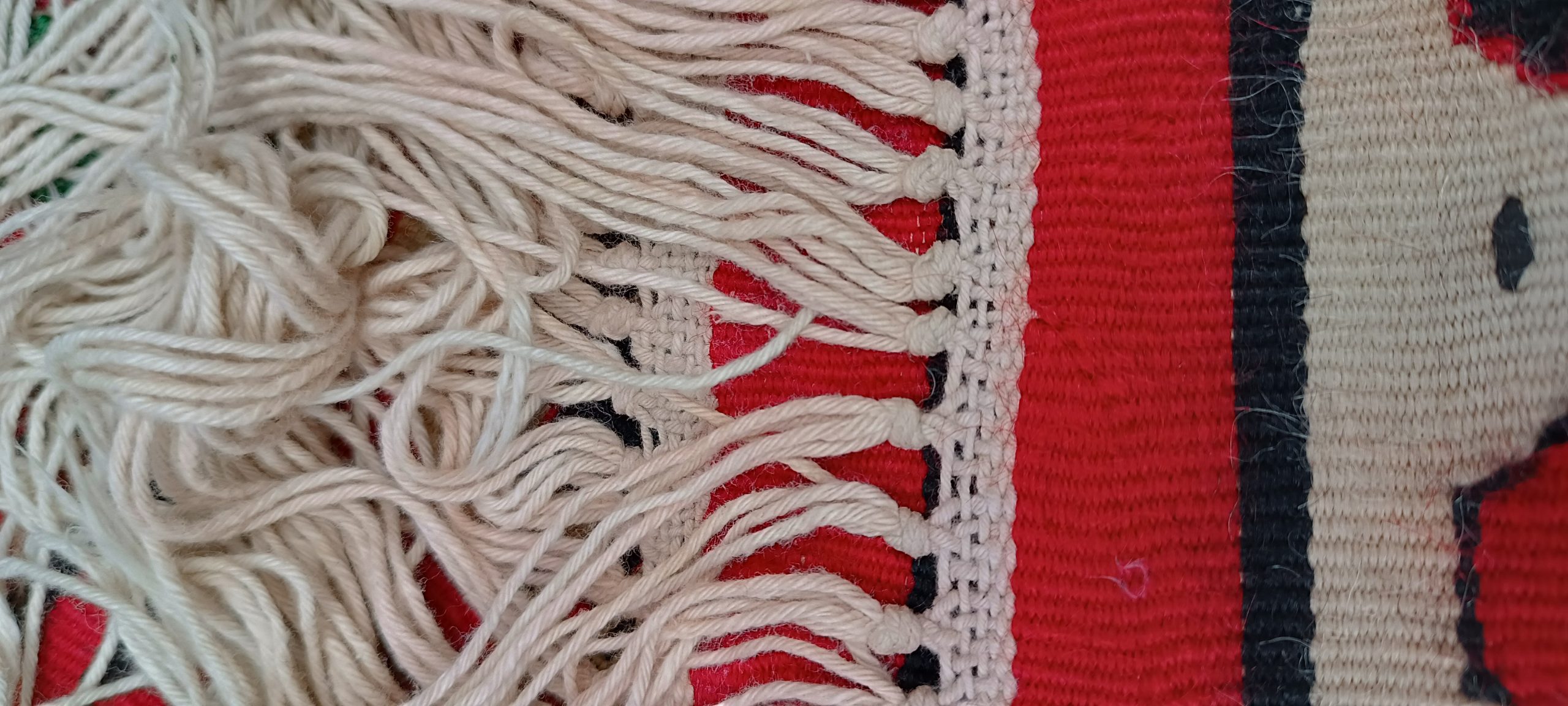
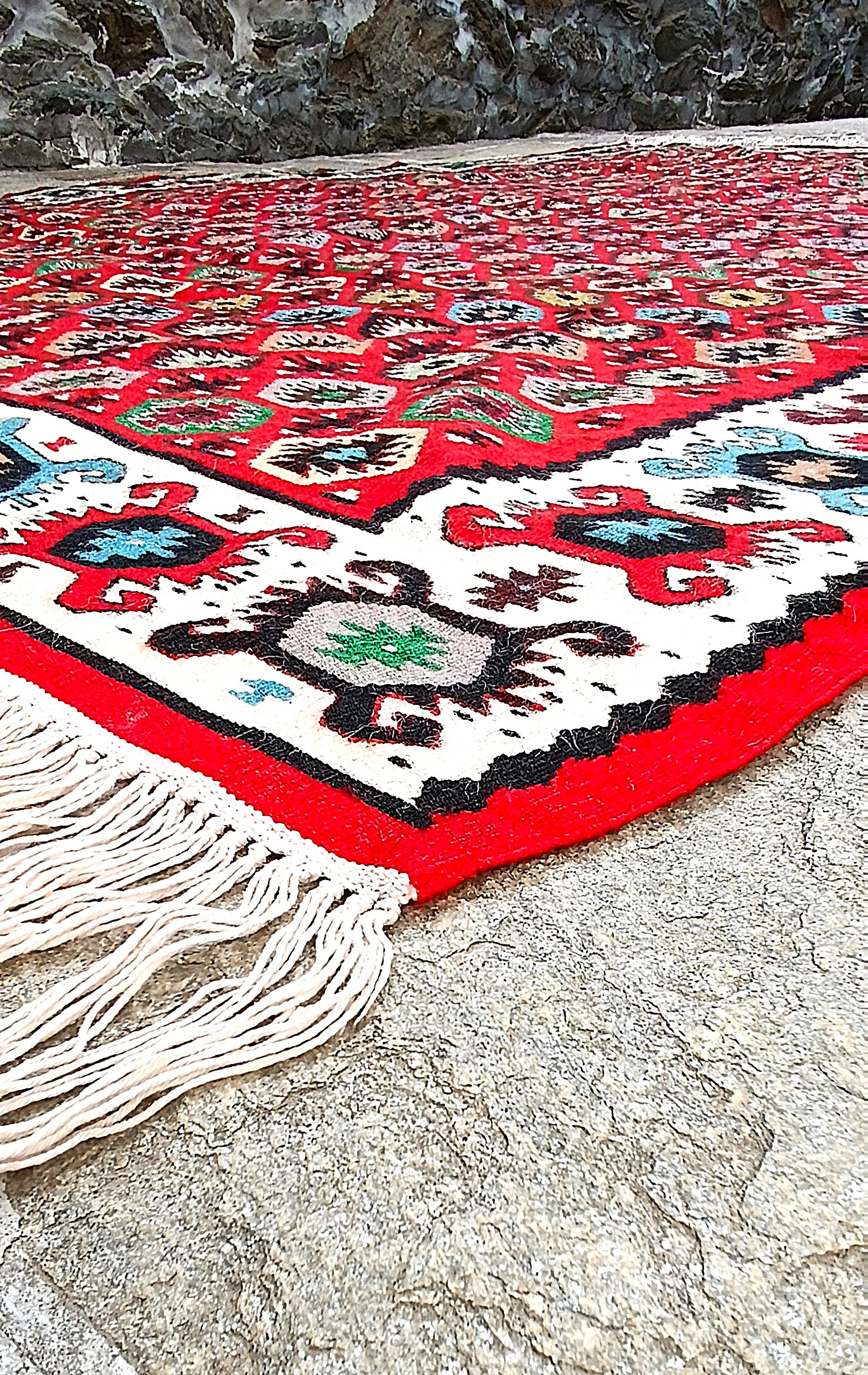
The folded-corner image is particularly informative: it allows the viewer to see the two faces of the carpet together. The detail is useful when describing construction, but it cannot, by itself, establish the object’s age.
What the close-ups tell us
The macro photographs reveal the compact weave, the transitions between small areas of colour and the execution of the larger border ornaments. Such details help document workmanship and condition, and they are essential for future comparisons with better-dated examples.
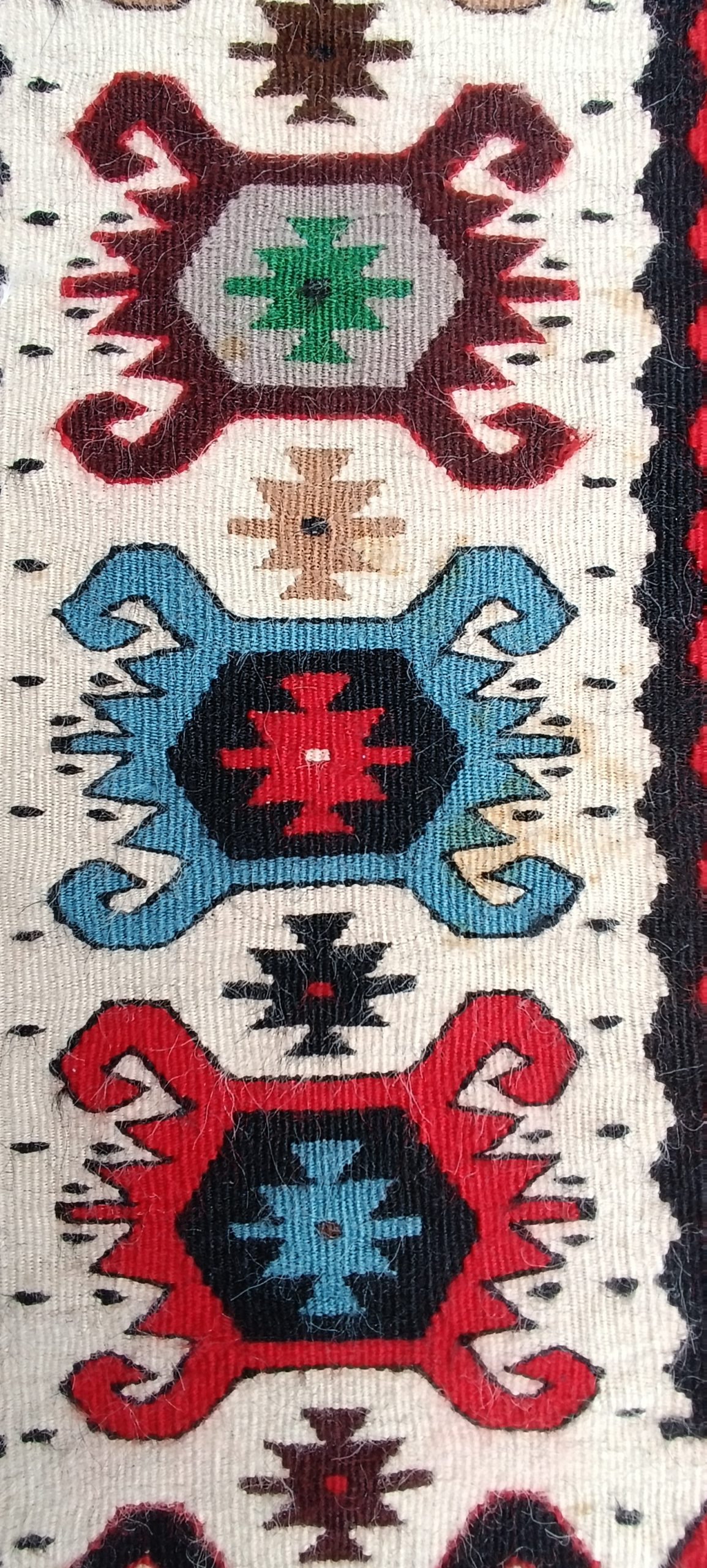
A note on dating: early Chiprovtsi rugs could use wool in both warp and weft; cotton warp became common in later production. However, cotton alone cannot securely date this particular carpet. Its maker, production year, exact dye recipes and previous owners remain undocumented.
5. The First Rug: A Personal Journey to Chiprovtsi
The following passages are a first-person account by the collector. They preserve a personal experience and emotional interpretation, not claims about the rug’s supernatural properties or documented provenance.
Eleven years of waiting
Folk art has always set an inner rhythm for me. The music, the dances, the costumes, the customs and the almost mysterious rituals hidden in everyday life have shaped the way I experience the world. I have always felt life as a kind of ceremony: something to approach with gratitude, attention and care for every gesture. At times it feels as though I am moving through a dance, listening to the changing melody of the space around me.
For about eleven years, I wanted to visit Chiprovtsi during its carpet festival. Somehow the journey never happened. Perhaps, without knowing it, I was waiting for the right moment. I carried a feeling that something important awaited me there, something that might change how I understood myself.
Through the Petrokhan Pass
One beautiful sunny day, my family and I finally travelled through the Petrokhan Pass. The road curled between luminous green forests and great rocky forms. As we moved through the mountains, I felt I was crossing into a different world: open, mysterious and filled with an unexpected sense of freedom. I smiled. I grew quiet. Time seemed first to expand and then to contract. And suddenly we had arrived in Chiprovtsi.
I was excited like a child. The festival was full of people: some had come to walk, to eat or to spend the weekend; others wanted to see the craft. And there were people, I felt, who had come searching for something less easily named. I moved among the carpets and their bright patterns as though part of my own memory were returning home.
The women who carried the thread
I spoke with older craftswomen, their daughters and their granddaughters. Their conversations moved effortlessly between patterns, colours, techniques, ordinary family concerns and laughter. To me they seemed the guardians of an extraordinary knowledge, yet they spoke of their work as something completely natural. The thread required patience, discipline and immense labour; in their hands it belonged to everyday life. I felt that they were not simply making a textile. They were continuing a relationship between generations.
At a workshop on colouring wool with natural materials, led by the granddaughter of a respected master weaver, there was one available place. I took it. I learned and experimented with the delight of a child who has discovered a secret room. Whether it was chance or perfect timing did not matter; the experience felt like a gift.
A teacher’s words
Later we visited the museum. I was overwhelmed by the designs and by the human lives I imagined behind them. There, unexpectedly, I met a teacher from my primary-school years whom I had not seen for more than thirty years. She recognised me as though no time had passed. After we greeted each other, she said a few words that I did not yet fully understand:
“You will leave here rich.”
Then she continued on her way with her group. The words remained with me.
Before leaving, we stopped in a sheltered green meadow among the hills and rocks. I sat down to enjoy the freshness of the grass and noticed something at my feet: a four-leaf clover. I looked again and again to be certain. It was real. By then the whole day felt full of coincidences that spoke directly to my sense of wonder.
We had to leave Chiprovtsi unexpectedly and in a hurry. The day disappeared almost as quickly as a revelation. Yet on the journey home I realised what my teacher had meant. I had become rich in feeling, encounters, knowledge and gratitude. Above all, among the mountains, carpets and women who kept the craft alive, I had met a part of myself: both familiar and new.
The scent of lavender and the first rug
Not long afterwards, I instinctively began searching for Chiprovtsi carpets online. Then I saw this red one. I did not yet know that its pattern was called Bombichki, but something about it held my attention completely. The excitement of the festival returned. I called the seller and learned that I could see the rug in person.
When the dealer unfolded it before me, I noticed the scent of lavender. I fell silent. I smiled, knelt beside the carpet and gently touched its surface. Suddenly the whole journey — the mountain road, the museum, the craftswomen, my teacher’s blessing — seemed present again in one object.
It was not a scientific discovery or a fact that could be measured. It was an encounter. I felt that this rug had been woven not only with fibres from the earth but with something deeply human: care, imagination and love. In that moment I knew I wanted to preserve it. It became the first rug in my collection, and it continues to remind me of the day I discovered how rich a person can become without acquiring anything other than understanding.
“To me, the carpet was not woven only from wool. It was woven with love from the heart.”
6. Caring for a Rug That May Outlive Us
Traditional textiles can remain part of family life for generations when their condition and use are respected. Preservation does not always mean locking a carpet away. It means understanding what the object can safely endure and avoiding preventable damage.
- Keep a record: retain dimensions, photographs of both faces, purchase information and every reliable detail of the rug’s history.
- Control light: limit prolonged direct sunlight, which can fade dyes and weaken fibres.
- Protect the warp ends: avoid dragging the rug by its fringes or placing furniture directly on vulnerable edge details.
- Avoid damp storage: ensure the textile is clean and dry before storing it; inspect for pests periodically.
- Choose cleaning carefully: do not bleach, machine-wash or use aggressive detergents on an old or valuable rug; consult a textile conservator when in doubt.
- Use thoughtfully: for display on a floor, consider a suitable non-slip underlay and the amount of foot traffic; rotate the rug if condition permits.
An inherited kilim is more than a furnishing. Reusing and caring for an existing, well-made textile can give it another meaningful chapter of life while keeping the skills and memories behind it visible. Longevity, however, depends on the individual rug’s materials, condition, environment and treatment.
Collector’s Checklist: What Do We Know, and What Remains Open?
Recorded: Bombichki pattern, 325 × 203 cm, first acquisition in the collection, cotton foundation confirmed by the selling dealer, original photographs of both sides and construction details.
Still to investigate: exact weaving date, maker or workshop, full ownership history, analytical fibre confirmation, dyes, possible repairs and comparative examples with documented dates.
Frequently Asked Questions About the Bombichki Rug
What is a Bombichki rug?
It is a named Chiprovtsi kilim design characterised by repeating small geometric motifs, often arranged densely across the central field.
Where is Chiprovtsi?
Chiprovtsi is a town in northwestern Bulgaria, near the western Balkan Mountains.
How large is the rug in this article?
The rug measures 325 × 203 cm.
Is it handmade?
It has the reversible flatwoven construction characteristic of the handmade Chiprovtsi tradition. The identity of its individual weaver is unknown.
Is the Bombichki pattern connected to Kanatitsa?
Their geometric forms can be compared, and symbolic interpretations sometimes overlap. A direct documented evolutionary relationship has not been established for this particular design.
Does Bombichki mean the rug has a military purpose?
No military use has been documented for this rug. The design name has different local interpretations, including a modern maker’s association with memories of regional conflict.
Is this exact rug UNESCO-listed?
No. UNESCO recognised the tradition of carpet-making in Chiprovtsi in 2014, not this individual object.
What are the warp and weft made of?
The carpet dealer identified the warp as cotton. The patterned weft is consistent with wool used in Chiprovtsi weaving, but independent fibre analysis has not been performed.
How old is this rug?
Its date is not established. Pattern, palette and fibre type alone are not enough for a reliable year or century attribution.
Why does this rug matter to the collection?
It was the first rug acquired for The Old Antiquarian and is tied to the collector’s transformative visit to the Chiprovtsi carpet festival.
Sources, References and Research Method
Descriptions of the object and the collection story come from our original photographs and the collector’s personal account. Information about the cotton foundation was supplied by the selling carpet dealer. Wider historical background is based on the sources below. Interpretations of symbols, oral traditions and suggested links between motifs are explicitly identified as such.
- UNESCO Intangible Cultural Heritage — The Tradition of Carpet-making in Chiprovtsi. Official inscription and description, 2014.
- UNESCO Decision 9.COM 10.9. Formal recognition of the living tradition.
- Municipality of Chiprovtsi — Local Heritage and Traditional Motif Names. Municipal presentation of carpet traditions.
- Elisa Art — Chiprovtsi “Bombichki” Pattern. Contemporary maker’s identification and interpretation of the named model; not a provenance record for our object.
- The Old Antiquarian — Chiprovtsi Rugs: History, Weaving & UNESCO Heritage. Related object-led historical study.
Have an Inherited Bulgarian Rug with a Story?
A kilim may preserve family memories, traditional skills and traces of a journey across generations. If you own a Chiprovtsi or Kotel rug, preserving its photographs and documented history can be as valuable as preserving the textile itself.
