
How to Identify Rosenthal Porcelain
Rosenthal is one of Germany’s most important porcelain manufacturers and a major name in European decorative arts and twentieth-century design. Founded in 1879 by Philipp Rosenthal, the company developed from a porcelain-decorating business in Bavaria into an internationally recognised producer of porcelain tableware, figurines, vases, sculptures and designer collections.
For collectors, one of the most useful features of Rosenthal porcelain is its extensive sequence of factory marks and backstamps. These marks changed over time and can provide valuable evidence when identifying and approximately dating a piece.
Whether you have found an early Rosenthal figurine, an Art Deco vase, a dinner service marked Selb Bavaria, or a modern Rosenthal studio-line object, this guide explains how to read the marks, understand their dates and recognise the most important identification clues.
If you are beginning your porcelain research, you may also find useful our guides to What Is Porcelain?, What Is German Porcelain?, Types of Porcelain Explained and What Are Porcelain Marks?.
Rosenthal Porcelain at a Glance
| Founded | 1879 |
| Founder | Philipp Rosenthal |
| Historic centre | Selb, Bavaria, Germany |
| Early activity | Porcelain decorating |
| Own porcelain production | From 1891 |
| Studio-Line introduced | 1961 |
| Key identification clues | Factory mark, location wording, model numbers, pattern numbers, designer marks, glaze, decoration and craftsmanship |
What Is Rosenthal Porcelain?
Rosenthal is best known for high-quality German porcelain combining technical precision with refined decoration and increasingly modern design. During its long history, the company produced everything from traditional dinner services and ornamental porcelain to modernist vessels, figurines and artist-designed objects.
Unlike manufacturers whose reputation rests primarily on eighteenth-century court porcelain, Rosenthal became especially important during the nineteenth and twentieth centuries. Its history reflects the development of German industrial porcelain from traditional craftsmanship to modern international design.
Collectors particularly associate Rosenthal with:
- high-quality hard-paste porcelain;
- clear and refined glazing;
- Art Nouveau and Art Deco designs;
- luxury dinner and tea services;
- porcelain figurines and decorative objects;
- modern designer collaborations;
- Rosenthal studio-line;
- limited and artist-associated editions.
The History of Rosenthal
The history of Rosenthal began in 1879, when Philipp Rosenthal established a porcelain-decorating business at Erkersreuth Castle near Selb in Bavaria.
During the earliest period, Rosenthal primarily decorated porcelain blanks produced elsewhere. Commercial success encouraged the company to expand, and in 1891 Philipp Rosenthal established his own porcelain production.
In 1897, the business adopted the name Porzellanfabrik Ph. Rosenthal & Co. AG, Selb. By the early twentieth century, Rosenthal had developed into an important German porcelain manufacturer with a growing international market.
The twentieth century brought an increasing emphasis on modern design. Rosenthal collaborated with important artists, architects and industrial designers, helping establish a distinctive identity that differed from more historically oriented European porcelain manufacturers.
A particularly important development came in 1961 with the formal introduction of Rosenthal studio-line, which became internationally recognised for collaborations with leading designers and architects.
Why Is Rosenthal Porcelain So Collectible?
Rosenthal attracts both traditional porcelain collectors and enthusiasts of modern design because the company produced across many different artistic periods.
A single Rosenthal collection may include objects influenced by Art Nouveau, Art Deco, modernism, Scandinavian design, post-war industrial design or contemporary decorative art.
Collectors particularly appreciate Rosenthal for:
- historic German manufacturing;
- consistently high production standards;
- recognisable factory marks;
- designer collaborations;
- Studio-Line production;
- important figurines and sculptural porcelain;
- rare patterns and discontinued shapes;
- well-documented production history.
When determining whether a piece is truly period Rosenthal, specialists may also consider whether it is an original, later copy, replica or misleading fake.
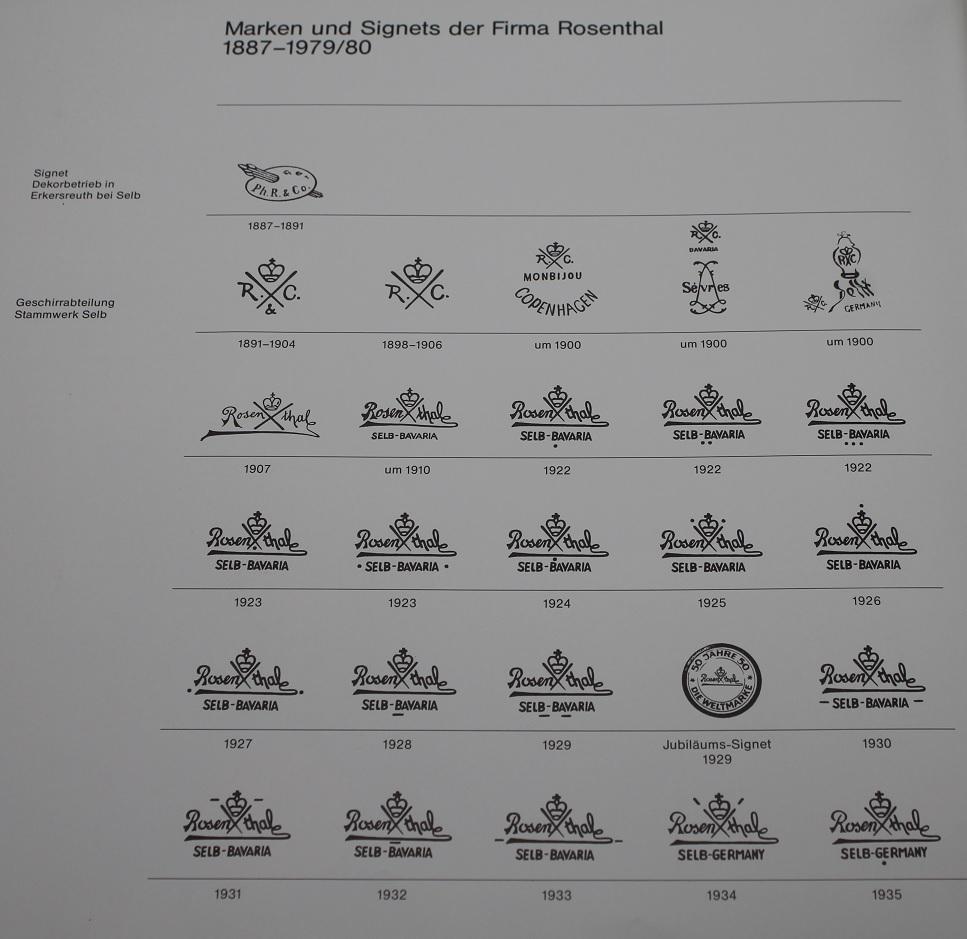
Rosenthal Porcelain Marks: The Most Important Identification Clue
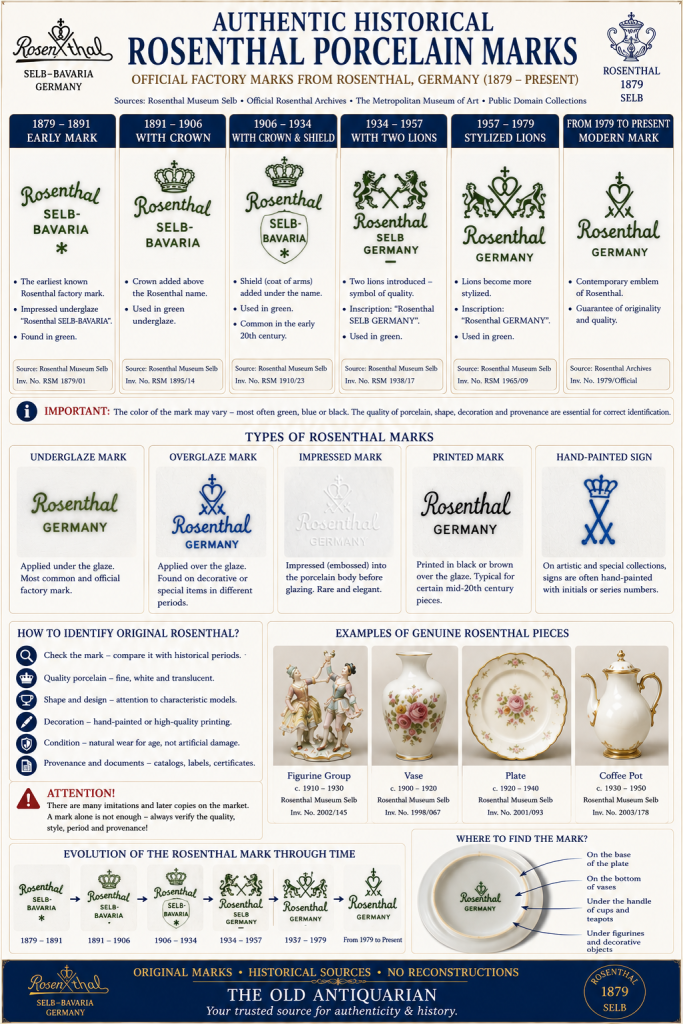
The underside of a Rosenthal porcelain object is usually the best place to begin identification. Factory marks may be printed, stamped or applied beneath the glaze and can include the company name, crown devices, crossed elements, production locations and collection names.
Depending on the period, collectors may encounter wording such as:
- Ph.R.&Co.
- R.&C.
- Rosenthal
- Philipp Rosenthal & Co.
- Selb Bavaria
- Selb-Germany
- Germany
- Rosenthal studio-line
- Classic Rose
- Rosenthal Classic
Collectors should remember that a mark normally provides a date range, not necessarily an exact production year. Some forms and decorations continued for many years, while similar marks can also occur across transitional periods.
Rosenthal Marks by Date: Factory Mark Timeline
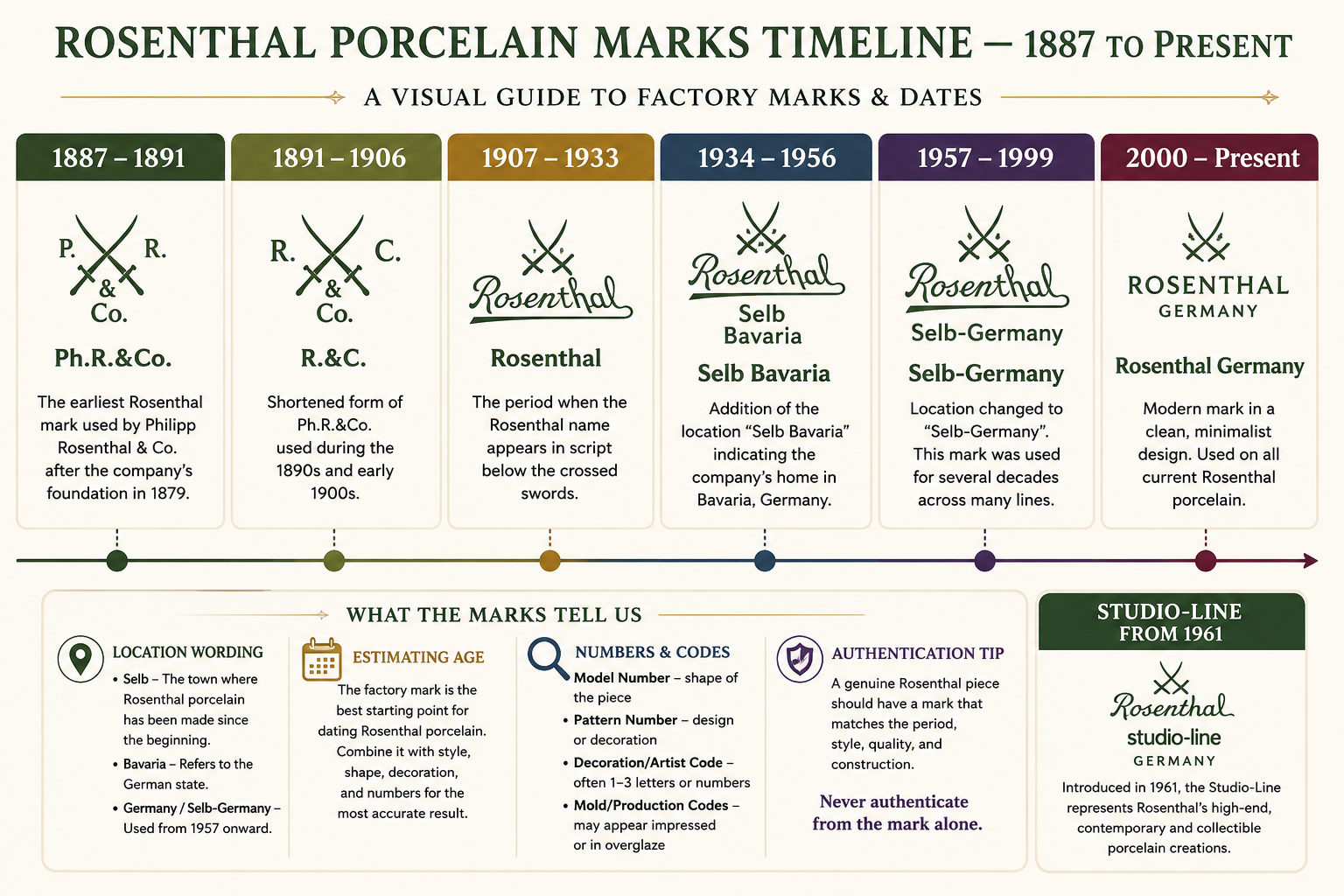
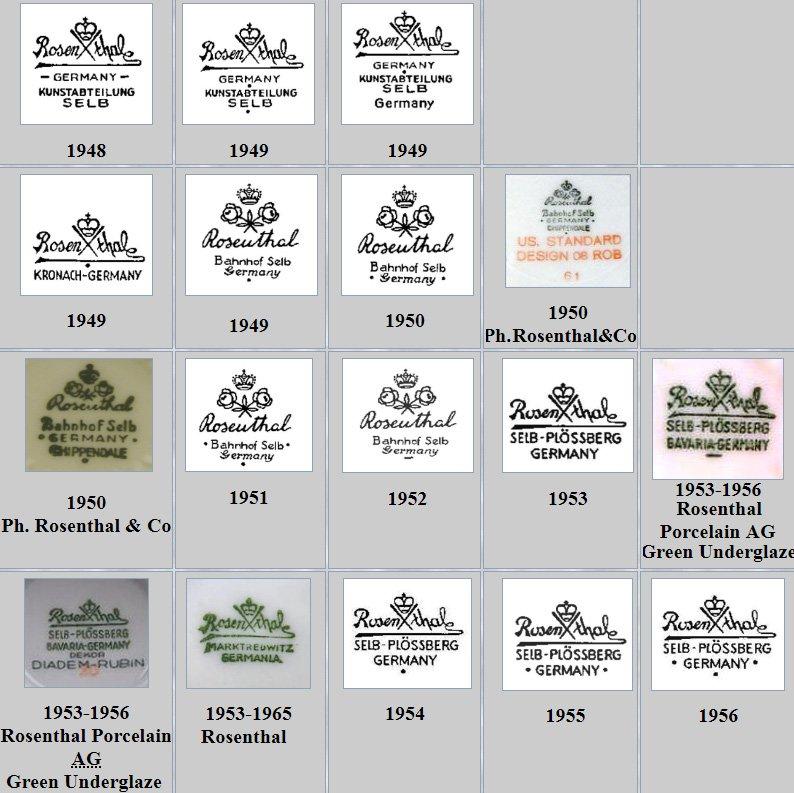
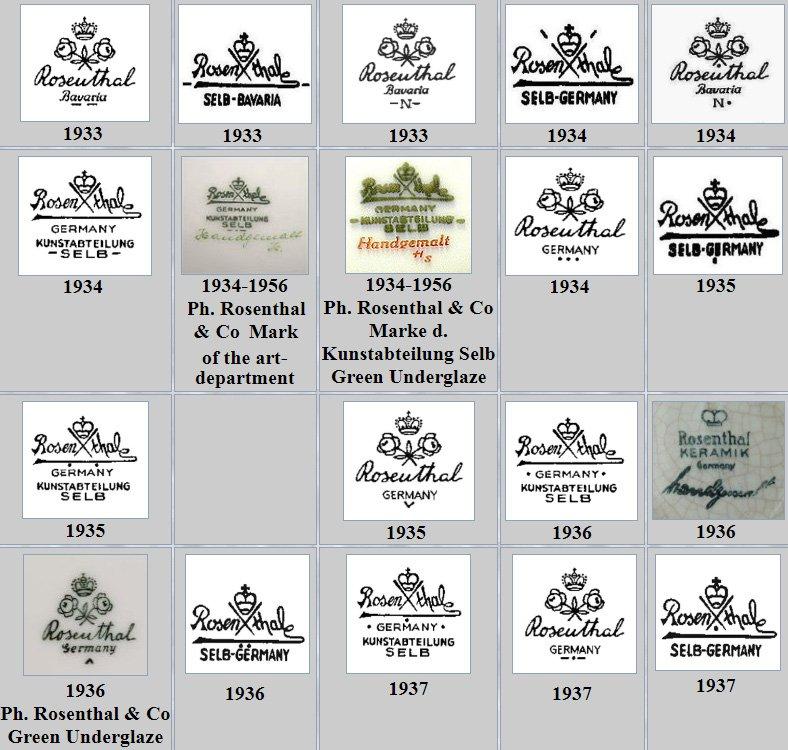
Rosenthal’s own historical chronology shows that the company changed its principal factory marks several times. These periods provide one of the most useful starting points for dating Rosenthal porcelain.
| Period | Typical Rosenthal Mark | Dating Clue |
|---|---|---|
| 1887–1891 | Painter’s palette and brushes with Ph.R.&Co. | Very early decorating-period Rosenthal mark; comparatively scarce. |
| 1891–1906 | Crown with crossed rods and R.&C. | Associated with Rosenthal’s early period of its own porcelain manufacture. |
| 1907–1933 | Curved Rosenthal script with crown and crossed rods | Often accompanied by wording such as Selb Bavaria; important for Art Nouveau and Art Deco period pieces. |
| 1934–1956 | Recognisable Rosenthal script-and-crown mark with relatively minor variations | Additional wording such as Germany or Selb can help narrow the period. |
| 1957–1999 | Modernised version of the traditional Rosenthal logo | Post-war examples often include Selb-Germany or Germany. |
| 2000–present | Updated contemporary Rosenthal trademark | Modern production retaining the recognisable Rosenthal script and crown identity. |
How to Date Rosenthal Porcelain by Its Factory Mark
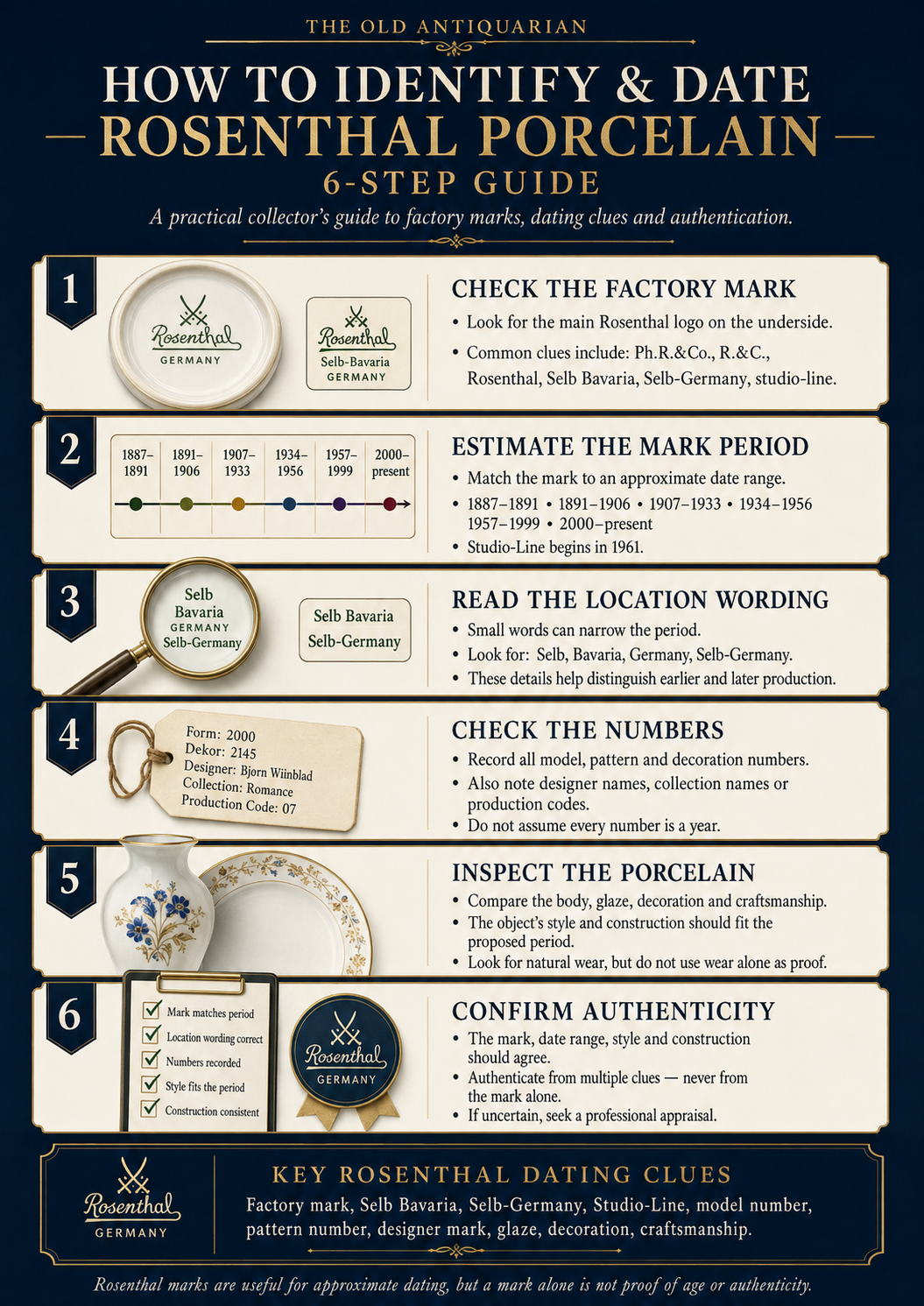
The most reliable way to date Rosenthal porcelain is to combine the backstamp with several independent clues.
1. Identify the Main Rosenthal Logo
Begin by comparing the overall structure of the mark. Look at the lettering, crown, crossed elements and company initials. An early painter’s-palette mark is fundamentally different from the later curved Rosenthal script.
2. Read Every Word Beneath the Logo
Small inscriptions can be extremely important. Terms such as Bavaria, Selb Bavaria, Selb-Germany, Germany, studio-line and classic help distinguish production periods and product lines.
3. Examine Model and Pattern Numbers
Rosenthal pieces may carry impressed, printed or handwritten numbers associated with a model, shape, pattern, decoration or production process. These numbers should be recorded exactly as found.
4. Look for Designer or Artist Information
Designer pieces may include signatures, model references or collection identifiers. This is particularly relevant for twentieth-century Rosenthal and Studio-Line production.
5. Compare the Mark with the Object’s Style
A factory mark should make historical sense when compared with the shape, decoration and manufacturing technique. An Art Deco-style object carrying a clearly modern mark, for example, may be a later production or reissue of an older design.
6. Consider Reissues and Continued Production
Some successful Rosenthal designs remained in production or were reintroduced many years after their original creation. This means that the design date and the production date of an individual object may be different.
What Does “Rosenthal Selb Bavaria” Mean?
The wording Selb Bavaria is one of the most useful phrases encountered on early twentieth-century Rosenthal porcelain.
Selb refers to the Bavarian town closely associated with Rosenthal’s historic porcelain production, while Bavaria identifies the wider German region.
Rosenthal’s official mark chronology associates the Selb Bavaria wording particularly with marks from the 1907–1933 period. During this era the familiar curved Rosenthal script, crown and crossed elements were already established.
However, collectors should not automatically date every object carrying the word Bavaria to a single exact year. Typography, logo design, numbers, decoration and the physical construction of the piece should also be examined.
Rosenthal Selb-Germany and Germany Marks
Later Rosenthal porcelain frequently carries wording such as Selb-Germany or simply Germany.
These inscriptions are commonly associated with later twentieth-century production and should be interpreted together with the form of the Rosenthal logo itself.
For pieces dating broadly from the post-war decades, details such as the collection name, designer, shape number and style can be particularly useful because many classic Rosenthal designs remained in production for extended periods.
Rosenthal Studio-Line Marks
Rosenthal studio-line is one of the most recognisable areas of modern Rosenthal collecting.
The line was formally introduced in 1961 under Philip Rosenthal Jr. and became an important platform for collaboration with international designers, artists and architects.
The Studio-Line base mark normally combines the traditional Rosenthal identity with the wording studio-line. Therefore, a genuine Studio-Line mark indicates production from 1961 onward.
The Studio-Line logo was revised in 1999, creating another useful distinction when broadly dating later designer pieces.
Important designers associated with Rosenthal’s modern design history include names such as Walter Gropius, Raymond Loewy, Tapio Wirkkala and Bjørn Wiinblad. Designer attribution can significantly affect collector interest, but attribution should be supported by the correct model, mark and documented production history.
Rosenthal Classic Rose and Rosenthal Classic Marks
Collectors should pay particular attention to the words Classic Rose or Rosenthal Classic.
The Classic Rose line was introduced during the second half of the twentieth century and included reissues or continuations of popular historic Rosenthal designs.
This is important because an object may reproduce an older shape while having been manufactured much later. Rosenthal’s historical mark references identify several periods for this line, including Classic Rose Collection and later Rosenthal Classic marks.
Where Is the Rosenthal Factory Mark Located?
On most Rosenthal porcelain, the primary factory mark is located on the underside or base of the object.
Depending on the type of piece, collectors may also find:
- impressed model numbers;
- pattern numbers;
- decoration numbers;
- painter’s or decorator’s marks;
- designer names or signatures;
- collection names;
- factory control marks;
- production codes.
Do not clean or polish an old mark aggressively. Printed and painted inscriptions can sometimes be fragile, and unnecessary cleaning may remove useful evidence.
How to Identify Authentic Rosenthal Porcelain
Correct identification involves much more than matching a logo from an online chart.
Experienced collectors and professional appraisers compare the factory mark with the physical qualities of the porcelain and the historical characteristics expected for the period.
Porcelain Body
Quality Rosenthal porcelain generally displays a refined, dense and well-finished body appropriate to the object and production period.
Glaze
The glaze should normally appear even and professionally fired. Unusual surface defects or poor finishing may require closer examination.
Decoration
Examine whether decoration is hand painted, printed, transfer decorated, gilded or otherwise applied. The technique should be consistent with the period and product line.
Craftsmanship
Well-made Rosenthal objects usually show careful finishing, balanced forms and controlled detailing. Figurines should be examined especially closely around fingers, faces, drapery and bases.
Mark Consistency
The backstamp must be historically plausible for the object. A correct-looking logo does not automatically prove authenticity if the porcelain, decoration or construction is inconsistent with the supposed period.
Rosenthal Identification Checklist
Collector Checklist
- Photograph the complete factory mark.
- Record every word, letter and number.
- Identify the approximate mark period.
- Check whether it says Selb Bavaria, Selb-Germany, Germany, studio-line or Classic.
- Look for model and pattern numbers.
- Check for designer or artist marks.
- Compare the porcelain body and glaze with the proposed period.
- Examine decoration and manufacturing technique.
- Check for natural wear, restoration and repainting.
- Research the specific form or collection.
- Do not authenticate the object from the mark alone.
Are There Fake Rosenthal Marks?
Misleading marks, incorrect attributions and later pieces offered as much older Rosenthal can appear on the antiques market.
Rosenthal is not necessarily counterfeited in exactly the same way as some highly valuable eighteenth-century porcelain manufacturers, but collectors should still treat a factory mark as evidence rather than absolute proof.
Warning signs may include:
- a mark that does not match the style of the object;
- poor porcelain quality;
- rough or careless finishing;
- decoration inconsistent with the claimed period;
- incorrect typography;
- artificial ageing;
- modern reproduction presented as early production;
- a historically implausible combination of mark and model.
For more background, see What Is a Fake?, What Is a Replica? and What Is a Copy?.
Rosenthal Seconds and “2. Wahl”: How to Recognise Second Quality Porcelain
Collectors researching Rosenthal porcelain may occasionally encounter the German term “2. Wahl”, meaning second choice or second quality. It generally refers to genuine factory-produced porcelain that did not meet the manufacturer’s full first-quality standard because of a minor production or finishing imperfection.
A Rosenthal piece classified as second quality should not automatically be confused with a fake, reproduction or damaged antique. It may still be genuine Rosenthal porcelain made at the factory, but originally considered below the standard required for first-quality sale.
Why Was Rosenthal Porcelain Classified as Second Quality?
Porcelain manufacture involves several stages in which small imperfections can occur. Depending on the period, object and factory quality standards, a piece may have been downgraded because of relatively minor manufacturing irregularities.
Possible reasons can include:
- small glaze irregularities;
- minor firing imperfections;
- tiny inclusions or firing spots;
- slight distortion of the shape;
- small decoration inconsistencies;
- minor gilding or surface imperfections;
- other factory defects considered unacceptable for first-quality production.
The presence of one of these characteristics does not by itself prove that a Rosenthal object was officially sold as second quality. The complete base, factory mark and any additional factory indicators must be examined together.
How Can You Identify Rosenthal 2. Wahl Porcelain?
There is no safe method of identifying every Rosenthal second-quality piece from appearance alone. Collectors should begin by examining the complete factory mark and looking for any additional factory-applied indication associated with the quality classification.
When researching a possible Rosenthal second, check:
- the complete Rosenthal backstamp;
- any line, cancellation or additional mark associated with the factory stamp;
- model, pattern and decoration numbers;
- the porcelain body and glaze;
- visible manufacturing imperfections;
- whether the mark style corresponds to the proposed production period;
- whether the supposed quality indicator appears factory-applied rather than later damage.
Does 2. Wahl Mean Fake Rosenthal?
No. A second-quality designation and a fake factory mark are two completely different issues.
A genuine Rosenthal second may have been produced by Rosenthal but classified below first quality because of a manufacturing imperfection. A fake Rosenthal object, by contrast, is an object incorrectly or deceptively represented as genuine Rosenthal production.
This distinction is important when evaluating old porcelain. The presence of an authentic Rosenthal factory mark should still be considered together with the porcelain body, glaze, decoration, construction, numbers and production history.
Is Rosenthal 2. Wahl Less Valuable?
Second-quality status can influence collector value, particularly when an identical first-quality example is readily available. Collectors generally prefer pieces with strong condition, correct factory markings and the highest original production quality.
However, the effect on value depends on the individual object. Rarity, designer, model, age, decoration, historical importance, condition and collector demand can sometimes be more significant than a relatively minor original factory imperfection.
For unusual figurines, scarce patterns, early Rosenthal production or important designer pieces, a second-quality example may still be highly collectible.
The Most Collectible Rosenthal Porcelain
Collector interest varies greatly depending on rarity, period, designer, condition and artistic significance.
Important collecting areas include:
- early Philipp Rosenthal & Co. porcelain;
- early twentieth-century Rosenthal;
- Art Nouveau pieces;
- Art Deco figurines and decorative porcelain;
- rare dinner-service patterns;
- designer vases and sculptural objects;
- Rosenthal studio-line;
- artist-designed editions;
- limited editions;
- discontinued collections;
- pieces retaining clearly identifiable historic factory marks.
Rosenthal Studio-Line and Designer Porcelain
Studio-Line occupies a special place in Rosenthal collecting because it connects porcelain craftsmanship with modern industrial and artistic design.
The programme involved collaborations with a large number of international designers. For collectors, the designer’s identity can sometimes be as important as the Rosenthal name itself.
When researching a Studio-Line piece, record:
- the complete base stamp;
- designer’s name;
- shape or model number;
- collection name;
- dimensions;
- material;
- condition;
- original labels or packaging, if present.
What Determines the Value of Rosenthal Porcelain?
There is no single price level for Rosenthal porcelain. Common tableware may have modest resale value, while unusual figurines, scarce early production, important designer pieces or rare editions can attract much stronger collector interest.
Important valuation factors include:
- production period;
- factory mark;
- designer or artist;
- collection or series;
- model and pattern number;
- rarity;
- quality of decoration;
- condition;
- restoration;
- provenance;
- current collector demand.
Does an Old Rosenthal Mark Automatically Mean High Value?
No. Age alone does not determine value. An early piece may be historically interesting but commercially modest if the form is common or the condition is poor.
Conversely, a later twentieth-century Studio-Line object by an important designer may attract substantial collector interest even though it is much younger.
Does Condition Matter?
Yes. Chips, cracks, hairlines, staining, lost gilding, repainting, replaced components and restoration can all influence market value.
Professional specialists should also determine whether an object has undergone restoration or conservation. The effect on value depends on the rarity and importance of the object as well as the type and quality of the intervention.
How to Research a Rosenthal Pattern or Model Number
If your piece carries additional numbers, photograph them before beginning research.
A useful research sequence is:
- Identify the main Rosenthal factory mark.
- Estimate the likely production period.
- Record all numbers and letters.
- Identify whether the object belongs to tableware, decorative porcelain, figurines or Studio-Line.
- Compare the shape with documented Rosenthal collections.
- Research the pattern or designer separately.
- Compare only with pieces that have the same form and corresponding period mark.
This approach reduces the risk of confusing a later production with an earlier version of the same design.
Rosenthal in the International Collectors’ Market
Rosenthal occupies an unusual position within European porcelain collecting because its reputation spans both traditional decorative porcelain and modern design.
Collectors may therefore approach Rosenthal from very different directions: German porcelain, Art Nouveau, Art Deco, twentieth-century design, Studio-Line, designer ceramics or luxury tableware.
Rosenthal can be compared with other major European porcelain traditions represented by Meissen, Limoges, Herend, Royal Copenhagen and Wedgwood, while remaining particularly important for modern German and international design.
How to Care for Antique Rosenthal Porcelain
Even high-quality hard-paste porcelain can be damaged by impact, thermal shock, inappropriate cleaning or poor storage.
To preserve Rosenthal porcelain:
- handle pieces with clean, dry hands;
- support objects from the strongest structural area;
- never lift objects by handles, lids or delicate decorative elements;
- avoid sudden temperature changes;
- protect decoration from prolonged direct sunlight;
- avoid abrasive cleaners;
- avoid aggressive chemical cleaning;
- do not place valuable antique porcelain in a dishwasher;
- use padding between stacked pieces;
- keep fragile figurines away from vibration and unstable shelves.
Studio-Line pieces and porcelain decorated with gilding, platinum or delicate surface decoration may require particularly careful handling.
If damage occurs, professional conservation is generally preferable to unnecessary or irreversible repair.
When Should You Seek a Professional Rosenthal Appraisal?
Professional evaluation may be useful when you need to determine whether a Rosenthal object is authentic, identify its production period, attribute a designer, establish a collection name or understand its approximate market value.
Consider professional appraisal before:
- selling an inherited collection;
- buying an expensive Rosenthal piece;
- sending an object to auction;
- restoring damaged porcelain;
- insuring a valuable collection;
- dividing an estate or family collection.
Do you own Rosenthal porcelain and want help identifying its mark, period or possible collector value?
Frequently Asked Questions About Rosenthal Porcelain
How can I identify a Rosenthal porcelain mark?
Begin with the factory mark on the underside. Compare the lettering, crown, crossed elements and any wording such as Selb Bavaria, Selb-Germany, Germany, studio-line or Classic. Then check model numbers, decoration, glaze and overall manufacturing quality.
Can Rosenthal porcelain be dated by the mark?
Yes, approximately. Rosenthal changed its major factory marks several times, allowing many pieces to be assigned to broad production periods. Exact dating often requires additional evidence such as model numbers, collection history and decoration.
What is the earliest Rosenthal mark?
Rosenthal’s documented early mark from 1887–1891 shows a painter’s palette with brushes and the initials Ph.R.&Co..
What does Rosenthal R.&C. mean?
The initials R.&C. appear on an early Rosenthal mark used approximately between 1891 and 1906, together with a crown and crossed rods.
What does Rosenthal Selb Bavaria mean?
Selb refers to Rosenthal’s historic production centre in Bavaria. The wording Selb Bavaria is particularly associated with Rosenthal marks from the 1907–1933 period, although the complete mark and object should always be examined together.
What does Rosenthal Selb-Germany mean?
Selb-Germany is found on later Rosenthal production, particularly during the twentieth century. The exact dating depends on the form of the logo, collection, numbers and other markings.
When did Rosenthal Studio-Line begin?
Rosenthal studio-line was formally introduced in 1961. Pieces marked studio-line therefore belong to production from 1961 onward.
What does “2. Wahl” mean on Rosenthal porcelain?
2. Wahl is a German term meaning second choice or second quality. It may refer to genuine Rosenthal porcelain that did not meet the factory’s full first-quality standard because of a minor manufacturing or finishing imperfection. It does not automatically mean that the piece is fake. The complete factory mark, porcelain body, decoration, numbers and any additional quality indicators should be examined together.
Is all Rosenthal porcelain valuable?
No. Value depends on rarity, age, model, designer, collection, decoration, condition and collector demand. Common tableware and rare designer porcelain can have very different market values.
Are old Rosenthal marks always authentic?
No. A convincing mark should never be considered proof by itself. Specialists also examine the porcelain body, glaze, decoration, craftsmanship, numbers and historical consistency.
Can damaged Rosenthal porcelain still have value?
Yes. Rare or important pieces may retain collector value despite damage, although chips, cracks, restoration and replacement parts generally affect desirability and price.
Are Rosenthal Classic pieces antique?
Not necessarily. Classic Rose and Rosenthal Classic marks were used for later collections and reissues of traditional designs. An old-looking shape can therefore have a substantially later production date.
Conclusion
Identifying Rosenthal porcelain is best approached as a combination of mark recognition, dating, material examination and historical research.
The factory mark provides the first major clue. Early palette marks, R.&C. crown marks, curved Rosenthal script, Selb Bavaria inscriptions, later Germany marks and Studio-Line backstamps all belong to different chapters of Rosenthal’s history.
However, the strongest identification comes from comparing the mark with the porcelain body, glaze, decoration, numbers, designer information and documented production history.
For collectors, learning to read these clues transforms the underside of a Rosenthal object from a simple manufacturer’s stamp into an important historical record of when, where and under which collection a piece was produced.
Sources & References
- Rosenthal GmbH — official company history and historical timeline.
- Rosenthal GmbH — official collector guidance on determining the age and value of Rosenthal porcelain.
- Rosenthal GmbH — official Studio-Line history and factory mark chronology.
- Historical Rosenthal factory-mark reference material and documented porcelain collections.
This guide was prepared by The Old Antiquarian as an educational reference for collectors researching Rosenthal porcelain, factory marks, dating and authentication.
Last updated: 7 September 2026
Related Guides
- What Is Porcelain?
- Types of Porcelain Explained
- Porcelain vs Faience vs Ceramic
- What Are Porcelain Marks?
- What Is German Porcelain?
- How to Identify Meissen Porcelain
- How to Identify Limoges Porcelain
- Herend Porcelain Guide
- Royal Copenhagen Porcelain Guide
- Wedgwood Porcelain Guide
- What Is a Maker’s Mark?
- What Is Restoration?
- What Is Conservation?
- What Is an Original?
- What Is a Fake?
One Comment
Handmade
Generally I don’t read article on blogs, however I wish
to say that this write-up very pressured me to check out and do it!
Your writing taste has been surprised me. Thank you, very great post.