
What Is Villeroy & Boch ?
Villeroy & Boch: History, Marks, Mettlach Ceramics & Antique Identification Guide
Few European ceramic manufacturers have a history as long, complex and influential as Villeroy & Boch. Founded from ceramic enterprises whose origins reach back to 1748, the company became associated with an extraordinary range of tableware, decorative ceramics, architectural tiles, stoneware, earthenware and porcelain.
For collectors, however, identifying an old Villeroy & Boch object is not always straightforward. Different factories operated in different regions, marks changed over time, production included several ceramic bodies, and the same historic name can appear on objects separated by many decades.
This guide explores the history of Villeroy & Boch, Mettlach ceramics, factory marks and backstamps, production centres, materials, patterns, dating clues and methods for identifying authentic antique and vintage Villeroy & Boch.
If you are beginning your research into European ceramics, our
complete guide to antique porcelain
provides useful background on ceramic bodies, manufacturers, marks, dating and collecting.
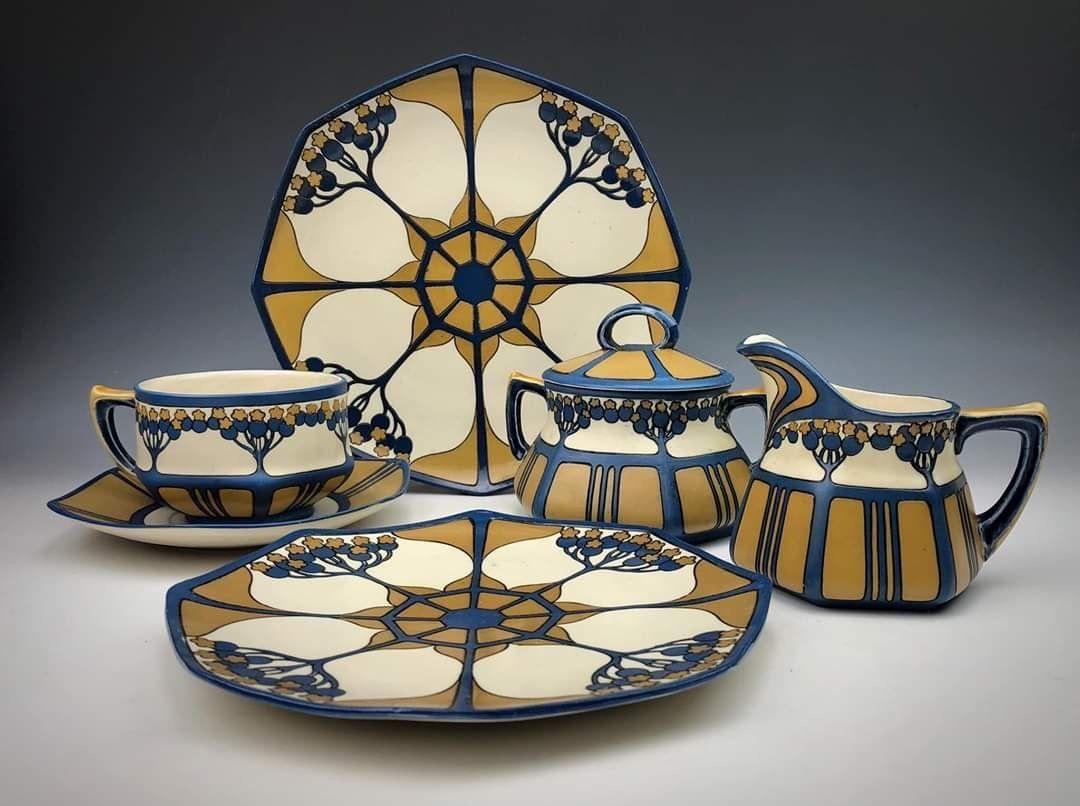
Villeroy & Boch at a Glance
| Feature | Collector Reference |
|---|---|
| Origins | 1748 |
| Founder of the Boch ceramic enterprise | François Boch |
| Septfontaines factory | 1766 |
| Mettlach production centre | Established by Jean-François Boch in 1809 |
| Villeroy & Boch partnership | 1836 |
| Important historic centres | Septfontaines, Wallerfangen, Mettlach, Dresden and other later works |
| Historic materials | Earthenware, stoneware, porcelain and specialised ceramic bodies |
| Important collector categories | Tableware, Mettlach stoneware, beer steins, vases, plaques, tiles and decorative ceramics |
| Key identification evidence | Mark, material, factory, form, decoration, numbers, condition and period |
Is Villeroy & Boch Porcelain?
One of the first misconceptions collectors encounter is the assumption that every old Villeroy & Boch object is porcelain.
It is not.
Over its long history, Villeroy & Boch manufactured objects in several ceramic materials. Depending on the factory, period and intended use, an object may be made from earthenware, stoneware, porcelain or another specialised ceramic body.
This distinction matters because material is one of the first clues used when identifying an old ceramic object. Calling a Mettlach stoneware vessel “porcelain,” for example, can immediately send the research in the wrong direction.
Collectors unfamiliar with the differences between ceramic bodies may also find our guide to
antique porcelain and historic ceramic materials
useful before attempting attribution.
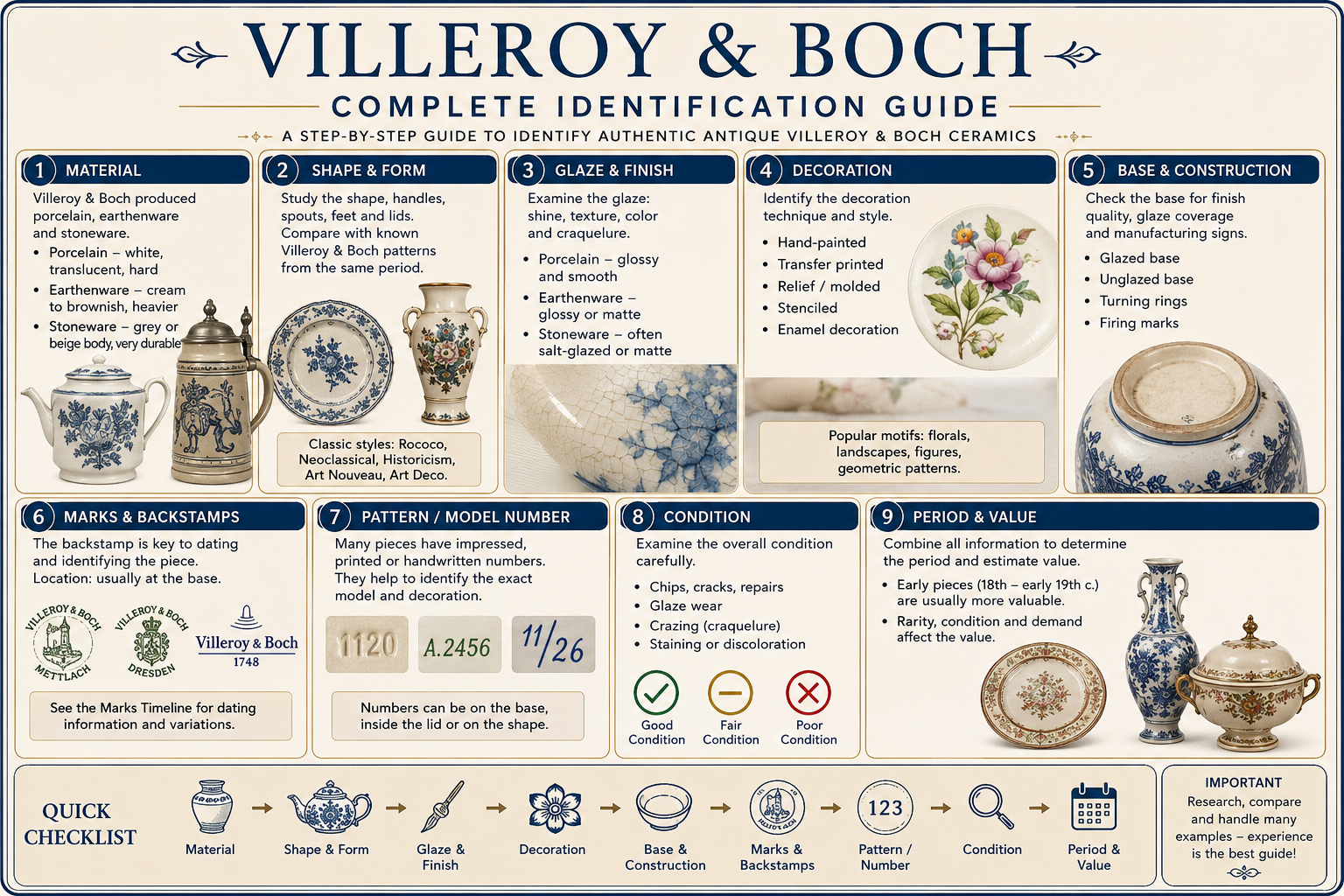
The Origins of Villeroy & Boch
The history begins in 1748, when François Boch and his sons began manufacturing ceramic tableware in Lorraine. What started as a family ceramic enterprise would eventually develop into one of Europe’s best-known ceramic manufacturers.
A major step followed in 1766, when Pierre-Joseph Boch established a factory at Septfontaines in Luxembourg. The new operation represented an important transition toward larger-scale production.
Meanwhile, another ceramic enterprise was developing under Nicolas Villeroy. The two families would eventually combine their interests, creating the name that collectors recognise today.
1809 – Mettlach Becomes Central to the Story
In 1809, Jean-François Boch established production at the former Benedictine abbey at Mettlach on the Saar.
Mettlach would become one of the most important names in the history of Villeroy & Boch and today remains particularly significant to collectors of nineteenth- and early twentieth-century ceramics.
1836 – Villeroy and Boch Join Forces
The decisive moment came in 1836, when the Boch and Villeroy enterprises joined forces.
The resulting company could draw upon established manufacturing knowledge, different production centres, commercial networks and generations of ceramic experience.
During the nineteenth century, Villeroy & Boch expanded dramatically, developing large-scale production while simultaneously creating highly decorative objects that today occupy a very different position in the collectors’ market from ordinary utilitarian ware.
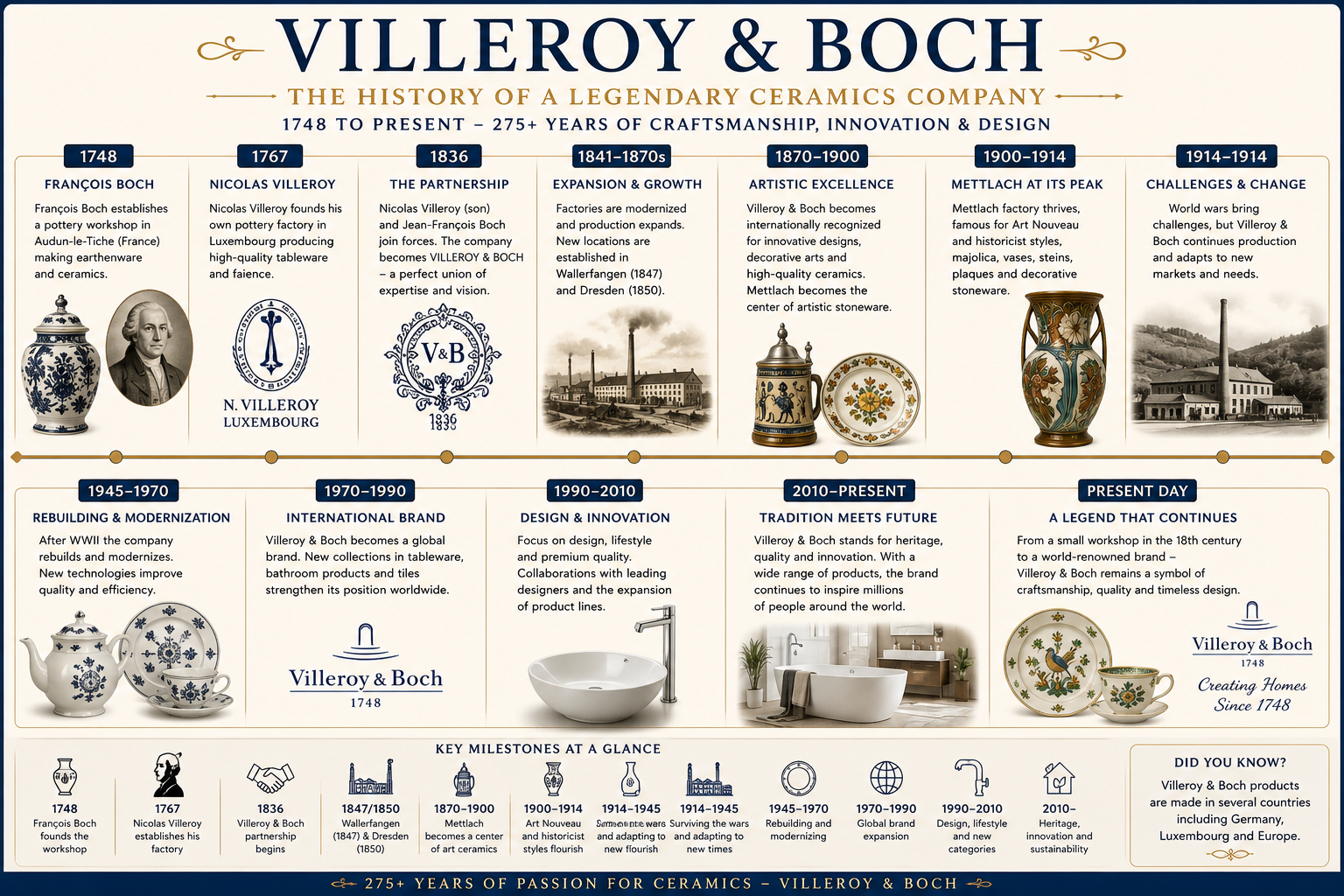
Villeroy & Boch Historical Timeline
| Period | Development | Why It Matters to Collectors |
|---|---|---|
| 1748 | François Boch begins ceramic production with his sons | Origin of the Boch ceramic tradition |
| 1766 | Septfontaines factory established | Important early production centre |
| 1790s | Nicolas Villeroy develops his ceramic enterprise at Wallerfangen | Beginning of the Villeroy side of the later partnership |
| 1809 | Jean-François Boch establishes production at Mettlach | Mettlach later becomes crucial to collectors |
| 1836 | Villeroy and Boch join forces | Formation of Villeroy & Boch |
| 19th century | Rapid industrial and artistic expansion | Numerous forms, decorations and factory marks appear |
| Late 19th–early 20th century | Major decorative and architectural ceramic production | Important period for collectible Mettlach and historicist ceramics |
| 20th century | Changing industrial production and modern design | Marks and product ranges continue to evolve |
Mettlach: The Name Every Villeroy & Boch Collector Should Know
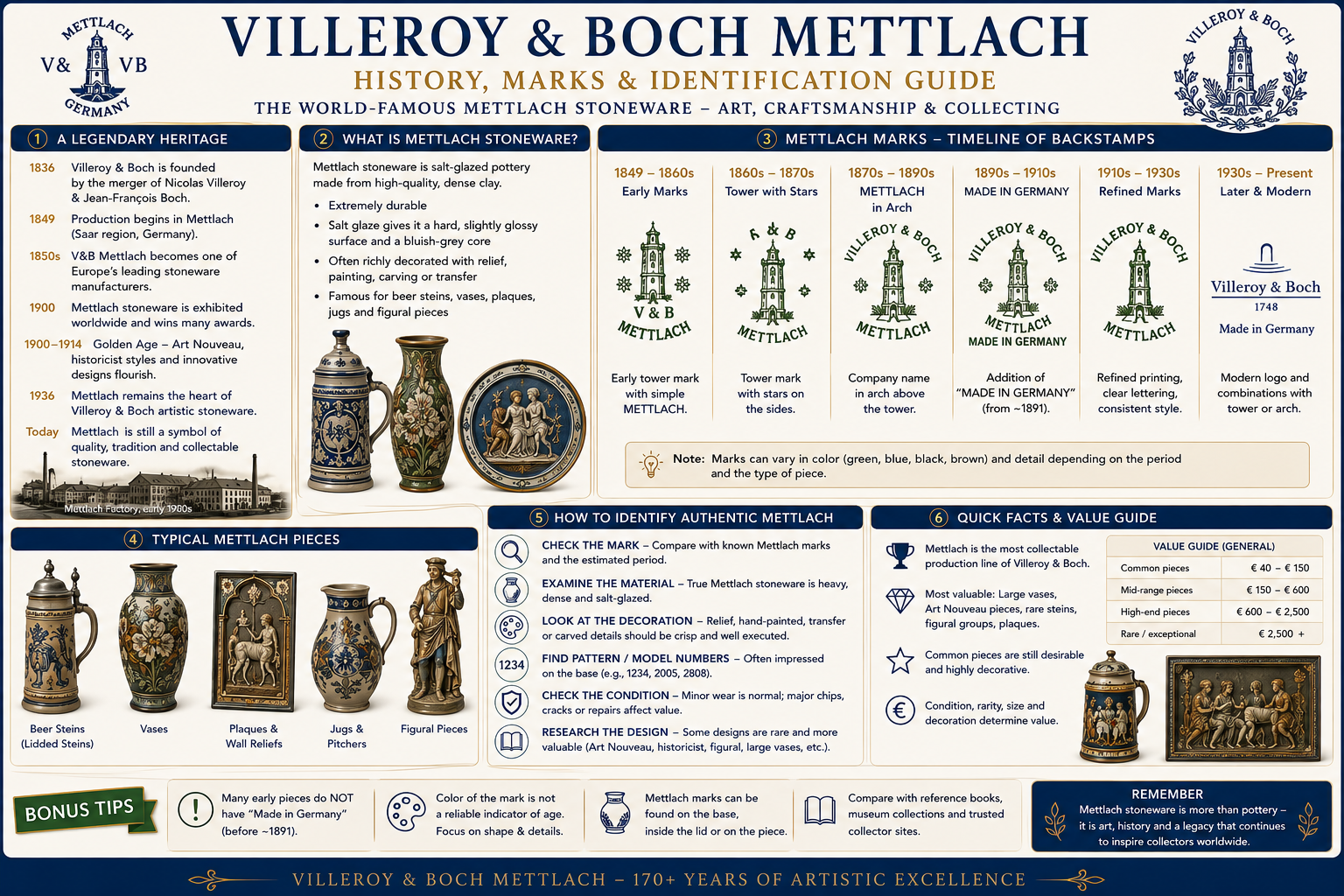
For many collectors, Villeroy & Boch Mettlach represents the most fascinating part of the company’s historic production.
Mettlach became internationally associated with sophisticated stoneware and decorative ceramics, including vessels, jugs, beer steins, plaques, vases and other richly ornamented objects.
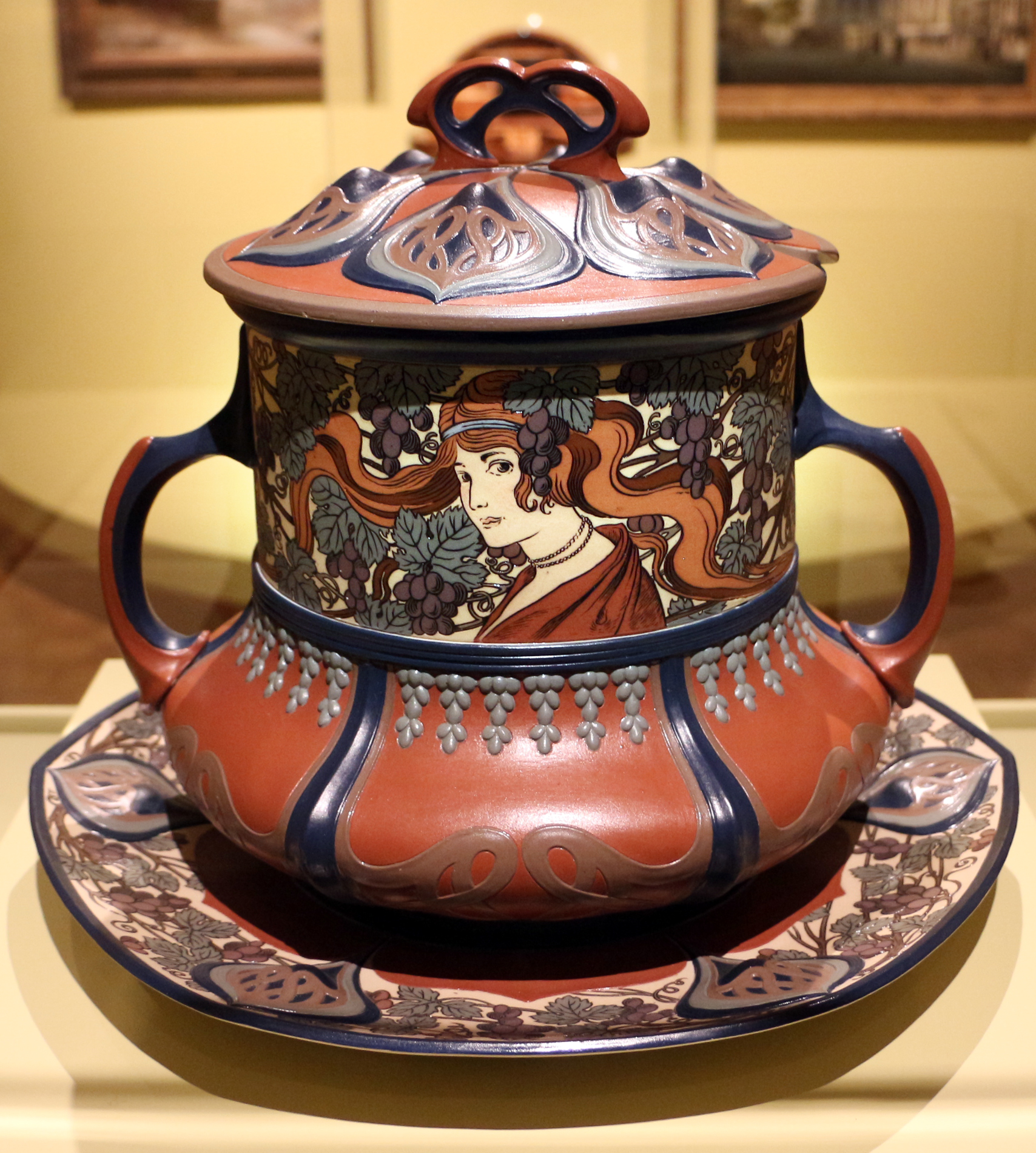
The best Mettlach pieces can display remarkably complex decoration: relief work, incised designs, coloured grounds, historical subjects, heraldic imagery, architectural scenes and elaborate ornamental borders.
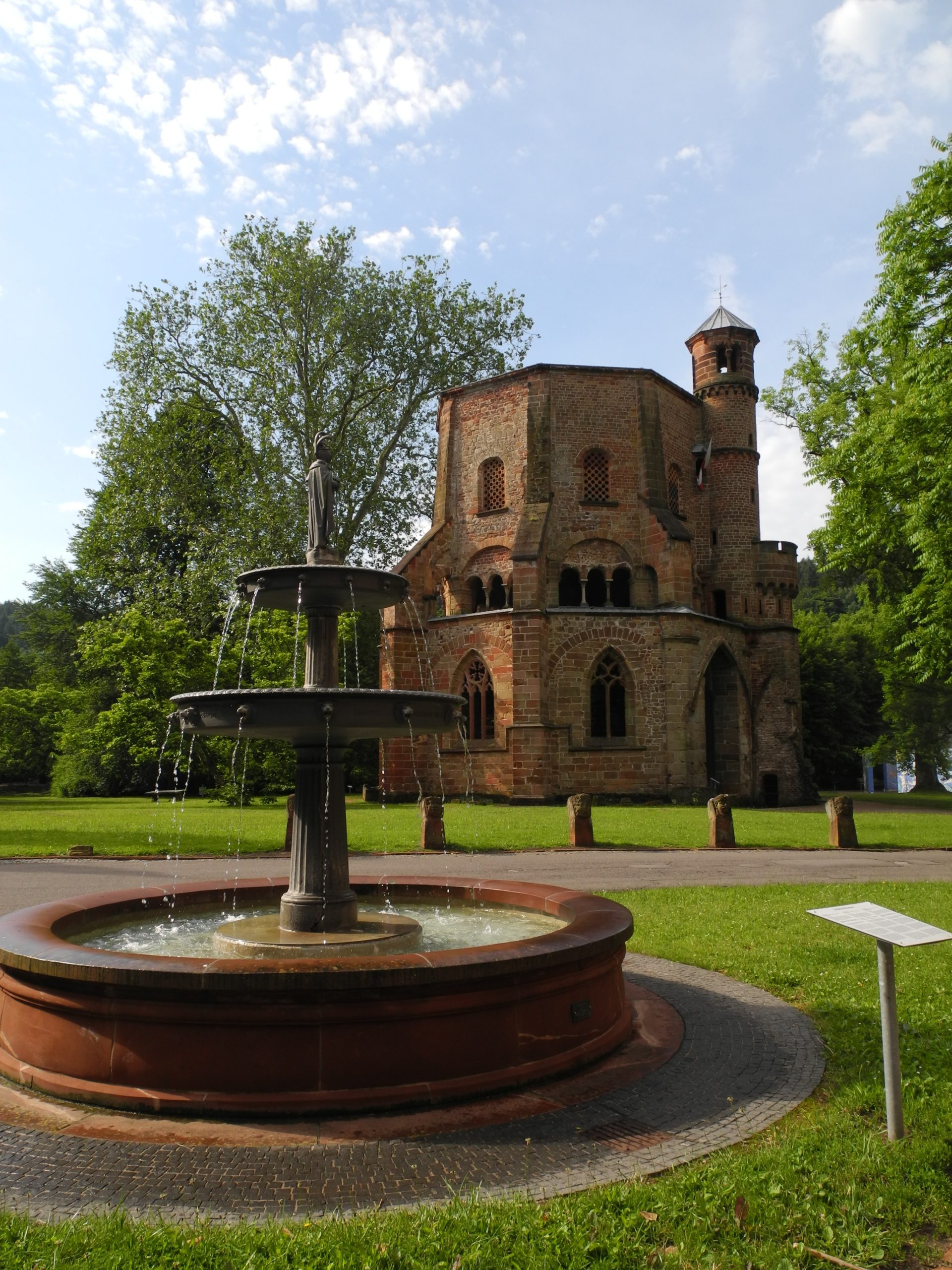
Why Mettlach Became Famous
Mettlach production benefited from the combination of industrial organisation and ambitious decorative design. The factory was capable of producing useful household ceramics on a large scale while also creating technically sophisticated pieces aimed at more demanding markets.
Today, the word Mettlach is especially important when researching antique Villeroy & Boch because it may connect an object with particular materials, forms, marks and production traditions.
What Did Villeroy & Boch Mettlach Produce?
Historic Mettlach production was remarkably varied. Surviving objects include both practical wares and elaborate decorative ceramics.
| Object Type | Typical Collector Interest |
|---|---|
| Beer steins | Highly recognised Mettlach collecting category, especially decorated and relief examples |
| Vases | Collected for form, glaze, decoration and historicist or artistic design |
| Jugs and pitchers | Range from utilitarian forms to elaborate decorative examples |
| Plaques | Often valued for pictorial or relief decoration |
| Tableware | Patterns, marks and completeness strongly affect interest |
| Tiles | Important part of Villeroy & Boch’s architectural ceramic tradition |
| Decorative vessels | Unusual shapes and elaborate decoration can be particularly collectible |
Villeroy & Boch Materials: Porcelain, Earthenware and Stoneware
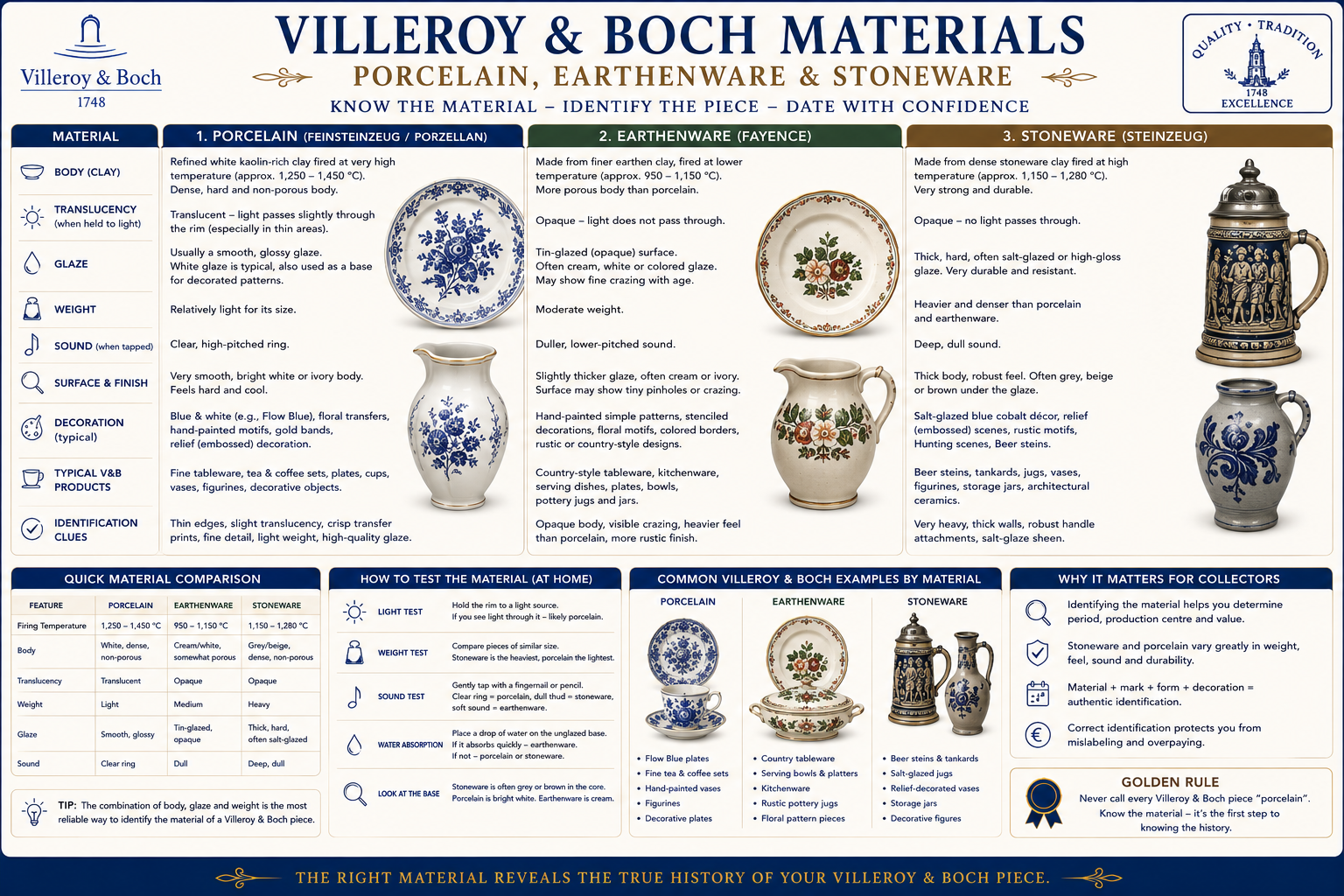
Correct material identification is fundamental. Villeroy & Boch’s long history cannot be understood through porcelain alone.
Three terms are particularly important to collectors:
| Material | Typical Characteristics | Collector Clues |
|---|---|---|
| Porcelain | Fine, highly vitrified ceramic body; some bodies show translucency | Examine body colour, thinness, glaze and transmitted light |
| Earthenware | Generally more porous body, usually covered by glaze | Often heavier-looking and opaque compared with fine porcelain |
| Stoneware | Dense, strong, vitrified ceramic body | Especially important in historic Mettlach production |
The distinction should be made by examining the actual ceramic body rather than relying on an online listing or seller’s description.
Historic Villeroy & Boch Craftsmanship
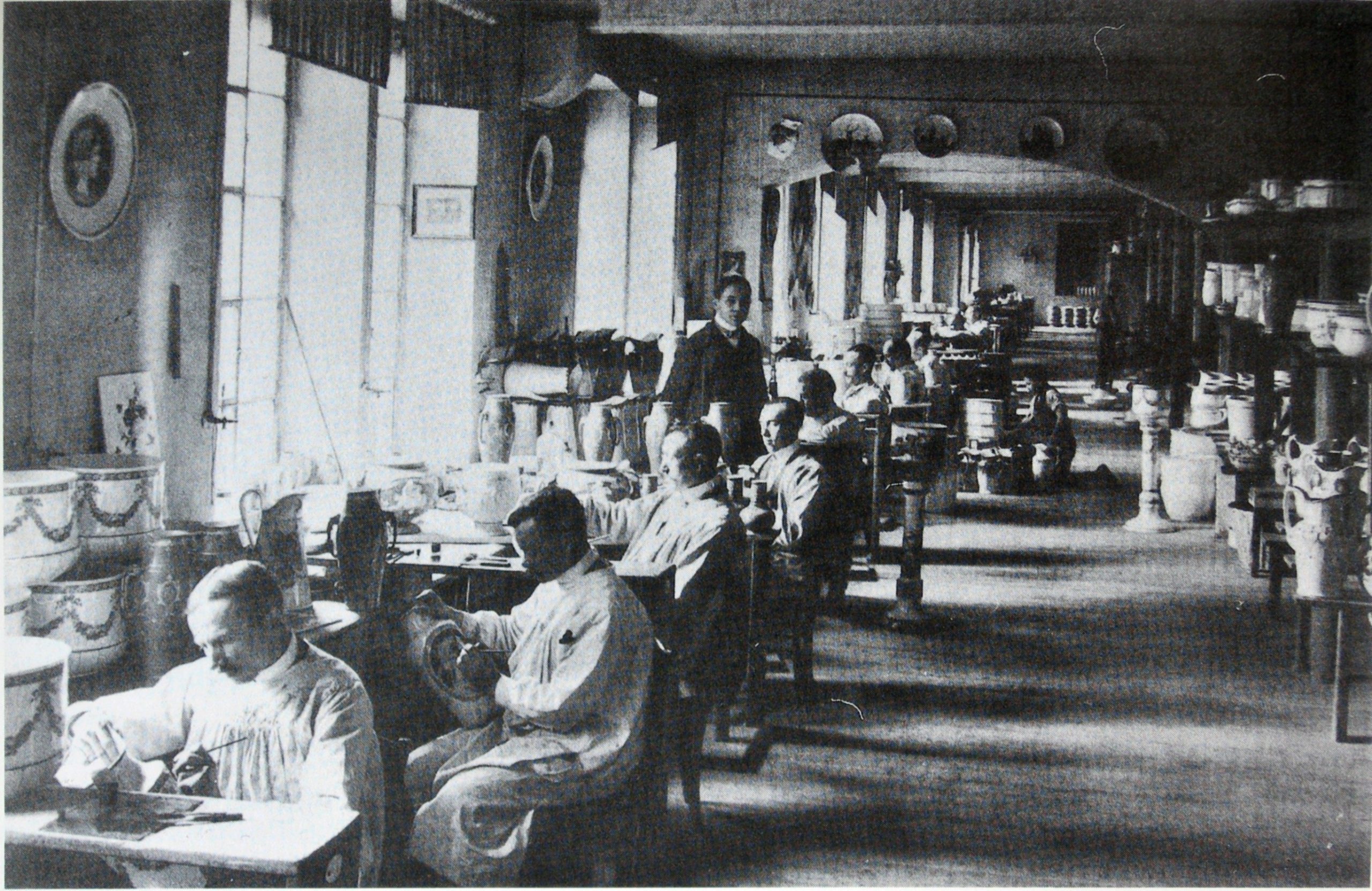
Understanding how ceramics were produced also helps collectors recognise the difference between routine factory production and more ambitious decorative work.
Painters, modellers, designers, kiln workers and other specialists contributed to the finished object. Decoration could involve transfer printing, painting, gilding, relief, incised ornament and combinations of several techniques.
How to Identify Villeroy & Boch Marks
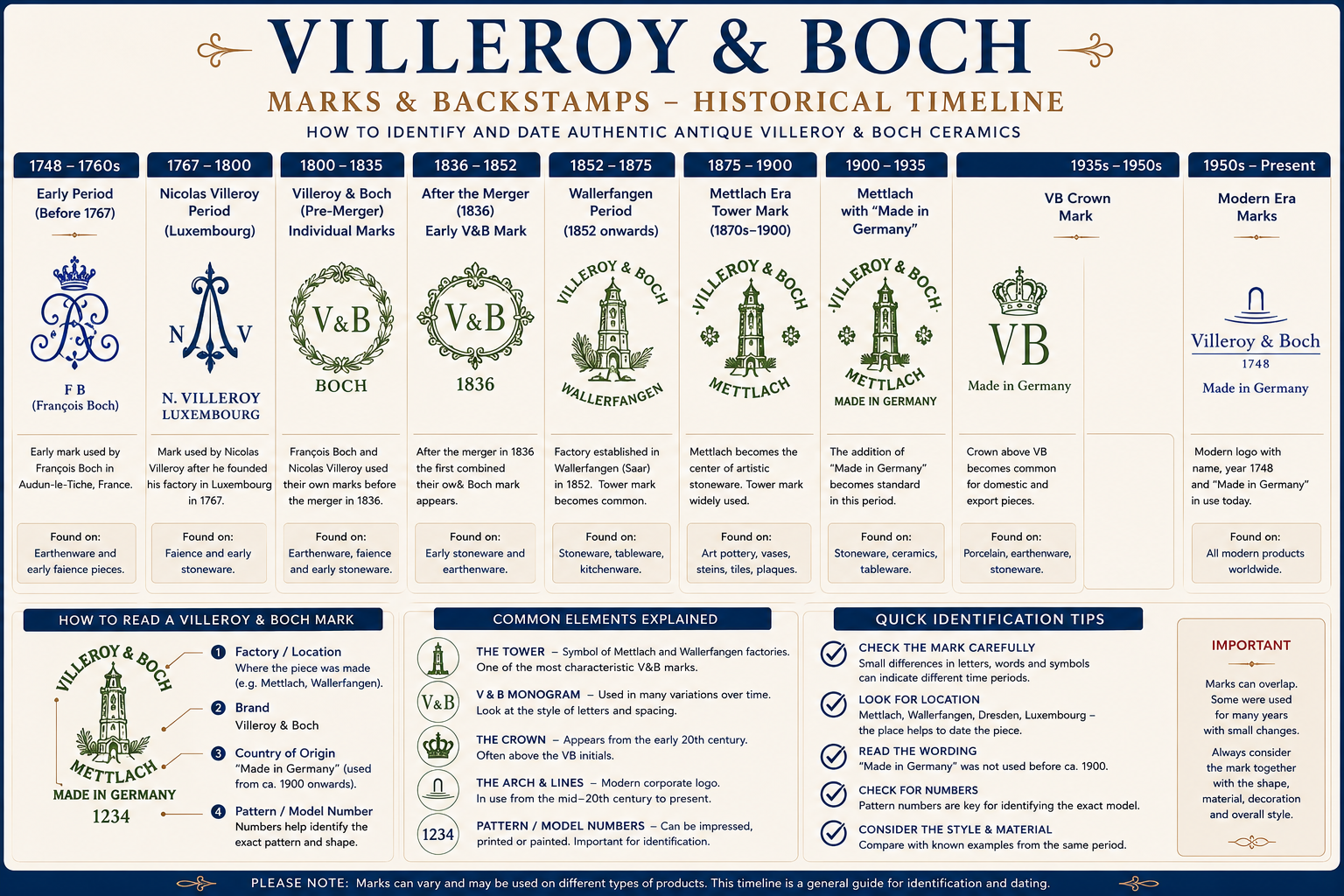
Turn the object over and inspect the base carefully. A Villeroy & Boch mark may provide clues about the manufacturer, factory, product line and approximate production period.
But the most important rule is simple:
A mark is evidence, not proof by itself.
Marks can be copied, misunderstood or assigned overly precise dates. Correct identification therefore compares the backstamp with the ceramic body, glaze, shape, decoration, production method and natural wear.
For a broader explanation of this process, see our
guide to identifying porcelain marks and backstamps.
What Should You Look for in a Villeroy & Boch Backstamp?
Record everything you can see rather than searching only for the company name.
- Villeroy & Boch name or monogram
- factory or place name
- Mettlach or other location references
- country-of-origin wording
- printed or impressed numbers
- pattern references
- shape or mould numbers
- decorator or production marks
- colour and application technique of the mark
- relationship between the mark and the glaze
Even small differences can matter. Typography, wording, symbols and manufacturing technique may change between periods.
Can a Villeroy & Boch Mark Tell You the Exact Date?
Sometimes a mark can narrow the period considerably, but it should not automatically be interpreted as an exact manufacturing date.
Numbers are particularly easy to misunderstand. Depending on the object, they may refer to a shape, model, pattern, decoration, production series or internal factory reference rather than a year.
This is why reliable dating combines several forms of evidence. Our separate guide on
how to date antique porcelain
explains this multi-factor method in greater detail.
Factory Location Can Be an Important Identification Clue
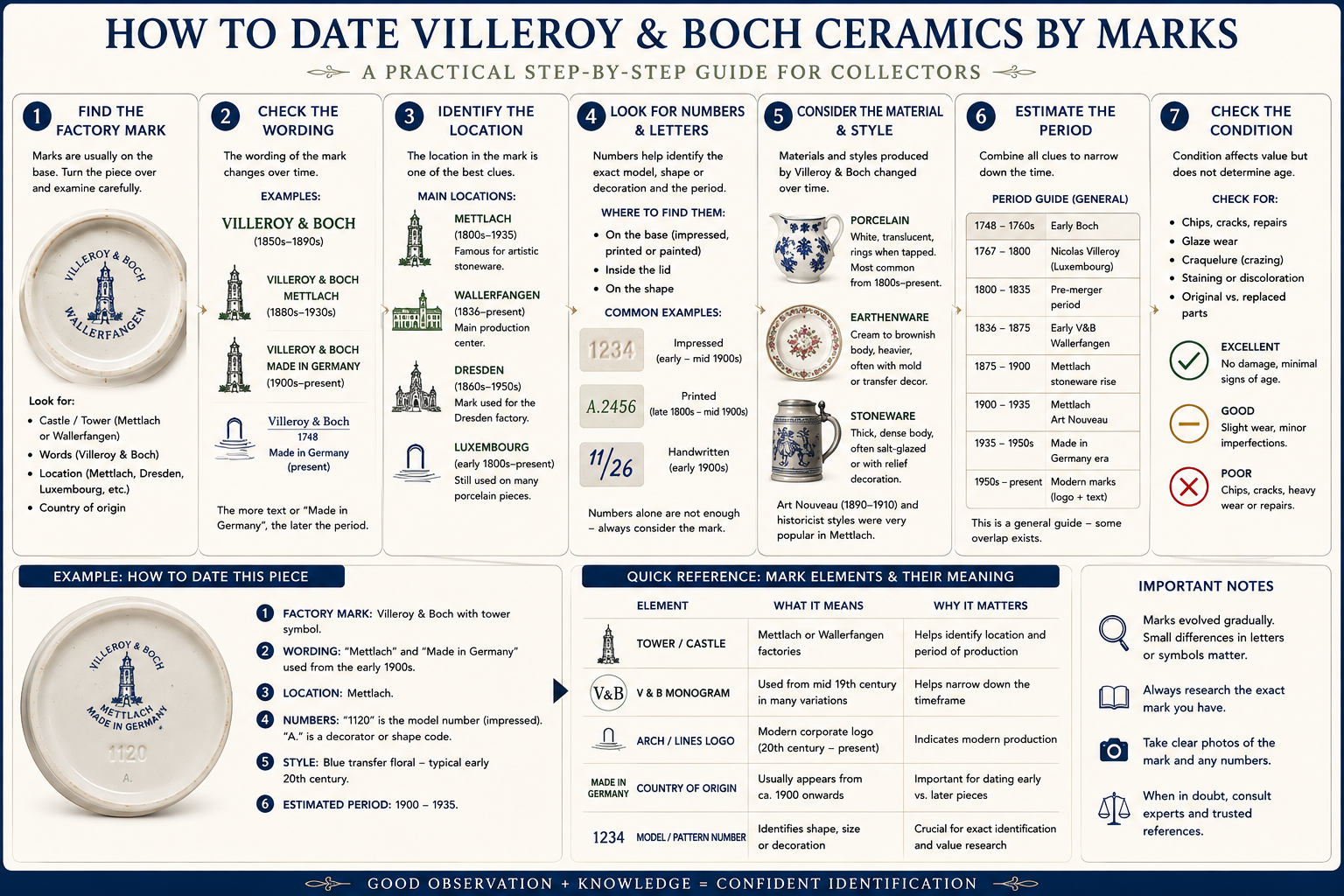
Villeroy & Boch developed through a network of production centres rather than a single uninterrupted factory tradition.
Among the historically important locations are Septfontaines, Wallerfangen, Mettlach and Dresden. Different works developed particular production strengths, and these distinctions can help collectors understand an object’s likely origin.
The Dresden operation is a good example of why historical research matters. Archival records document a broad production programme that included tableware and decorative objects as well as tiles, stoves and other ceramic products.
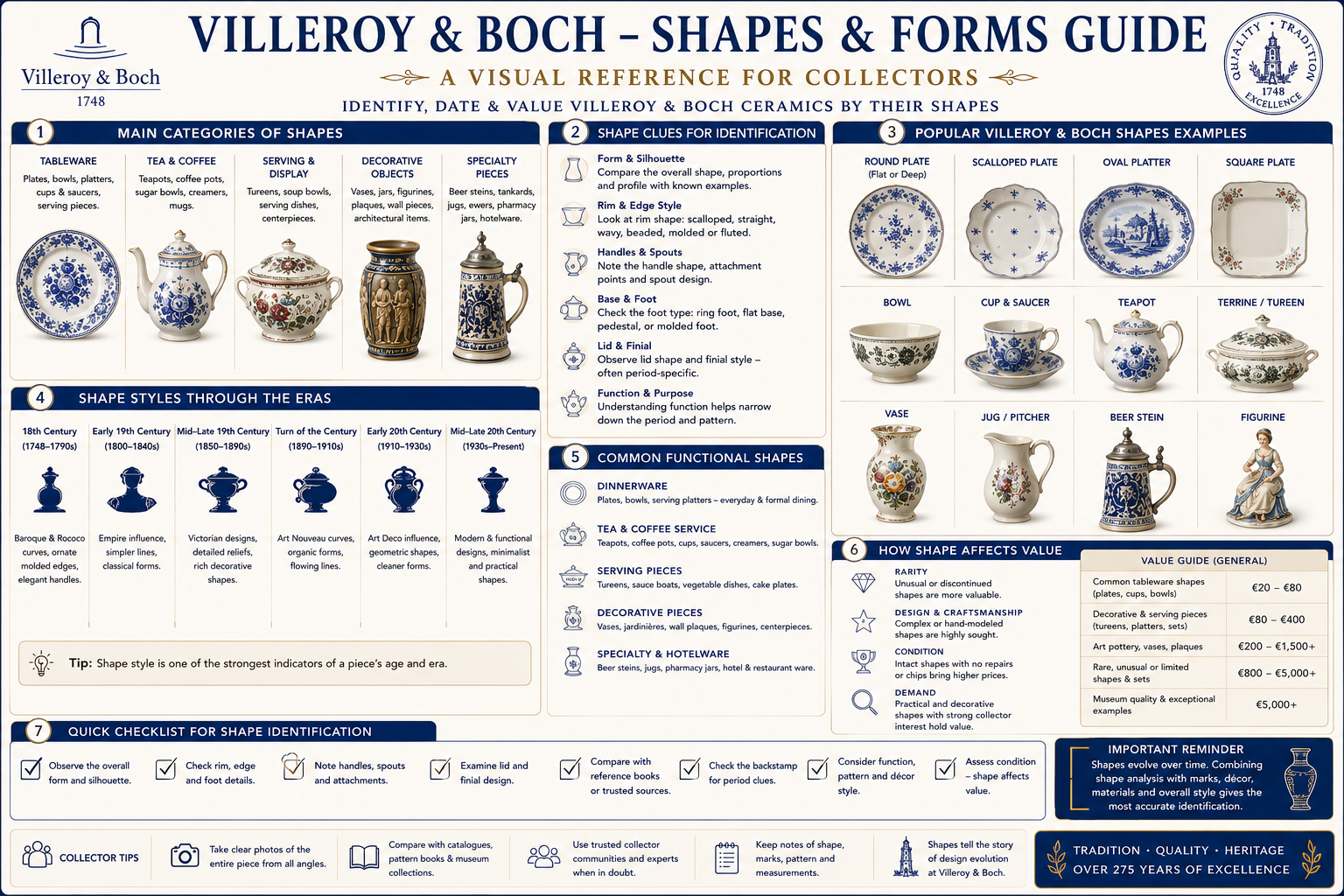
Why Shape Matters
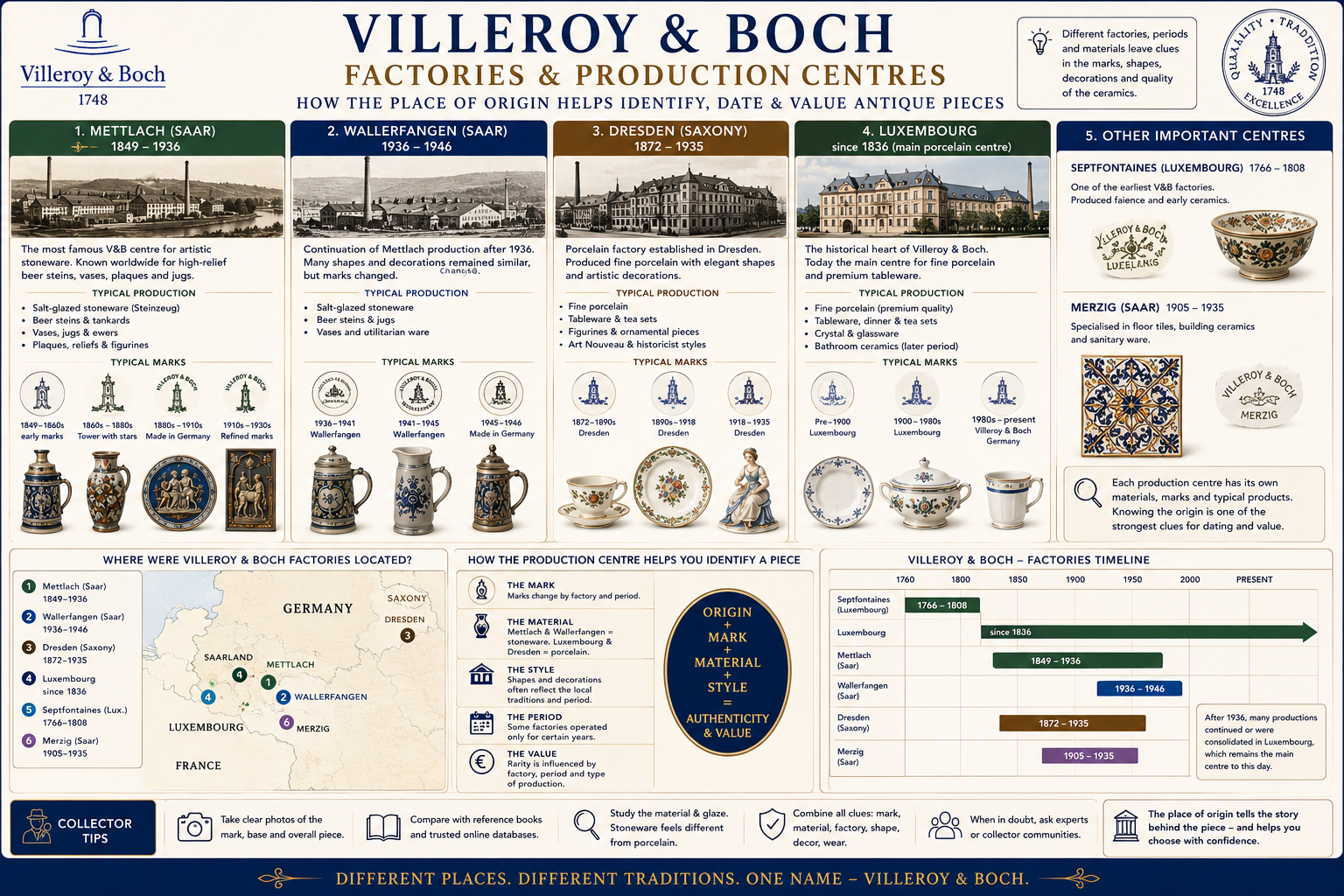
Collectors often concentrate so heavily on the backstamp that they overlook the object itself.
Shape can be extremely informative.
Examine the silhouette, proportions, handles, spouts, feet, rims, lids and finials. Compare these characteristics with documented examples from the same factory and period.
A mark suggesting an early period combined with a clearly later shape should encourage further investigation rather than immediate attribution.
Decoration: Another Key to Identification
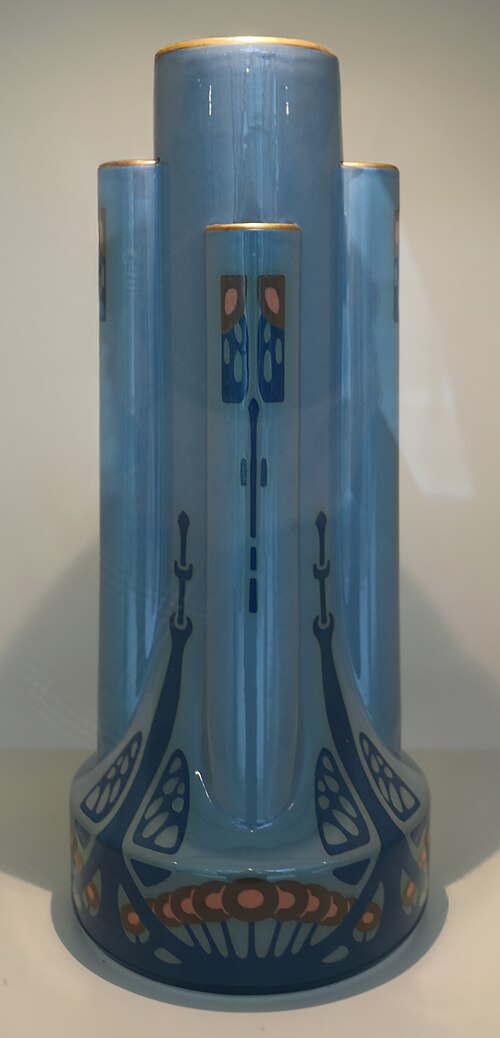
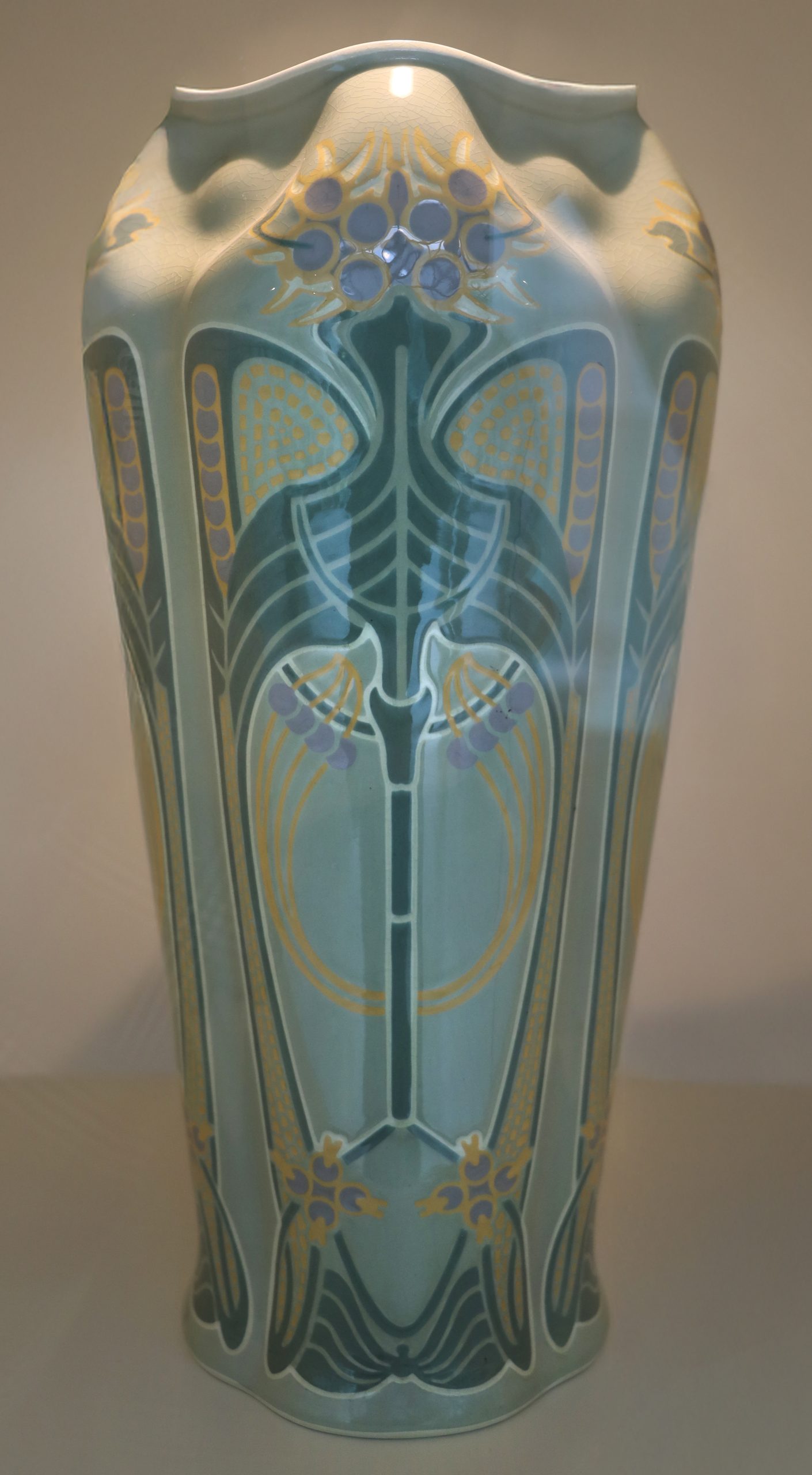
Decoration can help connect an object with a period, production centre or product family.
Historic Villeroy & Boch ceramics appear with an enormous range of decorative approaches, including floral designs, geometric ornament, transfer-printed scenes, relief decoration, gilding, coloured grounds, historicist imagery and architectural motifs.
Look closely at how the decoration was applied. Hand painting, transfer printing, underglaze decoration, relief and gilding leave different physical evidence.
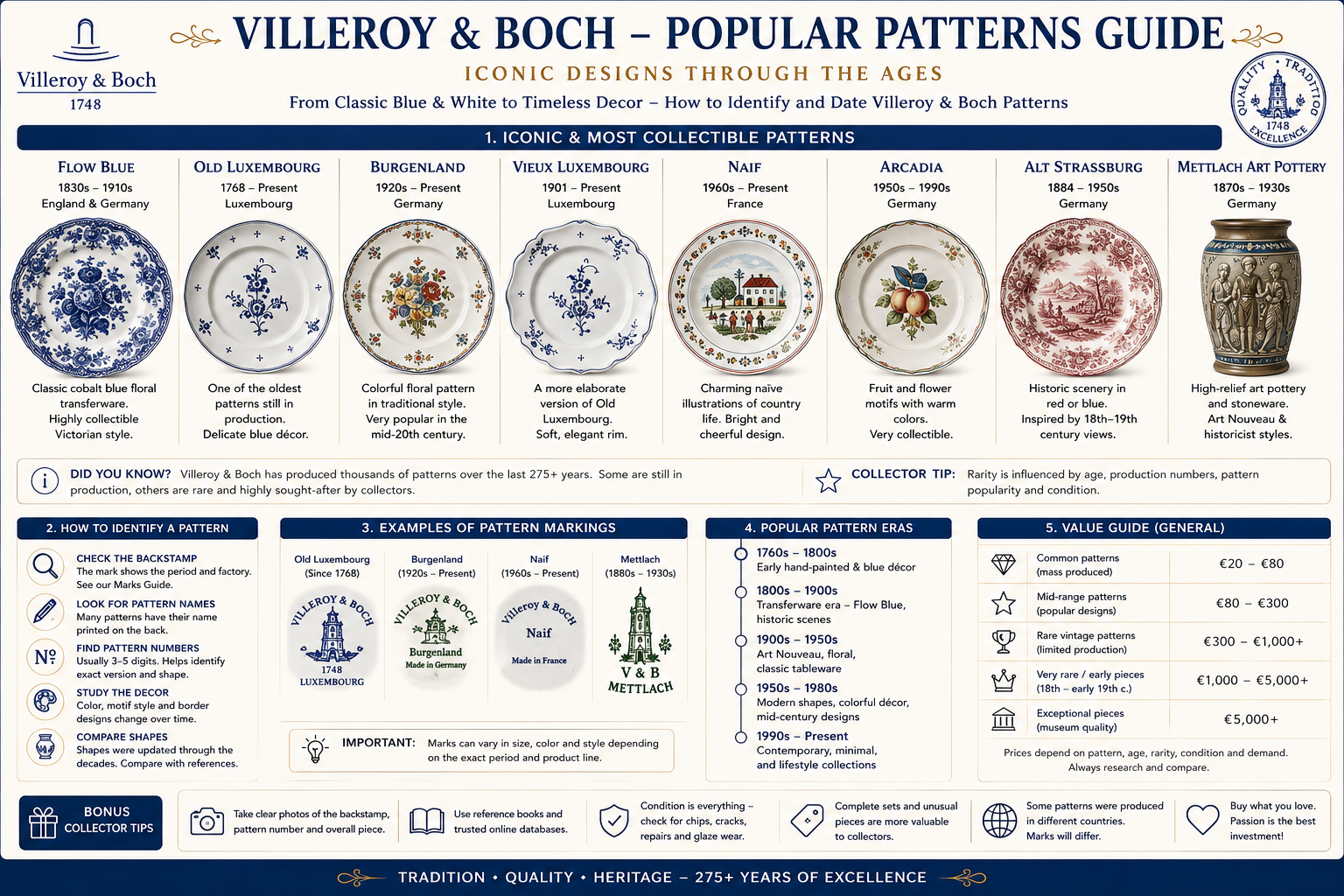
Patterns and Sample Pieces
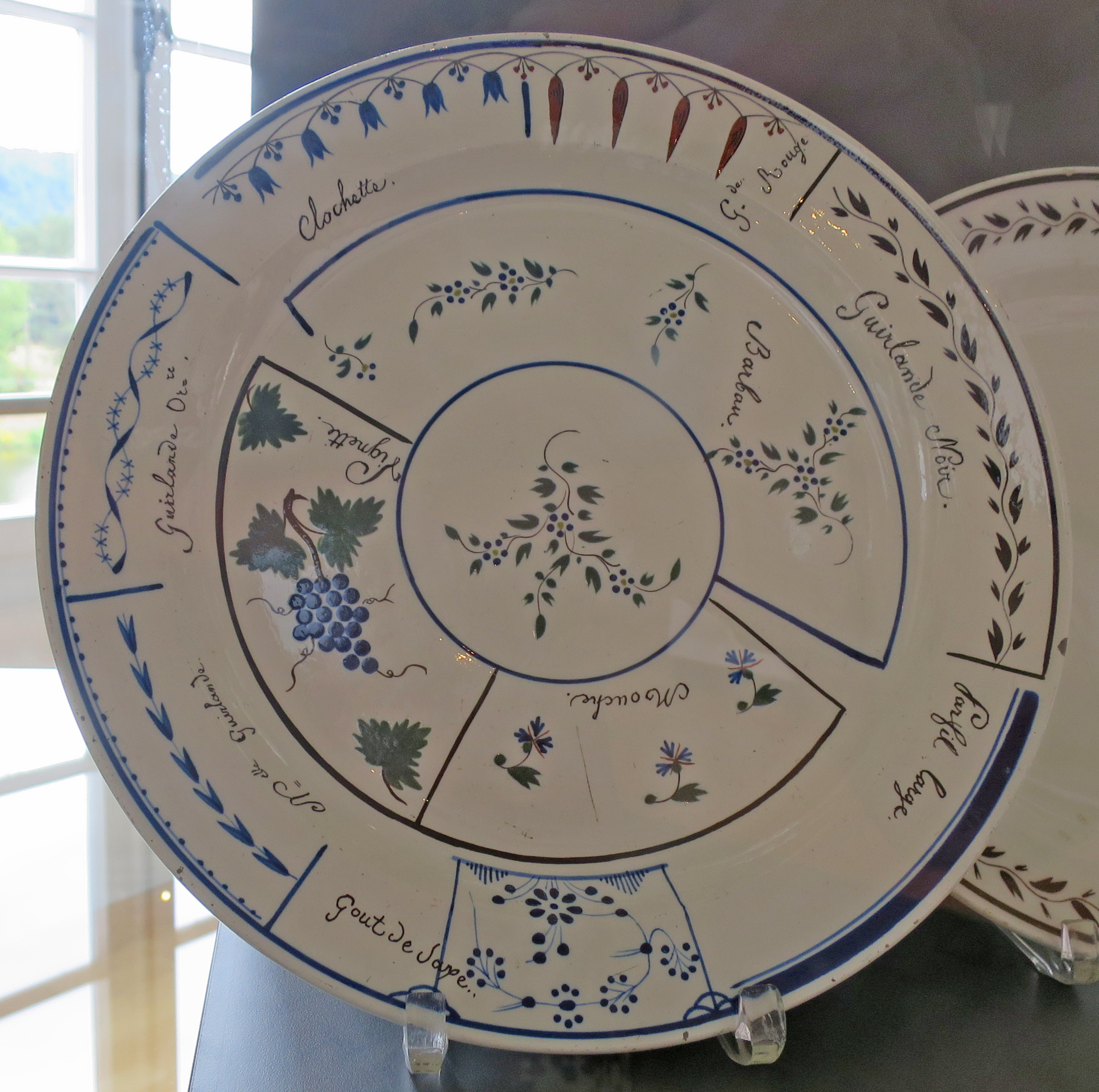
Patterns can provide another route into identification. Surviving sample pieces are particularly interesting because they document how factories presented or organised decorative options.
Villeroy & Boch Beyond Tableware
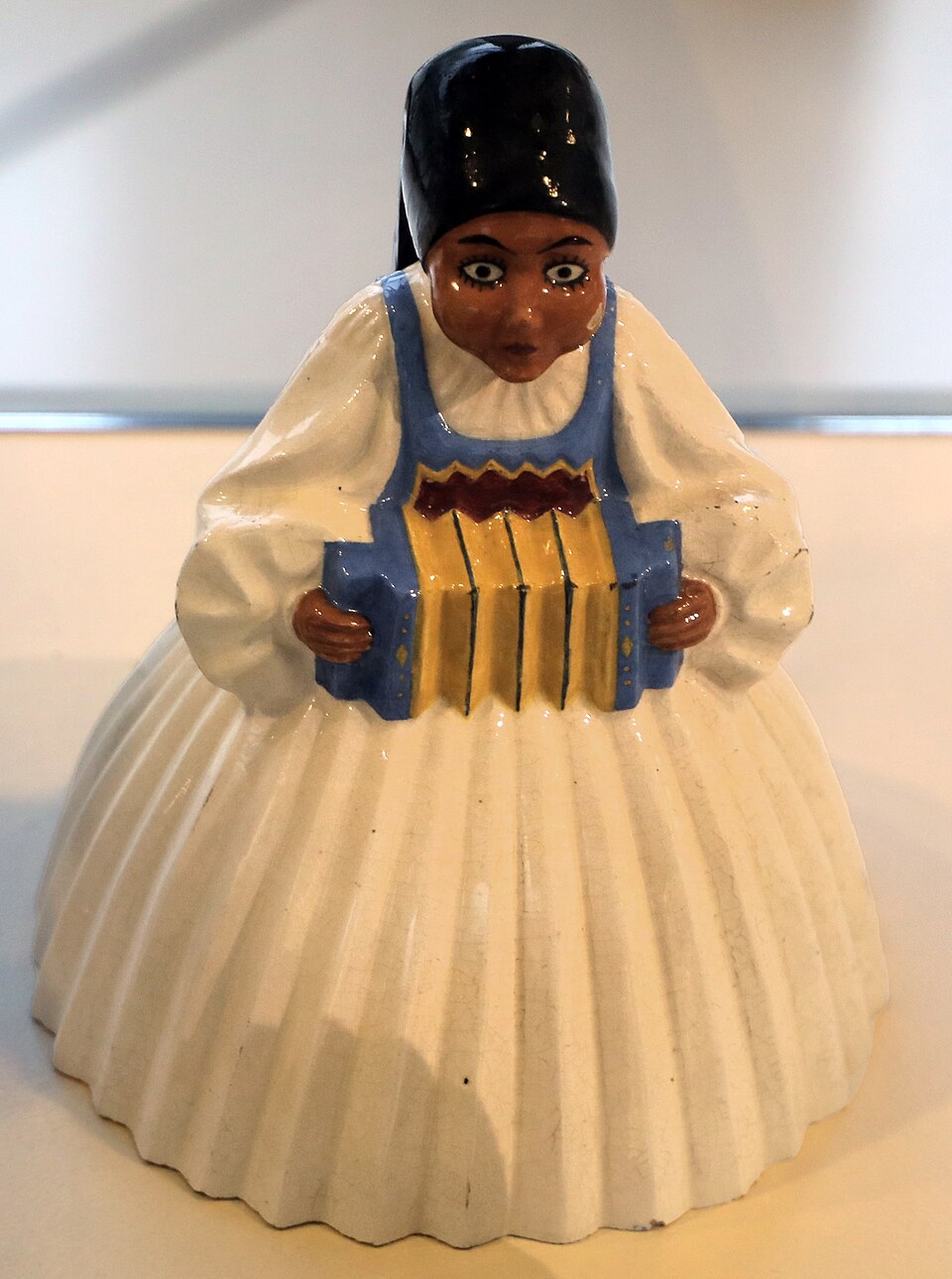
Another common mistake is thinking of Villeroy & Boch only in terms of dinner services, cups and plates.
The company’s historical production extended far beyond tableware. Architectural and decorative ceramics became an important part of its identity, particularly during the period of rapid industrial expansion.
Antique vs Vintage Villeroy & Boch
Not every collectible Villeroy & Boch piece is an antique.
As a practical collecting convention, objects more than approximately one hundred years old are generally described as antique, while younger twentieth-century pieces are often described as vintage. The distinction is useful, but age alone does not determine desirability or value.
| Category | General Meaning | Collector Perspective |
|---|---|---|
| Antique | Generally around 100 years old or more | Historical production, rarity and condition become especially important |
| Vintage | Later collectible production, commonly twentieth century | Design, discontinued patterns and nostalgia may drive demand |
| Modern | Recent or current production | Should not be represented as antique merely because the company is historic |
How to Begin Identifying an Unknown Villeroy & Boch Piece
If you have found an unfamiliar Villeroy & Boch vase, plate, cup, stein or decorative object, resist the temptation to date it from the logo alone.
Instead, follow a structured sequence:
- Photograph the entire object.
- Photograph the base and every mark.
- Determine the ceramic material.
- Record factory or place names.
- Study the shape and construction.
- Examine the decoration technique.
- Record every number and letter.
- Inspect natural wear and condition.
- Compare all evidence with documented examples from the proposed period.
The same principle applies to porcelain more broadly. Our
complete guide to identifying antique porcelain
explains why marks, body, glaze, decoration and natural ageing should always be considered together.
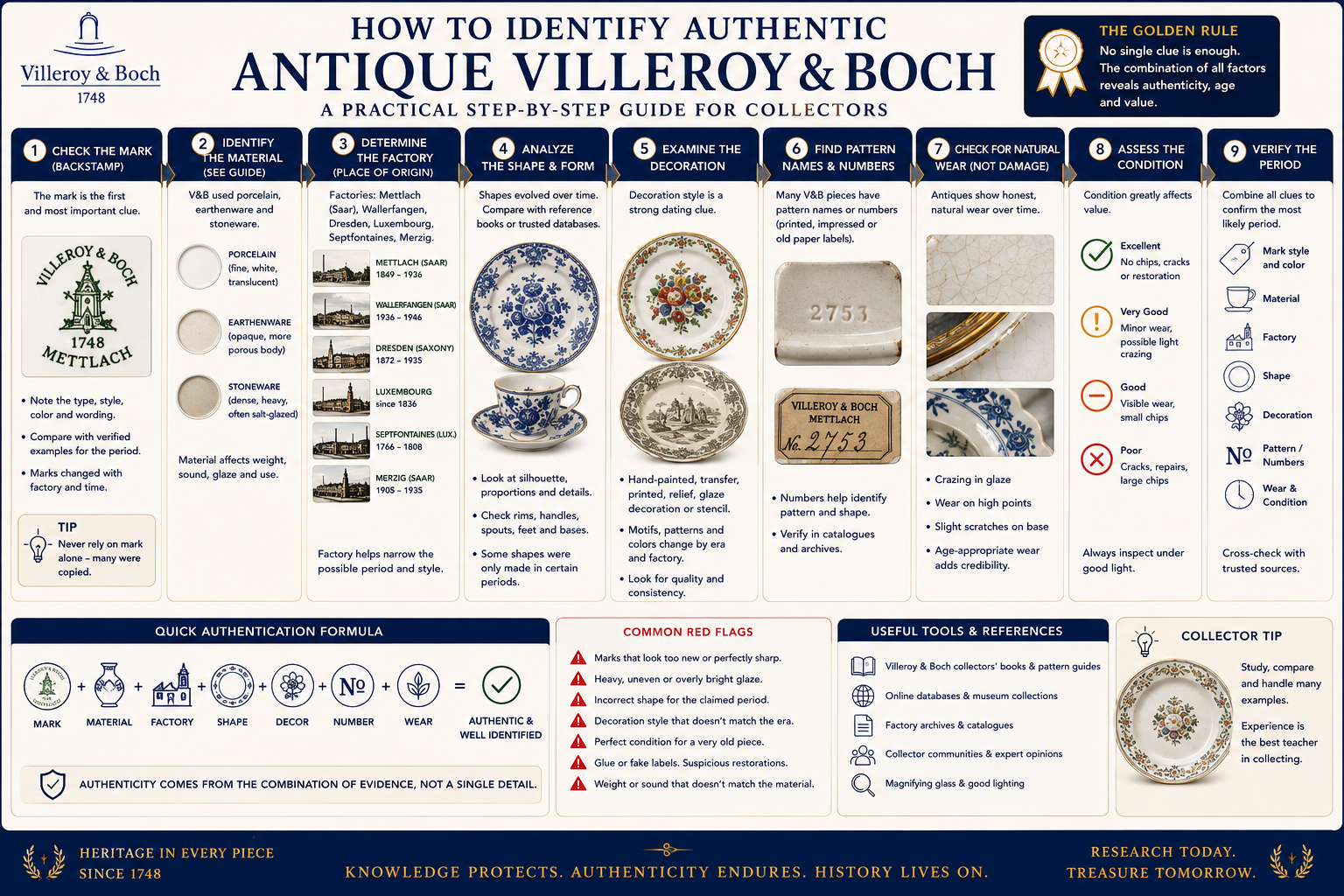
How to Identify Authentic Antique Villeroy & Boch
Authenticating an antique Villeroy & Boch object should never depend on a single mark, number or decorative feature. The safest approach is to examine the object as a whole and determine whether its mark, material, factory attribution, shape, decoration, manufacturing technique and natural ageing are historically consistent with one another.
This is particularly important with Villeroy & Boch because the company has been producing ceramics for generations. A genuine Villeroy & Boch mark proves little about age unless the rest of the object supports the same period.
Collectors researching an unfamiliar piece should therefore work through the evidence systematically.
| Feature | What to Examine | Possible Warning Sign |
|---|---|---|
| Mark | Design, wording, typography, colour, placement and application method | A mark inconsistent with the claimed period |
| Material | Porcelain, earthenware, stoneware or another ceramic body | Material inconsistent with the attributed factory or object type |
| Factory | Place names and documented production history | Factory attribution incompatible with the supposed date |
| Shape | Profile, handles, feet, rims, spouts, lids and proportions | A clearly later form carrying an allegedly early mark |
| Decoration | Painting, transfer printing, relief, gilding and glaze | Technique or style inconsistent with the proposed period |
| Numbers | Model, pattern, shape and decoration references | Assuming every number represents a date |
| Wear | Base wear, gilding loss, scratches and ageing | Artificially uniform or implausible ageing |
| Condition | Chips, cracks, restoration, repainting and replacements | Repairs concealed beneath later decoration |
Step 1: Examine the Mark or Backstamp
Begin with the underside of the object. Photograph the entire base in good natural light and then make detailed photographs of every printed, painted, impressed or incised marking.
Do not record only the words Villeroy & Boch. Factory names, symbols, numbers and country-of-origin wording may all provide additional clues.
Useful details include:
- company name or initials;
- factory or place name;
- printed symbols;
- impressed marks;
- country-of-origin wording;
- model or pattern numbers;
- decoration numbers;
- letters or production codes;
- colour of the backstamp;
- whether the mark is under or over the glaze.
For collectors unfamiliar with factory markings, our
complete guide to porcelain marks and makers’ marks
explains how backstamps should be interpreted together with the object itself.
Step 2: Identify the Ceramic Material
Next determine what the object is actually made from.
This is one of the most important stages because historic Villeroy & Boch production was not limited to porcelain. The company became particularly important for sophisticated earthenware and stoneware production as well as later porcelain.
Examine:
- the colour of the ceramic body;
- the exposed foot rim;
- thickness;
- weight;
- translucency;
- surface texture;
- glaze;
- sound when very gently tapped.
Never perform aggressive tests on valuable ceramics. Visual examination under good light is normally far safer than scratching, scraping or chemically testing an object.
Step 3: Determine the Likely Factory
Factory attribution can dramatically narrow the research.
Mettlach is particularly important, but Villeroy & Boch’s history involves several production centres. Place names appearing on a base should therefore be researched rather than treated as decorative wording.
A factory attribution can help establish which materials, shapes and production techniques are plausible for a particular object.
Step 4: Study the Shape
Shape is sometimes more revealing than collectors expect.
Compare the object’s silhouette and construction with securely documented examples. Look carefully at handles, feet, spouts, rims, lids and finials.
Manufacturing fashions changed. An object whose form is inconsistent with the supposed period deserves closer examination even if its mark initially appears convincing.
Step 5: Examine the Decoration
Decoration should be studied both artistically and technically.
Ask whether the design is:
- hand painted;
- transfer printed;
- stencilled;
- incised;
- moulded in relief;
- decorated under the glaze;
- decorated over the glaze;
- finished with gilding or metallic decoration.
The quality of execution also matters. Fine historic factory production generally displays intentional composition and competent finishing, although variations naturally occur between product grades and periods.
Step 6: Record Every Number
Numbers found on old ceramics are useful, but they are also among the most frequently misinterpreted clues.
A number may identify a shape, mould, pattern, decoration or internal production reference. It should not automatically be read as a year.
Photograph impressed numbers from different angles because shallow impressions can disappear under direct frontal lighting.
Step 7: Look for Natural Ageing
An object that has survived for many decades usually carries evidence of use and handling, although the amount varies enormously depending on how it was stored.
Potentially natural signs include:
- wear beneath the foot;
- minor surface scratches;
- softening of exposed gilding;
- small contact marks;
- age-related glaze changes;
- wear concentrated on projecting areas.
Ageing should make physical sense. Heavy wear in protected areas combined with pristine exposed surfaces, for example, deserves investigation.
Patina and Wear Are Not the Same as Damage
Collectors should distinguish natural ageing from actual damage.
A small amount of age-consistent wear may support the historical character of an object. A crack through the body, a missing handle or extensive repainting is a different matter entirely.
Equally, the absence of heavy wear does not prove that an object is modern. Some antiques were carefully stored and rarely used.
Step 8: Assess the Condition
Condition can have a major influence on collector desirability and market value.
Inspect the object under strong but diffused light. Look especially around handles, rims, spouts, feet and finials, where damage frequently occurs.
| Condition Issue | What to Look For | Possible Effect |
|---|---|---|
| Hairline crack | Fine line extending through glaze or body | Can significantly affect value |
| Chip | Missing ceramic at rim, base or projecting detail | Depends on size, visibility and rarity |
| Restoration | Filled cracks, rebuilt sections, repainting | Quality and extent are important |
| Gilding wear | Loss on rims, handles and raised decoration | Minor natural wear may be acceptable |
| Staining | Discolouration within body or crazing | May reduce desirability |
| Replacement parts | Later lid, handle, mount or fitting | Can materially affect originality |
Step 9: Verify the Period
Only after examining all these characteristics should you attempt to assign a production period.
The strongest attribution occurs when several independent clues agree:
mark + material + factory + shape + decoration + numbers + manufacturing technique + ageing = historically consistent attribution.
This multi-factor approach is considerably safer than dating a ceramic object from a single online image of a backstamp.
Can Villeroy & Boch Marks Be Fake?
A recognisable factory mark should never be treated as an automatic guarantee of age or authenticity.
Marks can be copied, reapplied, misunderstood or incorrectly associated with a production period. In other cases, an authentic later Villeroy & Boch object may simply be advertised as much older than it really is.
The question is therefore not merely:
“Is this a Villeroy & Boch mark?”
A better question is:
“Is this mark historically consistent with this particular object?”
Warning Signs When Examining Villeroy & Boch
No single warning sign proves that an object is fake, but several inconsistencies together should encourage caution.
- A backstamp that appears unusually fresh compared with the surrounding base.
- A mark whose wording appears inconsistent with the proposed date.
- A ceramic body incompatible with the attributed product.
- A shape that appears much later than the claimed period.
- Decoration inconsistent with the supposed production era.
- Artificial-looking wear.
- Numbers interpreted as dates without supporting evidence.
- Restoration hidden beneath repainting.
- An exceptionally precise attribution based only on a single mark.
Original, Later Production or Reproduction?
Another important distinction is between a genuine historic object and genuine later production.
Villeroy & Boch has existed for centuries. Therefore, a genuine company mark does not automatically make an object an antique.
A twentieth-century or modern Villeroy & Boch piece can be completely authentic while still being far younger than an eighteenth- or nineteenth-century object.
Understanding the distinction between age and authenticity is essential when collecting ceramics. Our guide to
what qualifies as an antique
provides additional context.
What Makes Antique Villeroy & Boch Valuable?
There is no universal price for old Villeroy & Boch.
Two objects carrying the same manufacturer’s name may have dramatically different values. A common later plate and a rare elaborately decorated Mettlach object occupy completely different collecting markets.
The principal factors include:
| Value Factor | Why It Matters |
|---|---|
| Age | Earlier production may be scarcer, but age alone does not guarantee value |
| Factory | Certain historic production centres are particularly sought after |
| Material | Specialised stoneware or unusual ceramic bodies may attract dedicated collectors |
| Rarity | Uncommon shapes, patterns and subjects generally deserve closer attention |
| Decoration | Complex relief, fine painting and ambitious designs may increase desirability |
| Condition | Damage and poor restoration can substantially affect market value |
| Completeness | Original lids, trays, inserts and associated pieces can matter considerably |
| Provenance | Reliable documented history can strengthen an important object’s significance |
| Collector Demand | Market interest varies between periods, forms and decorative categories |
Which Villeroy & Boch Pieces Are Most Collectible?
Collector preferences vary, but certain categories repeatedly attract specialist interest.
Mettlach Beer Steins
Decorated Mettlach beer steins are among the most recognisable Villeroy & Boch collectibles. Collectors study shape numbers, subjects, relief work, lids, inscriptions, marks and condition.
Rare forms and particularly elaborate decoration may command substantially more attention than ordinary examples.
Mettlach Vases and Decorative Vessels
Large or unusual vases can be highly appealing, particularly where the form and decoration demonstrate the technical sophistication of historic Mettlach production.
Original condition and clearly documented factory attribution are important.
Historic Plaques
Decorative plaques combine ceramic technology with pictorial art. Subject, size, technique, rarity and condition all influence collector interest.
Architectural Tiles
Tiles occupy an important place in Villeroy & Boch history. The company’s famous Mettlach tile production expanded during the nineteenth century and became internationally successful.
Individual decorative tiles, panels and surviving architectural installations can therefore be of considerable historical interest.
Complete Services
Complete or substantially complete historic dinner, tea and coffee services may be more desirable than isolated pieces, especially when they retain unusual patterns and remain in good condition.
Unusual Shapes and Exhibition-Quality Pieces
Objects with unusual forms, ambitious decoration or technical complexity deserve special attention. They may represent a very different level of production from ordinary household ceramics.
Does Old Villeroy & Boch Always Have High Value?
No.
Villeroy & Boch was a major manufacturer and produced ceramics on a very large scale. Many older pieces survive today.
Age and a famous name therefore do not automatically create rarity.
A relatively common plate in average condition may have modest market value even if it is genuinely old. Conversely, an unusual Mettlach vessel with rare decoration, strong condition and documented production history can attract serious collector interest.
The correct question is not simply “How old is it?” but:
“What exactly is it, how rare is it, and how desirable is this particular example?”
Does a Mettlach Mark Make a Piece Valuable?
Not automatically.
Mettlach is an important collecting field, but value still depends on the individual object.
Collectors may consider:
- form;
- model or shape number;
- decoration;
- subject;
- size;
- production technique;
- rarity;
- original components;
- condition;
- restoration;
- current market demand.
This is why two genuine Mettlach objects can have dramatically different market values.
How Restoration Affects Value
Restoration is not automatically disastrous, especially when dealing with genuinely rare ceramics, but its extent and quality matter.
A professionally conserved rare object may remain important despite an old repair. Extensive rebuilding, overpainting or replacement components can have a much greater effect.
Before purchasing an expensive piece, inspect it under different lighting conditions and look carefully for changes in surface texture, colour and gloss.
How to Research a Villeroy & Boch Piece at Home
A useful research process begins with documentation rather than internet price comparisons.
- Photograph the front, back, sides and base.
- Measure height, width and diameter.
- Record all marks and numbers exactly.
- Identify the ceramic body.
- Determine the likely production centre.
- Compare the form with documented examples.
- Study how the decoration was applied.
- Check for restoration and replacements.
- Compare several reliable historical references.
- Only then investigate comparable market results.
Do Not Identify an Antique from Online Asking Prices Alone
Online marketplace listings can be useful for discovering comparable objects, but asking prices are not the same as realised market values.
Sellers may also misidentify factories, production dates, patterns and materials. Once an incorrect attribution appears online, it can easily be copied into dozens of later listings.
For serious research, prioritise museum collections, factory archives, specialist catalogues, reputable auction records and established reference literature.
Frequently Asked Questions About Villeroy & Boch
Is Villeroy & Boch German?
Villeroy & Boch developed from interconnected ceramic enterprises in the historic border region encompassing Lorraine, Luxembourg and the Saar. The company formed through the 1836 merger of the Boch and Villeroy businesses and is headquartered in Mettlach, Germany.
When was Villeroy & Boch founded?
The company traces its origins to 1748, when François Boch and his sons began producing ceramic tableware. The Villeroy and Boch enterprises formally joined in 1836.
What is Villeroy & Boch Mettlach?
Mettlach is one of the most historically important Villeroy & Boch production centres. Jean-François Boch acquired the former Benedictine abbey there in 1809 and developed ceramic production at the site. Mettlach later became internationally associated with tableware, stoneware, decorative ceramics and tiles.
Is all Villeroy & Boch porcelain?
No. Historic Villeroy & Boch production includes earthenware, stoneware, porcelain and other ceramic bodies. Correct material identification is essential when researching an object.
How can I identify an old Villeroy & Boch mark?
Examine the entire backstamp, including symbols, lettering, factory or place names, country wording, numbers and application method. Then compare the mark with the object’s material, shape, decoration and expected production period.
Can I date Villeroy & Boch from the backstamp?
A backstamp may help narrow the production period, but reliable dating normally requires additional evidence. Shape, material, decoration, factory attribution and model or pattern references should also be considered.
What do the numbers on Villeroy & Boch ceramics mean?
Depending on the piece, numbers may relate to the model, shape, pattern, decoration or another production reference. They should not automatically be interpreted as dates.
Are antique Villeroy & Boch pieces valuable?
Some are, but the manufacturer’s name alone does not determine value. Rarity, production period, factory, decoration, form, condition, completeness and collector demand are more important.
Are Villeroy & Boch Mettlach pieces collectible?
Yes. Historic Mettlach ceramics form an established collecting field, particularly decorated stoneware, beer steins, vases, plaques, tiles and unusual decorative objects.
Does crazing mean Villeroy & Boch is antique?
No. Crazing can develop for different reasons and should never be used alone to determine age. It must be evaluated together with the ceramic body, glaze, mark, construction and other evidence.
Does an old-looking mark prove authenticity?
No. A mark is only one component of authentication. The strongest identification comes from multiple historically consistent characteristics.
Villeroy & Boch in the History of European Ceramics
Villeroy & Boch is particularly interesting because its history connects traditional craftsmanship with industrialisation.
The company began with ceramic tableware in the eighteenth century and subsequently developed innovations in materials, mechanised production, printed decoration and architectural ceramics. During the nineteenth century its products reached international markets, while Mettlach became particularly associated with technically and artistically ambitious ceramic production.
Its history therefore provides more than a chronology of one manufacturer. It illustrates how European ceramics evolved from regional workshops and manufactories into internationally distributed industrial and artistic production.
Final Identification Checklist
| Check | Question |
|---|---|
| ✓ Mark | Is the backstamp documented and consistent with the proposed period? |
| ✓ Material | Is it porcelain, earthenware, stoneware or another ceramic body? |
| ✓ Factory | Can the production centre be identified? |
| ✓ Shape | Does the form correspond with known period production? |
| ✓ Decoration | Is the decorative technique historically plausible? |
| ✓ Numbers | Can model, pattern or decoration numbers be interpreted? |
| ✓ Wear | Does the ageing appear natural and logically distributed? |
| ✓ Condition | Are there chips, cracks, repairs, repainting or replacements? |
| ✓ Period | Do all of the clues support the same approximate date? |
Conclusion
Identifying antique Villeroy & Boch ceramics is a process of combining evidence.
The factory mark may provide the first clue, but the ceramic body, production centre, shape, decoration, numbers, manufacturing technique, natural ageing and condition must tell the same historical story.
This is especially important with Villeroy & Boch Mettlach, where stoneware, elaborate decoration, unusual forms and numerous factory references have created a specialised collecting field of their own.
Learning to recognise these characteristics makes it possible to move beyond simply finding a famous name on the base. Instead, collectors can begin to understand what the object is, where it was produced, approximately when it was made, how it was decorated and why it may be historically or commercially significant.
Continue Exploring Antique Porcelain & Ceramics
Continue your research with these guides from The Old Antiquarian:
-
Antique Porcelain – Complete History, Identification & Collecting Guide
-
How to Identify Antique Porcelain
-
How to Identify Porcelain Marks & Backstamps
-
How to Date Antique Porcelain
-
What Is an Antique?
-
Danish Porcelain – History, Marks & Identification
-
Italian Porcelain – History, Marks & Identification
Have an Antique Villeroy & Boch Piece?
If you own an old Villeroy & Boch vase, service, Mettlach stoneware piece, beer stein, plaque, tile or other ceramic object, clear photographs of the object and its base can provide important first clues about its identity.
Include photographs of all marks, numbers, decoration and any visible damage or restoration.
