
Heinrich & Co. Selb Bavaria Porcelain: Marks, Dating, Patterns, Gemmo & Value
Factory Marks · Dating · Gemmo · Collecting
Quick Answer
Heinrich & Co. Selb Bavaria
was a major German porcelain manufacturer
associated with the town of
Selb in Bavaria, Germany.
Franz Heinrich established the business
in 1896 as a porcelain
decorating workshop.
The company developed its own
porcelain manufacturing operations
in 1901–1902.
Heinrich porcelain can carry factory
marks such as
H Co Selb, H&C Selb Bavaria,
H & Co Bavaria, Heinrich Germany,
Heinrich W. Germany
and later inscriptions associated
with Villeroy & Boch.
The company became part of
Villeroy & Boch in 1976.
Bone China production at the Selb
factory began in 1980.
Heinrich is also known for
Gemmo porcelain,
a specialized artistic surface-treatment
technique that reached production
readiness in 1949.
The essential identification rule:
a Heinrich factory mark alone cannot
establish an exact manufacturing year,
authenticity or market value.
Reliable identification combines
the complete mark, porcelain body,
shape, decoration, production history,
condition and documented comparisons.
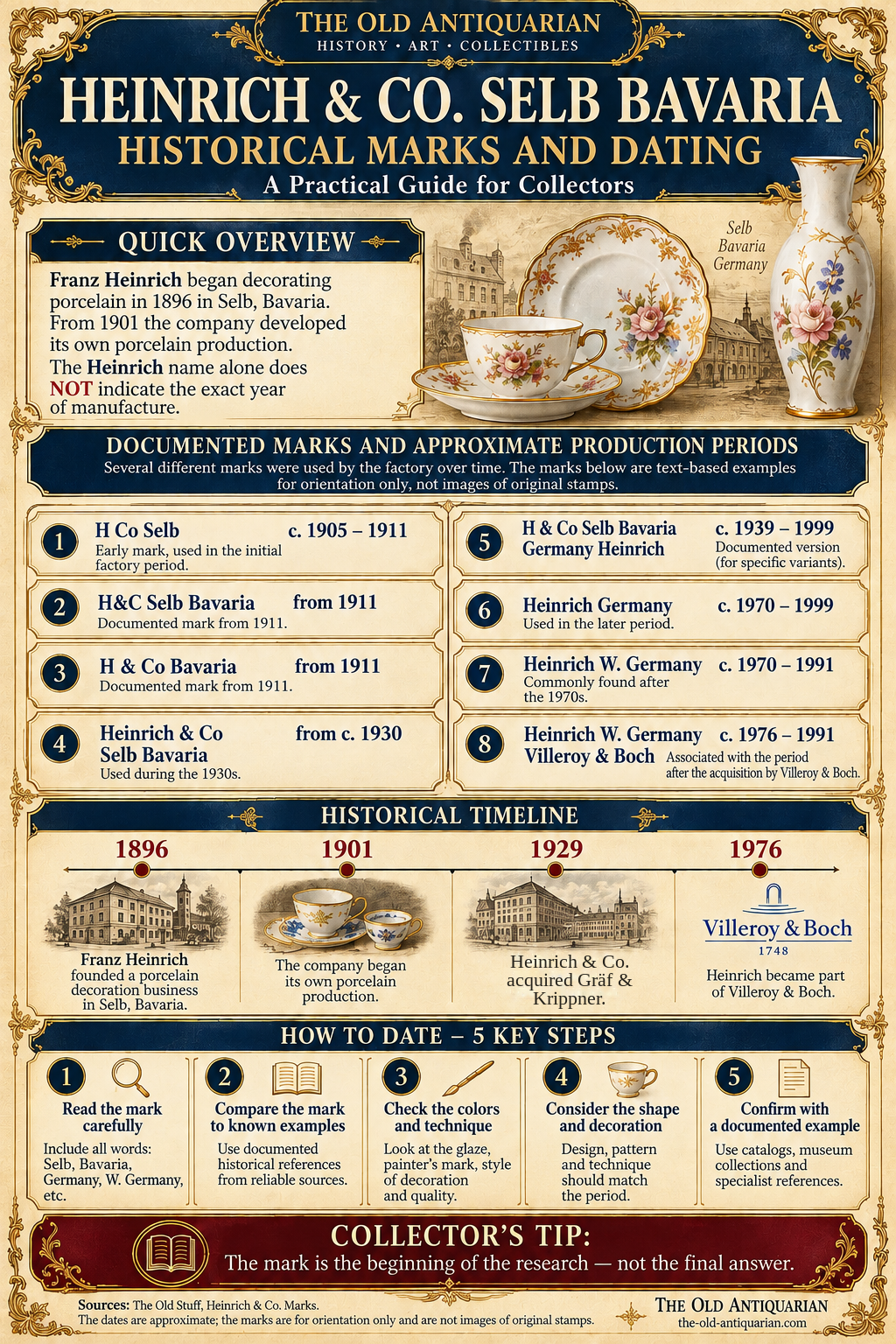
Historical Marks & Dating Guide.
Collector reference covering eight
historical backstamp inscriptions,
approximate dating periods and
five practical identification checks.
The inscriptions are educational
text-based references, not
exact reproductions of original
factory stamps.
Heinrich Porcelain at a Glance
| Feature | Historical and Collector Information |
|---|---|
| Manufacturer | Heinrich & Co. / Heinrich Porzellan |
| Founder | Franz Heinrich |
| Location | Selb, Bavaria, Germany |
| Business established | 1896 – porcelain decorating |
| Own porcelain production | 1901–1902 |
| Historic factory marks | H Co, H&C, H & Co, Heinrich, Selb Bavaria, Germany and W. Germany |
| Products | Dinnerware, coffee and tea sets, vases, decorative porcelain and artistic ceramics |
| Special technique | Gemmo – specialized artistic porcelain surface treatment |
| Gemmo production | Series-production readiness in 1949 |
| Art department | Manufaktur Chiemsee, 1947–1973 |
| Acquisition | Villeroy & Boch, 1976 |
| Bone China | Production in Selb from 1980 |
| Documented service shapes | Anmut, Madame, Europa, Elisabeth, Jacqueline and Rondo |
| Value considerations | Factory attribution, shape, pattern, rarity, decoration, condition, completeness and comparable realized sales |
The factory mark is the beginning
of the research, not the final answer.
The object itself must support
the proposed manufacturer,
production period and attribution.
Among the German porcelain manufacturers
active during the late nineteenth and
twentieth centuries,
Heinrich & Co.
holds an important position
in both industrial history
and decorative porcelain collecting.
The company’s development from
a small decorating workshop
into an established porcelain producer
reflects the wider industrial growth
of Selb, one of Germany’s
major porcelain-making centers.
Today, collectors encounter
Heinrich porcelain in many forms:
coffee sets, dinner services,
decorative vases, artistic pieces
and later wares carrying the names
Heinrich and Villeroy & Boch.
The challenge is that these pieces
may belong to very different
production periods and
decorative traditions.
For the broader principles of
ceramic identification, see our
complete guide to antique porcelain
.
History of Heinrich & Co. Selb Bavaria
1896: Franz Heinrich Establishes the Business
The history of Heinrich porcelain
begins in 1896,
when Franz Heinrich founded
a small porcelain decorating
business in Selb, Bavaria.
His first operation was not
a large porcelain manufactory.
Instead, it specialized in decorating
white porcelain blanks
purchased from other producers.
The early workshop was established
at his parents’ property,
where a small muffle kiln
was used for firing decorated wares.
According to specialist historical accounts,
the business initially operated
with the assistance of
one female employee.
This distinction matters
when collectors investigate
early Heinrich porcelain.
The founding date of a company
does not necessarily mark
the beginning of all its
manufacturing activities.
1896 marks the establishment
of Franz Heinrich’s
porcelain decorating business.
The transition toward producing
the porcelain bodies themselves
occurred in 1901–1902.
1901–1902: From Decorating to Manufacturing
By 1901, the business
had expanded to approximately
50 employees.
Franz Heinrich recognized that
continued growth depended on
being able to produce
white porcelain independently,
rather than relying solely
on blanks from other factories.
In 1902, the first porcelain
firing kiln and associated
production facilities were constructed.
The manufacturer Ernst Adler
from Asch became a silent partner,
providing capital for
the company’s expansion.
Over the following years,
Heinrich developed additional kilns,
decorating departments,
model-making workshops,
storage buildings and
larger manufacturing facilities.
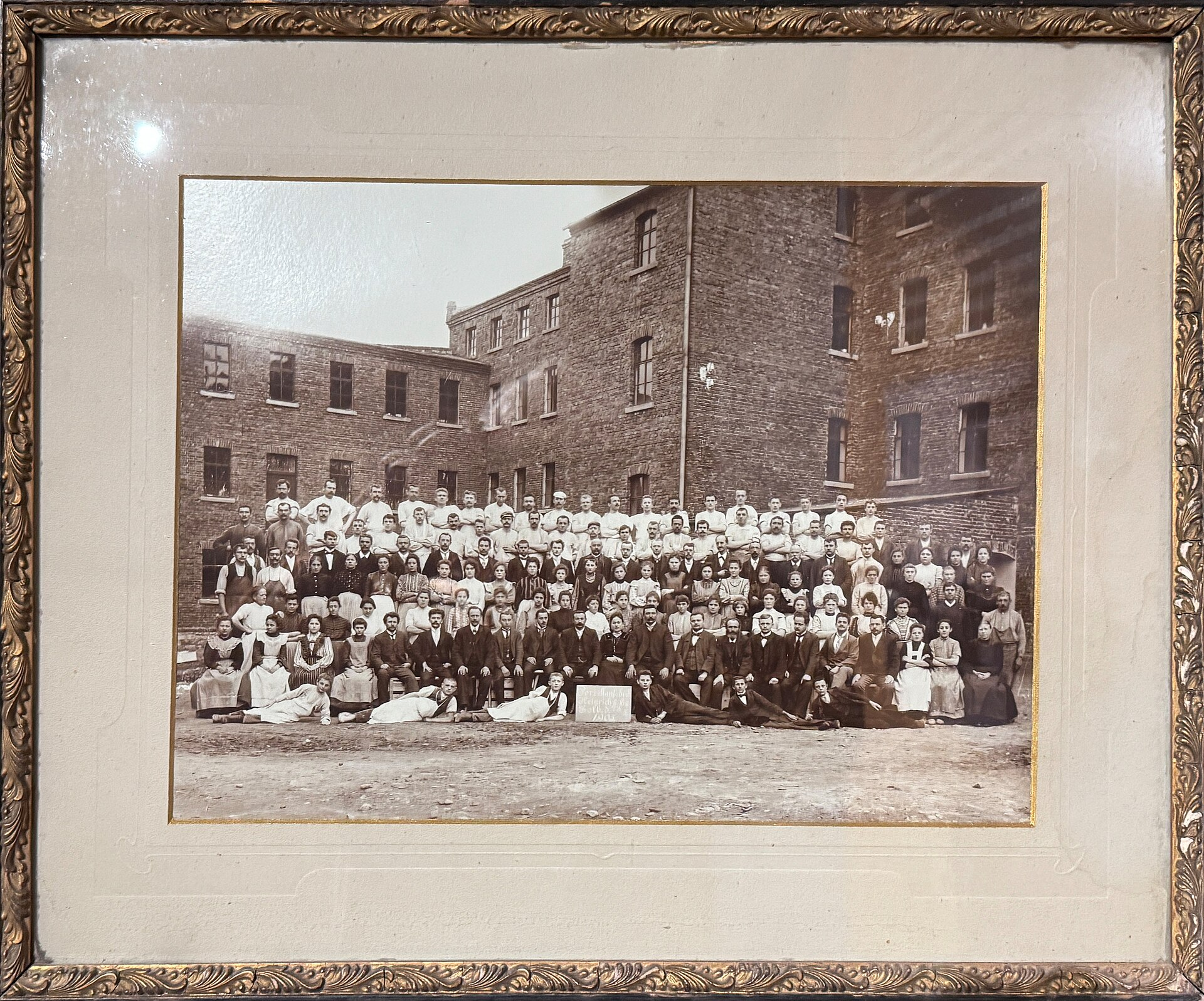
Selb, circa 1905.
This historical group photograph
documents the company’s early
industrial development.
Source: Porzellanikon / Wikimedia Commons.
Photograph of the historical original:
Dguendel, CC BY 4.0.
By approximately 1906,
the workforce had reached
around 200 employees.
The expansion continued
through the years preceding
the First World War.
Selb was becoming an important
industrial center for porcelain,
with several manufacturers
developing increasingly specialized
production programs.
1928–1929: Leadership and Expansion
Franz Heinrich died in
1928.
The company continued operating
under the management of
the Heinrich family.
In 1929,
Heinrich & Co. acquired
the porcelain factory
Gräf & Krippner,
another producer based in Selb.
The direction of the 1929 acquisition
is important:
Heinrich & Co. acquired
Gräf & Krippner,
not the other way around.
This is documented in specialist
histories of the two factories.
Heinrich Porcelain – Historical Timeline
| Year | Historical Event | Collector Significance |
|---|---|---|
| 1896 | Franz Heinrich establishes a porcelain decorating business in Selb, Bavaria. |
Beginning of the company’s history. |
| 1901–1902 | Development of independent porcelain production and construction of the first kiln. |
Important context for early factory attribution. |
| 1906 | The company employs approximately 200 workers. |
Evidence of industrial expansion. |
| 1912–1914 | Significant factory expansion and construction projects. |
Growing production capacity. |
| 1928 | Death of Franz Heinrich. | Transition in company leadership. |
| 1929 | Heinrich & Co. acquires Gräf & Krippner. |
Important for the history of Selb porcelain manufacturers. |
| 1945 | Porcelain production resumes after the Second World War. |
Beginning of a new postwar production phase. |
| 1947 | Heinrich establishes an artistic department near Lake Chiemsee. |
Specialized hand-decorated porcelain. |
| 1949 | Gemmo reaches readiness for series production. |
Introduction of a distinctive artistic porcelain technique. |
| 1959 | Factory production and showroom photographed for the German Federal Archives. |
Authentic visual documentation of forms and manufacturing. |
| 1967 | Publication of a Heinrich product brochure. |
Documented service shapes, patterns and decorative variants. |
| 1973 | Closure of the Chiemsee artistic department. |
End of a distinctive artistic production program. |
| 1976 | Heinrich becomes part of Villeroy & Boch. |
Important ownership and branding milestone. |
| 1980 | Bone China production begins in Selb under Villeroy & Boch. |
Important material and production development. |
Historical events provide
a framework for researching
Heinrich porcelain.
They should not be treated
as an automatic dating system.
A change in ownership,
factory management or
production technology does not
necessarily mean that every
factory mark changed immediately.
Inside the Heinrich Porcelain Factory
During the twentieth century,
Heinrich developed a large and
diverse range of porcelain products.
The factory manufactured
dinnerware, coffee and tea sets,
decorative vessels, vases and
specialized artistic porcelain.
The range of products changed
with contemporary fashions,
technical developments and
commercial demand.
Heinrich Showroom in 1959
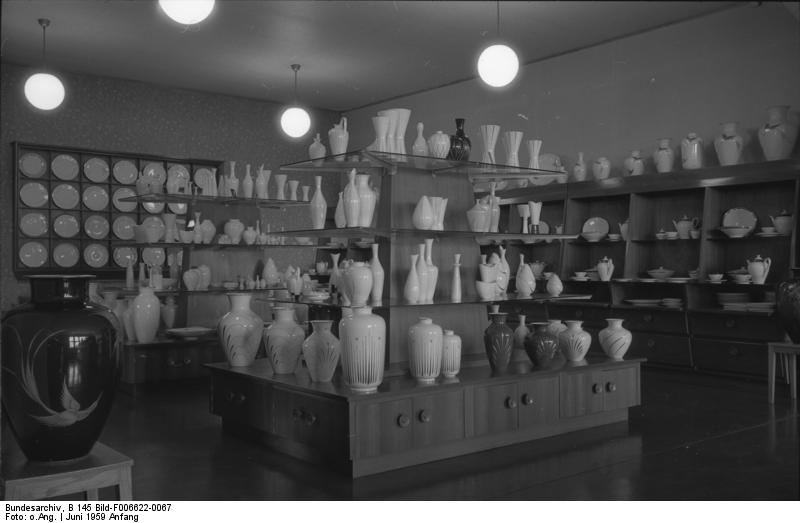
June 1, 1959.
The archival image shows
decorative vases, pitchers
and other porcelain products.
Source: Bundesarchiv,
B 145 Bild-F006622-0067,
Wikimedia Commons,
CC BY-SA 3.0 DE.
This photograph demonstrates
the considerable variety
of forms manufactured
by Heinrich in the middle
of the twentieth century.
The visible objects include
tall vases, small decorative vessels,
pitchers, bowls and plates
displayed on cabinets and shelves.
For identification purposes,
these archival photographs
can help establish that
particular types of objects
were produced during
a documented historical period.
However, they do not prove
that every visually similar item
was manufactured in the
same year.
Porcelain Production Before Glazing
Manufacturing high-quality porcelain
involves several stages,
including shaping, drying,
firing, glazing, decorating
and final inspection.
The precise production sequence
can vary according to
the type of porcelain and
the techniques used.
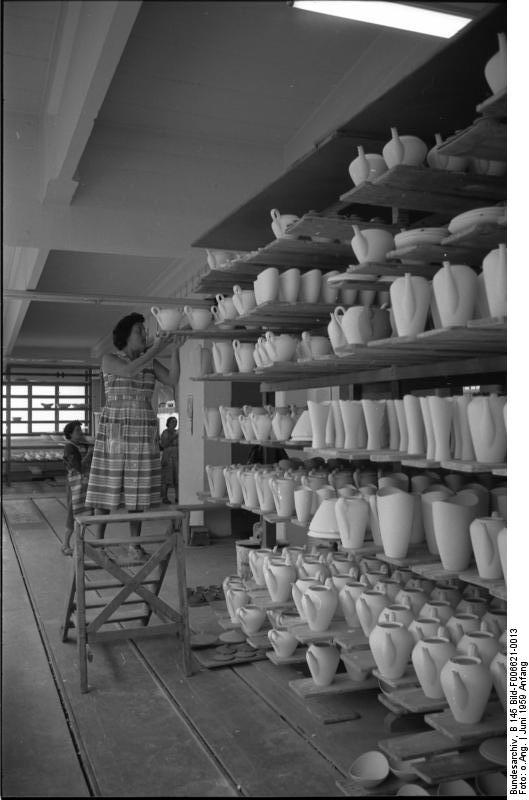
for glazing, June 1, 1959.
A factory worker is shown
among shelves of unglazed
porcelain vases and vessels.
Source: Bundesarchiv,
B 145 Bild-F006621-0013,
Wikimedia Commons,
CC BY-SA 3.0 DE.
Archival images provide
documentary evidence of
manufacturing techniques,
production environments
and historical porcelain forms.
They are more reliable
for historical research
than speculative illustrations
of factory operations.
Heinrich & Co. Porcelain Marks and Backstamps
Factory marks are among
the most useful starting points
for identifying Heinrich porcelain.
Depending on the period,
an object may carry inscriptions
such as H Co Selb,
H&C Selb Bavaria,
H & Co Bavaria,
Heinrich Germany
or Heinrich W. Germany.
These inscriptions can provide
information about the manufacturer,
factory location, export market
and approximate production period.
However, small differences
in lettering, typography,
mark design and supplementary
wording may be important.
Historical Heinrich Marks by Period
| Factory Mark / Inscription | Approximate Period | Collector’s Interpretation |
|---|---|---|
| H Co Selb | c. 1905–1911 | Early documented Heinrich mark. |
| H&C Selb Bavaria | Documented from 1911 | Compare the specific design and lettering. |
| H & Co Bavaria | Documented from 1911 | Early factory-related inscription; exact variants require comparison. |
| Heinrich & Co Selb Bavaria |
From approximately 1930 | Used in documented later factory mark variants. |
| H & Co Selb Bavaria Germany Heinrich |
c. 1939–1999 for the specific catalogued variant |
A broad reference range; not an exact dating tool. |
| Heinrich Germany | c. 1970–1999 | Later marks; multiple variants are documented. |
| Heinrich W. Germany | c. 1970–1991 | Associated with later West German export-era marks. |
| Heinrich W. Germany Villeroy & Boch |
c. 1976–1991 | Associated with the period following the acquisition by Villeroy & Boch. |
Dating ranges are based on
The Old Stuff – Heinrich & Co. Marks.
They refer to catalogued examples
and should not be extended automatically
to every backstamp with similar wording.
A catalogue may list
a particular Heinrich mark
under a long range such as
1939–1999.
This should not be interpreted
as proof that all pieces with
similar lettering were produced
throughout that entire period.
Always compare the complete
design of the mark,
porcelain body, shape,
decoration and documented model.
What Does H&C Mean on Porcelain?
The letters H&C
are associated with
Heinrich & Co.,
but these letters must be
interpreted within the
complete factory mark.
Other manufacturers may have
used similar initials,
monograms or abbreviations.
Record every element:
- the full manufacturer inscription;
- the typography and positioning of letters;
- the color of the backstamp;
- country or regional wording;
- additional numbers and symbols;
- the application method;
- the porcelain body and shape.
For a broader explanation of
maker’s marks and backstamps,
continue to our
guide to identifying porcelain marks
.
The infographic at the beginning
of this article presents
educational text-based mark examples.
For an authenticated
visual comparison,
consult the original
photographed marks in the
Heinrich & Co. mark catalogue
.
How to Date Heinrich Selb Bavaria Porcelain
Dating Heinrich porcelain
requires a combination
of factory history,
mark identification
and examination of
the complete object.
A backstamp may help establish
a broad production period,
but rarely provides a precise
manufacturing year by itself.
Capture the complete base,
including every word,
number and symbol.
Compare typography,
layout, colors and wording
with documented examples.
Study color, density,
glaze, translucency
and manufacturing quality.
Compare handles, rims,
foot rings and proportions
with historical models.
Examine floral motifs,
hand painting, transfer decoration,
gilding and specialized techniques.
Use specialist catalogues,
museum collections,
factory brochures
and reliable historical sources.
DECORATION + TECHNIQUE +
DOCUMENTED HISTORICAL COMPARISON
Our broader
complete guide to dating antique porcelain
explains why manufacturing period,
style and factory marks
must be considered together.
What Do Bavaria, Germany and W. Germany Mean?
Words referring to a country
or region can provide useful
historical context when
identifying German porcelain.
However, they should not be
treated as exact date codes.
| Inscription | Meaning | What It Does Not Prove |
|---|---|---|
| Selb | The German porcelain-making town. | An exact year of manufacture. |
| Bavaria | The German region of Bavaria. | That the object is necessarily antique or rare. |
| Germany | Country of origin or export-related wording. |
A precise manufacturing decade. |
| W. Germany | West Germany. | An exact date without the complete mark and additional historical evidence. |
| Villeroy & Boch | Connection with the company that acquired Heinrich. |
That the object must be made from Bone China. |
Bavaria appears on porcelain
from numerous manufacturers
and across different periods.
It is useful geographical
information, but not
a universal dating code.
Heinrich & Co. vs Villeroy & Boch
An important milestone
in Heinrich’s history
occurred in 1976,
when the company became
part of Villeroy & Boch.
The acquisition created a
connection between the established
Selb porcelain manufacturer
and one of Europe’s
longest-established ceramics groups.
The Heinrich name continued
to appear on various porcelain
products and factory marks
after this change.
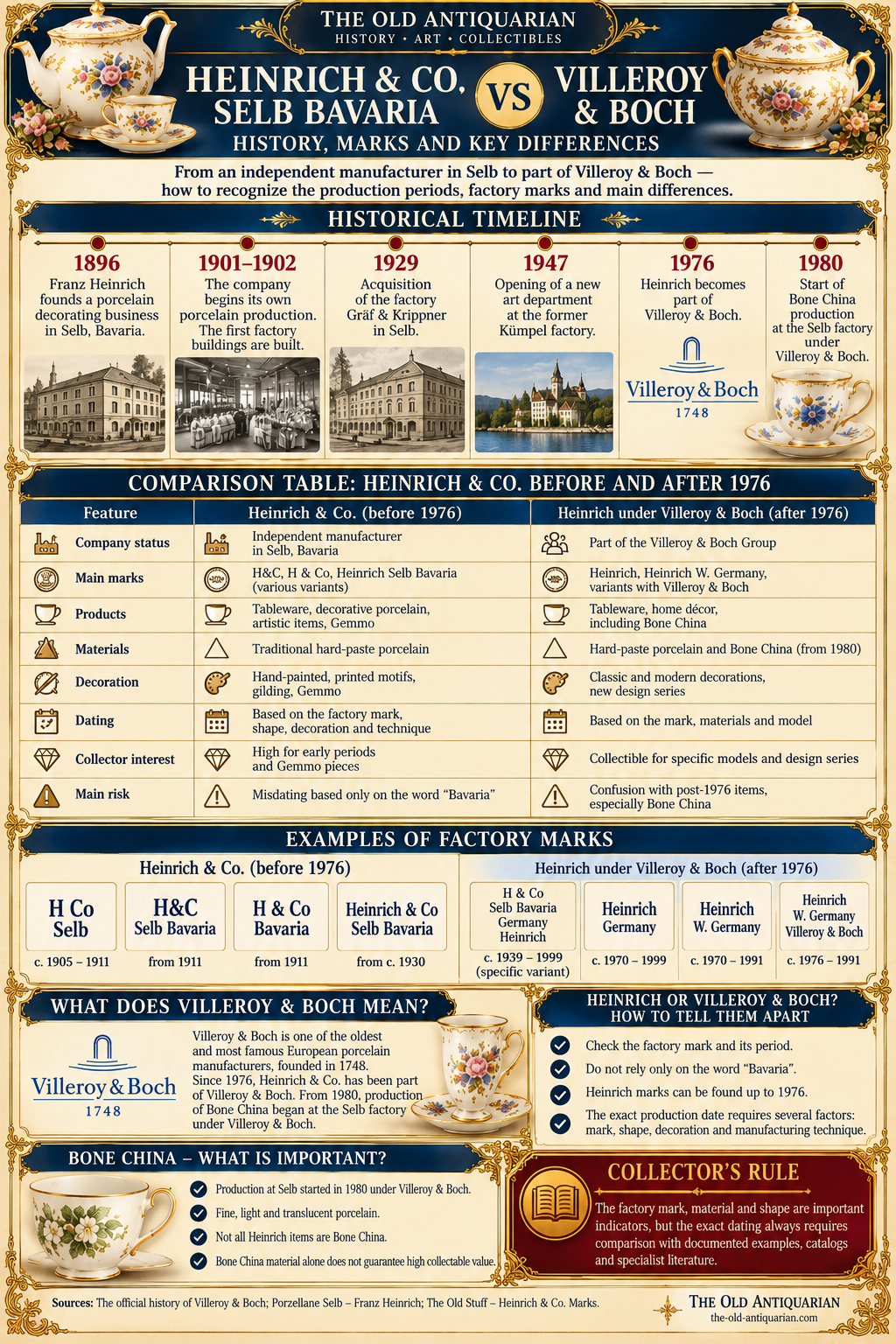
Comparison of ownership,
factory marks, materials,
products and dating clues
before and after 1976.
Includes Bone China
production in Selb from 1980.
Mark representations are
educational text examples.
Heinrich Before and After 1976
| Feature | Heinrich Before 1976 | Heinrich Under Villeroy & Boch |
|---|---|---|
| Company status | Independent historic porcelain manufacturer. |
Part of the Villeroy & Boch group. |
| Factory marks | H&C, H & Co, Heinrich Selb Bavaria and related variants. |
Heinrich, W. Germany and certain marks including Villeroy & Boch. |
| Products | Dinnerware, coffee sets, vases and artistic porcelain. |
Tableware, decorative porcelain and additional product ranges. |
| Materials | Predominantly traditional hard-paste porcelain. |
Hard-paste porcelain and Bone China from 1980. |
| Decorative techniques | Painting, printing, gilding and Gemmo. |
Traditional and contemporary decorative programs. |
| Dating | Factory mark, shape, pattern and technique. |
Complete backstamp, material, model and historical references. |
| Main identification risk | Dating solely from Bavaria. | Assuming that all post-1976 wares are Bone China. |
The acquisition in 1976
does not mean all Heinrich
marks changed immediately.
Some mark families have
overlapping dating ranges.
The full backstamp must
be compared with the
material and the model.
For more context about
the parent company’s
broader ceramic history,
see our
Villeroy & Boch identification guide
.
Heinrich Bone China – Identification and History
According to the official
history of Villeroy & Boch,
Bone China production
began at the Selb factory
in 1980.
Bone China is a refined
porcelain material containing
bone ash in the ceramic body.
It is often associated
with fine construction,
an elegant appearance
and pronounced translucency
in thin areas.
Hard-Paste Porcelain vs Bone China
| Feature | Hard-Paste Porcelain | Bone China |
|---|---|---|
| Body composition | Typically based on kaolin and other ceramic materials. |
Contains bone ash as a constituent. |
| Appearance | Fine white ceramic body with varying characteristics. |
Often particularly fine, white and translucent. |
| Translucency | Possible in thin sections. | Often especially noticeable in thin sections. |
| Decoration | Painting, printing, gilding and other methods. |
Also suitable for varied decorative techniques. |
| Dating significance | Material alone does not establish an exact period. |
Material alone does not establish the year of manufacture. |
| Collector value | Depends on the specific item and market. |
Not automatically higher because of the material. |
1976 marks the acquisition
by Villeroy & Boch.
1980 marks the start
of Bone China production
at the Selb factory.
Neither date means
that every later Heinrich
object was made using
the same ceramic body.
Heinrich Porcelain Shapes, Patterns and Designs
One of the most useful
primary sources for
researching Heinrich
is a factory product brochure
published in 1967.
The brochure,
“Heinrich Porzellan –
Qualitäts Porzellan”,
is preserved in a museum
collection and made accessible
through LEO-BW.
It documents actual
service shapes and
decorative variants
offered by the manufacturer.
Documented Heinrich Service Shapes
| Shape / Form | Historical Evidence | What Collectors Should Check |
|---|---|---|
| Anmut | Documented in the 1967 brochure. Design attributed to Karl Leutner. |
Silhouette, handle, rim, dimensions and decoration. |
| Madame | Documented historical service shape. |
Shape and specific decorative variant. |
| Europa | Documented historical service shape. |
Proportions and catalogue comparisons. |
| Elisabeth | Documented historical service shape. |
Shape details and known decorative combinations. |
| Jacqueline | Documented historical service shape. |
Foot, handles, rim and surface decoration. |
| Rondo | Documented historical service shape. |
Model characteristics, decoration and factory mark. |
The 1967 Heinrich brochure
identifies Karl Leutner
in connection with
the Anmut service shape.
This is valuable historical
evidence of design authorship.
However, the name Anmut
does not identify the precise
production year of an
individual surviving piece.
Heinrich Decorative Patterns and Styles
Heinrich porcelain was produced
with numerous decorative treatments,
including floral painting,
printed decoration,
gilding and specialized
artistic techniques.
The 1967 product brochure
records a variety of
named decorative variants.
| Documented Decoration | What It Represents | Identification Advice |
|---|---|---|
| Nora | Named decorative variant. | Compare the design and catalogue number. |
| Stella | Documented pattern name. | Do not confuse decoration with service shape. |
| Astrid | Documented decorative variant. | Check the design against original illustrations. |
| Beatrice | Documented decorative variant. | Identify the combination of shape and decoration. |
| Dagmar | Documented decoration. | Verify the exact pattern reference. |
| Atlantis | Documented decoration. | A pattern name does not establish the precise date. |
| Kobalt mit Ätzkante | Historical decorative designation involving cobalt and etched-border terminology. |
Compare its finish and design with the catalogue. |
| Rothenburg, Wachau and Milano |
Additional documented decorative names. |
Match the visual appearance with original catalogue examples. |
A Heinrich service shape
could be offered in
multiple decorative variants.
Accurate identification
requires the shape,
the decoration and
the factory mark to
be researched together.
The primary museum record
can be consulted here:
Heinrich Porcelain Product Brochure, 1967
.
Heinrich Gemmo – Special Artistic Porcelain
One of the most distinctive
technical developments
associated with Heinrich
is Gemmo porcelain.
Rather than relying entirely
on conventional painted
or printed decoration,
Gemmo involves specialized
treatment of the porcelain
surface itself.
Historical German accounts
describe the process with
the term Kunstschliff,
referring to artistic grinding.
After considerable experimentation,
the technique reached readiness
for series production in
1949.
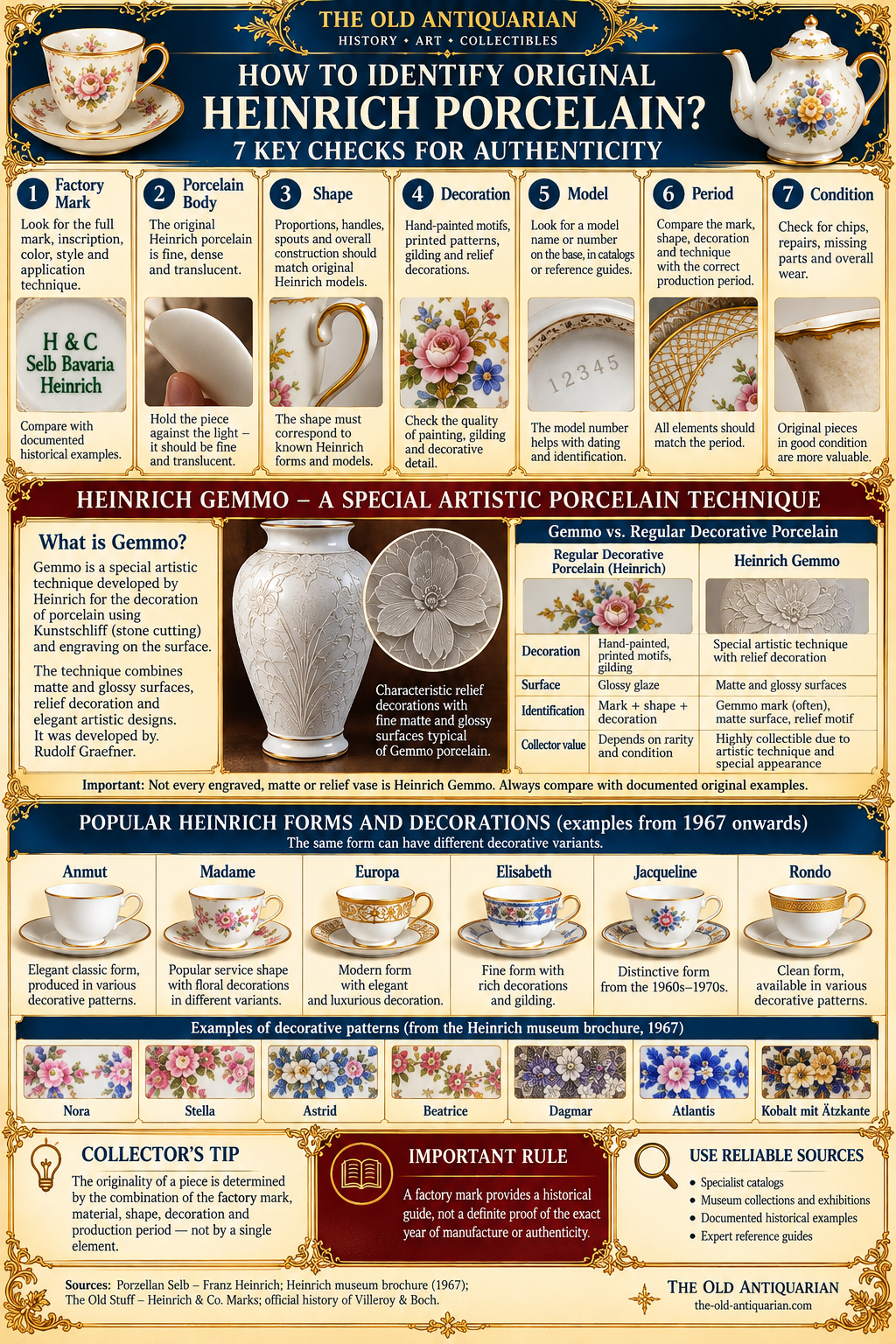
Porcelain and Gemmo.
Seven identification checks,
a comparison of conventional
decoration and Gemmo,
and historical Heinrich
shape and pattern names
documented in the 1967 brochure.
The objects are educational illustrations,
not authenticated photographs
of particular museum pieces.
How Is Heinrich Gemmo Identified?
Gemmo is associated with
specialized surface finishing
and decorative treatment,
rather than a single
floral design or color.
Collectors should examine
the actual surface technique,
factory mark, shape
and documented design.
| Feature | Regular Decorative Heinrich | Heinrich Gemmo |
|---|---|---|
| Decoration | May feature hand painting, transfer printing and gilding. |
Specialized artistic surface treatment. |
| Technique | Various conventional decorative methods. |
Kunstschliff – artistic grinding. |
| Identification | Factory mark, form, pattern and period. |
Factory mark, specific surface technique, form and documented design. |
| Historical reference | Numerous manufacturing periods and collections. |
Production readiness from 1949. |
| Collector interest | Depends on the item, decoration and condition. |
Can also depend on the specialized technique and rarity of the example. |
The Early Gemmo Pattern 200a
The historical Porzellan Selb
reference identifies
Rudolf Greiner
as the designer of
the first series Gemmo decoration,
numbered 200a,
in 1949.
Greiner worked within
the artistic activities
associated with
Heinrich’s Chiemsee department.
A vase may be engraved,
textured or decorated
with relief without having
been manufactured using
the Gemmo process.
Correct attribution requires
comparison with documented
Gemmo examples,
not merely a visual resemblance.
Manufaktur Chiemsee – Heinrich’s Art Department
In October 1947,
Heinrich established
a specialized art department
at Seethal near
Lake Chiemsee in Bavaria.
The Manufaktur Chiemsee
was intended to develop
high-quality artistic decoration
through more individual
handwork than ordinary
factory production.
The department operated
under the artistic direction
of Karl Mötsch.
Specialized painters decorated
Heinrich porcelain forms
using original designs
and demanding painting techniques.
The department continued
until approximately
1973.
A hand-painted Heinrich
piece is not automatically
a product of the
Chiemsee art department.
Attribution requires
appropriate marks,
documented designs
or convincing historical
comparisons.
How to Identify Authentic Heinrich Porcelain
Identifying an original
Heinrich porcelain object
is not simply a matter
of recognizing the name
on the base.
The complete object
should be historically
consistent with the
factory and period.
| Identification Feature | What to Examine | Possible Warning Sign |
|---|---|---|
| Factory mark | Wording, typography, color and application method. |
Important differences from documented variants. |
| Porcelain body | Color, glaze, density, finish and translucency where appropriate. |
Material inconsistent with the proposed attribution. |
| Shape | Handles, foot, rim, proportions and molded details. |
Construction that does not match the identified model. |
| Decoration | Painting, printing, gilding, relief and technique. |
Decoration inconsistent with the proposed period. |
| Numbers | Shape, pattern, mold and other codes. |
Assuming every number is a production year. |
| Period | Compatibility between mark, form and technology. |
An object described as much earlier than its documented characteristics. |
| Condition | Wear, repairs, replacement components and restoration. |
Concealed alterations or misleading surface aging. |
| Documentation | Factory catalogues, museum examples and historical references. |
Attribution based only on an unverified sale listing. |
For the broader identification
method, see
How to Identify Antique Porcelain
.
Common Heinrich Porcelain Identification Mistakes
1. Dating Solely from Bavaria
The word Bavaria identifies
a region, not an exact
manufacturing date.
2. Assuming Every Heinrich Piece Is Antique
The company’s history
begins in the nineteenth century,
but many surviving pieces
are twentieth-century vintage
rather than antique porcelain.
3. Assuming Everything After 1976 Is Bone China
The Villeroy & Boch
acquisition and the start
of Bone China production
are separate historical events.
4. Calling Every Textured Vase Gemmo
Gemmo refers to a
specific artistic technology,
not every textured
or matte ceramic surface.
5. Confusing Shape with Decoration
Anmut and Rondo are
documented service shapes,
while Nora and Stella
are documented decorative names.
6. Treating Every Number as a Date
Numbers may identify
shapes, molds, patterns,
decorations or other
factory information.
Condition, Damage and Restoration
Condition plays a major role
in the desirability of
Heinrich porcelain.
Before purchasing or selling,
inspect handles, rims,
foot rings, lids,
painted decoration and gilding.
| Condition Issue | Typical Appearance | Collector Significance |
|---|---|---|
| Chips | Damage to rims, handles, lids and bases. |
Often reduces desirability. |
| Hairline cracks | Fine fractures in the porcelain body. |
Can materially affect value. |
| Gilding wear | Loss or thinning of gold decoration. |
Impact depends on severity and originality. |
| Restoration | Repaired or repainted areas. | Should be identified and disclosed when selling. |
| Missing lids | Incomplete decorative or service pieces. |
Can reduce collector demand. |
| Mismatched sets | Pieces from different shapes or decorative variants. |
May indicate an assembled rather than original matching service. |
| Overcleaning | Scratches, surface changes or damaged gilding. |
May cause irreversible loss. |
Do not attempt to remove
stains, repaint decoration,
regild worn areas or
repair chips before
the object’s significance
has been established.
Poor restoration can
reduce originality
and collector value.
Heinrich Porcelain Value – What Is It Worth?
The value of Heinrich porcelain
depends on far more than
the manufacturer’s name.
An ordinary dinner plate,
a complete coffee service,
a decorative vase and
an authenticated Gemmo piece
may appeal to different
collectors and markets.
There is no universal
price chart that can
reliably value every
Heinrich & Co. object.
Eight Factors Affecting Heinrich Porcelain Value
| Factor | Why It Matters |
|---|---|
| 1. Manufacturing period | Documented age and historical context may influence collector interest. |
| 2. Shape and form | Unusual, artistic or desirable forms may attract different demand. |
| 3. Pattern and decoration | Recognized designs and decorative variants may influence desirability. |
| 4. Gemmo technique | Correct identification of specialized artistic production may be significant. |
| 5. Artistic quality | Hand painting, gilding and decorative execution can influence value. |
| 6. Condition | Chips, cracks, missing parts and restoration often reduce value. |
| 7. Completeness and provenance | Matching sets, original components, labels and documentation. |
| 8. Realized market sales | Completed sales provide stronger evidence than unsold asking prices. |
An advertised price
does not establish
what collectors are
actually willing to pay.
The strongest comparisons
use documented completed sales
of objects with closely
matching shape, decoration,
period and condition.
How to Compare Heinrich Porcelain Prices
| Comparison | Example | Reliability |
|---|---|---|
| Appropriate | Two cups with matching shapes, patterns and similar condition. |
Useful when based on verified completed sales. |
| Partial | Two vases of comparable size but different decorative techniques. |
Requires further research and adjustments. |
| Unsuitable | A rare Gemmo art vase compared with an ordinary porcelain plate. |
Not a reliable basis for valuation. |
For the general factors
used in professional
antique appraisal,
visit our
antique valuation service
.
Heinrich Porcelain Collector Checklist
Before buying, selling
or requesting an appraisal,
collect all available information
about your Heinrich porcelain.
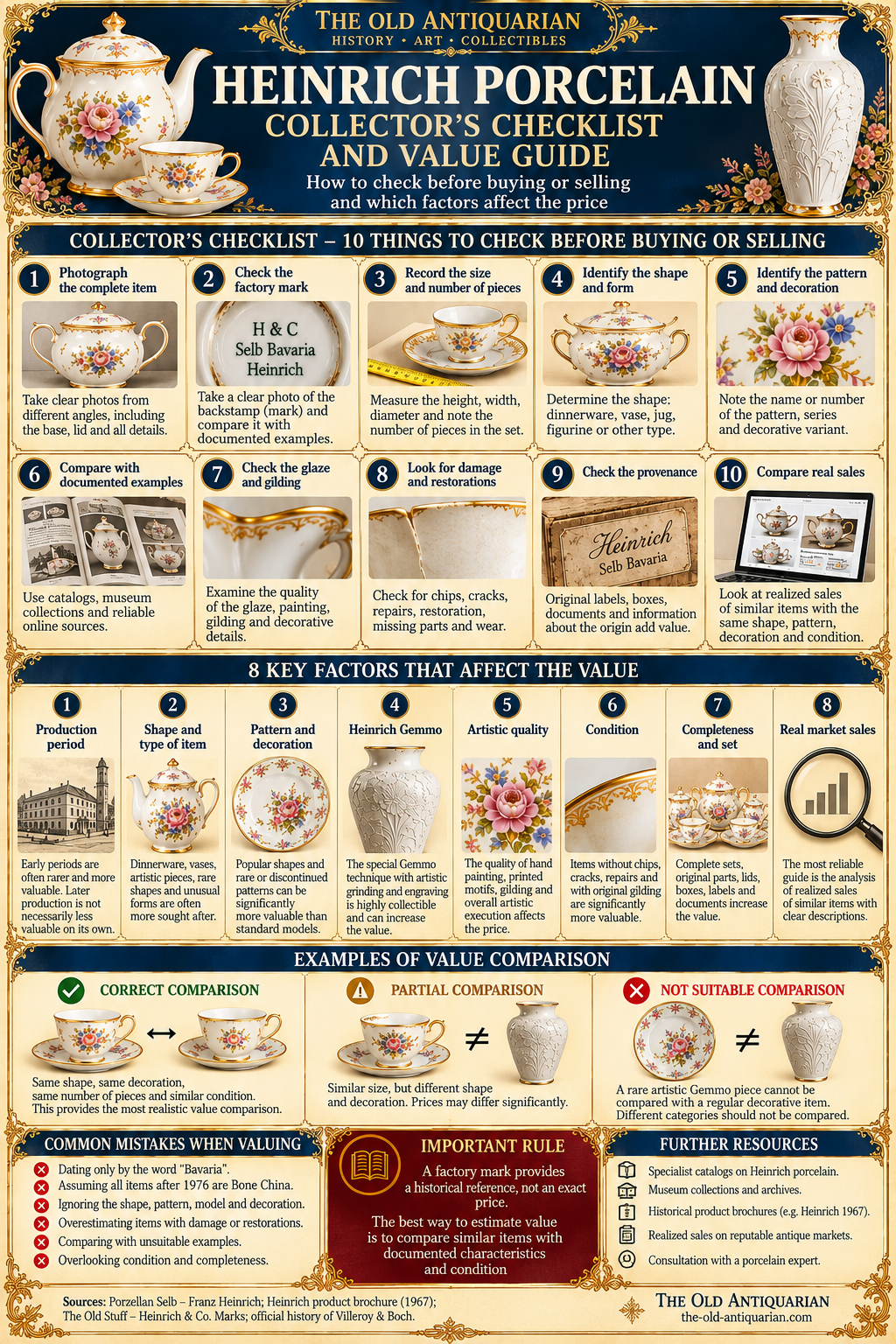
Collector’s Checklist & Value Guide.
Ten identification checks,
eight factors affecting value,
examples of comparable sales
and common valuation mistakes.
Educational infographic
by The Old Antiquarian.
Ten Checks Before Buying or Selling Heinrich Porcelain
Include the front,
back, sides and base.
Photograph all letters,
symbols and numbers.
Record height, width,
diameter and the number
of items in a set.
Determine whether it is
a cup, plate, vase,
service or decorative piece.
Look for pattern names,
painting, gilding and
decorative numbers.
Compare with original
factory documentation
and museum examples.
Inspect the glaze,
gilding, edges
and painted details.
Check for cracks,
chips, repairs
and missing parts.
Preserve original labels,
boxes, receipts and
ownership information.
Look for genuinely
similar objects
in comparable condition.
Own Heinrich & Co. Selb Bavaria Porcelain?
Do you have a Heinrich porcelain
coffee service, dinner set,
vase, decorative piece or
possible Gemmo object?
Photograph the complete item,
its factory mark,
dimensions, decoration
and any damage or restoration.
The Old Antiquarian offers
collector guidance and
professional antique valuation,
supported by more than
35 years of experience
with antiques and collectibles.
Frequently Asked Questions About Heinrich Porcelain
What is Heinrich & Co. Selb Bavaria porcelain?
Heinrich & Co. was a German porcelain manufacturer based in Selb, Bavaria. Franz Heinrich founded the business in 1896 as a porcelain decorating workshop, and the company developed its own porcelain production in 1901–1902.
What does H&C Selb Bavaria mean?
H&C Selb Bavaria is a factory inscription associated with Heinrich & Co. Specialist mark references document a variant from 1911. The complete design must be compared with original examples to estimate the period.
How old is Heinrich Selb Bavaria porcelain?
The company dates to 1896, with independent porcelain production beginning in 1901–1902. Individual pieces may belong to different decades of the twentieth century and must be dated according to their marks, shapes and decorations.
How do you date Heinrich Germany porcelain marks?
Some documented Heinrich Germany marks have broad dating ranges around 1970–1999. Precise attribution requires examining the exact backstamp, porcelain body, shape and decorative characteristics.
What does Heinrich W. Germany mean?
W. Germany stands for West Germany. The inscription provides historical context, but its presence alone does not identify an exact manufacturing year.
Is Heinrich porcelain part of Villeroy & Boch?
Heinrich became part of Villeroy & Boch in 1976. The Heinrich name continued to be associated with porcelain products and later factory marks.
Is all Heinrich porcelain made after 1976 Bone China?
No. Villeroy & Boch introduced Bone China production at the Selb factory in 1980, but not all Heinrich porcelain made after the 1976 acquisition is Bone China.
What is Heinrich Gemmo porcelain?
Heinrich Gemmo is a specialized artistic porcelain technique associated with Kunstschliff, or artistic grinding of the porcelain surface. The process reached readiness for series production in 1949.
How can I identify an original Heinrich Gemmo vase?
Examine the factory mark, shape, surface treatment and decorative technique, then compare the object with documented Gemmo examples. Not every textured, engraved or matte Heinrich vase is Gemmo.
What are the best-known Heinrich porcelain patterns?
A Heinrich factory brochure from 1967 documents service shapes including Anmut, Madame, Europa, Elisabeth, Jacqueline and Rondo, together with decorative names such as Nora, Stella, Astrid, Beatrice, Dagmar and Atlantis.
Is Heinrich Bavaria porcelain valuable?
Some Heinrich pieces attract collector interest, especially unusual artistic objects, documented designs and correctly identified Gemmo wares. Value depends on rarity, decoration, condition, completeness and comparable completed sales.
Can genuine Heinrich porcelain be unmarked?
A porcelain object may have no visible or readable mark, but attribution then requires stronger evidence from its shape, material, decoration and documented factory examples.
Where can I sell Heinrich porcelain?
Owners can request an initial valuation or submit an antique selling enquiry through The Old Antiquarian. Clear photographs, factory marks, dimensions, condition and provenance information are particularly helpful.
Related Guides – Continue Exploring
Sources and Further Research
The historical research in this guide
draws on specialist factory histories,
documented mark references,
museum publications and
the official history of
Villeroy & Boch.
| Historical Source | Information Used |
|---|---|
|
Porzellan Selb – Franz Heinrich |
Company foundation, industrial expansion, factory development, Gemmo, artistic departments, designers and historical chronology. |
|
The Old Stuff – Heinrich & Co. Marks |
Documented factory mark variants and approximate production periods. |
|
The Old Stuff – Gräf & Krippner |
Historical information concerning the factory acquired by Heinrich in 1929. |
|
Villeroy & Boch – Official Company History |
The 1976 acquisition and Bone China production at Selb from 1980. |
|
LEO-BW – Heinrich Product Brochure, 1967 |
Historical service shapes, pattern names, decorative variants and documented design information. Museum record: CC0. |
| Porzellanikon / Wikimedia Commons |
Historical photograph of factory employees, circa 1905. Photograph: Dguendel, CC BY 4.0. |
| Bundesarchiv / Wikimedia Commons |
1959 showroom photograph: B 145 Bild-F006622-0067. CC BY-SA 3.0 DE. |
| Bundesarchiv / Wikimedia Commons |
1959 factory production photograph: B 145 Bild-F006621-0013. CC BY-SA 3.0 DE. |
Historical factory marks
should be compared with
documented original examples.
Educational infographics
can provide useful visual
orientation but are not
substitutes for authentic
factory records or museum objects.
Where a general diagram
differs from reliable
documentary evidence,
the documented source
should take precedence.
Conclusion
Heinrich & Co. Selb Bavaria
represents an important chapter
in the history of German
porcelain manufacturing.
From Franz Heinrich’s
small decorating workshop
in 1896, the company
developed into a significant
producer of both functional
and artistic porcelain.
Its collector interest
extends beyond ordinary
factory marks and dinnerware
to include historical
service shapes, specialized
decoration, the Chiemsee
art department, Gemmo porcelain
and the later Villeroy & Boch era.
Whether examining an
H&C Selb Bavaria cup,
a Heinrich Germany vase
or a possible Gemmo piece,
the best approach remains
evidence-based identification.
Factory mark + porcelain body +
shape + pattern + decoration +
manufacturing period + condition +
documented comparison
is the foundation for
reliable Heinrich porcelain
identification and informed
collector valuation.
