
Ottoman & Turkish Porcelain:Identification Guide
Ottoman & Turkish Porcelain: Yıldız Porcelain, Marks, History, Identification & Value Guide
Last Updated: August 2026
Quick Answer
The most important name in genuine late Ottoman porcelain is
Yıldız Imperial Porcelain, produced at the imperial factory
established within the Yıldız Palace complex during the reign of Sultan
Abdülhamid II. The factory developed a distinctive combination of European
porcelain technology and Ottoman artistic identity, producing vases, plates,
tableware, coffee services, writing sets and elaborate presentation pieces.
Collectors should not use the terms Ottoman porcelain and
Ottoman ceramics interchangeably. Earlier celebrated wares
from İznik and Kütahya belong primarily to
ceramic traditions such as stonepaste/fritware and pottery rather than true
porcelain. For antique porcelain collectors, Yıldız is therefore the central
Ottoman name to understand.
Identification should never depend on a mark alone. Examine the
mark, porcelain body, manufacturing technique, decoration, form,
period, condition and provenance together.
Ottoman & Turkish Porcelain at a Glance
| Tradition / Maker | Principal Period | Material | Known For | Collector Importance |
|---|---|---|---|---|
| İznik | Especially 15th–17th centuries | Primarily stonepaste / fritware | Underglaze decoration, tulips, carnations, saz leaves, cobalt blue, turquoise and red | Major Ottoman ceramic tradition, but not porcelain in the strict material sense |
| Kütahya | Ottoman period into later Turkish production | Ceramic / pottery traditions | Polychrome decoration, vessels, tiles and regional production | Important field of Ottoman and Turkish ceramic collecting |
| Yıldız Imperial Porcelain | Late 19th–early 20th century imperial production | Porcelain | Palace porcelain, landscapes, floral painting, gilding, tableware and presentation objects | One of the key names for collectors of genuine Ottoman porcelain |
| Later Turkish porcelain | 20th century onward | Porcelain and ceramics | Tableware and decorative production | Collectibility depends heavily on maker, date, rarity and quality |
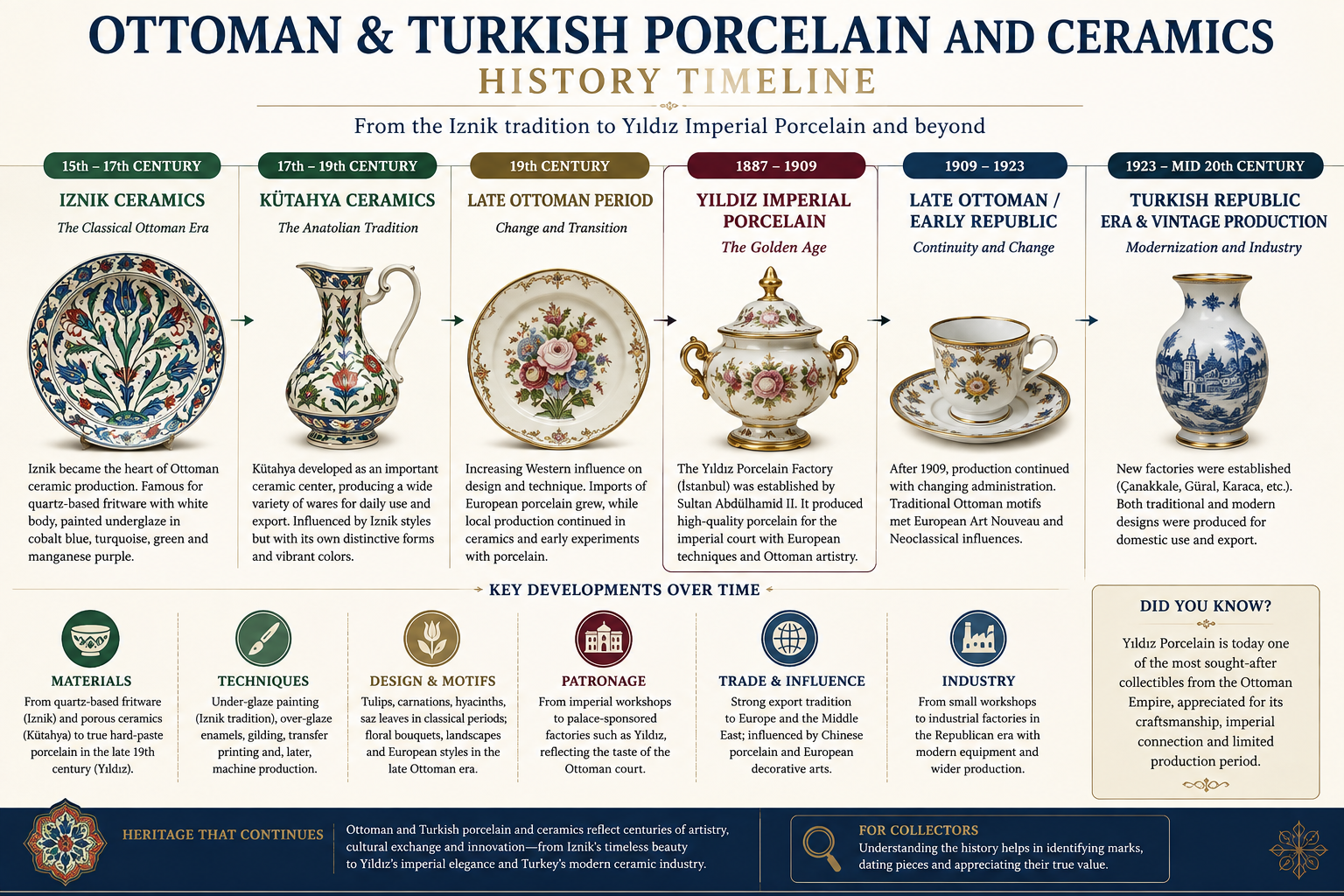
Is There Such a Thing as Ottoman Porcelain?
Yes, but the terminology requires care.
The Ottoman Empire possessed one of the world’s great ceramic traditions
centuries before an imperial porcelain factory appeared in Istanbul.
İznik workshops created sophisticated stonepaste vessels and architectural
tiles, while Kütahya developed another important centre of ceramic production.
These objects are frequently described loosely in the antiques trade as
“Turkish porcelain”, but this can be technically misleading.
For collectors, the distinction between
porcelain,
earthenware, stoneware and other ceramic bodies matters. Material is one of
the first clues when determining where and when an object was manufactured.
The Metropolitan Museum of Art, for example, describes sixteenth-century
İznik objects as stonepaste painted under transparent glaze,
rather than porcelain. This distinction is essential when identifying
supposed antique Ottoman porcelain.
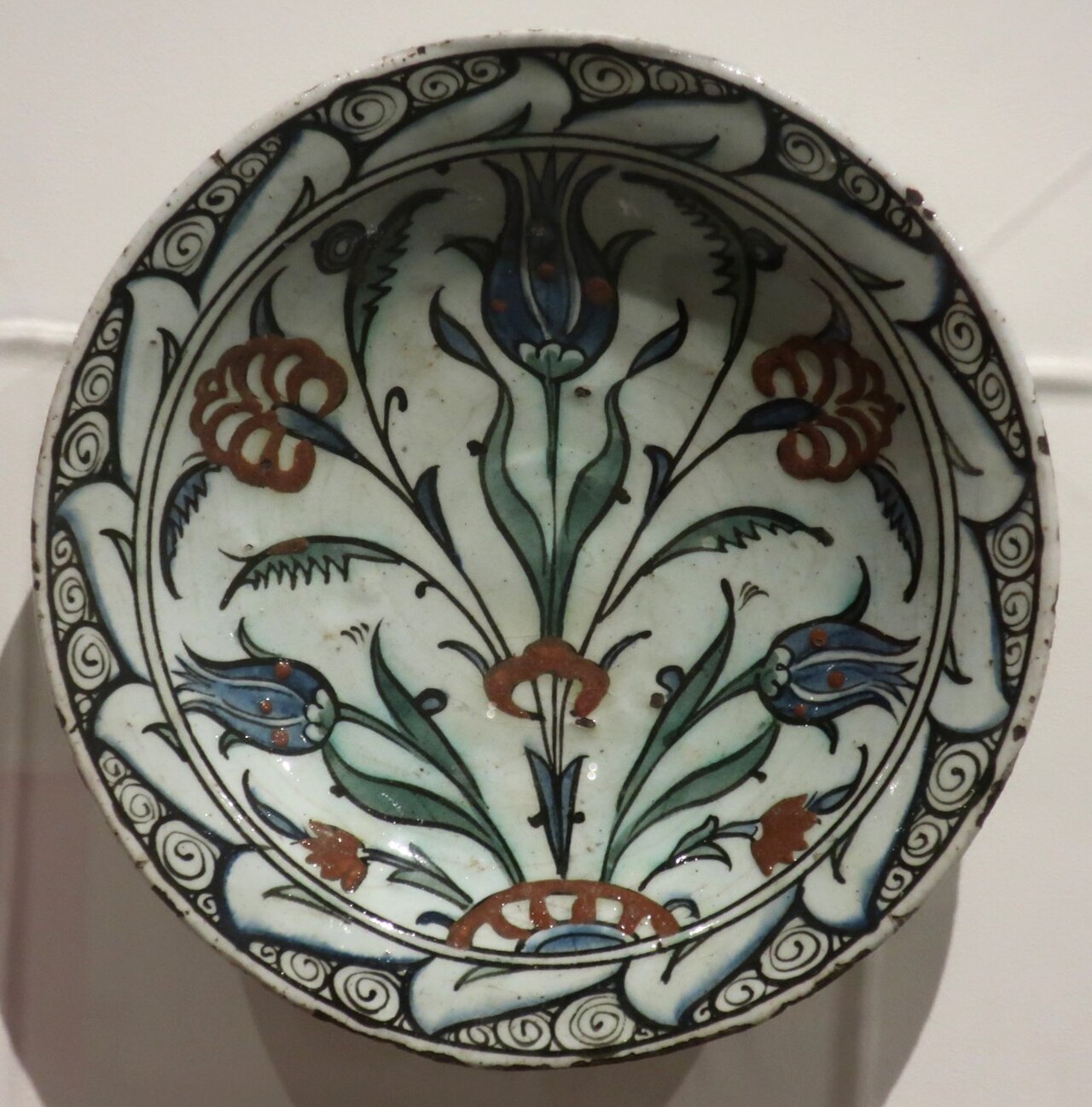
17th century. Earlier Ottoman ceramic traditions should not automatically
be classified as porcelain.
İznik Ceramics: The Great Ottoman Tradition Before Yıldız
Long before Yıldız porcelain appeared, İznik had established an artistic
language that became synonymous with classical Ottoman decorative art.
İznik potters produced vessels and architectural tiles using a refined
stonepaste body covered with painted decoration beneath a transparent glaze.
Blue-and-white designs were followed by increasingly complex palettes that
included turquoise, green and the celebrated raised red associated with
mature İznik production.
Tulips, carnations, hyacinths, roses and elongated saz leaves became
particularly recognisable elements. Chinese ceramic art provided an important
early influence, but Ottoman designers transformed those sources into a
distinctive visual language.
For collectors this distinction is crucial:
a sixteenth- or seventeenth-century İznik dish can be exceptionally
important and valuable without being porcelain.
Typical İznik Identification Clues
| Feature | What to Look For |
|---|---|
| Body | Light-coloured stonepaste / fritware rather than translucent porcelain |
| Decoration | Underglaze-painted floral and vegetal compositions |
| Colours | Cobalt blue, turquoise, green, black outlining and characteristic red on many later examples |
| Motifs | Tulips, carnations, hyacinths, roses, saz leaves and scrolling vegetation |
| Forms | Dishes, bowls, jugs, tankards and architectural tiles |
| Dating | Must be assessed through body, glaze, decoration, form and provenance rather than decoration alone |
Kütahya Ceramics
Kütahya represents another major chapter in the history of Ottoman and
Turkish ceramics. Its workshops developed their own regional traditions and
continued producing decorated ceramics through changing Ottoman and later
Turkish periods.
Kütahya deserves a separate place in any collector’s guide because pieces
are sometimes marketed broadly as “Ottoman porcelain”. A careful
identification should begin with the ceramic body and manufacturing
technique before attempting to attribute the maker or period.
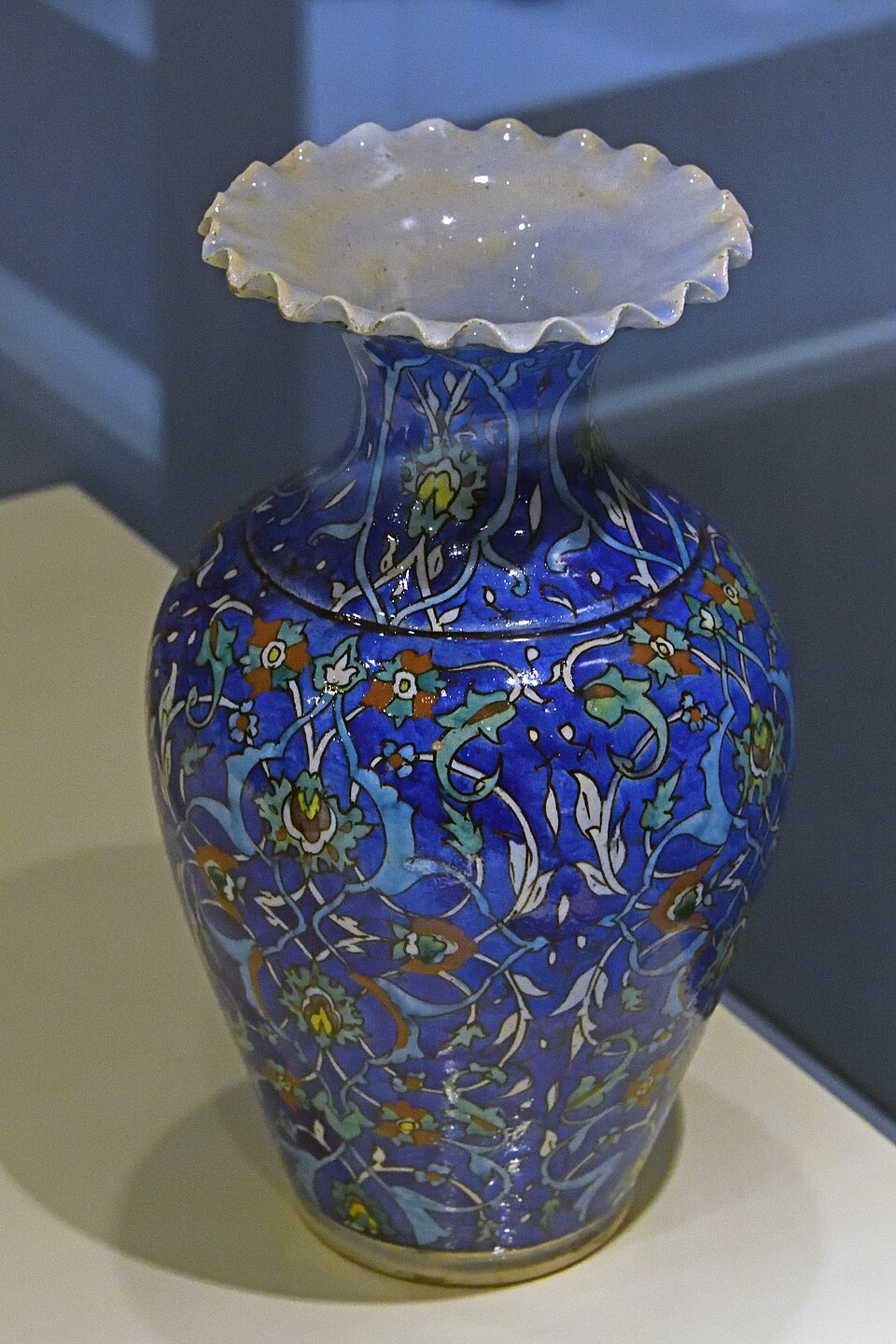
Ottoman and Turkish decorative arts.
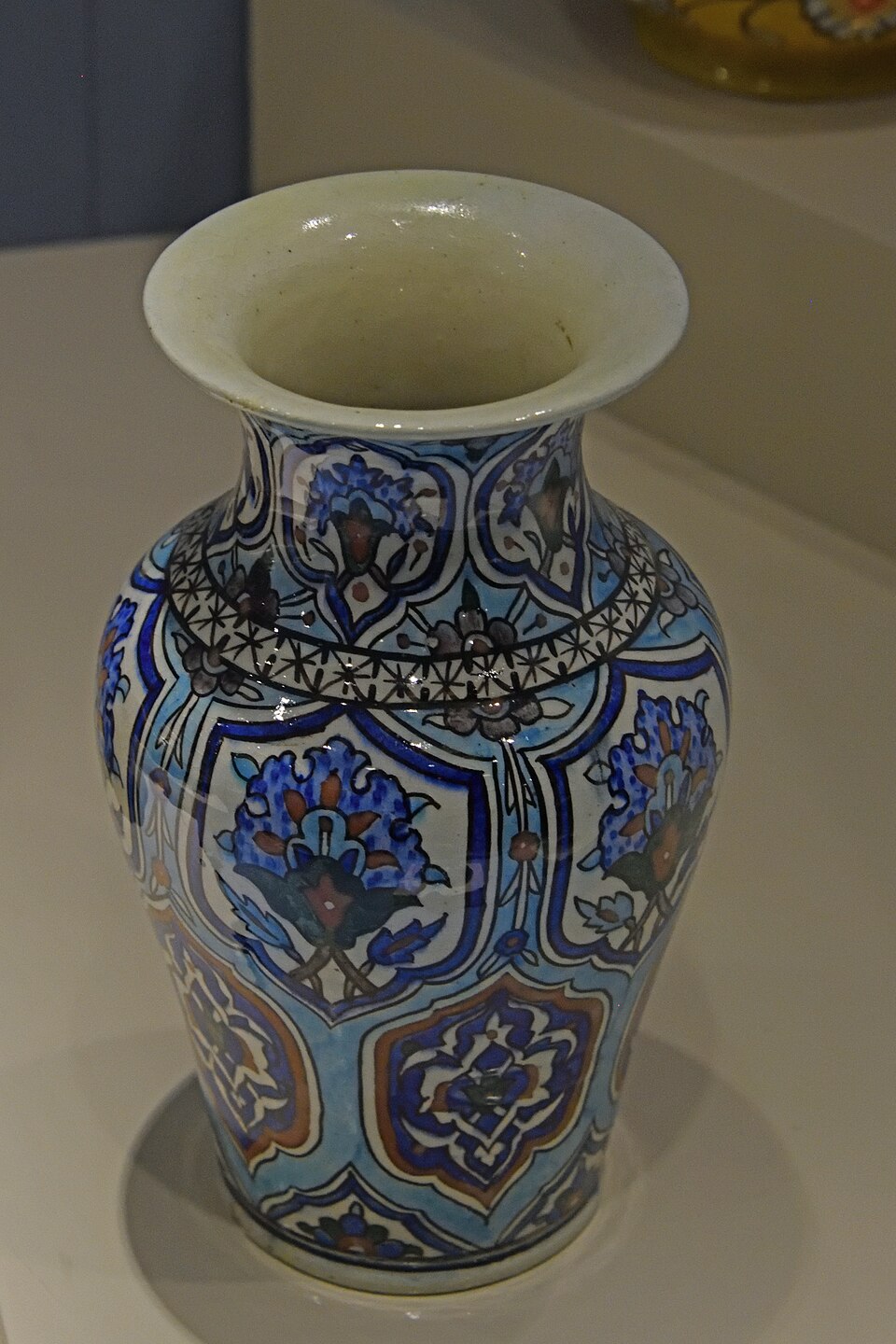
materials, forms and traditional decoration.
From Ottoman Ceramics to Imperial Porcelain
By the nineteenth century the Ottoman court existed within an increasingly
international world of luxury manufacture. European porcelain from major
continental factories had become an important part of elite material culture.
The establishment of a porcelain factory within the Yıldız Palace complex
therefore represented more than the creation of another workshop. It was
connected with technological modernisation, imperial patronage and the
ambition to manufacture prestigious porcelain within the Ottoman Empire.
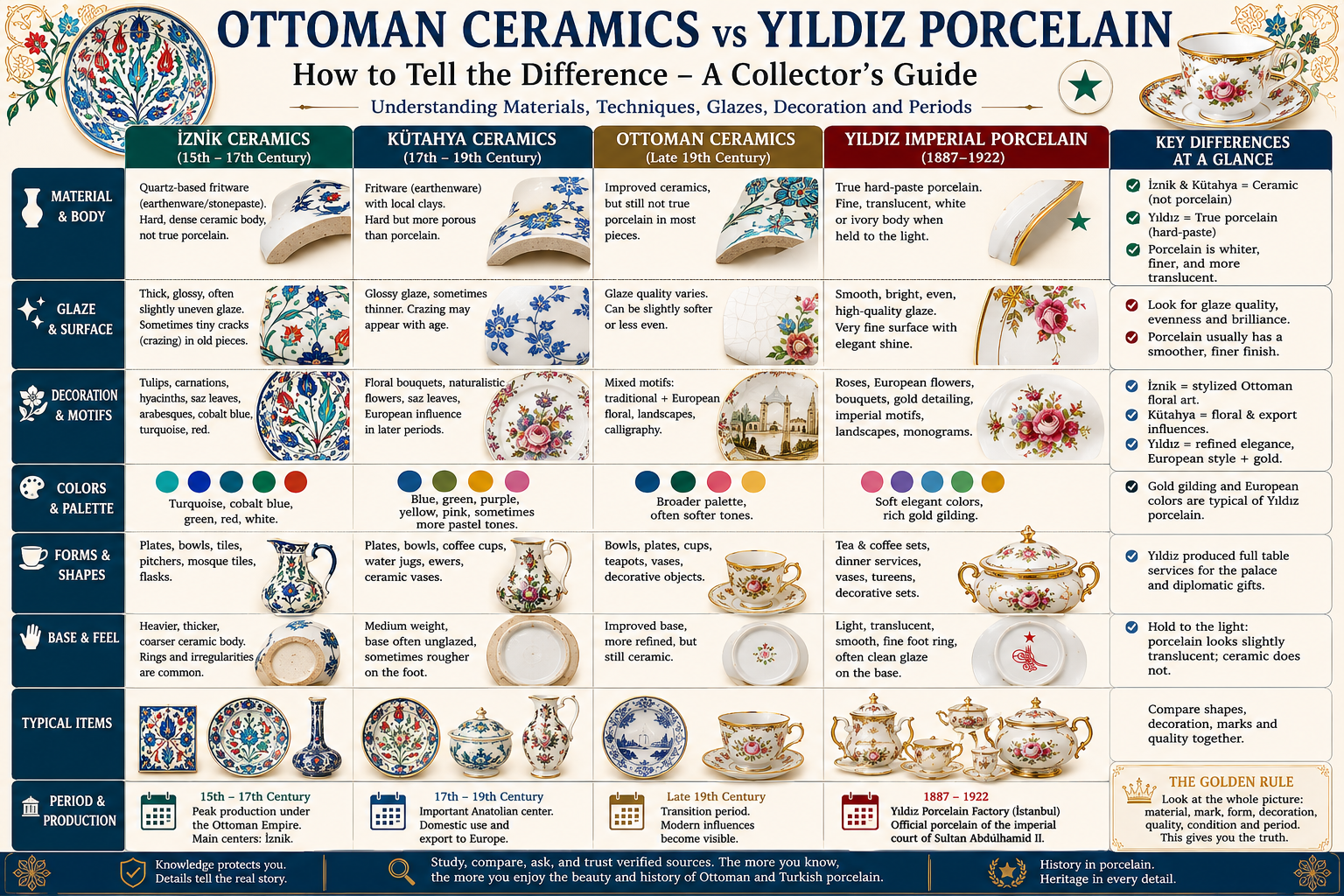
decoration and period rather than grouped together simply as Turkish porcelain.
Yıldız Imperial Porcelain: The Heart of Ottoman Porcelain
For anyone researching antique Ottoman porcelain,
Yıldız is the essential name.
The imperial factory was established in the grounds of
Yıldız Palace in Istanbul during the reign of Sultan Abdülhamid II.
Official Turkish National Palaces documentation identifies it as the
Yıldız Çini Fabrika-i Hümâyûnu and places its foundation in
the early 1890s.
Its purpose was closely connected with the palace. The factory was intended
to supply porcelain for imperial residences while also producing prestigious
objects capable of representing Ottoman artistic and industrial achievement
abroad.
Production incorporated European porcelain technology while developing
decoration suited to the late Ottoman court. This combination is one reason
Yıldız occupies such an unusual position in porcelain history: it was neither
simply a continuation of classical İznik ceramics nor merely an imitation of
European porcelain.
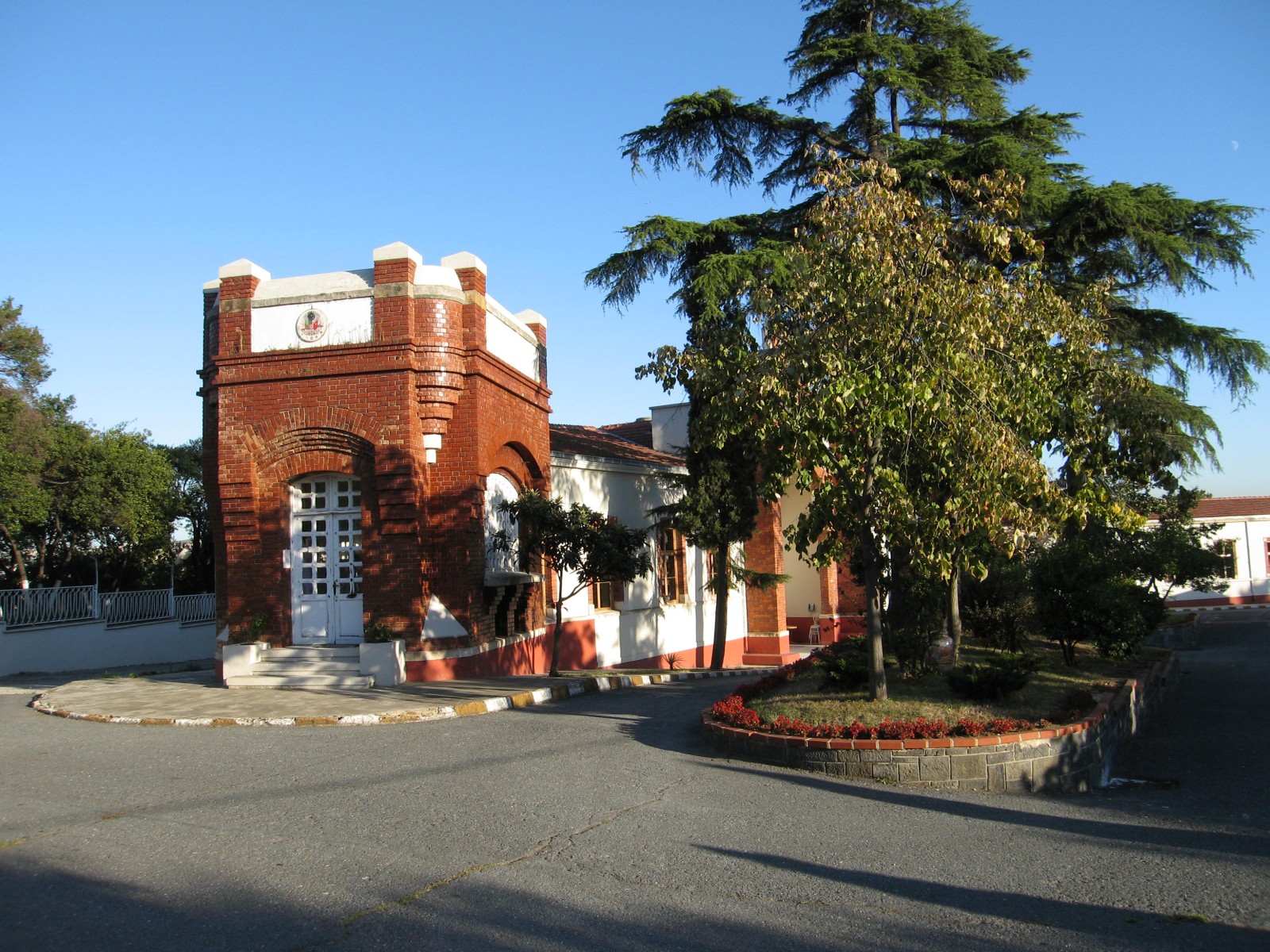
complex during the reign of Sultan Abdülhamid II.
When Was the Yıldız Porcelain Factory Founded?
Sources sometimes give slightly different dates because they distinguish
between establishment, construction, trial production and full operation.
Official and scholarly sources place the creation of the factory in the
early 1890s, while archival research identifies
1894 as the year in which the factory became operational.
The Istanbul earthquake of 1894 severely damaged the building. It was then
reconstructed under the Italian architect Raimondo D’Aronco.
European equipment, materials and expertise — particularly connections with
French porcelain technology — played an important role in the development
of the factory.
This is a useful lesson for collectors: when dating Yıldız porcelain, avoid
reducing its history to a single foundation date. Marks, production phase,
decoration and the individual object must be considered together.
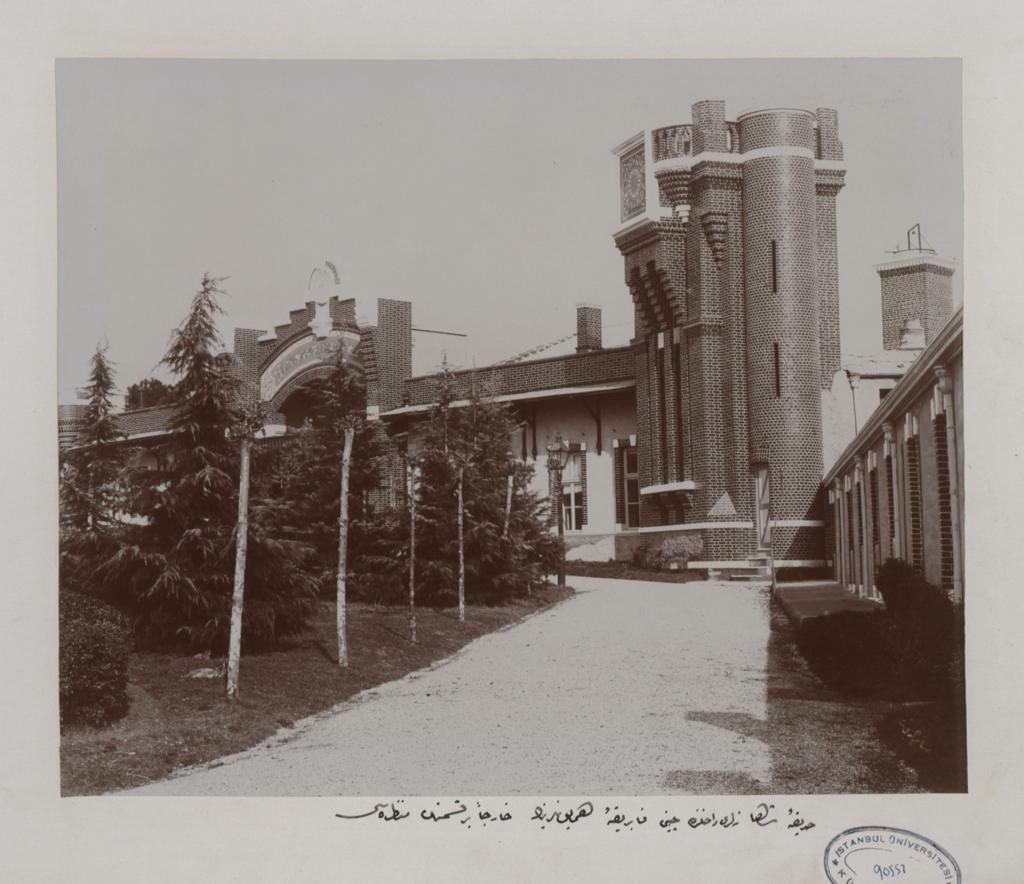
porcelain technology with late Ottoman artistic ambitions.
What Did the Yıldız Factory Produce?
Yıldız production was surprisingly diverse. Official National Palaces
documentation records objects ranging from monumental decorative vases to
table porcelain, coffee services and writing sets.
| Object Type | Typical Collector Interest |
|---|---|
| Large decorative vases | Scale, painting quality, landscapes, gilding and palace associations |
| Plates and wall plates | Painted scenes, floral decoration, marks and commemorative character |
| Cups and saucers | Complete pairs, decoration, gilding and condition |
| Coffee services | Completeness, rarity and Ottoman cultural context |
| Tableware | Pattern, surviving sets and provenance |
| Writing sets | Unusual forms and imperial-period associations |
| Presentation pieces | Provenance, inscriptions, recipients and historical importance |
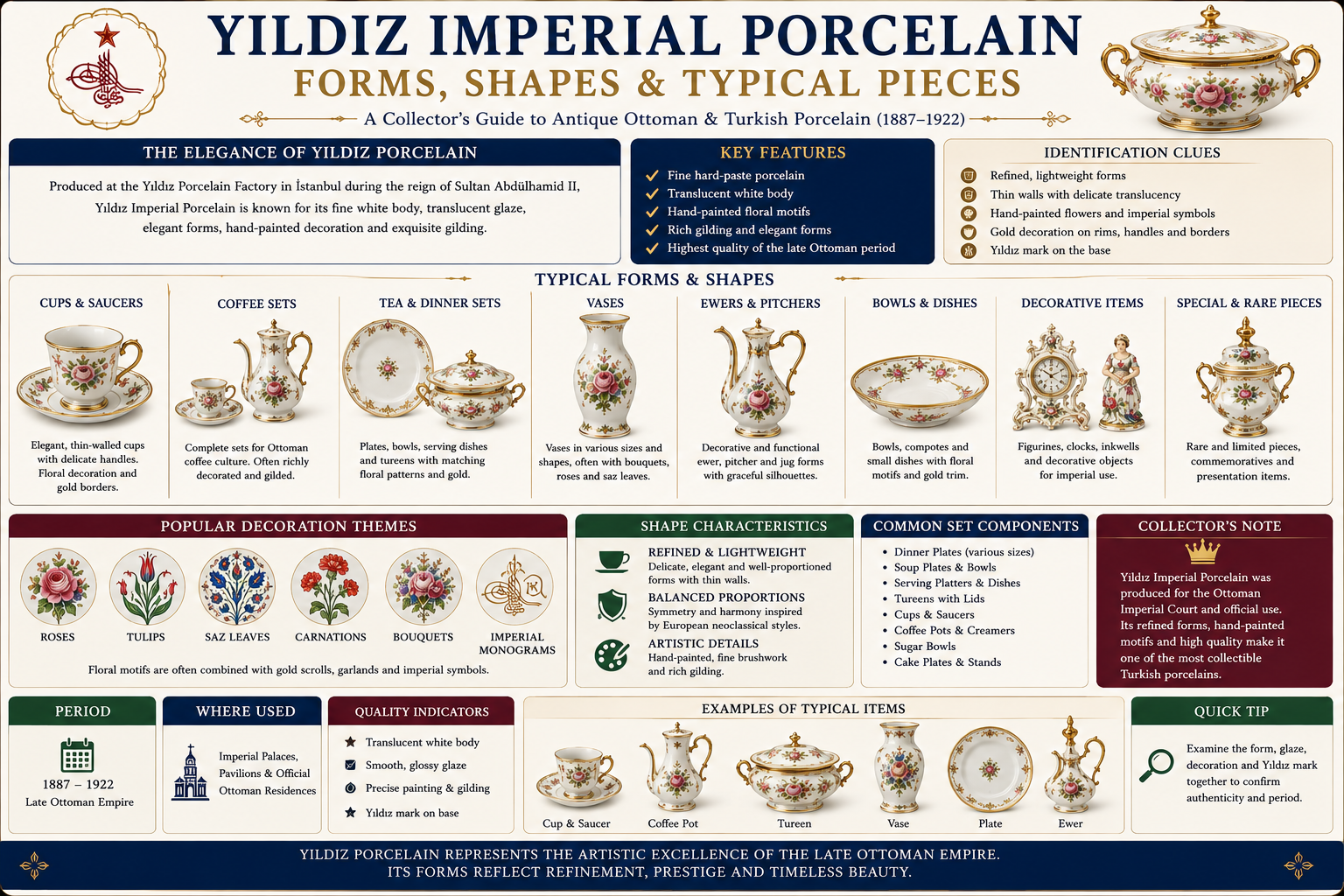
evidence when identifying an unrecorded piece.
What Does Antique Yıldız Porcelain Look Like?
There is no single decoration that identifies every Yıldız object.
The factory produced pieces in several artistic directions, and collectors
should be suspicious of any identification system based on one colour,
flower or border.
Nevertheless, genuine examples can display finely painted landscapes,
architectural scenes, flowers, Ottoman-inspired ornament, elaborate gilding
and decorative compositions influenced by European porcelain aesthetics.
Some pieces document contemporary architecture and landscapes with
remarkable detail.
The quality of painting matters. On a strong period example, decoration
should be evaluated as part of the object’s manufacture rather than treated
as an isolated printed image applied to an otherwise generic porcelain form.
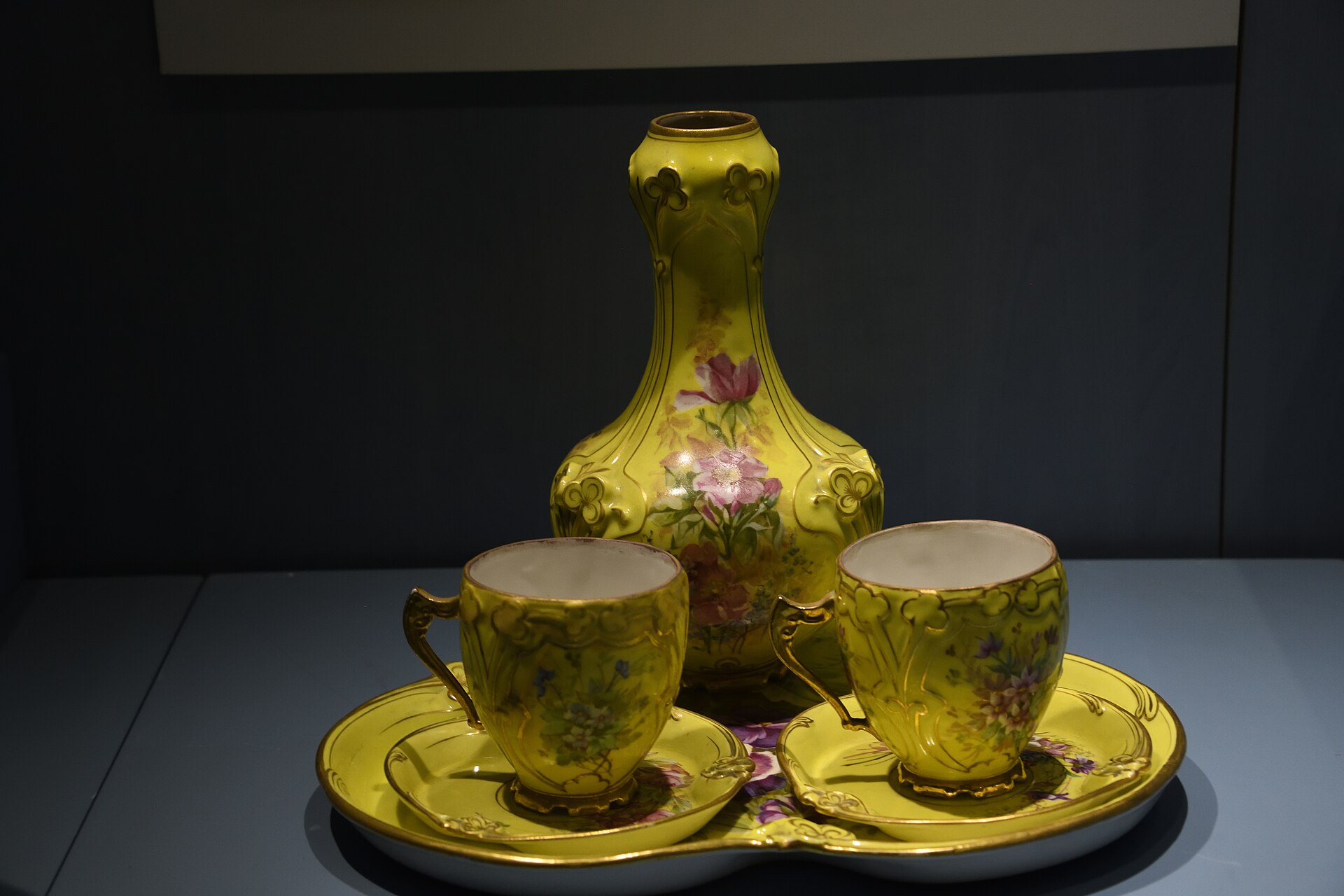
for collectors studying authentic late Ottoman examples.
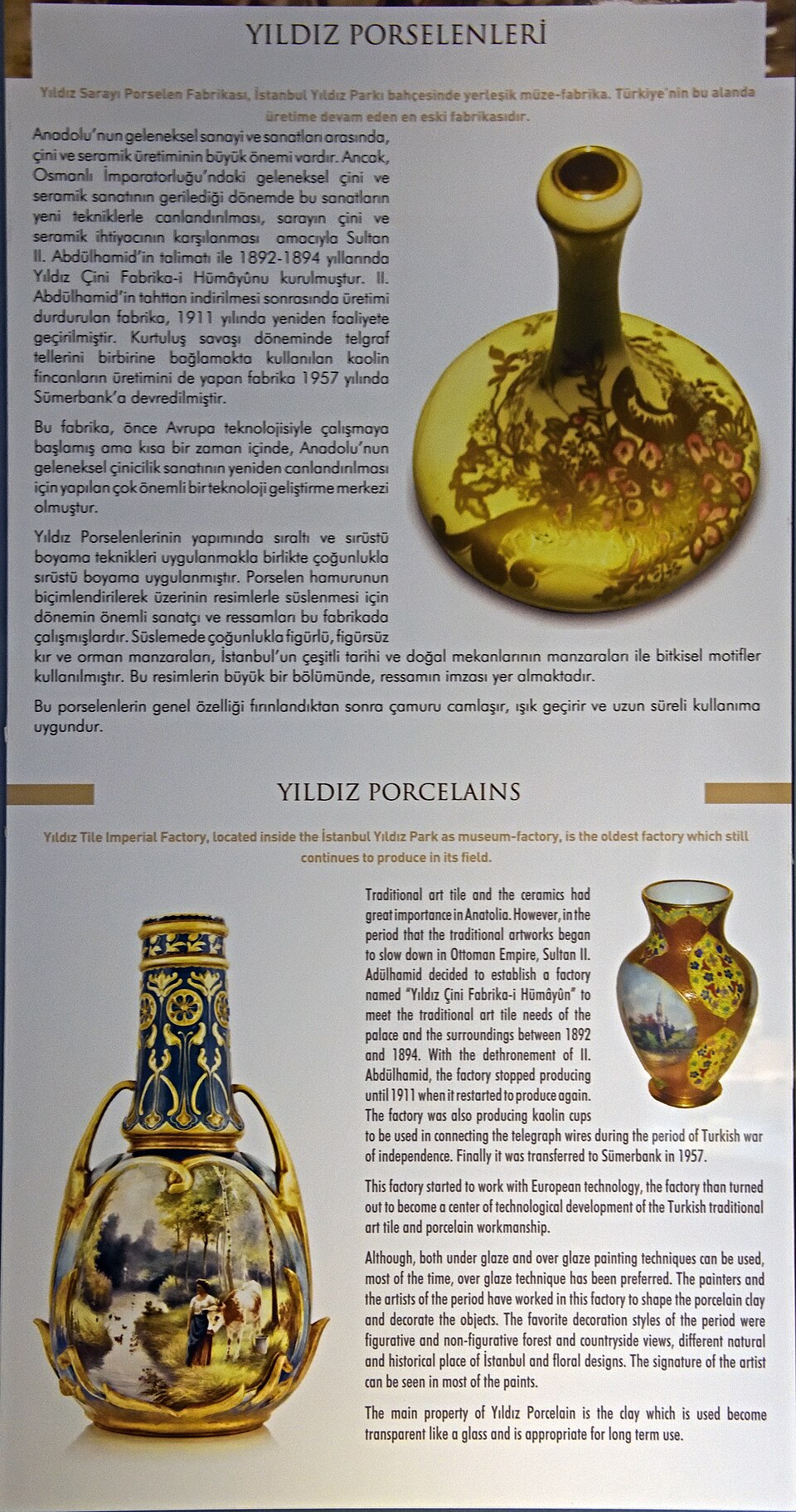
for comparing form, decoration and workmanship.
Yıldız Porcelain Marks
The mark is one of the most useful clues when identifying Yıldız porcelain,
but it must be interpreted carefully.
Official information from the Turkish National Palaces states that works
produced at the imperial factory carried its original
crescent-and-star emblem, with dating information associated
with the factory’s foundation and the year in which the piece was produced.
That makes the base of an object extremely important. When examining a
possible Yıldız piece, photograph the entire underside in good light before
cleaning it.
What to Examine on a Yıldız Mark
| Clue | Why It Matters |
|---|---|
| Crescent and star | An important element associated with documented imperial factory marks |
| Inscription | Lettering and script should be compared with documented period examples |
| Date information | Can assist in placing a piece within the factory’s production history |
| Application | Printed, painted or other mark characteristics should correspond with the object |
| Wear | The mark should make physical sense in relation to base wear and overall age |
| Porcelain body | A convincing mark on the wrong material remains a warning sign |
| Decoration and form | Both should be compatible with the proposed attribution and period |
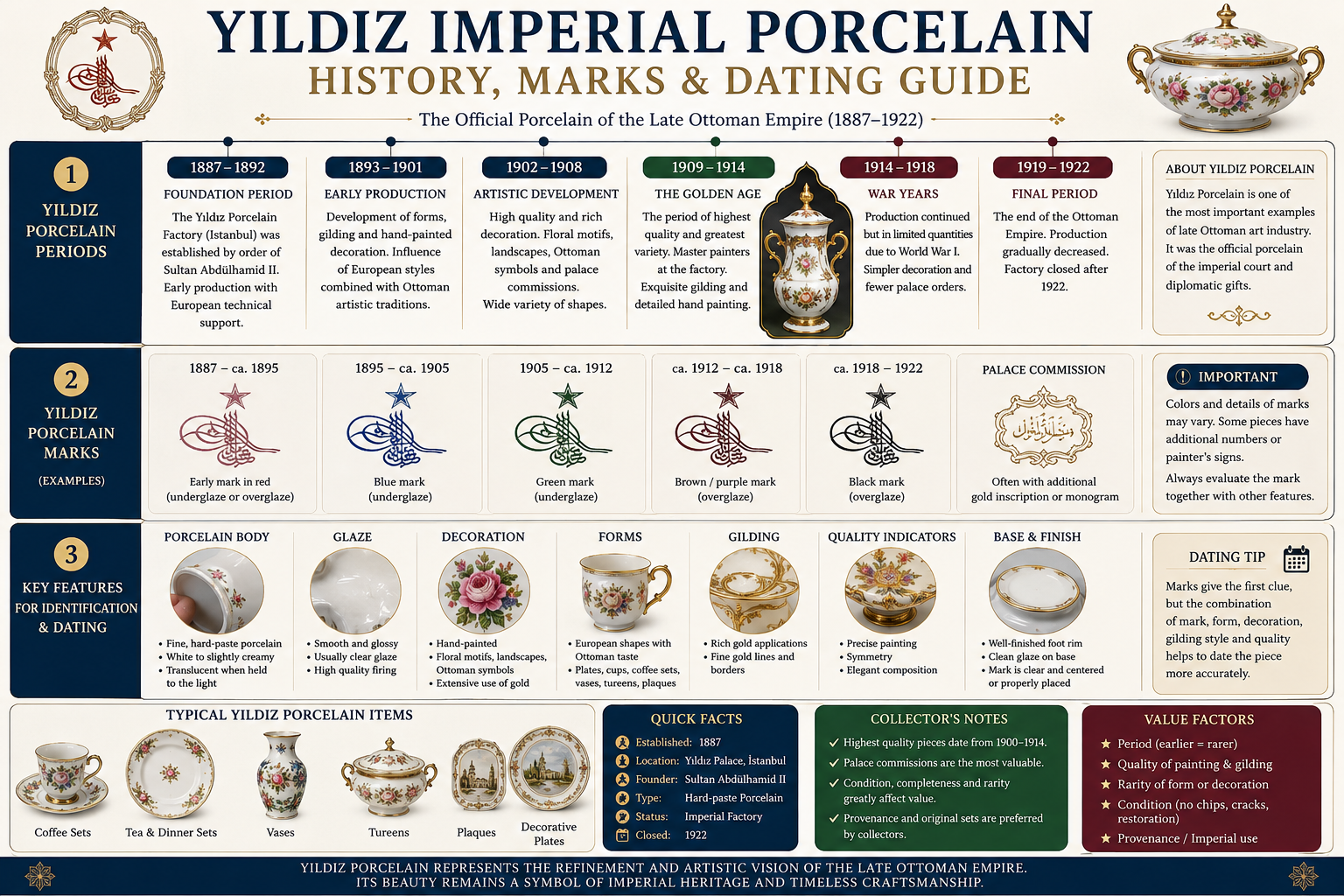
material, form, decoration and production history.
Can a Yıldız Mark Prove Authenticity?
No.
A mark is evidence, not a certificate of authenticity.
Marks can be copied, misunderstood or placed on later objects.
Conversely, an unclear or partially worn mark does not automatically prove
that an object is fake.
The safer approach is the same method used when examining other
porcelain marks:
compare every available clue.
A convincing attribution should produce a coherent picture:
- the porcelain body is appropriate;
- the mark is consistent with documented examples;
- the form belongs to the expected production tradition;
- the decoration and technique make sense;
- wear is consistent across the object;
- the proposed date is historically plausible;
- provenance supports rather than contradicts the attribution.
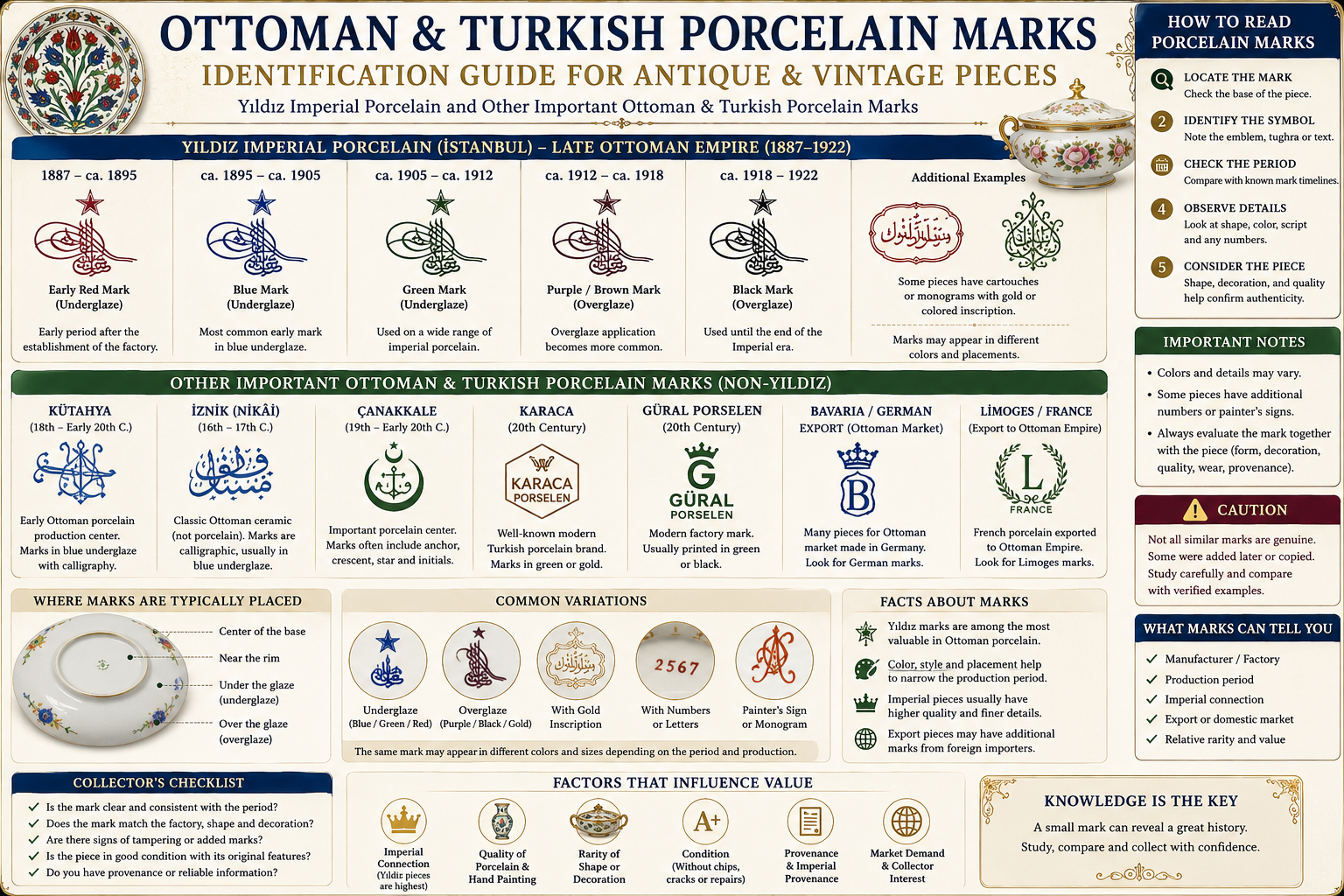
Marks should be evaluated within the complete physical and historical context.
How to Identify Antique Yıldız Porcelain
A practical examination should move from objective physical evidence toward
attribution rather than beginning with the assumption that a famous-looking
mark must be genuine.
| Step | Examination | Question to Ask |
|---|---|---|
| 1 | Mark | What exactly is written or depicted underneath? |
| 2 | Material | Is the object actually porcelain? |
| 3 | Manufacture | Does the body and construction fit Yıldız production? |
| 4 | Period | Do all characteristics support the proposed date? |
| 5 | Shape | Is the form compatible with documented production? |
| 6 | Decoration | Is it painted, printed, gilded or later decorated? |
| 7 | Wear | Is ageing natural and consistent? |
| 8 | Condition | Are there restorations, cracks, chips or replacements? |
| 9 | Provenance | Can ownership or collection history be documented? |
| 10 | Comparison | Does it correspond with reliable museum examples? |
Decoration and Motifs on Ottoman & Turkish Porcelain
Ottoman decorative history cannot be reduced to one visual vocabulary.
Classical İznik ceramics, provincial traditions such as Kütahya and late
imperial Yıldız porcelain belong to different periods and manufacturing
contexts.
Yet certain visual themes help explain the continuity of Ottoman decorative
culture. Tulips, carnations, roses, hyacinths, scrolling vegetation and
saz-derived foliage occur prominently in classical Ottoman art. Later
porcelain production could combine Ottoman references with European
naturalism, landscape painting and gilded decoration.
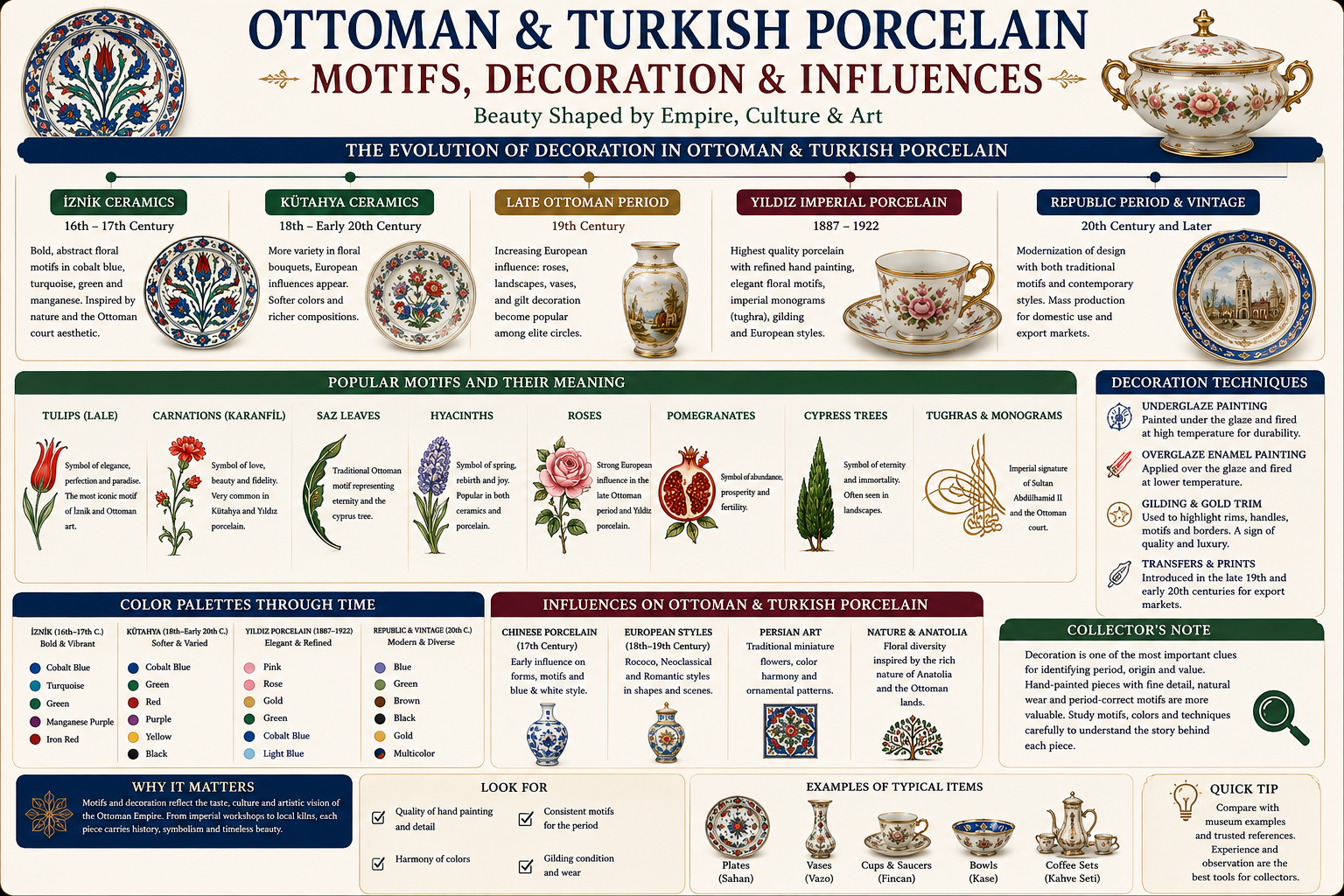
classical floral ceramic design to the more eclectic language of late
imperial porcelain.
Yıldız Porcelain and European Influence
Yıldız porcelain emerged within a period when Ottoman court culture was
deeply engaged with European technology, architecture and decorative arts.
The factory incorporated expertise and equipment associated with French
porcelain production while remaining an imperial Ottoman institution.
UNESCO’s documentation for the Yıldız Palace complex notes the use of
technology and materials connected with Sèvres and Limoges
during the reconstruction of the factory after the 1894 earthquake.
This European connection should not be interpreted as proof that Yıldız was
simply copying French porcelain. Its historical importance lies precisely in
the interaction between imported technology, palace patronage, Ottoman
subjects and locally developed artistic production.
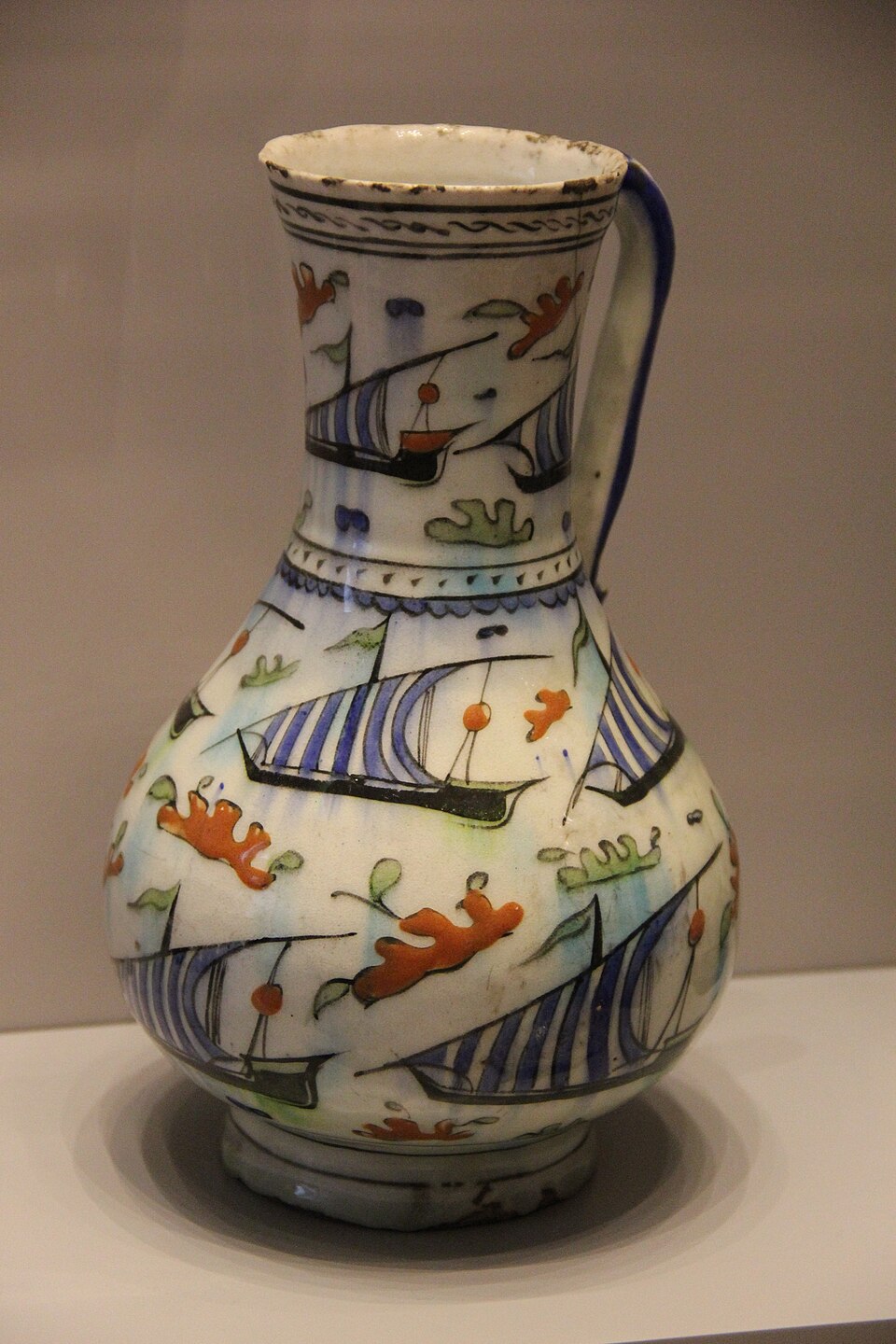
relationship between Ottoman ceramic traditions and later porcelain.
Why Yıldız Porcelain Matters to Collectors
Yıldız occupies a particularly interesting intersection of
Ottoman history, imperial patronage, European technology and
decorative art.
It is therefore collected for more than appearance alone. A significant
object may appeal simultaneously to collectors of porcelain, Islamic and
Ottoman art, nineteenth-century decorative arts, royal and imperial objects,
Turkish history and historic interiors.
This cross-category interest can be particularly important when assessing
rarity and market demand — subjects we will examine in the valuation section
of this guide.
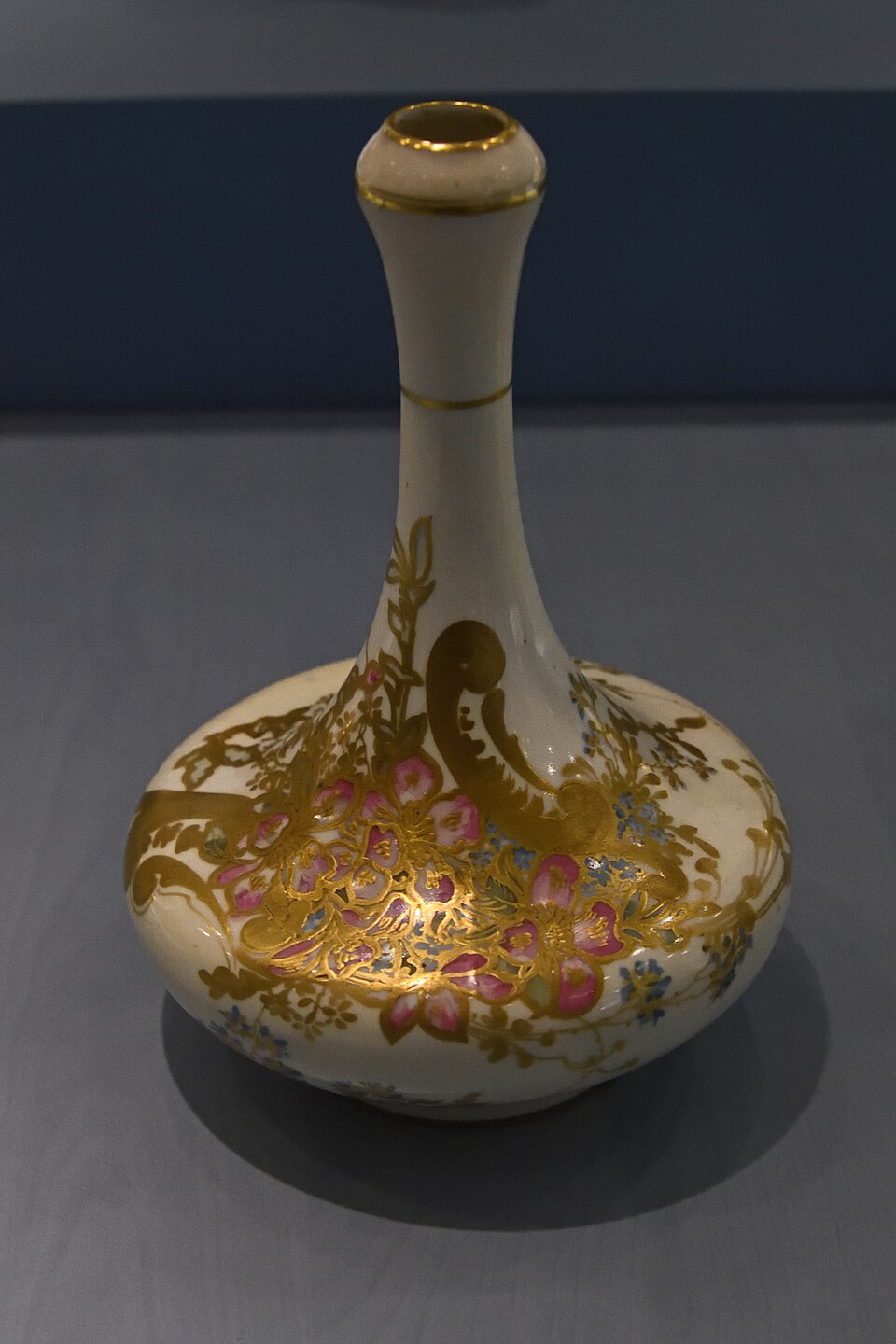
valuable reference material for attribution and dating.
How to Date Yıldız Porcelain
Dating Yıldız porcelain requires more than recognising the
crescent-and-star factory emblem. The strongest attribution combines the
mark with the porcelain body, decoration, form, documented production
history and signs of genuine age.
This is particularly important because the Yıldız factory did not belong to
only one historical moment. Its history includes the imperial production of
the Abdülhamid II period, interruptions and resumptions of production, and
much later twentieth-century manufacture.
Yıldız Porcelain Dating Timeline
| Period | Historical Context | Collector Significance |
|---|---|---|
| Early 1890s–1894 | Foundation and earliest imperial production under Sultan Abdülhamid II | Early imperial-period pieces deserve particularly careful study |
| 1894 | The Istanbul earthquake seriously damaged the factory; reconstruction followed | An important dividing point in the physical history of the factory |
| 1894–1909 | Main late Ottoman imperial production period | Central period for collectors of Abdülhamid II-era Yıldız porcelain |
| 1909 | Production stopped following the deposition of Sultan Abdülhamid II | Marks the end of the original palace-sponsored phase |
| 1910–1920 | Production resumed after the factory was attached to the Imperial Museum administration | Still historic Ottoman-period production, but a different institutional phase |
| Later 20th century | Factory activity eventually resumed under later Turkish institutions | Must not automatically be valued or described as imperial-period Yıldız |
| Modern production | The historic factory continues as a museum-factory and producer | A Yıldız name or mark therefore does not by itself prove nineteenth-century age |
Imperial Yıldız vs Later Yıldız Porcelain
This distinction is one of the most important points in the entire field.
The survival of the factory tradition means that the words
Yıldız, Yıldız Porselen or a Turkish
crescent-and-star motif should never automatically be interpreted as proof
of nineteenth-century imperial manufacture.
The historic factory eventually entered later institutional phases and
continued producing porcelain. Modern production inspired by traditional
motifs also exists.
Consequently, collectors should ask a more precise question:
Is this an imperial-period Yıldız object, an early twentieth-century
historic piece, or later Turkish production?
That question can have a major effect on historical significance,
collectibility and value.
Understanding Yıldız Porcelain Dates and Marks
Official documentation from the Turkish National Palaces provides an
especially useful clue. Imperial factory pieces carried the factory’s
crescent-and-star emblem, and dating information could appear beneath the
mark.
However, Ottoman dates require careful interpretation. A number appearing
on a genuine period mark should not be casually converted into a Gregorian
year without understanding the dating system and the context in which the
factory used it.
For example, documented Yıldız pieces can carry Ottoman date information
that corresponds to a particular year of production after the foundation
of the factory.
When in doubt, compare the mark with securely dated museum or published
examples rather than relying on an online mark chart alone.
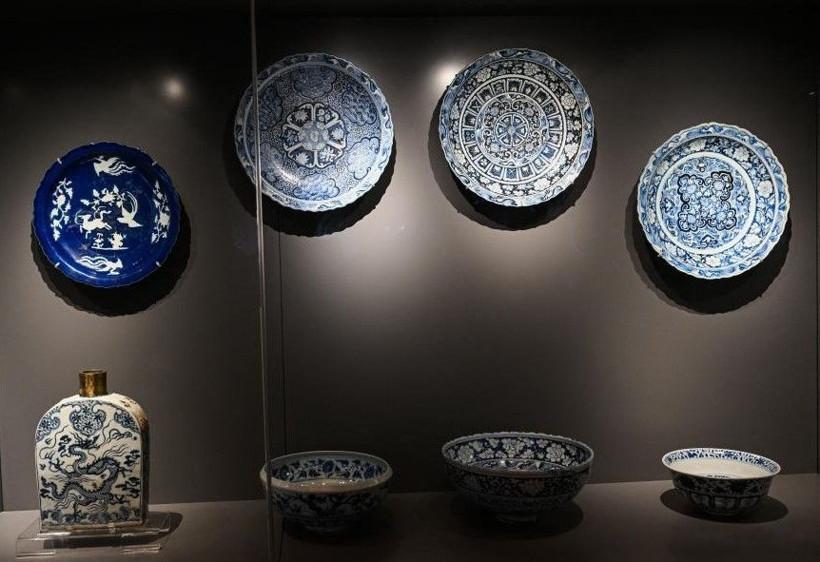
marks, decoration, forms and dating characteristics.
How to Spot a Possible Reproduction or Misidentified Piece
No single feature proves that a porcelain object is a reproduction.
Authentication is a process of eliminating contradictions.
A suspicious object often reveals itself because several pieces of evidence
do not agree with one another.
| Warning Sign | Why It Deserves Attention |
|---|---|
| Famous mark on an inappropriate body | A convincing-looking stamp cannot compensate for the wrong material |
| Artificial-looking wear | Ageing concentrated only around the mark or foot can be suspicious |
| Modern-looking printed decoration | Compare printing, painting and gilding with documented period workmanship |
| Historically impossible combination | Mark, form and decoration should belong to a plausible production context |
| Overly perfect mark on heavily worn porcelain | Different areas of an authentic object usually tell a reasonably consistent story |
| Seller relies only on the mark | Authentication requires material, technique, form, decoration and provenance too |
| No comparison with documented examples | Rare or expensive pieces deserve museum, catalogue or specialist comparison |
Natural Age Is a Pattern, Not a Trick
Collectors sometimes look for one magical sign of age: crazing, scratches,
a dirty foot rim or faded gilding. None of these alone proves authenticity.
Instead, examine whether the entire object has aged coherently.
- Does base wear correspond with the apparent age?
- Does gilding show plausible handling wear?
- Are scratches located where normal use would produce them?
- Does the mark age consistently with the surrounding porcelain?
- Are stains underneath or within old damage rather than simply applied to the surface?
- Does restoration explain any unusually fresh-looking area?
Porcelain Body and Quality
The porcelain itself is fundamental. Before researching a mark, establish
whether the object is actually porcelain.
Collectors should examine the exposed foot rim, thickness, firing quality,
glaze and — where appropriate — the way light interacts with thinner areas
of the body.
Do not confuse this with a simplistic “light test”. Not every genuine
porcelain object will appear dramatically translucent, especially when the
body is thick.
The objective is to understand the material as part of the complete
identification.
Hand Painting, Gilding and Decoration
Decoration is one of the pleasures of collecting Yıldız porcelain and also
one of the most useful identification clues.
Period objects may display detailed floral painting, landscapes,
architectural subjects, Ottoman symbols, inscriptions and gilded borders.
Some documented factory works depict contemporary buildings and landscaped
settings with an almost documentary character.
Look closely rather than judging the decoration from a distance.
Hand-painted work may reveal subtle brush variation, layering and individual
handling that differs from mechanically repeated transfer decoration.
Yet hand painting alone does not prove age. Modern porcelain can also be
hand decorated.
The correct question is whether the painting technique, porcelain
body, form, mark and proposed period agree with one another.
Condition: What Matters Most?
Condition can substantially influence the desirability and market value of
antique porcelain. At the same time, collectors should avoid expecting a
130-year-old object to look completely untouched.
| Condition Issue | Typical Importance |
|---|---|
| Minor surface wear | Often acceptable when consistent with age |
| Light gilding wear | Common on handled or frequently cleaned areas |
| Small rim chip | Can reduce value, depending on rarity and visibility |
| Hairline crack | Usually more significant than superficial wear |
| Major crack | Can substantially affect structural integrity and value |
| Old restoration | Impact depends on extent, quality and importance of the object |
| Replaced component | Important for lids, handles, finials and multi-part objects |
| Extensive overpainting | Can conceal damage and significantly complicate valuation |
Should Antique Yıldız Porcelain Be Restored?
Restoration is not automatically negative. A rare or historically important
piece may remain highly collectible despite an old professional repair.
The key questions are:
- How extensive is the restoration?
- Was original material removed?
- Has decoration been reconstructed?
- Is the restoration stable?
- Can it be detected and documented?
- How rare is the object without considering condition?
Before cleaning or restoring an important piece, consider professional
advice. Aggressive cleaning can remove gilding, painted decoration,
historical labels or other evidence useful for identification.
Why Provenance Matters
Provenance is the documented history of ownership and
custody of an object.
For ordinary table porcelain, provenance may have limited influence.
For an exceptional Yıldız presentation object, however, documented
connections with an Ottoman palace, diplomatic recipient, historic
collection or important individual can dramatically change its historical
importance.
Useful provenance evidence can include:
- old invoices;
- auction catalogues;
- collection labels;
- historic photographs;
- inventory numbers;
- family records;
- museum deaccession documentation;
- published collection catalogues;
- correspondence relating to a diplomatic or presentation gift.
Keep such documents with the object. Never remove an old label simply
because it appears unattractive.
How Rare Is Antique Yıldız Porcelain?
Rarity is more complicated than age.
A relatively early piece is not necessarily rare, while an unusual form,
important painted subject, special commission or documented presentation
piece may be substantially scarcer than ordinary production from the same
period.
Features That Can Increase Collector Interest
- early imperial production;
- unusual or monumental size;
- rare form;
- exceptional hand-painted decoration;
- important architectural or landscape subject;
- Ottoman imperial arms or associated symbolism;
- inscription or dedication;
- documented artist;
- documented palace provenance;
- diplomatic presentation history;
- complete coffee, tea or table service;
- excellent original condition.
What Is Yıldız Porcelain Worth?
There is no reliable universal price list for antique
Yıldız porcelain.
Market value depends on exactly what the object is, when it was made,
whether its attribution is secure, its quality, rarity, condition,
provenance and current collector demand.
This is why two objects carrying superficially similar marks can have
dramatically different values.
Main Factors Affecting Yıldız Porcelain Value
| Factor | Potential Effect on Value |
|---|---|
| Authenticity | Fundamental — an incorrect attribution can change the market category completely |
| Period | Imperial-period production can attract stronger historical interest |
| Rarity | Scarce forms, subjects and commissions may command premiums |
| Decoration | Exceptional hand painting and sophisticated gilding can increase desirability |
| Artist / decorator | A documented maker or artist can be important on exceptional pieces |
| Condition | Cracks, major restoration and losses usually reduce value |
| Provenance | Documented palace or diplomatic history may add substantial importance |
| Size | Monumental pieces can attract interest, but size alone does not guarantee value |
| Completeness | Complete services and matching components may be more desirable |
| Market demand | Collector taste and auction competition change over time |
A Documented Yıldız Auction Example
Auction archives can be useful for understanding what serious collectors
look for, although an old auction result should never be treated as a
permanent price guide.
For example, Christie’s has documented an Ottoman Yıldız porcelain armorial
platter dated AH 1312 / 1894–95. The platter bears the
Ottoman coat of arms and the tughra of Sultan Abdülhamid II, with the
Yıldız mark and date on the underside.
The importance of such a piece comes from the combination of
documented dating, imperial iconography, factory attribution,
decoration and historical context — not simply from the presence
of a Yıldız mark.
Do Yıldız Marks Make a Piece Valuable?
Not automatically.
The mark helps answer who, where and possibly when. It does not
answer all the questions that determine value.
Consider two marked Yıldız objects. One might be a relatively ordinary later
decorative plate with wear. Another could be an imperial-period presentation
vase with exceptional painting and documented provenance.
The difference in significance can be enormous even though both carry a
factory mark.
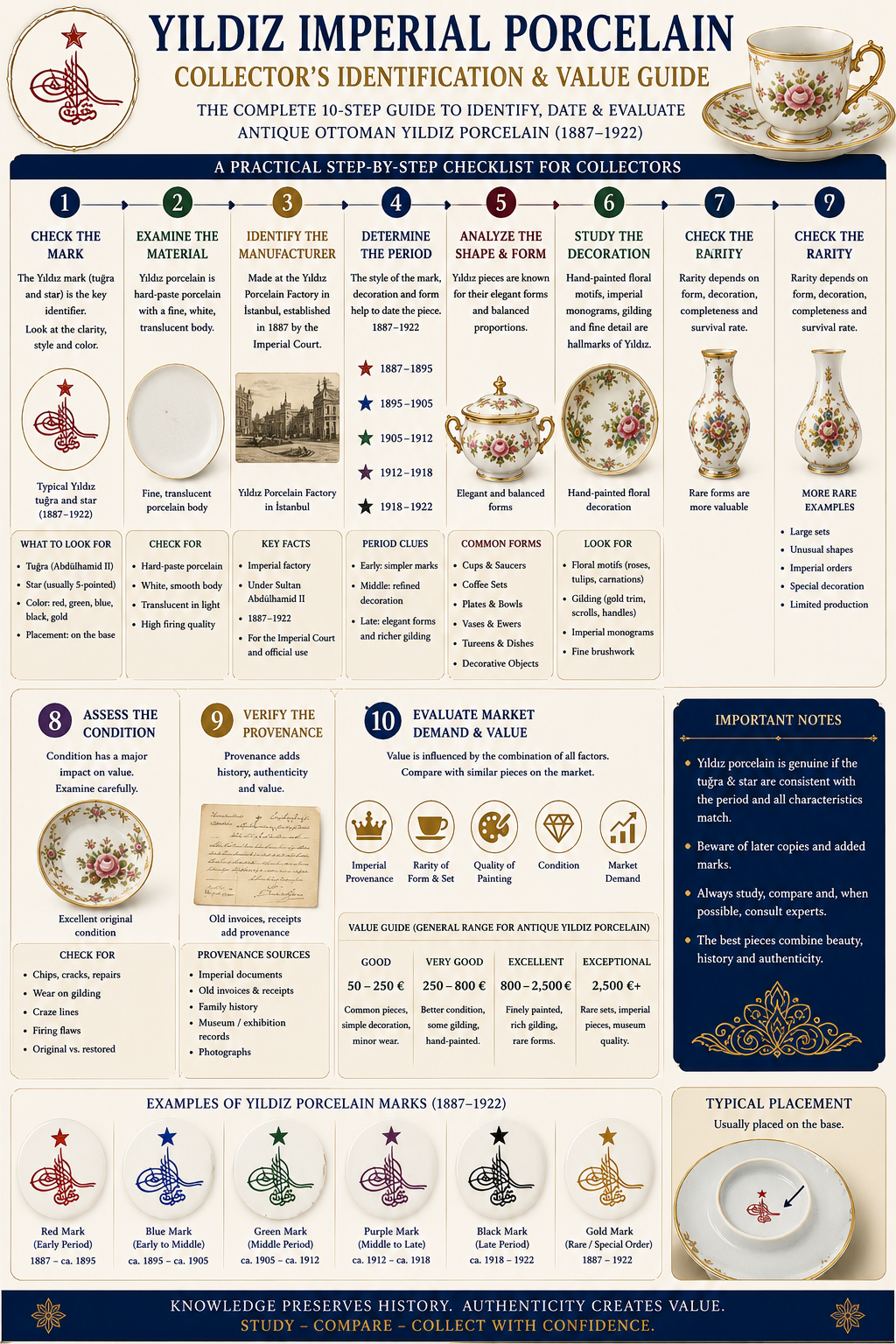
marks, material, maker, period, form, decoration, rarity, condition,
provenance and market demand.
10-Step Yıldız Porcelain Identification & Value Method
| # | Check | What You Are Establishing |
|---|---|---|
| 1 | Mark | Factory, inscription, emblem and possible dating information |
| 2 | Material | Whether the object is genuinely porcelain rather than another ceramic body |
| 3 | Manufacturer | Whether Yıldız attribution is physically and historically plausible |
| 4 | Period | Imperial, later Ottoman, later Turkish or modern production |
| 5 | Shape | Whether the form corresponds with known production |
| 6 | Decoration | Painting, gilding, transfer decoration and stylistic quality |
| 7 | Rarity | How frequently comparable pieces appear |
| 8 | Condition | Damage, restoration, wear and completeness |
| 9 | Provenance | Documented ownership and historical associations |
| 10 | Market Demand | Current interest in comparable objects |
Collector Checklist
- □ Photograph the front, back and underside.
- □ Photograph the mark straight-on in natural light.
- □ Measure height, width and diameter accurately.
- □ Determine whether the body is porcelain or another ceramic material.
- □ Compare the mark with documented Yıldız examples.
- □ Check whether the proposed date fits the factory’s history.
- □ Examine decoration under magnification.
- □ Inspect gilding for natural wear.
- □ Look for chips, cracks and hairlines.
- □ Check for restoration and overpainting.
- □ Inspect lids, handles and finials for replacements.
- □ Preserve all labels and old inventory numbers.
- □ Research provenance before cleaning the object.
- □ Compare with museum and reputable auction examples.
- □ Never determine authenticity from the mark alone.
Common Identification Mistakes
| Mistake | Better Approach |
|---|---|
| Calling every Ottoman ceramic object porcelain | Identify the ceramic body first |
| Calling İznik porcelain | Use historically accurate material terminology such as stonepaste / fritware where appropriate |
| Assuming every Yıldız mark is imperial | Determine the production period |
| Dating from decoration alone | Combine style with mark, body, form and provenance |
| Assuming crazing proves age | Study the complete pattern of wear and manufacture |
| Ignoring restoration | Inspect under different lighting and magnification |
| Using asking prices as market value | Study comparable documented sales and object quality |
| Cleaning before research | Document the object completely before intervention |
Ottoman Ceramics vs Ottoman Porcelain: Quick Reference
| Feature | İznik | Kütahya | Yıldız |
|---|---|---|---|
| Primary Category | Historic Ottoman ceramics | Ottoman / Turkish ceramics | Ottoman porcelain |
| Material | Primarily stonepaste / fritware | Various ceramic bodies | Porcelain |
| Major Historical Importance | Classical Ottoman period | Long regional ceramic tradition | Late Ottoman imperial production |
| Typical Collector Clue | Body + underglaze decoration + style | Body + decoration + regional characteristics | Mark + porcelain body + date + decoration |
| Should It Automatically Be Called Porcelain? | No | No | Yes, for documented porcelain production |
Why Museum Comparisons Matter
Museum collections provide something that online marketplace listings often
cannot: objects with researched attribution and institutional documentation.
When studying an unfamiliar Ottoman or Turkish ceramic object, compare it
with examples held by museums and recognised collections before comparing
it with anonymous internet listings.
Ottoman and Yıldız porcelain.
How to Photograph Yıldız Porcelain for Identification
Good photographs can make the difference between a useful preliminary
assessment and an impossible one.
Photograph:
- the complete object from the front;
- the reverse;
- both sides;
- the entire underside;
- a close-up of every mark;
- the foot rim;
- decoration details;
- gilding;
- any signature or inscription;
- all chips, cracks or restoration;
- old labels and collection numbers.
Avoid filters and excessive image sharpening. Natural colour is useful when
assessing porcelain and painted decoration.
Frequently Asked Questions About Yıldız & Ottoman Porcelain
Is Yıldız porcelain Ottoman?
Imperial-period Yıldız porcelain was produced in Istanbul under the Ottoman
Empire and is one of the most important examples of genuine late Ottoman
porcelain production. The factory, however, survived into later periods, so
not every Yıldız object is necessarily Ottoman-period.
When was the Yıldız Porcelain Factory founded?
The factory was established during the reign of Sultan Abdülhamid II in the
early 1890s. Official National Palaces publications commonly identify 1891
in connection with its foundation. The factory was seriously damaged by the
1894 Istanbul earthquake and rebuilt.
What is the Yıldız porcelain mark?
The historic imperial factory used a distinctive emblem incorporating the
crescent and star. Documented factory pieces may also carry dating
information. Marks should always be compared with reliable period examples.
Does a crescent-and-star mark mean my porcelain is Yıldız?
Not necessarily. Crescent-and-star imagery is not exclusive proof of Yıldız
manufacture. The mark, porcelain body, decoration, form, age and historical
context must agree.
Is İznik porcelain?
Generally, no. Classical İznik ware is more accurately described as
stonepaste or fritware ceramic rather than true porcelain. Calling all İznik
objects “porcelain” obscures an important material distinction.
Is Kütahya porcelain?
Kütahya has a long and important ceramic tradition, but historic Kütahya
wares should not automatically be classified as porcelain. The material of
the individual object must be identified.
How can I tell whether Yıldız porcelain is old?
Study the mark, body, form, decoration, gilding, wear and production period
together. Compare the object with documented museum examples and preserve
any provenance information.
Is antique Yıldız porcelain valuable?
Some pieces can be highly collectible, particularly when they combine
imperial-period manufacture, rarity, exceptional decoration, good condition
and documented provenance. Other Yıldız pieces may be considerably more
common. The factory name alone does not establish value.
Does restoration destroy the value?
Not always. Restoration generally affects value, but the impact depends on
its extent and quality as well as the rarity and historical importance of
the object. A very rare piece can remain significant despite restoration.
Can I identify Yıldız porcelain from a photograph?
Photographs can support a preliminary identification, especially when clear
images of the base and mark are available. Important or valuable pieces may
require physical examination and additional provenance research.
Final Collector’s Takeaway
The key to understanding Ottoman and Turkish porcelain is
classification before attribution.
Do not begin by asking whether an object looks Ottoman. Begin by asking what
it is made from.
İznik represents one of the greatest traditions of Ottoman ceramic art, but
its celebrated wares are not porcelain in the strict technical sense.
Kütahya represents another long and important ceramic tradition.
Yıldız, meanwhile, occupies the central position in the
history of genuine late Ottoman imperial porcelain.
For Yıldız, the safest identification sequence remains:
mark → material → manufacturer → period → shape → decoration → rarity →
condition → provenance → market demand
No single mark, motif or colour replaces that complete examination.
Related Guides
- What Is Porcelain?
- What Are Porcelain Marks?
- How to Identify Antique Porcelain
- What Is Authenticity?
- What Is a Replica?
- What Is a Fake?
- What Is Patina?
- Antique Valuation Guide
Continue Exploring
Explore more identification guides, porcelain histories, makers’ marks and
collector resources in
Stories & Knowledge
from The Old Antiquarian.
Sources & References
-
Presidency of the Republic of Türkiye – National Palaces:
Yıldız Tile and Porcelain Factory. Official history of the factory,
its establishment under Sultan Abdülhamid II, production, marks and later
institutional history. -
National Palaces – Yıldız Tile and Porcelain Factory Catalogue
(2022):
official catalogue devoted to the history and production of the imperial
factory. -
The Metropolitan Museum of Art:
museum collection records for Ottoman and İznik ceramics used for material
and historical comparison. -
Christie’s:
archival catalogue entry for a Yıldız porcelain armorial platter,
Ottoman Istanbul, dated AH 1312 / 1894–95. -
Honolulu Museum of Art:
museum reference for seventeenth-century Ottoman glazed ceramic ware.
