
The Complete Object: Why Original Labels, Boxes and Paperwork Matter to Collectors
Last Updated: September 12, 2026 | By The Old Antiquarian
A vintage or antique object does not always survive alone. Sometimes its original box, factory tag, receipt, warranty card, instructions, catalogue, service papers, photographs or other documents survive with it. These apparently secondary materials can preserve information that the object itself no longer reveals.
For collectors, this matters because an object is understood not only through its appearance, but through the combined evidence of authenticity, originality, provenance, completeness, condition and historical context. An original box or old receipt does not automatically make an object authentic or valuable—but when the paperwork genuinely belongs to the item and agrees with its physical evidence, it may make the object easier to identify, research and understand.
Quick Answer
Do original boxes, labels and paperwork make vintage or antique objects more valuable?
Sometimes—but there is no universal premium or fixed percentage. Original packaging, labels, receipts, warranty papers, manuals, certificates, accessories and provenance documents can strengthen completeness, identification, provenance and collector confidence. Their effect on desirability or market value depends on the category, rarity, condition, originality, documentation quality and current collector demand. Paperwork must also genuinely correspond to the object: an old box or certificate alone is never proof of authenticity.
At a Glance: What Surviving Material Can Tell Us
| Surviving Element | What It May Help Establish | Important Limitation |
|---|---|---|
| Original label / factory tag | Maker, retailer, model, material, size, stock information or original market | Labels can be moved, copied or associated with the wrong object |
| Original box / packaging | Original retail presentation, model identification and completeness | A period box is not necessarily the correct box |
| Receipt / invoice | Purchase date, retailer, location, buyer or historic price | Useful only when the connection to the object is credible |
| Warranty papers | Dealer, sale date, model or serial number, depending on category | Numbers and dates should correspond with the object |
| Manual / instructions | Model, intended use, configuration, accessories or period context | Generic manuals may cover several models |
| Certificate | Attribution, identity or provenance information | A certificate is only as reliable as its issuer and supporting evidence |
| Service papers | Maintenance, repairs, replaced parts or service chronology | Service history may reveal both positive care and significant alteration |
| Letters / photographs / inventories | Ownership, location, family history, collection history or historical context | The connection to the exact object must be demonstrated |
What Does “Complete” Mean in Collecting?
In collecting, complete is not a universal condition grade. It usually means that an object retains the components, accessories or supporting material expected to have accompanied it when originally sold or issued.
What constitutes completeness varies dramatically by category. A vintage watch might be described as complete when it retains its presentation box, warranty papers, booklet, tags and accessories. A camera set might include the case, lens caps, instruction manual, warranty card and original carton. A porcelain figurine may originally have been sold simply with a branded box and paper label.
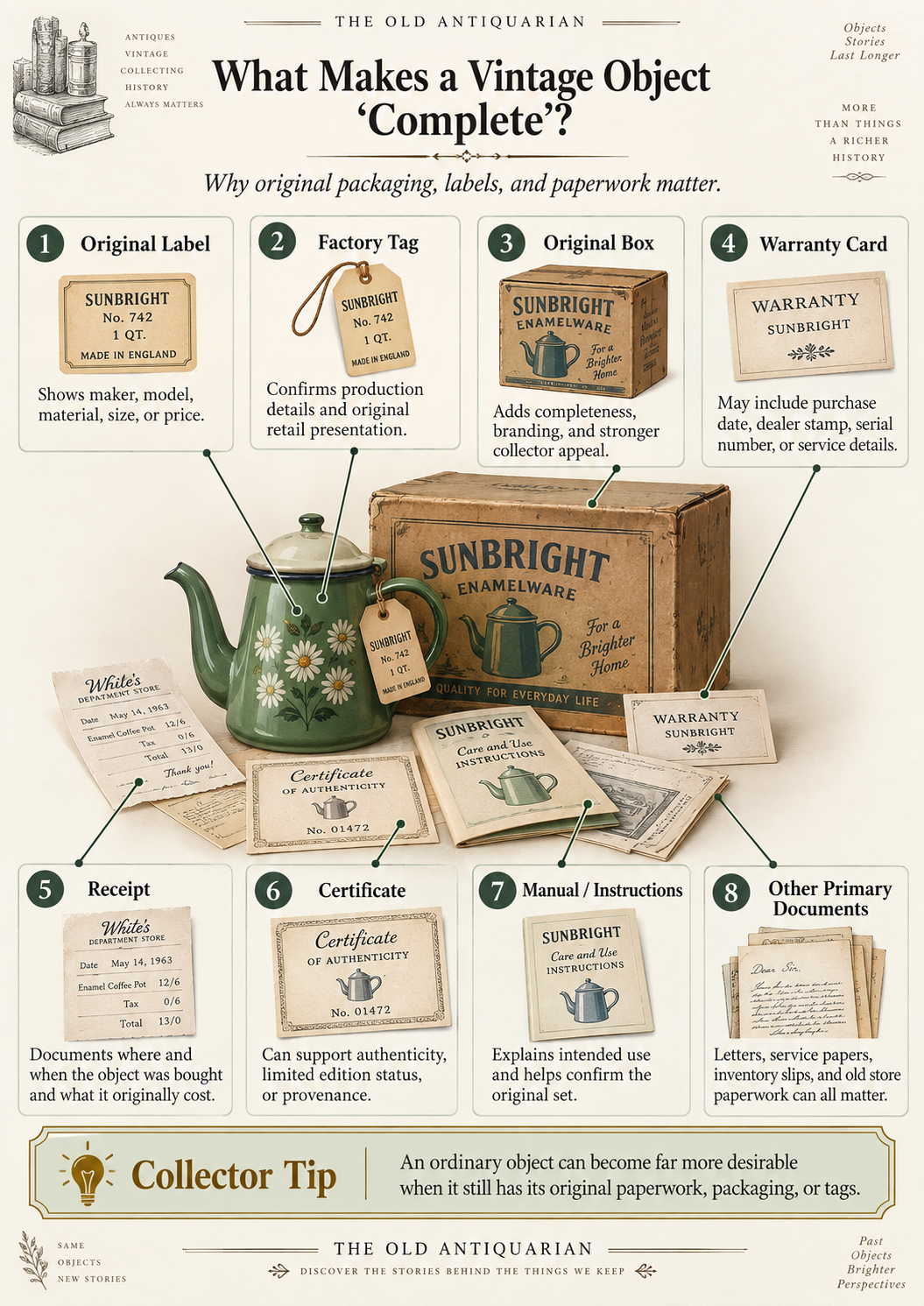
Complete, Full Set, Box & Papers, NOS and Deadstock
| Term | Typical Collector Meaning |
|---|---|
| Complete | Retains the expected original components or accessories relevant to that item. |
| Full set | Market shorthand for an object accompanied by a substantial or complete group of its original accessories and documentation. |
| Box & papers | Common shorthand, especially in watch and luxury collecting, for an item retaining its presentation packaging and relevant original documents. |
| NOS — New Old Stock | Usually describes older inventory represented as unused or never sold into ordinary use. The claim should be verified rather than assumed. |
| Deadstock | Often refers to unsold older inventory. Usage varies between collecting fields and is not a universal formal grading standard. |
Object Alone vs. Complete Set
An object without its original box or paperwork can still be completely authentic. Many genuine antiques have survived for generations after their packaging, receipts and instructions were discarded.
The difference is informational. An isolated object may require identification almost entirely from its physical construction, materials, marks, serial numbers, wear and design. A complete set may provide additional independent clues: a retailer name, a purchase date, matching model number, factory description, warranty stamp or historic owner.
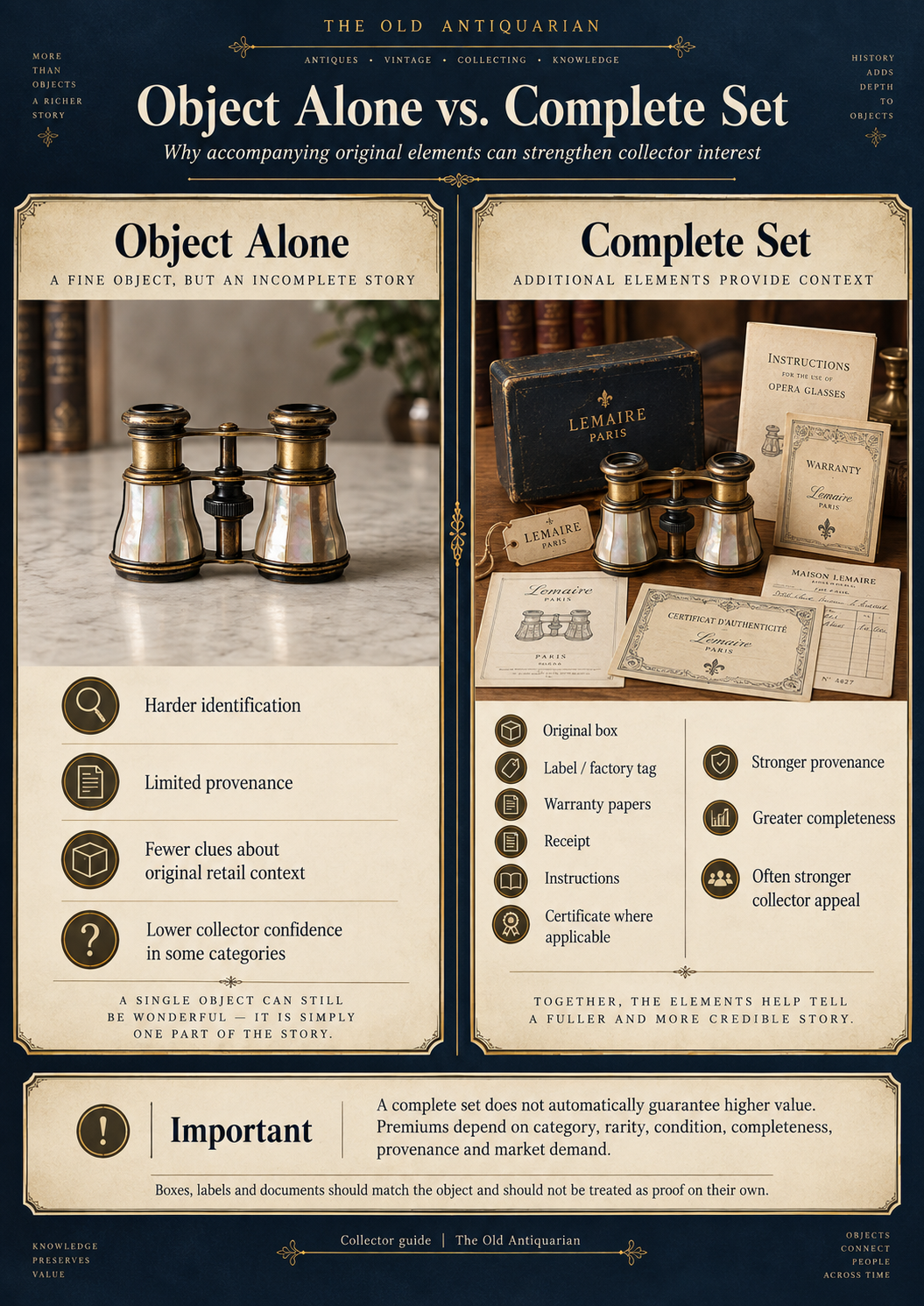
This can strengthen collector confidence in some markets because the object is easier to place within its original retail and ownership context. But completeness should never substitute for examination of the object itself.
Our guide to what makes an object original explains why physical evidence, materials, workmanship and historical consistency remain fundamental even when documentation survives.
Authenticity, Provenance and Completeness Are Different Questions
These concepts overlap, but they should not be used as synonyms.
| Concept | The Question It Answers |
|---|---|
| Authenticity | Is the object genuinely what it claims to be? |
| Originality | How much of the object remains as originally produced? |
| Provenance | What can be documented about the object’s ownership, location and transmission over time? |
| Completeness | How much of the original set, packaging, accessories and associated material survives? |
| Condition | What physical state is the object in today? |
A complete object is not necessarily authentic. An authentic object is not necessarily complete. An authentic antique can survive without paperwork, while a later copy or replica may retain every piece of its original packaging.
Original Labels and Factory Tags
Paper labels, cloth labels, factory stickers, hang tags and retailer labels can be surprisingly informative. Depending on the object, they may contain a manufacturer name, factory address, retailer, model designation, stock number, material description, size, country wording or original price.
They can also preserve evidence that disappears once removed. Typography, paper, printing method, adhesive, address wording and company name can sometimes help place a label within a particular period.
A maker’s label should also be considered alongside other identifying evidence. The same principle applies to stamped or impressed maker’s marks: a mark is a clue, not an automatic guarantee.
Original Boxes and Packaging
Original packaging can be especially important in collecting fields where presentation formed part of the product from the beginning. Watches, jewellery, cameras, writing instruments, toys, medals, designer objects, electronics, figurines and luxury goods are obvious examples.
Packaging may preserve model names, catalogue references, serial information, retailer labels or instructions that have disappeared from the object itself. It can also show how an item was originally presented, transported or marketed.
Yet an old box is not automatically the correct box. Collectors should compare dimensions, branding, period, internal fittings, model references, wear patterns and any matching numbers. A genuine period box paired later with an unrelated object does not create genuine provenance.
Receipts and Invoices
An original receipt or invoice can become a small historical record. It may identify the retailer, transaction date, location, purchaser, model, serial number or original purchase price.
For provenance, the most useful receipts are those that can be tied convincingly to the exact object. A serial number appearing both on the item and on the invoice is considerably more informative than a generic receipt from the same shop.
Historic receipts can also preserve evidence of retail networks and ownership. They may show that an object was bought in another country, purchased from a specialist dealer, inherited as part of a documented collection or owned by the same family for decades.
Warranty Cards and Guarantee Papers
Warranty documentation can be especially helpful with twentieth-century watches, cameras, instruments, appliances and luxury goods. Depending on the manufacturer and period, it may include:
- purchase date;
- authorised retailer or dealer stamp;
- model reference;
- serial number;
- owner information;
- warranty conditions;
- service or inspection entries.
The central question is consistency. Do the dates, numbers, retailer information and format make sense for the object? A genuine blank warranty card from the correct period is not equivalent to a completed card demonstrably linked to the item.
Manuals, Instructions and Catalogues
Original manuals and instruction booklets can clarify how an object was intended to function, which accessories were originally supplied and which model variants existed. They are particularly useful for technical objects where small differences in controls, fittings or specifications identify a production version.
Factory and retailer catalogues provide another kind of evidence. A period catalogue showing the same model may help confirm how an object was described, configured and marketed at the time. Catalogue evidence should still be compared carefully: a similar illustration does not automatically prove that the object in hand is the same production variant.
Service Papers and Repair Records
Service documentation can preserve an object’s mechanical history. For watches, clocks, cameras, vehicles and other technical collectibles, it may reveal when maintenance occurred, who performed it and whether components were repaired or replaced.
That information can be valuable even when it is not entirely positive. A documented replacement part is often more useful to a serious collector than an unexplained component that appears inconsistent with the rest of the object.
When alteration or repair is involved, it is important to distinguish professional restoration from conservation, and to understand how each may affect originality and historical integrity.
Certificates of Authenticity: Useful, but Not Absolute
A Certificate of Authenticity can be useful supporting documentation—but the words printed at the top of a sheet of paper do not make the underlying claim true.
The credibility of a certificate depends on who issued it, what evidence supports it, whether the issuer has relevant expertise and whether the document can be independently connected to the object.
A certificate issued by the original manufacturer, recognised artist’s estate, established archive or qualified specialist may carry very different evidential weight from an anonymous certificate supplied by an unknown seller.
Our detailed guide to Certificates of Authenticity examines this distinction in greater depth.
Document → What Does It Help Establish?
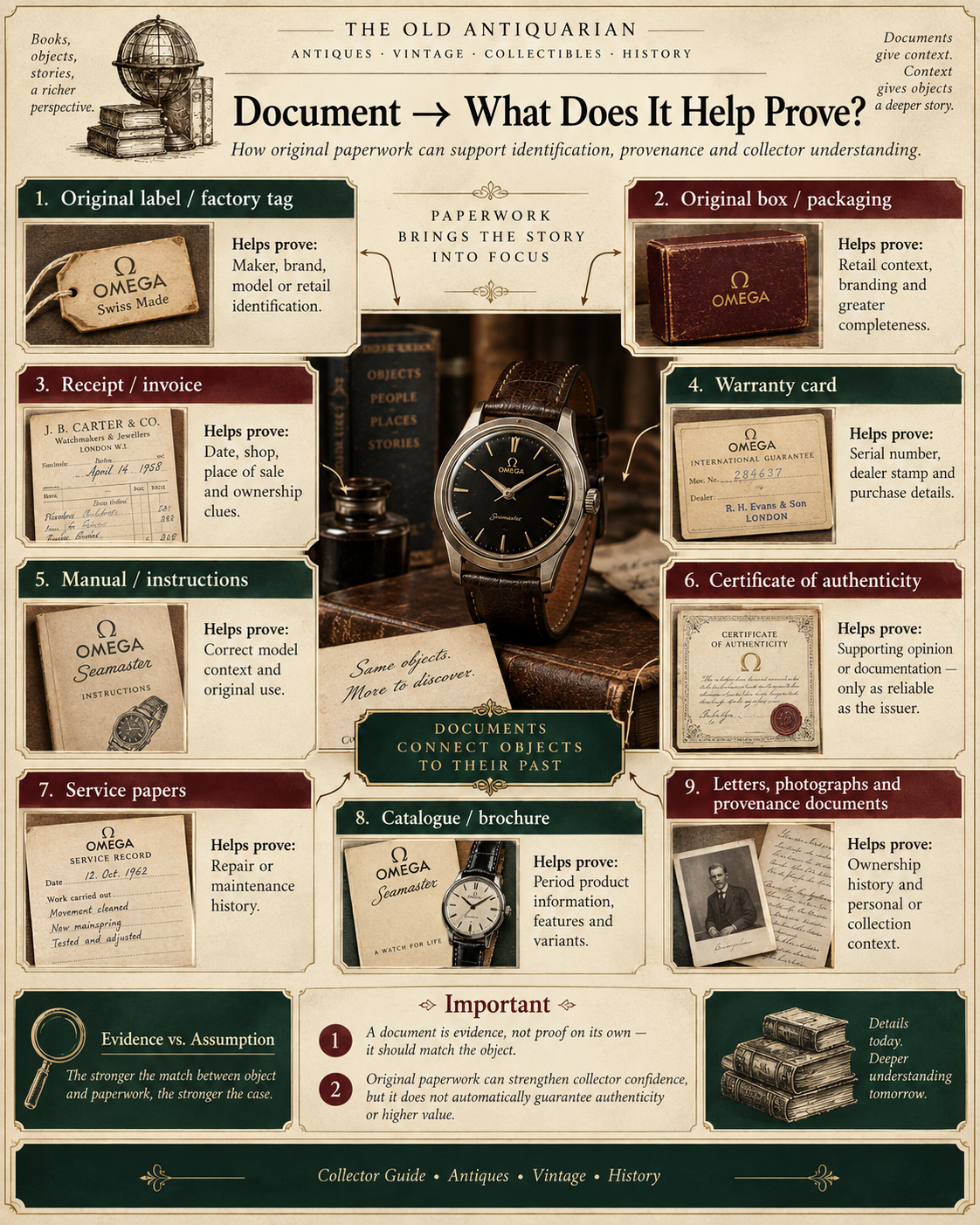
Letters, Photographs and Primary Provenance Documents
Some of the most interesting evidence was never created for collectors at all.
Family letters, historic photographs, estate inventories, collection lists, exhibition labels, dealer records, old insurance schedules and handwritten notes may help reconstruct where an object has been and who owned it.
This is where provenance becomes more than a fashionable word. In professional museum practice, provenance refers to the documented history of an object’s ownership and transmission. It is often reconstructed from several sources rather than one perfect document.
A photograph showing an identifiable object in a family interior decades earlier, for example, may provide a useful dated ownership clue. A letter discussing the purchase of that same object may strengthen the connection further. An inventory listing a matching description and number may add another independent piece of evidence.
Evidence vs. Assumption
The safest collecting approach is to separate what the surviving material actually demonstrates from what we merely hope it means.
| Evidence | Reasonable Interpretation | What It Does NOT Automatically Prove |
|---|---|---|
| Receipt with matching serial number | Strong link between the transaction and the object | That every component remains original today |
| Correct period factory box | Packaging is historically appropriate | That the box was originally sold with this exact object |
| Old factory label attached to object | Useful maker or retail evidence when consistent | Authenticity if the rest of the object contradicts it |
| Certificate from unknown issuer | A claim requiring verification | Authenticity |
| Historic photograph showing the object | Potential evidence of location or ownership at that time | Complete ownership history by itself |
| Service record matching serial number | Documented maintenance or repair history | That no undocumented alterations occurred |
The same evidence-based approach is important when distinguishing an original from a later reproduction or deliberate fake. Strong conclusions usually come from several independent clues pointing in the same direction.
Documentation vs. Condition
Collectors sometimes face an interesting choice: one example looks nearly perfect but has no supporting history; another shows honest use but retains its original box, papers, accessories and documentation.
There is no universal winner.
In some categories, the complete and documented example may attract stronger collector interest because more of its original context survives. In others, superior physical condition may be the dominant consideration. Exceptional rarity, provenance or historical significance can also outweigh ordinary condition concerns.
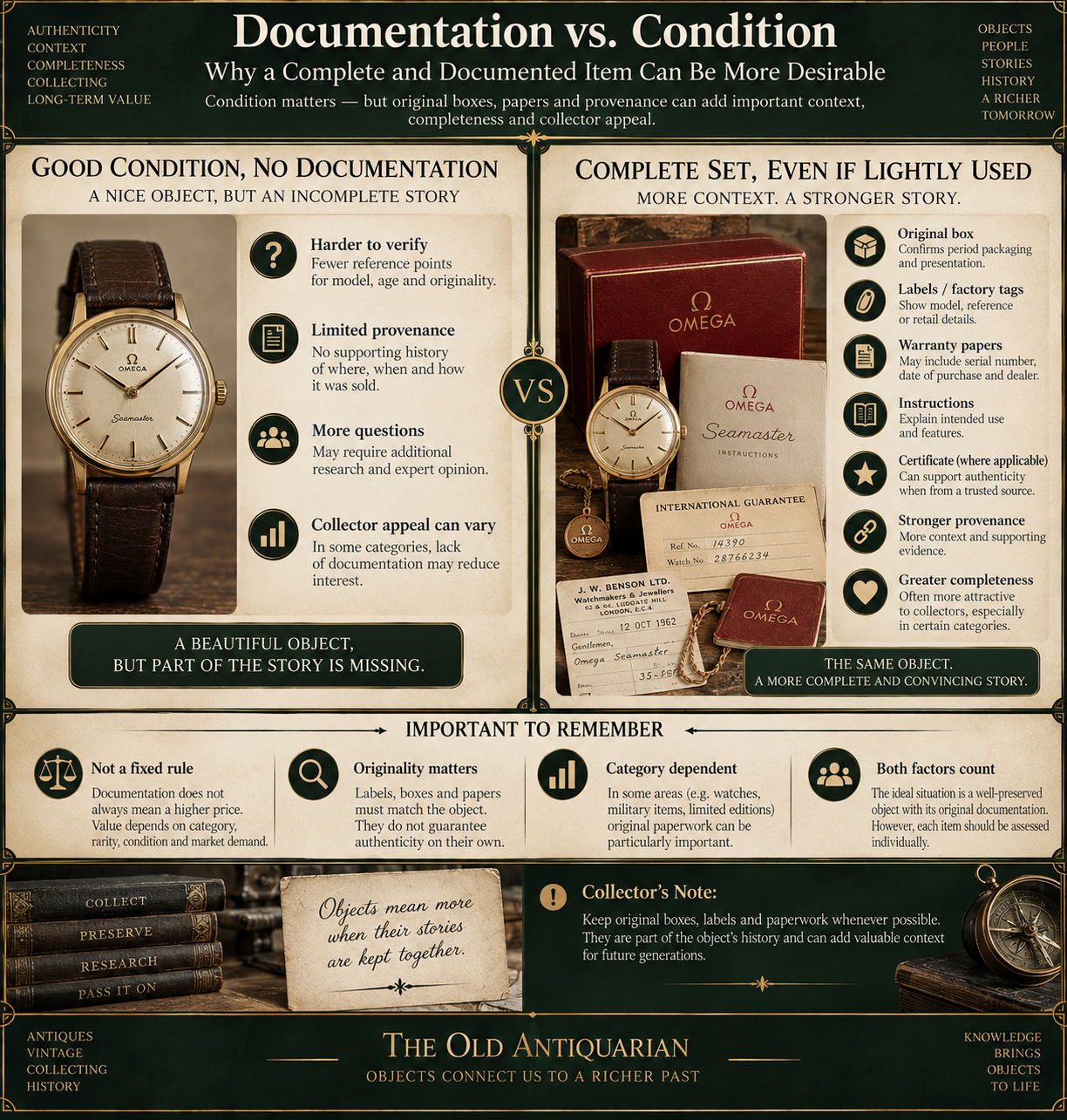
This is why responsible valuation does not assign an automatic percentage to “box and papers.” The effect must be judged within the specific market for the specific object.
When Does Completeness Matter Most?
| Collecting Area | Why Original Material May Matter |
|---|---|
| Watches | Reference numbers, serials, warranty history, presentation box and service records can help reconstruct a watch’s history. |
| Cameras & technical equipment | Manuals, cases, warranty documents and accessories can help establish exact configuration and completeness. |
| Toys & collectibles | Original packaging can be a significant part of the surviving collectible presentation. |
| Jewellery & luxury goods | Cases, receipts, retailer paperwork and manufacturer documentation can provide useful origin and ownership clues. |
| Art | Gallery labels, exhibition records, invoices, photographs and correspondence may contribute to provenance research. |
| Military & historical objects | Letters, photographs, award papers and personal records may connect an object to a person, unit or historical event. |
| Porcelain & decorative arts | Factory labels, boxes, retailer marks, collection inventories and old photographs can support identification and history. |
| Books & printed material | Dust jackets, slipcases, inscriptions, bookplates, invoices and collection records can be important parts of the surviving context. |
Can Original Boxes and Paperwork Increase Collector Value?
They can, but the effect is category-specific and object-specific.
A collector may prefer a complete set because it is harder to replace, better documented or closer to its original retail state. Another collector may prioritise exceptional condition. A museum or specialist researcher may value historical documentation even when it has little effect on ordinary retail demand.
The factors should therefore be considered together:
- authenticity;
- originality;
- rarity;
- condition;
- completeness;
- quality and maker;
- documented provenance;
- historical significance;
- collector demand;
- current market evidence.
This is also why professional antique valuation compares like with like. A complete set should ideally be compared with other complete sets of the same or closely comparable model, period and condition—not with an unrelated asking price found online.
What Collectors Should Never Throw Away
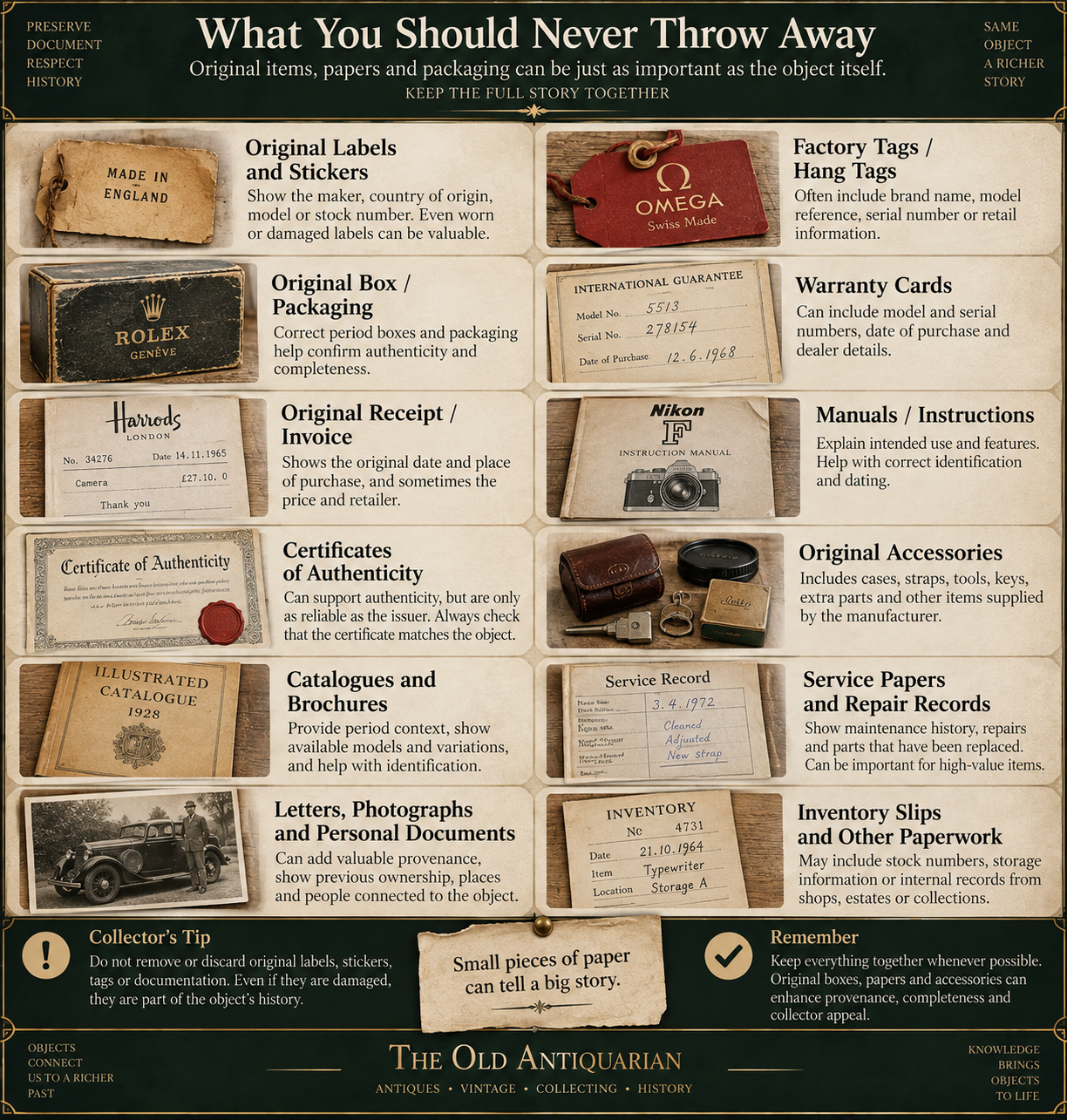
Unless there is a conservation reason requiring specialist treatment, keep associated material together with the object:
- original labels and stickers;
- factory tags and hang tags;
- presentation boxes;
- outer cartons and protective packaging;
- warranty cards;
- receipts and invoices;
- manuals and instruction sheets;
- certificates;
- original accessories;
- factory or retailer catalogues;
- service records;
- inventory slips and collection numbers;
- letters and correspondence;
- old photographs;
- auction or dealer documentation;
- family records relating to ownership.
Before cleaning, restoring or discarding anything associated with an unidentified object, see our guide to what not to do before an antique valuation or sale.
Collector Checklist: Before Buying a “Full Set”
Check the complete story—not just the number of accessories.
- Does the box correspond to the exact model or only the same manufacturer?
- Do model, reference or serial numbers match?
- Are the papers historically appropriate for the production period?
- Does the retailer or dealer information make chronological sense?
- Are the accessories correct for the exact version?
- Do materials, typography and printing appear consistent with the period?
- Are there unexplained erasures, additions or altered numbers?
- Does the paperwork agree with the physical evidence of the object?
- Is the claimed provenance documented or merely repeated?
- Has restoration, servicing or component replacement been disclosed?
Common Mistakes Collectors Should Avoid
1. Assuming an Old Box Must Be the Original Box
Age alone is not enough. Boxes can be exchanged, reused, married to another object or purchased separately.
2. Treating a Certificate as Unquestionable Proof
The issuer, date, expertise and supporting evidence matter more than the word “Certificate.”
3. Removing Worn Labels
A damaged original label may still preserve information unavailable anywhere else.
4. Separating Documents from the Object
Once paperwork becomes detached from the item it documents, the relationship may be difficult—or impossible—to reconstruct.
5. Creating an Artificial “Complete Set”
Adding period-correct but unrelated accessories may make a display look more complete without making it historically complete. Replacements should be described honestly.
6. Assuming Missing Paperwork Means an Object Is Fake
Many authentic antiques never had surviving paperwork. Physical evidence remains fundamental.
Expert Note: The Object and the Documents Must Tell the Same Story
The most persuasive collector evidence is coherent. A mark should fit the maker and period. A warranty card should match the model or serial where applicable. A receipt should make sense for the retailer and date. A box should correspond to the object it contains. Provenance documents should form a plausible chronology. When several independent clues support one another, confidence grows. When they contradict one another, the contradiction deserves investigation.
Frequently Asked Questions
Does an original box increase the value of an antique or vintage object?
It can increase collector interest in some categories, particularly when the box is scarce, correct for the exact object and part of a genuinely complete set. There is no universal percentage premium, and some collecting fields place much less emphasis on packaging.
What does “box and papers” mean?
“Box and papers” is collector shorthand for an object—commonly a watch or luxury collectible—retaining its original presentation packaging and relevant original documentation. Exactly what counts as “papers” varies by maker, period and category.
Does paperwork prove an antique is authentic?
No. Paperwork can support authenticity and provenance, but the object itself must remain consistent with the documentation. Documents can be incorrect, mismatched, altered or forged.
Can an authentic antique have no paperwork?
Yes. Many genuine antiques have survived for generations or centuries after their original paperwork disappeared. Construction, materials, marks, craftsmanship, wear and historical consistency may provide stronger evidence than paperwork alone.
Should I remove an old label or sticker from an antique?
Generally, do not remove it before the object has been assessed. Old labels can contain information about makers, retailers, collections, exhibitions or ownership. Removal may destroy historical evidence.
Does a Certificate of Authenticity guarantee authenticity?
No. A certificate is only as reliable as its issuer, the evidence behind it and its demonstrable connection with the object.
What is provenance?
Provenance is the documented history of an object’s ownership and transmission over time. It may be reconstructed from invoices, catalogues, inventories, letters, photographs, museum or exhibition records, dealer archives and other evidence.
Is a complete set always worth more than an object alone?
No. Completeness can improve desirability in some markets, but rarity, authenticity, condition, provenance, quality, historical significance and current demand may matter more.
Is NOS the same as mint condition?
Not necessarily. “New Old Stock” usually suggests older unused inventory, while condition describes the object’s present physical state. An unused object can still show storage wear, ageing or deterioration.
Are service papers good or bad for collector value?
They can be useful because they document maintenance and changes. Their impact depends on what was done, whether important original parts were replaced, the quality of the work and the expectations of collectors in that category.
What should I photograph before asking for a valuation?
Photograph the whole object, every side, the base or back, all marks and numbers, labels, damage, repairs, original packaging, accessories and every page of relevant documentation. Keep documents beside the object but avoid attaching them with tape, glue or other permanent methods.
Do You Have an Object with Original Labels, Boxes or Paperwork?
Keep the object and its supporting material together. Clear photographs of labels, marks, serial numbers, receipts, boxes, certificates and other documents can provide important evidence during identification and valuation.
Sources & Further Research
This guide follows an evidence-based approach consistent with professional object and provenance research. Useful reference frameworks include:
- J. Paul Getty Museum — provenance research and the use of catalogues, inventories, personal papers, physical marks, stickers, inscriptions and archival records in reconstructing an object’s history.
- Getty Research Institute / Categories for the Description of Works of Art (CDWA) — professional terminology for ownership and collecting history, documentary sources and degrees of certainty.
- The Old Antiquarian — What Is an Original? — originality, authenticity, physical evidence and provenance.
- The Old Antiquarian — What Is a Certificate of Authenticity? — evaluating certificates, issuers and documentary evidence.
- The Old Antiquarian — What Not to Do Before an Antique Valuation or Sale — preserving labels, packaging, paperwork, marks and original surfaces before evaluation.
- The Old Antiquarian — Restoration & Conservation Guides — understanding repair, preservation and historical integrity.
Research Note: Collector terminology and the importance attached to boxes, papers and completeness vary across markets and categories. Market value should therefore be assessed from genuinely comparable objects and recent completed transactions rather than from a universal formula.
Continue Exploring
For related collector terminology and authentication principles, continue with
What Is an Original?,
What Is a Copy?,
What Is a Replica?,
What Is a Fake? and
What Is a Certificate of Authenticity?.
You can also explore more identification, preservation and collecting research in
Stories & Knowledge.
The Complete Object Tells the Strongest Story
The object comes first. The box, label, receipt, papers and provenance can help explain where it came from, how it was sold, who owned it and how much of its original context survives. Preserve them together—and let the evidence, not assumptions, tell the story.
Expert / Author
The Old Antiquarian
The Old Antiquarian draws on more than 35 years of experience with antiques and collecting. Our guides are created to help collectors identify, research, preserve and understand historic objects through careful physical examination, documentary comparison, responsible interpretation of marks and provenance, and awareness of the international collectors’ market.
Last Updated: September 12, 2026
