
Precious Moments Figurines Identification
Precious Moments Figurines: History, Marks, Dating, Identification & Value Guide
Last Updated: September 14, 2026
|
By The Old Antiquarian
Precious Moments figurines are collectible porcelain-bisque figures based on the artwork of American artist
Samuel J. Butcher, best recognized for children with distinctive teardrop-shaped eyes.
The collectible figurine line began with the Original 21 in 1978, and annual production symbols have been used since 1981.
To identify and date a figurine correctly, examine the base, production mark, copyright information, exact item number or title,
craftsmanship, condition, original box and documented references together.
A mark alone does not prove authenticity, age or value.
Precious Moments at a Glance
| Collector Question | Reference Answer |
|---|---|
| Founding artist | Samuel J. Butcher (1939–2024) |
| Early artwork | Teardrop-eyed children used in greeting cards and inspirational artwork during the 1970s |
| First figurines | 1978 – the Original 21 |
| Main material | Hand-painted porcelain bisque |
| Production marks | Annual symbols used from 1981 onward |
| Collectors’ Club | Established in 1981 |
| Number of figurines | The official FAQ reports well over 2,500 figurines produced |
| Important value factors | Exact model, age, rarity, retired status, edition, condition, box, paperwork, demand and comparable completed sales |
Most Precious Moments figurines are better described as
vintage or modern collectibles rather than antiques.
Even the earliest 1978 figurines are not yet 100 years old.
For a broader explanation of the distinction, see our
guide to vintage collectibles.
Few American collectible figurines are as immediately recognizable as Precious Moments.
The combination of soft pastel color, sentimental subjects and large teardrop-shaped eyes made the figures part of
American gift-giving and collecting culture from the late twentieth century onward.
For collectors, however, recognition is only the beginning.
Two Precious Moments figurines that appear almost identical may belong to different production years,
editions or market categories.
Correct research therefore begins with the exact figurine rather than with the general style.
If you are new to ceramic collecting, our
Antique Porcelain Collector’s Guide
provides the broader framework for understanding ceramic bodies, factory marks, model numbers, condition and value.
The History of Precious Moments
The artistic world behind Precious Moments was created by
Samuel J. Butcher.
During the early 1970s, Butcher developed illustrations of children with the distinctive teardrop-shaped eyes
that would become the visual signature of the brand.
By 1974, his Precious Moments character artwork was being used on greeting cards.
A major turning point came in 1978.
Working with Enesco president Gene Freedman and sculptor Yasuhei Fujioka,
Butcher’s drawings were translated into three-dimensional porcelain-bisque figures.
A group of twenty-one figurines was introduced to giftware retailers in the fall of 1978.
Today collectors know them as the Original 21.
The collection reached stores in the spring of 1979 and developed rapidly from giftware into a collecting phenomenon.
The Precious Moments Collectors’ Club followed in 1981.
The Precious Moments Chapel in Carthage, Missouri, later became one of the most recognizable physical expressions of
Samuel Butcher’s artistic and religious vision; construction began in 1985 and the Chapel opened in 1989.
Precious Moments separated from Enesco in 2005 and operated independently for roughly two decades.
In December 2025, the companies announced a renewed licensing relationship,
with Enesco once again taking on development, manufacturing and distribution of new Precious Moments figurines and giftware beginning in 2026.
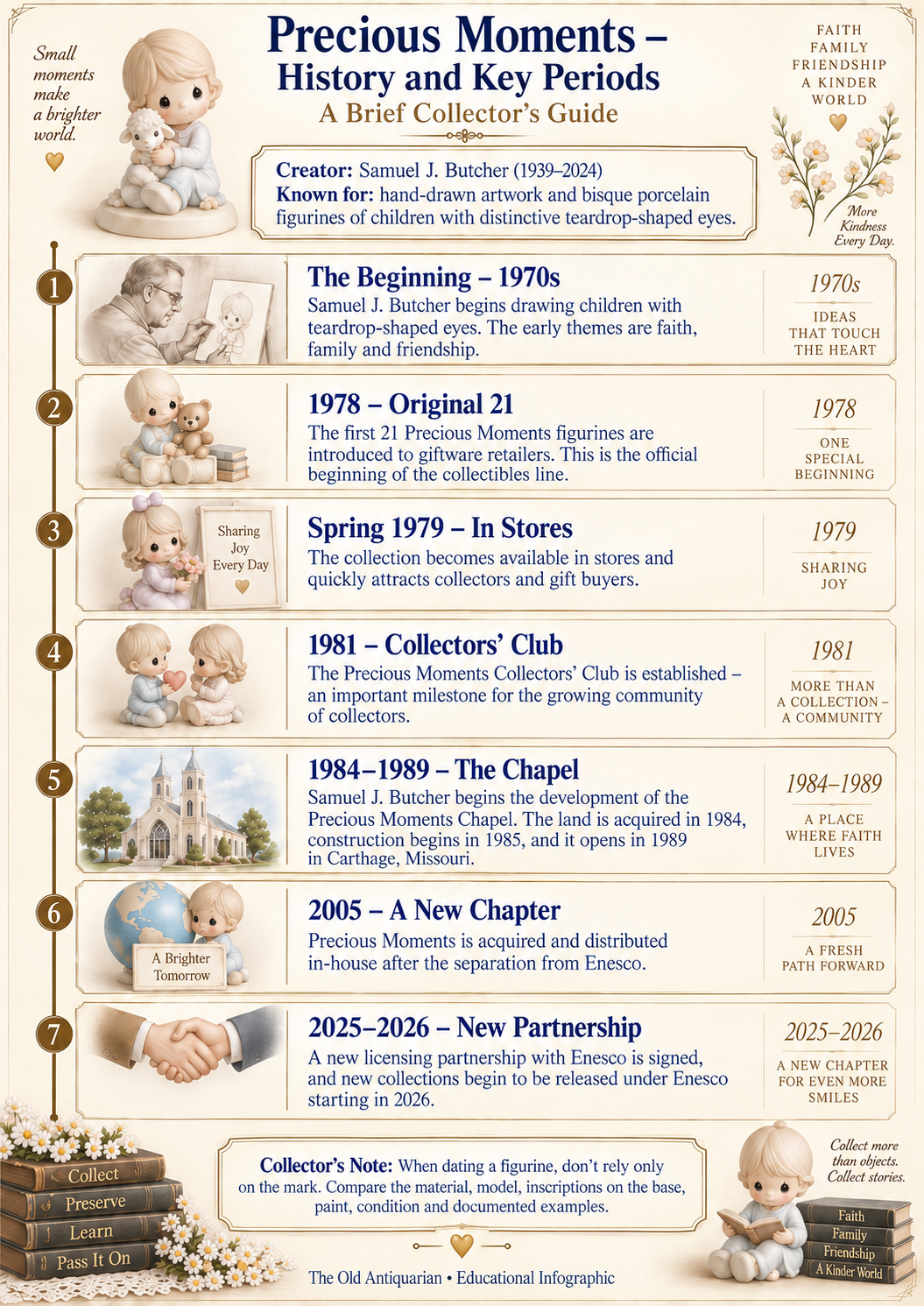
| Period | Development | Collector Significance |
|---|---|---|
| Early 1970s | Samuel Butcher develops the teardrop-eyed character style. | Origins of the visual identity. |
| 1974 | Precious Moments character artwork appears on greeting cards. | Pre-figurine history. |
| 1978 | Original 21 introduced to retailers. | Beginning of the figurine line. |
| Spring 1979 | Figurines become available in stores. | Expansion into the consumer market. |
| 1981 | Collectors’ Club and annual production marks. | A crucial year for collecting and dating. |
| 1989 | Precious Moments Chapel opens in Carthage, Missouri. | Major brand and cultural landmark. |
| 2005 | Precious Moments separates from Enesco. | Independent operating period. |
| 2025–2026 | New licensing partnership with Enesco. | A new phase in development and distribution. |
The Original 21 Precious Moments Figurines
The first twenty-one porcelain-bisque figurines were originally marketed under the
Jonathan & David name.
They later became known collectively as the Original 21 and remain central to Precious Moments collecting history.
The exact title and item number matter.
A figurine should never be identified only because its pose appears similar to an Original 21 design.
| # | Original 21 Title | Item Number |
|---|---|---|
| 1 | Unto Us, A Child Is Born | E-2013 |
| 2 | Jesus Is Born | E-2012 |
| 3 | His Burden Is Light | E-1380G |
| 4 | Come Let Us Adore Him | E-2011 |
| 5 | Love Lifted Me | E-1375A |
| 6 | Jesus Is The Answer | E-1381 |
| 7 | Make A Joyful Noise | E-1374G |
| 8 | Prayer Changes Things | E-1375B |
| 9 | He Leadeth Me | E-1377A |
| 10 | We Have Seen His Star | E-2010 |
| 11 | Jesus Is The Light | E-1373G |
| 12 | Jesus Loves Me (Boy) | E-1372B |
| 13 | Jesus Loves Me (Girl) | E-1372G |
| 14 | Love One Another | E-1376 |
| 15 | God Understands | E-1379B |
| 16 | Smile God Loves You | E-1373B |
| 17 | God Loveth A Cheerful Giver | E-1378 |
| 18 | Love Is Kind | E-1379A |
| 19 | O, How I Love Jesus | E-1380B |
| 20 | He Careth For You | E-1377B |
| 21 | Praise The Lord Anyhow | E-1374B |
The official 2026 Precious Moments guide states that twenty of the Original 21 have been retired.
Love One Another remains the exception.
Retired status adds historical interest, but it does not automatically establish rarity or high value.
What Are Precious Moments Figurines Made Of?
Classic Precious Moments figurines are widely documented as
hand-painted porcelain bisque.
Bisque porcelain is fired porcelain with a characteristically soft, matte-looking surface rather than the strong glossy appearance associated with many glazed porcelain figurines.
That finish is part of the familiar Precious Moments aesthetic, but collectors should not authenticate a figurine from texture alone.
Material, molding quality, facial modeling, decoration and the information on the base should support one another.
| Feature | What to Examine | Why It Matters |
|---|---|---|
| Surface | Soft matte bisque appearance | Should be consistent with the documented model |
| Modeling | Face, fingers, hair, clothing and accessories | Soft or poorly defined detail deserves further investigation |
| Decoration | Pastel color, facial details and small painted elements | Useful when checking repainting or unusual decoration |
| Base | Marks, numbers, inscriptions and openings | Primary identification evidence |
Popular Precious Moments Figurine Themes
Precious Moments collecting is unusually broad because the figurines were designed around life events and emotional themes rather than one narrow decorative subject.
Collectors may specialize in children, weddings, angels, Christmas, professions, animals, religious subjects, birthdays, family scenes or special editions.
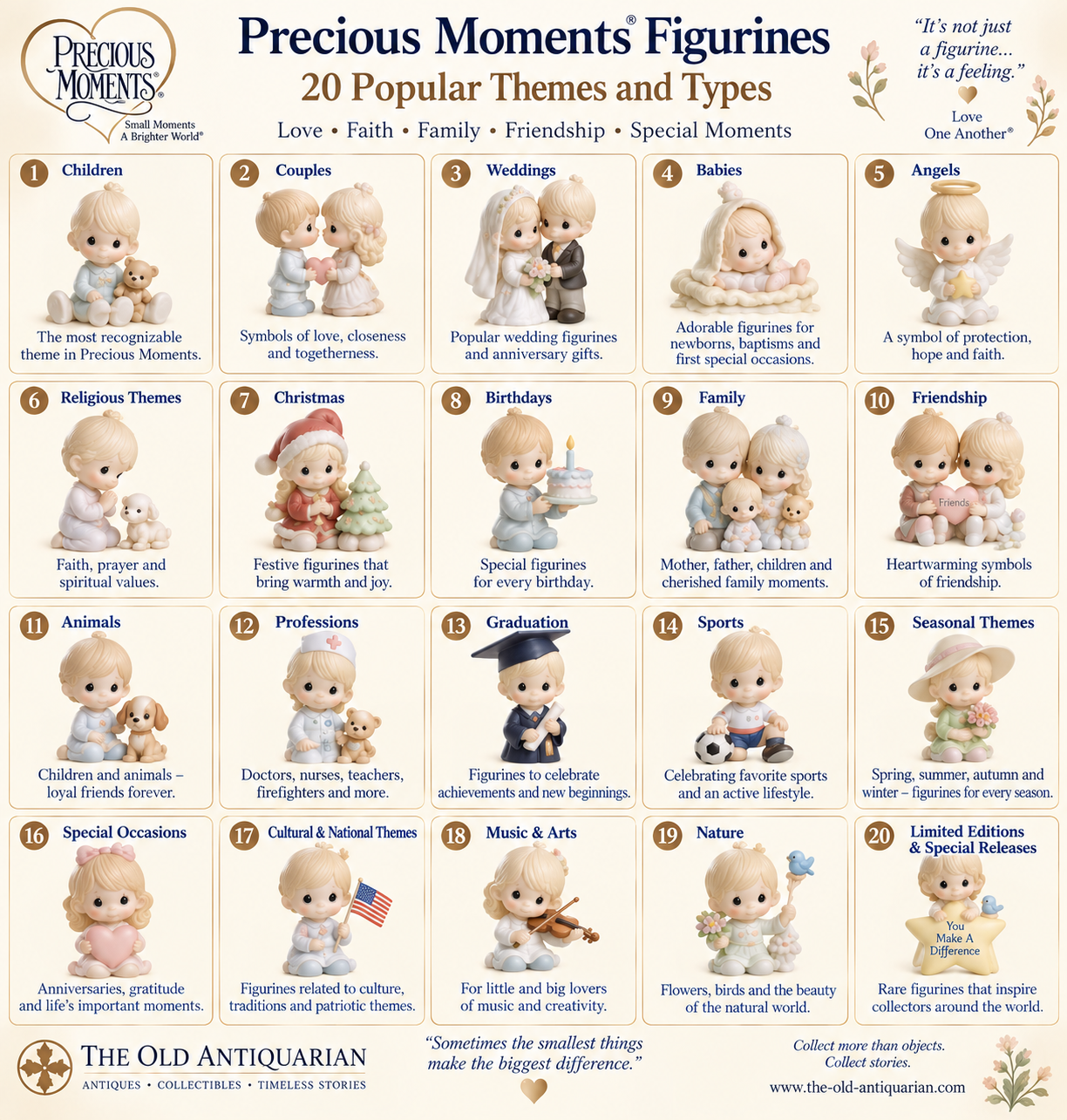
The illustrated figures are educational category references rather than a catalogue of specific historical models.
Theme can influence collector demand, but it should never replace exact model research.
A popular angel, wedding or Christmas subject may still have been produced in large numbers,
while an obscure model or unusual edition may be far less common.
Precious Moments Marks and Dating
For many collectors, the underside of the figurine is the most important place to begin.
Depending on the model and period, the base may contain the Precious Moments name or logo,
copyright information, an item number, a title, production information and an
annual production mark.
The annual production-mark system began in 1981.
Each year was assigned a different symbolic mark.
These marks are extremely useful for dating, but they should be interpreted together with the figurine’s exact model and all other base information.
For the broader method behind factory marks, model numbers and backstamps, see our
Porcelain Marks Identification Guide.
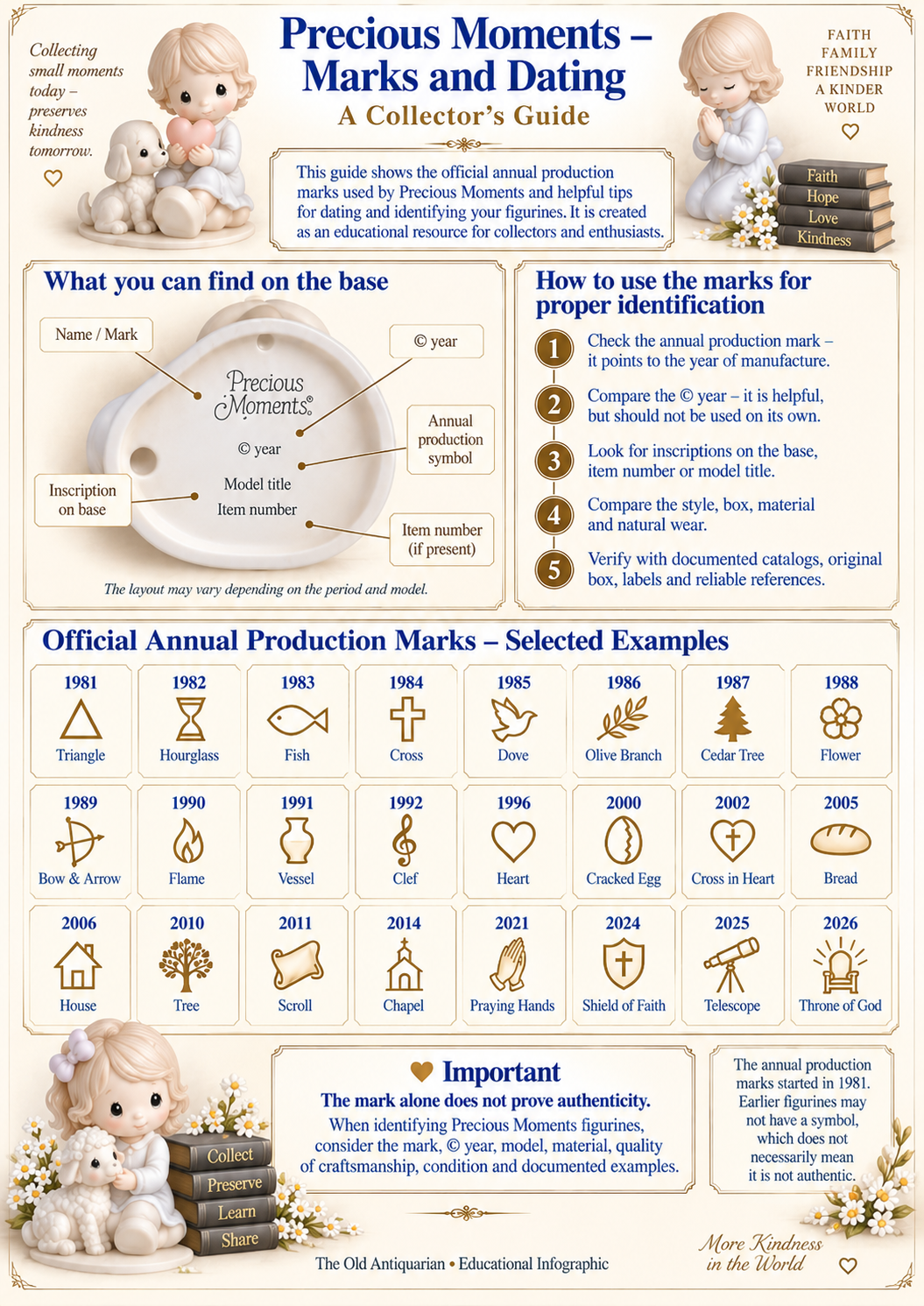
Precious Moments Annual Production Marks: 1981–2026
| Year | Production Mark | Year | Production Mark |
|---|---|---|---|
| 1981 | Triangle | 2004 | 3-Petal Flower |
| 1982 | Hourglass | 2005 | Bread |
| 1983 | Fish | 2006 | House |
| 1984 | Cross | 2007 | Hammer |
| 1985 | Dove | 2008 | Heart |
| 1986 | Olive Branch | 2009 | Wheat |
| 1987 | Cedar Tree | 2010 | Tree |
| 1988 | Flower | 2011 | Inheritance Scroll |
| 1989 | Bow & Arrow | 2012 | Box with Bow |
| 1990 | Flame | 2013 | Flame |
| 1991 | Vessel | 2014 | Chapel |
| 1992 | Clef | 2015 | Timmy |
| 1993 | Butterfly | 2016 | Open Door |
| 1994 | Trumpet | 2017 | Lighthouse |
| 1995 | Ship | 2018 | Rock |
| 1996 | Heart | 2019 | Water Drop |
| 1997 | Sword | 2020 | Eagle |
| 1998 | Glasses | 2021 | Praying Hands |
| 1999 | Star | 2022 | Fortress |
| 2000 | Cracked Egg | 2023 | Lamb |
| 2001 | Sandal | 2024 | Shield of Faith |
| 2002 | Cross in Heart | 2025 | Telescope |
| 2003 | Crown | 2026 | Throne of God |
A copyright date, model introduction date and annual production-mark year are not necessarily the same thing.
Record all of them separately.
Repeated symbol concepts such as Heart and Flame are another reason to compare the exact mark rather than identifying a year from a vague description.
For a broader dating method, continue with
How to Date Antique Porcelain.
How to Identify an Original Precious Moments Figurine
There is no single test for authenticity.
Reliable identification comes from consistency between several independent characteristics.
The base may begin the investigation, but the complete figurine must confirm it.
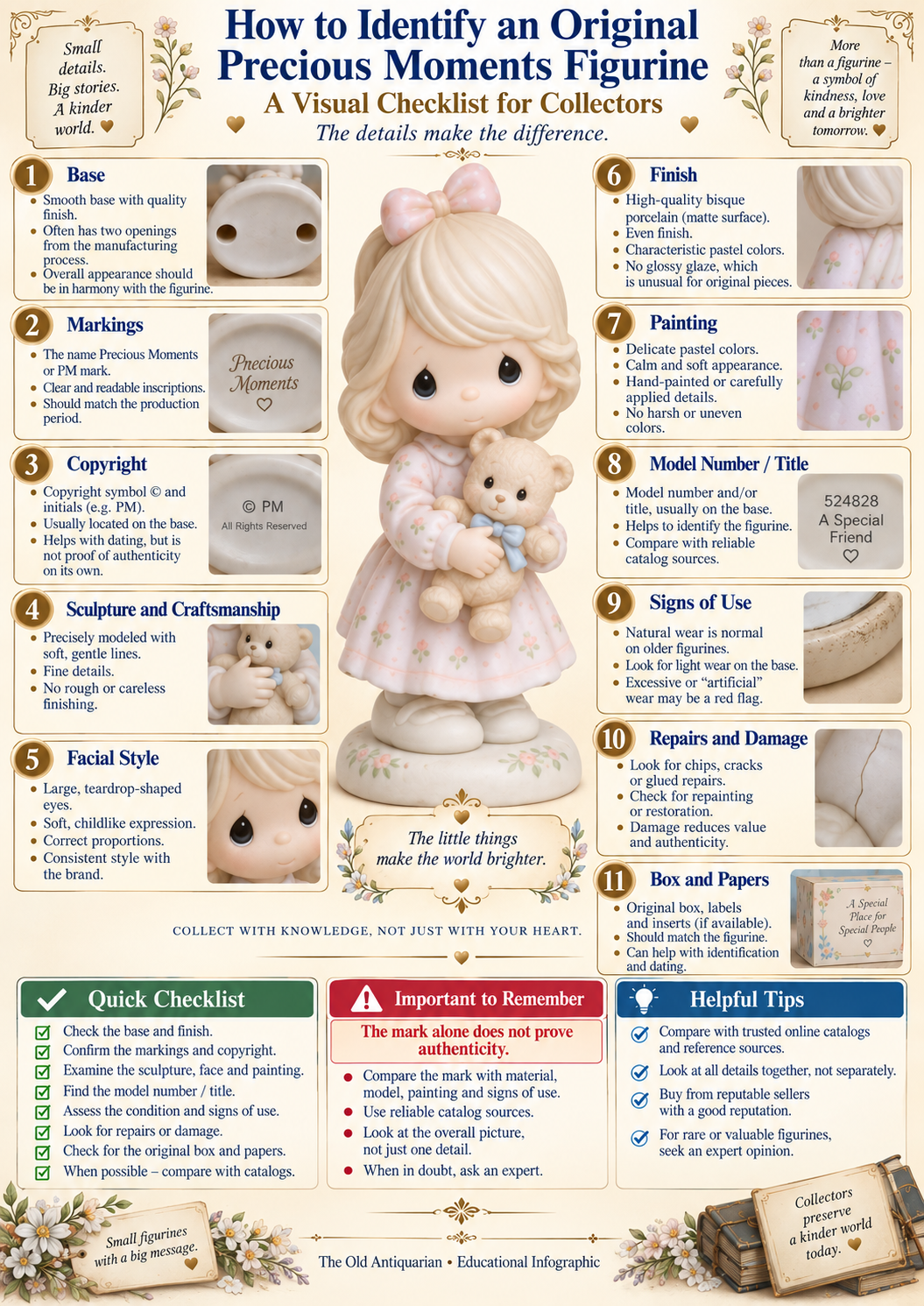
The illustrations are educational visual references and are not proof of authenticity for a specific model.
| Check | What to Examine | Collector Purpose |
|---|---|---|
| Base | Full underside, openings, surface and inscriptions | Preserves the complete identification record |
| Mark | Precious Moments wording, logo and production symbol | Supports brand and period research |
| Copyright | © date, initials and copyright wording | Helpful evidence, but not a manufacturing date by itself |
| Model / item number | Numbers, title and associated codes | Connects the figurine with catalogs and documented references |
| Facial style | Eyes, expression and proportions | Supports comparison with the documented model |
| Sculpting | Hair, hands, clothing, animals and accessories | Helps evaluate production quality |
| Finish | Bisque surface and consistency | Should make sense for the model and period |
| Painting | Facial features, pastel decoration and small details | Can reveal repainting or unusual workmanship |
| Wear | Base wear and natural contact points | Supports condition and age assessment |
| Repairs | Glue, cracks, filling, repainting and replacement elements | Important for both originality and market value |
| Box and paperwork | Label, item number, inserts and certificates | Additional identification and provenance evidence |
Use the complete evidence:
mark + production symbol + exact model + material + sculpting + painting + condition + wear + packaging + documented comparison.
The same evidence-based method is explained in greater depth in our
Porcelain Identification Guide.
Retired, Limited Edition, Members’ Only and Chapel Exclusive Figurines
Terms used in Precious Moments collecting are often treated as if they automatically indicate rarity.
They do not.
Each term describes a different part of the figurine’s production or distribution history.
| Term | Collector Meaning | Value Warning |
|---|---|---|
| Retired | The figurine is no longer in regular production. | Retired does not automatically mean scarce or expensive. |
| Limited Edition | Production is intentionally limited. | Check edition size, demand, documentation and actual sales. |
| Members’ Only | Issued for members of the collectors’ community or club. | Club status alone does not establish market value. |
| Chapel Exclusive | A special category distributed through Precious Moments Chapel and official channels. | Distribution exclusivity and collector demand must both be considered. |
What Makes Precious Moments Figurines Valuable?
There is no trustworthy universal price list for Precious Moments figurines.
Two examples of the same general subject can have very different collector value because their model,
production period, edition, condition, packaging and demand are different.
The most reliable valuation method begins by identifying the exact item and ends by comparing it with
completed sales of genuinely comparable examples.
An ambitious asking price is not evidence that a figurine actually sells at that level.
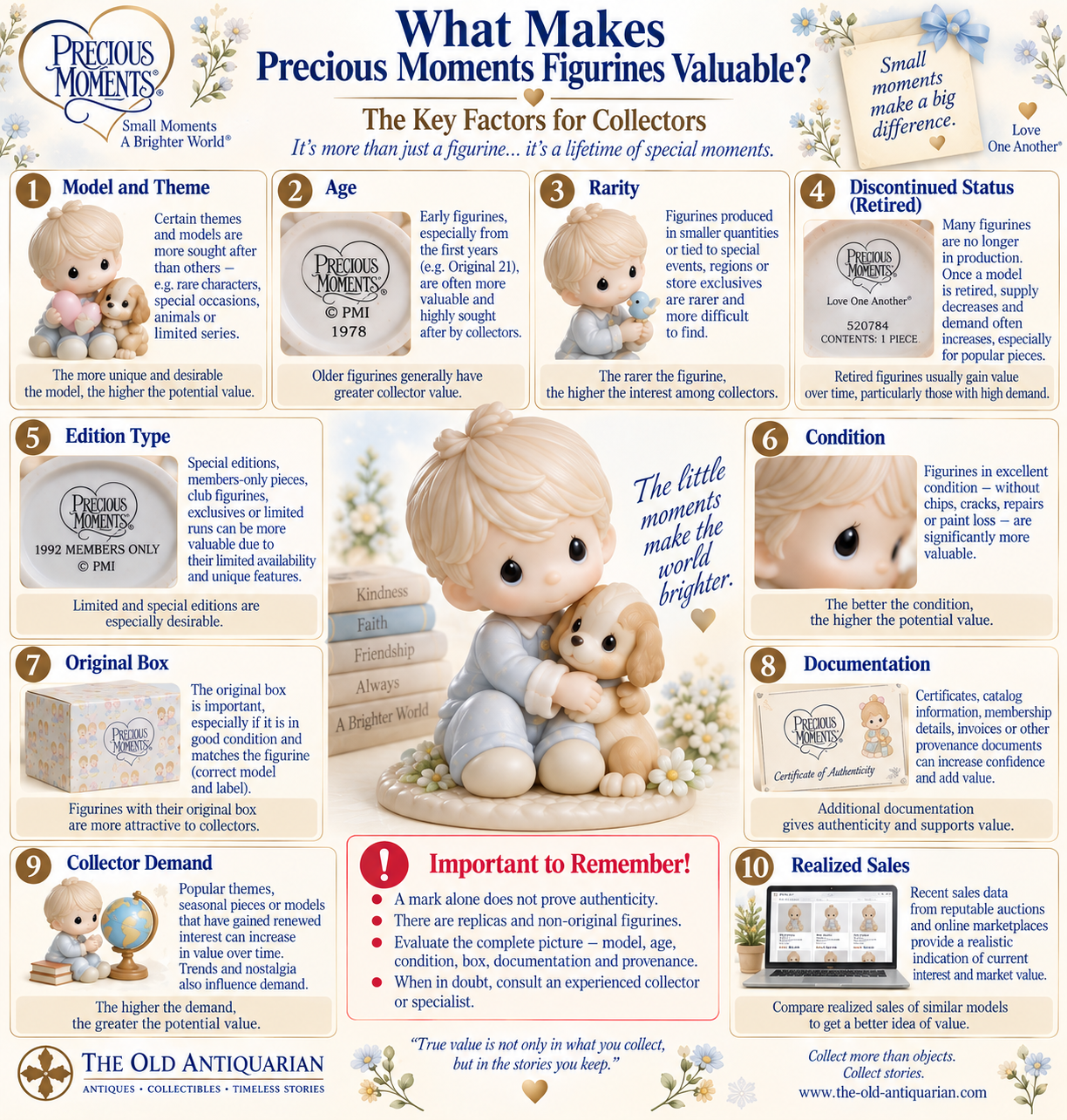
No single factor determines market value by itself.
| Value Factor | Why It Matters | What to Compare |
|---|---|---|
| Exact model | Different titles attract different levels of demand. | Exact item number and title. |
| Age | Early production may interest collectors more strongly. | Production mark and model history. |
| Rarity | Scarcer models or variants may be harder to replace. | Documented availability and completed sales. |
| Retired status | No further regular production may limit future supply. | Retirement plus real collector demand. |
| Edition | Limited, special and club issues can form distinct markets. | Edition documentation and production details. |
| Condition | Chips, cracks, losses and repairs can materially reduce demand. | Compare equivalent condition. |
| Original box | Adds completeness and identification evidence. | Correct box, label and condition. |
| Documentation | Can support model identity, ownership and provenance. | Certificates, receipts and catalog material. |
| Collector demand | Demand changes by theme, generation and market cycle. | Recent activity for the same model. |
| Completed sales | Shows what buyers actually paid. | Same model, period, box status and condition. |
Compare like with like:
exact model + production period + edition + condition + box + paperwork + recent completed sales.
Does “Retired” Mean Valuable?
No.
A retired figurine may be desirable, but thousands of examples may still survive.
Retirement becomes more meaningful when it is combined with limited availability, strong collector demand,
excellent condition and documented sales.
Does the Original Box Matter?
Yes, but context matters.
A correct box with matching item information can make a figurine more attractive to collectors and can support identification.
A damaged or mismatched box is less useful, and packaging can never authenticate the figurine by itself.
A Practical Research Method for U.S. Collectors
Precious Moments figurines regularly appear in American family collections,
estate sales, antique malls, thrift stores, flea markets and online marketplaces.
The safest way to research a newly discovered piece is systematic rather than price-driven.
- Photograph the entire figurine from several angles.
- Photograph the complete underside without cropping secondary marks.
- Record every word, symbol and number exactly.
- Identify the annual production mark when present.
- Search the exact item number and title rather than a generic description.
- Check whether the model was standard, limited, club, exclusive or retired.
- Inspect for chips, cracks, glued parts, repainting and missing elements.
- Keep the original box, inserts, receipts and paperwork together.
- Compare with documented catalog examples.
- Use completed sales of the same or closely comparable model for market context.
Before cleaning, gluing or improving a newly discovered collectible, read
What Not to Do Before a Valuation or Sale.
Original labels, boxes, surfaces and even old repairs can contain useful evidence.
Precious Moments vs Hummel, Lladró and Other Collectible Figurines
Collectors often encounter Precious Moments alongside Hummel, Lladró and other twentieth-century figurine traditions.
The subjects may overlap, but the makers, ceramic bodies and identification systems are very different.
| Tradition | Origin | Material / Character | Identification Focus |
|---|---|---|---|
| Precious Moments | United States collecting tradition | Porcelain bisque; sentimental figurines | Production mark, item number, title, base and condition |
| M.I. Hummel | Germany | Classic production is primarily fine earthenware rather than conventional porcelain | HUM number, M.I. Hummel signature and Goebel/TMK trademark |
| Lladró | Spain | Fine porcelain sculpture, often with soft pastel decoration | Lladró logo, reference number, model and craftsmanship |
| Nymphenburg | Bavaria, Germany | Historic hard-paste porcelain and fine sculptural traditions | Wittelsbach shield, model number, modeller, decoration and period |
| Beswick | England | Ceramics strongly associated with earthenware, animals and character figures | Backstamp, model number, material, glaze and modeling |
| Bing & Grøndahl | Denmark | Porcelain figurines, animals and collector series | Three Towers marks, model numbers and factory dating |
| Royal Copenhagen & Danish Porcelain | Denmark | Fine porcelain, underglaze decoration and naturalistic figurines | Three Blue Waves, crown marks, model numbers and painter marks |
These comparisons are useful because the collector’s market often uses the word
porcelain too broadly.
For example, classic Hummel and much historic Beswick production should not automatically be classified as porcelain.
Correct material terminology improves identification and valuation.
Condition, Repairs and Restoration
Condition is especially important with figurines because the most vulnerable parts are often the very details that create the design:
fingers, flowers, wings, animal ears, tails, small accessories and thin projecting elements.
| Condition Issue | What to Look For | Collector Impact |
|---|---|---|
| Chip | Missing edge or small decorative detail | Usually reduces desirability |
| Hairline crack | Fine structural line in porcelain | Can be more serious than surface wear |
| Glue repair | Glossy adhesive, yellowing or uneven joint | Important to disclose and compare separately |
| Repainting | Different texture, color or brushwork | May affect originality and value |
| Natural wear | Light base wear or handling evidence | Can be normal and should not be confused with damage |
| Missing element | Flower, instrument, animal detail or accessory absent | May significantly affect completeness |
How to Care for and Store Precious Moments Figurines
Porcelain bisque is hard but brittle.
The greatest practical risk to a figurine is often not age but accidental impact, poor handling or unnecessary cleaning.
Display figurines on stable shelves with enough room to lift each piece without touching its neighbors.
Always support the strongest part of the body or base rather than lifting the figurine by an arm, wing, flower, animal or accessory.
Dust gently with a clean, soft brush.
Before using water or cleaning products, inspect the figurine for cracks, old repairs, labels and unstable painted areas.
Older, repaired or unusually valuable pieces should be treated more cautiously than ordinary modern examples.
For broader preservation advice, see
How to Store Antique Decorative Objects.
Precious Moments Collector Checklist
- Photograph the complete figurine.
- Photograph the entire underside.
- Record every mark, word, number and symbol.
- Identify the exact item number and title.
- Identify the annual production mark if present.
- Do not confuse copyright year with production year.
- Compare the exact pose, size and accessories with documented examples.
- Inspect sculpting, facial style and paint quality.
- Check fingers, flowers, wings, animals and other fragile elements.
- Look for chips, cracks, glue and repainting.
- Keep the original box and paperwork.
- Determine whether the figurine is retired, limited, club or exclusive.
- Compare completed sales rather than asking prices.
Send clear photographs of the complete figurine, the underside, every mark and number,
the original box and any chips, cracks or previous repairs.
Precious Moments Figurines FAQ
Are Precious Moments figurines valuable?
Some are more collectible than others.
Value depends on the exact model, age, rarity, edition, retired status, condition, box, paperwork,
collector demand and completed sales.
The Precious Moments name alone does not guarantee high value.
How do I date a Precious Moments figurine?
Begin with the annual production symbol on the base.
The system started in 1981 with the Triangle.
Then compare the symbol with the exact model, copyright information, item number and documented production history.
What if my figurine has no annual production mark?
The yearly production-mark system began in 1981, so early figurines may predate it.
However, absence of a symbol does not by itself prove that a piece is early.
The exact model and all other markings must still be checked.
What are the Original 21?
The Original 21 are the first twenty-one porcelain-bisque figurines introduced to giftware retailers in 1978.
They were originally marketed under the Jonathan & David name and later became the foundation of Precious Moments collecting.
Are Precious Moments figurines porcelain?
Classic Precious Moments figurines are widely documented as hand-painted porcelain bisque.
The characteristic surface is usually softer and more matte than glossy glazed porcelain.
Does the mark prove a Precious Moments figurine is authentic?
No.
The mark should agree with the model, material, production symbol, sculpting, painting, condition and documented examples.
Marks can be misunderstood, copied or interpreted incorrectly.
Does retired mean rare?
Not necessarily.
A retired model is no longer in regular production, but many examples may still exist.
Rarity and market demand must be established independently.
Does an original box increase value?
It can.
A correct box and label improve completeness and may help identify the exact model.
Condition and collector demand remain more important than packaging alone.
Are Precious Moments antiques?
Generally no.
The figurine line began in 1978, so even the earliest pieces are still younger than the commonly used 100-year antique threshold.
Early examples are more accurately described as vintage collectibles.
What is the best way to find the market value of my figurine?
Identify the exact item number and production period, document condition and packaging,
then compare recent completed sales of the same model or genuinely comparable examples.
Do not rely only on active listings.
Continue Exploring Collectible Figurines & Porcelain
- Hummel Figurines: Marks, Identification, Dating & Value
- Lladró Porcelain: Marks, Figurines, Dating & Value
- Nymphenburg Porcelain: Marks, Bustelli Figurines, Dating & Value
- Beswick Figurines: Marks, History, Dating & Value
- Bing & Grøndahl Porcelain: Marks, Figurines & Collecting
- Danish Porcelain: Royal Copenhagen, Figurines & Identification
- Complete Antique Porcelain Guide
- Porcelain Marks Identification Guide
- How to Date Antique Porcelain
Sources & Further Research
Historical dates, Original 21 references and annual production marks in this guide were checked against
current official Precious Moments material and compared with specialist collector resources.
Recommended primary references include:
- Precious Moments – Official FAQ.
- Precious Moments – Proud History.
- Precious Moments – The Story of the Brand: A Fifty-Year Legacy of Love.
- Precious Moments – The Original 21 Precious Moments Figurines: Complete Guide.
- Precious Moments – The Authentic Meaning Behind the Precious Moments Annual Production Marks.
- Precious Moments – history of Gene Freedman, Enesco and the development of the figurine line.
- Precious Moments Chapel – official history of Samuel J. Butcher and the Chapel.
The Old Antiquarian combines more than 35 years of practical experience with antiques and collectibles
with historical, museum and comparative research.
When studying a collectible figurine, we consider the maker, exact model, marks, material, craftsmanship,
production period, condition, restoration, packaging, provenance and market evidence as interconnected clues
rather than relying on one isolated feature.
Final Collector Takeaway
Precious Moments collecting is not simply about finding an old figurine with familiar teardrop-shaped eyes.
The strongest collection is built by identifying the exact model,
understanding the annual production mark,
documenting condition and packaging,
and separating genuine rarity from marketing language.
Whether a figurine came from a family display cabinet, an estate sale, an antique mall or a recent collection,
the same rule applies:
identify first, verify second, value last.
Collect more than objects. Collect their stories.
