
U.S.Colt Holster in Bulgaria – Historic Mystery
A U.S. M1916 Colt M1911 Holster in Bulgaria: A Mystery from Europe’s Historic Crossroads
Last Updated: September 1, 2026
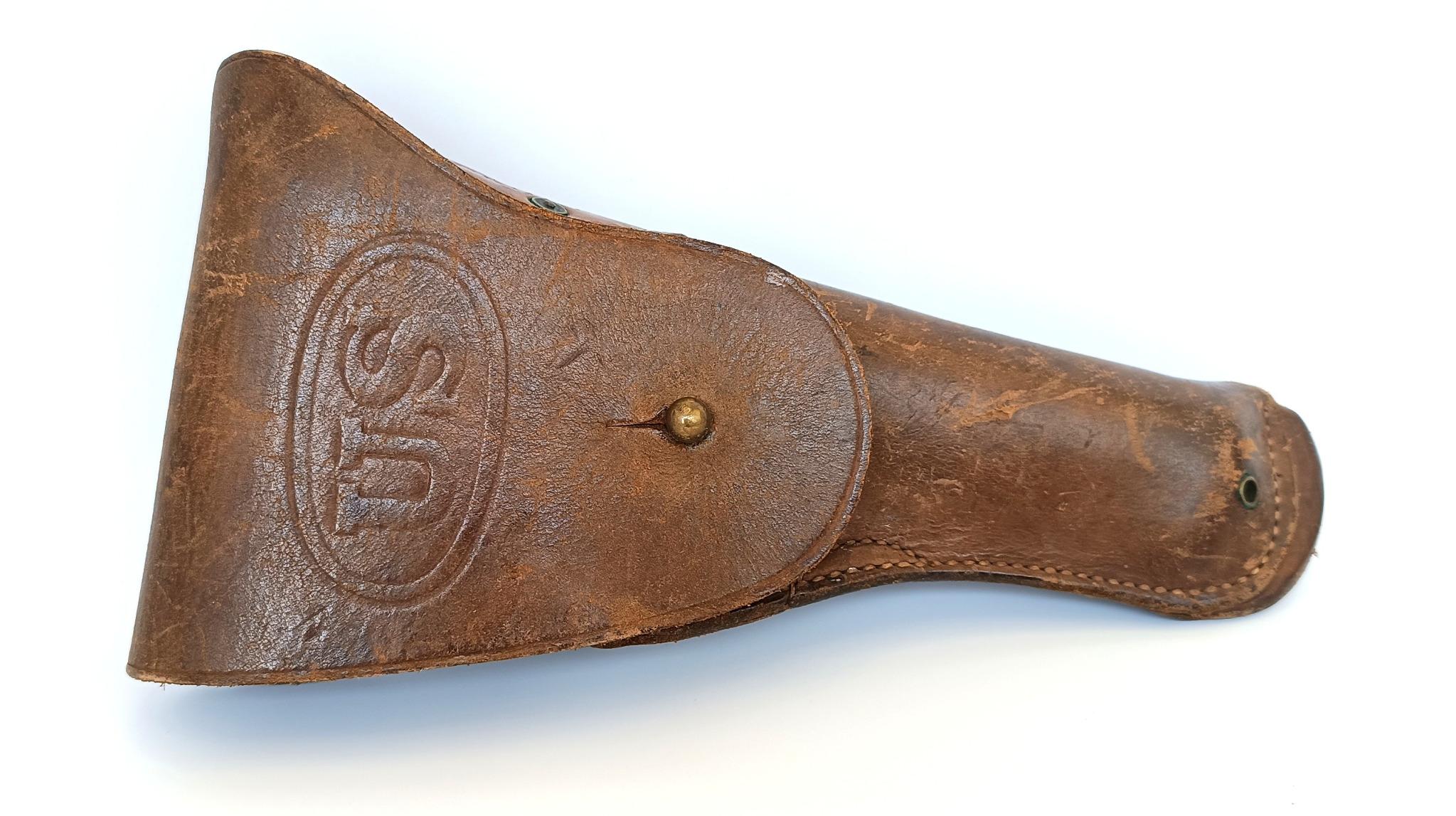
The original holster featured in this historical investigation is available from The Old Antiquarian.
Examine the U.S. and BOYT markings, original brown leather, metal fittings and authentic service wear in the full object listing.
What Do We Know – and What Remains a Mystery?
| Detail | What We Can Establish |
|---|---|
| Type | U.S. military M1916 leather holster |
| Designed for | Colt M1911 / M1911A1 |
| Front marking | Embossed U.S. |
| Maker | BOYT / Boyt Harness Company |
| Exact production year | Not sufficiently legible |
| Evidence of use | Patina, wear and internal contact marks |
| How did it reach Bulgaria? | Unknown |
The M1916 Holster and the Colt M1911
The M1916 is a U.S. military leather belt holster developed for the Colt M1911 pistol and subsequently used with the improved M1911A1.
Its construction is straightforward and durable: a heavy leather body shaped around the pistol, a protective flap, metal fastening hardware and an attachment system for military web equipment.
The pattern had an unusually long military life. M1916 holsters existed during the First World War and were again produced in very large quantities during the Second World War.
Boyt was one of the manufacturers associated with military leather equipment in both periods.
That makes the worn date on this particular example especially important.
If this holster proves to be an early First World War-era BOYT example, a possible connection with the Spanish Civil War remains chronologically possible. If it proves to have been manufactured during the 1940s, that particular route disappears. An earlier holster, however, could still have remained in service and been used during the Second World War.
Bulgaria and the Balkans – Europe’s Historic Crossroads
To understand how an American military object could end up in Bulgaria, it helps to look beyond modern national borders.
During the 1930s and 1940s, the Balkans were crossed repeatedly by soldiers, resistance fighters, refugees, intelligence missions, prisoners, aircraft, weapons and captured military equipment.
Bulgarian volunteers fought in Spain. British officers parachuted into Serbia to establish contact with Bulgarian resistance groups. American B-17 Flying Fortresses and B-24 Liberators crossed the region on missions against strategic targets in Romania.
German forces withdrew through Yugoslavia. The Soviet 3rd Ukrainian Front entered Bulgaria. Bulgarian troops then marched west to fight German forces. Soon after the Second World War, the Greek Civil War created yet another movement of armed men, refugees and equipment across the southern Balkans.
In such an environment, a single object could cross several borders and pass through several owners without ever appearing in an official record.
That is the essence of a historic crossroads: objects sometimes tell stories that do not follow the lines on a map.
A Short Historical Timeline
| 1916–1918 | The M1916 pattern enters U.S. service for the Colt M1911. |
| 1936–1939 | Bulgarian volunteers serve in the International Brigades during the Spanish Civil War. |
| 1941–1945 | The M1916 is again manufactured extensively for U.S. military service. |
| 1943–1944 | American heavy bombers conduct major operations against the Romanian oil industry. |
| 1944 | British special missions seek contact with Bulgarian resistance groups, while the Soviet 3rd Ukrainian Front enters Bulgaria. |
| 1944–1945 | Bulgarian forces fight German troops in Yugoslavia, Hungary and towards Central Europe. |
| 1946–1949 | The Greek Civil War creates new cross-border movement of people and military material in the Balkans. |
The Marks Inside the Holster – A Possible Trace of the Pistol
One of the most intriguing physical details is found inside the holster.
Grey to dark-grey contact marks are visible in areas where the metal surfaces of a pistol would repeatedly touch the leather.
They do not simply resemble black paint.
One possible explanation is prolonged contact with a firearm carrying a military phosphate finish.
During the Second World War, many M1911A1 pistols received a phosphate finish commonly known as Parkerizing. Depending on treatment, oil and age, such finishes can appear grey, dark grey or grey-green.
Repeated insertion and removal of a pistol, together with gun oil, dust and pressure against the leather, can create distinctive contact and wear patterns.
This also raises another possibility: even if the holster itself predates the Second World War, it could later have been used with a wartime Parkerized M1911A1.
Six Possible Routes to Bulgaria
1. From a Downed American B-17 or B-24?
Perhaps the most dramatic possibility begins in the skies over the Balkans.
The oil refineries around Ploiești, Romania, were among the most strategically important targets of the Allied air war.
On August 1, 1943, Operation Tidal Wave sent 178 B-24 Liberators from North Africa in a low-level strike against the Ploiești oil complex.
During 1944 the campaign continued from bases in Italy, with both B-24 Liberators and B-17 Flying Fortresses operating against Romanian oil targets.
One particularly well-documented case occurred on June 23, 1944.
A B-17 of the 97th Bomb Group carrying bombardier 2nd Lt. David R. Kingsley was severely damaged during a mission against Ploiești.
After the bombing run the aircraft was attacked by German fighters. Kingsley gave his parachute harness to a severely wounded crew member and remained aboard the aircraft.
The damaged B-17 eventually crashed in Bulgaria. Kingsley was posthumously awarded the Medal of Honor.
This provides direct historical evidence that American heavy bombers damaged during missions against Romania did indeed come down on Bulgarian territory.
When an Aircraft Crashed – Local People Reached the Wreckage
Another documented case is particularly relevant to the mystery of objects surviving after an aircraft crash.
On June 28, 1944, the B-24 Liberator flown by 1st Lt. John D. Crouchley crashed near Churen in Bulgaria after returning from a bombing mission over Romania.
Local villagers witnessed the crash.
They reached the aircraft, recovered the dead pilot and gave him a burial.
That episode establishes an important point for our investigation: local civilians could physically reach the wreckage of downed American aircraft.
It does not prove that weapons, holsters or personal equipment were removed from that particular aircraft.
But in wartime conditions, it is entirely plausible that small, portable pieces of equipment from a crash site or from an airman’s kit could eventually pass into private hands.
A leather holster could remain in a household for decades while the story of how it arrived there slowly disappeared.
The M3 shoulder holster was specifically adopted for aviators, tank crews and others who preferred a shoulder-carried pistol. An M1916 belt holster is therefore not automatically an “aircrew holster.” Its presence alone cannot establish a connection with a B-17 or B-24.
2. An Allied Parachute Supply for Balkan Partisans?
The second route leads through the resistance war in Yugoslavia and Bulgaria.
The Allies supplied Yugoslav partisan formations by air with weapons, ammunition, medical supplies, radio equipment, food and other material.
The connection with Bulgarian resistance groups is also documented.
British officer Major Frank Thompson was parachuted into Eastern Serbia on the night of January 25–26, 1944, as commander of a special mission intended to establish contact with Bulgarian partisans.
In May 1944 he crossed into Bulgaria together with a Bulgarian partisan unit.
His mission demonstrates the existence of real Allied networks connecting air operations, Serbia and Bulgarian resistance groups.
That creates a historically possible route:
Allied supply system → aircraft → Serbia → resistance formation → Bulgaria
There is no documentary evidence, however, that this particular M1916 holster was part of such a supply.
3. Brought Home by a Bulgarian Veteran of the Spanish Civil War?
The third possibility takes us further back, to the Spanish Civil War of 1936–1939.
Bulgarian volunteers served in the International Brigades supporting the Spanish Republic.
Their participation is documented through archival files, memoirs and historical studies.
The M1916 pattern already existed by this period, and documented BOYT examples survive from the First World War.
It is therefore chronologically possible that an early American M1916 holster reached Europe and Spain and was later carried back towards the Balkans by a volunteer.
But there is one essential condition:
If the worn BOYT marking is eventually shown to contain a production date from the 1940s, this theory can be eliminated.
4. America → Lend-Lease → Soviet Union → Bulgaria?
An American-made object did not necessarily have to arrive with an American serviceman.
Under Lend-Lease, the United States supplied the Soviet Union with enormous quantities of vehicles, equipment, raw materials and weapons during the Second World War.
American Colt M1911/M1911A1 pistols were among the U.S.-made small arms that reached Soviet hands.
Then, in September 1944, the military situation in Bulgaria changed dramatically.
On September 8, forward elements of the 3rd Ukrainian Front crossed the Romanian-Bulgarian frontier.
From September 18, the Bulgarian Army came under the operational command of Marshal Fyodor Tolbukhin’s 3rd Ukrainian Front for the campaign against Germany.
This creates another plausible route:
United States → Lend-Lease → Soviet Union → Soviet serviceman → 3rd Ukrainian Front → Bulgaria
We cannot establish whether American pistols sent to the Soviet Union travelled with original M1916 holsters, or whether this particular example was among such equipment.
But the broader movement of American-made weapons through the Soviet military makes the route historically possible.
5. The Post-War Balkan Crossroads – The Greek Civil War
The end of the Second World War did not end the movement of armed groups across the Balkans.
During the Greek Civil War, the frontiers between Greece, Yugoslavia, Bulgaria and Albania again became politically and militarily active.
U.S. diplomatic documents from 1947 describe Greek guerrillas moving across Bulgarian territory between Yugoslavia and Greece.
Evidence considered by an international commission included transportation, refuge and hospital treatment on Bulgarian territory.
The commission also recorded evidence that on at least two occasions Greek guerrillas had received arms in or near Sofia, although evidence concerning the wider arming and equipping of guerrillas in Bulgaria was more limited.
This does not connect our M1916 holster to a Greek fighter.
It does, however, demonstrate that military material and armed individuals continued to cross Balkan borders even after 1945.
An American object could therefore have changed hands years after the end of the world war.
6. A Battlefield Trophy – American to German, Then Bulgarian or Soviet?
The final theory may be one of the simplest.
War constantly changes ownership.
American weapons and equipment were captured by German troops on the battlefields of Western Europe.
A Colt M1911 or its holster could therefore have become a German battlefield trophy.
During 1944–1945, German formations withdrew through Southeastern and Central Europe.
After September 1944, Bulgarian forces entered the war against Germany, initially fighting in Yugoslavia and later in Hungary.
Bulgarian formations operated within the wider strategic framework of the Soviet 3rd Ukrainian Front.
A possible journey might therefore have been:
American serviceman → German battlefield capture → Bulgarian or Soviet soldier → Bulgaria
For a small personal object such as a leather pistol holster, such a transfer might never have appeared in any official archive.
It could simply have returned home in a soldier’s kit.
The Six Theories Compared
| Possible Route | Historical Basis | What Is Missing |
|---|---|---|
| B-17 / B-24 | Documented American bombers crashed in Bulgaria, and civilians reached some wreck sites. | No connection to a specific aircraft or crew. |
| Allied partisan supply | Allied air supply networks and British missions operated in the Balkans. | No document linking this holster to a supply drop. |
| Spanish Civil War | Bulgarian International Brigade volunteers and pre-1939 M1916 holsters are documented. | Requires an early production date. |
| Lend-Lease / USSR | American Colt pistols reached Soviet hands; the 3rd Ukrainian Front entered Bulgaria. | No individual service history for the holster. |
| Greek Civil War | Cross-border movement and assistance to Greek guerrillas through Bulgaria are documented. | No evidence linking this object to a Greek fighter. |
| Battlefield trophy | Captured weapons and personal equipment frequently changed hands during wartime. | No soldier’s name, photograph or family documentation. |
Which Theory Is Most Likely?
At present, choosing one of these six routes and presenting it as the true story would go beyond the available evidence.
Instead, the information should be divided into three levels:
- Established: M1916 pattern, association with the Colt M1911/M1911A1, embossed U.S. marking and BOYT maker’s mark.
- Physical observations: authentic wear, patina, contact marks and evidence that the holster was used.
- Historical hypotheses: the six possible routes by which an American military holster might have reached Bulgaria.
This distinction matters.
A compelling story can increase our understanding of an antique, but a plausible story should never be transformed into invented provenance.
What Could Solve the Mystery?
- a clearer reading of the BOYT stamp and possible production date;
- identification of any inspection marks, numbers or additional stamps;
- comparison of the belt hanger and hardware with documented M1916 production variants;
- macro photographs of the internal contact marks;
- information about where in Bulgaria the holster was originally acquired or found;
- the name or family history of an earlier owner;
- period photographs showing Bulgarian or Soviet servicemen with similar equipment;
- records of an American aircraft crash in the area where the object surfaced;
- family memories concerning partisan, battlefield or post-war military objects.
Do Not Clean Away the Evidence
The worn leather, grey interior marks and greenish oxidation around some of the metal fittings are part of the object’s history.
Aggressive cleaning, polishing, re-dyeing or treatment with strong chemicals can destroy clues that may later help with identification.
With historic militaria, the detail that looks like a flaw may sometimes be the most informative feature.
What Do You Think – How Did This American Holster Reach Bulgaria?
This M1916 is a real surviving object.
Its markings can still be examined, its leather construction can be studied, and the physical traces of use remain visible.
But the identity of the person who carried it – and the route by which it reached Bulgaria – remain unknown.
Which possibility do you think is the most likely?
- It came from a U.S. B-17 or B-24 that crashed in Bulgaria.
- It formed part of an Allied parachute supply for Balkan partisans.
- It was brought back by a Bulgarian veteran of the Spanish Civil War.
- It reached the Balkans through U.S. Lend-Lease supplies to the Soviet Union.
- It changed hands during the Greek Civil War and post-war Balkan movement.
- It became a German battlefield trophy and was later taken by a Bulgarian or Soviet soldier.
Or is there a seventh possibility we have overlooked?
Share your theory in the comments.
If you own a similar holster, a period photograph, a military document or a family story involving an American Colt M1911/M1911A1 in Bulgaria, Serbia, Greece or elsewhere in the Balkans, we would be very interested to hear from you.
Somewhere, a photograph, a name or a family memory may still survive that could connect this object with the person who once carried it.
Friends of The Old Antiquarian
Collectors united by history, not by borders.
Want to examine the object behind the story?
Frequently Asked Questions
What is a U.S. M1916 holster?
The M1916 is a U.S. military leather belt holster developed for the Colt M1911 pistol and subsequently used with the M1911A1. The pattern had a long service life and appears across more than one military period.
What does the BOYT marking mean?
BOYT refers to Boyt, an American manufacturer associated with military leather equipment and M1916 holsters. Documented BOYT examples survive from both the First and Second World War periods.
Is this holster definitely from World War II?
Not necessarily. The exact production date on this particular example cannot currently be read with confidence. Because BOYT produced military leather equipment in more than one period, a precise date requires further examination of the maker’s mark and construction details.
Could this holster have belonged to an American airman?
It is historically possible for American military equipment to have reached Bulgaria through a crashed B-17 or B-24, and such crashes are documented. However, the M3 shoulder holster was particularly associated with American aircrew, so an M1916 alone does not demonstrate aviation provenance.
Did American bombers crash in Bulgaria after missions over Romania?
Yes. There are documented examples of both B-17 and B-24 aircraft coming down on Bulgarian territory after being damaged during operations connected with Romanian targets.
Did local Bulgarian civilians reach American crash sites?
Yes, in at least some documented cases. After John D. Crouchley’s B-24 crashed near Churen in June 1944, local villagers reached the wreck and recovered the pilot. This confirms civilian access to a crash site, but it does not demonstrate that any particular piece of equipment was removed.
What could the grey marks inside the holster mean?
They may result from long-term contact with metal, gun oil, dirt and repeated friction. They could also be compatible with contact from the phosphate or Parkerized finish found on many wartime M1911A1 pistols, but this cannot be established visually alone.
Could Bulgarian partisans have used this holster?
Allied contact with Balkan resistance movements is historically documented, including British missions connected with Bulgarian partisans. There is currently no evidence, however, linking this particular M1916 holster to a specific partisan group.
Could it have arrived with the Soviet Army?
That is historically possible. American-made weapons reached the Soviet Union through wartime aid, while the Soviet 3rd Ukrainian Front entered Bulgaria in September 1944. No individual record connects this particular holster with a Soviet serviceman.
Could it have been a battlefield trophy?
Yes. Weapons and personal equipment frequently changed owners during wartime. An American holster could have been captured by a German soldier and subsequently taken by a Bulgarian or Soviet serviceman. For this specific object, however, that remains a hypothesis.
Sources and Further Research
-
U.S. Air Force / 142nd Wing – The Final Flight of David R. Kingsley
-
U.S. Department of Defense / DVIDS – John D. Crouchley and the B-24 crash in Bulgaria
-
UK Parliament, Hansard – Major Frank Thompson and the Bulgarian Partisan Mission
-
U.S. Department of State – Foreign Relations of the United States, 1947: Greek Guerrillas and Bulgaria
-
National Museum of Military History, Bulgaria – September 1944 and the 3rd Ukrainian Front
-
International Military Antiques – Documented BOYT M1916 Holster, 1942
-
Legacy Collectibles – Documented 1917 BOYT M1916 Holster
A Note from The Old Antiquarian
History and hypothesis are not the same thing.
At The Old Antiquarian, we try to distinguish between what an object can establish through its materials, markings and construction, and what is historically possible but not yet supported by documentary provenance.
Sometimes the unknown part is the most fascinating part – because it transforms an old object into the beginning of a genuine historical investigation.
Continue Exploring Europe’s Historic Crossroads
The history of antiques rarely ends where they were manufactured.
Objects move with soldiers, travellers, refugees, merchants and families. They cross borders, survive political systems and outlive the people who once owned them.
The Old Antiquarian explores these objects as witnesses to Europe’s historic crossroads – where empires, wars, faiths and cultures have met for centuries.
