
How to Identify Herend Porcelain
Herend porcelain is one of the world’s finest luxury porcelains and one of Europe’s most prestigious porcelain manufacturers. Founded in 1826, the Herend Porcelain Manufactory in Hungary has earned an international reputation for its exceptional hand-painted porcelain, elegant figurines, luxury dinner services, decorative objects, and museum-quality craftsmanship.
Every authentic Herend porcelain piece is still produced and hand-painted in Hungary using traditional techniques that have been preserved for nearly two centuries. Today, antique and modern Herend porcelain is highly sought after by collectors, museums, auction houses, and fine porcelain enthusiasts worldwide.
Whether you own a Herend figurine, an Apponyi dinner plate, a Rothschild Bird tea cup, or a complete Victoria dinner service, learning how to identify authentic Herend porcelain is the first step toward determining its authenticity, production period, and collector value.
If you are new to porcelain collecting, we recommend first reading What Is Porcelain?, What Is Hungarian Porcelain?, Types of Porcelain Explained, and What Are Porcelain Marks?. These guides provide an excellent foundation before identifying Herend porcelain.
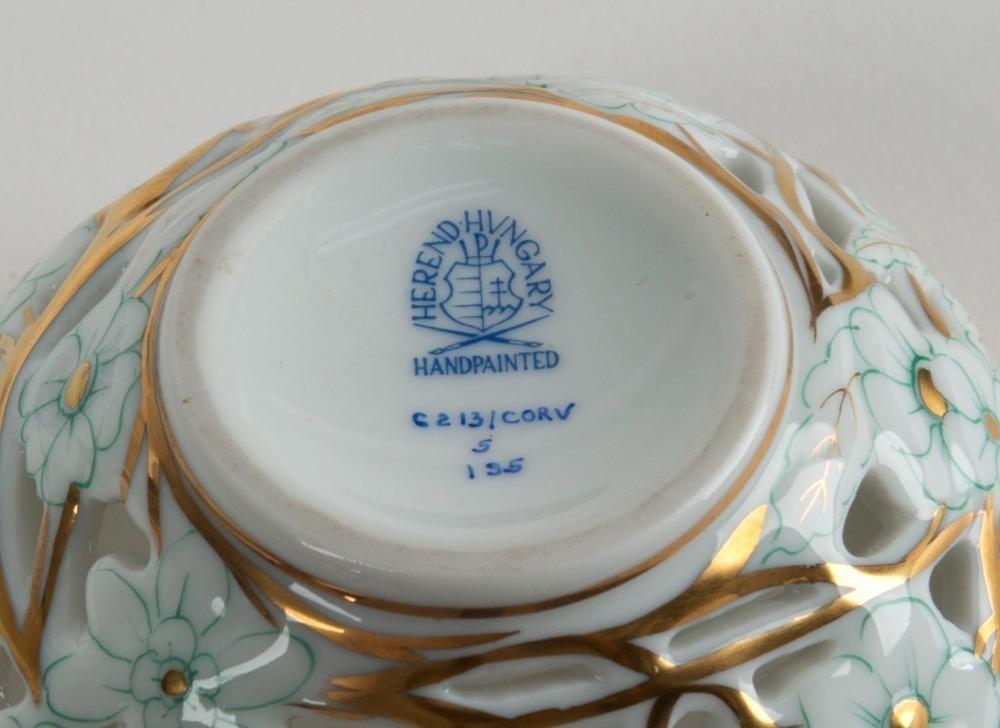
What Is Herend Porcelain?
Herend porcelain is celebrated for its exceptionally fine hard-paste porcelain, brilliant white body, hand-painted decoration, and luxurious hand-applied gilding. Every authentic piece passes through dozens of individual production stages, with many processes still performed entirely by hand.
Unlike mass-produced porcelain, every genuine Herend object is individually painted by skilled artists. This means no two hand-painted pieces are ever completely identical, making each object unique.
The Herend Porcelain Manufactory is famous for iconic collections including Victoria, Rothschild Bird, Apponyi, Queen Victoria, and Chinese Bouquet. These classic patterns remain among the most desirable Herend porcelain designs for collectors worldwide.
The History of the Herend Porcelain Manufactory
The Herend Porcelain Manufactory was established in 1826 in the Hungarian town of Herend. During the nineteenth century the factory gained international recognition after successfully reproducing and restoring valuable European and Chinese porcelain for aristocratic collectors.
Its worldwide reputation grew rapidly after the Great Exhibition in London in 1851, where Queen Victoria ordered a magnificent butterfly-and-flower dinner service that later became known as the famous Victoria Pattern.
From that moment onward, Herend supplied porcelain to royal families across Europe, including the British Royal Family, the Habsburg court, aristocratic households, and distinguished collectors. Today, Herend continues producing luxury porcelain using many of the same traditional methods developed nearly two centuries ago.
Why Is Herend Porcelain So Famous?
Collectors admire Herend because it combines exceptional Hungarian craftsmanship with extraordinary artistic quality. Every object is individually handcrafted, hand-painted, and inspected to meet the factory’s exceptionally high standards.
Collectors especially value Herend for its:
- Nearly 200 years of porcelain tradition.
- Entirely hand-painted decoration.
- Luxury hard-paste porcelain.
- Exceptional craftsmanship.
- Fine hand-applied gilding.
- Royal commissions.
- Iconic decorative patterns.
- Outstanding collector reputation.
Professional specialists also determine whether an object remains an original, or whether it could instead be a later copy, a replica, or even a fake.
Herend Porcelain Marks and Backstamps
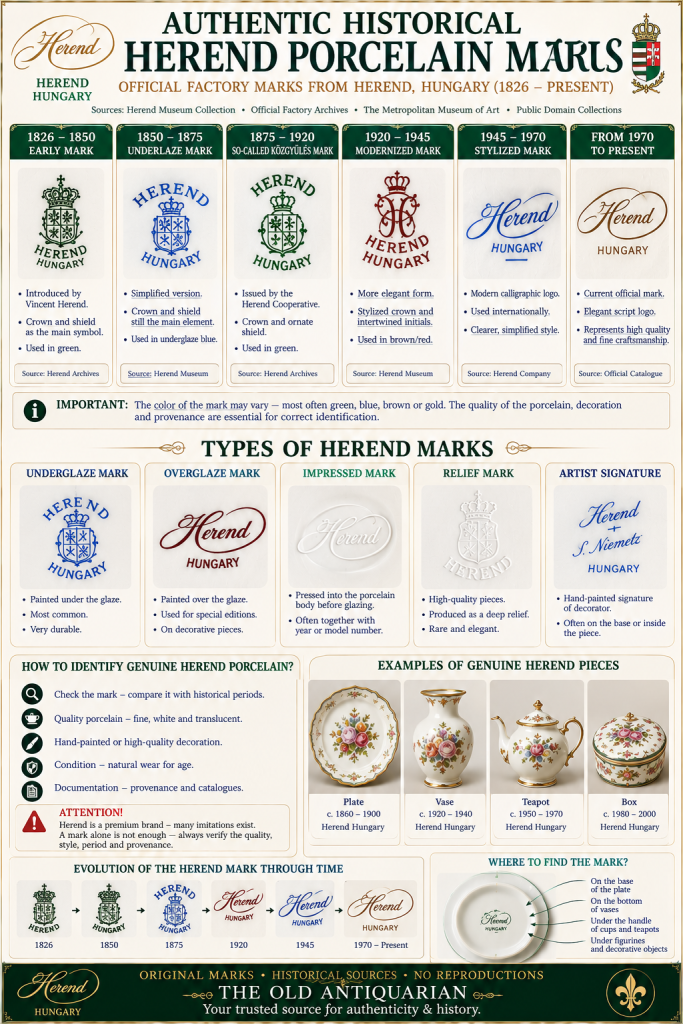
Most authentic Herend porcelain pieces carry the factory backstamp HEREND HUNGARY HANDPAINTED on the underside. Depending on the production period, additional marks may include shape numbers, pattern codes, painter’s signatures, decorator’s marks, and factory identification numbers.
Modern Herend porcelain often includes a production date code, making it easier for specialists to estimate when the piece was manufactured.
Where Is the Herend Backstamp Located?
The Herend factory mark is almost always found on the base of the porcelain piece. Alongside the official backstamp, collectors may also find:
- shape numbers;
- pattern or decoration codes;
- painter’s initials or signature;
- limited edition numbers;
- quality-control marks.
These additional markings help specialists identify the exact pattern, production period, decorator, and manufacturing process.
How Have Herend Porcelain Marks Changed Over Time?
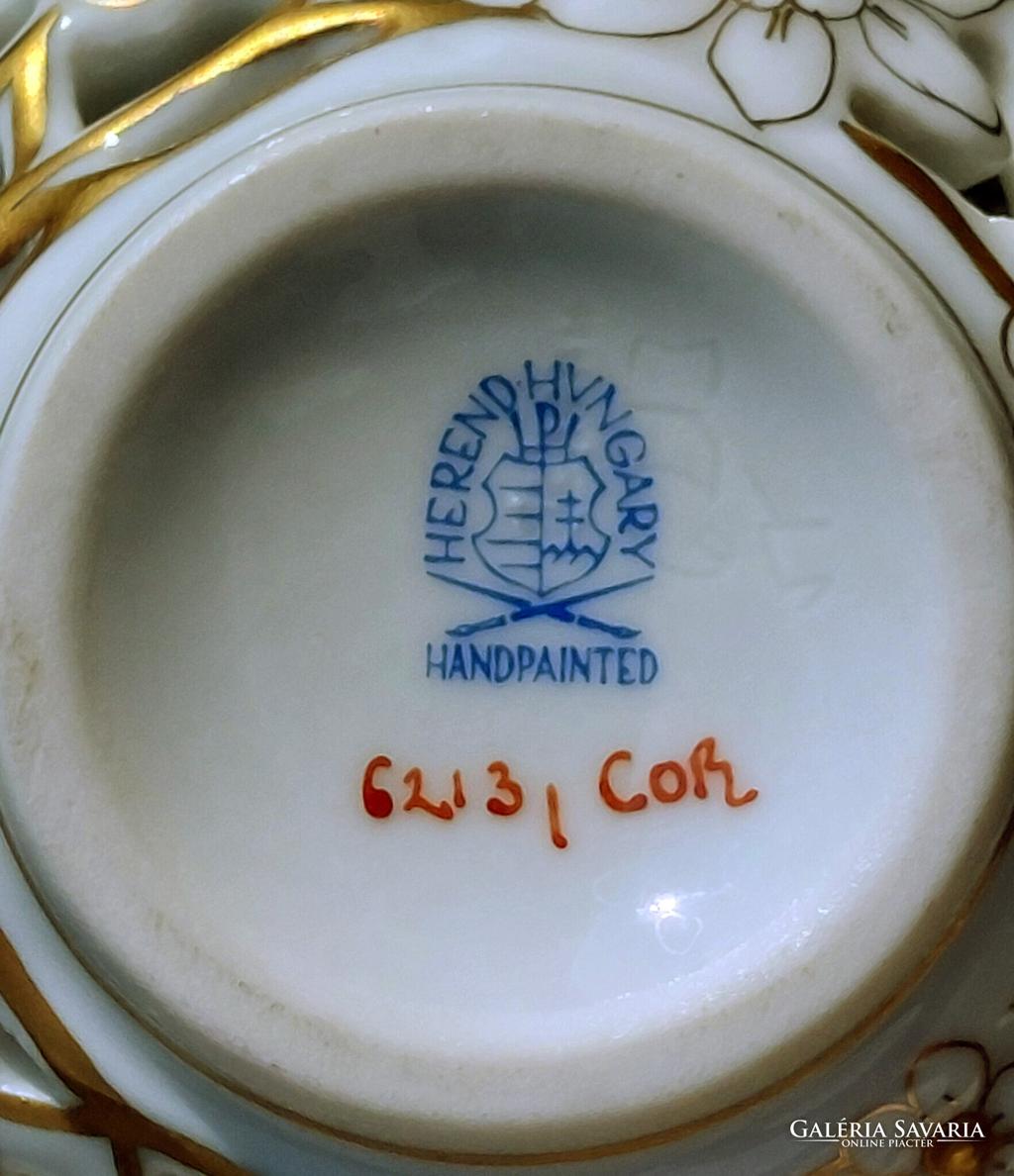
Since the nineteenth century, the Herend Porcelain Manufactory has used several versions of its official factory mark. Changes in typography, shield designs, decorative elements, and additional inscriptions allow specialists to estimate the production period with considerable accuracy.
Earlier nineteenth-century pieces often feature simpler factory marks, while later examples include increasingly detailed inscriptions such as HEREND, HUNGARY, HANDPAINTED, together with the famous shield emblem that has become synonymous with the Herend brand.
Since the early 1990s, Herend has also introduced a factory dating system that helps specialists identify modern production years. Comparing these backstamps with official reference guides is one of the most reliable methods for dating authentic Herend porcelain.
For a broader introduction to porcelain factory marks, see What Are Porcelain Marks?.
How to Identify Authentic Herend Porcelain
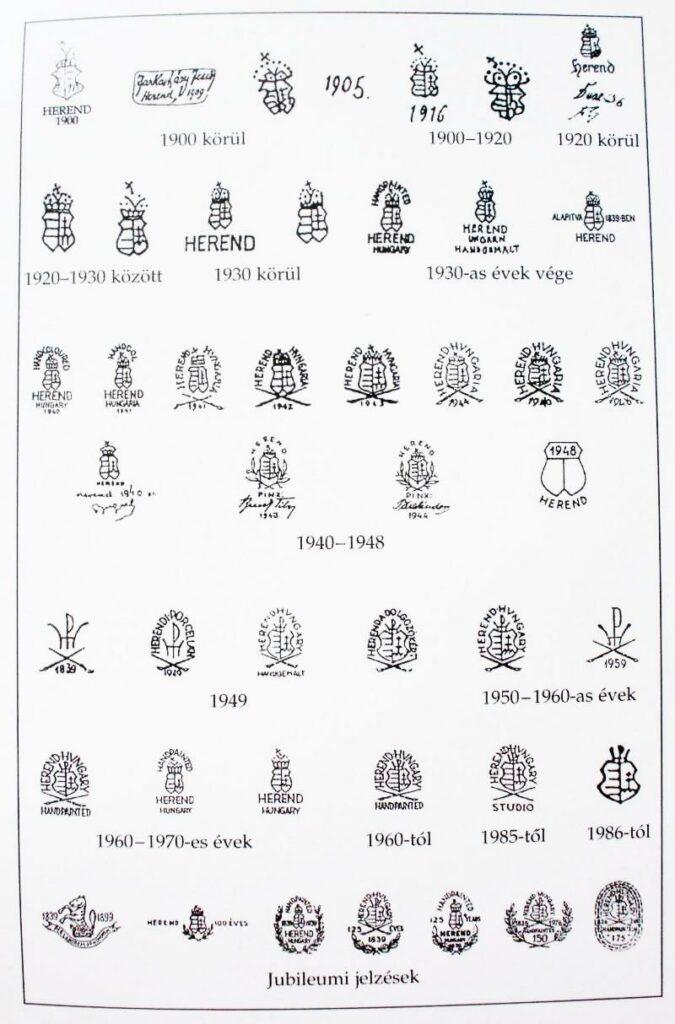
Authenticating Herend porcelain requires far more than examining the factory mark. Experienced specialists evaluate the porcelain body, translucency, glaze quality, hand-painted decoration, gilding, craftsmanship, sculptural modelling, and natural ageing before confirming authenticity.
Original Herend porcelain is distinguished by its brilliant white porcelain, flawless glaze, vivid hand-painted colours, and exceptional attention to detail. Every genuine piece reflects the remarkable craftsmanship for which the Herend Porcelain Manufactory has been famous for nearly two centuries.
Professional appraisers carefully examine:
- Original Herend porcelain backstamp.
- High-quality hard-paste porcelain.
- Brilliant white porcelain body.
- Fine translucency.
- Hand-painted decoration.
- Hand-applied gilding.
- Excellent glaze finish.
- Shape and pattern numbers.
- Artist’s signature or painter’s initials.
- Natural wear consistent with age.
- Overall craftsmanship.
Professional identification also determines whether an object remains an original, or whether it may instead be a later copy, a replica, or even a fake.
Are There Copies and Reproductions?
Yes. Because Herend is one of the world’s most prestigious porcelain manufacturers, reproductions, decorative copies, and counterfeit factory marks occasionally appear on the antiques market.
Some reproductions were produced as decorative objects and are honestly sold as such, while others imitate original Herend backstamps in an attempt to increase their value.
For this reason, authenticity should never be determined solely by the factory mark. Professional appraisers always examine:
- The porcelain body.
- Glaze quality.
- Hand-painted decoration.
- Gilding.
- Factory marks.
- Shape numbers.
- Production techniques.
- Overall craftsmanship.
Collectors should be particularly cautious when purchasing expensive Herend porcelain online without clear photographs of the factory mark, painter’s marks, and the underside of the object.
The Most Famous Herend Patterns
One of the reasons Herend porcelain is so highly collectible is the factory’s extraordinary range of hand-painted patterns. Some designs have remained in continuous production for more than 150 years and are recognised instantly by collectors worldwide.
- Victoria – colourful butterflies and flowers created for Queen Victoria.
- Rothschild Bird – elegant birds inspired by the Rothschild family.
- Apponyi – simplified floral decoration named after Count Apponyi.
- Chinese Bouquet – one of Herend’s most popular decorative styles.
- Queen Victoria – luxurious royal pattern with rich floral decoration.
- Indian Basket – colourful hand-painted floral motifs.
These classic collections remain among the most desirable Herend porcelain patterns and are frequently encountered at major international auctions and in important private collections.
The Most Collectible Herend Porcelain
For nearly two centuries, Herend has produced some of the world’s finest hand-painted porcelain. Today, antique Herend porcelain is highly sought after by collectors because of its exceptional craftsmanship, limited production, royal associations, and enduring artistic quality.
Collectors particularly value pieces that retain their original factory marks, hand-painted decoration, excellent condition, and documented provenance.
Among the most desirable Herend porcelain pieces are:
- Victoria pattern dinner services.
- Rothschild Bird collections.
- Apponyi porcelain.
- Chinese Bouquet services.
- Queen Victoria collections.
- Hand-painted figurines.
- Animal sculptures.
- Decorative vases.
- Cabinet plates.
- Limited edition collector pieces.
- Artist-signed porcelain.
- Royal commissions.
Collectors especially admire Herend figurines because every piece is individually modelled and hand-painted. No two examples are ever completely identical, making each object a unique work of art.
What Determines the Value of Herend Porcelain?
The value of Herend porcelain depends on many factors beyond the factory backstamp. Two pieces bearing similar marks may differ greatly in market value depending on their rarity, pattern, artistic quality, production period, and condition.
Professional appraisers carefully evaluate:
- Production period.
- Factory backstamp.
- Age.
- Pattern.
- Shape number.
- Painter’s initials.
- Artist’s signature.
- Hand-painted decoration.
- Quality of gilding.
- Condition.
- Rarity.
- Historical importance.
- Documented provenance.
- Collector demand.
Collectors generally pay the highest prices for porcelain that remains in excellent original condition, retains its original factory marks, and shows no evidence of poor restoration or overpainting.
Professional specialists also determine whether an object has undergone previous restoration or conservation. Proper conservation can help preserve an antique, while poor restoration, replacement parts, or excessive repainting can significantly reduce both historical authenticity and collector value.
Herend Porcelain in the International Collectors’ Market
Herend occupies one of the highest positions in the international luxury porcelain market. Museums, auction houses, antique dealers, and private collectors throughout Europe, North America, and Asia actively seek authentic Herend porcelain because of its exceptional craftsmanship and artistic heritage.
Collectors value Herend because it combines:
- Nearly 200 years of uninterrupted production.
- Entirely hand-painted decoration.
- Outstanding Hungarian craftsmanship.
- Luxury hard-paste porcelain.
- Royal commissions.
- Exceptional artistic quality.
- Historic factory traditions.
- Strong international collector demand.
Unlike many luxury porcelain manufacturers that have modernised large parts of their production, Herend continues to rely heavily on traditional handcrafting techniques. This dedication to craftsmanship has helped preserve the factory’s reputation as one of the world’s leading producers of fine porcelain.
Collectors frequently compare Herend with other prestigious European porcelain manufacturers such as Meissen, Rosenthal, Limoges, Royal Copenhagen, and Wedgwood, while recognising Herend’s unique contribution to the history of Hungarian porcelain and European decorative arts. “`html
How to Care for Antique Herend Porcelain
Antique Herend porcelain represents nearly two centuries of exceptional Hungarian craftsmanship. Although Herend uses one of the finest hard-paste porcelains in Europe, every piece should be handled with great care to preserve both its artistic beauty and long-term collector value.
Collectors should always support porcelain by its strongest structural points. Handles, lids, figurines, flowers, bird tails, delicate sculptural elements, and gilded decorations should never be used to lift an object, as these are the areas most vulnerable to accidental damage.
To help preserve antique Herend porcelain:
- Handle porcelain with clean, dry hands.
- Avoid sudden temperature changes.
- Keep porcelain away from prolonged direct sunlight.
- Protect it from vibration and accidental impacts.
- Display valuable pieces inside enclosed cabinets whenever possible.
- Use padded shelves for figurines and decorative objects.
- Never stack valuable porcelain without protective padding.
- Dust regularly using a soft microfiber cloth.
- Avoid abrasive cleaning products and harsh household chemicals.
- Never place antique porcelain in a dishwasher.
Herend’s famous hand-painted decoration and hand-applied gilding should never be aggressively cleaned or polished. Even gentle rubbing may eventually wear away original gold decoration that has survived for generations.
If damage occurs, professional conservation is generally preferable to unnecessary restoration. When repairs are required, they should always be performed using reversible conservation techniques that preserve as much original material as possible.
When Should You Seek a Professional Herend Appraisal?
If you own Herend porcelain and would like to determine its authenticity, production period, pattern, artist, or approximate market value, obtaining a professional appraisal is often the safest course of action.
Professional evaluation is especially recommended before:
- Buying valuable Herend porcelain.
- Selling inherited collections.
- Sending porcelain to auction.
- Restoring damaged objects.
- Obtaining insurance.
- Dividing family collections.
- Donating porcelain to museums or institutions.
Professional appraisers examine much more than the factory backstamp. They carefully evaluate the porcelain body, glaze, translucency, hand-painted decoration, gilding, painter’s marks, pattern numbers, craftsmanship, provenance, condition, and historical consistency before determining authenticity and market value.
➡️ Request a Professional Antique Valuation
Frequently Asked Questions
Is Herend porcelain valuable?
Yes. Authentic Herend porcelain is among the world’s most collectible luxury porcelains. Rare figurines, early production, royal commissions, discontinued patterns, and complete dinner services can command significant prices at international auctions.
How can I identify authentic Herend porcelain?
Authenticity is determined by examining the factory backstamp, porcelain quality, glaze, hand-painted decoration, gilding, painter’s marks, shape numbers, craftsmanship, and natural signs of ageing. Professional authentication never relies on the factory mark alone.
What is the Herend backstamp?
The most familiar Herend backstamp includes the words HEREND, HUNGARY, and HANDPAINTED, together with the factory shield emblem. Depending on the production period, additional pattern numbers, painter’s initials, and dating codes may also appear.
Can Herend porcelain be dated?
Yes. Changes in factory marks, shield designs, typography, and the modern Herend dating system allow specialists to estimate the production period of most authentic pieces with considerable accuracy.
Can damaged Herend porcelain still be valuable?
Yes. Rare Herend figurines, limited editions, discontinued patterns, and early production often retain significant collector value despite minor damage. However, poor restoration, repainting, or replacement parts can substantially reduce value.
Is Herend porcelain a good investment?
Exceptional Herend porcelain with documented provenance, original factory marks, excellent condition, and outstanding artistic quality has maintained strong international collector demand for decades. Museum-quality examples continue to achieve excellent results at major auctions worldwide.
Conclusion
Herend represents one of Europe’s greatest porcelain traditions and remains one of the world’s leading luxury porcelain manufacturers. Since 1826, the Herend Porcelain Manufactory has preserved traditional handcrafting techniques while producing porcelain admired by royal families, museums, and collectors across the globe.
Correct identification requires careful examination of factory marks, porcelain quality, glaze, hand-painted decoration, craftsmanship, historical context, and provenance. Together, these characteristics enable collectors to distinguish authentic Herend masterpieces from later reproductions while appreciating the extraordinary artistry behind every piece.
Whether you are researching a treasured family heirloom, expanding a Hungarian porcelain collection, or purchasing your first Herend masterpiece, understanding its history and craftsmanship will help you make informed collecting decisions and gain a deeper appreciation for one of Europe’s finest porcelain manufacturers.
Continue Learning
- What Is Porcelain?
- Types of Porcelain Explained
- Porcelain vs Faience vs Ceramic
- What Are Porcelain Marks?
- What Is Hungarian Porcelain?
- How to Identify Meissen Porcelain
- How to Identify Rosenthal Porcelain
- How to Identify Limoges Porcelain
- How to Identify Royal Copenhagen Porcelain
- How to Identify Wedgwood Porcelain
- What Is German Porcelain?
- What Is French Porcelain?
- What Is English Porcelain?
- What Is Italian Porcelain?
- What Is a Maker’s Mark?
- What Is Restoration?
- What Is Conservation?
- What Is an Original?
- What Is a Copy?
- What Is a Replica?
- What Is a Fake?
- What Is a Certificate of Authenticity?
Explore Related Collections
