
Delft Blue & Delftware: Marks, Royal Delft, Dating & Value
Dutch Ceramics · Delft Blue · Delftware · Royal Delft · Marks · Dating · Value
Traditional antique Delftware is generally tin-glazed earthenware rather than porcelain. Historic Dutch Delftware was produced in Delft roughly between 1620 and 1850 and is famous for blue-and-white decoration inspired partly by imported Asian porcelain, although genuine Delftware can also be polychrome, white, black or otherwise decorated. Some pieces bear factory or owner marks, while many genuine objects are unmarked. Royal Delft / De Porceleyne Fles is the surviving historic Delft factory and has used a documented year-code system on hand-painted production since 1879. Reliable identification combines material + glaze + foot rim + form + decoration + mark + period + condition + documented comparison.
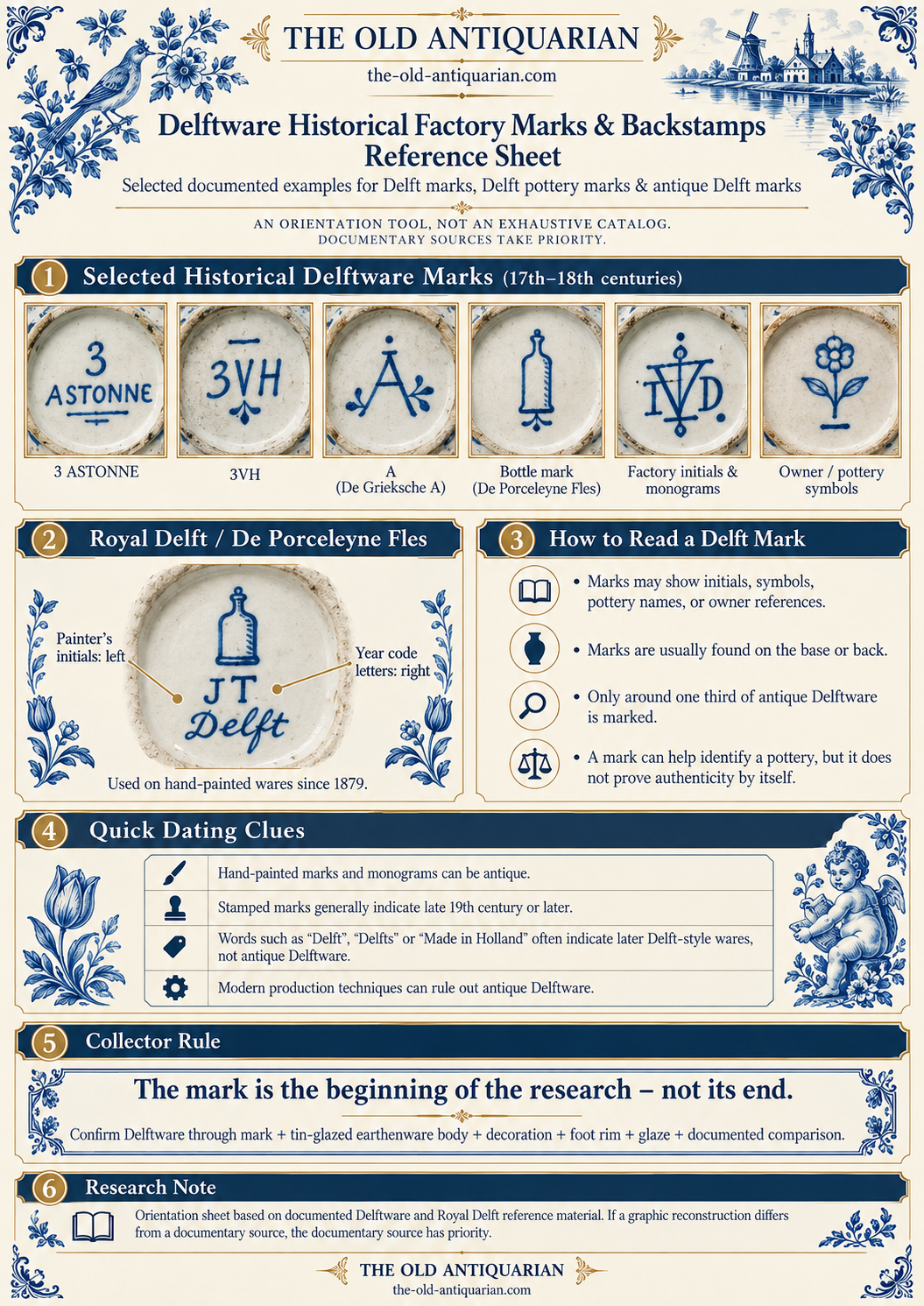
| Delftware at a Glance | Collector Reference |
|---|---|
| Traditional material | Tin-glazed earthenware / faience, not traditional hard-paste porcelain |
| Core antique period | Approximately 1620–1850 |
| Historic production centre | Delft, the Netherlands |
| Most famous decoration | Cobalt blue painting on an opaque white tin glaze |
| Must Delftware be blue and white? | No. Genuine historical Delftware also exists in polychrome, white, black and other decorative schemes. |
| Do all antique pieces have a mark? | No. A large proportion of historic Delftware is unmarked. |
| Surviving historic factory | De Porceleyne Fles / Royal Delft, founded in 1653 |
| Royal Delft year codes | Used on hand-painted production since 1879 |
| Important forms | Vases, tulip vases, chargers, plates, tiles, apothecary jars, ewers, jugs, tureens and decorative wares |
| Main authentication risk | Later Delft-style pottery, false historic marks, reproductions and incorrect use of the word “Delft” |
The mark is the beginning of the research – not its end.
A convincing Delft mark must be supported by the ceramic body, glaze, form, painting technique, foot rim, production period and documented examples.
Delftware sits at an important crossroads between European pottery and the history of porcelain. Because antique Delft imitated the visual effect of costly imported Asian porcelain, modern sellers frequently describe it as “Delft Blue porcelain.” Technically, however, traditional Delftware belongs to the earthenware and faience family. If you are unsure about the terminology, our
Porcelain vs Faience vs Ceramic guide
explains the material distinction in detail.
What Is Delftware?
Traditional Dutch Delftware is tin-glazed earthenware made in Delft. The opaque white surface was achieved with a glaze containing tin oxide, creating a bright ground on which painters could imitate the visual refinement of imported porcelain.
The historic definition is important because “Delft” is now used very broadly in the decorative-arts market. Blue-and-white ceramics made in the Netherlands, Belgium, France, England, Germany and elsewhere may be described as Delft-style without being antique Delftware in the strict historical sense.
Antique Dutch Delftware is usually defined as tin-glazed earthenware made in Delft approximately between 1620 and 1850. After that period, Delft-style ceramics continued to be produced using newer industrial techniques, including by historic and modern factories.
If the object is dense, white and translucent rather than porous beneath the glaze, it may be porcelain instead. For a deeper explanation of porcelain bodies, see
What Is Porcelain?
.
Is Delft Blue Porcelain?
This is one of the most useful distinctions for both Google searches and real-world collecting:
traditional antique Delftware is normally not porcelain.
It is tin-glazed earthenware.
The confusion developed because Delft potters were strongly influenced by imported Chinese porcelain. The expensive Asian material was admired for its brilliant white body and cobalt-blue decoration. Delft craftsmen reproduced the visual language using locally available clay covered by opaque tin glaze.
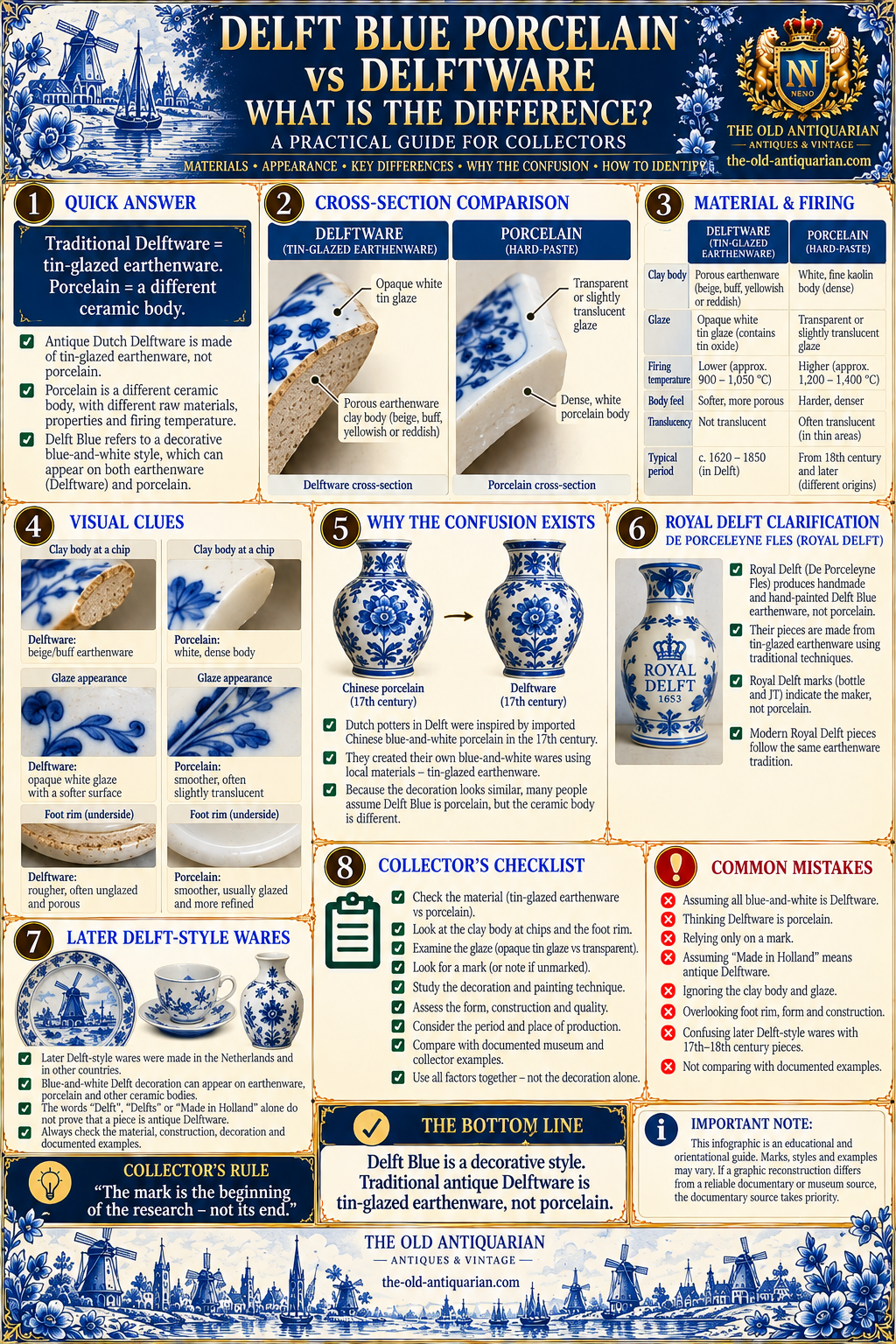
| Feature | Traditional Delftware | Porcelain |
|---|---|---|
| Body | Earthenware / faience | Dense vitrified ceramic body |
| Glaze | Opaque white tin glaze | Usually clear or translucent glaze over a white body |
| Broken edge | May reveal beige, buff, yellowish or pinkish clay | Usually reveals a white or near-white dense body |
| Translucency | Normally not translucent | Often translucent in thinner areas |
| Historic Delft period | Especially c. 1620–1850 | Different traditions and periods worldwide |
| Blue-and-white decoration | Very common but not universal | Also common in Asian and European porcelain |
“Delft Blue” can describe a decorative style. “Antique Delftware” is a more specific historical and technical category. Never identify the material from the blue-and-white decoration alone.
A Short History of Delftware
Imported Chinese porcelain reached the Netherlands in significant quantities around the beginning of the seventeenth century. Its whiteness, refinement and blue decoration had a major impact on European taste.
Dutch potters did not have access to the same porcelain raw materials and technology, so Delft workshops refined an existing European tin-glaze tradition. A layer of opaque white glaze allowed painters to create ceramic surfaces that visually approached the brilliance of porcelain.
Delft production expanded rapidly during the seventeenth century. The town had only a small number of pottery businesses in the early part of the century, but by around 1700 dozens of workshops were active. Some developed international reputations and exported large quantities of decorative and functional ware.
| Period | Development | Collector Context |
|---|---|---|
| Early 17th century | Growing influence of imported Asian porcelain | Early development of Delft’s porcelain-like tin-glazed wares |
| c. 1620–1650 | Delftware production becomes increasingly established | Early antique Delftware period |
| Second half of 17th century | Rapid growth in the number of Delft potteries | Many important factories and owners appear |
| c. 1650–1750 | Major blue-and-white, chinoiserie and decorative production | Core collecting period for many important Delft factories |
| 18th century | Changing European taste and increasingly diverse forms and colours | Marks, owners and factory histories become especially useful |
| Early 19th century | Traditional production declines | Late antique Delftware |
| After c. 1850 | Production methods change and Delft-style revival develops | Later Delftware must be separated from traditional antique Delftware |
| From 1879 | De Porceleyne Fles uses its documented bottle/JT/Delft mark and year-code system | Royal Delft can often be dated precisely from factory records |
Important Delftware Factories & Famous Makers
Historic Delftware was not made by one company. Delft supported a network of workshops whose owners, marks and styles changed over generations.
This is important because a letter or symbol on the base may refer to an individual owner rather than directly to the factory name. The same pottery could therefore use several different marks over its lifetime.
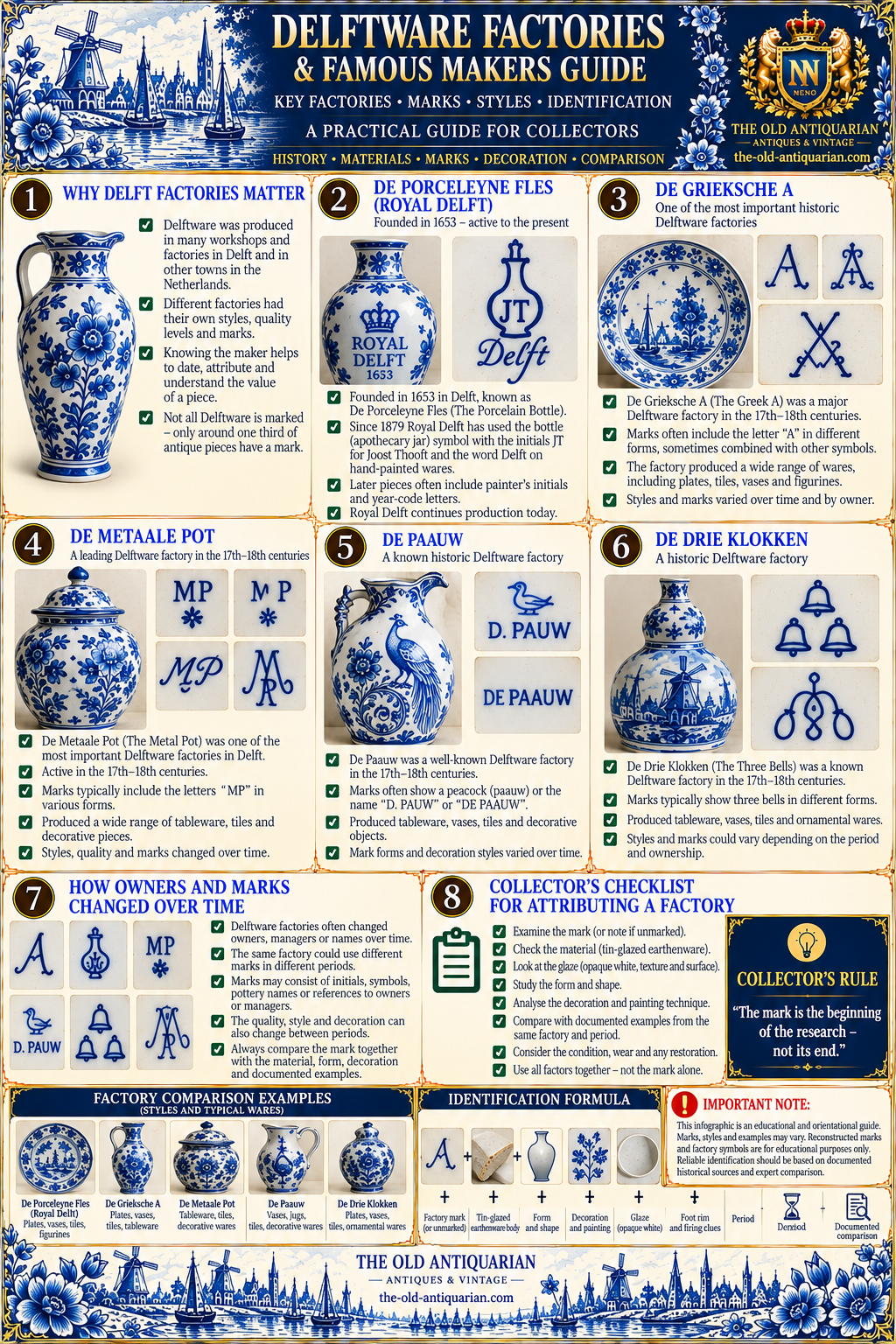
| Factory | Historic Period | Collector Notes |
|---|---|---|
| De Porceleyne Fles | Founded 1653; historical factory continued into Royal Delft | The best-known surviving Delft factory; later hand-painted pieces use a documented factory and year-code system. |
| De Grieksche A | 17th–early 19th century | One of the major historic factories; marks changed with owners such as Van Eenhoorn, Kocx, Van der Kool and Dextra. |
| De Metaale Pot | 1670–1775 | A highly regarded historic factory with several production and ownership periods. |
| De Paauw | 1651–1774 | Historic Delft factory associated with peacock references and documented marks including D-PAUW. |
| De Drie Klokken | 17th century–1841 | Known for mark families incorporating three bells. |
| De Klaauw | 1661–1840 | Another long-running Delft factory; claw-related marks occur in the wider Delftware mark tradition. |
For many Delft factories, the individual owner or manager is essential because ownership changes can narrow the production period far more precisely than the factory name alone.
Delft Marks & Backstamps
Historic Delft marks may consist of initials, monograms, names, numbers or figurative symbols. They are usually found on the base or reverse of the object.
A factory might incorporate its name into the mark, while another mark might identify the current owner or manager. Figurative symbols could also refer to the pottery name—for example a bottle for De Porceleyne Fles or bells for De Drie Klokken.
However, many genuine antique Delftware objects are completely unmarked. This makes Delftware very different from modern collector fields where a factory backstamp is expected on nearly every item.
mark + tin-glazed earthenware body + glaze + foot rim + construction + form + hand-painted decoration + period + documented comparison
For general methodology on reading symbols, initials and factory backstamps, our
Porcelain Marks & Backstamps Guide
explains the same multi-factor research principle across European ceramics.
Does the word “Delft” prove an antique origin?
No. Later nineteenth- and twentieth-century producers in and outside the Netherlands used words such as Delft, Delfts, Delftsch and Made in Holland.
Those words can identify a later Delft-style tradition, but they do not automatically mean seventeenth- or eighteenth-century antique Delftware.
Traditional antique Delftware was hand painted. A modern-looking stamped or printed mark can point toward later production and should be checked against the body, decoration and manufacturing technique.
Royal Delft / De Porceleyne Fles Marks & Year Codes
Royal Delft is the modern continuation of De Koninklijke Porceleyne Fles, the historic Delft pottery founded in 1653.
For collectors, its later factory documentation is unusually useful. Since 1879, the characteristic hand-painted Royal Delft system has included an apothecary-bottle or jar symbol, the initials JT for Joost Thooft and the word Delft.
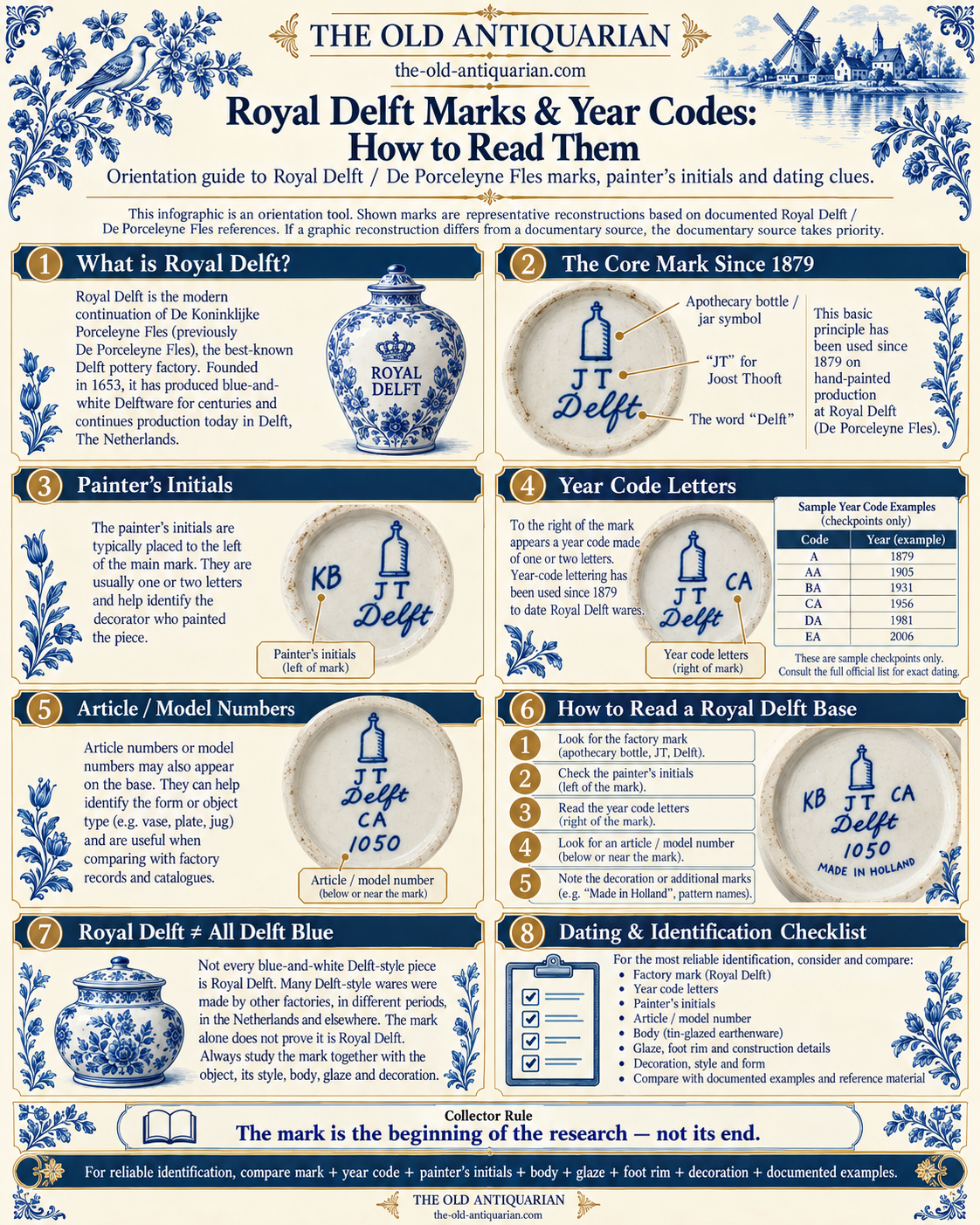
| Royal Delft Base Detail | Meaning |
|---|---|
| Bottle / apothecary jar | Core De Porceleyne Fles factory symbol |
| JT | Initials of Joost Thooft |
| Delft | Factory / city wording |
| Painter initials | Usually placed to the left of the principal mark |
| Year-code letter(s) | Placed to the right; the official year-code table can establish the production year |
| Article / model number | May help identify the form or factory reference |
Selected Royal Delft year-code checkpoints
| Code | Year | Use |
|---|---|---|
| A | 1879 | Beginning of the documented letter-code sequence |
| AA | 1905 | Useful early twentieth-century checkpoint |
| BA | 1931 | Interwar production checkpoint |
| CA | 1956 | Mid-twentieth-century checkpoint |
| DA | 1981 | Later twentieth-century checkpoint |
| EA | 2006 | Modern Royal Delft checkpoint |
Do not extrapolate a Royal Delft date from memory or from a marketplace chart. The documented factory list should take priority.
How to Identify Genuine Antique Delftware
The most reliable identification begins with the ceramic body rather than the mark.
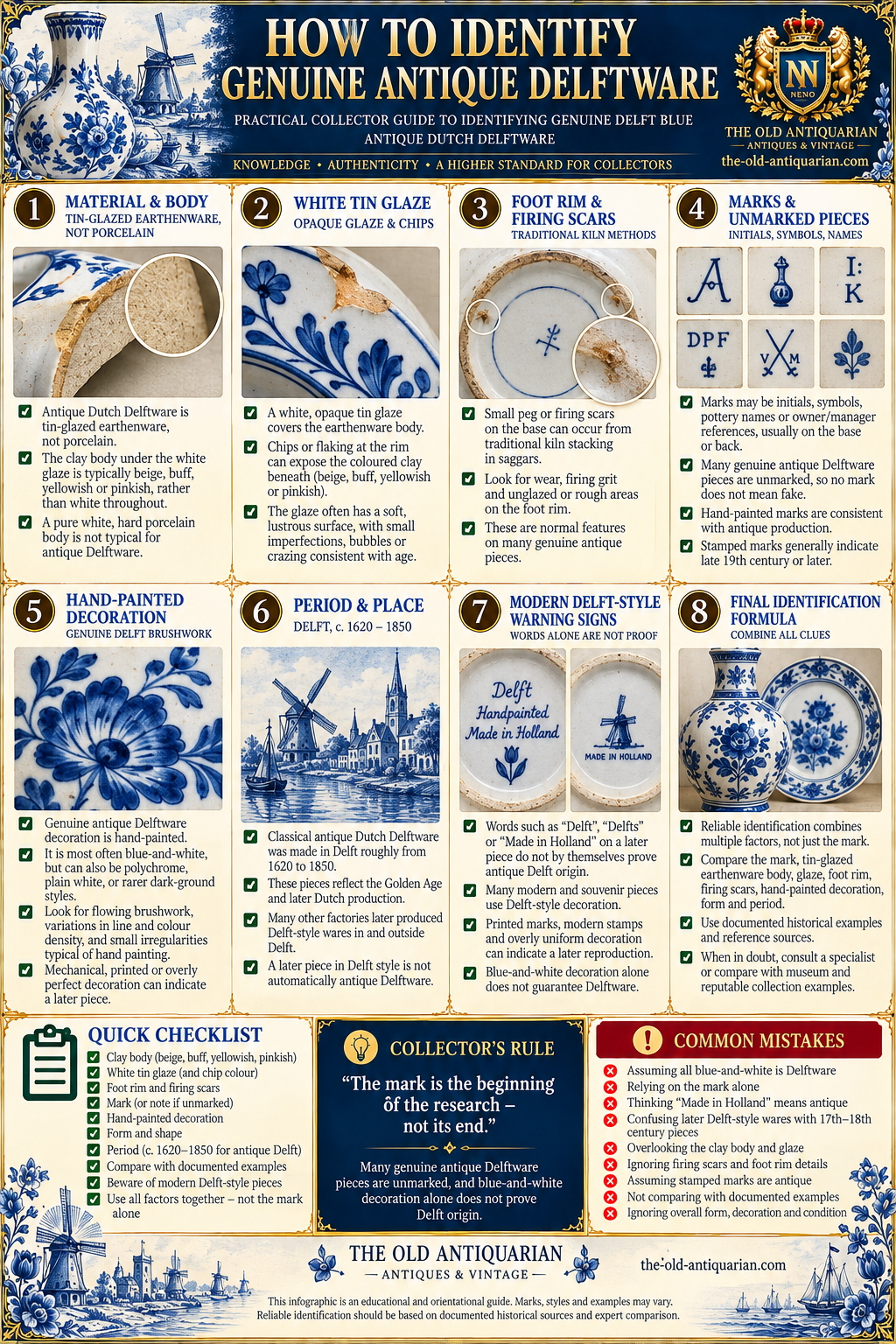
Look for an earthenware body rather than dense porcelain.
Traditional Delftware has an opaque white glazed surface.
Wear, kiln contact and construction details can provide useful evidence.
If present, photograph every letter, symbol, number and detail.
Historical Delftware is hand painted rather than decorated with modern printed transfer techniques.
Use museum collections, factory records and specialist Delftware references.
What should the ceramic body look like?
Where the glaze is chipped or the foot rim is exposed, traditional Delftware may reveal a beige, buff, yellowish or pinkish earthenware body. It should not look like a fully vitrified white porcelain body.
What should the glaze look like?
The glaze is opaque and white because tin oxide was used to mask the underlying earthenware. Small firing imperfections, unevenness and natural surface variation can occur.
Does a genuine piece need a factory mark?
No. Many authentic antique objects have no surviving or identifiable factory mark. When the mark is absent, material, form, glaze, painting and construction become even more important.
How to Date Delft Blue & Delftware
Dating Delftware begins by answering one basic question:
Is this traditional antique Delftware, later Delft-style earthenware, Royal Delft production or another blue-and-white ceramic entirely?
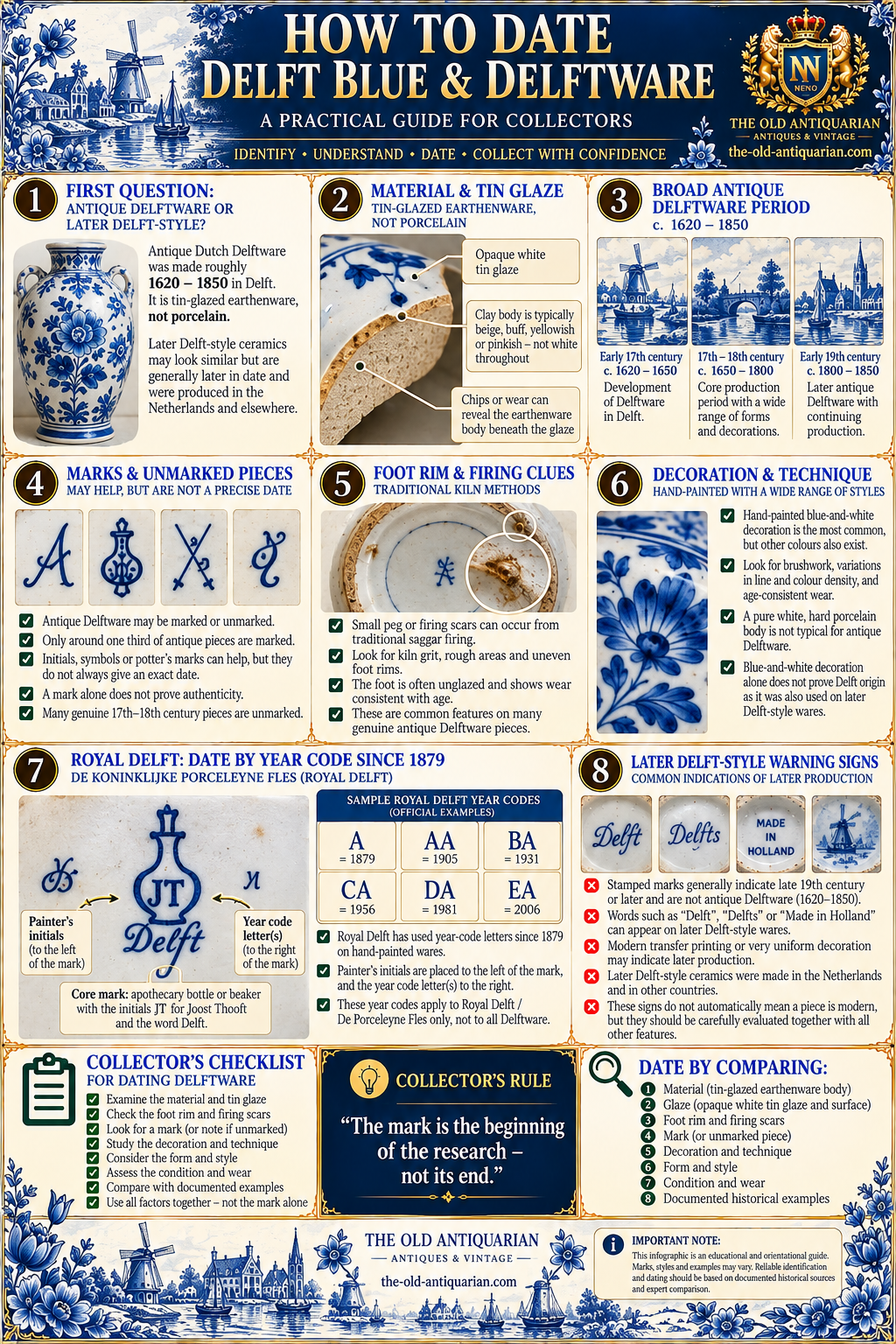
material + tin glaze + foot rim + firing clues + exact mark + form + decoration + production technique + documented factory history
| Dating Clue | What It Can Tell You | Caution |
|---|---|---|
| Tin-glazed earthenware body | Supports traditional Delftware attribution | Tin-glazed faience was also made outside Delft |
| Hand-painted historical mark | Can identify factory or owner period | Marks were copied and falsified |
| Unmarked base | Still compatible with genuine antique Delftware | Requires stronger form and material comparison |
| Factory ownership mark | Can narrow the date considerably | Confirm exact owner and period |
| Royal Delft letter code | Can identify an exact documented year after 1879 | Applies to the Royal Delft coding system, not all Delftware |
| Stamped “Delft” or “Made in Holland” | Often indicates later production | Do not classify age from wording alone |
| Decoration | Can support seventeenth-, eighteenth-, nineteenth- or later-period attribution | Historic styles were deliberately revived |
The broader logic is similar to dating porcelain: the strongest conclusion comes when several independent clues agree. Our
How to Date Antique Porcelain
guide explains this evidence-based method in greater detail.
Real vs Fake Delft Marks & Modern Reproductions
Fake Delft marks are not a modern internet-era problem. By the late nineteenth and early twentieth centuries, renewed enthusiasm for old Dutch Delftware created a strong commercial incentive to imitate desirable historical pieces and marks.
Some false marks were applied to later ceramics, while other objects were deliberately produced in an antique Delft style.
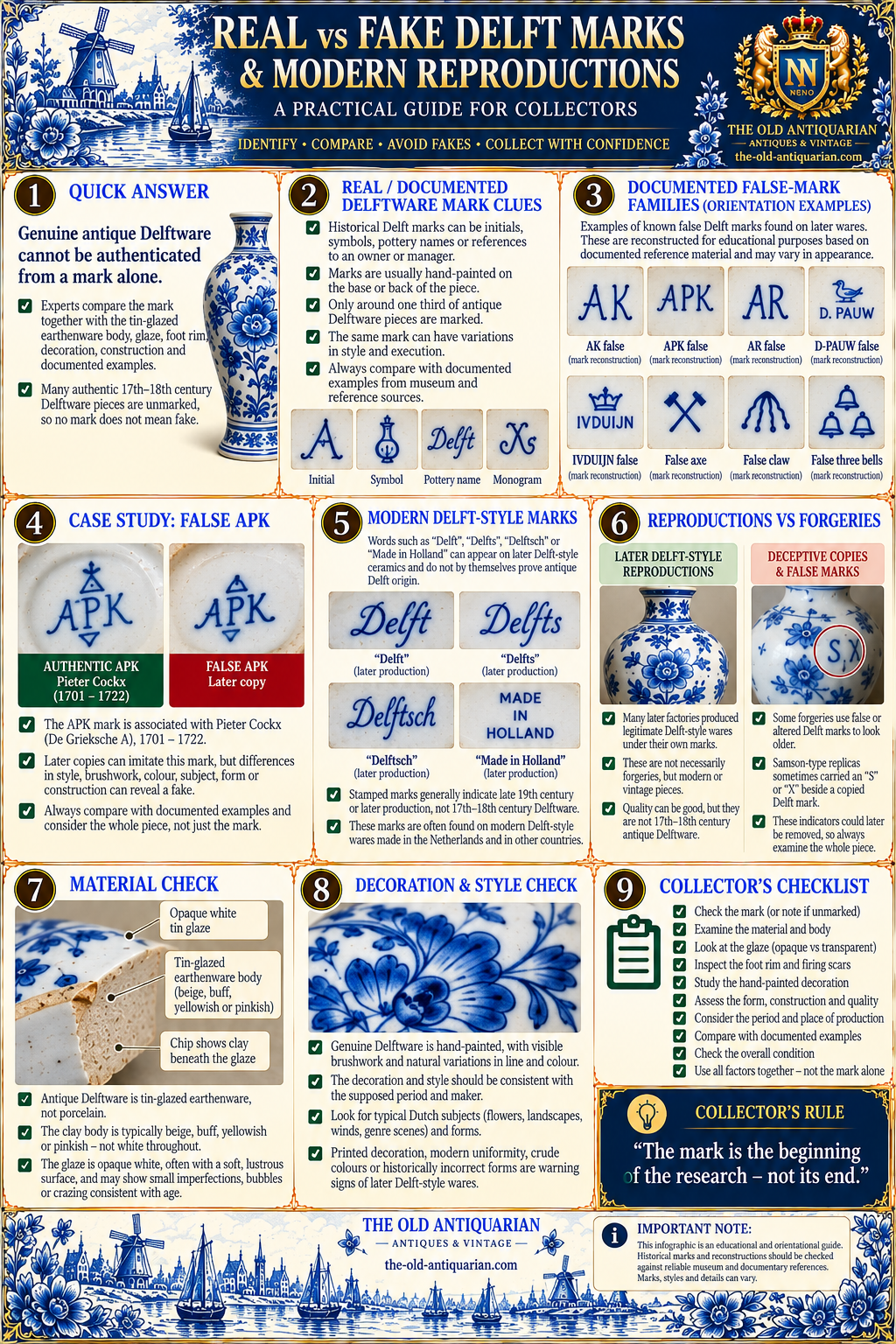
The famous AK / APK problem
Marks connected with De Grieksche A are among the best-known examples of the authentication problem. Historic AK and related Kocx marks are documented, but copies and false variants are also known.
For example, an apparently convincing mark attributed to a late seventeenth- or early eighteenth-century owner becomes suspicious if it appears on a ceramic body, form or decoration that belongs to a much later production tradition.
| Check | More Consistent With Historic Delftware | Warning Sign |
|---|---|---|
| Mark application | Hand-painted mark consistent with documented examples | Modern stamp or crude copied historic mark |
| Body | Traditional tin-glazed earthenware | White porcelain or obviously modern industrial body |
| Decoration | Hand-painted and historically consistent | Printed transfer or highly uniform modern decoration |
| Shape | Documented form for factory and period | Form inconsistent with claimed date |
| Wording | Appropriate owner / factory system | Modern “Made in Holland” used to imply great age |
| Overall evidence | Material, mark and style agree | One convincing mark contradicts the rest of the object |
The bottom, side profile, exposed body, glaze, complete form and decoration may reveal more than the backstamp.
Delft Blue Forms: What Collectors Encounter
Delft workshops produced a very broad range of objects. Many were practical household wares; others were designed as prestigious display pieces for affluent interiors and international export.
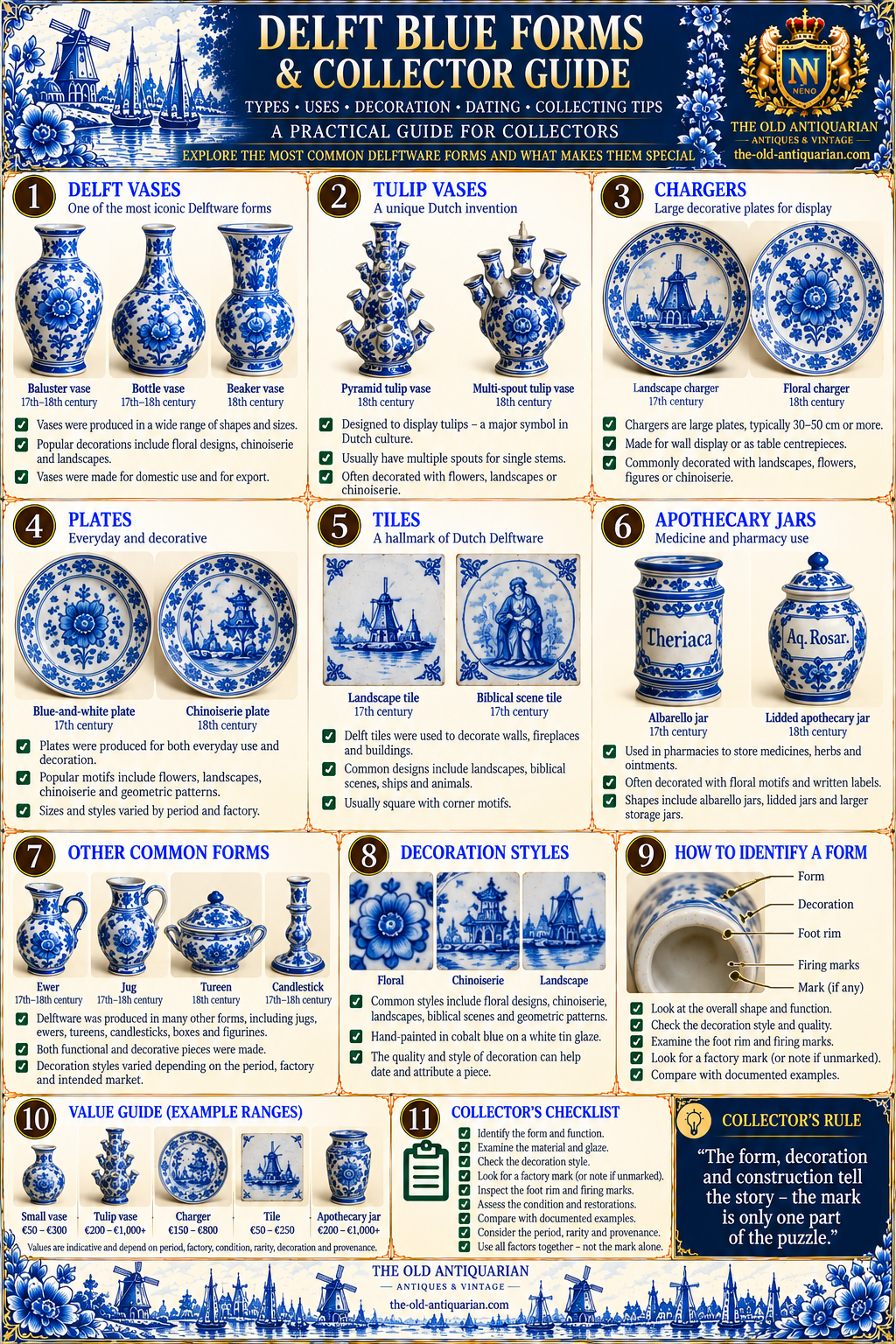
| Form | Collector Interest | What to Examine |
|---|---|---|
| Baluster & bottle vases | Among the classic Delft display forms | Profile, neck, foot, painting and factory attribution |
| Tulip vases / flower pyramids | Iconic and visually distinctive | Number of spouts, construction, scale, decoration and condition |
| Chargers | Large decorative display pieces | Diameter, rim design, central subject, reverse and marks |
| Plates | Very broad market from common to museum-quality | Painting quality, factory, subject, age and condition |
| Tiles | Major field in their own right | Subject, corner motifs, clay body, edges and architectural context |
| Apothecary jars | Strong historical and decorative appeal | Form, inscription, lid, pharmacy use and decoration |
| Ewers & jugs | Functional and ornamental | Handle, spout, foot, moulding and painting |
| Tureens & services | Completeness can be important | Lids, handles, matching components and damage |
Delftware Decoration: More Than Blue and White
Blue-and-white decoration became the international visual signature of Delft, but historical production was much more diverse.
Delft painters borrowed heavily from Chinese porcelain, particularly motifs associated with seventeenth-century trade. These Asian sources were gradually combined with European flowers, landscapes, coats of arms, religious scenes, figures, maritime subjects and local decorative fashions.
Blue & White
Cobalt-blue painting on an opaque white ground is the most recognisable Delft tradition and one of the strongest visual links to imported Chinese porcelain.
Polychrome Delftware
Historical makers also produced multi-coloured decoration, including palettes influenced by Chinese and Japanese porcelain traditions.
Traditional antique Delftware was hand decorated. Visible variation in brushwork and line quality can therefore be meaningful, although craftsmanship ranged from inexpensive domestic ware to extraordinarily refined luxury production.
Condition, Restoration & Natural Wear
Tin-glazed earthenware is softer and more vulnerable than hard-paste porcelain. Edge chips, glaze losses and small firing imperfections are therefore common on genuine antique Delftware.
Condition should always be judged relative to the object’s rarity, form and age. A rare seventeenth-century charger with old rim losses belongs to a different market from a common later decorative plate with extensive restoration.
| Condition Issue | Where to Look | Collector Significance |
|---|---|---|
| Rim chips | Edges of plates, chargers and vases | Very common; severity matters |
| Glaze flaking | Raised areas and vulnerable edges | May expose the earthenware body |
| Hairline cracks | Rim, base, handles and structural joins | Can materially affect value |
| Restoration | Handles, rims, lids and large old breaks | Extent and quality should be disclosed |
| Overpainting | Blue decoration and repaired areas | Can conceal damage and complicate authentication |
| Replacement parts | Lids, mounts and service components | Original completeness may be important |
Before cleaning or repairing a potentially important piece, read
What Not to Do Before an Antique Valuation or Sale
.
Old labels, dirt patterns, restoration and surface evidence can all contain useful information.
What Affects Delft Blue & Delftware Value?
There is no reliable universal price for “Delft Blue.” The category includes everything from modern souvenir ceramics to museum-quality seventeenth-century objects.
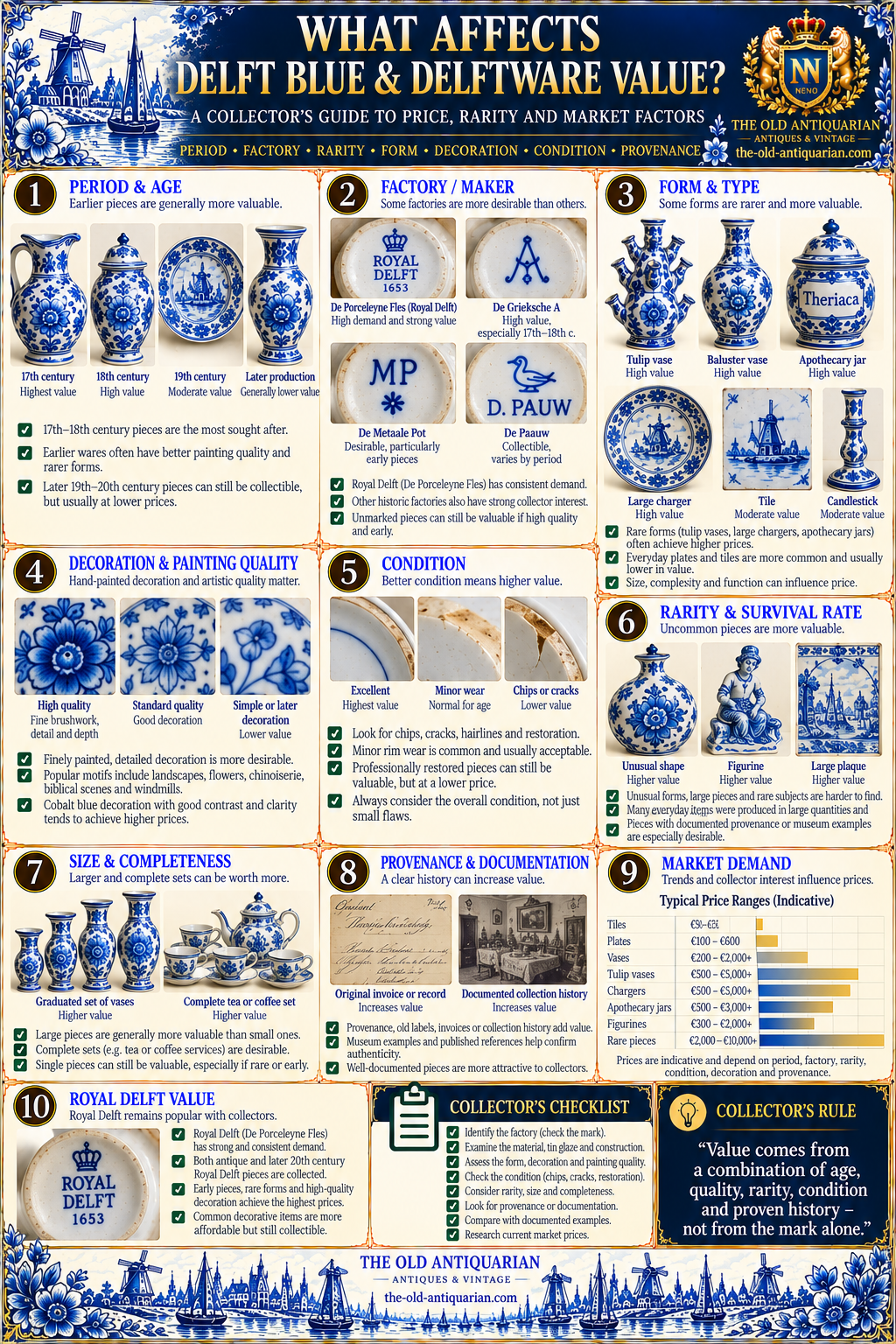
An online asking price shows what a seller hopes to receive. Market research should use genuinely comparable completed sales for objects with similar maker, period, form, size, decoration, condition and restoration.
| Value Factor | Why It Matters |
|---|---|
| Period | Seventeenth-, eighteenth-, nineteenth- and later Delft-style objects belong to very different markets |
| Factory / owner | Documented makers and production periods can attract specialist demand |
| Form | Rare tulip vases, large chargers or unusual vessels may be more desirable than common forms |
| Decoration | Exceptional brushwork, rare subjects and high artistic quality can materially affect demand |
| Rarity | Unusual factory-period combinations can attract advanced collectors |
| Size | Large scale can matter, but rarity and quality remain more important than size alone |
| Condition | Chips, cracks, missing parts and structural damage affect comparability |
| Restoration | Location, extent and quality of restoration should be considered |
| Provenance | Reliable historic ownership and collection records can strengthen significance |
| Documentation | Museum and published comparables can support correct attribution |
| Completed sales | Provide stronger evidence than unsold marketplace listings |
They are not a current price list or a substitute for object-specific market research.
For an individual object, use our
Professional Antique Valuation
service once identification, condition and available documentation have been established.
Delftware Collector Checklist – Before You Buy or Sell
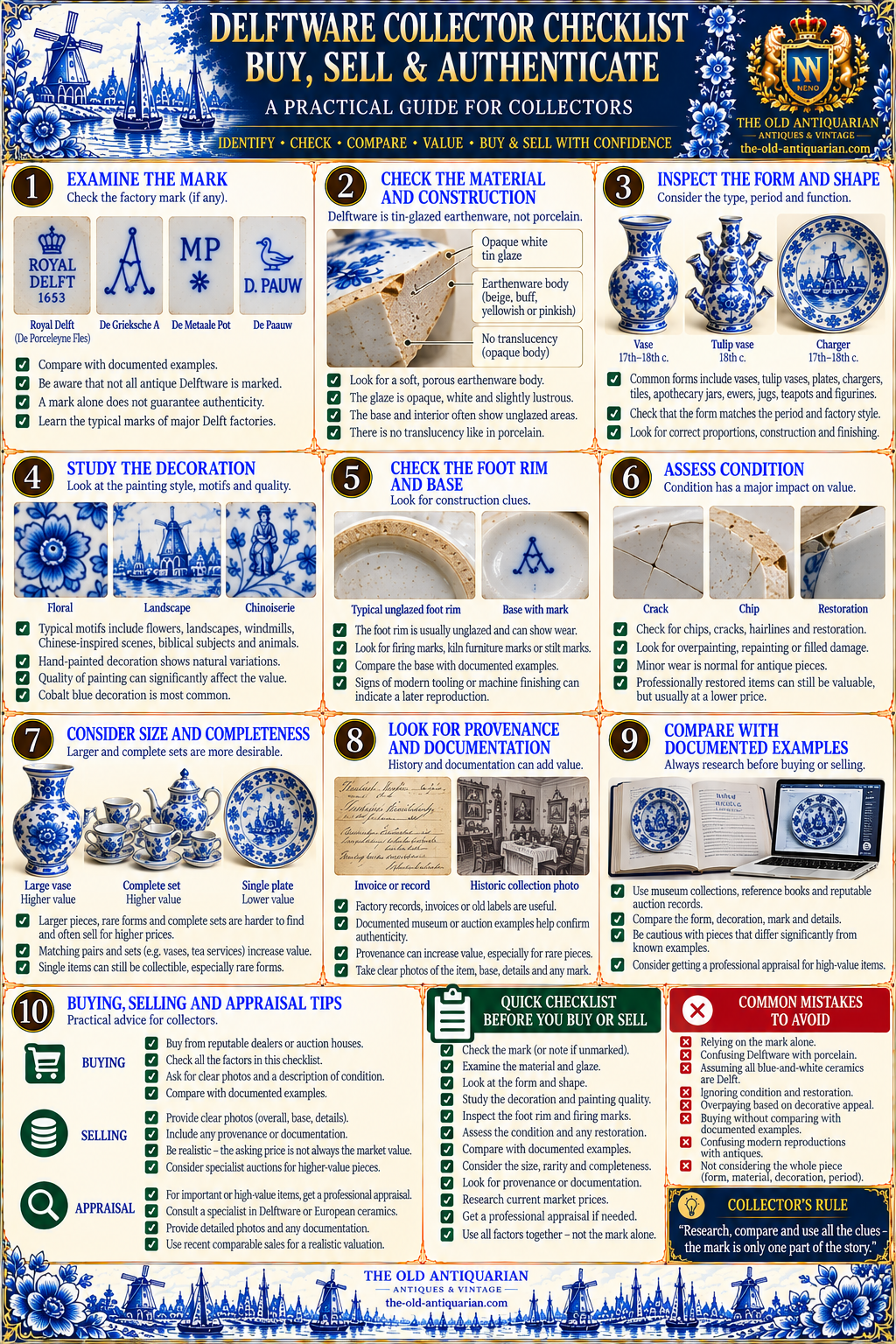
Front, back, sides and overall profile.
Include the foot rim, marks, numbers and old labels.
Determine whether it is earthenware, porcelain or another ceramic body.
Look at opacity, texture, chips and exposed clay.
Determine whether it is hand painted, printed or mixed technique.
Use museum collections, factory records and specialist literature.
Record chips, cracks, staining, losses and restoration.
Compare completed sales only after the object is properly identified.
Keep old invoices, labels, collection records and related documentation.
Do You Own Delft Blue or Antique Delftware?
Send clear photographs of the complete object, underside, foot rim, every mark, decoration, dimensions and any damage or restoration. If you have old labels, invoices or family provenance, include those as well.
Frequently Asked Questions About Delft Blue & Delftware
Is Delft Blue porcelain?
Traditional antique Delftware is generally tin-glazed earthenware, not porcelain. The confusion exists because Delft potters deliberately imitated the white-and-blue appearance of imported Asian porcelain.
What is genuine antique Delftware?
In the strict historical sense, antique Dutch Delftware is tin-glazed earthenware made in Delft roughly between 1620 and 1850.
Does all antique Delftware have a mark?
No. Many genuine antique Delftware objects are unmarked. Material, glaze, form, decoration and construction must therefore be studied even when no factory mark is present.
What do antique Delft marks look like?
Marks can consist of initials, monograms, factory names, owner references, numbers or figurative symbols. The exact mark should be compared with documented examples from the proposed factory and ownership period.
Does the word Delft on the bottom mean the piece is antique?
No. The words Delft, Delfts, Delftsch and Made in Holland are also found on later Delft-style ceramics. Wording must be considered together with material and production technique.
How can I date Royal Delft?
Royal Delft / De Porceleyne Fles uses a documented letter-code dating system on hand-painted production from 1879. Painter initials are typically placed to the left of the main mark and the year code to the right.
What does JT mean on Royal Delft?
JT refers to Joost Thooft. The familiar Royal Delft mark combines an apothecary-bottle symbol, the initials JT and the word Delft.
Are fake antique Delft marks common?
False Delft marks are well documented, particularly during the revival of interest in antique Delftware in the late nineteenth and early twentieth centuries. Historic-looking marks therefore require material and stylistic verification.
What is the difference between Delftware and Delft-style pottery?
Traditional antique Delftware refers to tin-glazed earthenware historically made in Delft. Delft-style pottery is a much broader term and can include later ceramics made elsewhere using blue-and-white Dutch-inspired decoration.
What are the most collectible Delftware forms?
Collector interest extends to important vases, flower pyramids and tulip vases, chargers, tiles, apothecary jars, ewers, jugs, plates, services and other documented factory forms.
Is Royal Delft valuable?
Some Royal Delft pieces have strong collector interest, but value depends on the production year, form, decoration, painter where documented, rarity, size, condition, restoration and comparable completed sales.
How do I know what my Delft Blue is worth?
First identify the material, maker, period, form and condition. Then compare genuinely similar completed sales rather than relying on optimistic online asking prices.
Related Guides
Sources & Further Research
Delftware is a field where modern souvenir ceramics, legitimate later factory production, revival pieces and deliberate historical imitations can look deceptively similar. For that reason, this guide prioritises specialist Delftware databases, museum documentation and Royal Delft factory resources.
| Source | Used For |
|---|---|
|
Dutch Delftware – What Is Delftware? |
Definition of antique Delftware, c. 1620–1850, tin-glazed earthenware, Delft production and the distinction from later Delft-style ceramics |
|
Dutch Delftware – Marks |
Historic marks, unmarked objects, mark application and the principle that a mark alone does not prove genuine Delftware |
|
Dutch Delftware – Factory Marks Index |
Historic, modern, unidentified and false Delftware mark families |
|
Dutch Delftware – Delft Potteries |
Historic Delft factory network, production history and factory chronology |
|
Dutch Delftware – De Porceleyne Fles |
Foundation in 1653 and historical factory history |
|
Dutch Delftware – De Grieksche A |
Ownership periods, factory history and maker attribution |
|
Dutch Delftware – De Metaale Pot |
Historic factory chronology and production history |
|
Dutch Delftware – De Paauw |
Factory history and documented attribution context |
|
Dutch Delftware – De Drie Klokken |
Factory history and three-bells mark tradition |
|
Royal Delft Museum – Year Codes & Trade Marks |
Royal Delft bottle/JT/Delft mark, painter initials and year codes since 1879 |
If a marketplace listing, reseller description, Pinterest mark chart or graphic reconstruction conflicts with a reliable museum, factory or documented specialist source, the documentary source takes priority.
About The Old Antiquarian
The Old Antiquarian combines more than 35 years of practical experience with antiques and collecting with museum, historical and comparative research. We identify ceramics through the complete object: material, glaze, factory or workshop, mark, form, decoration, production technique, condition, restoration, provenance and documented comparison.
Conclusion: How to Research Delftware Correctly
Delft Blue is one of the most recognisable ceramic traditions in the world, but recognition is not the same as identification.
Traditional Delftware is not simply “blue porcelain from Holland.” It belongs to a distinctive historical technology of tin-glazed earthenware, developed in response to international trade and the enormous European demand for Asian porcelain.
A genuine seventeenth-century Delft charger, an eighteenth-century De Grieksche A vase, a Royal Delft object dated by its year code and a twentieth-century Delft-style souvenir may all share blue-and-white decoration while belonging to completely different historical and market categories.
The strongest attribution therefore follows the complete evidence chain:
material → glaze → foot rim → form → decoration → mark → factory or owner → period → condition → documented comparison.
Only after the object has been identified and dated should its market value be researched through genuinely comparable completed sales.
