
R.S. Prussia Porcelain: Marks, Dating, Fakes & Value
German Porcelain · Prussia · Reinhold Schlegelmilch · Marks · Authentication
R.S. Prussia is the collector term most commonly associated with porcelain produced by the Reinhold Schlegelmilch factory enterprise, especially the highly decorative export wares made around the turn of the twentieth century. The best-known backstamps include R.S. Prussia wreath-and-star marks, but collectors also encounter R.S. Germany, Suhl, Tillowitz and later related wording. Genuine pieces may also be completely unmarked. Reliable identification therefore requires the mark, mold, porcelain body, form, decoration, transfer quality, condition and documented historical comparisons to agree.
| R.S. Prussia at a Glance | Collector Reference |
|---|---|
| Primary maker | Reinhold Schlegelmilch |
| Main early factory | Suhl, Thuringia |
| Suhl factory founded | 1869 |
| Tillowitz connection | Arnold Schlegelmilch took over an existing Tillowitz factory in 1894 |
| Best-known collector mark | R.S. Prussia wreath-and-star mark |
| Other important wording | R.S. Germany, Suhl, Tillowitz and related export marks |
| Important collecting areas | Art Nouveau forms, floral and portrait decoration, molds, Hidden Image ware, chocolate sets, vases, bowls and decorative tableware |
| Can genuine pieces be unmarked? | Yes. Specialist collector references state that a substantial proportion of known Prussia pieces may have no factory mark. |
| Main authentication risk | Fake marks, reproduction forms, altered decoration and incorrect attribution |
“The mark is the beginning of the research – not its end.”
With R.S. Prussia this rule is especially important because genuine pieces can be unmarked and reproduction marks are well documented.
R.S. Prussia belongs within the wider history of
German porcelain,
but it requires a factory-specific method of research. The combination of multiple Schlegelmilch factories, export marks, unmarked wares, mold-based identification and widespread reproductions makes this collecting field unusually complex.
What Is R.S. Prussia Porcelain?
R.S. Prussia is not simply the name of one decorative pattern. It is a collecting category associated primarily with the porcelain enterprise of Reinhold Schlegelmilch, whose factory was established in Suhl, Thuringia, in 1869 and later expanded through a second production centre at Tillowitz in Upper Silesia.
The initials R.S. refer to Reinhold Schlegelmilch in the classic R.S. Prussia context. The word Prussia reflects the political and export geography of the period rather than the name of a pattern.
R.S. Prussia usually refers to collectible porcelain associated with Reinhold Schlegelmilch and related export production. It is especially known for highly decorative late-nineteenth- and early-twentieth-century porcelain, complex molds, floral transfers, portraits, scenic decoration and extensive gilding.
A major reason this field can be confusing is that several porcelain factories used the Schlegelmilch surname. Older collector literature often incorrectly combined their histories. Modern specialist research separates the Reinhold Schlegelmilch operation from the separate Erdmann Schlegelmilch enterprise in Suhl.
Who Was Reinhold Schlegelmilch?
Reinhold Schlegelmilch established his porcelain factory in Suhl in 1869. The operation later involved his sons Ehrhard and Arnold. The factory became particularly successful in export markets, especially the United States, where imported decorative porcelain became increasingly popular during the late nineteenth century.
Historical research used by the International Association of R.S. Prussia Collectors has corrected a persistent misconception: Reinhold Schlegelmilch and the family behind the separate Erdmann Schlegelmilch factory were not operating one shared factory. They were distinct and competing enterprises.
Similar surnames, initials and overlapping geography created decades of confusion in older porcelain books. Factory attribution must be based on documented history, not the surname alone.
R.S. Prussia History & Production Timeline
The history of R.S. Prussia is closely tied to the expansion of the international porcelain trade. According to collector research based on historical factory and wholesale records, relatively little Reinhold Schlegelmilch porcelain reached the American market before the early 1890s.
A small group of objects from approximately 1889–1892 is associated with an early R.S. “Arrow” mark. From 1893, American wholesalers began importing larger quantities of European china, and Reinhold’s production became increasingly important within this trade.
The year 1894 was especially important. Arnold Schlegelmilch took over an existing porcelain factory at Tillowitz in Upper Silesia and operated it as part of the Reinhold Schlegelmilch enterprise. During the second half of the 1890s, exports to American wholesale firms expanded substantially.
Around 1900, improved decalcomania techniques allowed manufacturers to produce colourful transfer decoration with greater consistency and visual impact. The years around 1900–1905 are associated with some of the elaborate molded and decorated wares that collectors most strongly associate with classic R.S. Prussia.
After about 1905, changing public taste increasingly favoured simpler forms. By 1910, simpler shapes dominated many wholesale and retail catalogues. Products from the period after 1910 are frequently referred to by collectors as R.S. Germany, although specialist research warns against treating the wording change as one exact dividing date.
| Period | Historical Development | Collector Importance |
|---|---|---|
| 1869 | Reinhold Schlegelmilch establishes his factory in Suhl | Foundation of the principal factory associated with R.S. Prussia collecting |
| 1889–1892 | Early molds are documented with the R.S. Arrow mark | Important early production clue |
| From 1893 | American wholesale imports of European china increase | R.S. export production becomes much more visible |
| 1894 | Arnold Schlegelmilch takes over the Tillowitz factory | Creates the second major production centre in the Reinhold enterprise |
| c. 1895–1900 | Major expansion of U.S. export business | Important period for collector-marked export porcelain |
| c. 1900–1905 | Highly decorative molds and improved decal decoration flourish | Core collecting period for elaborate R.S. Prussia |
| After c. 1905 | Market taste shifts toward simpler forms | Mold style becomes useful as a broad dating clue |
| From c. 1910 | R.S. Germany wording becomes increasingly associated with production | Useful distinction, but not an absolute dating rule |
| World War I | Suhl production is effectively curtailed; Tillowitz continues | Factory location becomes increasingly important |
| Through World War II | Porcelain production continues at Tillowitz | Later Schlegelmilch-related marks require separate historical context |
Suhl vs Tillowitz: Why the Factory Location Matters
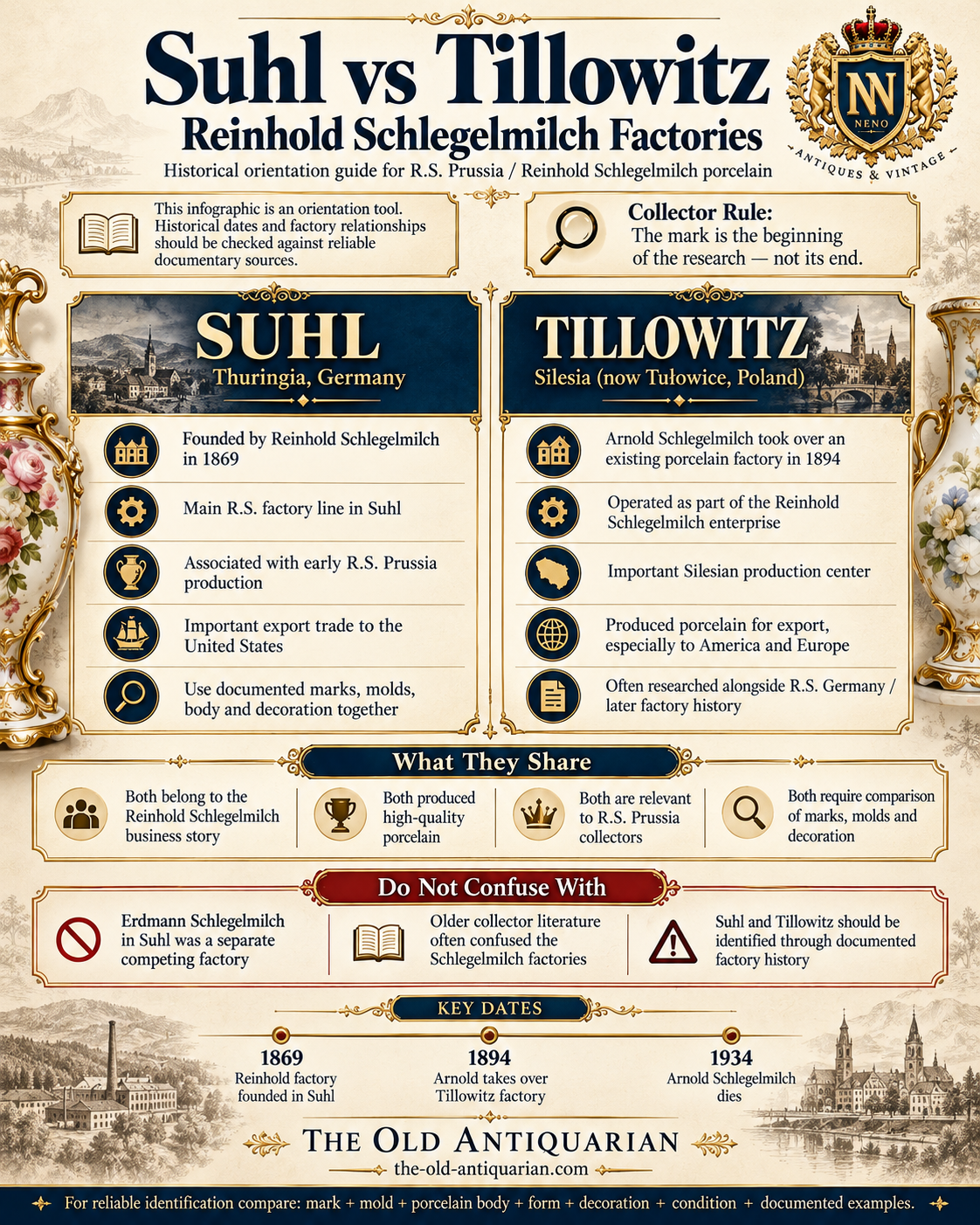
Suhl, Thuringia
Reinhold Schlegelmilch established his factory in Suhl in 1869. Suhl is central to the early history and to the classic R.S. Prussia collecting story.
Tillowitz, Silesia
Arnold Schlegelmilch took over an existing Tillowitz porcelain factory in 1894 and ran it as part of the Reinhold Schlegelmilch enterprise until his death in 1934.
Tillowitz—today Tułowice in Poland—became an important production centre. It benefited from access to raw materials and labour and played a major role in the wider Schlegelmilch export business.
The two production centres mean that a piece should not be dated or authenticated solely from the word “Suhl,” “Tillowitz,” “Prussia” or “Germany.” The object itself must support the attribution.
R.S. Prussia Marks & Backstamps
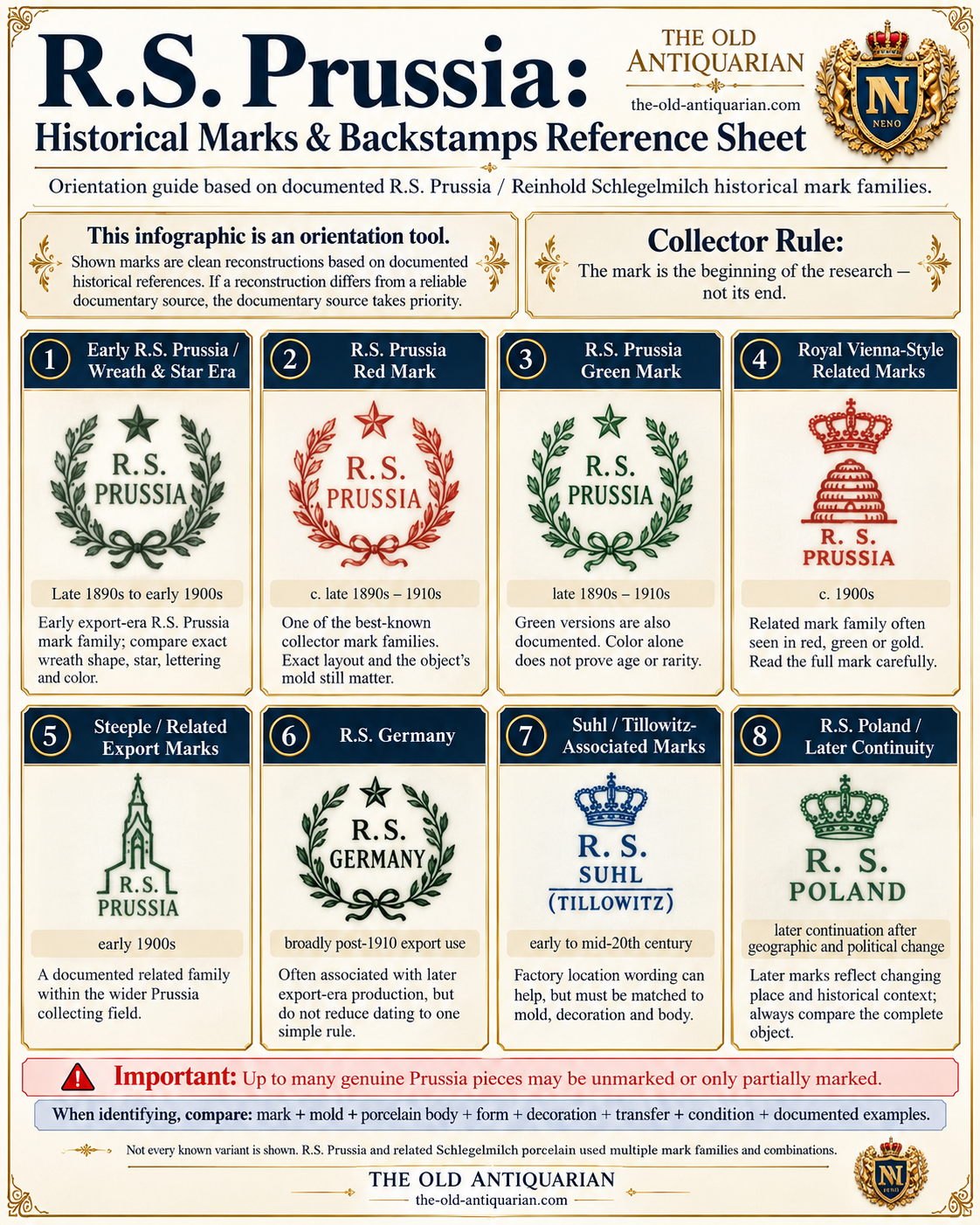
R.S. Prussia collecting includes a large family of marks rather than one universal logo. Specialist collector references document the famous R.S. Prussia red and green marks as well as R.S.P. Royal Vienna, R.S. Germany, R.S. Prussia / Tillowitz combinations, R.S. Poland, Prussia Steeple, Prussia Suhl and several related Schlegelmilch marks.
This variety is one reason general internet mark charts can be misleading. A mark that resembles a documented example is only the first stage of research.
| Mark Family | What It Can Suggest | Main Caution |
|---|---|---|
| R.S. Prussia wreath & star | Classic export-period Reinhold Schlegelmilch collecting context | Frequently copied; exact mark and object must agree |
| R.S. Prussia green variants | Documented variation within the broader R.S. mark family | Colour alone does not establish date or rarity |
| R.S. Germany | Often associated with later Reinhold production, especially after c. 1910 | Do not convert this into a rigid single-year rule |
| R.S. Suhl | Potential Suhl-related production or mark family | Known fake versions require careful examination |
| Tillowitz-related wording | May connect an object with the Silesian production centre | Factory wording still requires mold and decoration comparison |
| R.S. Poland | Later political and geographic context | Not part of the classic late-19th-century R.S. Prussia core |
| Royal Vienna-related R.S. marks | Collector-documented related mark family | Must not be confused with authentic Imperial Vienna porcelain |
All historical mark sheets in this article are orientation tools. If a visual reconstruction differs from a reliable historic factory record, specialist reference, museum object or archival source, the documented source has priority.
If you are unfamiliar with underglaze, overglaze, printed, impressed and painted factory marks, first read
How to Identify Porcelain Marks & Backstamps.
The R.S. Prussia Red Mark
The wreath-and-star R.S. Prussia mark is the best-known mark in the collecting field. Typical documented examples use a star above the initials R.S., the word PRUSSIA and a wreath around the central lettering.
Collector research notes that genuine examples commonly show red lettering, star and outer wreath details, with green appearing within the wreath. Age and firing can modify colour, so a formerly strong red may appear brownish or muted.
The precise colour should never be treated as a stand-alone test. Genuine marks can vary, and copied red marks are widespread.
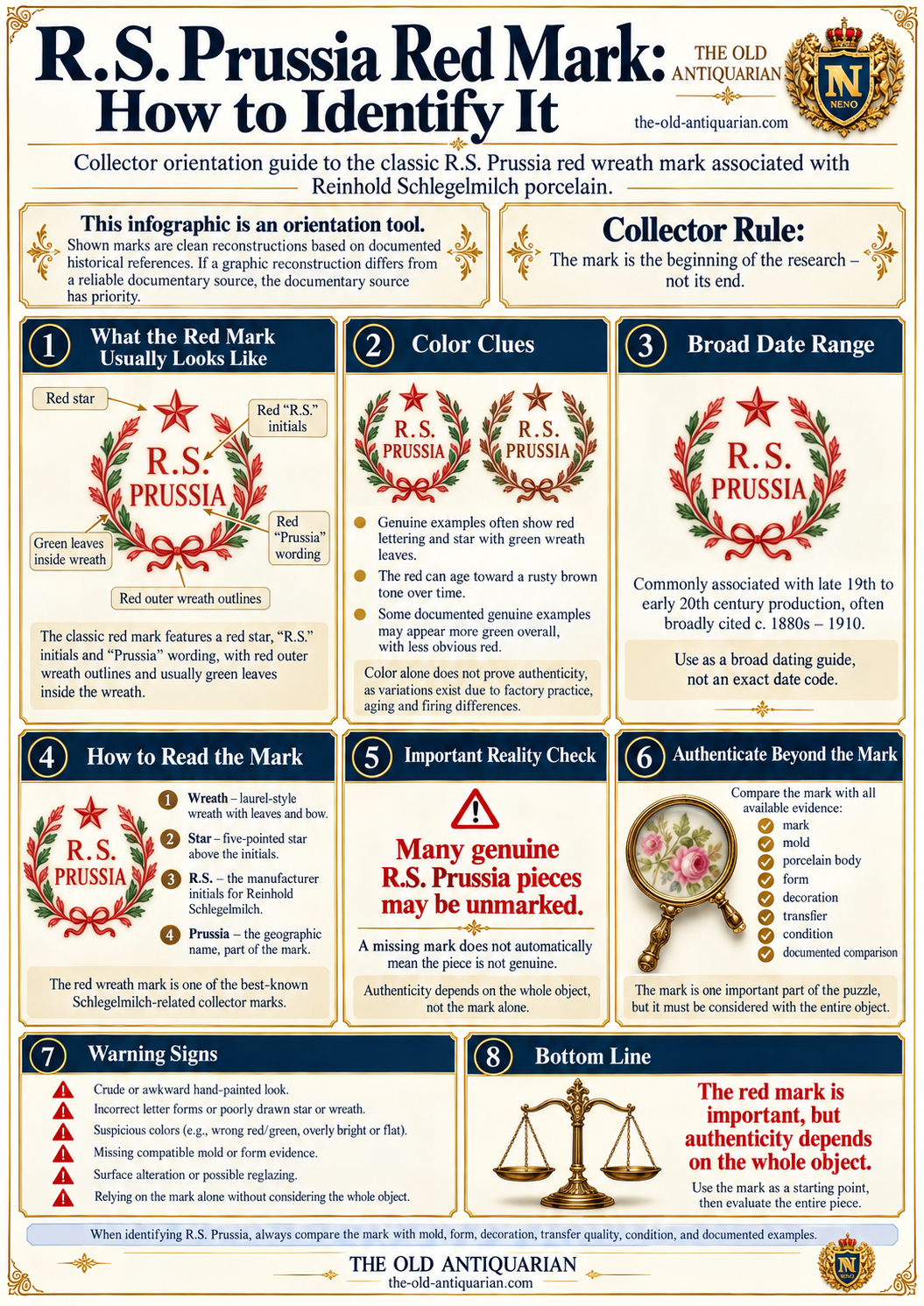
Fake and reproduction marks exist. The porcelain body, mold, decoration, application of the mark, wear and historical consistency must all be examined.
R.S. Prussia vs R.S. Germany
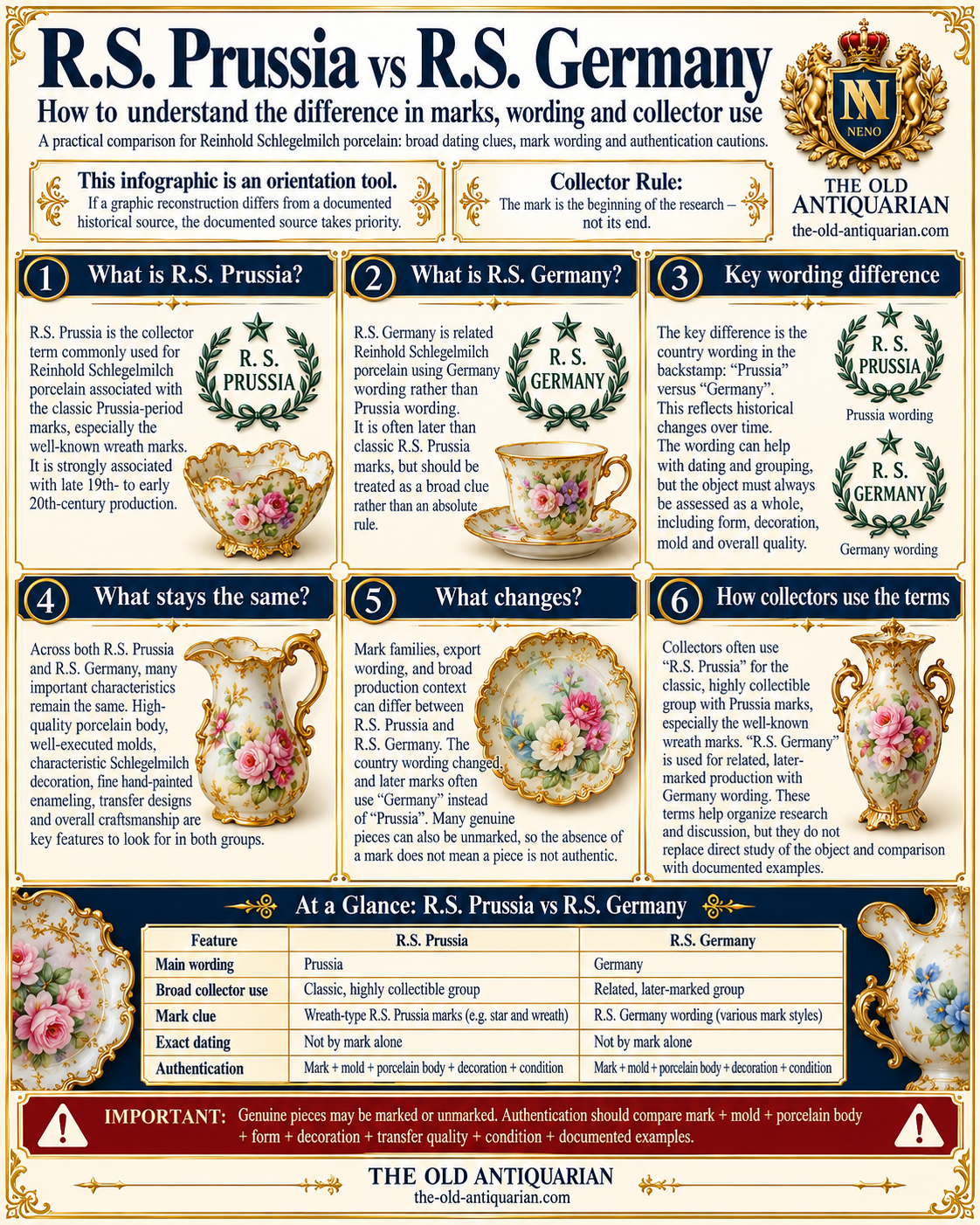
Collectors often separate “R.S. Prussia” and “R.S. Germany,” but the historical relationship is more nuanced than a simple before-and-after date.
Specialist research notes that products made after about 1910 are frequently referred to as R.S. Germany because of trademark changes. However, Reinhold Schlegelmilch’s researchers also point out that several changes in trademark and country wording occurred between the 1890s and 1910.
| Feature | R.S. Prussia | R.S. Germany |
|---|---|---|
| Collector use | Commonly used for the classic Prussia-period collecting field | Commonly used for related later-marked Reinhold production |
| Typical wording | Prussia | Germany |
| Dating value | Broad period clue | Broad later-period clue |
| Can wording give an exact year? | No | No |
| Authentication method | Mark + mold + body + decoration + condition | Mark + mold + body + decoration + condition |
How to Date R.S. Prussia Porcelain
Dating R.S. Prussia works best by establishing a range rather than assigning an exact year. Marks overlap, the same or related molds can appear across more than one period, and a piece may have no factory mark at all.
exact mark + mold + porcelain body + form + decoration + transfer + export wording + condition + documented comparison
Record every word, star, wreath, symbol and colour.
Compare rim, relief, handles, foot, profile and overall silhouette.
Note floral transfers, portraits, scenes, enamelling, cobalt and gilding.
Weight, fineness, glazing and construction should be historically consistent.
Prussia, Germany, Suhl, Tillowitz and Poland belong to different historical contexts.
Use specialist catalogs, historical wholesale records and documented collector references.
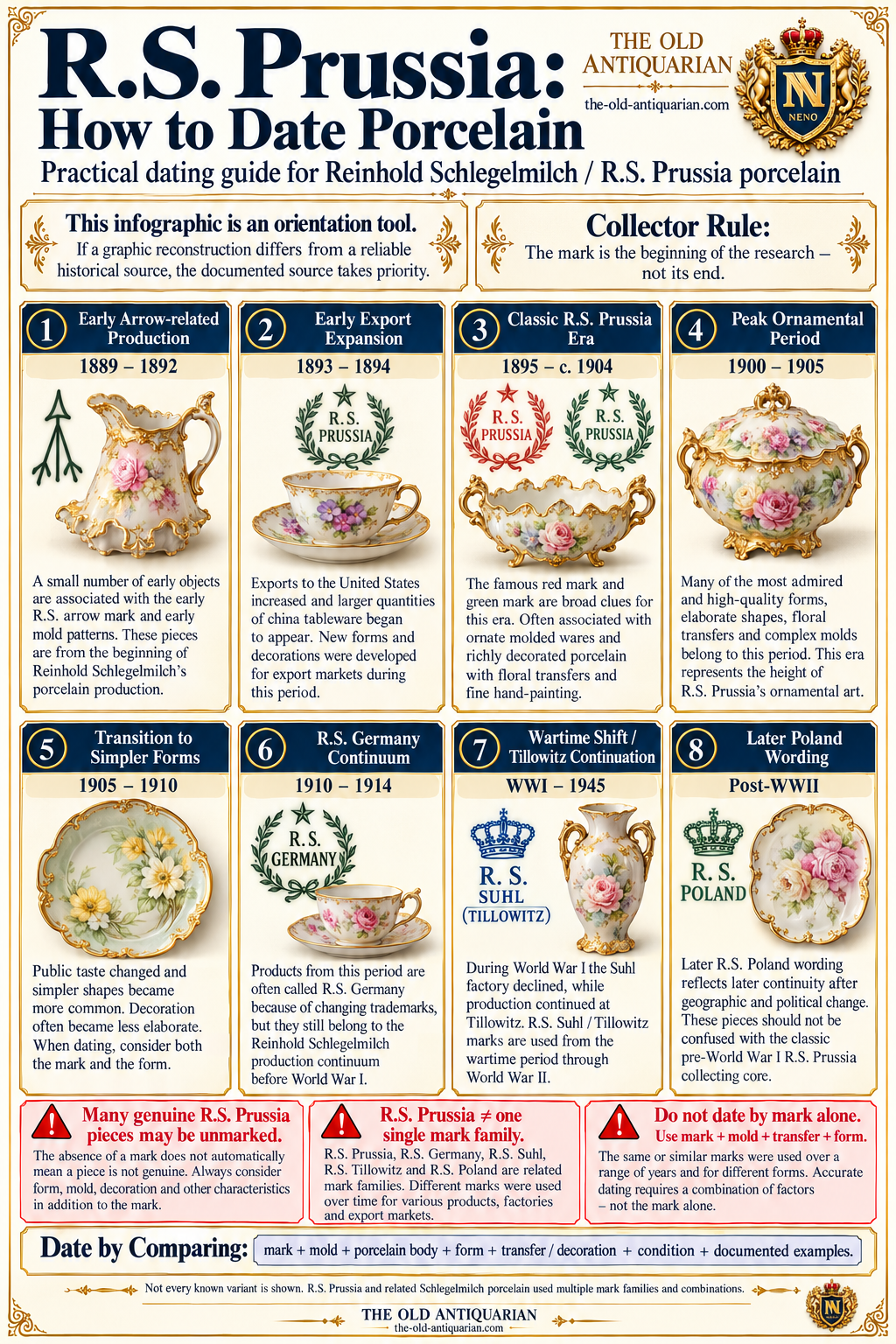
For the wider methodology used across manufacturers, see
How to Date Antique Porcelain.
How to Identify Genuine R.S. Prussia Porcelain
Genuine R.S. Prussia is identified by convergence of evidence. This is especially important because the International Association of R.S. Prussia Collectors states that up to roughly half of known Prussia pieces may be unmarked.
An unmarked piece is therefore not automatically fake. At the same time, an apparently correct mark does not make an object genuine.
| Evidence | What to Examine | Why It Matters |
|---|---|---|
| Mark | Layout, lettering, star, wreath, colour, wording and application | Places the object within a possible historical mark family |
| Mold | Relief, rim, handles, feet, silhouette and shape | Essential when genuine pieces lack a backstamp |
| Porcelain body | Weight, refinement, colour, firing and glaze | Can contradict a convincing-looking fake mark |
| Decoration | Transfer quality, enamelling, portraits, florals, scenes and gilding | Historical decoration should match the mold and production context |
| Condition | Wear, restoration, repainting, regilding and altered surfaces | Can reveal modification or later intervention |
| Documentation | Historical catalogs, specialist books, collector research and comparable objects | Turns resemblance into evidence-based attribution |
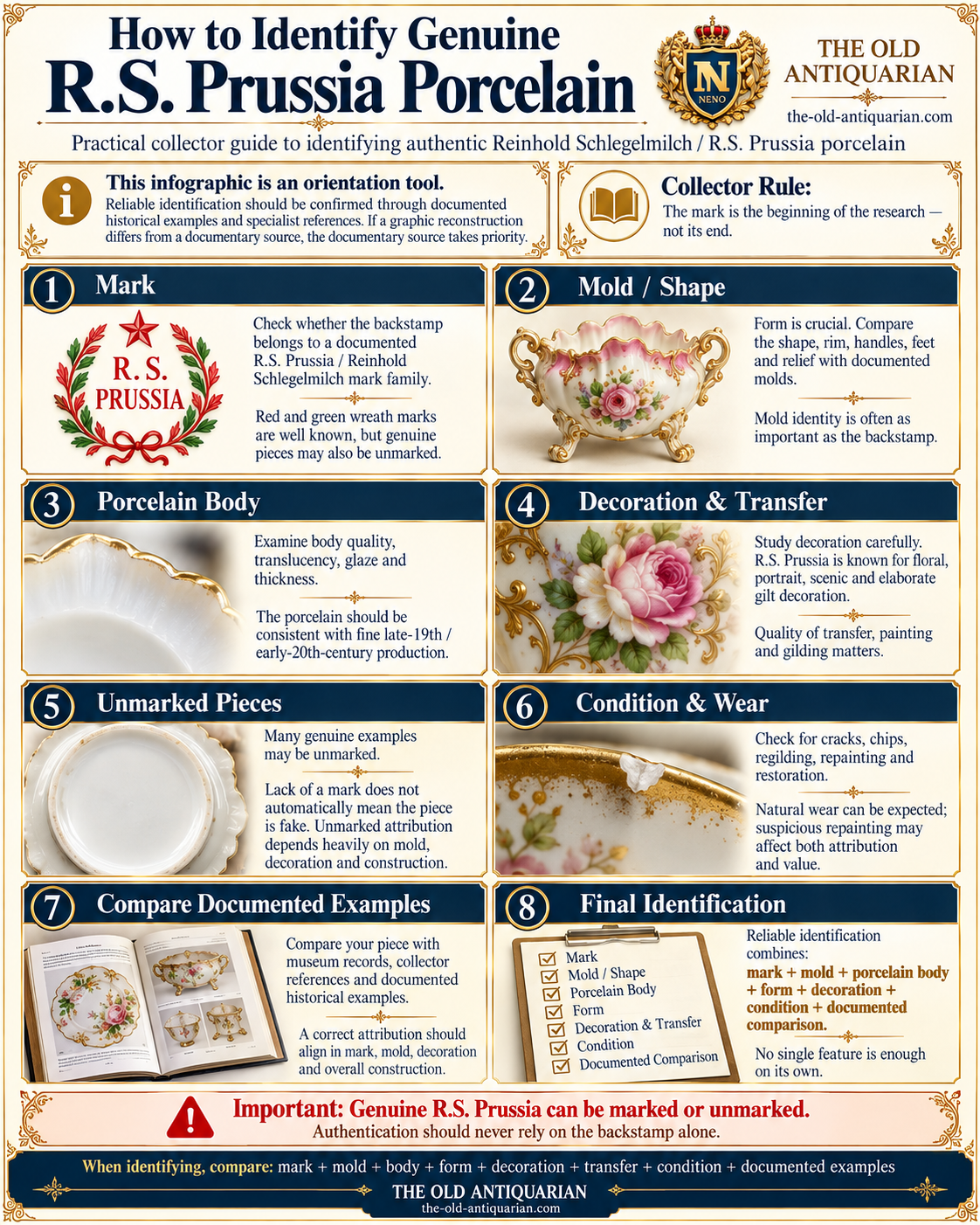
For the broader multi-factor approach used across European porcelain, continue to the
Complete Antique Porcelain Guide.
R.S. Prussia Molds & Shapes
Mold identification is unusually important in R.S. Prussia collecting. Mary Frank Gaston’s reference series catalogued many Prussia molds by number. Specialist collector references note that approximately the first fifty numbered molds also acquired commonly used collector names, while many later forms are primarily identified by number.
Not every mold has been definitively identified. That means a collector should avoid inventing a mold number merely because two shapes look similar.
Common forms encountered in the collecting field include bowls, plates, vases, pitchers, chocolate pots, cups, saucers, sugars, creamers, cracker jars, dresser wares and decorative serving pieces.
| Mold Feature | What to Record |
|---|---|
| Rim | Scallops, points, lobes, scrolls and pierced sections |
| Handles | Number, position, curvature, relief and attachment points |
| Relief | Flowers, leaves, scrollwork, cameos and geometric molding |
| Foot | Shape, height, ring construction and unglazed areas |
| Silhouette | Overall proportion and characteristic outline |
| Object type | Bowl, vase, plate, chocolate pot, cracker jar, pitcher or service piece |
| Decoration | Whether the decorative scheme is documented on the same mold |
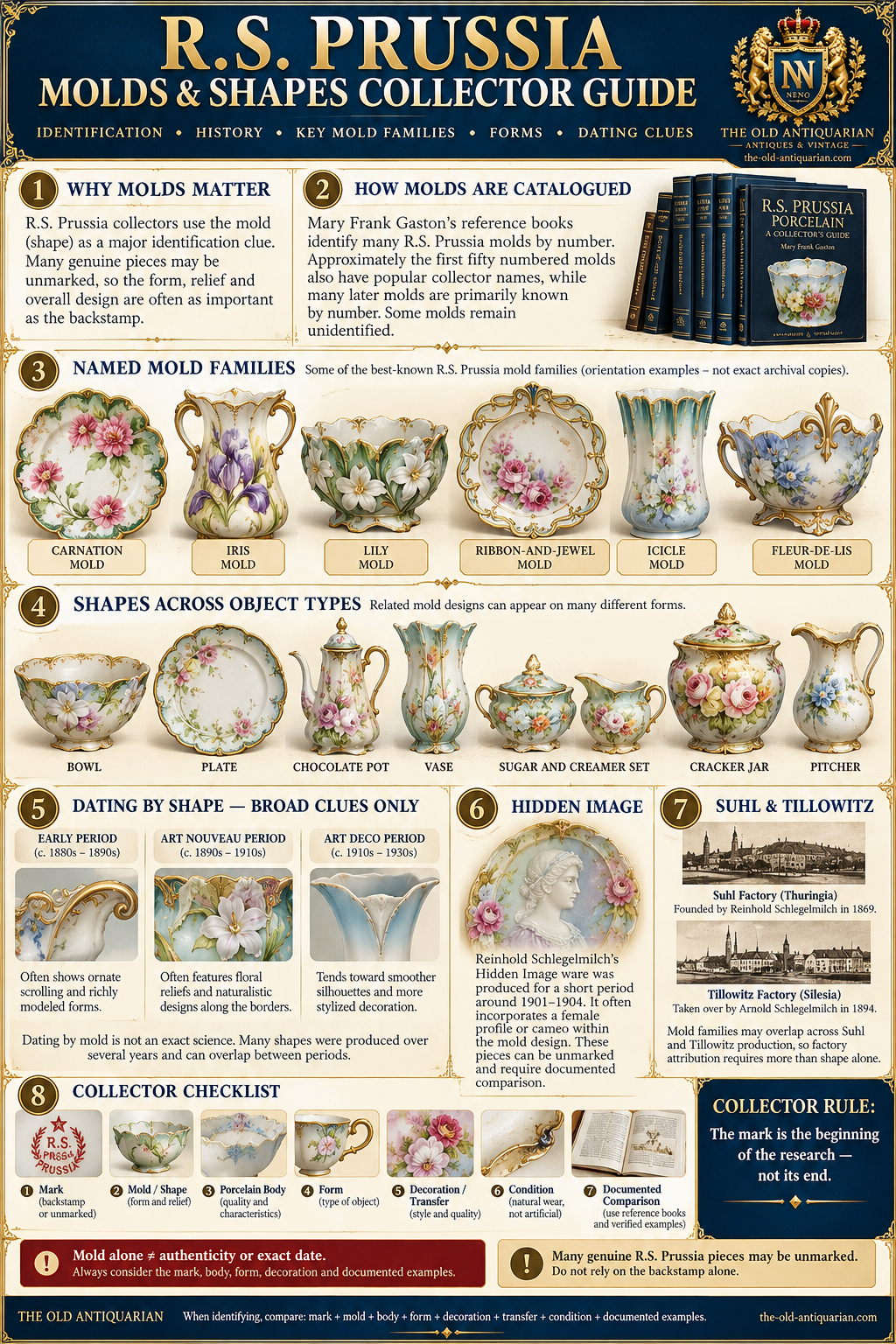
Reproductions can imitate historic shapes. A convincing form still has to agree with the porcelain body, decoration, mark where present and documented factory examples.
R.S. Prussia Hidden Image Porcelain
Hidden Image is one of the most interesting specialist areas of R.S. Prussia collecting. Research published by the International Association of R.S. Prussia Collectors identifies the ware as a Reinhold Schlegelmilch production made during a short period from approximately 1901 to 1904.
The defining feature is an image—usually a female profile—incorporated directly into the mold. Depending on the object and decoration, the image may be obvious, lightly painted, left undecorated or partially concealed by the decorative scheme.
Many Hidden Image pieces do not carry an obvious Reinhold trademark. Historical wholesale catalog research was required to confirm the attribution, making this category a perfect example of why R.S. Prussia cannot be researched through marks alone.
Hidden Image demonstrates the value of mold research. A documented mold can sometimes provide stronger attribution evidence than the absence of a factory backstamp.
Decoration: Flowers, Portraits, Scenes & Gilding
R.S. Prussia is famous for decorative variety. Reinhold’s wares reached international markets with floral decoration, portraits, landscapes, scenic subjects, buildings, birds, animals and other transfer-based designs, often enhanced with enamelling or gilding.
Around 1900, improvements in decalcomania helped produce increasingly colourful and sophisticated decorative effects. This does not mean every R.S. Prussia piece was hand painted. Many admired examples combine printed or transferred imagery with hand-applied colour, enamel details or gold.
What should you examine?
Decoration Quality
Look for fine transfer detail, controlled colour transitions, well-integrated backgrounds, careful enamelling and historically plausible gilding.
Decoration Consistency
The decoration should make sense on the mold. An expensive-looking portrait applied later to an unrelated blank is not equivalent to documented factory-period production.
Real vs Fake R.S. Prussia
Reproductions and fake R.S. Prussia marks have circulated for decades. The International Association of R.S. Prussia Collectors maintains a dedicated reference collection of counterfeit marks and reproduction items, including tea sets, chocolate sets, pitchers, plates, shoes, hatpin holders and other forms.
Collector guidance describes several recurring warning signs. The classic wreath-and-star mark is commonly found under the glaze on genuine examples, producing a smooth surface, while some fake marks are applied over the glaze and may be physically detectable. Genuine historic marks are often more subdued than crude modern imitations.
Specialist collectors also note that authentic R.S. Prussia often has a comparatively refined, light porcelain body and high-quality decorative transfers. Heavy bodies, crude decoration, extremely vivid colours or cartoon-like marks deserve closer investigation.
A smooth underglaze mark does not automatically prove authenticity, just as an unusual surface does not automatically prove a fake. Alteration, restoration and different production methods must also be considered.
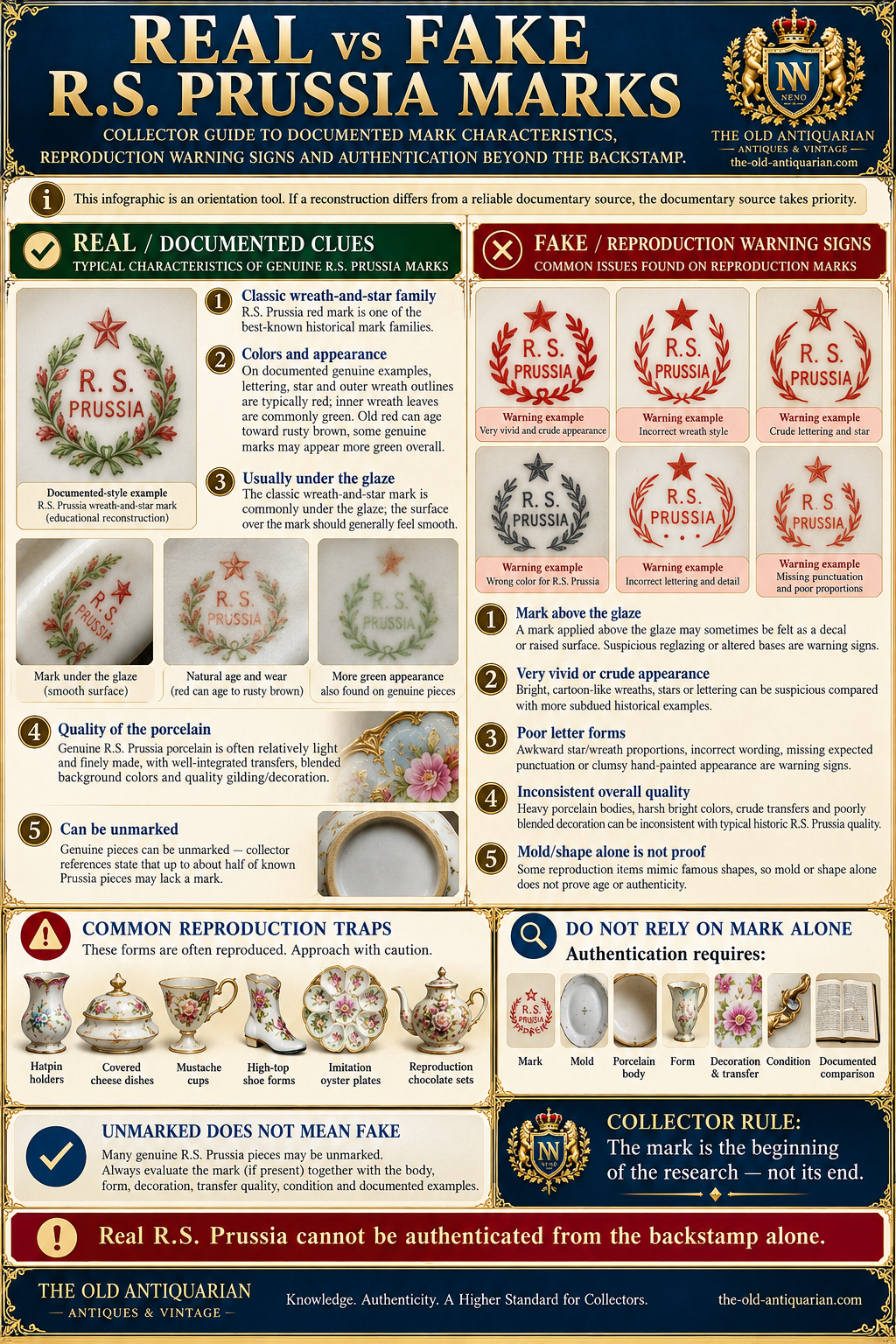
| Check | Potentially Reassuring Clue | Warning Sign |
|---|---|---|
| Mark application | Historically documented application consistent with the mark family | Raised, crude or suspiciously altered base surface |
| Typography | Letters and star proportions match documented examples | Awkward letters, poor spacing or incorrect punctuation |
| Colour | Subdued historic appearance can be consistent with age | Very bright, flat or cartoon-like colours |
| Body | Fine, relatively light porcelain consistent with known production | Heavy or coarse body inconsistent with comparable examples |
| Mold | Documented historical mold | Crude imitation of a famous mold |
| Decoration | Transfer and enamelling compatible with documented R.S. production | Later decoration, crude transfer or artificially added portrait |
R.S. Prussia collecting also intersects with the wider problem of Vienna-style and “Royal Vienna” marks. If an object carries beehive, shield or Royal Vienna wording, do not assume an Imperial Vienna origin. Our
Royal Vienna Porcelain Guide
explains why that terminology requires separate authentication.
Condition, Wear & Restoration
Complex R.S. Prussia molds can be vulnerable to damage. Inspect handles, pointed rims, feet, relief decoration, raised gold, lids and thin molded sections carefully.
| Condition Issue | Where to Look | Why It Matters |
|---|---|---|
| Hairline cracks | Handles, rims, bases and thin molded transitions | Can significantly affect desirability |
| Chips | Scalloped edges, feet, lids and applied details | Especially important on elaborate molds |
| Regilding | Raised borders, handles and ornamental scrollwork | May reduce originality if extensive or poorly matched |
| Repainting | Portraits, florals and damaged decorative areas | Can obscure original decoration and complicate authentication |
| Base alteration | Around the backstamp and foot rim | Important when evaluating potentially added or altered marks |
| Missing components | Lids, cups, saucers and matching service pieces | Completeness may strongly affect collector interest |
R.S. Prussia Value: What Is It Worth?
There is no responsible universal price chart for R.S. Prussia. Collector auction records demonstrate how widely prices can vary even within one broad category. A common floral bowl, an elaborate Carnation mold piece, a rare Hidden Image example and a complete chocolate set belong to very different comparison groups.
Market value should be based on genuinely comparable completed sales—not unsold listings, optimistic dealer prices or generic online price guides.
| Value Factor | Why It Matters |
|---|---|
| Exact attribution | Correctly distinguishing Reinhold production from related Schlegelmilch wares is fundamental |
| Mold | Some forms are much scarcer or more desirable than common tableware shapes |
| Decoration | Exceptional portraits, scenes, florals, cobalt and gilding can materially affect demand |
| Rarity | Rare combinations of mold and decoration can attract specialist collectors |
| Size | Large and visually impressive examples may belong to a different market from small common forms |
| Condition | Cracks, chips, regilding and restoration can change value substantially |
| Completeness | Original lids, matching components and complete services can be important |
| Provenance | Documented ownership or old collection history can strengthen confidence |
| Comparable sales | Completed transactions are the best starting point for current market research |
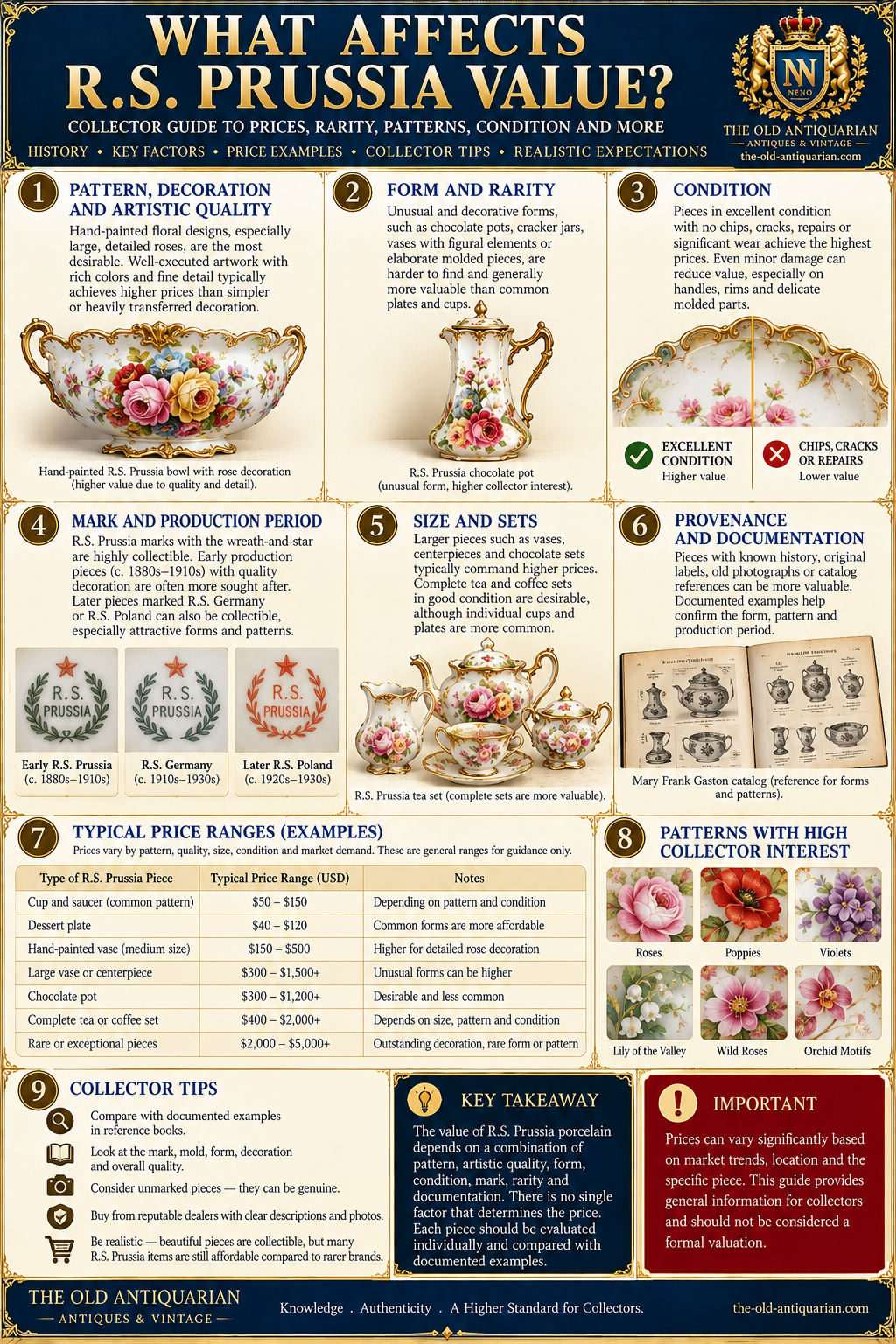
Any price ranges shown inside educational graphics are illustrative orientation only and should not be treated as a current market price list. Current valuation requires recent, genuinely comparable completed sales.
If you need an individual market assessment, use our
Professional Antique Valuation
service.
R.S. Prussia Collector Checklist
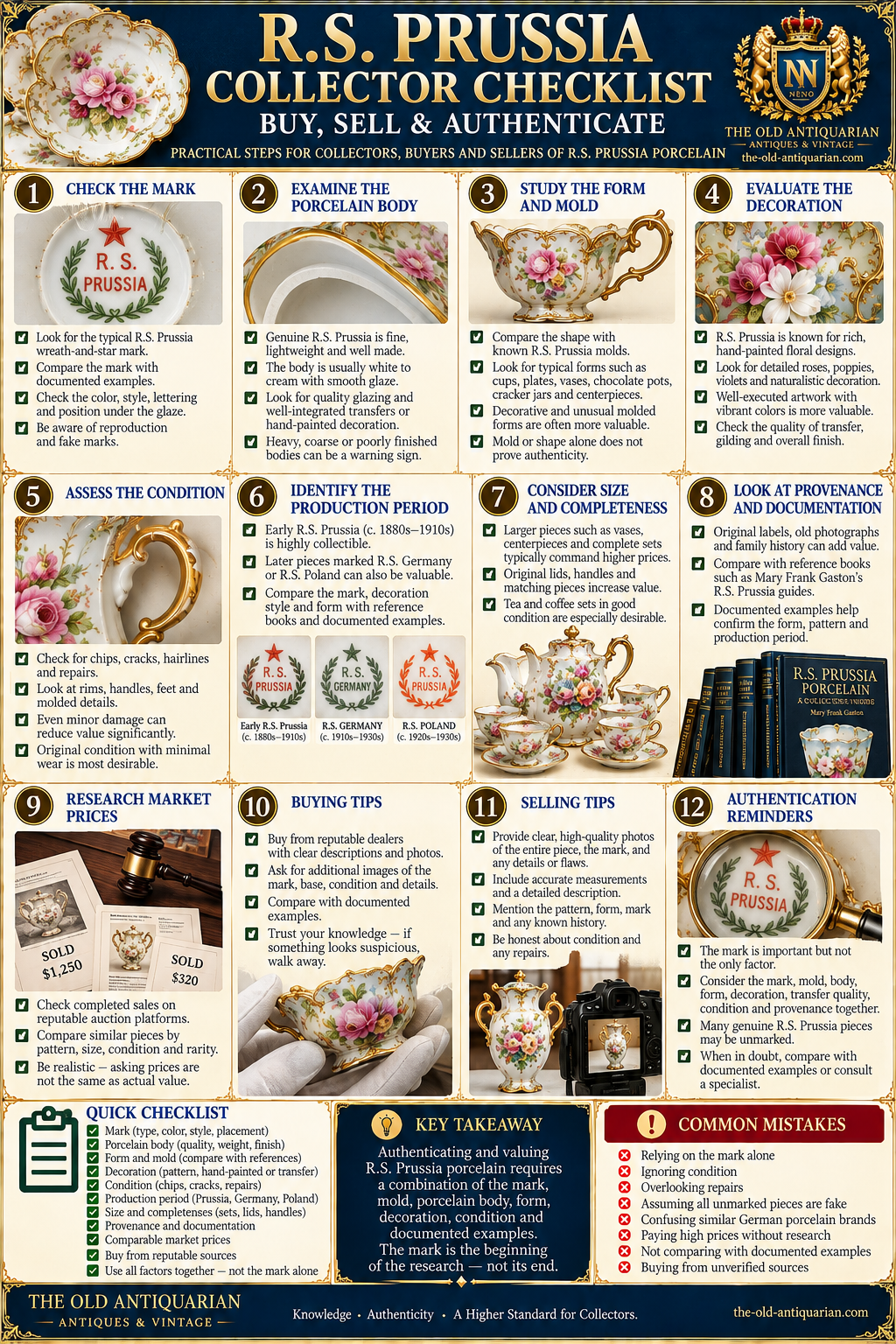
Include front, back, sides, base and important molded details.
Do not crop numbers, secondary marks or foot-rim details.
Compare the exact form rather than relying on decoration alone.
Record transfer, enamel, portrait, floral, scenic and gilded details.
Look for chips, cracks, repainting, regilding and restoration.
Compare only genuinely similar mold, decoration, size and condition.
Do You Own R.S. Prussia Porcelain?
Send clear photographs of the complete object, base, mark, molded details, decoration, dimensions and any damage or restoration. The Old Antiquarian can help with identification, period research and market orientation.
Request a Professional Antique Valuation
Sell Porcelain & Ceramics
Frequently Asked Questions About R.S. Prussia
What does R.S. Prussia mean?
In the classic collector context, R.S. refers to Reinhold Schlegelmilch and Prussia reflects the historical geographic and export wording associated with the porcelain.
When was the Reinhold Schlegelmilch factory founded?
Reinhold Schlegelmilch established his porcelain factory in Suhl in 1869.
When did Tillowitz become part of the Reinhold Schlegelmilch business?
Arnold Schlegelmilch took over an existing porcelain factory at Tillowitz in 1894 and operated it as part of the Reinhold enterprise.
Can genuine R.S. Prussia be unmarked?
Yes. Specialist collector references state that a substantial proportion of known Prussia pieces may lack a factory mark. Mold, decoration and construction therefore become especially important.
What is the R.S. Prussia red mark?
It is the well-known wreath-and-star backstamp associated with classic R.S. Prussia collecting. Genuine examples vary, so the red mark alone should never be treated as proof of authenticity.
What is the difference between R.S. Prussia and R.S. Germany?
R.S. Germany is commonly associated with later Reinhold Schlegelmilch production and country wording, especially after about 1910. The transition was not instantaneous, so the complete object must still be examined.
What is Hidden Image R.S. Prussia?
Hidden Image is a specialist Reinhold Schlegelmilch mold category produced approximately 1901–1904 in which a female profile or similar image is incorporated into the porcelain mold.
Are fake R.S. Prussia marks common?
Reproduction and counterfeit marks are well documented. Fake marks can appear on reproduction porcelain or on older unrelated porcelain that has been altered to resemble R.S. Prussia.
How can I tell if R.S. Prussia is genuine?
Compare the exact mark, mold, porcelain body, form, decoration, transfer quality, condition and documented historical examples. No single feature is enough.
Is all R.S. Prussia valuable?
No. Collector value depends on the exact mold, decoration, rarity, size, condition, completeness, provenance and current demand. Common forms and exceptional rare pieces can have very different markets.
Related Guides
Sources & Further Research
R.S. Prussia is a collecting field in which older publications can contain repeated historical errors. For that reason, this guide gives priority to specialist research from the International Association of R.S. Prussia Collectors, documented factory history and independent specialist mark references.
| Source | Used For |
|---|---|
|
International Association of R.S. Prussia Collectors – History |
Reinhold Schlegelmilch factory history, Suhl, Tillowitz, early Arrow-mark production, export expansion, post-1910 terminology and wartime production changes |
|
International Association of R.S. Prussia Collectors – Marks |
R.S. Prussia red and green marks, R.S. Germany, Tillowitz, Suhl, R.S. Poland, related marks and the importance of unmarked porcelain |
|
International Association of R.S. Prussia Collectors – Fakes & Replicas |
Fake marks, reproduction objects and the principle of comparing mold, decoration and mark together |
|
IARSPC Newsletter – February 2007 |
Authentication warning signs, wreath-and-star mark application, porcelain quality and common reproduction forms |
|
IARSPC Newsletter – April 2011 |
Reinhold Schlegelmilch Hidden Image porcelain, c. 1901–1904, mold characteristics and catalog-based attribution |
|
Porcelain Marks & More – Suhl |
Independent specialist context for the separate Reinhold and Erdmann Schlegelmilch factory histories |
When a marketplace listing, unsourced online mark chart or older collector book conflicts with later documented factory research, the documented historical source should take priority.
About The Old Antiquarian
The Old Antiquarian combines more than 35 years of practical experience with antiques and collecting with historical, museum and comparative research. Our approach to porcelain identification treats the mark as one part of a larger chain of evidence: maker, porcelain body, mold, form, decoration, production period, condition, restoration, provenance and documented comparison.
Conclusion: How to Research R.S. Prussia Correctly
R.S. Prussia is one of the most rewarding areas of late-nineteenth- and early-twentieth-century German porcelain collecting because the field combines factory history, export trade, Art Nouveau design, elaborate molds, portrait and floral decoration, specialist mark study and a large body of collector research.
It is also a field in which shortcuts are particularly dangerous. Genuine pieces may be unmarked. Fake marks exist. Famous shapes have been reproduced. Related Schlegelmilch factories have been confused for generations.
The strongest attribution is therefore built from the complete object:
mark + mold + porcelain body + form + decoration + transfer + period + condition + documented comparison.
Only after identification and dating have been established should value be researched through genuinely comparable completed sales.
