
Johann Haviland Bavaria: Marks, Dating, Patterns & Value
German Porcelain · Bavaria · Waldershof · Johann Haviland · Marks · Dating · Patterns
Johann Haviland Bavaria Porcelain
Johann Haviland Bavaria porcelain is associated with the porcelain factory established at
Waldershof, Bavaria, in 1907, with actual porcelain production beginning around
1910. The factory passed to Richard-Ginori in 1924 and was acquired
by Rosenthal in 1937. Collectors encounter JHW monograms, John Haviland and Johann
Haviland wording, crown marks, Bavaria and Germany designations and later commercial backstamps.
Johann Haviland Bavaria is German porcelain and should not be confused with French Haviland
Limoges. Reliable identification requires the mark, wording, porcelain body, form, decoration,
pattern, period and documented historical comparisons to agree.
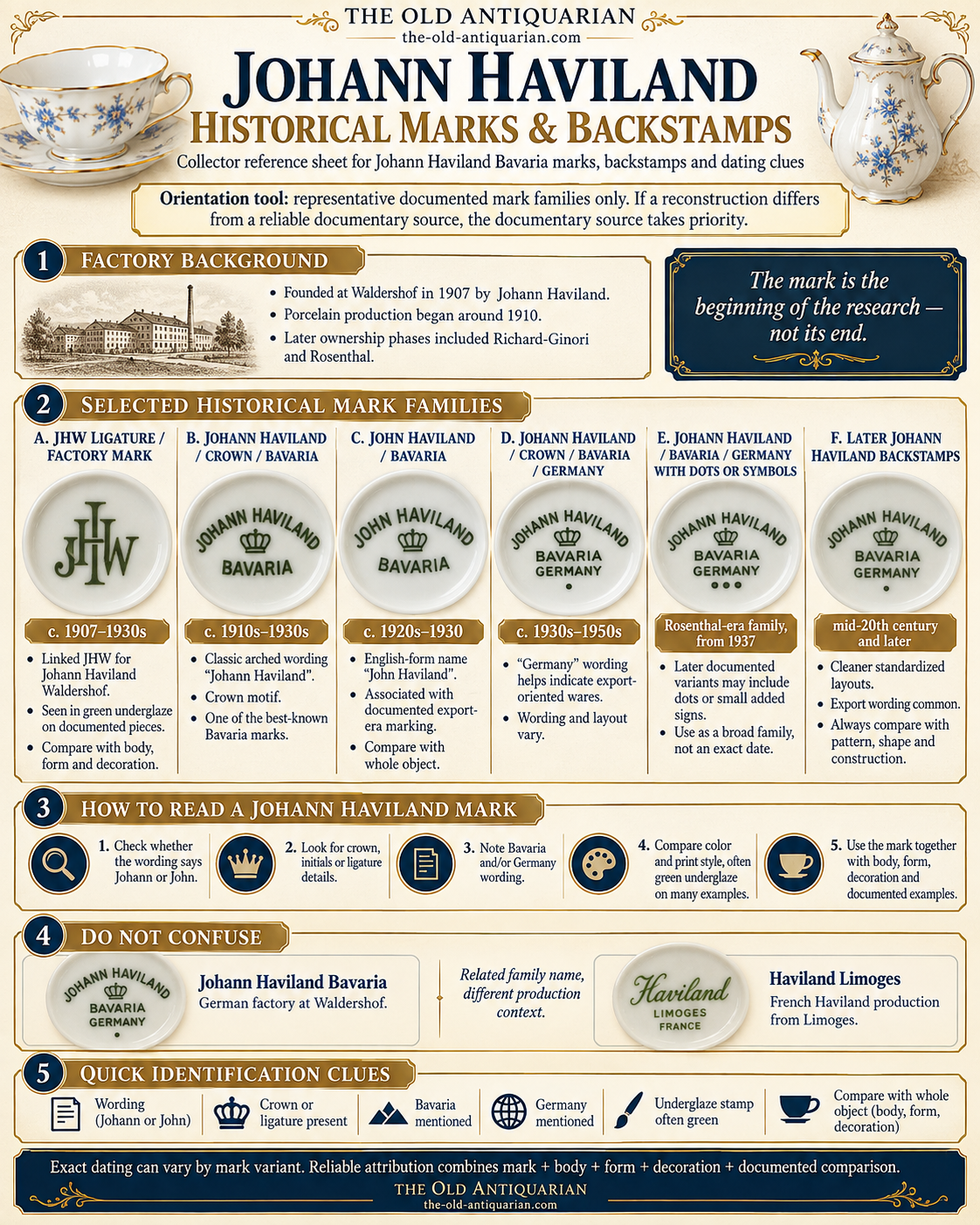
Historical mark graphics should always be checked against documented factory,
museum and specialist sources.
| Johann Haviland at a Glance | Collector Reference |
|---|---|
| Primary production centre | Waldershof, Bavaria, Germany |
| Factory established | 1907 |
| Porcelain production begins | About 1910 |
| Richard-Ginori ownership | From 1924 |
| Rosenthal acquisition | 1937 |
| Important mark wording | JHW, John Haviland, Johann Haviland, Bavaria, Germany |
| Well-known patterns | Blue Garland, Moss Rose, Sweetheart Rose, Sepia Rose, Silver Wheat, Forever Spring |
| Major identification risk | Confusing German Johann Haviland Bavaria with French Haviland Limoges |
| Best identification method | Mark + wording + body + form + decoration + pattern + period + documentation |
“The mark is the beginning of the research – not its end.”
Johann Haviland marks overlap across ownership and commercial periods, so a backstamp must be
supported by the porcelain body, form, decoration, pattern chronology and documented examples.
Johann Haviland occupies a distinctive place in German porcelain history. The Haviland name is
famous because of the French Limoges tradition, but the porcelain covered here belongs to a
German manufacturing history centred on Waldershof in Bavaria.
This distinction matters because pieces marked Johann Haviland Bavaria,
John Haviland Bavaria or Johann Haviland Germany are frequently described online
as “Haviland Limoges.” The shared family name does not make the German and French factories,
backstamps or dating systems interchangeable.
If your piece simply says “Bavaria” and the manufacturer is uncertain, start with our
Bavaria Porcelain identification guide
.
What Is Johann Haviland Bavaria Porcelain?
Johann Haviland Bavaria is the collector and commercial name associated with porcelain produced
within the Waldershof enterprise established by Johann — also known as Jean or John in different
contexts — Haviland in Bavaria.
The factory produced tableware and decorative porcelain across several historical phases.
Because ownership changed and the Johann Haviland name continued in commercial use, objects
bearing the name can belong to very different periods.
Johann Haviland Bavaria is German porcelain associated primarily with Waldershof.
It is historically connected to the wider Haviland family but should not be dated,
identified or valued using French Haviland Limoges mark systems.
Johann Haviland History & Production Timeline
The Johann Haviland porcelain enterprise was established in
Waldershof in 1907. Museum research records the commercial registration in July
1907, while actual porcelain production began around 1910.
The company entered international markets early, including the United States. The First World War
interrupted production and overseas trade, and business resumed during the early 1920s.
Economic pressure and inflation contributed to a major change in 1924, when the Waldershof
factory passed to the Italian Richard-Ginori group.
| Period | Historical Development | Collector Importance |
|---|---|---|
| 1907 | Johann Haviland establishes the porcelain enterprise at Waldershof | Foundation date; not automatically the date of an individual piece |
| c. 1910 | Actual porcelain production begins | Beginning of the main early production phase |
| 1910s | Early export and international marketing | John / Johann wording and early factory marks become important |
| World War I | Production and U.S. trade are disrupted | Historical interruption in early export activity |
| Early 1920s | Export sales resume | Important transitional commercial period |
| 1924 | Factory passes to Richard-Ginori | Beginning of a major ownership transition |
| 1924–1937 | Porzellanfabrik Waldershof A.G., vormals Johann Haviland | Johann Haviland identity overlaps with Richard-Ginori ownership |
| 1937 | Rosenthal acquires the Waldershof company | Beginning of the Rosenthal ownership period |
| Post-war decades | Strong tableware and export market | Pattern identification becomes increasingly important |
| Later 20th century | Johann Haviland branding continues in commercial use | The brand name alone does not indicate early production |
A plate carrying the Johann Haviland name is not automatically from 1907–1924.
Many familiar patterns belong to much later post-war and vintage production.
Richard-Ginori and Waldershof
In 1924 the enterprise was transferred to the Italian Richard-Ginori group and reorganised as
Porzellanfabrik Waldershof A.G., vormals Johann Haviland.
This period matters because collectors may encounter objects whose factory identity remains
closely associated with Johann Haviland while the corporate ownership belonged to Richard-Ginori.
Documented pieces with Richard-Ginori-related markings are known.
Rosenthal Ownership from 1937
In 1937 Rosenthal acquired the Waldershof company. Museum documentation records later
Johann Haviland / crown / Bavaria variants with additional dots, letters or Germany wording
connected with the Rosenthal period.
A company acquisition provides historical context, but individual backstamps can overlap.
Use ownership history to establish a likely range rather than forcing every mark into one exact year.
Johann Haviland Bavaria Marks & Backstamps
Johann Haviland collecting involves several families of marks rather than one single universal
backstamp. Some use initials, some spell out John or Johann Haviland, and later versions can add
Bavaria, Germany, crowns, dots or other details.
This is also an area where published porcelain-mark books sometimes disagree. Museum research
shows that visually similar marks have been assigned different date ranges by different authors.
| Mark Family | What It Can Suggest | Main Caution |
|---|---|---|
| JHW ligature | Factory identity associated with Johann Haviland Waldershof | Published references differ on exact runtime |
| John Haviland / Bavaria | English-form name associated with earlier and transitional use | Do not assign an exact date from wording alone |
| Johann Haviland / Bavaria | Major German-form commercial identity | Used across more than one historical phase |
| Crown + Johann Haviland | Recognisable later mark family | Crowns are common in German porcelain and are not unique identifiers |
| Germany wording | Country-of-origin and export context | Germany is supporting evidence, not a precise date code |
| Richard-Ginori-related mark | Can support the 1924–1937 ownership period | The complete mark and object must agree |
| Rosenthal-era variants | Can support post-1937 production | Johann Haviland branding continued under Rosenthal |
Historical mark sheets in this article are orientation tools.
If a reconstructed mark differs from a reliable museum object, factory record or specialist
publication, the documentary source takes priority.
For a broader explanation of printed, painted, impressed, underglaze and overglaze factory marks,
see our
Porcelain Marks & Backstamps Guide
.
John Haviland vs Johann Haviland
Collectors frequently ask whether John Haviland and
Johann Haviland indicate different factories.
They belong to the same broader Waldershof history. Historical legal evidence records that
early Waldershof chinaware was marketed under the John Haviland name and that the German-form
Johann Haviland trademark became the continuing U.S. identity from the later 1920s onward.
John Haviland
Useful as an earlier naming clue. Museum examples document John Haviland / Bavaria backstamps
during the 1920s.
Johann Haviland
The German-form name became the continuing commercial identity and appears across later
ownership and production periods.
The wording is useful chronological evidence, but the mark, form, decoration and factory context
must still agree.
How to Date Johann Haviland Bavaria Porcelain
Johann Haviland should normally be dated to a period or range, not to a precise
year, unless there is stronger documentary evidence for a specific pattern or production reference.
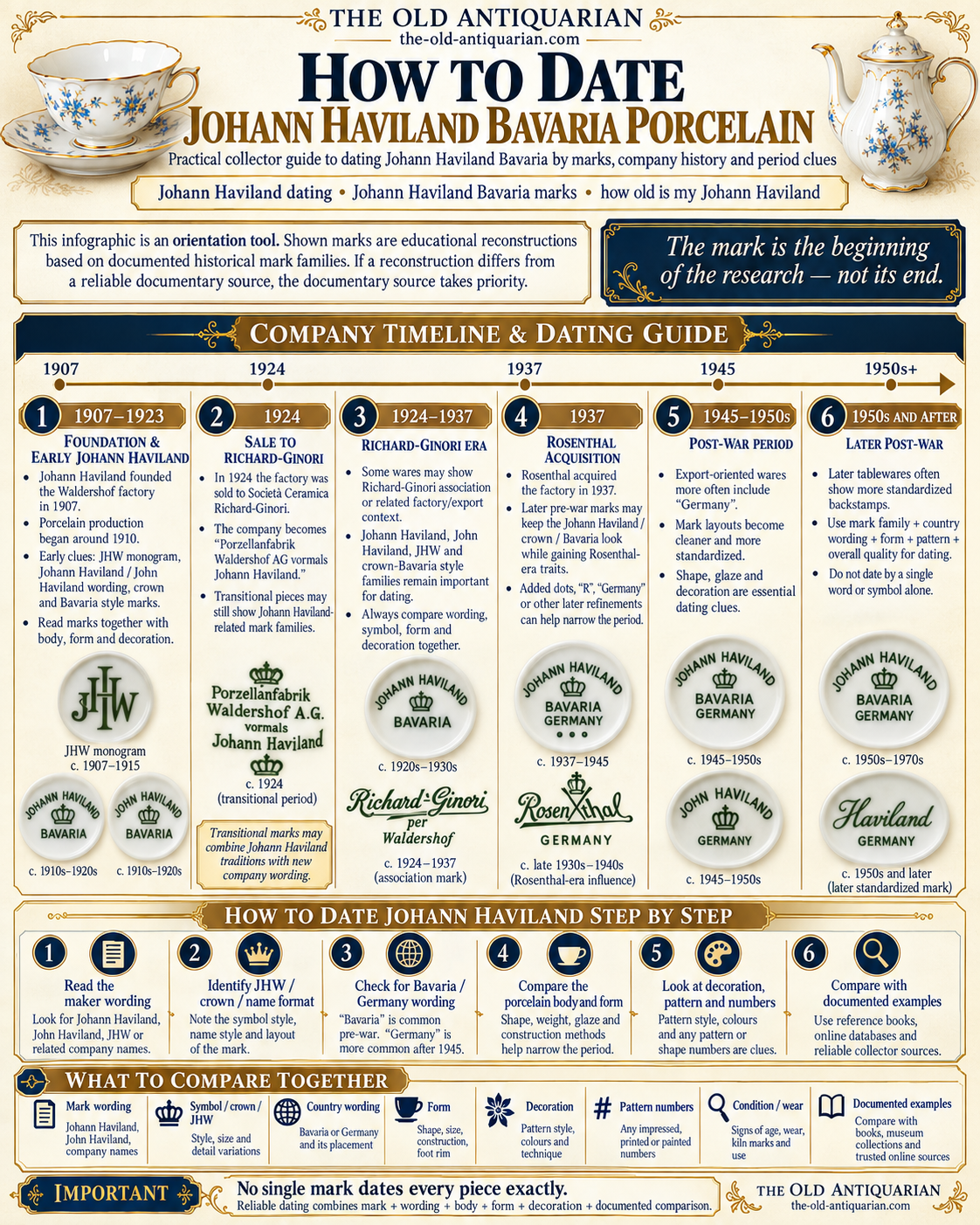
Richard-Ginori ownership, Rosenthal ownership and post-war identification clues.
exact mark + John / Johann wording + Bavaria / Germany wording + ownership period +
porcelain body + form + decoration + pattern + documented comparison
Record the exact wording, initials, crown, dots and country designation.
Compare the piece with the early Waldershof, Richard-Ginori or Rosenthal period.
Study whiteness, density, translucency, firing and the unglazed foot.
Compare cup profiles, handles, rims, feet, lids and serving shapes.
Note transfers, floral motifs, gilding, platinum trim and hand finishing.
Later pattern documentation can narrow the production period substantially.
For the wider dating method used across European porcelain, continue to
How to Date Antique Porcelain
.
Johann Haviland Bavaria vs Haviland Limoges
The most important Haviland distinction is geographical:
Johann Haviland Bavaria belongs to Germany, while Haviland Limoges belongs to France.
The businesses are historically connected through the Haviland family, but they are not the same
factory tradition and should not share one mark chronology.
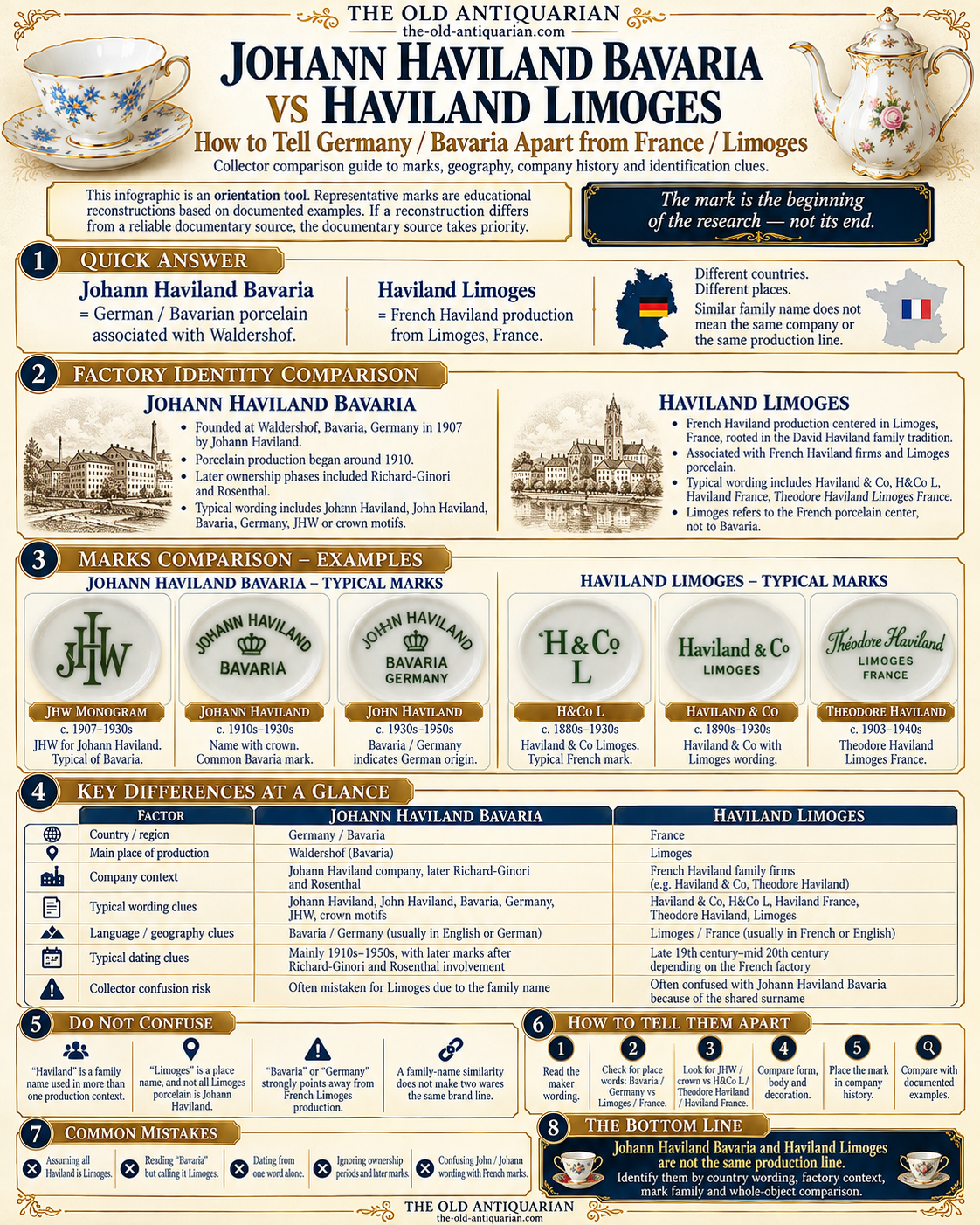
the same factory, country, backstamp chronology or collector market.
| Feature | Johann Haviland Bavaria | Haviland Limoges |
|---|---|---|
| Country | Germany | France |
| Main centre | Waldershof, Bavaria | Limoges |
| Typical wording | JHW, John Haviland, Johann Haviland, Bavaria, Germany | Haviland & Co., H&Co L, Théodore Haviland, Limoges, France |
| Richard-Ginori connection | Yes, from 1924 | Not part of French Haviland dating |
| Rosenthal connection | Yes, from 1937 | Not the French Limoges production line |
| Main identification focus | Waldershof mark + ownership period + pattern | French factory / decorator marks + Limoges pattern systems |
For the French Haviland tradition, including Haviland & Co., Théodore Haviland,
CFH, French backstamps and Limoges pattern identification, use our dedicated
Haviland Limoges Porcelain Guide
.
Johann Haviland Patterns & Decorations
Pattern identification is especially important for later Johann Haviland tableware.
Large replacement catalogues document hundreds of Johann Haviland pattern entries, ranging from
floral services to geometric, banded and platinum-trimmed designs.
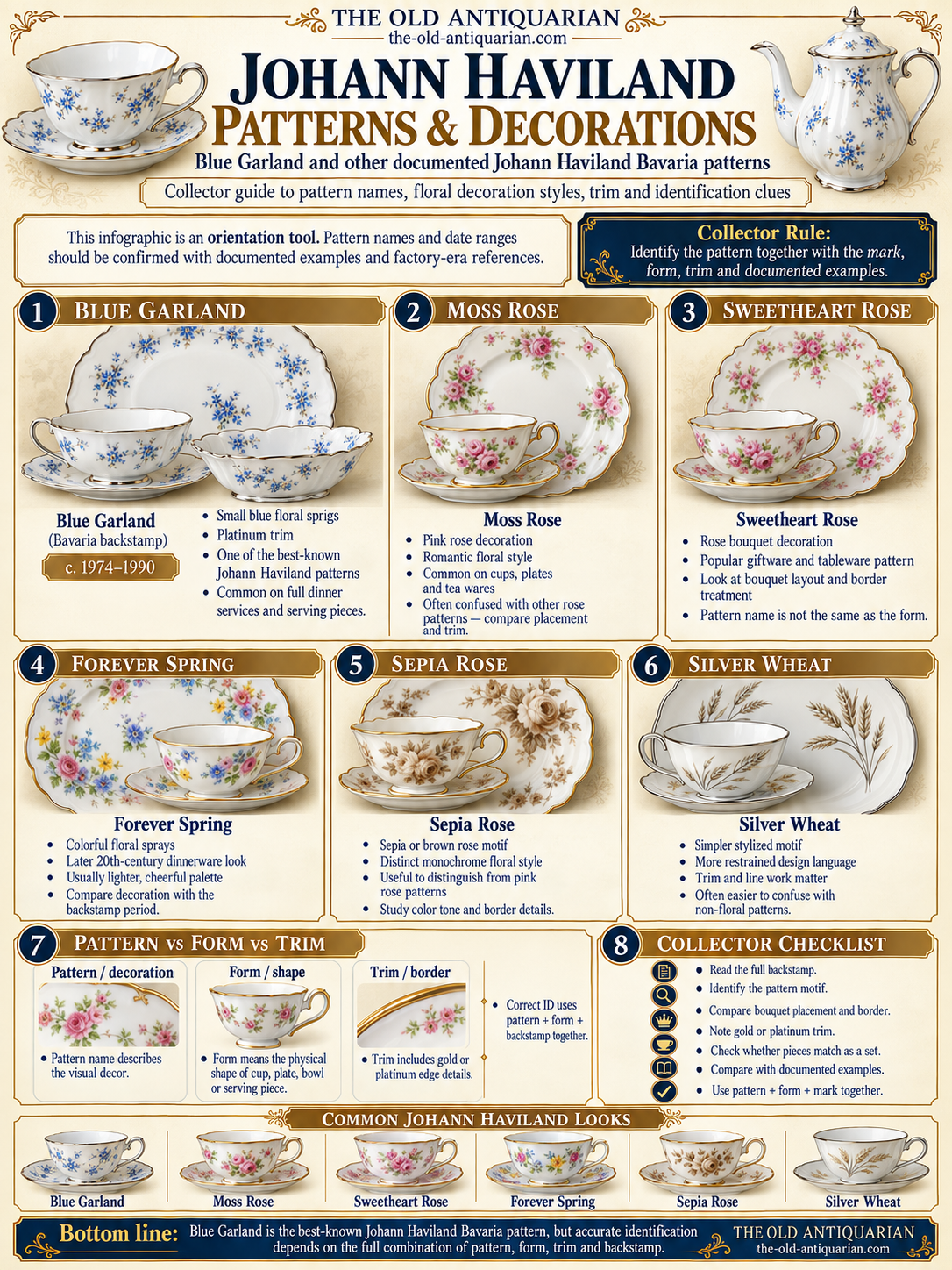
including Blue Garland, Moss Rose, Sweetheart Rose, Forever Spring,
Sepia Rose and Silver Wheat.
| Pattern | Documented Reference | Identification Clue |
|---|---|---|
| Sepia Rose | Catalogued from circa 1946 | Beige and pink rose / floral decoration |
| Silver Wheat | Catalogued from circa 1950 | Grey wheat decoration positioned toward the side |
| Sweetheart Rose | Catalogued from circa 1969 | Pink and yellow roses with brown leaves |
| Blue Garland – Bavaria Backstamp | 1974–1990 | Small blue flowers and platinum trim |
| Moss Rose – Bavarian Backstamp | Catalogued from circa 1976 | Rose decoration around rim and centre |
| Forever Spring | Catalogued from circa 1982 | Floral rim and centre with platinum trim |
A pattern introduced in the 1970s or 1980s does not become early Johann Haviland simply because
the original Waldershof factory was founded in 1907.
Johann Haviland Blue Garland
Blue Garland is one of the most recognisable and frequently searched
Johann Haviland patterns.
The documented Blue Garland Bavaria Backstamp version was produced from
1974 to 1990. The pattern combines small blue floral sprays with platinum trim
on sculpted white dinnerware.
How to Recognise Blue Garland
Look for clusters of small blue flowers, a white moulded or sculpted body and platinum-coloured
trim. Confirm the pattern using the backstamp and exact form.
Why Dating Matters
Blue Garland is vintage rather than early twentieth-century Johann Haviland.
Do not date it to the 1910s or 1920s from the brand name alone.
“Johann Haviland Blue Garland – Bavaria Backstamp” is more precise than simply
“Haviland Blue Garland,” because later production contexts and other backstamps exist.
How to Identify Genuine Johann Haviland Bavaria Porcelain
Reliable identification requires convergence of evidence. A correct-looking mark can still be
misleading if the porcelain body, form, pattern or production period contradicts it.
| Evidence | What to Examine | Why It Matters |
|---|---|---|
| Backstamp | Lettering, crown, JHW, Bavaria / Germany wording, colour and layout | Places the object within a possible mark family |
| Porcelain body | Whiteness, density, translucency, firing and foot | Should be compatible with known production |
| Form | Shape, rim, handle, lid, foot and proportions | Can support or contradict a proposed pattern or period |
| Decoration | Floral transfers, gilding, platinum, hand finishing and placement | Should agree with documented production |
| Pattern | Motif, colours, trim and object form | Especially important for post-war pieces |
| Numbers | Printed, painted and impressed numbers | May relate to form, decoration or factory control |
| Condition | Wear, repair, repainting, regilding and replaced components | May reveal later intervention |
| Documentation | Museum objects, specialist references and documented patterns | Turns visual resemblance into evidence-based attribution |
Johann Haviland Authenticity & Red Flags
Johann Haviland does not have the same counterfeit market as some very high-value porcelain
brands, but incorrect attribution is common. A generic Bavaria crown mark, mismatched service
or later pattern can easily be described online as something older or rarer than it is.
Many German porcelain factories used crown motifs. Always identify the complete lettering,
factory initials and country wording.
| Check | More Reassuring Clue | Warning Sign |
|---|---|---|
| Mark layout | Consistent with documented Johann Haviland examples | Generic crown with no supporting Haviland wording |
| Typography | Lettering proportions match documented examples | Crude spacing or obviously modern-looking lettering |
| Pattern | Motif, trim and form match a documented pattern | Seller name does not match the actual decoration |
| Period | Pattern and mark chronology are compatible | 1970s pattern described as early 1900s porcelain |
| Service | Backstamps and forms are reasonably consistent | Mixed production periods presented as one original set |
| Condition | Wear is consistent with use and age | Heavy repainting or restoration not disclosed |
Condition, Wear & Restoration
Johann Haviland dinnerware was intended for practical use, so condition problems frequently involve
trim wear, chips, hairlines and mismatched replacement pieces rather than dramatic structural damage.
| Condition Issue | Where to Look | Collector Significance |
|---|---|---|
| Rim chips | Plates, cups and serving pieces | Common damage; severity affects resale appeal |
| Hairline cracks | Cups, handles, bases and structural joins | Can materially reduce value |
| Gold / platinum wear | Rims, handles and raised edges | Especially visible on patterns such as Blue Garland |
| Staining | Cups, bowls and foot rings | Can reduce display and replacement demand |
| Restoration | Handles, lids, feet and repaired breaks | Should always be disclosed |
| Mismatched pieces | Backstamps across a service | May indicate replacements from different production periods |
Before cleaning or repairing a potentially important set, read
What Not to Do to an Antique Before Valuation or Sale
.
Johann Haviland Bavaria Value: What Is It Worth?
There is no responsible universal price chart for Johann Haviland porcelain.
An early Waldershof object, a Richard-Ginori-associated piece, a post-war floral service and
a common Blue Garland plate belong to different market categories.
Market value should be based on genuinely comparable completed sales —
not unsold marketplace listings, optimistic dealer prices or generic “Haviland” results.
| Value Factor | Why It Matters |
|---|---|
| Exact attribution | German Johann Haviland and French Haviland Limoges belong to different markets |
| Production period | Early Waldershof and historically significant ownership periods can attract specialist interest |
| Backstamp | A documented mark helps establish factory and historical context |
| Pattern | Recognised patterns can have active replacement demand |
| Form | Unusual serving pieces may be harder to find than common plates |
| Completeness | Matched dinner, tea and coffee services can attract buyers seeking usable sets |
| Decoration | Quality and condition of flowers, gold and platinum trim affect desirability |
| Condition | Cracks, chips, staining and trim wear affect comparability |
| Provenance | Documentation can strengthen unusual or early pieces |
| Completed sales | Provide stronger evidence than asking prices |
A Blue Garland dinner plate should be compared with the same pattern and backstamp,
not with an early Waldershof vase or unrelated Haviland Limoges porcelain.
For an individual object or complete service, use our
Professional Antique Valuation
service once the mark, pattern and condition have been documented.
Johann Haviland Collector Checklist
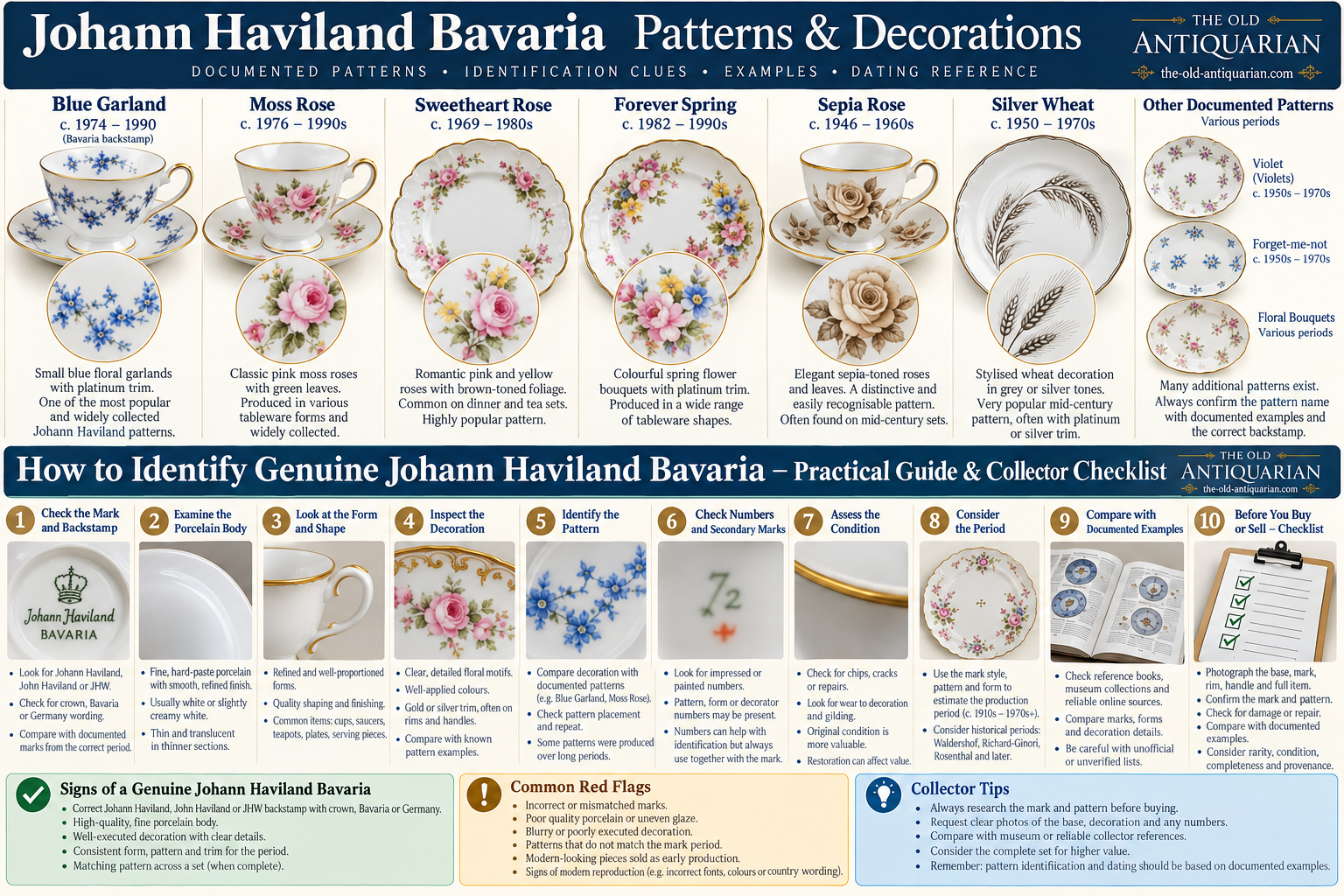
buying, selling, identifying and researching porcelain.
Include front, back, sides and full profile.
Do not crop the foot ring, numbers or secondary marks.
Record John, Johann, JHW, Bavaria, Germany and other wording.
Compare motif, colour, placement, trim and form.
Measure diameter, width and height where relevant.
Compare marks and forms across all pieces for replacements or mismatches.
Record chips, cracks, staining, trim wear and restoration.
Use mark family, ownership history and pattern chronology together.
Compare only genuinely similar pieces after correct identification.
Do You Own Johann Haviland Bavaria Porcelain?
Send clear photographs of the complete object, base, backstamp, pattern, decoration,
dimensions and any damage or restoration. The Old Antiquarian can help with identification,
period research and market orientation.
Frequently Asked Questions About Johann Haviland Bavaria
Is Johann Haviland Bavaria the same as Haviland Limoges?
No. Johann Haviland Bavaria is associated with Waldershof in Germany, while Haviland Limoges
refers to French Haviland porcelain production in Limoges. The family connection is historical,
but the factories, marks and dating systems should be researched separately.
When was Johann Haviland Bavaria founded?
The Waldershof porcelain enterprise was established in 1907. Actual porcelain production
began around 1910.
What does JHW mean on Johann Haviland porcelain?
JHW is a documented ligature associated with Johann Haviland Waldershof.
The complete object and mark should still be examined before assigning a production period.
What is the difference between John Haviland and Johann Haviland?
Both names belong to the Waldershof history. Early wares were marketed under the John Haviland
name, while Johann Haviland became the continuing German-form trademark identity.
The wording is useful dating evidence but not an exact date code.
When did Richard-Ginori acquire Johann Haviland?
The Waldershof factory passed to the Richard-Ginori group in 1924 and was reorganised as
Porzellanfabrik Waldershof A.G., vormals Johann Haviland.
When did Rosenthal acquire Johann Haviland?
Rosenthal acquired the Waldershof company in 1937. The Johann Haviland commercial identity
continued under later ownership.
What does Bavaria mean on Johann Haviland porcelain?
Bavaria identifies the German region associated with the porcelain. It is not a pattern name,
and because many German factories used Bavaria wording, it does not identify Johann Haviland by itself.
How old is Johann Haviland Blue Garland?
The documented Blue Garland Bavaria Backstamp version was produced from 1974 to 1990.
It is therefore vintage rather than early Johann Haviland production.
What are some Johann Haviland patterns?
Documented pattern names include Blue Garland, Moss Rose, Sweetheart Rose, Sepia Rose,
Silver Wheat and Forever Spring, along with many other designs.
How can I identify my Johann Haviland mark?
Photograph the complete base and compare the exact John or Johann Haviland wording,
JHW monogram, crown, Bavaria or Germany wording and secondary symbols with documented examples.
Then confirm the porcelain body, form, decoration and pattern.
Is Johann Haviland Bavaria porcelain valuable?
Some pieces and complete services are collectible, but value depends on the exact production period,
mark, pattern, rarity, form, condition, completeness and current market demand.
Related Guides
Sources & Further Research
Johann Haviland is a collecting field in which factory ownership, trademark history, mark
chronology and much later pattern production can easily be confused. For that reason, this guide
prioritises documented museum objects, historical legal records and specialist pattern references.
| Source | Used For |
|---|---|
|
Museum Europäischer Keramikkunst – Johann Haviland Waldershof |
Factory foundation, start of production, JHW and John Haviland marks, Richard-Ginori ownership, Rosenthal acquisition and conflicting published mark datings |
|
Haviland & Co. v. Johann Haviland China Corporation, 1967 |
Historical John / Johann Haviland trademark use, Waldershof and U.S. commercial history |
|
Haviland Collectors International Foundation – Haviland History |
Relationship and distinction between German Johann Haviland and French Haviland traditions |
|
Porcelain Marks & More – Waldershof Research |
Corrections to published Johann Haviland mark runtimes and Waldershof ownership context |
|
Replacements – Johann Haviland Pattern Index |
Documented commercial pattern names and pattern identification references |
|
Replacements – Blue Garland Bavaria Backstamp |
Blue Garland identification, small blue flower decoration and documented 1974–1990 range |
If a marketplace listing, reseller description, Pinterest mark chart or graphic reconstruction
conflicts with a reliable museum object, factory record, historical document or specialist source,
the documentary source takes priority.
Pattern dates should be researched independently from the 1907 factory foundation.
Later Johann Haviland patterns can belong to post-war and late twentieth-century production.
About The Old Antiquarian
The Old Antiquarian combines more than 35 years of practical experience with antiques
and collecting with museum, historical and comparative research. We identify porcelain
through the complete object: body, factory mark, form, decoration, pattern, production period,
condition, restoration, provenance and documented comparison.
Conclusion: How to Research Johann Haviland Bavaria Correctly
Johann Haviland Bavaria should be understood as a German porcelain tradition centred on
Waldershof rather than as another name for French Haviland Limoges.
Its history extends from the establishment of the Waldershof enterprise in 1907 through
production from around 1910, Richard-Ginori ownership from 1924, Rosenthal ownership from
1937 and later post-war and commercial use of the Johann Haviland name.
That long history explains why collectors encounter multiple mark families, different country
wordings and patterns produced many decades after the original factory was founded.
The strongest attribution follows the complete evidence chain:
mark → wording → porcelain body → form → decoration → pattern →
ownership period → condition → documented comparison.
Only after the exact object has been identified and dated should its value be researched through
genuinely comparable completed sales.
