
Kahla Porcelain: Marks, History, Dating & Value (1844–Today)
THE OLD ANTIQUARIAN
GERMAN PORCELAIN · FACTORY HISTORY · MAKER’S MARKS · COLLECTING
KAHLA PORCELAIN
From a Thuringian Factory in 1844 to a Modern German Design Tradition
HISTORICAL FACTORY MARKS · EAST GERMANY AND VEB
ANTIQUE AND VINTAGE TABLEWARE · DATING METHODS
AUTHENTIC EXAMPLES · COLLECTOR VALUE · PRESERVATION
Last Updated: October 14, 2026 · The Old Antiquarian
Quick Answer: What Is Kahla Porcelain?
Kahla porcelain is a historic German porcelain-making tradition associated with the town of Kahla in Thuringia. The original factory was founded in 1844 by Christian Eckardt and became an important producer of household and tableware porcelain.
Kahla’s history extends from nineteenth-century industrial production through the German Empire, the interwar years, the German Democratic Republic (GDR), and the establishment of KAHLA/Thüringen Porzellan GmbH in 1994.
To identify a piece of Kahla porcelain, examine the complete factory backstamp, porcelain body, shape, decoration, production codes, and condition. Important historical references include early twentieth-century marks, registered marks from 1931, and green factory marks associated with East German production.
Collector’s rule: A KAHLA backstamp can support identification, but a mark alone cannot prove the object’s exact age, authenticity, rarity, or market value.
An old porcelain cup may appear to be a modest household object. Its decoration may be familiar, its shape ordinary, and its factory mark almost invisible beneath the base. Yet sometimes that small mark opens a door to a much larger story.
Kahla is one such story.
Founded in nineteenth-century Thuringia, the porcelain factory developed during Germany’s industrial expansion, experienced two world wars, became part of the East German state-owned manufacturing system, and later entered a new era of contemporary product design.
Today, collectors encounter Kahla porcelain in inherited dinner services, vintage coffee sets, individual cups and saucers, decorative objects, and modern tableware. Some pieces were produced in considerable quantities. Others attract interest because of their historical period, distinctive decoration, unusual form, or documented design.
This guide explains the history of Kahla porcelain, the meaning of its important factory and decorator marks, how to approach dating, and what collectors should examine when assessing condition and value.
Kahla Porcelain at a Glance
| Historic maker | Porzellanfabrik Kahla and later associated enterprises |
| Location | Kahla, Thuringia, Germany |
| Founded | 1844, Christian Eckardt |
| Early products | Household porcelain and other porcelain goods |
| Important marks | Historic KAHLA marks, 1931 registered emblems, GDR-era marks |
| GDR period | 1949–1990; VEB status from 1952 |
| Industrial group | VEB Kombinat Feinkeramik, headquartered in Kahla from 1979 |
| Modern company | KAHLA/Thüringen Porzellan GmbH established in 1994 |
| Notable modern series | Update, associated with designer Barbara Schmidt |
| Collector value | Depends on identification, rarity, design, condition, completeness and demand |
CHAPTER I · ORIGINS AND INDUSTRIAL HISTORY
1. The History of Kahla Porcelain: A Thuringian Factory Founded in 1844
The history of Kahla porcelain begins in 1844, when Christian Eckardt founded a porcelain factory in Kahla, a town in the German region of Thuringia.
According to the manufacturer’s historical records, production began that year with approximately twenty employees. The enterprise grew from relatively modest beginnings into an important part of the region’s porcelain industry.
Thuringia already possessed a long ceramic manufacturing tradition. Its factories served a market that increasingly valued practical household porcelain alongside more elaborate decorative goods.
1856: August Koch and the Expansion of the Factory
In 1856, August Koch assumed ownership of the enterprise. Under the developing industrial organisation, Kahla became an increasingly significant porcelain manufacturer in Thuringia.
The growing production of tableware reflected a wider transformation in European households. Porcelain was gradually becoming accessible beyond royal and aristocratic settings.
1888: From Factory to Joint-Stock Company
In 1888, the company was reorganised as a joint-stock corporation. This change supported a larger industrial structure and further expansion.
By the beginning of the twentieth century, German porcelain had developed into an internationally recognised manufacturing industry, with factories specialising in different markets, shapes, decorative traditions and price ranges.
Kahla During the German Empire
By 1914, Kahla was among Germany’s major porcelain manufacturers. Its corporate history included connections with factories in Arzberg, Hutschenreuther and Schönwald.
For collectors, these relationships are important but should not be misunderstood. Corporate ownership or affiliation does not mean that every product from an associated factory was physically made in Kahla.
The wider context of this manufacturing tradition is explored in our guide to German porcelain, famous manufacturers and factory marks.
CHAPTER II · THE MANUFACTURER THROUGH TIME
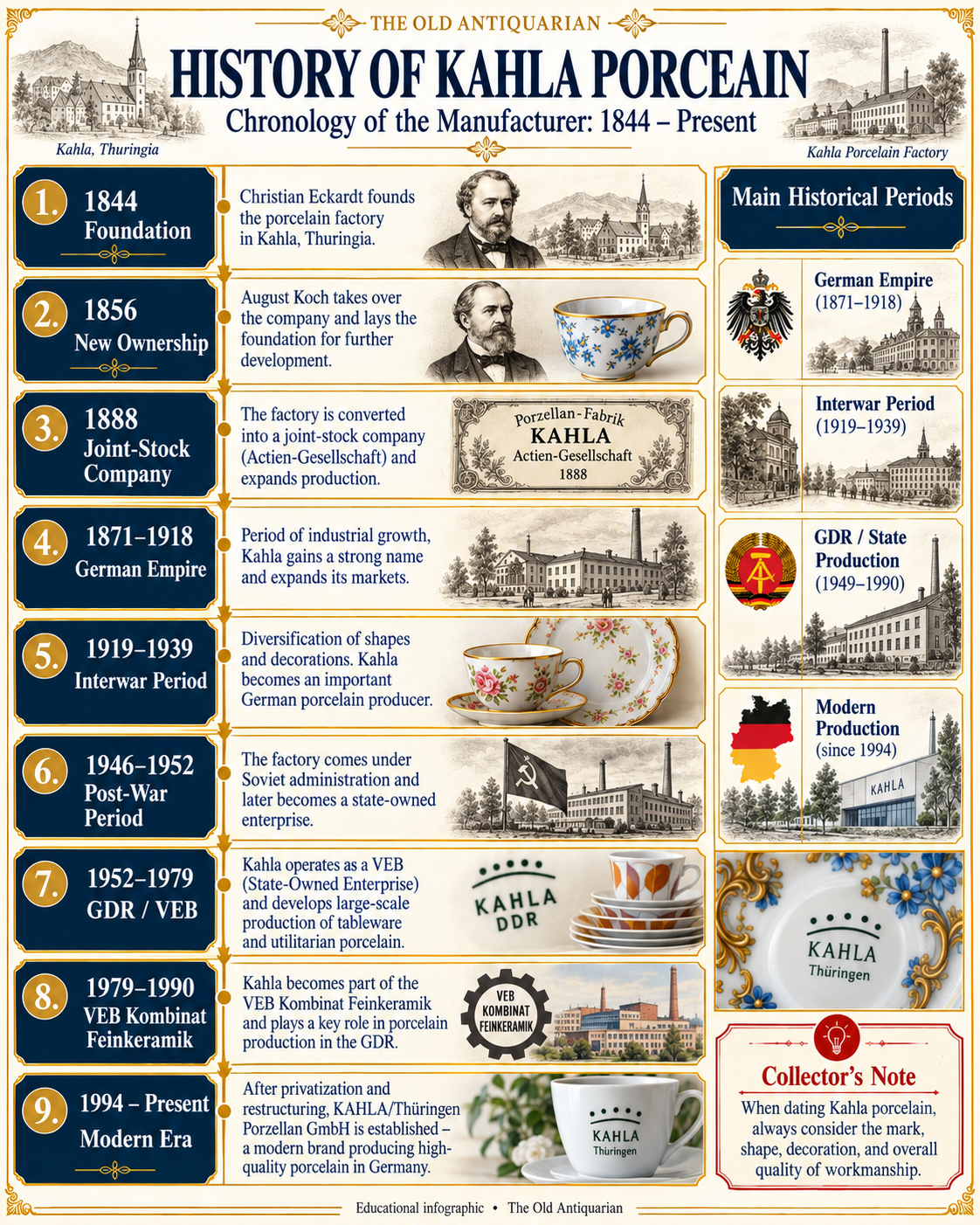
2. Kahla Porcelain Timeline: 1844 to the Present
Kahla’s development cannot be understood as a single unchanged business operating under the same ownership for nearly two centuries. Its history includes several distinct corporate and political periods.
| Year | Historical Development | Collector Significance |
|---|---|---|
| 1844 | Christian Eckardt establishes the factory. | Beginning of the manufacturer’s history. |
| 1856 | August Koch assumes ownership. | Expansion of industrial production. |
| 1888 | Joint-stock company established. | A new corporate phase. |
| 1914 | Kahla ranks among major German porcelain producers. | Factory affiliations require careful attribution. |
| Late 1920s–1930s | New marks and design developments. | Important reference period for backstamps. |
| 1946 | Soviet stock corporation administration. | Postwar industrial transition. |
| 1952 | Kahla becomes a state-owned enterprise, VEB. | Major East German production phase. |
| 1961 | Factory modernisation and tunnel kilns. | Development of industrial-scale output. |
| 1979 | Headquarters of VEB Kombinat Feinkeramik. | Distinguish factory, group and decorator. |
| 1991–1993 | Privatisation followed by insolvency. | Change in company continuity and ownership. |
| 1994 | KAHLA/Thüringen Porzellan GmbH established. | Beginning of a modern corporate chapter. |
| 1998 | Update collection introduced. | Recognisable contemporary design. |
This chronology provides historical context, not an automatic dating chart. Some factory marks were used across political transitions, while individual designs remained in production for extended periods.
Historical company records and the Thuringian State Archive inventory for VEB Feinkeramik Kahla document the growth and later organisation of this manufacturing group.
CHAPTER III · HISTORICAL MAKER’S MARKS
3. Early Kahla Porcelain Marks: How to Identify Pre-1945 Backstamps
Factory backstamps are among the strongest starting points for identifying Kahla porcelain. However, the manufacturer did not use one unchanged mark throughout its history.
The historical publication 150 Jahre Porzellan Kahla contains a valuable section entitled Bodenmarken, meaning marks on the underside of porcelain.
According to this source, there is no established evidence that every Kahla product was routinely marked from the factory’s founding in 1844. Recognisable factory marks became more widespread later, particularly around the turn of the twentieth century.
Early Twentieth-Century KAHLA Marks
An early documented form includes a stylised letter K associated with the name KAHLA. Such marks provide clues to early production, but the existence of unmarked pieces makes definitive identification more difficult.
An unmarked porcelain object should therefore not automatically be considered a reproduction, just as a printed KAHLA mark should not automatically be considered genuine.
The Geometric Mark of the Late 1920s
A geometric factory emblem is documented for the late 1920s, with specialist references indicating approximately 1927–1929.
The factory’s historical account connects the design with a model originating in the Bauhaus Weimar-Dessau environment. The influence of modernist design is an important element of this stage in the factory’s visual identity.
The Registered Marks of 1931
Two historically documented trademarks deserve particular attention.
On 8 May 1931, a crowned shield bearing a diagonal KAHLA band was registered for specified porcelain categories. The factory’s historical publication attributes the design to Walter Gropius.
Another emblem was registered on 3 June 1931. Its symbolism refers to expansion across the world’s oceans and the manufacturer’s international export activities.
The original historical source associates this second emblem with tableware, including festooned forms, and describes its validity from the middle of the 1930s.
| Period or Registration | Documented Mark Category | Dating Guidance |
|---|---|---|
| Around 1900 onward | Early KAHLA factory symbols | Early production was not universally marked. |
| Approximately 1927–1929 | Geometric KAHLA mark | Compare exact lines and lettering. |
| Registered 8 May 1931 | Crowned shield with diagonal KAHLA band | Registration date is not a production date for every object. |
| Registered 3 June 1931 | Symbolic circular export-related emblem | Associated with usage from the mid-1930s. |
| Approximately 1937–1957 | Additional Kahla mark variants | Some marks span the 1945 political divide. |
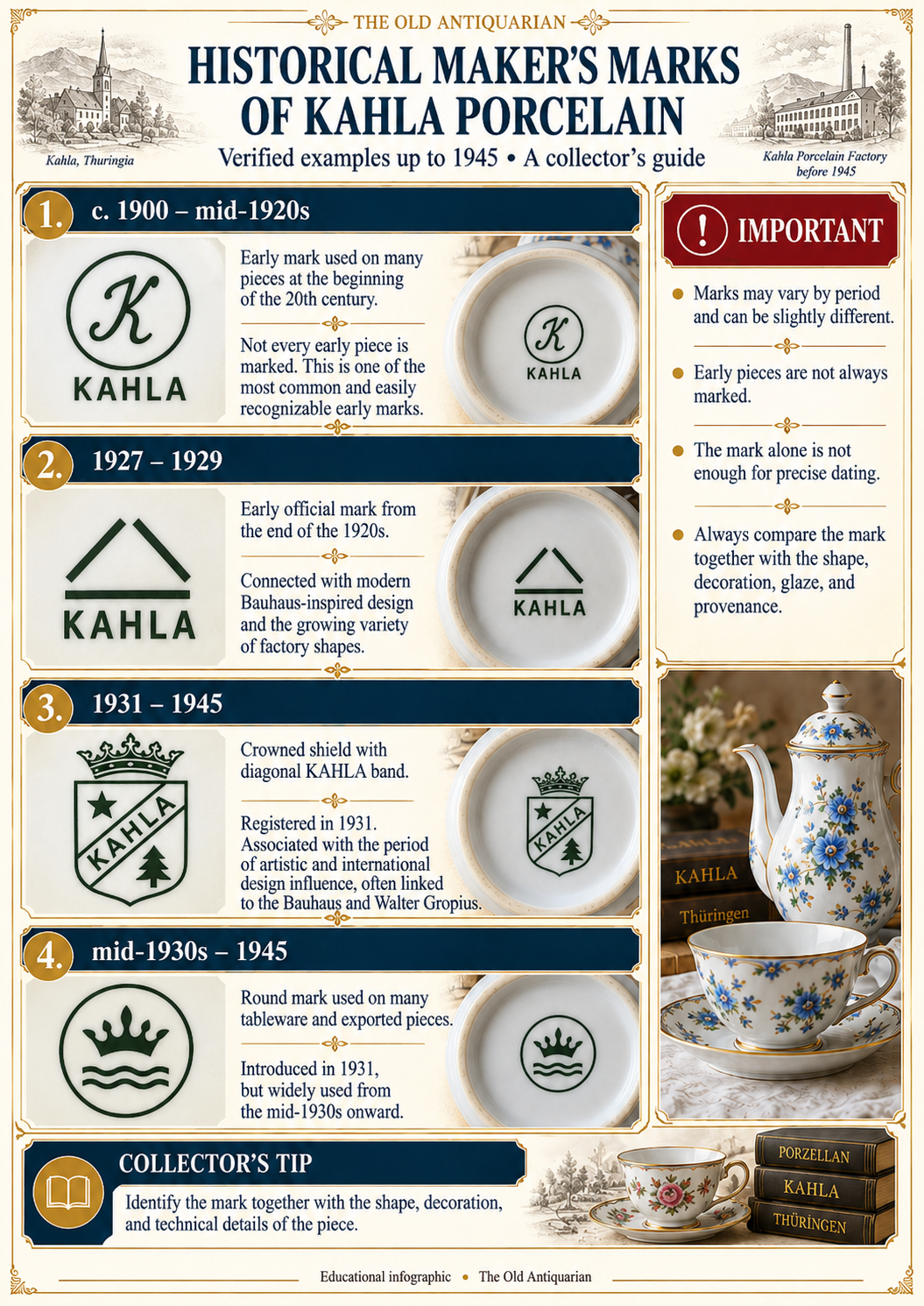
Research warning: A historical type of mark can be documented without every modern illustration of that mark being accurate. For identifying an actual porcelain object, use the authentic mark reproduced in the original historical source rather than relying exclusively on a stylised infographic.
For a broader explanation of backstamp terminology and methods, see How to Identify Porcelain Marks and Factory Backstamps.
CHAPTER IV · EAST GERMAN PRODUCTION
4. Kahla GDR and VEB Porcelain Marks: Understanding East German Production
The years following the Second World War brought substantial changes to the Kahla factory.
In 1946, the enterprise passed into Soviet stock corporation administration. Following the establishment of the German Democratic Republic in 1949, the factory developed within the East German planned industrial system.
In 1952, Kahla became a Volkseigener Betrieb, generally abbreviated to VEB, meaning a state-owned enterprise.
During the following decades, household tableware and other porcelain products were manufactured for domestic use and international export.
What Does Made in GDR Mean on Kahla Porcelain?
The words Made in GDR indicate manufacture in the German Democratic Republic.
The full expression German Democratic Republic may also appear on East German manufactured goods.
These inscriptions help establish historical and geographical context. However, they do not identify a specific factory mark variant or an exact manufacturing year.
Country wording should always be considered alongside the actual emblem, typography, model or shape numbers, porcelain body, and decoration.
The Standard Green Kahla Factory Mark
Specialist references document a standard green Kahla factory mark used approximately between 1968 and 1987.
This is a useful broad reference period, but it should not be transferred automatically to every green mark carrying the KAHLA name.
Collectors should compare the actual configuration of the mark rather than assuming that every crown-like symbol belongs to the same decade.
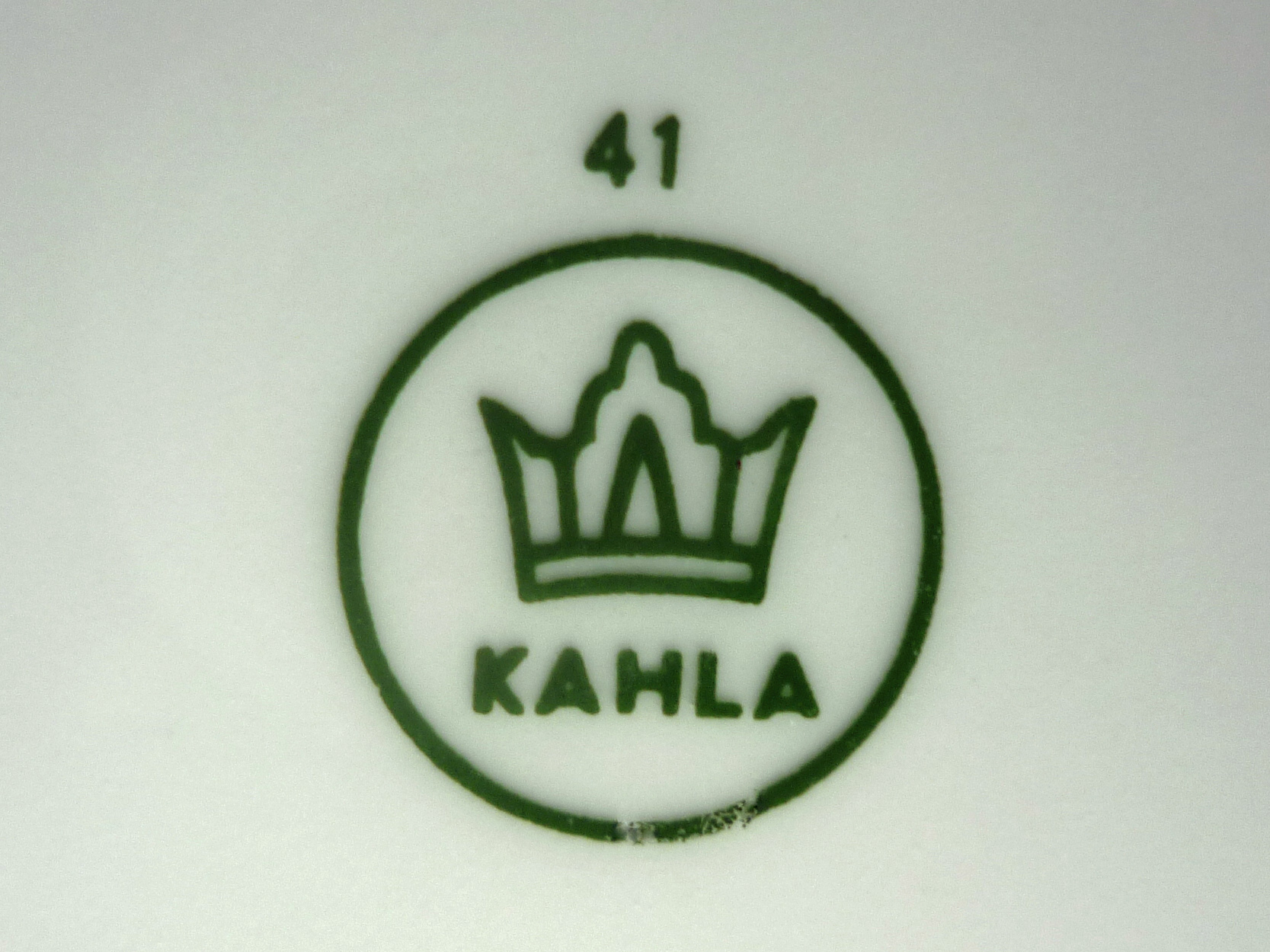
This photograph is particularly important because it shows a real backstamp applied to a porcelain surface.
The mark includes a circular border, a stylised crown-like symbol, the name KAHLA, and the separately positioned number 41.
The number should not automatically be read as the year 1941. It could relate to an internal production, form, pattern or control system, but its specific meaning needs documentary confirmation.
VEB Kombinat Feinkeramik and the Wider Industrial Network
In 1979, Kahla became the headquarters of VEB Kombinat Feinkeramik, an industrial organisation comprising seventeen porcelain factories and approximately 18,000 employees according to the manufacturer’s historical record.
Thuringian archival descriptions document connections with factories and production facilities in Könitz, Triptis, Gera, Rudolstadt-Volkstedt, Eisenberg and other locations.
For collectors, this creates an important identification problem: an object may carry a brand, factory mark, decorator’s mark or corporate association without every stage of manufacture having taken place in the same factory.
The porcelain body may have been made in one location while another enterprise applied the decoration.
AF/B&L and PMK: Decorator Marks, Not Simply Factory Marks
The history of VEB Porzellanmalerei Kahla is a useful example of why porcelain collectors must distinguish production from decoration.
The decorating enterprise developed from the previously private firms August Frank and Bauer & Lehmann.
Specialist reference material documents a crowned-shield mark containing KAHLA and the initials AF/B&L during approximately 1965–1972.
After nationalisation and the creation of VEB Porzellanmalerei Kahla in 1972, the mark was altered to include PMK. Documented variants were used approximately between 1972 and 1974, sometimes with the additional word HANDMALEREI, meaning hand painting.
These references are especially relevant when studying decorated porcelain whose original blank may have been supplied by a separate manufacturer.
| Mark or Wording | Documented Context | Collector Interpretation | Limitation |
|---|---|---|---|
| KAHLA transitional marks | Variants around 1937–1957 | Late pre-war and early postwar context | Overlapping periods. |
| Made in GDR | East German country-of-origin wording | Broad GDR-era context | Not an exact year. |
| Standard green Kahla mark | Approximately 1968–1987 | Documented factory-mark category | Exact variant matters. |
| KAHLA AF/B&L | 1965–1972 | Associated decorating enterprises | Not necessarily the maker of the blank. |
| KAHLA / PMK | 1972–1974 | VEB Porzellanmalerei Kahla | Decorator mark. |
| VEB Kombinat Feinkeramik | Industrial group from 1979 | Corporate and manufacturing context | Not a universal factory backstamp. |
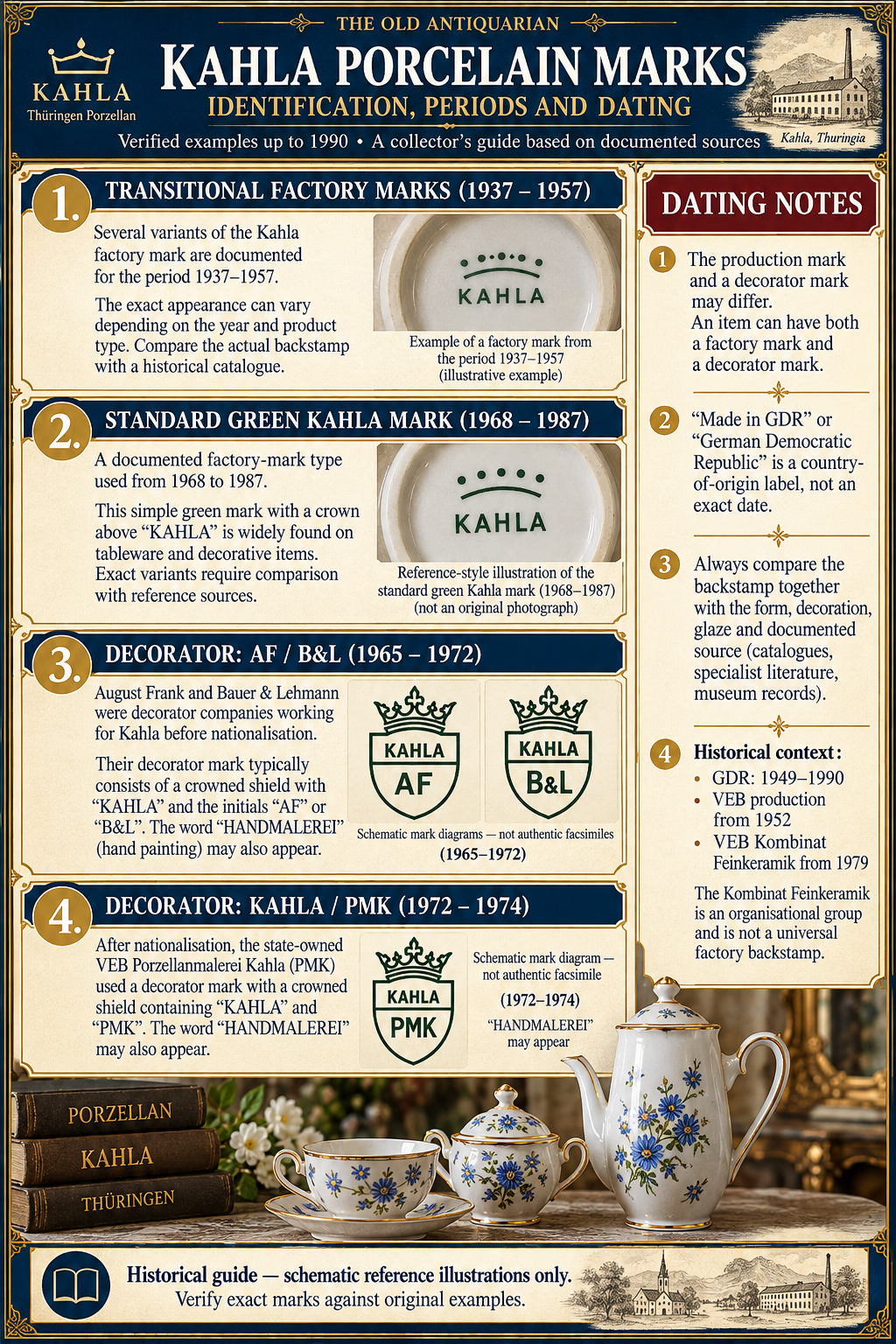
Important distinction: Factory mark, decorator mark, country-of-origin wording and industrial-group affiliation are different types of evidence. They should not be combined into one assumed manufacturing date or factory identity.
CHAPTER V · PRACTICAL IDENTIFICATION
5. How to Identify and Date Kahla Porcelain Step by Step
Reliable identification begins with observation rather than an immediate assumption about age or value.
A factory mark is often the first clue, but the strongest attribution is one supported by multiple characteristics of the same object.
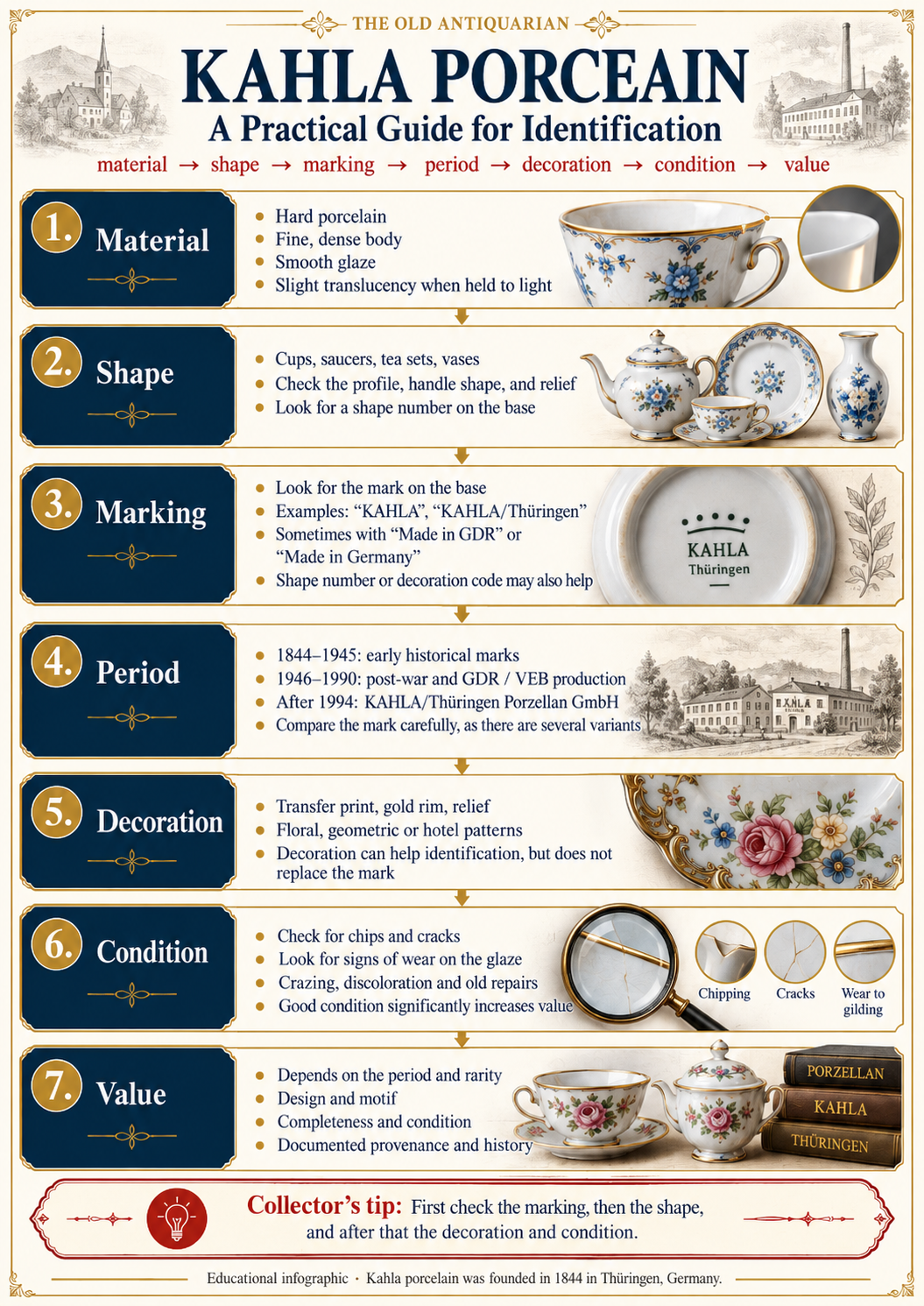
| Step | What to Examine | Why It Matters |
|---|---|---|
| 1. Material | Porcelain body, glaze, texture and translucency | Confirms the likely ceramic material. |
| 2. Shape | Profile, handles, rims, foot and moulding | May identify a series or period. |
| 3. Backstamp | Exact symbols, lettering, colour and wording | Supports factory and period identification. |
| 4. Numbers | Shape, mould, pattern or production codes | Can narrow the identification when documented. |
| 5. Decoration | Transfer printing, painted details, lustre, gilding | Helps compare patterns and manufacturing methods. |
| 6. Condition | Chips, cracks, repairs and surface wear | Relevant to originality and value. |
| 7. Documentation | Catalogues, historical references and provenance | Supports or challenges an attribution. |
Does a Number on Kahla Porcelain Indicate the Year?
Not necessarily. Numbers on porcelain can represent a shape number, pattern, mould, internal factory code, control designation or another production reference.
A number should only be interpreted as a date when the manufacturer’s documented coding system supports that conclusion.
The green KAHLA mark with the number 41 illustrated earlier is a useful reminder of this principle.
Why Shape and Decoration Matter
The same factory mark may appear on several forms over many years.
A particular cup profile, handle design, plate rim or lid construction may help connect an object with a documented series.
Decoration can also provide evidence, but floral patterns, gold borders and historicising scenes were used by many manufacturers. A decorative style alone does not prove that a piece belongs to Kahla.
For broader dating methods, continue with our guide to dating antique porcelain by factory marks, form and manufacturing evidence.
CHAPTER VI · SHAPES AND PRODUCT CATEGORIES
6. What Did Kahla Produce? Cups, Dinnerware, Coffee Sets and Decorative Porcelain
Kahla’s historical importance lies in large part in the production of practical porcelain for everyday life.
Over time, the factory’s output included different kinds of household and dining porcelain. Changing tastes, manufacturing methods and markets influenced the forms and decorative styles of its products.
Tableware is particularly important to collectors because individual objects may form part of larger services.
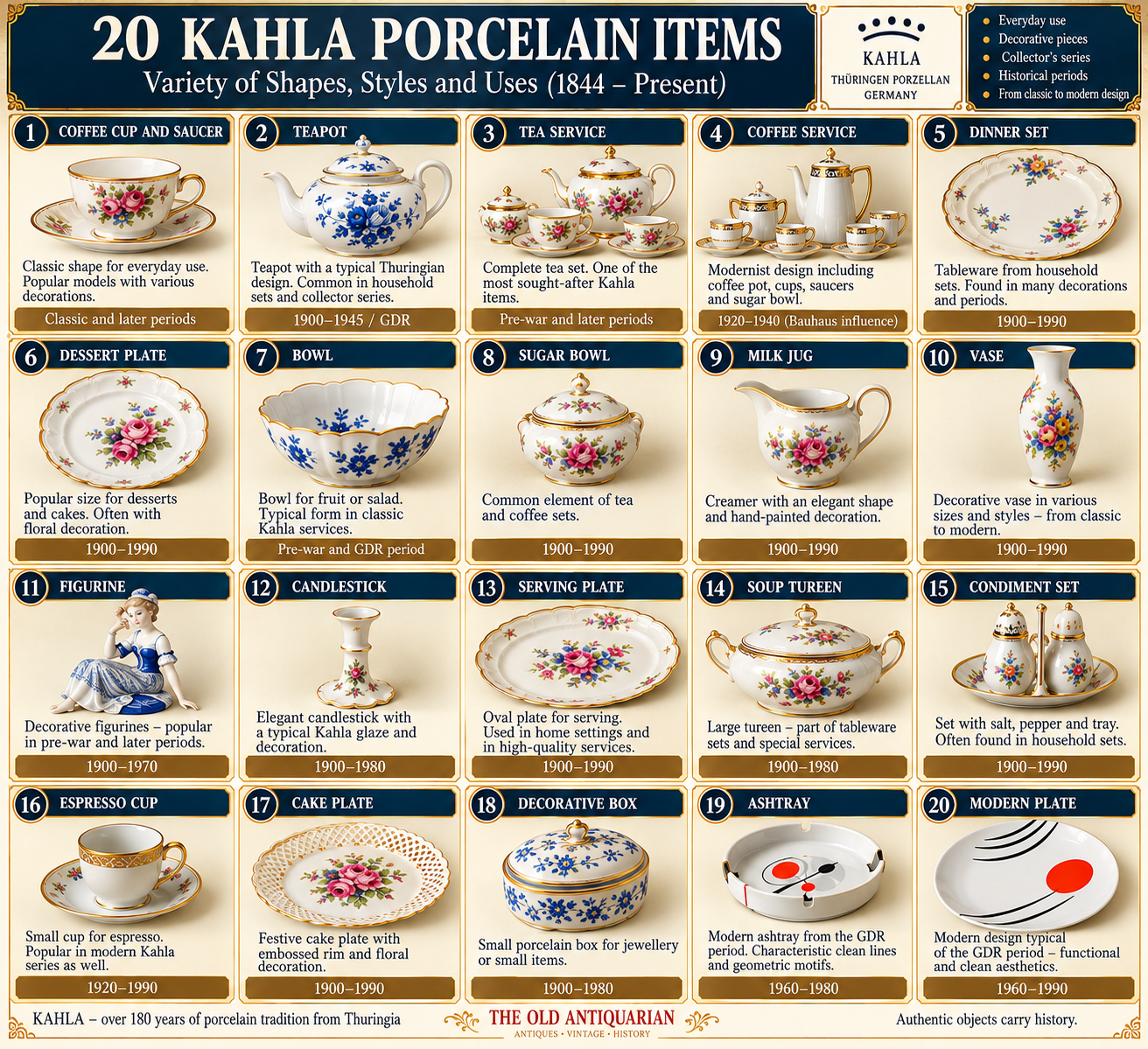
| Product Group | Typical Objects | Important Collector Details |
|---|---|---|
| Coffee services | Coffee pots, cups, saucers, sugar bowls | Matching decoration, marks, original parts. |
| Tea services | Teapots, cups, milk jugs, sugar bowls | Lids, handles, completeness, pattern. |
| Dinnerware | Dinner plates, dessert plates, bowls | Pattern, quantity, wear, replacement pieces. |
| Serving ware | Platters, tureens, covered vessels | Lids, finials, spouts, damage and restoration. |
| Decorative porcelain | Decorative forms and objects | Verify the actual model and factory attribution. |
| Hotel and professional ware | Durable tableware for commercial service | Series, construction, identifying marks. |
| Modern designer ware | Functional collections and modular tableware | Designer, documented series and date. |
One qualification is particularly important: a general illustration of a figurine, vase or decorative box does not establish that the precise model was manufactured by Kahla.
Specific models require confirmation through documented catalogues, marks and original examples.
CHAPTER VII · A DOCUMENTED EXAMPLE
7. Kahla Perlmutt: Iridescent Porcelain from the East German Period
One of the more visually distinctive examples of Kahla porcelain is the decorative finish known as Perlmutt.
The German word means mother-of-pearl and describes an iridescent effect that reflects different colours as the object is moved or viewed under changing light.
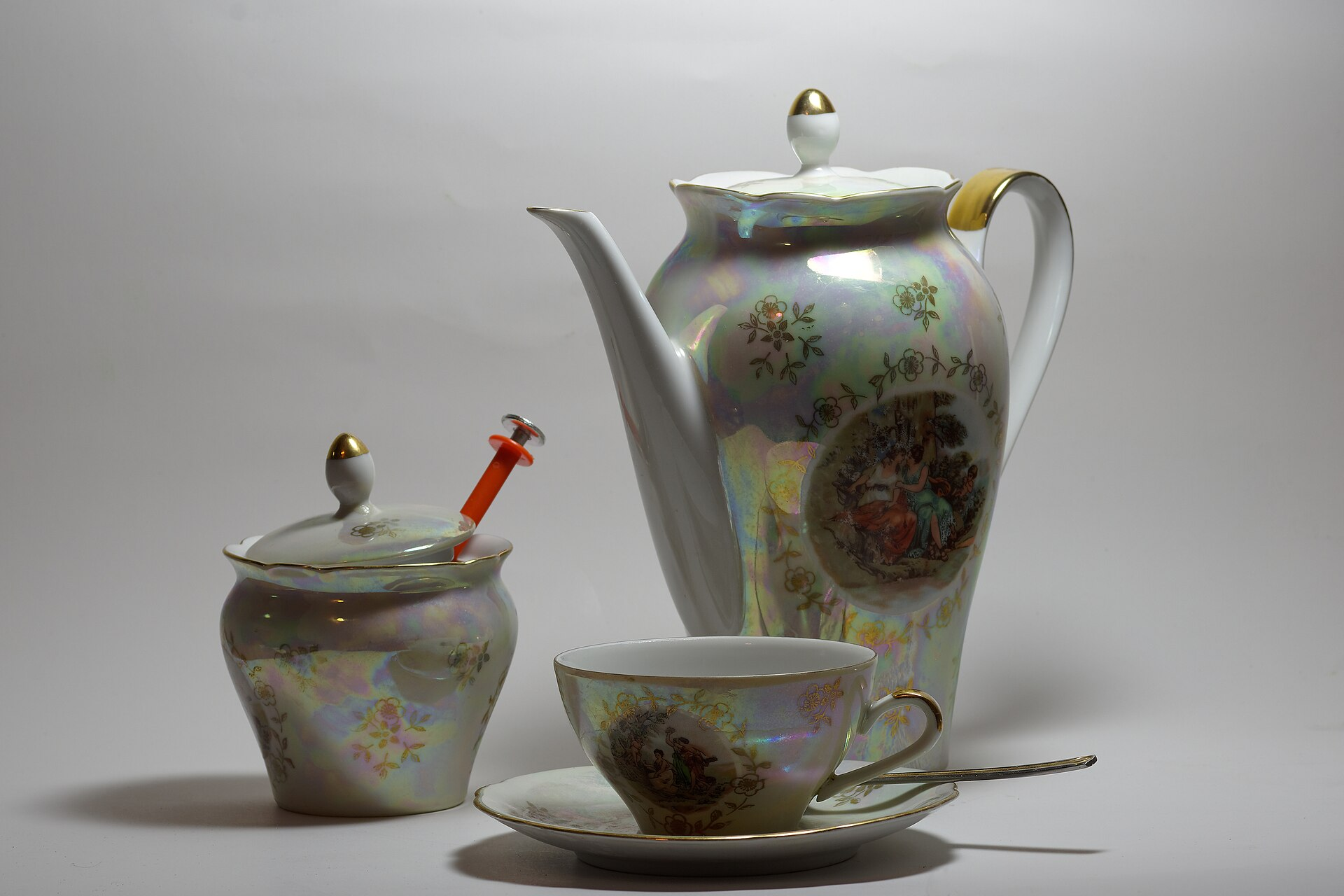
The authentic coffee service photographed at the beginning of this guide demonstrates this decorative approach.
Its tall coffee pot, covered sugar bowl and matching cup display a pearlescent lustre finish, fine gold details, floral decoration and pictorial scenes.
When Was This Kahla Perlmutt Service Made?
The photographer’s original Wikimedia Commons description identifies the service as Kahla Perlmutt from the GDR period.
It suggests an approximate production date of 1957–1962, based on the interpretation of the original backstamp.
This is a useful provisional attribution, not a confirmed manufacturing year for the individual pieces, and certainly not a universal date range for every Perlmutt-decorated object.
Collector’s note: Perlmutt describes the finish, not an independent factory name or exact date code. Identify the actual factory mark and form before assigning an age.
Comparing this richly decorated service with the minimalist designs of later Kahla production illustrates how dramatically the manufacturer’s visual language changed through the twentieth century.
CHAPTER VIII · CONTEMPORARY GERMAN DESIGN
8. Modern Kahla Porcelain After 1994: Barbara Schmidt and the Update Collection
The political and economic changes surrounding German reunification brought a difficult period of restructuring to many former East German industrial enterprises.
Kahla was privatised in 1991, and the previous company entered insolvency two years later.
In 1994, KAHLA/Thüringen Porzellan GmbH was established, marking a new phase in the manufacturer’s corporate and design history.
The modern business developed tableware that combined practical use with contemporary aesthetics.
Update: Functional Porcelain Design
The Update collection, associated with designer Barbara Schmidt and introduced in 1998, is a useful example of the new direction.
Its clean forms encourage flexible combinations of cups, bowls and plates rather than relying on elaborate painted ornament.
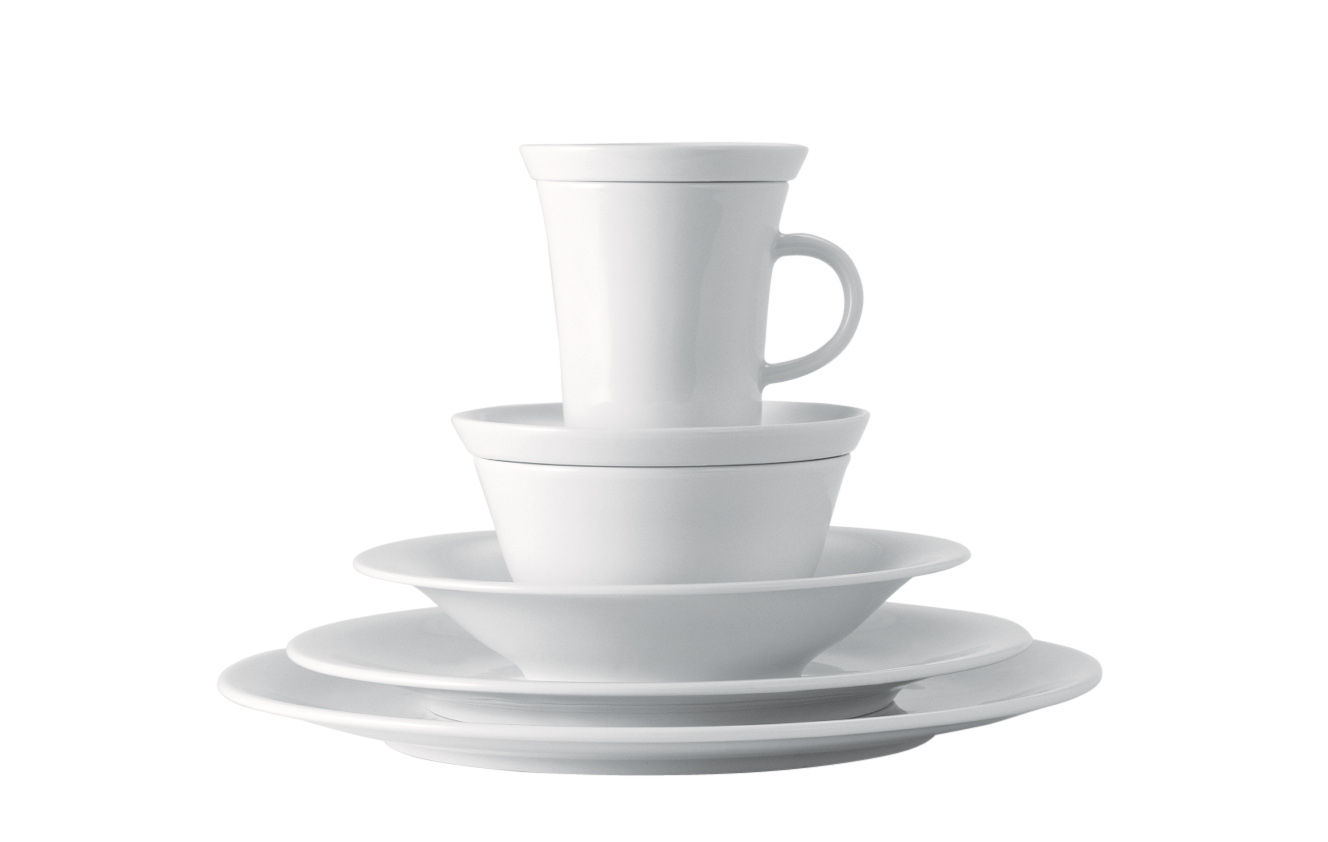
The photograph shows white porcelain objects arranged as a vertical composition, bringing attention to the relationship between their proportions, shapes and functions.
Compared with a gilded Perlmutt coffee service, Update represents an entirely different design philosophy.
Modern porcelain can still hold collector interest. Documented authorship, a recognisable design language, historical importance and market demand may make individual series attractive beyond their original practical purpose.
CHAPTER IX · COLLECTOR VALUE
9. Is Kahla Porcelain Valuable? Rarity, Condition and Market Demand
The value of Kahla porcelain cannot be determined from its age or factory name alone.
An ordinary old cup may have limited commercial demand, while an unusual historical form, rare decoration or documented designer piece could attract a more specialised collector.
Market value should be assessed using several connected factors.
| Factor | What to Check | Why It Matters |
|---|---|---|
| Factory mark | Authenticity and documented period | Supports confident identification. |
| Age | Reliable production range | Provides historical context, not automatic value. |
| Rarity | Availability of the exact model or decoration | Uncommon objects may attract specialist interest. |
| Design | Shape, decoration, designer and series | Important to some collector groups. |
| Condition | Chips, cracks, gilding, repairs | Damage can reduce market appeal. |
| Completeness | Matching original pieces and lids | May matter greatly for services. |
| Provenance | Family history, labels and documentation | Provides supporting historical information. |
| Market demand | Completed sales of comparable items | Grounds an estimate in observed transactions. |
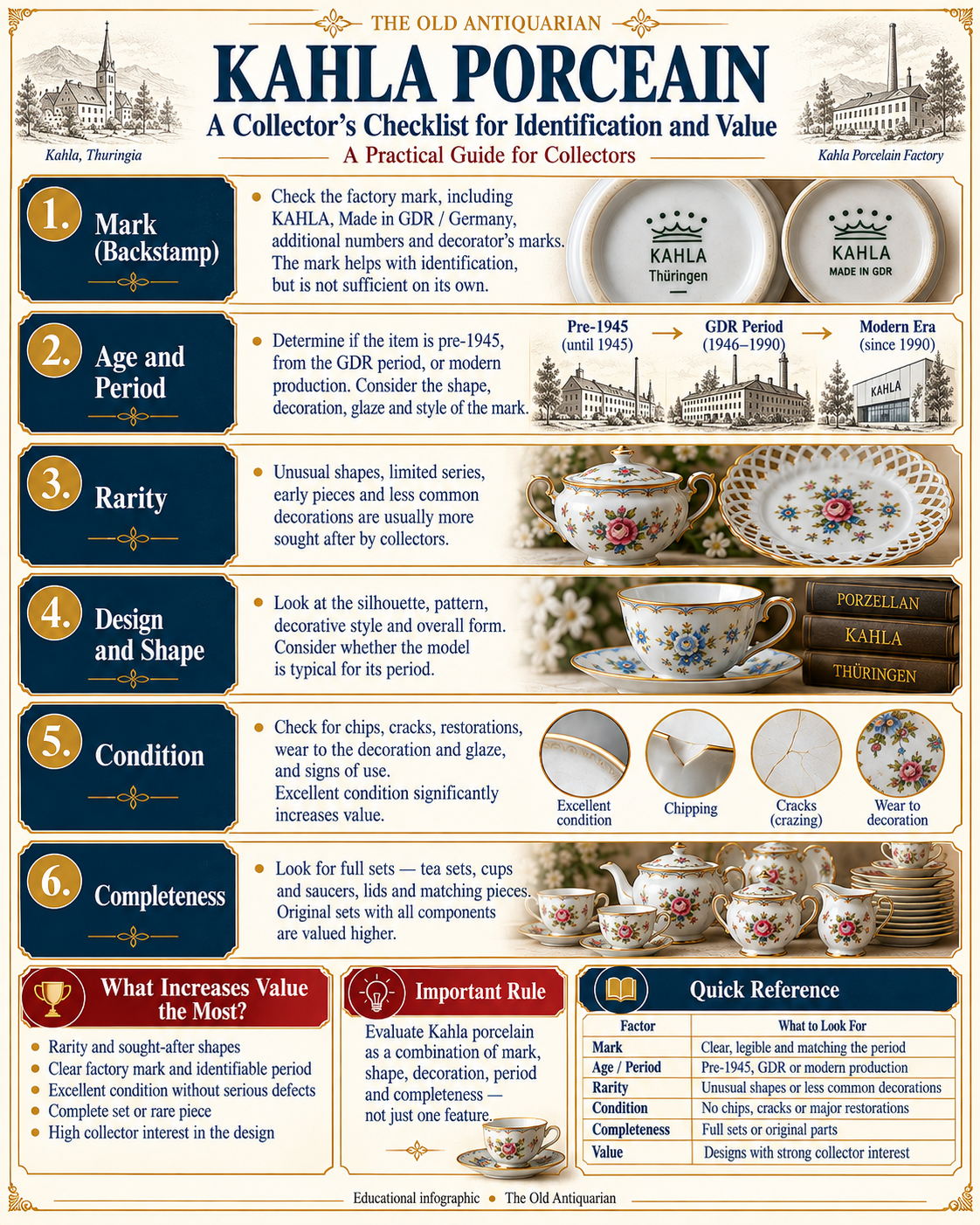
Which Kahla Pieces May Be More Collectible?
Potentially interesting categories include uncommon historical shapes, unusual decorative variants, well-preserved matching services, and documented designs with a recognisable place in the manufacturer’s history.
However, a less common object is not automatically valuable. Rarity must be considered alongside demand.
A large dinner service is not necessarily more valuable than a single desirable item, especially when shipping costs, condition or incomplete matching pieces affect the buyer’s decision.
Asking Price Is Not the Same as Market Value
A high online listing price does not prove that buyers are willing to pay it. Compare completed sales of genuinely similar objects, taking into account date, form, decoration, condition, completeness and location.
Our wider guide to antique porcelain appraisal and valuation explains the principles in greater detail.
CHAPTER X · BEFORE BUYING OR SELLING
10. Kahla Collector Checklist: Twelve Practical Checks
- Photograph the complete object from several angles.
- Photograph the entire underside and foot rim.
- Take a sharp close-up of the factory backstamp.
- Record every letter, symbol, number and country inscription.
- Check whether the mark matches an original documented example.
- Look for a separate decorator’s mark or retailer’s mark.
- Compare the shape with known historical or modern series.
- Examine the decoration, glaze and manufacturing technique.
- Inspect rims, feet, handles and spouts for chips or cracks.
- Look for worn gilding, repainting, regilding and old restoration.
- Count the matching parts of a service and check its completeness.
- Compare completed sales of similar authenticated pieces.
When the evidence is incomplete, it is more accurate to describe an object as a possible or probable Kahla example than to assign a precise factory date without documentation.
CHAPTER XI · COLLECTION CARE
11. How to Care for and Store Antique Kahla Porcelain
Porcelain may remain stable for generations, but it is brittle and vulnerable to physical damage.
Older gilding, lustre decoration, repaired surfaces and fragile applied details need particular care.
For valuable or historically important Kahla porcelain, a conservative approach is usually preferable to unnecessary cleaning or restoration.
| Risk | Recommended Practice |
|---|---|
| Chipped rims | Provide space between objects and avoid direct contact. |
| Broken handles or spouts | Support the main body when handling or lifting. |
| Worn gilding | Avoid abrasive cleaners and rubbing. |
| Sensitive lustre finish | Avoid aggressive detergents and unnecessary washing. |
| Accidental breakage | Use stable shelves and secure display arrangements. |
| Old restoration | Avoid soaking or solvents; seek conservation advice when needed. |
Do not assume that an old porcelain service is dishwasher-safe. Historical overglaze decoration, gilding and previous repairs may be damaged by cleaning methods suitable for contemporary tableware.
Detailed conservation-oriented advice is available in our guide to storing antique porcelain and ceramics.
FREQUENTLY ASKED QUESTIONS
12. Kahla Porcelain FAQ: Identification, Dating and Value
When was Kahla porcelain founded?
The original factory was founded in 1844 by Christian Eckardt in Kahla, Thuringia, Germany.
Is Kahla porcelain German?
Yes. Kahla is a German porcelain manufacturing name historically associated with the town of Kahla in Thuringia.
What does the Kahla porcelain mark look like?
Kahla used several marks over time. They include early symbols, geometric and shield emblems, and later green factory marks. The exact appearance must be compared with documented examples.
What does Kahla Made in GDR mean?
It refers to manufacture in the German Democratic Republic. It is a country-of-origin clue, not an exact date code.
How can I date a Kahla porcelain service?
Compare the complete backstamp with documented reference marks, then examine the form, decoration, production numbers and known series.
What does the number 41 mean on a Kahla mark?
The meaning of the number 41 on the photographed example has not been established from the image alone. It should not automatically be interpreted as 1941.
What does PMK mean on Kahla porcelain?
PMK refers to VEB Porzellanmalerei Kahla, a porcelain decorating enterprise. Documented PMK mark variants were used around 1972–1974.
What is Kahla Perlmutt porcelain?
Perlmutt refers to a pearlescent or iridescent decorative effect. It does not by itself identify an exact manufacturing date.
Is KAHLA Update considered antique porcelain?
No. Update belongs to the modern design phase of Kahla and was introduced in 1998. It can nevertheless be of interest to design collectors.
Is old Kahla porcelain valuable?
Some examples may have collector value, but age alone does not guarantee a high price. Rarity, design, condition, completeness and demand are essential considerations.
Can genuine Kahla porcelain be unmarked?
Some early porcelain was not routinely marked. An unmarked piece may be genuine, but attribution requires stronger evidence from form and provenance.
Does every Kahla mark identify the same factory?
Not necessarily. Corporate affiliations, industrial groups and specialist decorating workshops make it important to identify the particular mark and its function.
RESEARCH AND HISTORICAL DOCUMENTATION
Sources and Further Research
This guide draws on historical company material, public archival descriptions, specialist porcelain-mark references and authentic photographs of Kahla porcelain.
- KAHLA — Corporate Brochure (2013, English). Manufacturer’s milestones and industrial history.
- KAHLA — 150 Jahre Porzellan Geschichte. Historical publication including the section on early factory backstamps, Bodenmarken.
- Archivportal Thüringen — VEB Feinkeramik Kahla. Regional archival inventory covering the corporate and industrial history.
- The Old Stuff — Kahla Porcelain Marks. Specialist reference for selected factory-mark variants and approximate periods.
- Porcelain Marks & More — VEB Porzellanmalerei Kahla. Research on AF/B&L and PMK decorator marks.
- Wikimedia Commons — Kahla Perlmutt Coffee Service. Authentic illustrated example from the GDR period.
- Wikimedia Commons — Kahla Factory Backstamp. Original photograph of the green mark with number 41.
- Wikimedia Commons — KAHLA Update. Photograph of the modern designer collection.


Research note: Historical mark periods may overlap. Trademark registration dates are not always identical with production periods. The educational infographic symbols are not exact historical facsimiles and should never replace authenticated source material when dating an object.
Image Credits and Licences
Kahla Perlmutt coffee service: VSchagow / Wikimedia Commons. Licensed under CC BY-SA 4.0. Original photograph.
Green Kahla backstamp: SchiDD / Wikimedia Commons. Licensed under CC BY-SA 4.0. Original photograph.
KAHLA Update: KAHLA/Thüringen Porzellan GmbH / Wikimedia Commons. Licensed under CC BY-SA 3.0. Original photograph.
Creative Commons attribution requires appropriate credit, links to the source and licence, and indication of any modifications. If the locally hosted versions have been cropped, edited or otherwise adapted, those changes should be disclosed and the relevant ShareAlike conditions followed.
THE OLD ANTIQUARIAN · HISTORICAL RESEARCH AND COLLECTING
About This Guide
The Old Antiquarian is an independent project dedicated to antiques, vintage objects and historical collecting, drawing on more than 35 years of practical experience in the field.
Our porcelain research combines factory history, marks, materials, forms, historic catalogues, condition and documented comparisons.
We distinguish historically documented information from provisional identifications and artistic reconstructions, so readers can examine objects with greater confidence and an understanding of the limits of available evidence.
Do You Own an Old Kahla Porcelain Service?
An inherited coffee set, a marked plate or an unusual porcelain object may deserve a closer look.
For an initial enquiry, prepare clear photographs of the complete object, underside, backstamp and any damage. For services, include an image of the full group and the number of matching pieces.
Related Guides
- What Is German Porcelain?
- What Are Porcelain Marks?
- How to Identify Porcelain Marks and Backstamps
- How to Date Antique Porcelain
- How Is Antique Porcelain Valued?
- How to Store Antique Porcelain and Ceramics
Continue Exploring
Explore the Complete Guide to Antique Porcelain for a wider introduction to porcelain history, manufacturer marks, identification and collecting traditions.
