
What Is Minton ?
Minton Porcelain – History, Factory Marks, Dating & How to Identify Authentic Minton
Minton is one of the most celebrated names in the history of English porcelain. Founded in 1793 by Thomas Minton in Stoke-on-Trent, England, the company became internationally renowned for its exceptional craftsmanship, luxurious Bone China, innovative ceramic techniques, and artistic collaborations with some of the greatest designers of the Victorian era.
Today, antique Minton porcelain is highly sought after by collectors, museums, antique dealers, and auction houses around the world. From magnificent exhibition vases and elegant tea services to the famous Pâte-sur-Pâte, Majolica, and Secessionist wares, Minton has left an extraordinary legacy in the world of decorative arts.
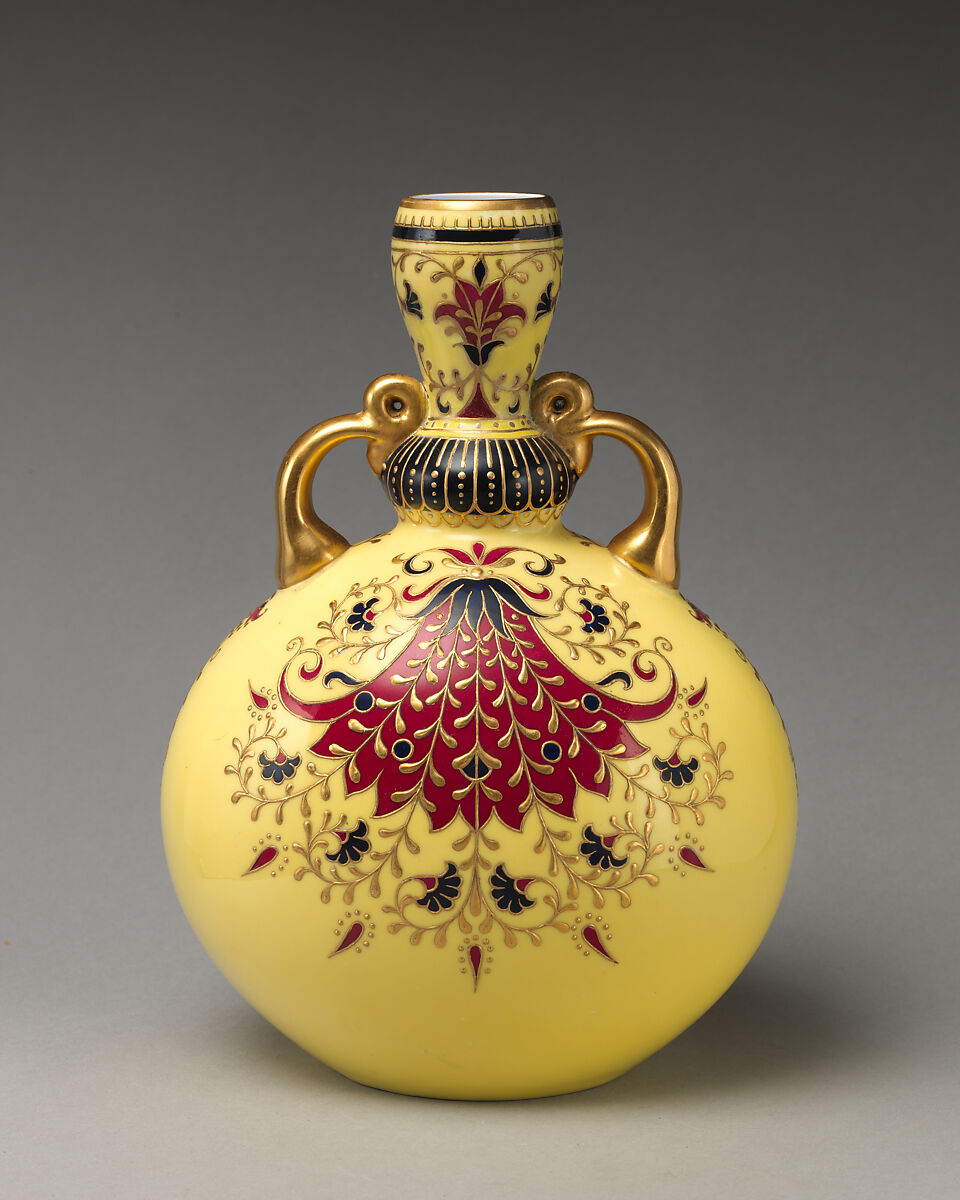
Whether you have inherited a family heirloom, discovered an old porcelain vase, or are building an antique porcelain collection, understanding Minton’s history, factory marks, production periods, and dating systems is essential for identifying authentic pieces.
If you are new to antique ceramics, you may also enjoy our guides explaining What Is Porcelain? and How to Identify Antique Porcelain, which provide an excellent introduction before exploring Minton in greater detail.
The History of Minton
The history of Minton begins in 1793, when engraver and entrepreneur Thomas Minton established his pottery in Stoke-on-Trent, the heart of England’s ceramic industry. Initially, the factory specialized in high-quality blue transfer-printed earthenware, but it soon expanded into fine porcelain and decorative ceramics that would become famous throughout Europe and beyond.
During the early nineteenth century, Minton developed a reputation for technical innovation and artistic excellence. The company continuously invested in new production methods, refined porcelain bodies, and sophisticated decorative techniques that distinguished its products from many of its competitors.
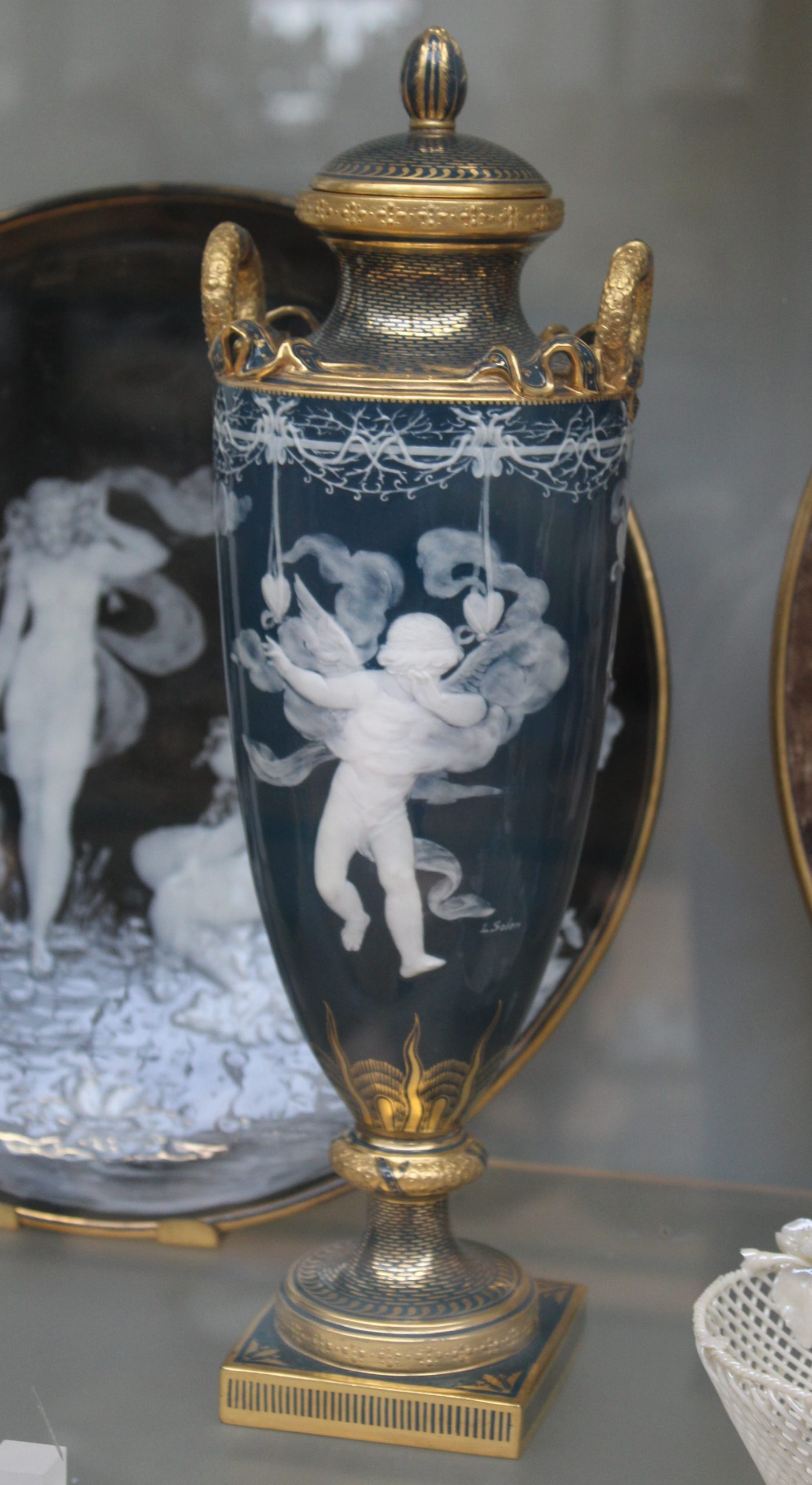
A major turning point came under the leadership of Herbert Minton, who transformed the company into one of Britain’s leading porcelain manufacturers. Throughout the Victorian period, Minton supplied royal households, aristocratic families, prestigious hotels, churches, and international exhibitions, earning worldwide recognition for both artistic and technical quality.
The Great Exhibition of London in 1851 introduced Minton’s remarkable ceramic achievements to an international audience. Its spectacular displays demonstrated the factory’s mastery of porcelain, Parian ware, encaustic tiles, and especially the colorful Majolica that would soon become one of the company’s defining products.
By the late nineteenth century, Minton employed many of Europe’s finest sculptors, painters, designers, and ceramic artists. The factory collaborated with influential figures including Christopher Dresser, Léon Arnoux, Marc-Louis Solon, and other celebrated artists whose work helped shape Victorian decorative arts.
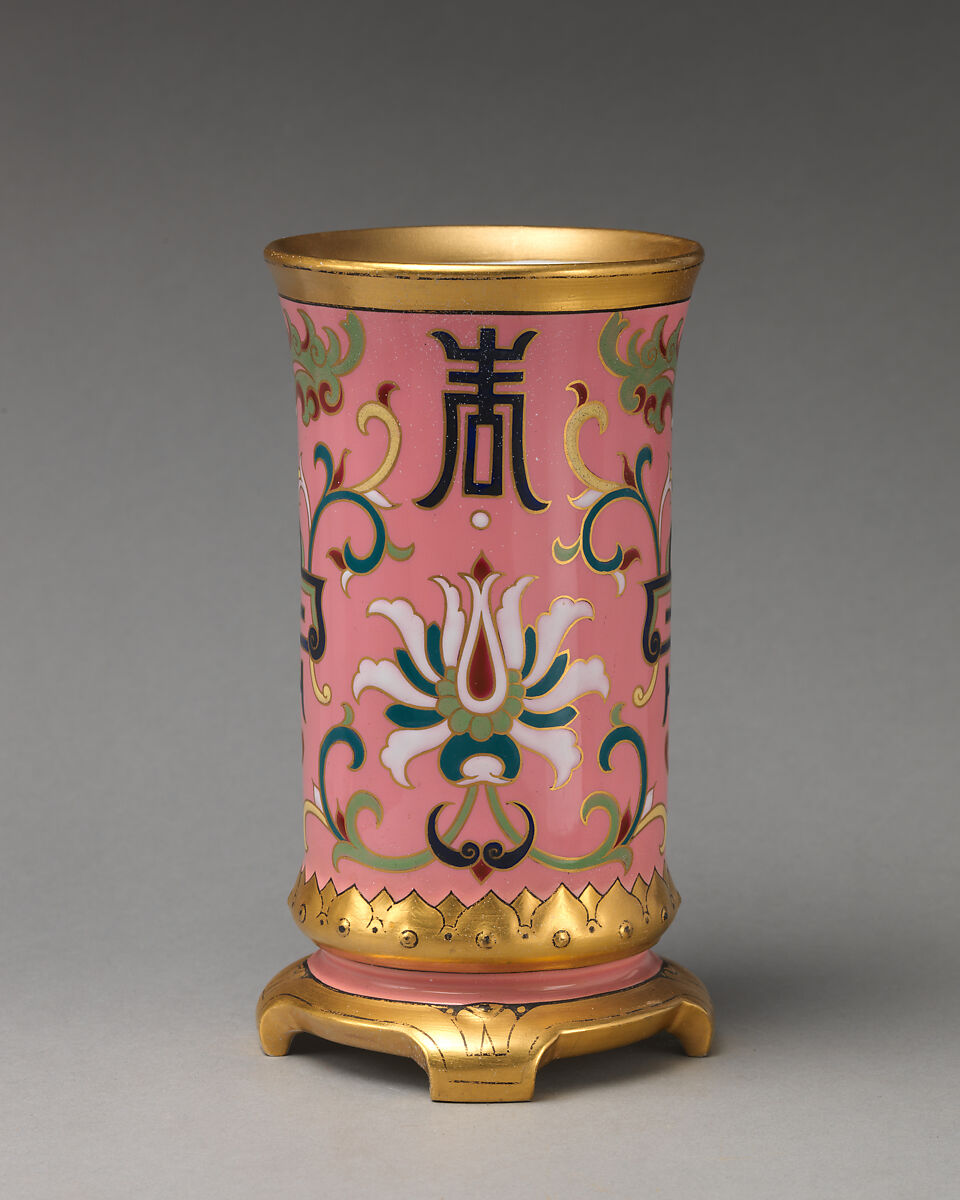
Collectors particularly admire this period because Minton successfully combined traditional English craftsmanship with influences from Renaissance art, Japanese aesthetics, Islamic ornament, classical sculpture, and the emerging Aesthetic Movement. These artistic influences created some of the most distinctive decorative porcelain ever produced in Britain.
Why Minton Is One of England’s Greatest Porcelain Manufacturers
Unlike many porcelain factories that became known for only a few successful patterns, Minton achieved excellence across an extraordinary range of artistic styles and ceramic techniques. The company continually experimented with new materials, glazes, decorative processes, and forms while maintaining exceptional production quality.
Among collectors, Minton is particularly famous for several important innovations:
- Fine English Bone China
- Pâte-sur-Pâte decoration
- Victorian Majolica
- Parian porcelain sculpture
- Secessionist ceramics
- Hand-painted exhibition pieces
- Rich burnished gilding
- Architectural encaustic tiles
Many antique specialists consider Minton to have been one of the most technically advanced ceramic manufacturers of the nineteenth century. Its products combined exceptional porcelain quality with artistic decoration that continues to impress collectors today.
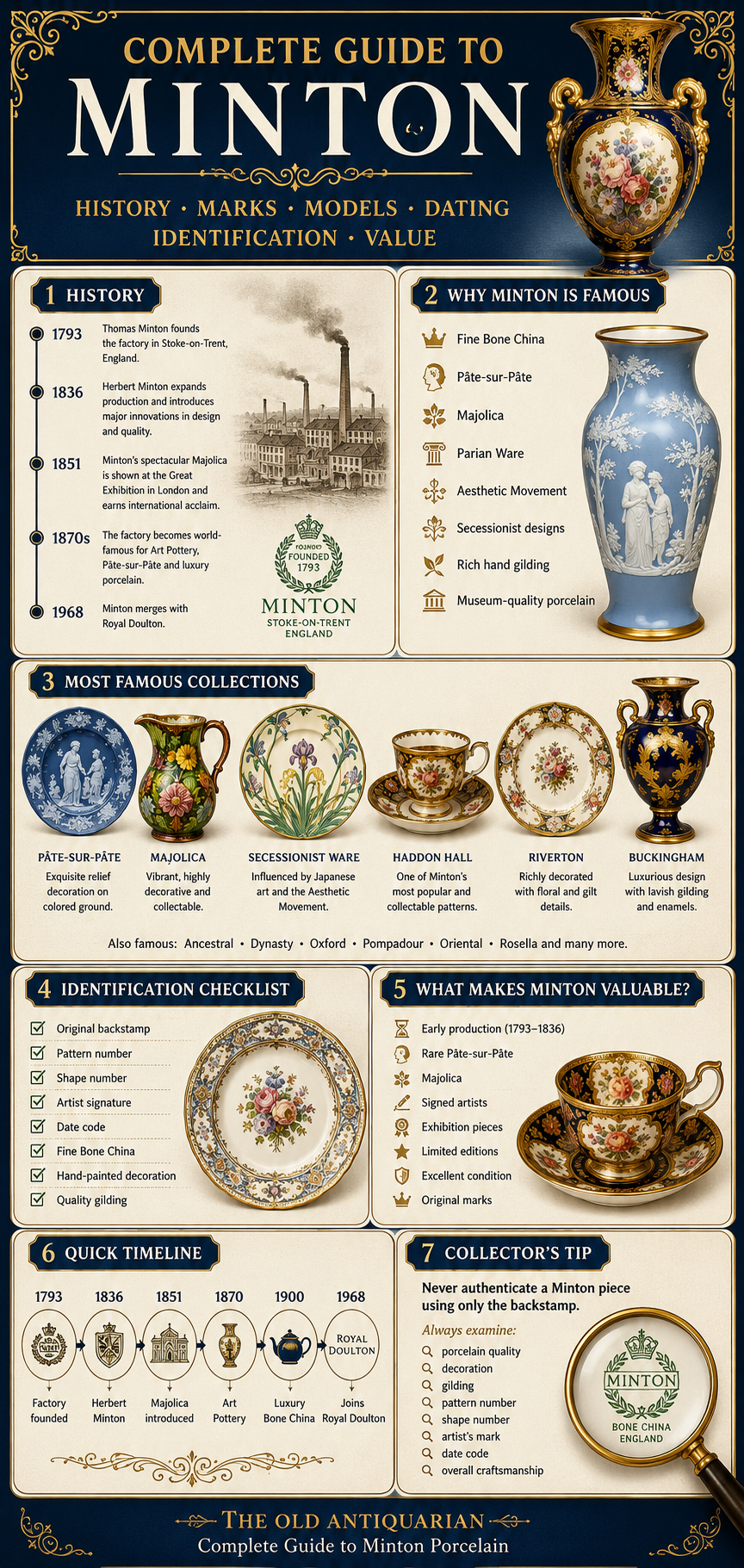
The infographic above summarizes the factory’s history, famous collections, identification checklist, and the characteristics that distinguish authentic Minton porcelain from later reproductions.
If you are interested in identifying antique English porcelain from other famous manufacturers, you may also find our guides to Royal Crown Derby, Royal Worcester, Spode, and Royal Doulton.
The Most Famous Minton Collections
One of the reasons Minton remains so highly collectible is the remarkable diversity of its production. Over nearly two centuries, the company created luxury porcelain, art pottery, sculptural ceramics, dinner services, exhibition pieces, and architectural ceramics that appealed to very different markets.
Some of the most desirable Minton collections include:
- Pâte-sur-Pâte
- Majolica
- Secessionist Ware
- Haddon Hall
- Riverton
- Ancestral
- Buckingham
- Dynasty
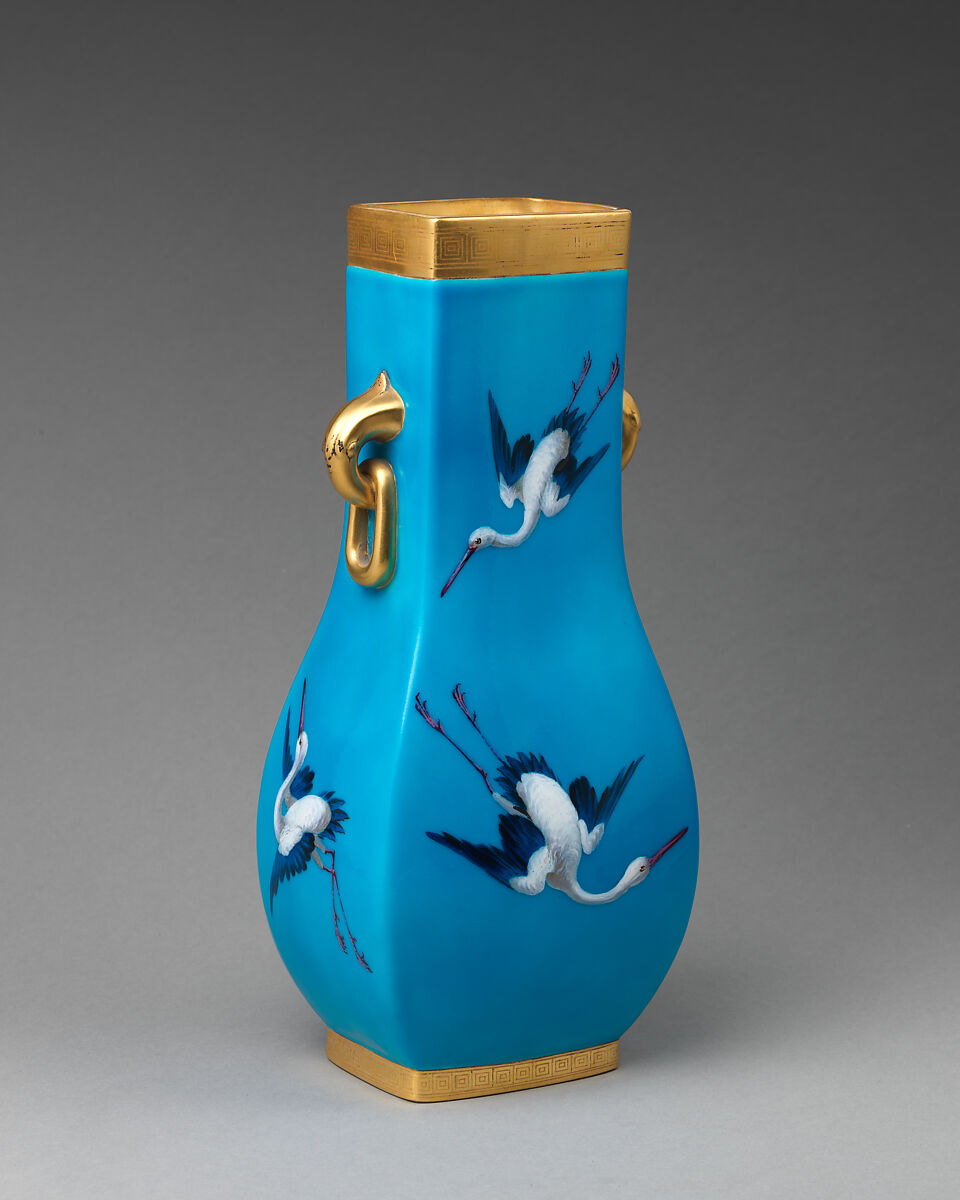
These collections demonstrate the extraordinary artistic range of the Minton factory—from richly gilded Victorian luxury porcelain to bold Art Nouveau ceramics inspired by the international design movements of the late nineteenth century.
Minton Majolica – One of the Factory’s Greatest Achievements
No discussion of Minton would be complete without mentioning its world-famous Majolica. Introduced at the Great Exhibition of 1851, Minton Majolica revolutionized Victorian decorative ceramics and quickly became one of the company’s greatest commercial and artistic successes.
Unlike traditional porcelain, Majolica was produced using colorful lead glazes applied over molded earthenware. The result was an extraordinary range of vibrant colors, naturalistic textures, and sculptural forms inspired by flowers, fruits, animals, shells, mythology, and Renaissance ornament.
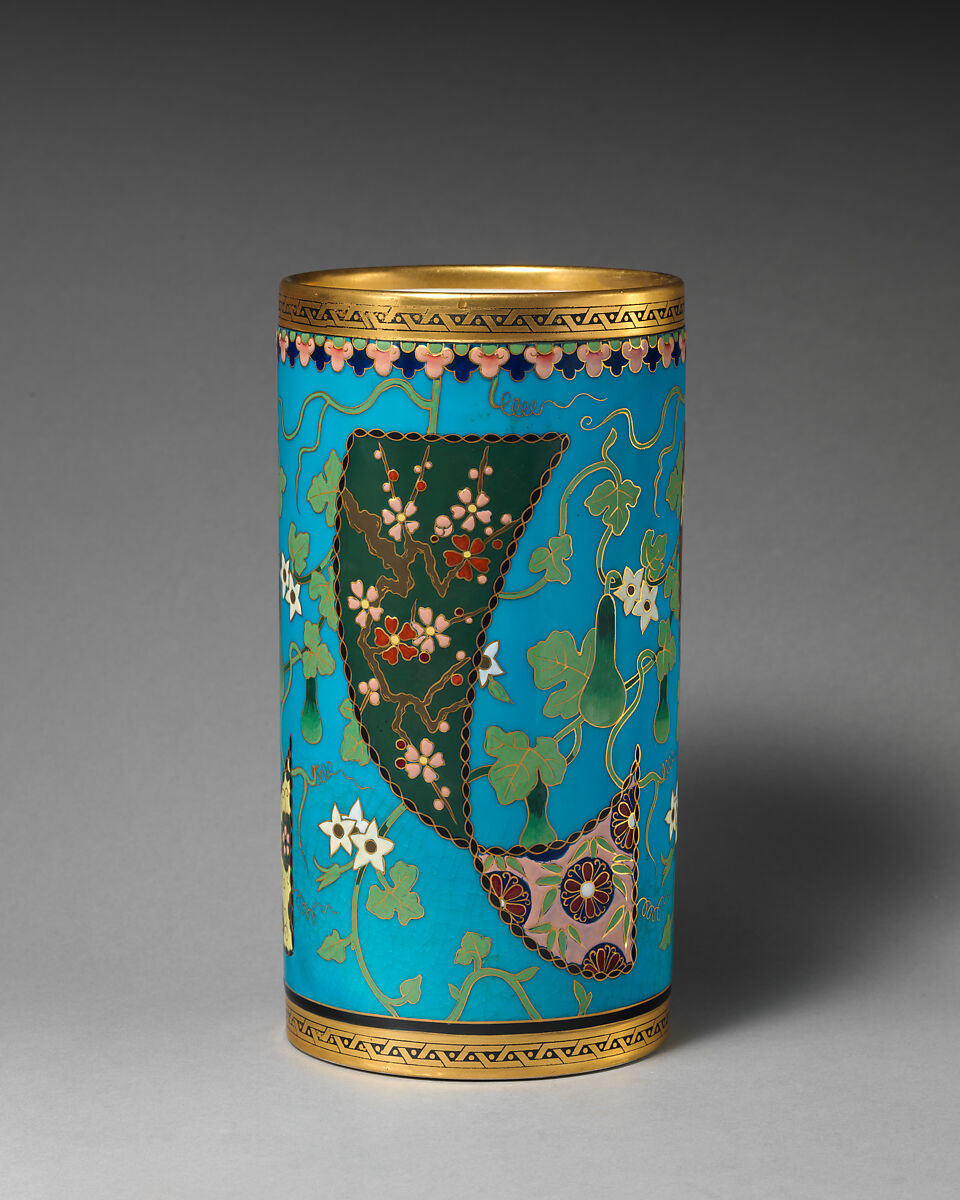
Today, original Minton Majolica remains one of the most collectible categories of Victorian ceramics. Large exhibition pieces, jardinieres, centerpieces, umbrella stands, and highly decorative vases regularly appear at major international auctions.
Pâte-sur-Pâte – The Ultimate Expression of Ceramic Art
Among serious collectors, Minton Pâte-sur-Pâte is often regarded as the pinnacle of nineteenth-century ceramic decoration. Developed by the French artist Marc-Louis Solon, this remarkable technique involved building delicate white relief decoration layer by layer onto a colored porcelain body.
Each figure, ornament, and decorative element required extraordinary patience and technical skill. A single vase could take weeks—or even months—to complete, making these works among the most expensive products ever produced by the factory.
Subjects commonly included:
- Classical mythology
- Greek and Roman figures
- Cherubs
- Portrait medallions
- Allegorical scenes
- Floral ornaments
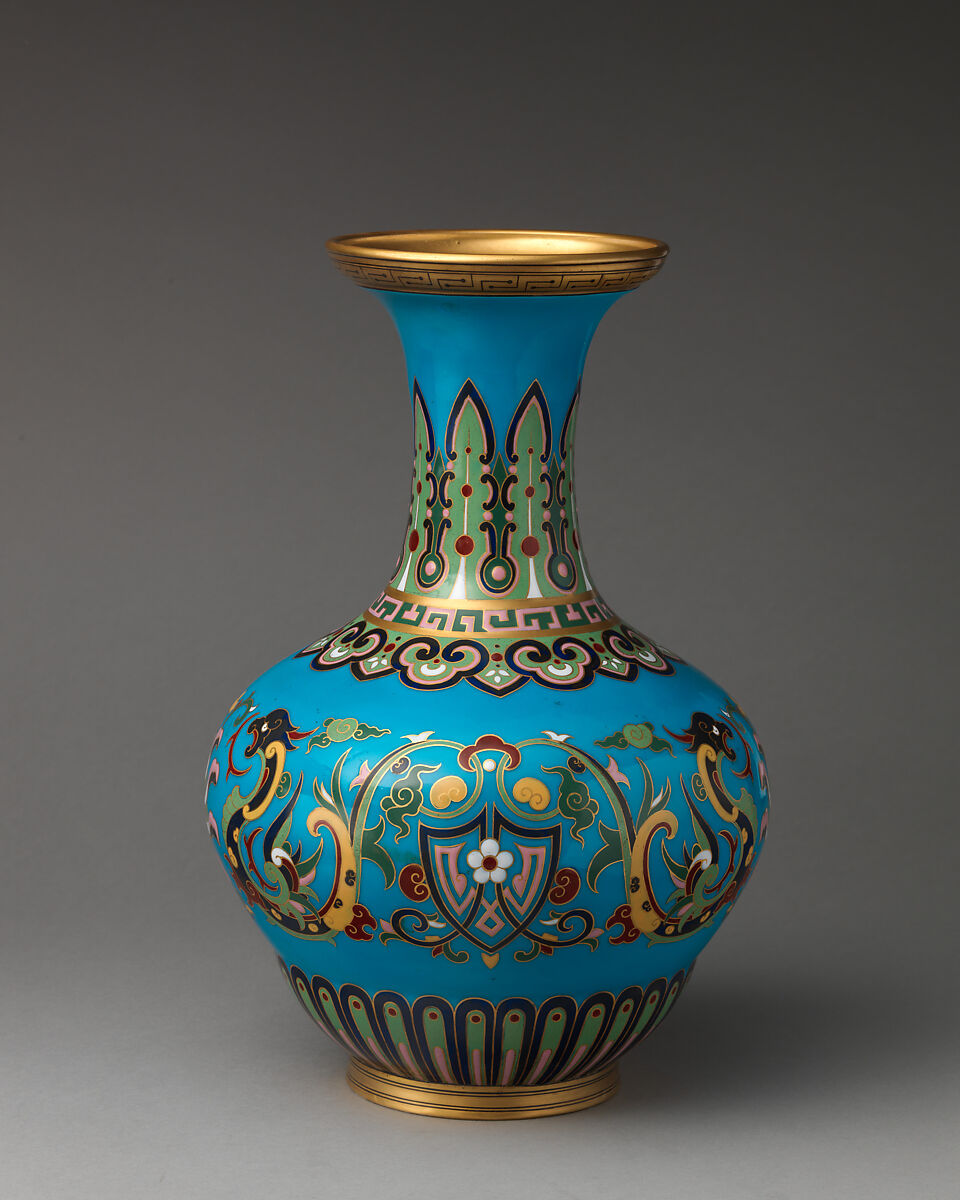
Authentic Pâte-sur-Pâte pieces are among the most valuable examples of antique English porcelain and are highly prized by museums and advanced collectors worldwide.
Original Minton Factory Marks
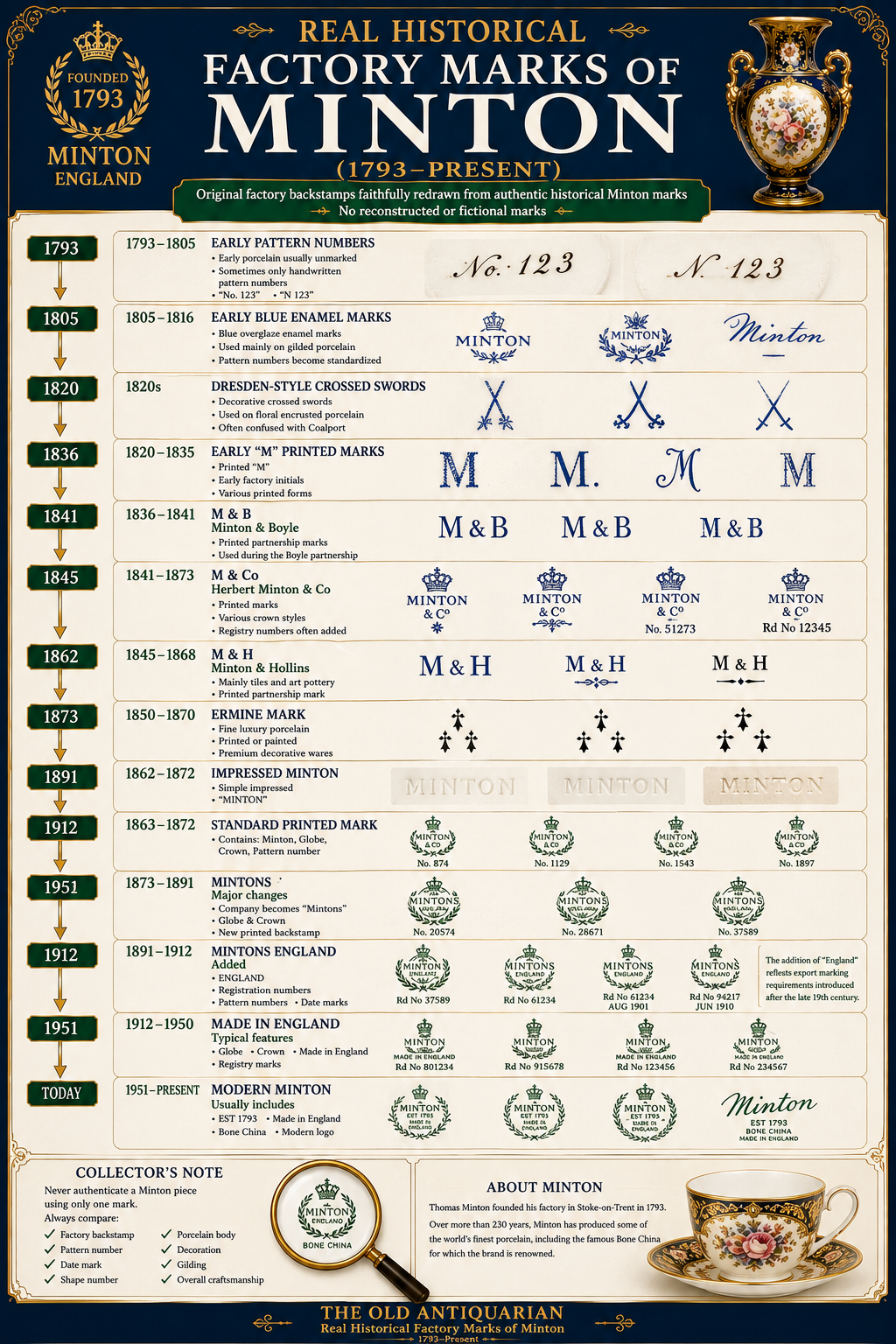
Factory marks are one of the most important tools for identifying genuine Minton porcelain. During more than two centuries of production, the company used numerous backstamps, impressed marks, printed marks, partnership marks, registry numbers, and pattern numbers that help determine both authenticity and approximate production date.
However, collectors should remember that no single factory mark can authenticate a piece on its own. Original Minton porcelain should always be evaluated by considering the porcelain body, decoration, shape, gilding, pattern numbers, artist’s marks, and overall craftsmanship together.
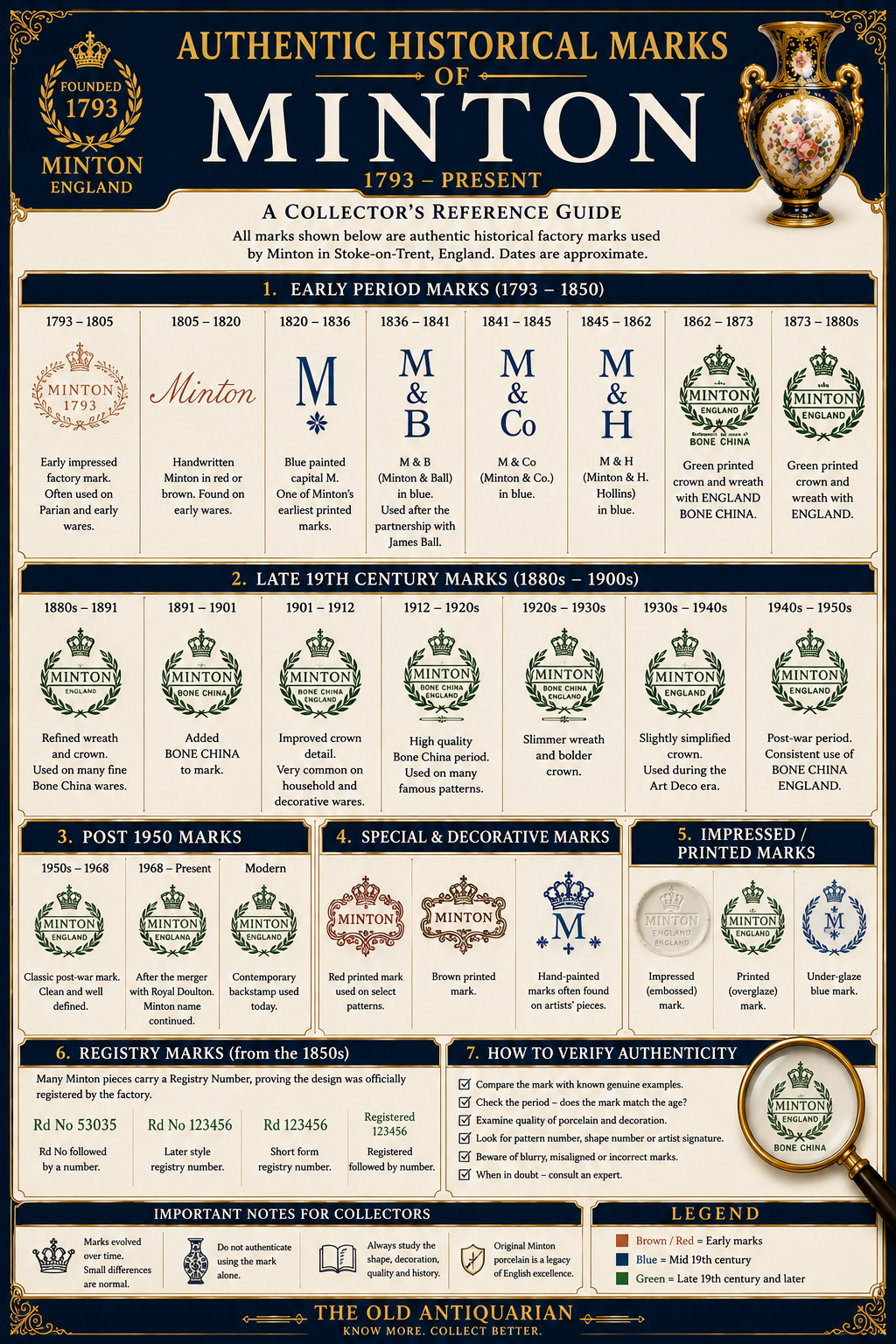
Throughout its history, Minton employed several distinctive categories of factory marks, including:
- Early handwritten pattern numbers
- Blue enamel marks
- Impressed factory marks
- M & B partnership marks
- M & Co marks
- M & H marks
- Mintons globe-and-crown backstamps
- Bone China marks
- Registration numbers
- Date marks
The historical reference above illustrates the evolution of authentic Minton factory marks from the earliest production in 1793 through the modern period, allowing collectors to compare original backstamps with confidence.
How to Identify Authentic Minton Porcelain
Although factory marks are essential, experienced collectors never rely on them alone. Authentic Minton porcelain exhibits a combination of manufacturing quality, artistic decoration, and historical consistency that is difficult for modern reproductions to replicate.
When examining a piece, check the following features:
- Original factory backstamp
- Correct typography and layout
- Fine translucent Bone China body
- Hand-painted decoration
- Natural brush strokes
- High-quality burnished gilding
- Pattern number
- Shape number
- Date code or registry number
- Artist’s signature or decorator’s initials (when present)
- Natural wear consistent with age
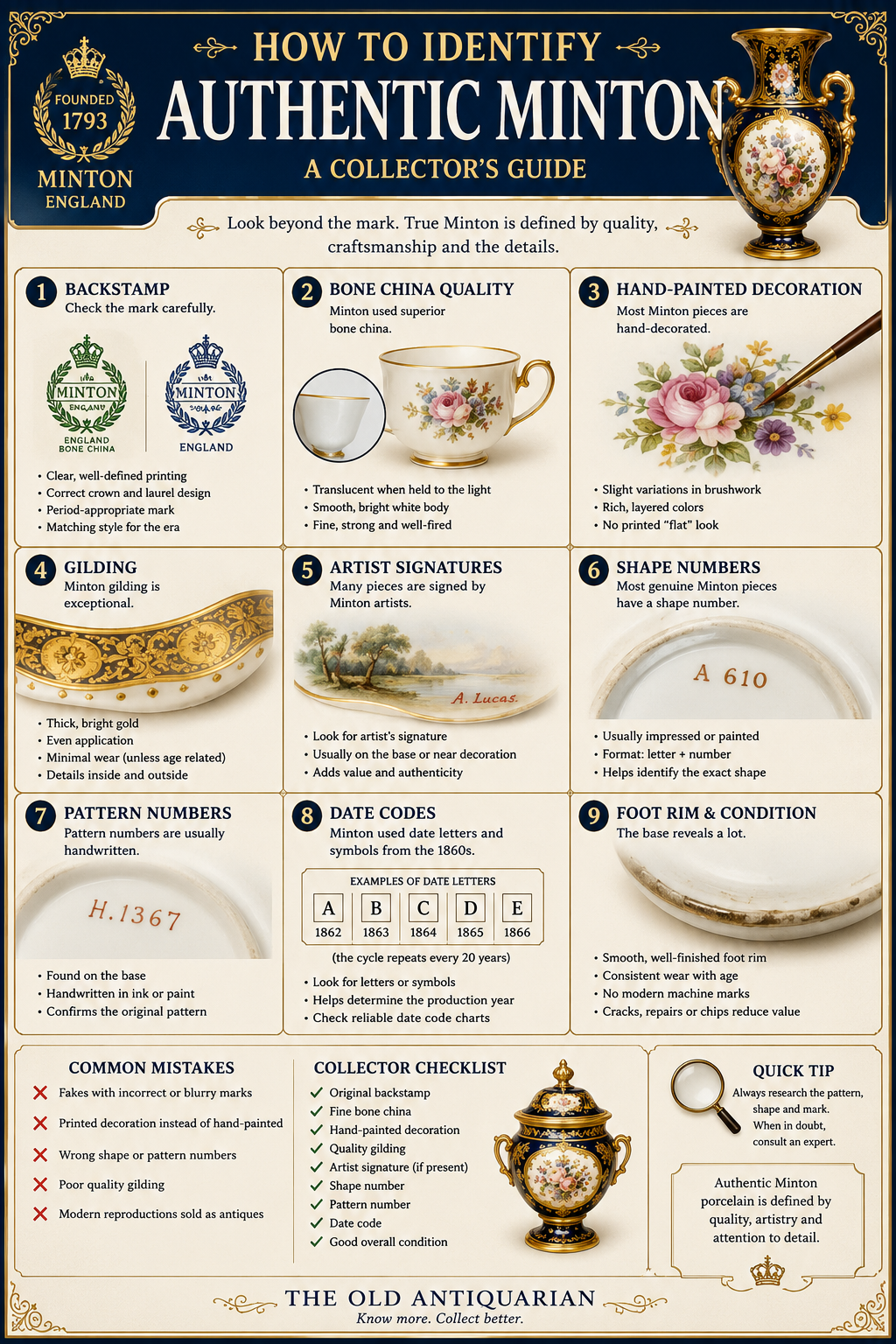
Collectors should also examine the underside of the piece. Genuine antique examples usually display natural wear on the foot rim, while the glaze remains smooth and well-finished. Artificial distressing, fresh grinding marks, or unusually bright modern gilding may indicate a later reproduction rather than an original Victorian piece.
If you would like to understand antique porcelain authentication in greater depth, you may also find our guide What Are Porcelain Marks? helpful before evaluating individual manufacturers.
Dating Minton Porcelain
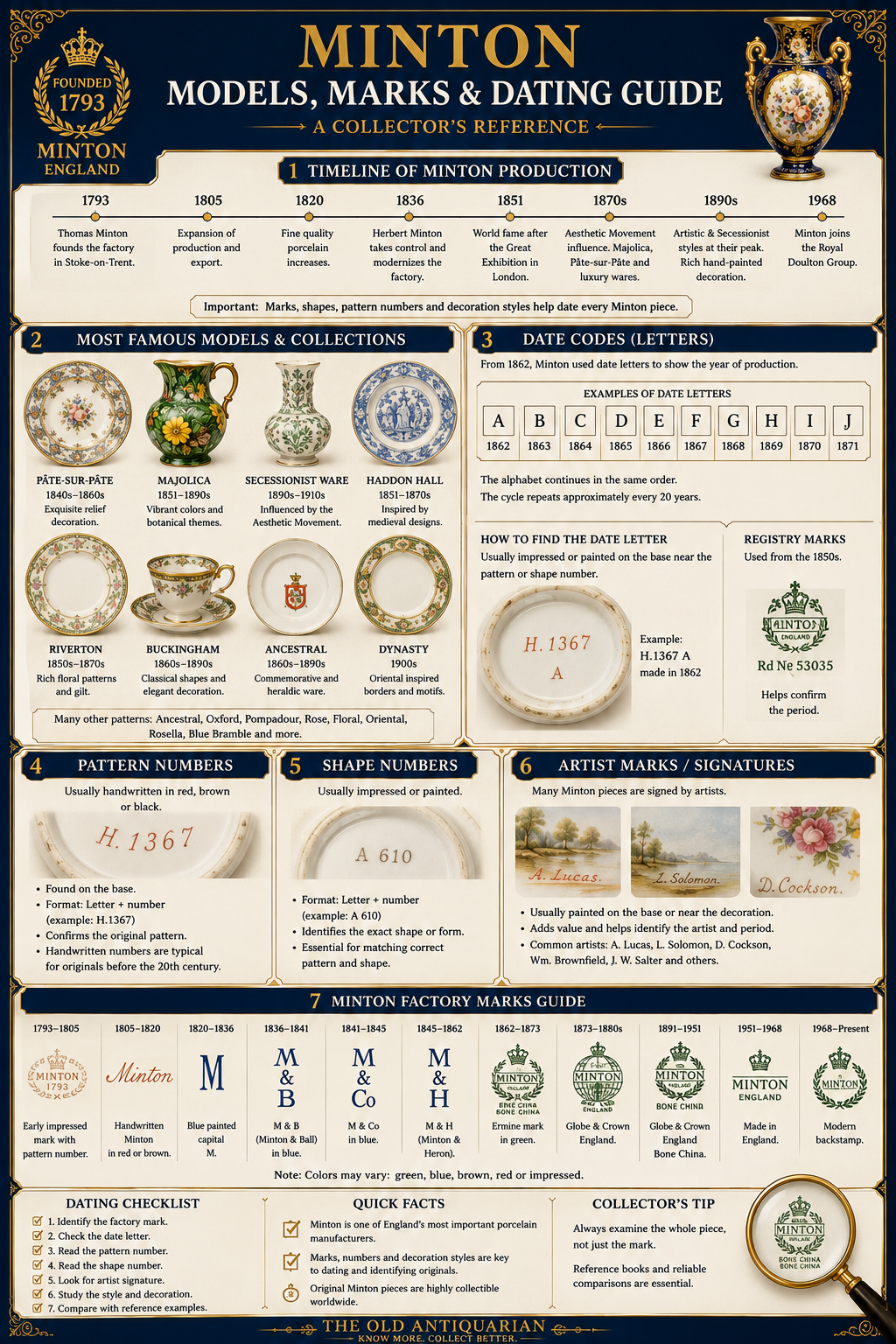
Dating authentic Minton porcelain is usually more straightforward than with many other English manufacturers because the factory employed a variety of pattern numbers, date marks, registry numbers, and factory backstamps throughout its history. Nevertheless, no single feature should be used in isolation. Professional identification always considers the complete combination of marks, decoration, porcelain body, shape, and craftsmanship.
Collectors should remember that factory marks evolved continuously between 1793 and the modern era. Changes in typography, company names, partnership marks, and export requirements often allow specialists to narrow production dates with remarkable accuracy.
How Minton Pieces Are Dated
Professional collectors usually examine several identification features before assigning an approximate production period.
- Factory backstamp
- Pattern number
- Shape number
- Date code or date letter
- Registry number
- Artist’s signature
- Decorating style
- Porcelain body
- Quality of gilding
- Manufacturing techniques
When these elements agree with one another, it becomes possible to establish a reliable production period for most Minton porcelain.
Original vs Fake Minton Porcelain
Because Minton has been admired for more than two centuries, reproductions and imitation pieces occasionally appear on the antiques market. Fortunately, most copies can be identified through careful examination of both the porcelain and the factory marks.
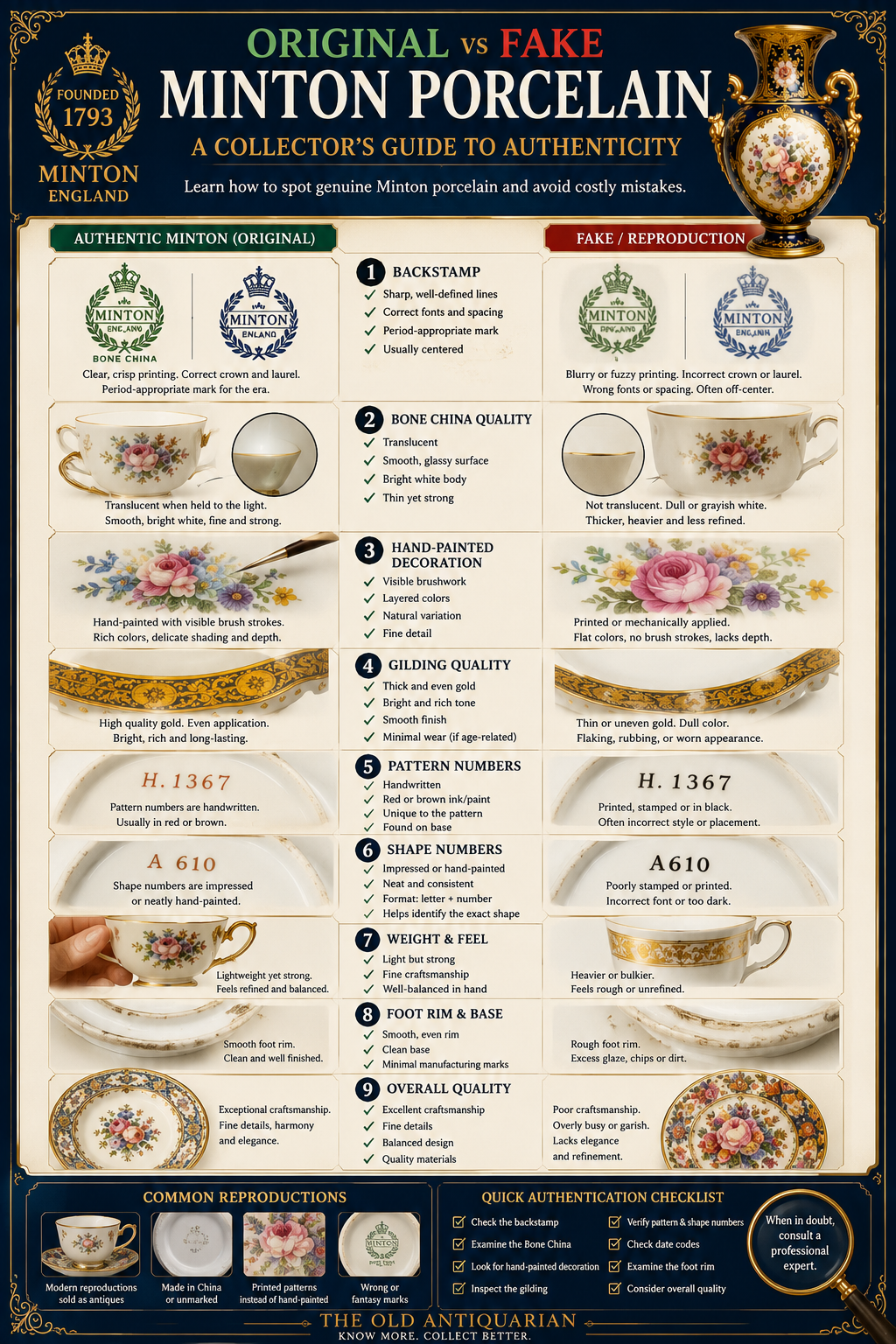
The most common warning signs include:
- Poorly reproduced factory marks
- Incorrect typography
- Modern printing techniques
- Heavy porcelain body
- Low-quality gilding
- Machine-printed decoration replacing hand painting
- Artificial ageing
- Incorrect pattern numbers
- Modern adhesive labels replacing proper factory marks
Many reproductions imitate only the appearance of an original backstamp while ignoring the numerous small details that experienced collectors immediately notice.
Common Mistakes Made by Collectors
Beginners often make the mistake of judging a piece solely by its backstamp. While factory marks are extremely important, they represent only one part of the authentication process.
Some of the most common mistakes include:
- Assuming every old mark indicates high value.
- Ignoring pattern and shape numbers.
- Confusing transfer printing with hand painting.
- Overlooking restoration.
- Judging value based only on age.
- Ignoring artist signatures.
- Believing all Victorian porcelain is rare.
Experienced specialists always evaluate the entire object rather than relying on a single identifying feature.
What Makes Minton Valuable?
Not every antique Minton piece commands the same value. Prices vary considerably depending on rarity, artistic quality, condition, historical importance, and collector demand.
The most valuable pieces generally include:
- Early nineteenth-century porcelain
- Pâte-sur-Pâte masterpieces
- Large exhibition vases
- Christopher Dresser designs
- Rare Majolica
- Museum-quality decorative wares
- Limited production pieces
- Items with documented provenance
Condition remains one of the most important factors. Chips, cracks, restoration, overpainting, or excessive wear can reduce market value substantially, whereas pieces in excellent original condition are significantly more desirable.
Collecting Minton Today
Interest in Minton continues to grow among collectors of Victorian decorative arts. Fine examples appear regularly at international auctions, specialist antique dealers, and museum exhibitions, where exceptional pieces often achieve impressive prices.
Collectors particularly seek:
- Pâte-sur-Pâte porcelain
- Majolica
- Christopher Dresser designs
- Secessionist ceramics
- Hand-painted exhibition vases
- Complete tea and dinner services
- Rare pattern variations
- Documented historical pieces
Understanding factory marks, production periods, and artistic styles allows collectors to make informed purchasing decisions and avoid many of the common mistakes associated with antique porcelain.
In the final section, we will look at how to care for antique Minton porcelain, preserve its condition, understand its long-term collector value, and explore additional guides for identifying English porcelain manufacturers.
How to Care for Antique Minton Porcelain
Proper care is essential for preserving the beauty and collector value of antique Minton porcelain. Although Bone China is remarkably strong for its weight, the hand-painted decoration, burnished gilding, and delicate handles found on many Minton pieces require careful handling.
Collectors should always lift vases, bowls, and tureens by supporting the body rather than the handles, lids, or decorative finials. Sudden temperature changes should also be avoided, as thermal shock can damage antique porcelain.
For a more detailed guide, you may also wish to read our article on How to Store Antique Porcelain and Ceramics.
Cleaning Minton Porcelain
Original Minton porcelain should be cleaned gently using lukewarm water, a soft microfiber cloth, and mild soap when necessary. Harsh chemicals, abrasive cleaning products, or stiff brushes should never be used on antique porcelain.
Particular care should be taken with gilded decoration. Gold applied by hand can gradually wear away through repeated rubbing or aggressive cleaning.
Collectors generally recommend:
- soft cotton or microfiber cloths;
- gentle hand washing only;
- avoiding dishwashers;
- never soaking pieces with old restoration;
- careful drying with a lint-free towel.
How to Store Minton Porcelain
Proper storage is equally important for maintaining long-term condition. Valuable porcelain should ideally be displayed inside closed cabinets where it is protected from dust, vibration, direct sunlight, and accidental impacts.
When storing plates, soft acid-free separators should be placed between each piece to prevent scratching. Heavy objects should never be stacked directly on delicate porcelain.
Collectors also recommend maintaining a stable indoor environment with moderate humidity and avoiding prolonged exposure to excessive heat or direct sunlight, which may affect gilding and decorative colors over many decades.
Investment Potential
Minton remains one of the most respected names in English decorative arts. Exceptional pieces continue to perform well at major international auction houses, particularly those featuring important artistic collaborations, exhibition quality, or rare production techniques.
Collectors generally regard the following categories as having the strongest long-term interest:
- Pâte-sur-Pâte masterpieces
- Large exhibition vases
- Christopher Dresser designs
- Victorian Majolica
- Rare Secessionist ware
- Signed artist pieces
- Early nineteenth-century porcelain
- Museum-quality decorative objects
As with any antique, rarity, condition, authenticity, provenance, and collector demand remain the primary factors influencing market value.
Conclusion
For more than 230 years, Minton has represented the highest standards of English ceramic artistry. From elegant Bone China and richly gilded decorative porcelain to revolutionary Majolica and breathtaking Pâte-sur-Pâte masterpieces, the factory has produced some of the finest ceramics ever created in Britain.
Learning how to identify authentic Minton porcelain requires more than simply recognizing a factory mark. True authentication combines careful examination of the porcelain body, decorative quality, pattern numbers, shape numbers, artist signatures, factory backstamps, and historical production methods.
Whether you are an experienced collector or have recently inherited a family heirloom, taking the time to understand Minton’s remarkable history will help you appreciate the artistic and historical significance of every genuine piece.
Continue Exploring English Porcelain
- What Is Porcelain?
- How to Identify Antique Porcelain
- What Are Porcelain Marks?
- How to Date Antique Porcelain
- How to Store Antique Porcelain and Ceramics
- How Is Antique Porcelain Valued?
- How to Identify Spode and Its Marks
- How to Identify Royal Doulton and Its Marks
- How to Identify Royal Worcester and Its Marks
- How to Identify Royal Crown Derby and Its Marks
- Guide to Antique Porcelain
Need help identifying or valuing your Minton porcelain?
Our specialists can help evaluate antique English porcelain, identify factory marks, estimate production periods, and provide professional opinions on authenticity and collector value.
