
Beswick Figurines : Identification Guide
Quick Answer
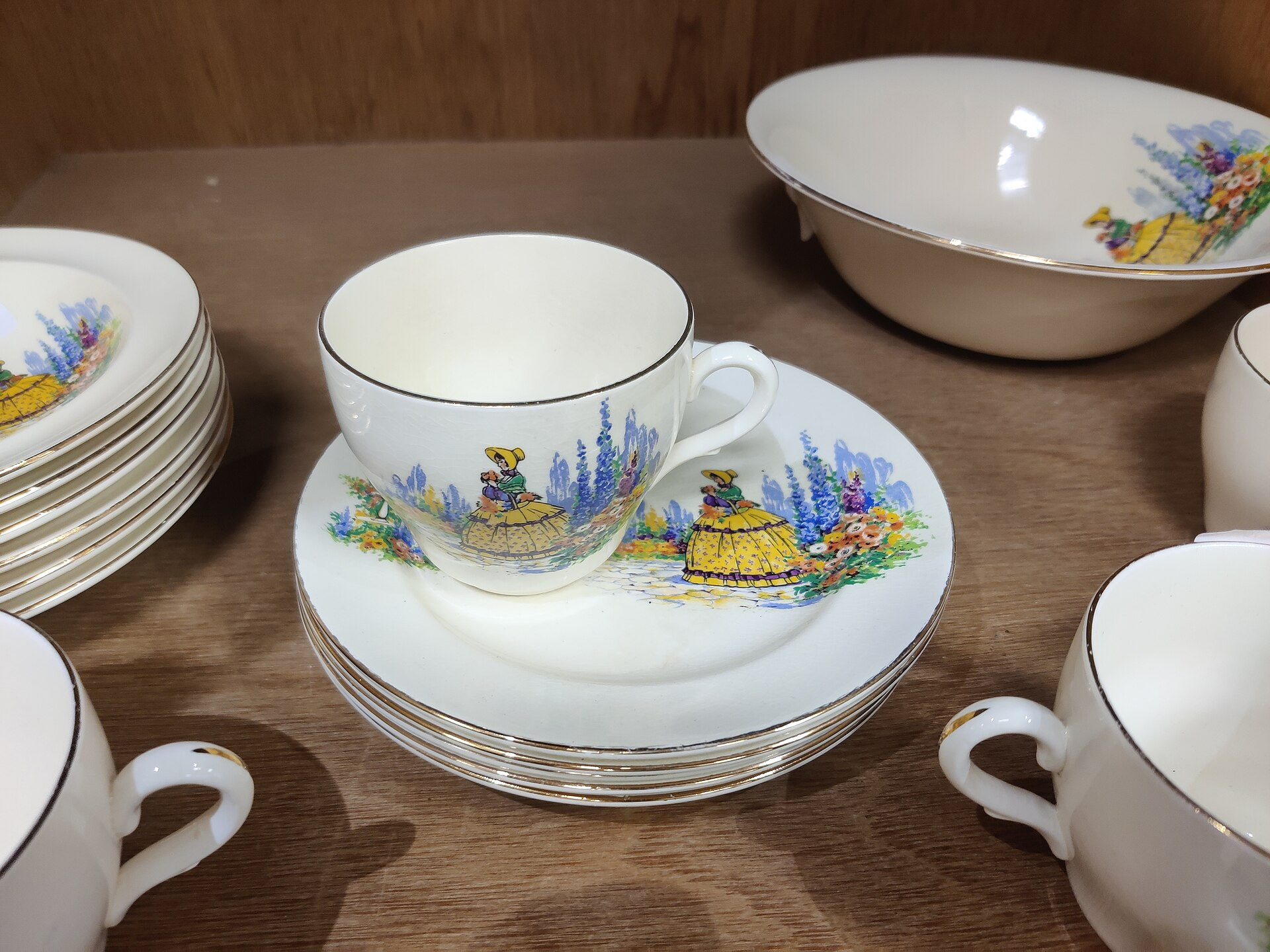
Beswick was one of the best-known names in twentieth-century English ceramics. Founded in Longton, Stoke-on-Trent, in 1894, the company produced tableware and ornamental ceramics before becoming internationally associated with finely modelled animal figurines, particularly horses, dogs and farm animals, as well as the celebrated licensed Beatrix Potter figures.
The safest way to identify a Beswick piece is not to rely on the backstamp alone. Compare the
mark + model number + impressed numbers + material + modelling + glaze + decoration + size + condition
and make sure these characteristics tell a consistent story.
It is also important not to describe every Beswick object automatically as “porcelain”. Much of the historic J. W. Beswick output was earthenware and other ceramic ware, so the material should be identified for the individual object.
Beswick at a Glance
| Key Fact | Beswick |
|---|---|
| Founded | 1894 |
| Location | Longton, Stoke-on-Trent, Staffordshire, England |
| Gold Street Works | Occupied by Beswick from 1898 |
| Historic Materials | Primarily earthenware and other ceramic bodies; related Beswick production also included china |
| Famous For | Horses, dogs, livestock, wildlife, birds and character figurines |
| Arthur Gredington | Chief modeller from 1939; created more than 130 equine models |
| Beatrix Potter | Licensed character production began in 1948 |
| Doulton Acquisition | 1969 |
| Beswick Trade Name | Standard use discontinued in early 1989 |
| Gold Street Closure | 2002 |
The History of Beswick Pottery
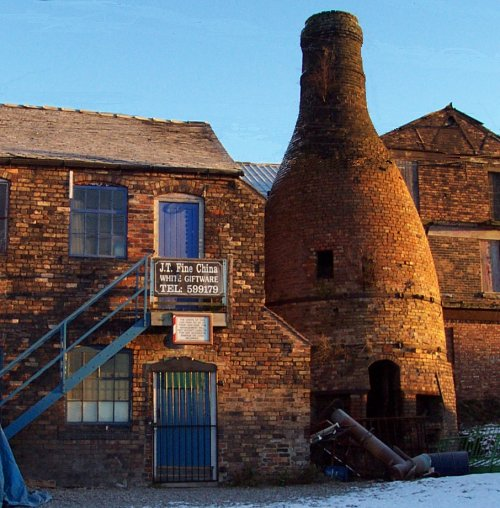
The story of Beswick begins in Longton in 1894, within the extraordinary industrial landscape of Stoke-on-Trent and the Staffordshire Potteries.
James Wright Beswick and his family established the pottery business at Baltimore Works in Albion Street. His son John had studied the potter’s craft at Tunstall and became closely involved in developing the enterprise.
In 1897, Gold Street Works became available. The Beswick family acquired the premises and moved production there in 1898. Gold Street would eventually become inseparable from the Beswick name.
Beswick’s early production was broad. The company manufactured domestic and ornamental wares, including dinner and tea services, toilet wares, decorative ceramics, vases and other household objects.
This background matters because modern collecting often reduces Beswick to animal figurines. The animals eventually became the company’s most celebrated products, but they emerged from a much wider pottery tradition.
The Staffordshire Pottery Tradition
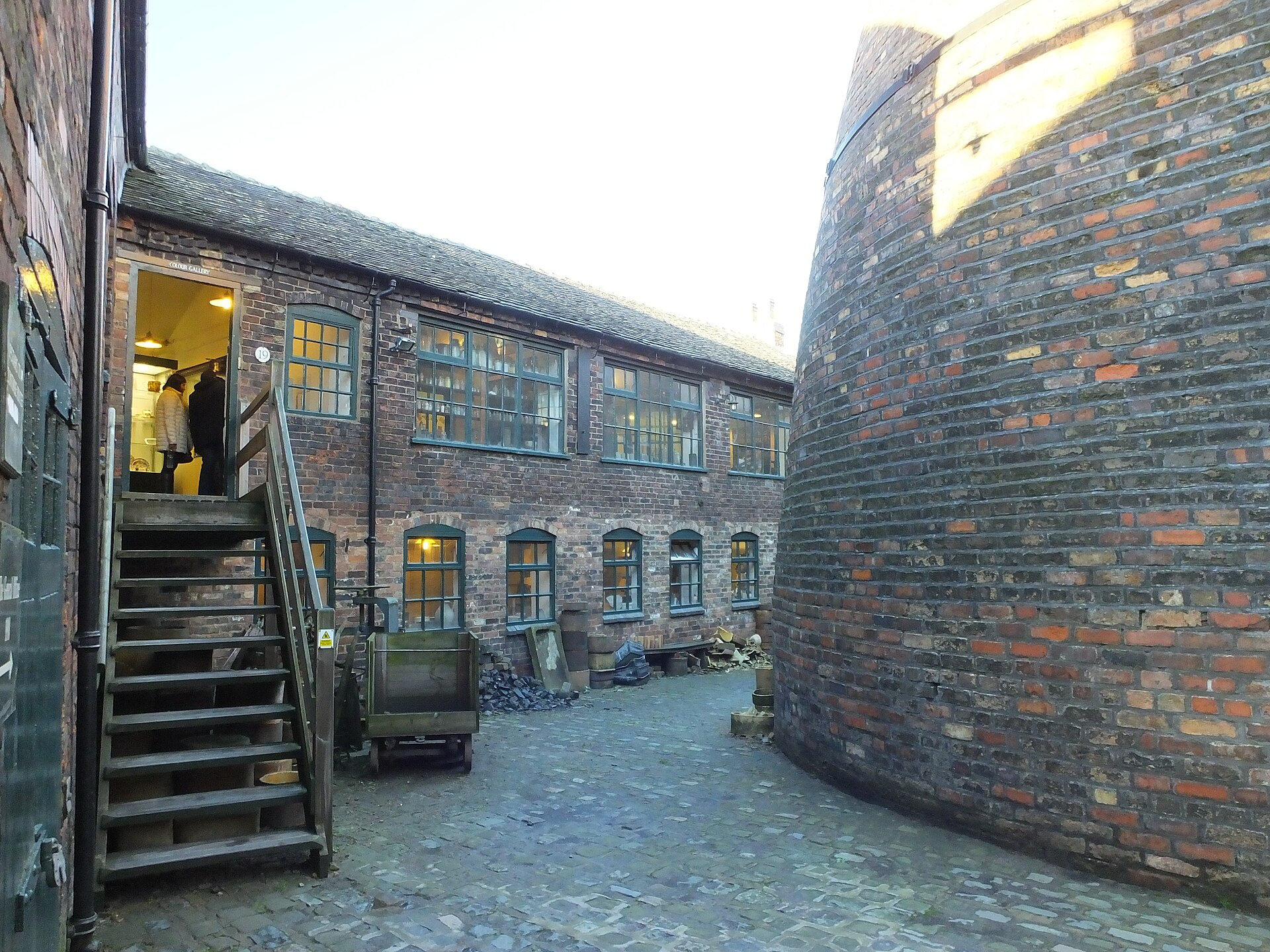
Longton formed part of a region where generations of potters, decorators, kiln workers, modellers and ceramic manufacturers developed highly specialised skills. The combination of clay-working knowledge, industrial infrastructure, firing technology and an experienced workforce created an environment in which firms such as Beswick could expand rapidly.
The Rise of the Animal Figures
By the 1930s Beswick was developing the forms, shape numbers and backstamps that are now so important to collectors. The same decade introduced one of the decisive figures in the company’s artistic history: Arthur Gredington.
Gredington became chief modeller in 1939. His subjects ranged across the animal kingdom, but his horses and representations of champion livestock became particularly admired.
His modelling was successful because the animals were not treated merely as decorative symbols. Posture, anatomy, breed characteristics, movement and expression were taken seriously. That naturalism became an important part of the visual identity of Beswick animals.
From Beswick to Doulton
In June 1969, John Ewart Beswick sold the company’s share capital to Doulton & Co. Ltd.
The takeover did not immediately end Beswick production. Doulton continued to manufacture many familiar animal models and figurines under the Beswick name, although the range became smaller and relatively few completely new models were introduced.
In early 1989, Doulton ceased the standard use of the Beswick trade name. Some established forms continued to be manufactured at Gold Street using Doulton-associated backstamps.
The historic Gold Street factory finally closed in 2002.
Collector’s Perspective
Ownership history, factory location, backstamp and actual production date are related—but they are not interchangeable. A Beswick-marked object should always be placed within the history of the particular model and product line.
Beswick Ware: What Does “Beswick Ware” Mean?
Collectors may encounter the wording Beswick Ware on vintage English ceramics as well as in catalogues and online searches. The term should not be understood as the name of one specific animal range or as proof that an object is porcelain. Beswick produced a broad variety of domestic, ornamental and figural ceramics, and the wording must be interpreted in the context of the individual piece and its mark.
When examining an object marked Beswick Ware, record the complete backstamp, country wording, impressed or painted numbers, shape and decoration. The mark is most useful when these details can be compared with documented Beswick production from the same period.
Is Beswick Porcelain or Pottery?
One of the most persistent terminology problems in online listings is the description of virtually every Beswick object as “Beswick porcelain”.
That is too broad.
Historic J. W. Beswick production was strongly associated with earthenware and ornamental pottery. Different ceramic bodies were used across the wider Beswick story, and related Beswick production also included china wares.
For that reason, the safest general terms are Beswick ceramics, Beswick pottery or simply Beswick figurine until the material of a particular object has been established.
| Term | How to Use It |
|---|---|
| Ceramic | Safe umbrella term when the precise ceramic body has not yet been established. |
| Earthenware | Historically important to J. W. Beswick production and appropriate where documented for the object or range. |
| China | Used for particular related Beswick production; should be supported by the specific ware and mark. |
| Porcelain | Do not use automatically merely because an object is white, glazed or finely made. |
For a broader introduction to ceramic identification, our
Guide to Antique Porcelain
explains how material, glaze, marks and manufacturing technique should be considered together.
Beswick Marks and Backstamps
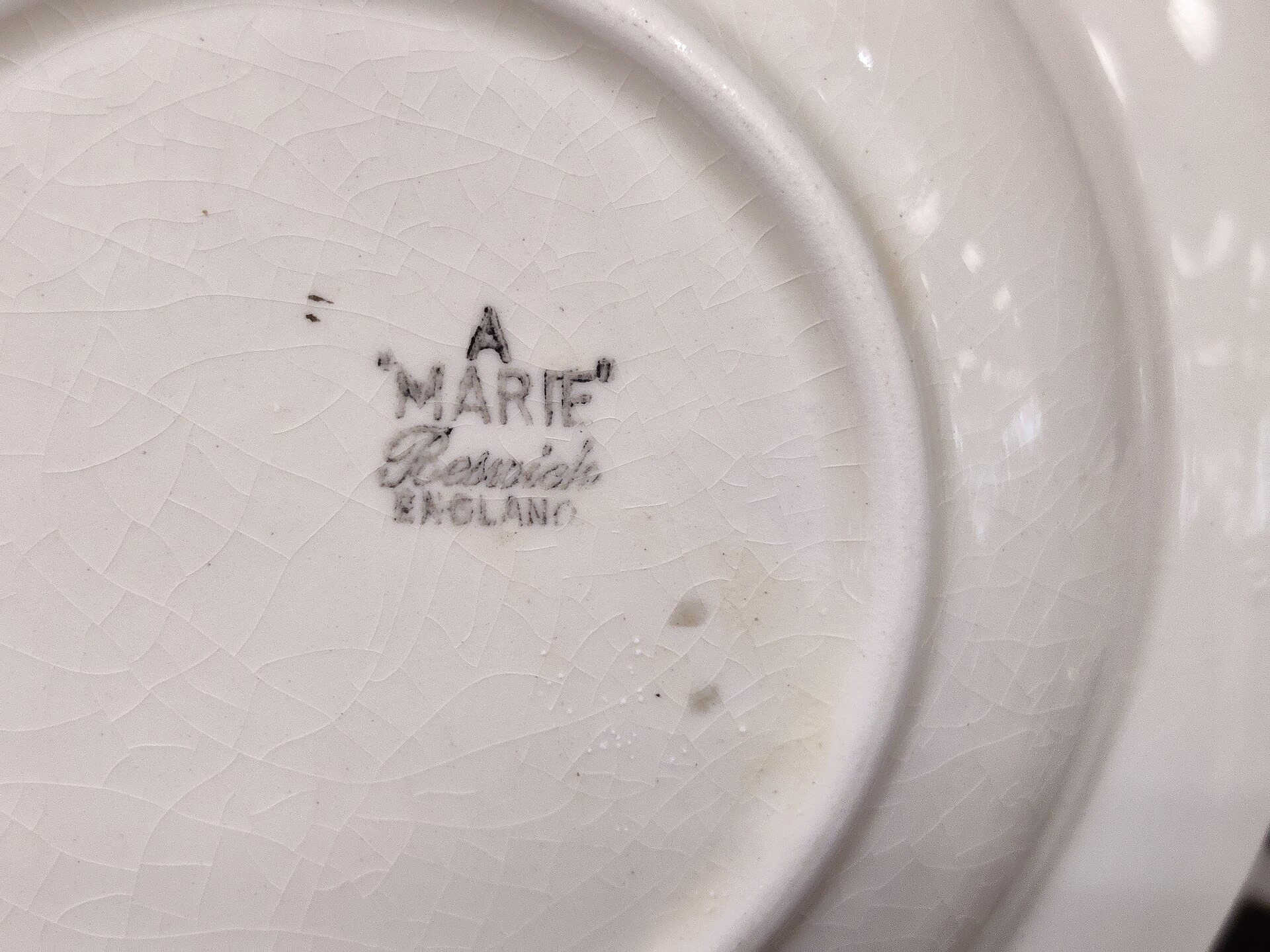
The mark on the underside is often the first feature a collector examines, but there is no single Beswick backstamp that covers the entire history of the factory.
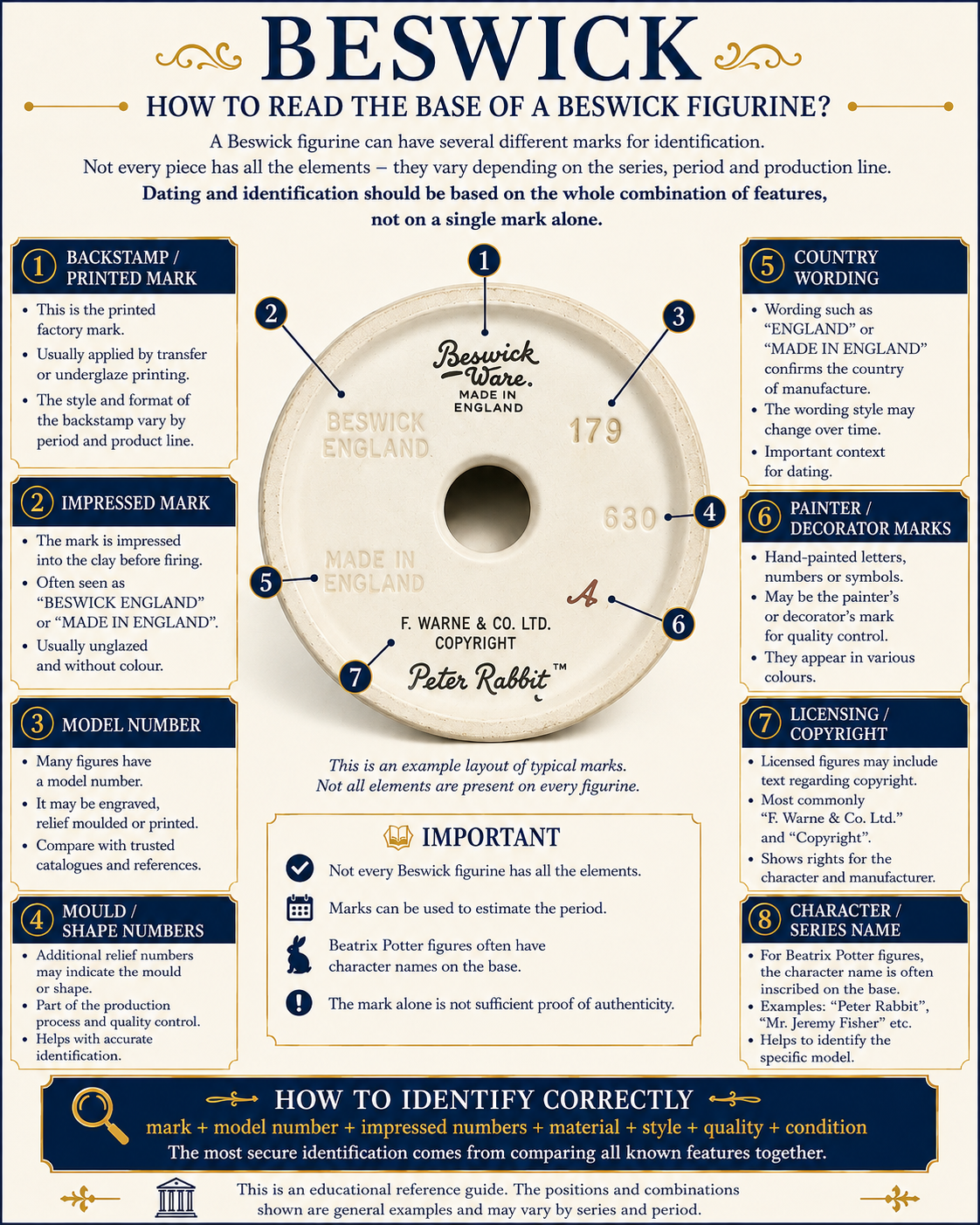
Depending on the period and product line, a base may show a printed backstamp, impressed factory mark, model number, mould or shape number, country wording, painted letter, decorator’s symbol or licensing information.
A Practical Beswick Mark Timeline
| Approximate Period | Documented Feature | Collector’s Use |
|---|---|---|
| From c. 1936 | Beswick Ware / Made in England | Associated with parts of the tableware and ornamental range. |
| c. 1948–1954 | Early Beswick England printed variants | Useful for early post-war figurines, but exact style and product line must be checked. |
| From c. 1954 | Impressed Beswick / Made in England marks and numbers | Impressed numbers can help identify a shape, model or production reference. |
| c. 1955–1972 | Gold Beswick England printed marks on particular ranges | Well known to collectors, particularly in relation to character figures. |
| 1969–early 1989 | Beswick during Doulton ownership | The Beswick name continued after acquisition; a Beswick mark does not automatically mean pre-1969 manufacture. |
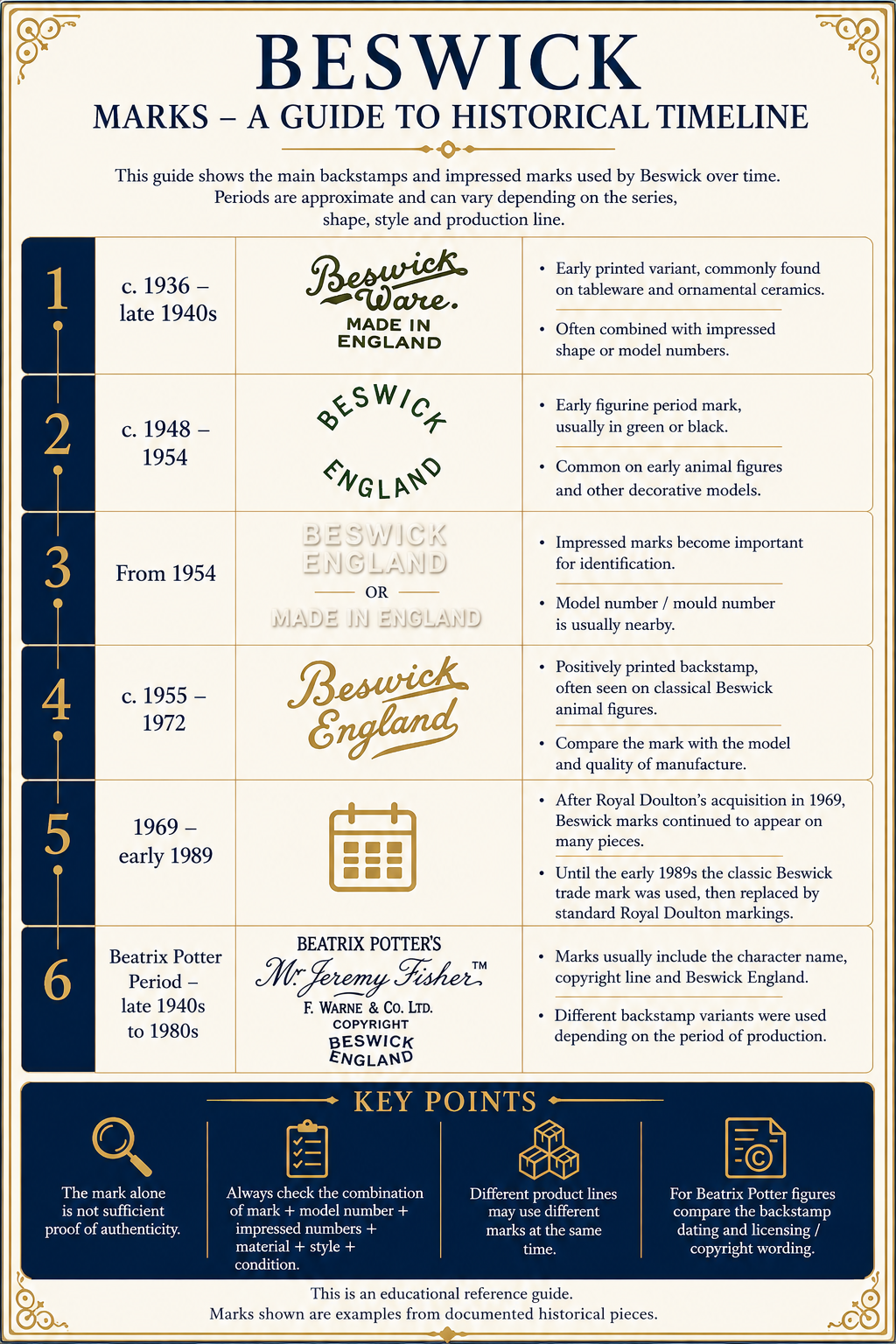
This approach follows the same principle used throughout serious ceramic research: identify the exact mark, but make the object confirm the attribution. Our
guide to dating antique ceramics and porcelain
explains why several independent characteristics should point toward the same production period.
How to Read the Base of a Beswick Figurine
Before searching for the figure online, photograph its entire underside in good light. Do not crop away small impressed numbers, painted symbols or wording around the edge.
| Base Feature | What It May Tell You |
|---|---|
| Printed Backstamp | Factory identification and an approximate manufacturing context. |
| Impressed Mark | A mark formed in the ceramic body, usually before firing. |
| Model Number | May identify a specific catalogue model when verified against a reliable reference. |
| Mould / Shape Number | May relate to the mould or shape rather than the commercial model designation. |
| England / Made in England | Country wording that can contribute to dating and production context. |
| Painted Letters or Symbols | May relate to decoration, factory control or another production process. |
| Copyright / Licensing Text | Particularly important for Beatrix Potter and other licensed character ranges. |
Beswick Model Numbers and Impressed Numbers
Model numbers are among the strongest tools available to a Beswick collector, but only when they are correctly interpreted.
The number must first be recorded exactly as it appears. A partially obscured digit should not be “completed” from memory or from a visually similar online example.
It is also important to distinguish between model numbers, shape numbers, mould numbers and other production codes. Not every impressed number identifies a commercial model.
Documented Examples
| Documented Model | Number | Why Collectors Know It |
|---|---|---|
| Shire Horse | 818 | Famous equine model with exceptionally rare colourways. |
| Mare & Foal on Base | 953 | Rare variants have achieved major auction results. |
| Walking Pony | 1516 | Known in highly desirable rare colourways. |
| Belted Galloway Bull | 1746B | One of the recognised desirable livestock subjects. |
An impressed number may describe a model, mould, shape or another production reference. A production date must be supported by the model history, backstamp and physical characteristics of the piece.
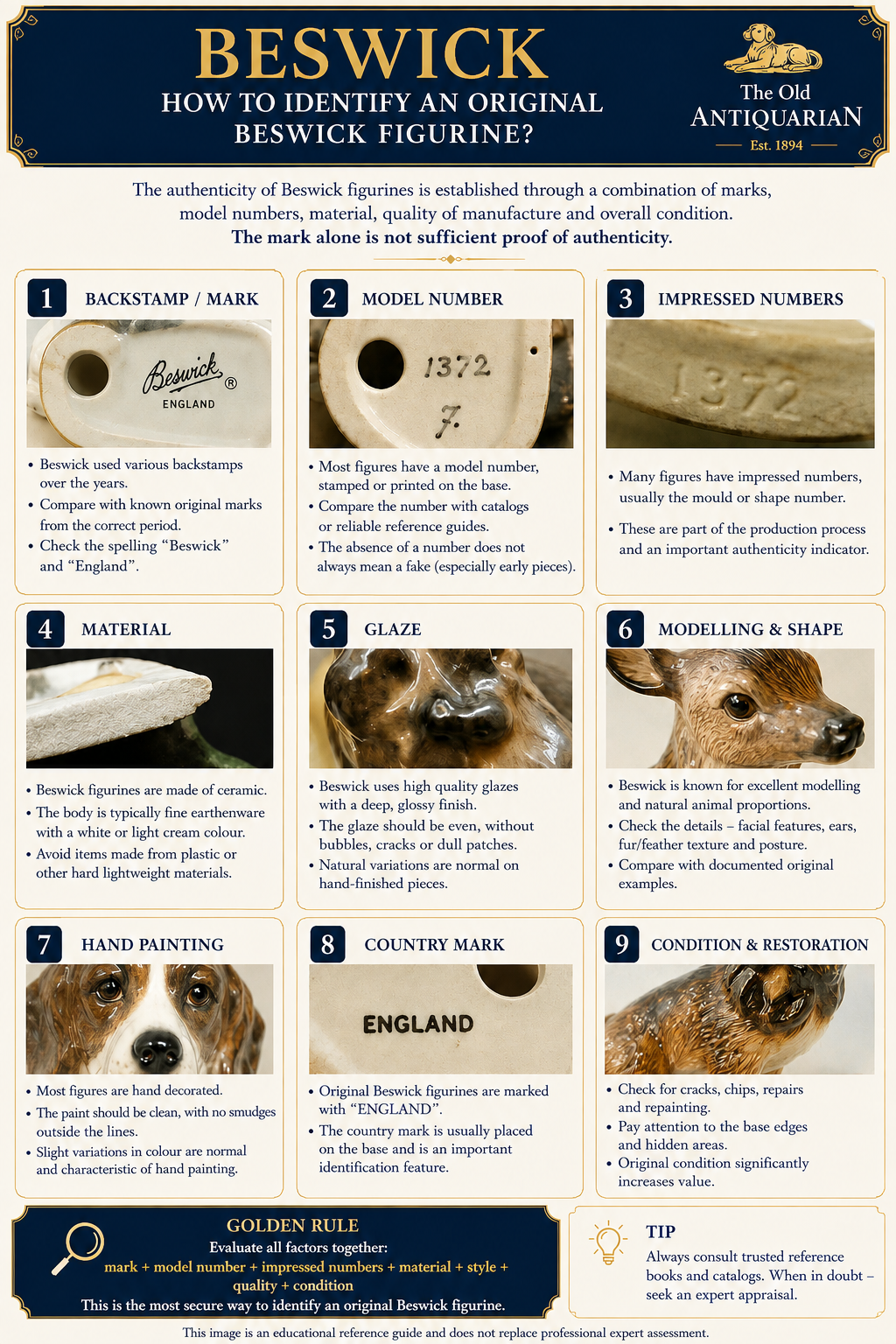
How to Identify an Original Beswick Figurine
There is no single test that proves a Beswick figurine is authentic. Reliable identification is based on consistency between several independent characteristics.
| Check | What to Examine | Why It Matters |
|---|---|---|
| Backstamp | Exact lettering, layout, colour and application method | Should be consistent with the model and period |
| Model Number | Number and how it is applied | Can connect the object to a documented design |
| Material | Ceramic body, texture, density and exposed base | Should make sense for the documented ware |
| Modelling | Proportions, anatomy, expression and fine details | Strong modelling is central to classic Beswick quality |
| Glaze / Finish | Gloss, matt or other documented finish | Some variants differ significantly in rarity |
| Decoration | Colour placement, brushwork and detail | Can help confirm or challenge the attribution |
| Condition | Chips, cracks, repairs and repainting | Essential for both authenticity assessment and value |
Collectors researching a questionable piece may also find it useful to understand the distinction between an original and a later
replica
or
copy.
The terminology matters because a later object can be perfectly legitimate while still not belonging to the original historic production.
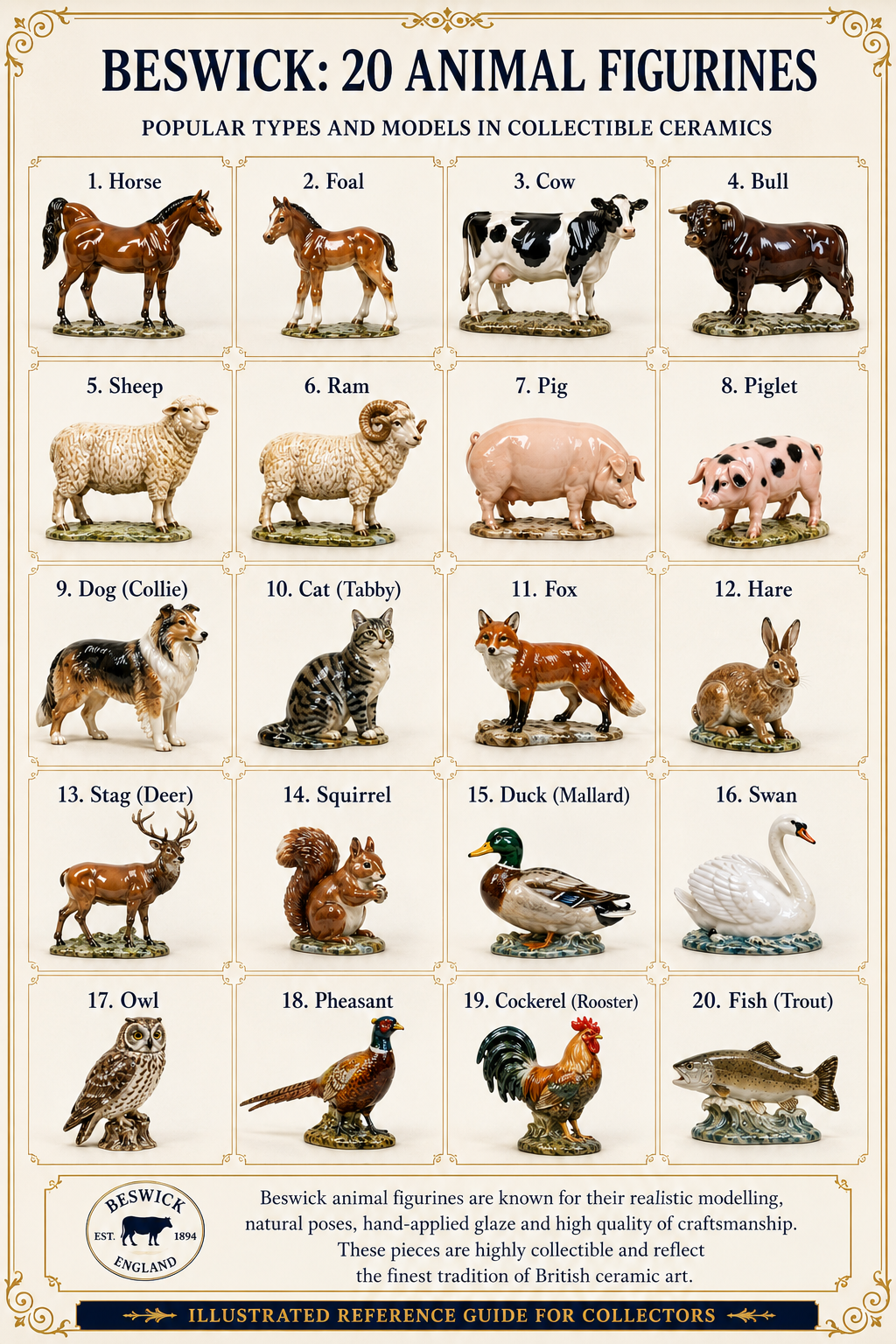
Beswick Animal Figurines
Animal modelling became the field in which Beswick achieved its strongest collector identity.
Today, Beswick animals form one of the largest areas of Beswick collectables. Collectors may specialise in a single breed or subject—such as horses, dogs or cattle—or build broader collections around model numbers, colourways, gloss and matt finishes, production periods and rare variants.
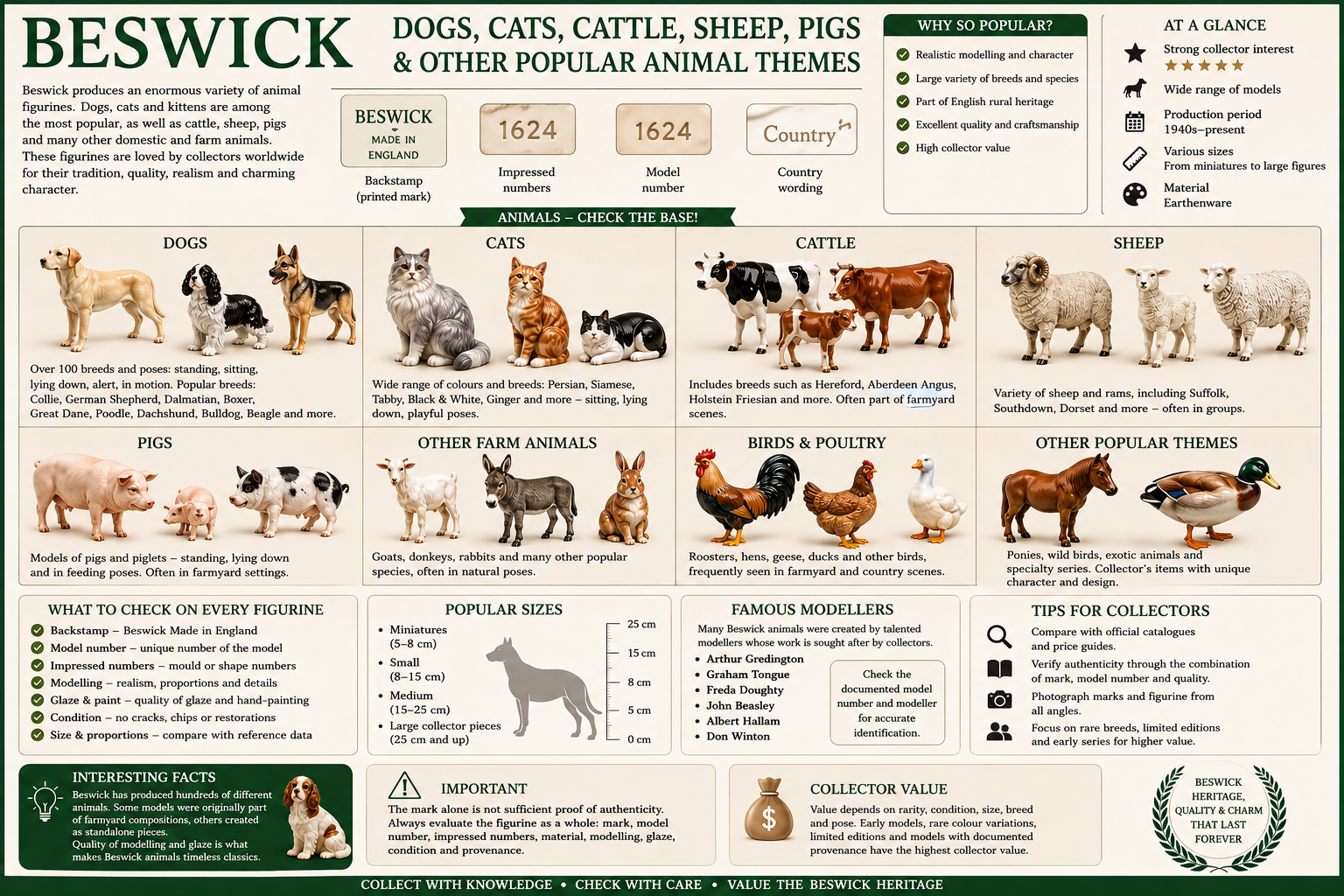
The range was exceptionally broad. Horses and dogs are among the best-known subjects, but Beswick also produced cattle, sheep, pigs, cats, birds, fish and wildlife.
For identification purposes, it is essential to distinguish the subject from the model. Two figurines may represent the same species or even the same breed while belonging to completely different model numbers, production periods and value ranges.
Why Beswick Animals Became So Popular
Their appeal lies partly in recognisable subject matter, but craftsmanship is equally important. Strong examples show convincing anatomy, carefully controlled proportions and an ability to capture the character of the animal without losing the decorative quality expected of ceramic sculpture.
Gredington’s champion livestock models were particularly admired because accuracy mattered to farming communities as well as ceramic collectors. When the ideal characteristics of a breed changed, the modelling could change with them.
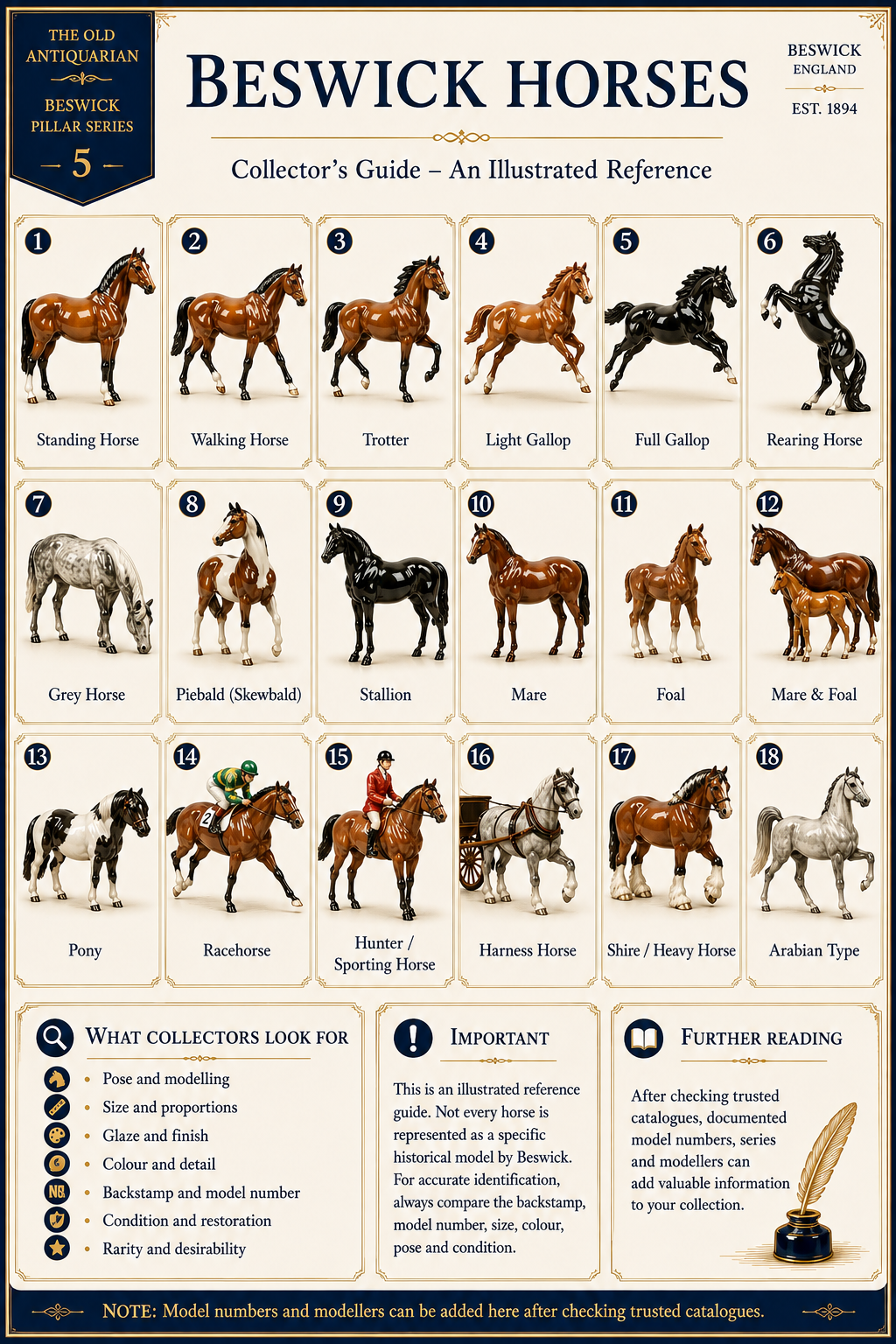
Beswick Horses – A Major Collecting Field
For many collectors, Beswick horses represent the pinnacle of the company’s animal modelling.
Arthur Gredington alone created more than 130 equine models. Across the wider range, collectors encounter standing horses, mares, foals, ponies, racehorses, hunters, working horses and numerous different poses.
How to Identify a Beswick Horse
Begin with the model number whenever one is present. Then compare the exact height and length, stance, position of the legs, head carriage, mane, tail and base.
Colourway is particularly important. A standard version of a familiar model may be relatively accessible, while an exceptionally rare colour variation of the same shape can become a major collector’s item.
Legs, ears and tails are vulnerable to damage. Examine changes in gloss, colour or surface texture around joints carefully, as these may indicate an old repair or repainting.
How Rare Can a Beswick Horse Become?
An exceptional auction result demonstrates the difference between an ordinary model and an extraordinary variant.
A Beswick Shire Horse model 818 in Painted White Gloss achieved a hammer price of £11,300 in November 2022. The result was driven by the extreme rarity of that particular colourway—not simply by the fact that it was model 818.
This is a useful lesson for every valuation: never transfer the price of an exceptional variant to a standard example of the same model.
Beswick Dogs, Cats and Farm Animals
Dogs form another major branch of Beswick collecting. Different breeds were represented with careful attention to silhouette, head shape, ears, coat and posture.
Farm animals are equally important. Bulls, cows, sheep, pigs and other livestock connect Beswick not only with decorative ceramics but also with British rural culture and agricultural collecting.
Collectors should be cautious about descriptions such as “Beswick dog” or “Beswick cow” without a model number. The exact model, breed, pose and variation matter.
Beswick and Beatrix Potter
The Beatrix Potter figures are one of the most recognisable intersections between English children’s literature and twentieth-century ceramics.
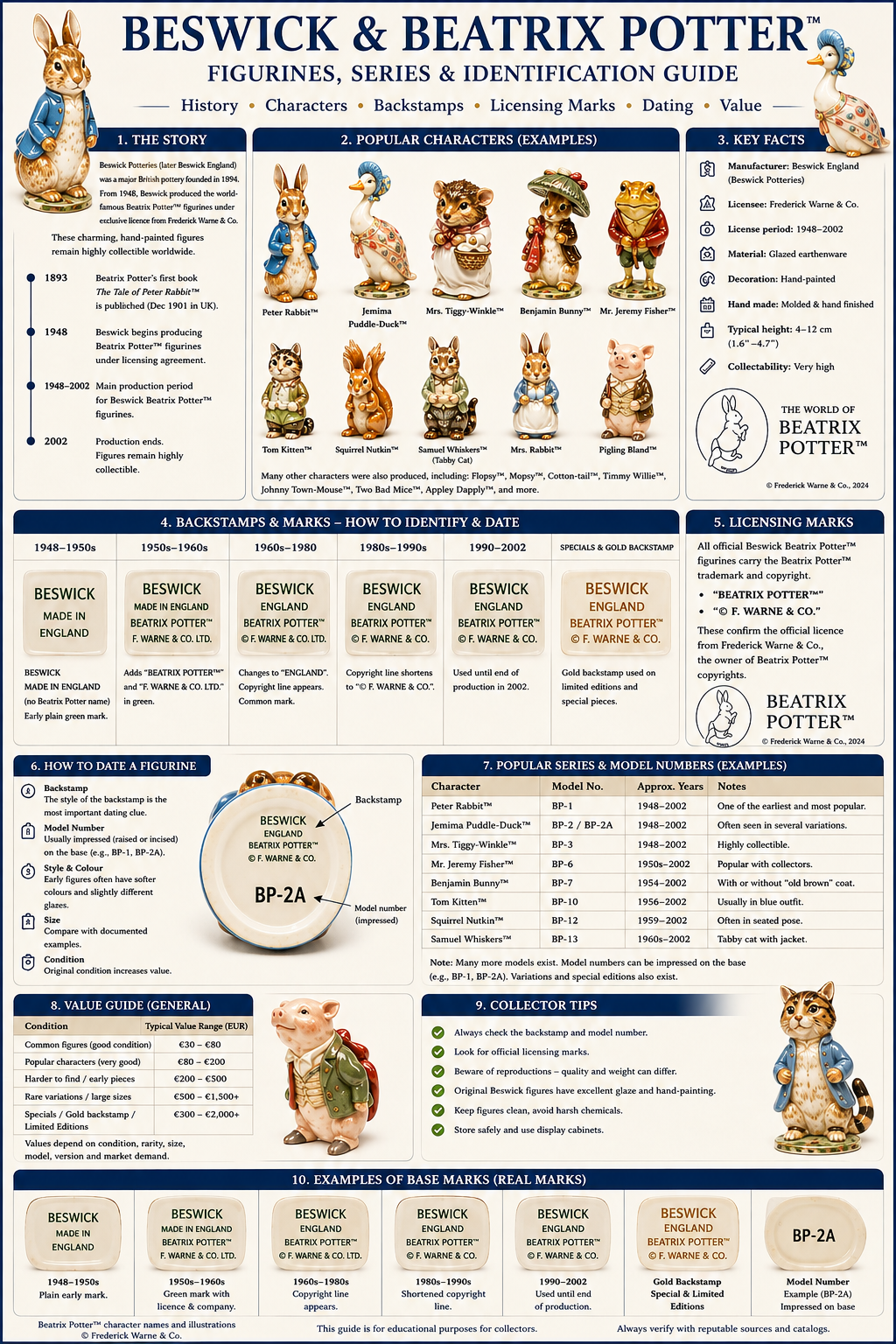
The Beswick series began in 1948, when the company obtained a licence from Frederick Warne & Co. to reproduce ten Beatrix Potter characters.
The first figure was Jemima Puddle-Duck, modelled by Arthur Gredington.
The range expanded considerably over the following decades, turning characters from Potter’s small books into one of the best-known groups of British character ceramics.
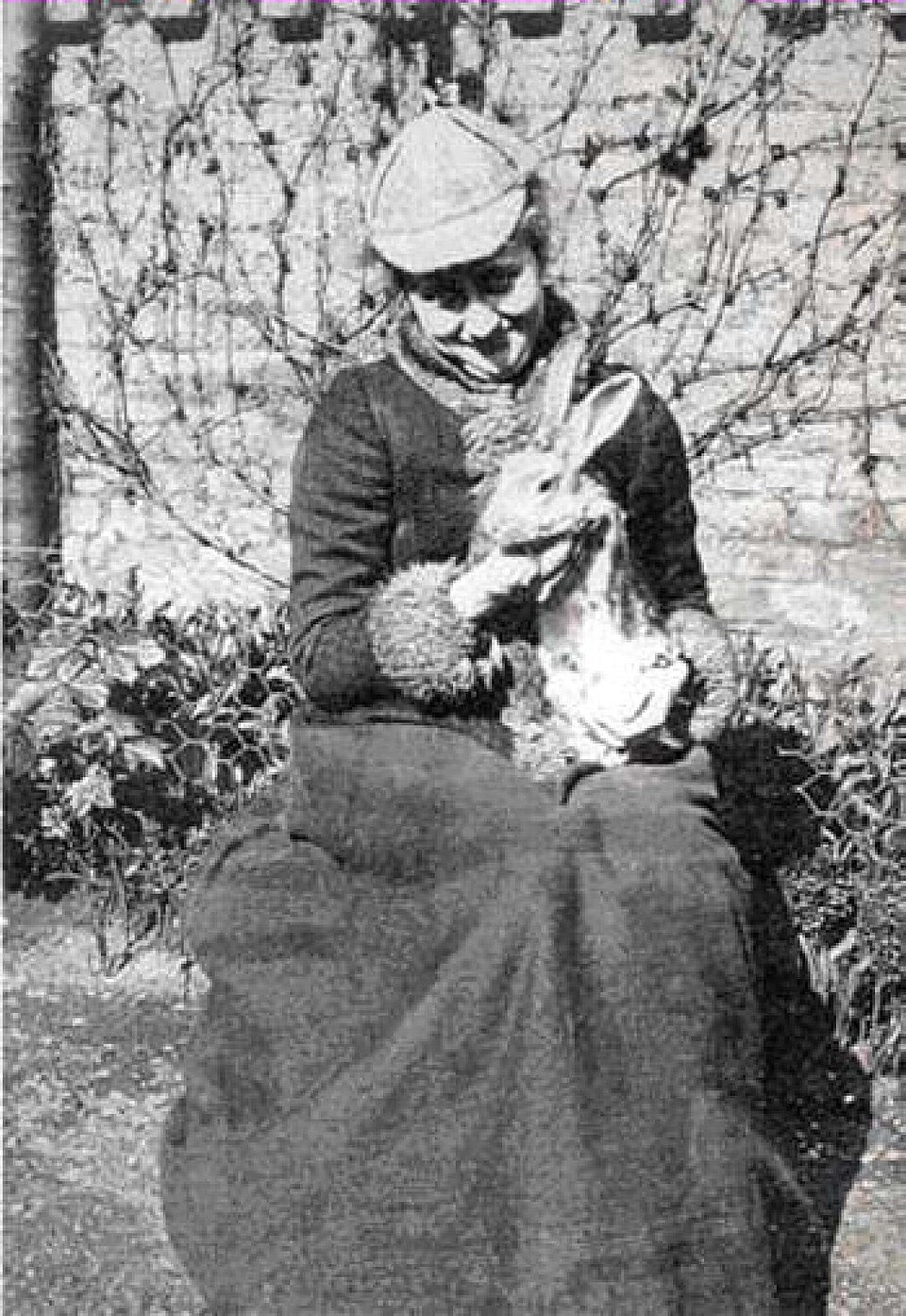
The Natural World Behind Beatrix Potter
Beatrix Potter’s art was rooted in close observation. Animals were not simply decorative inventions; she studied their forms, behaviour and character with remarkable attention.
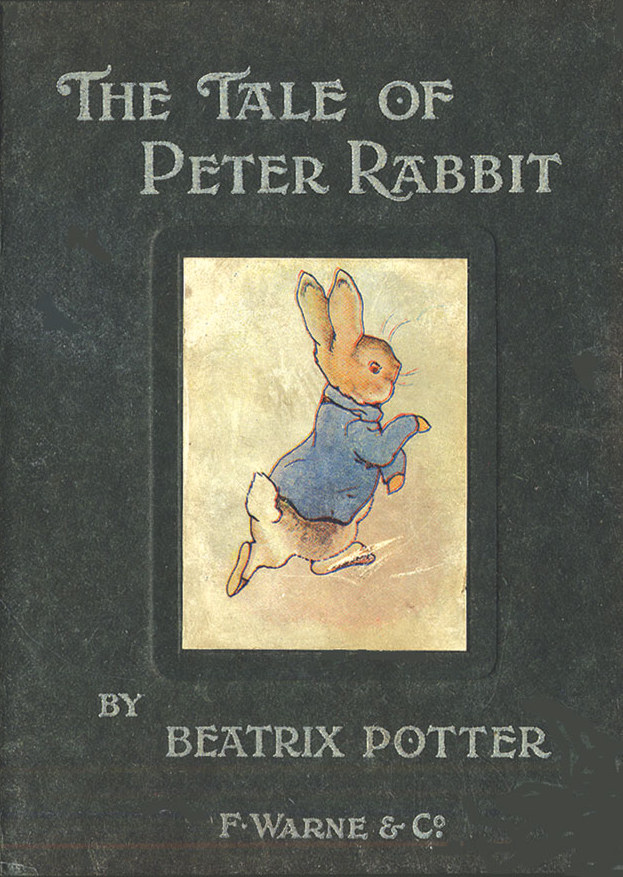
The Tale of Peter Rabbit
The origins of Peter Rabbit can be traced to 4 September 1893, when Beatrix Potter wrote an illustrated letter to five-year-old Noel Moore.
She later developed the story into a book and privately printed an edition in 1901. Frederick Warne subsequently published the commercial version in 1902, establishing the foundation for one of the most enduring children’s publishing traditions in Britain.
Popular Beswick Beatrix Potter Characters
Collectors encounter a wide range of familiar names, including Peter Rabbit, Jemima Puddle-Duck, Benjamin Bunny, Mrs. Tiggy-Winkle, Mr. Jeremy Fisher, Tom Kitten and Squirrel Nutkin.
But the character name alone does not determine value. A long-running popular character may exist in numerous backstamp and decorative variations, while another figure may have had a much shorter production life.
Beswick Beatrix Potter Backstamps
Dating these figures requires special care because licensing and copyright wording form part of the base information.
| Approximate Period | Documented Marking Context |
|---|---|
| 1948–1954 | Early gold Beswick backstamp period, including early collector variants. |
| 1955–1972 | Gold Beswick England marks continued on character figures. |
| 1973–1974 | Documented Beatrix Potter character marks include F. Warne & Co. copyright wording. |
| 1974–1985 | Later brown character backstamp variants with licensing/copyright information. |
| 1985–1988 | Further changes in copyright and licensing wording before the broader 1989 branding transition. |
A copyright date associated with a character or design is not automatically the firing date of the individual figure in your hand. The complete backstamp variant and model production history must be considered.
Beswick Collectables: What Do Collectors Look For?
The term Beswick collectables covers much more than one type of figurine. Popular collecting fields include animal models, horses, dogs, farm animals, Beatrix Potter characters and selected tableware or ornamental wares. Within each field, the exact model and variant matter more than the Beswick name alone.
Experienced collectors commonly look for documented model numbers, scarce colourways, unusual finishes, short production runs, early or distinctive backstamps, original boxes and strong original condition. A common model with a rare documented variation can be substantially more desirable than its standard counterpart.
Do not assume that “vintage Beswick” automatically means rare or valuable. Identify the exact model, variation and condition before comparing it with recent sold examples.
Beswick Materials, Making and Quality
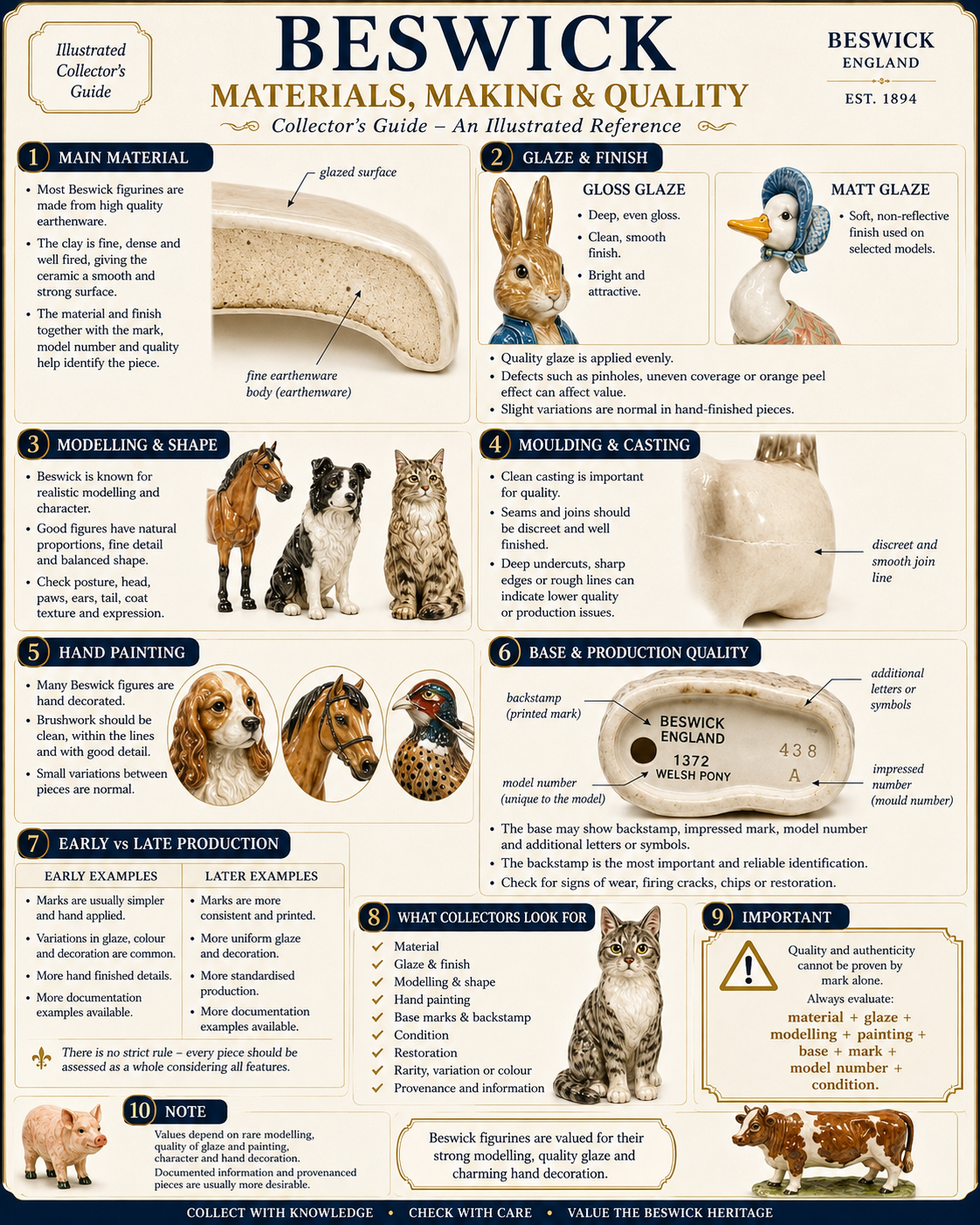
A genuine-looking mark is much more convincing when the rest of the object demonstrates the quality expected of the model.
1. Ceramic Body
Study the exposed ceramic body around the base or another unglazed area. Its colour, texture and density provide information that cannot be seen through the glaze.
2. Glaze and Finish
Some Beswick figures are associated with gloss finishes, while others appear in matt or alternative finishes. Never assume one is automatically earlier or better. Determine whether the finish is documented for the exact model.
3. Modelling
Look closely at the head, eyes, ears, paws, hooves, feathers, coat texture and overall posture. Strong examples should retain convincing detail rather than appearing soft or indistinct.
4. Moulding and Casting
Manufacturing seams may be present, but they should normally be handled with care. Rough joints, unusually blurred detail or badly finished edges deserve closer examination.
5. Hand-Finished Decoration
Hand-applied decoration means two genuine pieces need not be absolutely identical. Small differences in brushwork, facial details and colour transitions can be natural.
Early vs Later Beswick Production
It is tempting to assume that the earliest version must always be the most desirable. The collecting market is more complicated.
| Characteristic | Earlier Production | Later Production |
|---|---|---|
| Marks | Earlier Beswick backstamp variants | Later Beswick and Doulton-era markings |
| Decoration | May show characteristic hand-finished variation | Some ranges display more standardised production |
| Rarity | Some early models and variants are scarce | Later limited or unusual variants can also be very scarce |
| Value | Depends on model, variation and condition | The same principle applies |
A later rare colourway in superb original condition may be more valuable than an earlier but common version. Age is a factor—not a valuation formula.
Condition, Damage and Restoration
Condition is one of the strongest determinants of Beswick value.
Animal figures are particularly vulnerable because ears, legs, tails, horns, beaks and other projecting details can break relatively easily.
Inspect Carefully For
Check ears, hooves, horns, beaks, tails and base edges.
Examine under strong side lighting and around vulnerable joints.
Look for joins, glue, filling and unusual surface transitions.
A repaired area may have a different colour, texture or gloss.
Record it, but do not automatically treat crazing as proof of great age.
Grinding or excessive cleaning can remove useful evidence.
A professionally restored object can remain genuine Beswick, but restoration normally affects market value compared with an equivalent example in original condition.
What Determines the Value of a Beswick Figurine?
There is no reliable universal “Beswick price list”. Value must be assessed for the exact model and variant.
Is Beswick pottery valuable? Some Beswick pottery and figurines can be highly collectible, but values vary enormously. Scarce models, rare documented colourways, desirable animal subjects, important early or unusual pieces and examples in excellent original condition can command much stronger prices than common later-production wares.
| Value Factor | Why It Matters |
|---|---|
| Model | Collector demand varies dramatically between individual models. |
| Rarity | Short production runs, prototypes and scarce variants can command strong premiums. |
| Period | Earlier production may be desirable, but age alone does not determine value. |
| Colourway / Variant | An unusual documented colour can transform the rarity of a familiar model. |
| Size | Different sizes must be compared like-for-like. |
| Condition | Excellent original condition generally attracts stronger collector interest. |
| Restoration | Repairs and repainting usually reduce value compared with an undamaged equivalent. |
| Original Box | A correct matching box and label can improve completeness and desirability. |
| Provenance | Documented history can add confidence, especially for unusual or valuable pieces. |
| Recent Comparable Sales | Actual sold prices provide a stronger market reference than unsold asking prices. |
Use Like-for-Like Comparisons
The best comparable is the same model, same colourway, same size and similar condition sold reasonably recently.
An asking price is not a sale result. A seller can ask any amount; the market is demonstrated more reliably by what a buyer actually paid.
Rare Variants Can Change Everything
The £11,300 hammer result for the Painted White Gloss Shire Horse model 818 illustrates how dramatically rarity can influence value.
A normal model 818 should therefore never be valued by simply copying that record result. The exact colourway, production history, condition and rarity must match.
How to Date a Beswick Piece
The strongest dating method is cumulative. Begin with the factory mark, but require other evidence to support it.
| Step | What to Do |
|---|---|
| 1 | Photograph and transcribe the complete backstamp. |
| 2 | Record every impressed number, letter and symbol. |
| 3 | Identify the model number where possible. |
| 4 | Establish the documented production range of the model. |
| 5 | Compare the exact backstamp variant. |
| 6 | Check material, glaze, size and colourway. |
| 7 | For licensed figures, compare copyright and licensing wording. |
The same evidence-led approach is explained in greater detail in
How to Date Antique Porcelain.
Although Beswick should not automatically be classified as porcelain, the underlying dating method—combining several independent clues—is equally useful.
Collector Checklist
12 Checks Before Buying or Valuing Beswick
| 1. Mark | Is the exact backstamp documented for Beswick? |
| 2. Model Number | Does the number match the documented model? |
| 3. Impressed Numbers | Have additional mould or shape references been recorded? |
| 4. Material | Is the ceramic body consistent with the documented ware? |
| 5. Size | Do the measurements match a reliable reference? |
| 6. Pose | Are the stance and proportions correct? |
| 7. Colourway | Is this colour variation documented? |
| 8. Finish | Is gloss, matt or another finish correct for the version? |
| 9. Condition | Are there chips, cracks, crazing or paint losses? |
| 10. Restoration | Have repairs, fills or repainting been detected? |
| 11. Box / Provenance | Can packaging or ownership history be linked convincingly to the piece? |
| 12. Market Evidence | Have recent comparable sold examples been checked? |
Common Beswick Identification Mistakes
- Calling every Beswick object porcelain without checking the ceramic body.
- Assuming the word “Beswick” alone proves authenticity.
- Using a broad logo chart rather than comparing the exact mark.
- Treating every impressed number as a model number.
- Treating every number as a production date.
- Ignoring size differences between versions of similar models.
- Assuming older always means more valuable.
- Ignoring rare colourways.
- Using active marketplace asking prices as market value.
- Failing to check ears, tails, legs, horns and other vulnerable areas for restoration.
- Assuming an old box automatically belongs to the figure inside it.
- Reading a character copyright date as the firing date of the individual figure.
Frequently Asked Questions About Beswick
What is Beswick?
Beswick was an English ceramic manufacturer founded in Longton, Stoke-on-Trent, in 1894. It became particularly famous for animal and character figurines.
Are all Beswick figurines porcelain?
No. Beswick used different ceramic bodies, and historic J. W. Beswick production was strongly associated with earthenware. The material should be established for the individual object.
How can I identify a genuine Beswick figurine?
Compare the backstamp, model number, impressed numbers, material, size, modelling, glaze, decoration and condition with documented references. Do not rely on the factory mark alone.
Does every Beswick figure have a model number?
No. Numbers are extremely useful when present, but their absence does not automatically mean that an object is not Beswick.
What do impressed numbers mean?
They may identify a model, mould, shape or another part of the manufacturing process. Their meaning must be established from reliable reference material.
When did Beswick begin producing Beatrix Potter figures?
The licensed Beswick Beatrix Potter range began in 1948.
What was the first Beswick Beatrix Potter figurine?
Jemima Puddle-Duck was the first figure in the licensed range and was modelled by Arthur Gredington.
Can a Beswick backstamp give an exact year?
Usually not. A backstamp normally suggests a period rather than one precise manufacturing year. Model history and other evidence should be used to narrow the date.
Are Beswick horses valuable?
Some are, but values vary dramatically. Standard models can be relatively accessible, whereas very rare colourways or exceptional variants can achieve substantial prices.
Does restoration reduce value?
Usually yes when compared with an equivalent example in excellent original condition. The effect depends on the rarity of the model, the extent of the damage and the quality of the restoration.
Does an original box increase value?
It can improve completeness and collector interest, particularly when the box, label and model can be convincingly matched.
What is the best way to value a Beswick figurine?
Identify the exact model and variation first, assess its condition and then compare recent sold examples of the same or closely comparable version.
What does Beswick Ware mean?
Beswick Ware is wording encountered on some Beswick ceramics and backstamps. It should be treated as factory and production evidence rather than as the name of one specific figurine range or an exact date code. The complete mark, object type, numbers and decoration should be considered together.
What are the most collectible Beswick animals?
Horses, dogs, cattle and other animal figures are major Beswick collecting fields, but collectability depends on the exact model, colourway, finish, rarity, production history and condition rather than the animal species alone.
Is Beswick pottery valuable?
Some Beswick pottery and figurines can be valuable, especially scarce models and rare documented variants in excellent original condition. Common pieces may be much more modestly valued, so recent sold results for the same model, colourway, size and condition are the best comparison.
The Old Antiquarian
Do You Have a Beswick Figurine or Collection?
Clear photographs of the complete object, the underside, all marks and numbers are the best place to begin. Include exact dimensions, details of any damage or restoration, and photographs of an original box or documentation where available.
Research & Documentation
Sources and References
The historical dates, production context, marks and collector information in this guide have been compared with specialist British pottery references, museum material and documented market records.
- The Potteries.org – J. W. Beswick, Baltimore Works, Gold Street Works, Longton and Doulton ownership history.
- Antiques Trade Gazette – Beswick collecting history, Arthur Gredington, animal modelling, horses and documented collector examples.
- Potteries Auctions – Beswick horses, rare colourways, documented models and verified auction results.
- Victoria and Albert Museum – Beatrix Potter, the 1893 Peter Rabbit letter and the publication history of The Tale of Peter Rabbit.
- The Old Stuff – documented Beswick pottery marks and approximate backstamp periods.
- Specialist Beatrix Potter collector references – character backstamp classifications and licensing variations.
Beswick marks and backstamps can overlap between periods and product lines. Where the documentary record is not precise enough to support an exact year, this guide deliberately uses approximate periods rather than false precision.
Expert / Author
The Old Antiquarian
The Old Antiquarian draws on more than 35 years of experience with antiques and collecting. Our guides are designed to help collectors identify, research, preserve and better understand historic objects through careful physical examination, documentary comparison and responsible interpretation of marks and provenance.
Related Guides
Continue Exploring
Guide to Antique Porcelain: Identification, Marks, Manufacturers & Value
A mark is a clue. The complete object tells the story.
The strongest Beswick identification is achieved when the mark, model number, material, modelling, glaze, decoration, condition and documented history all support the same conclusion.
Last Updated: 7 September 2026
