
Greek Porcelain and Ceramics.Identification Guide
Greek Porcelain and Ceramics: History, Factories, Marks & Identification Guide
Greek ceramics are usually associated with the extraordinary pottery of the ancient world, yet the story did not end with classical Greece. Across the islands and mainland, ceramic traditions continued through local workshops, regional centres and, eventually, modern factories producing tableware, decorative ceramics, hotel and restaurant ware, souvenirs and objects created for an expanding international market.
For collectors today, vintage Greek porcelain and ceramics represent a particularly interesting field. Pieces associated with Rhodes, Athens and other production centres can combine traditional Mediterranean decoration with the unmistakable visual language of the twentieth century.
Among the names encountered by collectors are ICARO and IKAROS of Rhodes, together with other Greek workshops and manufacturers whose products reached homes, hotels, restaurants and tourist markets.
This guide explores the history of Greek porcelain and ceramics, important production centres, manufacturers, marks, dating clues, tourism and hospitality connections, identification methods and the factors that influence collector value.
Quick Answer
Vintage Greek ceramics are best identified by examining the maker’s mark, material, glaze, shape, decoration, manufacturing technique and historical context together. Rhodes became particularly important during the twentieth century through manufacturers such as ICARO and IKAROS, while tourism helped Greek ceramics reach an international audience. A Greek-looking decoration or the word “Greece” alone is not sufficient to identify the maker, age or value of an object.
Greek Porcelain & Ceramics at a Glance
| Feature | What Collectors Should Know |
|---|---|
| Important centres | Rhodes, Athens and numerous regional pottery centres and workshops |
| Important names | ICARO, IKAROS and other twentieth-century Greek ceramic manufacturers and workshops |
| Materials | Porcelain, earthenware, stoneware and other ceramic bodies |
| Common objects | Plates, bowls, cups, coffee sets, vases, jugs, tiles, decorative objects and souvenirs |
| Identification | Mark + material + shape + decoration + period + manufacturing technique |
| Collector interest | Early production, documented makers, unusual designs, hand decoration, complete sets and strong provenance |
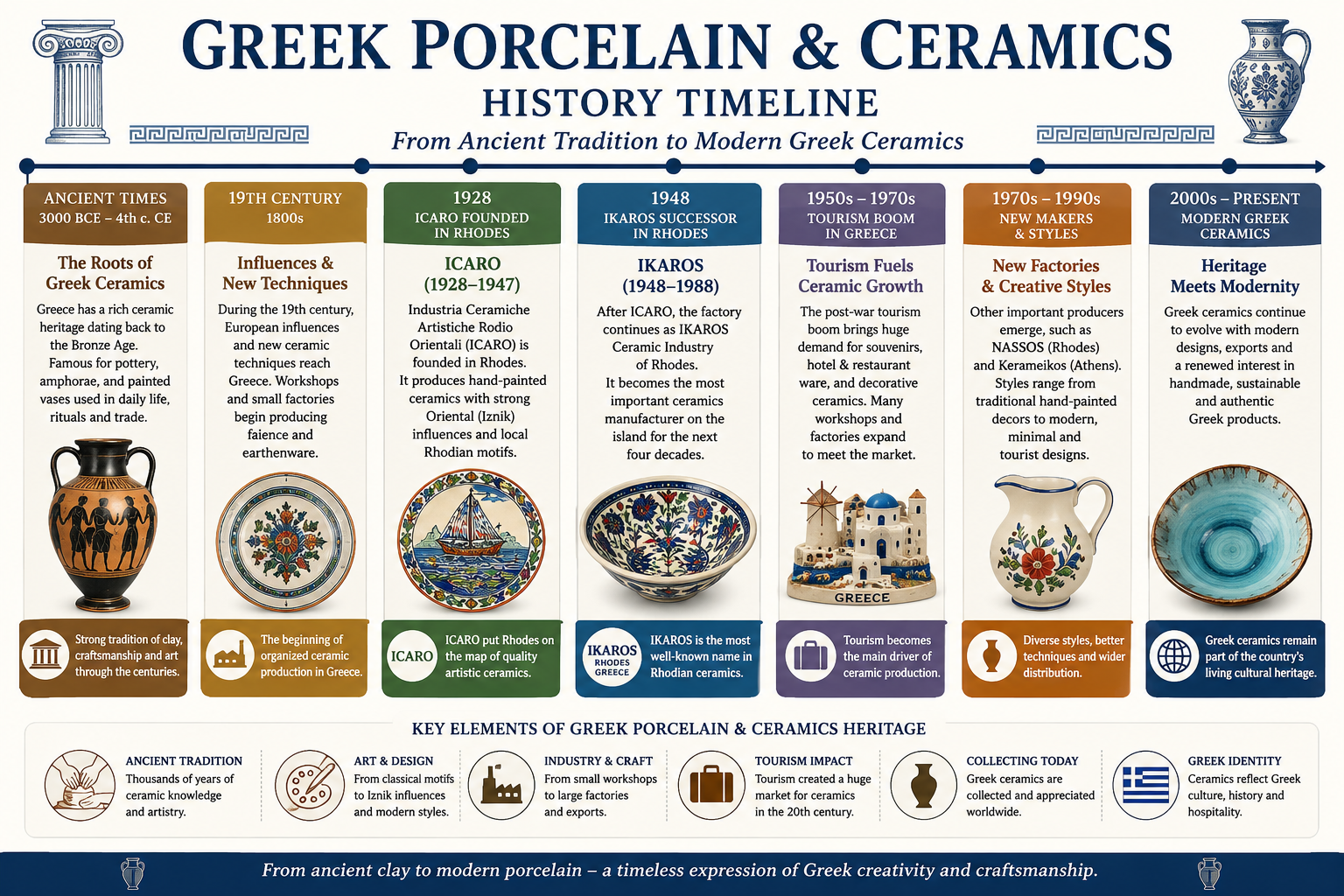
From Ancient Pottery to Modern Greek Ceramics
No discussion of Greek ceramics can completely separate modern production from the country’s much older ceramic heritage. Pottery has been produced in the Greek world for thousands of years, creating an enormous vocabulary of forms, decorative traditions and craftsmanship.
The famous vessels of antiquity belong to a very different historical and technological context from twentieth-century Greek porcelain. Nevertheless, the cultural importance of ceramics remained deeply rooted in Greece.
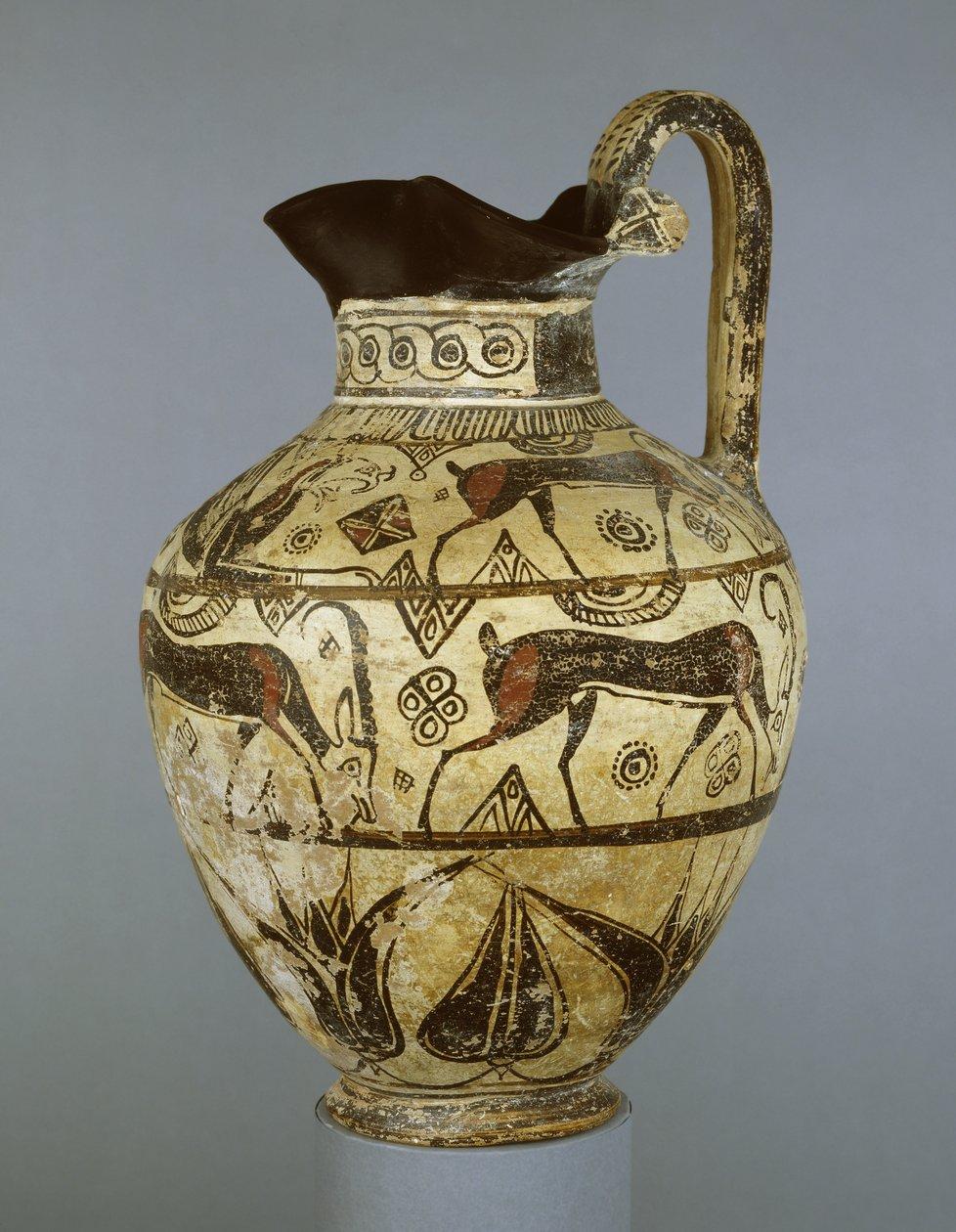
For collectors, this distinction is important. An object decorated with ancient Greek figures, geometric borders, ships or mythological subjects is not necessarily ancient—or even particularly old. Such motifs were repeatedly revived by modern workshops and the tourist industry.
Understanding the difference between porcelain, earthenware and other ceramic materials is therefore an essential first step. Our broader
Guide to Antique Porcelain
explains how porcelain bodies, factory marks, glaze and manufacturing techniques are examined when identifying older pieces.
The Greek Workshop Tradition
One of the defining characteristics of Greek ceramics is the persistence of workshop production alongside larger-scale manufacturing.
Potters and decorators continued to work in regional centres, creating practical vessels as well as increasingly decorative pieces intended for domestic interiors and visitors.
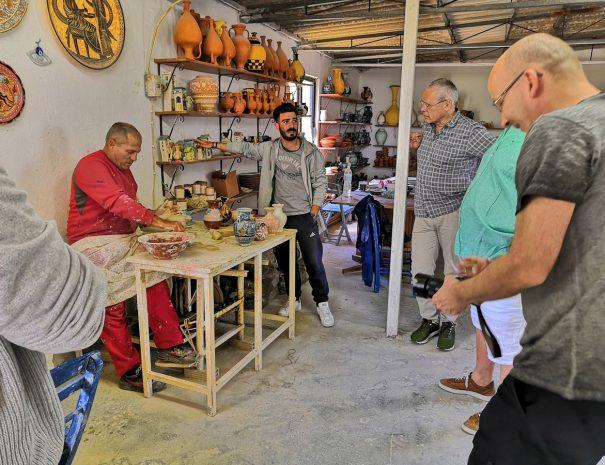
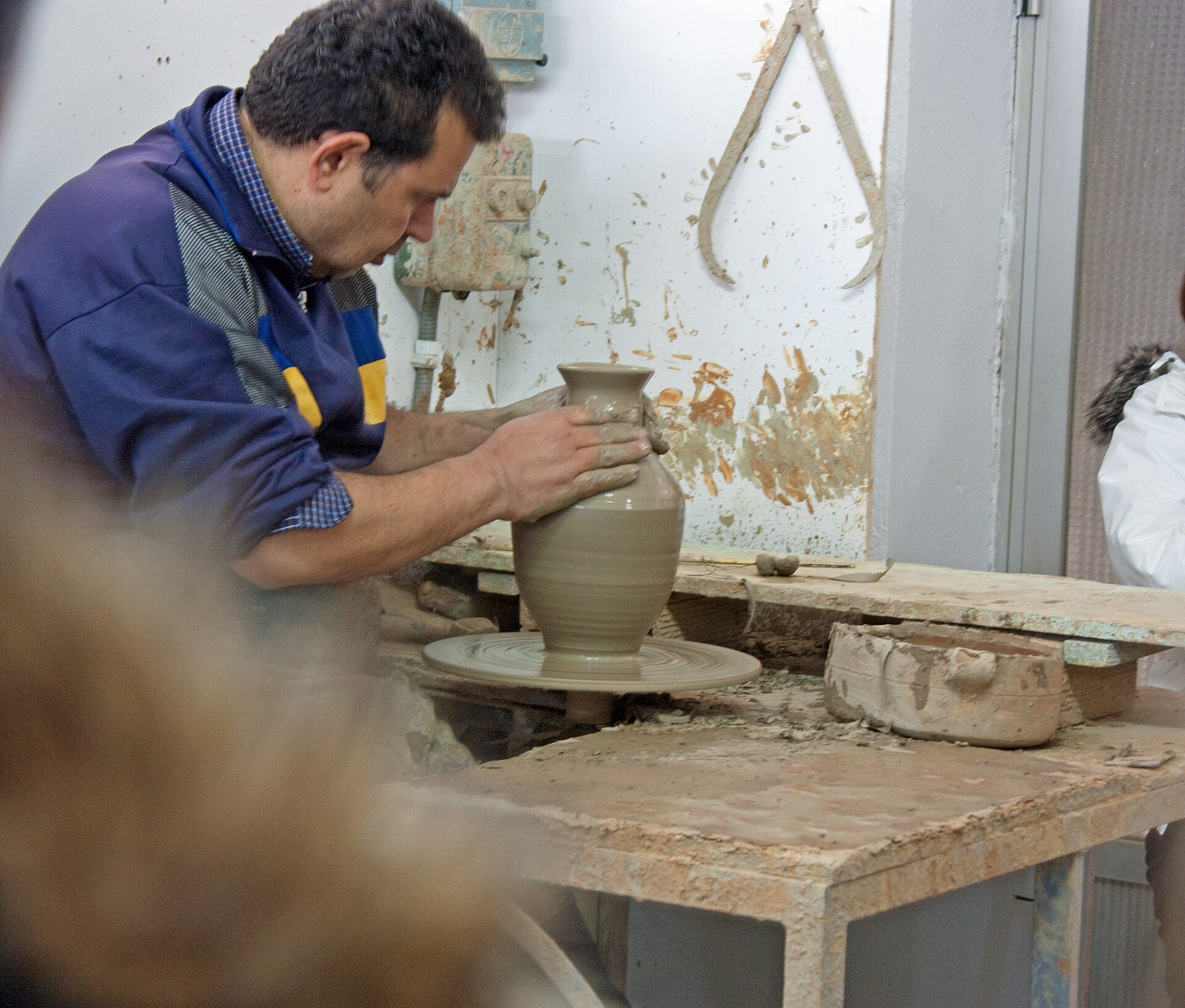
Production could involve several stages: preparing and shaping the clay, drying the vessel, firing, glazing, painting or decorating, and additional firing where required.
Hand-Painted Greek Ceramics
Decoration is one of the features that makes twentieth-century Greek ceramics immediately attractive to collectors.
Depending on the workshop and period, pieces may incorporate floral ornament, geometric borders, marine subjects, stylised plants, historical references and Mediterranean colour combinations.
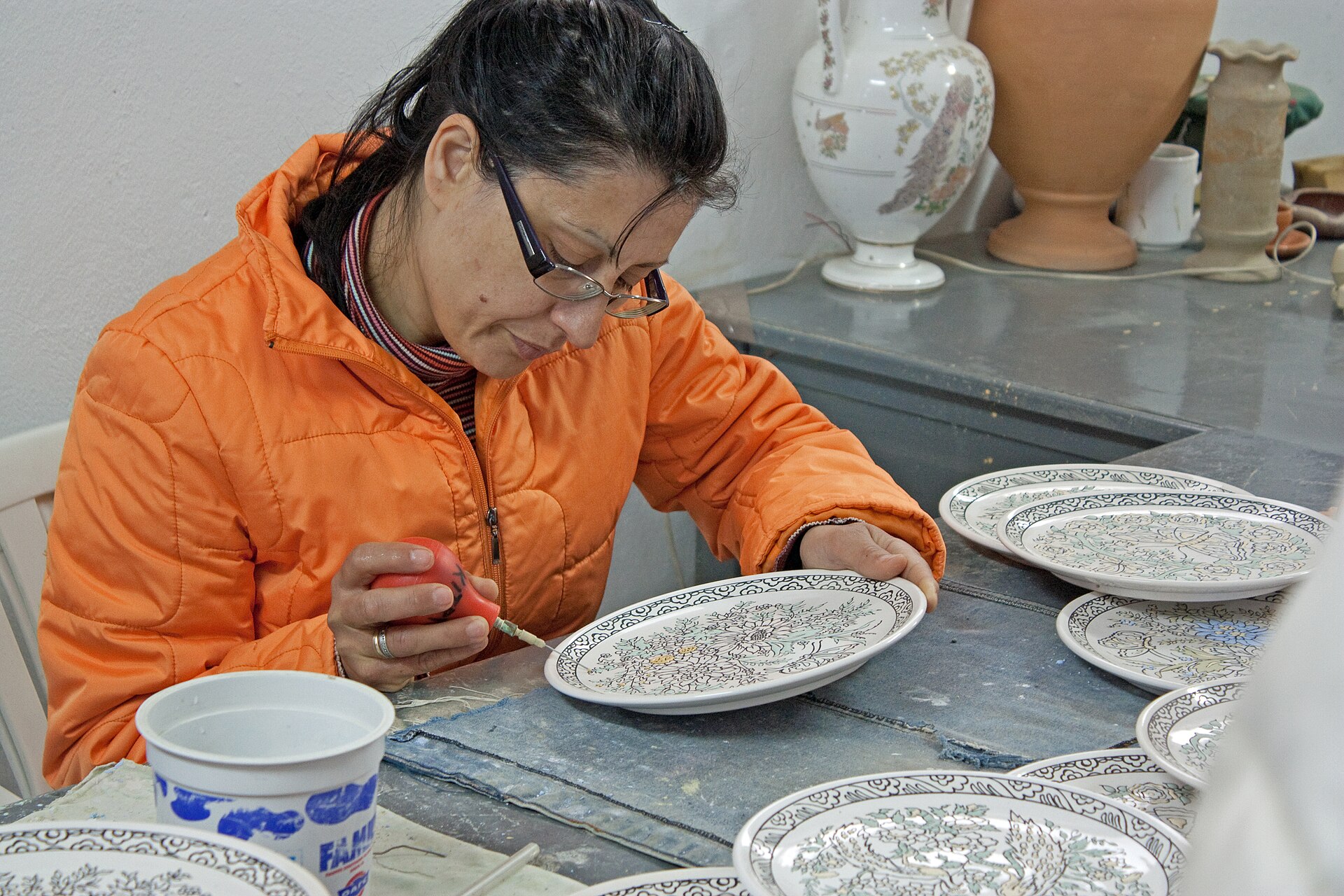
Hand decoration should always be examined closely. Genuine brushwork normally shows small variations in line thickness, colour density and execution. These variations can help distinguish individually decorated ceramics from mechanically repeated decoration, although hand painting alone does not establish age or authenticity.
Where Was Greek Porcelain and Ceramics Produced?
Modern Greek ceramic production was geographically diverse. Some areas became associated with traditional pottery, while others developed workshops and more industrial forms of production.
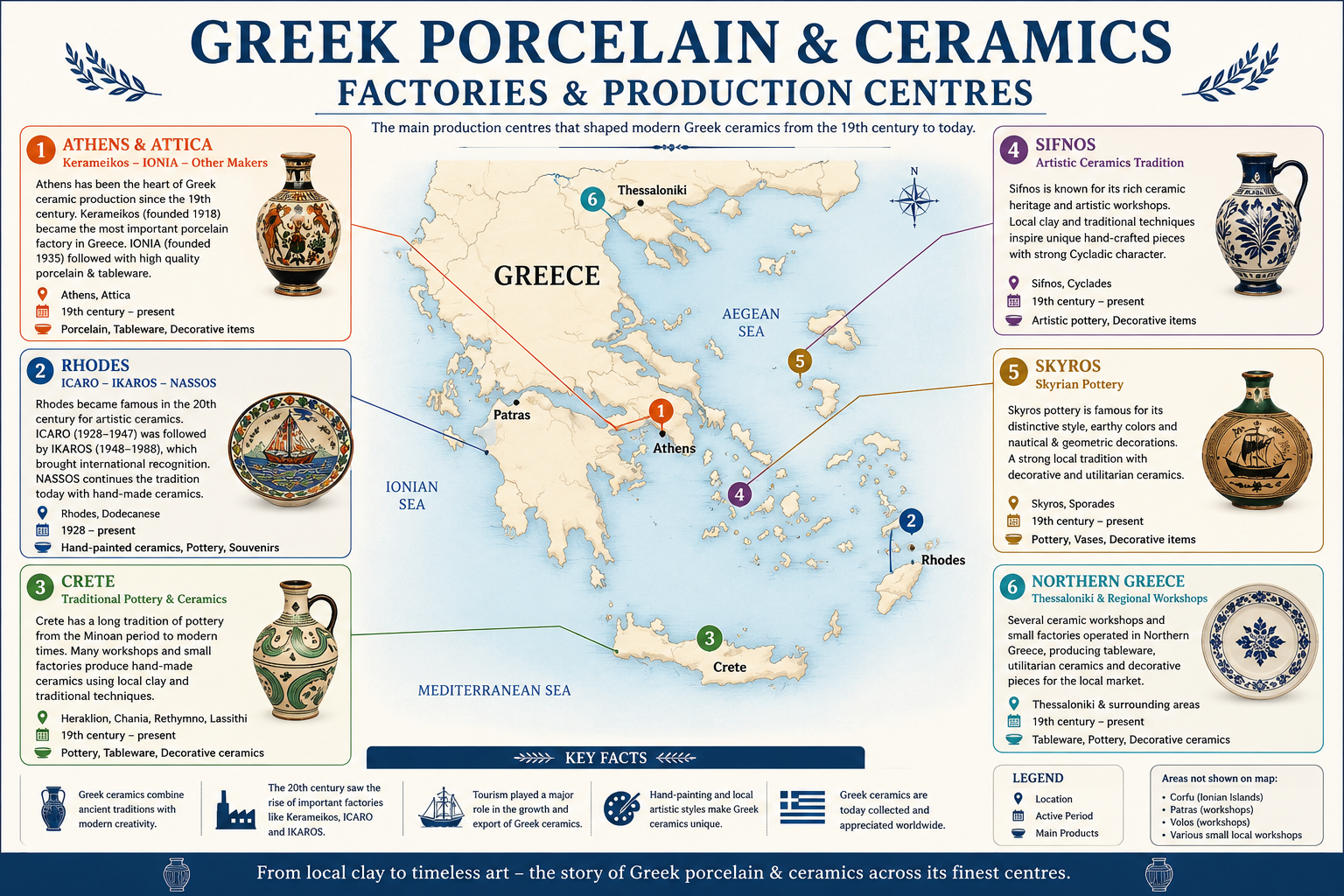
For twentieth-century collectors, Rhodes is particularly important. Its combination of established ceramic traditions, artistic production and a rapidly developing tourist economy created an environment in which decorative ceramics could flourish.
Rhodes
Rhodes occupies a special position in the modern collecting story. Its geographical location, long decorative tradition and twentieth-century tourism created strong demand for ceramics that could function simultaneously as useful objects, decorative pieces and souvenirs.
The island is especially associated with the names ICARO and later IKAROS, which today are among the most recognisable names encountered by collectors researching vintage Rhodian ceramics.
Athens and Mainland Greece
Athens developed a different environment in which urban workshops, decorative arts, retail markets and modern design could intersect. Ceramic production in and around the capital served both Greek consumers and an increasingly international audience.
Elsewhere in Greece, regional workshops preserved distinctive approaches to form, clay and decoration. This makes the term “Greek ceramics” much broader than the history of any single factory.
ICARO Rhodes – An Important Chapter in Modern Greek Ceramics
ICARO is particularly significant for collectors interested in twentieth-century ceramics from Rhodes.
Pieces associated with the workshop can reflect a mixture of local inspiration, Mediterranean decorative traditions and designs adapted to the changing market for decorative and tourist ceramics.
When examining a possible ICARO piece, collectors should never identify it from decoration alone. The underside, mark, material, shape and quality of manufacture all need to support the attribution.
From ICARO to IKAROS
The relationship between ICARO and IKAROS is one of the most useful subjects for collectors researching Rhodian pottery because it helps place objects within the development of twentieth-century production on the island.
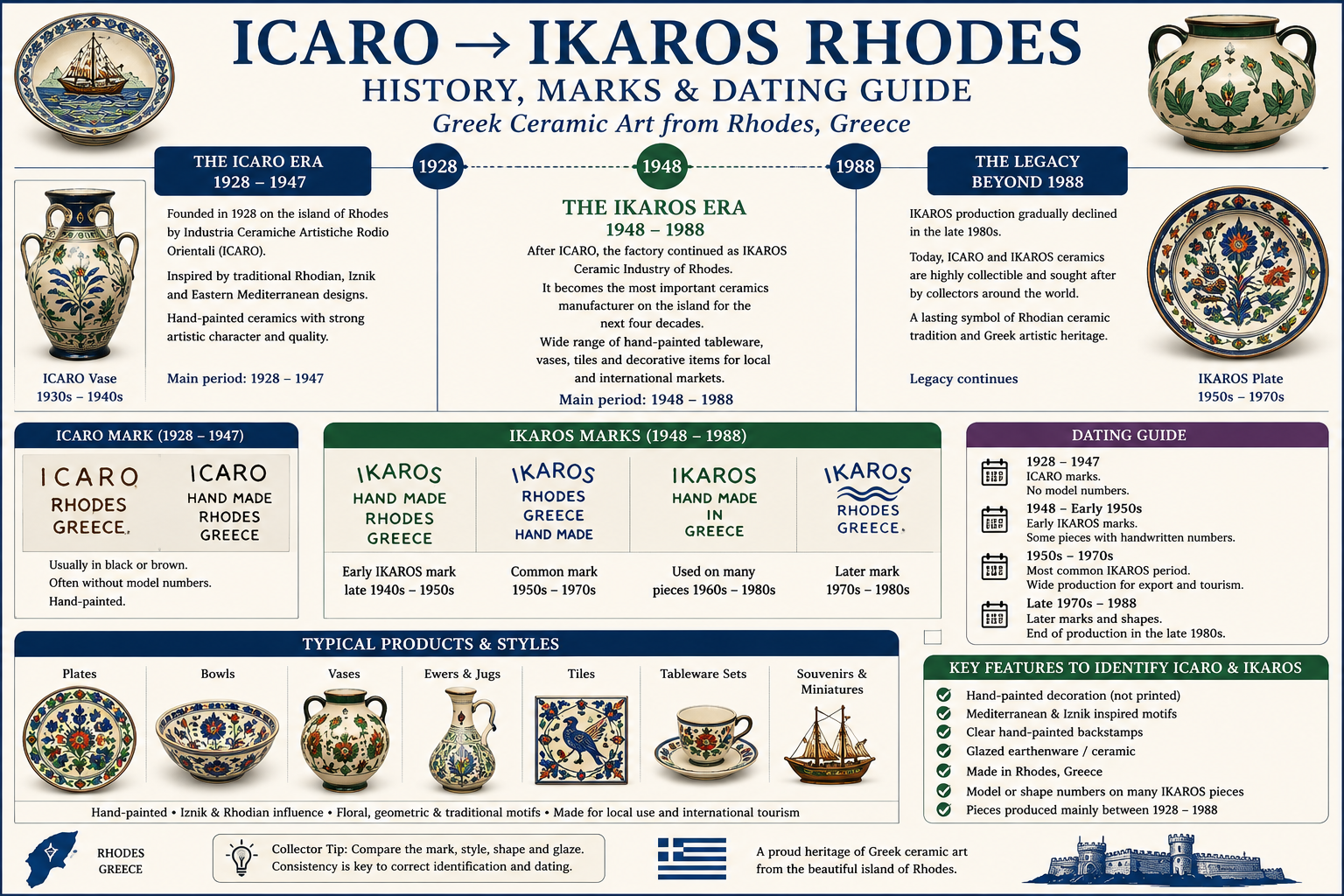
The chronology is valuable, but it should not be treated as a shortcut. Marks changed, individual products can be difficult to date precisely, and decorative traditions may continue across different periods.
A collector should therefore treat the mark as the beginning of an investigation rather than its conclusion.
ICARO vs IKAROS – What Collectors Should Compare
| Clue | What to Examine | Why It Matters |
|---|---|---|
| Mark | Wording, lettering, symbols and method of application | Can help establish manufacturer and period |
| Material | Body colour, texture, glaze and weight | Helps distinguish different ceramic bodies and production methods |
| Decoration | Brushwork, motifs, colours and repetition | May connect the object with a particular style or production line |
| Shape | Vessel profile, handles, rim and foot | Some forms are characteristic of particular periods |
| Condition | Chips, cracks, glaze wear and restoration | Important for both identification and value |
Greek Porcelain and Ceramic Marks
Marks are among the first things collectors search for when they turn over a Greek vase, plate, cup or decorative object.
They can contain a manufacturer’s name, workshop name, place of production, the word Greece, handwritten information, numbers or other symbols.
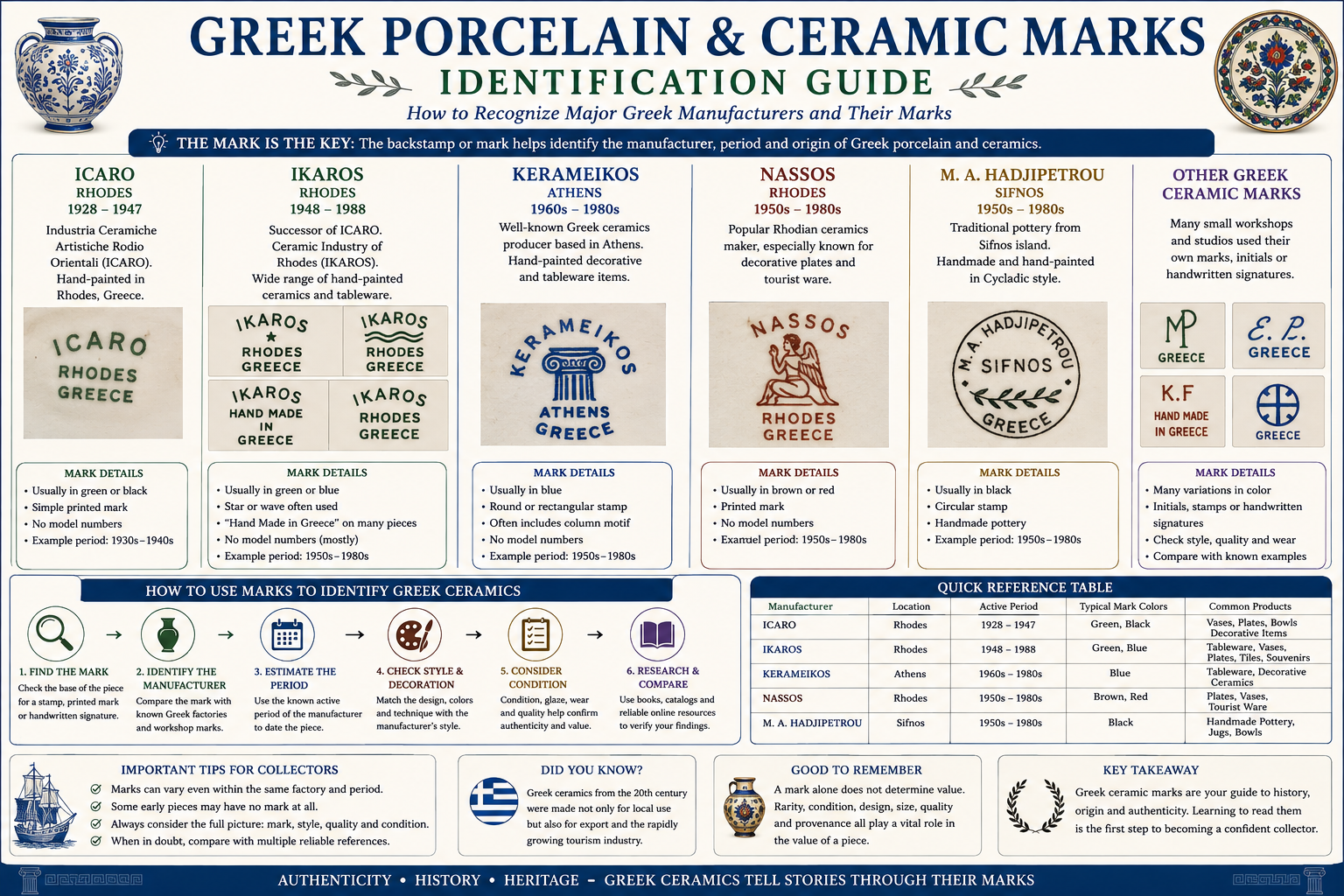
Never Identify Greek Ceramics by the Mark Alone
This is especially important with tourist ceramics. A geographical inscription may tell us where an object was sold, decorated or intended to be associated with, but it does not automatically prove who manufactured it.
Likewise, older manufacturers’ names can become desirable enough that collectors encounter incorrect attributions.
The safest method is the same one used for other collectible porcelain: compare the mark with the material, glaze, shape, decoration, construction and natural wear.
For a broader explanation of this method, see our
guide to dating antique porcelain,
which explains why several independent clues should agree before a production period is assigned.
How to Read a Greek Ceramic Mark
Before trying to identify the maker, photograph the entire object and its base in good natural light. Do not crop away handwritten numbers, impressed symbols or small secondary marks.
| Step | Check | Possible Information |
|---|---|---|
| 1 | Main name or logo | Manufacturer or workshop |
| 2 | Place name | Rhodes, Athens or another geographical association |
| 3 | Country wording | Domestic or export identification |
| 4 | Numbers | Model, pattern, decorator or production reference |
| 5 | Application method | Printed, painted, impressed or incised |
| 6 | Wear and glaze relationship | Can help determine whether the mark is consistent with the object |
Is It Really Porcelain?
One of the most important points in this subject is that not every collectible Greek ceramic is porcelain.
The market contains earthenware, studio pottery and other ceramic bodies alongside porcelain. Calling every white or glazed Greek object “porcelain” can lead to incorrect identification and valuation.
Collectors should examine:
- the colour of the exposed ceramic body;
- the unglazed foot;
- weight and wall thickness;
- translucency where appropriate;
- glaze characteristics;
- firing quality;
- sound and density;
- the manufacturer’s documented production.
This distinction matters because material can influence the history, manufacturing technique, rarity and market for an object.
Modern Greek Porcelain in the Domestic Interior
Porcelain also formed part of modern Greek domestic and decorative culture. Museum collections provide valuable visual evidence for how porcelain and ceramics were displayed and used rather than treating every object as an isolated collectible.
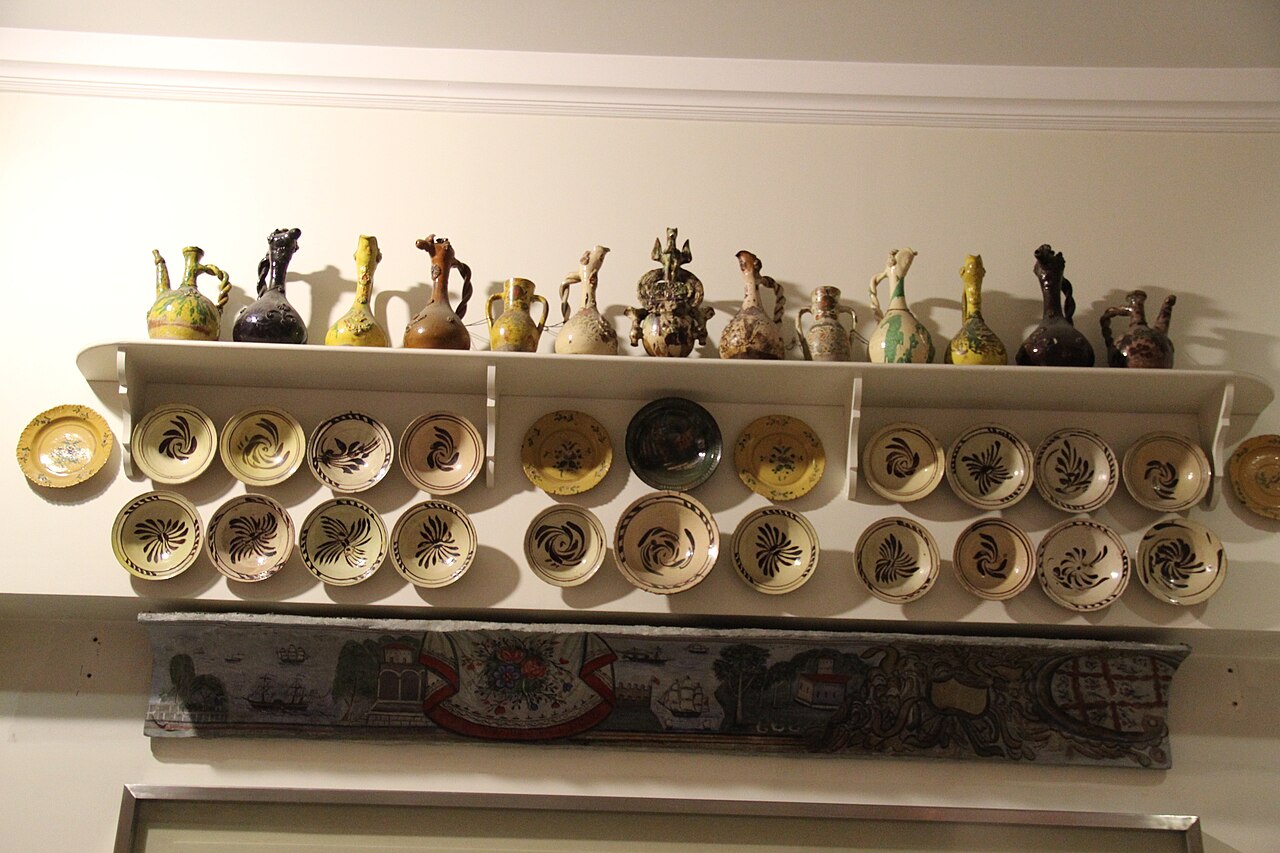
Museum displays are particularly useful because they place objects within a wider history of interiors, taste and material culture.
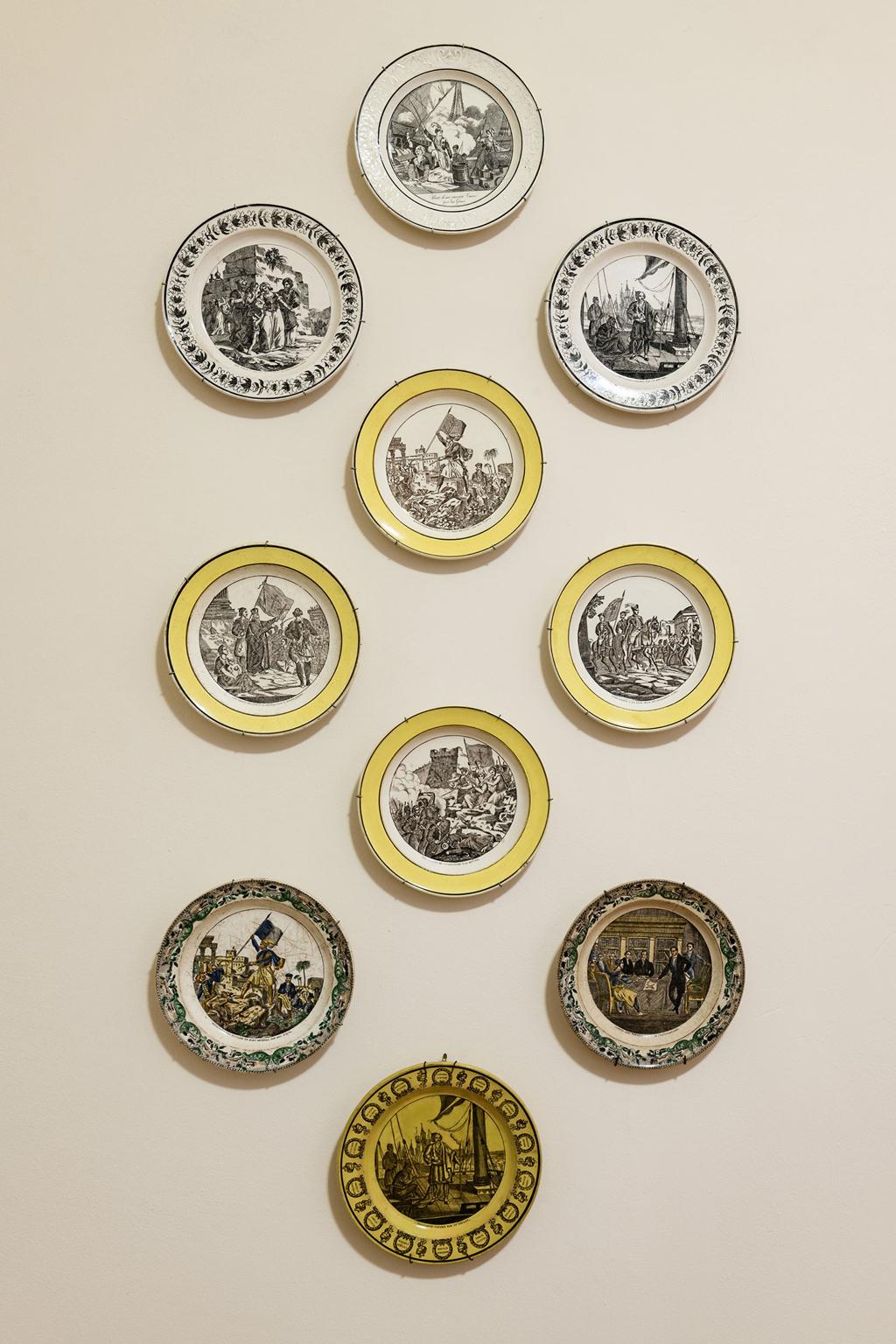
Porcelain, Taste and the Greek Interior
The presence of porcelain in Greek interiors also reminds us that the history of ceramics in Greece was never isolated from wider European and Mediterranean trade.
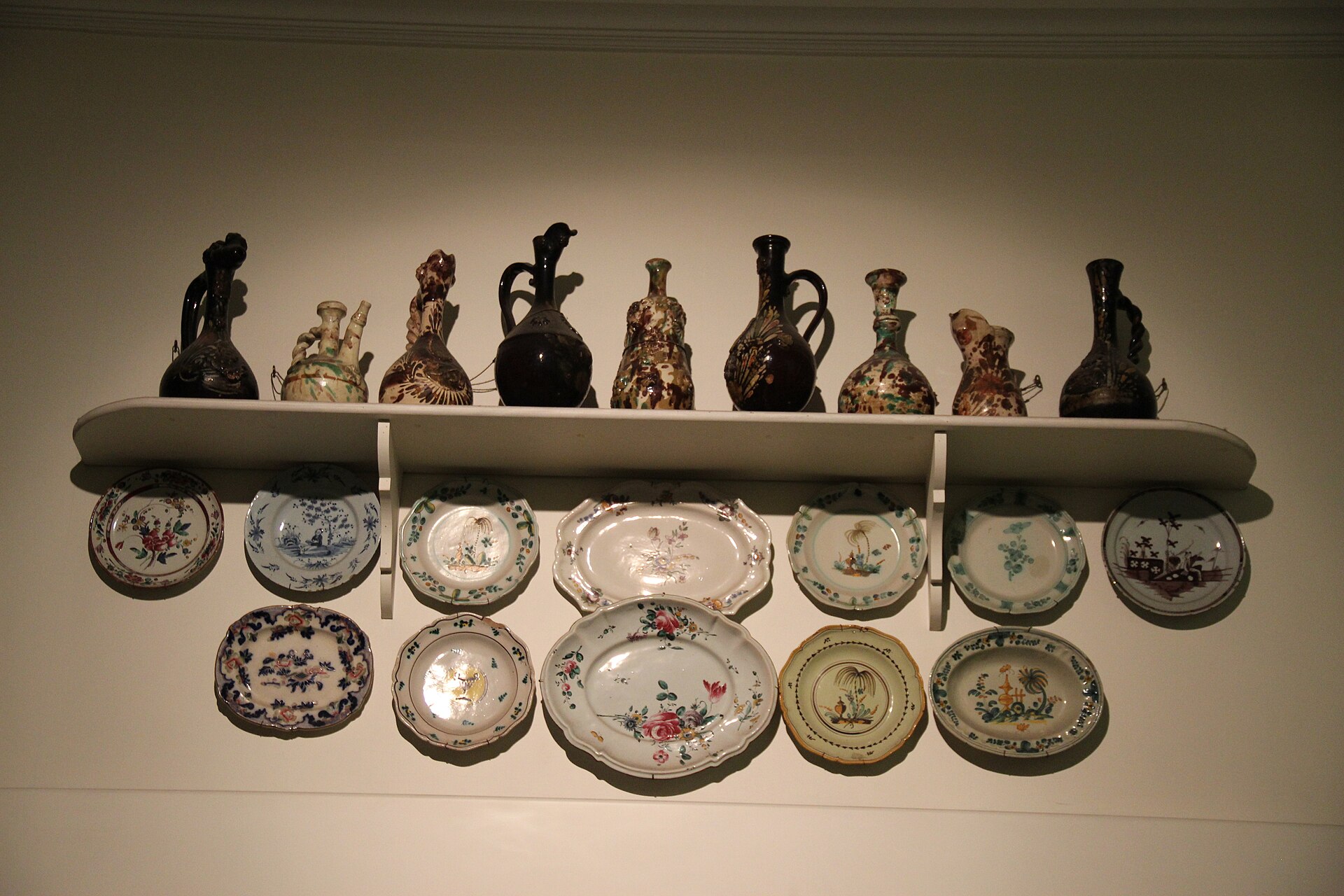
Imported porcelain, locally produced ceramics, inherited objects and decorative wares could exist within the same interior. Consequently, an object found in Greece should not automatically be assumed to have been manufactured there.
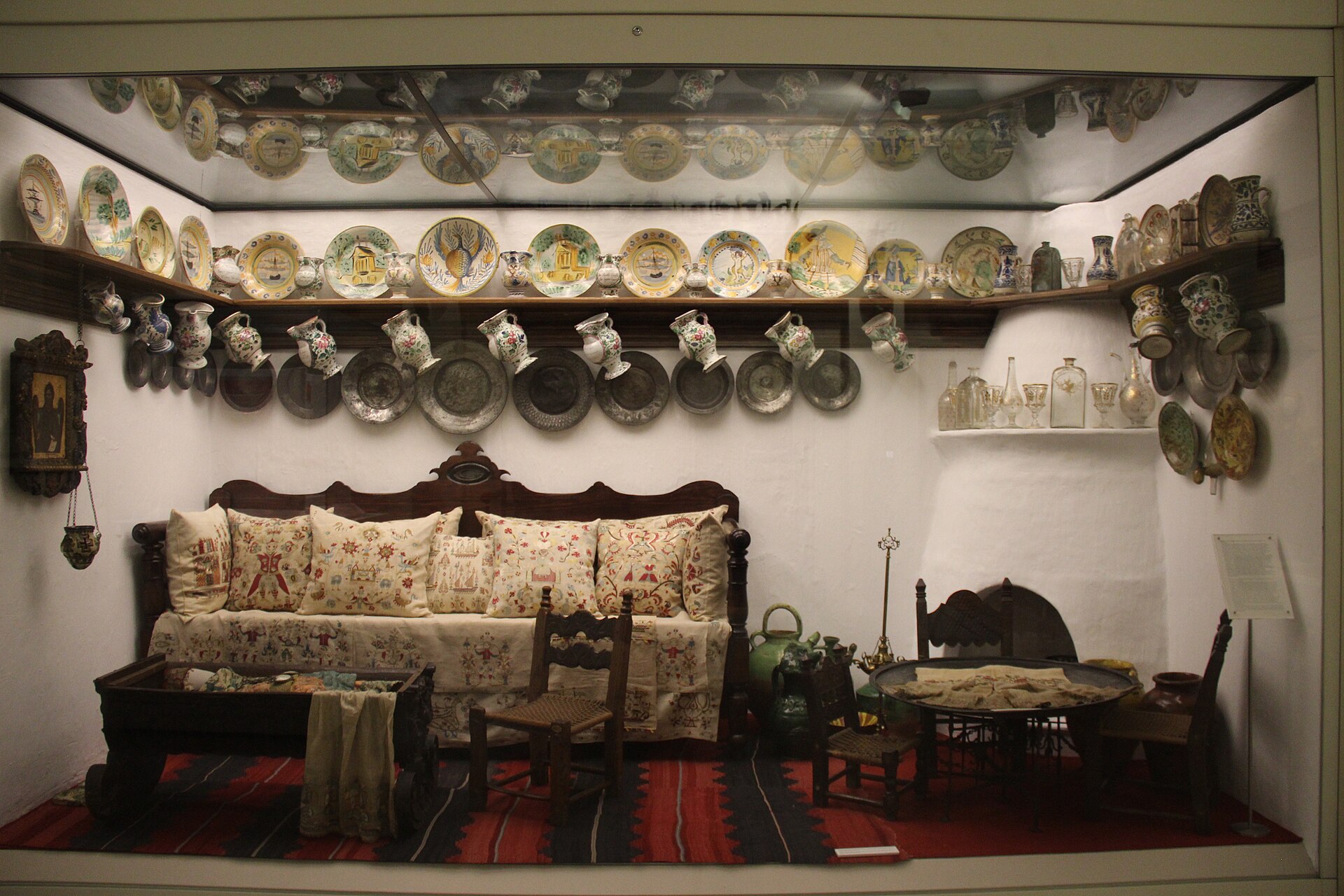
Provenance and place of discovery are not the same as place of manufacture. This simple distinction prevents many incorrect attributions.
The Rise of Tourism and Greek Ceramics
The extraordinary growth of Greek tourism during the twentieth century created a new audience for ceramics.
Visitors wanted objects that were attractive, recognisably Greek, relatively easy to transport and capable of preserving the memory of a journey. Ceramics were ideally suited to this market.
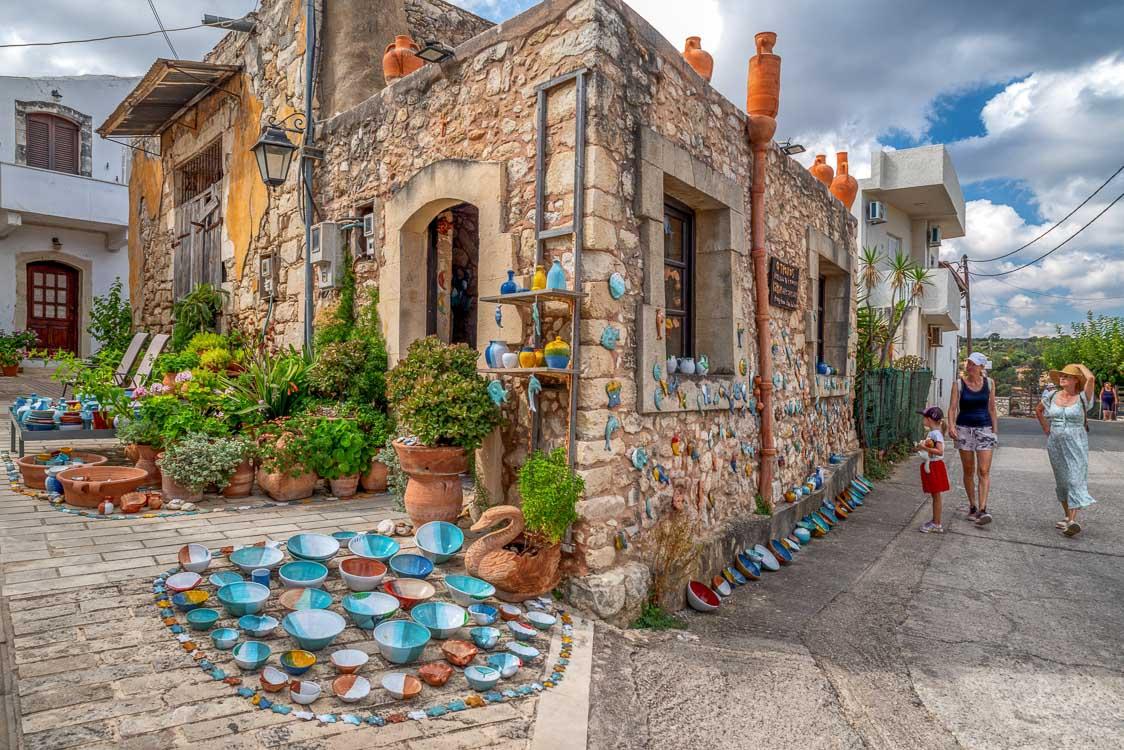
The result was not a single “tourist style”. Production ranged from inexpensive souvenir objects to accomplished hand-decorated ceramics created by skilled workshops and designers.
This distinction is increasingly important for collectors today. A piece originally sold to a visitor may still have artistic, historical or collector interest if it can be connected with an identifiable workshop, maker, designer or documented period.
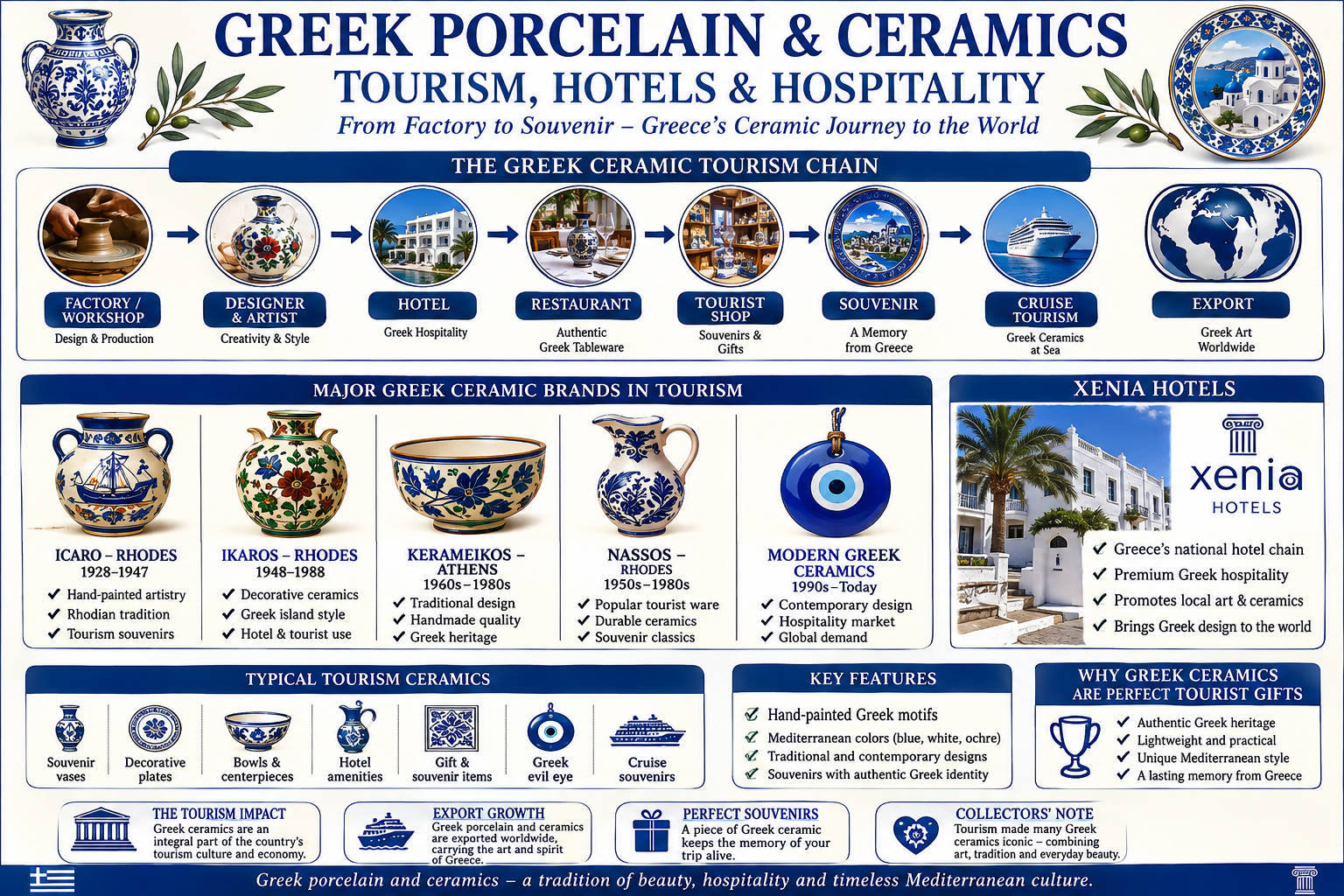
From Workshop to Souvenir – The Ceramic Tourism Chain
The growth of tourism created an entire ecosystem around Greek ceramics:
Workshop → Artist → Hotel → Restaurant → Tourist Shop → Souvenir → Traveller → International Collection
A locally made plate could be encountered in a hotel, purchased from an island shop and carried to Britain, Germany, France, Scandinavia or the United States. Decades later, that same object may appear at an estate sale or auction far from Greece.
This helps explain why vintage Greek ceramics are now encountered internationally.
Hotels, Restaurants and the New Image of Greece
Post-war tourism also changed how visitors encountered Greek design. Hotels, restaurants and resorts became spaces where architecture, furniture, tableware, textiles and decorative arts could contribute to an image of modern Greece.
Ceramics were naturally part of this environment. Functional tableware served practical needs, while decorative ceramics reinforced a sense of place.
For collectors, documented connections with a particular hotel, restaurant, resort or institutional setting can be especially interesting because they provide something that anonymous decorative objects often lack: provenance.
Why Tourist Ceramics Should Not Automatically Be Dismissed
“Souvenir” is sometimes used as if it automatically means cheap or uncollectible. Historically, this is too simplistic.
Tourist markets can support several levels of production simultaneously:
- mass-produced inexpensive souvenirs;
- small workshop production;
- hand-decorated ceramics;
- artist-designed pieces;
- hotel and restaurant ware;
- limited decorative series;
- export ceramics;
- high-quality objects sold through specialist retailers.
The important question is therefore not simply “Was this made for tourists?” but rather:
who made it, when, how, in what quantity, and with what level of craftsmanship?
Continue to Part 2: identification by shape and decoration, dating Greek ceramics, condition, rarity, collector value, the 10-step identification method, collector checklist, FAQ, references and professional evaluation.
How to Identify Vintage Greek Porcelain and Ceramics
Identifying vintage Greek porcelain and ceramics requires more than recognising a Greek motif or finding the word Greece on the base.
The most reliable approach is to examine several characteristics together:
mark, material, manufacturer, period, shape, decoration, manufacturing quality, rarity, condition and provenance.
This method is particularly useful for twentieth-century ceramics because Greek workshops produced objects for many different markets—from domestic tableware and decorative pieces to hotel ceramics, tourist souvenirs and export wares.
If you are still learning the fundamentals, our
complete guide to identifying antique porcelain
explains why the porcelain body, glaze, decoration, marks and natural wear should always be studied together.
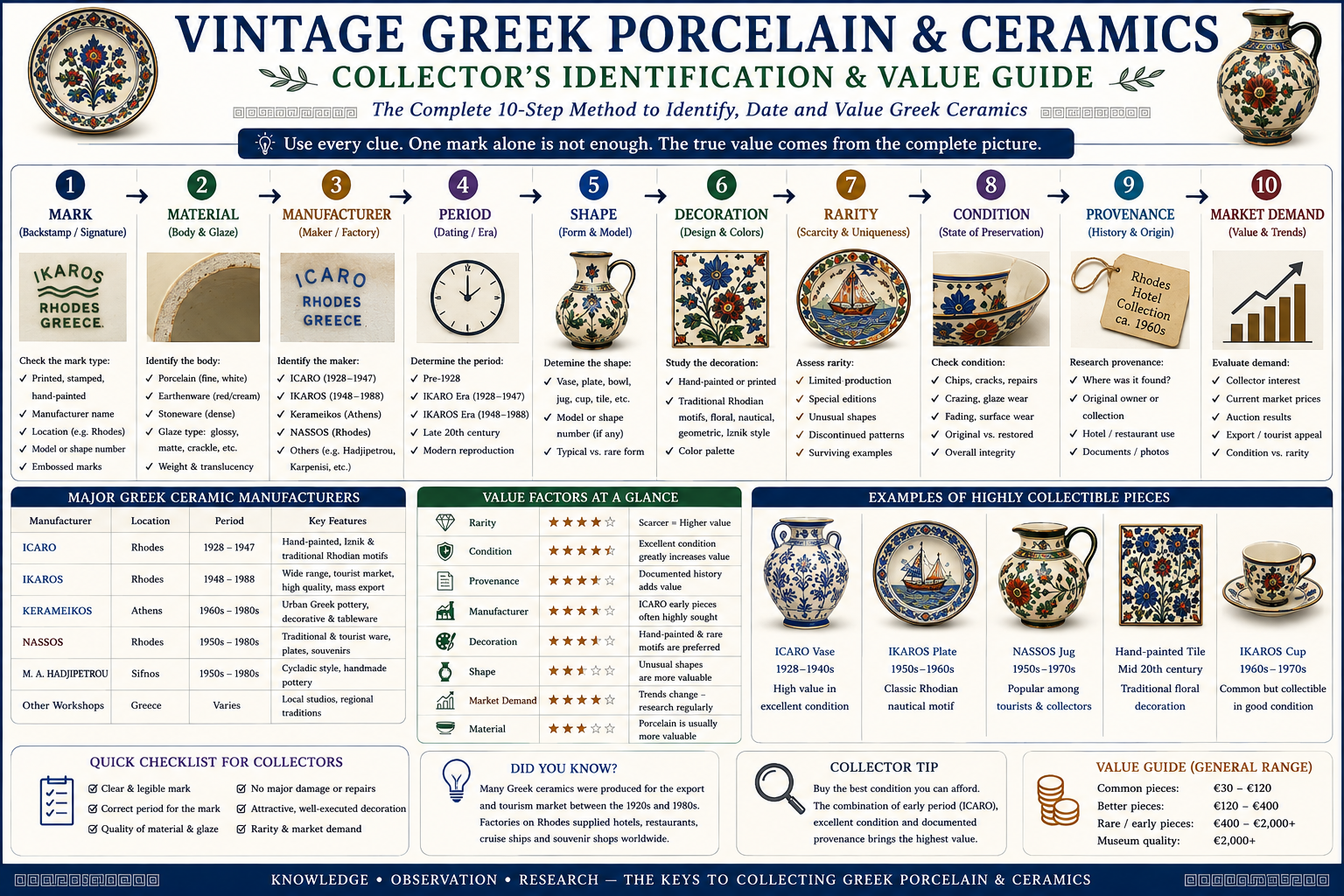
The 10-Step Greek Ceramics Identification Method
When examining an unidentified Greek ceramic object, use the following sequence rather than jumping directly to the factory mark.
| Step | Examine | What It May Reveal |
|---|---|---|
| 1 | Mark / Backstamp | Maker, workshop, origin or approximate period |
| 2 | Material | Porcelain, earthenware, stoneware or another ceramic body |
| 3 | Manufacturer | Possible factory or workshop attribution |
| 4 | Period | Historical and stylistic context |
| 5 | Shape | Possible function, design period or product family |
| 6 | Decoration | Technique, workshop tradition and stylistic influences |
| 7 | Rarity | How frequently comparable pieces appear |
| 8 | Condition | Preservation, restoration and completeness |
| 9 | Provenance | Documented ownership or historical context |
| 10 | Market Demand | Current collector interest and comparable realized sales |
1. Start with the Mark or Backstamp
Turn the object over and examine the entire base carefully.
Greek ceramic marks can appear as printed backstamps, painted signatures, handwritten inscriptions, impressed marks, workshop names, place names or combinations of these elements.
Look carefully for words such as Rhodes, Rodos, Greece, Hellas or a recognizable manufacturer or workshop name.
But remember an essential collector’s rule:
the object must confirm the mark—not the other way around.
Marks have been copied, reused and misunderstood. A convincing attribution requires consistency between the mark and the object’s material, shape, decoration, manufacturing method and expected period.
Our dedicated
Porcelain Marks Identification Guide
explains in greater detail how factory marks, backstamps, numbers and secondary marks should be interpreted.
2. Examine the Ceramic Body
Before calling an object porcelain, examine the body itself.
True porcelain generally has a dense, vitrified body. Depending on thickness and composition, some porcelain may show a degree of translucency when held against strong light.
Earthenware normally has a more porous body and is fired at lower temperatures. Stoneware is dense and durable but generally differs from porcelain in composition and appearance.
Pay particular attention to the unglazed foot ring. It can reveal the colour, texture and refinement of the ceramic body more clearly than the glazed surface.
3. Identify the Manufacturer or Workshop
A documented manufacturer can transform an anonymous decorative object into a historically identifiable piece.
For collectors of twentieth-century Greek ceramics, ICARO–IKAROS of Rhodes deserves particular attention.
The factory was established on Rhodes in 1928 as Industria Ceramiche Artistiche Rodio Orientali (I.C.A.R.O.). Its early production drew inspiration from the celebrated Iznik ceramics historically preserved in significant numbers on Rhodes, particularly around Lindos.
The factory’s production was extensive and included decorative plates, jars, pitchers, dinnerware, tile compositions, animal forms and other useful and decorative ceramics.
Production continued through the Greek period under the IKAROS name, and the history of the enterprise extends to 1988.
ICARO and IKAROS Rhodes – Why Collectors Care
ICARO and IKAROS pieces are interesting because they combine several collecting fields:
- Greek twentieth-century design;
- Rhodian history;
- Mediterranean decorative arts;
- industrial and workshop ceramics;
- tourism history;
- Iznik-inspired decoration;
- modern Greek material culture.
The Benaki Museum has devoted both an exhibition and a substantial scholarly publication to the factory, demonstrating its importance within the modern ceramic history of Rhodes.
4. Determine the Approximate Period
Dating Greek ceramics is rarely as simple as finding a year on the bottom.
Instead, compare the mark with the object’s form, decoration, glaze and manufacturing technique.
For ICARO–IKAROS in particular, the historical transition from the Italian-period ICARO production to later Greek IKAROS production provides an important chronological framework.
A documented example of an ICARO Rodi signature has been associated with approximately 1935, while documented Greek-period pieces bearing IKAROS RODOS are known from around 1950–1955.
These examples are useful reference points, but they should not be interpreted as universal dates for every variation of a mark.
For the general principles involved, see
How to Date Antique Porcelain.
5. Study the Shape
Shape is often underestimated when identifying vintage ceramics.
Look at the proportions of the body, handles, foot, rim, lid and spout. Compare these characteristics with documented examples from the suspected manufacturer.
Typical collectible Greek ceramic forms include:
- decorative wall plates;
- serving plates and platters;
- bowls;
- jugs and pitchers;
- vases;
- cups and saucers;
- coffee and tea wares;
- tiles and tile compositions;
- figurines;
- animal forms;
- souvenir objects.
6. Study the Decoration
Decoration can reveal both artistic influence and manufacturing technique.
Greek twentieth-century ceramics may display floral compositions, geometric patterns, stylised vegetation, ships, animals, figures and designs inspired by earlier Mediterranean traditions.
ICARO’s documented repertoire is particularly interesting. The factory produced ceramics influenced by Iznik decoration, including floral compositions featuring forms associated with tulips, hyacinths, roses and carnations, as well as representations of ships.
Collectors should determine whether the decoration is:
- hand-painted;
- stencilled;
- transfer-printed;
- incised;
- moulded;
- relief decorated;
- gilded;
- or produced through a combination of techniques.
Hand-Painted Does Not Automatically Mean Old
One common collecting mistake is assuming that visible brushwork automatically indicates considerable age.
Hand decoration continued throughout the twentieth century and remains part of ceramic production today.
Instead, examine whether the painting technique, pigments, glaze, design and manufacturing quality are consistent with the suspected period and workshop.
7. Determine Rarity
Age and rarity are not the same thing.
An older piece produced in large numbers may be easier to find than a later experimental form or short-lived decorative series.
Rarity can depend on:
- production quantity;
- survival rate;
- unusual shape;
- rare decoration;
- early or uncommon mark;
- documented designer;
- special commission;
- limited production;
- institutional use;
- complete surviving sets.
What Makes a Greek Ceramic Collectible?
| Factor | Potential Collector Importance |
|---|---|
| Recognised maker | Provides attribution and historical context |
| Early production | Can be scarcer than later mass-market production |
| Rare mark | May help identify a shorter production period |
| Hand decoration | May increase artistic and collector interest |
| Unusual form | Can be more difficult to find than ordinary tableware |
| Complete set | Often more desirable than isolated pieces |
| Provenance | Can establish historical context and strengthen attribution |
| Excellent condition | Usually preferred by collectors |
8. Check the Condition Carefully
Condition can significantly influence the desirability and market value of vintage Greek ceramics.
Inspect the object under good light and check for:
- rim chips;
- hairline cracks;
- star cracks;
- restored handles;
- repaired spouts;
- glaze loss;
- heavy scratching;
- staining;
- repainting;
- loss of gilding;
- missing lids or components.
Natural signs of use are not necessarily serious problems. A small amount of wear consistent with age may be expected.
Structural damage and extensive restoration, however, normally have a much greater effect on collector value.
Crazing – Is It a Sign of Age?
Fine networks of cracks in a glaze are known as crazing.
Crazing can develop as ceramic bodies and glazes respond differently over time, but its presence alone cannot prove that an object is old.
Modern ceramics can craze as well.
Treat crazing as one observation among many—not as an authenticity test.
9. Investigate Provenance
Provenance is the documented history of an object: where it came from, who owned it and, in some cases, where it was originally used.
For Greek ceramics, useful provenance might include:
- original purchase receipts;
- old photographs;
- factory labels;
- retailer labels;
- hotel or restaurant documentation;
- family records;
- exhibition history;
- collection inventories;
- old packaging;
- auction records.
A story told by a previous owner can provide a useful lead, but documented evidence carries considerably more weight.
Hotel and Restaurant Provenance
Because tourism played such an important role in twentieth-century Greece, ceramics associated with historic hotels, restaurants, resorts or ships can be particularly interesting.
Institutional provenance can transform an ordinary piece of tableware into an object connected with the history of Greek tourism and hospitality.
Original photographs, invoices, hotel logos or documented ownership can strengthen such an attribution.
10. Study Market Demand
The final step is the one most often skipped: determine whether collectors are actually buying comparable objects.
An asking price is not the same as market value.
A seller can ask any amount for an object. What matters more is evidence from realized sales of genuinely comparable pieces.
Compare:
- the same manufacturer;
- similar period;
- similar mark;
- comparable size;
- similar decoration;
- similar condition;
- similar rarity;
- and, where possible, comparable provenance.
How Much Is Vintage Greek Porcelain Worth?
There is no universal price for vintage Greek porcelain or ceramics.
Two objects made by the same factory can have dramatically different values.
Value depends on the interaction of several factors:
Maker + Period + Rarity + Design + Condition + Provenance + Demand = Market Value
A common piece of souvenir pottery and a scarce, documented early factory piece should therefore never be valued according to the same formula.
Factors That Can Increase Collector Value
- Documented manufacturer – particularly when the maker is actively collected.
- Early or scarce production – especially when supported by reliable dating evidence.
- Rare decoration – unusual motifs or less frequently encountered patterns may attract greater interest.
- Designer attribution – documented artistic authorship can create another collecting dimension.
- Large or unusual forms – distinctive shapes may be harder to find.
- Excellent condition – particularly important for fragile ceramics.
- Complete sets – surviving groups may be more desirable than individual components.
- Provenance – documented history can substantially increase historical significance.
- Collector demand – ultimately, rarity matters most when collectors want the object.
What Can Reduce Value?
- major cracks;
- large chips;
- poor restoration;
- repainting;
- missing lids or components;
- heavy decoration loss;
- incorrect attribution;
- common mass-market production;
- weak or uncertain provenance;
- low collector demand.
Greek Tourist Ceramics – Collectible or Common?
Both.
Tourist ceramics form a very broad category, and their quality ranges enormously.
Some were inexpensive objects manufactured in large numbers. Others were made or decorated by established workshops and reflect important developments in Greek twentieth-century design and tourism.
This is why collectors should avoid dismissing an object simply because it was purchased as a souvenir.
A well-documented workshop piece acquired by a traveller decades ago may now provide an excellent historical record of the development of Greek tourism.
Common Mistakes When Identifying Greek Ceramics
| Mistake | Better Approach |
|---|---|
| Assuming every Greek ceramic is porcelain | Identify the ceramic body first |
| Dating from the mark alone | Compare mark, material, shape, glaze and decoration |
| Assuming hand-painted means antique | Compare technique with documented production |
| Calling all Rhodes ceramics IKAROS | Confirm the factory through marks and documented examples |
| Assuming Greece on the base identifies the maker | Treat country wording as only one clue |
| Using asking prices as valuations | Research comparable realized sales |
| Ignoring restoration | Inspect the entire object before assessing value |
Collector Checklist
Before buying, selling or identifying vintage Greek ceramics:
☐ Photograph the entire object.
☐ Photograph the base and every mark.
☐ Determine whether it is actually porcelain.
☐ Identify the manufacturer or workshop if possible.
☐ Compare the mark with documented examples.
☐ Examine the shape and construction.
☐ Identify the decoration technique.
☐ Check the glaze and ceramic body.
☐ Look for chips, cracks and restoration.
☐ Research the production period.
☐ Investigate provenance.
☐ Compare genuinely similar realized sales.
Frequently Asked Questions About Greek Porcelain and Ceramics
Is there antique Greek porcelain?
Yes, porcelain objects have long circulated and been used in Greece, but collectors should distinguish between porcelain made in Greece, imported porcelain found in Greece and the much broader tradition of Greek pottery and ceramics. For twentieth-century collecting, many important Greek objects are ceramics but not necessarily porcelain.
What is IKAROS Rhodes pottery?
IKAROS is associated with the important twentieth-century ceramic factory of Rhodes whose history began with ICARO in 1928. The factory became closely connected with the modern ceramic and industrial history of the island and continued production until 1988.
What does ICARO Rhodes mean?
ICARO refers to Industria Ceramiche Artistiche Rodio Orientali, established on Rhodes in 1928 during the Italian administration of the Dodecanese. Its production included a broad range of decorative and functional ceramics.
Are ICARO and IKAROS the same factory?
They belong to the historical development of the same Rhodian ceramic enterprise, but the names relate to different historical phases. This distinction can be important when dating and researching individual pieces.
How can I identify an IKAROS Rhodes mark?
Begin with the complete inscription or symbol on the base, then compare it with documented factory examples. Never authenticate an IKAROS piece solely from a logo: material, glaze, shape, decoration and manufacturing quality should also be consistent.
Are old Greek ceramics valuable?
Some can be. Manufacturer, rarity, period, artistic quality, condition, provenance and collector demand are much more important than nationality alone.
Are Greek souvenir ceramics collectible?
Yes, certain examples are collectible, particularly when they can be attributed to a documented workshop, designer or manufacturer or when they represent an important period in the development of Greek tourism and design.
Does crazing prove that Greek pottery is old?
No. Crazing can occur on both older and newer ceramics. It should never be used as the sole evidence of age.
How do I date vintage Greek ceramics?
Compare the mark, material, shape, decoration, glaze and manufacturing method with documented examples. Historical factory information and museum references can then help narrow the likely production period.
Where are Greek ceramic marks usually found?
Most identifying information is found on the underside or foot of an object. Marks may be printed, painted, handwritten, impressed or incised, and additional numbers or decorator’s signs may also appear.
Research Before You Buy
Good collecting depends on comparison rather than intuition.
Whenever possible, compare an object with museum collections, documented exhibitions, specialist publications, factory archives and reputable auction records.
For ICARO–IKAROS, one particularly important reference is the research associated with the Benaki Museum exhibition and publication devoted to ICARO–IKAROS: The Pottery Factory of Rhodes 1928–1988.
The existence of extensive documented research is especially valuable because it allows collectors to move beyond internet folklore and compare objects with historically grounded information.
Sources & References
- Benaki Museum – ICARO – IKAROS: The Pottery Factory of Rhodes 1928–1988, exhibition and accompanying scholarly publication.
- Municipality of Rhodes – historical material concerning the ICARO–IKAROS ceramic factory and its role in the economy and ceramic history of Rhodes.
- The Old Antiquarian – Guide to Antique Porcelain: Identification, Marks, Manufacturers, History & Values.
- The Old Antiquarian – How to Identify Porcelain Marks: The Complete Guide to Porcelain Backstamps and Maker’s Marks.
- The Old Antiquarian – How to Date Antique Porcelain: A Complete Guide to Determining Age.
Final Collector’s Advice
Vintage Greek porcelain and ceramics deserve to be studied as more than souvenirs. They tell a much larger story about craftsmanship, industrial development, Mediterranean design, changing tastes, tourism and the international image of modern Greece.
Rhodes is especially fascinating. The history of ICARO and IKAROS demonstrates how older decorative traditions could be reinterpreted through twentieth-century production and transformed into objects that travelled far beyond the island.
For collectors, however, the fundamental rule remains simple:
never rely on one clue.
A convincing identification emerges when the mark, material, manufacturer, period, shape, decoration, craftsmanship, condition and provenance tell the same story.
And when determining value, add one final element: evidence of what comparable objects actually sell for.
About The Old Antiquarian
The Old Antiquarian draws on more than 35 years of experience with antiques and collecting. Our guides are created to help collectors identify, research, preserve and better understand historic objects through careful examination, comparison and documented sources.
Identification and valuation should always consider the complete object rather than relying on a single mark, photograph or characteristic.
Last Updated: August 2026
Related Guides
-
Guide to Antique Porcelain: History, Identification, Marks & Manufacturers
-
How to Identify Antique Porcelain
-
How to Identify Porcelain Marks & Backstamps
-
How to Date Antique Porcelain
Do You Have Vintage Greek Porcelain or Ceramics?
If you own an old Greek plate, vase, tea or coffee set, decorative ceramic, ICARO or IKAROS Rhodes piece, photographs of the object and its marks can help establish its manufacturer, approximate period and collector interest.
