
What is Yugoslav Porcelain ? Identification Guide
Yugoslav Porcelain: History, Factories, Marks & Identification Guide
Vintage Yugoslav porcelain is one of the most fascinating yet still relatively under-documented fields of 20th-century European collecting. Produced across the territories that formed Yugoslavia, it ranges from elegant porcelain coffee services and decorative wares to modernist tableware, hotel porcelain, restaurant services and everyday household ceramics.
For collectors, however, the expression “Yugoslav porcelain” can be misleading. Yugoslavia was not a single ceramic tradition. It brought together regions with very different histories of pottery, ceramics, porcelain and industrial production, including Slovenia, Croatia, Bosnia and Herzegovina, Serbia, Vojvodina, Kosovo, Macedonia and Montenegro.
Some ceramic industries had roots that pre-dated Yugoslavia, while other factories were established, nationalised, reorganised or greatly expanded during the socialist period. After the breakup of Yugoslavia, several manufacturers disappeared, changed ownership or continued under new names.
This guide follows that history from the earlier regional ceramic traditions to the major manufacturers of socialist Yugoslavia. It also explains how collectors can identify Yugoslav porcelain marks, backstamps, manufacturers, production periods and designs. For a broader introduction to porcelain history and collecting, see our
complete guide to antique porcelain.
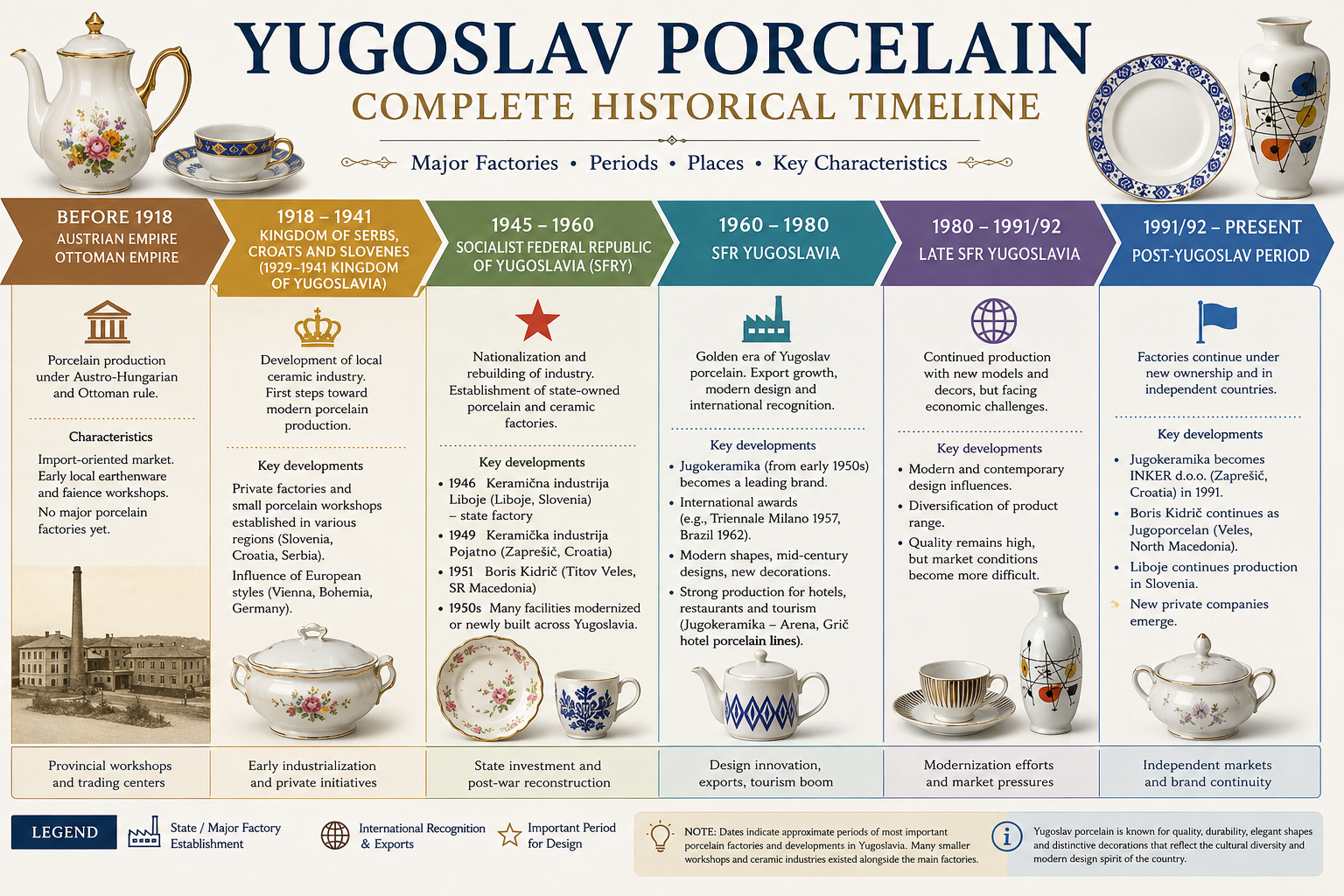
What Is Yugoslav Porcelain?
In the antiques and vintage market, the term Yugoslav porcelain generally describes porcelain produced within the territories of former Yugoslavia, particularly during the decades following the Second World War.
Surviving objects include:
- dinner and table services;
- tea and coffee sets;
- cups and saucers;
- plates, bowls and serving dishes;
- vases and decorative porcelain;
- figurines and ornamental objects;
- hotel and restaurant tableware;
- commemorative and institutional pieces;
- modernist and designer ceramics.
Collectors should remember that not every ceramic object marked Yugoslavia is technically porcelain. Earthenware, stoneware and other ceramic bodies were also widely manufactured.
Correctly identifying the material should therefore be part of the examination rather than being assumed from the country mark alone. Our
guide to identifying antique porcelain
explains the physical characteristics collectors can examine when distinguishing porcelain from related ceramic materials.
Why Yugoslav Porcelain Can Be Difficult to Identify
Identification is complicated by the political and industrial history of the region. Borders changed, cities changed names, factories were reorganised and manufacturers sometimes used several different marks over the course of their existence.
A single object may carry a factory name, trade name, city, model number, decoration code or simply an export inscription such as Made in Yugoslavia.
Understanding
porcelain marks and backstamps
is therefore one of the most useful starting points when researching an unidentified Yugoslav piece.
The most reliable identification method combines several clues:
mark → factory → location → historical period → material → form → decoration → model number → condition.
If the backstamp is difficult to interpret, our
step-by-step porcelain marks identification guide
explains how to examine factory symbols, maker’s names, country inscriptions, numbers and other markings.
Porcelain and Ceramics Before Yugoslavia
The history of Yugoslav ceramics did not begin with Yugoslavia itself.
Several regions already possessed established pottery and ceramic traditions during the 19th and early 20th centuries. This is particularly important when studying Slovenia and Croatia, where industrial ceramic production developed within the economic and cultural environment of the Habsburg and Austro-Hungarian worlds.
When the Kingdom of Serbs, Croats and Slovenes was created in 1918, these existing traditions did not disappear. They became part of a new political and economic framework.
For collectors today, this means that the history of a Yugoslav-era factory may extend decades — sometimes considerably longer — into the pre-Yugoslav period.
Liboje: A Ceramic Tradition Older Than Yugoslavia
One of the clearest examples is Liboje near Celje, in present-day Slovenia.
The industrial lineage associated with Liboje reaches back to 1815. In 1870, the Schütz brothers from Moravia established a factory on the site that later became associated with the Liboje ceramic industry.
In 1922, the factory was taken over, together with a smaller works at Slovenski Dol, by the Zagorka company of Zagreb.
Following the Second World War, the industry was reorganised. In 1946, the government of the People’s Republic of Slovenia established Keramična industrija Liboje pri Celju. The enterprise was subsequently reorganised again, including an important change in 1974.
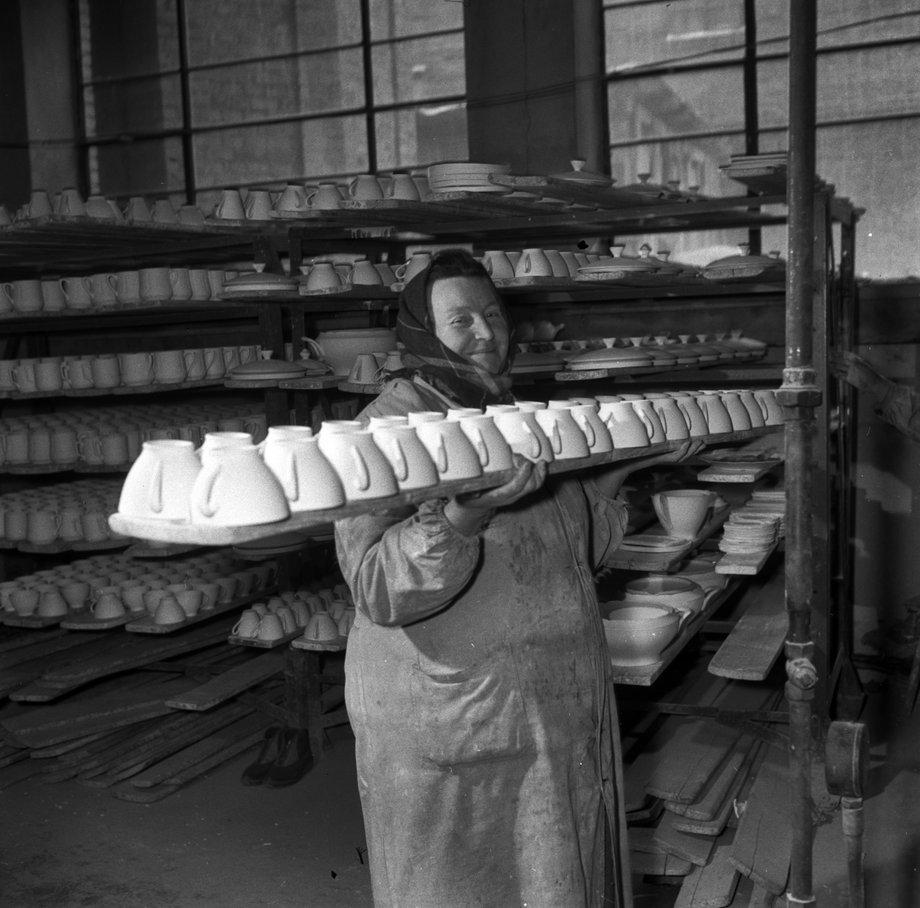
Liboje demonstrates why the history of Yugoslav ceramics cannot simply begin in 1945. Industrial knowledge, workers, production facilities and regional ceramic traditions could survive major political transformations.
From the Kingdom of Yugoslavia to Socialist Yugoslavia
The Kingdom of Serbs, Croats and Slovenes was established in 1918 and renamed the Kingdom of Yugoslavia in 1929.
Ceramic production during the interwar decades remained regionally diverse. Some areas inherited older workshops and factories, while others had much more limited industrial production.
The major transformation came after the Second World War.
Industrialisation became one of the central economic objectives of socialist Yugoslavia. Existing enterprises were reorganised, new factories were created and industrial production expanded to serve a rapidly urbanising population.
Porcelain and ceramics became part of everyday Yugoslav life — in private homes, cafés, restaurants, hotels, workplaces, institutions and the rapidly developing tourism industry.
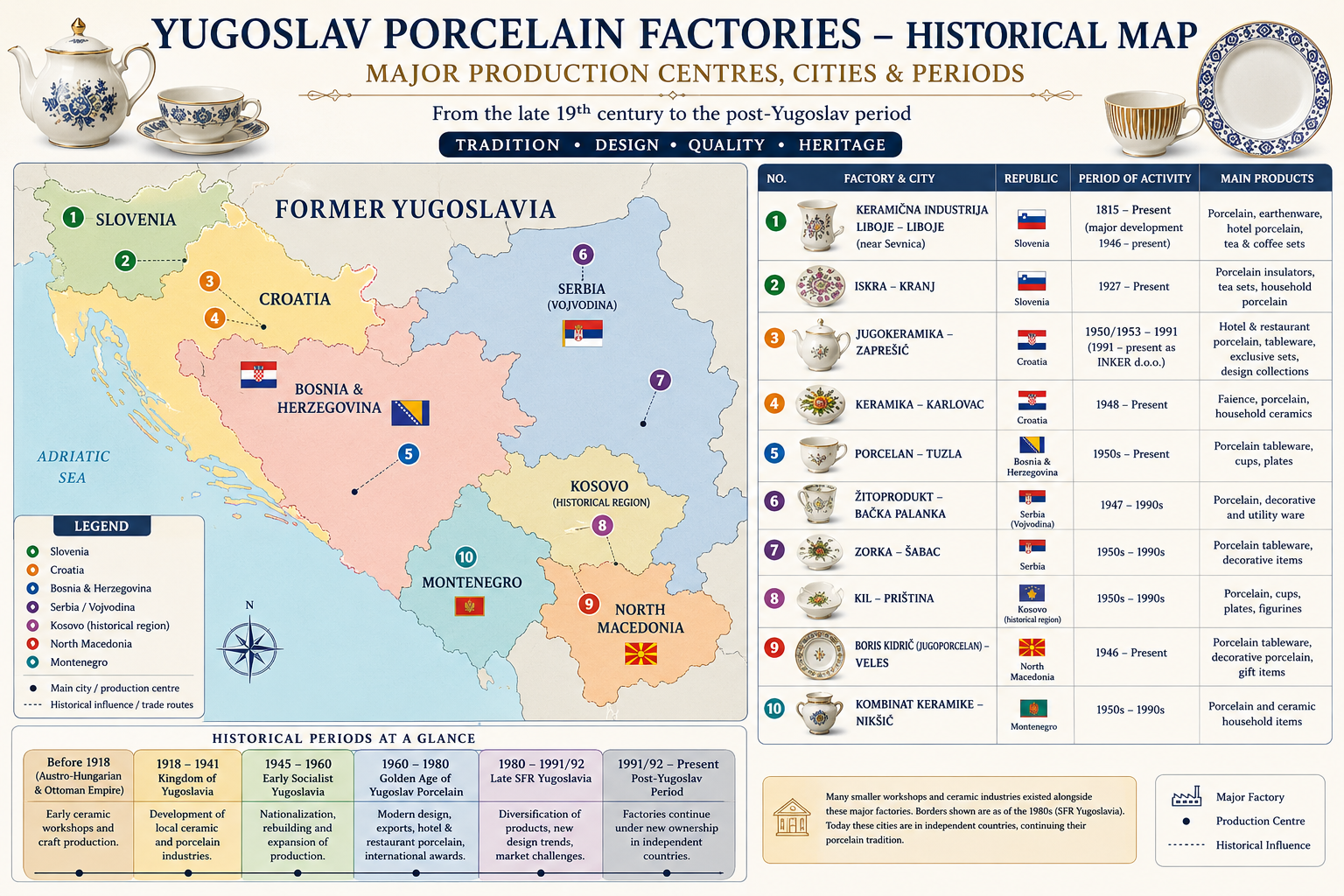
Major Yugoslav Porcelain and Ceramic Production Centres
The following table provides a practical historical framework for collectors. It should not be interpreted as suggesting that every producer manufactured the same ceramic body or that every surviving product was porcelain.
| Factory / Tradition | Location | Historical Region | Important Period | Known Production |
|---|---|---|---|---|
| Keramična industrija Liboje | Liboje / Celje | Slovenia | Pre-Yugoslav roots; major Yugoslav-era production | Ceramics, decorative and household wares |
| Jugokeramika | Zaprešić | Croatia | 1950–1991 | Porcelain tableware, household porcelain and hospitality ware |
| Inker | Zaprešić | Croatia | From 1991 | Porcelain tableware and professional hospitality porcelain |
| Boris Kidrič / Jugoporcelan | Veles / Titov Veles | Macedonia | Socialist Yugoslav period | Porcelain tableware, coffee services and decorated porcelain |
| Ceramic production in Zaječar | Zaječar | Serbia | 20th century | Household ceramics and tableware; individual pieces require mark verification |
| Other regional manufacturers | Various | Across Yugoslavia | Various | Household, decorative, industrial and hospitality ceramics |
Jugokeramika Zaprešić: A Major Yugoslav Porcelain Manufacturer
Among the most important and best-documented names in Yugoslav porcelain history is Jugokeramika of Zaprešić, near Zagreb in present-day Croatia.
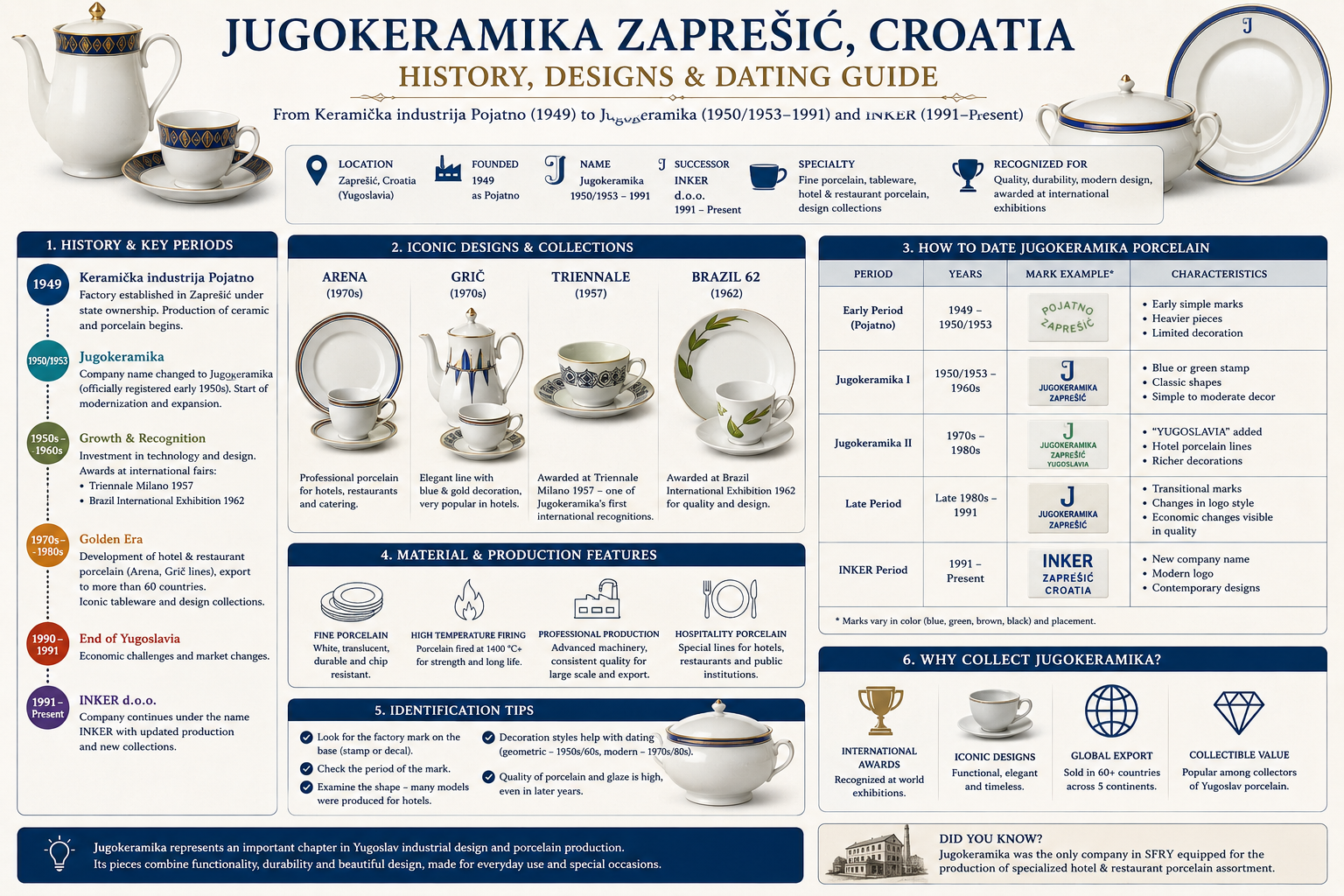
The enterprise was legally established in 1949 as Keramička industrija Pojatno. The Jugokeramika name was adopted in 1950, experimental production developed during the early 1950s and regular production followed.
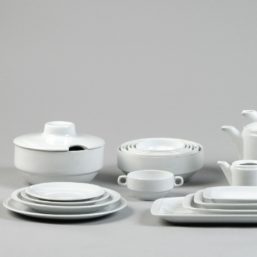
Jugokeramika became significant not merely because of the scale of its manufacturing. The company also became an important meeting point between industrial production and modern Yugoslav design.
Jugokeramika and Yugoslav Industrial Design
During the 1950s, Jugokeramika increasingly incorporated professional design into industrial production.
Designers associated with the company included Jelena Antolčić, Dragica Perhač, Anica Kuhta Severin and Marta Šribar.
An important international success came in 1957, when Marta Šribar’s Triennale service received a silver medal at the XI Milan Triennale.
Another important design followed in 1962 with Dragica Perhač’s Brazil service, documented as the first Yugoslav dining and coffee service manufactured from thin porcelain.
These objects demonstrate why Yugoslav porcelain should not be viewed only as mass-produced household ware. Some factory production belongs directly to the history of post-war European industrial design.
How to Recognise Jugokeramika Porcelain
When examining a possible Jugokeramika object, begin with the underside.
Depending on the production period and product line, collectors may encounter factory wording, symbols, export information, model numbers or later Inker marks.
This is the same basic principle used when researching many European porcelain manufacturers: the backstamp provides an important starting point, but it must agree with the porcelain body, shape, glaze and decoration. See
What Are Porcelain Marks?
for a detailed explanation of the different types of factory marks and backstamps.
The corporate history provides a useful broad chronological framework:
- 1949–1950: Keramička industrija Pojatno;
- 1950–1991: Jugokeramika;
- from 1991: Inker;
- later production continued through successor structures.
A factory name alone is not sufficient for precise dating. The backstamp should be compared with the shape, decoration, porcelain body and documented period designs.
The same evidence-based approach is explained in our
complete guide to dating antique porcelain.
Jugokeramika and Yugoslav Modernism
Mid-century Yugoslavia developed a distinctive design culture that combined modern European aesthetics with the industrial structures of a socialist state.
Porcelain provides a particularly tangible expression of that period.
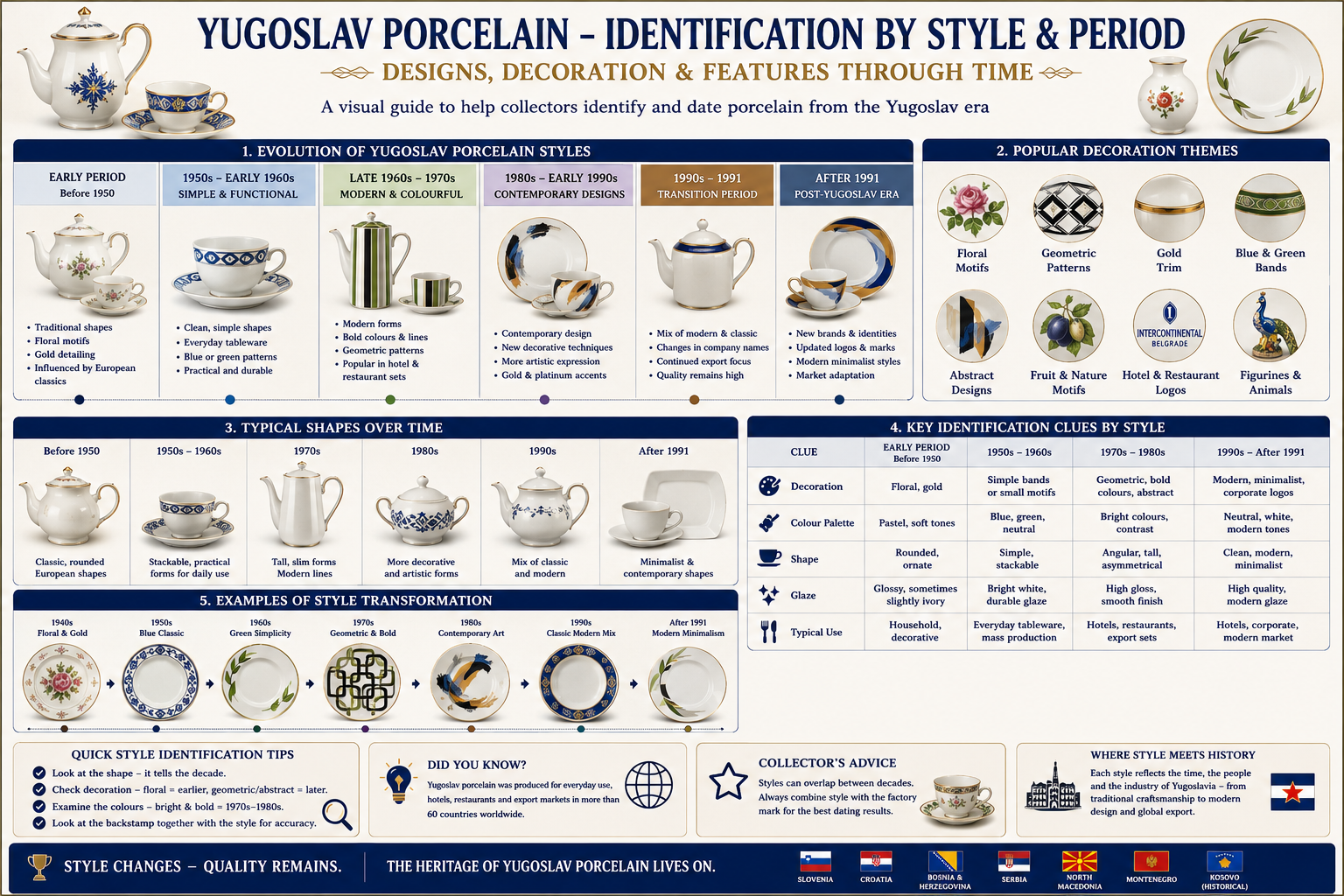
Traditional floral decoration and gilding continued to be produced, but alongside them appeared cleaner silhouettes, geometric decoration, restrained colour combinations, stackable forms and products intended for modern apartments, cafés, hotels and restaurants.
Collectors should therefore not expect all Yugoslav porcelain to resemble traditional European antique porcelain.
Some of the most historically interesting pieces are deliberately simple, functional and modern.
Yugoslav Hotel and Restaurant Porcelain
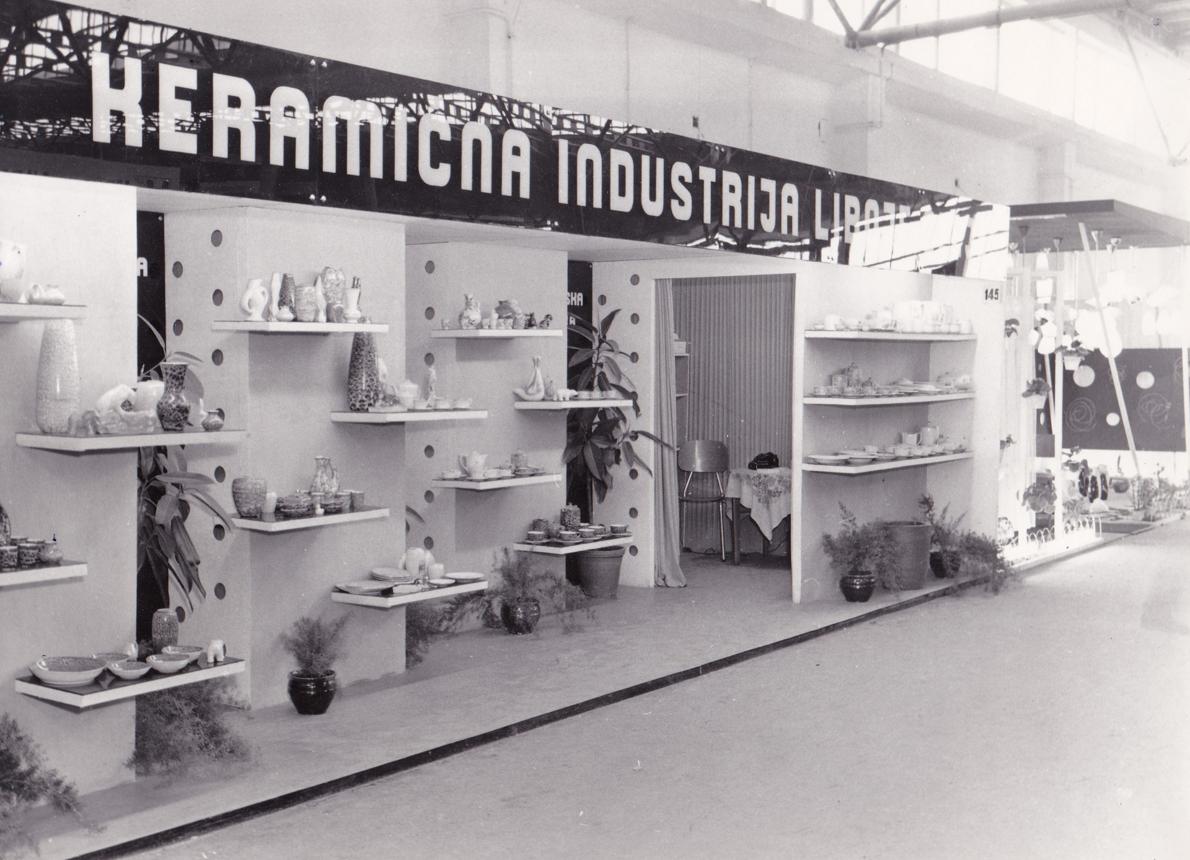
One of the most historically interesting aspects of Yugoslav porcelain is its relationship with the country’s rapidly expanding hospitality and tourism industries.
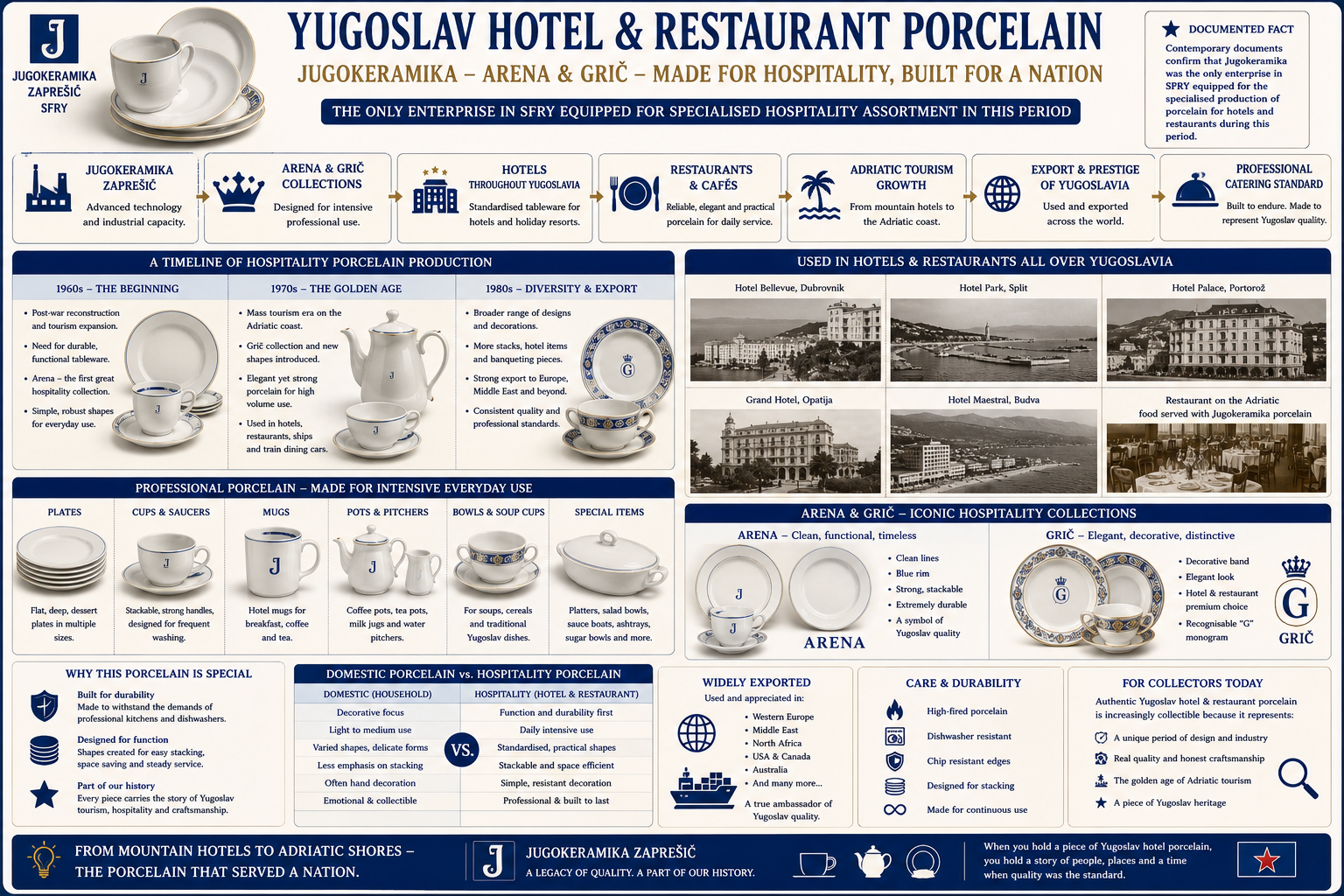
During the 1970s, Jugokeramika increasingly developed ugostiteljski porculan — porcelain specifically intended for professional hospitality use.
Jugokeramika became the only enterprise in the Socialist Federal Republic of Yugoslavia equipped during this period for specialised production of this hospitality assortment. Among the best-known services associated with this field were Arena and Grič.
Professional porcelain had different requirements from delicate domestic tableware. Important characteristics included:
- durability;
- standardised forms;
- practical handling;
- stackability;
- resistance to intensive use;
- easy replacement of individual pieces;
- suitability for hotels, restaurants, cafés and catering.
Porcelain and the Rise of Adriatic Tourism
The expansion of modern hotels and resorts along the Adriatic coast created substantial demand for professional restaurant equipment, glassware, cutlery, textiles and tableware.
Porcelain therefore became more than a household product. It formed part of the material culture and visual identity of Yugoslav hospitality.
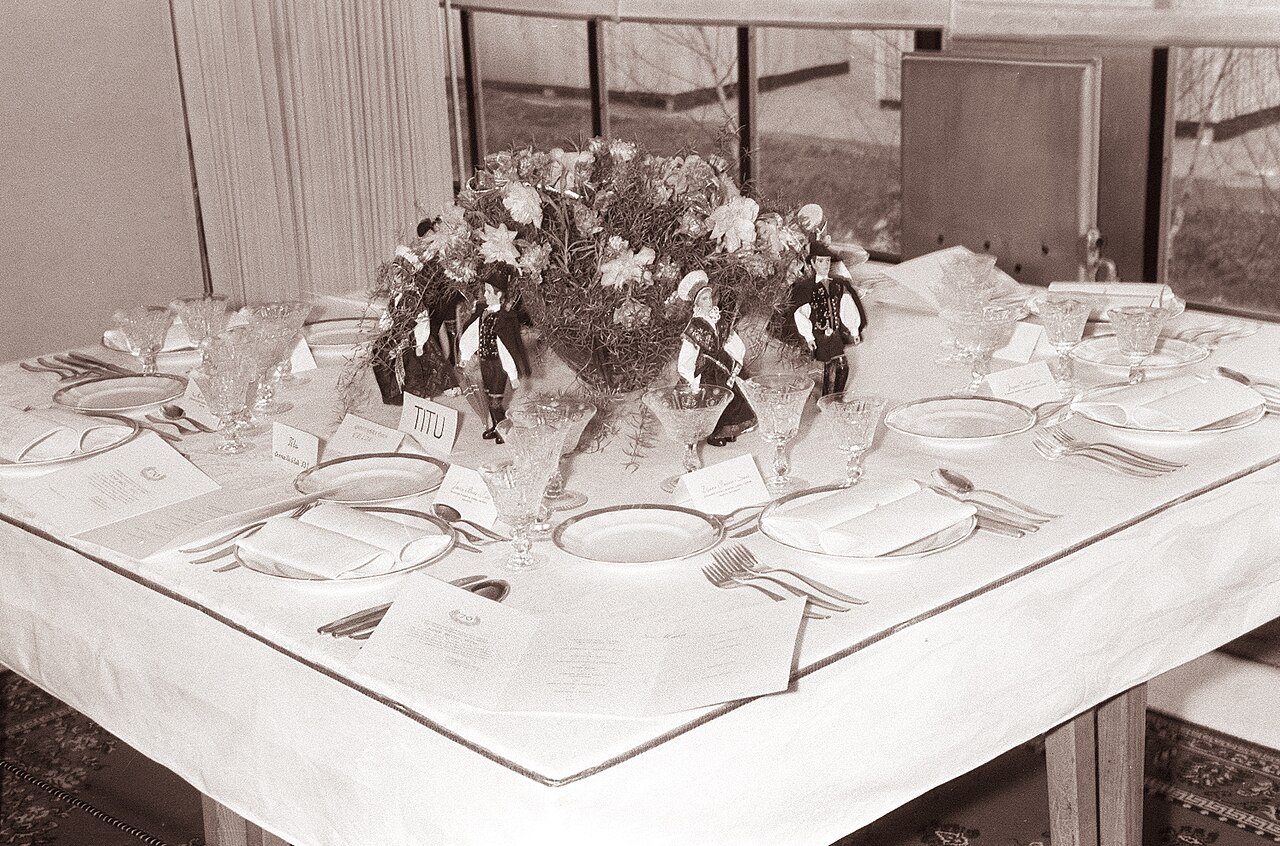
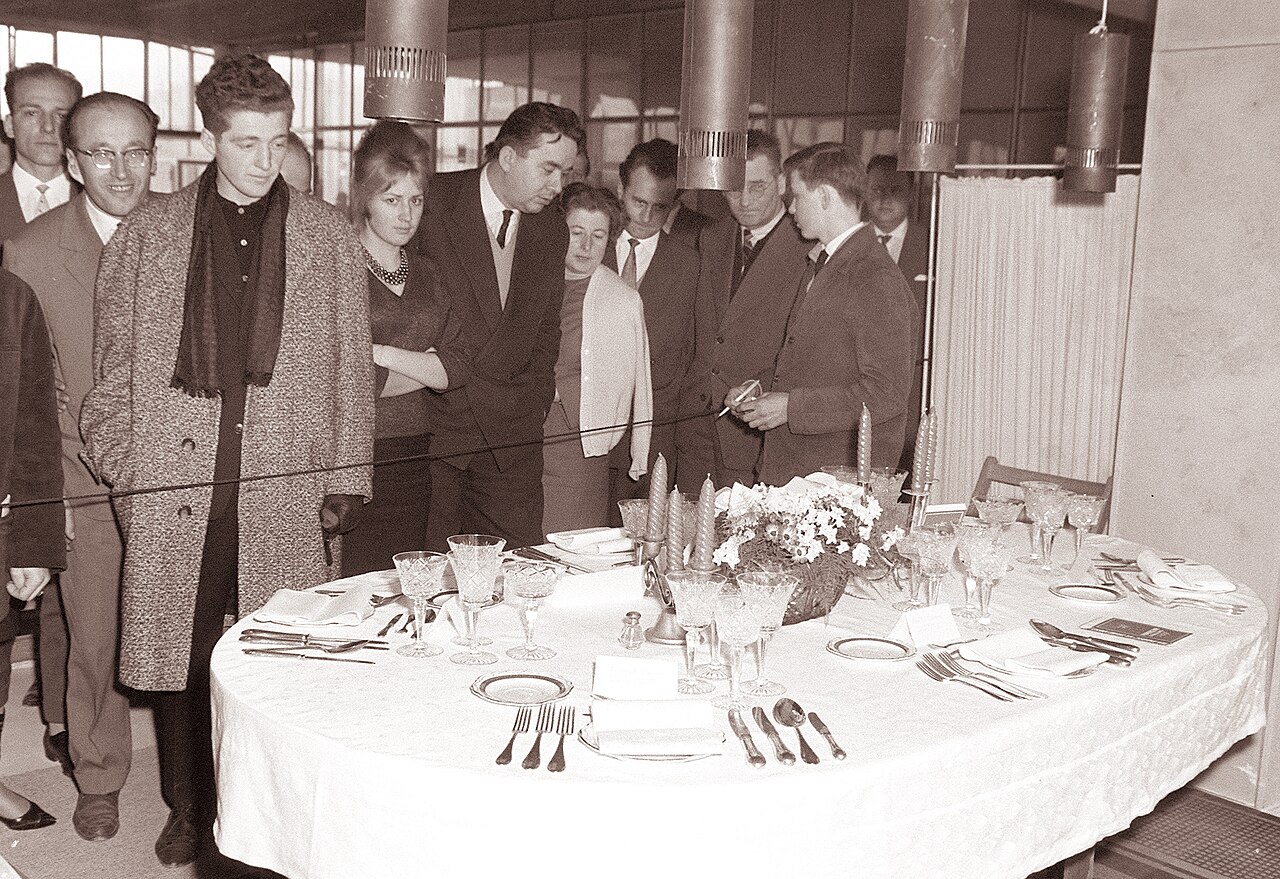
Professional trade fairs devoted to catering equipment demonstrate how important the hospitality sector had become. Restaurant equipment, culinary presentations and table settings were displayed for professionals serving Yugoslavia’s growing hotel and tourism industries.
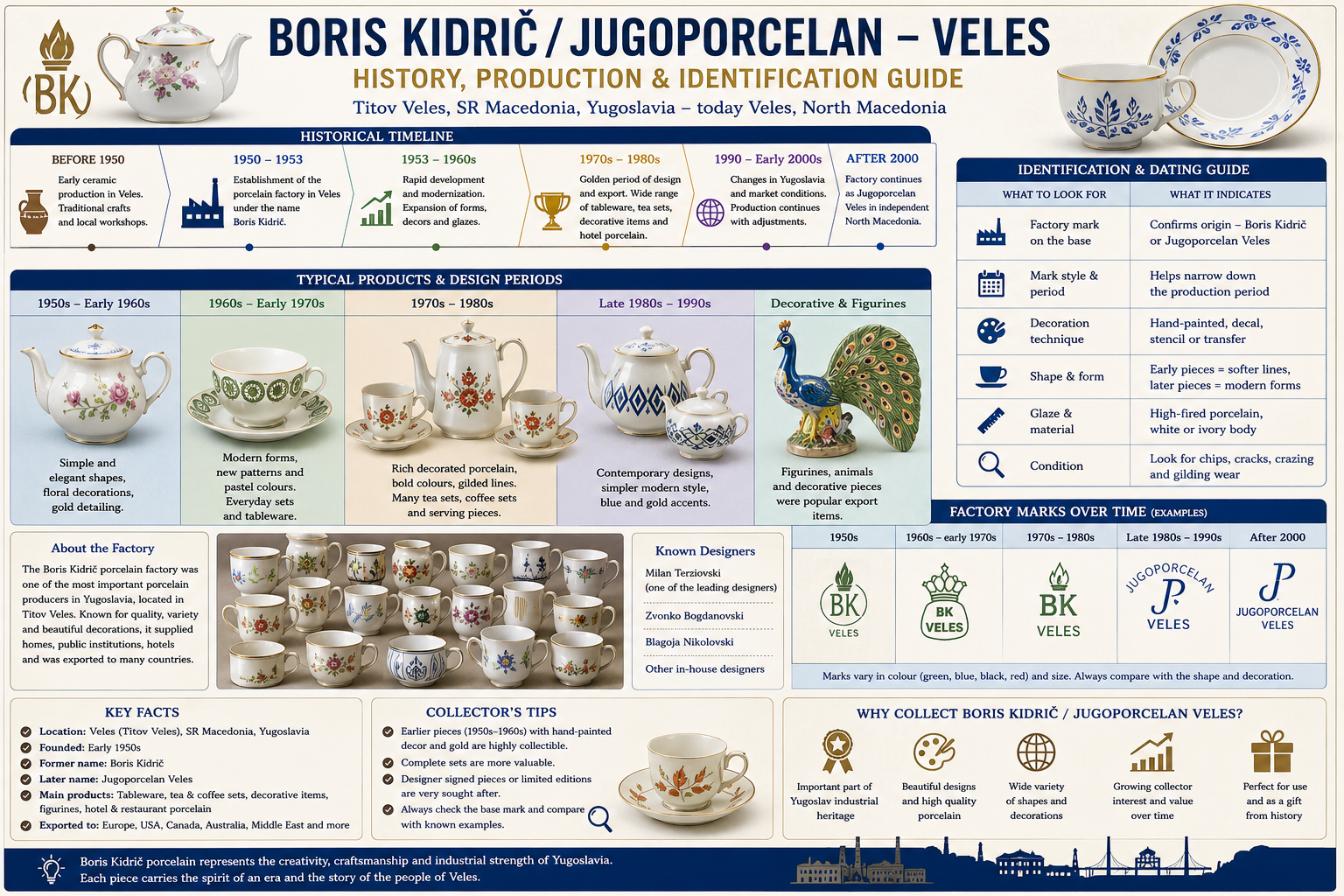
Boris Kidrič and Jugoporcelan Veles
Another important centre for collectors is Veles in present-day North Macedonia, known during much of the socialist Yugoslav period as Titov Veles.
Porcelain associated with the Boris Kidrič factory and the Jugoporcelan name survives in numerous forms, including cups, coffee services, teapots and decorated porcelain.
These surviving objects are especially useful for studying Yugoslav design because documented examples reveal considerable variation in shape, colour and decoration.
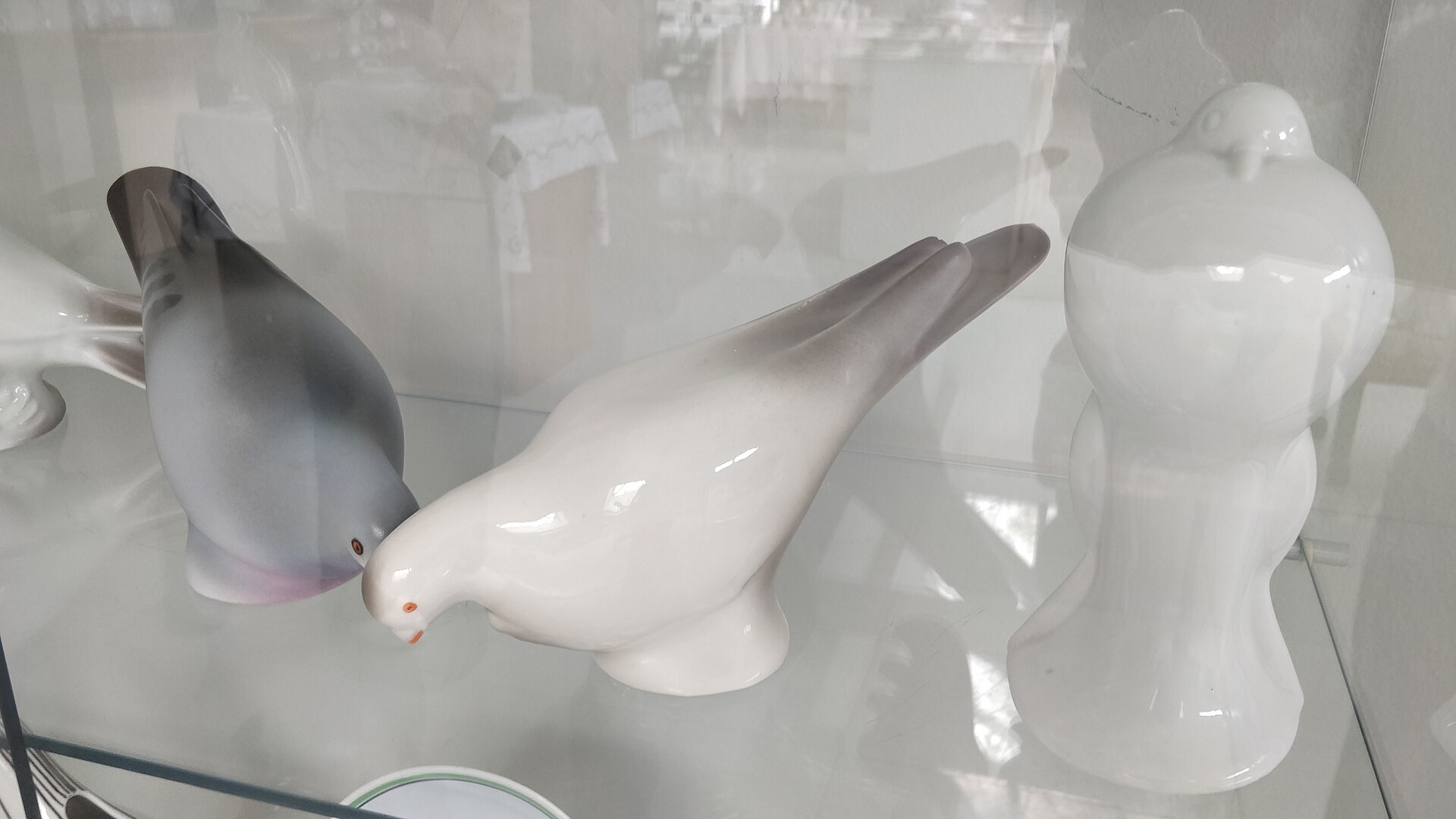
Museum and archival examples are particularly useful because they allow collectors to compare documented factory production with objects appearing on today’s antiques and vintage markets.
This type of comparison is one of the key methods described in our
complete antique porcelain identification guide.
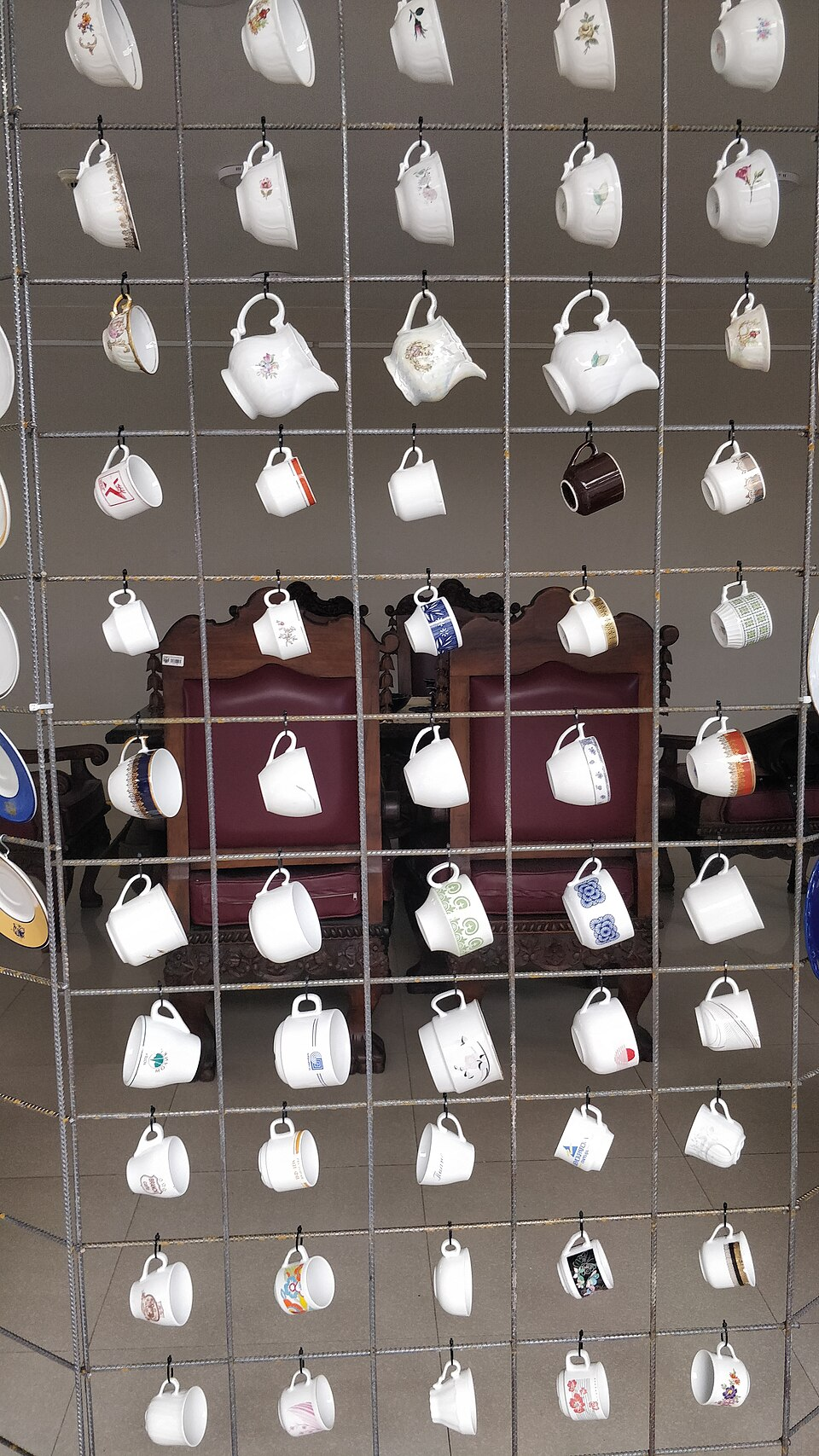
Why Veles Porcelain Is Useful for Identification
Seeing many objects from the same manufacturing tradition together reveals something that a single cup cannot: factories changed their designs over time.
Handles, rims, proportions, colour combinations and graphic decoration evolved. A floral cup, geometric modernist cup and restrained institutional cup may belong to the same broader factory tradition but represent different periods or product lines.
Collectors should therefore avoid dating a piece solely because it “looks 1960s” or “looks Yugoslav”.
Style is useful evidence, but it should agree with the mark, construction, material and documented factory history.
Porcelain and Ceramic Production in Zaječar
Objects attributed on the collectors’ market to porcelain and ceramic production in Zaječar, Serbia deserve particularly careful examination.
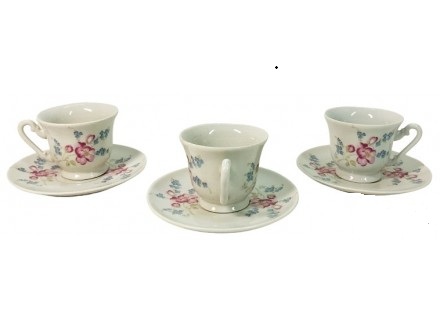
Compared with manufacturers such as Jugokeramika, the industrial history and surviving documentation for individual Zaječar porcelain marks can be more difficult to reconstruct.
Collectors should therefore avoid assigning an exact manufacturer or production date solely from an online seller’s description.
Whenever possible, examine the actual backstamp and compare it with documented factory material, catalogues, museum objects and archival evidence. Our
porcelain backstamp identification guide
provides a useful method for making these comparisons.
Jugoporcelan Coffee Services
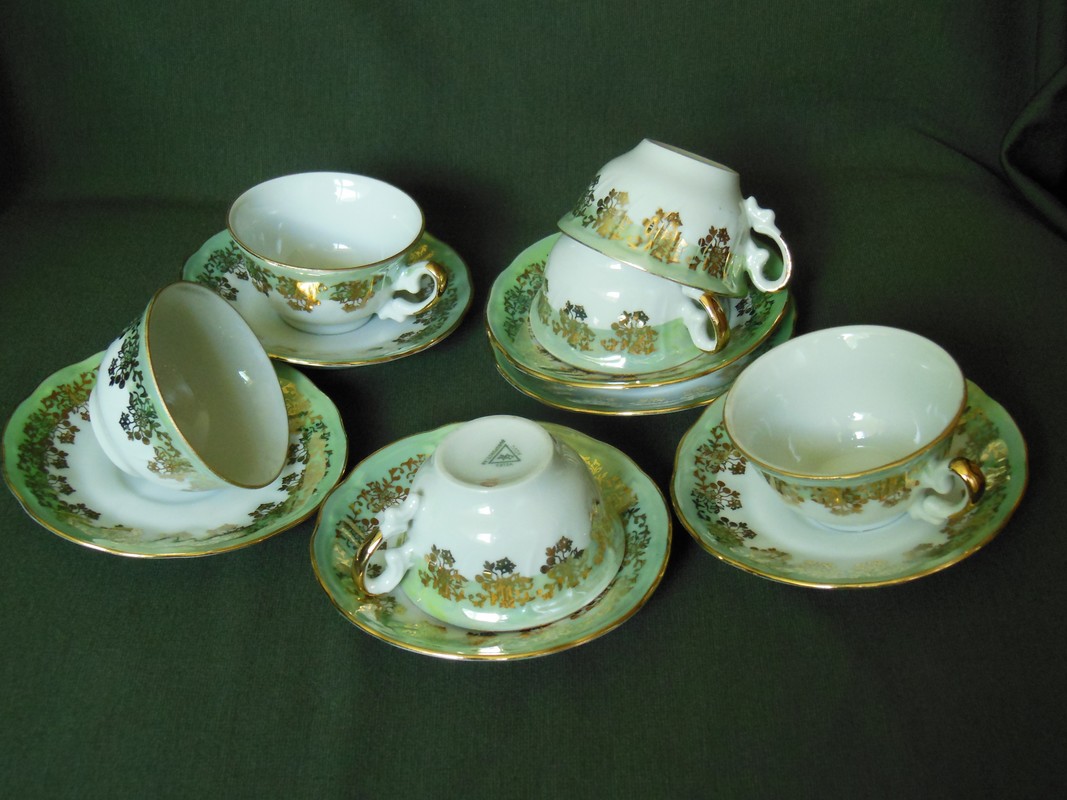
Coffee services are particularly useful for collectors because complete or near-complete sets preserve several forms belonging to the same design family.
A service may include cups, saucers, a coffee pot, sugar bowl, creamer and additional serving pieces.
When these objects retain matching factory marks, shapes and decoration, they can provide stronger evidence for identification than a single isolated cup.
From Factory History to Porcelain Identification
Understanding the factories is only the first stage of identifying Yugoslav porcelain.
The object itself must now be examined: its factory mark, backstamp, model number, export wording, porcelain body, glaze, shape, decoration, production period and condition.
In Part 2 of this guide, we examine how to read Yugoslav porcelain marks, how to date a piece, how to distinguish domestic porcelain from hotel and restaurant ware, which mistakes collectors should avoid, and which factors can influence rarity and value.
Yugoslav Porcelain Marks and Backstamps
For many collectors, the most important clue is found on the underside of the object. A factory mark or backstamp can help identify the manufacturer, production centre and sometimes the approximate period of a piece of Yugoslav porcelain.
However, a mark should never be interpreted in isolation. The factory name, city, country wording, model number and symbols should agree with the material, shape, decoration and known history of the manufacturer.
If you are unfamiliar with these markings, begin with our
complete guide to porcelain marks and backstamps.
Collectors may encounter wording or marks referring to:
- Jugokeramika;
- Jugoporcelan;
- Boris Kidrič;
- Titov Veles;
- Yugoslavia;
- Made in Yugoslavia;
- factory initials or logos;
- model numbers;
- shape numbers;
- decoration codes.
The absence of the word Yugoslavia does not automatically mean that an object was produced before or after the Yugoslav period. Likewise, the presence of the country name alone does not identify a particular factory.
Letters, symbols and numbers can serve very different purposes. Before assigning a manufacturer or date, compare every element of the backstamp with documented examples. Our
Porcelain Marks Identification Guide
explains this process step by step.
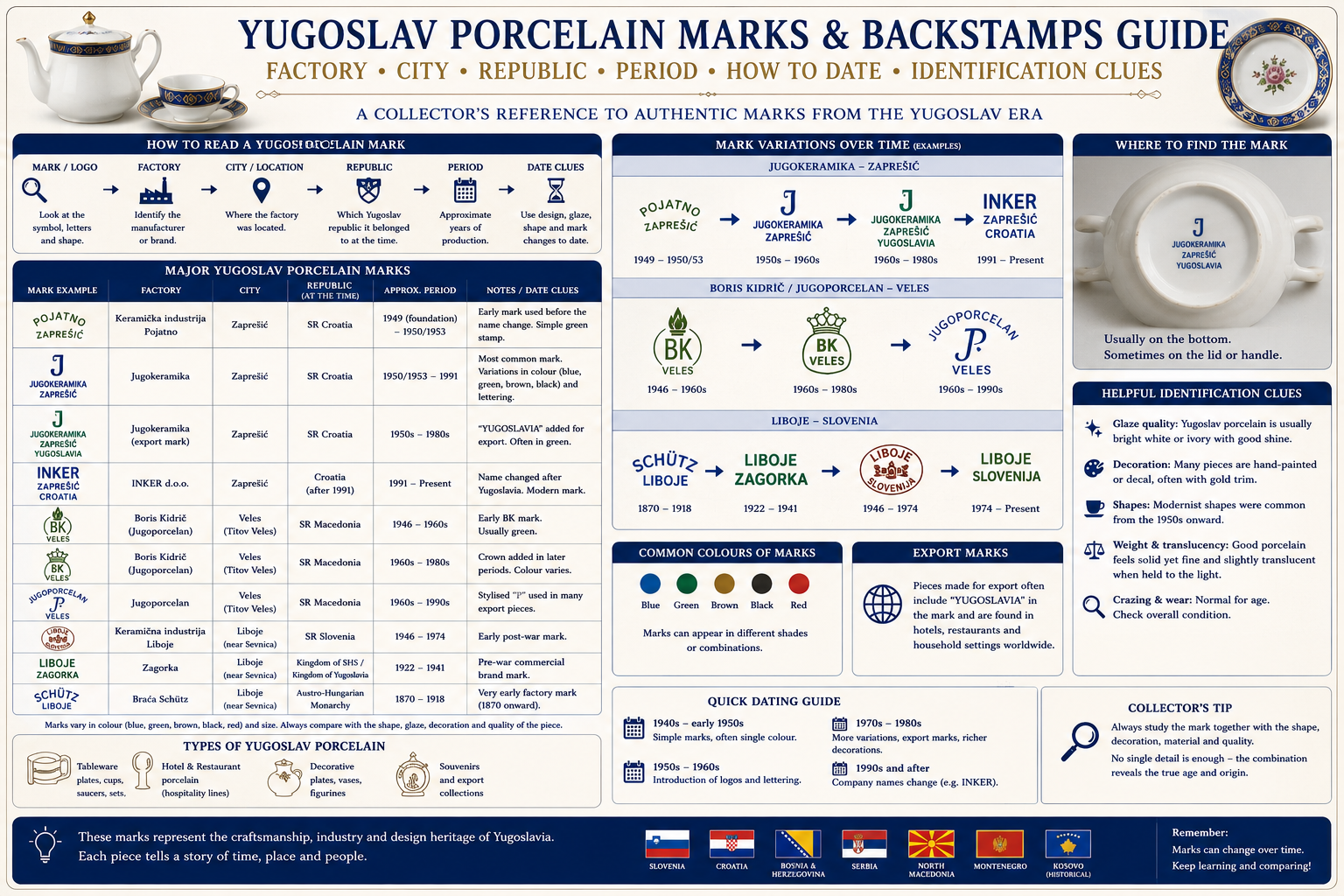
Yugoslav Porcelain Marks: Quick Reference
The following table provides a practical starting point. Exact dating should always be supported by additional evidence.
| Mark or Wording | Associated Producer / Context | Historical Location | Dating Use | What Else to Check |
|---|---|---|---|---|
| Jugokeramika | Jugokeramika | Zaprešić, SR Croatia, Yugoslavia | Broadly associated with the Jugokeramika era | Logo style, model, shape, decoration and product line |
| Inker | Successor to Jugokeramika | Zaprešić, Croatia | Post-1991 production context | Backstamp design, collection and factory documentation |
| Boris Kidrič | Porcelain production in Veles | Veles / Titov Veles, SR Macedonia, Yugoslavia | Useful Yugoslav-period clue | Factory symbol, wording, numbers, form and decoration |
| Jugoporcelan | Veles porcelain production | Titov Veles, SR Macedonia, Yugoslavia | Useful when combined with factory and city information | Logo variation, model numbers and documented examples |
| Titov Veles | Historical geographical wording | SR Macedonia, Yugoslavia | Can help establish a broad historical context | Factory name and accompanying mark |
| Made in Yugoslavia | Country-of-origin / export wording | Various factories | Useful for establishing Yugoslav production context | Manufacturer logo, material, shape and decoration |
| Model or numerical codes | Various manufacturers | Various | Potentially useful when matched to documented records | Do not interpret isolated numbers without supporting evidence |
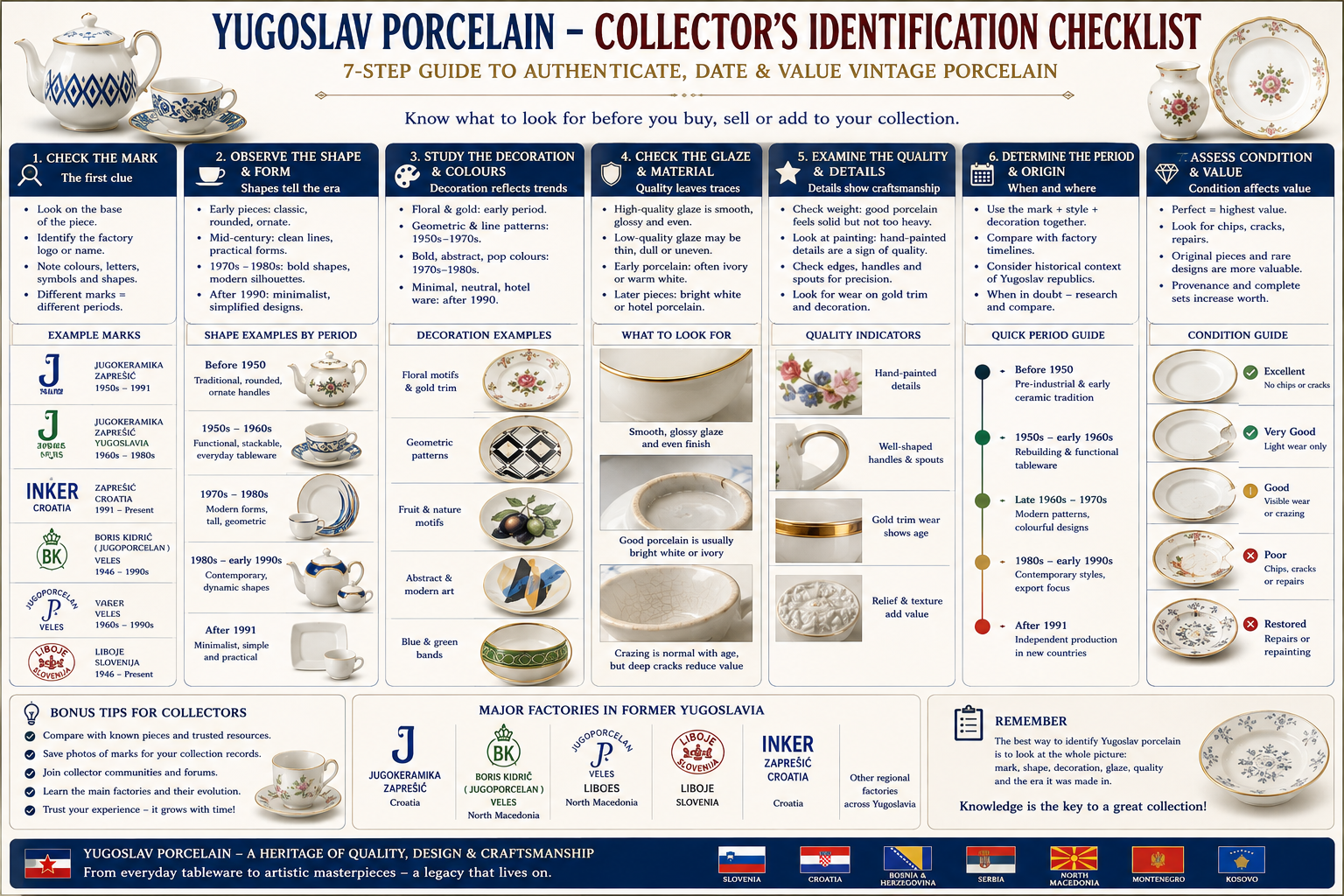
How to Identify Yugoslav Porcelain in 60 Seconds
If you have an unidentified cup, plate, vase, figurine or coffee service, resist the temptation to identify it from the decoration alone.
The following method is a shortened version of the systematic examination used for
identifying antique and vintage porcelain,
adapted specifically for Yugoslav production.
- Turn the object over. Look for printed, impressed, painted or moulded markings.
- Read every word. Record the factory name, city, country wording and numbers exactly as they appear.
- Identify the manufacturer. Determine whether the mark points to Jugokeramika, Jugoporcelan, Boris Kidrič, Liboje or another producer.
- Identify the historical location. Remember that modern national borders may differ from the historical Yugoslav context.
- Identify the material. Do not assume every Yugoslav ceramic object is porcelain.
- Examine the shape. Study handles, rims, feet, lids and proportions.
- Study the decoration. Floral, geometric, gilded, transfer-printed and minimalist decoration may provide useful supporting evidence.
- Look for model numbers. These can become valuable when matched with catalogues or documented museum objects.
- Assess condition and completeness. Both can affect identification and collector value.
- Compare documented examples. Avoid relying on a single marketplace attribution.
How to Date Yugoslav Porcelain
Dating vintage Yugoslav porcelain usually requires several clues rather than one decisive feature.
Factory names, historical place names, country wording, backstamps, shapes and decoration should support one another. For a more detailed explanation of these methods, see our
complete guide to dating antique porcelain.
1. Factory Name
Company-name changes can establish broad chronological boundaries.
Jugokeramika is particularly useful because the company’s development from Keramička industrija Pojatno through the Jugokeramika period and later Inker production provides collectors with a broad historical framework.
2. Historical Place Name
Geographical wording can sometimes be just as useful as the factory name.
Veles, for example, was officially known as Titov Veles for much of the socialist Yugoslav period. A genuine period factory mark incorporating this geographical wording can therefore provide additional chronological evidence.
3. Country Wording
Marks such as Yugoslavia and Made in Yugoslavia can help establish a broad political or export context.
They rarely provide an exact production year on their own.
4. Shape and Decoration
Yugoslav design changed substantially during the post-war decades.
Traditional floral and gilded decoration continued to coexist with cleaner modernist forms, abstract motifs, geometric patterns and highly functional hospitality porcelain.
5. Documentary Comparison
Museum collections, factory catalogues, exhibition records, archival photographs and documented designer objects are generally more reliable than unsourced marketplace descriptions.
Identifying Yugoslav Porcelain by Style and Period
Style can provide useful dating evidence, but it should always be treated as supporting evidence rather than proof.
Collectors may encounter traditional European floral decoration, gilded tableware, restrained post-war forms, mid-century modern shapes, geometric patterns and functional institutional porcelain.
During the 1960s and 1970s, modern industrial design became increasingly visible in Yugoslav tableware. Cleaner profiles and practical forms reflected changing domestic interiors as well as the needs of cafés, hotels and restaurants.
Factories did not abandon older styles overnight. Traditional and modern designs could be produced simultaneously for different consumers and markets.
Household Porcelain vs Hotel and Restaurant Porcelain
Determining whether a piece was intended for a private household or professional hospitality use can provide another important clue.
| Feature | Household Porcelain | Hotel / Restaurant Porcelain |
|---|---|---|
| Body | May be relatively fine or delicate | Often designed with durability in mind |
| Shape | May prioritise decorative appearance | Frequently practical and standardised |
| Stacking | Not always important | Often an important design consideration |
| Decoration | May be floral, gilded or elaborate | Often restrained and practical, although decorated examples exist |
| Primary Use | Private homes | Hotels, restaurants, cafés and institutional catering |
| Survival | Complete sets may remain in private ownership | Heavy commercial use can make complete surviving services more difficult to find |
Is Yugoslav Porcelain Valuable?
Some Yugoslav porcelain can have meaningful collector value, but the words Made in Yugoslavia do not automatically make an object rare or expensive.
Large quantities of household tableware and ceramics were produced during the Yugoslav period. Individual cups, saucers, plates and common services can therefore still be relatively accessible.
Collector interest generally becomes stronger when several desirable factors occur together:
factory → designer → period → model → decoration → mark → completeness → condition → provenance → market demand.
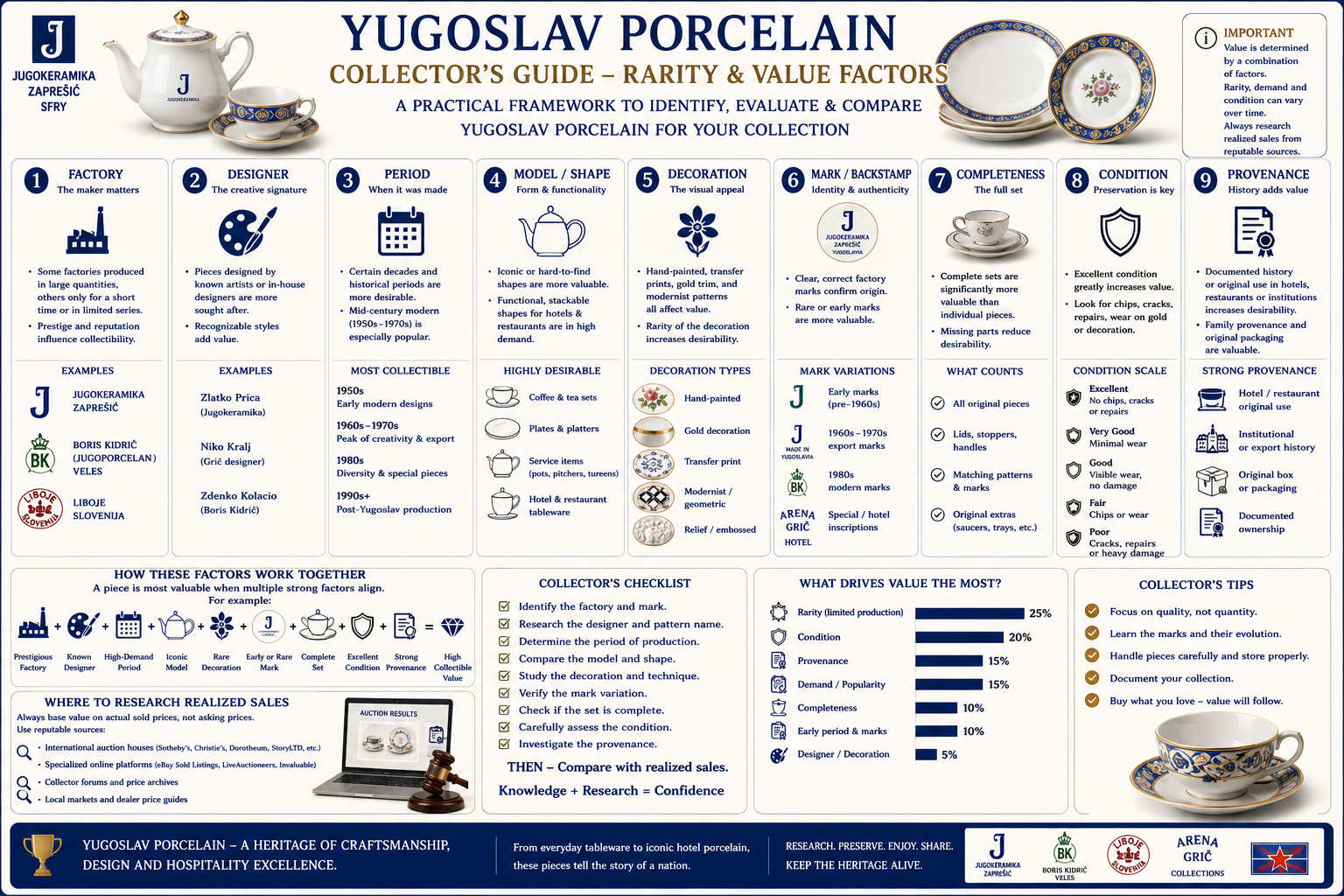
What Determines the Value of Yugoslav Porcelain?
Factory
A well-documented manufacturer usually attracts greater collector confidence than an unidentified object carrying only generic country-of-origin wording.
Designer
Designer attribution can be particularly important for Yugoslav modernist porcelain.
A documented design by a recognised industrial designer may belong to a very different collecting category from anonymous mass-produced tableware.
Production Period
Early production, historically important design periods and short-lived manufacturing phases can sometimes be more desirable.
Age alone, however, does not determine value.
Model and Shape
Distinctive models can become collectible in their own right, particularly when the shape can be connected with catalogues, exhibitions, museum collections or a known designer.
Decoration
Unusual colourways, less common patterns, hand decoration and historically significant designs may increase collector interest.
Factory Mark
A clear and historically appropriate backstamp can significantly improve confidence in an attribution.
If you are uncertain how to interpret the underside of a piece, compare it with the methods described in our
guide to identifying porcelain marks and maker’s marks.
Completeness
A complete coffee, tea or dinner service can be more desirable than a small group of unrelated pieces.
Completeness is especially important when individual components share the same factory mark, shape family and decoration.
Condition
Chips, cracks, hairlines, staining, worn gilding, scratches, restoration and replacement components can all influence collector desirability.
Provenance
Documented ownership, original packaging, factory labels, hotel provenance, exhibition history or accompanying archival material can strengthen the historical significance of an object.
Market Demand
Rarity does not automatically equal value.
An object also needs collector demand. A visually distinctive mid-century design may sometimes attract more attention than an older but less recognised piece.
Do Not Confuse Asking Prices with Market Value
One of the most common mistakes when researching vintage porcelain is finding a high online asking price and assuming that it represents the object’s actual market value.
It does not.
A seller can ask almost any price. More useful evidence comes from realised sales of genuinely comparable objects.
When researching value, compare:
- the same manufacturer;
- the same or closely related model;
- the same designer where known;
- a similar production period;
- similar completeness;
- similar condition;
- similar provenance;
- actual sold results rather than unsold asking prices.
For this reason, this guide deliberately avoids presenting unsupported price ranges for Yugoslav porcelain.
Rare Does Not Always Mean Old
This is particularly important when collecting 20th-century Yugoslav design.
A relatively late 1960s or 1970s designer service may be more desirable than an older but common household service.
Likewise, professional hotel porcelain may originally have been produced in considerable quantities yet become difficult to find as a complete service because years of commercial use resulted in breakage, replacement and dispersal.
Collector value therefore depends on historical importance, design, survival and demand — not simply age.
Complete Sets vs Individual Pieces
Complete services are particularly useful for research because they preserve the original relationship between several forms.
A coffee service may include:
- coffee pot;
- cups;
- saucers;
- sugar bowl;
- creamer or milk jug;
- additional serving pieces.
When all components share the same mark, design language and decoration, attribution becomes considerably easier.
An individual piece can nevertheless be important if it represents a scarce model, documented designer, unusual backstamp or historically significant production line.
Condition: What Collectors Should Examine
Always examine porcelain carefully in strong natural or neutral light.
Look for:
- rim chips;
- hairline cracks;
- star cracks;
- glaze crazing;
- staining;
- scratches;
- worn gilding;
- decoration loss;
- restoration;
- repaired handles;
- replacement lids;
- mismatched components.
Manufacturing imperfections should also be distinguished from later damage. Kiln marks, glaze irregularities and minor firing flaws may originate from production rather than subsequent use.
Are Yugoslav Porcelain Marks Always Reliable?
A mark should never be accepted without asking whether it makes historical and physical sense for the object.
Check whether the factory existed during the proposed period, whether the geographical wording is plausible, whether the mark resembles documented examples and whether the material and design correspond with known factory production.
Copied, misleading and incorrectly interpreted marks are a wider problem in porcelain collecting. This is why our
porcelain backstamp identification guide
recommends examining the entire object rather than authenticating porcelain from a logo alone.
Common Mistakes When Identifying Yugoslav Porcelain
- Calling every Yugoslav ceramic object porcelain.
- Assuming every Made in Yugoslavia mark belongs to the same factory.
- Confusing modern national borders with historical Yugoslav republics.
- Dating an object solely from its decoration.
- Trusting marketplace titles without examining the underside.
- Assuming an older-looking design must be pre-war.
- Ignoring factory reorganisations and company-name changes.
- Assuming a city name remained unchanged throughout the 20th century.
- Treating asking prices as realised market values.
- Assuming rarity automatically means high value.
Historical Geography Matters
Modern maps can easily create confusion when studying Yugoslav porcelain.
Collectors should distinguish between the historical location associated with an object and the country’s present-day geography.
| Historical Identification | Present-Day Location |
|---|---|
| Zaprešić, SR Croatia, Yugoslavia | Zaprešić, Croatia |
| Liboje, SR Slovenia, Yugoslavia | Liboje, Slovenia |
| Titov Veles, SR Macedonia, Yugoslavia | Veles, North Macedonia |
| Zaječar, SR Serbia, Yugoslavia | Zaječar, Serbia |
This distinction is especially useful when searching museum databases, factory catalogues and archival collections, because the same production centre may appear under different historical geographical descriptions.
From Yugoslavia to the Successor States
The breakup of Yugoslavia during the 1990s transformed the region’s industrial landscape.
Manufacturers faced the disappearance of a common domestic market, political disruption, privatisation, changing ownership structures and increasing international competition.
Some factories disappeared. Others survived under different names or corporate structures.
Jugokeramika provides an especially useful example for collectors: the company became Inker in 1991, creating an important broad chronological dividing point between Jugoslav-era Jugokeramika and later production.
Post-Yugoslav pieces can themselves be historically interesting because they document the transition from a shared industrial system into the separate economies of the successor states.
Why Yugoslav Porcelain Deserves More Attention
Yugoslav porcelain occupies an unusual position within the wider history of
European and international porcelain collecting.
It connects older Central and Southeast European ceramic traditions with socialist industrialisation, modern design, international exhibitions, mass housing, café culture, hotel development and Adriatic tourism.
A single coffee cup can therefore tell several stories at once.
Its shape may reflect mid-century industrial design. Its mark may preserve the name of a country that no longer exists. Its decoration may reveal a particular factory period. Its heavy construction may indicate that it was designed for a hotel or restaurant rather than a private household.
That combination of design, social history, industrial history and changing geography makes Yugoslav porcelain particularly rewarding to study.
Yugoslav Porcelain Collector’s Checklist
Before buying, selling, identifying or valuing a piece, ask:
- What material is the object actually made from?
- Does it carry a factory mark or backstamp?
- What exactly does the mark say?
- Can the manufacturer be documented?
- Does the geographical wording fit the proposed period?
- Does the shape correspond with known factory production?
- Can the model or designer be identified?
- Is the decoration original?
- Is the service complete?
- Are there chips, cracks or restoration?
- Is there documented provenance?
- Can comparable realised sales be found?
Frequently Asked Questions About Yugoslav Porcelain
What is Yugoslav porcelain?
Yugoslav porcelain generally refers to porcelain manufactured within the territories of former Yugoslavia, particularly during the 20th century. It does not represent one single factory or ceramic tradition, but production from several regions and manufacturers.
How can I identify Yugoslav porcelain?
Start with the underside. Record the factory name, logo, city, country wording and numbers, then compare them with the material, shape and decoration. Our
complete porcelain identification guide
explains the wider identification process.
What does “Made in Yugoslavia” mean on porcelain?
It indicates Yugoslav country-of-origin or export context, but by itself it normally does not identify the exact manufacturer. Search for additional factory symbols, names, model numbers or decoration codes.
Is Yugoslav porcelain valuable?
Some examples can be valuable and highly collectible, particularly documented designer pieces, unusual models, scarce decorations, historically significant production and complete services in excellent condition. Common mass-produced pieces may remain relatively affordable.
What is Jugokeramika?
Jugokeramika was a major porcelain and ceramics manufacturer based in Zaprešić, in the Socialist Republic of Croatia within Yugoslavia. It became particularly important for modern tableware, industrial design and specialised hotel and restaurant porcelain.
What is Jugoporcelan Veles?
Jugoporcelan is associated with porcelain production in Veles, known during much of the socialist Yugoslav period as Titov Veles, in the Socialist Republic of Macedonia. Surviving production includes coffee services, cups, teapots and decorated porcelain.
What was the Boris Kidrič porcelain factory?
The Boris Kidrič name is associated with porcelain and ceramic production in Veles during the Yugoslav period. Surviving documented examples provide important evidence for studying the forms and decoration produced there.
How old is Jugokeramika porcelain?
The enterprise developed from Keramička industrija Pojatno, established in 1949. The Jugokeramika name was adopted in 1950 and remained associated with the company until the transition to Inker in 1991.
How can Yugoslav porcelain be dated?
Dating normally requires a combination of factory name, mark style, historical place name, country wording, model, shape, decoration and comparison with documented examples. See our
guide to dating antique porcelain
for the complete methodology.
Is all Yugoslav ceramic tableware porcelain?
No. Manufacturers across Yugoslavia produced porcelain alongside earthenware, stoneware and other ceramic bodies. Material should be identified separately rather than assumed from the country mark.
Is old Yugoslav hotel porcelain collectible?
Yes. Hotel and restaurant porcelain can be particularly interesting because it is closely connected with Yugoslavia’s hospitality and tourism history. Complete surviving services may also be harder to find because professional tableware was subjected to intensive everyday use.
Which Yugoslav porcelain factories should collectors know?
Important names include Jugokeramika in Zaprešić and Boris Kidrič/Jugoporcelan production in Veles. The wider ceramic history of Yugoslavia also includes Liboje and numerous other regional manufacturers and traditions.
Final Thoughts
The best way to understand vintage Yugoslav porcelain is not to examine the mark, factory, decoration or age separately. Treat the entire object as historical evidence.
Start with the material. Read the mark carefully. Identify the manufacturer and production centre. Place them within the correct historical period. Compare the shape and decoration with documented production. Finally, examine completeness, condition and provenance.
This approach reveals something far richer than a simple Made in Yugoslavia label.
From the long ceramic tradition of Liboje to the modernist porcelain of Jugokeramika, from Boris Kidrič and Jugoporcelan in Veles to the professional tableware used in Yugoslav hotels and restaurants, these objects document a complex chapter of 20th-century European industrial and design history.
As surviving services, marks, catalogues and archival photographs are studied more carefully, Yugoslav porcelain has the potential to become an increasingly recognisable collecting field within European vintage ceramics.
Continue Exploring Porcelain
