
How to Identify Finnish Porcelain and Ceramics
Finnish Porcelain and Ceramics: Arabia Finland, History, Marks & Identification
Few names are as closely connected with Finnish ceramics and Scandinavian design as Arabia Finland. Founded in Helsinki in 1873, Arabia developed from a nineteenth-century ceramics factory into one of Finland’s most internationally recognised design names.
For collectors, however, Arabia is much more than a famous Finnish brand. Its long production history encompasses porcelain, faience and other ceramic bodies, tableware, art pottery, decorative objects and studio ceramics. Pieces may carry factory backstamps, model numbers, pattern codes, painter’s marks or designer signatures that can provide valuable clues about their origin and date.
This complete collector’s guide explores Arabia Finland history, factory marks, backstamps, materials, designers, dating, identification and collector value. It also explains an important point that is often overlooked: not every object made by Arabia should automatically be described as porcelain.
If you are new to the subject, our
Guide to Antique Porcelain
provides a useful introduction to identifying historic porcelain, factory marks and manufacturing traditions.
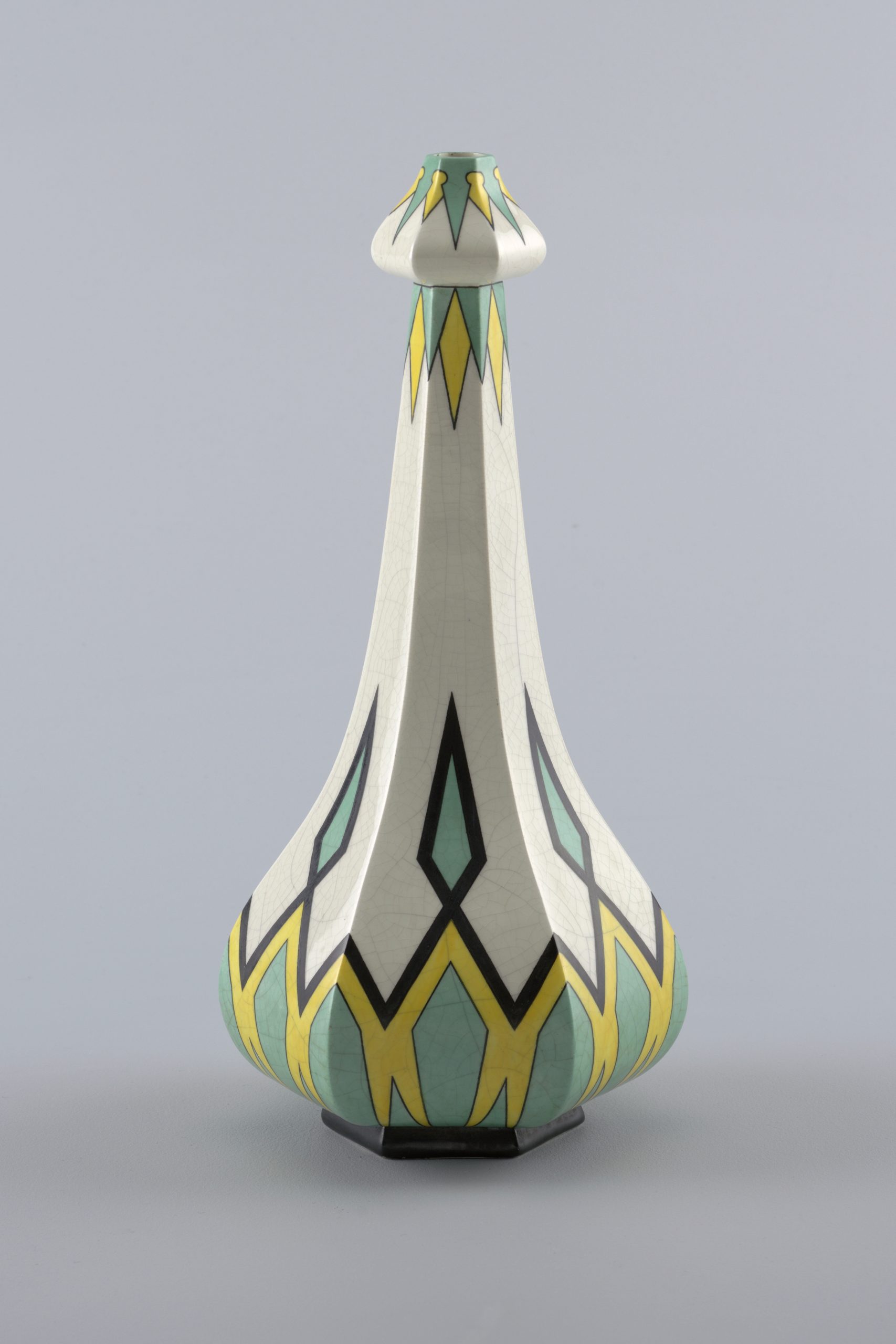
What Is Arabia Finland?
Arabia is a historic Finnish ceramics manufacturer whose story began in Helsinki in 1873. The factory was originally established as a subsidiary of the Swedish porcelain manufacturer Rörstrand, at a time when Finland was still the Grand Duchy of Finland within the Russian Empire.
The factory was built in the Arabia district of Helsinki, from which the company took its famous name.
During the decades that followed, Arabia developed an increasingly independent identity. Rather than simply reproducing continental European styles, the factory gradually became associated with Finnish decorative culture, Nordic functionalism and eventually the international modern-design movement.
Arabia’s importance therefore extends beyond tableware. Its history mirrors the emergence of modern Finnish design itself.
Arabia Finland at a Glance
| Feature | Arabia Finland |
|---|---|
| Founded | 1873 |
| Location | Helsinki, Finland |
| Original connection | Established as a subsidiary of Rörstrand |
| Known for | Tableware, decorative ceramics, art pottery and Finnish design |
| Materials encountered | Porcelain, faience and other ceramic bodies |
| Collector clues | Factory marks, backstamps, model numbers, patterns, signatures and decoration |
| Major appeal | Historic Finnish ceramics and Scandinavian modern design |
A Short History of Arabia Finland
1873: The Beginning
Arabia’s story begins during a period of rapid industrial and cultural development in Finland. Establishing a large ceramics factory near Helsinki made it possible to serve a growing domestic market while taking advantage of the technical knowledge already developed by Rörstrand.
Early Arabia production naturally reflected the wider European ceramic traditions of the nineteenth century. Over time, however, Finnish artists, designers and decorators increasingly contributed to the factory’s identity.
From Industrial Ceramics to Finnish Artistic Identity
Around the turn of the twentieth century, Finland was experiencing a broader cultural awakening. Architecture, painting, textiles and decorative arts increasingly incorporated motifs inspired by Finnish nature, folklore and national traditions.
Arabia became part of this movement.
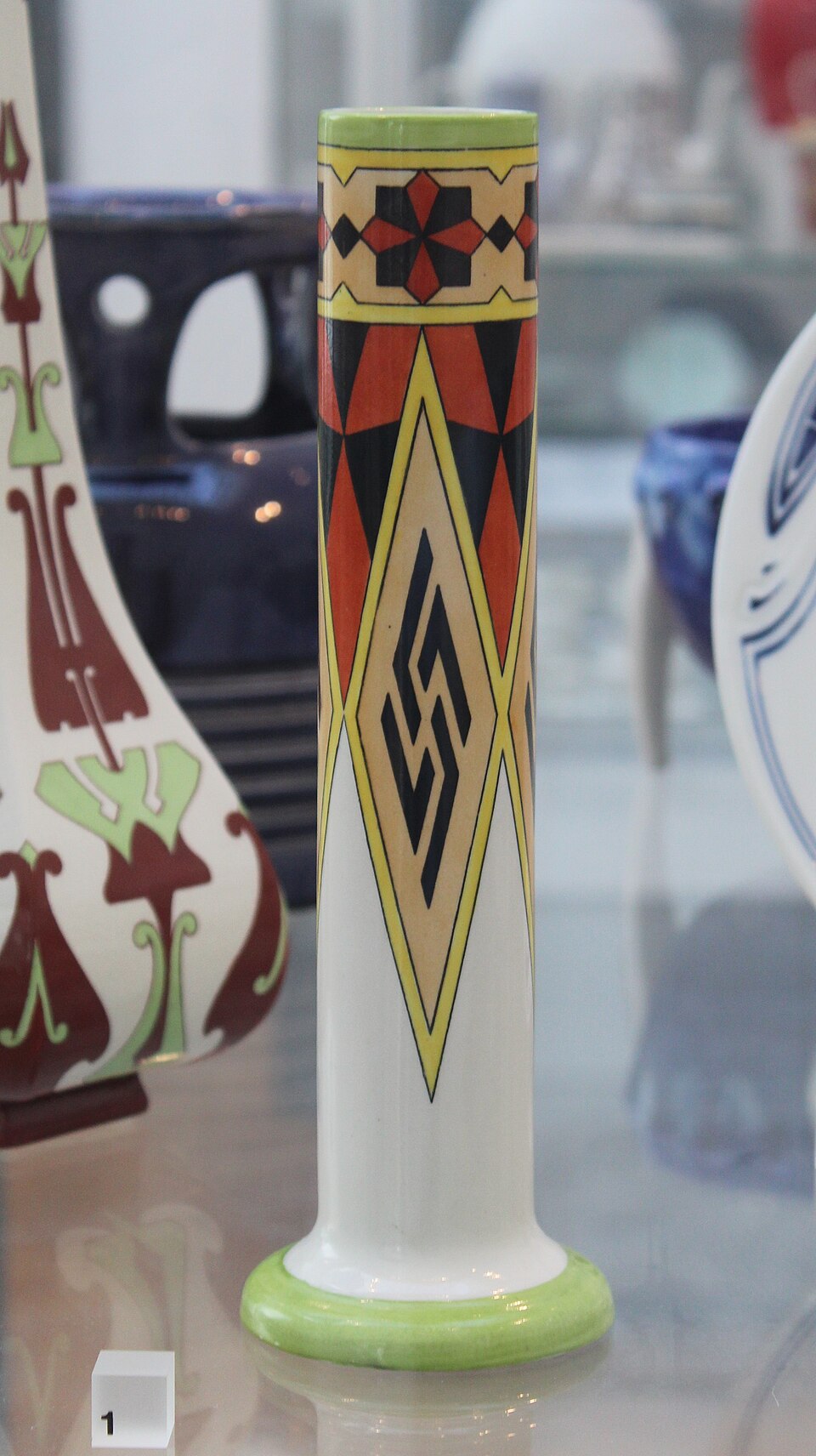
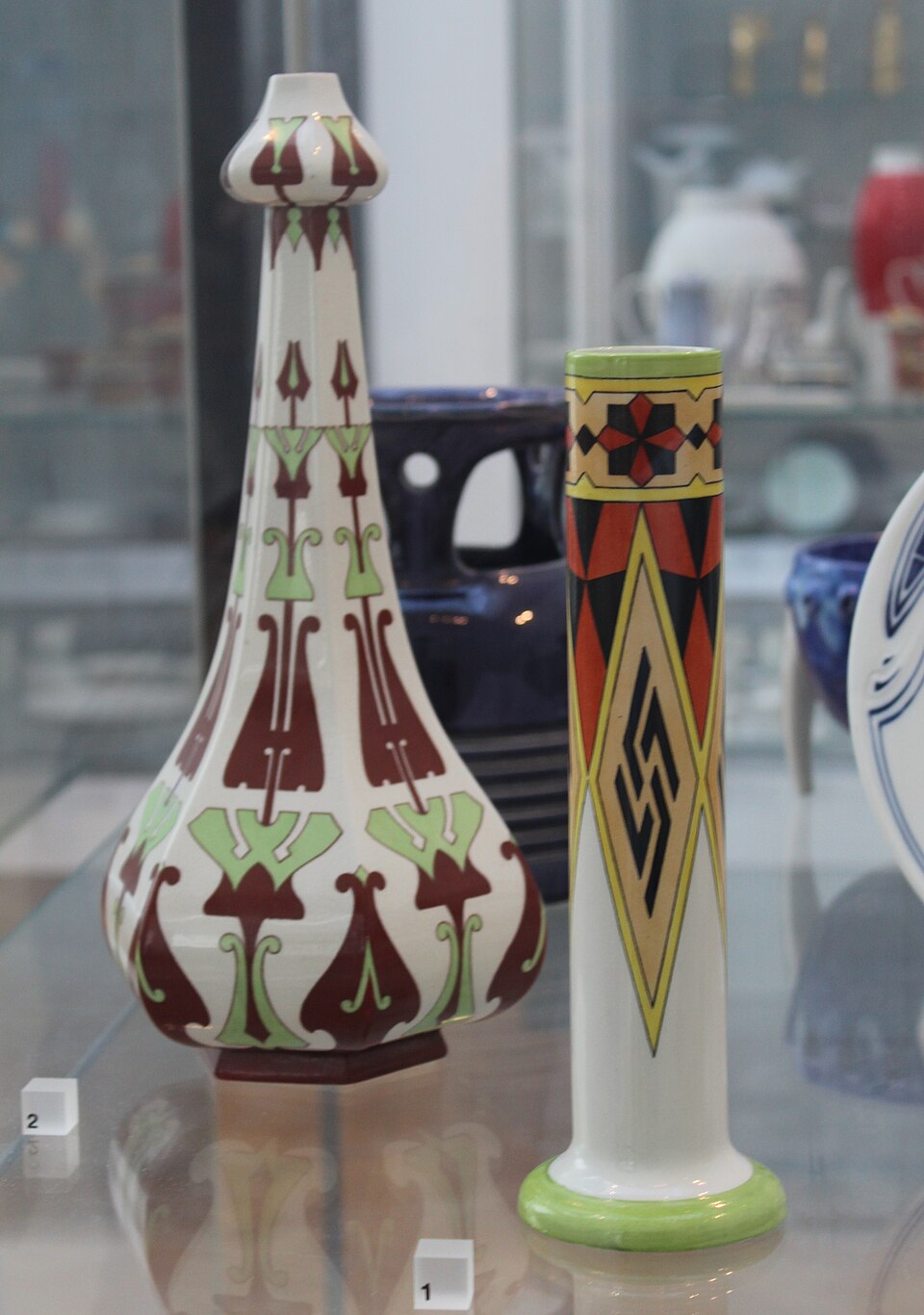
One particularly interesting example is the Fennia range. These pieces demonstrate how Arabia combined industrial ceramic production with decorative design at the beginning of the twentieth century.
For collectors, Fennia is also an excellent reminder of why terminology matters: historic Arabia objects may be described as faience or other ceramic ware rather than porcelain.
Is Arabia Finland Porcelain or Ceramic?
This is one of the most important questions for anyone researching Arabia.
Arabia Finland is not exclusively a porcelain manufacturer.
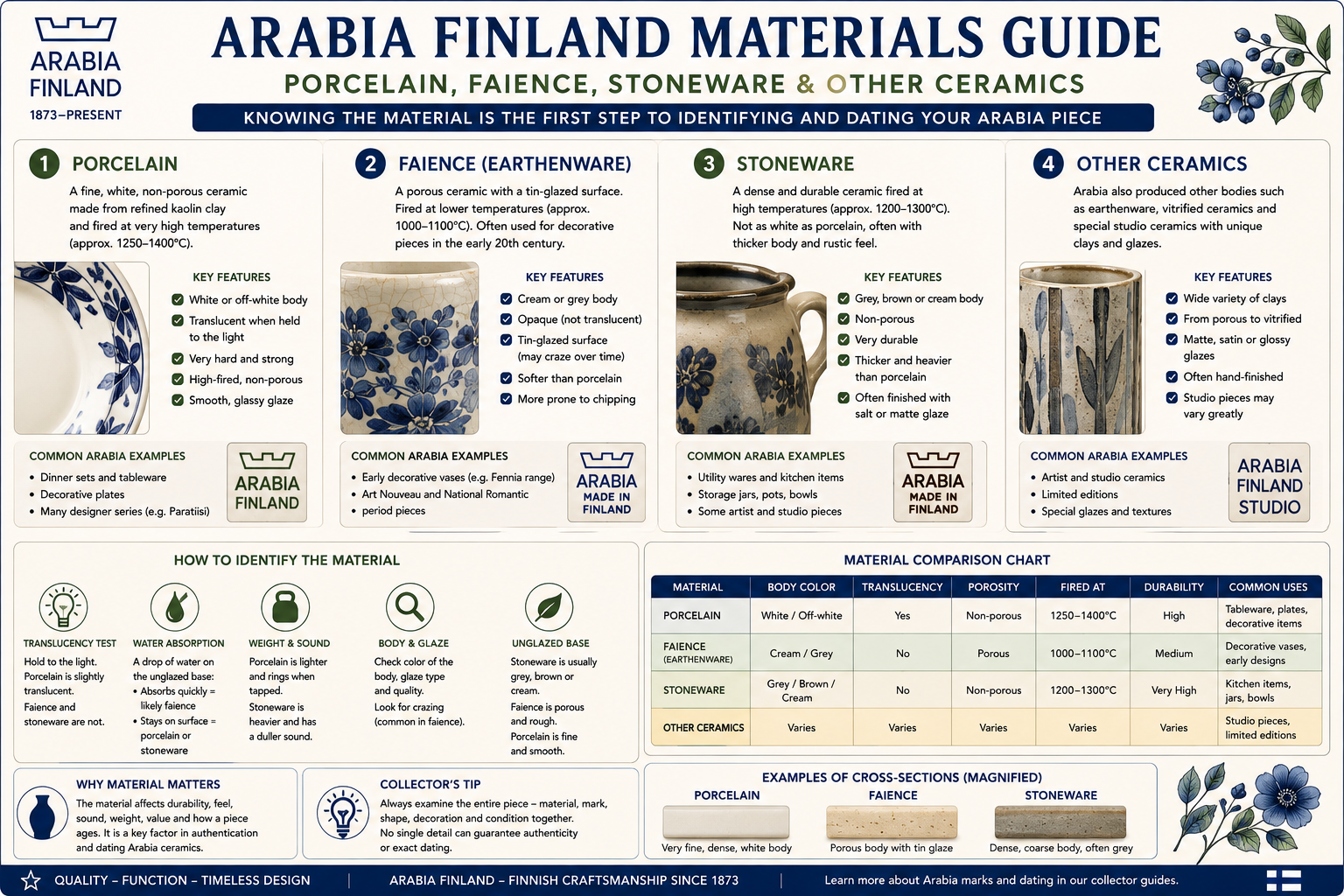
The word ceramic is the broader category. Porcelain, faience and stoneware are different ceramic materials with different compositions, firing characteristics and physical properties.
Consequently, identifying an Arabia object begins with determining what the object is actually made from, rather than assuming that an Arabia backstamp automatically means porcelain.
Porcelain, Faience and Stoneware: Key Differences
| Material | Typical Body | Porosity | Translucency | Collector Clue |
|---|---|---|---|---|
| Porcelain | Dense, refined, usually white | Very low | May be translucent when thin | Fine, vitrified body |
| Faience / Earthenware | More porous ceramic body | Higher | Usually opaque | Relies strongly on its glazed surface |
| Stoneware | Dense and robust | Low | Usually opaque | Often heavier and more substantial |
Understanding these distinctions is essential when identifying both Arabia and other European ceramics. Our broader
antique porcelain identification guide
explains why material, glaze and manufacturing technique should always be examined alongside the factory mark.
How to Identify Arabia Finland Ceramics
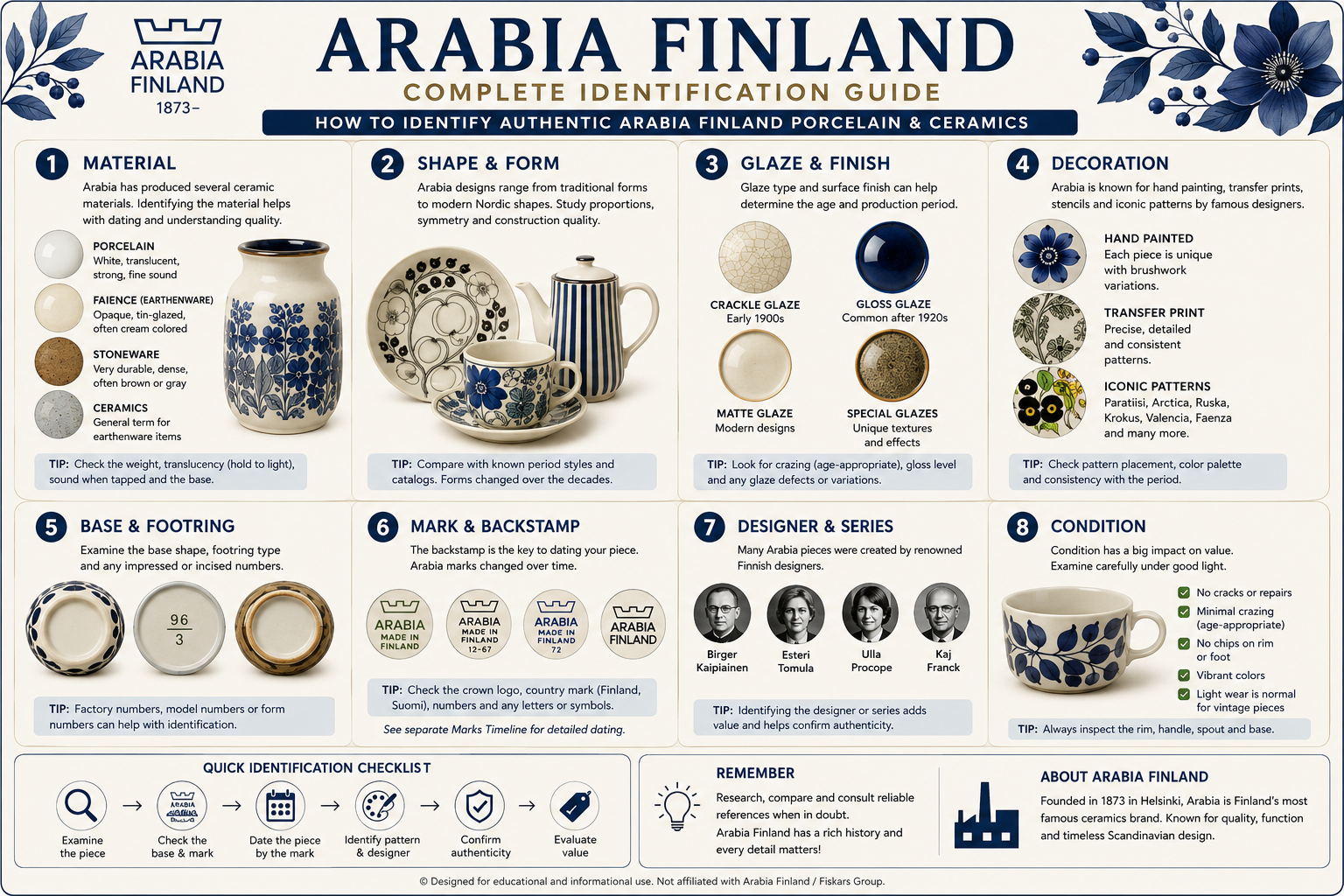
The safest way to identify Arabia Finland is to examine the whole object. A backstamp is important, but it should never be the only evidence used to identify or date a ceramic piece.
A careful examination normally considers:
- ceramic body and material;
- shape and proportions;
- glaze;
- decoration;
- underside and foot rim;
- factory mark or backstamp;
- model and pattern numbers;
- designer or decorator marks;
- manufacturing characteristics;
- wear and condition;
- documented provenance where available.
This same multi-factor approach is important when examining other historic ceramics. A factory mark can be an excellent starting point, but the body, decoration and manufacturing technique must agree with the period indicated by that mark.
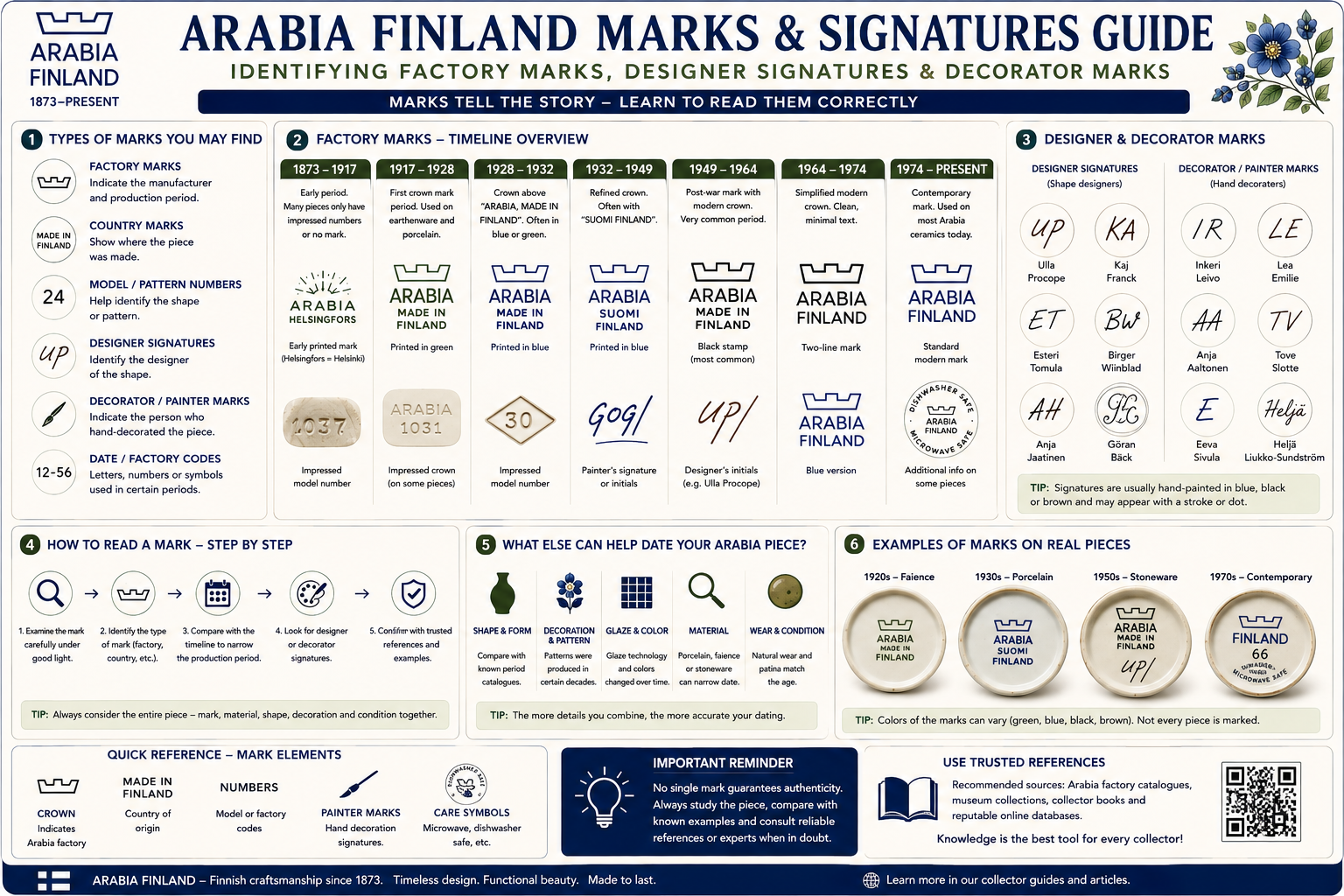
Understanding Arabia Finland Marks and Backstamps
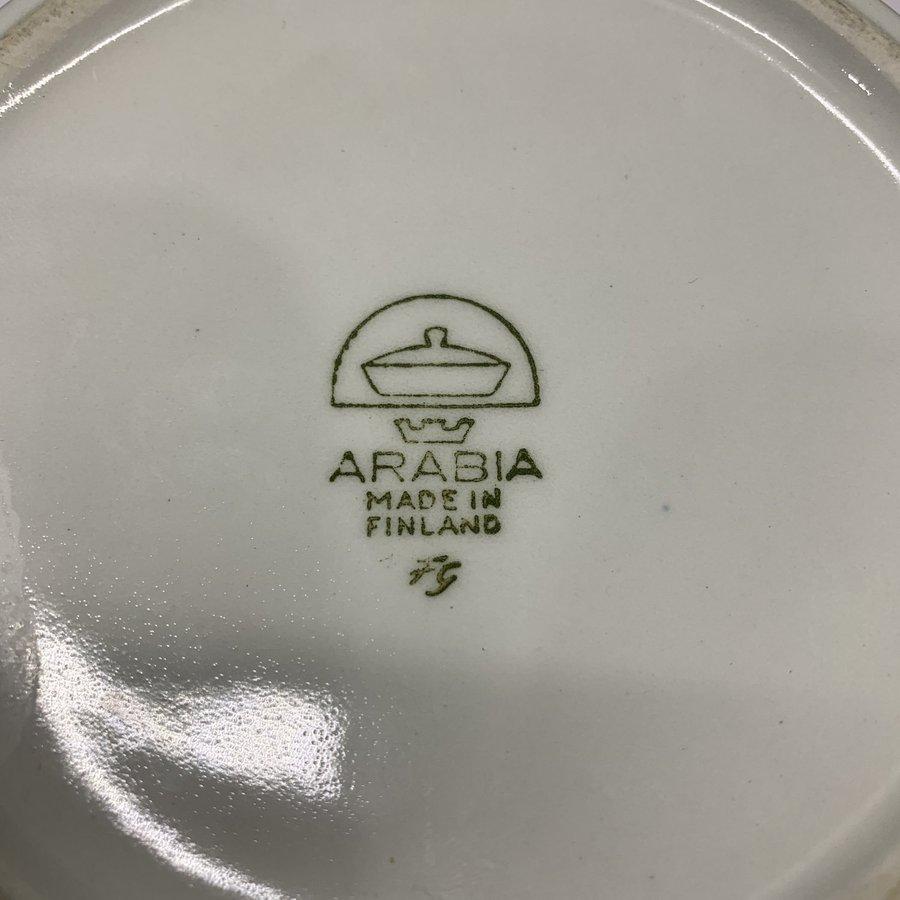
For many collectors, the underside of an Arabia piece is where the investigation begins.
Depending on the period and type of object, markings associated with Arabia may include a combination of:
- the Arabia name;
- Finland or country-of-origin wording;
- factory symbols or logos;
- printed or stamped backstamps;
- impressed numbers;
- model numbers;
- pattern or decoration codes;
- designer initials or signatures;
- decorator or painter marks;
- production-related codes.
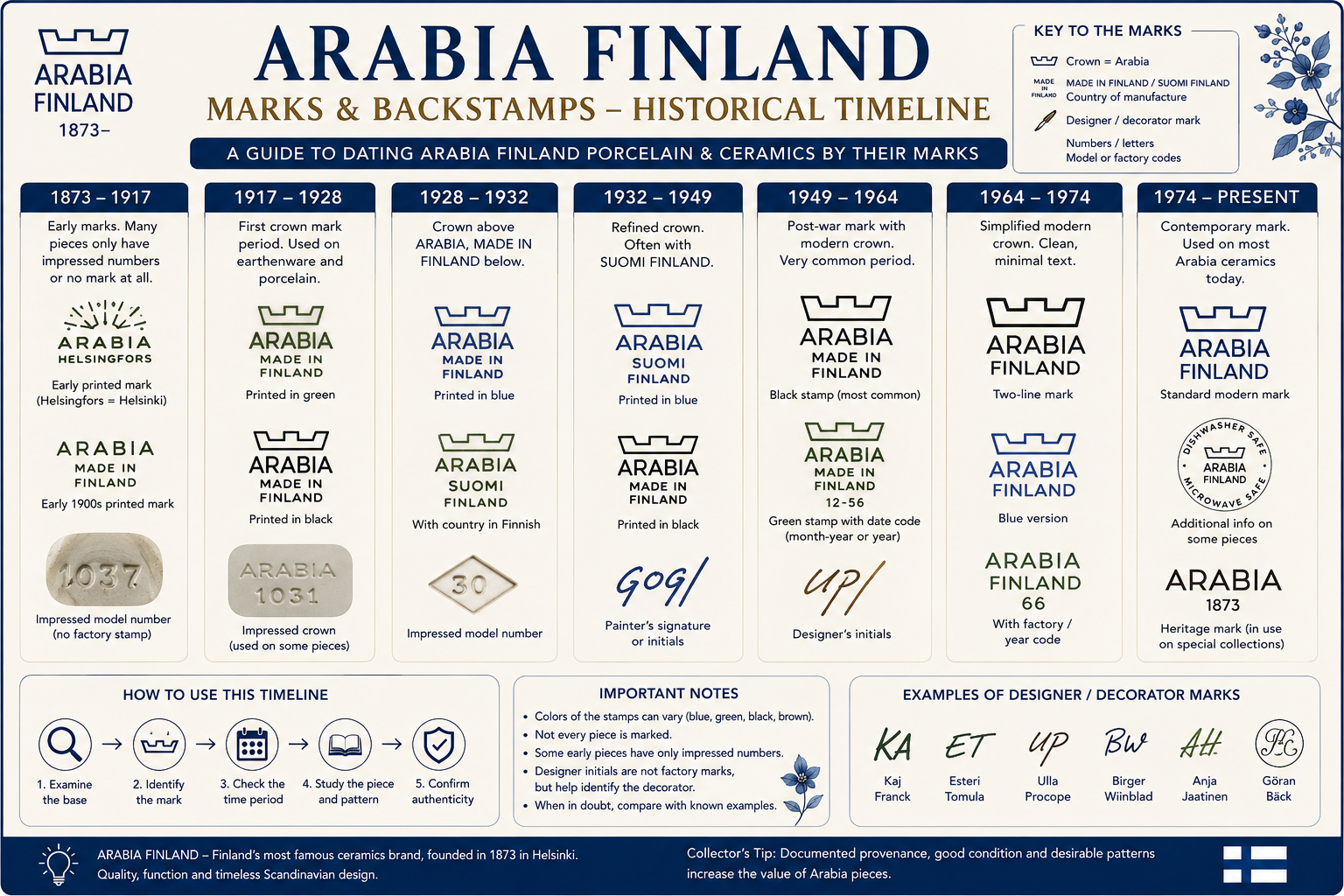
These elements can be extremely useful, but collectors should avoid the common mistake of assuming that every Arabia mark belongs to one precise year.
Marks can change over time, overlap between production periods and appear differently according to manufacturing method, decoration or intended market.
If you are unfamiliar with the principles of dating ceramics, our
guide to dating antique porcelain
explains how factory marks should be combined with shape, glaze, decoration and natural wear.
Arabia Finland Marks: What Can They Tell You?
| Marking | What It May Indicate | Important Caution |
|---|---|---|
| Factory name | Manufacturer or brand | The typography and format may change over time |
| Finland / Made in Finland | Country-of-origin information | Wording alone does not provide an exact date |
| Model number | Shape or factory model | Must be compared with documented records |
| Pattern code | Decoration or series | Pattern and shape may have different production spans |
| Designer mark | Possible designer attribution | Verify against documented examples |
| Decorator mark | Painter or decorator information | Not necessarily a dating mark |
| Impressed number | Production, mould or model information | Its meaning depends on the individual production system |
How to Date Arabia Finland Ceramics
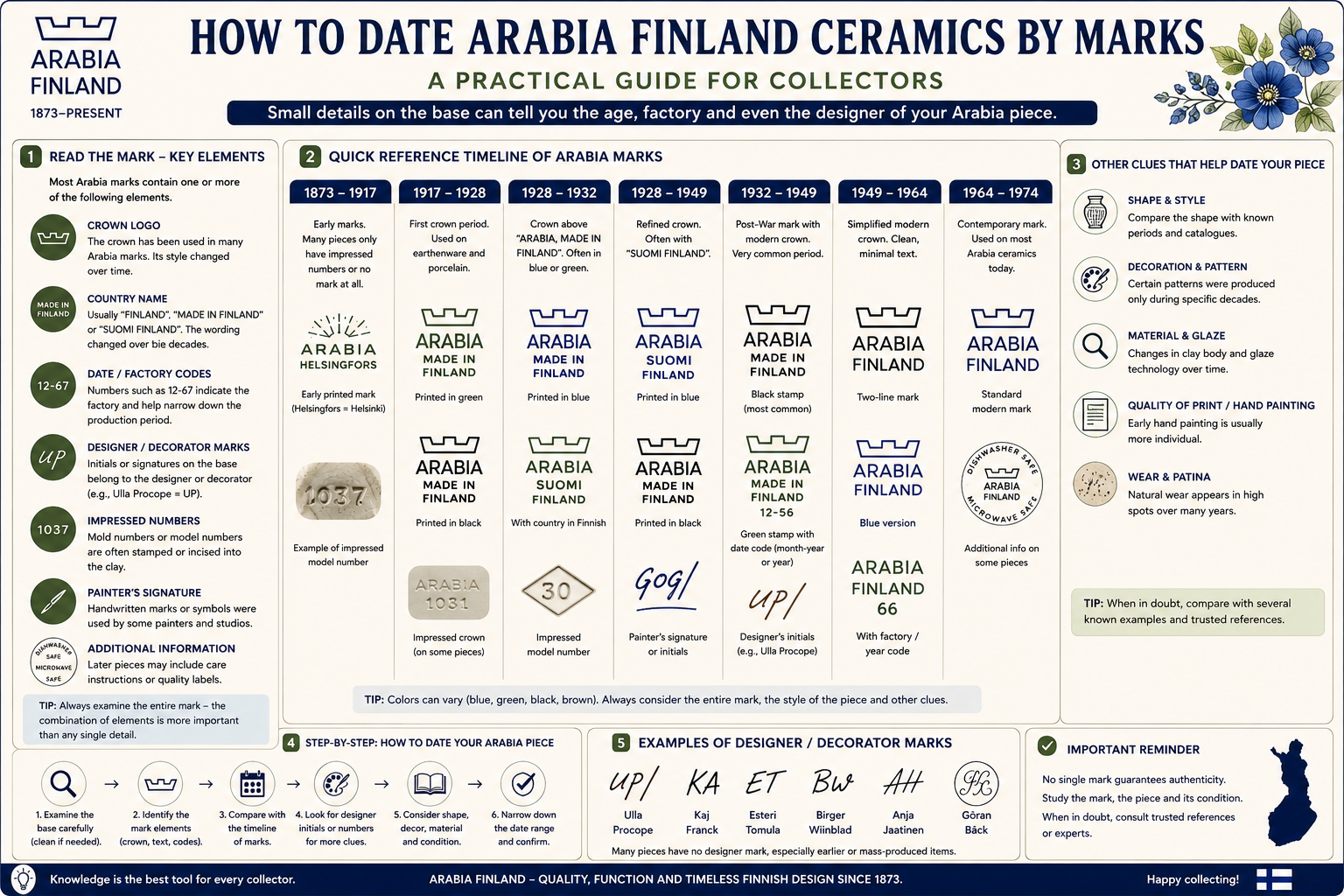
Dating Arabia ceramics is best approached as a process of cross-checking independent clues.
Start with the factory mark, but then ask whether the material, shape, decoration, manufacturing technique and condition are consistent with the period suggested by that mark.
1. Examine the Backstamp
Photograph the underside clearly. Record every word, number, symbol and handwritten or impressed character before beginning your research.
2. Identify the Material
Determine whether the object is porcelain, faience, stoneware or another ceramic body. This can immediately eliminate incorrect comparisons.
3. Identify the Shape
A model number can be extremely helpful when it can be matched with reliable catalogues or museum collections. Even without a number, the form itself may reveal a particular design period.
4. Study the Decoration
Look closely at whether decoration is hand-painted, printed, transfer-applied or produced using a combination of techniques.
5. Look for Designer and Decorator Information
Arabia’s history is closely associated with designers and ceramic artists. A documented signature, initials or pattern attribution may considerably narrow the possible production period.
6. Examine Natural Wear
The foot rim, contact surfaces and exposed decoration can reveal how an object has been handled. Natural wear should normally correspond with the object’s proposed age and use.
Remember that wear cannot authenticate a piece by itself. Artificial ageing, later decoration and replacement components are all possible.
Arabia Finland and the Rise of Finnish Design
What ultimately distinguishes Arabia from many nineteenth-century ceramic manufacturers is its transformation into an important platform for Finnish design.
During the twentieth century, Finnish designers increasingly rejected unnecessary ornament in favour of objects that combined beauty with everyday usefulness. Tableware was no longer simply decoration for formal dining rooms; it could become part of modern life.
Arabia played a significant role in this development.
The result was a distinctive design language characterised by combinations of:
- functional forms;
- strong silhouettes;
- nature-inspired decoration;
- modern Scandinavian simplicity;
- experimental ceramic surfaces;
- bold graphic patterns;
- high-quality industrial production.
Collectors interested in the wider Nordic tradition may also enjoy our guide to
Danish porcelain,
where Royal Copenhagen, Bing & Grøndahl and Aluminia illustrate a different but complementary Scandinavian ceramic tradition.
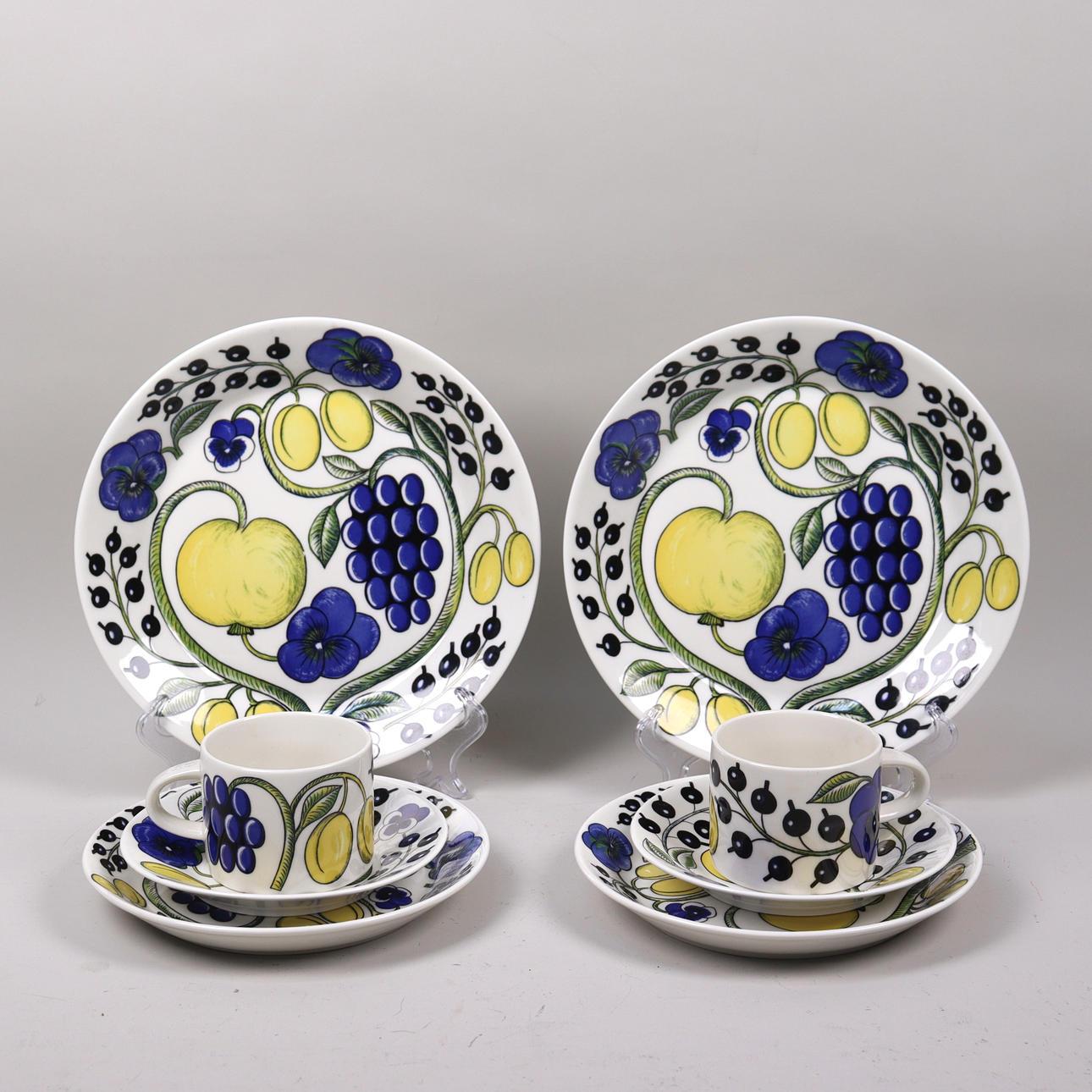
Birger Kaipiainen and Paratiisi
Among the names most closely associated with Arabia is Birger Kaipiainen, one of Finland’s celebrated ceramic artists and designers.
His work demonstrates how Finnish modernism did not necessarily mean minimalism. Rich botanical imagery, fruit, flowers and decorative surfaces could coexist with carefully considered functional forms.
The famous Paratiisi decoration became one of the most recognisable designs associated with Arabia.
Why Designers Matter When Identifying Arabia
With many historic porcelain factories, collectors focus primarily on the factory itself. Arabia requires a slightly broader approach because designer attribution can be central to both identification and collector interest.
When researching an Arabia object, therefore, ask two separate questions:
- Who manufactured the object?
- Who designed its shape or decoration?
These are not necessarily the same person or entity.
A piece can combine an Arabia factory backstamp with a particular shape designer, pattern designer, decorator or studio artist. Understanding these different layers can transform a generic identification into a much more precise attribution.
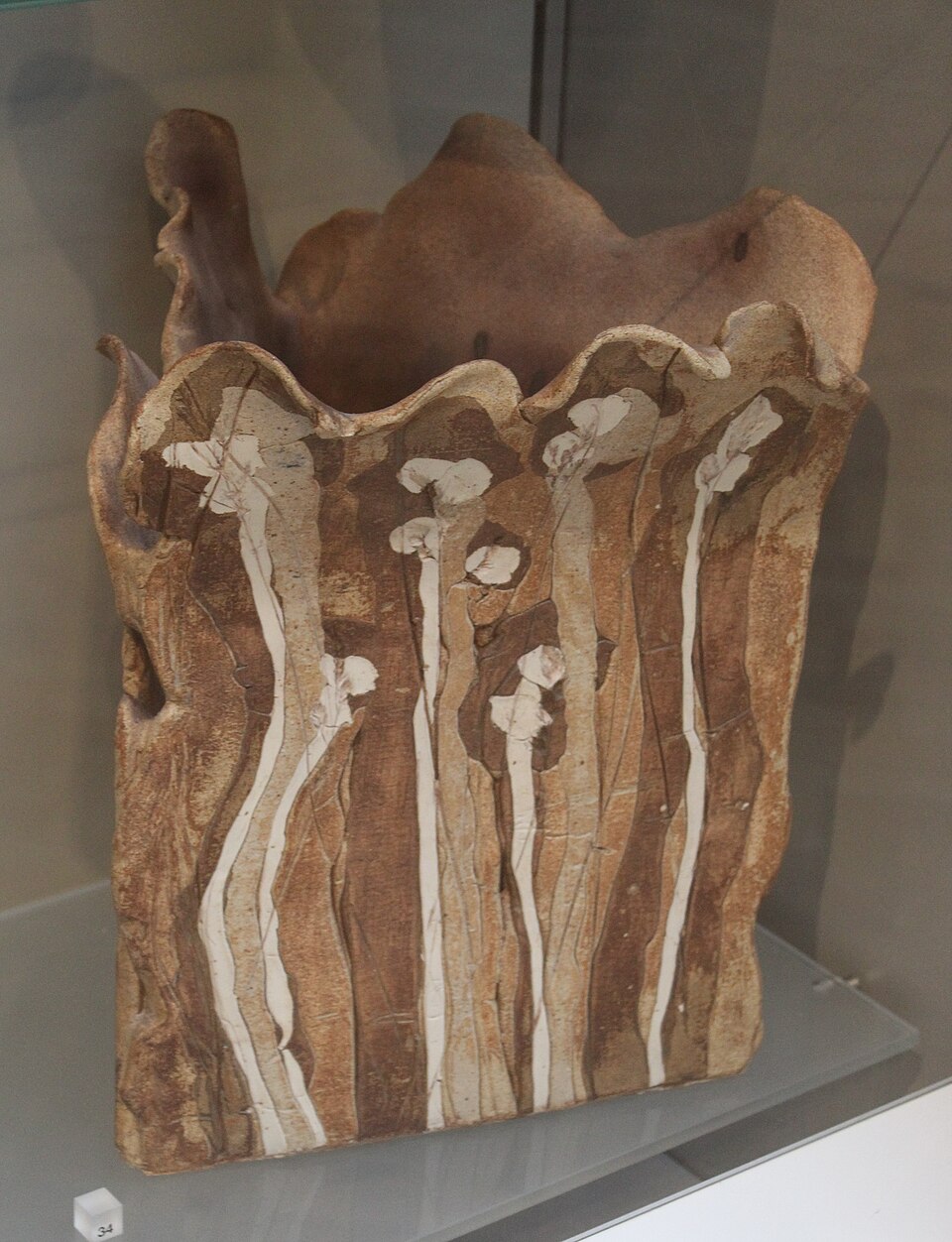
Important Arabia Finland Designers and Artists
Arabia’s reputation was shaped by numerous designers and ceramic artists. Collectors may encounter names associated with forms, decorations, studio ceramics or important production series.
| Name | Why Collectors Know the Name |
|---|---|
| Birger Kaipiainen | Highly decorative ceramic art and the celebrated Paratiisi design |
| Kaj Franck | Functional modernism and influential approaches to everyday tableware |
| Ulla Procopé | Functional ceramic forms and highly collectible tableware designs |
| Rut Bryk | Important Finnish ceramic art and highly distinctive decorative work |
| Francesca Lindh | Later twentieth-century studio and ceramic design associated with Arabia |
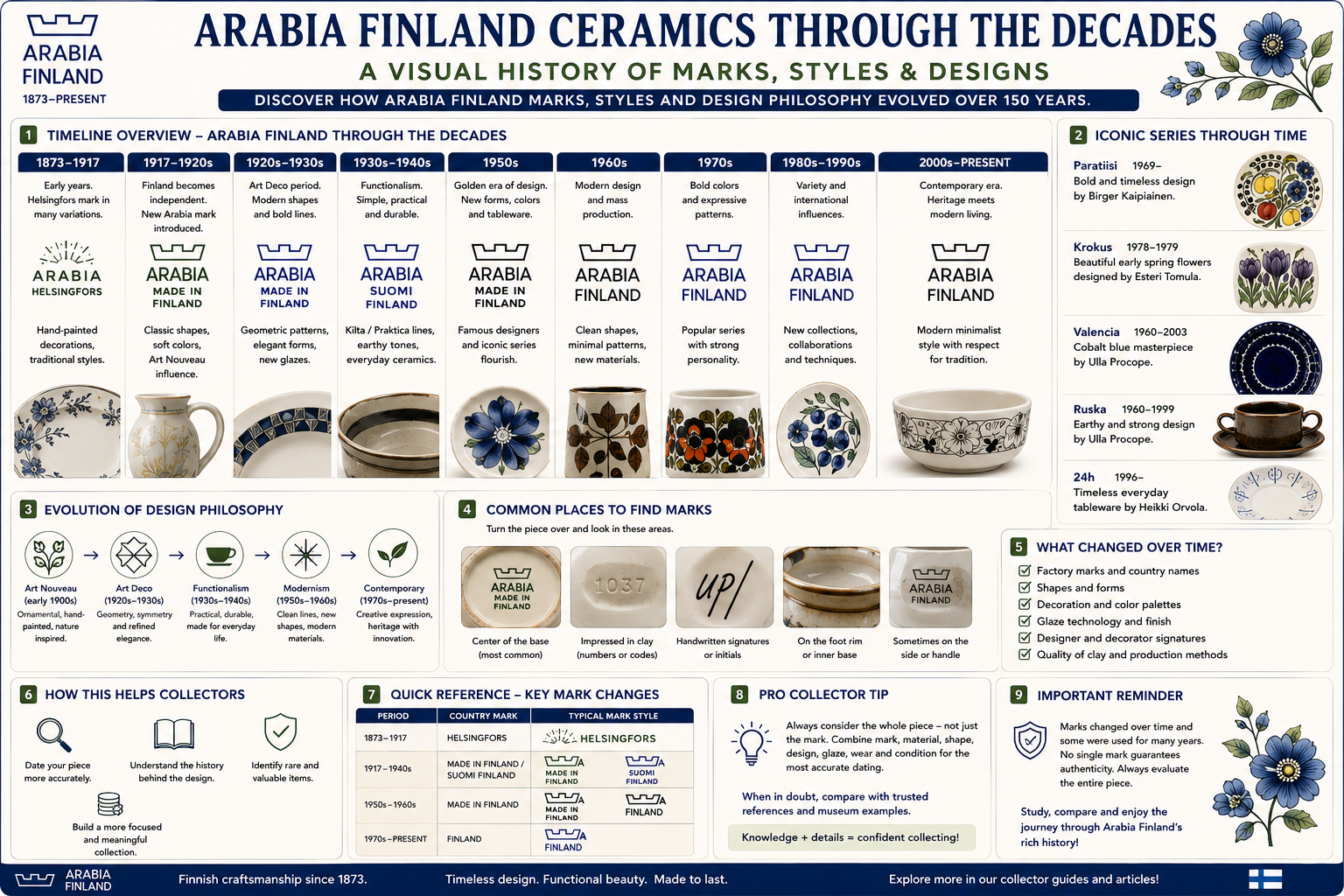
Arabia Finland Through the Decades
The appearance of Arabia ceramics changed substantially over time. Early production reflected nineteenth-century European traditions, while the twentieth century brought increasingly distinctive Finnish artistic and functional approaches.
For collectors, this stylistic evolution is useful because form and decoration can provide an independent check on a factory mark.
| Period | General Collector Context |
|---|---|
| Late 19th century | Early industrial production and strong European ceramic influences |
| c. 1900–1920s | Growing Finnish artistic identity and decorative experimentation |
| 1930s–1940s | Increasing functionalism and modern design principles |
| 1950s–1960s | Major period for internationally recognised Finnish modern design |
| 1970s–1980s | Bold patterns, established classics and continued artistic experimentation |
| Later production | Reissues, continuing patterns and evolving Arabia branding |
How to Identify Authentic Arabia Finland Ceramics
Authenticating an Arabia Finland piece requires more than finding the word
Arabia on its base. Factory marks are extremely useful, but
they should always agree with the material, shape, glaze, decoration,
manufacturing technique and expected production period.
This principle applies throughout the world of historic ceramics. As explained
in our
guide to identifying porcelain marks,
a backstamp is evidence that should support an attribution rather than replace
careful examination of the complete object.
When examining vintage Arabia Finland ceramics, collectors should therefore
work systematically from the object itself to the mark — and then compare all
the evidence.
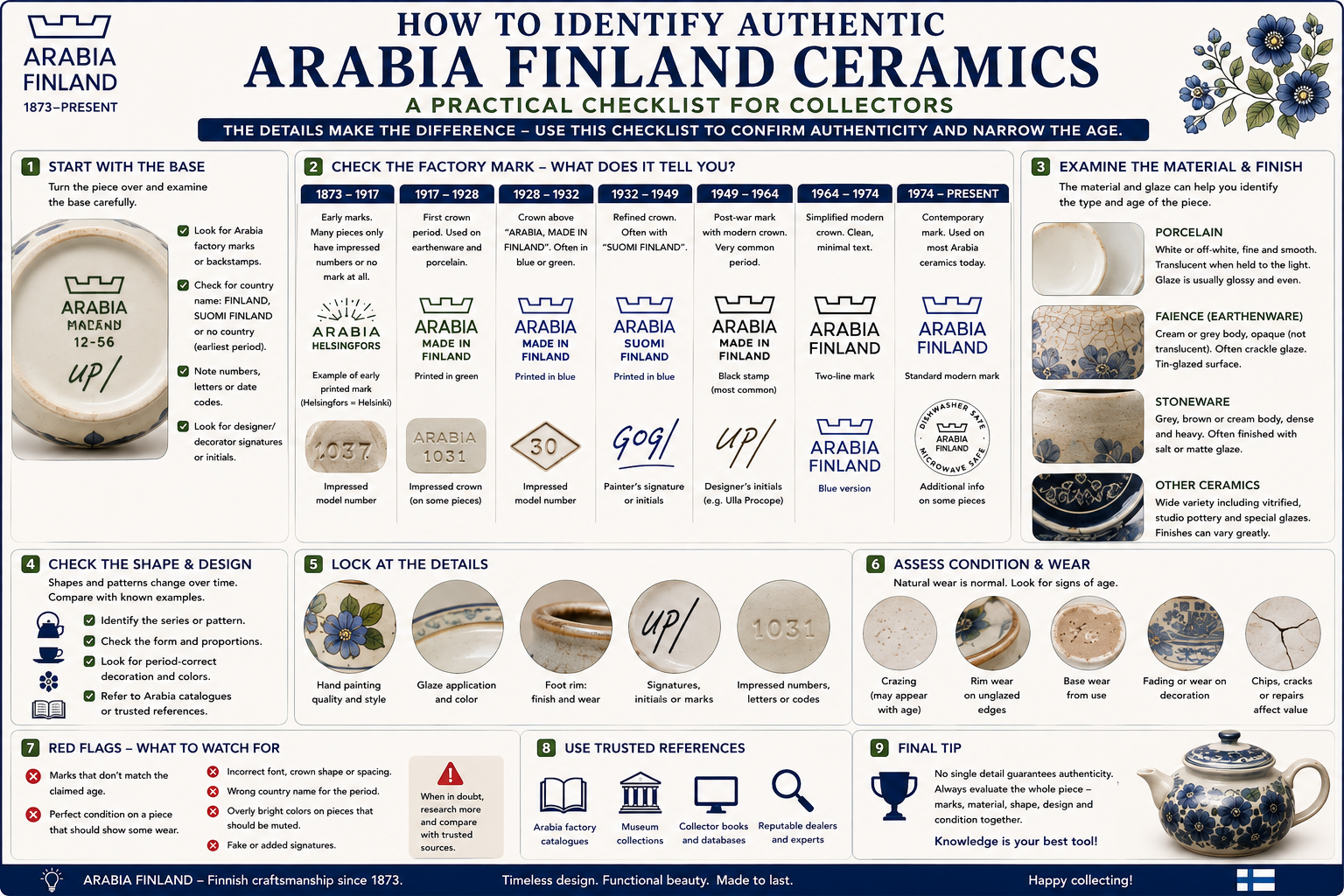
marks, decoration, signatures, manufacturing characteristics and condition.
1. Examine the Ceramic Body
Begin with the material. Do not assume that every Arabia object is porcelain.
The company’s long history includes different ceramic bodies, and identifying
the material can immediately narrow the range of possible comparisons.
Look at the exposed body around the foot rim and other unglazed areas. Consider
its colour, density, texture, weight and, where appropriate, translucency.
2. Study the Shape
Shape can be one of the strongest clues in Arabia identification. Many designs
were produced as recognisable families of tableware or decorative objects.
Proportions, handles, rims, feet, lids and profiles should be compared with
documented examples.
A model number can make this research considerably easier, but even an
unmarked shape may sometimes be attributed through careful comparison with
museum collections and historical catalogues.
3. Examine the Glaze
The glaze should be consistent with the ceramic body and manufacturing period.
Look for its colour, gloss, thickness and relationship with the decoration.
Irregularities are not automatically evidence of great age, just as a smooth
surface is not automatically evidence of modern manufacture. The entire
production context matters.
4. Study the Decoration
Determine how the decoration was applied. Arabia used numerous decorative
approaches throughout its history, ranging from industrial decoration to
artist-designed and studio work.
Look closely for printed elements, hand-painted details, variations in colour,
brushwork and the relationship between the pattern and the ceramic form.
5. Turn the Piece Over
The underside can contain some of the most useful evidence:
- factory backstamp;
- country-of-origin wording;
- model number;
- pattern or decoration code;
- impressed characters;
- designer initials;
- decorator or painter marks;
- production codes.
Photograph all markings before researching them. Small characters that appear
insignificant may prove important when compared with documented examples.
6. Compare the Mark with the Object
A convincing identification requires consistency.
If a mark suggests one production period but the shape, decoration or
manufacturing characteristics belong to another, further investigation is
necessary.
This is particularly important because marks can be copied, misunderstood,
misdated or added to objects that were not originally associated with the
factory.
Arabia Finland Identification Checklist
| Feature | What to Examine | Why It Matters |
|---|---|---|
| Material | Porcelain, faience, stoneware or another ceramic body | Helps establish the correct production context |
| Shape | Profile, handles, rim, foot, lid and proportions | May correspond to a documented Arabia model |
| Glaze | Surface, colour, gloss and consistency | Should agree with material and production technique |
| Decoration | Printed, painted or combined techniques | May identify a pattern, designer or period |
| Backstamp | Logo, wording, typography and application method | Can help establish manufacturer and approximate period |
| Numbers | Model, pattern and production numbers | Can narrow identification considerably |
| Signatures | Designer, decorator or artist marks | May establish an important attribution |
| Condition | Wear, chips, cracks and restoration | Important for authenticity and value |
| Provenance | Labels, receipts, collections and documentation | Can strengthen attribution and historical significance |
Original Arabia, Later Production and Reissues
One of the most important distinctions for collectors is the difference between
an early or vintage Arabia object and a later example of the same or
related design.
Successful designs can remain in production for long periods, disappear and
later return, or appear in revised forms. Consequently, recognising a famous
pattern does not automatically establish the age of an individual object.
The same principle applies to factory branding. The presence of an Arabia mark
can support identification of the manufacturer, but it does not automatically
mean that the object is antique.
This distinction is particularly important because, in the conventional
collecting sense, an
antique
is generally understood as an object at least 100 years old. Much highly
collectible Arabia production belongs instead to the category of
vintage or twentieth-century design.
Can Arabia Finland Marks Be Misleading?
Yes. The mark is one of the best starting points for identification, but it
should never be treated as absolute proof of age, rarity or value.
Several problems can occur:
- a genuine Arabia piece may be much later than a seller claims;
- a familiar design may have been produced during several periods;
- numbers may be incorrectly interpreted as date codes;
- a decorator’s mark may be mistaken for a factory date;
- a poorly documented online image may contain an incorrect attribution;
- a mark may be copied or imitated;
- later decoration may appear on an earlier ceramic body.
For this reason, collectors researching an unfamiliar backstamp should compare
it with documented museum examples, factory records, specialist publications
and reliable reference collections rather than relying on a single online
photograph.
Our detailed
guide to porcelain backstamps and factory marks
explains the same principle in greater detail.
Arabia Finland Signatures, Numbers and Codes
The underside of an Arabia object can contain considerably more information
than the main factory logo.
Collectors should record everything they see.
| Type | Possible Meaning | Collector Approach |
|---|---|---|
| Factory mark | Manufacturer and possible production period | Compare with documented marks |
| Model number | Shape or factory model | Search documented model references |
| Pattern code | Decoration or series | Compare pattern and shape separately |
| Designer signature | Design attribution | Verify against known signatures |
| Decorator mark | Individual painter or decorator | Do not automatically treat as a date |
| Impressed characters | Mould, production or model information | Interpret within the correct factory system |
| Country wording | Export or origin information | Useful for dating, but rarely sufficient alone |
How to Recognise Natural Age and Wear
Condition provides another layer of evidence. An object that has genuinely
survived decades of use may show subtle wear, particularly on its foot,
contact points, handles or exposed decoration.
Natural wear is usually irregular. It develops where the object has actually
been touched, placed on surfaces or washed.
Collectors may encounter:
- light wear to the foot rim;
- small surface scratches;
- minor wear to decoration;
- utensil marks on tableware;
- small manufacturing imperfections;
- old labels or adhesive traces.
None of these features proves age by itself. Condition should simply form part
of the wider identification.
Common Warning Signs When Examining Arabia Finland
Not every unusual feature indicates a fake. Nevertheless, certain
inconsistencies deserve closer investigation.
| Warning Sign | Why to Investigate It |
|---|---|
| Mark inconsistent with the shape | The proposed period may be incorrect |
| Incorrectly attributed material | A faience object may be incorrectly advertised as porcelain |
| Suspiciously perfect mark | Compare carefully with documented factory examples |
| Unexplained signature | Do not assume every handwritten mark belongs to a famous designer |
| Fresh decoration on an apparently old body | Later decoration or alteration may be possible |
| Artificial-looking wear | Wear must correspond naturally with handling and use |
| Seller dates from the mark alone | Independent evidence should confirm the attribution |
Which Arabia Finland Pieces Are Collectible?
Arabia attracts several overlapping groups of collectors. Some seek early
Finnish ceramics, while others concentrate on twentieth-century Scandinavian
design, particular designers, individual patterns or studio pieces.
Collectible categories can include:
- early Arabia production;
- historic Fennia pieces;
- rare decorative ceramics;
- designer tableware;
- artist-designed objects;
- studio ceramics;
- discontinued patterns;
- unusual colour variations;
- complete services;
- rare shapes;
- documented designer pieces;
- objects with important provenance.
Paratiisi and Collecting Arabia Patterns
Pattern collecting represents an important part of the Arabia market.
Paratiisi, associated with Birger Kaipiainen, is among the
most instantly recognisable examples, but Arabia’s design history extends far
beyond a single famous pattern.
When researching patterned tableware, collectors should distinguish between
four separate questions:
- Who designed the ceramic shape?
- Who designed the decoration?
- When was that decoration introduced?
- When was the individual object actually manufactured?
These questions may produce different answers.
This is why pattern recognition alone should not be used to date Arabia
tableware.
What Makes Arabia Finland Ceramics Valuable?
There is no single price category for Arabia Finland. Common later tableware
and rare artist-designed ceramics belong to very different collector markets.
Value is usually determined by a combination of factors.
| Factor | Potential Influence on Value |
|---|---|
| Designer or artist | Important documented designers can attract specialist collectors |
| Production period | Early or historically important production may be scarcer |
| Rarity | Rare models, patterns and variations can command greater interest |
| Condition | Original undamaged examples are generally preferred |
| Pattern | Demand differs substantially between patterns |
| Shape | Rare forms may be more desirable than common tableware |
| Signature | Documented artist or designer attribution may increase importance |
| Provenance | Strong documentation can increase confidence and historical interest |
| Market demand | Collector preferences influence current prices |
Does an Old Arabia Finland Mark Make a Piece Valuable?
Not necessarily.
Age and factory marks are important, but neither determines market value by
itself.
Two Arabia objects from approximately the same period can have dramatically
different values. One may be a common piece of tableware with considerable
wear, while another could be a rare artist-designed object in excellent
condition.
A realistic valuation therefore considers attribution, rarity,
designer, model, decoration, condition, provenance and current collector
demand together.
Condition and Arabia Finland Collector Value
Condition can have a significant effect on value, especially when several
comparable examples are available to collectors.
Check carefully for:
- chips;
- hairline cracks;
- star cracks;
- rim damage;
- handle repairs;
- restoration;
- overpainting;
- heavy utensil wear;
- staining;
- missing lids or components;
- replacement parts.
A rare or historically important object may still be collectible despite
damage, but restoration should always be considered when assessing its market
value.
Restoration: When Does It Matter?
Older ceramic objects are fragile, and restoration is not unusual. Professional
restoration can stabilise or visually reintegrate a damaged object, but it
does not return the piece to its original factory condition.
Collectors should inspect suspicious areas under strong, even light and look
for differences in surface texture, colour, gloss or translucency.
Handles, rims, lids and projecting decorative elements deserve particular
attention because they are especially vulnerable to damage.
For valuable ceramics, aggressive amateur repair can cause more harm than the
original damage. Our
complete antique porcelain guide
also covers the importance of conservation, restoration and correct storage.
How to Research an Arabia Finland Piece at Home
If you have discovered an Arabia object and want to identify it, use the
following sequence.
- Photograph the entire object. Include front, back and side views.
- Photograph the underside. Make the factory mark sharp and readable.
- Record every number and letter. Do not ignore impressed or handwritten characters.
- Measure the object. Record height, width and diameter where relevant.
- Identify the ceramic body. Do not automatically call it porcelain.
- Research the shape. Look for documented Arabia models.
- Research the pattern separately. Shape and decoration may have different histories.
- Check designer information. Verify signatures against reliable references.
- Compare the backstamp. Use museum collections, factory archives and specialist literature.
- Inspect condition. Record damage and previous restoration.
How to Photograph Arabia Finland Marks for Identification
A poor photograph can make an otherwise identifiable mark impossible to read.
For research or appraisal, photograph the underside in natural or diffused
light and keep the camera directly above the mark.
Take at least:
- one photograph of the complete object;
- one photograph of the complete underside;
- one close-up of the factory backstamp;
- close-ups of numbers and signatures;
- one photograph of any damage or restoration;
- one photograph showing the object’s scale.
Avoid filters and excessive digital sharpening. Accurate colour can itself be
useful when examining marks and ceramic bodies.
Arabia Finland Compared with Other Scandinavian Ceramics
Arabia belongs to a wider Nordic design tradition, but Finnish ceramics should
not simply be grouped together with Danish or Swedish production.
Each country developed its own factories, designers, materials and decorative
languages.
| Tradition | Collector Association |
|---|---|
| Finland | Arabia, Finnish modernism, artist-designed ceramics and functional tableware |
| Denmark | Royal Copenhagen, Bing & Grøndahl, porcelain painting and Scandinavian design |
| Sweden | Important industrial and studio ceramic traditions with strong modernist design |
For comparison, explore our
complete guide to Danish porcelain,
including Royal Copenhagen, Bing & Grøndahl, historical marks and
identification.
Is Arabia Finland Antique or Vintage?
It can be either, depending on when the individual object was made.
Because Arabia was founded in 1873, its earliest surviving production can now
qualify as antique. However, a very large proportion of the Arabia ceramics
encountered by collectors comes from the twentieth century and is more
accurately described as vintage Finnish ceramics.
This distinction matters for accurate cataloguing and SEO as well as for
collecting.
Arabia Finland should therefore not automatically be described
as antique porcelain. The correct description depends on the object’s
material and actual production date.
Frequently Asked Questions About Arabia Finland
What is Arabia Finland?
Arabia is a historic Finnish ceramics manufacturer founded in Helsinki in
1873. It became one of the best-known names in Finnish ceramic and
Scandinavian design.
Is Arabia Finland porcelain?
Some Arabia production can be described as porcelain, but Arabia manufactured
different types of ceramics. Historic examples may also be faience,
stoneware or other ceramic bodies. The material of each object should be
identified individually.
How can I identify Arabia Finland ceramics?
Examine the material, shape, glaze, decoration, underside, factory backstamp,
model and pattern numbers, designer or decorator marks, condition and
provenance. Never rely on the factory mark alone.
Where are Arabia Finland marks usually found?
Factory marks and related production information are commonly found on the
underside of the object. Additional numbers, impressed characters or
handwritten marks may also appear there.
What does an Arabia Finland backstamp mean?
A backstamp can help identify the manufacturer and may provide clues about
production period, country of origin, pattern or series. Its exact meaning
depends on the type of mark and the object on which it appears.
Can an Arabia mark tell the exact year?
Not always. Some marks can narrow the likely production period, but dating is
more reliable when the mark is combined with the object’s shape, pattern,
material and other production information.
Are all Arabia Finland pieces old?
No. Arabia has a long production history, and pieces encountered today can
range from early historic ceramics to relatively recent production.
Is old Arabia Finland valuable?
Some Arabia pieces are highly collectible, but age alone does not determine
value. Designer, rarity, model, pattern, condition, provenance and current
collector demand are all important.
Is Paratiisi collectible?
Yes. Paratiisi is one of the best-known designs associated with Arabia and
Birger Kaipiainen. However, collectors should establish the production period
of an individual piece rather than assuming that every example has the same
age or rarity.
Who are important Arabia designers?
Arabia’s history is associated with numerous important Finnish designers and
ceramic artists, including Birger Kaipiainen, Kaj Franck, Ulla Procopé and
Rut Bryk, among others.
Can Arabia Finland marks be copied?
Marks should never be treated as proof of authenticity by themselves. Compare
the mark with documented examples and verify that the material, shape,
decoration and manufacturing characteristics are historically consistent.
Should I clean Arabia ceramics before selling them?
Avoid aggressive cleaning. Abrasive products, harsh chemicals and excessive
scrubbing can damage decoration, glaze and historically important surface
features. Valuable pieces should be handled conservatively.
Final Collector’s Checklist
| Question | Check |
|---|---|
| Have I identified the actual ceramic material? | ✓ |
| Does the shape correspond with documented Arabia production? | ✓ |
| Have I photographed the complete backstamp? | ✓ |
| Have I recorded every number and signature? | ✓ |
| Does the mark agree with the proposed period? | ✓ |
| Have I identified the pattern separately from the shape? | ✓ |
| Have I checked for designer or decorator attribution? | ✓ |
| Have I examined chips, cracks and restoration? | ✓ |
| Have I compared the object with reliable documented examples? | ✓ |
| Am I evaluating the whole object rather than the mark alone? | ✓ |
Arabia Finland: More Than a Factory Mark
The enduring appeal of Arabia Finland lies in the remarkable breadth of its
history. What began as a nineteenth-century ceramics factory developed into
one of the defining names of Finnish design.
For collectors, that long history is precisely what makes Arabia fascinating —
and occasionally challenging.
An Arabia object may represent early Finnish industrial ceramics, decorative
faience, functional modernist tableware, an internationally recognised pattern
or the work of an important ceramic artist. Understanding which of these you
are looking at requires considerably more than reading the name printed on the
base.
The most reliable identification comes from bringing together
material, shape, glaze, decoration, factory marks, numbers, signatures,
condition, provenance and historical context.
That approach not only improves authentication and dating. It also reveals the
larger story behind the object — the transformation of Finnish ceramics from
nineteenth-century industrial production into one of the world’s most
recognisable modern design traditions.
Related Guides
-
Guide to Antique Porcelain: History, Identification, Marks, Manufacturers & Collecting
-
How to Identify Porcelain Marks: Backstamps & Maker’s Marks
-
What Are Porcelain Marks?
-
What Is Danish Porcelain? History, Marks & Identification
-
What Is Italian Porcelain? History, Marks & Identification
-
What Is an Antique?
Continue Exploring
Explore more identification guides, collecting advice and stories from the
world of antiques in
Stories & Knowledge
.
