
How to Identify Meissen Porcelain
Meissen porcelain is one of the world’s most prestigious and historically important types of European porcelain. Produced continuously since 1710 in the German town of Meissen, it was the first successful European hard-paste porcelain and forever changed the history of ceramics. Today, antique Meissen porcelain is admired for its exceptional craftsmanship, brilliant white porcelain body, exquisite hand-painted decoration, and the famous crossed blue swords factory mark.
Collectors, museums, auction houses, and antique dealers regard Meissen as one of the most desirable porcelain manufacturers in the world. Genuine eighteenth- and nineteenth-century Meissen pieces regularly achieve remarkable prices because of their rarity, artistic quality, and historical significance.
Whether you own a porcelain figurine, decorative vase, cabinet plate, tea service, or an object bearing the famous crossed swords, understanding Meissen’s history is the first step toward determining its authenticity and collector value.
If you are new to porcelain collecting, we recommend first reading What Is Porcelain?, Types of Porcelain Explained, Porcelain vs Faience vs Ceramic, and What Is German Porcelain?. These guides provide an excellent foundation before exploring the remarkable history of Meissen.
Meissen Porcelain at a Glance
| Manufactory founded | 1710 |
| Location | Meissen, Saxony, Germany |
| Crossed Swords introduced | 1722 |
| Trademark registered | 1875 |
| Most useful dating clues | Sword form, dots, stars, year symbols, model numbers, painter’s numbers and quality marks |
| Authentication rule | Never authenticate Meissen from the Crossed Swords alone |
The History of Meissen Porcelain
The story of Meissen began in the early eighteenth century when Augustus the Strong, Elector of Saxony and King of Poland, sought to unlock the secret of Chinese porcelain. For centuries, Europe had imported expensive porcelain from China and Japan, but no European manufacturer had succeeded in producing true hard-paste porcelain.
After years of experimentation, the alchemist Johann Friedrich Böttger and scientist Ehrenfried Walther von Tschirnhaus developed the first successful European hard-paste porcelain formula. In 1710 the Meissen Porcelain Manufactory was officially established inside Albrechtsburg Castle in Meissen, marking the birth of European porcelain manufacturing.
This breakthrough transformed European decorative arts. Meissen quickly became the model for many later porcelain factories, including those established in France, Austria, Russia, Denmark, Hungary, England, and Italy. Its influence can still be seen in countless porcelain traditions across Europe.
Throughout the eighteenth century, Meissen produced magnificent dinner services, sculptural centerpieces, religious figures, decorative animals, cabinet pieces, and elegant tableware for Europe’s royal courts and aristocracy. Many of these masterpieces are now displayed in museums and remain among the world’s most valuable porcelain objects.
Why Is Meissen So Important?
Meissen occupies a unique place in the history of porcelain because it was the first European factory to master true hard-paste porcelain. Its innovations influenced virtually every major European porcelain manufacturer that followed.
Collectors especially admire Meissen for its:
- First successful European hard-paste porcelain.
- More than 300 years of continuous production.
- Outstanding hand-painted decoration.
- Exceptional sculptural modelling.
- Museum-quality artistic standards.
- Historic royal commissions.
- The world-famous crossed swords trademark.
- Outstanding collector prestige.
Professional specialists also determine whether an object remains an original, or whether it could instead be a later copy, a replica, or a fake.
The Famous Crossed Swords Mark
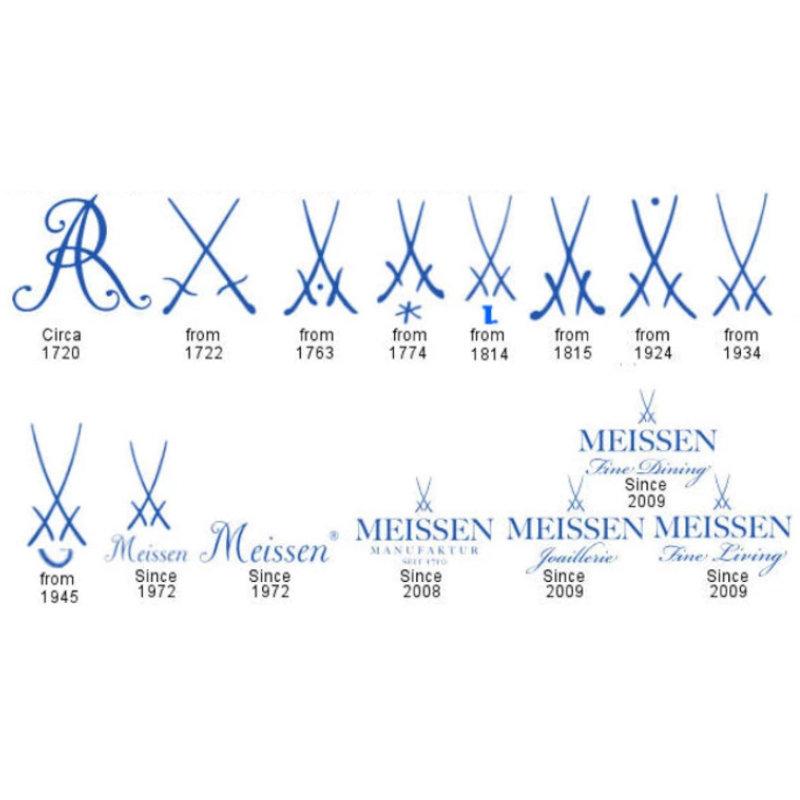
The most recognizable symbol of authentic Meissen porcelain is the famous crossed blue swords. Introduced during the early eighteenth century, this trademark remains the official emblem of the Meissen Porcelain Manufactory and is one of the oldest continuously used trademarks anywhere in the world.
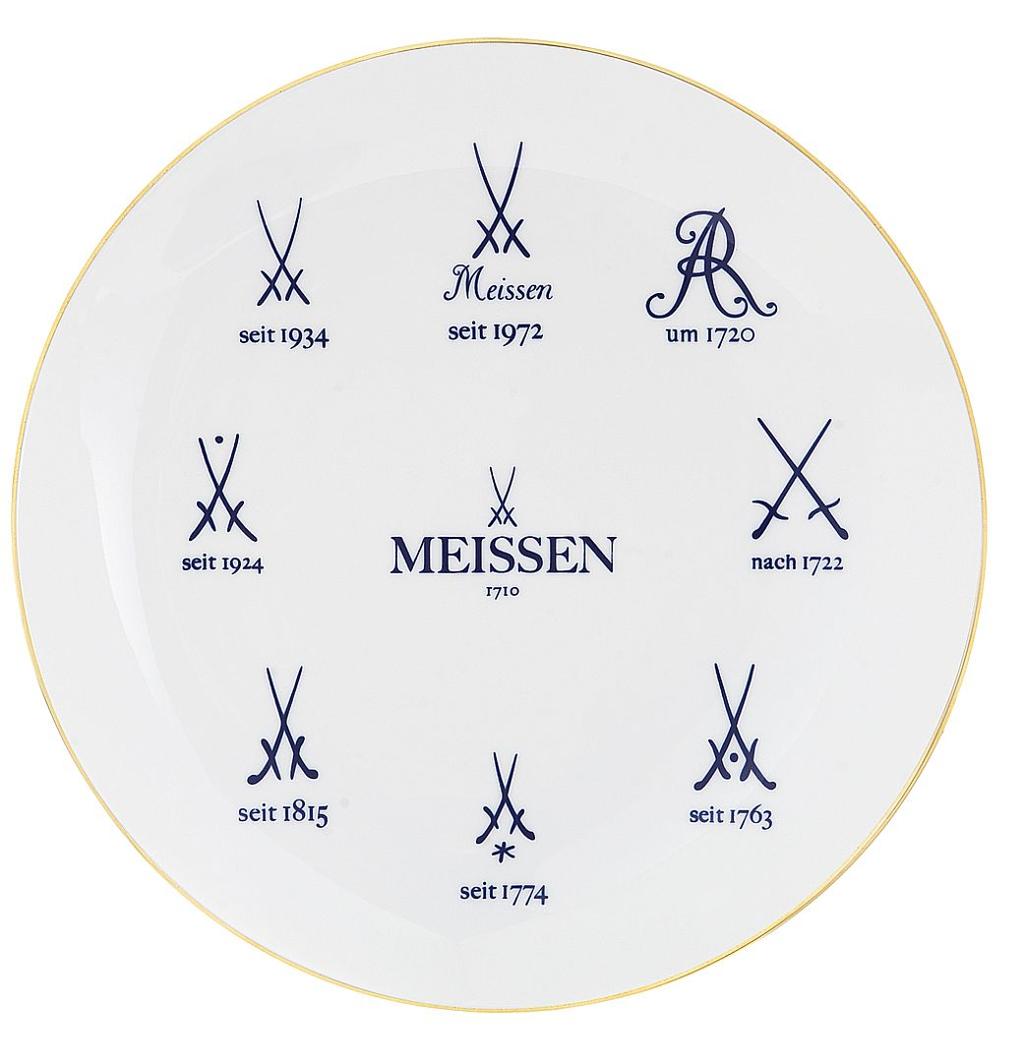
Although the crossed swords have remained Meissen’s official trademark for more than three centuries, their appearance has changed slightly throughout different production periods. Small variations in the blade shape, sword handles, guards, stars, dots, and additional symbols help specialists estimate the approximate production date of many Meissen porcelain pieces.
Because the crossed swords are internationally recognised, they have also become one of the most frequently copied porcelain marks. This is why experienced collectors never rely on the mark alone when determining authenticity.
Where Is the Meissen Factory Mark Located?
On most authentic Meissen porcelain, the factory mark appears on the underside of the object. It is typically painted in underglaze blue, although impressed marks, painter’s marks, model numbers, decorator’s numbers, and factory control marks may also be present.
Collectors should examine every symbol carefully because additional marks often reveal valuable information about the production model, decorator, sculptor, manufacturing period, or quality-control process.
Understanding these factory marks is one of the most important skills in porcelain collecting. For a broader introduction, see What Are Porcelain Marks?.
How to Identify Authentic Meissen Porcelain
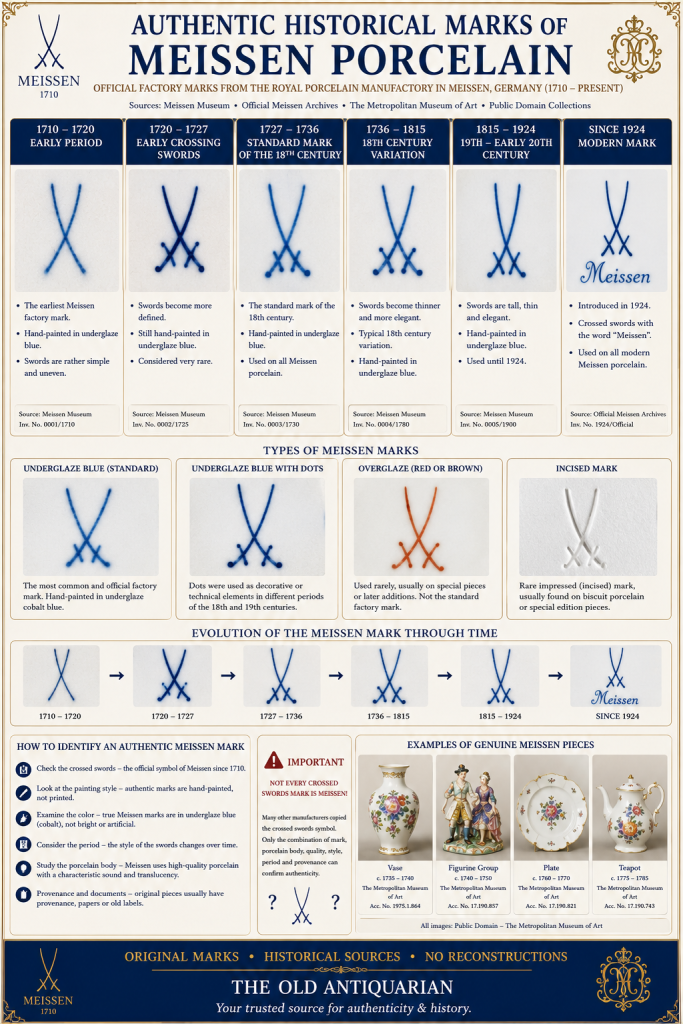
Correctly identifying authentic Meissen porcelain requires considerably more than checking the famous crossed swords mark. While the factory mark is one of the most valuable clues, professional appraisers always examine the entire object before determining its authenticity, production period, manufacturer, and market value.
Experienced specialists carefully examine:
- The crossed swords factory mark.
- The quality of the hard-paste porcelain body.
- Glaze consistency and finish.
- Translucency.
- Hand-painted decoration.
- Sculptural modelling.
- Model numbers.
- Painter’s and decorator’s marks.
- Factory control marks.
- Natural ageing and wear.
- Overall craftsmanship.
Authentic Meissen porcelain is recognised for its brilliant white hard-paste porcelain, exceptionally smooth glaze, remarkable translucency, crisp modelling, and extraordinary hand-painted decoration. Even the smallest decorative details are executed with remarkable precision by highly skilled craftsmen.
Professional identification also determines whether an object remains an original, or whether it may instead be a later copy, a replica, or even a fake.
How Have Meissen Marks Changed Over Time?
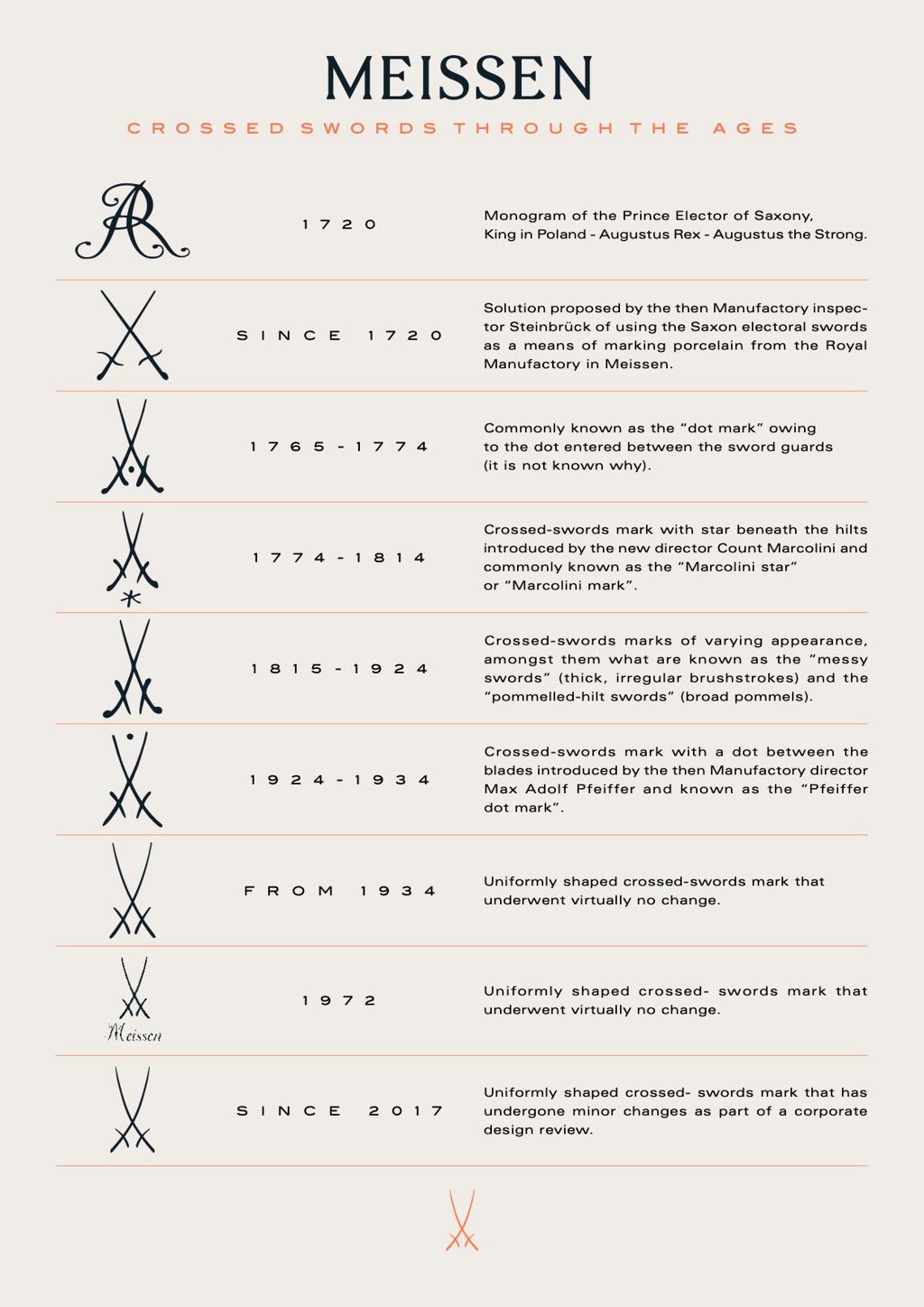
Throughout more than three centuries of production, the Meissen Porcelain Manufactory has used numerous variations of its famous crossed swords trademark. Although many of the changes appear subtle, they provide valuable information for dating porcelain.
Specialists compare:
- The shape of the sword blades.
- The design of the handles.
- The guards.
- Crossing angles.
- Stars or dots.
- Additional letters.
- Painter’s marks.
- Model numbers.
- Decorator’s symbols.
These small differences have been carefully documented in specialist catalogues and museum references. By comparing a factory mark with known historical examples, experienced appraisers can often estimate the production period with remarkable accuracy.
For a broader introduction to porcelain factory marks, see What Are Porcelain Marks?.
Meissen Crossed Swords Marks by Date
The Meissen manufactory introduced the Crossed Swords as its identifying mark in 1722. Over the following centuries, changes to the swords and additional symbols created a number of important dating periods. The chronology below follows historical information published by the Meissen manufactory.
| Period | Typical Mark | Dating Clue |
|---|---|---|
| c. 1722–1764 | Early Crossed Swords in varying hand-painted forms | Early swords are not completely uniform; the whole object and decoration must be considered. |
| 1765–1774 | Dot Sword mark | A dot appears between the swords below the intersection of the blades. |
| 1774–1814 | Marcolini star | A star appears beneath the crossed swords; strongly associated with the Marcolini period. |
| 1815–1924 | Crossed Swords in several forms | Includes broad, irregular brushstroke swords and so-called knob-sword forms with pronounced pommels. |
| 1924–1934 | Pfeiffer dot | A dot appears at the top between the sword blades. |
| Since 1934 | More standardised Crossed Swords mark | The basic trademark becomes more uniform, although minor changes still occur. |
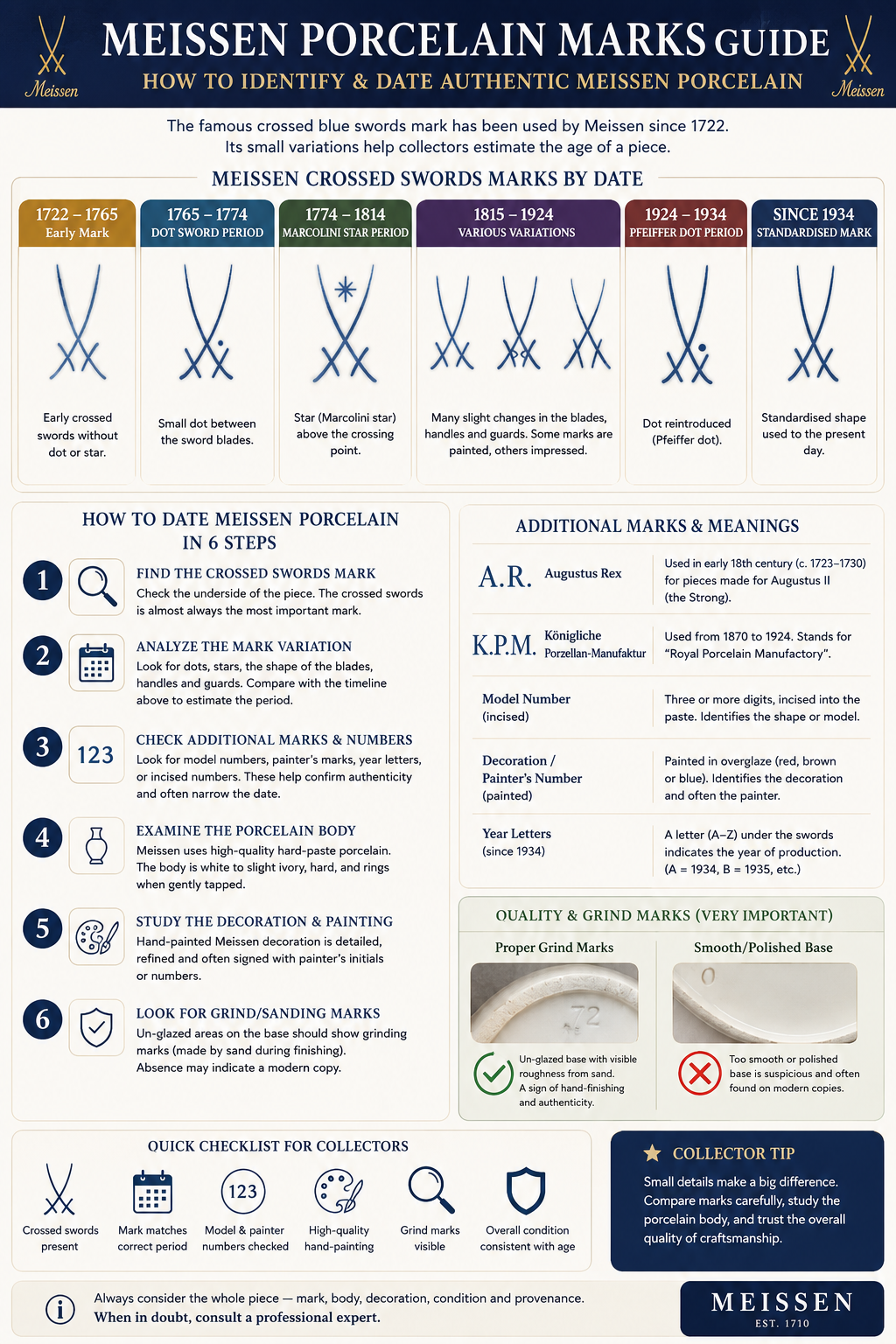
How to Date Meissen Porcelain by the Crossed Swords Mark
1. Examine the Shape of the Swords
Look at the blades, pommels, guards, crossing angle and overall brushwork. Because the mark has been painted by hand, exact line shape varies, but historically important design changes can still provide useful dating evidence.
2. Look for a Dot or Star
A dot below the crossing of the blades is associated with the 1765–1774 Dot Sword period. A star beneath the swords is characteristic of the 1774–1814 Marcolini period. A dot placed at the top between the blades is associated with the 1924–1934 Pfeiffer period.
3. Record Every Number and Symbol
Meissen pieces may also carry model numbers, painter’s numbers, decoration numbers, year symbols and other factory marks. These can be more precise than the swords alone when researching a particular object.
4. Compare the Mark with the Object’s Style
The proposed production period should agree with the porcelain body, modelling, decoration and manufacturing technique. A convincing mark on an object whose style or construction is historically inconsistent requires further investigation.
5. Check for Later Production of Older Models
Many successful Meissen models remained in production for long periods or were produced again later. The date when a model was first designed is therefore not necessarily the date when an individual piece was manufactured.
Meissen Year Marks, Painter’s Numbers and Other Base Marks
The Crossed Swords are only one part of the information that may appear on the underside of Meissen porcelain. The manufactory also uses or has used year marks, decoration numbers, painter’s numbers, model numbers and quality-control markings.
These additional symbols are especially valuable when a collector is trying to narrow a broad Crossed Swords period to a more precise manufacturing date or identify a particular decoration or model.
What Do Sanding or Grind Marks on Meissen Porcelain Mean?
Sanding or grind marks should not automatically be interpreted as damage or evidence of a fake. According to Meissen’s own collector information, they can indicate the factory’s quality classification.
- First choice: normally no grind mark.
- Second choice: typically one grind mark below the trademark.
- Faulty or damaged goods: may show several grind marks.
These marks primarily relate to quality classification rather than age. They should therefore be read separately from the historical form of the Crossed Swords.
Are There Fake Meissen Pieces?
Yes. Meissen is one of the most frequently copied porcelain manufacturers in the world. Thousands of reproductions, imitations, and outright counterfeits have appeared over the past two centuries, many carrying marks that closely resemble the famous crossed blue swords.
Some reproductions were honestly produced as decorative pieces, while others were intentionally created to deceive collectors. Because of this, the factory mark alone should never be accepted as proof of authenticity.
Professional authentication always considers:
- The porcelain body.
- Hard-paste porcelain quality.
- Glaze.
- Painting techniques.
- Sculptural modelling.
- Manufacturing methods.
- Factory marks.
- Overall craftsmanship.
Many convincing reproductions can only be distinguished through careful examination by experienced specialists familiar with historic Meissen production methods.
Common Types of Meissen Porcelain
Over more than three hundred years, Meissen has produced an extraordinary variety of luxury porcelain. Many categories remain highly desirable among collectors worldwide.
- Luxury dinner services.
- Tea services.
- Coffee services.
- Decorative cabinet plates.
- Porcelain figurines.
- Animal sculptures.
- Large decorative vases.
- Candlesticks.
- Religious figures.
- Mythological sculptures.
- Limited-edition collector pieces.
- Museum-quality decorative porcelain.
Meissen figurines created by Johann Joachim Kändler, elaborate table centrepieces, hand-painted cabinet plates, and early eighteenth-century porcelain remain among the most valuable examples ever produced by the factory.
The Most Collectible Meissen Porcelain
For more than three centuries, Meissen has produced some of the world’s finest porcelain, and many of its creations are now considered masterpieces of European decorative art. Antique Meissen porcelain is highly sought after by museums, auction houses, antique dealers, and private collectors because of its historical importance, artistic excellence, and exceptional craftsmanship.
Collectors most frequently seek:
- Early eighteenth-century Meissen porcelain.
- Johann Joachim Kändler figurines.
- Monkey Orchestra figurines.
- Swan Service pieces.
- Hand-painted cabinet plates.
- Large decorative vases.
- Animal sculptures.
- Religious and mythological figures.
- Luxury tea and coffee services.
- Dinner services.
- Limited-edition collector pieces.
- Artist-signed porcelain.
The famous Swan Service, commissioned in the 1730s for Count Heinrich von Brühl, is regarded as one of the greatest porcelain services ever created. Designed by Johann Joachim Kändler, it consists of more than two thousand pieces decorated with extraordinary relief scenes of swans, shells, fish, and aquatic life. Original examples are among the rarest and most valuable Meissen porcelains in existence.
Equally celebrated are Kändler’s porcelain figurines, which revolutionised European porcelain sculpture. His highly expressive figures, animals, mythological characters, musicians, and court scenes continue to rank among the most desirable porcelain sculptures ever produced.
What Determines the Value of Meissen Porcelain?
The value of antique Meissen porcelain depends on numerous factors rather than a single characteristic. Two objects that appear almost identical may differ dramatically in market value depending on their age, rarity, production period, artistic quality, and condition.
Professional appraisers carefully evaluate:
- Production period.
- Crossed swords factory mark.
- Age.
- Model number.
- Sculptor or modeller.
- Painter’s marks.
- Hand-painted decoration.
- Quality of sculptural modelling.
- Original gilding.
- Condition.
- Rarity.
- Historical importance.
- Documented provenance.
- Collector demand.
Collectors generally pay the highest prices for porcelain that remains in excellent original condition, retains its original crossed swords mark, and shows no evidence of poor restoration, repainting, or replacement parts.
Professional specialists also determine whether an object has undergone previous restoration or conservation. Careful conservation may help preserve an antique, while excessive restoration, replacement elements, or modern overpainting can significantly reduce both historical integrity and collector value.
Meissen Porcelain in the International Collectors’ Market
Meissen occupies one of the highest positions in the international antiques market. Collectors throughout Europe, North America, and Asia actively seek authentic eighteenth- and nineteenth-century Meissen porcelain because of its historical significance and extraordinary artistic quality.
Collectors value Meissen because it combines:
- The first successful European hard-paste porcelain.
- More than 300 years of uninterrupted production.
- Outstanding sculptural modelling.
- Exceptional hand-painted decoration.
- Historic royal commissions.
- Museum-quality craftsmanship.
- The world-famous crossed swords trademark.
- Excellent long-term collector demand.
Meissen established the artistic and technical standards that later influenced factories across Europe, including Sèvres, Imperial Russian Porcelain, Royal Copenhagen, Herend, English Bone China, and many other prestigious manufacturers.
Collectors frequently compare Meissen with other important European porcelain traditions such as French porcelain, English porcelain, Italian porcelain, Hungarian porcelain, Russian porcelain, while recognising the lasting influence of Chinese porcelain, whose secrets originally inspired the creation of Meissen itself.
How to Care for Antique Meissen Porcelain
Antique Meissen porcelain has survived for more than three centuries thanks to its exceptional quality and craftsmanship, but it remains delicate and should always be handled with great care. Proper cleaning, storage, and display help preserve both its beauty and its long-term collector value.
Collectors should always support porcelain by its strongest structural points. Handles, lids, sculptural flowers, delicate figurines, and ornamental details should never be used to lift an object, as these are the areas most vulnerable to accidental damage.
To help preserve antique Meissen porcelain:
- Handle porcelain with clean, dry hands.
- Avoid sudden temperature changes.
- Keep porcelain away from prolonged direct sunlight.
- Protect it from vibration and accidental impacts.
- Display valuable pieces inside enclosed cabinets whenever possible.
- Use padded shelves for figurines, decorative plates, and large vases.
- Never stack valuable porcelain without protective padding.
- Dust regularly using a soft microfiber cloth.
- Avoid abrasive cleaning products and harsh household chemicals.
- Never place antique porcelain in a dishwasher.
Particular care should be taken with Meissen figurines, applied flowers, and sculptural compositions, as these delicate elements are highly detailed and easily damaged. Original hand-painted decoration and gilding should never be aggressively cleaned or polished.
If damage occurs, professional conservation is generally preferable to unnecessary restoration. When repairs are required, they should always be carried out using reversible conservation techniques that preserve as much original material as possible.
When Should You Seek a Professional Appraisal?
If you own Meissen porcelain and would like to determine its authenticity, production period, historical importance, or approximate market value, obtaining a professional appraisal is often the safest course of action.
Professional evaluation is especially recommended before:
- Buying valuable Meissen porcelain.
- Selling inherited collections.
- Sending porcelain to auction.
- Restoring damaged objects.
- Obtaining insurance.
- Dividing family collections.
- Donating porcelain to museums or institutions.
Professional appraisers examine much more than the crossed swords mark. They carefully evaluate the porcelain body, glaze, sculptural modelling, painter’s marks, model numbers, craftsmanship, provenance, condition, and historical consistency before determining authenticity and market value.
➡️ Request a Professional Antique Valuation
Frequently Asked Questions
Is Meissen porcelain valuable?
Yes. Authentic Meissen porcelain is among the world’s most valuable and collectible porcelains. Early eighteenth-century pieces, rare figurines, cabinet plates, decorative vases, and complete dinner services can achieve exceptional prices at international auctions.
How can I identify authentic Meissen porcelain?
Authenticity is determined by examining the crossed swords mark, porcelain body, glaze, sculptural modelling, hand-painted decoration, craftsmanship, painter’s marks, model numbers, and natural signs of ageing. Professional authentication never relies on the factory mark alone.
What is the famous Meissen crossed swords mark?
The crossed blue swords are the official trademark of the Meissen Porcelain Manufactory and have been used since the early eighteenth century. They are among the oldest continuously used trademarks in the world and remain the most recognizable porcelain mark ever created.
Who designed the famous Meissen figurines?
Many of the factory’s most celebrated porcelain sculptures were created by Johann Joachim Kändler, one of Europe’s greatest porcelain modellers. His figurines, animals, mythological characters, and court scenes remain among the finest examples of porcelain sculpture ever produced.
Can damaged Meissen porcelain still be valuable?
Yes. Rare Meissen pieces often retain significant collector value despite minor damage. However, poor restoration, replacement parts, overpainting, or heavily altered factory marks can substantially reduce both historical importance and market value.
Can Meissen porcelain be a good investment?
Exceptional Meissen porcelain with documented provenance, excellent condition, rare crossed swords marks, and outstanding artistic quality has demonstrated strong collector demand for more than three centuries. Museum-quality Meissen pieces continue to achieve outstanding results at major international auctions.
How can I date Meissen porcelain by the crossed swords?
Begin with the overall form of the swords and look for additional symbols. Important periods include the Dot Sword mark of 1765–1774, the Marcolini star of 1774–1814, the Pfeiffer dot of 1924–1934 and the more standardised Crossed Swords used from 1934 onward. Model numbers, year marks and decoration should then be used to refine the dating.
What does a star under the Meissen swords mean?
A star beneath the crossed swords is associated with the Marcolini period, approximately 1774–1814. It is one of the most recognisable historical Meissen dating marks.
What does a dot between the Meissen swords mean?
The position of the dot matters. A dot beneath the intersection of the swords is associated with the 1765–1774 Dot Sword period, while a dot at the top between the blades is characteristic of the 1924–1934 Pfeiffer period.
What does a line or grind mark through the Meissen swords mean?
A grind or sanding mark can indicate factory quality classification rather than age. A single grind mark is commonly associated with second-choice porcelain, while several grind marks may indicate faulty or damaged goods. It should not be used by itself to date a piece.
Conclusion
Meissen porcelain represents one of the greatest achievements in the history of European decorative arts. As the first successful producer of hard-paste porcelain outside Asia, the Meissen Porcelain Manufactory transformed ceramic history and established standards that influenced virtually every major European porcelain factory.
Correct identification requires careful examination of factory marks, porcelain quality, glaze, sculptural modelling, hand-painted decoration, craftsmanship, historical style, and provenance. Together, these characteristics enable collectors to distinguish authentic Meissen masterpieces from later reproductions while appreciating the extraordinary artistry behind every piece.
Whether you are researching a treasured family heirloom, expanding a European porcelain collection, or purchasing your first Meissen masterpiece, understanding its history and craftsmanship will help you make informed collecting decisions and gain a deeper appreciation for one of the world’s greatest porcelain traditions.
Sources & References
- Meissen Porcelain Manufactory — official history of the Crossed Swords trademark and its introduction in 1722.
- Meissen Porcelain Manufactory — historical information on Crossed Swords mark periods, including the Dot Sword, Marcolini star, Pfeiffer dot and post-1934 mark.
- Meissen Porcelain Manufactory — official collector information on year symbols, painter’s numbers, decoration numbers and quality/grind marks.
This guide was prepared by The Old Antiquarian as an educational reference for collectors researching Meissen porcelain, Crossed Swords marks, dating and authentication.
Last updated: 29 August 2026
Continue Learning
- What Is Porcelain?
- Types of Porcelain Explained
- Porcelain vs Faience vs Ceramic
- What Are Porcelain Marks?
- What Is German Porcelain?
- How to Identify Rosenthal Porcelain
- How to Identify Limoges Porcelain
- How to Identify Herend Porcelain
- How to Identify Royal Copenhagen Porcelain
- How to Identify Wedgwood Porcelain
- What Is Chinese Porcelain?
- What Is French Porcelain?
- What Is English Porcelain?
- What Is a Maker’s Mark?
- What Is Restoration?
- What Is Conservation?
- What Is an Original?
- What Is a Copy?
- What Is a Replica?
- What Is a Fake?
- What Is a Certificate of Authenticity?
Explore Related Collections
