
What Is Sèvres Porcelain? History, Royal Origins and Why It Became the World’s Most Famous French Porcelain
Sèvres porcelain is one of the world’s most celebrated luxury porcelains and a masterpiece of French decorative arts. Produced by the famous Manufacture de Sèvres, it has represented exceptional craftsmanship, artistic innovation and royal prestige for more than 250 years.
Collectors recognise authentic Sèvres porcelain for its extraordinary hand-painted decoration, brilliant coloured grounds, elegant shapes and distinctive factory marks. From magnificent royal vases and luxurious dinner services to sculptural masterpieces and museum-quality works of art, Sèvres has influenced porcelain production throughout Europe and continues to be one of the most desirable names in the antique market.
Unlike many factories that focused primarily on tableware, Sèvres became famous for combining fine porcelain with painting, sculpture, architecture and decorative arts. Every important object was the result of collaboration between modellers, painters, gilders, sculptors and master craftsmen, creating pieces that are admired as works of art rather than simply functional ceramics.
Today, original Sèvres porcelain can be found in royal collections, major museums and private collections around the world. Because of its prestige, it has also become one of the most frequently copied porcelain manufacturers, making correct identification especially important for collectors.
Quick Answer
Sèvres porcelain is luxury French porcelain produced by the historic Manufacture nationale de Sèvres. Established originally at Vincennes in 1740 and moved to Sèvres in 1756, the factory became the official royal porcelain manufactory of France under King Louis XV.
Authentic Sèvres porcelain is admired for:
- Royal French heritage
- Outstanding hand-painted decoration
- Rich cobalt blue, turquoise and pink ground colours
- Fine gilding
- Exceptional artistic quality
- Historic factory marks
- Museum-level craftsmanship
If you are beginning to study European ceramics, our guide explaining what porcelain is provides an excellent introduction before exploring individual manufacturers.
The Origins of Sèvres Porcelain
The story of Sèvres porcelain begins long before the factory itself was established. During the seventeenth and early eighteenth centuries, European aristocracy developed an enormous fascination with Chinese and Japanese porcelain.
Imported porcelain from Jingdezhen, Arita and Imari was regarded as one of the greatest luxury goods in Europe. Kings, queens and noble families competed to acquire rare Oriental porcelain for their palaces.
European rulers soon realised that mastering porcelain production would not only reduce expensive imports but also demonstrate scientific knowledge, artistic achievement and national prestige.
Across Europe, factories such as Meissen, Vienna, Capodimonte and later Sèvres attempted to solve what became known as the “porcelain mystery.”
French Ambitions
France had long excelled in luxury goods including silk, furniture, jewellery, tapestry and decorative arts. However, unlike Saxony’s Meissen factory, France initially lacked the secret formula required to manufacture true hard-paste porcelain.
Instead of waiting for the formula to become available, French craftsmen perfected an alternative known today as soft-paste porcelain.
Although technically different from hard-paste porcelain, early French soft-paste porcelain possessed remarkable beauty and allowed artists to achieve rich colours and elegant finishes unlike anything produced elsewhere in Europe.
The Vincennes Factory (1740–1756)
The direct predecessor of Sèvres porcelain was established at Vincennes in 1740.
Initially supported by private investors and later by the French Crown, the Vincennes manufactory quickly attracted some of the finest painters, chemists, sculptors and decorators in France.
Rather than copying Asian porcelain exactly, Vincennes artists developed an unmistakably French artistic language inspired by Rococo elegance.
Their porcelain displayed:
- Delicate floral painting
- Pastoral landscapes
- Mythological scenes
- Rich gilding
- Graceful Rococo curves
- Highly refined modelling
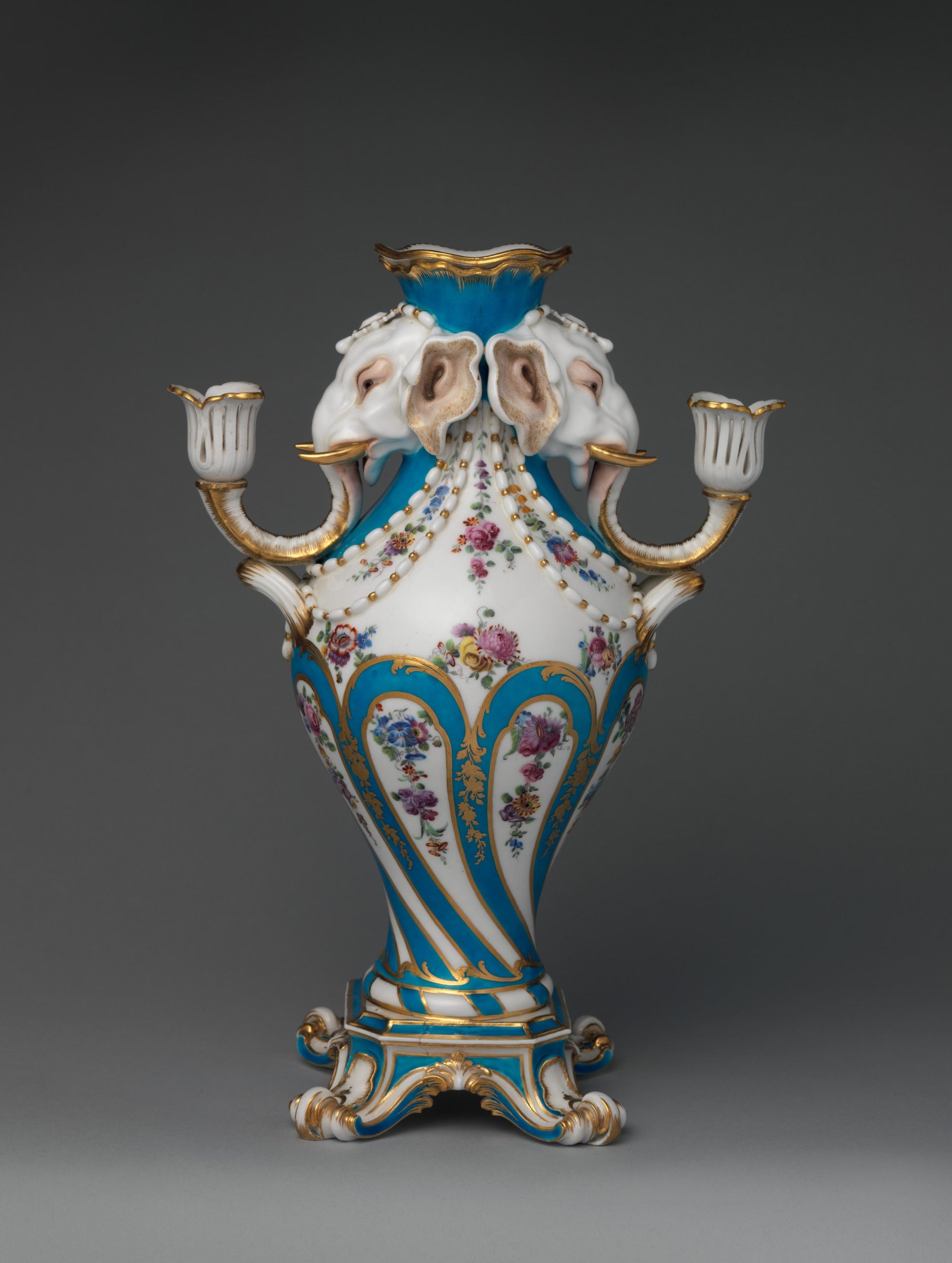
Within only a few years, Vincennes porcelain had become one of the most admired luxury products in Europe.
Why the Factory Moved to Sèvres
In 1756 the manufactory relocated from Vincennes to Sèvres, southwest of Paris.
Several reasons influenced this decision.
The new location offered larger workshops, improved facilities and easier access to Versailles, allowing close contact with the royal court.
More importantly, moving nearer to Versailles reinforced the connection between the factory and the French monarchy.
Only three years later, in 1759, King Louis XV purchased the manufactory outright, transforming it into the official royal porcelain factory of France.
From this moment onward, Sèvres became synonymous with French luxury.
King Louis XV and Royal Patronage
Royal patronage completely changed the future of the manufactory.
Under Louis XV, financial resources increased dramatically, allowing artists to experiment with new porcelain bodies, innovative glazes, brilliant colours and increasingly ambitious artistic projects.
Unlike commercial factories that depended primarily on public sales, Sèvres was encouraged to pursue artistic excellence above all else.
Its porcelain became:
- Royal diplomatic gifts
- Palace decoration
- Official state commissions
- Prestigious exhibition pieces
- Symbols of French cultural leadership
This unique environment enabled the manufactory to produce some of the finest porcelain ever created.
The Influence of Madame de Pompadour
No discussion of Sèvres porcelain would be complete without Madame de Pompadour.
As the influential favourite of King Louis XV, she became one of the manufactory’s strongest supporters and played an essential role in promoting French porcelain throughout Europe.
Madame de Pompadour possessed refined artistic taste and encouraged innovation in colour, decoration and design.
One of the factory’s most famous colours, Rose Pompadour, was named in her honour.
Her patronage helped establish Sèvres not merely as a porcelain factory but as one of Europe’s leading artistic institutions.
From Royal Workshop to National Treasure
Although closely associated with the French monarchy, the manufactory survived enormous political changes.
The French Revolution fundamentally transformed the institution, yet production continued.
During the nineteenth century the factory evolved into the Manufacture nationale de Sèvres, becoming both a production centre and an artistic laboratory dedicated to ceramic innovation.
Rather than disappearing with the monarchy, Sèvres continued developing new techniques, new artistic styles and increasingly sophisticated porcelain.
This remarkable continuity explains why Sèvres remains active today and is one of the oldest continuously operating porcelain manufactories in the world.
Alexandre Brongniart and the Golden Age of Innovation
One of the most important figures in Sèvres history was Alexandre Brongniart, director of the manufactory from 1800 until 1847.
Brongniart transformed Sèvres into one of Europe’s leading centres of ceramic science and artistic research.
He introduced improvements in:
- Porcelain chemistry
- Kiln technology
- Hard-paste porcelain production
- Colour development
- Historical research
- Museum collections
- Artist training
His influence extended far beyond France and helped shape nineteenth-century porcelain production across Europe.
Soft-Paste vs Hard-Paste Sèvres Porcelain
One of the first questions collectors ask is whether a piece is soft-paste or hard-paste porcelain.
Early Vincennes and early Sèvres production consisted primarily of soft-paste porcelain because France had not yet mastered true hard-paste production.
Soft-paste porcelain is generally admired for:
- A warm ivory tone
- Soft luminous glaze
- Excellent colour absorption
- Elegant artistic finish
Later, after deposits of kaolin were discovered in France, Sèvres gradually introduced genuine hard-paste porcelain.
Hard-paste porcelain provided:
- Greater durability
- Higher firing temperatures
- Improved resistance
- A brighter white body
Both types are historically important and highly collectible.
Understanding this distinction is essential when attempting to date antique porcelain correctly .
The Famous Colours of Sèvres Porcelain
One of the defining characteristics of authentic Sèvres porcelain is its extraordinary use of colour. While many European factories mastered porcelain production, very few achieved the remarkable depth, brilliance and refinement of the colours developed at Sèvres.
The manufactory invested enormous resources in ceramic chemistry, experimenting with pigments, glazes and firing techniques. Some colours required years of research before they could be produced consistently.
Today, these famous coloured grounds are among the first features collectors notice when identifying Sèvres porcelain.
Bleu de Roi – The Royal Blue of France
Perhaps no colour is more closely associated with Sèvres than Bleu de Roi, literally meaning “Royal Blue.”
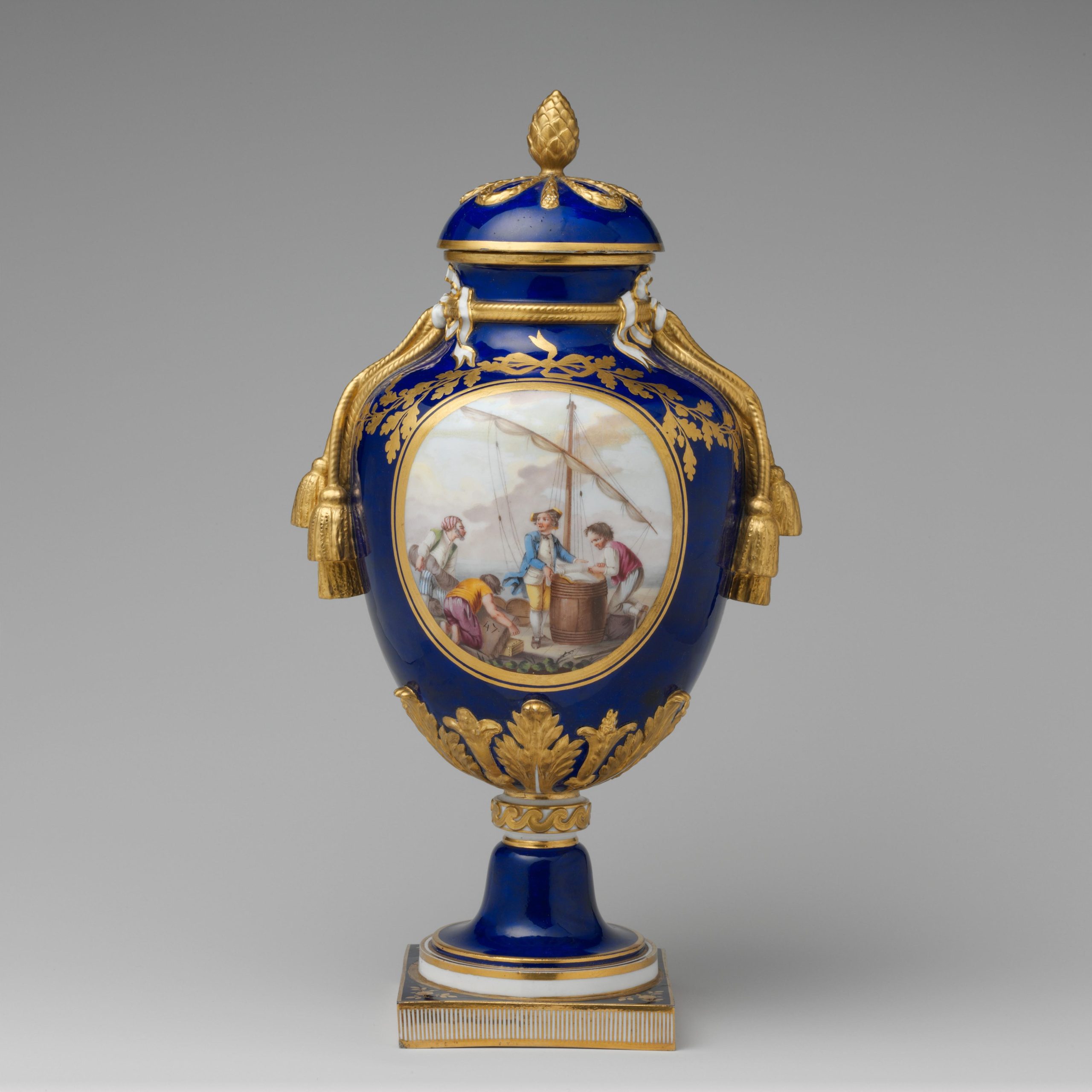
This deep cobalt blue became one of the defining features of luxury French porcelain during the eighteenth century. Rich, elegant and dramatic, Bleu de Roi created the perfect background for hand-painted reserves and brilliant gilding.
Many of the finest royal presentation vases produced for Louis XV and later Napoleon featured this magnificent colour.
Authentic Bleu de Roi displays exceptional depth, appearing almost luminous under natural light rather than flat or artificially glossy.
Bleu Céleste
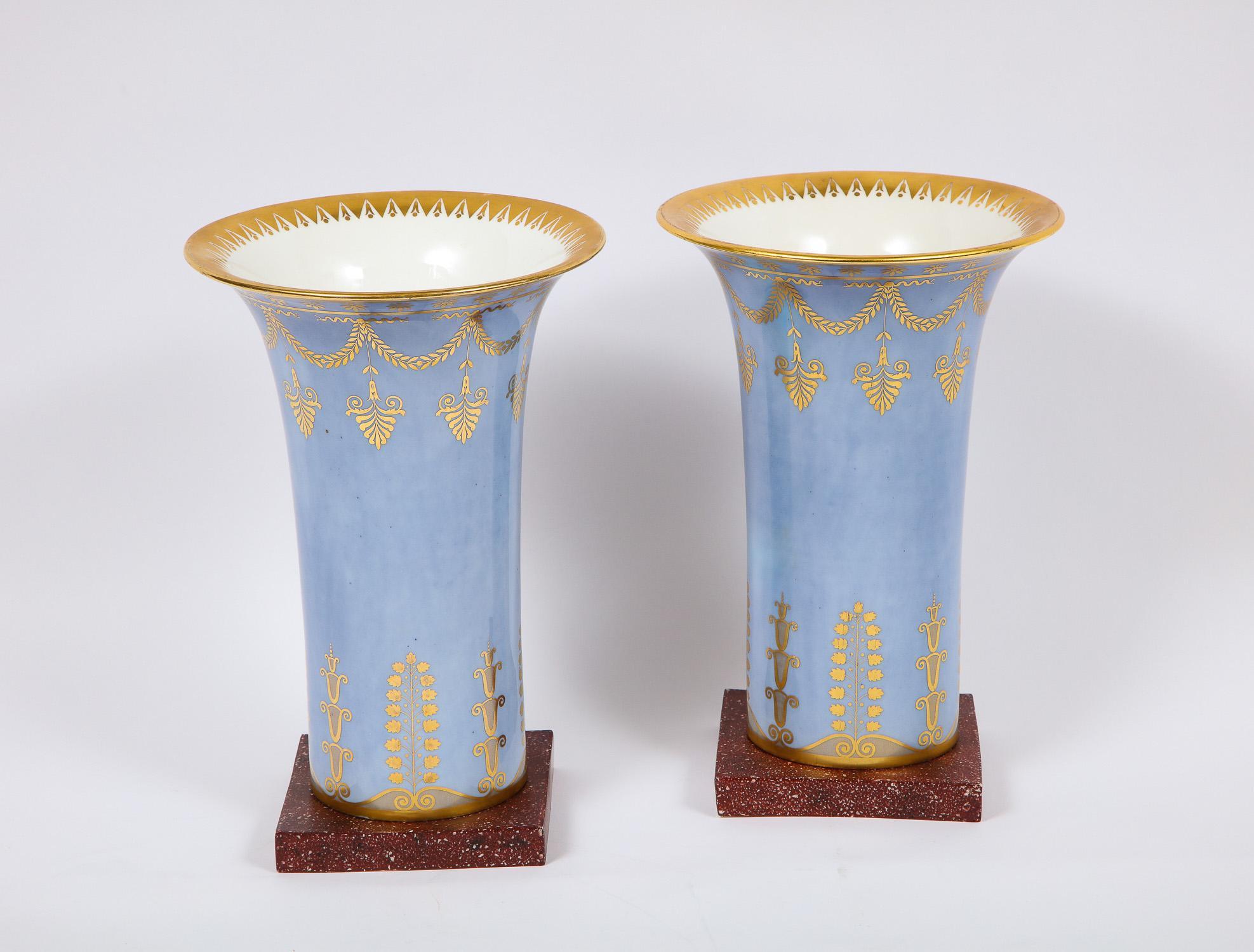
Another famous colour developed by the factory was Bleu Céleste, often described as heavenly blue.
Lighter than Bleu de Roi, this elegant turquoise-blue tone became one of the most luxurious colours ever produced on European porcelain.
Creating this colour required extraordinary technical precision because even small differences in firing temperature could dramatically affect the final appearance.
Collectors often regard Bleu Céleste pieces among the finest achievements of eighteenth-century French porcelain.
Rose Pompadour
Few porcelain colours are as instantly recognisable as Rose Pompadour.
Named after Madame de Pompadour, this rich pink colour reflected the elegance and refinement of the French Rococo period.
Rose Pompadour pieces frequently combine:
- Hand-painted flowers
- Romantic landscapes
- Portrait reserves
- Heavy gilding
- Scrolled borders
Because of its beauty, Rose Pompadour became widely copied throughout Europe, making careful identification particularly important.
Other Famous Sèvres Colours
Besides its famous blues and pinks, Sèvres produced numerous other luxurious coloured grounds including:
- Apple green
- Emerald green
- Canary yellow
- Ivory white
- Chocolate brown
- Deep crimson
- Lavender
- Turquoise
Many colours were produced only for limited periods, making them especially desirable among collectors today.
Why Sèvres Painting Is So Exceptional
Unlike factory decoration found on ordinary tableware, Sèvres painting was regarded as fine art.
Each object often passed through the hands of multiple specialists, including:
- Master modellers
- Figure painters
- Landscape painters
- Flower painters
- Animal painters
- Portrait artists
- Gilders
This collaborative approach resulted in porcelain that rivals oil painting in its artistic quality.
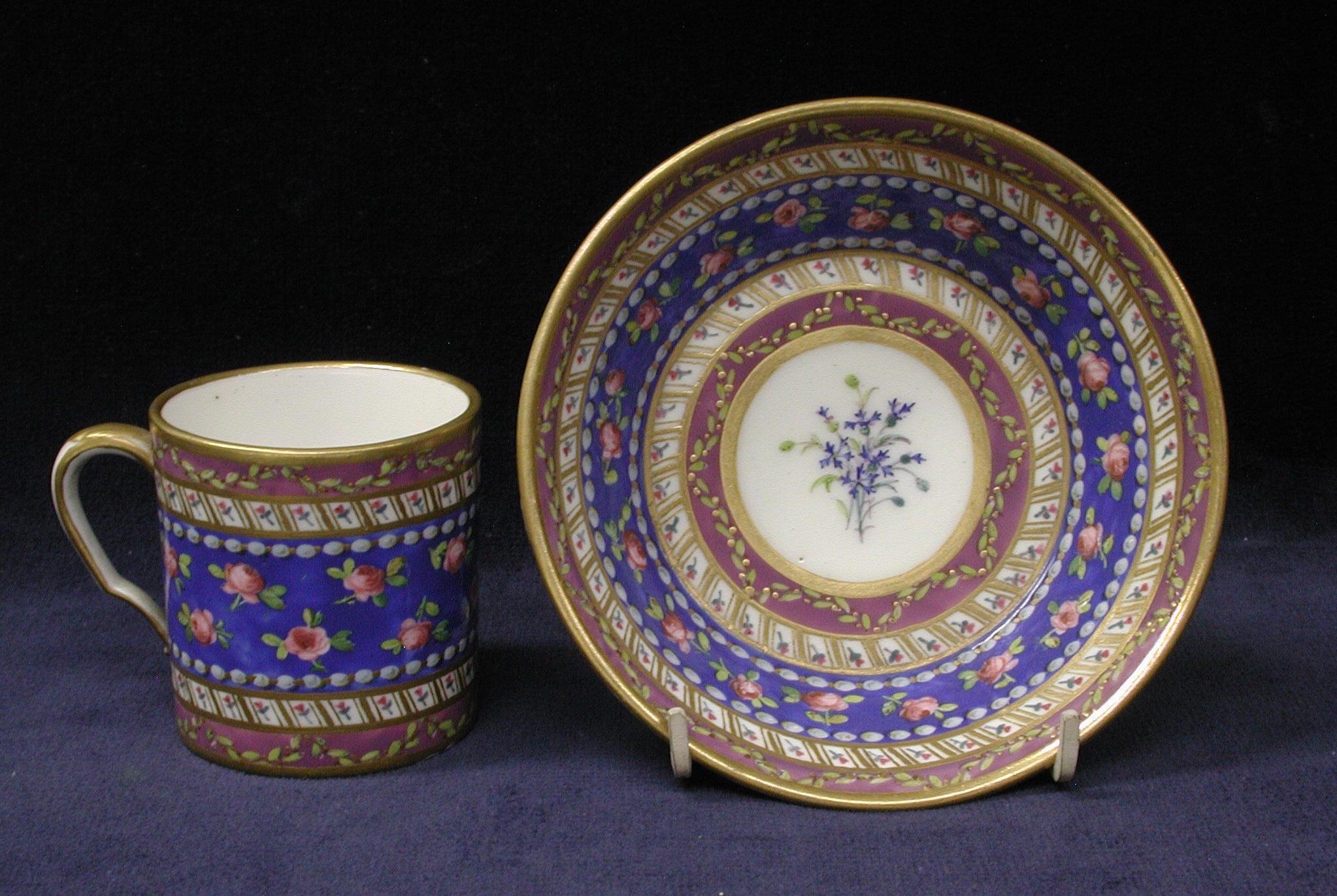
When viewed under magnification, genuine Sèvres decoration displays subtle brushstrokes, smooth colour transitions and remarkable precision impossible to reproduce with modern transfer printing.
If you would like to learn more about identifying authentic hand-painted decoration, our guide on how to identify antique porcelain explains the process in greater detail.
Famous Decorative Subjects
Sèvres artists painted an astonishing variety of decorative themes.
Among the most popular were:
- Mythological scenes
- Royal portraits
- Pastoral landscapes
- Classical architecture
- Floral bouquets
- Birds
- Exotic animals
- Military victories
- Romantic scenes
- Historical figures
Many painters specialised in only one subject throughout their careers, contributing to the exceptional quality of the finished porcelain.
The Most Famous Types of Sèvres Porcelain
Royal Vases
Large decorative vases became symbols of royal prestige and French artistic achievement.
These impressive objects were often produced in pairs and displayed in palaces, embassies and aristocratic residences.
Some required months—or even years—to complete because of their elaborate painting and gilding.
Tea and Coffee Services
Sèvres produced luxurious tea and coffee services for royal households across Europe.
Each cup was individually painted, making complete surviving sets exceptionally valuable today.
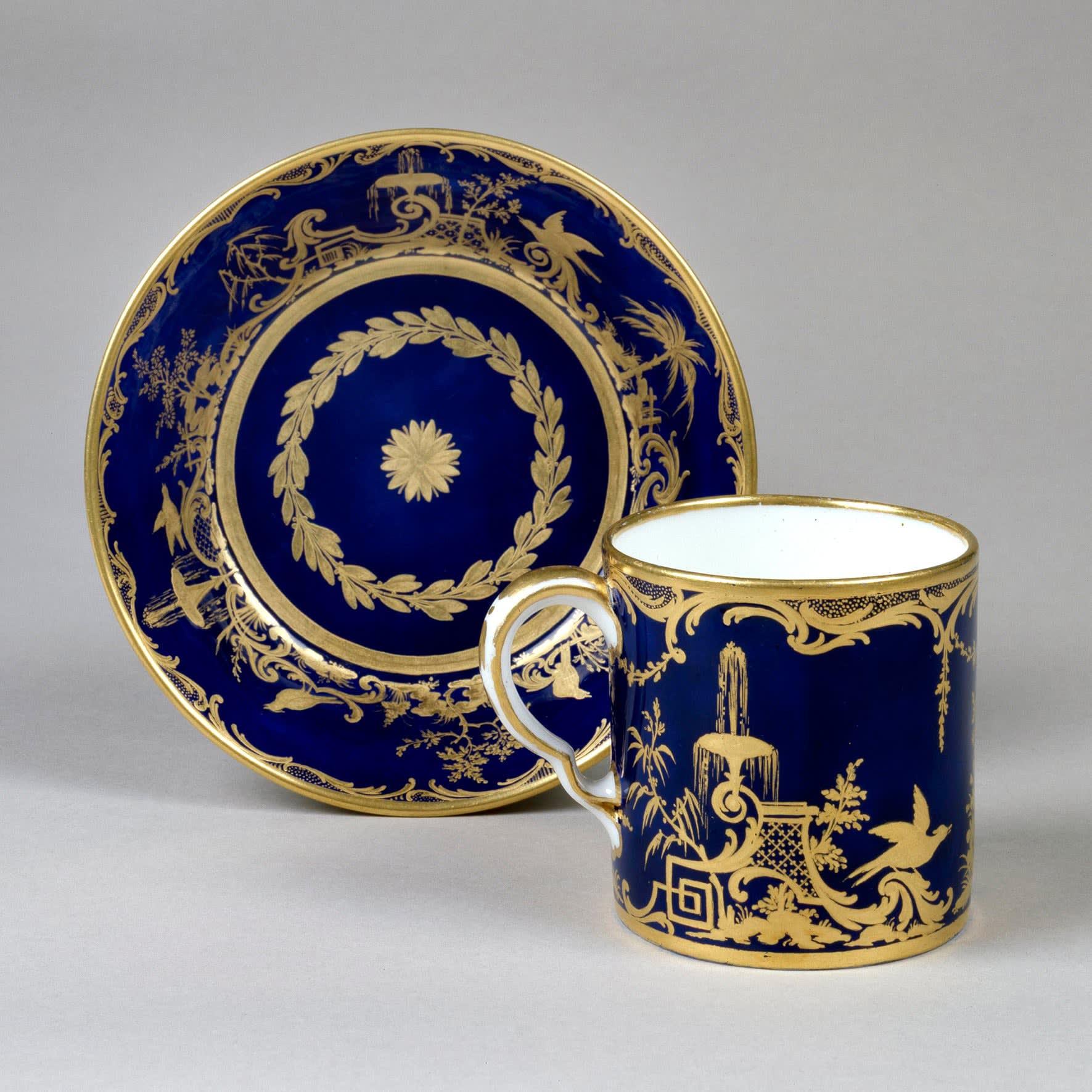
Unlike mass-produced ceramics, slight differences between individual cups often confirm genuine hand craftsmanship.
Decorative Plates
Many Sèvres plates were never intended for everyday dining.
Instead, they functioned as decorative artworks displayed in cabinets or presented as diplomatic gifts.
Portrait plates, botanical studies and historical scenes remain especially sought after by collectors.
Porcelain Sculptures
The manufactory also became famous for elegant biscuit porcelain sculptures.
Unglazed biscuit porcelain closely resembled marble, making it ideal for classical figures inspired by Ancient Greece and Rome.
Many sculptors working at Sèvres were among the finest artists of their generation.
Luxury Beyond Porcelain
Many important Sèvres objects incorporated gilt bronze mounts produced by leading French bronze workshops.
These luxurious combinations of porcelain and ormolu transformed vases, clocks and furniture into masterpieces of decorative art.
Collectors should remember that original bronze mounts often contribute significantly to an object’s historical and financial value.
How Sèvres Influenced European Porcelain
The artistic success of Sèvres inspired manufacturers across Europe.
Factories in Germany, Austria, England and Italy frequently adopted French-inspired colours, Rococo shapes and decorative themes.
As a result, collectors regularly encounter “Sèvres style” porcelain that resembles the French originals without actually being produced by the royal manufactory.
Understanding these distinctions is essential before attempting to value or authenticate a piece.
Our guide to porcelain marks and factory backstamps explains how specialists distinguish genuine Sèvres from later copies and imitations.
Sèvres Porcelain Marks – The Complete Guide to Factory Marks and Identification
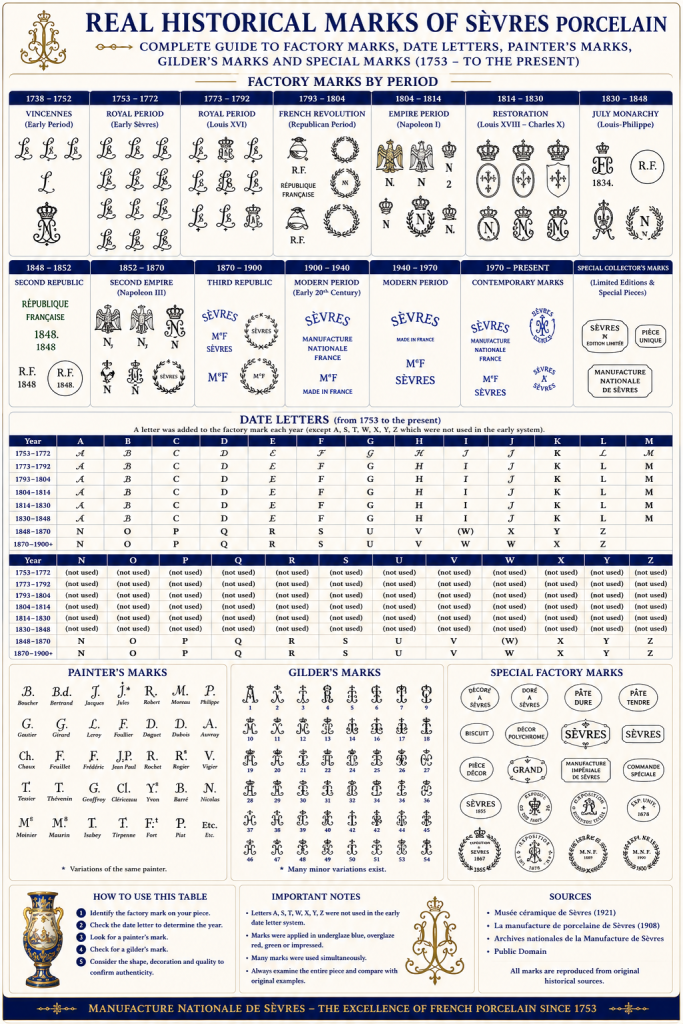
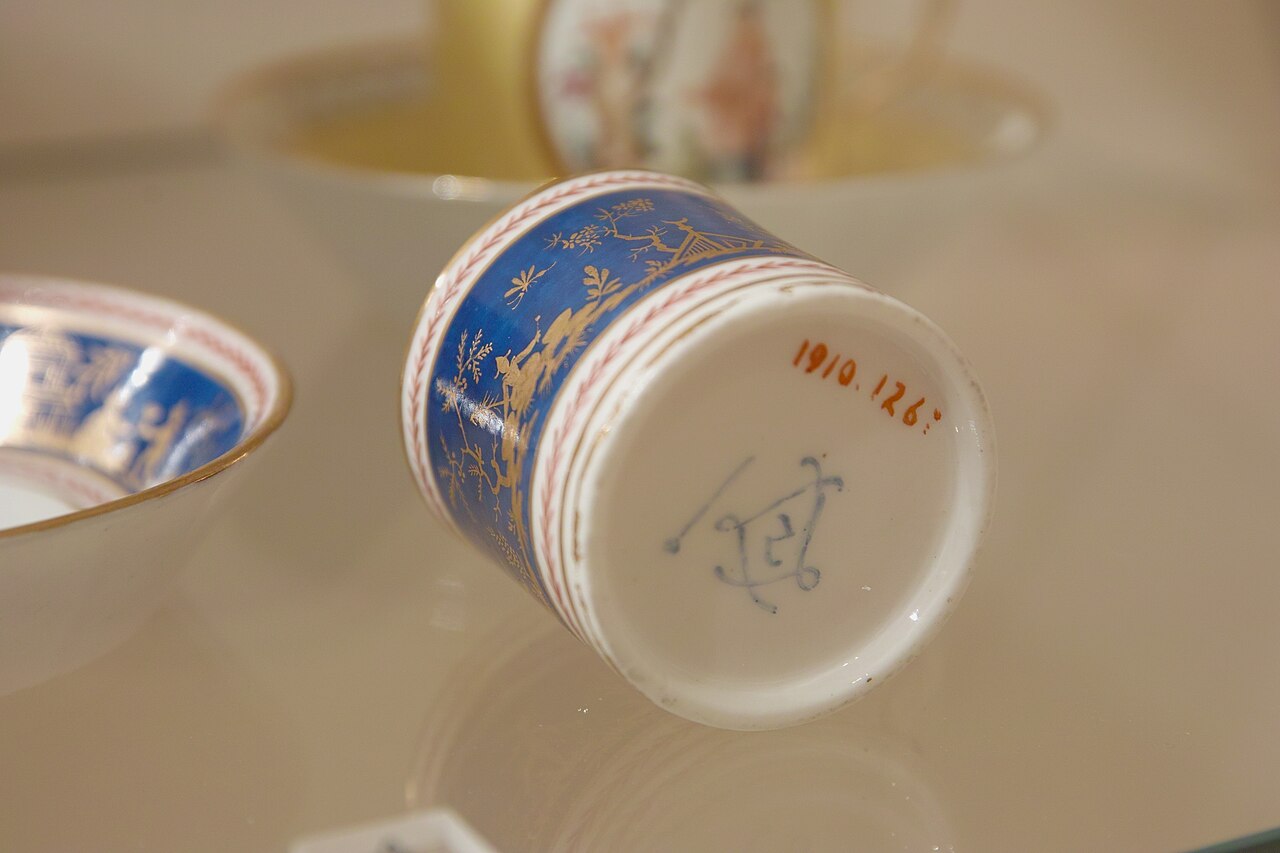
One of the first things collectors look for when examining antique porcelain is the factory mark. In the case of Sèvres porcelain, marks provide valuable information about the manufacturer, production period and, in many cases, even the individual artists who decorated the object.
However, one of the biggest mistakes beginners make is assuming that the presence of a Sèvres mark automatically proves authenticity. This is not true.
Because Sèvres has been one of Europe’s most prestigious porcelain manufacturers for more than two centuries, its marks have been copied countless times. Some reproductions are honest decorative pieces, while others were deliberately created to deceive collectors.
Professional identification always considers the mark together with the porcelain body, glaze, decoration, modelling, wear and historical consistency.
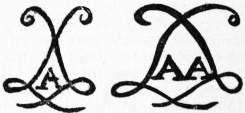
The Famous Double L Mark
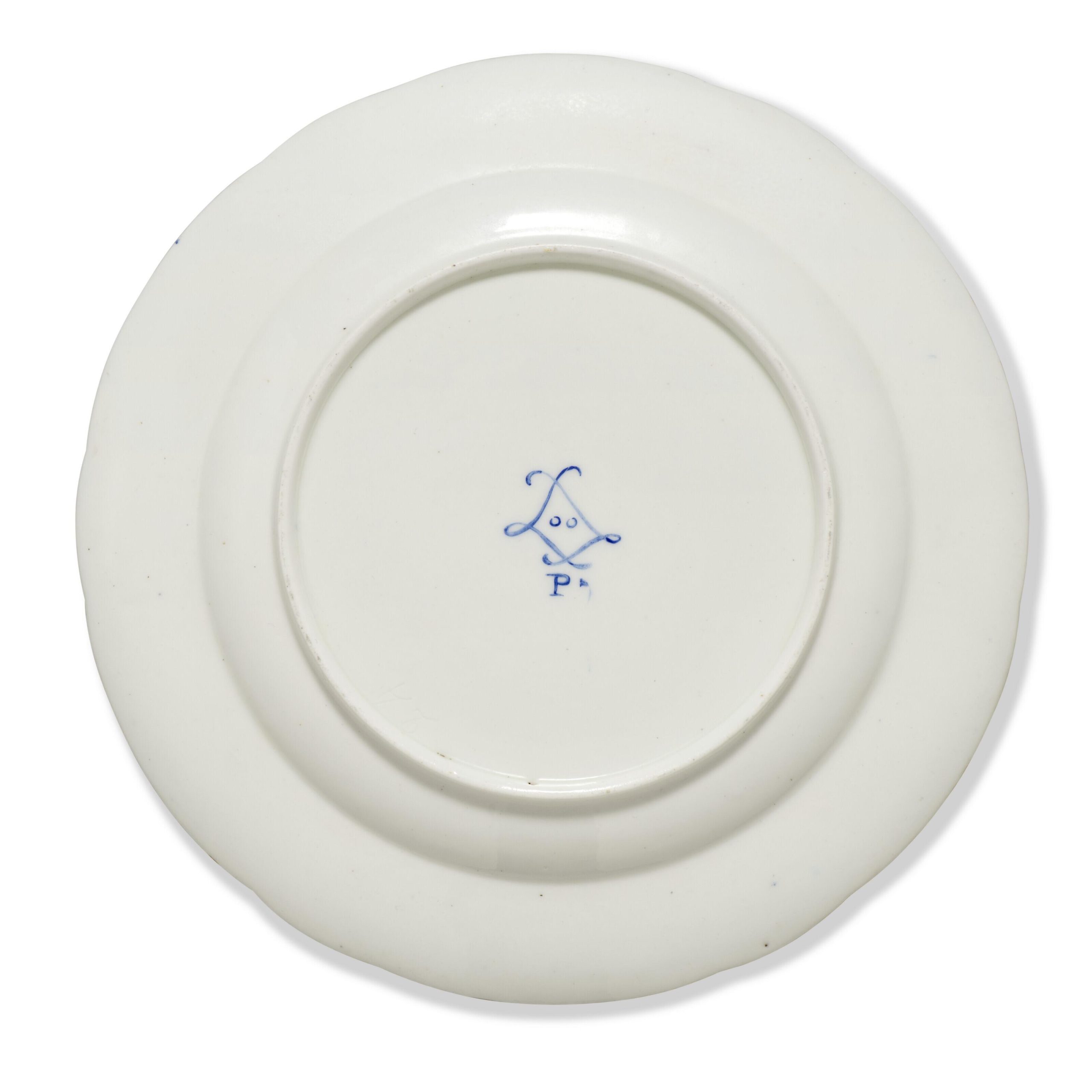
The best-known Sèvres mark consists of two interlaced capital letter Ls.
This famous symbol represents King Louis XV (Louis XV) and became closely associated with the royal manufactory during the eighteenth century.
Collectors around the world often refer to it simply as the Double L mark.
Most authentic eighteenth-century examples display the mark painted by hand beneath the glaze, usually in blue, although other colours may also appear depending on the production period.
Date Letters Inside the Double L
One remarkable feature of many eighteenth-century Sèvres marks is the addition of a single letter positioned between the two interlaced Ls.
These letters correspond to specific production years.
For example, specialists can often determine the approximate manufacturing date simply by interpreting this small letter correctly.
The lettering system changed over time, making specialist reference books essential for precise dating.
This dating method is one reason why Sèvres porcelain is considered particularly well documented compared with many other European factories.
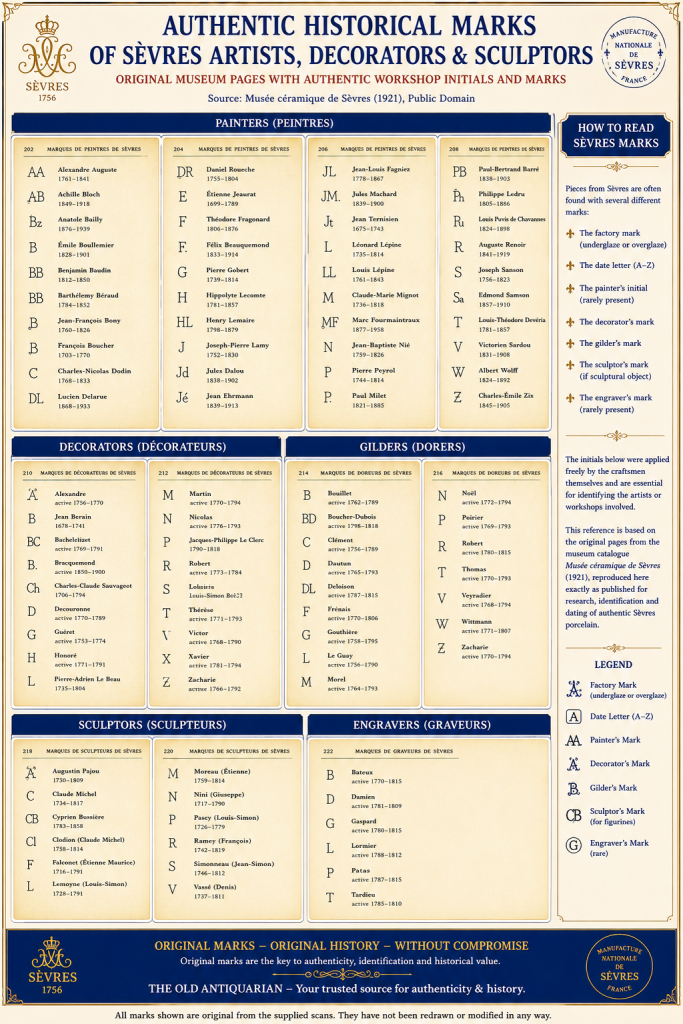
Painter’s Marks
Factory marks are only part of the story.
Many genuine Sèvres objects also include the initials of the painter responsible for decorating the porcelain.
These initials may appear beside, below or near the factory mark.
Because painters often specialised in flowers, portraits, landscapes or figure painting, identifying the artist can significantly increase historical interest and collector value.
Gilder’s Marks
Gold decoration played a major role in Sèvres production.
Master gilders frequently applied their own identifying marks, allowing historians to determine who completed the elaborate gold decoration found on many royal commissions.
These marks are often much smaller than the factory mark and may require magnification to read properly.
Workman’s Marks
Some objects also display workshop symbols, firing marks or assembly marks.
These were never intended for collectors but instead helped organise production inside the manufactory.
Although they may appear insignificant, they can sometimes provide valuable information during professional authentication.
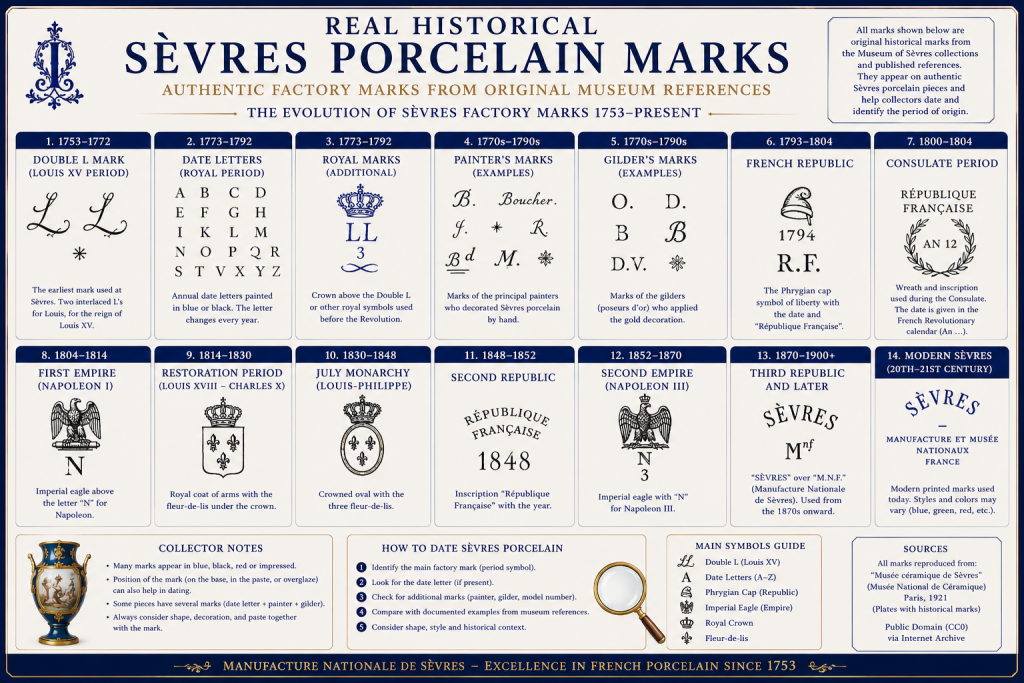
How the Marks Changed After the French Revolution
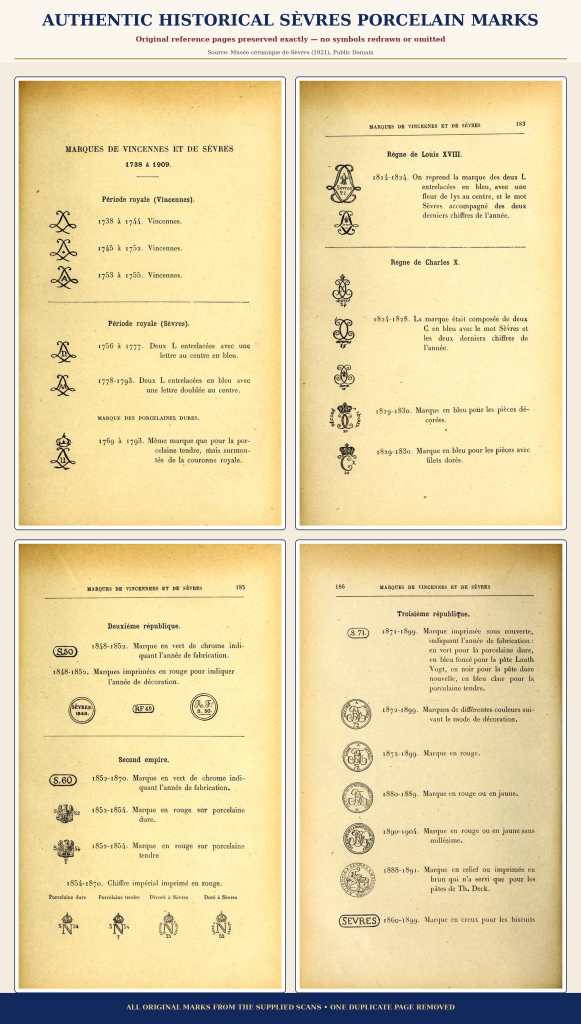
The French Revolution brought enormous political change, and naturally the factory’s marks evolved as well.
Royal symbols gradually disappeared and were replaced by marks reflecting the political system of the period.
Collectors may encounter marks from:
- The Revolutionary period
- The Consulate
- The First Empire
- The Bourbon Restoration
- The July Monarchy
- The Second Empire
- The French Republic
Understanding these historical transitions helps confirm whether the decoration, shape and mark belong to the same production period.
Nineteenth-Century Sèvres Marks
During the nineteenth century the manufactory continued to evolve while maintaining extremely high artistic standards.
Marks became increasingly detailed and often included additional factory information.
Many nineteenth-century pieces are highly collectible in their own right and should never be dismissed simply because they are younger than eighteenth-century examples.
Modern Sèvres Marks
The Manufacture nationale de Sèvres continues producing exceptional porcelain today.
Modern marks differ significantly from historic royal marks and are well documented.
Collectors should therefore be cautious whenever a supposedly eighteenth-century object carries a mark inconsistent with its manufacturing period.
How to Examine a Sèvres Mark Correctly
Professional examination always follows a logical sequence.
- Inspect the mark under natural light.
- Use magnification.
- Study the brushwork.
- Compare the colour with documented examples.
- Examine glaze over and around the mark.
- Check for later additions.
- Compare the mark with the porcelain body.
- Verify historical consistency.
This process usually reveals much more information than looking at the mark alone.
Warning Signs of Fake Marks
Because Sèvres porcelain commands high prices, counterfeit marks are common.
Collectors should be cautious if they notice:
- Perfectly symmetrical modern-looking marks
- Artificial ageing around the mark only
- Incorrect lettering
- Modern paint sitting on top of the glaze
- Marks inconsistent with the object’s style
- Poor-quality porcelain carrying prestigious royal marks
- Fresh-looking blue pigment on an otherwise worn base
- Incorrect combinations of date letters and factory symbols
A fake mark does not necessarily mean the porcelain itself is modern—it may indicate that an older object has been altered to increase its value.
Original Sèvres vs Sèvres Style
Many beautiful porcelain objects described as “Sèvres Style” were produced outside the official French manufactory.
German, Austrian, English and Italian factories frequently adopted French-inspired decoration, royal blue grounds and elaborate gilding.
Some of these pieces are excellent antiques in their own right, but they should not be confused with genuine Manufacture de Sèvres production.
Learning to distinguish between authentic Sèvres and Sèvres-style porcelain is one of the most valuable skills a collector can develop.
Can the Mark Alone Identify Authentic Sèvres?
The simple answer is no.
Professional appraisers never authenticate porcelain using the factory mark alone.
Instead, they evaluate:
- The porcelain body
- The glaze
- The modelling
- The painting
- The gilding
- The base
- Natural wear
- The factory mark
- Painter’s initials
- Historical consistency
- Provenance
Only when all of these elements support one another can a reliable opinion about authenticity be formed.
Visual Guide to Sèvres Marks
Because many collectors find factory marks confusing, the following infographic summarises the most important information about Sèvres history, identification and marks.
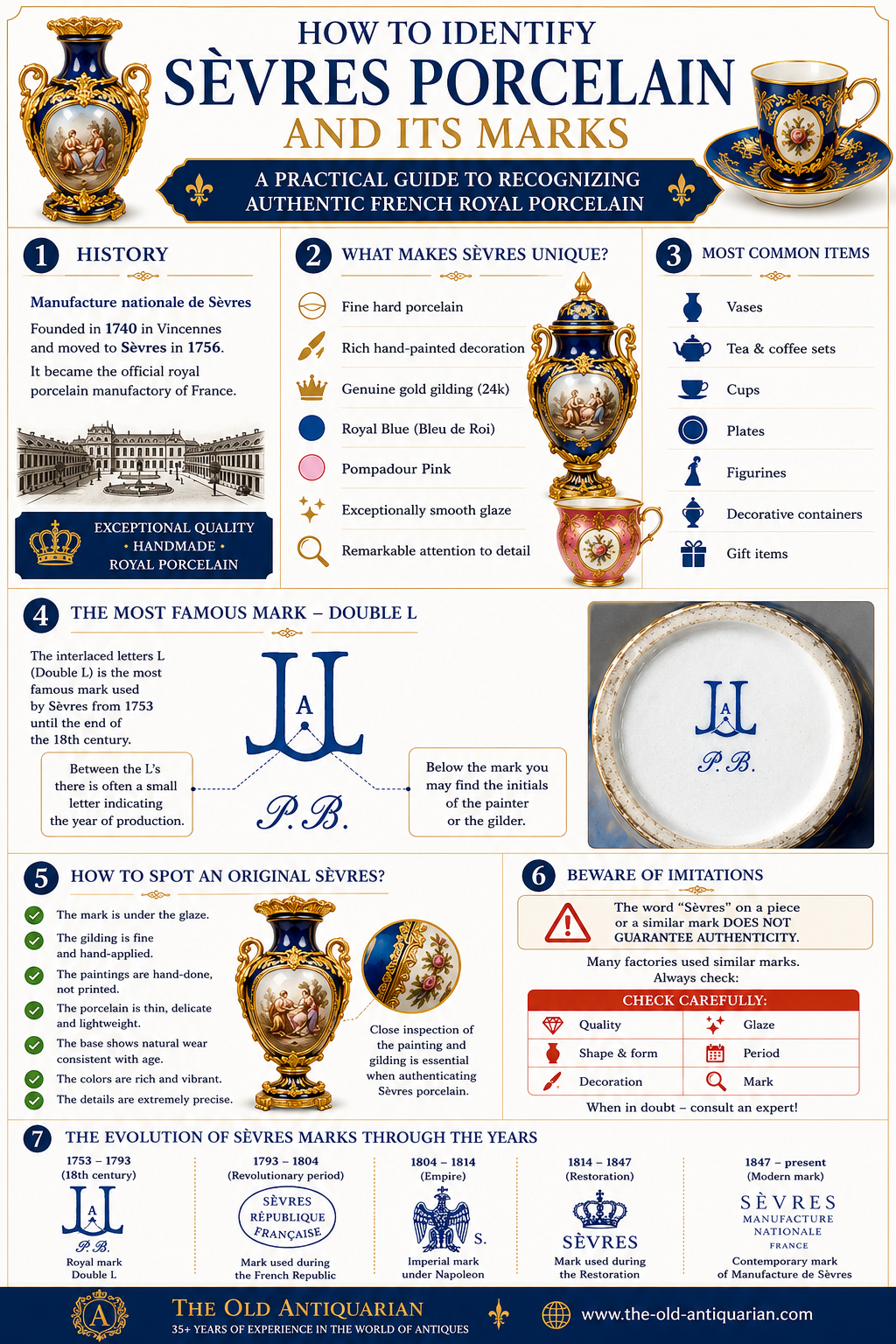
For collectors interested in comparing marks from many different manufacturers, our complete guide to Porcelain Marks and Backstamps covers hundreds of historic European porcelain factories.
The next section explains how experts authenticate Sèvres porcelain step by step, identify reproductions and determine collector value.
How to Identify Authentic Sèvres Porcelain
Authenticating Sèvres porcelain requires much more than locating the factory mark. Professional appraisers evaluate every aspect of an object, from the porcelain body and glaze to the painting, gilding and signs of age.
Although no single characteristic can guarantee authenticity, several factors consistently appear on genuine pieces produced by the Manufacture de Sèvres.
1. Examine the Porcelain Body
Authentic Sèvres porcelain has an exceptionally refined body. Early soft-paste porcelain often displays a warm ivory tone, while later hard-paste examples are brighter white and slightly harder.
The surface should feel smooth and elegant, never coarse or grainy.
Poor-quality porcelain is one of the strongest indications that an object was not produced by the royal manufactory.
2. Study the Glaze
Original Sèvres glaze has remarkable depth and clarity. Under natural light it appears luminous rather than overly glossy.
Modern reproductions often have thick, glass-like glazes that lack the subtle character of antique porcelain.
3. Look Closely at the Painting
Every genuine eighteenth- and nineteenth-century Sèvres object was decorated by skilled artists.
Under magnification, collectors should see delicate brushstrokes, smooth colour transitions and tiny variations that confirm hand painting.
Modern transfer printing usually appears flat and mechanically perfect.
4. Inspect the Gilding
Sèvres became famous for exceptionally fine gilding.
Original gold decoration often shows gentle wear on raised areas where centuries of careful handling have naturally polished the surface.
Artificially aged gilding usually looks random or inconsistent.
5. Check the Base
The underside frequently provides valuable clues.
Collectors should examine:
- Factory marks
- Painter’s initials
- Gilder’s marks
- Wear patterns
- Foot rim construction
- Glaze consistency
Natural wear develops gradually over centuries and cannot easily be reproduced.
Original Sèvres vs Modern Reproductions
Because authentic Sèvres porcelain is highly valuable, reproductions have been manufactured since the nineteenth century.
Fortunately, many copies reveal themselves through inconsistencies in materials, decoration or workmanship.
| Authentic Sèvres | Modern Reproduction |
|---|---|
| Hand-painted decoration | Transfer printed decoration |
| Natural wear | Artificial ageing |
| Fine porcelain body | Heavier ceramic body |
| Sophisticated gilding | Bright modern gold paint |
| Historically correct marks | Incorrect or copied marks |
| Consistent craftsmanship | Mixed historical features |
Common Types of Fake Sèvres Porcelain
Not every fake is modern.
Collectors regularly encounter several categories of misleading objects:
- Nineteenth-century decorative copies
- Twentieth-century tourist souvenirs
- Modern reproductions
- Objects carrying forged Double L marks
- Altered antiques with added factory marks
- Completely fabricated fantasy pieces
Some nineteenth-century reproductions have become collectible themselves, although they should never be sold as original royal Sèvres porcelain.
Collector’s Authentication Checklist
Before purchasing an expensive piece, ask yourself the following questions:
- Does the porcelain quality match genuine Sèvres?
- Are the colours historically correct?
- Is the decoration genuinely hand painted?
- Does the gilding appear original?
- Are the marks appropriate for the period?
- Does the wear appear natural?
- Has the object been restored?
- Does the seller provide reliable provenance?
- Have similar examples been documented?
- Does every element agree historically?
If several answers raise doubts, professional authentication is strongly recommended.
How Valuable Is Sèvres Porcelain?
Sèvres porcelain remains one of the most valuable categories of European ceramics.
Prices vary enormously depending on age, rarity, artist, condition and provenance.
Simple nineteenth-century cabinet pieces may sell for several hundred euros, while exceptional royal presentation vases, complete services or museum-quality masterpieces have achieved prices of hundreds of thousands—and occasionally even millions—at major international auctions.
Objects painted by well-documented artists or made for members of the French royal family are especially desirable.
For a more detailed explanation of how specialists determine market value, see our guide on How Antique Porcelain Is Valued .
Sèvres Compared with Other Famous European Porcelain Manufacturers
Collectors often compare Sèvres with other prestigious European factories.
| Manufacturer | Known For |
|---|---|
| Sèvres | Royal French porcelain, brilliant colours and artistic painting |
| Meissen | Europe’s first hard-paste porcelain and sculptural excellence |
| Royal Copenhagen | Blue underglaze decoration and Scandinavian elegance |
| Wedgwood | Jasperware and refined English neoclassical ceramics |
| Limoges | Fine white French porcelain and luxury tableware |
| KPM Berlin | Royal Prussian porcelain and exceptional craftsmanship |
| Herend | Hand-painted Hungarian porcelain |
| Capodimonte | Italian porcelain and sculptural modelling |
Learning the distinctive characteristics of each factory makes identification considerably easier.
How to Care for Sèvres Porcelain
Proper care is essential for preserving both beauty and value.
- Handle objects with clean, dry hands.
- Avoid sudden temperature changes.
- Never use abrasive cleaners.
- Keep valuable pieces away from direct sunlight.
- Support heavy vases from the base, never the handles.
- Store porcelain securely inside display cabinets.
Our complete guide on storing antique porcelain contains additional recommendations.
Should Antique Sèvres Be Restored?
Minor conservation may help stabilise damaged porcelain, but unnecessary restoration can reduce collector value.
Whenever possible, restoration should be carried out by experienced conservation specialists using reversible techniques.
If you would like to learn more, our article on porcelain restoration explains the differences between restoration and conservation.
Frequently Asked Questions
Is all Sèvres porcelain valuable?
No. Value depends on authenticity, age, rarity, condition, artist, provenance and collector demand.
What is the most famous Sèvres mark?
The interlaced Double L mark associated with King Louis XV remains the factory’s best-known symbol.
Can Sèvres marks be forged?
Yes. Counterfeit marks have been applied to porcelain for more than a century, which is why experts never rely on the mark alone.
Is nineteenth-century Sèvres collectible?
Absolutely. Many nineteenth-century examples are highly desirable and represent exceptional artistic quality.
How can I tell whether my Sèvres porcelain is authentic?
Authenticity should always be evaluated by examining the porcelain body, glaze, decoration, marks, craftsmanship, condition and historical consistency together.
Final Thoughts
For more than two and a half centuries, Sèvres porcelain has represented the highest standards of French artistic craftsmanship. From the royal workshops of Louis XV to today’s Manufacture nationale de Sèvres, the factory has continuously combined technical innovation with extraordinary artistic talent.
Whether you are collecting, researching or inheriting antique porcelain, understanding the history, colours, marks and craftsmanship of Sèvres is the best foundation for recognising genuine examples and appreciating their historical significance.
Continue Exploring
- What Is Porcelain?
- How to Identify Antique Porcelain
- Porcelain Marks Guide
- How to Date Antique Porcelain
- How to Identify Meissen Porcelain
- How to Identify Wedgwood
- How to Store Antique Porcelain
- How to Restore Antique Porcelain
Need Help Identifying Sèvres Porcelain?
If you own a piece of Sèvres porcelain—or believe you may have one—we can help you identify its age, authenticity and potential collector value. Our specialists have more than 35 years of experience working with European antiques, fine porcelain and collectible works of art.
