
Schumann Arzberg Porcelain: Marks, Bavaria, Dating & Value
German Porcelain · Bavaria · Marks · Dating · Patterns
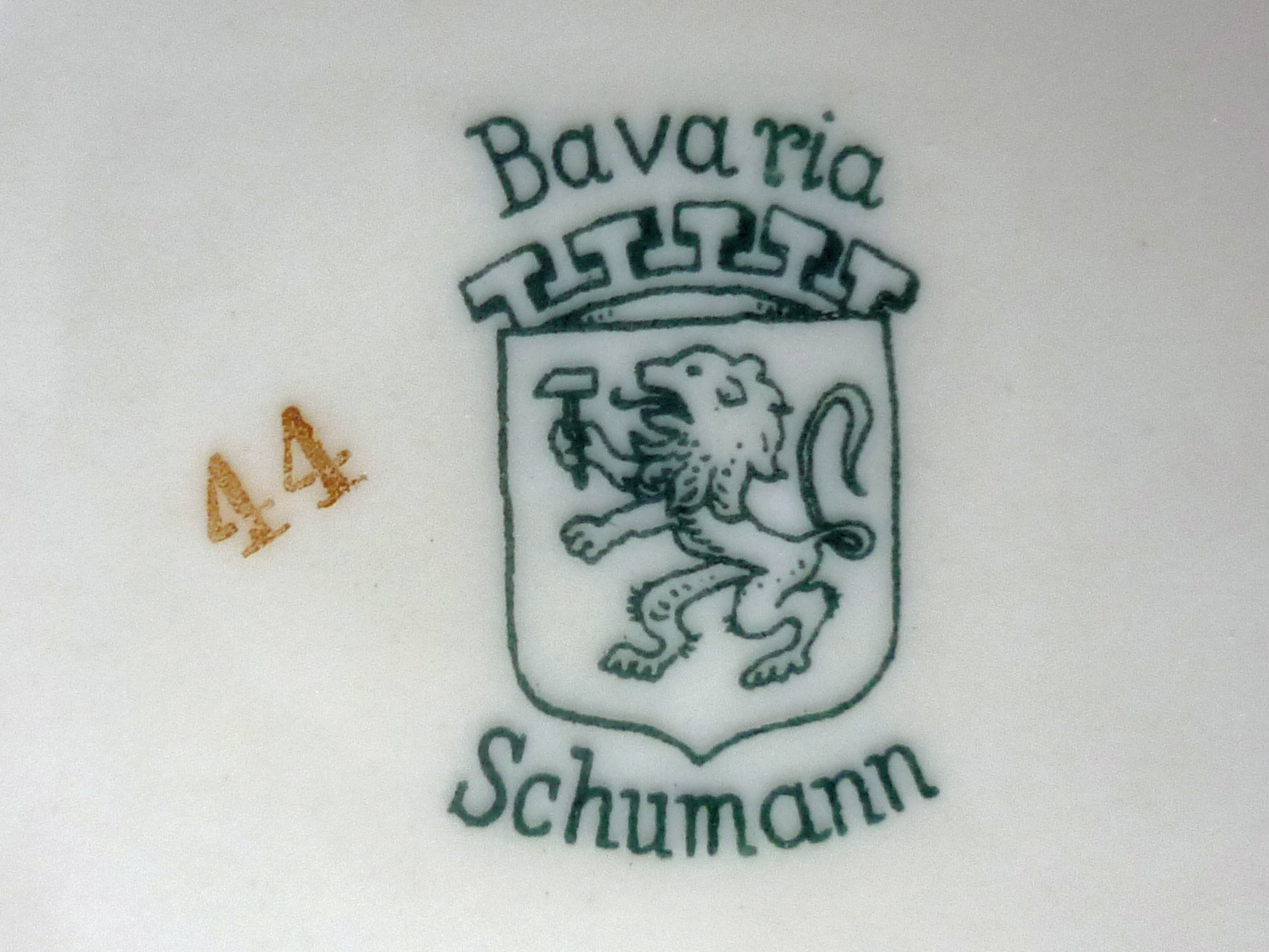
Schumann Arzberg porcelain was produced in Arzberg, Bavaria, by the factory line that began as Schumann & Riess in 1881 and became associated with Carl Schumann from 1892. Collectors may encounter backstamps containing Schumann, Bavaria, Arzberg, Germany, U.S. Zone, W.-Germany, crowns, lion shields, signatures, pattern names and additional numbers. “Bavaria” usually identifies the geographic region, not a separate maker or pattern. Reliable identification and dating require the exact mark to agree with the porcelain body, form, decoration, pattern, country wording, numbers, condition and documented historical examples.
| Schumann Arzberg at a Glance | Collector Reference |
|---|---|
| Historic centre | Arzberg, Bavaria, Germany |
| Schumann & Riess | 1881–1892 |
| Porzellanfabrik Carl Schumann | From 1892 |
| Carl Schumann AG | Corporate form established in 1923 |
| Important mark wording | Schumann, Bavaria, Arzberg, Germany, U.S. Zone, W.-Germany |
| Documented decorative / series wording | Wild Rose, Empress / Dresden Flower, White Rose, Dresdener Art and related Schumann designations |
| Collecting areas | Tableware, tea and coffee services, decorative porcelain, pierced porcelain, floral patterns and selected figurines |
| Factory closure | 1994 |
“The mark is the beginning of the research – not its end.”
A Schumann mark can suggest a maker and production period, but it does not prove authenticity, an exact year or market value by itself.
If you are starting with an unidentified German or Bavarian piece, first review the broader
Bavaria Porcelain Identification Guide.
For the wider research method, see our
Complete Antique Porcelain Guide.
What Is Schumann Arzberg Porcelain?
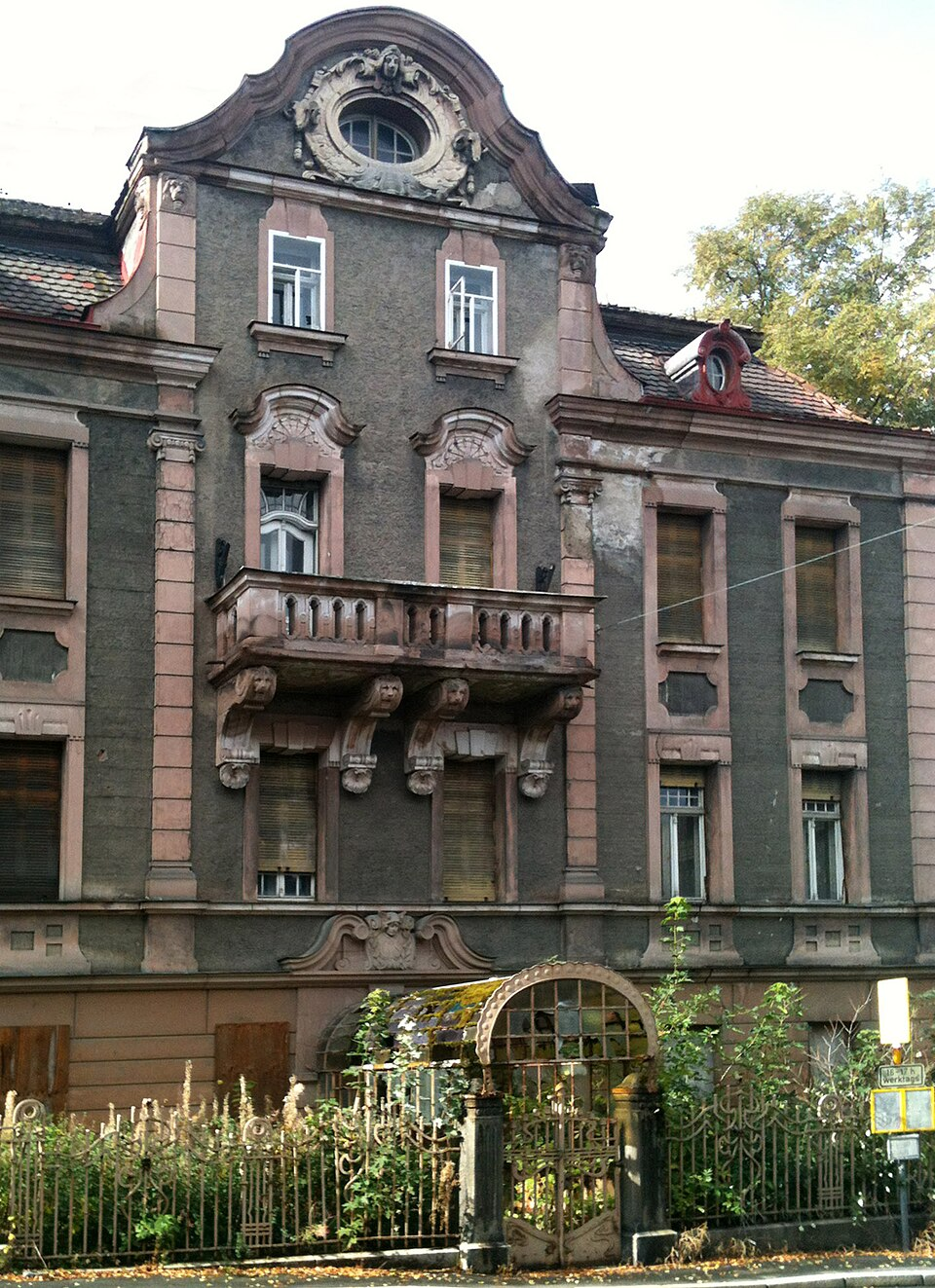
Schumann Arzberg is the collector shorthand commonly used for porcelain associated with the Carl Schumann factory line in Arzberg, Bavaria. The porcelain enterprise developed from Schumann & Riess, founded in 1881, and later operated under the Carl Schumann name and, from 1923, as Porzellanfabrik Carl Schumann AG.
This distinction matters because Arzberg is a place, Bavaria is a region, and Schumann identifies the manufacturer family and factory line. A piece marked only “Arzberg” or “Bavaria” should therefore not automatically be attributed to Carl Schumann.
On Schumann porcelain, “Bavaria” normally indicates regional origin. It is not the pattern name and it is not a separate porcelain manufacturer.
The same principle applies across Bavarian porcelain. Many different factories used regional wording, which is why the full maker name and exact backstamp matter more than the word Bavaria alone. For comparison, see the dedicated
Nymphenburg Porcelain Guide
and
Seltmann Weiden Guide.
History of Schumann Arzberg
The Schumann porcelain story in Arzberg grew out of an earlier ceramic enterprise associated with Christian Heinrich Schumann. Historical references do not always give the same starting year for that pre-porcelain phase, so the safest fixed point for collectors is 1881, when Porzellanfabrik Schumann & Riess was established as the porcelain factory line relevant to later Carl Schumann production.
Heinrich Schumann died in 1884. His son Carl was still too young to take over formally, so the business was managed by Carl’s mother, Christiana Schumann. In 1892, when Carl reached the age of twenty-one, the company was renamed Porzellanfabrik Carl Schumann GmbH & Co. KG.
Business expanded during the following decades. Carl Schumann and his brother Eduard also established the Westdeutsche Porzellanfabrik Duisdorf near Bonn in 1904. In 1923 the Arzberg business became Porzellanfabrik Carl Schumann AG.
After Carl Schumann I died in 1926, the next generation continued the business. Carl Schumann II had studied in the United States and later founded the Schumann China Corporation in New York to distribute Schumann porcelain in the American market. The factory also produced porcelain for export and for companies such as Ebeling & Reuss, whose Erphila name is familiar to many collectors.
The factory recovered strongly after the Second World War and reached a substantial workforce during the early 1950s. Carl Schumann III took over management in 1961 and modernised and rationalised production. Sabine Schaefer, a granddaughter of Carl Schumann I, became manager in 1981.
In 1990 Schumann entered an alliance involving porcelain factories in Colditz and Freiberg. The economic environment of German reunification proved difficult, and the Arzberg factory ultimately closed in 1994.
| Period | Factory Development | Why It Matters to Collectors |
|---|---|---|
| 1881–1892 | Porzellanfabrik Schumann & Riess | Beginning of the porcelain factory line that developed into Carl Schumann production |
| 1892–1923 | Porzellanfabrik Carl Schumann GmbH & Co. KG | The Carl Schumann name becomes central to factory identity |
| 1923–1990 | Porzellanfabrik Carl Schumann AG | Major twentieth-century production period with numerous backstamp families |
| 1946–1949 | Immediate post-war U.S. Zone period | Explicit U.S. Zone wording can provide a relatively narrow dating clue |
| 1950s | Strong post-war production and export activity | Many service forms and decorative lines encountered by collectors today |
| 1961 onward | Carl Schumann III management | Modernisation and rationalisation affected product ranges and factory systems |
| After 1981 | Anniversary and later-production marks | Important because some later marks can include wording collectors may otherwise misdate |
| 1990–1994 | Vereinigte Porzellanwerke Carl Schumann Arzberg Colditz Freiberg | Final corporate phase before the Arzberg factory closed in 1994 |
Schumann and Pierced Porcelain
One historically important aspect of Schumann production was Durchbruchporzellan—pierced or openwork porcelain. Museum documentation links Schumann’s industrial success in part to a mechanical punching process acquired by Carl Schumann in 1910. Before such mechanisation, elaborate pierced porcelain required much more labour-intensive forming and finishing.
Piercing can therefore be an important visual feature, but it is not a maker’s mark. Other German manufacturers also produced openwork porcelain, so the form must still be tested against the factory mark, porcelain body, decoration and production period.
Schumann Bavaria: What Does the Mark Mean?
“Schumann Bavaria” is one of the most common search terms associated with the factory, but it is also one of the easiest to misunderstand.
Schumann = Manufacturer
Schumann points toward the Carl Schumann factory line in Arzberg.
Bavaria = Region
Bavaria identifies the geographic region in Germany. It is not automatically a pattern or separate maker.
Pattern or series names are a separate layer of information. A Schumann backstamp may appear together with names such as Wild Rose, White Rose, Dresden Flower or other decorative wording, but the regional word “Bavaria” does not become the pattern name simply because it is printed prominently.
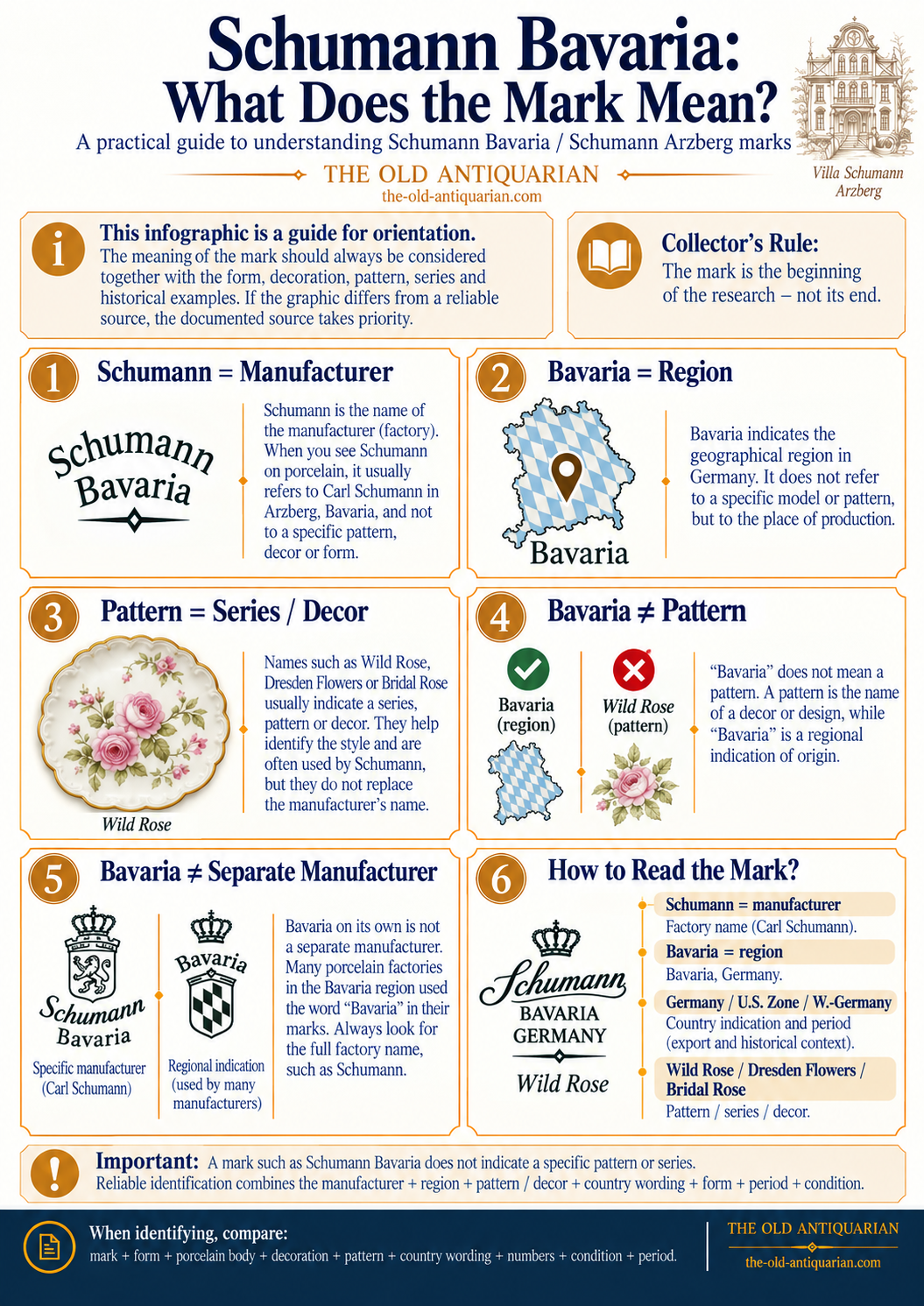
This regional distinction is fundamental when researching German porcelain. Our
Bavaria Porcelain Guide
explains why many manufacturers used Bavaria wording and why the exact maker must always be identified separately.
Schumann Arzberg Marks & Backstamps
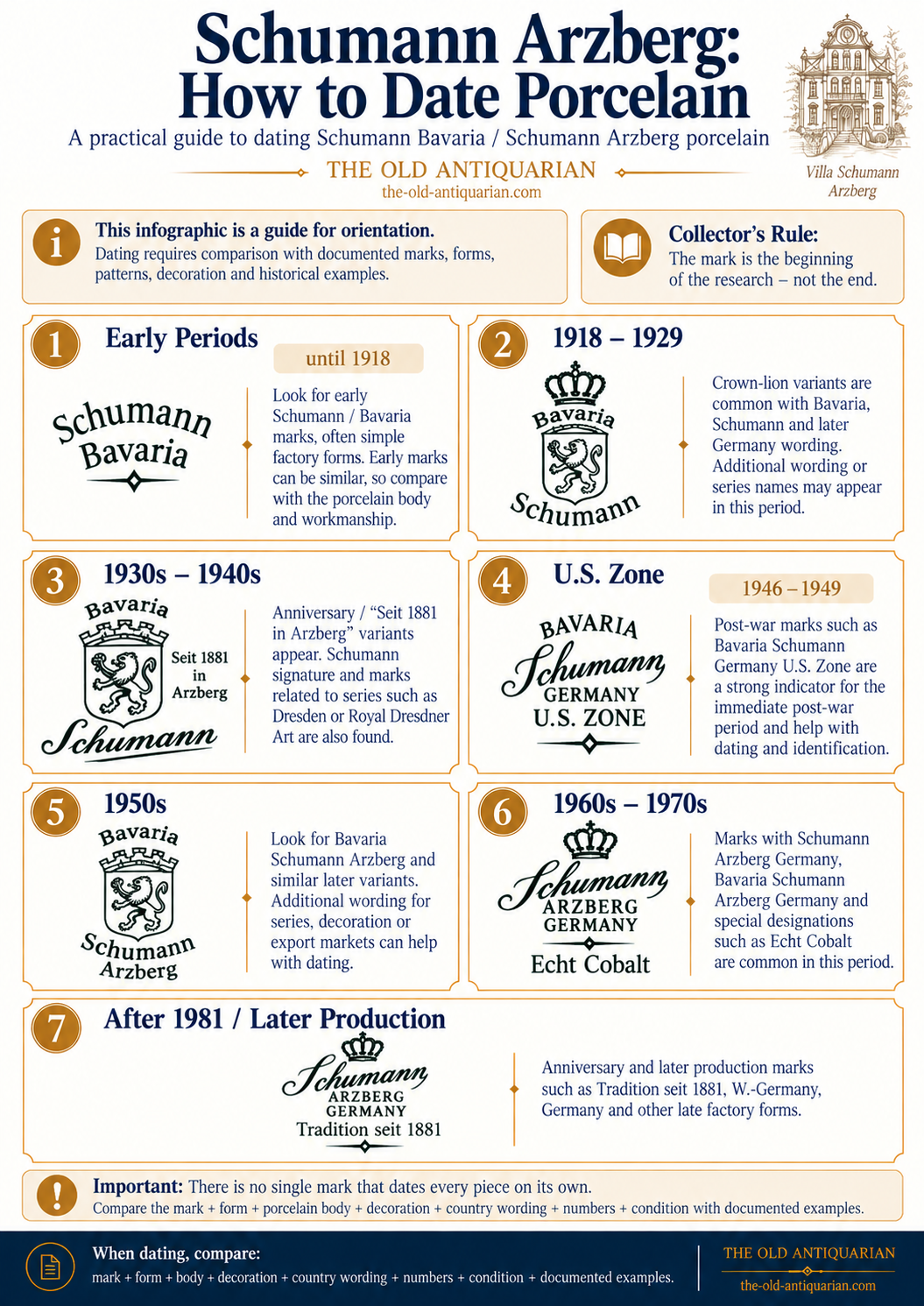
There is no single Schumann backstamp that covers the company’s entire history. The factory used a large number of mark families, including simple early Schumann / Bavaria wording, crown marks, lion-and-shield devices, Carl Schumann signature marks, Arzberg wording, Germany, U.S. Zone, W.-Germany and later anniversary marks.
Small details matter. Colour, lettering, the shape of the crown, presence or absence of the lion shield, placement of Bavaria or Germany, a series name, decorator wording and additional numbers can all help distinguish one production period from another.
| Documented Period | Mark Clues | Collector Use |
|---|---|---|
| From 1896 | Early documented Schumann mark | Useful only when the exact graphic form is matched |
| From 1897 | Another documented early mark family | Shows why small differences between early backstamps matter |
| After 1900 | Additional versions, including a red example with “Dresden Flowers” wording | Decoration wording may appear separately from maker identity |
| 1918–1929 | Crown, lion/shield, Schumann, Bavaria, Germany and many combinations | A diverse mark group requiring exact comparison |
| 1931–c.1940 | 50th-anniversary mark with “seit 1881 in Arzberg” and Carl Schumann signature | A useful broad chronological clue when the complete mark matches |
| 1932–1944 | Several Schumann / Bavaria / Dresden-related mark families | Read all text, not only the crown or signature |
| Around 1945 | Transitional marks in several colours and forms | Should not automatically be called U.S. Zone |
| 1946–1949 | Germany / U.S. Zone additions | One of the strongest broad dating clues for immediate post-war Schumann |
| 1950–1960 | Post-war mark families with Schumann / Bavaria / Arzberg combinations | Compare with exact pattern and form |
| From 1955 | Documented examples on Empress / Dresden Flower and Wild Rose | Pattern wording plus exact mark can strengthen identification |
| 1960–1970 | Schumann Arzberg, Bavaria / Germany variants and cobalt-related wording | Useful for later vintage tableware and decorative porcelain |
| After 1981 | Anniversary and later marks, including W.-Germany and Germany variants | Important warning against dating from country wording alone |
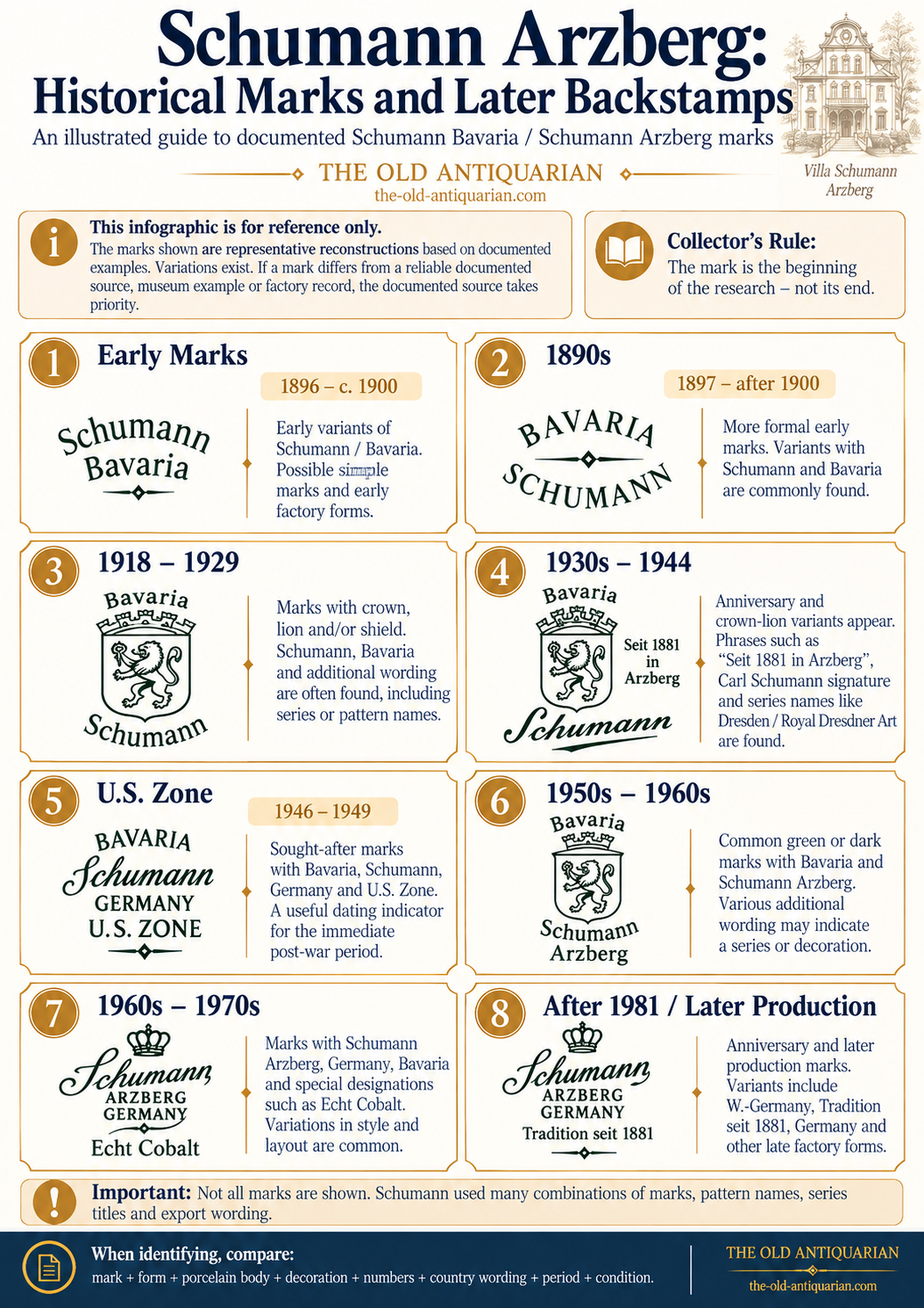
The infographics in this guide are educational orientation tools. Historical marks are visually reconstructed from documented references. If an illustrated reconstruction differs from a reliable museum object, archival record, factory document or specialist historical source, the documented source takes priority.
For a broader method of reading symbols, factory names, country wording and secondary numbers, continue with
How to Identify Porcelain Marks & Backstamps.
How to Date Schumann Arzberg Porcelain
The safest way to date Schumann porcelain is to establish a production range rather than forcing the object into one exact year. Most Schumann marks identify a broad period, and marks can appear with different decorative, series or export additions.
exact mark + country wording + form + pattern + decoration + porcelain body + numbers + condition + documented comparison
Include every letter, number, symbol and secondary stamp.
Bavaria, Germany, U.S. Zone, W.-Germany and other wording may narrow the period.
Compare handles, rims, feet, lids, profiles and pierced work with known Schumann shapes.
Note hand painting, transfer decoration, cobalt, gilding and floral composition.
Pattern names, shape numbers and decorator marks can add important evidence.
The mark and the object should tell the same historical story.
For the general dating methodology used across porcelain manufacturers, see
How to Date Antique Porcelain.
Schumann U.S. Zone, W.-Germany & Germany Marks
U.S. Zone: 1946–1949
Specialist mark references document Schumann backstamps with additional Germany / U.S. Zone wording between 1946 and 1949. This is one of the most useful broad chronological clues in Schumann research because it connects the object with the immediate post-war occupation period.
Even here, country wording should not be used alone. The mark layout, porcelain body, form and decoration should still be historically compatible with late-1940s production.
W.-Germany: useful, but not automatically “1950s”
A common collecting mistake is to assume that every W.-Germany mark must belong to the 1950s or 1960s. Schumann is a good example of why this rule can fail: specialist references record a W.-Germany version among the post-1981 anniversary marks.
This means the exact factory mark must take priority over a simple geopolitical dating shortcut.
Germany
Germany wording appears in several Schumann periods. It can support an attribution and date range, but it is not a standalone date code.
How to Identify Authentic Schumann Arzberg Porcelain
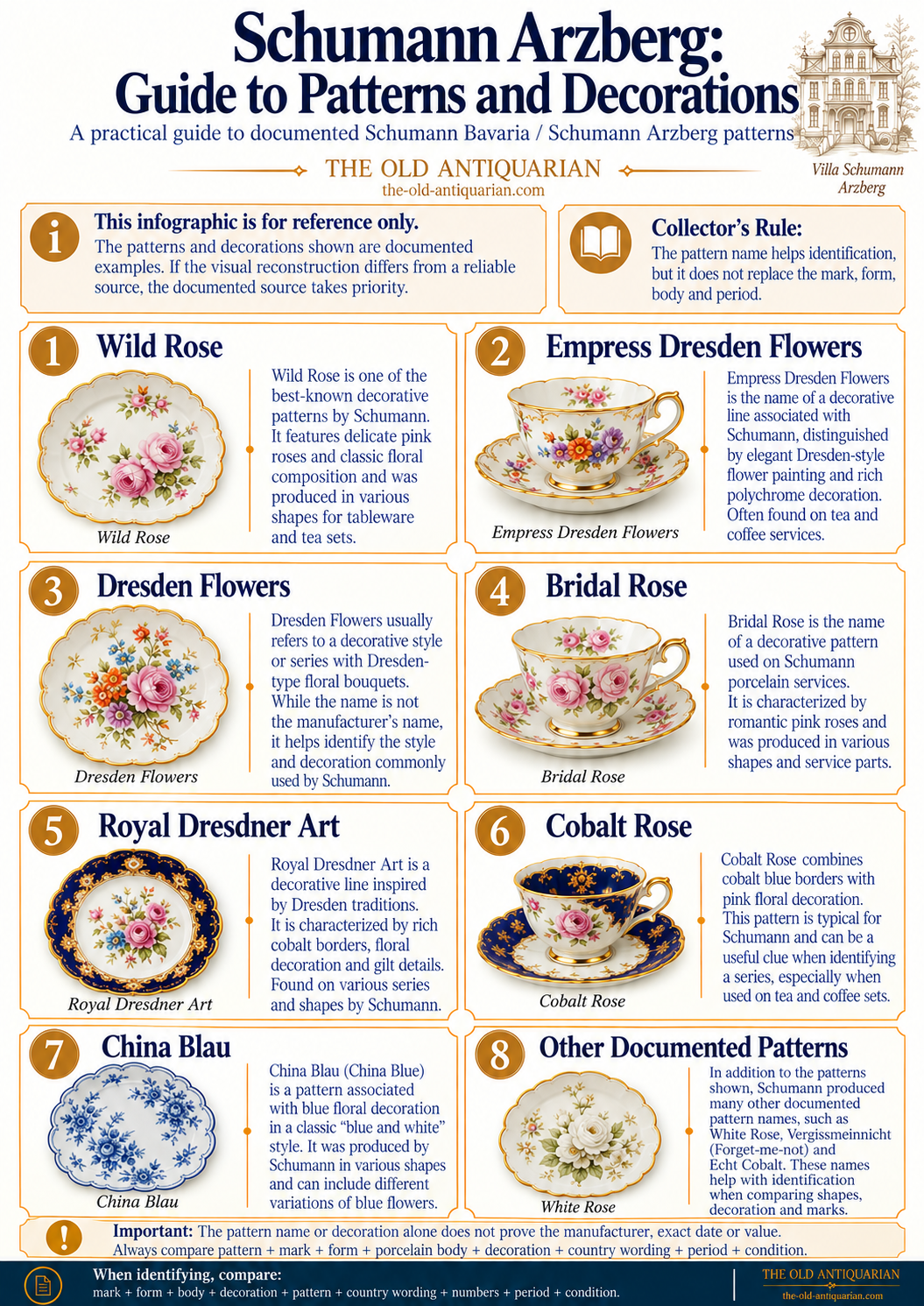
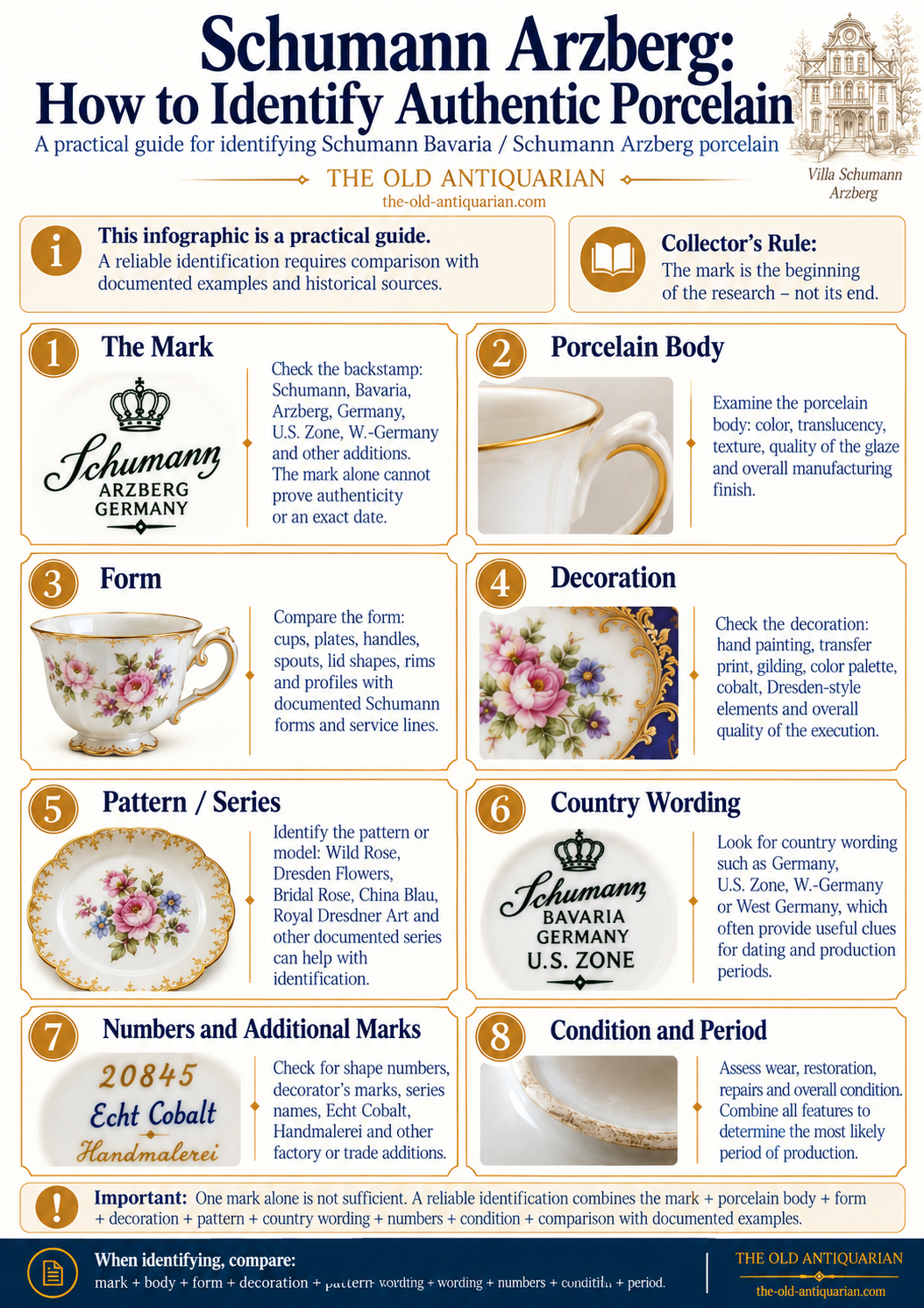
Authenticity should never be reduced to the question “Does the mark look right?” A convincing attribution requires the whole object to make sense for the proposed factory and production period.
| Identification Check | What to Examine | Why It Matters |
|---|---|---|
| Backstamp | Schumann, Bavaria, Arzberg, Germany, symbols, colour and typography | Helps place the object within a documented factory mark family |
| Porcelain body | Colour, refinement, glaze, thickness and overall quality | The material should be compatible with the proposed form and period |
| Form | Handles, rims, feet, lid shapes, relief and pierced sections | Factory forms can support or contradict the mark |
| Decoration | Hand painting, transfers, cobalt, gilding and floral layout | Technique and quality should make historical sense |
| Pattern / series | Wild Rose, Dresden Flower, White Rose and other names | May connect the piece with documented service lines |
| Country wording | Bavaria, Germany, U.S. Zone, W.-Germany | Can narrow a period when used with the full mark |
| Numbers | Shape, model, decoration, painted or impressed numbers | Secondary marks may identify forms or internal factory systems |
| Condition | Wear, chips, cracks, regilding, repainting and restoration | Helps evaluate both historical consistency and collector value |
If you are still unsure whether the object is genuine porcelain or whether its material is consistent with the attribution, begin with our
Complete Antique Porcelain Identification Guide.
Porcelain Body, Form & Decoration
Schumann production covered a long period, so there is no single universal “Schumann look.” Collectors encounter cups and saucers, dinnerware, tea and coffee sets, serving pieces, bowls, pierced porcelain, decorative objects and selected figurines.
Examine the porcelain body in natural light. Look at its colour, refinement, translucency where appropriate, glaze quality and the finish of handles, rims and foot rings. Manufacturing quality should be judged in the context of the production period rather than against one imagined standard for the entire factory history.
Decoration can include floral painting, transfer decoration, cobalt grounds, gilding and Dresden-inspired ornamental treatments. Hand-painted decoration often shows small variations in brushwork and colour. Transfer decoration tends to be more repeatable, but neither technique alone establishes age.
A beautiful floral pattern is not enough to identify Schumann. Similar rose bouquets, cobalt borders and gilded motifs were used by many German and European factories.
Schumann Wild Rose, Dresden Flowers & Other Patterns
Pattern research is one of the strongest long-tail search areas for Schumann porcelain, but terminology requires care. Some names are documented directly with historic Schumann marks, while others are widely used in collector and replacement catalogues.
| Pattern / Wording | Research Status | Collector Interpretation |
|---|---|---|
| Wild Rose | Documented specialist mark reference from 1955 | A strong pattern clue when the shape and backstamp agree |
| Empress / Dresden Flower | Documented specialist mark example from 1955 | Useful for identifying post-war service pieces |
| Dresden Flowers | “Dresden Flowers” wording is documented on an earlier Schumann mark after 1900 | Dresden wording does not mean the piece was necessarily made in Dresden |
| Dresdener Art | Documented on Schumann marks from 1918–1929 | A decorative / commercial designation, not a separate factory |
| Royal Dresdner Art | Documented as an addition to the 1931 anniversary-style mark | Should be read as part of the complete Schumann mark |
| White Rose | Documented with a Schumann crown mark in the 1918–1929 group | Useful when combined with the exact backstamp variant |
| Bridal Rose | Widely used collector / replacement catalogue name | Verify the actual factory mark separately |
| Cobalt Rose | Collector catalogue terminology associated with Schumann | Cobalt colour alone does not identify the factory |
| China Blau | Encountered in Schumann collector references | Blue-and-white decoration must still be matched to form and mark |
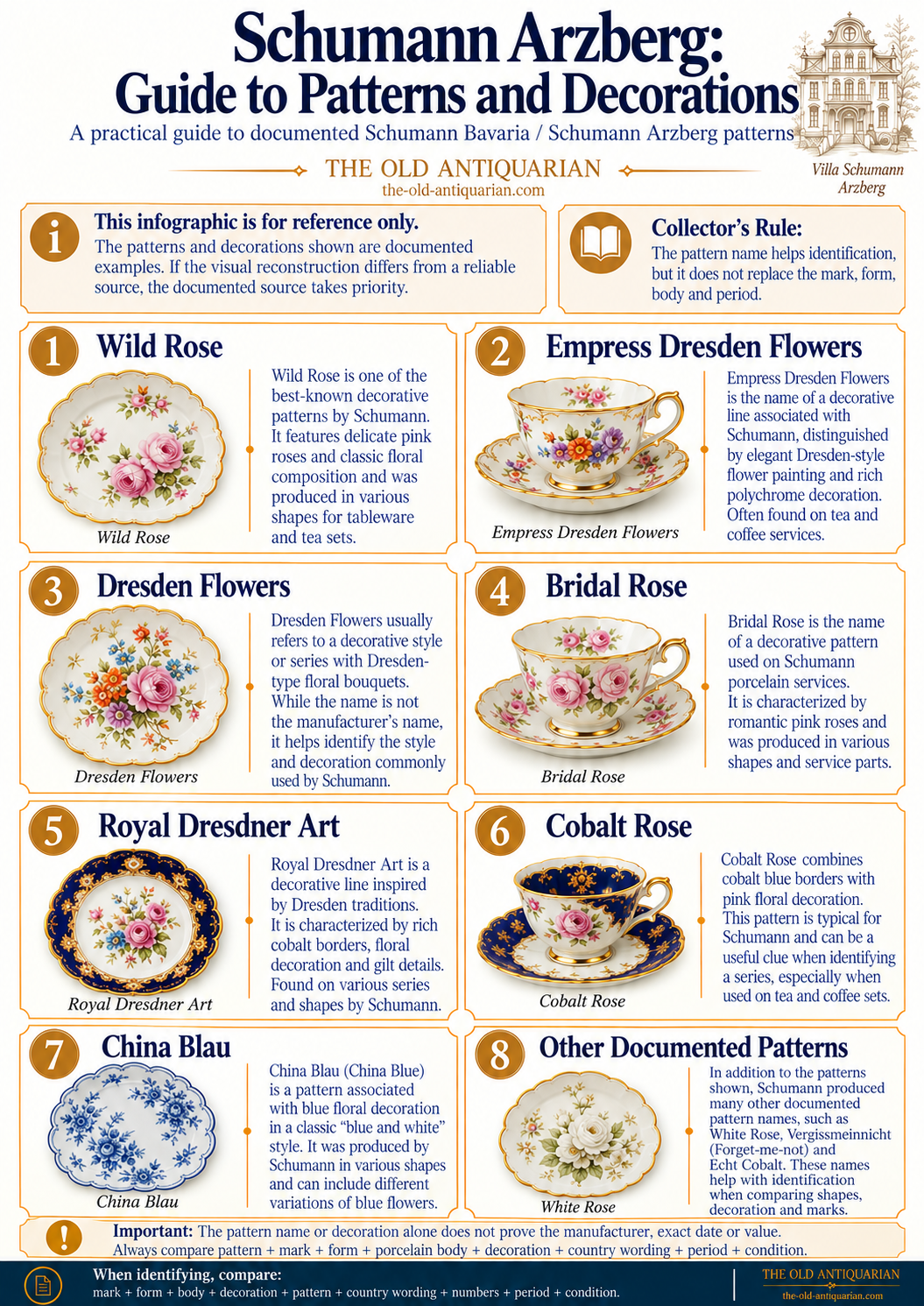
On Schumann porcelain, Dresden-related wording may describe a decorative style, pattern or commercial line. For the separate regional tradition, see the
Dresden Porcelain Guide.
Schumann Arzberg vs Other Arzberg Porcelain
Arzberg had more than one porcelain factory, and the Schumann family history itself created separate business lines. This is one of the most important areas of potential misattribution.
Christian Heinrich Schumann’s son Christoph founded a separate porcelain factory in Arzberg in 1887. That factory later passed through different owners and company names, including Lehmann & Roßberg, Theodor Lehmann, Schönwald and Kahla-related structures. It was not the same continuing company as Carl Schumann’s factory.
“Arzberg” on a backstamp does not automatically mean Carl Schumann, and “Bavaria” does not identify one single manufacturer.
This is why a factory-specific guide is more useful than a generic list of German marks. Once the maker has been narrowed, compare the complete mark chronology for that exact company.
Condition, Damage & Restoration
Condition is especially important with Schumann tea services, pierced porcelain, gilded pieces and decorative forms. Inspect rims, handles, spouts, lids, feet and openwork sections carefully.
| Condition Issue | Where to Look | Collector Significance |
|---|---|---|
| Hairline cracks | Rims, handles, junctions and thin porcelain sections | Can significantly affect desirability and value |
| Chips | Foot rims, handles, lids, pierced edges and applied details | Especially important on rare or elaborate forms |
| Gilding wear | Rims, handles and raised decoration | Light natural wear differs from major decorative loss |
| Old restoration | Look for differences in gloss, colour, surface texture or repainting | Should be disclosed when buying, selling or appraising |
| Missing components | Lids, saucers, sugar-bowl covers, service pieces or decorative elements | Completeness can strongly affect collector demand |
Schumann Bavaria Value: What Is It Worth?
There is no responsible single price range for all Schumann Bavaria porcelain. A common cup and saucer, a complete service, a scarce pierced form, an unusual pre-war figure and a rare documented pattern can belong to completely different markets even when they carry the same manufacturer name.
An asking price is what a seller requests. Market value should be researched through genuinely comparable completed sales and adjusted for maker, period, exact form, pattern, size, decoration, rarity, condition, restoration, completeness and provenance.
| Value Factor | Why It Matters |
|---|---|
| Production period | Earlier, historically significant or short production phases may attract different collector interest |
| Rarity | An uncommon model, pattern or format may matter more than age alone |
| Pattern | Collector demand varies strongly between service patterns and decorative lines |
| Form | Unusual pierced pieces, serving forms or scarce models may be harder to replace |
| Decoration | Hand painting, elaborate gilding, cobalt and complex decoration can influence demand |
| Condition | Cracks, chips, heavy wear and restoration normally reduce desirability |
| Completeness | A complete service may have a different market profile from isolated pieces |
| Provenance | Documented history can strengthen confidence in attribution and significance |
| Comparable completed sales | Actual transactions are more informative than unsold online listings |
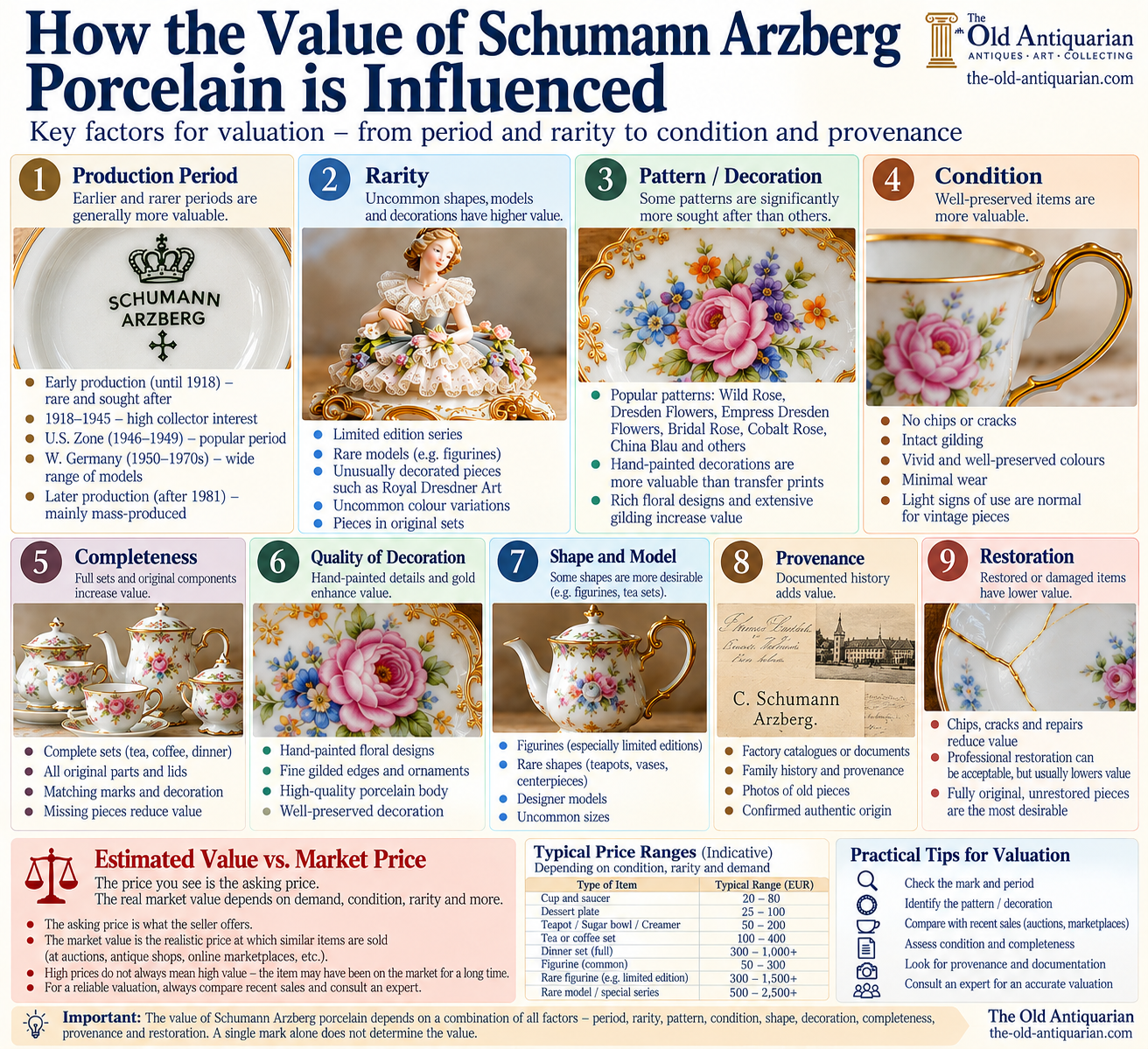
Any ranges shown in educational graphics should be treated only as illustrative orientation, not as a current price list. This article intentionally avoids generic Schumann values unless they are supported by truly comparable completed sales.
For the wider appraisal process, visit our
Professional Antique Valuation
page.
Collector Checklist: Before Buying or Selling Schumann Porcelain
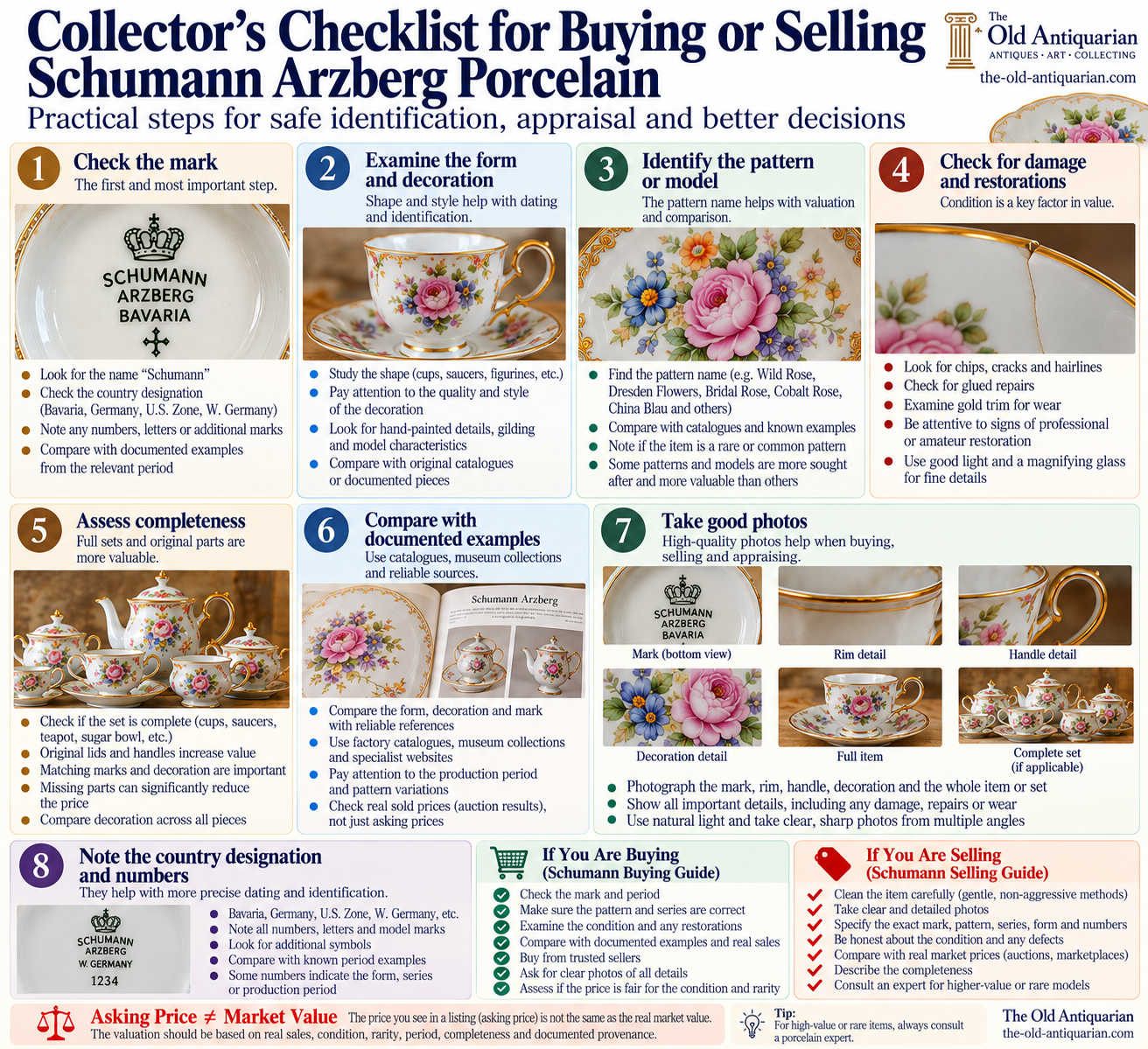
Photograph every word, number and symbol.
Compare the whole object, not only the underside.
Separate the pattern name from regional wording such as Bavaria.
Check cracks, chips, regilding, repainting and old repairs.
Museum objects and specialist mark references are more useful than unsourced images.
Include base, rim, handle, decoration, full object and complete service where applicable.
Do You Own Schumann Bavaria Porcelain?
Send clear photographs of the complete object, underside, factory mark, dimensions, decoration and any damage or restoration. The Old Antiquarian can help with maker identification, approximate production period, condition assessment and market research.
Frequently Asked Questions About Schumann Arzberg
What does Schumann Bavaria mean?
Schumann identifies the manufacturer, while Bavaria normally identifies the geographic region in Germany. Bavaria is not automatically a pattern or separate maker.
How old is Schumann Bavaria porcelain?
Schumann porcelain spans many decades. The exact mark variant, country wording, form, pattern, decoration and numbers must be compared to determine an approximate production period.
What does U.S. Zone mean on Schumann porcelain?
Specialist mark references document Schumann Germany / U.S. Zone marks from 1946–1949, making this wording a useful clue for immediate post-war production.
Does W. Germany always mean Schumann porcelain is from the 1950s or 1960s?
No. Schumann references also document a W.-Germany anniversary mark used after 1981. Always identify the complete mark rather than dating from country wording alone.
Is Wild Rose a Schumann pattern?
Yes. A specialist Schumann mark reference documents a Wild Rose example from 1955. The pattern name alone, however, does not establish the date of every Wild Rose piece.
What is Empress Dresden Flowers?
Empress / Dresden Flower is documented in connection with Schumann post-war production. Dresden wording in a pattern name does not automatically mean the porcelain was manufactured in Dresden.
Is Royal Dresdner Art a separate porcelain manufacturer?
It should not automatically be treated as a separate factory. Royal Dresdner Art appears as additional wording on documented Schumann marks and must be interpreted with the complete backstamp.
Is Schumann Arzberg porcelain valuable?
Some Schumann porcelain has meaningful collector value, but value depends on the exact period, pattern, form, decoration, rarity, condition, restoration, completeness, provenance and genuinely comparable completed sales.
Does a Schumann backstamp prove authenticity?
No. The backstamp is an important clue, but authentication should combine the mark with the porcelain body, form, decoration, numbers, production period, condition and documented comparisons.
Related Guides
Sources & Further Research
Historical dates and Schumann mark periods in this guide were checked against museum documentation and specialist mark references. Where sources differ on an early date or a precise corporate-day detail, this article uses the broader securely documented period rather than presenting false precision.
| Source | Used For |
|---|---|
|
Museum Europäischer Keramikkunst |
Museum-documented Carl Schumann objects, 1918–1929 mark, c.1960 mark, company history, factory succession and pierced-porcelain production |
|
Porcelain Marks & More – Arzberg (02) |
Detailed Schumann mark chronology, 1896 onward, 1918–1929, anniversary marks, U.S. Zone, 1950–1960, 1960–1970 and post-1981 marks |
A documented museum object, archival factory record or reliable historical source takes priority over a simplified online mark chart or visual reconstruction.
About The Old Antiquarian
The Old Antiquarian combines more than 35 years of practical experience with antiques and collecting with historical, museum and comparative research. When examining porcelain, we treat the mark as one part of a larger evidence chain that includes material, form, model, decoration, numbers, production period, condition, restoration, provenance and documented comparison.
Conclusion: How to Research Schumann Arzberg Correctly
Schumann Arzberg is an important part of Bavaria’s industrial porcelain history. Its long production period, extensive export activity, varied backstamps, floral tableware, pierced porcelain and numerous decorative lines make it particularly rewarding—but also easy to oversimplify.
The strongest identification is never based on “Bavaria,” one crown, one lion shield or one familiar pattern name. Instead, build the attribution from the complete evidence:
mark + porcelain body + form + decoration + pattern + country wording + numbers + period + condition + documented comparison.
Only after the object has been correctly identified and approximately dated should market value be researched through genuinely comparable completed sales.
